

1. Define the investment decision
The investment decision is whether a proposed Saudi hospital PPP can commit capital, workforce and long-term public payments to a service configuration that remains accessible, operable and financeable under plausible demand and delivery conditions. The answer cannot come from a national beds-per-capita ratio alone. The transaction needs a service-level view of population needs, referral pathways, current provision, operating constraints, staff availability and payment obligations.
The procuring authority should define the public-service objective before selecting the contract form. The objective may be to increase access in a growing catchment, replace obsolete capacity, create a specialist centre, reduce transfers, expand diagnostics or integrate primary, acute and post-acute care. Each objective produces a different asset, risk allocation and performance regime. The private partner can design, build, finance, maintain or operate specified elements. Clinical accountability and statutory duties remain where applicable under Saudi law and the executed contracts.
The board-level decision statement should identify the services, catchment, interfaces, output standards, procurement route, affordability envelope, proposed term, indexed payment basis, expansion rights, data responsibilities and risk allocation. It should also state which variables remain uncertain. A lender decision then asks whether construction, commissioning, ramp-up, operating and payment risks are allocated to parties able to manage them, and whether downside cash flow supports debt service without weakening essential care.
2. Start with a service system, not a bed target
A hospital is one node in a wider care system. Demand can be absorbed or created by primary care, urgent care, ambulatory clinics, diagnostics, day surgery, home health, rehabilitation, long-term care, telehealth and referral agreements. A bed target that ignores these pathways can overbuild inpatient capacity while underproviding clinics, diagnostics or discharge support. The result can be an expensive asset with persistent queues and poor flow.
The planning unit should therefore be the care pathway. For each material pathway, the model should describe incidence or need, entry point, referral probability, service intensity, diagnostic requirements, theatre or procedure use, admission probability, length of stay, critical-care probability, discharge destination and follow-up. Pathways can then be aggregated into resource demand while preserving their different drivers and uncertainties.
This approach aligns more closely with Saudi transformation objectives that emphasise access, quality, prevention, integrated delivery and private participation [1][2]. It also supports phased procurement. A hospital can open with the clinics, diagnostics and staffed beds needed for a credible initial pathway mix, while retaining physical and contractual options to expand when verified utilisation, outcomes and workforce evidence justify the next module.
| Evidence layer | Examples | Decision use | Required control |
|---|---|---|---|
| Population and need | Demographics, disease burden, births, ageing, injury and chronic-condition prevalence | Catchment demand and service mix | Source date, geographic fit and uncertainty range |
| Current service activity | Referrals, visits, diagnostics, procedures, admissions, transfers and length of stay | Baseline pathway volumes | Reconciliation to health information systems |
| Existing and committed supply | Public and private clinics, hospitals, beds, equipment and announced projects | Net capacity gap | Verify operating status and commissioning dates |
| Workforce | Licensed staff, vacancies, productivity, turnover, training and recruitment lead times | Operable capacity and ramp profile | Cadre-level evidence and shift design |
| Contract and finance | Output specification, payment rules, indexation, deductions, relief and termination | Revenue, risk and debt service | Legal, technical and financial review |
| Model outputs | Demand bands, bottlenecks, staffing and cash flow | Scenario comparison | Validation, version control and human approval |
The hierarchy is a diligence framework. Project-specific evidence, legal requirements and clinical standards must be verified for each procurement.
3. Define the catchment precisely
The catchment should be defined by observed and plausible patient behaviour rather than administrative boundaries alone. Travel time, road access, ambulance patterns, employer insurance networks, referral rules, patient preferences, specialist reputation and alternative providers can shift activity across boundaries. A regional hospital may receive routine demand from nearby districts and complex referrals from a much wider area.
A practical catchment model divides the geography into small zones. Each zone contains population by age and relevant risk characteristics, projected growth, travel time to current providers and expected choice shares by service. The model distinguishes resident demand from inward referrals, workforce and visitor populations where relevant. It also records planned housing, transport and industrial development that can alter local demand, while labelling such plans by implementation status.
Demand should be presented as a range. The lower case may assume slower population growth, stronger primary-care diversion and continuing use of existing hospitals. The upper case may assume faster growth, higher insurance coverage, stronger referral capture or service closures elsewhere. Scenario probabilities should not disguise uncertainty. Procurement and financing decisions should survive specified downside cases rather than rely on a single point estimate.
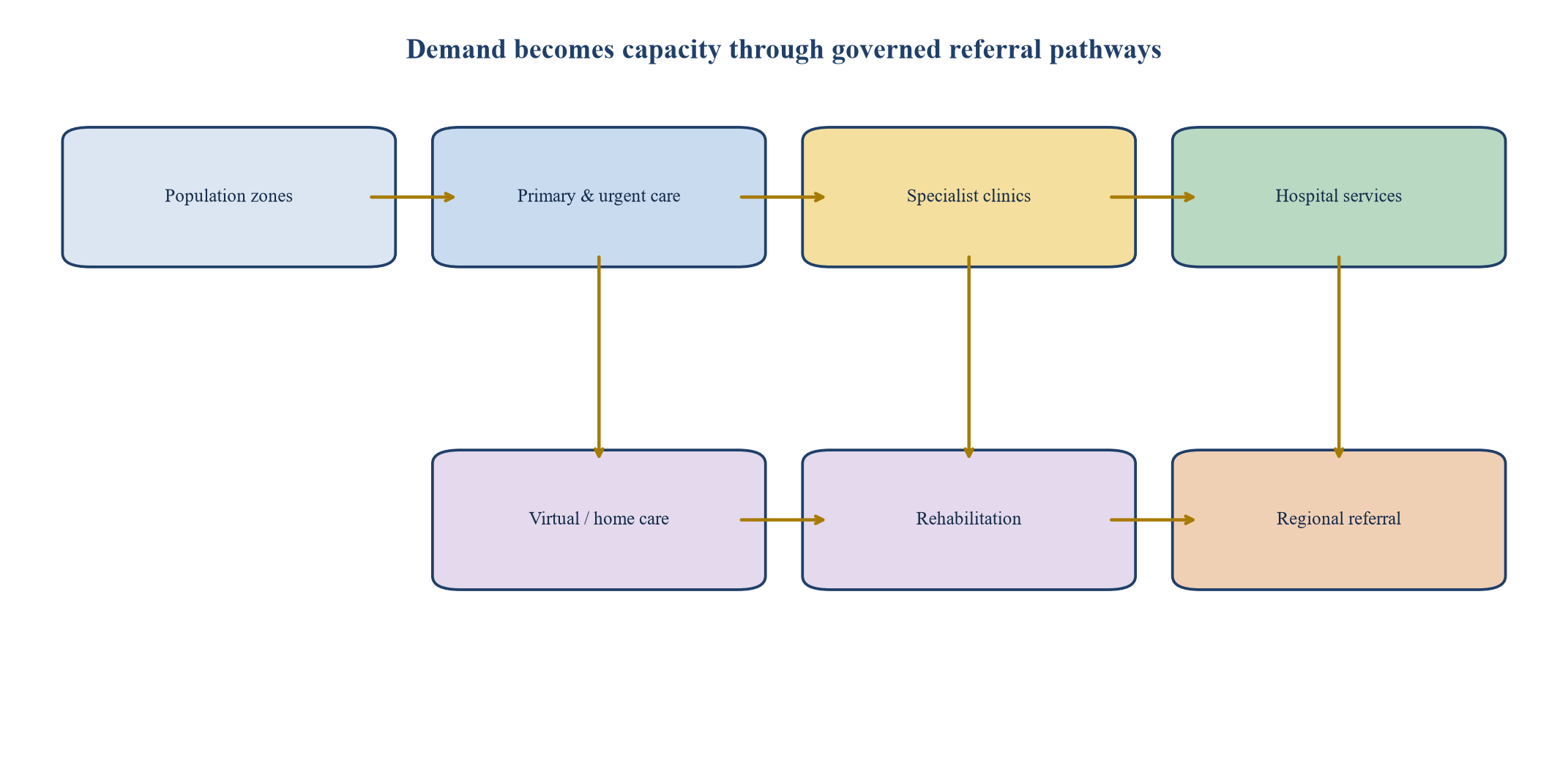
The diagram is a conceptual planning framework. It does not represent an existing Saudi project or patient-level data.
4. Translate need into service volumes
Population need becomes capacity only after applying pathway assumptions. A model can combine age-specific incidence, consultation rates, referral probabilities, diagnostic intensity, admission probabilities and treatment patterns. Each multiplier should have an identified source, a base period and a clinical owner. Imported benchmarks should be adjusted for Saudi service design and tested against local activity.
Observed utilisation is an incomplete measure of need. Low use can indicate low demand, limited supply, travel barriers, waiting time or weak referral access. The planning team should triangulate administrative activity, epidemiology, waiting lists, transfers, rejected referrals and clinician input. It should also distinguish policy-driven demand from historical behaviour. A new screening or prevention programme can change activity even when the population remains stable.
The output should be a volume distribution by pathway and time period, including uncertainty bands. Annual totals are insufficient for operating design. The model should include day-of-week, hour-of-day and seasonal patterns where they affect emergency departments, imaging, theatres, laboratories, maternity and staffing. Peaks often determine required capacity, yet contracting every resource for the maximum possible peak can destroy affordability. Flexible rosters, surge protocols and transfer agreements can address infrequent peaks.
5. Map referrals and leakage
Referral behaviour determines which needs arrive at the PPP hospital. The model should identify referral sources, criteria, information requirements, transport arrangements, acceptance rules, escalation and feedback. It should quantify current leakage to other facilities and explain whether the proposed hospital can credibly recapture that activity. A new building does not automatically change established clinician and patient behaviour.
Referral assumptions should be service-specific. Routine outpatient referrals may respond to appointment availability and distance. Complex surgery may depend on specialist reputation, multidisciplinary capability and payer networks. Emergency flows may depend on ambulance protocols and critical-care availability. The model should therefore avoid a single market-share assumption across all services.
Contract design can support integration. Output standards can cover referral response times, appointment access, transfer acceptance, discharge communication and digital interoperability. Payment should avoid incentives to attract unnecessary activity or reject complex patients. The authority should retain visibility over unmet need, rejected referrals, external transfers and pathway outcomes so that apparent efficiency is not achieved by moving demand elsewhere.
6. Convert volumes into resource minutes
Capacity should be calculated from resource time. An outpatient visit uses clinician, nurse, room, diagnostics and administrative time. A procedure can require theatre, anaesthesia, recovery, sterilisation and inpatient support. An admission consumes a bed over time and may use imaging, pharmacy, laboratory and allied-health capacity. The binding constraint can sit outside the bed base.
The model should assign each pathway a resource bundle and duration distribution. It then converts expected volumes into occupied minutes or hours by day and shift. Utilisation limits should allow for cleaning, maintenance, emergency capacity, changeover and variation. A theoretical 100 per cent utilisation assumption creates queues and operational fragility. Appropriate limits vary by resource and service.
This translation creates a transparent bridge from demand to asset scope. It can show, for example, that additional clinics and imaging capacity delay the need for inpatient expansion, or that discharge support releases beds more efficiently than building another ward. It also supports value engineering because each proposed room, machine and staff group can be traced to pathways and output obligations.
7. Model queues, flow and bottlenecks
Static averages conceal congestion. A hospital can have enough annual capacity and still experience daily queues because arrivals and service times vary. Discrete-event simulation can represent patients moving through registration, triage, consultation, diagnostics, treatment, admission and discharge. It can test the effect of scheduling, prioritisation, resource pooling and failure events.
The simulation should use distributions rather than fixed averages for arrivals, service times, cancellations, no-shows, clinical acuity and length of stay. It should represent dependencies, such as an inpatient bed waiting for cleaning, a theatre case waiting for recovery space or a discharge waiting for transport and medication. Results should include waiting-time percentiles, queue lengths, resource occupancy, diversion and missed output standards.
Simulation does not validate the underlying demand. It explores the operating consequences of stated assumptions. The model should be tested against current facilities where possible, reviewed by clinical and operational teams and subjected to sensitivity analysis. A visually persuasive animation is not evidence of accuracy. The decision record should retain the input set, version, validation results, limitations and approved use.
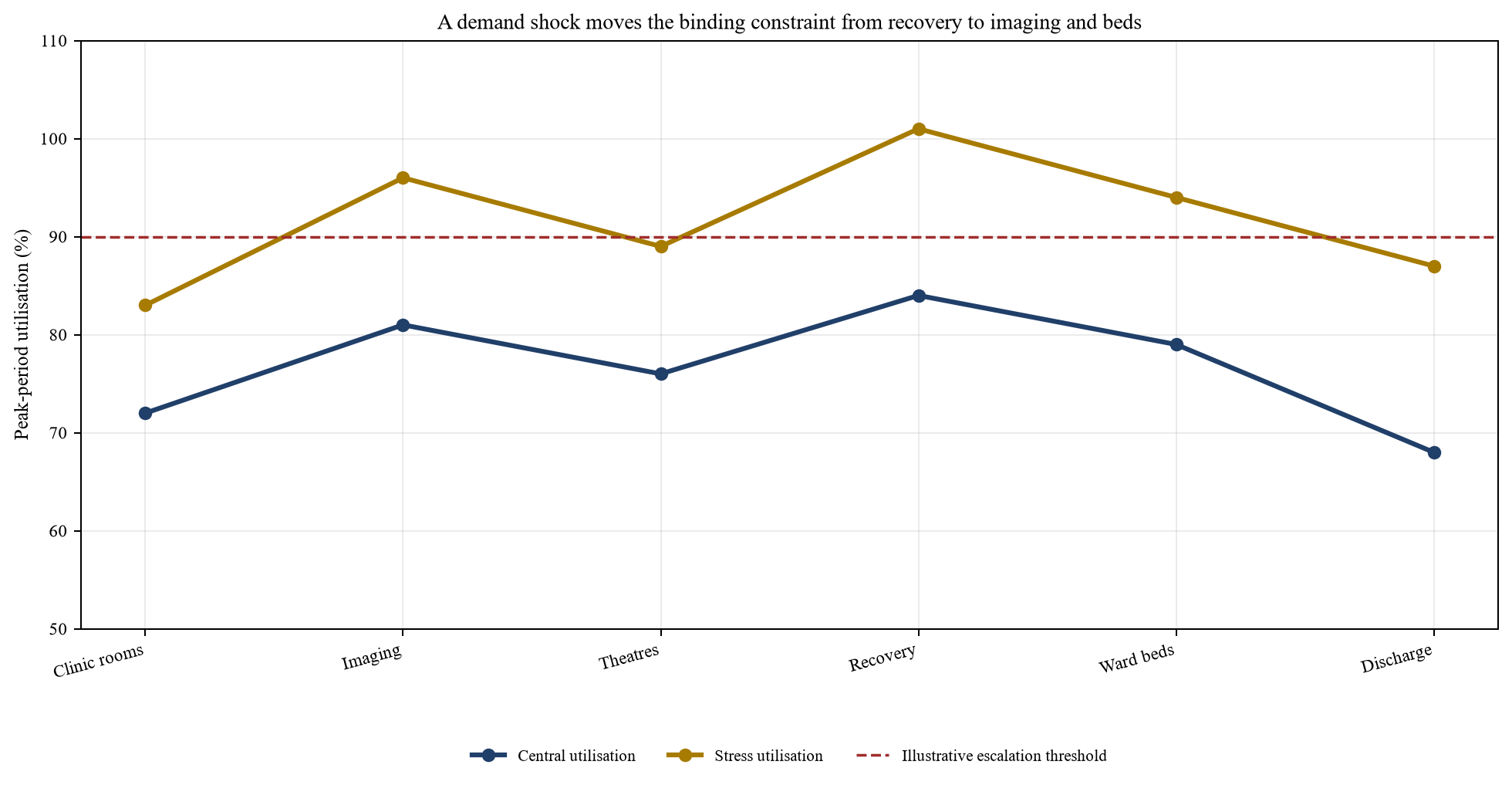
Illustrative values show how constraints can migrate across a care pathway. They are not observed performance data.
8. Treat beds as a flow outcome
Bed demand equals admissions multiplied by length of stay, adjusted for occupancy and variation. Each element can change through clinical practice, case mix, diagnostics, discharge processes and post-acute capacity. A bed forecast should therefore show the contribution of each driver rather than apply a population ratio to the catchment.
The bed model should distinguish medical, surgical, maternity, paediatric, mental-health, isolation, critical-care and other relevant categories. These beds are not perfectly substitutable. Infection control, gender, age, acuity, equipment and staffing constraints can prevent an apparently empty bed from serving a waiting patient. Flex capacity should have defined conversion rules and staff plans.
Length of stay deserves careful governance because reducing it can create value or shift risk. Safe discharge requires clinical readiness, medicines, patient education, transport, home support, rehabilitation and follow-up. The payment mechanism should not reward premature discharge. Outcome and readmission measures should accompany efficiency measures. Expansion decisions should consider bed occupancy together with waiting time, cancellations, transfers, quality and workforce pressure.
9. Size clinics, diagnostics and theatres together
Outpatient clinics are a principal gateway to diagnostics, procedures and admissions. Adding specialty sessions without imaging, laboratory, pharmacy or procedure capacity can increase waiting lists without improving access. Better triage and virtual follow-up can release rooms and clinician time for patients who need physical examination.
Diagnostic capacity should be modelled by modality, protocol, operating hours, maintenance and reporting time. Equipment throughput is often constrained by staff, preparation, infection control or report turnaround rather than the machine's technical maximum. Theatre planning should incorporate case duration, changeover, cancellations, emergency access, anaesthesia, recovery and sterile services.
The business case should show cross-resource ratios and failure dependencies. If one scanner failure delays theatre decisions, redundancy may be an availability requirement. If additional theatres cannot operate because recovery bays or anaesthetists are constrained, construction adds little service capacity. The model should identify the intervention that relieves the binding constraint while preserving quality.
10. Forecast workforce by activity and shift
The workforce forecast should begin with work, not a fixed staff-to-bed ratio. WHO's Workload Indicators of Staffing Need method links workload components to activity standards and available working time [11][12]. A PPP model can apply the same principle to defined services, while adapting standards to Saudi licensing, scope of practice, quality rules and the intended operating model.
For each cadre, required full-time equivalents should reflect direct clinical activity, indirect care, administration, training, leave, sickness, supervision and on-call coverage. The model should distinguish headcount from productive hours. It should also distinguish minimum safe presence from variable workload. Critical-care, emergency and theatre services require qualified coverage during lower-volume periods.
The forecast should include consultants, physicians, nurses, allied health, pharmacists, technologists, technicians, support staff, facility management and contract-management capabilities. Skills matter as much as numbers. A model that aggregates all nurses or physicians can conceal a shortage in a critical speciality. The mobilisation plan should show recruitment, licensing, credentialing, orientation, competency verification and supervised ramp-up by service.
| Workforce element | Primary driver | Planning evidence | Financing relevance |
|---|---|---|---|
| Specialist physicians | Pathway volume, roster coverage and complexity | Credentialed pipeline, recruitment lead time and retention plan | Limits service commencement and activity revenue |
| Nursing | Patient acuity, occupied hours and minimum shift coverage | Workload standards, skill mix and leave factor | Largest operating-cost block and central quality dependency |
| Diagnostics and theatre staff | Modality and procedure schedules | Equipment plan, operating hours and competency requirements | Determines throughput of capital-intensive assets |
| Allied health and discharge teams | Rehabilitation and pathway requirements | Activity standards and external-care interfaces | Influences length of stay and bed release |
| Digital, data and biomedical staff | System uptime, cybersecurity and equipment maintenance | Service model, vendor support and incident response | Supports availability and data-dependent payment evidence |
| Contract management | Reporting, deductions, change and performance review | Authority and private-party governance plan | Protects payment certification and dispute resolution |
Cadres and controls are examples. Actual staffing must follow current Saudi requirements, clinical standards and the approved operating model.
11. Make the labour market part of capacity
Physical capacity is unusable without an available workforce. The project should map domestic supply, recruitment channels, localisation requirements, licensing timelines, housing, transport, schooling, rotation, retention and agency dependence. It should identify which roles can be recruited at scale, which require long lead times and which depend on a small number of individuals.
Workforce scenarios should include vacancy, delayed onboarding, attrition, sickness, training and competition from other projects. The model can convert each scenario into operable clinics, theatres and beds. This prevents the financial model from assuming full revenue or availability while the facility cannot safely staff its output specification. It also informs the mobilisation period and phased opening sequence.
Contract risk allocation should recognise controllability. The private party can manage recruitment, rostering, training and retention within an agreed framework. System-wide scarcity, changes in immigration or licensing policy, or mandated service expansion may require defined relief or change mechanisms. Broad relief weakens incentives; absolute transfer of uncontrollable risk raises price or reduces bankability. The contract should define evidence, mitigation duties and financial consequences.
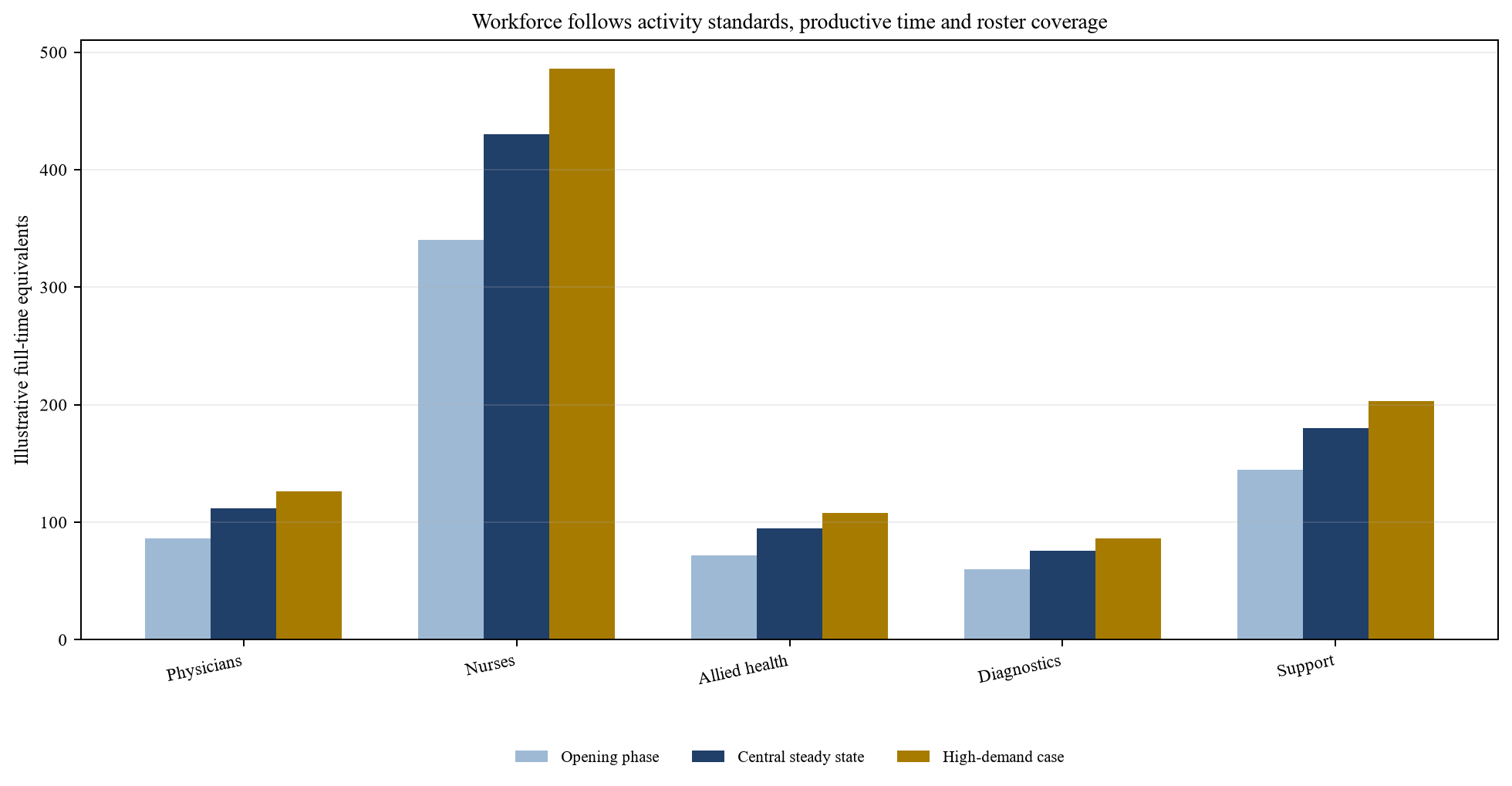
The values are hypothetical and demonstrate a workload-based planning sequence.
12. Use phased capacity and evidence gates
A phased structure preserves option value when demand, referral capture or workforce supply is uncertain. The initial phase should be large enough to operate safely and efficiently, while enabling expansion without major disruption. Expansion can involve fitted wards, shelled space, modular clinics, additional equipment or longer operating hours. Each option has different capital cost, lead time and operational consequences.
Expansion gates should combine several indicators. Sustained occupancy alone is inadequate because high occupancy can reflect poor flow. A balanced gate can require pathway demand above an agreed threshold, access standards under pressure, existing resources operating efficiently, acceptable quality, a verified workforce plan and an affordable payment consequence. The measurement period should avoid triggering permanent capital from a temporary peak.
The contract should specify who proposes expansion, who validates evidence, how scope and price are determined, how financing is arranged and how disputes are resolved. Bidders should price known options where feasible. The authority should retain competitive tension or benchmarking for later modules. Lenders need clarity on whether expansion is mandatory, whether additional debt ranks equally and whether completion risk can affect the original project.
13. Select the PPP functions deliberately
The Saudi private-participation programme contemplates different roles for private capital and operators, including financing, operating and managing healthcare projects [3][4]. The transaction should allocate functions based on the service objective and market capacity. Design-build-finance-maintain structures can focus on infrastructure availability. Operating contracts can add non-clinical or clinical functions. More integrated models can transfer wider performance risk, subject to policy, law and clinical governance.
Bundling can create lifecycle incentives. A party responsible for construction and long-term maintenance has reason to consider maintainability and energy use. Bundling can also create complex interfaces and reduce bidder depth. The authority should test whether transferred risks are measurable, priceable and controllable. Unclear transfer often returns through qualifications, claims or financing constraints.
The project company commonly ring-fences contracts, assets, liabilities and financing [9]. Its subcontracting structure should align design, construction, facilities management, digital systems, equipment and clinical operations. Interface agreements need back-to-back obligations, liability caps, cure rights and lender protections. The authority should understand which entity actually holds the workforce and operational capability supporting the bid.
14. Design the payment mechanism around outcomes and control
Government-pays PPPs can link periodic payment to asset or service availability, while volume-based elements can pay for services delivered [9]. A hospital structure may combine a fixed availability payment, variable activity component, quality adjustments and approved pass-throughs. Each component transfers a different risk and creates different behaviour.
Availability payment can support debt capacity because it is predictable when the asset meets defined standards. Deductions should be material enough to create incentives, proportionate to the failure and subject to cure and repetition rules. Activity payment can address variable consumables and clinical workload. Excessive volume incentives can encourage unnecessary activity; a completely fixed payment can weaken responsiveness to demand. Quality measures should cover outcomes, safety, access and patient experience without creating incentives to avoid complex cases.
The payment mechanism needs a transparent data architecture. Definitions, calculation periods, exclusions, caps, indexation, certification and dispute procedures should be testable before financial close. The authority and lenders should be able to reproduce the calculation from source evidence. Material dependence on an unvalidated AI model would create payment and financing risk.
| Payment element | Intended purpose | Principal risk owner | Control needed |
|---|---|---|---|
| Availability payment | Cover available infrastructure and contracted service readiness | Private party for controllable failures | Clear output specification, deduction calibration and cure rules |
| Activity payment | Compensate variable service volume and consumables | Shared according to demand assumptions | Verified activity, tariff logic and volume corridors |
| Quality adjustment | Align access, safety, outcomes and experience | Private party for attributable performance | Risk adjustment, audit and anti-avoidance measures |
| Capacity option payment | Preserve or activate future expansion | Authority until exercised; private party after notice | Objective trigger, price method and financing plan |
| Exceptional change | Address defined law, policy or system events | Allocated by contract | Evidence, mitigation and capped relief |
| Lifecycle and energy adjustment | Maintain asset condition and efficiency | Private party within controllable perimeter | Condition surveys, metering and handback regime |
The matrix illustrates structuring choices rather than proposed terms for a live procurement.
15. Connect capacity to the financial model
The financial model should trace demand to activity, staffing, operating cost, payment and debt service. It should not assume that physical completion creates full payment. Commissioning, accreditation, workforce mobilisation, service acceptance and ramp-up can delay cash flow. The model should include working capital for payroll, supplies, insurance, maintenance and payment certification.
Capital expenditure should be separated into base works, equipment, digital systems, lifecycle reserve, contingencies and optional modules. Operating expenditure should distinguish fixed readiness cost from variable activity cost. Workforce is likely to be a major fixed or semi-fixed component. Inflation and foreign-currency exposure should be mapped to payment indexation, hedging and procurement contracts.
Debt sizing should use cash available for debt service after operating and lifecycle requirements. Lenders should test construction delay, slower mobilisation, lower activity, higher staffing cost, payment deductions, receivable delay, interest-rate changes and expansion obligations. A stable availability payment can support leverage, yet weak output definitions or large uncapped deductions can make that payment volatile. The model should align with the executed contract rather than a preliminary commercial summary.
16. Build a downside case around service continuity
The downside case should preserve safe service while testing financial resilience. Scenarios can include delayed referral ramp, higher acuity, longer length of stay, reduced staff availability, equipment outage, cyber interruption, inflation and delayed payment. Correlated cases matter because workforce pressure, waiting time, quality and deductions can deteriorate together.
Management actions should be specific and operationally feasible. Opening fewer safely staffed wards can be preferable to opening the full physical capacity with excessive agency dependence. Extending clinic hours can relieve access if staff and diagnostics are available. Temporary transfer agreements can protect patients during an outage. Cost reduction should not assume removal of staff or maintenance required by the output specification.
The downside case should identify covenant headroom, reserve use, distribution lock-up, sponsor support, insurance and authority relief. It should also identify an early-warning set that appears before debt-service failure: vacancy, overtime, cancellations, queue growth, transfer rates, system incidents, deduction notices and unresolved payment disputes. These indicators allow timely intervention.
17. Illustrative case: define the assumptions
The illustrative case considers a hypothetical regional hospital serving 1.1 million people. The initial phase includes 180 staffed beds, 36 outpatient consultation rooms, six operating theatres, two procedure rooms, imaging, laboratory, pharmacy, critical care and virtual follow-up. The site and core infrastructure allow expansion to 300 beds. These figures demonstrate the framework and do not describe a named Saudi project.
The central scenario assumes a three-year referral ramp, gradually improving pathway capture and safe reductions in length of stay supported by discharge services. The opening workforce is recruited in stages and reaches steady state after service acceptance. A fixed availability payment covers infrastructure and readiness, while an activity component addresses defined variable clinical workload. Quality and access failures can create deductions.
Five cases are tested: central, slow referral, high acuity, workforce delay and combined stress. The model asks whether the initial phase meets access and quality standards, whether expansion triggers are reached, and whether cash available for debt service remains above the required threshold. The exercise does not assign probabilities or claim commercial viability. Actual procurement decisions require project-specific clinical, legal, technical, financial, environmental and social diligence.
18. Interpret the illustrative capacity results
In the central case, outpatient and diagnostic demand ramps before inpatient occupancy. This supports commissioning clinics and imaging early, while opening inpatient wards in safely staffed modules. The first binding constraint appears in diagnostic reporting and theatre recovery rather than physical beds. A targeted workforce and scheduling intervention produces more usable capacity than immediate construction.
The high-acuity case increases critical-care, theatre and ward intensity. Occupancy approaches the escalation threshold during peaks, and discharge support becomes important to preserve flow. The scenario does not automatically justify the full 300-bed build because the pressure may be addressed through pathway redesign, post-acute capacity or selective expansion. The evidence gate requires sustained demand and a verified staff plan.
The slow-referral case leaves physical capacity underused while fixed staffing and maintenance costs remain. Activity payment declines and the availability component becomes central to debt service. This result highlights the need to allocate demand risk explicitly. If the private party cannot control referral policy or competing public capacity, complete demand transfer may be costly or unbankable.
19. Interpret the workforce-delay case
The workforce-delay case assumes that several specialist and nursing cohorts arrive six months later than planned. Physical completion remains on schedule, yet only part of the facility can be accepted for service. The project incurs payroll, mobilisation and financing costs while availability payment is reduced or delayed. This is a commissioning risk with direct debt-service consequences.
Mitigation begins before construction completion. The workforce plan should identify critical roles by service, start licensing and credentialing early, maintain recruitment alternatives and align onboarding with commissioning. Service acceptance can be modular where clinical safety and contract drafting permit. The private partner should provide evidence of signed offers, licensing progress and training rather than rely on aggregate recruitment forecasts.
The authority should test whether partial opening still provides a coherent service. Opening clinics without the diagnostics or emergency support required by their pathways can create transfer risk. A mobilisation committee should integrate clinical, workforce, equipment, digital, facility and payment readiness. Independent certification should verify that accepted modules meet the output specification.
20. Build an AI governance perimeter
AI can support demand forecasting, geospatial analysis, referral prediction, queue simulation, roster optimisation, maintenance and anomaly detection. Each use should have a defined decision, owner, data perimeter and consequence. A forecast used to compare capacity scenarios carries different risk from an algorithm that changes patient scheduling or contract payment.
Governance can draw on WHO principles for ethics and governance of AI for health [14], NIST's AI Risk Management Framework [15] and applicable Saudi data and cybersecurity requirements [16][17]. The project should document data authority, quality, lineage, representativeness, model purpose, validation, limitations, monitoring, overrides, security and incident response. Patient-identifiable data should be minimised and protected.
Human accountability should be explicit. Clinical leaders approve pathways and safe staffing. The authority approves service scope and payment. The private partner manages delivery within contract. Independent reviewers challenge the model. Lenders determine credit use. An optimisation result should never override clinical judgement, statutory duties or the executed agreement.
21. Validate models against operational reality
Validation should test the full decision chain rather than a headline accuracy statistic. Demand forecasts should be compared with mature observed periods and alternative transparent methods. Referral models should be checked by service and origin. Simulation should reproduce current queue and throughput patterns before it is used to evaluate future designs. Workforce calculations should reconcile activity standards, productive time and rosters.
Temporal validation matters because population, policy, referral networks and clinical practice change. A random split of historical records can overstate performance when neighbouring time periods share the same operating conditions. Out-of-time testing and scenario back-testing provide stronger evidence of robustness. Subgroup analysis should identify geographic or patient populations for which error is materially higher.
Validation should also test implementation. Correct analytical code can produce incorrect decisions if data feeds, units, mappings or dashboards are wrong. Parallel runs, reconciliation, access controls and change management are required. Where evidence is immature, the contract and financing model should retain conservative capacity and payment assumptions.
22. Monitor the operating contract
Contract management should begin during procurement. The authority needs data, people and systems capable of measuring availability, activity, quality, workforce and payment. The private partner needs timely certification, change control and dispute resolution. Weak contract-management capacity can turn precise drafting into delayed decisions and contested payments.
A monthly dashboard can track access, queues, cancellations, transfers, occupancy, length of stay, workforce, equipment uptime, incidents, quality, deductions, invoices and payment. Trends should be reviewed by pathway and service, with root-cause analysis for persistent variance. Model predictions should be compared with observed demand and staffing so that drift is detected before it affects capacity decisions.
Change control should distinguish normal operating optimisation from a contractual change. New services, policy changes, revised clinical standards, technology replacement and material demand shifts may alter scope or cost. The contract should specify notice, evidence, mitigation, valuation and approval. Informal changes can create unfunded obligations and later disputes.
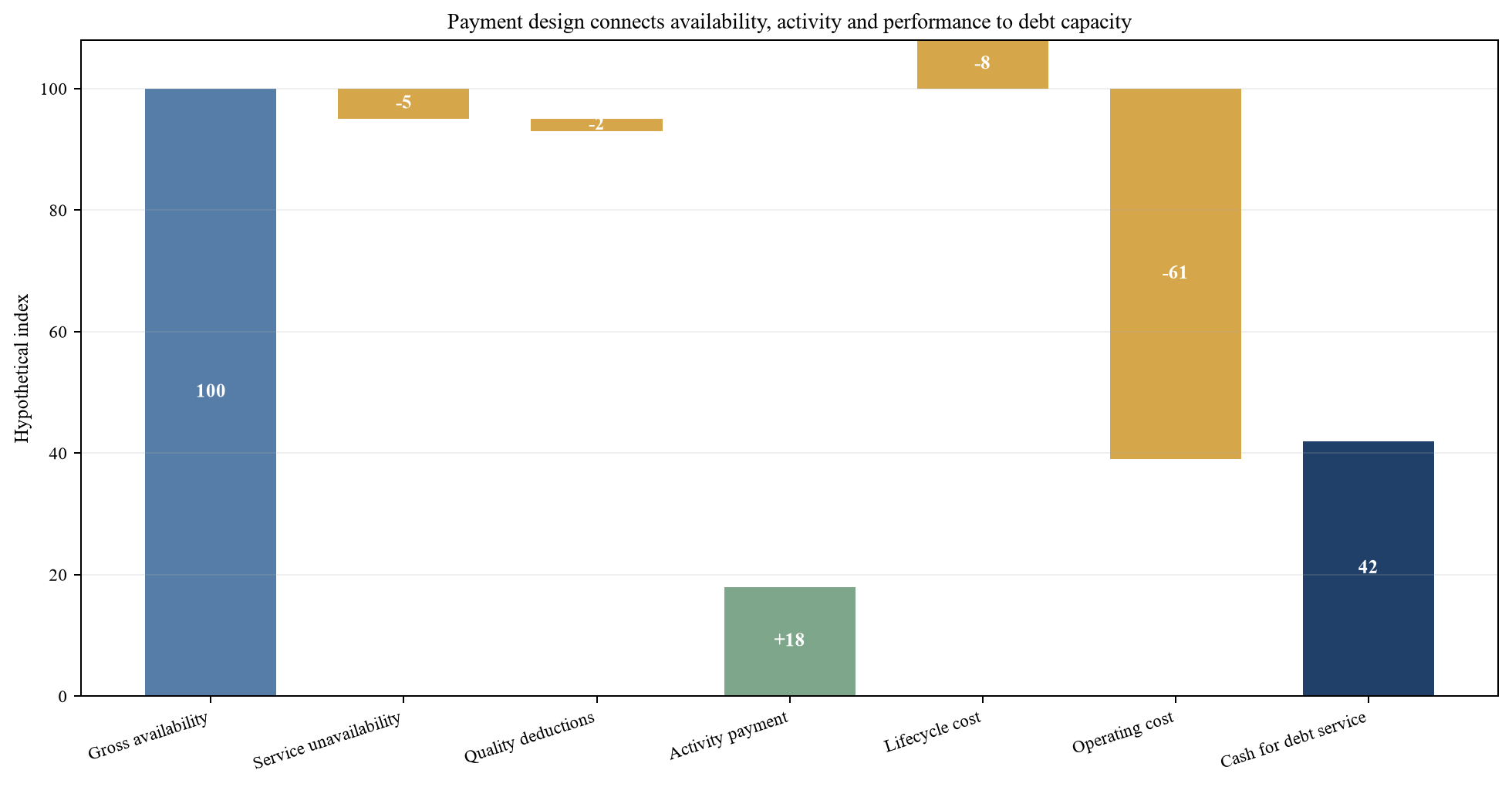
Values are hypothetical index amounts and do not represent a live procurement or financing proposal.
23. Allocate the principal risks
Demand risk should follow control and policy. The private party can influence access, quality and operating efficiency. It may have limited control over public referral rules, competing capacity, insurance policy or mandated pathways. Construction and lifecycle risk can transfer when scope and site conditions are sufficiently defined. Workforce risk can transfer within a verified labour-market and regulatory perimeter.
Technology risk needs a lifecycle view. Digital systems and medical equipment can become obsolete during a long concession. The output specification should focus on required capability, interoperability, security, maintenance and replacement. It should also define which technology upgrades are included in the payment and which qualify as change. Rigid equipment lists can lock the project into outdated solutions.
Residual risks should be visible in pricing and governance. The authority may retain policy, discriminatory change in law and exceptional system events. Lenders may require reserves, insurance, sponsor support or direct agreements. Risk allocation should be evaluated by expected value, tail exposure and behavioural incentives rather than the number of risks nominally transferred.
| Risk | Leading evidence | Potential allocation | Structured response |
|---|---|---|---|
| Demand and referral | Source-level referrals, waiting, transfers and competing capacity | Shared according to controllability | Volume corridor, rebasing and pathway obligations |
| Workforce mobilisation | Offers, licensing, credentialing, vacancy and attrition | Private party within defined perimeter | Milestones, modular acceptance and contingency roster |
| Construction and commissioning | Design maturity, interfaces, tests and permits | Private party subject to retained risks | Fixed completion regime, tests and relief events |
| Availability and quality | Uptime, response, access and outcome measures | Private party for attributable failure | Calibrated deductions, cure and repeated-failure rules |
| Data and AI | Lineage, validation, drift, security and incidents | Each party for controlled systems and uses | Governance plan, audit, fallback and suspension |
| Policy and change | New services, standards, law or authority instruction | Authority or shared as defined | Formal change procedure and affordability test |
| Financing | Interest, refinancing, payment timing and covenant headroom | Project company, sponsors and authority as contracted | Hedging, reserves, direct agreement and payment discipline |
Allocation is illustrative and must be negotiated for the specific project under applicable law.
24. Apply a staged decision process
The first stage defines the public-service need and tests strategic options, including non-asset interventions. The second establishes the evidence baseline for catchment, pathways, capacity, workforce and existing supply. The third develops a reference design and affordability case. The fourth tests market appetite, risk allocation and bankability before procurement.
During procurement, bidders should receive a controlled data room, common assumptions and a clear output specification. Dialogue and clarification should expose qualifications and interface gaps. Evaluation should compare whole-life value, service quality, capacity resilience, workforce credibility, financing and contract compliance. A low headline price supported by an implausible workforce or demand assumption is not value for money.
Before financial close, the authority, preferred bidder and lenders should reconcile the technical, workforce, payment and financial models. Conditions precedent should cover permits, land, design, financing, key subcontracts, insurance, data and mobilisation. During delivery, assurance should track whether the asset and workforce remain aligned with the approved service model.
The reconciliation should use one controlled assumption register. Every material input should identify its owner, evidence date, unit, base case, downside range, contractual location and approval status. Differences between the clinical model, technical schedules, bidder price and financing model should be resolved before they become embedded in documents. An agreed change to opening beds, operating hours or workforce must flow through capital expenditure, operating cost, payment, acceptance testing and debt service.
Independent review should focus on the interfaces most likely to fail. These include design-to-equipment coordination, equipment-to-workforce readiness, referral-to-activity assumptions, service acceptance-to-payment, lifecycle obligations-to-reserves and model outputs-to-contract definitions. Review should test calculations and decision logic. A technically correct model can still support a weak decision when its outputs are applied outside the approved purpose.
The authority should also prepare for post-close governance. Named decision rights, meeting calendars, reporting templates, escalation thresholds and audit access should be agreed before mobilisation. The private partner should demonstrate that subcontract information can be consolidated into the project company's reporting. Lenders should receive the financial and operational indicators specified in financing documents without assuming access to confidential patient information. These arrangements convert the procurement model into a practical operating-control system.
25. Conclusion
Saudi hospital PPP capacity should be planned as a connected service system. The core financing question is whether the proposed pathways, physical resources, workforce and payment mechanism can deliver contracted access and quality while supporting lifecycle cost and debt service. Beds are one output of that analysis rather than its starting point.
AI and simulation can improve the decision by joining demographic, referral, operational and workforce evidence; testing uncertainty; and exposing bottlenecks. Their value depends on traceable data, validation, documented limitations, accountable use and a conservative fallback. Human authorities remain responsible for procurement, clinical safety, workforce, payment and credit decisions.
A strong transaction therefore uses phased capacity, evidence-based expansion gates, workload-based staffing, balanced payment and continuous contract management. It connects each capital commitment to a service need and each payment to a measurable obligation. That structure gives the authority, provider, sponsors and lenders a common basis for deciding what to build, when to open it and when to expand.
Sources
- Saudi Vision 2030. Health Sector Transformation Program Delivery Plan. Read the primary source
- Saudi Ministry of Health. Healthcare Transformation Strategy. Read the primary source
- Saudi Ministry of Health. Private Sector Participation. Read the primary source
- Saudi Ministry of Health. Private Sector Participation Vision and Goals. Read the primary source
- Saudi Ministry of Health. Current Private Sector Participation Plans. Read the primary source
- Saudi Ministry of Health. MOH and National Infrastructure Fund Launch Healthcare Financing Initiative. 11 December 2025. Read the primary source
- Saudi Ministry of Health. National Kidney Care PPP Qualification. 4 May 2026. Read the primary source
- Saudi Ministry of Health. SABIC Mental Health Hospital PPP Operations Contract. 19 June 2026. Read the primary source
- World Bank Group and partners. PPP Reference Guide Version 3. 2017. Read the primary source
- World Bank PPP Resource Center. PPP Reference Guide 3.0. Read the primary source
- World Health Organization. Workload Indicators of Staffing Need User Manual, Second Edition. 2023. Read the primary source
- World Health Organization. Workload Indicators of Staffing Need. Read the primary source
- World Health Organization. Global Strategy on Human Resources for Health: Workforce 2030. Read the primary source
- World Health Organization. Ethics and Governance of Artificial Intelligence for Health. 2021. Read the primary source
- National Institute of Standards and Technology. Artificial Intelligence Risk Management Framework 1.0. 2023. Read the primary source
- Saudi Data and Artificial Intelligence Authority. Personal Data Protection Law. Read the primary source
- National Cybersecurity Authority. Essential Cybersecurity Controls. Read the primary source
- Saudi Central Bank. Rules for Bank Accounts. Read the primary source
- Saudi Ministry of Health. Radiology PPP Across Seven Riyadh Hospitals. 10 June 2023. Read the primary source
- Saudi Ministry of Health. Strategic Partnerships. Read the primary source
- Saudi Ministry of Health. Statistical Yearbook. Read the primary source
- General Authority for Statistics. Population Estimates. Read the primary source
- Council of Health Insurance. Regulations and Policies. Read the primary source
- Saudi Commission for Health Specialties. Practitioner Classification and Registration. Read the primary source
- International Finance Corporation. Environmental, Health, and Safety Guidelines for Health Care Facilities. Read the primary source
- World Bank Group. Guidance on PPP Contractual Provisions. Read the primary source
- World Health Organization. Global Patient Safety Action Plan 2021-2030. Read the primary source
- World Health Organization. State of the World's Nursing 2025. Read the primary source
