

1. Define the financing decision
The board should begin with the cash flow that financiers are expected to rely on. Identify the tower entities, countries, sites, tenants, lease obligations, currencies, collection accounts, energy responsibilities, service-level remedies, maintenance duties and rights that would enter the proposed pool. State whether the objective is receivables purchase, secured borrowing, private asset-backed notes, capital-markets issuance, warehouse finance or a refinancing path. The funding route should follow legal isolation, data quality, cash-flow durability and investor requirements.
The decision should compare securitisation with corporate debt, project finance, bilateral facilities, development-finance lending, vendor finance and equity. Securitisation can improve tenor, diversification and cash-flow discipline where the pool is sufficiently granular and controlled. It also introduces structuring, legal, reporting, reserve, servicing and governance costs. The board should assess proceeds, all-in cost, recourse, covenant flexibility, retained risk, currency mismatch, tax, accounting and execution certainty.
Site operations remain part of credit. A tenant invoice may be reduced, disputed or delayed when uptime, power, access, maintenance or asset records fail. The financing model should therefore reconcile every included cash flow to a verified site, enforceable tenant obligation, measured service state, invoice, collection and controlled account. Unsupported revenue, future colocations, unapproved escalation and assumed energy savings remain outside the base case until evidenced.
Scenario analysis should combine correlated pressures. Tenant consolidation can raise churn and concentration. Grid interruption can increase diesel consumption at the same time as fuel prices, theft and working-capital needs rise. Currency depreciation can weaken hard-currency debt service while local-currency leases remain fixed. Severe weather, security incidents, logistics disruption and battery failure can affect many sites together. The financing decision should test liquidity and triggers before relying on enhancement or recovery value.
2. Use the African Telecom-Tower Securitisation Framework
The framework has eight linked ledgers: legal perimeter, site and ground rights, tenant contracts, service availability, energy and maintenance, billing and collections, pool eligibility, and the financing waterfall. Each ledger should use common site, tenant, contract, invoice and period identifiers. Differences between operational, billing and banking records should become visible exceptions with named owners and resolution dates.
Four evidence states should remain separate. Source facts come from executed contracts, bank records, meters, alarms, fuel records, maintenance systems and regulator publications. Professional assessments include legal, engineering, tax, accounting, model-validation and valuation conclusions. Management assumptions cover future occupancy, escalation, cost, currency, refinancing and recoveries. Transaction decisions state eligibility, haircut, reserve, enhancement, trigger or exclusion. The investor should be able to trace a decision back through these states.
Artificial intelligence operates inside this evidence architecture. It can extract clauses, match invoices to collections, detect abnormal fuel patterns, forecast battery degradation, rank outage risk and test scenarios. Every material output should preserve source, cut-off date, transformation, model version, confidence, override, reviewer and approval. An algorithm does not establish true sale, certify uptime, determine enforceability, approve a rating or authorise an investment.
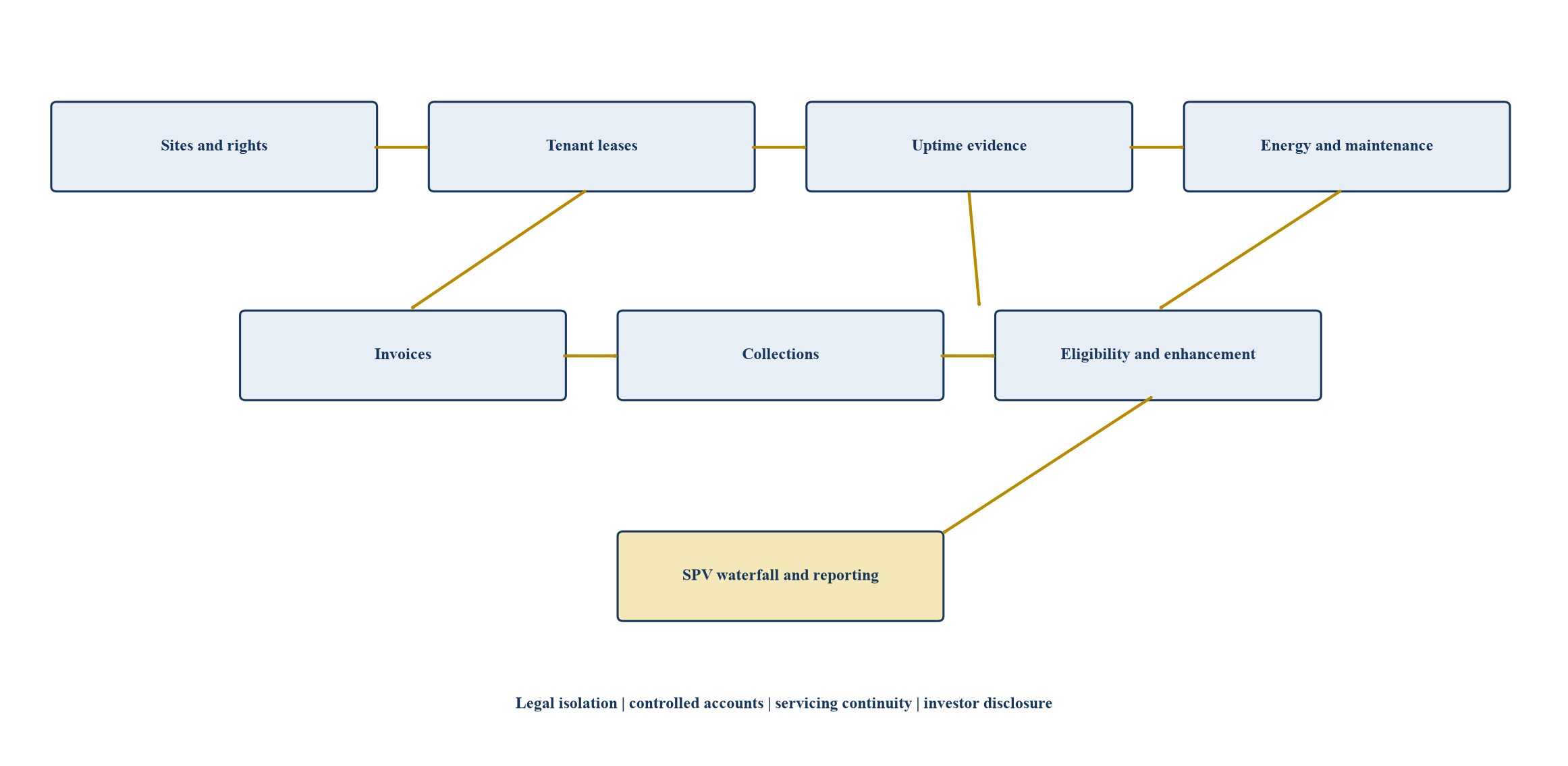
Proposed control architecture linking physical service evidence to the financing waterfall.
3. Fix the asset perimeter
A tower portfolio may include masts, rooftops, land, shelters, power, fibre, access roads, permits, monitoring systems and active radio equipment. Classify owned, leased, licensed, shared, disputed and third-party-managed assets and identify active components that remain with the operator. The analysis should distinguish observed site, contract, operating, regulatory and financial evidence from management assumptions and connect each material judgment to network continuity, customer access, capital efficiency, financing and value. Completion accounts and post-closing responsibility should follow a verified site register rather than a headline tower count. The work should test central and correlated downside cases for anchor rent, escalation, ground rights, tenancy, colocation delivery, churn, power, operating cost, maintenance, build-to-suit capex, interest rates, currency, tax and regulatory remedies. Exceptions require a named owner, source, due date and decision consequence. Unsupported revenue, savings, multiple expansion or refinancing remains outside the base case until enforceable evidence supports it. Management should define the earliest warning indicator, intervention trigger and executable remedy. Reporting should preserve the approved baseline, contract change and realised cash so growth, indexation and timing shifts remain distinguishable.
| Layer | Included evidence | Separation question | Value consequence |
|---|---|---|---|
| Structure | Tower, mast, rooftop and compound | What transfers? | Verified site count |
| Ground | Title, easement, lease and consent | Is use durable? | Contracted life |
| Network | Active and passive equipment | Who controls service? | Capex and operations |
| Commercial | Anchor and third-party contracts | What revenue is enforceable? | Cash-flow quality |
| Systems | Asset, billing and field data | Can the platform operate? | Standalone cost |
The site register should link physical, legal, operational and financial evidence.
4. Verify title and ground rights
Tower economics can be impaired when ground leases expire before tenant contracts, contain change-of-control restrictions or escalate faster than site revenue. Review land ownership, easements, rooftop licences, renewal options, landlord consent, access, registration, rent escalation, taxes and restoration obligations. The analysis should distinguish observed site, contract, operating, regulatory and financial evidence from management assumptions and connect each material judgment to network continuity, customer access, capital efficiency, financing and value. Value should reflect the duration and enforceability of the underlying right at each material site. The work should test central and correlated downside cases for anchor rent, escalation, ground rights, tenancy, colocation delivery, churn, power, operating cost, maintenance, build-to-suit capex, interest rates, currency, tax and regulatory remedies. Exceptions require a named owner, source, due date and decision consequence. Unsupported revenue, savings, multiple expansion or refinancing remains outside the base case until enforceable evidence supports it. The section output should identify the governing contract, site evidence, cash-flow line, risk owner, approval right and network consequence. This creates a traceable bridge from perimeter diligence to valuation, separation and post-closing control.
5. Define the passive-active boundary
The transaction boundary determines network control, maintenance responsibility, upgrade rights and accounting treatment. Map structure, compound, power, cooling, security, fibre, backhaul, antenna, radio and software responsibilities. The analysis should distinguish observed site, contract, operating, regulatory and financial evidence from management assumptions and connect each material judgment to network continuity, customer access, capital efficiency, financing and value. The master lease and separation plan should prevent unowned assets, duplicate obligations and operational gaps. The work should test central and correlated downside cases for anchor rent, escalation, ground rights, tenancy, colocation delivery, churn, power, operating cost, maintenance, build-to-suit capex, interest rates, currency, tax and regulatory remedies. Exceptions require a named owner, source, due date and decision consequence. Unsupported revenue, savings, multiple expansion or refinancing remains outside the base case until enforceable evidence supports it. Evidence should remain traceable to site, structure, ground interest, tenant, contract, technology, cost centre and forecast year. The tenant and TowerCo models should reconcile to the same physical and legal register.
6. Design the anchor master lease
The anchor contract creates the base cash flow and can also transfer inflexibility and cost back to the operator. Specify sites, reserved space, permitted equipment, service levels, term, renewals, pricing, escalators, pass-throughs, access, remedies and termination. The analysis should distinguish observed site, contract, operating, regulatory and financial evidence from management assumptions and connect each material judgment to network continuity, customer access, capital efficiency, financing and value. Model the operator's full cash commitment and the TowerCo's enforceable revenue before valuing the transaction. The work should test central and correlated downside cases for anchor rent, escalation, ground rights, tenancy, colocation delivery, churn, power, operating cost, maintenance, build-to-suit capex, interest rates, currency, tax and regulatory remedies. Exceptions require a named owner, source, due date and decision consequence. Unsupported revenue, savings, multiple expansion or refinancing remains outside the base case until enforceable evidence supports it. Management should define the earliest warning indicator, intervention trigger and executable remedy. Reporting should preserve the approved baseline, contract change and realised cash so growth, indexation and timing shifts remain distinguishable.
| Clause | TowerCo objective | Operator objective | Required test |
|---|---|---|---|
| Term and renewal | Durable contracted cash | Network flexibility | Effective duration |
| Escalation | Inflation protection | Cost predictability | Nominal and real burden |
| Reserved space | Anchor certainty | Upgrade capacity | Physical utilisation |
| Colocation | Third-party growth | Security and interference control | Neutral access |
| Decommissioning | Revenue protection | Network modernisation | Exit allowance and price |
| Build-to-suit | Growth pipeline | Delivery certainty | Order and acceptance evidence |
Each clause affects operator flexibility and TowerCo financeability.
7. Align lease term with network strategy
A long lease supports financing while constraining the operator's ability to modernise, consolidate or exit sites. Test initial term, renewal control, technology change, swap rights, relocation, decommissioning, termination payments and minimum-site commitments. The analysis should distinguish observed site, contract, operating, regulatory and financial evidence from management assumptions and connect each material judgment to network continuity, customer access, capital efficiency, financing and value. Flexibility should be priced explicitly rather than buried in a nominal headline rent. The work should test central and correlated downside cases for anchor rent, escalation, ground rights, tenancy, colocation delivery, churn, power, operating cost, maintenance, build-to-suit capex, interest rates, currency, tax and regulatory remedies. Exceptions require a named owner, source, due date and decision consequence. Unsupported revenue, savings, multiple expansion or refinancing remains outside the base case until enforceable evidence supports it. The section output should identify the governing contract, site evidence, cash-flow line, risk owner, approval right and network consequence. This creates a traceable bridge from perimeter diligence to valuation, separation and post-closing control.
8. Price escalation and indexation
Fixed and inflation-linked escalators can create value for the TowerCo and a compounding cost burden for the anchor tenant. Model caps, floors, reference indices, reset dates, currency, pass-throughs and asymmetry between ground and tenant leases. The analysis should distinguish observed site, contract, operating, regulatory and financial evidence from management assumptions and connect each material judgment to network continuity, customer access, capital efficiency, financing and value. The operator should test nominal and real lease cost through every renewal period. The work should test central and correlated downside cases for anchor rent, escalation, ground rights, tenancy, colocation delivery, churn, power, operating cost, maintenance, build-to-suit capex, interest rates, currency, tax and regulatory remedies. Exceptions require a named owner, source, due date and decision consequence. Unsupported revenue, savings, multiple expansion or refinancing remains outside the base case until enforceable evidence supports it. Evidence should remain traceable to site, structure, ground interest, tenant, contract, technology, cost centre and forecast year. The tenant and TowerCo models should reconcile to the same physical and legal register.
9. Measure the starting tenancy ratio
Tenancy ratio can overstate commercial depth when multiple technologies from one customer, inactive equipment or contracted future installations are counted inconsistently. Define active billable tenants, amendments, reserved capacity, colocations and pending orders at site level. The analysis should distinguish observed site, contract, operating, regulatory and financial evidence from management assumptions and connect each material judgment to network continuity, customer access, capital efficiency, financing and value. Diligence should reconcile commercial metrics to invoices, contracts and physical equipment. The work should test central and correlated downside cases for anchor rent, escalation, ground rights, tenancy, colocation delivery, churn, power, operating cost, maintenance, build-to-suit capex, interest rates, currency, tax and regulatory remedies. Exceptions require a named owner, source, due date and decision consequence. Unsupported revenue, savings, multiple expansion or refinancing remains outside the base case until enforceable evidence supports it. Management should define the earliest warning indicator, intervention trigger and executable remedy. Reporting should preserve the approved baseline, contract change and realised cash so growth, indexation and timing shifts remain distinguishable.
10. Underwrite colocation growth
The value thesis often depends on adding tenants at relatively low incremental site cost. Map demand by geography, spectrum, coverage gap, operator network plan, site loading, power, permits and competing infrastructure. The analysis should distinguish observed site, contract, operating, regulatory and financial evidence from management assumptions and connect each material judgment to network continuity, customer access, capital efficiency, financing and value. Only evidenced pipeline with executable rights, structural capacity and realistic delivery timing should enter the base case. The work should test central and correlated downside cases for anchor rent, escalation, ground rights, tenancy, colocation delivery, churn, power, operating cost, maintenance, build-to-suit capex, interest rates, currency, tax and regulatory remedies. Exceptions require a named owner, source, due date and decision consequence. Unsupported revenue, savings, multiple expansion or refinancing remains outside the base case until enforceable evidence supports it. The section output should identify the governing contract, site evidence, cash-flow line, risk owner, approval right and network consequence. This creates a traceable bridge from perimeter diligence to valuation, separation and post-closing control.
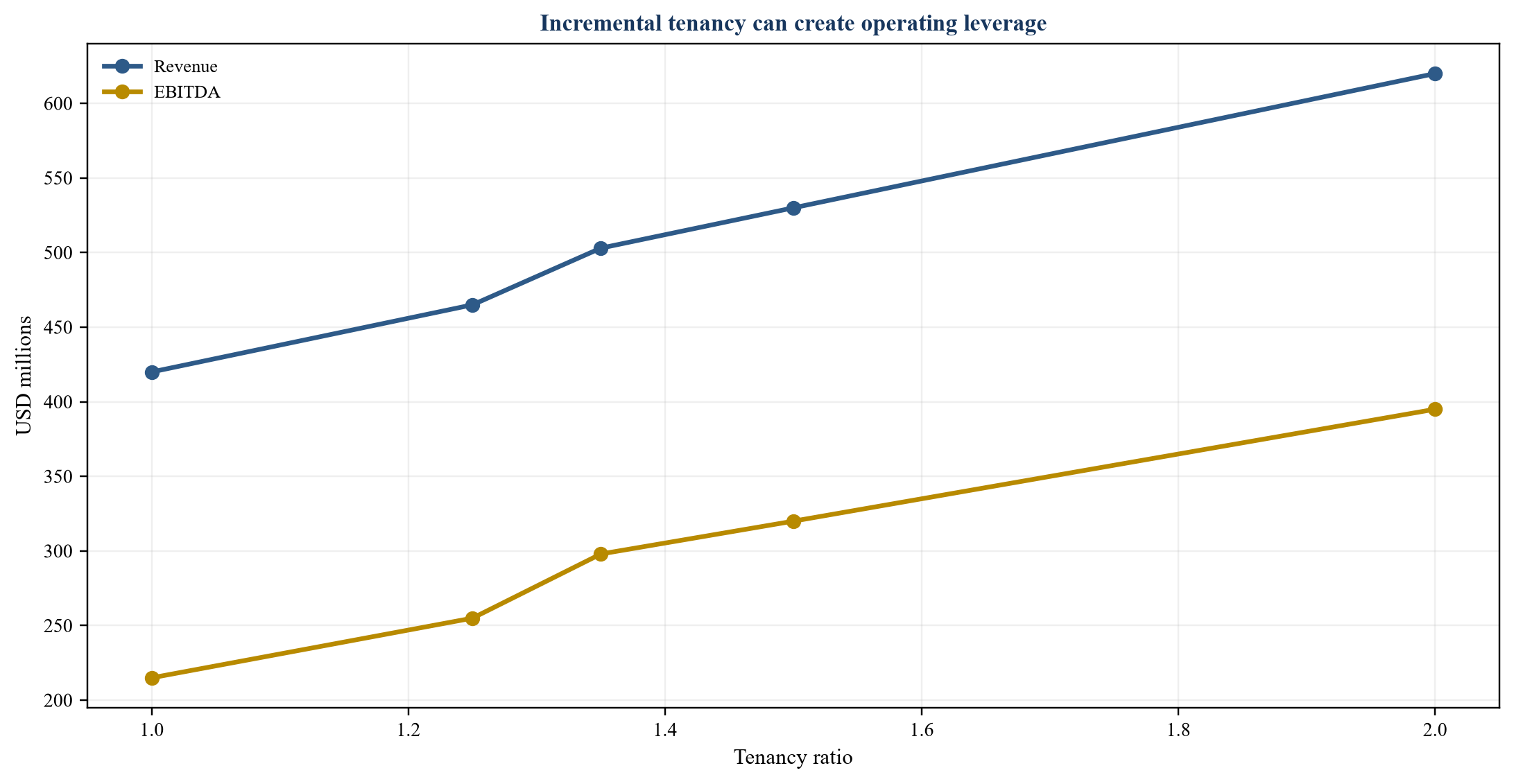
USD millions; all values are illustrative management assumptions.
11. Separate new tenancy from amendments
Additional equipment, spectrum and power at an existing tenant can produce revenue without increasing tenant count. Track new colocations, technology amendments, indexation, churn, consolidation and new-site revenue separately. The analysis should distinguish observed site, contract, operating, regulatory and financial evidence from management assumptions and connect each material judgment to network continuity, customer access, capital efficiency, financing and value. Organic growth should distinguish contractual escalation from genuine demand and capital-intensive delivery. The work should test central and correlated downside cases for anchor rent, escalation, ground rights, tenancy, colocation delivery, churn, power, operating cost, maintenance, build-to-suit capex, interest rates, currency, tax and regulatory remedies. Exceptions require a named owner, source, due date and decision consequence. Unsupported revenue, savings, multiple expansion or refinancing remains outside the base case until enforceable evidence supports it. Evidence should remain traceable to site, structure, ground interest, tenant, contract, technology, cost centre and forecast year. The tenant and TowerCo models should reconcile to the same physical and legal register.
12. Protect fair third-party access
Anchor rights, reserved capacity or discriminatory processes can prevent an independent TowerCo from attracting competing tenants. Review access workflow, priority rights, information barriers, pricing, service levels, dispute mechanisms and regulatory obligations. The analysis should distinguish observed site, contract, operating, regulatory and financial evidence from management assumptions and connect each material judgment to network continuity, customer access, capital efficiency, financing and value. The commercial model should preserve neutral access while protecting network security and legitimate anchor needs. The work should test central and correlated downside cases for anchor rent, escalation, ground rights, tenancy, colocation delivery, churn, power, operating cost, maintenance, build-to-suit capex, interest rates, currency, tax and regulatory remedies. Exceptions require a named owner, source, due date and decision consequence. Unsupported revenue, savings, multiple expansion or refinancing remains outside the base case until enforceable evidence supports it. Management should define the earliest warning indicator, intervention trigger and executable remedy. Reporting should preserve the approved baseline, contract change and realised cash so growth, indexation and timing shifts remain distinguishable.
13. Model fixed-cost operating leverage
Tower site costs are often relatively stable over short periods, so additional tenancy can generate high incremental contribution. Separate ground rent, power, fuel, maintenance, monitoring, security, tax, insurance and central overhead by site and responsibility. The analysis should distinguish observed site, contract, operating, regulatory and financial evidence from management assumptions and connect each material judgment to network continuity, customer access, capital efficiency, financing and value. The model should show which costs vary with tenants, equipment load, grid availability and service levels. The work should test central and correlated downside cases for anchor rent, escalation, ground rights, tenancy, colocation delivery, churn, power, operating cost, maintenance, build-to-suit capex, interest rates, currency, tax and regulatory remedies. Exceptions require a named owner, source, due date and decision consequence. Unsupported revenue, savings, multiple expansion or refinancing remains outside the base case until enforceable evidence supports it. The section output should identify the governing contract, site evidence, cash-flow line, risk owner, approval right and network consequence. This creates a traceable bridge from perimeter diligence to valuation, separation and post-closing control.
14. Allocate power and energy risk
Energy availability is a credit input because a tower must remain operational before the related service revenue is economically dependable. Build a site-level energy ledger for grid status, outage hours, diesel use, fuel price, generator runtime, battery capacity and state of health, solar yield, hybrid controls, theft, maintenance and pass-through rights. The model should distinguish tenant-reimbursed energy from costs borne by the TowerCo and should reconcile procurement, delivery, tank measurement, generator telemetry and invoices.
GSMA reports that diesel can represent 30 to 60 per cent of mobile-operator operating expenditure in some African markets and illustrates that a continuously diesel-powered single-tenant site can consume about 28,000 litres annually [1]. Its Mobile Net Zero work also identifies substantial diesel use by operators and tower companies in Sub-Saharan Africa [2]. These figures are contextual rather than pool assumptions. Actual consumption depends on grid availability, load, generator efficiency, battery dispatch, solar resource, site access and control quality.
Solar, batteries and hybrid controls can reduce fuel exposure while adding equipment, software, warranty and lifecycle risks. The base case should use verified historical performance and contracted projects. Forecast savings should identify commissioning date, degradation, replacement capital, operating responsibility and evidence of realised performance. A lender should stress grid interruption, fuel price, theft, delayed deliveries, battery failure, inverter failure, solar underperformance and unavailable field crews together.
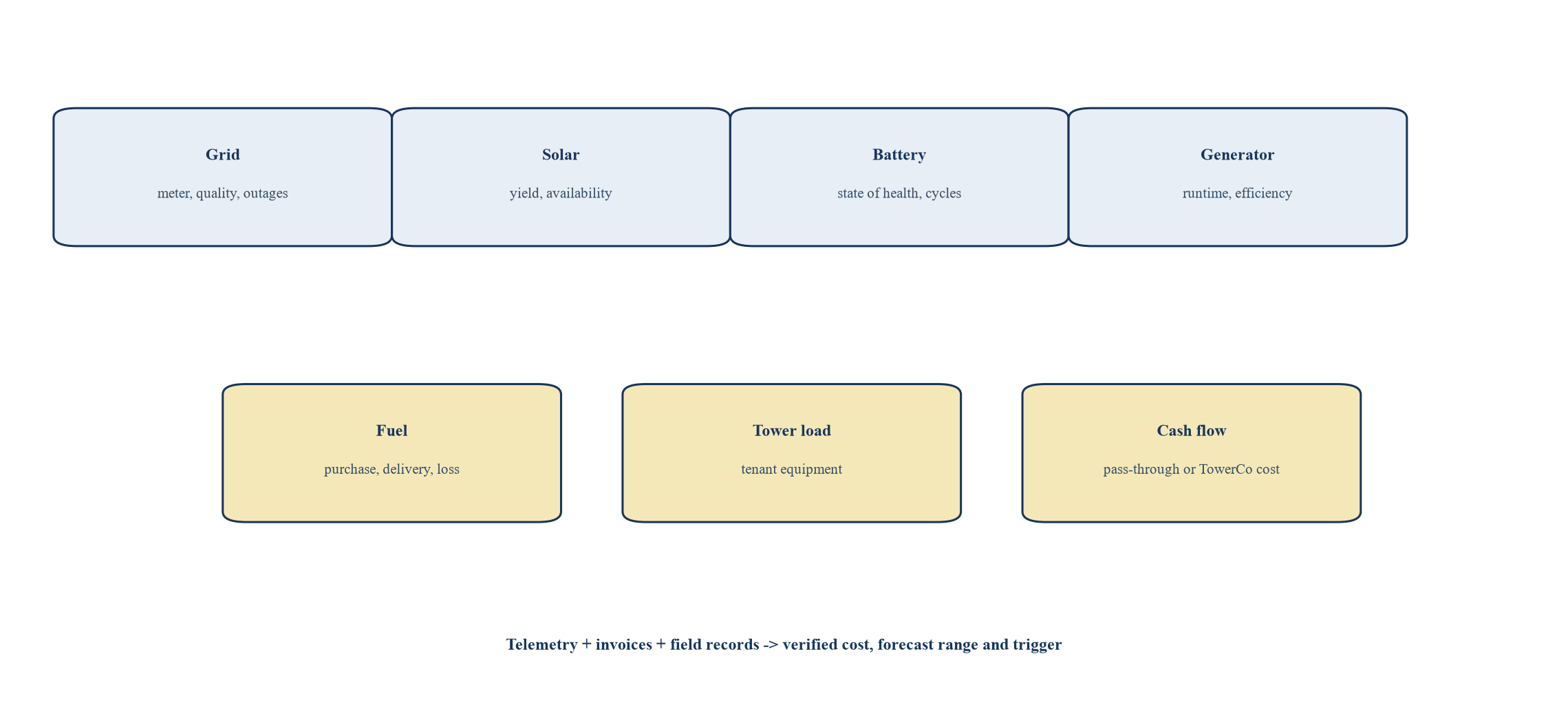
Proposed operating model; actual site configurations and responsibilities vary.
15. Distinguish maintenance from growth capex
Routine asset preservation, structural reinforcement, new tenant equipment, build-to-suit sites and ground-right purchases have different returns. Classify capex by maintenance, compliance, revenue generation, expansion, energy and acquisition. The analysis should distinguish observed site, contract, operating, regulatory and financial evidence from management assumptions and connect each material judgment to network continuity, customer access, capital efficiency, financing and value. Valuation and financing should use cash returns after required maintenance rather than EBITDA alone. The work should test central and correlated downside cases for anchor rent, escalation, ground rights, tenancy, colocation delivery, churn, power, operating cost, maintenance, build-to-suit capex, interest rates, currency, tax and regulatory remedies. Exceptions require a named owner, source, due date and decision consequence. Unsupported revenue, savings, multiple expansion or refinancing remains outside the base case until enforceable evidence supports it. Management should define the earliest warning indicator, intervention trigger and executable remedy. Reporting should preserve the approved baseline, contract change and realised cash so growth, indexation and timing shifts remain distinguishable.
16. Price build-to-suit commitments
The anchor may require a TowerCo to fund new sites under a multi-year rollout, transferring delivery and utilisation risk. Define order process, forecast status, cancellation, site acquisition, permits, acceptance, lease commencement, pricing and minimum volume. The analysis should distinguish observed site, contract, operating, regulatory and financial evidence from management assumptions and connect each material judgment to network continuity, customer access, capital efficiency, financing and value. The model should distinguish committed orders from aspirational network plans and test cash before rent starts. The work should test central and correlated downside cases for anchor rent, escalation, ground rights, tenancy, colocation delivery, churn, power, operating cost, maintenance, build-to-suit capex, interest rates, currency, tax and regulatory remedies. Exceptions require a named owner, source, due date and decision consequence. Unsupported revenue, savings, multiple expansion or refinancing remains outside the base case until enforceable evidence supports it. The section output should identify the governing contract, site evidence, cash-flow line, risk owner, approval right and network consequence. This creates a traceable bridge from perimeter diligence to valuation, separation and post-closing control.
17. Preserve decommissioning flexibility
Network consolidation, spectrum refarming, sharing and new radio architecture can reduce the need for some sites. Define annual termination allowances, swap pools, duplicate-site treatment, notice periods, make-whole payments and restoration. The analysis should distinguish observed site, contract, operating, regulatory and financial evidence from management assumptions and connect each material judgment to network continuity, customer access, capital efficiency, financing and value. The seller should value flexibility against proceeds; the financier should model churn and stranded site costs. The work should test central and correlated downside cases for anchor rent, escalation, ground rights, tenancy, colocation delivery, churn, power, operating cost, maintenance, build-to-suit capex, interest rates, currency, tax and regulatory remedies. Exceptions require a named owner, source, due date and decision consequence. Unsupported revenue, savings, multiple expansion or refinancing remains outside the base case until enforceable evidence supports it. Evidence should remain traceable to site, structure, ground interest, tenant, contract, technology, cost centre and forecast year. The tenant and TowerCo models should reconcile to the same physical and legal register.
18. Control tenant concentration and contract durability
Tower pools often depend on a small number of mobile-network operators. Concentration should be measured by tenant group, guarantor, country, currency, contract, technology and expiry period. Affiliated operating companies should not be treated as independent risk merely because invoices carry different legal names. The credit file should map support, cross-defaults, termination rights, disputes, deductions and payment history.
Contract durability depends on the master lease, site schedules and operating evidence. Review initial term, renewals, escalation, energy charging, service levels, credits, termination, decommissioning, technology change, assignment, set-off, tax, currency and dispute provisions. A long stated term can provide weak financeable duration when the tenant can terminate sites, offset claims broadly or avoid renewal while note principal remains outstanding.
Eligibility criteria should cap exposures and require minimum evidence. Concentrated excess can be excluded, haircut or supported with additional enhancement. The downside case should combine a tenant downgrade or delayed payment with site rationalisation, currency weakness and energy-cost stress. The structure should identify the earliest warning indicator and executable response before cash coverage is lost.
19. Map regulation legal isolation and country risk
A multi-country tower securitisation crosses corporate, insolvency, security, capital-markets, banking, telecom, competition, land, tax, exchange-control and data regimes. Counsel should determine whether receivables and related rights can be transferred, whether perfection is required, whether obligor notice or consent is needed, how collections are controlled, whether set-off survives, and how insolvency or administration affects the special-purpose vehicle. The framework does not assume that one structure works across Africa.
Telecom regulation can affect tower licensing, infrastructure sharing, quality of service, site approvals, spectrum-dependent tenant demand, access pricing and change of control. Country analysis should also cover convertibility, transfer, withholding, stamp duties, VAT, political force majeure and enforcement. Development-finance institutions and investors may impose environmental, social, integrity, sanctions and disclosure standards beyond local minimums.
True sale and bankruptcy remoteness require transaction-specific opinions. Where transfer is unavailable or inefficient, the financing may rely on security and account control, with different recourse and capital consequences. The investor memorandum should describe the actual legal route and residual risks in plain language.
| Workstream | Required evidence | Financing question | Possible response |
|---|---|---|---|
| receivable transfer | contracts, notices, consents and legal opinion | can cash flow be isolated? | transfer, security or exclusion |
| insolvency | entity structure and opinion | can creditors reach SPV assets? | remoteness covenants and separateness |
| telecom regulation | licences, sharing rules and approvals | can the site and lease continue? | condition, consent or reserve |
| land and site rights | title, lease, access and permits | does the right outlast the notes? | haircut, replacement or exclusion |
| currency and tax | exchange-control and tax analysis | can net cash reach the waterfall? | hedge, reserve and structural limit |
Current qualified advice is required for every relevant jurisdiction.
20. Design servicing and operating continuity
The servicer connects physical operations to investor cash. Its duties should cover billing, collections, dispute management, tenant communications, site data, uptime reporting, energy reconciliation, maintenance, eligibility testing, reserve calculations and waterfall inputs. Service standards should identify cut-off dates, reconciliation tolerances, correction processes and escalation.
A backup-servicing plan should establish who can obtain contracts, site registers, invoices, bank data, alarm history, energy records, work orders and model documentation after servicer failure. Transition rights have limited value when the data are incomplete or systems cannot be operated. The transaction should test data export, access credentials, interfaces, field-provider arrangements, account control and a sample reporting cycle before closing.
Operational continuity also requires cyber and physical resilience. Restrict access by role, protect tenant and network information, log changes, maintain backups and rehearse incident response. External analytical providers should receive only authorised data and should not reuse it. Material model or data incidents should enter investor reporting and trigger conservative treatment until resolved.
21. Build the transaction and evidence roadmap
Execute through six gates. Gate one fixes the commercial objective, entities, jurisdictions and candidate cash flows. Gate two verifies sites, rights, tenants, uptime, energy, maintenance, invoices and collections. Gate three resolves legal transfer, security, accounts, tax, regulation and servicing. Gate four sets pool eligibility, scenarios, enhancement, reserves, waterfall and triggers. Gate five completes model validation, investor disclosure, documentation and operational testing. Gate six closes, reconciles proceeds and begins surveillance.
Each gate should have an owner, required documents, quantitative thresholds, unresolved exceptions and approval authority. The board and credit committee should see source facts, professional assessments, management assumptions and decisions as separate categories. A financing calendar should preserve time for obligor consent, account migration, legal opinions, ratings where applicable, investor diligence and data remediation.
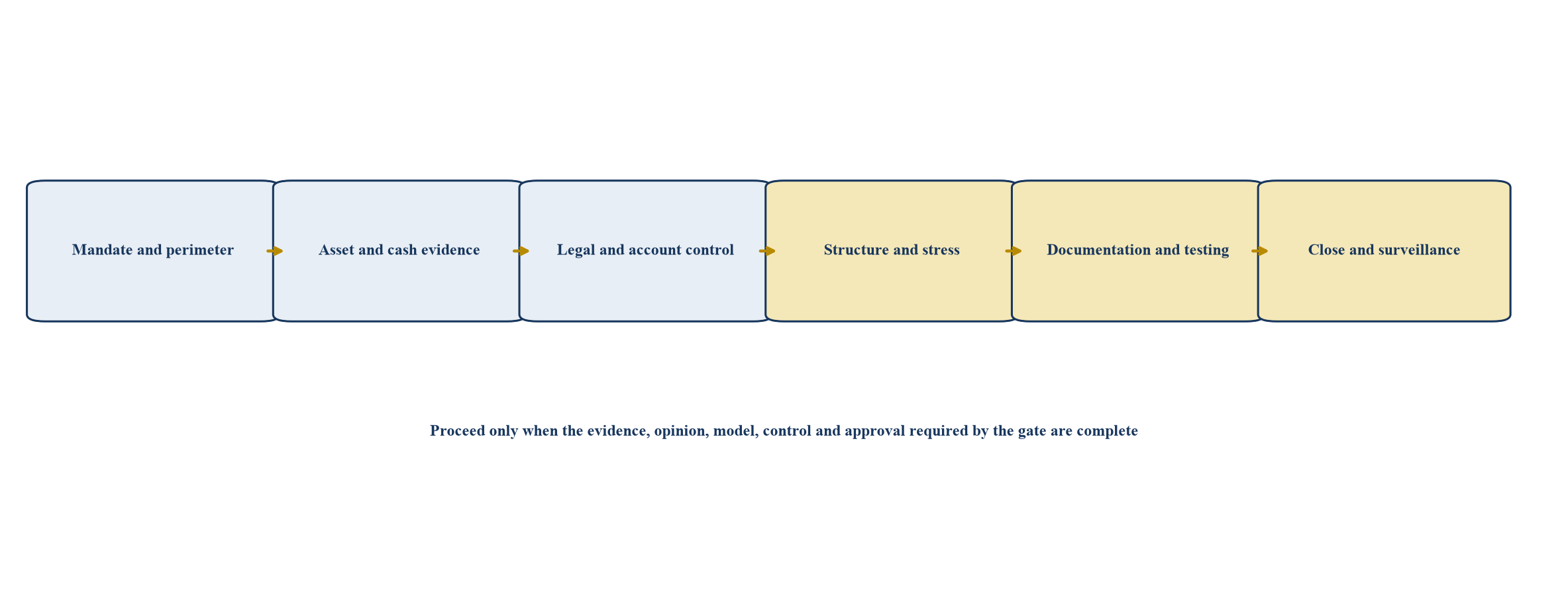
Proposed stage gates; timing depends on jurisdictions, data readiness and market route.
22. Define pool eligibility and substitution
Eligibility should be objective and reproducible. A candidate site can require verified legal identity, usable ground right, executed tenant schedule, minimum remaining term, no unresolved material dispute, complete billing and collection history, acceptable uptime evidence, energy and maintenance records, permitted currency, concentration capacity and compliance with environmental and social requirements. Missing data should produce exclusion or an explicit conservative treatment.
Substitution can preserve a revolving or amortising pool while introducing adverse-selection risk. Replacement sites should satisfy the same tests and should not worsen weighted lease term, tenant concentration, country risk, currency, uptime, energy cost, collections or expected loss beyond approved limits. Independent verification may be appropriate for material substitutions.
The servicer should retain the closing pool and every later change. Investors should be able to reconcile additions, removals, breaches, waivers, recoveries and realised cash. Overrides need a named approver, rationale, quantitative effect and expiry.
23. Create the uptime and energy analytics layer
The analytics layer should estimate defined outcomes at a defined decision date. Useful targets include probability of an uptime breach, outage duration, generator failure, battery replacement, abnormal fuel loss, maintenance backlog, invoice dispute and delayed collection. Training data should preserve time order and avoid information that became known after the prediction date.
Features can include grid hours, alarm sequences, generator runtime, fuel intensity, battery cycles and state of health, solar yield, load, temperature, preventive-maintenance compliance, repeat faults, access delay, spare-parts lead time, technician response, tenant deductions and collection history. Missingness can itself signal weak controls and should be reported rather than silently imputed.
Interpretable baselines should precede complex models. Validation should assess calibration, discrimination, stability, geographic and equipment segments, false-negative cost and performance through stress periods. Field engineers and credit analysts should challenge causal plausibility. A high-risk score directs inspection, reserve, exclusion or remediation; it does not prove failure.
| Control | Evidence | Financing use | Accountable decision |
|---|---|---|---|
| target definition | timestamped breach or cost event | consistent labels | model owner and validator |
| time cut-off | features available before decision | prevents leakage | validator |
| site segmentation | country, grid, equipment, tenant | performance testing | credit committee |
| calibration | observed versus forecast risk | reserve and haircut bands | credit committee |
| field review | work order and engineer inspection | challenge false signals | operations owner |
| drift monitoring | stability and missingness | suspend or recalibrate | model governance body |
Proposed controls for transaction use of site-level models.
24. Build the hypothetical tower pool
The worked case demonstrates mechanics only. The assumed pool contains 1,200 sites across several African markets and three tenant groups. Annual contracted billings are USD 70.2 million. Historical timing, disputes and deductions reduce assumed cash collections to USD 67.4 million. Energy and maintenance cost USD 25.8 million, while ground rent, insurance, servicing and other pool costs total USD 6.0 million. Cash available for debt service is therefore USD 35.6 million.
The structure excludes sites with unresolved rights, incomplete tenant schedules, material disputes or deficient telemetry. Concentration tests apply by tenant group, country and currency. The pool uses observed cash and service records as its starting point. Future colocations, assumed escalators and uncommissioned energy projects do not enter the central cash flow until their contractual and operating evidence meets the eligibility test.
| Segment | Sites | Contracted billings USDm | Collection rate | Average uptime | Energy and maintenance USDm |
|---|---|---|---|---|---|
| Grid-supported urban | 420 | 27.8 | 97.5% | 99.95% | 6.9 |
| Hybrid peri-urban | 500 | 28.9 | 96.0% | 99.80% | 10.7 |
| Off-grid and remote | 280 | 13.5 | 92.7% | 99.35% | 8.2 |
| Total | 1,200 | 70.2 | 96.0% weighted | 99.75% weighted | 25.8 |
All amounts and percentages are illustrative assumptions, not observed market data.
25. Reconcile cash available for debt service
The model should start with billed and collected cash, then deduct service credits, taxes borne by the pool, energy, maintenance, ground cost, insurance, servicing, administration and lifecycle reserve contributions. Accounting EBITDA is not automatically cash available for debt service. Working-capital movements, restricted cash, currency conversion, leakage and non-pool obligations require separate treatment.
In the hypothetical case, USD 67.4 million of collections less USD 25.8 million of energy and maintenance and USD 6.0 million of other pool costs produces USD 35.6 million of cash available for debt service. A minimum lifecycle reserve contribution is included in the other pool costs. The model should reconcile each line to contracts, bank statements, operating systems and approved assumptions.
AI-supported reconciliation can identify invoice-payment mismatches, unusual fuel use, missing telemetry and cost anomalies. Exceptions remain subject to human investigation. Material unresolved differences should reduce eligible cash rather than be treated as timing noise.
26. Design the notes reserves and payment waterfall
The hypothetical structure issues USD 165 million of senior notes and USD 40 million of junior notes. Sponsor retention, overcollateralisation and a funded liquidity reserve absorb risk before senior principal. The transaction maintains controlled collection accounts and a priority of payments that allocates taxes and essential operating costs, servicing, senior interest, reserve top-up, senior principal, junior obligations and residual distributions.
Liquidity support addresses timing; credit enhancement addresses expected and stressed loss. The reserve should reflect payment frequency, collection delay, energy-cost volatility, servicing transition and currency conversion. Enhancement should reflect tenant, country and currency concentration, contract durability, service deductions, expected site loss, recovery time and legal structure. The release of reserves or excess cash should depend on performance and data-quality tests.
| Item | Hypothetical amount or rule | Principal purpose |
|---|---|---|
| senior notes | USD 165m | priority funding |
| junior notes | USD 40m | subordinated funding |
| liquidity reserve | USD 12m at closing | timing, energy shock and servicing transition |
| concentration excess | excluded or haircut | tenant, country and currency control |
| waterfall step 1 | taxes and essential pool operation | preserve service and legal standing |
| waterfall step 2 | servicing and senior interest | operating and payment continuity |
| waterfall step 3 | reserve top-up and senior principal | restore protection and amortise |
| waterfall step 4 | junior obligations and residual | subordinate distribution |
Illustrative assumptions only; the paper provides no rating, investment recommendation or term sheet.
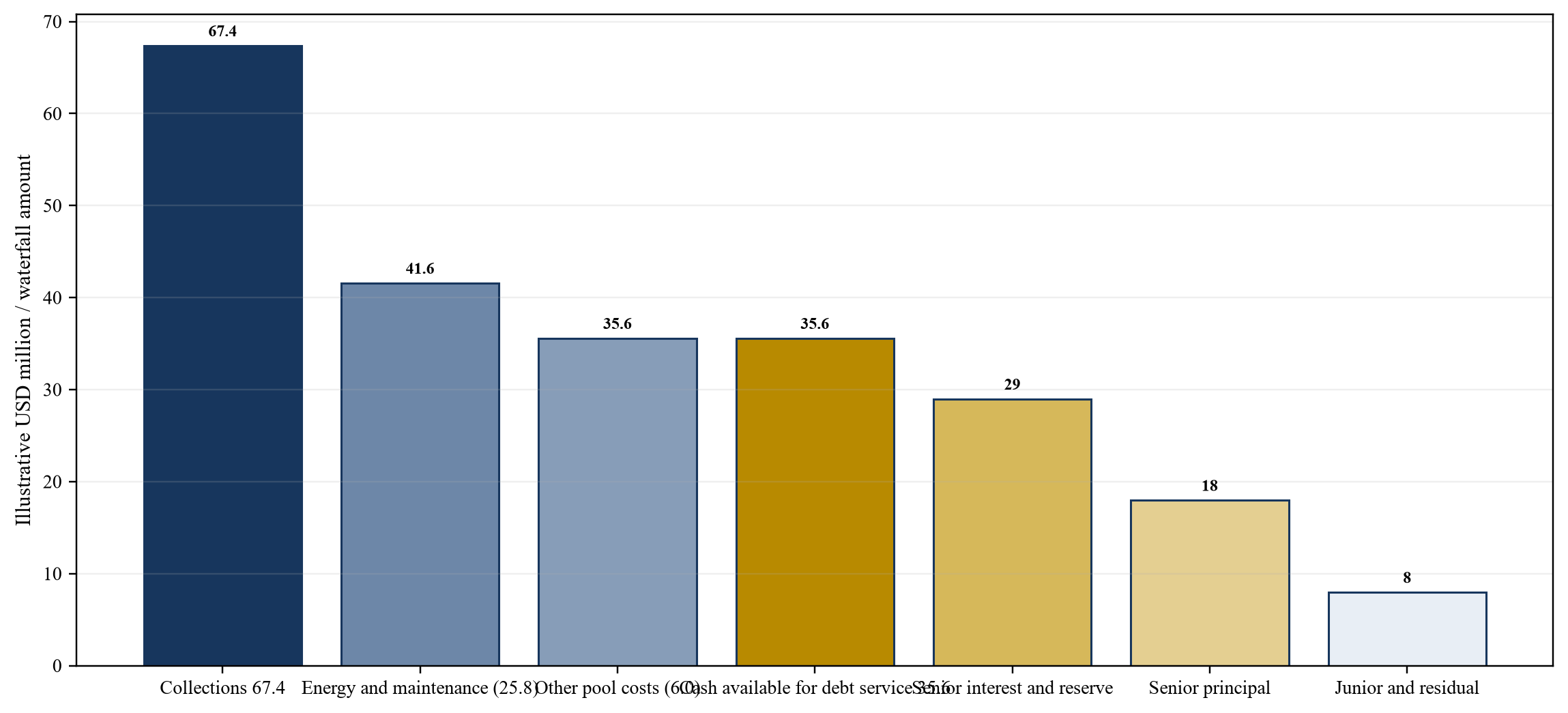
Illustrative payment sequence; legal documents determine actual priorities.
27. Stress cash flow enhancement and triggers
Three hypothetical cases test the structure. The central case uses the assumed USD 35.6 million cash available for debt service. Energy stress assumes longer grid outages, higher fuel cost, battery underperformance and slower reimbursement. The correlated downside adds a material tenant payment delay, currency weakness and lower uptime. The model should calculate interest coverage, principal capacity, reserve use, trapped cash and time to remedy.
Triggers should be measurable and connected to an action. Examples include collection ratio, tenant concentration, uptime, service credits, fuel intensity, battery-health migration, maintenance backlog, reserve deficiency, debt-service coverage, currency mismatch, data completeness and servicer breach. Responses can include cash trapping, accelerated amortisation, additional enhancement, suspension of substitution, independent engineering review, model recalibration or servicer replacement.
The trigger should activate before the loss is irreversible. A metric without a reliable data source or operational remedy provides limited protection. Thresholds, cure periods, waivers and reporting should be defined in documents and systems at closing.
| Case | Cash available for debt service USDm | Reserve draw USDm | Indicative response |
|---|---|---|---|
| central | 35.6 | 0.0 | scheduled waterfall |
| energy stress | 29.1 | 2.5 | cash trap and energy remediation |
| tenant delay | 26.8 | 4.2 | concentration review and accelerated amortisation |
| correlated downside | 21.4 | 8.8 | reserve draw, senior protection and substitution suspension |
Illustrative assumptions only; figures are not forecasts or ratings.
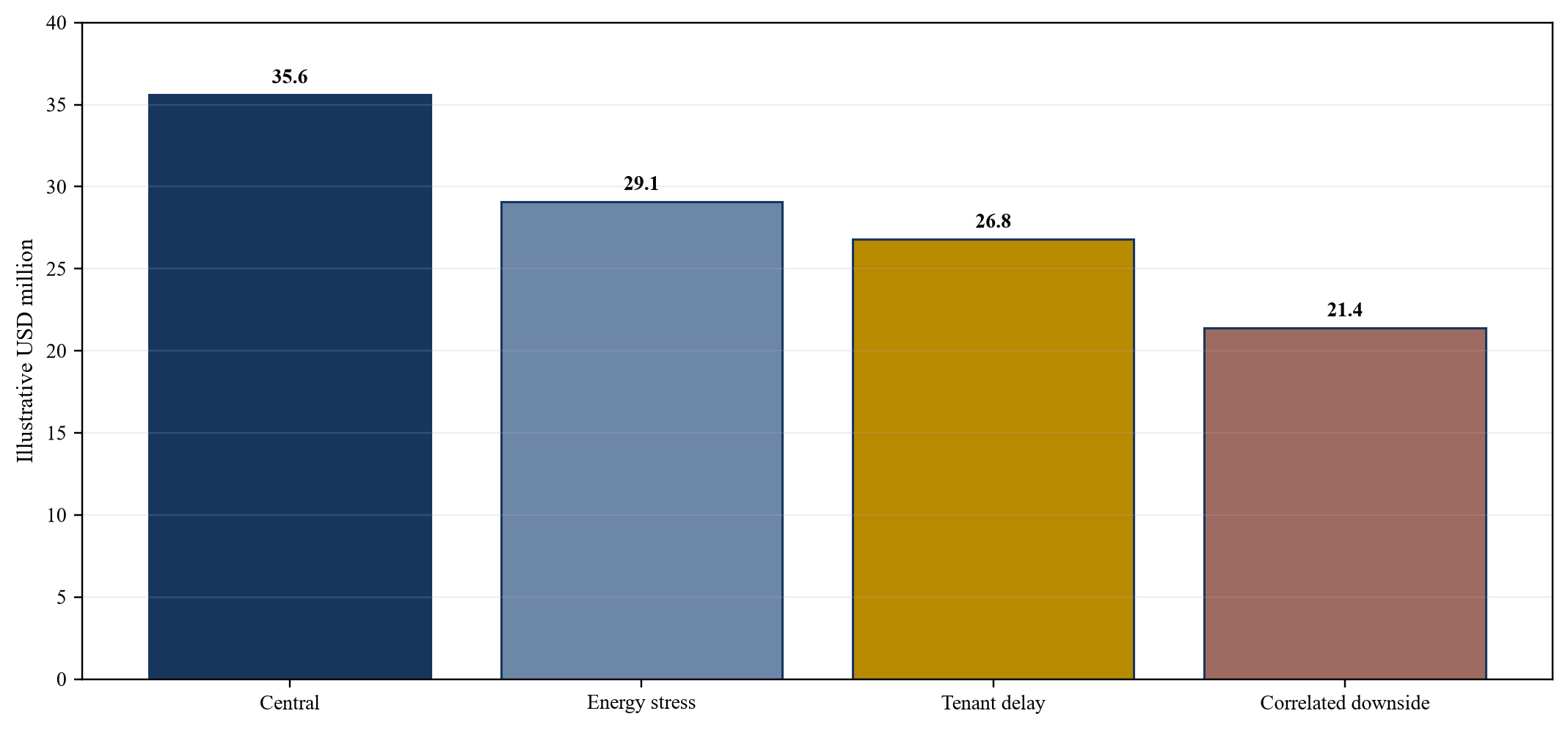
Illustrative assumptions only; the chart demonstrates scenario mechanics.
28. Establish surveillance and investor reporting
Monthly reporting should reconcile opening pool, additions, removals, invoices, collections, arrears, deductions, tenant concentrations, currencies, uptime, outages, energy consumption, maintenance, lifecycle capital, reserve balances and waterfall payments. Quarterly analysis can add trend, model performance, site inspections and scenario updates. Material incidents require prompt reporting according to transaction documents.
Model surveillance should assess calibration, discrimination, stability, missingness, segment performance and override rates. Deterioration can arise from equipment change, grid conditions, tenant behaviour, operating acquisitions or altered maintenance practices. A model outside tolerance should cease determining eligibility or reserve release until approved remediation is complete.
Investor disclosure should explain limitations and residual risk. Reported uptime should state the definition, exclusions, measurement source and aggregation. Energy savings should distinguish commissioned performance from forecast. Collections should be shown before and after disputes, offsets and currency effects. This allows investors to understand both economic deterioration and data uncertainty.
29. Allocate governance and decision rights
The sponsor owns source data and operating strategy. The servicer owns billing, collection, reporting and pool administration. Counsel assesses transfer, security, regulation and enforcement. Engineers assess structures, power and maintenance. Accountants advise on recognition and consolidation. Model developers build analytics; independent validators challenge them. The arranger and credit committee approve structure and use.
Every material output should show data cut-off, model version, scenario, override, reviewer and approval. Changes to contracts, sites, pool criteria, accounts, waterfall, models or reporting should pass through controlled governance. Conflicts should be identified where a party earns fees from inclusion, substitution, valuation or model use.
The governing body should retain authority to impose conservative treatment when evidence is missing or validation is incomplete. Waivers should state rationale, quantitative effect and duration. The closing baseline should remain available so realised performance and management action can be compared with the case presented to investors.
30. Conclude the financing case
African tower securitisation can broaden infrastructure funding when contractual cash flows, operating service and controlled collections form one auditable system. A tower count or invoice ledger alone is insufficient. Investors need to know which entity owns the right, which tenant owes the cash, whether the site delivered service, what energy and maintenance consumed, how money reached the controlled account and what happens under stress.
Uptime and energy analytics can improve pool selection, operating intervention, reserve sizing and surveillance. Their value depends on defined outcomes, time-consistent data, validation, field challenge and accountable decisions. Legal isolation, enhancement, reserves, triggers, servicing continuity and transparent reporting carry the risk that prediction cannot remove.
The structure should proceed when the sponsor and financiers can reconcile site rights, tenant contracts, service evidence, energy and maintenance, invoices, collections, eligibility, enhancement and waterfall. It should remain resilient under tenant, energy, currency, operational and servicing stress. A live financing requires verified portfolio data and current qualified advice in every relevant jurisdiction.
Sources
- GSMA, Why and how mobile operators are looking to renewables to power networks across Africa, 2024. Read the primary source
- GSMA, Mobile Net Zero Report 2026. Read the primary source
- International Finance Corporation, Enabling a Competitive Mobile Sector in Emerging Markets Through the Development of Tower Companies, 2021. Read the primary source
- International Finance Corporation, Telecom Energy Service Company Study. Read the primary source
- International Finance Corporation, Airtel Africa II Upsizing project disclosure. Read the primary source
- International Finance Corporation, ATK Debt II project disclosure. Read the primary source
- International Finance Corporation, Benin TowerCo project disclosure. Read the primary source
- African Development Bank, Digital Connectivity and Infrastructure. Read the primary source
- African Development Bank, Partnership with AXIAN Telecom to accelerate Africa's digital transformation, 2025. Read the primary source
- International Telecommunication Union, Measuring Digital Development: Facts and Figures 2025. Read the primary source
- Basel Committee on Banking Supervision and IOSCO, Criteria for identifying simple, transparent and comparable securitisations. Read the primary source
- Basel Committee on Banking Supervision, Revisions to the securitisation framework. Read the primary source
- International Organization of Securities Commissions, Securitisation and structured finance publications. Read the primary source
- IFRS Foundation, IFRS 9 Financial Instruments. Read the primary source
- IFRS Foundation, IFRS 7 Financial Instruments: Disclosures. Read the primary source
- IFRS Foundation, IFRS 10 Consolidated Financial Statements. Read the primary source
- National Institute of Standards and Technology, Artificial Intelligence Risk Management Framework 1.0. Read the primary source
- National Institute of Standards and Technology, AI RMF Core. Read the primary source
- World Bank Group, Environmental, Health and Safety Guidelines for Telecommunications. Read the primary source
- International Finance Corporation, Performance Standards on Environmental and Social Sustainability. Read the primary source
- GSMA, Tower Power Africa: Energy Challenges and Opportunities. Read the primary source
- African Development Bank, Understanding Power Project Financing. Read the primary source
