

1. Define the financing decision
The financing decision is whether a defined corridor business can support the proposed capital structure from cash that is legally earned, operationally deliverable and collectible under central and adverse conditions. The decision begins with a precise perimeter. It should identify each asset, legal entity, concession, licence, route, terminal, border interface, warehouse, operating contract, data right, customer contract and financing obligation included in the case. It should also identify the services and infrastructure outside the borrower's control.
Corridor finance usually combines several instruments. Long-lived roads, rail links, terminals and equipment may support project, asset or corporate debt. Cargo owners and logistics operators may need letters of credit, guarantees, receivables finance, inventory finance or revolving facilities. Public or development-finance capital may fund enabling works, project preparation, guarantees or subordinated risk. Each instrument has a different repayment source, tenor, security package and evidence requirement. A combined model should preserve these distinctions.
The board and credit committee should approve a decision statement before modelling begins. It should specify the amount, instrument, term, currency, borrower, permitted use, target return, minimum coverage, concentration limits, risk appetite and actions available after disruption. The framework supports finance, commercial, technical, legal, operational and data diligence. Qualified advisers and competent authorities retain responsibility for legal, regulatory, customs, tax, security, environmental and engineering conclusions.
2. Establish the evidence hierarchy
Underwriting should distinguish authoritative records, independently verified records, controlled operating records, analytical outputs and transaction assumptions. Authoritative records include concessions, licences, customs releases, permits, executed contracts and official border procedures. Independent evidence can include engineer reports, traffic counts, insurance surveys, environmental studies and lender technical reviews. Controlled operating records include gate events, weighbridge records, warehouse movements, GPS pings, invoices and bank receipts.
Analytical outputs include predicted volumes, estimated arrival times, anomaly scores and route-risk classifications. They are derived from evidence and remain sensitive to model design, data quality and changing conditions. Transaction assumptions include tariffs, capture rates, operating costs, refinancing terms, reserves and downside cases selected by management or advisers. They should be traceable to an approver and separated from observed results.
Evidence quality has four dimensions. Provenance establishes where the record originated and who can change it. Completeness tests missing periods, locations, cargo classes and counterparties. Timeliness determines whether the record can support a live decision. Reconciliation connects separate systems to the same shipment, contract, invoice and receipt. A sophisticated model applied to incomplete or unreconciled records can amplify confidence without improving credit evidence.
| Evidence domain | Primary records | Core test | Financing use |
|---|---|---|---|
| Permission and border | Licences, permits, declarations, releases, transit guarantees and inspection records | Can the cargo, operator and vehicle use the route under the stated procedure? | Conditions, eligibility and legal risk |
| Physical movement | Gate events, GPS, rail waybills, port records, weighbridge data and warehouse receipts | Did the cargo move through the claimed nodes in the claimed quantity? | Volume, capacity and collateral control |
| Commercial entitlement | Customer contract, tariff schedule, service record and acceptance | Is the borrower entitled to invoice the amount? | Revenue and receivables eligibility |
| Cash | Invoice, deduction, settlement and bank receipt | Did billed service convert into unrestricted cash? | Cash waterfall and debt capacity |
| Risk environment | Weather, road condition, security, closure and disruption notices | Can the preferred route continue to operate safely and economically? | Reserves, triggers and contingency routes |
The register is a diligence template. Actual sources and legal rights vary by jurisdiction, corridor and transaction.
3. Map the corridor as an operating system
A corridor is an operating system rather than a line between two locations. The underwriting map should show origin nodes, consolidation points, warehouses, terminals, roads, railways, ports, border posts, customs systems, alternative routes, fuel and power dependencies, communications, security controls and final customers. Each edge should identify capacity, operator, tariff, currency, legal permission, data source, failure mode and substitution option.
The map should separate physical control from economic dependence. A borrower may own a terminal while depending on a public road, third-party railway, border agency, port concessionaire or payment bank. The strongest asset can remain exposed to the weakest external link. Contracts, memoranda of understanding and public plans have different enforceability. The financing case should identify which dependencies are committed, which are operational conventions and which remain aspirations.
The map should also show the evidence path. A truck gate event may prove entry to a terminal but not customs release, customer acceptance or payment. A GPS ping may show location but not cargo ownership. A warehouse receipt may support inventory control when its issuer, goods description, insurance and release process are verified. The operating map becomes a financing map when each event is connected to a right, obligation or cash consequence.
4. Reconcile permission to operate
Cross-border cargo can require vehicle permits, operator licences, product registrations, sanitary or phytosanitary documentation, rules-of-origin evidence, customs declarations, transit guarantees and security clearances. Requirements differ by cargo, route and jurisdiction. The underwriter should build a permission matrix by movement rather than relying on a general statement that the corridor is open.
Permission should be tested at ordinary volume and at peak volume. A procedure that works through manual escalation for ten consignments may fail at one hundred. The review should record documentary lead times, rejected declarations, inspection frequency, amendment procedures, weekend operations, system downtime and the treatment of diverted cargo. Historical clearance should be reconciled with current rules and current systems.
The financing model should reflect permission failure through eligibility and timing. Cargo awaiting a missing permit may remain economically valuable while becoming ineligible for borrowing-base purposes. A delayed transit guarantee can extend the cash cycle. A new product classification can change duty, security or inspection requirements. Conditions precedent, representations, reporting covenants and event-driven reserves should address these risks with legal advice.
5. Measure cargo flow from event-level data
Cargo-flow underwriting begins with an event ledger. Each shipment should have a stable identifier connecting booking, origin, carrier, route, border events, terminal events, delivery, acceptance, invoice and cash. The ledger should preserve timestamps, quantity, cargo class, customer, currency and source system. Duplicate identifiers, missing events and retrospective changes should be visible.
Volume should be measured in units relevant to the asset and cash model. Tonnes, containers, vehicle movements, pallets and storage days answer different questions. Conversion factors should be documented. Gross gate volume can overstate billable volume when transhipments, empties, rejected loads, free storage, internal transfers or non-paying public traffic are included. A reconciliation should bridge physical flow to billed service and collected cash.
Data frequency should match the decision. Annual statistics can support context, monthly records can support covenant monitoring and event-level data can support working-capital eligibility or disruption response. The lender should avoid imposing real-time reporting where data quality and operational response are not ready. A lower-frequency, reconciled control can be more useful than an ungoverned live dashboard.
6. Build the route-risk index
The route-risk index should convert observed conditions into a transparent decision aid. A practical index can combine border delay, infrastructure condition, weather exposure, security status, congestion, fuel availability, communications availability and alternative-route capacity. Each component needs a definition, source, update frequency, direction of risk and accountable owner.
Weights should reflect the financed cash flow. A cold-chain cargo may give greater weight to delay and power reliability. Bulk minerals may be more sensitive to rail and port throughput. High-value electronics may emphasise theft and customs risk. The score should not conceal veto conditions. A security closure, withdrawn permit or unsafe bridge can stop movement regardless of the weighted average.
The index should have decision bands linked to actions. A green band may support ordinary advance rates. Amber can require enhanced reporting, route confirmation or additional liquidity. Red can stop new eligibility, redirect cargo or trigger a reserve. A separate emergency state can suspend movement under the safety and legal protocols of the relevant authorities. Credit teams should review overrides and false alarms to prevent the score from becoming ceremonial.
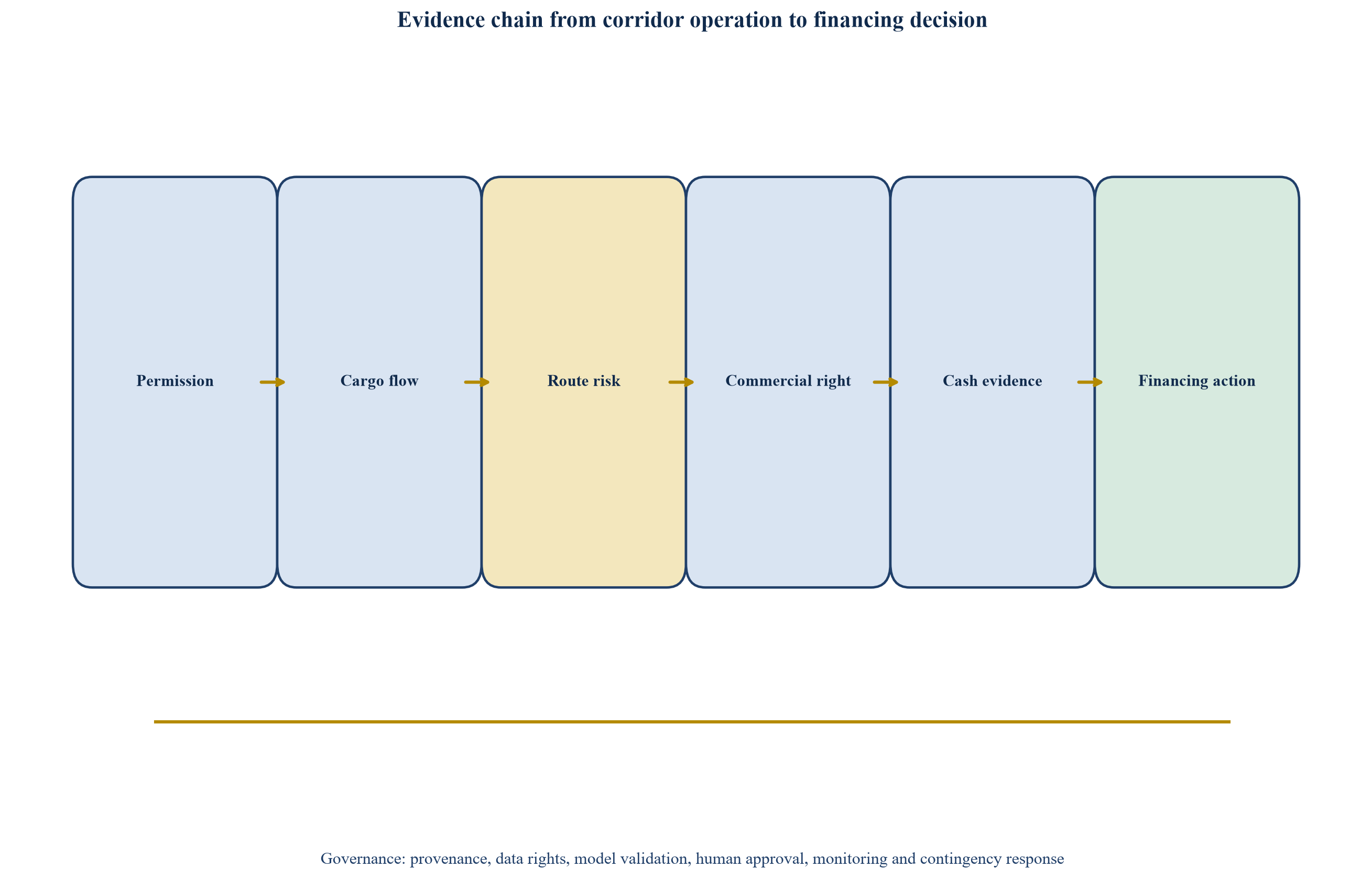
The architecture is proposed for transaction design and does not replace legal, customs, engineering, security or credit judgement.
7. Use AI within a governed analytical role
Artificial intelligence can support classification, forecasting, anomaly detection and scenario generation. It can flag an unusual dwell time, identify a route deviation, estimate expected arrival, detect inconsistent weight records or produce a cargo-flow forecast from historical and external variables. These functions can help allocate investigation and update financial scenarios more quickly.
The model should have a defined intended use. A model built to estimate arrival time should not automatically determine credit eligibility. A security anomaly score should not be treated as proof of wrongdoing. A cargo forecast should not substitute for customer commitments. Each output requires an approved user, decision boundary, confidence measure, escalation process and retained evidence of the final human decision.
Model governance should cover data rights, version control, training and validation data, performance by route and cargo class, drift monitoring, cyber security, access, change approval and rollback. The World Customs Organization's work on data analytics and AI adoption highlights technical, organisational, legal, ethical and capacity requirements. The underwriting framework should use the same discipline when private financiers consume customs or logistics data.
8. Validate data rights and interoperability
The ability to access data during diligence does not prove the right to use it after closing or throughout the loan. The borrower should identify the owner, controller, permitted user, purpose, retention rule, transfer restriction and termination consequence for each dataset. Public data, customer data, carrier data, customs data and security data require different treatment.
Interoperability should be tested through identifiers and semantics. One system may record a consignment, another a declaration, another a vehicle and another an invoice. The data model should specify how these objects are linked. Units, timestamps, location codes, cargo descriptions and status labels should be normalised without erasing the source record. Manual bridges should be controlled and reconciled.
Continuity matters to lenders. The financing documents should address access if a technology vendor fails, a public interface changes, a carrier terminates or the borrower loses a customer. Data escrow, export rights, documented schemas, alternate evidence and transition services can reduce dependency. The appropriate protection depends on law, commercial leverage and operational feasibility.
9. Forecast cargo flow by driver
A useful cargo forecast decomposes volume by customer, commodity, origin, destination, contract, season, route and service. It distinguishes committed minimums, nominated volumes, historical repeat business, addressable demand and speculative capture. Forecasts should bridge from regional trade statistics to the corridor's actual competitive position and contractual rights.
Drivers can include production, commodity prices, import demand, harvest calendars, mine output, customer capacity, port calls, border performance, freight rates and alternative routes. External data should be matched to the corridor's lag structure. A commodity price can affect production with delay. A new road can initially attract traffic before service quality stabilises. Historical relationships may break after policy or security changes.
Machine-learning models can improve nonlinear forecasts and interactions, but they require comparison with simpler benchmarks. The credit file should retain an interpretable base model, back-testing, forecast error, sensitivity and qualitative overlays. Management overlays should have named owners and expiry dates. The lender should be able to explain why the forecast changed without relying on an opaque score.
10. Convert volume into deliverable capacity
Physical capacity should be measured at the binding constraint. Road design capacity, rail paths, locomotive availability, wagon cycles, berth windows, crane moves, yard slots, warehouse doors, customs booths, inspection bays and power supply can each limit throughput. Capacity reported for one node does not establish end-to-end capacity.
The model should distinguish nominal, scheduled, available and deliverable capacity. Nominal capacity reflects design. Scheduled capacity reflects operating plans. Available capacity deducts maintenance and known outages. Deliverable capacity deducts congestion, connection mismatch, labour, border and handling constraints. Financeable volume should remain below deliverable capacity with an operating buffer.
Peak conditions matter. Harvests, mine shipments, retail seasons and vessel schedules can create short periods where queues drive cost and delay. A monthly average may conceal the peak. The underwriter should test queueing, storage overflow, demurrage, overtime and customer prioritisation. Capital expenditure should target the binding constraint and include the time and permits needed before capacity becomes usable.
11. Connect cargo movement to revenue
The revenue model should identify the chargeable event. A corridor company may earn through access fees, handling, storage, transport, terminal services, documentation, customs support, equipment hire or availability payments. Each line has a different volume base, tariff, escalation, acceptance and deduction mechanism.
Reported tariffs should be reconciled to invoices and receipts. Discounts, rebates, free time, penalties, fuel adjustments, currency conversion, taxes and related-party terms can change realised unit revenue. Customer concentration should be measured through revenue, contribution and cash. A large customer with reliable payment may support bankability while creating renewal and bargaining risk.
Revenue forecasts should not count the same cargo repeatedly across consolidated entities. A port, rail operator and inland terminal can each recognise revenue from one shipment. Consolidated models should eliminate intra-group charges and preserve third-party cash. Public subsidies or availability payments need appropriation, performance and payment evidence.
12. Reconcile invoice acceptance and cash
Cash collection requires evidence beyond invoice issuance. The lender should reconcile service completion, customer acceptance, invoice, dispute, deduction, settlement date, currency and bank receipt. Ageing should be measured from the contractual payment trigger and segmented by customer, country, service and dispute status.
Receivables should be excluded or reserved when acceptance is missing, set-off rights are broad, invoices are disputed, debtors are related, payment depends on unperformed obligations or proceeds cannot be controlled. Sovereign and state-owned customers may have strong ultimate capacity while operating through long approval cycles. The model should use observed timing and legal analysis.
Foreign-exchange availability can delay conversion or transfer after local-currency collection. The cash model should separate invoiced currency, collected currency, debt currency, conversion access, hedging cost and distribution restrictions. A nominally matched tariff can remain exposed if payment timing and conversion liquidity differ.
13. Separate infrastructure finance from working capital
Infrastructure debt is generally repaid from operating cash over a long tenor. Working-capital finance is repaid from a shorter conversion cycle. Combining both in one undifferentiated debt balance can conceal maturity mismatch and collateral leakage. The capital structure should assign each use to an instrument with a credible repayment source.
Senior infrastructure lenders may rely on controlled accounts, reserves, security over assets and contracts, assignment of insurance and distribution tests. Trade lenders may rely on eligible receivables, inventory, documents, guarantees and controlled collections. Development-finance institutions may add tenor, guarantees, subordinated funding or project preparation. Equity absorbs construction, ramp-up and residual risk.
Common dependencies should be modelled. A border closure can reduce infrastructure revenue and trap financed inventory at the same time. A currency shortage can weaken both debt service and trade settlement. Intercreditor arrangements, cash waterfalls and information rights should define how facilities respond without competing for the same cash or collateral.
| Risk component | Illustrative weight | Current score out of 100 | Evidence | Linked action |
|---|---|---|---|---|
| Border and customs delay | 25% | 42 | Clearance timestamps and exception log | Enhanced monitoring; reserve if median delay exceeds trigger |
| Weather and physical access | 20% | 35 | Forecast, closure notices and road condition | Confirm diversion route and seasonal liquidity |
| Security and cargo integrity | 20% | 48 | Authority notices, incidents and seal exceptions | Route approval and enhanced control for affected cargo |
| Capacity and congestion | 15% | 30 | Queue, dwell and throughput records | Restrict forecast to deliverable capacity |
| Fuel, power and communications | 10% | 28 | Availability and outage records | Minimum operating stock and backup test |
| Alternative-route readiness | 10% | 55 | Permits, cost, capacity and live test | Reduce eligibility until alternate route is executable |
Scores and actions are hypothetical. Actual thresholds require corridor-specific legal, security, operational and credit approval.
14. Build the infrastructure cash waterfall
The infrastructure cash waterfall should begin with collected third-party operating revenue. It should deduct operating costs, maintenance, tax, essential public charges, lifecycle reserves and other permitted senior items to derive cash available for debt service. Debt service should follow the legal order of priority. Distributions should occur after reserves and coverage tests.
The model should distinguish accounting EBITDA from cash. Concession fees, maintenance catch-up, receivables growth, inventory, capital expenditure, withholding, blocked cash and lease payments can create material differences. Cash should be located by entity and jurisdiction. Upstream distributions require legal, tax and currency analysis.
Coverage ratios should use periods that reflect seasonality and covenant design. Historical, forecast and trailing measures answer different questions. The lender should test the numerator, denominator, cure rights, permitted distributions and consequences of breach. A high annual ratio can conceal intra-year liquidity deficits.
15. Build a separate borrowing base
A borrowing base converts eligible short-term assets into a facility limit. The calculation can include approved receivables, inventory or confirmed trade instruments after applying advance rates, concentration limits, ageing exclusions and reserves. The lender should test ownership, perfection, control, insurance, release and liquidation evidence.
Receivable eligibility should connect to accepted service and controlled cash. Inventory eligibility should connect to title, quantity, quality, location, warehouse control, marketability and permitted release. Transit cargo may need specific insurance and document control. The same asset should not support multiple facilities without disclosed intercreditor treatment.
Advance rates should reflect volatility, dilution, legal enforceability, operational control and exit value. A model can recommend a rate, but credit approval should record the rationale. Route-risk triggers can reduce new availability while preserving a controlled run-off. The facility should provide time for orderly action rather than creating unnecessary forced movement during disruption.
| Component | Gross eligible candidate | Advance rate | Initial availability | Key control |
|---|---|---|---|---|
| Accepted receivables | 80.0 | 70% | 56.0 | Debtor confirmation and controlled collection |
| Controlled inventory | 48.0 | 55% | 26.4 | Title, warehouse control, insurance and release protocol |
| Gross collateral availability | 128.0 | 82.4 | Reconciled asset ledger | |
| Concentration and route reserve | (7.4) | Customer, border and route triggers | ||
| Dilution and dispute reserve | (5.0) | Credit notes, deductions and disputes | ||
| Net borrowing base | 70.0 | Subject to facility commitment | ||
| Illustrative facility commitment | 65.0 | Lower of commitment and net borrowing base |
All amounts are hypothetical USD millions. Advance rates and reserves are assumptions for the illustrative case.
16. Design the illustrative capital plan
The illustrative corridor requires USD 420 million. Uses include USD 110 million for existing operating assets and rights, USD 125 million for transport and civil works, USD 55 million for an inland terminal and warehousing, USD 20 million for systems and security, USD 30 million for development, contingencies and transaction cost, and USD 80 million for peak working capital.
Illustrative sources include USD 125 million sponsor equity, USD 190 million senior infrastructure debt, USD 40 million development or subordinated finance and USD 65 million of trade and working-capital facilities. The sources do not imply market availability or terms. Each depends on diligence, approvals, documentation and the actual project.
The structure keeps long-lived assets outside the short-term borrowing base and funds peak trade assets with a revolving instrument. Equity and subordinated capital absorb development and ramp-up risk. The capital plan should be staged against land, permits, contracts, construction, systems, operating readiness and cargo commitments.
17. Model the base case
The hypothetical base case handles 2.4 million tonnes annually. Weighted transport and terminal revenue is USD 43.2 million, equivalent to USD 18 per handled tonne. Ancillary revenue of USD 9.8 million brings total revenue to USD 53.0 million. Operating cost is USD 27.5 million, maintenance and lifecycle funding is USD 5.0 million and other cash items reduce annual cash available for debt service to USD 18.5 million.
Annual senior debt service is USD 14.0 million, producing a hypothetical debt-service coverage ratio of 1.32 times. This ratio is sensitive to volume, realised tariff, route availability, customer deductions, cost, maintenance and cash timing. It excludes any claim that the illustrative project is bankable.
The base case should reconcile monthly cargo, revenue, receivables, cash and facility use. Peak working capital can occur before annual profitability is visible. The model should retain minimum cash, reserve funding and headroom under both the infrastructure facility and the borrowing base.
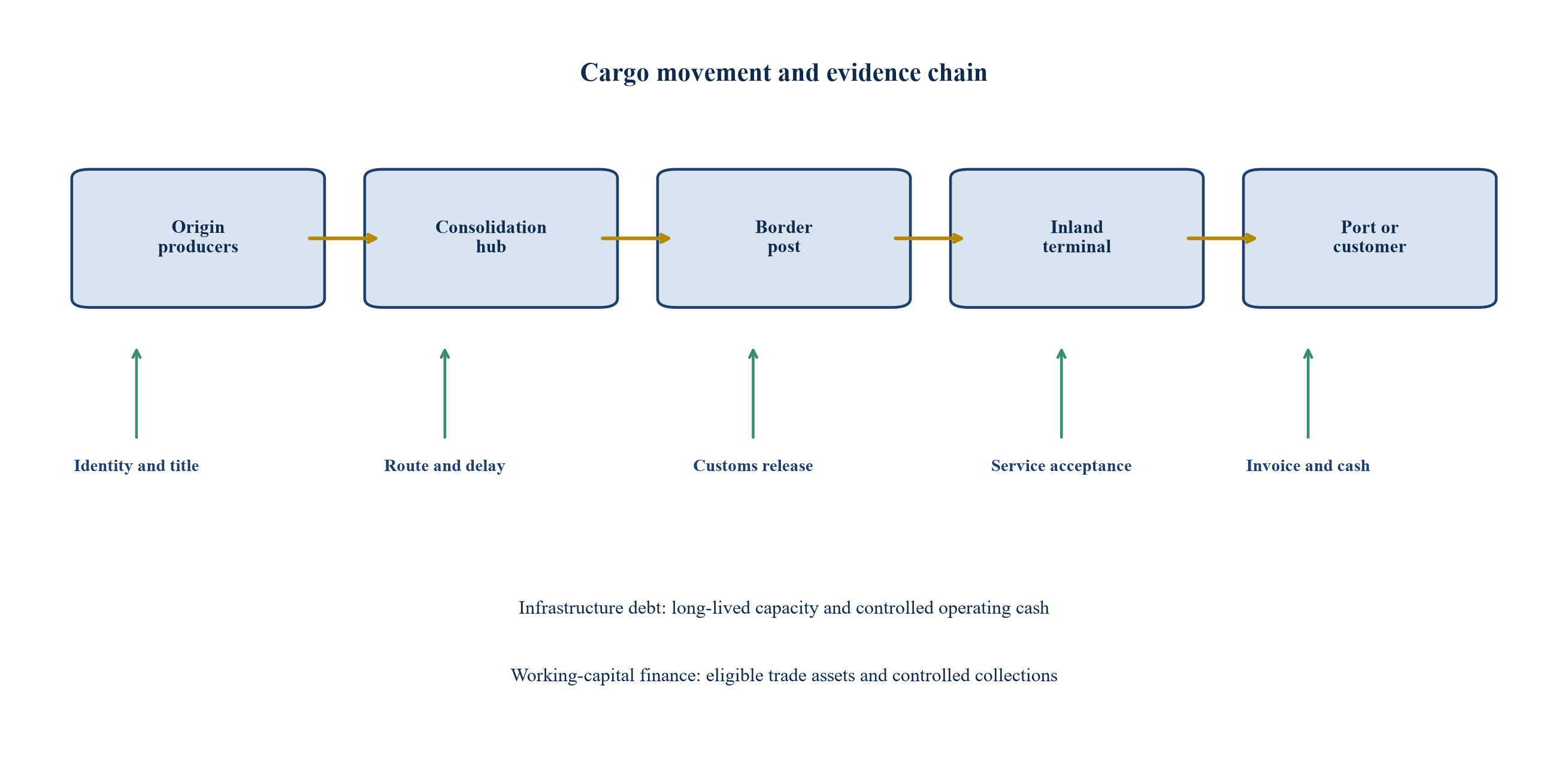
The nodes are conceptual and do not represent a specific route, country or project.
18. Test border delay and queueing
Border delay affects vehicle cycles, inventory days, fuel, driver time, demurrage, customer service and receivables. The model should use a distribution rather than one average. Median, upper-percentile and extreme cases show how ordinary variability and disruption differ. Delays should be segmented by border, direction, cargo and procedure.
Queueing can create nonlinear effects. Once arrival rates approach processing capacity, small disruptions can cause large dwell increases. Additional lanes or staff may not solve documentary or system bottlenecks. The capacity model should identify the constraint and test operating interventions before assuming major capital expenditure.
The financing response can include seasonal reserves, minimum liquidity, reporting, alternative routing, customer pass-through, extension of borrowing-base tenor or temporary advance-rate changes. Remedies should preserve safety and legal compliance. The model should avoid assuming that delayed cargo automatically becomes lost cargo.
19. Test weather and climate disruption
Flood, extreme heat, storm, drought, dust and other hazards can affect roads, rail, bridges, ports, rivers, equipment and cargo. Historical records should be combined with forward-looking engineering and climate analysis appropriate to the asset life. The underwriter should distinguish hazard, exposure, vulnerability and recovery.
Weather data can improve route planning and early warning. Predictive models should state spatial resolution, lead time, uncertainty and action. A forecast can support preparation without proving whether a specific asset will remain operable. Engineering inspection, operating judgement and authority instructions retain priority.
The financial model should include lost volume, diversion cost, repair, working-capital extension, insurance timing and customer consequences. Adaptation spending should have measurable outcomes and maintenance requirements. Reserves, insurance, contingent liquidity and alternative routes should be tested together.
20. Test security and integrity risk
Security risk can include theft, tampering, smuggling, fraud, route closure, conflict and threats to personnel. The underwriter should rely on competent advice and official sources. Sensitive operational information should be protected. Analytics should support risk management without exposing routes or individuals unnecessarily.
Shipment integrity can be supported by seal records, geofencing, custody events, weighbridge reconciliations and exception review. An anomaly is a prompt for investigation rather than proof of misconduct. False positives can delay legitimate trade and create harmful decisions. Review procedures, appeal, access and retention controls are essential.
The financing structure should identify cargo classes and routes requiring enhanced control, insurance or lower advance rates. A security event can trigger suspension of new eligibility, route confirmation or controlled diversion. Decisions affecting safety remain with authorised operators and public authorities.
21. Test alternative routes
An alternative route is valuable only when it is executable. The diligence file should verify permits, border procedures, capacity, customer acceptance, carrier access, cost, transit time, insurance and data visibility. A route that exists on a map may lack operational capacity or commercial rights.
The model should estimate the volume that can be diverted, the time to activate, the incremental cost and the duration it can operate. Alternative routes may share ports, bridges, fuel supply, communications or customs systems with the primary route. Correlated dependencies reduce resilience.
A live test can provide stronger evidence than a desktop plan. Selected cargo can be moved through the alternate route, reconciled through customs, delivered, invoiced and collected. The test should respect law, safety, customer requirements and cost. Results should update the route-risk score and contingency plan.
22. Test customer and commodity concentration
Volume concentration should be measured by customer, commodity, origin, destination, contract and cash payer. Two customers may depend on one mine, crop, government allocation or buyer. Apparent diversification can therefore conceal a common economic driver.
Commodity scenarios should connect price and production to cargo volume with an evidence-based lag. A lower price may reduce production, increase stockpiles or alter routes. A higher price can raise volume while straining capacity and working capital. The model should avoid a simple one-direction relationship.
Contracts should be reviewed for minimum volume, take-or-pay, force majeure, tariff adjustment, service levels, termination, assignment and credit support. Minimum-volume language does not establish collection under every event. Legal interpretation and counterparty capacity remain necessary.
23. Test currency and payment risk
The corridor can earn in several currencies while borrowing in another. Currency risk includes translation, transaction, convertibility, transferability and timing. The model should map currency by revenue, cost, capital expenditure, debt service, reserve and distribution.
Hedging may reduce market risk while introducing collateral, tenor, counterparty and accounting considerations. Tariff indexation can reduce exposure when it is enforceable, timely and collectible. A tariff denominated in foreign currency can remain exposed if customers pay local currency or conversion is delayed.
The cash waterfall should use cash available in the debt-service currency and location. Stress cases should include devaluation, wider hedge cost, delayed conversion and restricted upstreaming. Contingent liquidity and reserve currency should reflect actual access.
24. Test data failure and cyber resilience
Digital controls can create a new operational dependency. Customs interfaces, terminal operating systems, GPS platforms, warehouse systems, payment rails and analytics services can fail or be attacked. The underwriting case should identify critical services, recovery objectives, offline procedures, backups and accountable owners.
Cyber diligence should cover identity, access, network segmentation, vulnerability management, incident response, vendor risk, logging, backup and recovery. Model inputs and outputs need protection from unauthorised change. The borrower should be able to reconstruct material financing decisions after an incident.
Fallback evidence should be defined before failure. Manual documents, alternate interfaces, reconciled batches and delayed reporting can support continuity when properly controlled. The lender should test whether fallback operation preserves legal compliance, safety, cargo control and cash evidence.
25. Use scenario analysis and reverse stress
Scenario analysis should combine operational and financial variables that can move together. Border delay can increase cost, reduce vehicle cycles, delay customer acceptance and extend receivables. Weather disruption can damage infrastructure and divert cargo. Security events can stop routes and increase insurance or control cost.
The illustrative cases show annual cash available for debt service of USD 18.5 million in the base case, USD 16.0 million under border delay, USD 14.8 million under weather disruption, USD 13.2 million under a security diversion and USD 9.4 million under combined stress. With annual debt service of USD 14.0 million, coverage ranges from 1.32 times to 0.67 times. A mitigated case with diversion, reserve release and cost action produces USD 15.6 million and 1.11 times coverage.
Reverse stress should identify the combination of volume, tariff, cost, delay and collection that breaches minimum cash or coverage. The purpose is to define warning indicators and feasible actions. It should not assign a false probability to limited evidence.
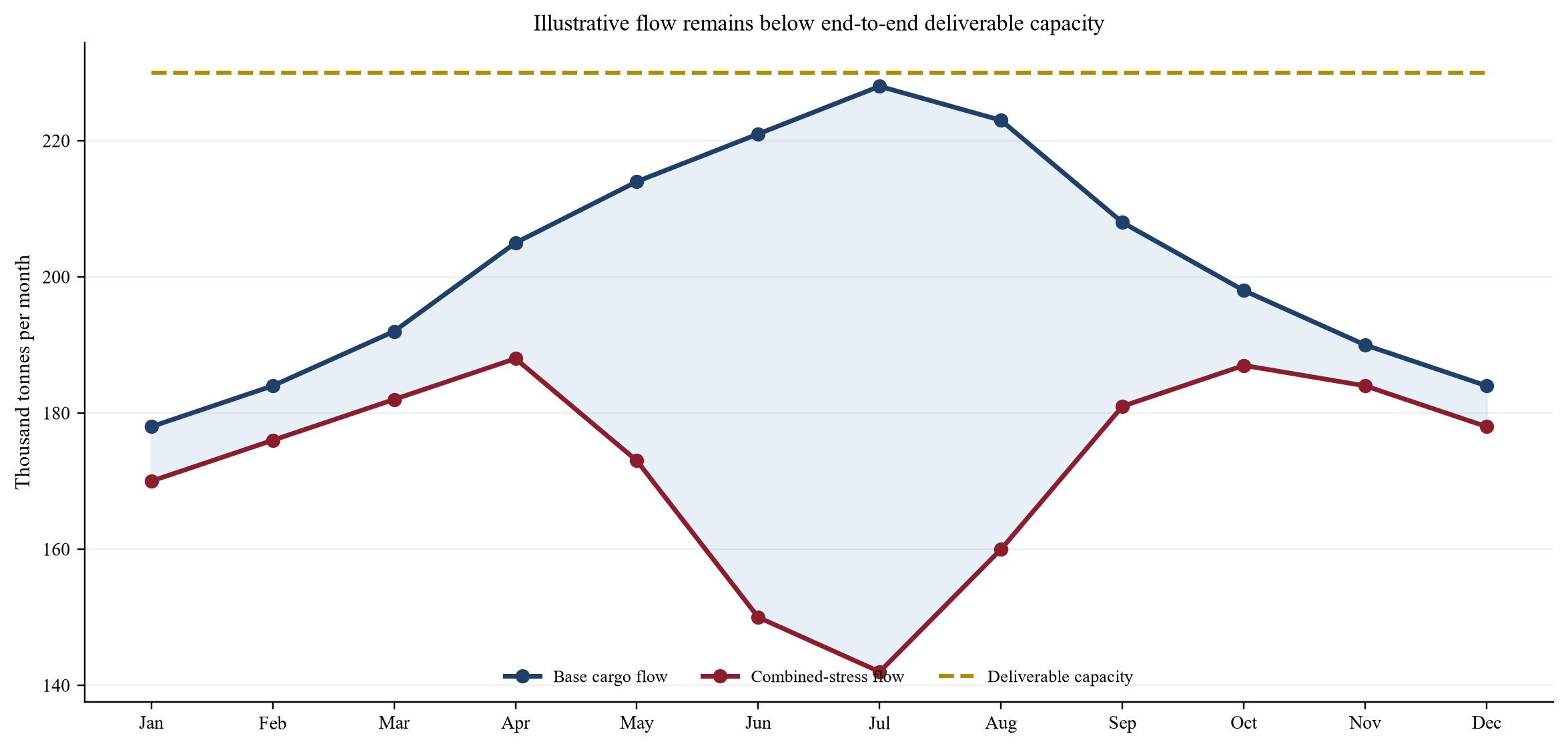
Volumes are management assumptions for an illustrative corridor and do not represent observed traffic.
26. Translate analytics into financing terms
Analytics create financing value when they change a documented decision. Cargo-flow forecasts can inform debt sizing and draw timing. Route-risk indicators can inform reserves and reporting. Event-level evidence can support borrowing-base eligibility. Forecast error can inform headroom. Each use should be approved and tested.
Terms should avoid automatic material consequences from one unstable model output. A two-stage structure can use a warning threshold for review and a separate evidence-based trigger for action. Hard stops remain appropriate for defined legal, safety or eligibility failures. Overrides should be documented and reviewed.
Financial covenants should connect to controlled accounts and action. Minimum coverage, reserve levels, borrowing-base availability, concentration limits, arrears and route availability can form a coherent package. Excessive indicators can obscure priority. The monitoring set should be small enough to operate and broad enough to detect the main failure modes.
| Risk or evidence gap | Instrument consequence | Possible control | Decision owner |
|---|---|---|---|
| Cargo forecast error | Excess infrastructure debt | Debt sized to downside flow with staged draw | Credit committee |
| Border or route deterioration | Lower cash and longer cycle | Liquidity reserve, diversion plan and review trigger | Borrower and facility agent |
| Ineligible receivable or inventory | Over-advance | Defined eligibility, reserves and field audit | Working-capital lender |
| Currency mismatch | Debt-service volatility | Currency mapping, hedge policy and reserve | Treasury and lenders |
| Data or model failure | Unsupported decision | Fallback evidence, model validation and override log | Data owner and credit risk |
| Correlated infrastructure and trade stress | Competing claims on cash | Intercreditor waterfall and minimum operating liquidity | Lender group |
The matrix illustrates structuring options. Final terms depend on credit, legal and regulatory review.
27. Design draw conditions and reserves
Draw conditions should correspond to the funded use and stage. Early development draws may require permits, land rights, procurement and equity contribution. Construction draws may require certified progress, cost-to-complete and contingency. Operating draws may require completion, insurance, service contracts, accounts and reporting. Working-capital drawings require eligible assets and controlled proceeds.
Reserves can address debt service, maintenance, lifecycle expenditure, route disruption, working-capital dilution and currency. They should be sized from identified risk rather than copied from another transaction. Funding, release, permitted investment and replenishment should be documented.
Route-risk analytics can inform a reserve review, but the legal trigger should remain clear. A temporary score deterioration can prompt enhanced evidence. A verified closure can prompt a draw stop or contingency route. The facility should define who determines the event and what evidence is accepted.
28. Allocate risk across stakeholders
Public authorities, corridor operators, carriers, customers, insurers, lenders, development-finance institutions and sponsors control different risks. Allocation should follow control, capacity and incentive. Transferring a risk by contract does not remove it when the counterparty cannot perform or the remedy arrives after the liquidity need.
Government support can address land, permits, border coordination, availability payments or political commitments. Guarantees and political-risk insurance can address defined events. Customer contracts can support minimum revenue or volume. Sponsor support can cover completion or cost overrun. Each protection should be tested for scope, conditions, tenor, currency, claim process and enforceability.
Risk-sharing should preserve operating incentives. A blanket guarantee can weaken cost or service discipline. A performance regime can become unfinanceable when deductions are uncapped or measured on unavailable data. The structure should use objective evidence, proportionate remedies and transparent dispute processes.
29. Plan implementation and governance
Implementation should begin with a data and contract reconciliation. The sponsor should appoint owners for the operating map, event ledger, financial model, legal matrix, route-risk index, cargo forecast, borrowing base and contingency plan. Independent review should focus on the evidence supporting the major financing decisions.
A staged programme can use a first phase to prove identifiers, data rights and cash reconciliation on a limited corridor segment. A second phase can validate forecasts and route-risk triggers. A third phase can integrate reporting with controlled accounts and lender processes. Scale should follow evidence quality and operating readiness.
Governance should include model approval, change control, credit review, security escalation, audit access, incident reporting and periodic contingency tests. Human decision makers should understand inputs, limitations and consequences. Training should include operators, finance, customs specialists, technology teams and lenders where appropriate.
30. Monitor the financed corridor
Monitoring should preserve the link between cargo and cash. A concise monthly pack can report permission exceptions, volume, capacity, dwell, route status, customer concentration, realised tariff, invoice acceptance, collections, working-capital eligibility, cash, reserves and debt service. Each metric should include the denominator, period and source.
Forecast performance should be measured through error by route, cargo and horizon. Model drift, missing data and overrides should be reported. A change in score matters when its cause and financing consequence are understood. Dashboards should retain access to source evidence for investigation.
Periodic tests should include alternative routing, cyber recovery, controlled-account reconciliation, collateral audit, insurance claims preparation and covenant calculation. Findings should have owners, dates and escalation. Lenders should distinguish temporary operational noise from deterioration in the repayment source.
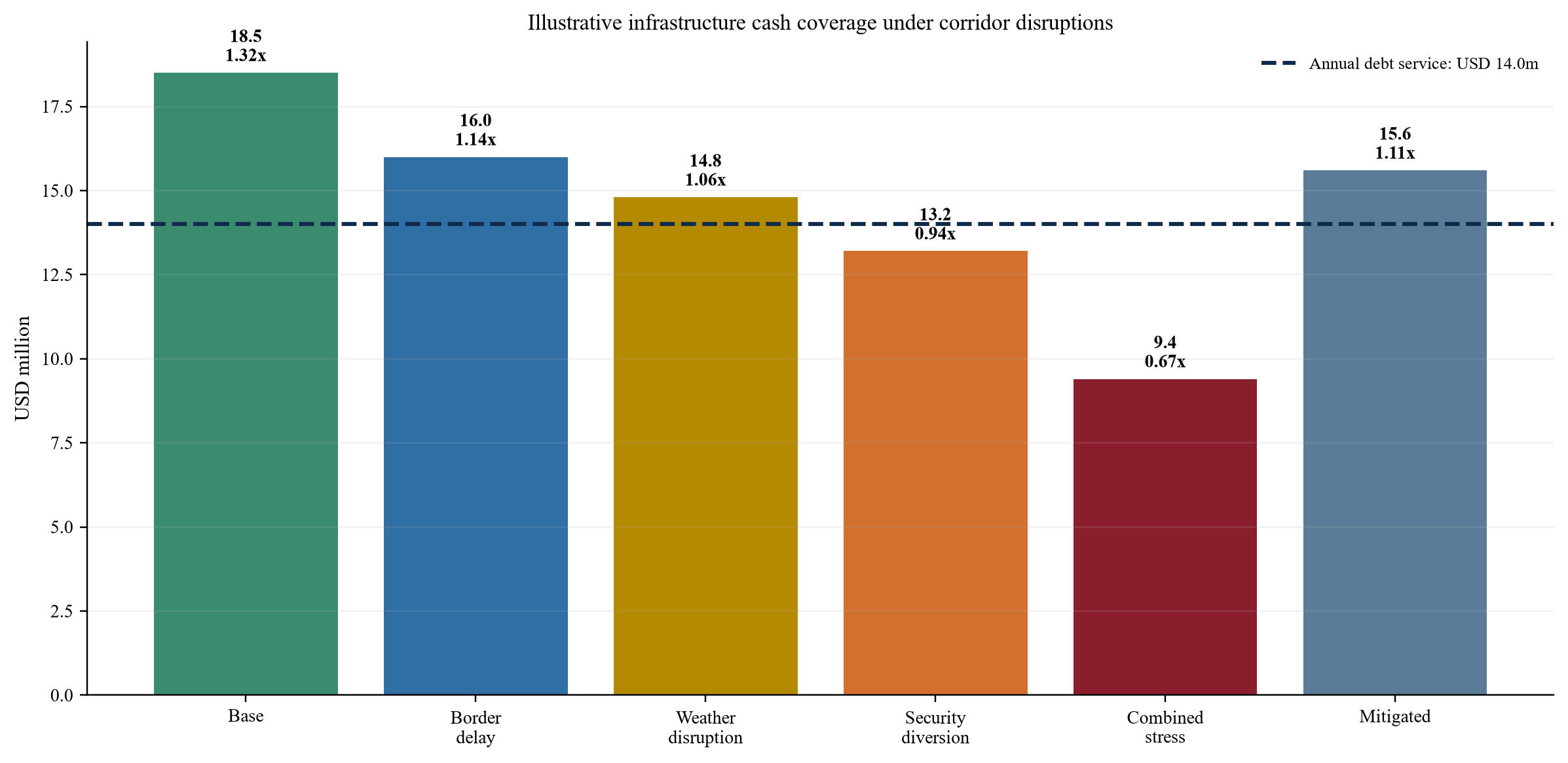
All amounts and ratios are illustrative management assumptions. Annual senior debt service is held at USD 14.0 million.
31. Recognise the framework's limits
The framework does not predict conflict, weather, government action, commodity prices, foreign-exchange availability or customer behaviour with certainty. It does not establish customs compliance, security clearance, engineering integrity, environmental approval, legal enforceability, insurance recovery, tax treatment or accounting treatment. Those conclusions require qualified specialists and current evidence.
Data can be incomplete, delayed, biased or inaccessible. Informal trade and manual processes may be economically important while poorly represented in digital records. A model trained on one route or stable period may fail under a new border rule or disruption. Quantitative precision should not exceed the evidence.
The illustrative case demonstrates method rather than an actual opportunity. Its amounts, ratios, weights, thresholds and actions are assumptions. A real financing requires corridor-specific diligence, stakeholder engagement, risk appetite, documentation and approvals.
32. Conclusion
African trade-corridor finance becomes more robust when underwriting follows the movement of goods and cash through the entire operating system. The credit case should connect permission, physical movement, commercial entitlement, invoice acceptance and collection. It should identify the external link that can interrupt the repayment source and the action available when that happens.
Artificial intelligence can improve route-risk analysis, cargo forecasting and anomaly detection when data rights, quality, validation, security, human approval and fallback evidence are controlled. Its value lies in better decisions and earlier action rather than a standalone model score.
A financeable structure separates long-lived infrastructure debt from working-capital instruments, models their common dependencies and preserves liquidity through disruption. The practical output is a staged capital plan, transparent route-risk index, reconciled cargo forecast, infrastructure cash waterfall, borrowing base, covenants, reserves and contingency programme. These components give boards, sponsors and lenders a common evidence base for deciding what to fund, how much risk to accept and which conditions must be satisfied before capital is committed.
Sources
- African Development Bank Group, “Trade Finance Supply in Africa: Post-COVID Trends and Emerging Opportunities,” 2026, Read the primary source
- African Development Bank Group, “2025 Trade Finance Report Highlights Resilience of African Financial Institutions After Covid-19,” 28 May 2026, Read the primary source
- African Development Bank Group, “Annual Development Effectiveness Review 2026,” 2026, Read the primary source
- African Development Bank Group, “Chapter 4: Integrate Africa: Regional integration and trade,” 28 May 2026, Read the primary source
- African Development Bank Group, “Zambia: African Development Bank Group approves $255m loan and $10m grant to advance the Lobito Economic Corridor,” 6 August 2026, Read the primary source
- African Development Bank Group, “African Development Bank Group champions trade corridors for Africa's Prosperity at Luanda Infrastructure Financing Summit,” 24 November 2025, Read the primary source
- African Development Bank Group, “Regional corridors as drivers of continental integration,” 19 March 2025, Read the primary source
- African Development Bank Group, “Ten-Year Strategy 2024-2033,” revised April 2025, Read the primary source
- African Export-Import Bank, “African Trade Report 2025: African Trade in a Changing Global Financial Architecture,” 2025, Read the primary source
- African Export-Import Bank, “Afreximbank Launches 2025 Report on African Trade in a Shifting Global Financial Landscape,” 25 June 2025, Read the primary source
- UN Trade and Development, “Economic Development in Africa Report 2024: Unlocking Africa's trade potential,” 2024, Read the primary source
- UN Trade and Development, “Turning geography into opportunity: New priorities for landlocked economies,” 7 August 2025, Read the primary source
- UN Trade and Development, “Digitalization of multimodal data and document exchange using UN standards in electronic corridors,” 28 June 2024, Read the primary source
- UN Trade and Development, “Support for the development of the Cotonou-Niamey Corridor,” project period 2025-2029, Read the primary source
- UN Trade and Development, “Red Sea Crisis and implications for trade facilitation in Africa,” 17 April 2024, Read the primary source
- UN Trade and Development, “Trade facilitation: How are countries faring?” 8 July 2025, Read the primary source
- UN Trade and Development, “ASYCUDA Report 2025,” 2025, Read the primary source
- World Customs Organization, “WCO Capacity Building Framework on Data Analytics,” current resource, Read the primary source
- World Customs Organization, “WCO Customs Risk Management Compendium,” current resource, Read the primary source
- World Customs Organization, “Smart Customs Project releases a detailed Report on the Adoption of AI/ML in Customs,” 28 March 2025, Read the primary source
- World Customs Organization BACUDA Project, “Data Governance as the Foundation for AI in Customs,” 31 July 2026, Read the primary source
- World Customs Organization, “Benin and Nigeria catch smugglers in first-of-its-kind geospatial intelligence-led Customs operation,” 17 July 2026, Read the primary source
- World Bank, “Democratic Republic of Congo Country Economic Memorandum,” 2023, Read the primary source
- World Trade Organization, “Trade Facilitation Agreement,” current legal text and implementation resources, Read the primary source
- United Nations Economic Commission for Europe, “UN/CEFACT Multimodal Transport Reference Data Model,” current standards resource, Read the primary source
- International Finance Corporation, “PPP Reference Guide,” version 3, 2017, Read the primary source
- OECD, “G20/OECD Principles of Corporate Governance 2023,” 2023, Read the primary source
- Basel Committee on Banking Supervision, “Principles for the Management of Credit Risk,” revised guidelines, 2025, Read the primary source
