

1. Define the financing decision
The first decision is the financing instrument, not the prediction model. The sponsor may seek liquidity against lease receivables, refinance property-level debt, transfer a pool of loan exposures, raise listed securitised debt, establish a real estate investment trust or finance an acquisition vehicle. Each route gives investors a different legal claim and relies on a different source of payment. The work should therefore begin with the proposed asset, obligor, transfer mechanism, payment waterfall, security package, investor class and intended accounting treatment.
The term securitisation should be used precisely. The Reserve Bank of India defines securitisation for regulated lenders around a pool of exposures transferred to a special-purpose entity and at least two tranches with different credit risk [1]. SEBI governs the issue and listing of securitised debt instruments under a separate securities framework [3-4]. A REIT owns income-producing real estate through a trust structure and follows its own investment, valuation, distribution and disclosure rules [5-6]. Ordinary secured debt remains another route. The board paper should identify the selected perimeter and the professional opinions required before execution.
The credit question is whether defined warehouse cash flows can support scheduled payments through vacancy, tenant churn, rent disruption, operating cost, capital expenditure and refinancing stress. Artificial intelligence can improve forecasting and monitoring when its inputs, limitations and governance are transparent. It cannot create legal isolation, cure weak leases or substitute for credit enhancement.
| Route | Primary asset or claim | Core evidence | Principal transaction question |
|---|---|---|---|
| Loan securitisation | Eligible loan exposures | Loan terms, payment history, security and obligor data | Does the pool satisfy transfer, homogeneity, retention and disclosure requirements? |
| Securitised debt instrument | Defined receivables or asset cash flows | Transfer, collections, waterfall, servicing and investor rights | Are cash flows legally isolated and sufficiently transparent? |
| REIT ownership | Income-producing real estate | Asset ownership, valuation, leases, distributions and governance | Does the portfolio meet trust, income and disclosure requirements? |
| Secured SPV debt | Borrower and pledged assets | Property cash flow, covenants, security and enforcement | Can the borrower service debt and preserve collateral value? |
The legal and regulatory treatment of an actual transaction requires qualified Indian advice.
2. Establish the legal and economic perimeter
The perimeter should list every property, land interest, building, lease, licence, tenant, receivable, deposit, operating contract, insurance policy, borrowing, guarantee, tax exposure, related-party arrangement and information system relevant to the proposed financing. Warehouse campuses can include separate landowners, development companies, asset-owning entities, facility managers, power or solar companies and customer-specific fit-out vehicles. Consolidated financial reporting may obscure where rights and obligations sit.
The analysis should distinguish property ownership from income entitlement. A sponsor may own a building while a master lease, management agreement or revenue-share arrangement redirects part of the cash flow. Security may cover shares, land, receivables, bank accounts or contractual rights in different combinations. Consent, assignment, change-of-control and non-disturbance provisions can determine whether a financier can rely on those rights.
The economic perimeter should identify cash that is available to the transaction after taxes, statutory payments, property expenses, maintenance, insurance, tenant incentives, fit-out obligations and leakage. Cash recorded in a property manager account may not be controlled by the financing vehicle. The diligence report should reconcile legal title, invoicing, collection and bank-account control for each material revenue stream.
3. Build the warehouse cash-flow map
The cash-flow map begins with each leasable unit and follows the path from signed lease to invoice, collection, operating expenditure, capital expenditure, debt service and distribution. It should record area, use, tenant, commencement, expiry, lock-in, break options, escalation, rent-free periods, deposits, fit-out contributions, service charges, taxes, arrears, disputes, renewal options and termination rights.
Physical occupancy, leased occupancy, billed occupancy and economic occupancy are different measures. Physical occupancy may include rent-free space. Leased occupancy may include units not yet handed over. Billed occupancy may exclude contractual concessions. Economic occupancy should reflect the cash contribution after incentives and credit losses. The financing model should state its definition and reconcile every measure to the rent roll and general ledger.
Collections should be separated from invoices. A tenant can occupy space and remain in arrears. Advance receipts can temporarily overstate collection performance. Service-charge recoveries may not be equivalent to rent. Deposits support liquidity only to the extent that law and contract permit their use. The map should preserve these distinctions so that forecasting and waterfall design use cash that is genuinely available.
4. Define the data contract
The data contract specifies what each field means, where it originates, who owns it, how frequently it is refreshed and which controls establish completeness. Core sources include executed leases, amendments, tenant master data, property-management systems, invoices, bank statements, general ledgers, maintenance systems, access-control logs, utility meters, fit-out records and external corporate information.
Every lease field should remain traceable to an executed document or approved amendment. Extracted fields require confidence scores and human review when they affect cash flow, termination, security or concentration. Tenant names should be resolved across subsidiaries and parent groups. Units, dates, tax treatment and currency should be normalised without overwriting source records.
The model should record a data cut-off and create exception queues for missing leases, unmatched collections, disputed area, duplicate tenants and inconsistent expiry dates. A data-quality score can direct diligence effort, but it should not conceal individual material gaps. Where a cash-flow conclusion depends on a missing document, the report should state the dependency and propose a condition, reserve, exclusion or other transaction response.
5. Reconstruct historical occupancy
Historical occupancy should be rebuilt at unit and day level where records permit. Month-end snapshots can miss intra-month vacancy, phased handover and temporary occupation. The reconstruction should identify when space became legally available, when the tenant obtained possession, when billing began, when rent was collected and when the unit ceased contributing cash.
The analyst should reconcile gross leasable area to approved plans, asset registers and leasing systems. Space held for redevelopment, common areas and tenant-specific expansion options should be classified consistently. Acquisitions and disposals should not create artificial occupancy changes. A portfolio average should be weighted by area, rent and cash contribution to show different economic views.
Historical analysis should cover at least one complete leasing cycle where available. New properties with limited operating history need wider uncertainty bands. Seasonality, regional logistics demand, customer onboarding and large lease events can distort short samples. The report should show the observed history, the gaps, and the extent to which the forecast depends on management assumptions rather than demonstrated behaviour.
6. Create an auditable occupancy definition
The securitisation model should adopt one primary occupancy metric and supporting reconciliations. Economic occupancy is generally the most relevant credit measure because it links occupied space to recurring cash. It can be defined as contractual rent recognised for paying tenants, net of rent-free periods and identified credit impairment, divided by stabilised market or contractual rent for available space. The precise denominator should be documented.
Committed future leases should remain separate from in-place occupancy until conditions and commencement are satisfied. Holdover tenants should be classified according to enforceable terms. A unit occupied by a defaulting tenant should not automatically contribute full economic occupancy. Space under redevelopment should carry its expected cost and downtime.
The metric should be reproducible from source data at each reporting date. Any manual override should record the owner, reason, evidence and expiry. The transaction documents can then define performance tests using the same controlled measure. This avoids covenant disputes caused by a headline percentage that changes meaning across sponsor reports, servicer files and investor disclosures.
7. Segment tenants by economic exposure
Tenant analysis should aggregate exposure by legal entity, parent group, sector, end market, geography, facility, lease expiry, credit quality and strategic dependence. Several lease entities can represent one economic group. A national logistics company may depend on a small number of customers. An apparently diversified portfolio can therefore contain correlated risk.
The model should distinguish investment-grade evidence, public financial information, sponsor assessments and missing credit data. Private-company tenants require financial statements, payment history, group support and operating evidence where available. Security deposits, bank guarantees and parent guarantees should be assessed for validity, amount, expiry and enforceability.
Concentration should be measured by rent, cash collection, occupied area and contribution to property net operating income. The largest tenant may occupy low-rent bulk space while a smaller high-rent tenant contributes more cash. The financing structure should consider both. Concentration limits, asset eligibility, reserve triggers and amortisation can respond to exposures that cannot be diversified at closing.
8. Define tenant churn
Tenant churn is the loss, downsizing or adverse repricing of a tenant at or before a lease decision point. It should not be reduced to a binary renewal outcome. A tenant can renew less space, demand incentives, delay commencement, enter short-term holdover, consolidate into another facility or default while remaining in occupation.
The model should define the prediction horizon relative to notice dates, lock-in expiry, break options and contractual expiry. A twelve-month risk score delivered after the tenant’s decision deadline has little operational value. The target variable should distinguish full renewal, partial renewal, exit, default and material rent reduction when data supports those outcomes.
Churn events require consistent labels. Management classifications should be reconciled to lease amendments, move-out evidence and billing. A unit transferred between related tenant entities may not represent economic churn. A tenant leaving because a property is redeveloped differs from a competitive loss. Label quality determines whether the model learns relevant behaviour or reproduces inconsistent historical coding.
9. Select predictive features
Useful features can include remaining lease term, notice date, rent relative to market, escalation, area utilisation, payment delays, service tickets, utility use, access patterns, expansion requests, industry conditions, tenant financial indicators, facility quality, location connectivity and historical renewal behaviour. Feature selection should follow an economic hypothesis and data-governance review.
Some operating data can be misleading. Lower utility use may indicate efficiency, seasonality, automation or reduced operations. Fewer service tickets may reflect strong facility performance or weak reporting. Access-control records can contain personal data and may not be appropriate for credit modelling. The Digital Personal Data Protection Act establishes the statutory framework for processing digital personal data in India [17]. Counsel and privacy specialists should confirm lawful purpose, data minimisation, retention and access controls.
The model should avoid features that encode prohibited or irrelevant attributes. Tenant identity should not become a shortcut for past outcomes without an economic basis. External data requires licensing and lineage. A feature register should state source, transformation, refresh frequency, expected relationship, stability and approved use.
10. Choose an interpretable model stack
A warehouse financing decision benefits from a layered model stack. A baseline survival or hazard model estimates the timing of lease exit. Logistic or tree-based models can estimate renewal and partial-renewal probabilities. Time-series models can forecast portfolio occupancy. Scenario overlays can incorporate tenant-specific events and macroeconomic stress. The final output should combine these components transparently.
Complexity should be justified by measurable improvement. A simpler model may be preferable when the dataset is small, leases are heterogeneous or decisions require explanation to rating committees and investors. Performance should be assessed through out-of-sample discrimination, calibration and stability, not accuracy alone. A model that ranks risk well but consistently understates probability can mis-size credit enhancement.
The NIST AI Risk Management Framework organises model governance around govern, map, measure and manage functions [15-16]. For this use case, that means documented purpose, accountable owners, data controls, validation, change management, monitoring and escalation. Human credit judgement remains responsible for pool eligibility, overrides, structure and disclosure.
11. Prevent leakage and target contamination
Training data should contain only information available at the prediction date. A field populated after renewal negotiations, such as a final amendment status, can leak the outcome into the model. Historical rent rolls may be overwritten with current tenant classifications. These errors create impressive back-tests and weak live performance.
The validation design should split data by time and, where possible, by tenant group or asset. Random row splits can place the same tenant and lease in both training and test sets. Portfolio acquisitions can also introduce duplicated history. The team should preserve snapshots and entity resolution so that the test period represents a genuine future decision.
Target contamination can occur when collection arrears are recorded after the churn event or when management labels are informed by the eventual outcome. Feature timestamps, source-system logs and data freezes are essential. Independent validation should reproduce the training population, examine leakage and challenge the economic plausibility of the strongest features.
12. Calibrate renewal and churn probabilities
Calibration compares predicted probabilities with observed outcomes. If leases assigned a twenty per cent churn probability exit at forty per cent, the model understates risk even when its ranking is useful. Calibration should be examined across probability bands, property type, tenant size, geography, lease age and forecast horizon.
Sparse subgroups require caution. A portfolio may have few large tenant exits, which are precisely the events that matter most to credit. The model should supplement statistical estimates with tenant-specific review and conservative floors. Confidence intervals or ranges are more informative than false precision.
The committee should approve how model probabilities enter cash flow. A probability-weighted average can conceal severe concentration loss. The financing model should therefore retain named-tenant scenarios, correlated stress and sequential vacancy. Probabilities support the central case and monitoring priorities; they do not replace downside cases or transaction protection.
13. Forecast occupancy as a state transition
Portfolio occupancy evolves through lease commencement, renewal, expansion, contraction, exit, downtime and replacement. A state-transition model can represent these events explicitly. Each unit moves among available, committed, rent-free, paying, arrears, holdover, vacated, under fit-out and under redevelopment states.
Forecasts should respect physical constraints. Replacement leasing cannot begin before handback, repairs and fit-out are complete. A tenant cannot occupy more area than exists. Multiple prospective tenants should not be counted for the same unit. Leasing assumptions should include broker time, negotiation, approvals, tenant works and operational commissioning.
The forecast should produce monthly occupied area, billed rent, collected rent and economic occupancy. This supports debt-service modelling and reserve release. It should also show the distribution of outcomes rather than one smooth curve. A portfolio with an average occupancy of ninety per cent can experience materially different cash timing depending on which tenant leaves and how long replacement takes.
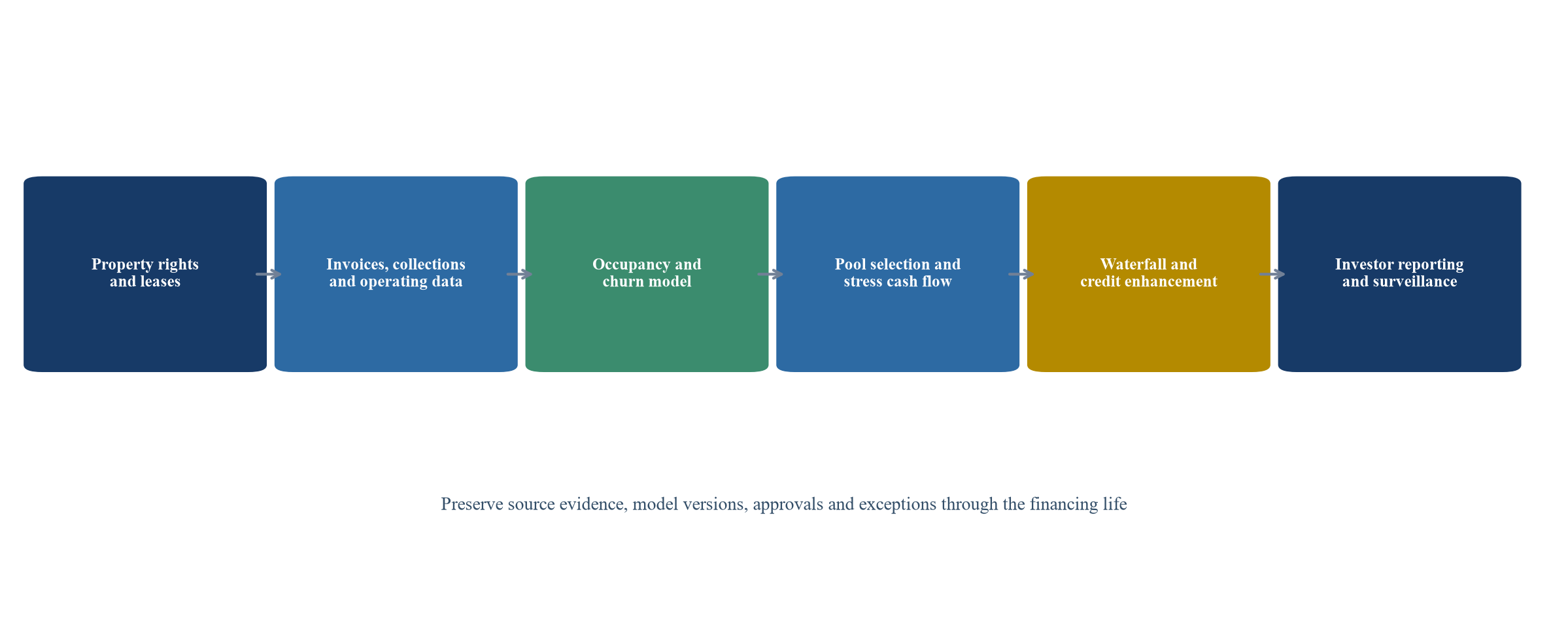
Financing conclusions depend on a governed chain from property rights and leases through collections, forecasts, structure and surveillance.
14. Estimate downtime and replacement cost
Tenant loss affects cash through vacancy, incentives, fit-out, brokerage, repairs, taxes, utilities, security and operating inefficiency. The model should estimate each component by unit type and market. A large fulfilment centre may have fewer replacement tenants and longer technical conversion than a standard distribution box. Cold storage, regulated goods and specialised automation can increase downtime and capital.
Historical downtime should be measured from economic cessation to recurring replacement cash, not merely from move-out to lease signing. Signed leases with lengthy conditions or fit-out periods still create funding gaps. The model should distinguish landlord works from tenant works and identify who bears delay risk.
Replacement rent should reflect market evidence and the unit’s condition, access, power, floor loading, clear height, fire systems and connectivity. A strong market average does not cure an asset-specific defect. Engineering and leasing professionals should validate the assumptions. The credit model should include cash reserves or enhancement for downtime and cost that cannot be absorbed by operating cash.
15. Build a transparent pool stratification
Pool stratification converts unit-level data into investor-relevant cohorts. Dimensions can include asset, city, corridor, tenant group, sector, lease expiry year, remaining term, rent-to-market, area, credit evidence, security support, occupancy state, payment status and predicted churn band. Each cohort should reconcile to the full pool.
Eligibility criteria can exclude disputed receivables, missing leases, related-party tenants, short residual terms, material arrears, non-transferable rights or assets with unresolved title and compliance matters. Concentration limits can prevent one tenant, asset or expiry period from dominating the pool. A breach should trigger substitution, additional support, amortisation or another documented response.
The stratification file should be reproducible at closing and each reporting date. Investors should be able to understand why the pool changed and how the change affects cash-flow risk. Artificial intelligence scores should appear with definitions, calibration date and performance evidence. A score without lineage or observed interpretation does not improve transparency.
16. Reconcile contracted rent to cash collection
Contracted rent should be bridged to invoices, collections and property net operating income. The bridge should show rent-free periods, step rents, escalation, turnover or variable rent, service charges, taxes, credits, arrears, bad debt, deposits applied and recoveries. Revenue recognition under accounting standards is not automatically the cash available to the waterfall.
Bank statements and controlled collection accounts provide stronger evidence than management summaries. Collections should be matched to tenant, invoice and period. Unallocated receipts, intercompany transfers and security deposits should remain separate. Persistent timing differences can signal administrative weakness or tenant stress.
The financing model should use a collection curve by tenant and scenario. Large tenants may pay reliably but create concentration. Smaller tenants may diversify exposure while adding servicing complexity. The structure should fund fees, taxes, essential operating costs and reserves before distributions according to the approved waterfall. Servicer reporting should explain every material variance from expected collection.
17. Rebuild property net operating income
Property net operating income should start with recurring collected rent and recoverable charges, then deduct property-level operating costs required to preserve service. These can include facility management, security, utilities, insurance, property tax, repairs, compliance, estate charges and non-recoverable common costs. Sponsor overhead and financing cost should remain separately identified.
Reported income may include one-off termination receipts, lease surrender payments, deposit releases, insurance proceeds or acquisition accounting effects. These items should not support recurring debt service without a clear structural reason. Conversely, deferred maintenance and underfunded operating costs can overstate earnings.
The model should reconcile each asset to audited or reviewed accounts and to cash. Asset-level allocations require consistent drivers. A portfolio can show stable aggregate income while one asset weakens. The surveillance system should preserve both levels so that deterioration is visible before portfolio covenants are breached.
18. Estimate lifecycle capital expenditure
Warehouse cash flow depends on roofs, floors, fire systems, docks, yards, drainage, power, automation interfaces and safety compliance. Routine repairs belong in operating cost; replacements and major upgrades require a lifecycle capital plan. Deferring expenditure can support short-term distributions while transferring risk to investors.
Engineering review should assess remaining useful life, defects, warranties, compliance and tenant obligations. The cash-flow model should time expenditure by asset and distinguish mandatory replacement, tenant-driven fit-out, efficiency investment and optional expansion. Capital funded by a tenant should not be assumed unless the contractual obligation and credit capacity are verified.
The structure can use funded reserves, cash traps or distribution tests to preserve capital. Reserve release should depend on completed work and evidence, not the passage of time alone. A warehouse pool with strong current occupancy can still require significant enhancement when roof, fire or automation expenditure coincides with lease expiries.
19. Separate asset value from receivable value
The property, lease receivable, loan exposure and equity interest are distinct assets. Their values respond differently to tenancy, market rent, legal rights, leverage and enforcement. A securitised debt investor may rely primarily on defined cash flows and enhancement, while a property lender also relies on collateral value. A REIT unit holder participates in property income and value under the trust framework.
IFRS 13 provides a framework for fair value measurement, IFRS 9 covers financial instruments, IFRS 7 addresses related disclosures and IAS 36 covers impairment of non-financial assets [11-14]. Indian accounting and tax treatment must be assessed under applicable law and standards. Transaction valuation, accounting recognition, regulatory capital and credit analysis are connected but separate tasks.
The committee should see a cash-flow value, collateral value and enforcement value under consistent scenarios. It should avoid using a property valuation multiple as direct proof of receivable performance. Time, cost and uncertainty of enforcement should enter recovery assumptions.
20. Define the special-purpose vehicle and true-sale questions
An asset transfer should be analysed for legal isolation, enforceability, perfection, commingling, set-off, insolvency and servicing continuity. The sponsor’s economic objective does not determine whether a transfer is a true sale. Qualified counsel should assess the documents, governing law, rights of investors and circumstances in which the assets could be challenged or consolidated.
The special-purpose vehicle should have limited objects, controlled accounts, independent governance and restrictions consistent with the selected structure. The transaction should identify who holds original documents, who can enforce leases or receivables, and how collections move if the servicer fails. Backup servicing should be operationally credible.
Representations should cover existence, ownership, eligibility, data accuracy, compliance and absence of undisclosed encumbrances. Breach remedies should match the risk and remain enforceable. Repurchase should not become an open-ended guarantee that changes the intended risk transfer or prudential treatment.
21. Design the payment waterfall
The waterfall converts collections into transaction payments in a defined order. It commonly provides for taxes and trustee costs, essential property or servicing expenses, senior interest, liquidity-reserve replenishment, senior principal, hedging, junior payments and residual distribution. The order should reflect legal priority and the cash needed to preserve assets and servicing.
Triggers can redirect cash when occupancy, debt-service coverage, arrears, concentration, reserve levels or servicer performance deteriorate. A trigger should use data that is timely, controlled and unambiguous. Cure conditions should prevent temporary cosmetic improvement from releasing trapped cash prematurely.
The model should test the waterfall monthly through the note term and any tail period. It should show interest shortfalls, principal timing, reserve draws, unpaid expenses and residual cash. Sequential and pro rata amortisation should be compared. The chosen mechanics should be understandable to investors and operationally executable by the trustee, servicer and account bank.
22. Size liquidity support
Liquidity support covers timing disruption rather than permanent credit loss. It can fund senior interest, essential expenses and taxes during collection delays, vacancy or servicer transition. The required amount depends on payment frequency, tenant concentration, collection timing, replacement period and trigger mechanics.
A fixed number of months of interest may be insufficient when a large tenant pays quarterly or when operating costs continue during vacancy. The model should test the largest plausible timing gap and correlated delays. Reserve funds, liquidity facilities and excess spread have different availability, cost and counterparty risks.
The structure should define permitted investments, account control, replenishment and release. A facility provided by the sponsor may weaken precisely when the portfolio is stressed. Counterparty eligibility and replacement provisions therefore matter. Liquidity should not be counted twice as credit enhancement and working capital.
23. Size credit enhancement
Credit enhancement absorbs permanent cash-flow loss and recovery shortfall. It can include subordination, overcollateralisation, cash reserve, excess spread, guarantees or a lower advance rate. Its size should follow portfolio risk, concentration, structural protections, recovery uncertainty and the desired resilience of each tranche.
The model should simulate tenant exits, rent reductions, downtime, capital expenditure, arrears, operating-cost inflation and refinancing. Enhancement should cover adverse paths rather than one deterministic loss estimate. A strong average occupancy forecast does not protect against a concentrated tenant failure early in the transaction.
Credit support should be clearly allocated. Security deposits and tenant guarantees are available only under their terms. Property equity supports recovery through enforcement and sale, with time and cost. Sponsor support should be documented and assessed for capacity. The transaction should avoid describing discretionary future support as committed enhancement.
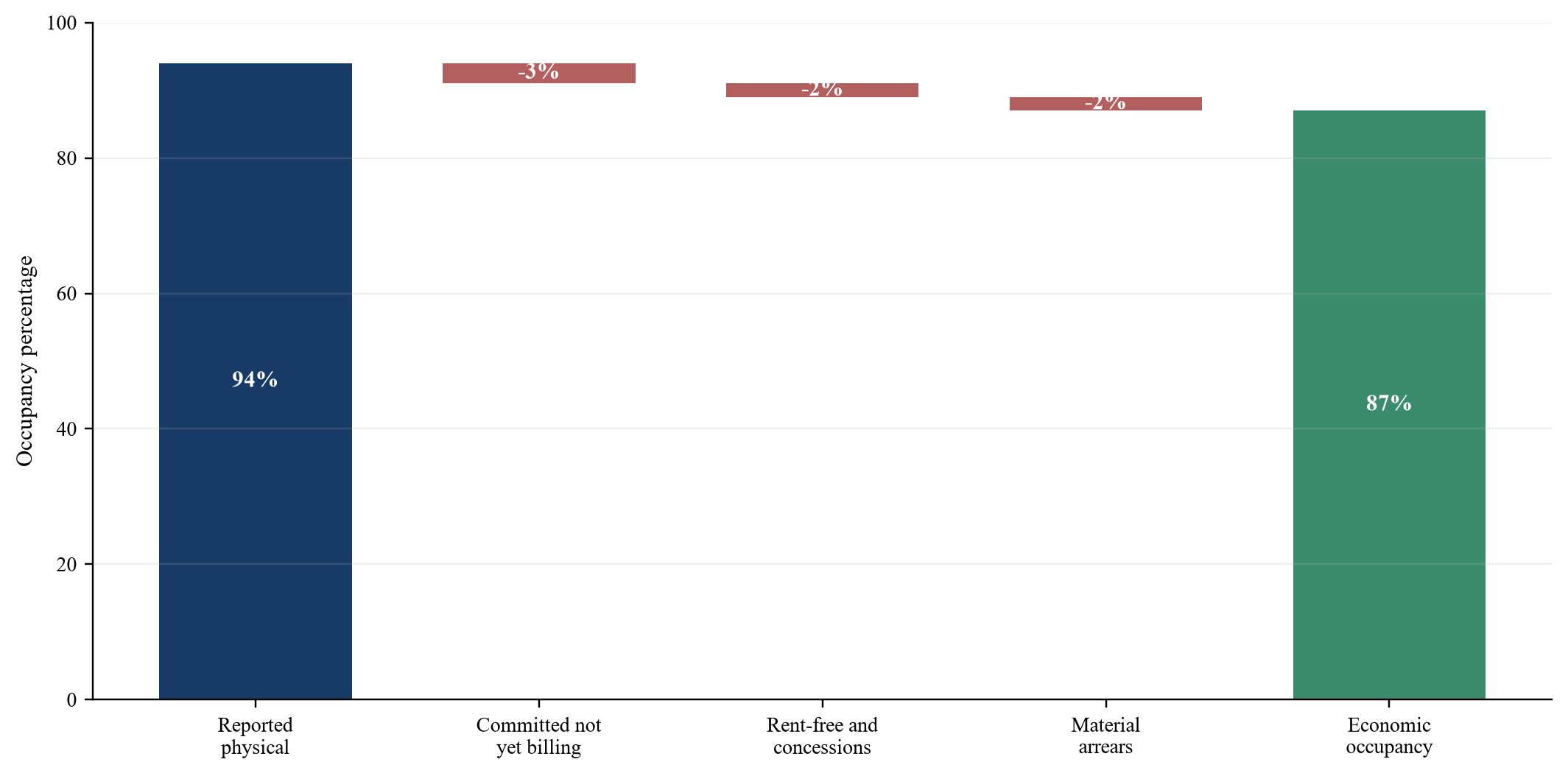
Percentages are management assumptions for the illustrative portfolio and are not observed company data.
24. Build central and downside scenarios
The central scenario should use calibrated renewal probabilities, observed collection, verified leasing pipeline, lifecycle capital and explicit market assumptions. It should remain a decision case rather than a promise. Downside scenarios should combine variables that can deteriorate together: tenant failure, slower replacement, lower rent, higher incentives, operating-cost inflation and tighter refinancing.
Named-tenant stresses are necessary where concentration is high. Geographic stresses can affect several assets through infrastructure, regulation or local demand. Sector stress can affect tenants across locations. Reverse stress testing identifies the combination that causes senior interest shortfall, principal loss or covenant breach.
Each scenario should show occupancy, collection, property net operating income, reserve draws, debt service and note balance over time. The committee should understand which assumption drives failure and which structural response changes the outcome. A scenario suite is useful when it informs advance rate, enhancement, triggers and eligibility; additional cases without decision relevance add false precision.
25. Link forecasts to pool selection
The forecast should affect the pool through controlled rules. A high churn probability can lead to exclusion, lower eligibility value, a concentration cap, additional enhancement or targeted monitoring. The response should consider lease economics and security rather than one score. A tenant with elevated churn risk may still support the pool if the unit is readily releasable and enhancement covers downtime.
Pool optimisation should respect constraints and remain explainable. An algorithm can search combinations of assets and receivables, but the approved result should show why each exposure is included and how concentrations change. It should not remove difficult assets merely to improve reported model performance if the financing objective requires a representative portfolio.
Substitution after closing should follow the same eligibility, representations and concentration tests. New receivables should not weaken the pool. A replenishment period, if permitted by the selected structure, requires transparent rules and surveillance. Regulatory criteria should be confirmed for the actual instrument [1,3-4].
26. Model the illustrative twelve-asset portfolio
Consider a hypothetical portfolio of twelve Grade A logistics assets across five Indian corridors. Management assumptions include 8.2 million square feet of gross leasable area, reported physical occupancy of 94 per cent, economic occupancy of 87 per cent, annualised contracted rent of INR 3.18 billion and reported property net operating income of INR 2.34 billion. The five largest tenant groups contribute 49 per cent of contracted rent.
The lease schedule places 31 per cent of rent at a decision point within three years. Unit-level analysis identifies committed space not yet billing, rent-free periods, material arrears and two tenant groups with overlapping sector exposure. The central forecast assumes weighted renewal of 72 per cent, median replacement downtime of nine months and recurring leasing cost equal to eight months of replacement rent.
Evidence adjustments reduce annual property net operating income by INR 0.29 billion to INR 2.05 billion. The largest adjustments relate to incentives, arrears, lifecycle maintenance and non-recoverable operating cost. All values are management assumptions created solely to demonstrate the framework.
| Cohort | Share of contracted rent | Economic occupancy | Rent at decision point within three years | Principal response |
|---|---|---|---|---|
| Top five tenant groups | 49% | 95% | 38% | Named-tenant stress and concentration support |
| Other large tenants | 24% | 90% | 29% | Credit and renewal monitoring |
| Mid-market tenants | 19% | 82% | 24% | Diversified eligibility and reserve |
| Small tenants and flex space | 8% | 71% | 46% | Higher haircut and servicing control |
| Portfolio | 100% | 87% | 31% | Combined waterfall and enhancement |
Values are management assumptions and do not describe an identified portfolio.
27. Reconcile maintainable cash flow
The hypothetical bridge begins with reported property net operating income of INR 2.34 billion. Rent-free and incentive normalisation reduces it by INR 0.09 billion. Collection and arrears adjustments reduce it by INR 0.06 billion. Lifecycle maintenance adds INR 0.08 billion of recurring cash need, and non-recoverable operating cost adds INR 0.06 billion. Maintainable property net operating income is therefore INR 2.05 billion.
This cash flow is tested before leverage. The financing model deducts trustee, servicing, hedging and transaction expenses according to the waterfall. Taxes and property obligations are treated under qualified advice. Cash not legally available to the special-purpose vehicle remains outside debt-service coverage.
The model also shows a separate upside case for leasing vacant units and improving collections. Upside does not support the base advance rate until evidence demonstrates delivery. Realised improvement can release cash or amortisation support through defined tests. This preserves an incentive for execution without requiring investors to fund the sponsor’s plan at closing.
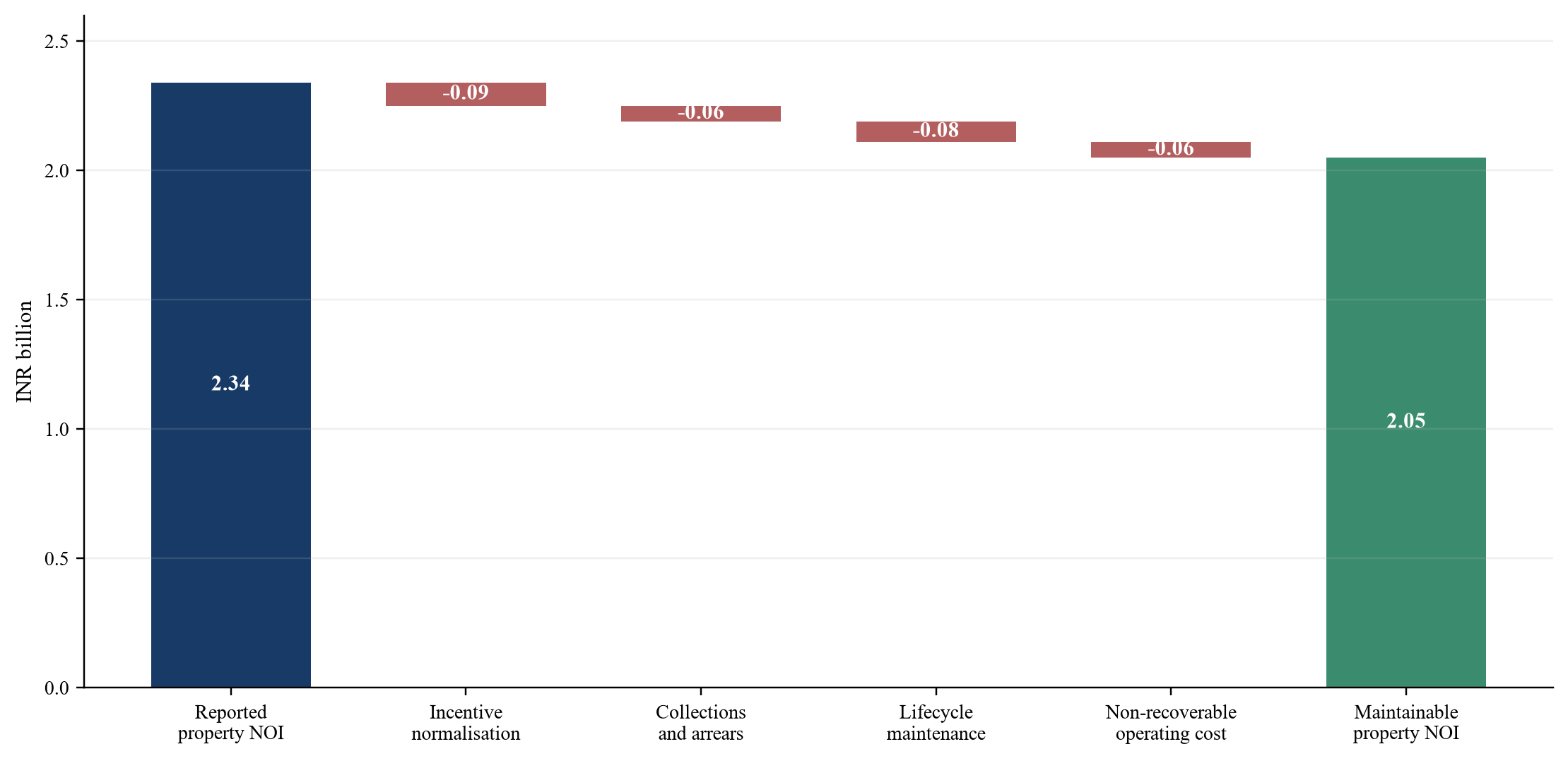
All amounts are management assumptions in INR billion and are not observed company data.
28. Structure the hypothetical notes
The illustrative structure uses an eligible cash-flow pool supported by property and contractual rights as determined by counsel. Total financing sources are INR 13.5 billion: a senior note of INR 10.6 billion, subordinated support of INR 2.15 billion and a funded liquidity reserve of INR 0.75 billion. The sponsor retains the residual exposure assumed by the structure.
Senior debt service is tested against maintainable cash after expenses and reserves. The central case maintains scheduled interest and amortisation. A named-tenant loss draws liquidity before replacement leasing restores collections. A correlated downside combining two tenant exits, lower replacement rent, twelve additional months of downtime and lifecycle capital traps cash and accelerates senior principal under the hypothetical trigger package.
The figures do not imply an executable capital structure. Pricing, tenor, enhancement, legal form, investor eligibility, prudential treatment and rating depend on verified data and current law. The purpose is to show how occupancy and churn evidence can influence advance rate, support and amortisation.
| Component | Amount | Function | Principal dependency |
|---|---|---|---|
| Senior note | 10.60 | Funded debt with priority payment | Cash-flow resilience and legal priority |
| Subordinated support | 2.15 | Absorbs loss before senior principal | Availability and enforceability |
| Liquidity reserve | 0.75 | Covers timing shortfalls and essential payments | Controlled account and replenishment |
| Total sources | 13.50 | Illustrative financing package | Final structure and qualified advice |
Amounts are management assumptions in INR billion; they are not an offer, rating or financing recommendation.
29. Test the waterfall under stress
The central case assumes economic occupancy remains between 85 and 89 per cent through the first three years, collections remain above 97 per cent of billed rent and replacement leasing follows calibrated downtime. The senior note amortises according to schedule and the liquidity reserve remains funded.
The tenant-loss case removes the largest tenant group at its first decision point, applies eighteen months of economic downtime, six months of rent-free replacement and a ten per cent reduction in replacement rent. The reserve funds timing gaps, cash is trapped, and senior principal receives accelerated payments before subordinate distributions resume.
The correlated-downside case combines two tenant exits, slower leasing across two corridors, operating-cost inflation and INR 0.45 billion of lifecycle capital. The hypothetical structure avoids senior interest loss through subordination, reserve and cash trapping, while senior principal extends into the tail. A more severe reverse stress creates principal loss. That boundary should be disclosed; enhancement cannot make the transaction immune to every outcome.
| Scenario | Lowest senior debt-service coverage | Liquidity-reserve use | Structural response |
|---|---|---|---|
| Central | 1.39x | None | Scheduled amortisation and ordinary surveillance |
| Largest-tenant loss | 1.08x | Partial draw | Cash trap and accelerated senior principal |
| Correlated downside | 0.91x | Material draw | Cash trap, extension into tail and subordinate loss absorption |
| Reverse stress | Below tested protection | Exhausted | Senior principal loss; transaction boundary disclosed |
Ratios and outcomes are management assumptions created to demonstrate the decision framework.
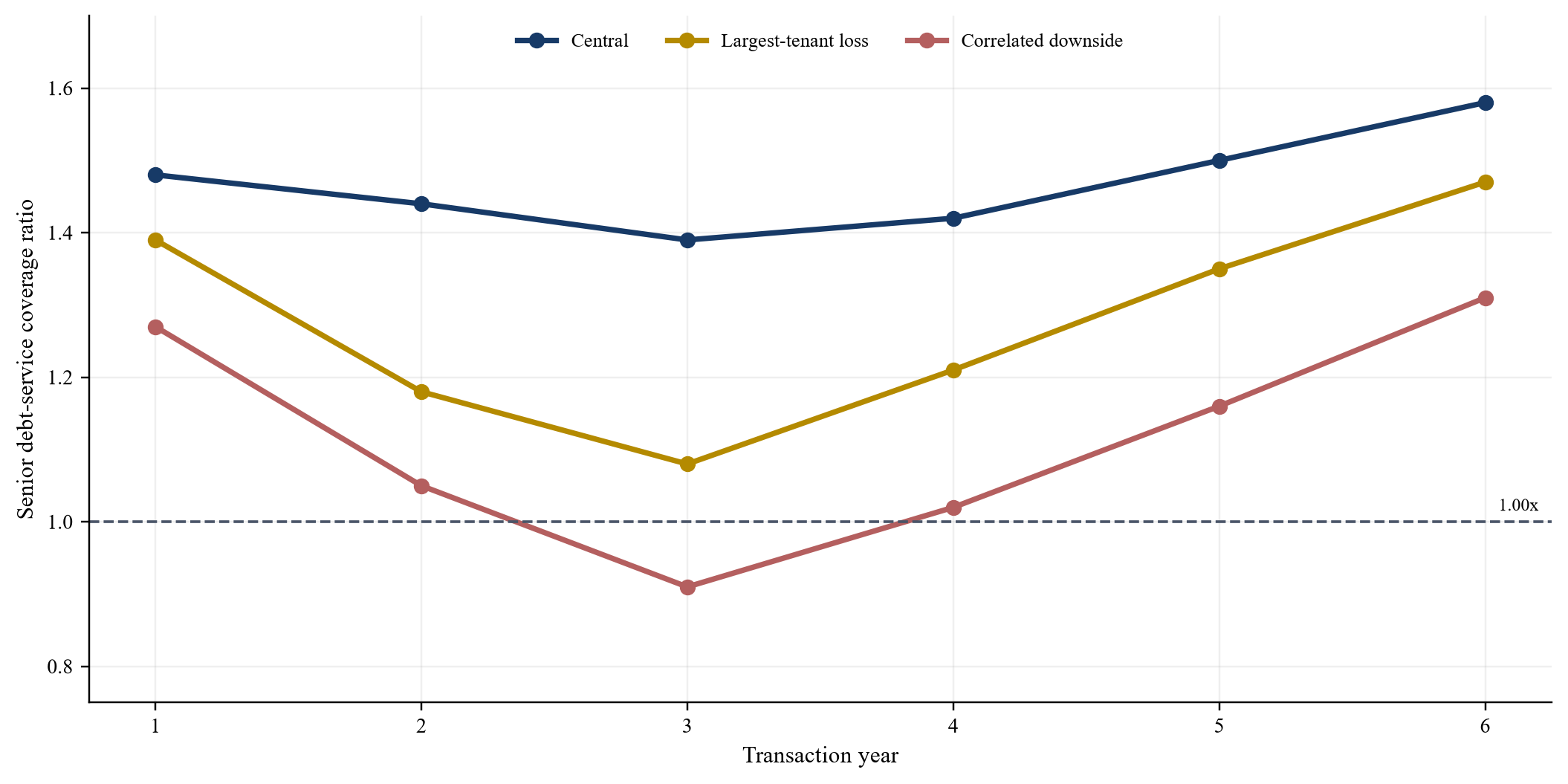
Ratios are management assumptions and demonstrate scenario comparison only.
30. Establish surveillance and triggers
Surveillance should refresh collections monthly and the occupancy and churn model at a frequency aligned with lease decisions. Core measures include economic occupancy, collections, arrears, weighted lease term, rent at decision point, tenant concentration, churn bands, leasing pipeline, downtime, lifecycle capital, reserve levels and debt-service coverage.
Trigger definitions should appear in transaction documents and servicing systems. Examples include occupancy below a threshold, adverse migration of a material tenant, concentration above a limit, reserve deficiency, data-quality failure, servicer breach and model performance outside tolerance. The response can include cash trapping, accelerated amortisation, additional reporting, independent review or replacement of the model.
Model monitoring should assess calibration, discrimination, stability, missingness and override rates. Drift can arise from changing tenant mix, new asset types or market conditions. A model that fails monitoring should not continue to determine eligibility without approved remediation. The governance body should retain authority to impose conservative treatment while validation is incomplete.
31. Protect data, systems and servicing continuity
The transaction depends on property-management, accounting, banking and model systems. Access rights, interfaces, vendor contracts, backups, cyber controls and incident response should be diligenced. CERT-In directions establish specified cyber incident and log-retention obligations for covered entities [18]. Applicability and implementation require specialist review.
Data processing should follow lawful purpose, minimisation and controlled access. Tenant and employee information should be separated from data needed for financing. Model-development copies should be governed and deleted according to approved retention. External providers should not reuse transaction data without authority.
A servicing-continuity plan should preserve invoicing, collection matching, reporting and enforcement if the sponsor or property manager fails. Data escrow, transition assistance, account control and backup servicer capability should be tested. A legal right to replace a servicer has limited value if the successor cannot obtain usable data and documents promptly.
32. Allocate governance and decision rights
The sponsor owns asset strategy and source data. The servicer owns billing, collection and reporting. The arranger structures the instrument. Counsel assesses legal and regulatory matters. Accountants advise on recognition and consolidation. Valuers assess property value. Engineers assess condition and capital. Model developers build forecasts, independent validators challenge them, and the credit committee approves their use.
Every material output should show data cut-off, model version, scenario, override, reviewer and approval. The credit committee should receive observed facts, professional assessments, management assumptions and unresolved gaps as separate categories. Overrides should state economic rationale, quantitative effect and expiry.
Changes to leases, assets, pool criteria, waterfall, model or reporting should pass through controlled governance. The transaction should retain the closing baseline so that realised performance can be compared with forecast. This creates accountability for both credit outcomes and operating improvement.
33. Recognise limitations
Occupancy and churn models are limited by data history, changing tenant behaviour, rare events, portfolio acquisitions, economic regime shifts and model design. A model can perform well in aggregate and fail on the tenant whose loss matters most. Forecast uncertainty rises when the portfolio contains new assets, bespoke facilities or concentrated sectors.
The framework does not determine whether a proposed transfer satisfies RBI or SEBI rules, whether a trust qualifies as a REIT, whether legal isolation is achieved, or how the transaction should be taxed or accounted for. Those conclusions require current qualified advice and transaction-specific evidence. It does not replace property valuation, engineering, credit rating, legal diligence, privacy review or investor suitability assessment.
The illustrative portfolio, cash flows, notes, enhancement and scenarios are hypothetical. They should not be applied to an identified company or asset without verification. Commercial demand for a financing mandate and any resulting fees remain unverified until supported by executed and paid engagement evidence.
34. Conclude the financing case
Warehouse securitisation begins with legally defined cash flows and a controlled operating record. Headline occupancy is insufficient. The financier needs to understand which space generates recurring cash, which tenants can change that cash, how long replacement takes, what capital preserves the assets and how collections enter the waterfall.
An interpretable occupancy and tenant-churn model can improve pool selection, stress design and surveillance. Its value comes from audited definitions, time-consistent data, calibration, scenario discipline and governance. The model should direct attention and quantify uncertainty. Credit enhancement, reserves, triggers and legal protections carry the risk that remains.
The transaction should proceed when the sponsor and investors can reconcile property rights, leases, collections, maintainable income, lifecycle capital, pool eligibility, enhancement and servicing continuity. The structure should remain resilient under named-tenant and correlated downside scenarios. Reporting should allow investors to see deterioration early and understand the response.
Sources
- Reserve Bank of India, Master Direction - Reserve Bank of India (Securitisation of Standard Assets) Directions, 2021, updated 5 December 2022. Read the primary source
- Reserve Bank of India, Master Direction - Transfer of Loan Exposures Directions, 2021. Read the primary source
- Securities and Exchange Board of India, Issue and Listing of Securitised Debt Instruments and Security Receipts Regulations, 2008, last amended 6 July 2026. Read the primary source
- Securities and Exchange Board of India, Master Circular for issue and listing of Non-convertible Securities, Securitised Debt Instruments, Security Receipts, Municipal Debt Securities and Commercial Paper, 15 October 2025. Read the primary source
- Securities and Exchange Board of India, Master Circular for Real Estate Investment Trusts, 11 July 2025. Read the primary source
- Securities and Exchange Board of India, Real Estate Investment Trusts Regulations, 2014. Read the primary source
- Government of India, National Logistics Policy. Read the primary source
- National Industrial Corridor Development Corporation, Unified Logistics Interface Platform. Read the primary source
- Department for Promotion of Industry and Internal Trade, Logistics Ease Across Different States. Read the primary source
- World Bank, Connecting to Compete 2023: Trade Logistics in an Uncertain Global Economy. Read the primary source
- IFRS Foundation, IFRS 9 Financial Instruments. Read the primary source
- IFRS Foundation, IFRS 13 Fair Value Measurement. Read the primary source
- IFRS Foundation, IAS 36 Impairment of Assets. Read the primary source
- IFRS Foundation, IFRS 7 Financial Instruments: Disclosures. Read the primary source
- National Institute of Standards and Technology, Artificial Intelligence Risk Management Framework 1.0. Read the primary source
- National Institute of Standards and Technology, AI RMF Core. Read the primary source
- Government of India, Digital Personal Data Protection Act 2023. Read the primary source
- Indian Computer Emergency Response Team, Directions relating to information security practices, procedure, prevention, response and reporting of cyber incidents. Read the primary source
- Basel Committee on Banking Supervision, Revisions to the securitisation framework. Read the primary source
- Basel Committee on Banking Supervision and IOSCO, Criteria for identifying simple, transparent and comparable securitisations. Read the primary source
- International Organization of Securities Commissions, Securitisation and structured finance. Read the primary source
- Royal Institution of Chartered Surveyors, RICS Valuation - Global Standards. Read the primary source
- Warehousing Development and Regulatory Authority, Electronic Negotiable Warehouse Receipt System. Read the primary source
- National Stock Exchange of India, Securitised Debt Instruments. Read the primary source
