

1. Define the financing decision
The central decision is whether a proposed shipping facility can be repaid through resilient operating cash flow while preserving safe operation and recoverable collateral value. The credit paper should specify borrower, vessel-owning entities, fleet perimeter, flags, classes, trades, charters, requested amount, tenor, repayment profile, security, currency and intended use of proceeds. A refinancing, acquisition facility, construction facility and working-capital line require different evidence and remedies.
The framework in this paper supports senior secured term debt against operating vessels. It does not replace legal, technical, insurance, tax, sanctions, environmental, valuation or accounting diligence. Qualified specialists must determine actual compliance and enforceability in each jurisdiction. The lender retains responsibility for credit approval, and the vessel owner retains responsibility for safe operation.
Five questions organise the decision. Can the vessels operate safely and reliably? Do voyages generate adequate contribution after fuel, port, charter and maintenance costs? Can the fleet remain commercially usable as emissions rules and customer requirements tighten? Does collateral value protect the lender under realistic sale conditions? Do cash flow and liquidity cover debt service through plausible disruption? Each analytical output should resolve into a financing term or a documented reason for taking no action.
2. Use an evidence hierarchy
Operational data varies in authority. Statutory certificates, class status, survey reports, machinery records, logbooks, audited financial statements, bank statements, executed charters, invoices and independent valuations should anchor the analysis. Sensor feeds, vendor dashboards and analytical models can add timeliness and granularity, yet they need reconciliation to those source records.
The lender should classify evidence as authoritative record, independently verified record, management record, model output or management assumption. Conflicts require resolution rather than averaging. A health score that indicates normal machinery cannot override an overdue class condition. A voyage dashboard cannot replace an executed charter, bunker invoice or port disbursement account. A high valuation cannot cure weak debt-service capacity.
Every material metric should have a data owner, calculation owner, approval owner, source, refresh frequency and control. The lender should know which fields are generated aboard the vessel, transmitted ashore, enriched by vendors, adjusted by management and used in the borrowing-base or covenant calculation. This hierarchy converts a large data lake into a limited set of decision-grade evidence.
3. Map the Southeast Asian operating context
Southeast Asian shipping combines dense port networks, archipelagic trades, transshipment hubs, shallow or constrained berths, monsoon exposure, congestion, diverse fuel availability and varied regulatory capacity. A regional fleet may call at Singapore, Malaysia, Indonesia, Thailand, Viet Nam and the Philippines while owning entities, financing banks, insurers, charterers and technical managers sit in different jurisdictions.
The operating map should identify every material route, port pair, cargo profile, sailing frequency, canal or strait dependency, seasonal pattern, weather exposure and alternative port. Route economics can change through port delay, berth productivity, draft restrictions, pilotage, bunker availability, cargo imbalance or container repositioning. A single fleet-wide average hides these differences.
The legal map should identify flag, registered owner, bareboat or time charter, mortgage jurisdiction, earnings account, insurance jurisdiction, technical manager, crewing company and charter counterparty. Maritime liens, arrest rights, insolvency, security enforcement and foreign-exchange controls require transaction-specific advice. The analysis should treat regional diversity as a financing input rather than a generic country premium.
4. Establish the vessel and entity perimeter
The lender should reconcile vessel identity across IMO number, registry, class, insurance, mortgage, management system and accounting ledger. Each vessel row should state type, capacity, build year, yard, engine, flag, class, ownership, charter status, trade, market value, debt allocation and material encumbrances. Sister vessels can still have different condition, employment and value.
The entity perimeter should show vessel-owning special-purpose companies, holding companies, operating companies, managers, charterers and guarantors. Intercompany charter, management, treasury and cost-sharing arrangements affect cash flow and security. Earnings collected outside the secured group or costs paid by an unsupported affiliate can weaken the lender’s control over repayment.
The security package may include first-ranking mortgages, assignments of earnings and insurances, account charges, share pledges, guarantees and covenants. Counsel must confirm creation, perfection, priority and enforcement. Operational analytics should map to the same vessel and entity perimeter; otherwise the lender may monitor one asset while lending against another.
| Evidence layer | Core records | Analytical output | Financing use |
|---|---|---|---|
| Vessel health | Class, surveys, planned maintenance, defects, sensor history | Condition trend and intervention window | Drawdown condition, reserve, inspection or repair plan |
| Voyage margin | Charters, bills, port accounts, bunker invoices, route data | Contribution by voyage and route | Debt sizing, cash sweep and downside case |
| Emissions pathway | Fuel records, IMO DCS, CII, SEEMP, retrofit plan | Compliance and cost trajectory | Capex reserve, reporting covenant and tenor limit |
| Collateral value | Independent valuation, sale evidence, class and employment | Current and stressed net recovery | Loan-to-value, amortisation and additional security |
| Debt profile | Facility terms, interest, fees, liquidity and hedging | DSCR, liquidity runway and maturity exposure | Pricing, repayment, reserve and covenant package |
Actual facility terms require transaction-specific credit, legal and technical approval.
5. Build a controlled maritime data contract
The financing parties should agree a data contract before relying on analytics. It should define source systems, fields, units, timestamps, time zones, vessel identifiers, retention, permitted use, access rights, quality rules, refresh cycles and exception handling. Data collected through a technical manager or equipment vendor may be subject to contractual restrictions.
Lineage should trace each reported metric to the original event. A main-engine vibration alert should link to sensor, sampling frequency, equipment tag, calibration, algorithm version, maintenance record and engineer disposition. A voyage margin should link to cargo or charter revenue, bunker consumption, bunker price, port cost, commission, canal cost and time allocation. A carbon metric should state method, fuel factors, distance and transport-work denominator.
The contract should address outages and substitutions. A missing feed must not be silently imputed into a covenant. Management should disclose loss of data, estimate the affected period under a documented method and obtain approval for its use. Persistent failure can trigger inspection or reporting remedies. The objective is reproducibility, not continuous surveillance for its own sake.
6. Create the vessel health score
The proposed vessel health score combines independent status and operating evidence. Components can include class conditions and recommendations, overdue maintenance, machinery alarms, lubricant analysis, vibration trends, temperature and pressure deviations, unplanned downtime, critical spares, defect recurrence and dry-dock progress. Safety-critical items should remain visible rather than disappearing inside an average.
A score should use bounded rules and documented weights. The lender should test sensitivity to missing data and false alerts. Thresholds should be calibrated against actual failures, inspections and maintenance outcomes for comparable equipment. A vendor’s generic model can support triage, but it should not determine seaworthiness or class compliance.
The practical output is a watchlist with evidence and action. Green can mean no identified variance requiring lender action. Amber can require chief-engineer review, targeted inspection or accelerated maintenance. Red can require an independent survey, repair plan, reserve draw restriction or other facility response. Every escalation needs a responsible human decision-maker and a recorded disposition.
7. Validate predictive-maintenance models
Predictive maintenance estimates the probability or timing of equipment degradation from patterns in sensor and maintenance data. Validation should ask whether the training population resembles the financed vessels, whether failure labels are reliable, whether maintenance changes the observed outcome and whether the model remains stable after overhaul, software update or operating-profile change.
Performance should be measured in decision terms. Precision indicates how many alerts were useful; recall indicates how many relevant failures were identified; lead time indicates whether the crew could act; false-alarm burden indicates whether the process remains operationally credible. A model with high statistical accuracy can still be unusable if it alerts after the intervention window or overwhelms engineers.
The validation file should contain model purpose, version, inputs, exclusions, test results, threshold rationale, known limitations, override process and monitoring plan. Independent technical advisers can test whether the output is consistent with machinery evidence. Credit staff should translate validated results into cash-flow and covenant implications without making engineering judgements outside their competence.
8. Keep human authority explicit
The master and chief engineer retain operational authority under applicable law, company procedures and the safety-management system. The IMO’s International Safety Management Code requires companies to assess identified risks and establish safeguards [4]. A lender dashboard should support that process, not direct navigation, machinery operation or safety-critical maintenance.
The governance matrix should identify who can acknowledge an alert, defer maintenance, approve a repair, release a reserve, amend a budget and waive a covenant. Model overrides should state reason, evidence, approver and expiry. Repeated overrides can reveal poor model calibration, inadequate resources or weak control and should be reviewed.
The lender should receive the outcome needed for credit monitoring, together with sufficient evidence to understand material changes. Continuous raw-data access may create cyber, privacy, contractual and liability issues without improving decisions. Proportionate reporting can combine exceptions, trend summaries, independent confirmation and access rights for a defined review.
9. Link maintenance to liquidity
Maintenance expenditure is economically different from discretionary growth capital. Deferring critical maintenance can temporarily improve cash while increasing failure, off-hire, safety and collateral risk. The forecast should separate routine maintenance, critical spares, class work, dry docking, mandatory retrofit and optional efficiency investment.
Each major item should have expected timing, cost range, contingency, yard window, off-hire days and funding source. Predictive signals can update timing, but the base plan should remain anchored to class, manufacturer and management requirements. The cash model should recognise that early intervention may reduce total loss while accelerating near-term cash need.
A maintenance reserve can be funded monthly, at drawdown or through a cash sweep. Release should require approved invoices, technical confirmation and no material default. The reserve should not substitute for adequate operating liquidity. A facility that captures all surplus cash can prevent the borrower from completing the maintenance that protects the lender’s collateral.
10. Construct voyage-level economics
Voyage analysis should begin with the contractual earning model. Time charter, voyage charter, contract of affreightment and liner operations allocate revenue, fuel, port and operating risks differently. The model should capture the actual party responsible for bunker cost, route choice, waiting time, cargo handling and emissions-related charges.
For each voyage or service loop, contribution equals earned revenue less bunker, port, canal, cargo-handling, commission, voyage-specific crew or service costs, and an appropriate time cost. Off-hire, ballast legs, repositioning and empty containers should be visible. Reported revenue without consumed time can overstate the economics of a delayed voyage.
The lender should reconcile voyage results to the general ledger and cash accounts. Timing differences, accruals and allocations should be documented. The objective is a forward-looking route model grounded in historical evidence, not a second unaudited accounting system.
11. Normalise route and port performance
Route performance should be segmented by port pair, vessel, season, cargo and charter arrangement. Median and percentile results are often more informative than a simple average because disruption is asymmetric. Weather, congestion, berth productivity, draft restrictions and port closure can affect time and fuel together.
The baseline should exclude or separately identify one-off items only when evidence supports that treatment. Recurring typhoon delays, monsoon effects or congestion belong in expected performance. A port call that appears exceptional every quarter is part of the operating model.
Voyage analytics can estimate schedule reliability, port-time distribution, fuel per nautical mile, speed, idle consumption and margin per vessel-day. These metrics should feed downside scenarios and operational improvement plans. They should also reveal when a commercially attractive route imposes maintenance or carbon costs that are absent from the headline rate.
12. Model fuel and bunker risk
Fuel exposure depends on consumption, speed, weather, hull condition, engine efficiency, fuel grade, purchase timing, port availability and contractual pass-through. The model should reconcile bunker deliveries, tank measurements, voyage consumption and invoices. Material unexplained differences require investigation.
Scenario analysis should vary both price and consumption. A higher price can coincide with route disruption or scarce compliant fuel. Slow steaming may reduce daily consumption while increasing voyage duration and reducing capacity. Hull fouling can raise consumption and also signal maintenance need. The model should represent these interactions.
Hedging, bunker-adjustment factors and customer pass-through should be assessed from executed terms. A theoretical right to reprice has limited value if it operates with a lag, cap or customer-discretion condition. The lender should size liquidity for timing mismatches even when full economic pass-through is expected.
13. Integrate weather and route uncertainty
Weather-routing systems can reduce fuel or improve safety by selecting speed and path within operational constraints. Finance models should treat their output as a distribution rather than a guaranteed saving. Historical back-testing should compare planned and actual route, weather, arrival, fuel and safety constraints.
The downside case should include adverse weather, congestion, missed berth windows, cargo delay and diversion. Correlated disruption matters because several vessels can be affected by the same regional event. The borrower’s alternative-port, spare-capacity and customer-communication plans influence cash recovery.
Lenders should avoid incentives that encourage unsafe speed or routing decisions to protect a covenant. Loan documentation can define financial reporting and notification while preserving the master’s authority. Safety-related delay should be recorded transparently and assessed with technical evidence.
14. Measure emissions performance
IMO requirements make emissions data financially relevant. Ships of 400 gross tonnage and above are subject to EEXI requirements, while ships of 5,000 gross tonnage and above calculate and report annual operational CII [1-3]. A ship rated E, or D for three consecutive years, must implement corrective action under the applicable framework [3].
The lender should reconcile fuel consumption, distance, capacity, transport work and reported CII. Ratings should be analysed by vessel and year, with management’s corrective plan and cost. An improving fleet average can conceal one vessel approaching commercial or regulatory constraints.
Emissions performance affects fuel cost, retrofit need, charter attractiveness, financing appetite and residual value. The Poseidon Principles provide a climate-alignment framework used by participating financial institutions and report 35 signatories in the 2025 disclosure [12]. A non-signatory lender can still use comparable evidence while defining its own policy and approval standards.
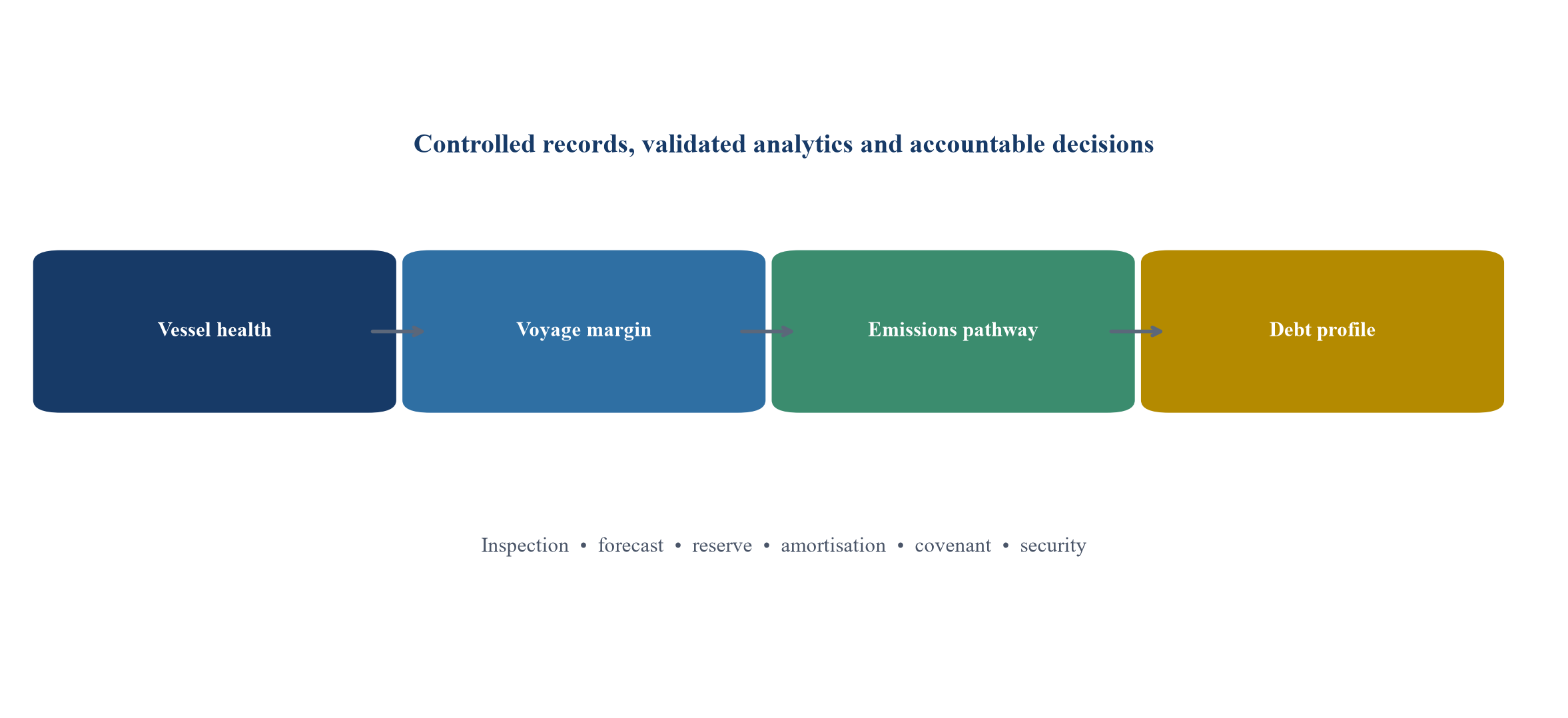
The architecture is a decision framework and does not represent an identified borrower or fleet.
15. Build the emissions pathway
The emissions pathway should identify each vessel’s current technical and operational position, expected rating trajectory, planned measures, cost, timing, downtime and remaining economic life. Measures can include hull and propeller treatment, engine tuning, energy-saving devices, voyage optimisation, speed management, shore power or fuel transition.
Management should distinguish committed regulation from policy direction and commercial preference. The IMO’s 2023 strategy aims for net-zero greenhouse-gas emissions from international shipping by or around 2050 and sets interim ambitions [1-2]. Scenario planning should reflect uncertainty in future measures, fuels, infrastructure and cost.
Financing terms can align with a credible pathway through reporting, capex reserves, permitted-debt controls and maturity. A long tenor against a vessel requiring uncertain retrofit can create refinancing risk. A short tenor can also concentrate risk if the balloon falls due before the investment produces value. The chosen structure should match evidence and remaining flexibility.
16. Value vessels under operational evidence
Independent ship valuations commonly use market evidence and vessel characteristics. The lender should provide the valuer with accurate class, condition, employment and specification information and should understand assumptions regarding charter-free or charter-attached value. Analytics can identify questions for the valuer, but cannot replace an independent valuation.
The collateral case should consider age, yard, type, size, engine, class, survey position, emissions performance, technical condition, charter, location, liquidity and sale costs. A forced or time-constrained sale can differ materially from an orderly market transaction. Net recovery should deduct enforcement, arrest, preservation, crewing, fuel, port, legal, broker and sale costs.
Valuation should be refreshed on a defined schedule and after material events. A health alert, class suspension, casualty, prolonged off-hire or regulatory impairment can justify an earlier review. Loan-to-value remedies should allow time for evidence and cure while protecting the lender against genuine deterioration.
17. Connect health to residual value
Maintenance condition affects value through immediate repair cost, off-hire, buyer uncertainty and remaining life. The credit model should translate a health issue into explicit cash-flow and valuation effects rather than applying an opaque score discount. For example, a deteriorating turbocharger can create inspection cost, planned replacement, off-hire and a contingency for consequential damage.
The lender should distinguish reversible and structural deterioration. A funded repair with confirmed completion can restore condition. Chronic corrosion, obsolete machinery, unavailable spares or repeated defects may reduce long-term value. Technical advisers and valuers should assess the implications within their respective roles.
This bridge supports proportionate remedies. A temporary anomaly may require monitoring. A confirmed defect can require a reserve or repair. A condition that materially reduces saleability can affect loan-to-value, amortisation or eligibility. The response should follow verified impact rather than the emotional colour of a dashboard alert.
18. Reconstruct maintainable cash flow
Maintainable EBITDA should be rebuilt from vessel and voyage economics. Revenue should be supported by executed employment and realistic utilisation. Costs should include crew, stores, insurance, management, repairs, maintenance, dry docking, class, communications, agency, overhead and environmental compliance. Related-party charges require arm’s-length review.
The model should separate cash maintenance from accounting depreciation and one-off repair. It should also distinguish owner and charterer costs. Capitalised expenditure still consumes cash and can be essential to continued service. A debt model based only on reported EBITDA can overstate repayment capacity.
Working capital, tax, interest, mandatory capex and reserves should bridge EBITDA to cash available for debt service. The base case should reflect demonstrated performance and approved actions. Upside from uncontracted rates, unproven fuel savings or future asset sales belongs in a separate case.
19. Design the downside cases
Shipping risks interact. The lender should test correlated cases rather than isolated sensitivities. A weak charter market can reduce utilisation and vessel values together. Machinery failure can create off-hire, repair cost and customer penalties. Higher fuel price can coincide with congestion and slower cash conversion.
At minimum, scenarios should vary rate, utilisation, voyage duration, fuel price, fuel consumption, port cost, off-hire, maintenance, interest, foreign exchange, carbon cost and residual value. The model should show minimum liquidity, debt-service coverage, loan-to-value, reserve balance and covenant headroom by period.
Scenario severity should be explained with historical, contractual or policy evidence where available. Management assumptions should remain visible. A severe but implausible combination can obscure the risks that actually drive structure. Reverse stress testing can identify the combination that exhausts liquidity or breaches debt service, then assess whether early-warning indicators provide sufficient response time.
| Assumption | Base case | Downside | Severe case |
|---|---|---|---|
| Fleet market value | USD 248m | USD 211m | USD 174m |
| Requested senior debt | USD 155m | USD 155m | USD 155m |
| Annual revenue | USD 118m | USD 103m | USD 88m |
| Normalised EBITDA | USD 31m | USD 22m | USD 12m |
| Scheduled maintenance cash | USD 8.4m | USD 10.6m | USD 14.2m |
| Aggregate off-hire | 84 days | 156 days | 260 days |
| Initial debt-service reserve | USD 9m | USD 9m | USD 9m |
| Illustrative interest rate | 7.25% | 8.00% | 9.00% |
All values are hypothetical management assumptions for demonstrating the framework; they are not observed market or company data.
20. Size debt from two constraints
Debt should be sized against both cash-flow capacity and collateral recovery. The lower result should govern, subject to liquidity and policy limits. Cash-flow capacity depends on sustainable earnings, maintenance and debt-service assumptions. Collateral capacity depends on eligible value, advance rate and net recovery.
The illustrative fleet requests USD 155 million against USD 248 million of fleet market value, an initial gross loan-to-value of 62.5%. That ratio does not establish safety. Under the severe assumed value of USD 174 million, gross loan-to-value rises to 89.1% before enforcement and sale costs. The structure therefore needs amortisation, value monitoring and liquidity protection.
Cash flow can constrain debt sooner. A fleet with strong current values but volatile employment may not support scheduled service. Conversely, contracted cash flow cannot eliminate technical or residual-value risk. The lender should document which constraint binds at closing and under each scenario.
21. Shape amortisation to the asset
Amortisation should reflect expected cash generation, vessel age, survey cycle, charter profile and residual value. Straight-line repayment is simple but can misalign with seasonal earnings or major maintenance. Sculpted repayment can match cash flow while increasing model dependence. A balloon can support affordability while concentrating refinancing risk.
The debt profile should remain viable after required maintenance and reserves. A repayment holiday that coincides with dry docking may protect liquidity. It should be compensated through later amortisation or lower opening leverage rather than relying on a larger balloon without evidence.
The lender can use excess-cash sweeps, disposal prepayments and value-triggered amortisation to accelerate deleveraging. Definitions should prevent cash leakage while allowing safe operation. Any cash sweep should operate after agreed maintenance, tax, working-capital and reserve needs.
22. Design maintenance and debt-service reserves
The maintenance reserve should be linked to an approved schedule and updated condition evidence. It can be funded through closing cash, periodic deposits or controlled retention from earnings. The lender should define eligible costs, release evidence, contingency use and replenishment.
The debt-service reserve protects against temporary cash disruption. Its amount can be expressed as months of scheduled principal and interest. Release and replenishment rules should reflect the facility’s risk. A reserve that can be freely distributed does not provide protection; a reserve that cannot fund an actual shortfall may be equally ineffective.
Separate accounts can improve transparency, but account control and local-law enforceability require advice. The lender should avoid double counting the same cash as operating liquidity, maintenance funding and debt-service protection. Each dollar should have a defined purpose and priority.
23. Convert analytics into covenants
Financial covenants can include minimum debt-service coverage, maximum loan-to-value, minimum liquidity and leverage where appropriate. Operational covenants can require class maintenance, insurance, regulatory compliance, approved management, reporting, vessel employment limits and notice of material casualty or off-hire.
Analytical metrics should generally trigger verification before default. A sustained health-score deterioration can require an independent inspection. A route-margin decline can require an updated forecast. A worsening emissions pathway can require a remediation plan and funded capex. This staged design reduces false-positive defaults while creating early action.
Hard covenant thresholds should use objective, reproducible definitions. The facility should state data sources, calculation periods, permitted adjustments and dispute process. Model vendors should not have unilateral power to change the borrower’s obligations through an algorithm update.
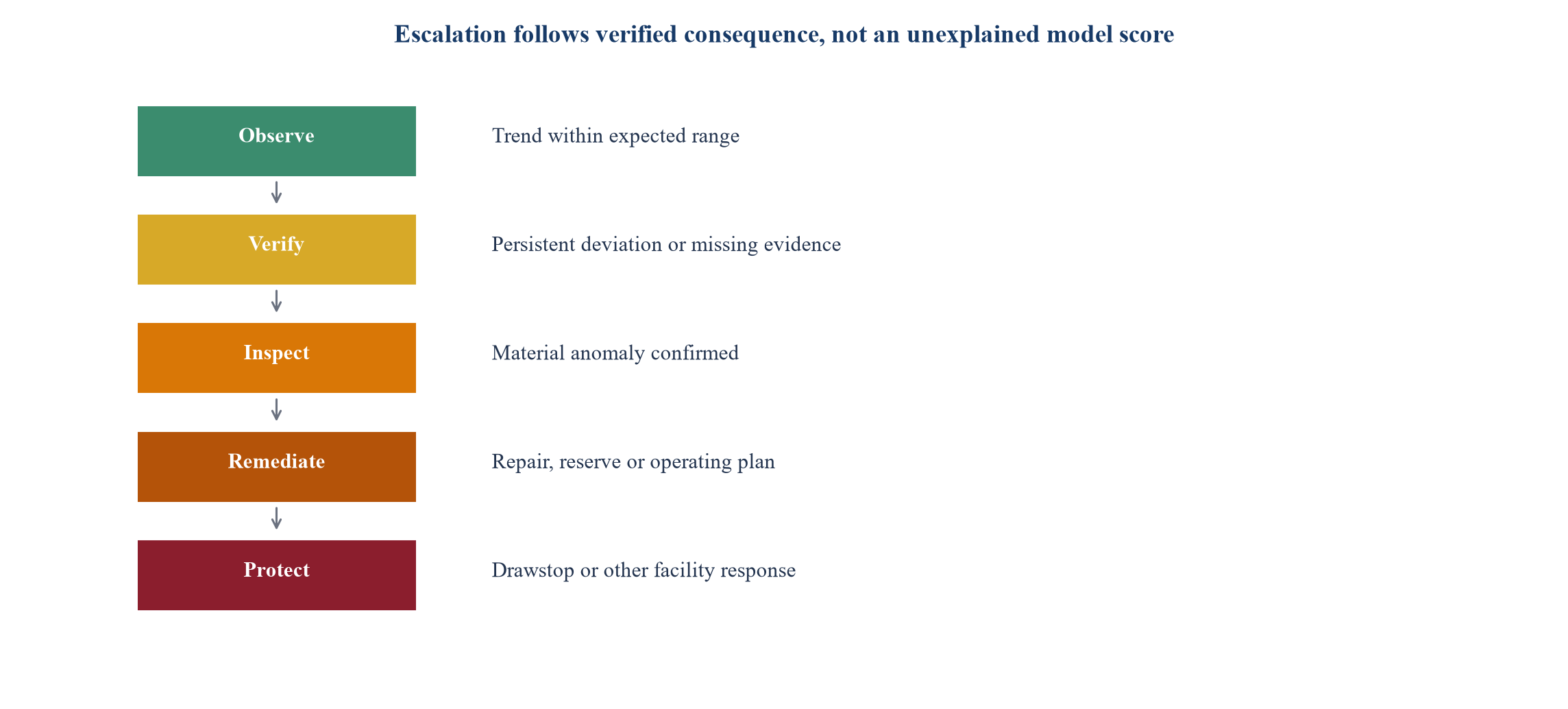
Thresholds and actions are illustrative; actual responses require technical, legal and credit approval.
24. Define information undertakings
The borrower should provide periodic financial statements, fleet operating reports, class status, insurance evidence, charter schedule, off-hire, maintenance, reserve, emissions and covenant calculations. Material events should be reported promptly under defined thresholds.
The analytical pack should focus on decisions. It can include vessel health status, unresolved alerts, maintenance variance, route contribution, schedule reliability, fuel variance, CII status, liquidity, debt service and collateral headroom. A large unfiltered data export can hide more than it reveals.
The lender should retain audit and inspection rights proportionate to the facility. Access should protect personal data, cyber security, customer confidentiality and safe vessel operation. Independent experts should be bound by appropriate confidentiality and competence requirements.
25. Address cyber and data integrity
Connected vessels and shore systems create cyber risk. The IMO identifies maritime cyber risk management as part of safety-management expectations [4]. A compromise can alter availability, confidentiality or integrity of operational data and can also disrupt voyage execution.
The financing data flow should use controlled identities, encryption, logging, backup, vendor oversight and incident response. The lender should not create a direct connection that weakens vessel or shore security. Reports can be delivered through a segregated environment with approved extracts.
Data-integrity controls should identify impossible values, timestamp gaps, duplicate records, manual changes and sensor calibration issues. Material corrections require an audit trail. A covenant calculation should preserve the exact input set and model version used at the reporting date.
26. Use AI within a controlled decision process
Machine learning can detect anomaly patterns, forecast fuel use, estimate arrival time or classify maintenance records. Its use should begin with a clear decision, accountable owner and measurable performance. A model that cannot improve inspection timing, forecast accuracy or resource allocation adds complexity without financing value.
Training data can reflect particular vessel classes, engines, routes and maintenance practices. Transfer to another fleet requires validation. Drift monitoring should test whether performance changes as equipment ages, routes shift or new fuels are introduced. Material model changes should follow approval and version control.
Human reviewers should see relevant evidence and known limitations. The system should support challenge, override and escalation. Credit approval should rely on the complete evidence set, including factors the model does not observe.
27. Structure the cash waterfall
The secured cash waterfall should identify earnings collection, operating costs, taxes, maintenance, reserves, debt service, permitted capex and distributions. It should reflect local-law account-control and insolvency considerations. Cash needed for safe operation should remain available under defined controls.
Voyage receipts can be volatile and arrive in different currencies. The model should reflect collection timing, deductions, agent balances and charterer credit. Currency and interest hedging should match actual exposure and documentation. A hedge can reduce volatility while creating collateral or break-cost obligations.
Distribution tests should combine no default, covenant compliance, funded reserves, minimum liquidity and forward maintenance. A historic test alone can permit a distribution immediately before a major cash need. A short forward-looking test grounded in approved budgets can protect the structure.
28. Allocate technical and commercial risk
Risk should sit with the party able to control, insure, price or absorb it. The owner generally controls maintenance and technical management. Charter structure can allocate fuel, employment and voyage costs differently. Insurers cover defined perils subject to terms and exclusions. Lenders price residual credit and collateral risk.
The transaction documents should align with operational reality. A covenant cannot transfer a risk that the borrower cannot control. A charter pass-through is only useful if enforceable and timely. A guarantee is only useful if the guarantor has capacity and the claim is enforceable.
The risk register should state cause, consequence, owner, evidence, mitigation, financing response and residual exposure. It should be updated after major changes in charter, class, management, regulation or condition.
29. Apply accounting and expected-credit-loss discipline
IFRS 9 requires expected credit losses to reflect probability-weighted outcomes, time value and reasonable, supportable information, including relevant forward-looking conditions [13-15]. Cash flows expected from contractual collateral and credit enhancements can be relevant under the standard’s requirements [13-14]. The reporting entity’s accountants and auditors must determine actual application.
Operational evidence can inform scenario variables, collateral timing and cure prospects. It should not mechanically determine staging or impairment. A health alert can be temporary, false or immaterial; a confirmed failure can affect cash flow, value and liquidity. The accounting process should document how evidence changes probability, exposure or loss assumptions.
Model governance should prevent circularity. A covenant breach generated by an unvalidated metric should not automatically create an accounting conclusion that then reinforces the same metric. Independent review and reconciled source data reduce this risk.
30. Build the illustrative financing case
The hypothetical borrower owns eight regional container vessels through ring-fenced entities. The fleet’s assumed market value is USD 248 million and requested senior debt is USD 155 million. Management assumes USD 118 million revenue, USD 31 million normalised EBITDA, USD 8.4 million scheduled maintenance cash and USD 9 million initial debt-service reserve.
The base case assumes diversified regional employment, no material class condition and funded maintenance. The downside case assumes lower utilisation and rates, higher fuel and maintenance, and 156 aggregate off-hire days. The severe case assumes USD 88 million revenue, USD 12 million EBITDA, USD 14.2 million maintenance, 260 off-hire days and a fleet value of USD 174 million.
These values demonstrate structure only. They are not market quotations. A real credit case would require audited accounts, executed contracts, class and survey evidence, insurance, vessel valuations, technical review, legal diligence, sanctions and know-your-customer checks.
31. Translate the case into terms
The illustrative structure uses the lower of cash-flow and collateral capacity, scheduled amortisation, a controlled debt-service reserve and a funded maintenance account. Vessel disposal proceeds prepay allocated debt. Excess cash can sweep after required reserves and approved maintenance.
A sustained health deterioration triggers technical verification. A confirmed material defect can require a repair plan and reserve top-up. Loan-to-value deterioration can trigger valuation, prepayment or additional security under agreed thresholds. Minimum liquidity and debt-service coverage provide cash-flow protection.
The tenor should end before an unsupported residual-value or retrofit assumption becomes the main source of repayment. A modest balloon can remain if the stressed value and refinancing case support it. Pricing should reflect risk after structure, rather than substitute for missing evidence.
| Evidence change | Verification | Potential financing response | Human authority |
|---|---|---|---|
| Persistent machinery anomaly | Chief engineer review and independent technical check | Maintenance reserve, repair milestone or draw restriction | Owner, technical adviser and lender credit authority |
| Voyage margin below plan | Reconcile charter, fuel, port cost and time | Forecast reset, cash sweep or lower distribution capacity | Management and lender credit authority |
| Deteriorating CII pathway | Verify fuel, distance and corrective plan | Retrofit reserve, reporting or tenor adjustment | Owner, class or verifier and lender |
| Material value decline | Independent valuation and net-recovery update | Prepayment, additional security or amortisation | Valuer, counsel and lender credit authority |
| Data outage or integrity failure | Restore source records and audit affected calculations | Manual reporting, inspection or temporary covenant treatment | Data owner, auditor or adviser and lender |
This matrix demonstrates decision logic and is not a term sheet or credit recommendation.
32. Govern waivers and exceptions
Waivers should identify the breached requirement, cause, evidence, duration, mitigation, pricing or fee where appropriate, and accountable approver. A waiver should not erase the underlying operational action. Repeated waivers can indicate that the covenant is poorly calibrated or the risk is worsening.
Technical exceptions need independent input when safety, class or value may be affected. Financial exceptions require a refreshed forecast and liquidity assessment. Data exceptions require identification of affected periods and recalculation when information becomes available.
The lender should preserve consistent treatment across the fleet while recognising vessel-specific facts. A central exception register supports portfolio oversight and audit. It also reveals whether the same vendor, component, route or control is driving repeated issues.
33. Prepare for enforcement without planning to operate vessels
A lender should understand the enforcement path before closing while avoiding an assumption that it can operate ships. Counsel should assess mortgage enforcement, arrest, recognition, priority, maritime liens, earnings assignments and insolvency. Technical managers, insurers and specialist advisers may be needed to preserve assets.
The recovery model should allow for delay, port and crew costs, fuel, insurance, class, repairs, legal expense, broker fees and sale discount. Location and employment can affect timing and value. A vessel requiring immediate maintenance may consume liquidity before sale.
Good monitoring can improve response time, but it cannot create legal priority or market liquidity. The security and recovery case must stand on valid documents and realistic operational continuity.
34. Implement the framework in twelve weeks
Weeks one and two define the financing decision, perimeter, evidence hierarchy and data contract. Weeks three and four reconcile class, maintenance, charter, finance, insurance, valuation and emissions records. Weeks five and six validate health and voyage models and identify missing controls.
Weeks seven and eight build base, downside, severe and reverse-stress cases. Weeks nine and ten translate results into debt size, amortisation, reserves, covenants, reporting and security. Weeks eleven and twelve complete independent review, documentation, data testing and credit approval.
The implementation should maintain one controlled issue register. Each issue needs evidence, consequence, owner, deadline and financing response. Drawdown occurs only after the agreed conditions are satisfied or explicitly waived by the authorised decision-maker.
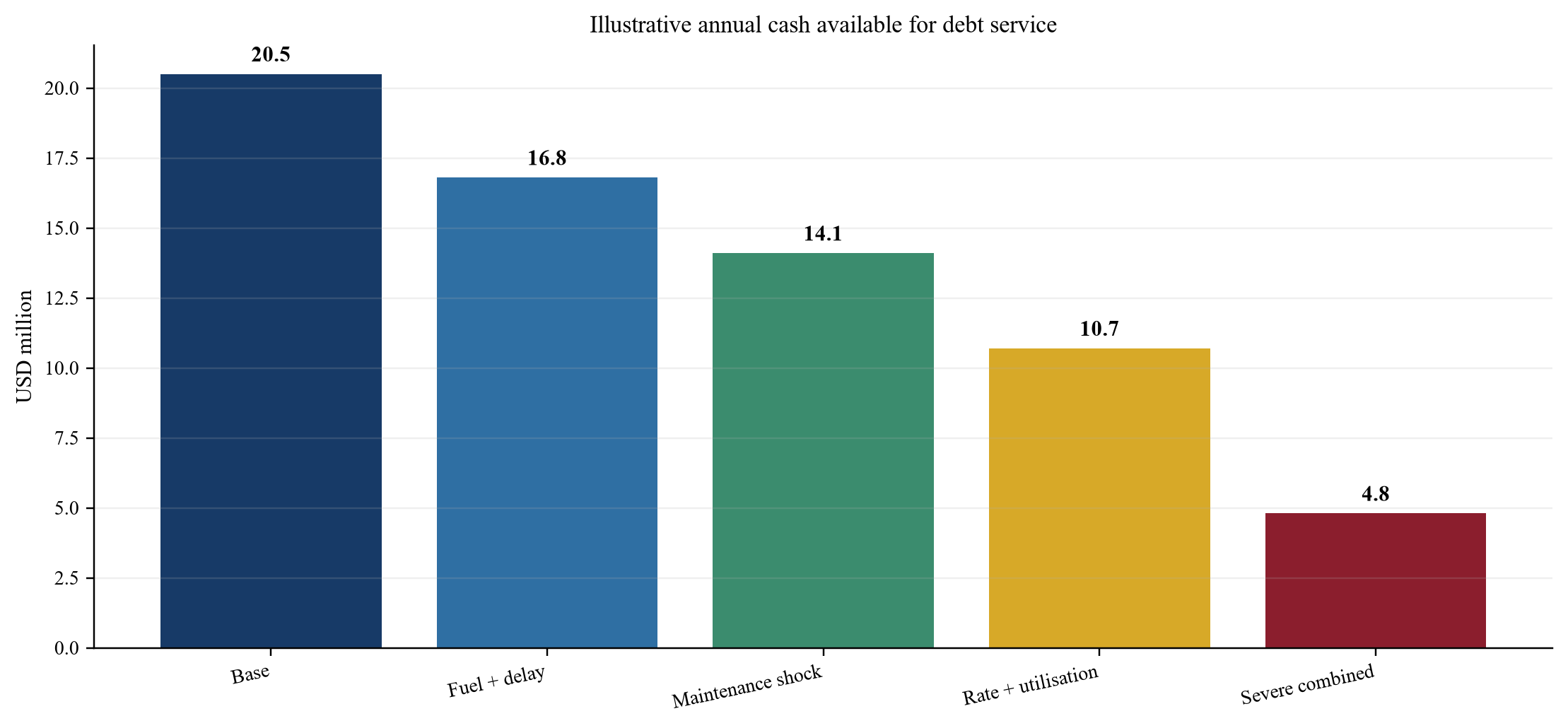
Values are hypothetical management assumptions and do not represent an identified fleet.
35. Use a credit-committee checklist
Credit committee should receive a concise decision record supported by the detailed file. It should confirm borrower and fleet perimeter, purpose, sources and uses, repayment source, condition, employment, emissions pathway, valuation, security, scenarios, reserves, covenants, exceptions and approvals.
The committee should see which figures are audited, independently verified, management records, model outputs or assumptions. Material discrepancies and limitations should be prominent. The paper should state the maximum loss drivers and the actions available before liquidity is exhausted.
Approval conditions should be testable. “Satisfactory technical review” should identify the report, reviewer, unresolved issues and authorised sign-off. “Data access” should identify feeds, controls and acceptance tests. This discipline reduces ambiguity at drawdown and during monitoring.
36. Recognise the framework's limits
Operational analytics cannot guarantee machinery performance, voyage profit, regulatory compliance, charterer payment, vessel value or debt repayment. Models can fail through poor data, changing equipment, unusual weather, cyber incidents, vendor error or human misuse. Historical relationships may not persist.
The framework does not determine seaworthiness, class, legal rights, sanctions, tax, accounting, insurance coverage or fair value. Those conclusions require qualified professionals and transaction-specific evidence. The illustrative case is unsuitable for direct use in an actual facility.
The framework’s value is organisational. It connects evidence to a defined decision, forces assumptions into view and creates proportionate responses. Its quality depends on governance, independent challenge and timely corrective action.
37. Conclusion
Southeast Asian shipping finance can use predictive maintenance and voyage analytics to improve the timing and specificity of credit decisions. The strongest structure begins with authoritative vessel, commercial and financial records; validates analytical signals; translates them into cash-flow and collateral consequences; and assigns each consequence to a clear financing response.
Vessel health, voyage margin, emissions pathway and debt profile should be monitored as one system. Maintenance protects safety and value. Voyage economics fund debt service. Emissions performance affects cost, employability and residual value. Amortisation, reserves and covenants should reflect all four.
The lender should retain human credit judgement and respect the authority of maritime professionals. A model becomes useful when it improves inspection, forecasting, liquidity and action. It becomes dangerous when an unexplained score is treated as fact. Controlled evidence and accountable decisions provide the basis for finance that supports both fleet resilience and repayment.
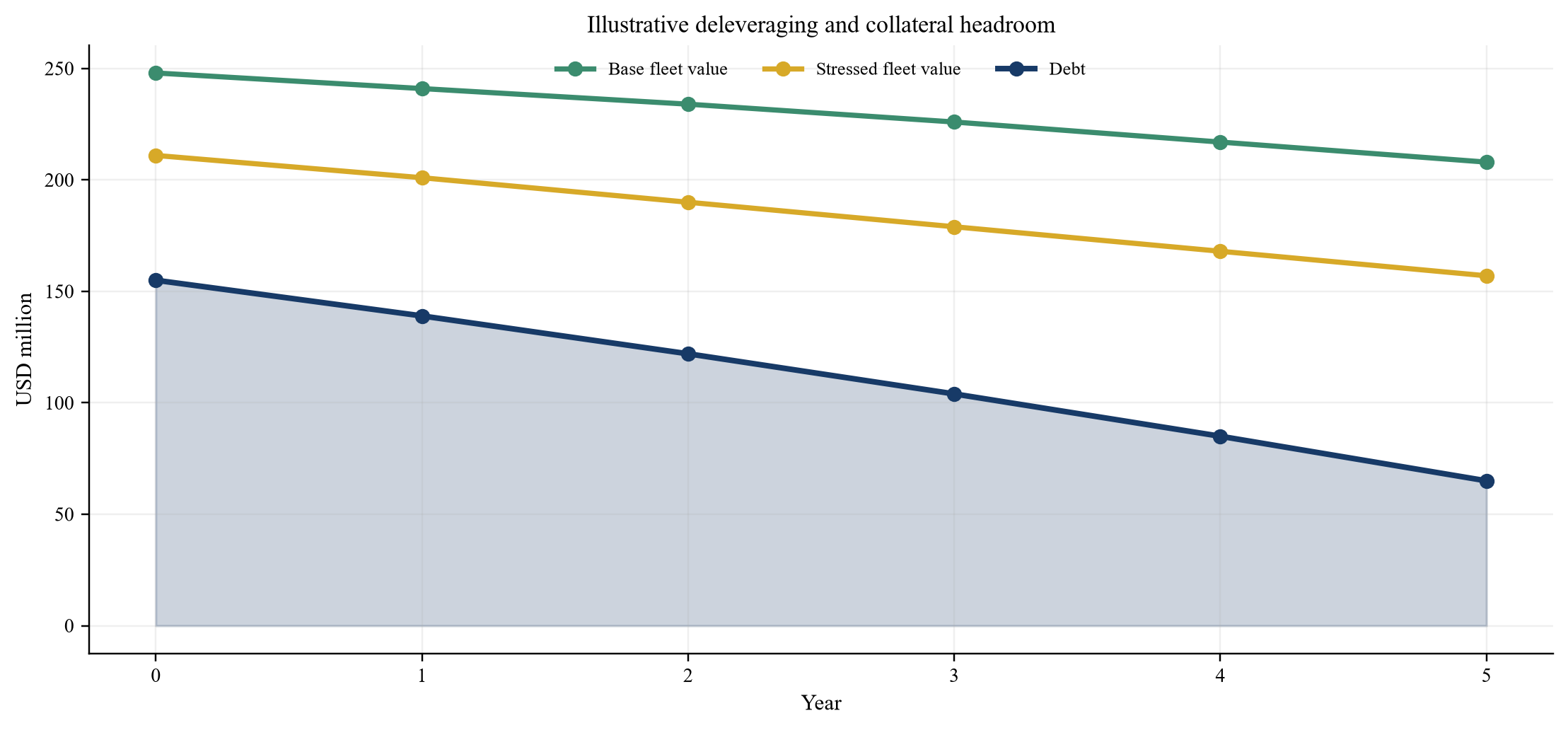
Values are hypothetical management assumptions and do not represent an identified facility or fleet.
| Weeks | Deliverable | Minimum evidence | Decision gate |
|---|---|---|---|
| 1-2 | Perimeter and data contract | Fleet, entities, routes, systems and owners | Scope approved |
| 3-4 | Reconciled diligence base | Class, maintenance, charters, finance, insurance and valuation | Material gaps assigned |
| 5-6 | Validated analytics | Model purpose, test results, thresholds and overrides | Outputs accepted for defined use |
| 7-8 | Integrated scenarios | Cash flow, liquidity, value and reverse stress | Binding constraints identified |
| 9-10 | Financing structure | Amount, amortisation, reserves, covenants and security | Terms approved |
| 11-12 | Documentation and tests | Conditions, controls, calculations and reporting | Drawdown readiness confirmed |
Timing is illustrative and should be adapted to the transaction and evidence available.
Sources
- International Maritime Organization, “EEXI and CII: ship carbon intensity and rating system,” updated guidance, 2026, Read the primary source
- International Maritime Organization, “Improving the energy efficiency of ships,” 2026, Read the primary source
- International Maritime Organization, “Short-term GHG reduction measure,” 2026, Read the primary source
- International Maritime Organization, “The International Safety Management Code,” 2026, Read the primary source
- International Maritime Organization, “International Convention for the Safety of Life at Sea, 1974,” 2026, Read the primary source
- International Maritime Organization, “Harmonized System of Survey and Certification,” 2026, Read the primary source
- International Maritime Organization, “The IMO Compendium on Facilitation and Electronic Business,” 2026, Read the primary source
- International Maritime Organization, “SMART-C GHG,” 2026, Read the primary source
- International Maritime Organization, “Fourth IMO GHG Study 2020,” 2021, Read the primary source
- Maritime and Port Authority of Singapore, “Maritime Singapore Decarbonisation Blueprint,” 2022, Read the primary source
- Maritime and Port Authority of Singapore, “Driving growth and innovation to strengthen maritime competitiveness and resilience,” 5 March 2025, Read the primary source
- Poseidon Principles, “Annual Disclosure Report 2025,” 2025, Read the primary source
- IFRS Foundation, “IFRS 9 Financial Instruments,” issued standard, 2026, Read the primary source
- IFRS Foundation, “Post-implementation Review of IFRS 9 Financial Instruments: Impairment,” May 2023, Read the primary source
- IFRS Foundation, “IASB publishes its review of impairment requirements relating to financial instruments,” 4 July 2024, Read the primary source
- Asian Development Bank, “Advancing Green Ports: Funding and Financing for Maritime Decarbonization,” August 2025, Read the primary source
- Asian Development Bank, “Financing the Ocean Back to Health in Southeast Asia,” December 2021, Read the primary source
- United Nations Conference on Trade and Development, “Review of Maritime Transport 2025,” 2025, Read the primary source
- International Association of Classification Societies, “Classification societies: what, why and how,” 2026, Read the primary source
- DNV, “Maritime Forecast to 2050,” 2025 edition, Read the primary source
- Lloyd’s Register, “The Engine Retrofit Report,” 2023, Read the primary source
- Global Maritime Forum, “Getting to Zero Coalition,” 2026, Read the primary source
- Monetary Authority of Singapore, “Guidelines on Environmental Risk Management for Banks,” 2020, Read the primary source
- Organisation for Economic Co-operation and Development, “ITF Transport Outlook 2024,” 2024, Read the primary source
