

1. Recognise the threshold as an operating-model event
Small Business Relief can simplify the corporate-tax outcome for an eligible Resident Person, but the relief does not remove the need to understand the business, measure revenue correctly, register where required, file on time and retain evidence. The threshold therefore belongs in the operating calendar well before annual revenue reaches AED 3 million. A board that waits for the year-end tax return has already lost the best window for data remediation, close discipline and cash planning.
The first management task is to separate three concepts. Revenue tests eligibility for Small Business Relief. Accounting income is the starting point for calculating taxable income. Taxable income determines the corporate-tax charge after the applicable statutory adjustments and rate bands. The AED 3 million revenue threshold and the AED 375,000 taxable-income threshold serve different purposes. Confusing them can produce incorrect forecasts, pricing decisions and cash reserves.
The transition changes the work expected from finance. Under relief, the return is simplified and taxable income is treated as nil for the elected period. Without relief, finance must produce supportable financial statements, trace accounting income to the ledger, identify tax adjustments, review exemptions and deductions, apply the arm's-length principle to related-party dealings, preserve loss and interest records, calculate tax, complete the return and reconcile payment. The work becomes a recurring controlled process rather than a year-end calculation.
The board should define a readiness trigger below the statutory threshold. A rolling twelve-month forecast, signed sales pipeline, billing schedule and entity-level revenue ledger can indicate when the business is likely to cross. The trigger should launch a documented programme with an executive sponsor, finance owner, tax adviser, work plan, budget, decision log and reporting cadence. The objective is a reliable tax operating model that supports growth, financing and diligence.
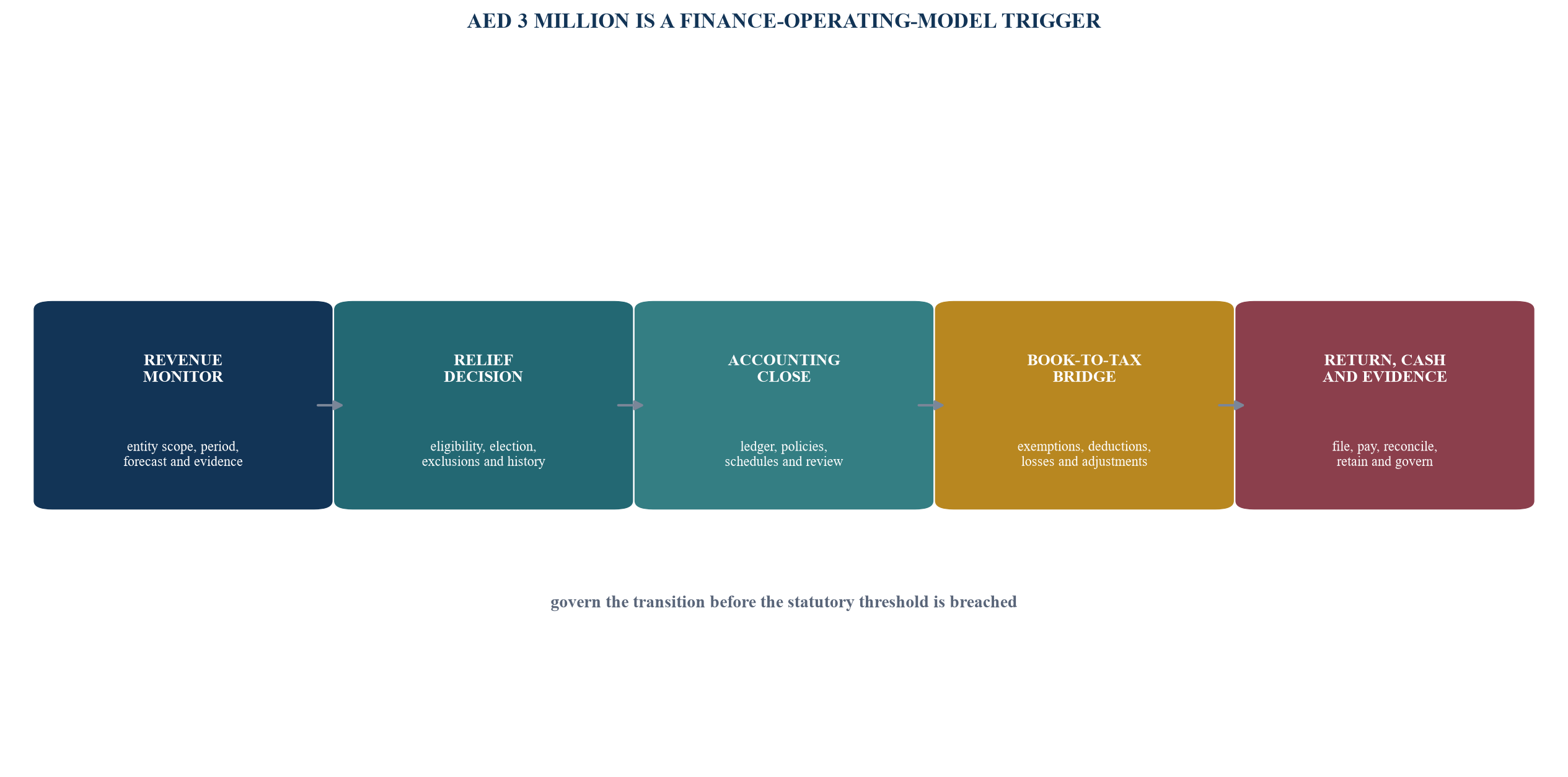
Revenue determines relief eligibility; accounting income and statutory adjustments determine taxable income and cash tax.
2. Establish the legal and evidence boundary
The readiness file should begin with a dated legal-and-factual matrix for each taxable person. It should record legal form, residence, trade licence, corporate-tax registration, tax period, financial year, free-zone status, ownership group, activities, elections, previous-period revenue and current-period forecast. Each conclusion should identify the official source, professional adviser, approval date and review date.
The Ministry of Finance states that Resident Persons may claim Small Business Relief where revenue in the relevant and previous tax periods does not exceed AED 3 million for each period. Once the threshold is exceeded in any tax period, the relief is no longer available in later periods, even if revenue falls. The published threshold applies to tax periods beginning on or after 1 June 2023 and ending on or before 31 December 2026. An election is made for each eligible period through the corporate-tax return.
Qualifying Free Zone Persons and members of multinational groups with consolidated group revenue above the specified threshold are excluded. Artificial separation of one business into several persons to obtain a corporate-tax advantage can engage the general anti-abuse rule. Entity scoping therefore requires substance: contracts, licences, employees, premises, banking, customers, risks, assets and management should support the actual legal and commercial structure.
Official sources should control technical conclusions. The board pack should distinguish enacted law and decisions, Federal Tax Authority guides, official clarifications, professional advice, accounting judgments and internal assumptions. A dated interpretation register can prevent an old presentation or vendor summary from being treated as current law. The tax return should refer back to the approved matrix and evidence file.
Table 1. Small Business Relief eligibility and evidence matrix
| Decision question | Current published rule | Required evidence | Accountable owner |
|---|---|---|---|
| Is the person resident and taxable? | relief is available to eligible Resident Persons | licence, incorporation, residence analysis and tax registration | legal and tax |
| Has revenue remained at or below AED 3 million? | current and all previous relevant tax periods must satisfy the threshold | financial statements, ledgers, invoices, bank and revenue reconciliation | controller |
| Does an exclusion apply? | Qualifying Free Zone Persons and specified multinational-group members are excluded | free-zone analysis, group chart and consolidated revenue evidence | tax director |
| Has the business been artificially separated? | artificial separation may engage the anti-abuse rule | operating model, contracts, people, assets, decision rights and commercial rationale | board and legal |
| Is the period within the published window? | qualifying periods begin on or after 1 June 2023 and end on or before 31 December 2026 | approved financial year and tax-period record | company secretary |
| Was the election made correctly? | election is made for each eligible tax period in the return | filed return, submission receipt and review sign-off | tax return owner |
Eligibility must be confirmed for the specific taxable person and tax period using current law and professional advice.
3. Monitor revenue through an entity-level control
Revenue monitoring needs an accounting definition and a controlled data source. The published rules refer to revenue determined under applicable accounting standards accepted in the UAE. A cash collection measure, VAT return total, bank inflow or sales-pipeline value may differ from accounting revenue. Finance should document how the general ledger produces revenue by taxable person and reconcile material differences to operational systems, VAT records and bank activity.
The monitor should run monthly and include actual year-to-date revenue, forecast revenue, contracted backlog, probability-weighted pipeline and a sensitivity range. It should address credit notes, refunds, principal-versus-agent judgments, revenue recognition over time, foreign currency, intercompany charges, discontinued activities and acquired entities. Where judgment affects the threshold, the accounting memorandum should state the facts, standard applied, conclusion, reviewer and quantitative effect.
Boards should set internal escalation bands. One practical design is a normal monitoring band, a readiness band and a transition band. The exact amounts should be approved for the business based on volatility and forecast reliability. Entry into the readiness band should start chart-of-accounts review, monthly tax schedules, adviser onboarding and cash forecasting. Entry into the transition band should require weekly revenue review and confirmation that the tax close can operate.
The monitor must remain separate by taxable person while showing group context. Consolidated management revenue can conceal that one entity has crossed and another has not. The legal entity that earns the revenue, bears the contractual obligation and records the accounting entry should be identifiable. Intercompany transactions and cost allocations should be governed consistently and reviewed for arm's-length treatment.
4. Choose and document the accounting basis
Financial statements are the starting point for taxable income. Ministerial Decision No. 114 of 2023 requires IFRS and permits a taxable person with revenue not exceeding AED 50 million to apply IFRS for SMEs. The official framework also allows cash-basis accounting for businesses whose revenue does not exceed AED 3 million, subject to the applicable conditions. A company moving above the relief threshold should assess whether its current basis, policies and systems can support accrual accounting and the tax calculation.
The accounting-policy file should cover revenue, contract assets and liabilities, inventories, expected credit losses, leases, fixed assets, capitalisation, provisions, employee benefits, foreign currency, related parties and subsequent events. It should identify every policy with a tax consequence and every judgment that could create a material book-to-tax adjustment. The controller and external accountant should agree the close instructions before the period ends.
A change of accounting basis or policy needs opening balances, cut-off testing and a documented bridge. Unbilled revenue, accrued expenses, prepaid costs, inventory, receivables, payables, fixed assets and provisions can be misstated when a cash-based record is converted. The company should reconcile customer and supplier subledgers to the general ledger and verify that bank movements are classified rather than merely imported.
The selected accounting framework should support management reporting as well as compliance. A disciplined monthly close creates timely margin, working-capital, covenant and tax information. It can improve the board's ability to price contracts, manage cash, prepare for fundraising and respond to diligence. Those outcomes depend on operating discipline and should be measured after implementation.
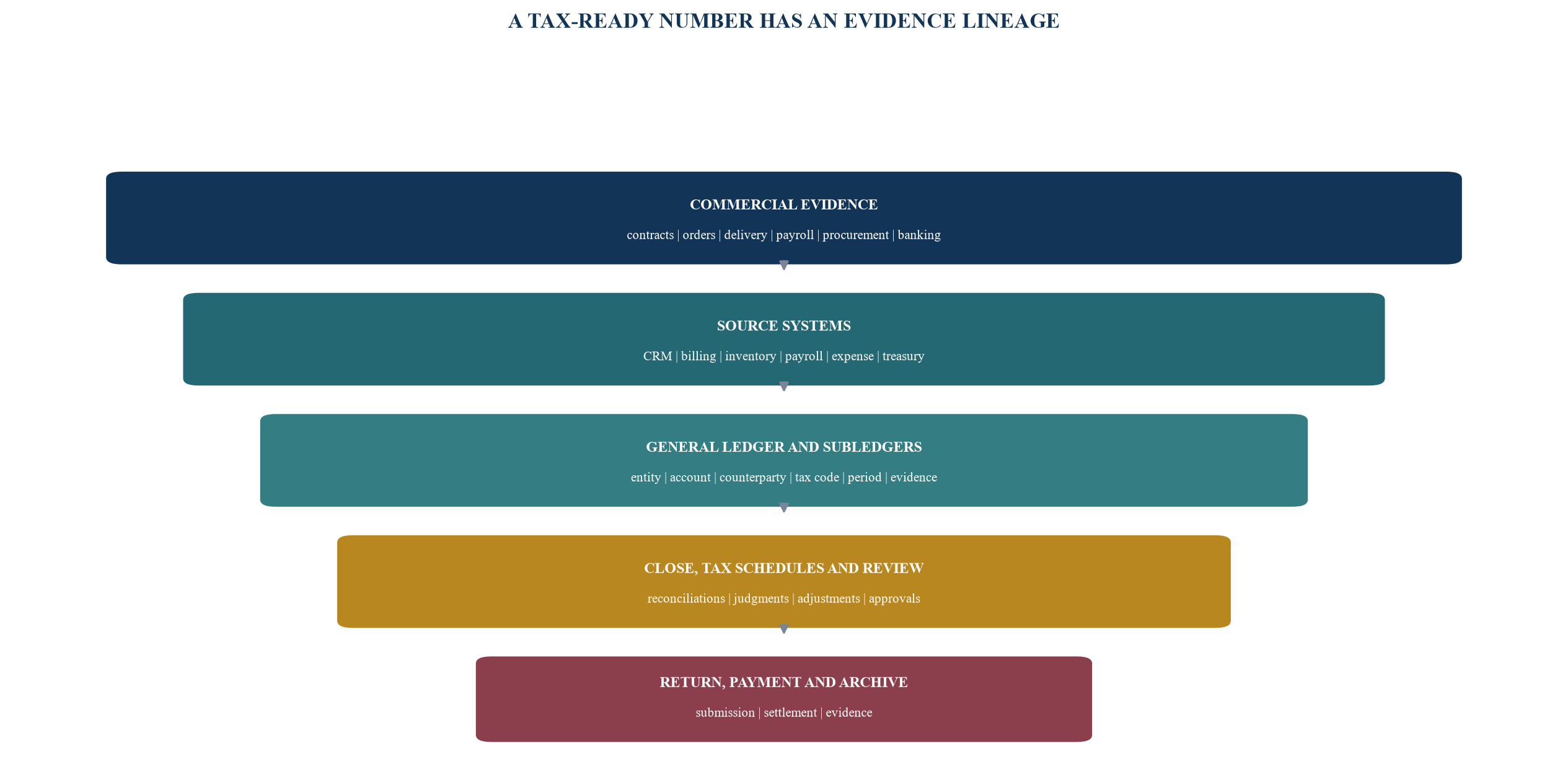
Each reported amount should be traceable through governed systems, reconciliations and approvals.
5. Redesign the chart of accounts and transaction coding
A tax-ready chart of accounts captures the distinctions needed to prepare financial statements and calculate taxable income. One generic expense account cannot show whether expenditure is wholly business-related, partly personal, capital, entertainment, financing, related-party, exempt-income-linked or unsupported. The redesign should balance useful granularity with reliable coding by the people and systems that create transactions.
The account structure can combine legal entity, natural account, business unit, project, counterparty, tax code and related-party flag. Mandatory fields should be limited to information that has a defined owner and control. Coding guidance should use actual transactions, decision trees and examples. High-risk categories should route to review before close rather than remain buried in a year-end spreadsheet.
Opening balances require particular care. Fixed-asset registers should agree to the ledger and contain acquisition date, cost, accumulated depreciation, useful life, location, owner and disposal evidence. Accruals and provisions should be supported by calculations and approvals. Shareholder and related-party balances should reconcile to agreements and confirmations. Loans should separate principal, interest, fees and repayment dates.
System configuration should enforce period controls, sequential documents, approval limits, audit logs and restricted master-data changes. Journal entries need preparer, reviewer, explanation and evidence. The company should prevent postings to closed periods without authorised reopening and record every change. These controls create a repeatable close and a defensible tax file.
Table 2. Tax-ready chart-of-accounts design
| Transaction domain | Required distinction | Typical evidence | Close control |
|---|---|---|---|
| revenue | entity, contract, product or service, customer, recognition period | contract, order, delivery and invoice | revenue cut-off and contract-to-ledger reconciliation |
| operating costs | business purpose, vendor, period, project and tax treatment | purchase order, receipt, invoice and approval | accrual, duplicate and deductibility review |
| fixed assets | class, location, useful life, owner and disposal | invoice, commissioning, register and disposal approval | register-to-ledger and depreciation review |
| financing | lender, instrument, principal, interest, fees and maturity | facility agreement, statements and calculations | interest, covenant and classification review |
| related parties | counterparty, relationship, agreement and pricing basis | register, contract, invoice and benchmark | arm's-length and disclosure review |
| owner or personal items | beneficiary, business purpose and approval | receipt, policy, reimbursement and board approval | connected-person and non-business review |
Final coding depends on the business model, accounting framework and current tax advice.
6. Build a controlled monthly close
The monthly close is the production line for the tax return. A board should expect an approved calendar, named preparers and reviewers, required schedules, materiality thresholds, issue log and sign-off. The process should close sales, purchasing, payroll, inventory, banking and subledgers before the general ledger is reviewed.
Core reconciliations include bank, receivables, payables, inventory, fixed assets, payroll, VAT, loans, related parties, accruals, prepayments and equity. Each reconciliation should show the ledger balance, supporting balance, difference, aging, action, owner and resolution date. Reconciliations need evidence of review, not only a saved workbook.
The close should identify tax-sensitive events as they occur. New contracts, cross-border payments, financing, acquisitions, disposals, restructurings, owner transactions, related-party charges and unusual provisions should enter a tax-events register. Early identification allows advice and evidence to be obtained before the return deadline.
The board can track close timeliness and quality through days to close, unreconciled value, aged reconciling items, late journals, post-close adjustments and unresolved tax events. Faster close has value only when reconciliations and review remain reliable. The programme should first stabilise quality and then compress elapsed time.
7. Construct the book-to-tax bridge
The book-to-tax bridge starts with accounting income before tax and records each statutory adjustment with a rule, amount, evidence, preparer and reviewer. The bridge should distinguish permanent differences, timing differences, exempt income, disallowable expenditure, reliefs, tax losses, interest limitations, related-party adjustments and tax credits. The final taxable-income figure should reconcile exactly to the return.
The recurring schedule should be built during the year. Entertainment, donations, fines and penalties, personal expenditure, depreciation, provisions, unrealised items, exempt income, interest and related-party charges may require separate review under the current law. The treatment depends on facts and official rules; the schedule should avoid automatic assumptions based solely on the account name.
Every adjustment needs an evidence link and a written rationale. A deduction may require proof of business purpose, invoice, contract, receipt, allocation and payment. An exemption may require ownership, holding-period and other conditions. A tax loss needs continuity and utilisation records. A financing deduction may require an interest schedule and limitation calculation.
The bridge should flow into the tax provision and cash forecast. Management can then explain the effective tax rate, movements from prior forecasts and the difference between accounting expense and payment. The bridge also provides a diligence-ready record for lenders, investors and buyers.
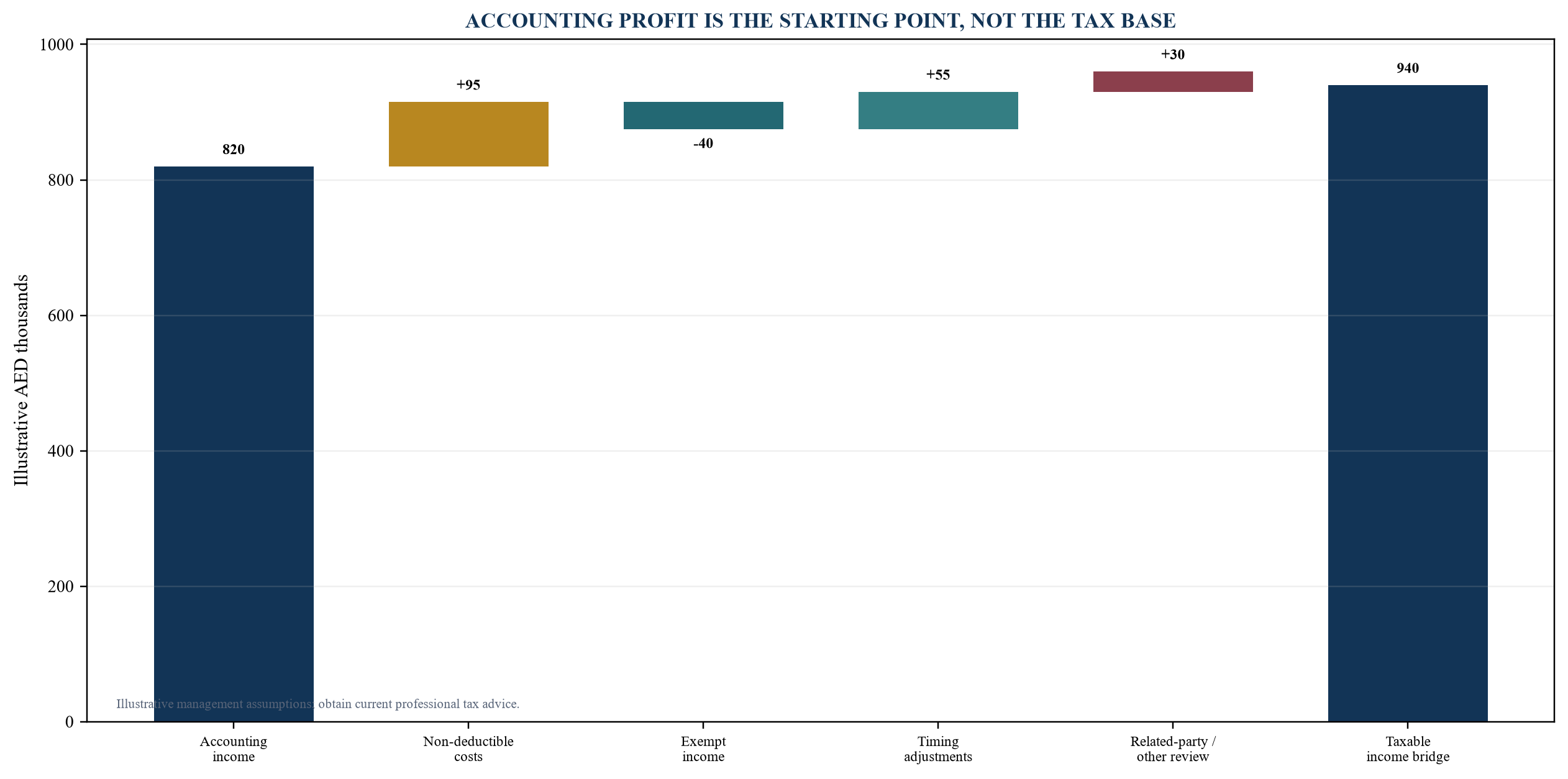
The bridge converts accounting income into taxable income through documented statutory adjustments.
8. Govern related-party and connected-person dealings
The arm's-length principle continues to matter even when a business previously elected for Small Business Relief. Once the business calculates taxable income, related-party and connected-person controls become a visible part of the return and evidence file. The company needs a current relationship register that covers legal ownership, control, directors, officers, relatives and other relationships within the statutory definitions.
Every recurring related-party transaction should have an agreement, service or asset description, pricing basis, invoice route, accounting treatment, settlement terms and evidence of performance. Management fees should connect to identifiable services and allocation drivers. Loans should state principal, interest, maturity, security and repayment. Asset transfers, intellectual property, guarantees and owner remuneration need fact-specific advice.
The Federal Tax Authority's return guide asks whether aggregate related-party transactions exceed AED 40 million and describes a related-party schedule. The current guide and applicable thresholds should be checked for the filing period. The existence of a disclosure threshold does not remove the arm's-length principle or the need for records below that threshold.
A quarterly review can compare actual charges to agreements and budgets, investigate unmatched balances, confirm settlements and capture new relationships. The board should approve material owner and related-party transactions under a documented conflict process. The tax file should preserve the commercial rationale and evidence supporting the price.
Table 3. Related-party control file
| Control component | Minimum record | Failure signal | Governance response |
|---|---|---|---|
| relationship register | entity, person, relationship, ownership and effective dates | counterparty omitted or relationship unclear | quarterly legal and finance certification |
| transaction catalogue | type, value, frequency, agreement and ledger accounts | recurring charge without contract | suspend or escalate until documented |
| pricing basis | method, comparable information, allocation key and approval | price derived from cash need or unsupported markup | tax review and contemporaneous rationale |
| performance evidence | deliverables, time, benefit, invoice and acceptance | management fee with no service evidence | require service-owner confirmation |
| balances and settlement | confirmations, aging, interest and repayment | long-outstanding owner or group balance | board action and documented terms |
| return disclosure | reconciled total and schedule mapping | return total differs from ledger register | controller and tax-adviser sign-off |
Definitions, thresholds and documentation requirements require current professional confirmation.
9. Control deductions, losses and financing costs
Deductibility should be embedded in procurement and expense approval. The requester states business purpose, the approver confirms authority, the vendor record supports identity, and finance applies the account and tax code. Mixed-purpose or owner-related costs should be separated. Missing evidence and policy exceptions should enter a visible queue before close.
Tax losses need a period-by-period roll-forward showing opening balance, current-period movement, utilisation, transfers, expiry analysis where relevant and closing balance. The company should record the conditions supporting utilisation and any ownership or activity changes that may affect access. Periods in which Small Business Relief is elected have specific consequences for losses and disallowed net interest expenditure, so the transition file should preserve the election history.
Financing costs require a complete debt register. It should include lender, related-party status, facility, drawdowns, repayments, interest, fees, security, purpose and covenant terms. Finance should reconcile lender statements to the ledger and separate capitalised, accrued and paid amounts. The current general interest-deduction limitation and any specific limitation require professional review.
The tax-ready model should connect financing decisions to after-tax cash. Debt pricing, arrangement fees, shareholder loans, acquisition financing and refinancing can create accounting and tax effects across several periods. A transaction should be modelled before commitment with the relevant advisers and then compared with actual close data.
10. Forecast cash tax and protect liquidity
Corporate tax is a cash obligation with a statutory deadline. The Federal Tax Authority states that taxable persons must file the return and pay corporate tax within nine months of the end of the tax period. A 31 December year-end therefore normally produces a 30 September deadline for that period, subject to current law and any specific authority direction.
The forecast should start with management accounts, update the book-to-tax bridge and apply the published rate bands. The Ministry of Finance states that taxable income up to AED 375,000 is subject to a 0 per cent rate and taxable income above that threshold to 9 per cent. The model should include scenarios for revenue, margin, non-deductible expenditure, timing adjustments, losses, tax credits and uncertain items.
Finance should distinguish tax expense, tax payable and cash payment. A provision recorded at year-end may be paid months later. Timing differences may affect accounting expense and future cash differently. VAT, payroll obligations, customs and other taxes remain separate cash flows. Treasury should maintain a ring-fenced reserve policy approved by the board and linked to forecast confidence.
Monthly variance analysis should explain movements from commercial performance, accounting judgments, tax adjustments and payments. The forecast should connect to the thirteen-week cash model and the annual budget. Covenant, dividend and investment decisions should use cash after tax rather than EBITDA alone.
Table 4. Illustrative book-to-tax and cash-tax case
| Bridge item | Illustrative amount | Management question | Evidence required |
|---|---|---|---|
| accounting income before tax | 820 | does the close reconcile to approved financial statements? | trial balance, reconciliations and review |
| non-deductible expenditure | 95 | which costs fail or limit current deductibility? | transaction evidence and tax analysis |
| exempt income adjustment | (40) | are every exemption condition and record satisfied? | ownership, income and condition file |
| timing and provision adjustments | 55 | when does accounting recognition differ from tax treatment? | roll-forward and reversal schedule |
| other reviewed adjustments | 10 | are related-party and other items complete? | relationship register and adviser review |
| illustrative taxable income | 940 | does the bridge reconcile to the return? | signed book-to-tax schedule |
| illustrative tax at published bands | 50.85 | is the rate calculation current and are credits available? | calculation, current law and return |
All amounts are illustrative management assumptions in AED thousands and do not represent a forecast or tax advice.
11. Build the return and evidence file during the year
The return file should be designed before the first close. A contents index can cover registration, entity facts, elections, financial statements, trial balance, account mapping, reconciliations, book-to-tax bridge, related-party schedules, losses, interest, exemptions, deductions, tax credits, return, payment and approvals. Each document needs a period, owner, version and evidence source.
The Federal Tax Authority has emphasised that records supporting the return should be retained for at least seven years after the end of the relevant tax period. The archive should preserve source documents, calculations, correspondence, judgments and approvals in a retrievable format. Access should be restricted and logged, with backup and recovery testing.
Tax return preparation should use a controlled checklist and a separate review. The reviewer should trace material amounts to financial statements and the ledger, inspect adjustments, compare current and previous periods, confirm elections and disclosures, and verify the payment instruction. Submission receipts and payment confirmations should be reconciled and archived.
If the business uses an external tax agent, management remains responsible for complete and accurate inputs. The engagement should define responsibility, deliverables, deadlines, queries, review points, data security and escalation. The company should retain the final filed return and all supporting schedules in its own controlled repository.
12. Implement a tax provision and effective-rate review
A tax provision gives the board a period-end estimate of current and, where applicable under the accounting framework, deferred tax. The calculation should be linked to the latest close and book-to-tax bridge. It should identify enacted rates, uncertain judgments, losses, temporary differences, credits and movements from the prior estimate.
The effective-rate reconciliation explains why tax expense differs from a simple rate applied to accounting profit. Permanent differences, exempt income, losses, different tax regimes and prior-period adjustments can contribute. The board should review both the percentage and the cash consequence. A low effective rate without a complete evidence file can carry risk rather than value.
Material judgments should be documented with facts, authority, professional advice and approval. The company should define when a new transaction or change in law triggers remeasurement. Acquisition, restructuring, free-zone activity, cross-border operations and financing can require specialist analysis.
Provision accuracy should be measured by comparing interim estimates, year-end provision, filed return and actual payment. Large unexplained true-ups indicate weak close data, late tax analysis or uncontrolled assumptions. Root causes should feed the finance improvement plan.
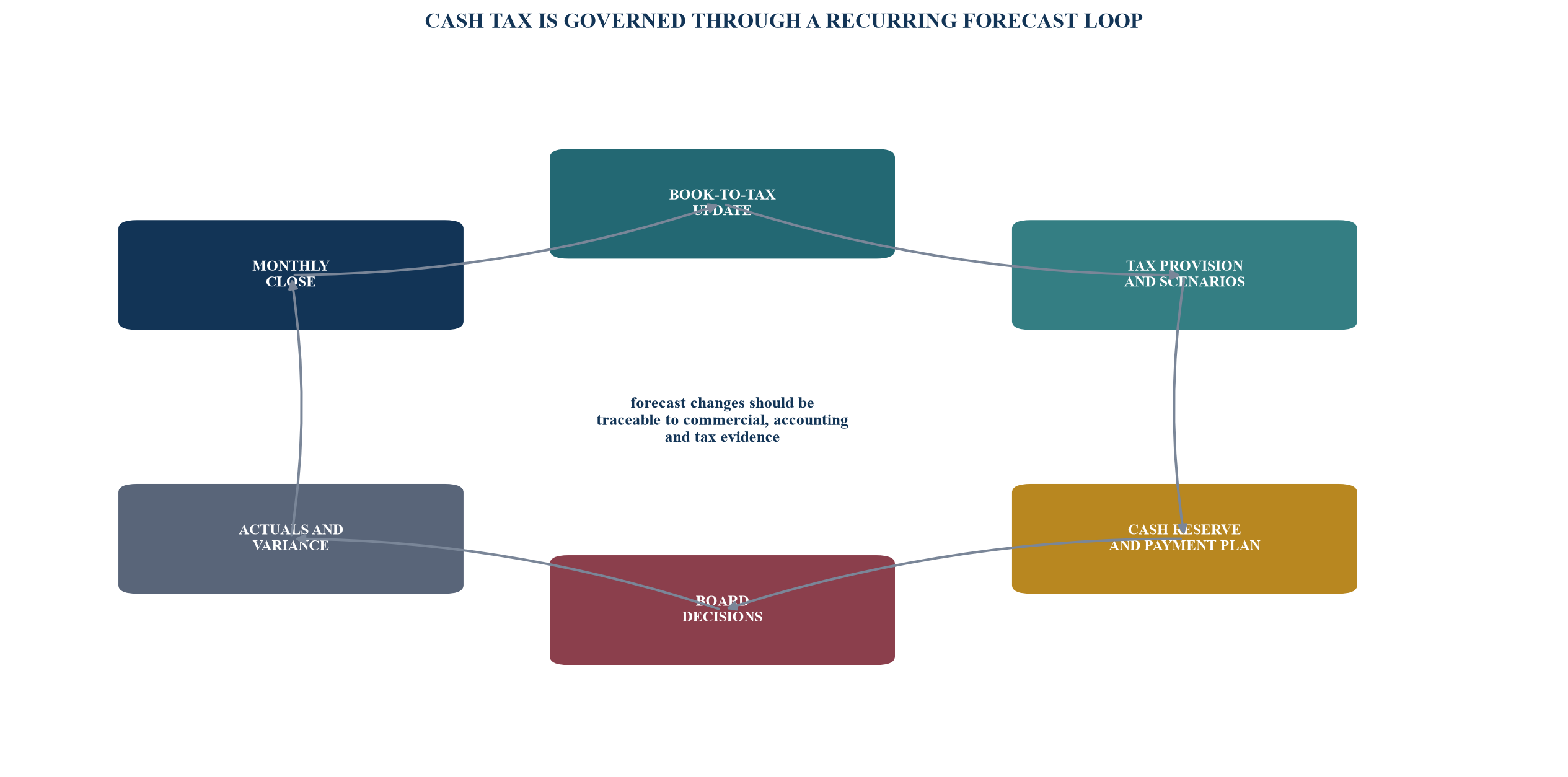
Each monthly close updates taxable income, provision, liquidity and board decisions.
13. Sequence a 120-day readiness programme
The programme should start before the threshold is crossed and progress through four controlled stages. The first thirty days establish entity scope, revenue history, accounting basis, close maturity, tax events and adviser boundary. Days 31 to 60 redesign the chart of accounts, data model, reconciliations, tax schedules and evidence repository. Days 61 to 90 run parallel closes and build the first book-to-tax bridge, provision and cash forecast. Days 91 to 120 remediate findings, test the return file and move into business-as-usual governance.
The diagnostic should be evidence-led. Interviews identify process intent; ledger extracts, reconciliations, contracts, invoices and system logs show operation. Gaps should be rated by exposure, likelihood, time to deadline, data dependency and cash consequence. Each action needs a named owner, due date, acceptance evidence and escalation rule.
Parallel running is essential. The company should execute at least two monthly closes using the redesigned accounts and schedules. Reviewers should trace material balances, challenge tax adjustments, inspect related-party records and test archive retrieval. Errors should be corrected at the source and the control redesigned before the next run.
The exit gate should require approved entity scope, supportable accounting policies, reconciled opening balances, a stable close, current tax matrix, completed book-to-tax bridge, tax provision, cash reserve, return calendar, evidence archive, trained owners and board dashboard. Outstanding items should have compensating controls and explicit approval.
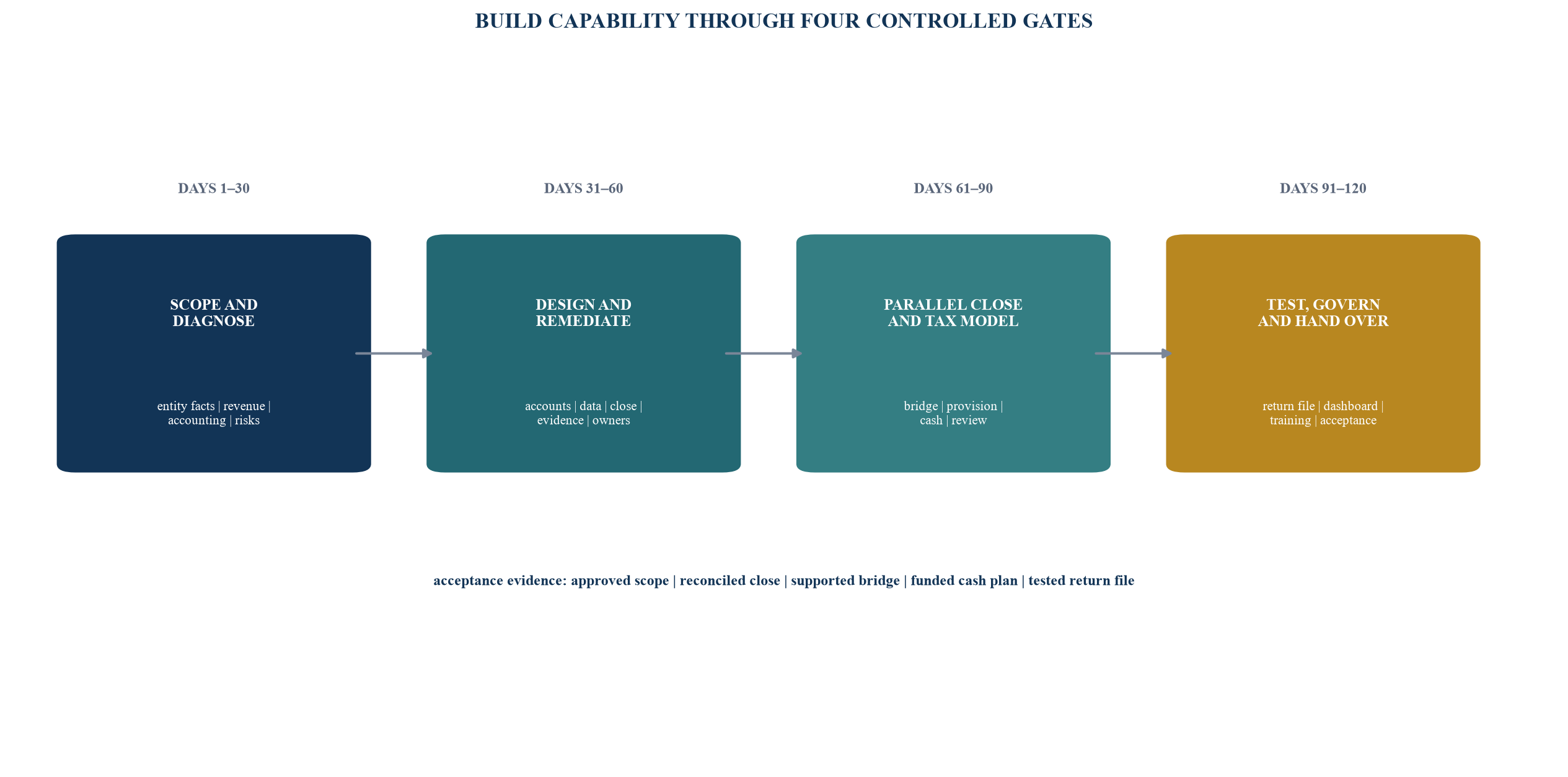
Each phase has an evidence gate before the next stage begins.
14. Define controls, ownership and segregation
The finance function needs clear ownership across commercial operations, procurement, payroll, treasury, accounting, tax, technology, legal and the board. Finance can orchestrate the process but cannot validate a contract milestone, employee status or legal relationship alone. Each data element and control should have one accountable owner and a defined reviewer.
Segregation should address customer and vendor creation, bank-detail changes, billing, purchasing, journal entry, payment, related-party approval and tax-return submission. System access should reflect roles, with periodic review of privileged accounts and departed users. Emergency access needs time limits and after-the-fact review.
Control descriptions should state purpose, frequency, owner, evidence, population, exception handling and reviewer. A monthly bank reconciliation is incomplete as a control description unless the company specifies all accounts, source statements, timing, aged items, approval and escalation. Automated controls require configuration evidence and change management.
The tax-control matrix should connect each return line and material risk to a source, reconciliation and approval. Internal audit or an independent reviewer can test design and operation. Findings should be ranked, owned and tracked to evidence-based closure.
Table 5. Close and tax-control ownership map
| Control | Preparer | Reviewer | Frequency | Acceptance evidence |
|---|---|---|---|---|
| revenue threshold monitor | financial planning | controller | monthly, weekly near trigger | ledger reconciliation, forecast and approved conclusion |
| accounting close | finance managers | controller or CFO | monthly | signed calendar, reconciliations and issue log |
| book-to-tax bridge | tax or controller team | qualified tax reviewer | monthly or quarterly | line-by-line rule, amount and evidence |
| related-party register | legal and finance | CFO or board committee | quarterly | certified relationships, agreements and balances |
| tax provision and cash reserve | controller and treasury | CFO | monthly or quarterly | scenario model, variance and funding decision |
| return and payment | tax return owner | CFO and authorised signatory | annual | reviewed return, submission receipt and bank confirmation |
Titles should be adapted to the organisation while preserving accountable ownership and independent review.
15. Connect readiness to financing, M&A and valuation
Lenders and investors examine the reliability of earnings, cash, liabilities and controls. A weak tax operating model can create diligence delays, uncertain liabilities, purchase-price holdbacks, covenant concerns and post-close remediation. A tax-ready close creates a clearer bridge from management accounts to statutory and tax records.
Financing models should include current and forecast tax payments. EBITDA does not fund debt service by itself; cash after working capital, capital expenditure and tax does. The company should test covenant headroom under downside margin and tax-adjustment scenarios. Lender information undertakings may require timely financial statements and notice of material tax disputes.
For M&A, the data room should contain registration, returns, payment evidence, financial statements, reconciliations, relief elections, revenue-threshold analysis, related-party schedules, tax advice and correspondence. Management should identify issues before exclusivity and quantify remediation where possible. Transaction counsel and tax advisers should determine warranties, indemnities and disclosure.
Valuation benefits cannot be assumed. Readiness may support confidence in reported earnings and reduce diligence friction when evidence is complete and operating. The company should measure the actual commercial effect through diligence queries, financing terms, close speed and avoided remediation. Any claimed valuation uplift requires transaction evidence.
16. Design the board dashboard
The dashboard should combine compliance, close quality, tax exposure, liquidity and execution. Status colours need quantitative definitions. A green revenue monitor, for example, should mean that entity-level actual and forecast revenue reconcile, the threshold conclusion is reviewed and no unresolved scope issue exists. A green close should mean that all material reconciliations are complete within the approved calendar.
Leading indicators include days to close, ledger accounts unreconciled, tax-sensitive events awaiting advice, related-party agreements missing, book-to-tax adjustments unsupported and action-plan milestones overdue. Outcome indicators include return filed on time, tax paid on time, provision-to-return variance, interest or penalties, audit findings and cash-reserve adequacy.
The dashboard should show value and aging, not only counts. One unsupported adjustment can matter more than fifty minor documentation gaps. Each red item should identify exposure, owner, decision required, interim control and target date. Board minutes should record the response.
The first dashboard can be simple and controlled. Automation should follow stable definitions and source data. A polished dashboard built on unreconciled ledgers creates false precision. The controller should certify source completeness and the CFO should explain material changes.
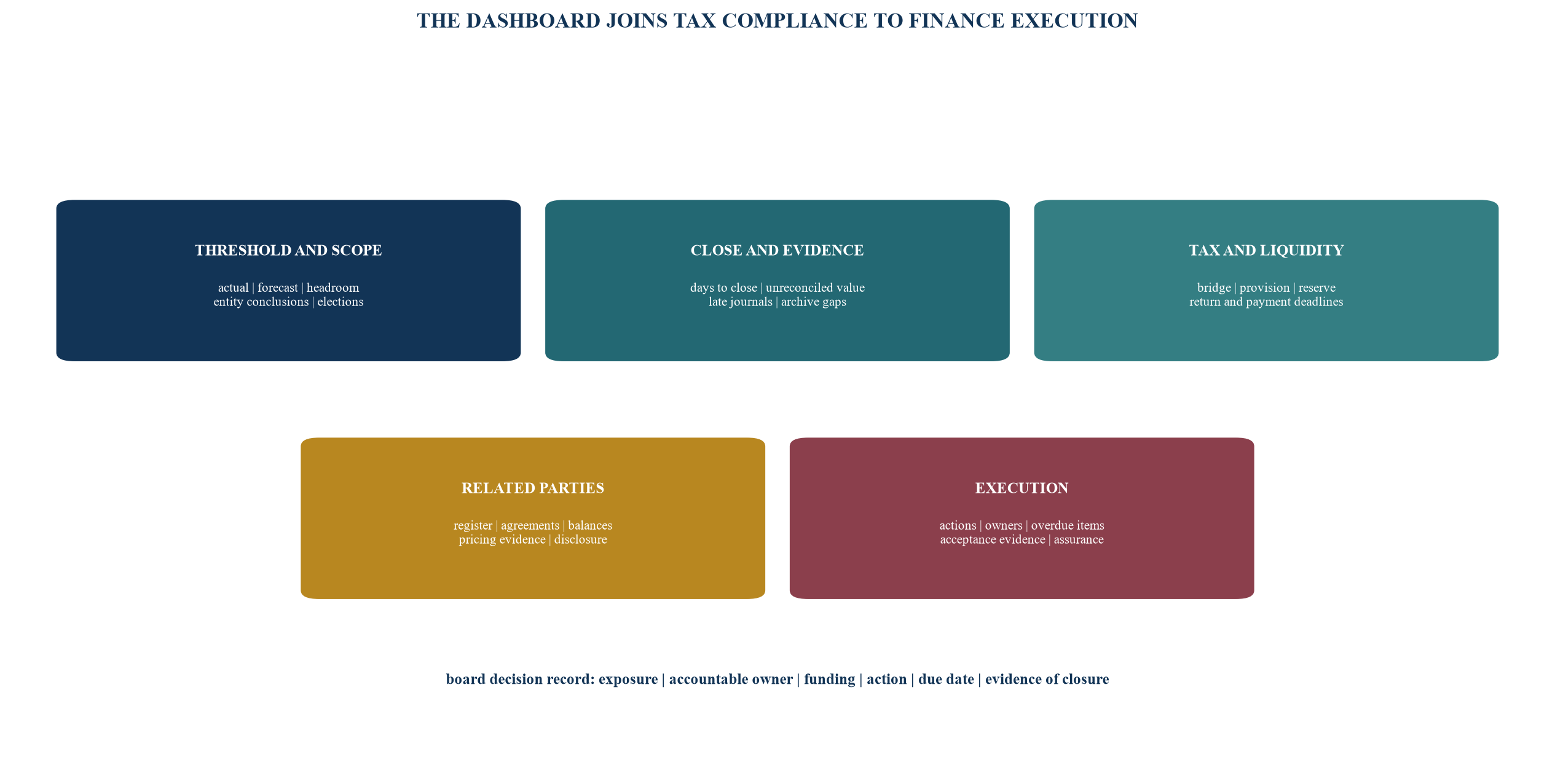
Metrics connect statutory deadlines with operating quality, liquidity and accountability.
17. Test readiness before the first full return
Readiness testing should trace complete transactions from contract or purchase request through the ledger, financial statements, tax adjustment, return field, payment and archive. The sample should cover ordinary sales and costs, credit notes, fixed assets, financing, payroll, provisions, foreign currency, related parties and unusual transactions. Each test records source, expected result, actual result, exception and remediation.
The company should run a mock return using a closed period. The exercise tests data extraction, schedule ownership, interpretation questions, review capacity, adviser turnaround, portal access, signatory authority and payment preparation. It also reveals where information exists only in one employee's inbox or spreadsheet.
Continuity testing should cover system outage, key-person absence, corrupted file, credential expiry and adviser delay. Critical schedules need documented instructions and backup owners. The archive should be restored from backup and a prior amount retrieved within an approved service level.
Acceptance requires evidence. Training attendance alone does not show that a controller can prepare the bridge or that a reviewer can identify a missing adjustment. The programme should use practical exercises and signed competency confirmation. Remaining gaps should carry interim controls and board-approved dates.
Table 6. Board readiness dashboard and acceptance gates
| Dimension | Measure | Acceptance gate | Escalation trigger |
|---|---|---|---|
| threshold | entity revenue actual, forecast and headroom | reconciled and reviewed conclusion | unresolved scope or forecast crossing |
| close | days to close and unreconciled value | all material accounts signed off | aged or unexplained material difference |
| tax bridge | supported adjustments and reviewer status | full reconciliation to provision or mock return | unsupported material adjustment |
| liquidity | forecast tax and funded reserve | approved cash plan through payment date | funding gap or unexplained variance |
| related parties | complete register, agreements and reconciled balances | quarterly certification complete | missing relationship or unsupported charge |
| return file | mock return, signatory, payment and archive test | end-to-end test passed | access failure, missing evidence or missed deadline |
Targets are management decisions and should reflect the company's risk and reporting needs.
18. Convert the transition into a retained execution mandate
The transition can be delivered as a defined finance-transformation mandate with clear workstreams, cadence and acceptance. The initial diagnostic establishes scope, maturity, exposures and the 120-day plan. Implementation redesigns accounts, data, close, tax schedules, controls and governance. Parallel running proves the process. Retained support stabilises the close, maintains the tax-events register, updates the forecast and prepares the return file.
A useful mandate separates client responsibilities from adviser responsibilities. Management owns factual completeness, accounting records, decisions and filings. The adviser can facilitate the diagnostic, design the operating model, build schedules, coordinate specialists, review outputs and track remediation. Tax and legal conclusions should be provided by appropriately qualified professionals within the agreed boundary.
Commercial outcomes should be evidence-based. The mandate can measure close timeliness, reconciliation completion, unsupported-adjustment value, provision accuracy, cash-reserve adequacy, response time to diligence and action closure. Revenue, valuation, financing and mandate outcomes remain unverified until supported by actual transactions, signed contracts and collected fees.
The enduring capability is a monthly management system. Revenue is monitored by entity, accounting records close reliably, tax-sensitive events are identified early, the book-to-tax bridge is current, related-party dealings are governed, cash tax is funded and the return file is continuously assembled. That system lets the business cross a growth threshold with control and evidence.
Implementation conclusion
The AED 3 million threshold should prompt a deliberate change in finance capability. The board needs an entity-level revenue monitor, supportable accounting framework, controlled close, documented book-to-tax bridge, related-party file, tax provision, cash reserve, return calendar and seven-year evidence archive. A 120-day programme can establish the operating model when it begins early enough and is accepted through real close and mock-return evidence.
Management should confirm current law and obtain advice for the entity's facts. The framework then converts those conclusions into ownership, data, process, control and cash decisions. The result is a finance function prepared for tax, growth, financing and diligence.
References
- UAE Ministry of Finance. Ministerial Decision No. 73 of 2023 on Small Business Relief for the Purposes of Federal Decree-Law No. 47 of 2022. https://mof.gov.ae/en/news/ministry-of-finance-issues-decision-on-small-business-relief-for-corporate-tax-purposes/
- UAE Federal Tax Authority. Corporate Tax Guide: Small Business Relief, CTGSBR1. https://tax.gov.ae/DataFolder/Files/Guides/CT/Small%20Business%20Relief%20Guide%20-%20EN%20-%2027%2008%202023.pdf
- UAE Ministry of Finance. Ministerial Decision No. 114 of 2023 on the Accounting Standards and Methods for Corporate Tax Purposes. https://mof.gov.ae/wp-content/uploads/2023/05/Ministerial-Decision-No.-114-of-2023-on-the-Accounting-Standards-and-Methods-for-Corporate-Tax-Purposes.pdf
- UAE Federal Tax Authority. General Corporate Tax Guide, CTGGCT1. https://tax.gov.ae/DataFolder/Files/Guides/CT/CT%20General%20Guide%20-%20EN%20-%2010%2009%202023.pdf
- UAE Ministry of Finance. Corporate Tax in the UAE. https://mof.gov.ae/en/public-finance/tax/corporate-tax/
- UAE Ministry of Finance. Applicable Taxable Income Threshold for Corporate Tax. https://mof.gov.ae/en/news/ministry-of-finance-confirms-applicable-taxable-income-threshold-for-corporate-tax-abu-dhabi-uae/
- UAE Federal Tax Authority. Corporate Tax Guide: Tax Returns, CTGTXR183. https://tax.gov.ae/Datafolder/Files/Guides/CT/CT-Returns-EN-11-11-2024.pdf
- UAE Federal Tax Authority. Records and documentation for Corporate Tax returns. https://tax.gov.ae/en/media.centre/news/pr.28082025.aspx
- UAE Federal Tax Authority. Corporate Tax registration service. https://tax.gov.ae/en/services/corporate.tax.registration.aspx
- UAE Federal Tax Authority. Corporate Tax topics: Small Business Relief. https://tax.gov.ae/en/taxes/corporate.tax/corporate.tax.topics.aspx
About the Author
Chennakeshav Adya is an Independent Researcher and Managing Partner at Matchpoint Partners. His work focuses on corporate finance, capital strategy, transaction execution and the operating systems that connect management decisions to evidence, cash and enterprise value.
