

1. Treat credit readiness as an evidence system
An SME becomes legible to a lender when its legal identity, trading activity, cash generation, obligations, controls and financing purpose can be understood from evidence that reconciles. A polished presentation can help a credit committee navigate the case. It cannot compensate for unidentified entities, missing bank accounts, unexplained transfers, unreliable receivables or forecasts that do not connect to historical performance.
The board should therefore treat credit readiness as an operating system. The system begins with an authoritative borrower perimeter. It then establishes lawful access to source data, reconciles transactions to accounting and tax records, translates operating activity into cash-flow drivers, tests downside capacity, maps the financing need to a suitable product and assembles a decision file. Each step needs an owner, a control, an exception process and evidence of completion.
Open finance can reduce the friction of gathering account and transaction information. The UAE framework is designed around regulated data sharing and service initiation through common infrastructure. Its commercial value to a borrower depends on what accounts and products are in scope, whether the relevant institutions and providers are operational, how much history is available, whether identities match and whether the information answers the lender's questions. A complete data feed may still reveal weak cash generation. A strong business may still present an incomplete feed.
The practical objective is decision readiness. Management should be able to explain what the business earns, when cash arrives, what must be paid, how volatility is managed, which obligations rank ahead of a new facility and how repayment performs under pressure. That explanation should be reproducible from controlled data rather than reconstructed for each application.
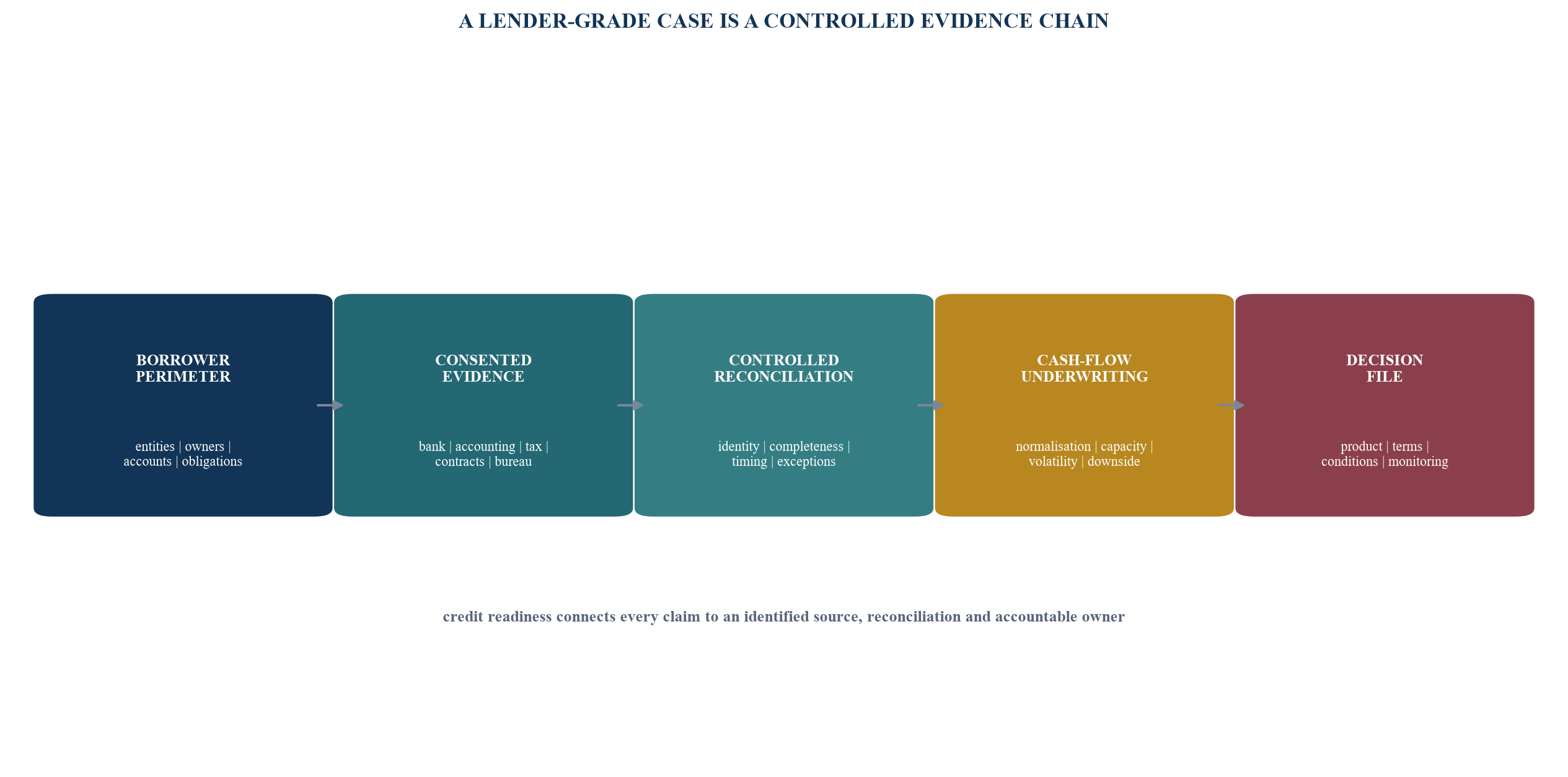
Data access creates value when identity, reconciliation, underwriting and decision evidence form one controlled chain.
2. Place the UAE open-finance framework in context
The CBUAE Open Finance Regulation establishes the licensing, supervision and operation of the UAE Open Finance Framework. The framework combines an API Hub, a trust framework and common infrastructural services. Participation is mandatory for licensed financial institutions with respect to products and services within scope. Open Finance Providers require authorisation or deemed-licensed status under the regulation, and the regulation sets boundaries on activities, data processing, consent, security, outsourcing and operational resilience.
The CBUAE's 2025 Annual Report records a significant implementation milestone. Al Tareq went live during 2025, two banks and two third-party providers met regulatory operational requirements to provide services using open-banking APIs, and centralised infrastructure enabled Nebras Open Finance to begin operations. Reported functionality included data-sharing APIs, payment initiation, e-KYC, payment-token services, standardised consent journeys, confirmation of payee and insurance quote services.
These facts establish an operating foundation. They do not establish universal availability for every SME, bank account, finance product or use case. A borrower should confirm current coverage, participating providers, supported data fields, lookback period, consent duration, refresh frequency, outage handling and revocation process before designing a funding timetable around an open-finance connection.
The regulatory context also extends beyond open finance. Etihad Bureau provides company credit reports containing a credit score where available, payment history, credit contracts and financial court obligations. UAE personal-data law and sector-specific financial rules govern relevant processing and confidentiality. A new CBUAE SME Customer Protection Regulation is scheduled to take effect on 13 September 2026. As at the date of this paper, management should distinguish its issued requirements from provisions already in force and obtain advice on implementation timing.
Table 1. UAE credit-readiness evidence landscape
| Evidence layer | What it can establish | Typical limitation | Borrower action |
|---|---|---|---|
| open-finance data sharing | consented account, balance and transaction evidence within supported scope | participation, history and fields can vary | confirm provider, scope, refresh and consent terms |
| company credit report | reported facilities, payment history, score where available and court obligations | depends on reported history and correction status | obtain, review and correct inaccuracies early |
| bank statements and confirmations | source account activity and facility position | manual files can be incomplete or altered | use direct or verified retrieval and account inventory |
| accounting and tax records | accrual performance, balances, returns and declared obligations | cut-off, classification and posting errors | close periods and reconcile to source transactions |
| contracts, invoices and orders | commercial basis for future and historical cash flow | enforceability, acceptance and collectability differ | evidence delivery, acceptance, disputes and collections |
| management forecast | expected liquidity, debt service and funding use | assumptions may lack historical support | document drivers, downside cases and ownership |
Scope and availability should be confirmed from current official sources and the relevant provider before use.
3. Start with the lender's decision questions
A credit committee usually needs to answer a small set of connected questions. Who is the borrower and which entities generate or consume cash? What is the facility for? How much is required, for how long and in what currency? What cash flow repays it? What can interrupt that cash flow? Which claims, security interests and obligations rank ahead or alongside? What controls reduce fraud and information risk? How will performance be monitored after drawdown?
Management should organise the data room around those questions. A raw transaction export is evidence, but it is not a credit memorandum. A useful decision file links each question to a schedule, source, reconciliation, explanation and accountable executive. It highlights exceptions before the lender discovers them and provides a remediation plan for matters that cannot be resolved immediately.
Different providers place different weight on the evidence. A relationship bank may combine account conduct, audited financial statements, collateral, sponsor support and sector limits. A factoring provider may focus on eligible receivables, dilution, disputes, debtor quality and assignment mechanics. A supply-chain finance programme may depend on anchor confirmation. A private-credit provider may emphasise sustainable EBITDA, free cash flow, covenants, downside protection and governance. A revenue-based provider may focus on high-frequency payment data and retention.
Open-finance data can strengthen the factual layer across several models. It can reveal seasonality, customer concentration, recurring payments, returned items, liquidity buffers and payment behaviour. The lender still applies its policy, models, judgment and legal process. Credit readiness increases the quality and speed of the conversation; approval, amount, pricing and terms remain the provider's independent decisions.
4. Define one authoritative borrower perimeter
Many credit problems begin before financial analysis. A trading brand may use several legal entities. Revenue may enter an owner's account, an overseas account or a payment processor. One company may employ staff while another invoices customers. Related-party transfers may support liquidity without formal documentation. Guarantees may sit outside the entity seeking finance.
The first readiness deliverable should be a borrower-perimeter map. It should show every legal entity, jurisdiction, licence, tax registration, beneficial owner, director, authorised signatory, bank account, merchant account, accounting ledger, material contract, existing facility and guarantee. It should identify which entity owns inventory, invoices customers, employs staff, holds licences and receives cash. The map should distinguish entities proposed as borrowers, guarantors, security providers and operating dependencies.
Identity fields need controlled matching. Names, trade-licence numbers, tax numbers, account titles, addresses and owner identifiers should reconcile across source systems. Old names, abbreviations, transliterations and dormant entities should be documented. A lender should not have to infer that two similar names represent the same company.
The board should approve the intended borrowing structure after legal, tax and financial review. If cash generation and debt service sit in different entities, the file should explain the lawful transfer mechanism and structural risk. If an account is excluded from analysis, management should state why. The output is a dated, version-controlled perimeter with source documents, review status and named owners.
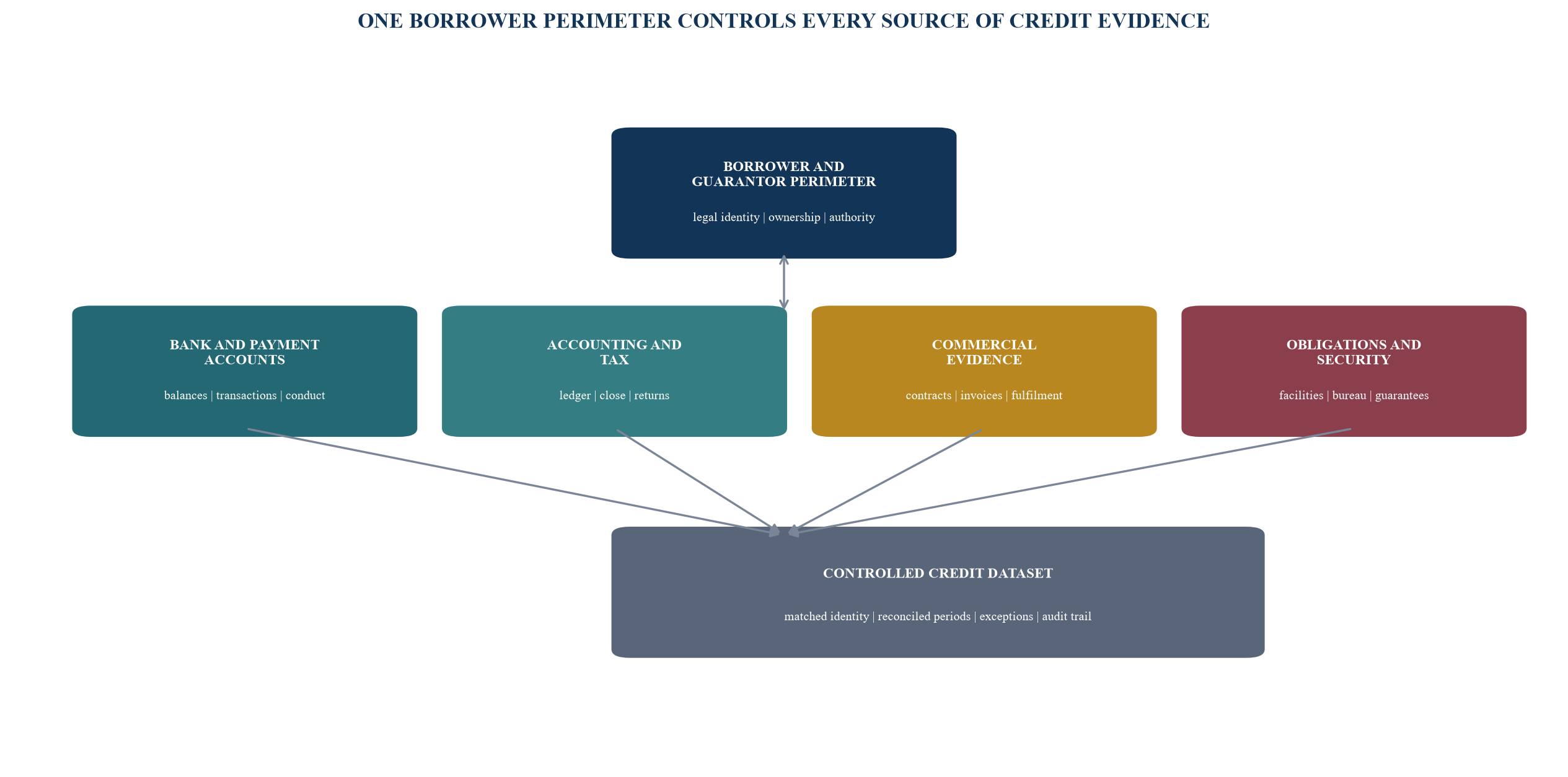
Credit analysis starts by connecting legal entities to accounts, operating systems, obligations and controlled evidence.
5. Govern consent, purpose and data provenance
Consent should be treated as a controlled business process. The file should record who authorised access, in what capacity, which data was requested, for what purpose, which provider received it, how long access lasts and how withdrawal is handled. The legal basis and precise obligations depend on the data, parties, activity and applicable framework. Qualified advisers should confirm the legal effect of the proposed process.
Data provenance is equally important. Each dataset should carry the source institution, account identifier, retrieval method, extraction time, coverage period, currency, field definition, transformations and checksum or other integrity evidence where available. Manual uploads should be distinguished from API retrieval. Missing days, duplicate records, reversals and corrected files should remain visible in an exception log.
The UAE Open Finance Regulation contains detailed requirements and restrictions for providers, including treatment of consent and sensitive data. Federal personal-data legislation establishes broader consent, processing, correction, portability and impact-assessment principles, with exclusions and sector-specific boundaries. Financial information and credit data also have dedicated legal treatment. Management should avoid assuming that a general permission covers every entity, owner, employee or counterparty data field.
Access should follow least-privilege principles. The funding team may need reconciled schedules without unrestricted access to personal information. External advisers should receive only what their mandate requires under appropriate confidentiality, security and retention terms. Revoked access, expired consent and deleted exports should be logged. A strong process improves lender trust because the borrower can explain both the data and the controls surrounding it.
Table 2. Consent and provenance control register
| Control field | Required evidence | Owner | Exception response |
|---|---|---|---|
| authority to consent | board, signatory or delegated-authority record | company secretary | suspend access until authority is confirmed |
| purpose and recipient | plain-language purpose, provider and permitted use | financing lead | narrow request and refresh disclosure |
| dataset and coverage | accounts, fields, dates, currency and refresh cycle | data owner | record gaps and obtain alternative evidence |
| extraction provenance | source, method, timestamp and file integrity | technology or finance | quarantine altered or unidentified files |
| transformation log | mapping, exclusions, normalisation and version | financial controller | reproduce output from source before release |
| withdrawal and retention | expiry, revocation, archive and deletion evidence | privacy lead | stop refresh and apply approved retention process |
The register is an operating template; legal requirements depend on the data, provider, purpose and current law.
6. Convert transactions into a cash-flow truth set
Bank transactions provide a high-frequency view of cash activity. They also contain noise. Internal transfers can double-count inflows and outflows. Loan proceeds can look like revenue. Owner injections can mask operating deficits. Tax payments, payroll, card settlements, foreign exchange and merchant-processor batches may use inconsistent descriptions. A lender-grade dataset needs classification rules that are documented and repeatable.
The finance team should ingest all in-scope accounts into a common transaction model. Each record should preserve the original description and source identifier while adding a controlled category, counterparty, entity, currency, recurring flag, internal-transfer link and confidence status. Rules should be tested against samples and updated through a governed change log. Low-confidence items should enter an exception queue rather than being forced into a category.
Internal transfers should be paired across accounts and removed from consolidated operating cash flow. Financing proceeds, shareholder flows, asset sales, exceptional settlements and other non-operating items should be identified separately. Gross receipts should be reconciled to merchant settlements, sales ledgers and tax declarations, allowing for timing, fees, refunds and chargebacks. Payroll and supplier payments should reconcile to underlying schedules.
The result is a monthly and weekly cash-flow truth set that can be reproduced from source transactions. It should show operating receipts, operating payments, tax, capital expenditure, financing flows, owner flows and closing liquidity. Management should retain both reported and normalised views. The lender can then see how the adjustments were made and decide which are acceptable for its own analysis.
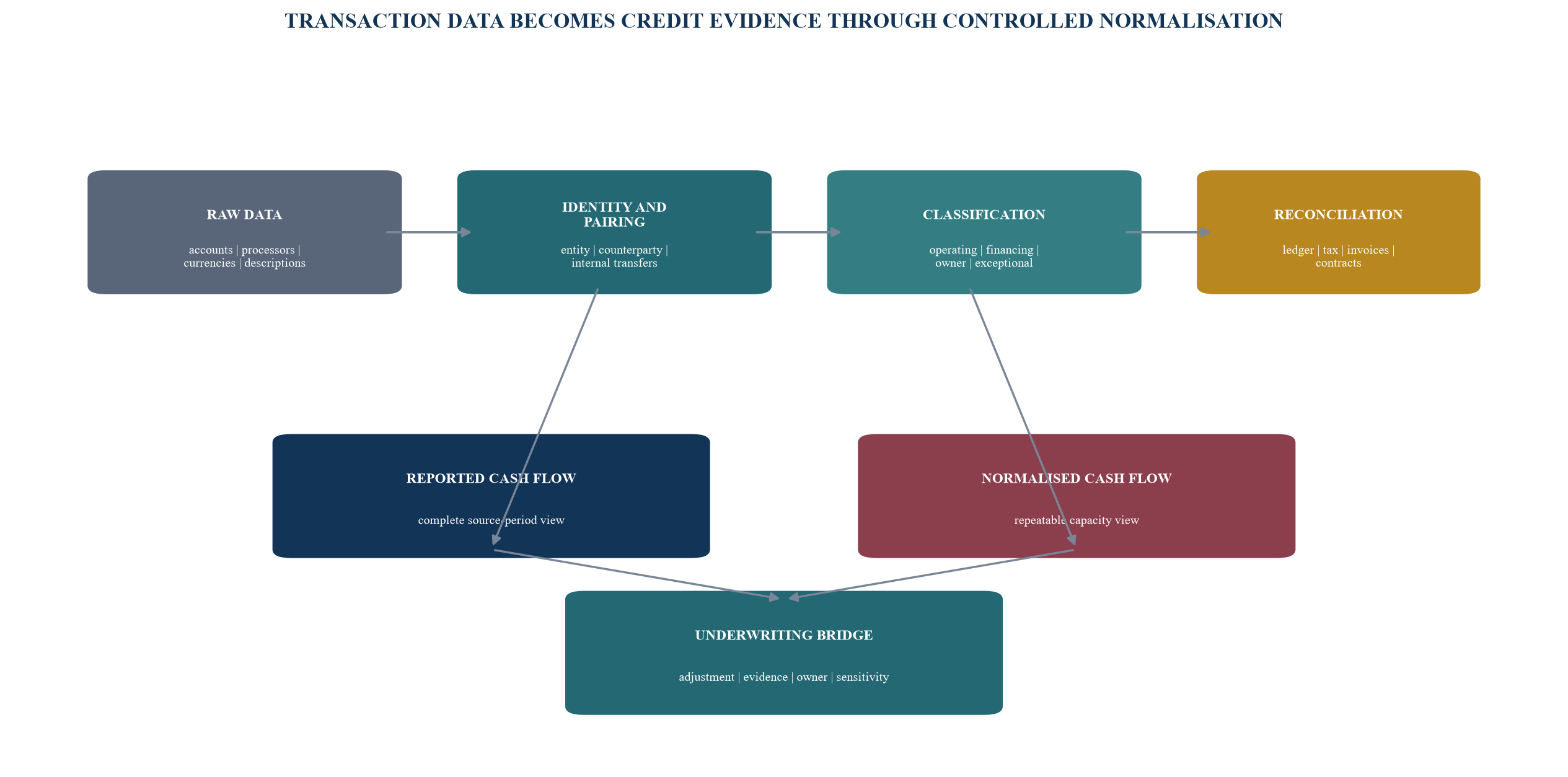
Reconciliation preserves source evidence while separating operating capacity from transfers, financing and exceptional items.
7. Separate recurring capacity from temporary support
Normalisation should answer a precise question: what cash generation is reasonably repeatable under the lender's selected period and assumptions? The process should begin with reported operating cash flow and then show each adjustment individually. Examples may include non-recurring legal settlements, emergency repairs, owner expenses charged through the company, unusually favourable collections, temporary subsidies, start-up costs for a completed site or one-off revenue.
Every adjustment should have a source, rationale, amount, period, direction and accountable approver. Positive adjustments deserve particular scrutiny because they increase apparent capacity. Management should show both historical evidence and forward conditions. If a cost is described as non-recurring, the file should demonstrate why it will not recur. If an expense is expected to reduce, the implementation action, contract or completed restructuring should be available.
Owner and related-party support should remain visible. An injection may be commercially valuable, but it is not operating cash flow. Its legal form, repayment rights, subordination and future availability affect the lender's view. Related-party receivables and payables should be documented and assessed for collectability and settlement timing.
An illustrative management assumption can show the method. Suppose reported annual operating cash flow is AED 6.0 million. Management identifies AED 1.2 million of completed site-launch costs, AED 0.7 million of owner injections and AED 0.5 million of unusually accelerated collections. A conservative normalisation might add only the evidenced non-recurring cost and exclude the owner flow while reversing the collection timing benefit. The resulting figure is a scenario for analysis, not a claim about any borrower or lender policy.
8. Diagnose working capital and seasonality
Many viable SMEs seek finance because timing consumes cash before profit becomes liquidity. Inventory may be purchased months before sale. Customers may pay after 60 or 90 days. Payroll, rent, duties and suppliers mature earlier. A monthly profit figure can therefore coexist with a severe weekly cash deficit.
The readiness file should model the cash-conversion cycle using transaction and ledger evidence. Days sales outstanding, inventory days and days payable outstanding provide useful summaries, but cohort and counterparty analysis is more diagnostic. Management should show invoice issuance, acceptance, disputes, credit notes, partial payments and cash receipt by customer. Inventory should be segmented by age, demand, location, title and realisable value. Supplier terms should distinguish contractual terms from actual payment practice.
Seasonality requires at least a monthly view and often a weekly view. The model should identify the peak cash trough, timing of tax and payroll, concentration of renewals, procurement lead times and buffer required for operational resilience. A borrowing base or revolving facility should be sized against eligible assets and a downside collection curve rather than the best month of revenue.
CBUAE's Q2 2025 Credit Sentiment Survey reported solid growth in business-credit demand, with working-capital requirements among the cited drivers. It also reported that lending appetite was stronger for large firms than for SMEs and that rejection increased more for SMEs. The survey does not describe any specific borrower's outcome. It supports the practical importance of presenting working-capital needs with precise evidence and a defensible repayment path.
Table 3. Working-capital diagnostic
| Driver | Required analysis | Warning signal | Readiness response |
|---|---|---|---|
| receivables | ageing, cohort collection, disputes and debtor concentration | ageing extends while reported sales rise | reconcile invoices to acceptance and cash receipt |
| inventory | age, turns, title, location and realisable value | slow stock funds accounting profit | segregate eligible stock and write-down policy |
| payables | contractual and actual terms, arrears and concentration | suppliers are stretched to create liquidity | agree cure plan and sustainable terms |
| seasonality | weekly inflows, outflows and peak trough | facility sized to average rather than trough | model base and downside liquidity curves |
| tax and payroll | due dates, balances and payment evidence | statutory payments depend on new borrowing | ring-fence obligations and evidence clearance |
| customer acquisition | payback, refunds and cohort retention | growth consumes cash without proven recovery | link funding to evidenced unit-economics gates |
Thresholds and eligibility are lender-specific; the table organises evidence rather than prescribing credit policy.
9. Test revenue quality, concentration and collectability
Revenue is useful to a lender when it converts into cash on a credible timetable. The analysis should connect customer contracts, purchase orders, delivery or acceptance evidence, invoices, credit notes and bank receipts. Reconciliation should explain timing differences and identify amounts recorded as revenue before collectability is established.
Concentration needs several lenses. The largest customers may account for a high share of sales, receivables, gross margin or cash receipts. Each lens can tell a different story. A customer with high sales but rapid payment may represent less liquidity risk than a smaller customer with disputed invoices. The file should show top customers, contract term, termination rights, renewal date, payment terms, actual days to pay, disputes, deductions and dependency on a key relationship.
Recurring revenue should be defined carefully. Repeat purchases, auto-renewing subscriptions, contracted minimums and cancellable orders carry different certainty. Transaction patterns can help verify frequency and amount, but they do not establish legal commitment. Management should avoid presenting all repeating deposits as recurring contracted revenue.
The downside case should model loss or delay of major customers. The response may include replacement pipeline, variable-cost flexibility, liquidity buffer, insurance, security or covenant headroom. Where future revenue depends on a backlog, the file should separate signed, conditional, awarded, tendered and prospective amounts. A lender can then apply its own probability and eligibility rules to evidence that is clearly described.
10. Build a complete obligations and conduct view
A lender needs to understand existing claims on cash. The obligations schedule should include loans, overdrafts, cards, leases, factoring, supplier finance, guarantees, letters of credit, tax, payroll, litigation, court obligations and material related-party balances. For each item, it should show borrower, provider, original amount, current balance, currency, rate, maturity, repayment, security, guarantor, covenant and arrears status.
Etihad Bureau's company credit report can provide an official view of reported credit history for the preceding three years, credit contracts, payment history, financial court obligations and a company credit score where the stated conditions for score generation are met. Management should obtain the report early, compare it with internal schedules and use the available correction process for inaccuracies or outdated information. A report is one evidence layer; it should be reconciled with current statements and provider confirmations.
Account conduct should be analysed across the review period. Returned payments, excesses, recurring late fees, cash withdrawals and rapid in-and-out transfers may require explanation. The explanation should be supported by source evidence and corrective action. Concealing adverse conduct damages credibility when it appears through another source.
The schedule should also identify negative pledges, security interests, cross-defaults and consent requirements that affect a new facility. Legal counsel should confirm priority and enforceability. The board should approve any proposed security or guarantee within valid authority and after considering stakeholder and solvency implications.
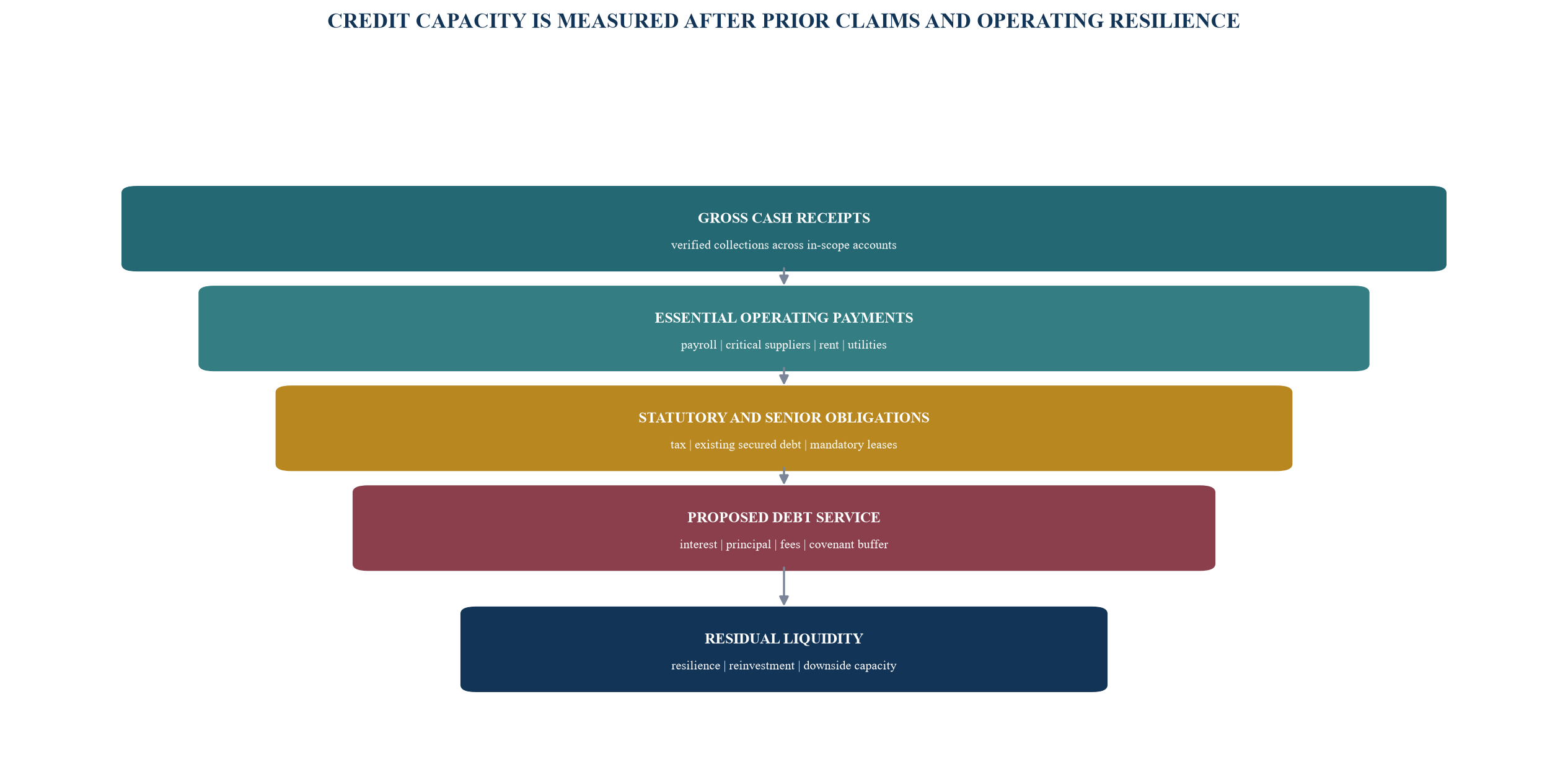
Repayment capacity should be tested after operating needs, statutory obligations and existing senior claims.
11. Make controls and anomaly review lender-grade
More data can improve visibility while creating new control requirements. The borrower should demonstrate that account access, data extraction, classification, adjustment and reporting are governed. Users should have role-based access, strong authentication, approved devices, logging and prompt removal when responsibilities change. Service providers should be assessed for licensing relevance, security, continuity and contractual handling of data.
Transaction analysis can flag duplicates, round-value transfers, unusual counterparties, weekend activity, rapid layering, refunds, reversals and changes from established patterns. These flags are prompts for investigation, not findings of misconduct. Each rule should have a documented purpose, threshold, reviewer, false-positive process and escalation route. Material exceptions should be resolved before the credit file is released or disclosed transparently with remediation.
Machine-learning models may assist classification or risk assessment. Management should know which variables are used, the model's intended purpose, validation status, override process, monitoring and limitations. A borrower should avoid asserting that an opaque score proves creditworthiness. The provider's credit model remains its responsibility; the borrower's duty is to present accurate, lawful and intelligible evidence.
Continuity also matters. Open-finance connections, APIs and internal systems can fail. The readiness process should have manual fallbacks, prior-period snapshots, incident contacts and recovery tests. The lender should receive a stable versioned data room, while periodic refreshes are controlled and reconcilable to the last approved version.
Table 4. Data, fraud and model control framework
| Risk | Preventive control | Detective evidence | Escalation |
|---|---|---|---|
| unauthorised access | least privilege, strong authentication and approval | access logs and quarterly entitlement review | suspend credentials and assess exposure |
| incomplete accounts | perimeter sign-off and account confirmation | bank-to-ledger and opening-to-closing cash checks | stop analysis until gap is resolved or disclosed |
| transaction manipulation | preserve source record and integrity evidence | duplicate, deletion and sequence tests | quarantine affected dataset and investigate |
| classification bias | documented rules and independent review | sample testing and exception-rate monitoring | revise rule, restate output and retain history |
| opaque model output | intended-use, validation and override governance | drift, error and override reports | restrict use and require human review |
| provider or API outage | tested fallback and stored approved snapshot | availability and failed-refresh log | activate contingency and notify decision owner |
Alerts require investigation; they are not evidence of wrongdoing by themselves.
12. Reconcile bank, ledger, tax and management reporting
The central readiness test is whether the same economic activity is described consistently across systems. Bank receipts should reconcile to customer collections and settlement reports. Sales and receivables should reconcile to invoicing and tax records, subject to documented timing and scope differences. Payroll payments should reconcile to payroll registers. Loan balances should reconcile to provider statements and the general ledger.
The finance team should establish a monthly close calendar for the review period. Each reconciliation needs a preparer, reviewer, cut-off, ageing of exceptions and evidence link. Suspense accounts, director balances, cash accounts, unallocated receipts and stale reconciling items deserve focused attention. Periods should not be silently reopened after lender materials are issued; any restatement should be versioned and explained.
Management accounts often contain useful operational detail, while audited statements provide external assurance over defined periods and scope. Neither should be misrepresented. If the latest period is unaudited, label it clearly and show the close and review process. If accounting policies changed, provide a bridge. If tax returns use different timing or classifications, explain the reconciliation.
The forecast should begin from the reconciled opening balance and use drivers that connect to history. Revenue, margin, collection, inventory, hiring, capital expenditure, tax and financing should be explicit. Base, downside and severe-but-plausible scenarios should show weekly or monthly liquidity, debt service and covenant headroom. The board should approve the assumptions and monitor actual performance against them.
13. Match the evidence to the right financing product
Credit readiness includes product readiness. A short-term working-capital gap should not automatically be funded with long-amortising debt. An equipment purchase may suit asset finance. Eligible receivables may support factoring or invoice finance. A seasonal business may need a revolving line with clean-down and borrowing-base mechanics. A high-growth company with limited collateral may consider venture debt, revenue-based finance or equity alongside debt, subject to cost, risk and availability.
The funding need should be decomposed by amount, currency, timing, duration, use and repayment source. Management should show the minimum viable facility, target facility and contingency. A 13-week cash-flow forecast can establish immediate needs, while a 24-month model tests sustainability. Drawdown conditions, fees, amortisation, security and covenants should be modelled in full.
Banks and alternative lenders may use the same evidence differently. A bank may value operating history and relationship conduct. A factoring provider focuses on receivable eligibility and debtor risk. A private-credit fund may accept complexity in exchange for stronger pricing, covenants, security and governance. A platform lender may rely more heavily on transaction data and automated monitoring. Product labels do not define actual risk; term sheets and legal documents do.
The board should compare total cost, flexibility, security, covenant headroom, reporting burden, refinancing risk and strategic constraints. A cheaper nominal rate may carry tighter control rights or unsuitable amortisation. A decision matrix should record the trade-offs and the authority approving them.
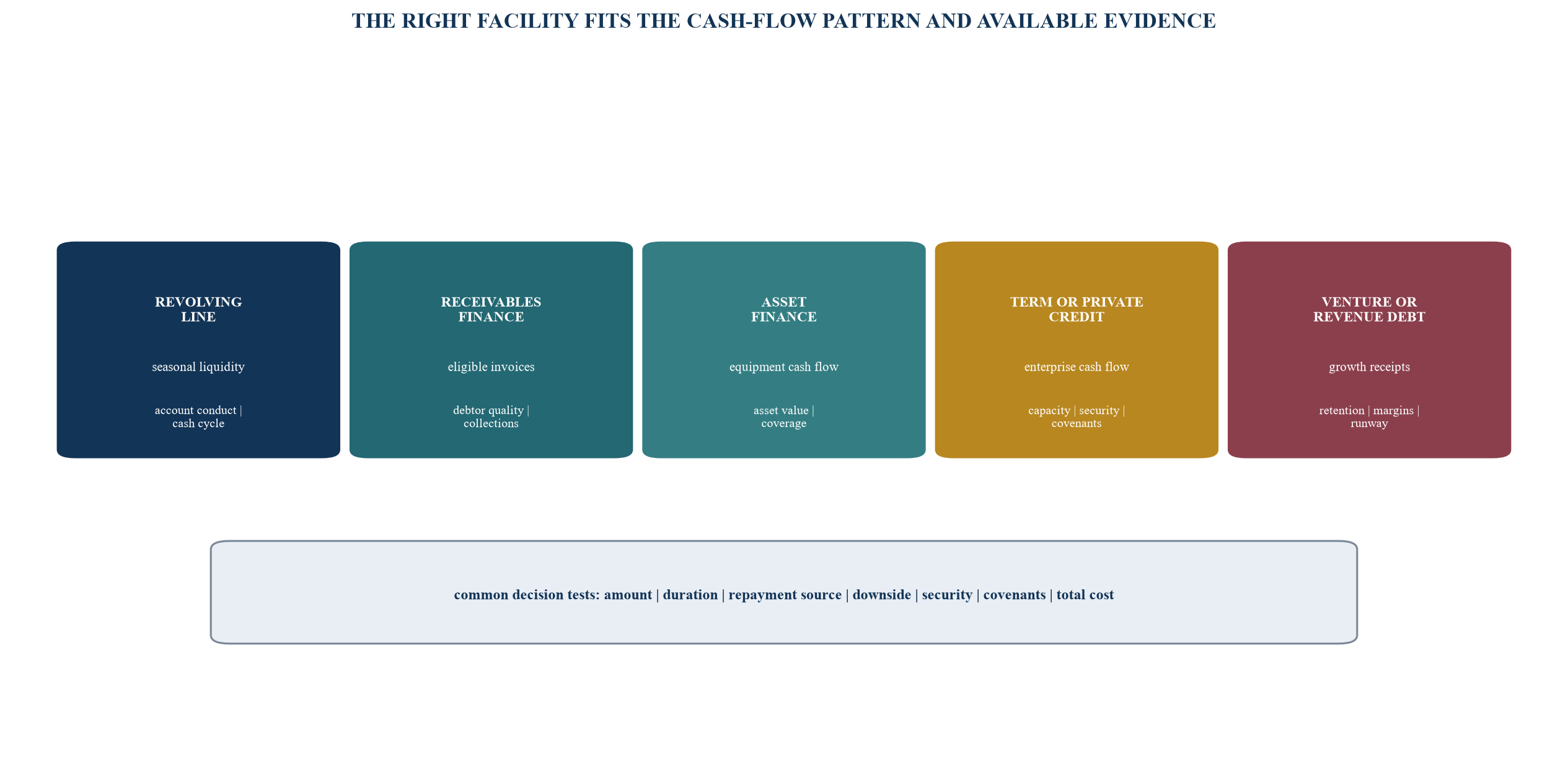
Product selection begins with the asset or cash-flow pattern that repays the facility.
14. Write a credit narrative that can be challenged
The credit narrative should help a decision-maker understand the evidence quickly. It should state the borrower, purpose, amount, product, repayment source and requested timetable. It should then explain the business model, market, ownership, management, historical performance, cash conversion, obligations, downside risks, mitigants and proposed monitoring.
Each material claim should link to a schedule or source. The narrative should distinguish fact, management assumption and adviser conclusion in ordinary reader-friendly prose. Management can state that a forecast assumes a specified collection period or margin and then show the historical evidence and downside sensitivity. Legal, tax and accounting conclusions should be attributed to qualified advisers or described as requiring confirmation.
The file should lead with the difficult issues. Customer concentration, prior arrears, thin collateral, a recent loss, related-party balances or a short operating history should be addressed directly. The response should include evidence, root cause, current status, remediation and residual risk. Avoid unsupported superlatives and generic claims that the company is low risk.
A lender Q&A log should record the question, response owner, evidence, date and any model change. Repeated questions may reveal a weakness in the core file. The final credit pack should be versioned and approved by management, finance and the board or delegated committee. External advisers can challenge coherence and lender fit, while management remains responsible for accuracy and disclosure.
Table 5. Decision-grade credit memorandum structure
| Section | Decision question | Core evidence | Quality gate |
|---|---|---|---|
| request | what is required and when | facility, use, amount, currency and timeline | cash need reconciles to model |
| borrower | who owes, guarantees and provides security | entity, ownership, authority and perimeter map | identities match across sources |
| business and cash flow | how money is earned and collected | contracts, invoices, transactions and accounts | revenue and cash reconcile |
| repayment and downside | what pays debt under pressure | normalised cash flow and scenarios | prior claims and buffers included |
| risks and mitigants | what can impair repayment | concentration, controls, security and actions | residual risk stated clearly |
| monitoring | how deterioration becomes visible | reporting pack, covenants and consented refresh | owner, cadence and escalation agreed |
The structure should be adapted to the provider, product and transaction.
15. Build a consent-based credit data room
The data room should be organised for controlled review. A practical index includes corporate identity, ownership and authority; financial statements and management accounts; tax; bank and payment evidence; customers and receivables; suppliers, inventory and working capital; facilities and credit reports; forecasts and sensitivities; legal and compliance; security; and management responses.
Every folder should have an owner and completion status. Files should use stable names, dates and version numbers. The index should identify source, period, confidentiality and whether the document is final, draft or superseded. Sensitive access should be role-based, time-limited and logged. Download rights may be restricted where appropriate, although a lender must receive sufficient evidence for its process.
Open-finance feeds can supplement the room with refreshable evidence. The room should still preserve the approved snapshot used for a decision. If a balance or transaction history changes after refresh, the next version should show the difference. Links should be tested from a lender account rather than only from the preparer's device.
The room should include an exception register. Missing audited accounts, disputed invoices, unreconciled transactions, expired licences, report corrections and pending legal opinions should have owners and target dates. Material unresolved items should appear in the executive summary. Transparency supports a more efficient process and avoids last-minute surprises.
The provider's information request remains authoritative for its process. The borrower should maintain a reusable core room, then create a controlled transaction view rather than granting every party unrestricted access to the entire corporate archive.
16. Execute a 120-day readiness programme
A focused programme can move from fragmented evidence to lender engagement in four stages. During days 1 to 30, management confirms the borrower perimeter, funding need, authority, provider landscape, data sources, consent plan and major gaps. It obtains the company credit report, inventories all accounts and establishes the reconciliation calendar.
During days 31 to 60, finance builds the transaction truth set, closes historical periods, reconciles bank, ledger and tax information and produces customer, supplier and obligation schedules. The team creates normalisation rules, investigates anomalies and records evidence. Legal and data specialists address authority, consent, security and document issues.
During days 61 to 90, management completes the integrated forecast, downside cases, product-fit assessment, credit narrative and indexed data room. An independent challenge should test entity scope, cash flow, adjustments, concentration, facilities, security, assumptions and disclosure. The board approves the funding strategy and delegated negotiation parameters.
During days 91 to 120, the company engages selected providers, manages Q&A, compares term sheets and updates the case for material information. It should maintain a decision log covering pricing, covenants, security, conditions precedent and reporting. Closing workstreams are assigned with daily visibility where timing is critical.
Some companies will need longer because historic records, legal structures, audits or disputes require remediation. The programme should use quality gates rather than forcing a date. A readiness score can help sequence work; it should not conceal a material red flag behind an average score.
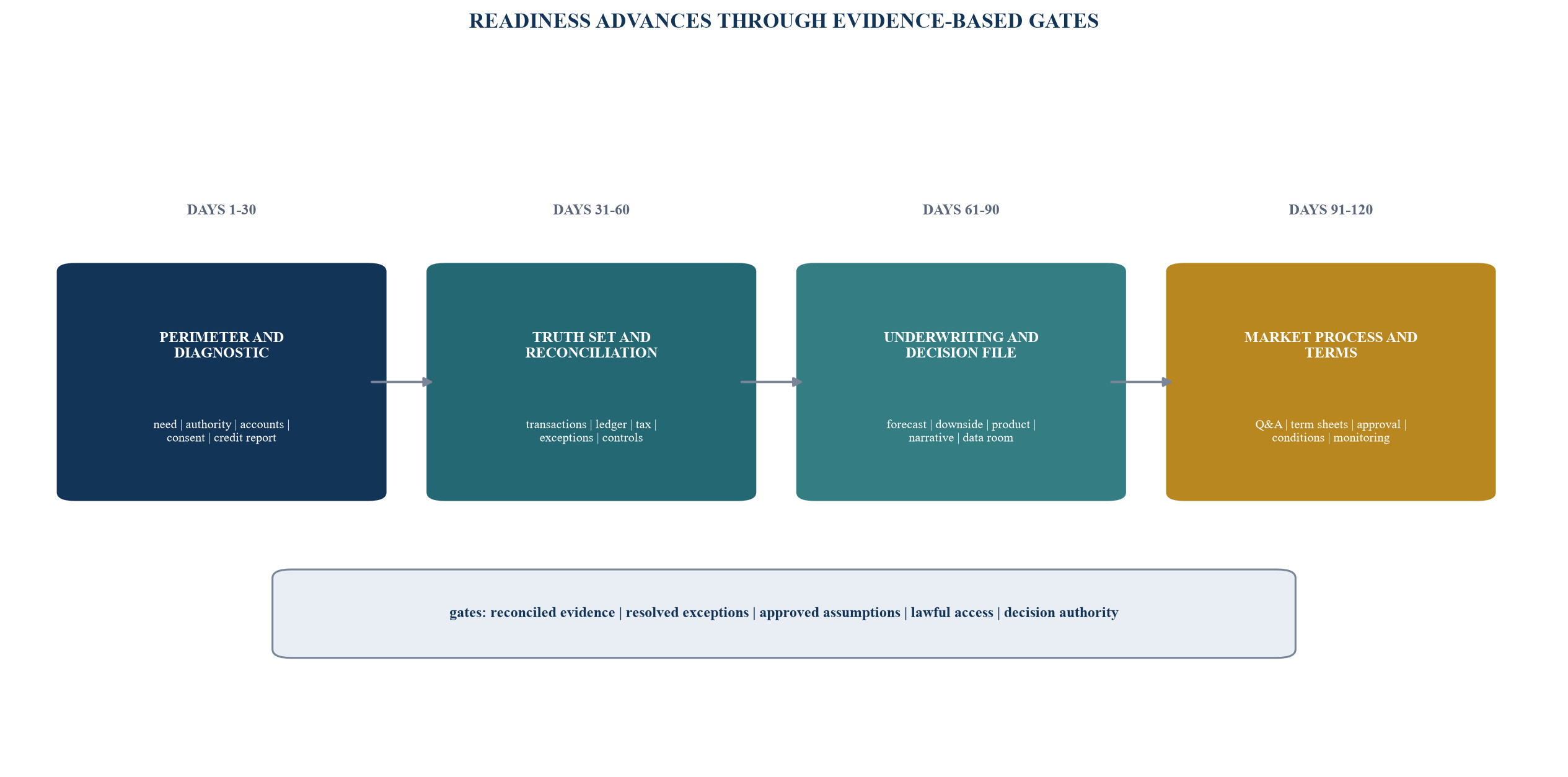
Each stage closes with evidence and approval before lender engagement advances.
17. Govern readiness through a board scorecard
The board needs a concise view of whether the company can enter and sustain a financing process. The scorecard should report completion and quality across borrower identity, data access, reconciliation, historical close, cash-flow normalisation, working capital, obligations, forecast, legal documentation, controls, data room and provider engagement.
Measures should be specific. Examples include percentage of in-scope accounts connected or independently obtained, percentage of transaction value classified, number and value of unreconciled items, days to monthly close, receivables with acceptance evidence, facilities confirmed, downside liquidity headroom and open material exceptions. Status should be supported by evidence rather than self-assessed confidence.
The scorecard needs escalation thresholds. A missing account, unresolved bureau error, inability to reconcile opening and closing cash, material tax arrears, uncertain borrowing authority or unsupported forecast may require a stop decision. Lesser gaps can proceed with an owned remediation plan and transparent disclosure. The board should record the rationale.
After financing, the same system can support covenant reporting and early-warning monitoring. Consented refreshes may make information more timely, subject to provider capability and lawful access. Management should agree reporting definitions with the lender and preserve a reproducible period-end record. Changes in classification or systems should be documented so trends remain meaningful.
Table 6. Board credit-readiness scorecard
| Dimension | Board evidence | Example gate | Escalation owner |
|---|---|---|---|
| borrower perimeter | signed entity, account and obligation map | all material entities and accounts confirmed | chief financial officer |
| data integrity | source coverage, provenance and exception log | opening-to-closing cash reconciles by period | financial controller |
| cash-flow capacity | reported-to-normalised bridge and scenarios | debt service tested in downside case | chief financial officer |
| working capital | receivable, inventory, payable and weekly cash analysis | peak trough and facility use are evidenced | treasury lead |
| legal and consent | authority, provider scope and advice tracker | material approvals and data rights confirmed | general counsel or privacy lead |
| lender process | Q&A, terms, conditions and decision log | open items have owners, evidence and dates | financing lead |
Proposed gates are illustrative management assumptions and should be adapted to the company and provider.
18. Convert readiness into a retained finance capability
Credit readiness should survive the transaction. The company can retain the borrower map, controlled data model, close calendar, working-capital schedules, obligation register, forecast, exception log and board scorecard as recurring finance infrastructure. This reduces the cost of renewals, refinancings, acquisitions, supplier negotiations and investor diligence.
A retained operating cadence may include weekly liquidity review, monthly close and reconciliation, quarterly credit-report review, covenant reporting, annual facility strategy and event-driven updates for acquisitions, new entities, major contracts or ownership changes. Account and system changes should enter the perimeter promptly. Consent and access should be renewed, withdrawn or archived under approved procedures.
The mandate for external support should be concrete. Work can include diagnostic and remediation, lender materials, modelling, data-room management, process coordination, term-sheet comparison, covenant design and post-close reporting. Legal, tax, accounting, privacy and regulatory conclusions should remain with qualified advisers in their respective scopes. Lenders retain their independent credit judgment.
Commercial demand should be measured through qualified opportunities, signed mandates and collected fees. Website visits, downloads and conversations are useful leading indicators. They do not establish willingness to pay or a financing outcome. Management should track which credit-readiness problems lead to funded engagements and which deliverables shorten decisions, improve terms or prevent failed processes based on actual evidence.
The enduring capability is disciplined financial legibility. The company knows its borrowing perimeter, can reproduce cash flow from source evidence, understands prior claims, models downside capacity and communicates risk with candour. Open finance can make the evidence more accessible and timely. Governance converts that access into a finance capability a lender can examine.
Implementation conclusion
Open finance creates a new path for an SME to share consented financial evidence. Credit readiness still depends on the quality of the borrower perimeter, the completeness and provenance of data, reconciliation to accounting and tax records, disciplined cash-flow normalisation, transparent obligations, credible downside analysis and controlled disclosure.
A 120-day programme can build this system through diagnostic, truth-set construction, underwriting, lender engagement and post-close monitoring. The objective is a decision file that can withstand challenge and a finance operating system that remains useful after closing. Each provider applies its own policy and judgment; the SME's task is to make the facts complete, controlled and intelligible.
References
- Central Bank of the UAE. Open Finance Regulation and Framework, C 03/2025, in force. https://rulebook.centralbank.ae/en/entiresection/6127
- Central Bank of the UAE. Annual Report 2025, including Al Tareq and Nebras Open Finance implementation. https://www.centralbank.ae/media/pjimtxfq/annual-report-2025-en.pdf
- Central Bank of the UAE. Credit Sentiment Survey, Q2 2025. https://www.centralbank.ae/media/mtkba34x/credit-sentiment-survey-q2-2025.pdf
- Central Bank of the UAE. Small to Medium Sized Enterprises Customer Protection Regulation, C 2/2026, effective 13 September 2026. https://rulebook.centralbank.ae/en/entiresection/6974
- Etihad Bureau. Company Credit Report: contents, access and correction information. https://etihadbureau.ae/Business/CreditReport
- UAE Legislation. Federal Decree by Law No. 45 of 2021 Concerning the Protection of Personal Data. https://uaelegislation.gov.ae/en/legislations/1972
- UAE Legislation. Cabinet Resolution No. 115 of 2021 concerning the Executive Regulations of the Federal Credit Information Law. https://uaelegislation.gov.ae/en/legislations/1075/download
- World Bank Group. Alternative Data: Transforming SME Finance. https://documents.worldbank.org/curated/en/701331497329509915/pdf/116186-WP-AlternativeFinanceReportlowres-PUBLIC.pdf
- World Bank. The role of digital financial services in bridging the SME financing gap, 18 November 2022. https://blogs.worldbank.org/en/psd/role-digital-financial-services-bridging-sme-financing-gap
- Bank for International Settlements. The impact of fintech lending on credit access for U.S. small businesses, research study No. 1041, 26 September 2022. https://www.bis.org/publ/work1041.htm
- Bank for International Settlements Innovation Hub. Project Aperta: enabling cross-border interconnectivity through open finance interoperability, updated 29 May 2026. https://www.bis.org/about/bisih/topics/open_finance/aperta.htm
- OECD. Financing SMEs and Entrepreneurs 2026, including recent financing and fintech trends. https://www.oecd.org/en/publications/financing-smes-and-entrepreneurs-2026_075d8058-en.html
About the Author
Chennakeshav Adya is an Independent Researcher and Managing Partner at Matchpoint Partners. His work focuses on corporate finance, capital strategy, transaction execution and the operating systems that connect financial evidence, board decisions and measurable enterprise performance.
