

1. Define the mandate as cash release with operating protection
A working-capital war room needs a dual mandate. It should release cash that is unnecessarily trapped in receivables, inventory and process failure, while protecting revenue, service, supplier continuity, product quality and the capacity required for profitable growth. A cash target without operating guardrails can produce a short-lived improvement and a larger subsequent cost.
The board should approve the problem statement, scope and decision boundaries before execution. The scope normally includes all material legal entities, currencies, customer channels, products, warehouses, suppliers, bank accounts, debt facilities and restricted cash. The decision boundaries should identify which actions management may execute immediately, which require commercial or operational approval, and which need board, lender, legal or shareholder consent.
The programme should distinguish cash release from accounting movement. Collecting an overdue receivable releases cash. Writing off the receivable changes reported balances and may recognise an economic loss. Delaying a valid supplier payment retains cash temporarily and can create contractual, ethical, operational and reputational consequences. Selling inventory below recoverable economics produces cash while potentially destroying value. The war room should track each effect separately.
Four questions establish discipline. Where is cash trapped? What operating cause created the position? Which intervention changes the cause? What evidence proves that the intervention released cash without transferring unacceptable risk elsewhere? Each initiative should have a baseline, an owner, an approval path, a cash timing, a downside indicator and a validation method.
The mandate should also define what the programme will preserve. Examples include minimum customer service levels, critical-stock coverage, supplier concentration limits, statutory and contractual payment obligations, payroll, tax, safety, quality and committed growth investments. These protections convert a broad cost-cutting exercise into a controlled enterprise-cash programme.
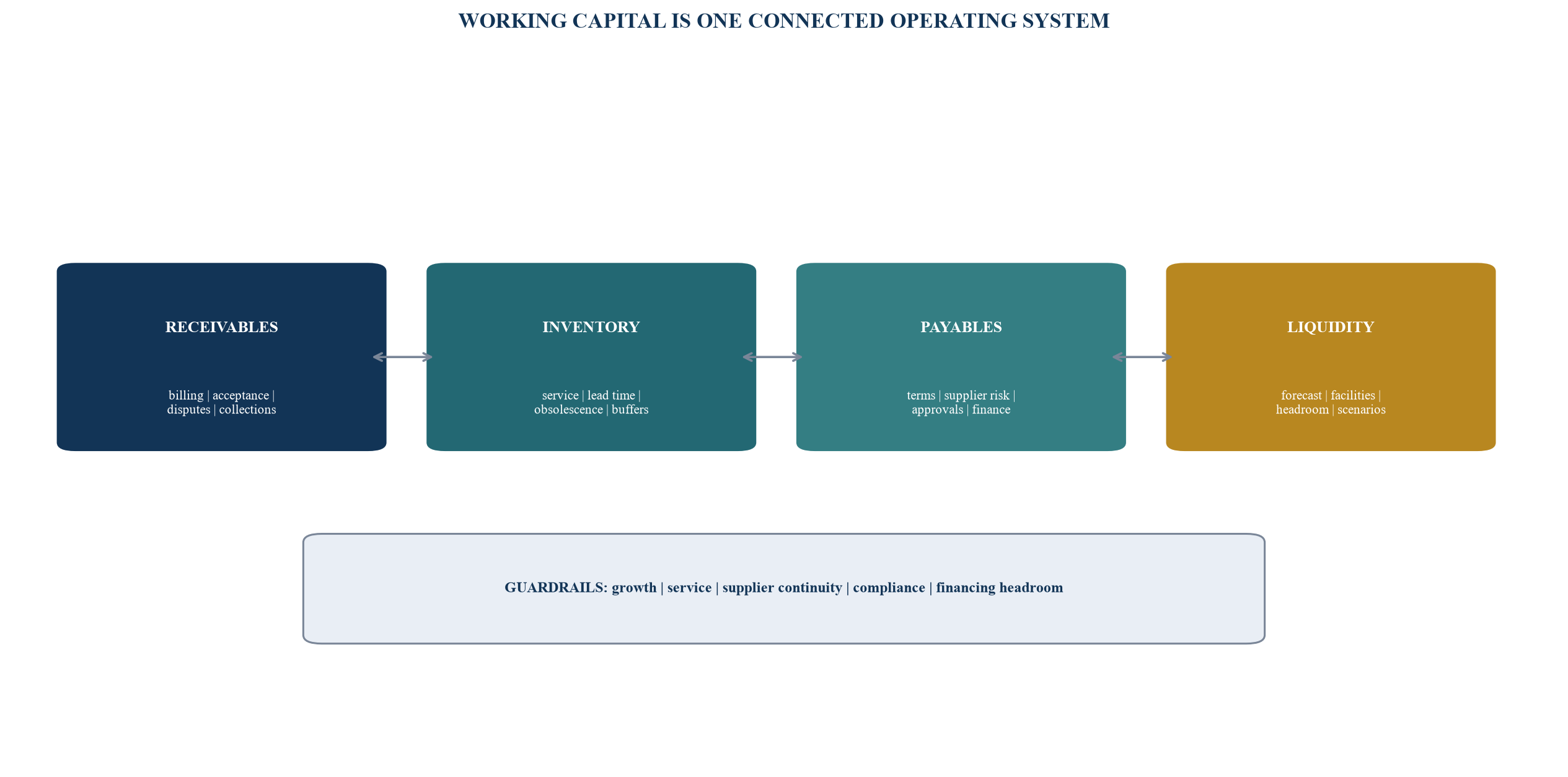
Cash release is sustainable when commercial, operational, supplier and financing constraints are governed together.
2. Ground the programme in current cross-market evidence
Working capital is a recurring financing requirement across economies. The Central Bank of the UAE's Credit Sentiment Survey for the second quarter of 2025 reported strong business-credit demand and identified working-capital requirements among the factors supporting demand. The same survey reported positive lending appetite, with stronger appetite for large firms than for small and medium-sized enterprises. This makes internal cash discipline relevant even when aggregate credit conditions appear supportive.
The OECD's 2026 financing scoreboard covers 48 countries and reports that borrowing costs for SMEs remained high relative to pre-pandemic levels in many participating economies. It also reports continued stringent lending terms, mixed performance across factoring and leasing, and an expanding role for fintech and non-bank finance. The implication for a company is practical: liquidity resilience should combine internal cash release, committed facilities and suitable asset-based or transactional finance rather than depend on a single funding source.
Payment behaviour is a distinct operating risk. The European Commission's Payment Observatory reported that more than half of surveyed companies experienced difficulties from late payments in 2024 and that payment periods exceeded 60 days on average in business-to-business and government-to-business transactions. The United Kingdom expanded payment-practices reporting requirements from 2025 and published a 2026 response setting out intended further measures. These sources also show that payment terms, disputes and retention practices can become governance and disclosure matters.
United States Federal Reserve Small Business Credit Survey findings for employer firms show that meeting operating expenses was the most common stated reason among firms seeking financing in the 12 months before the 2024 survey. World Bank Enterprise Surveys maintain comparable indicators for the use of banks, supplier credit and internal funds to finance working capital. BIS research links credit lines and working-capital needs to firms' positions in production networks, particularly where supply chains are long.
Table 1. Evidence base for a working-capital war room
| Source | Current evidence | Management implication | Boundary |
|---|---|---|---|
| CBUAE Credit Sentiment Survey Q2 2025 | working-capital requirements supported business-loan demand | connect cash release to facility strategy and lender evidence | survey balances describe market sentiment, not a specific borrower |
| OECD SME Financing Scoreboard 2026 | financing conditions and instrument availability vary across countries | diversify liquidity sources and monitor affordability | country coverage and definitions differ |
| EU Payment Observatory 2025 | late payment remains material across surveyed companies | govern collections, terms and supplier payment behaviour | survey evidence does not determine individual enforceability |
| UK payment-practices regime | qualifying large businesses report defined payment metrics | make payment governance board-visible | scope and thresholds require current legal confirmation |
| Federal Reserve Small Business Credit Survey 2025 | operating expenses were a common financing purpose | distinguish recurring cash need from expansion funding | survey is self-reported and United States focused |
| BIS and World Bank research | working capital interacts with supply chains and access to finance | combine operational diagnosis with funding design | research findings require company-specific testing |
Management should confirm current rules, data definitions and local applicability before relying on any source.
3. Build a reconciled cash-conversion baseline
The baseline should connect financial statements to transactions. At a minimum, management should reconcile trade receivables, contract assets, inventory, trade payables and supplier-finance balances to the general ledger, subledgers and source documents. Opening balances plus period activity should reconcile to closing balances. Material manual journals, credit notes, write-offs, reclassifications and foreign-exchange movements should remain visible.
The conventional cash-conversion cycle is days sales outstanding plus days inventory outstanding minus days payables outstanding. It is useful as a directional measure and weak as a stand-alone decision tool. A blended average can conceal overdue customer balances, low-quality inventory, supplier disputes, advance payments, seasonality, acquisitions, mix changes and rapid growth. The war room should calculate the measure using documented definitions and then decompose it.
Decomposition begins with cohorts. Receivables should be analysed by customer, invoice, due date, dispute status, acceptance evidence, currency and collector. Inventory should be analysed by item, location, demand class, age, lead time, service criticality and ownership status. Payables should be analysed by supplier, due date, contractual term, dispute status, criticality, early-payment economics and financing arrangement.
The programme needs a frozen baseline date and a bridge to every subsequent reporting period. The bridge should show operational cash release, accounting corrections, acquired or disposed balances, foreign exchange, revenue growth, seasonality and deliberate investment. A target based on an unreconciled opening position cannot support reliable performance management.
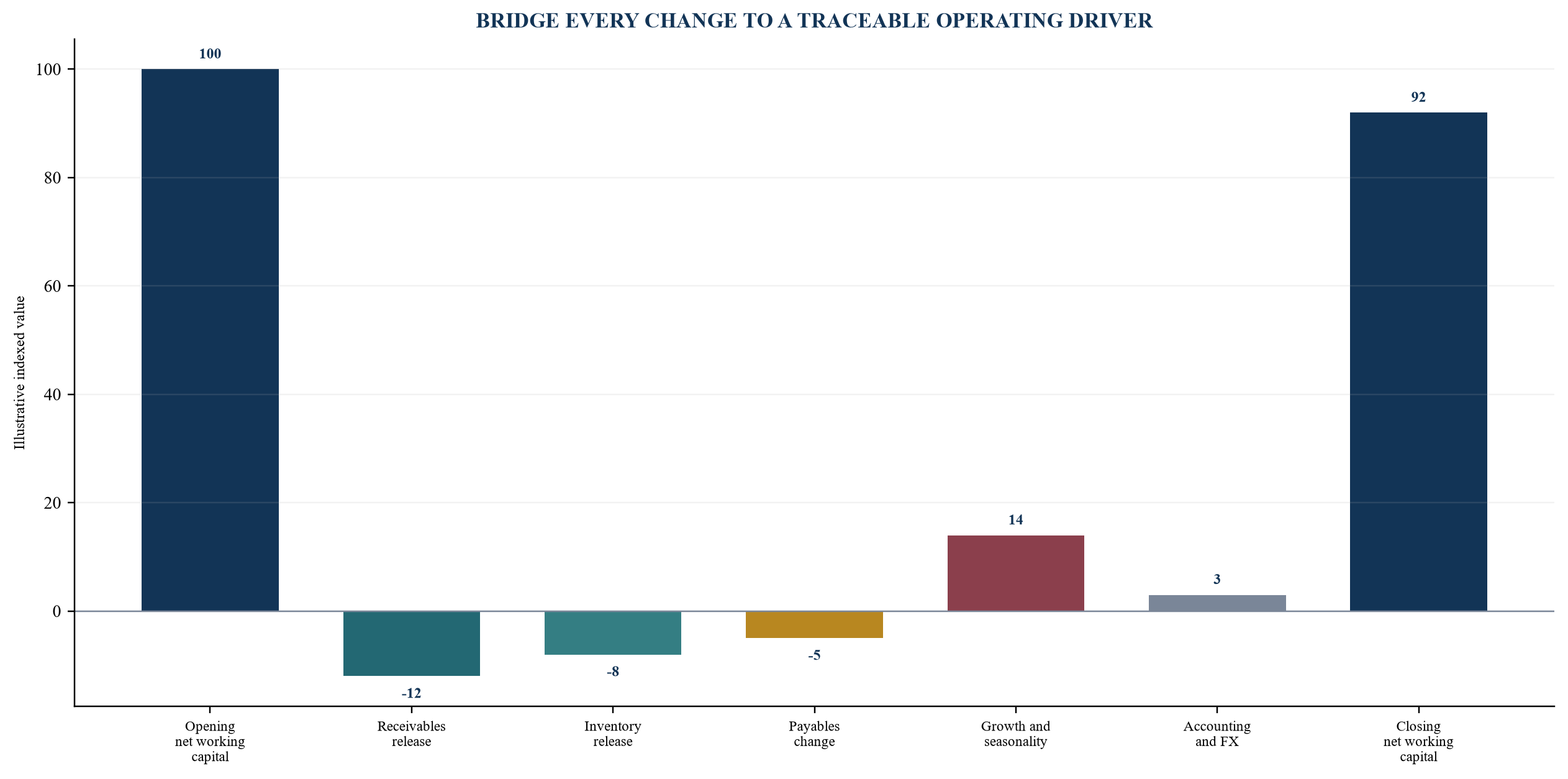
The bridge separates operating cash release from growth, seasonality, accounting corrections and financing effects.
4. Segment the business before setting targets
Working-capital economics vary by business model. A project business funds mobilisation, work in progress, certification and retention. A distributor holds stock across service levels and demand uncertainty. A software company may collect annual subscriptions in advance and carry limited inventory. A healthcare platform can face claims-processing delays. A hospitality business experiences seasonal deposits, payroll and consumables. A single group target can reward behaviour that harms one segment and is irrelevant to another.
The baseline should therefore be segmented by entity, geography, business unit, channel, customer type, product family and transaction model where material. Each segment should have an operating explanation for its receivable, inventory and payable profile. Management should distinguish contracted terms from actual behaviour and compare recent cohorts with historical periods under consistent definitions.
Growth deserves explicit treatment. Rapid revenue growth may increase receivables and inventory even when days metrics improve. A cash programme should identify working capital required to support approved growth and separately identify leakage caused by process failure or poor decisions. The forecast should show volume, price, mix, lead-time and payment assumptions that connect growth to cash consumption.
The segmentation also reveals concentration. A small number of customers may represent most overdue receivables. A narrow item set may drive excess inventory. A few suppliers may account for the majority of payable leverage and operational risk. Concentrated opportunities should receive senior attention, with tailored interventions and clear relationship ownership.
Table 2. Diagnostic segmentation and decision questions
| Dimension | Receivables question | Inventory question | Payables question |
|---|---|---|---|
| customer or supplier | which counterparties drive overdue value? | which items depend on the counterparty? | which suppliers are critical or concentrated? |
| product or service | where do billing and acceptance fail? | where does service require a buffer? | where do input terms differ from customer terms? |
| geography and currency | where do collection and FX risks arise? | where are stock transfers or customs delays material? | where do payment law and currency affect timing? |
| contract type | what triggers invoice and acceptance? | who owns work in progress or consignment stock? | what are due dates, retentions and dispute rights? |
| growth cohort | which new sales convert slowly to cash? | which launch stock is planned or excessive? | which suppliers fund or constrain expansion? |
| exception status | what is disputed, blocked or unallocated? | what is obsolete, quarantined or unmatched? | what is disputed, duplicated or approval-blocked? |
Dimensions should be adapted to the company's operating model and available evidence.
5. Convert receivables into a collection operating system
Receivables improvement begins before an invoice becomes overdue. Commercial terms, customer master data, purchase orders, delivery evidence, acceptance, billing accuracy, tax documentation and dispute handling determine whether a valid invoice can be collected. The war room should map the order-to-cash process and quantify failure at each handoff.
Every material overdue balance should have an owner, status, next action and promised-payment date supported by evidence. Collections should be prioritised by cash value, probability, age, dispute cause, customer importance and escalation path. A large current invoice with a known documentation gap may deserve more attention than an old low-value balance with limited recoverability.
Disputes should be coded by root cause. Common categories include pricing, quantity, delivery, acceptance, tax documentation, purchase-order mismatch, duplicate invoice, missing credit note and customer insolvency. Coding turns collections from repeated chasing into process repair. The finance team should report how much overdue value arises from internal failure, customer behaviour and formal dispute.
Commercial decisions require discipline. Revised terms, settlement discounts, payment plans, credit insurance, factoring and collection escalation can each accelerate cash. Their economics and relationship effects differ. A discount should be compared with funding cost, expected delay, default risk and margin. Factoring should be assessed for eligibility, recourse, concentration, dilution, notification, legal assignment, fees and operational requirements.
Sales incentives should include cash quality. Revenue booked without enforceable terms, acceptance evidence or collectability can increase reported growth while weakening liquidity. The war room should connect customer acquisition, pricing approval, credit limits, invoicing and collections through shared metrics.
Table 3. Receivables intervention register
| Failure point | Evidence | Primary action | Growth protection |
|---|---|---|---|
| missing purchase order | invoice rejection and order record | correct order governance before fulfilment | retain fast exception route for strategic orders |
| incomplete delivery or acceptance | service record, delivery note and customer response | capture acceptance at source | avoid delaying genuine fulfilment |
| pricing or quantity dispute | contract, quote, invoice and credit note | resolve root cause with commercial owner | preserve relationship through documented resolution |
| slow approval at customer | customer workflow and payment history | map approvers and submit complete pack early | align billing cadence to customer process |
| customer credit deterioration | ageing, bureau or market evidence | reduce exposure and structure payment | protect viable sales with limits or security |
| portfolio funding need | eligible ledger and dilution data | evaluate factoring or receivables finance | compare economics with margin and customer impact |
Actions require company-specific legal, commercial, tax and accounting review.
6. Resolve disputes before applying pressure
An overdue invoice can represent a collection problem, an operational failure or a genuine disagreement. Treating every balance as delinquency can damage customer relationships and conceal the internal cause. The war room should separate undisputed due amounts, administrative blocks, commercial claims, performance disputes and probable losses.
The dispute file should contain the contract, purchase order, delivery evidence, acceptance, correspondence, invoice, credit notes, customer reason code, internal owner and proposed resolution. The company should record when the dispute was raised and whether the undisputed portion can be collected. Legal rights and escalation steps depend on the contract and jurisdiction and should be confirmed by qualified counsel.
Root-cause resolution matters because disputes recur. If invoices repeatedly fail because customer master data is incomplete, the fix belongs in onboarding. If project milestones are disputed, the fix may involve scope control, change orders and acceptance governance. If credits are delayed, the control sits in approval workflow. The war room should close the operating defect with the same urgency as the individual invoice.
The board scorecard should show disputed value, days in dispute, percentage with complete evidence, resolution velocity and recurring causes. Collection targets should avoid pressuring teams to mask disputes through unsupported credit notes or re-ageing. Transparent classification supports more reliable cash forecasting and customer decisions.
7. Segment inventory by service role and economic risk
Inventory reduction requires item-level economics. Age alone does not determine excess. A slow-moving component may protect a high-value service contract or have a long replenishment lead time. A recently purchased item may already be obsolete. The war room should classify inventory by demand, service criticality, lead time, substitutability, shelf life, margin, ownership, quality status and contractual commitment.
The first task is physical and accounting integrity. Quantities should reconcile across warehouse, enterprise-resource-planning and general-ledger records. Consignment, customer-owned, quarantined, in-transit, returned and work-in-progress balances should be separately identified. Unexplained adjustments and negative stock require resolution before targets are assigned.
The second task is a policy test. Safety stock, reorder points, minimum order quantities, forecast inputs and service levels should be compared with actual demand and supplier performance. The objective is to identify policy-driven excess, forecast error, purchase-order behaviour, product proliferation and operational bottlenecks.
Actions include transfer, substitution, return to supplier, order cancellation, controlled run-down, remarketing, refurbishment, bundling and disposal. Each action should show expected cash timing, margin effect, tax and accounting treatment, service risk and approval. Inventory released through a one-time sale should remain separate from sustainable policy improvement.
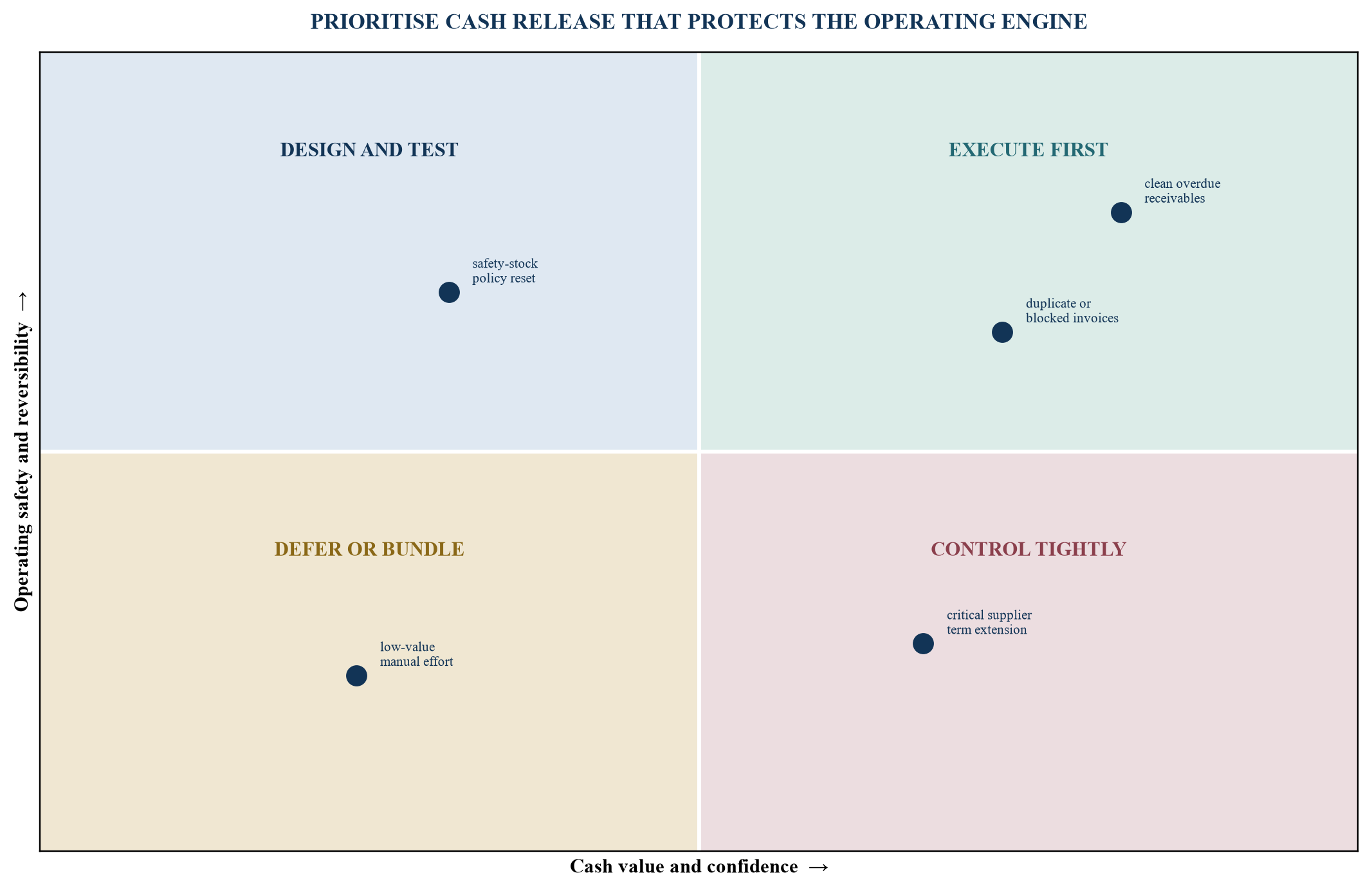
Cash actions should be prioritised by value and operating risk rather than by balance alone.
8. Reset inventory policy without cutting service capacity
Inventory policy should state the service outcome it buys. A target can be expressed as fill rate, production continuity, response time or probability of stock-out. The war room should then determine the minimum inventory required under observed demand, lead times, variability and contractual commitments.
Growth scenarios should remain visible. New customers, geographic expansion and product launches can require deliberate stock investment. The forecast should label this as approved growth inventory with an owner, launch plan and exit criteria. If demand does not materialise by a defined date, the stock should move into an exception process.
Supplier decisions interact with inventory. Longer lead times, minimum order quantities and unreliable deliveries increase buffer requirements. Procurement savings that increase lead time can consume more working capital than they save in price. The war room should evaluate total landed economics, including cash, service and risk.
The inventory control tower should monitor days on hand alongside availability, forecast accuracy, lead-time performance, purchase-order adherence, ageing, write-down risk and expedite cost. A falling inventory balance accompanied by more stock-outs and emergency freight does not meet the dual mandate.
Table 4. Inventory decision framework
| Inventory class | Evidence required | Potential action | Protection metric |
|---|---|---|---|
| service-critical buffer | demand variability, lead time and service commitment | recalibrate safety stock | fill rate and service failure |
| launch or growth stock | approved plan, cohort demand and exit date | retain with milestone review | launch conversion and ageing |
| slow-moving but recoverable | demand history, substitution and resale channel | transfer, bundle or controlled run-down | realised margin and service |
| obsolete or expired | technical, legal and quality confirmation | dispose or write down through approval | compliance and recovery value |
| work in progress | routing, bottleneck and completion evidence | remove constraint or stop uneconomic work | cycle time and completion cash |
| supplier-constrained item | minimum order, reliability and alternatives | renegotiate lot size or qualify source | lead time and continuity |
Example gates are management-design choices and require validation with operating data.
9. Govern payables as supplier-capital allocation
Payables are a source of operating finance and a claim held by suppliers. The war room should optimise payment timing within valid contractual, legal, ethical and relationship boundaries. Blanket extensions can transfer liquidity stress into the supply chain and endanger delivery, quality or access to scarce capacity.
The supplier base should be segmented by criticality, substitutability, financial resilience, concentration, contract, dispute status and payment history. Strategic and vulnerable suppliers require active relationship decisions. Commodity suppliers with competitive alternatives may support term harmonisation. Small suppliers may have limited capacity to fund a large customer and may warrant accelerated payment or supply-chain finance.
Payment accuracy is the first release opportunity. Duplicate invoices, blocked approvals, unmatched receipts, incorrect bank details, unclaimed credits and inconsistent terms create both leakage and delay. A clean procure-to-pay process enables the company to pay on agreed terms, capture valid discounts and forecast cash reliably.
Early-payment discounts should be evaluated against annualised economics, liquidity headroom and supplier benefit. Extended terms should be negotiated through documented commercial agreement. Supplier-finance arrangements require scrutiny of terms, classification, liquidity risk and disclosure. The IASB's amendments to IAS 7 and IFRS 7 require disclosures about supplier-finance arrangements for reporting periods beginning on or after 1 January 2024 under applicable IFRS Accounting Standards.
The board should monitor due and overdue payables, weighted average terms, critical-supplier exposure, disputes, concentration, discounts, supplier-finance balances and payment promises. This makes supplier conduct part of the working-capital governance system.
Table 5. Payables and supplier decision rules
| Supplier situation | Cash action | Required control | Stop condition |
|---|---|---|---|
| duplicate or incorrect invoice | prevent or recover duplicate payment | master-data and invoice-match evidence | unresolved ownership or authenticity |
| non-critical supplier on short legacy terms | negotiate market-consistent terms | contract amendment and relationship owner | supply disruption outweighs benefit |
| small or vulnerable critical supplier | preserve or accelerate payment | criticality and resilience review | payment delay threatens continuity |
| attractive early-payment discount | compare return with funding cost | verified invoice and liquidity approval | headroom or dispute is insufficient |
| supplier-finance proposal | assess economics, classification and liquidity | treasury, accounting and legal review | disclosure or withdrawal risk is unclear |
| disputed payable | resolve and pay undisputed amount where appropriate | evidence file and accountable owner | legal or quality position is unresolved |
Accounting classification, disclosure and legal obligations require current specialist advice.
10. Build a 13-week liquidity control loop
The 13-week cash forecast translates working-capital actions into time. It should begin with bank-confirmed opening cash and show receipts, payroll, suppliers, tax, debt service, capital expenditure, distributions and other material flows by week. Each line should have a source, owner and confidence classification.
Receipts should be customer and invoice based for material balances. The forecast should distinguish promised dates, contractual dates, historical behaviour and disputed amounts. Supplier payments should reflect contractual obligations, approved payment runs and criticality. Financing should show committed and uncommitted facilities, availability conditions, borrowing-base eligibility, covenant headroom, draw notice and maturity.
Forecast accuracy should be measured through a bridge between forecast and actual cash. Variances should be classified as timing, amount, omission, classification or decision change. Repeated optimism in collections or understatement of purchases should result in assumption changes and ownership escalation.
The war room should maintain base, downside and severe-but-plausible scenarios. Scenarios can test slower collections, inventory build, supplier compression, revenue reduction, input-cost shock, foreign-exchange movement or facility restriction. Management should avoid false precision and should document the assumptions that drive the liquidity trough.
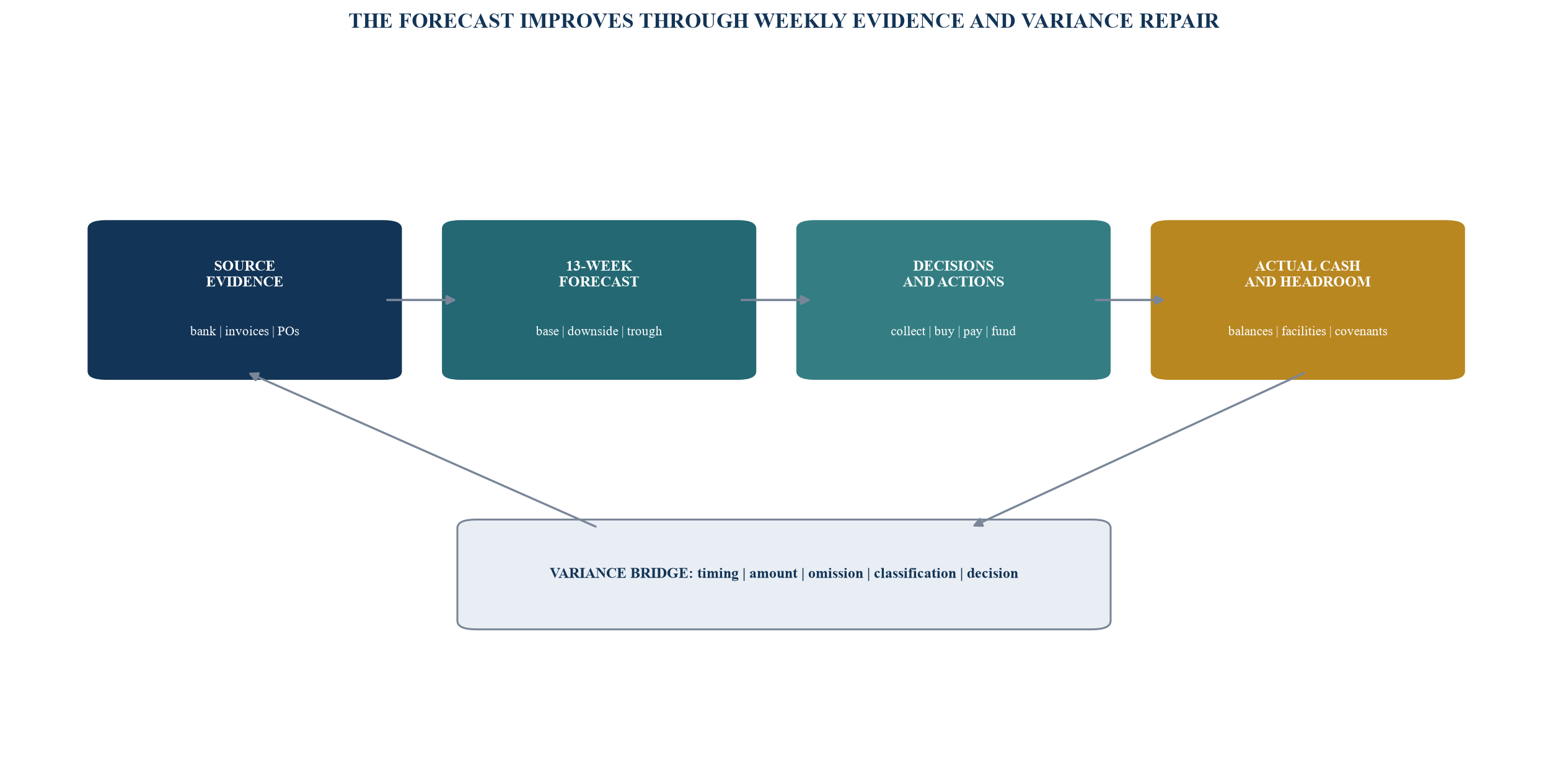
A weekly loop connects source evidence, forecast, action, actual cash and assumption repair.
11. Protect financing headroom and covenant integrity
Internal cash release and external finance should be designed together. A company may need revolving credit, overdraft, receivables finance, inventory finance, supply-chain finance or private credit to bridge timing and fund growth. The facility should match the asset, currency, duration and volatility of the cash need.
The war room should maintain an obligation and availability register. It should show committed amount, drawn amount, undrawn amount, maturity, security, guarantees, borrowing-base rules, financial covenants, information undertakings, draw conditions, notice periods and cross-defaults. Reported headroom should reflect practical availability after eligibility, reserves, operational access and conditions.
Working-capital actions can affect covenant definitions. Factoring may change receivables, debt or cash-flow presentation depending on terms and accounting conclusions. Supplier finance can change liquidity risk and disclosure. Inventory disposal can reduce collateral. Settlement discounts can reduce revenue or margin. The company should obtain lender consent and specialist advice where required.
The programme should also protect renewal readiness. A lender will examine the quality of ageing, inventory, forecasts, controls and management information. A war room that produces reconciled evidence and transparent downside reporting can strengthen that process. Approval and terms remain the lender's independent decision.
12. Turn data into decisions with controlled definitions
Working-capital data commonly spans banking, accounting, billing, procurement, inventory, customer-relationship and warehouse systems. The war room needs a controlled data model with common entity, customer, supplier, item, contract, invoice, purchase-order, currency and date identifiers.
Each metric should have a definition, source, transformation, owner, refresh frequency and reconciliation. Days measures require consistent numerator and denominator periods. Ageing requires a defined date basis. Past-due status should reflect contractual terms and valid amendments. Inventory age should distinguish receipt, production and last-movement dates. Payables should identify supplier-finance balances and disputes.
Manual adjustments should remain traceable. The programme should preserve the raw source, adjustment rationale, approver and period. Access should follow role and confidentiality requirements. Customer and supplier bank-detail changes require secure verification because payment redirection fraud can create immediate loss.
Automation can improve speed, classification and exception detection. It should retain human review for material decisions, defined overrides, audit logs and reconciliation. A dashboard is useful when every reported number can be traced to a controlled source and action owner.
13. Prioritise initiatives by value, confidence and operating safety
An opportunity register should estimate cash value, timing, confidence, implementation cost, reversibility, operating risk and dependency for each initiative. Estimates should show the method and source data. Management should avoid treating every theoretical reduction to a benchmark as collectible cash.
High-confidence opportunities often include billing completed work, resolving administrative invoice blocks, applying credits, correcting duplicate payments, cancelling unneeded orders and collecting documented promises. Structural opportunities may include customer-term redesign, inventory-policy reset, supplier negotiation, product simplification and process automation. These require more evidence and change management.
The register should prevent double counting. A receivable collected through factoring cannot also be counted as internal collections release. Inventory sold below cost affects margin. A supplier-term extension that increases eligible supply-chain finance should show both effects. Growth-driven balance changes should be separated from execution performance.
Each initiative should pass a growth-protection test. The owner should identify customer, service, supplier, employee, compliance, quality and financing consequences. A reversible pilot can validate a change before wider rollout. Stop triggers should be agreed in advance.
14. Design decision rights and escalation
A war room becomes effective when decisions are made at the required speed and level. The governance model should include an executive sponsor, programme leader, treasury, controllership, sales, procurement, operations, supply chain, legal and technology. Business-unit leaders remain accountable for operating outcomes.
Decision rights should be explicit. Finance can prioritise collections and reconcile cash. Sales may approve customer-term changes within policy. Procurement may negotiate supplier terms subject to criticality thresholds. Operations owns service and inventory buffers. Treasury owns facility use and liquidity. Legal and specialist advisers address contractual and regulatory questions within their mandates.
The daily cadence should focus on exceptions and actions. The weekly meeting should approve interventions, review the 13-week forecast, test constraints and remove blockers. The monthly board report should show cash released, forecast headroom, growth protection, structural fixes and unresolved risks. Meeting volume is not evidence of progress; closed actions and reconciled cash are.
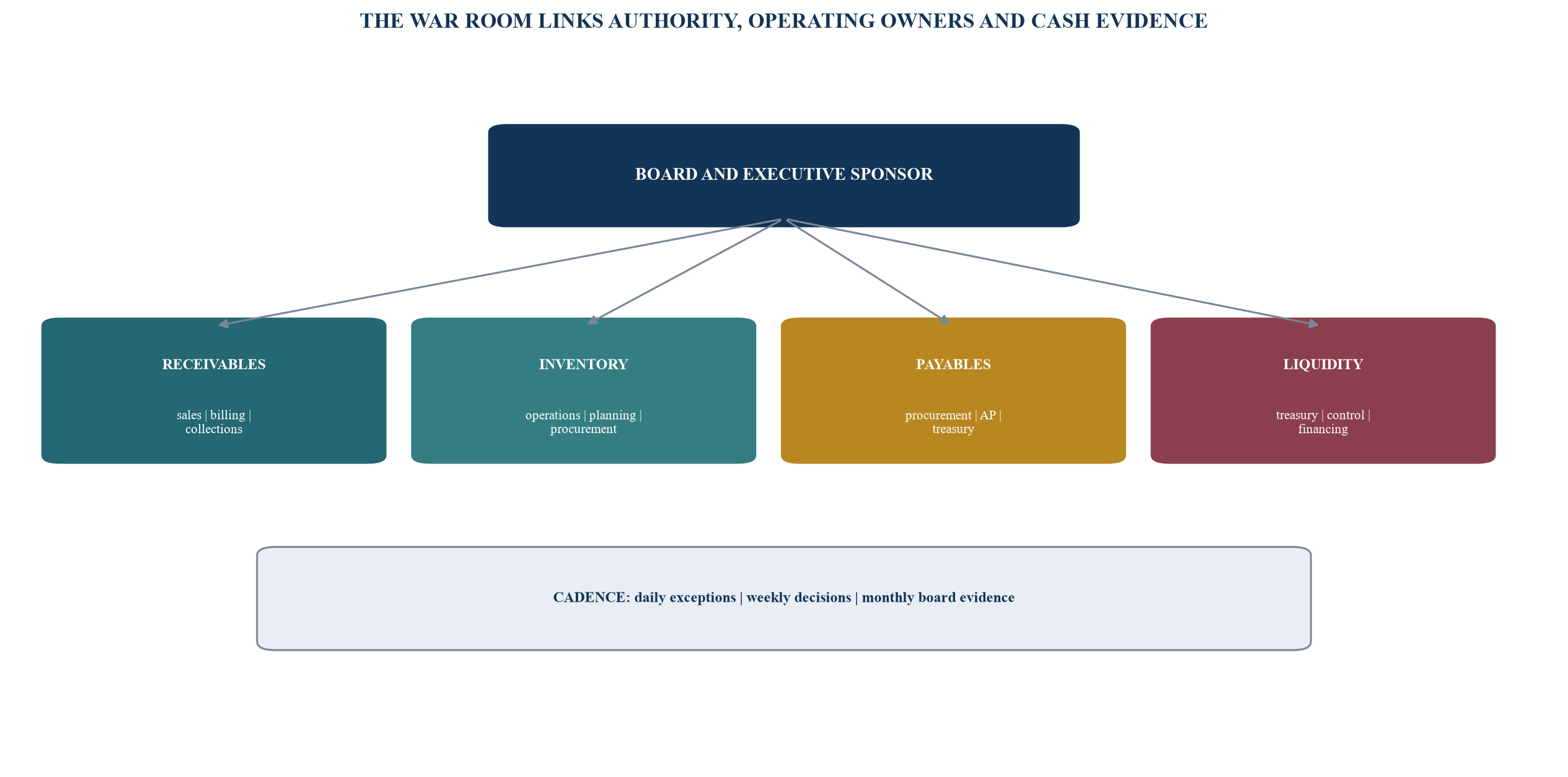
Decision rights connect executive authority with process owners and an evidence-led reporting cadence.
15. Execute through a 120-day programme
The first 30 days establish the perimeter, baseline and immediate liquidity control. Management confirms entities, accounts, facilities and data sources; reconciles core balances; launches the 13-week forecast; identifies top exceptions; and agrees decision rights and guardrails. Quick wins should be supported by source evidence.
Days 31 to 60 focus on transaction-level action. Receivables owners resolve administrative blocks and disputes. Inventory teams classify items and test policies. Procurement cleans payables and segments suppliers. Treasury confirms facility headroom and scenarios. The programme records realised cash separately from forecast opportunity.
Days 61 to 90 address structural causes. Teams redesign customer onboarding, acceptance, billing, inventory parameters, purchase approvals, supplier terms, data controls and incentive measures. Pilots test higher-risk changes. Financing alternatives are evaluated against the refined cash profile.
Days 91 to 120 embed governance. The company closes residual exceptions, integrates metrics into management reporting, confirms recurring owners, documents policies, and establishes board and lender reporting. Each initiative receives a sustainment test and an evidence file.
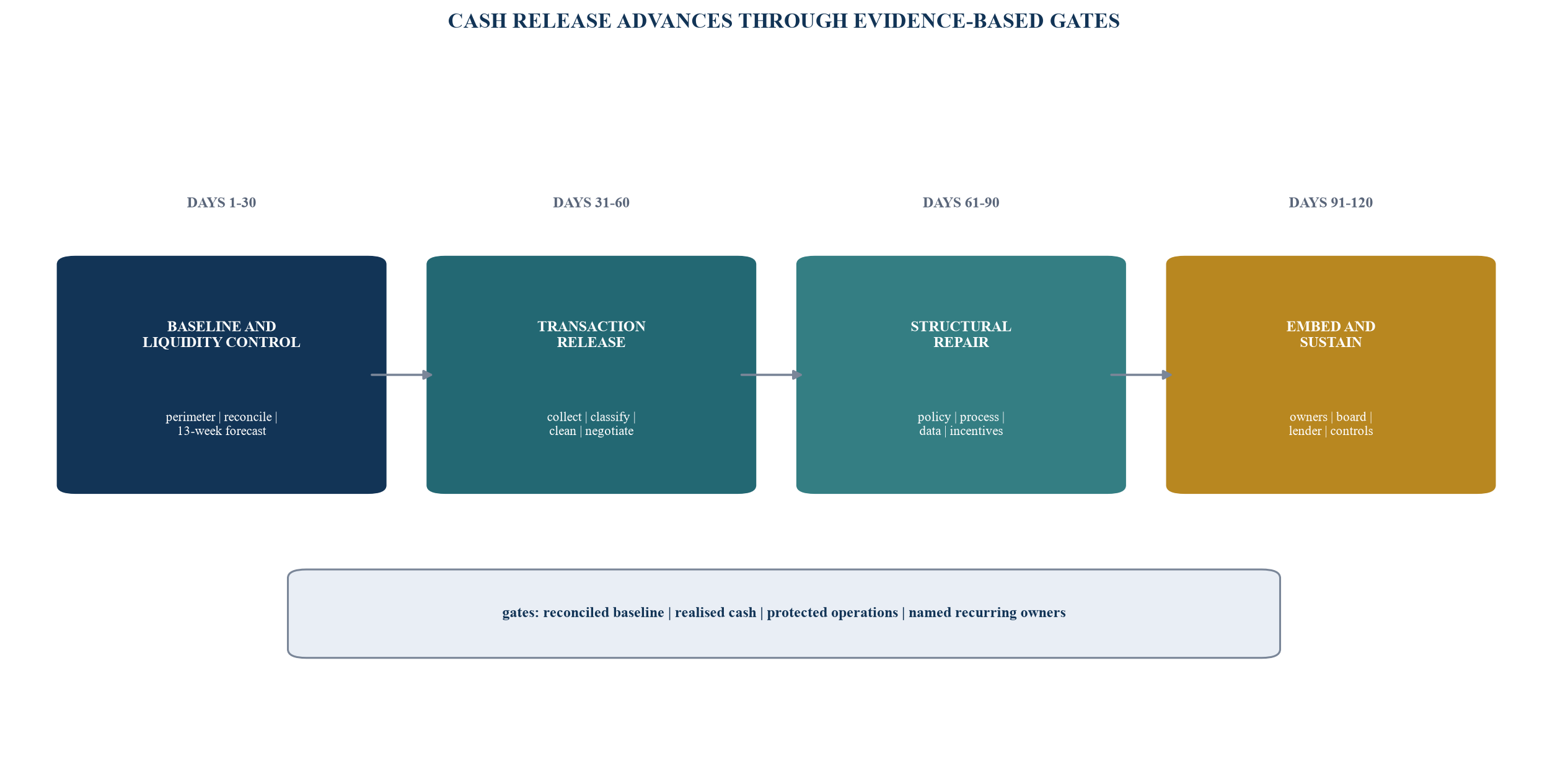
The programme progresses from truth and control to release, structural repair and retained capability.
16. Measure realised cash and protected growth
The scorecard should distinguish opportunity, approved action, forecast release, realised cash and sustained release. Realised cash should reconcile to bank activity and the balance-sheet bridge. Sustained release should remain after an agreed observation period and reflect any reversal or rebuilding.
Growth-protection metrics should sit beside cash. Examples include order intake, revenue, gross margin, customer churn, service level, stock-outs, expedite cost, supplier incidents, quality failures, employee capacity, disputed invoices and cancelled orders. The metric set should match the business model and the initiative.
The board should also monitor liquidity trough, facility headroom, covenant headroom, forecast accuracy, overdue receivables, disputed balances, inventory quality, due payables, critical-supplier exposure and execution blockers. A concise scorecard is more useful than a large dashboard without decisions.
Commercial impact should be evidenced. An improvement in cash can affect valuation through lower net debt, lower financing need, stronger conversion and reduced risk. The transaction or investor outcome depends on sustainability, accounting treatment, buyer definitions and market conditions. Management should avoid applying a valuation multiple to one-time or reversible release without analysis.
Table 6. Board working-capital scorecard
| Dimension | Evidence | Board metric | Escalation trigger |
|---|---|---|---|
| realised cash | bank and balance-sheet bridge | cash released and sustained | value cannot be reconciled |
| receivables | invoice-level ageing and dispute file | overdue value, promise conversion and disputes | strategic balance lacks owner or evidence |
| inventory | item-level class and physical reconciliation | excess, availability and ageing | stock-out, quality or critical-buffer breach |
| payables | due-date and supplier register | on-time payment, terms and critical exposure | supplier continuity or legal concern |
| liquidity | 13-week forecast and facility register | trough, headroom and forecast accuracy | minimum headroom or covenant risk |
| growth protection | commercial and operational measures | revenue, margin, service and incidents | adverse movement outside approved tolerance |
Thresholds and targets are illustrative management choices and should be approved for the company.
17. Convert the war room into enterprise value
Working-capital improvement creates value when the company can operate with less external funding, lower liquidity risk and more reliable cash conversion. It can support debt capacity, acquisition financing, dividends, capital expenditure and strategic flexibility. The value is strongest when process and policy changes make the release repeatable.
Transaction readiness requires evidence. A buyer or lender may test whether receivables were accelerated through discounts, whether payables were stretched beyond normal terms, whether inventory was run below sustainable levels and whether seasonality or growth will reverse the benefit. The company should retain the baseline, interventions, bridge, operating indicators and sustainment history.
The war room can also improve commercial decisions. Customer profitability should incorporate credit terms, disputes and collection cost. Product economics should incorporate inventory and lead time. Supplier economics should incorporate terms, reliability and working-capital impact. Capital allocation should reflect the cash required to grow each segment.
External support can cover diagnostic, modelling, cash forecasting, programme management, process redesign, financing strategy, lender materials and board reporting. Specialist legal, accounting, tax and regulatory conclusions remain with qualified advisers. Performance should be measured through evidenced cash, durable controls, signed mandates and collected fees rather than assumed demand.
18. Retain a permanent cash operating system
The final deliverable is a recurring operating system. The company should retain the data definitions, baseline bridge, 13-week forecast, receivables and dispute workflow, inventory policy, supplier segmentation, facility register, initiative log, decision rights and board scorecard.
The cadence can move from daily war-room intervention to weekly liquidity review, monthly working-capital performance, quarterly policy review and annual facility strategy. Material events such as acquisitions, launches, customer concentration, supplier disruption, system changes and refinancing should trigger additional review.
Ownership should remain in the business. Finance controls the numbers and cash forecast. Commercial leaders own customer terms and acceptance. Operations owns service and inventory policy. Procurement owns supplier strategy. Treasury owns liquidity and facilities. Technology supports reliable data. The board governs risk appetite and major decisions.
The programme should close only when balances reconcile, actions have recurring owners, policies are documented, operating protections are monitored and realised cash has been sustained. A temporary reduction without control transfer remains an unfinished intervention.
Implementation conclusion
A working-capital war room should release cash by repairing the operating causes that trap it. The method begins with a reconciled and segmented baseline, then connects invoice collection, dispute resolution, inventory policy, supplier conduct, liquidity forecasting and financing headroom through explicit decision rights.
A 120-day programme provides a practical sequence from evidence and immediate control to transaction release, structural repair and retained capability. The board receives a complete view of realised cash and the customer, service, supplier and financing risks associated with each action. This supports liquidity resilience and enterprise value without treating growth capacity as expendable.
References
- Central Bank of the UAE. Credit Sentiment Survey, Q2 2025. https://www.centralbank.ae/media/mtkba34x/credit-sentiment-survey-q2-2025.pdf
- OECD. Financing SMEs and Entrepreneurs 2026: An OECD Scoreboard. https://www.oecd.org/en/publications/financing-smes-and-entrepreneurs-2026_075d8058-en.html
- European Commission. EU Payment Observatory Annual Report 2025. https://single-market-economy.ec.europa.eu/smes/challenges-and-resilience/late-payment/eu-payment-observatory/observatory-analysis_en
- UK Department for Business and Trade. Duty to report on payment practices and performance, updated 2 September 2025. https://www.gov.uk/government/publications/business-payment-practices-and-performance-reporting-requirements/duty-to-report-guidance-to-reporting-on-payment-practices-and-performance
- UK Department for Business and Trade. Late payment consultation: time to pay up, government response, updated 24 July 2026. https://www.gov.uk/government/consultations/late-payments-tackling-poor-payment-practices/outcome/late-payment-consultation-time-to-pay-up-government-response-web-version
- Federal Reserve Banks. 2025 Report on Employer Firms: Findings from the 2024 Small Business Credit Survey. https://www.fedsmallbusiness.org/reports/survey/2025/2025-report-on-employer-firms
- World Bank. Enterprise Surveys indicator methodology: firms using banks to finance working capital. https://databank.worldbank.org/metadataglossary/world-development-indicators/series/IC.FRM.BKWC.ZS
- Bank for International Settlements. Elasticity of money in production networks, working capital, credit lines and financial conditions, Working Paper No. 1350, 21 May 2026. https://www.bis.org/publ/work1350.htm
- Bank for International Settlements. Theory of supply chains: a working capital approach, Working Paper No. 1070, revised October 2024. https://www.bis.org/publ/work1070.htm
- IFRS Foundation. IASB increases transparency of companies' supplier finance, 25 May 2023. https://www.ifrs.org/news-and-events/news/2023/05/iasb-increases-transparency-of-companies-supplier-finance/
- IFRS Foundation. IAS 7 Statement of Cash Flows, including Supplier Finance Arrangements amendments effective for annual periods beginning on or after 1 January 2024. https://www.ifrs.org/content/dam/ifrs/publications/pdf-standards/english/2024/issued/part-a/ias-7-statement-of-cash-flows.pdf?bypass=on
- Bank of England. Understanding the macroeconomic effects of working capital in the United Kingdom, Working Paper No. 422, 5 April 2011. https://www.bankofengland.co.uk/working-paper/2011/understanding-the-macroeconomic-effects-of-working-capital-in-the-uk
About the Author
Chennakeshav Adya is an Independent Researcher and Managing Partner at Matchpoint Partners. His work focuses on corporate finance, capital strategy, transaction execution and the operating systems that connect financial evidence, board decisions and measurable enterprise performance.
