

1. Treat e-invoicing as a transaction-system redesign
An invoice sits at the intersection of a contract, delivery evidence, accounting, tax, customer acceptance and payment. Structured e-invoicing makes that intersection machine-readable and time-sensitive. Fields that were previously interpreted by a person must be populated consistently; statuses that were buried in email must be captured; and exceptions must be resolved before they block validation, delivery or settlement. Readiness begins with the commercial event and ends with collected cash and reconciled reporting.
The board should define the programme through outcomes. The first outcome is jurisdiction-specific compliance supported by current official guidance. The second is transaction completeness: every sale and purchase follows an identified route with the correct data, control and evidence. The third is operational continuity: the organisation can issue, receive, correct, archive and reconcile invoices during normal operations and service interruptions. The fourth is cash control: finance can see whether an invoice was created, validated, exchanged, accepted, disputed, due and paid.
A software purchase alone cannot create those outcomes. The company needs accountable owners across sales, procurement, operations, finance, tax, technology, information security, legal and treasury. It must decide which system owns each data element, how provider messages return to the enterprise resource planning system, who resolves each exception, and how the general ledger, tax return, customer balance, supplier balance and bank account reconcile.
The readiness programme should therefore start with an end-to-end transaction map. It should identify documents, fields, decisions, systems, interfaces, controls and evidence from commercial commitment through cash. Each gap should be assigned a consequence: legal or tax exposure, rejected or delayed invoice, customer dispute, supplier interruption, inaccurate reporting, duplicate payment, fraud risk or working-capital leakage. This turns a broad compliance obligation into a governed operating agenda.
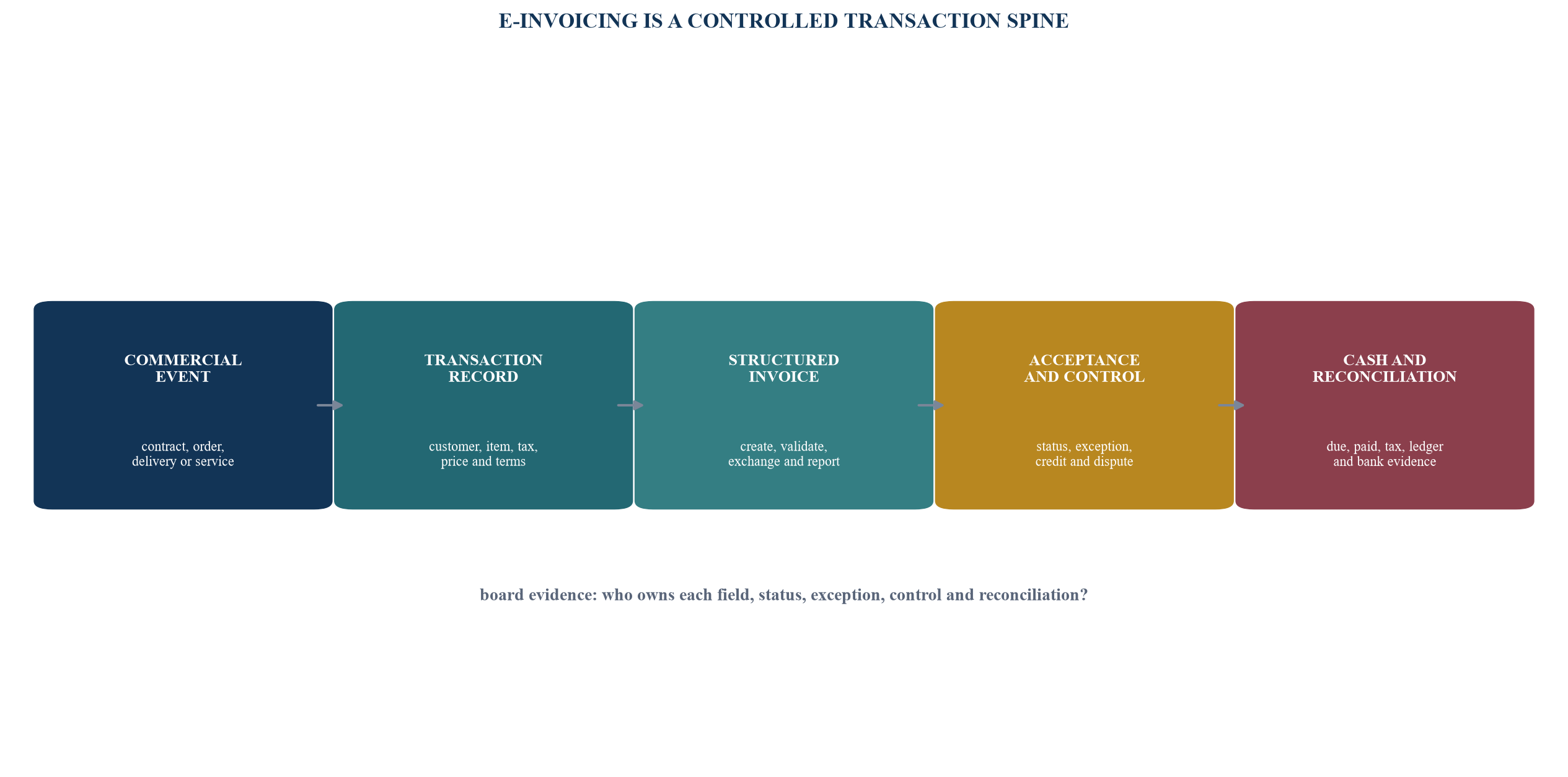
Readiness links the commercial event to structured exchange, accounting, tax reporting and collected cash.
2. Define the evidence and legal boundary
The programme needs a dated obligations register for every legal entity and transaction route. It should record the jurisdiction, tax-registration status, revenue threshold where relevant, effective date, excluded or special transactions, required invoice type, exchange model, service-provider requirement, reporting or clearance timing, retention rule and authoritative source. Qualified advisers should confirm application to the actual facts.
Evidence must be separated by strength. An enacted decision, tax-authority specification, approved provider contract, completed technical test and transmitted production invoice support different conclusions from a consultation, vendor presentation or project plan. The programme record should preserve the source, publication date, retrieval date, version, interpretation owner and next review date. Changes in official guidance should trigger a controlled impact assessment.
The UAE Ministry of Finance states that an electronic invoice is structured data exchanged between supplier and buyer systems and reported to the Federal Tax Authority. A PDF, image, Word document, scanned copy or email does not meet that definition. The February 2026 guidelines describe businesses conducting activities in the UAE as within scope subject to stated exclusions, including transactions with consumers. Current applicability depends on the governing decisions, later amendments and the entity's transactions.
This paper provides an operating framework and a dated source map. It does not determine legal scope for a particular business. Every implementation decision that depends on law, tax treatment, data localisation, record retention, digital signature, consumer treatment or cross-border reporting should carry a named professional owner and a current written conclusion.
3. Map the GCC implementation position with dated sources
The GCC should be managed as a portfolio of jurisdiction-specific programmes. Saudi Arabia has a mature phased regime. Its first phase required compliant invoice generation from 4 December 2021; its integration phase began on 1 January 2023 in waves. The Zakat, Tax and Customs Authority announced Wave 25 on 24 July 2026 for taxpayers whose value-added-tax-subject revenues exceeded SAR 187,500 in 2022, 2023, 2024 or 2025, with integration required by 1 February 2027 and notification at least six months before the date.
The UAE entered a voluntary pilot phase from 1 July 2026. The current Ministry of Finance portal and February 2026 guidelines describe a decentralised continuous transaction control and exchange model using accredited service providers and the UAE Peppol invoice specification. The May 2026 amendment set 30 October 2026 as the service-provider appointment date for businesses with revenue of at least AED 50 million while keeping mandatory implementation from 1 January 2027. The published timetable for businesses below that threshold should be rechecked against the latest decisions before reliance.
Oman's Tax Authority describes a five-corner model involving suppliers, buyers, accredited service providers and the authority. Its published frequently asked questions identify August 2026 as the first rollout and state that participants will be approached at least six months before onboarding. The authority also says technical details will continue to evolve. A business should therefore preserve design flexibility and confirm its participant notice, scope and current specifications.
The official Bahrain National Bureau for Revenue and Qatar General Tax Authority portals reviewed for this paper did not publish a nationwide structured e-invoicing mandate as of 15 August 2026. Kuwait's current position requires direct confirmation with the Ministry of Finance and qualified advisers. These statements are a monitoring record, not a legal conclusion. Boards should assign quarterly monitoring and event-driven updates for all entities.
Table 1. GCC e-invoicing implementation and evidence matrix
| Market | Published position | Immediate management action | Evidence to retain |
|---|---|---|---|
| Saudi Arabia | generation phase in force; integration phase operating in taxpayer waves | confirm wave notice, solution compliance, onboarding, clearance and reporting controls | ZATCA notice, technical validation, production messages and reconciliations |
| United Arab Emirates | pilot from July 2026; phased mandatory implementation under current decisions | confirm entity scope and threshold, select an approved service provider, map data and test exchange | current decisions, provider appointment, PINT AE mapping, test and production evidence |
| Oman | five-corner model; first rollout identified for August 2026 with participant notification | monitor participant notice, specifications and service-provider requirements | authority correspondence, current technical rules, onboarding and acceptance records |
| Bahrain | official portal reviewed did not publish a nationwide structured mandate | maintain quarterly monitoring and avoid treating vendor timelines as law | dated portal review and local-adviser confirmation |
| Qatar | official portal reviewed did not publish a nationwide structured mandate | maintain quarterly monitoring and assess voluntary architecture choices | dated portal review and local-adviser confirmation |
| Kuwait | position requires direct current confirmation | obtain written local advice and monitor Ministry of Finance publications | dated legal or tax conclusion and official source record |
Status is based on official sources reviewed on 15 August 2026; current applicability requires jurisdiction-specific advice.
4. Trace order-to-cash and procure-to-pay
Order-to-cash begins before invoice creation. The company needs a valid legal customer, tax identity, address, contract, price, item or service code, delivery obligation, credit limit, purchase-order requirement, payment terms and dispute route. Billing should occur only when the commercial and operational evidence satisfies the approved trigger. The structured invoice must then pass business, tax and technical validation before exchange and reporting.
The return messages matter. A technically delivered invoice can still be rejected commercially because the purchase-order number is absent, a delivery reference does not match, a unit of measure is wrong or a customer requires an additional workflow. Finance should distinguish technical validation, network delivery, customer receipt, business acceptance, dispute, due date and payment. Combining these states into a single “sent” flag conceals cash risk.
Procure-to-pay has a parallel structure. The company should validate supplier identity, tax registration, bank details, purchase order, receipt, invoice, tax treatment, approval and payment instruction. Incoming structured data can reduce manual entry only when the supplier record, order and receipt are sufficiently disciplined. Weak matching rules can create large exception queues and supplier disputes.
The process map should include recurring bills, advance payments, milestones, retainage, self-billing, intercompany charges, cross-border services, imports, credit notes, debit notes, cancellations, bad debt, foreign currency, mixed supplies and customer-specific portals. Every route should show the accounting entry, tax position, approver, exception owner and cash consequence. Unmapped routes are controlled exceptions until they receive an approved design.
5. Build the invoice data model and master-data controls
Structured exchange makes master-data quality visible at transaction speed. The company should identify mandatory, conditional and commercial fields for each invoice type and jurisdiction. It should assign a system of record and accountable owner to legal-entity identifiers, tax numbers, customer and supplier identities, addresses, item codes, descriptions, units, quantities, tax categories, rates, exemptions, currencies, exchange rates, payment terms, bank details and document references.
The data model should distinguish stable master data from transaction data and derived values. A customer tax number can be governed through onboarding and periodic validation. Quantity and delivery date arise from the commercial event. Tax amount may be calculated from approved rules. A payment due date can be derived from the invoice date and terms, provided both are reliable. Manual override rights should be limited, logged and reviewed.
Duplicate records create material risks. Different spellings of one customer can split credit exposure and receivables. Old tax numbers can cause rejection or incorrect reporting. Free-text descriptions can break mapping and analytics. Conflicting bank details can enable fraud. The readiness diagnostic should profile completeness, uniqueness, validity, consistency, timeliness and ownership for the fields that drive invoice creation and acceptance.
Data remediation should use root-cause controls. A one-time cleanup may improve the initial migration and should be followed by controlled creation, maker-checker approval, reference validation, change history, periodic review and exception reporting. Data owners need service levels for corrections because a rejected invoice can delay the contractual payment clock.
Table 2. Critical data domains and accountable controls
| Data domain | Typical source | Principal failure | Accountable control |
|---|---|---|---|
| legal entity and tax identity | corporate and tax master | wrong supplier identity or registration | controlled entity master with current official evidence |
| customer and supplier identity | counterparty master | rejection, split exposure or duplicate payment | validated onboarding, duplicate detection and periodic review |
| product, service and tax category | item or service master | incorrect classification, rate or description | approved coding rules and tax-owner sign-off |
| contract, order and delivery reference | CRM, procurement or operations | commercial rejection or premature billing | mandatory evidence link and billing trigger |
| quantity, price, discount and currency | order and pricing engine | value mismatch or unauthorised concession | contract-to-invoice reconciliation and override approval |
| payment terms and bank details | treasury and counterparty master | cash delay or payment fraud | controlled change, callback and independent verification |
| credit, debit and cancellation link | receivables or payables ledger | orphan adjustment and reconciliation failure | reference integrity and approval workflow |
The required field set depends on the current jurisdictional specification and transaction type.
6. Segment transaction types and legal entities
A mid-market group should avoid one generic design for all invoices. The programme should build a transaction catalogue by legal entity, jurisdiction, customer type, product or service, billing trigger, invoice frequency, system, currency, tax treatment, value, exception rate and cash importance. High-volume standard sales need resilient automation; low-volume complex projects need controlled evidence and specialist review.
Business-to-business, business-to-government and consumer transactions can follow different rules. Domestic and cross-border transactions can require different tax and reporting treatment. Construction milestones, professional services, subscription charges, utilities, goods shipments, logistics, commissions and asset sales each create distinct source documents and acceptance conditions. The catalogue should also cover transactions created outside the main ERP, including spreadsheets, branch systems and acquired businesses.
Legal-entity boundaries matter. A shared service centre may create invoices for several entities while tax liability and record retention remain entity-specific. Intercompany transactions need consistent counterparty records, agreements, transfer-pricing evidence and settlement. Branches, free-zone entities and permanent establishments require fact-specific review. Provider contracts and system credentials should align with the correct entity and authority relationship.
Prioritisation should reflect obligation, cash and operational exposure. The first wave can combine transactions with near-term compliance dates, high volume, high receivable value, repeatable rules and clean source data. Complex exceptions can enter controlled later waves when permitted by the implementation rules. Every deferral needs an owner, legal basis, temporary control and completion date.
7. Create an exception taxonomy linked to cash
An exception is any event that prevents the transaction spine from reaching its next accepted state. Technical exceptions include invalid syntax, unavailable network, duplicate identifiers and schema failure. Tax exceptions include missing registrations, invalid categories and inconsistent totals. Commercial exceptions include absent purchase orders, disputed quantities, incorrect prices and unmet delivery evidence. Accounting exceptions include posting failure, unmatched credit notes and ledger imbalance.
The programme should define severity by consequence and time. A stopped invoice with a material customer can delay both revenue evidence and cash. A warning that does not affect validity can be scheduled for correction. A duplicate payable or changed bank account can create immediate loss exposure. Each exception class needs an owner, resolution clock, escalation trigger, approved workaround, root-cause code and prevention action.
Queue design is a control decision. A central tax team cannot resolve a missing delivery certificate; operations owns the evidence. Technology can address an interface failure; it cannot decide whether a price concession is authorised. Finance should orchestrate the queue while routing each cause to the process owner. Aging should be measured from the failed event and linked to invoice value, due date and customer or supplier criticality.
Recurring exceptions reveal upstream process weakness. The dashboard should show first-pass validation, technical delivery, business acceptance, disputed value, average resolution time, invoices approaching due date without acceptance, supplier invoices blocked for matching and repeated root causes. Remediation should target the source system or commercial rule rather than expand manual repair capacity.
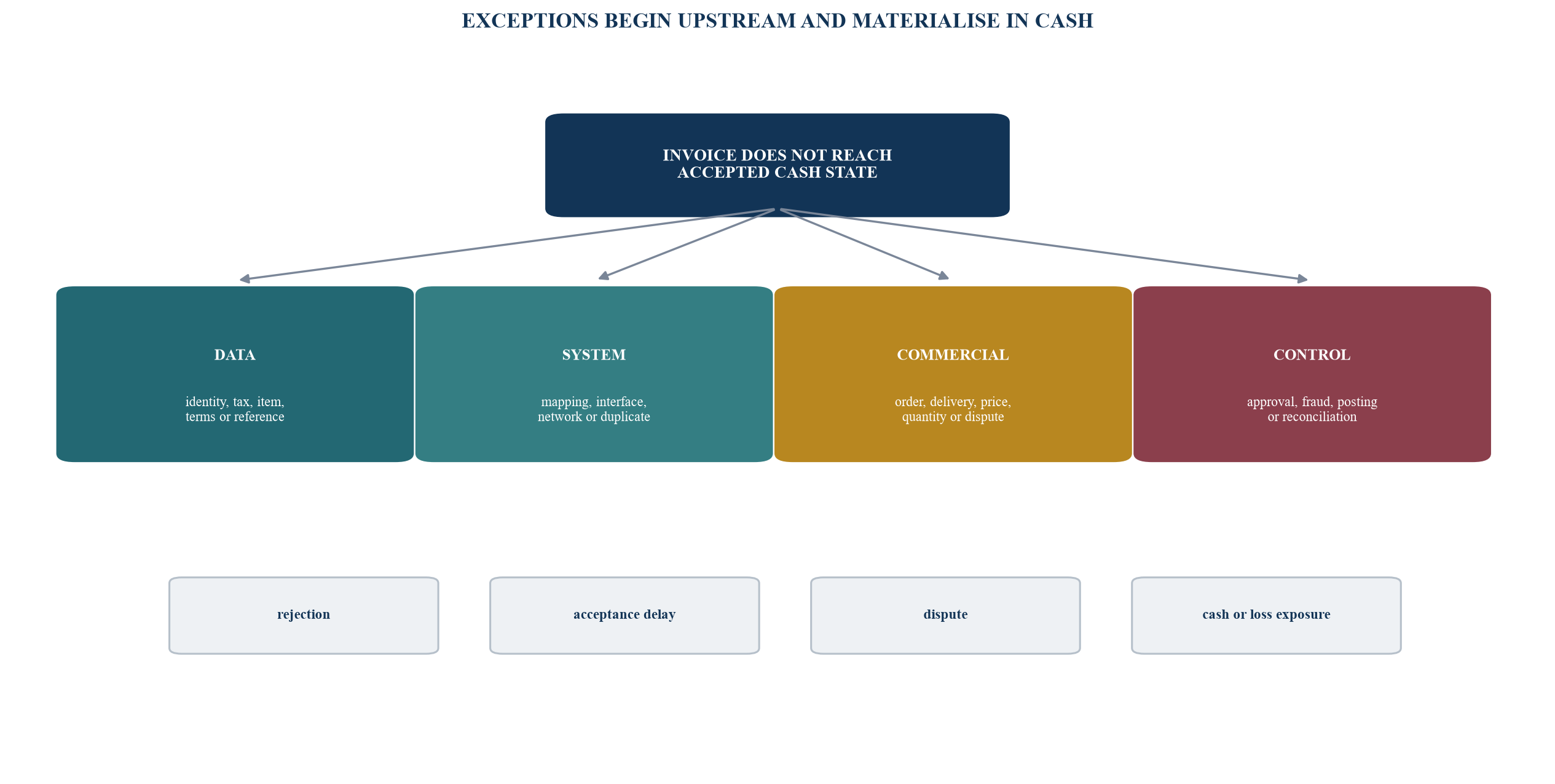
The tree connects upstream causes with rejected invoices, delayed acceptance and working-capital exposure.
8. Design the target architecture and status loop
The target architecture should establish authoritative systems and controlled message flows. The commercial or procurement system creates the underlying commitment. Operations confirms performance. The ERP or billing engine creates the accounting transaction. A tax engine may determine classification. The accredited service provider validates and exchanges the structured invoice. Authority and counterparty responses return to the enterprise system. Treasury and the ledger complete settlement and reconciliation.
Every interface should define message, direction, timing, authentication, encryption, validation, retry, duplicate handling, acknowledgement, alert, retention and support ownership. The design should prevent the invoice from being posted as successfully issued when validation or exchange has failed. It should also prevent a network retry from creating a duplicate liability or receivable.
The status loop needs a common vocabulary. Created, validated, submitted, delivered, received, accepted, rejected, disputed, corrected, cancelled, due, paid and reconciled are different states. The company should map official protocol messages and provider statuses to internal states without losing detail. Customer portal acceptance can remain separate from network delivery. Treasury settlement can remain separate from invoice acceptance.
Resilience should cover provider outage, enterprise outage, network interruption, certificate or credential expiry, message backlog, data corruption and cyber incident. The business continuity plan should define permitted delay, alternative capture, queue protection, notification, recovery, reconciliation and post-incident review. Any manual fallback must be permitted under the applicable rules and designed with approval and duplicate controls.
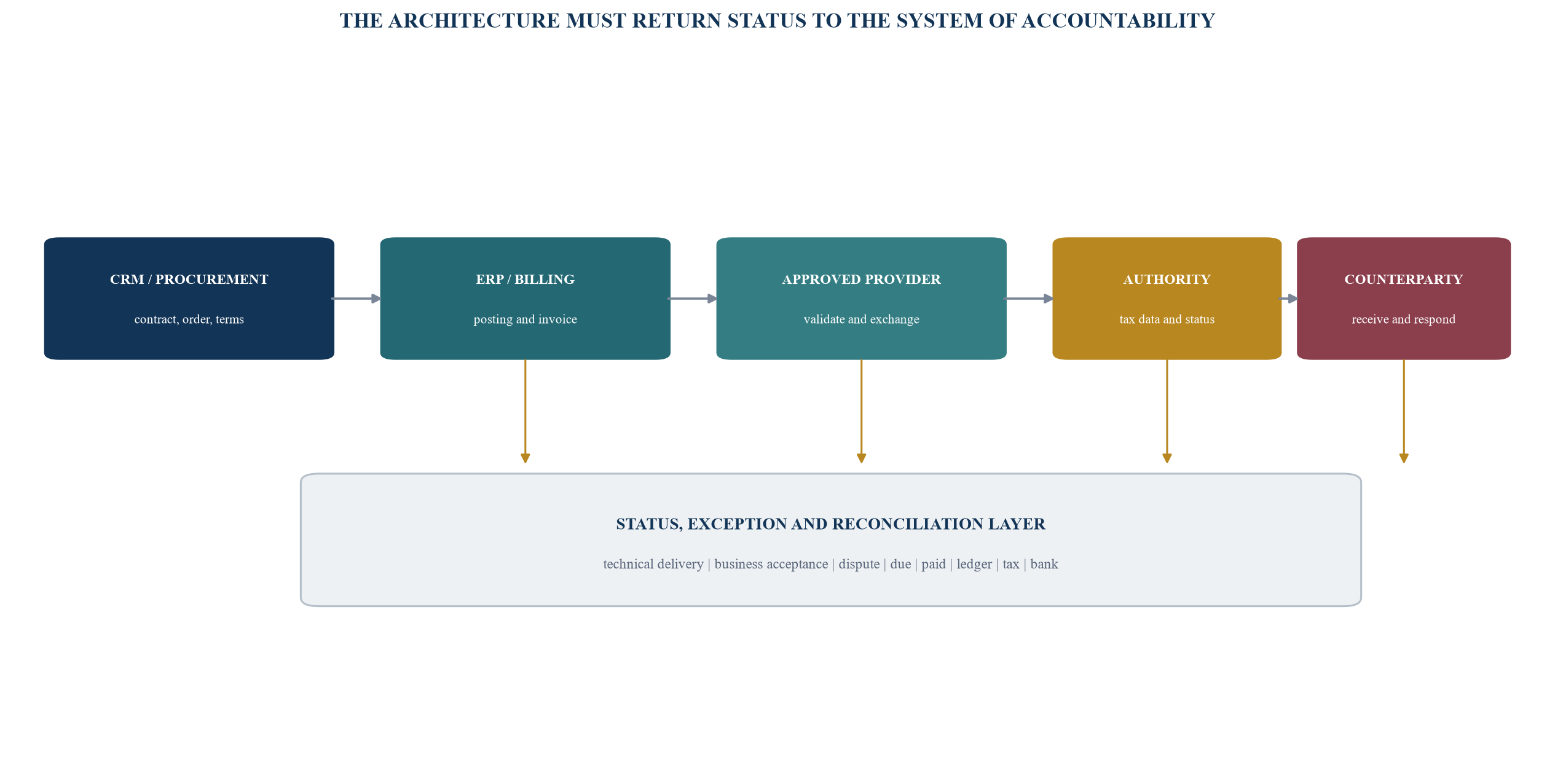
Structured messages and acknowledgements return to the enterprise systems that own accounting, control and cash.
9. Select and contract the service provider
Provider selection should begin with jurisdictional eligibility and end with operating accountability. In the UAE, businesses must use an accredited service provider under the published model. The company should verify current approval status directly with the Ministry of Finance, then assess coverage, technical capability, security, resilience, implementation capacity, support, reporting, pricing and contractual allocation.
The request for proposal should use real transaction samples and volumes. Providers should demonstrate mapping for standard invoices, credit notes, debit notes, foreign currency, advances, project milestones, recurring charges, intercompany transactions and exceptions. The evaluation should test inbound and outbound flows, acknowledgements, error messages, dashboards, archives, audit access, language, identity controls and integration with the existing technology estate.
Commercial terms should identify one-time and recurring fees, transaction bands, implementation effort, change requests, testing environments, support levels, data retention, exit assistance and pass-through costs. Service levels should address availability, message processing, response, incident notification, recovery and backlog clearing. The contract should define responsibilities for validation, tax logic, mapping, credentials, cybersecurity, subcontractors, data location and regulatory change.
Exit and continuity deserve board attention. The company needs access to its data, configuration, messages, acknowledgements and audit trail during and after termination. It should understand portability to another provider, outstanding-message treatment and credential revocation. Legal and technology advisers should review limitation of liability, indemnity, confidentiality, intellectual property, audit, insurance and regulatory cooperation.
Table 3. Service-provider selection and contracting scorecard
| Domain | Diligence question | Acceptance evidence | Contract protection |
|---|---|---|---|
| accreditation and coverage | is the provider currently approved for each required market and route? | official listing and written scope | ongoing eligibility and change notification |
| transaction and technical fit | can the provider handle actual invoice types, volumes and exceptions? | scripted demonstration and successful test messages | documented specifications and acceptance criteria |
| security and resilience | how are identities, credentials, data, outages and incidents controlled? | architecture, assurance reports, recovery test and incident process | security schedule, audit, notification and recovery obligations |
| implementation capacity | who performs mapping, integration, testing, training and cutover? | named team, plan, references and responsibility matrix | milestones, dependencies, remedies and change control |
| operations and support | how are errors, backlog and regulatory changes managed? | service desk test, dashboards, reporting and release process | service levels, escalation and governance |
| economics and exit | what is the total cost and how can the company migrate? | complete price model and portability demonstration | data return, assistance, retention and termination rights |
Eligibility and requirements must be confirmed against current official lists and specifications.
10. Rebuild controls and segregation of duties
E-invoicing changes control points without removing management responsibility. The control framework should cover customer and supplier onboarding, tax classification, pricing, billing trigger, invoice creation, validation, correction, cancellation, approval, posting, receipt, matching, payment, reconciliation, access, change and retention. Automated controls require evidence that they are configured, authorised, tested and monitored.
Segregation should prevent one person from creating a counterparty, changing bank details, issuing or approving an invoice and directing payment. Privileged system access, provider credentials and certificate management should have named owners, independent approval and periodic review. Emergency access needs expiry and after-the-fact review. Changes to tax rules, mappings and interfaces should follow tested release procedures.
Invoice corrections deserve a specific policy. A rejected document, commercial dispute, tax error and cancelled transaction may require different actions. Users should not delete or overwrite the record in a way that breaks the chain of evidence. Credit notes, debit notes and replacement invoices should reference the original transaction where required and reconcile to the ledger and authority reporting.
The assurance plan can combine control self-assessment, finance review, tax review, information-security testing, internal audit and external specialist work. The board should know which controls are designed, implemented, tested and operating. A successful provider transmission does not establish that the underlying sale, tax treatment or accounting entry is correct.
11. Translate statuses into receivables and cash control
Cash conversion depends on when the customer regards the invoice as valid and payable. Some contracts start the payment period at invoice date; others depend on receipt, acceptance, milestone certification or portal approval. The company should map the legal and commercial trigger for each significant customer and reconcile it to the structured exchange status. A technically delivered invoice that remains commercially unaccepted can still age without approaching collectible cash.
Receivables reporting should add operational states to the accounting balance. Management needs invoice value created but not validated, validated but not delivered, delivered but not accepted, accepted but disputed, due but unpaid and paid but unreconciled. Each bucket has a different owner and remedy. The value and days at risk provide a stronger cash signal than exception counts alone.
E-invoicing can create an earlier and more reliable evidence trail when master data, billing triggers and customer acceptance are disciplined. It can also expose or accelerate failure when data is poor. No improvement in days sales outstanding should be included in a business case without a causal pathway, accountable action and measured result. Compliance spending may be required even when the cash case is neutral.
Supplier status affects liquidity and continuity. Incoming invoice quality, purchase-order matching, approval and payment scheduling can improve visibility. Poor controls can generate duplicate payment, early payment, missed discount, late-payment penalty or critical supplier disruption. Treasury should connect accepted payable data to cash forecasting while retaining independent payment authorisation and bank-detail verification.
12. Work an illustrative cash-conversion case
Consider a mid-market group that issues 9,000 business invoices each month with an illustrative value of AED 180 million. The starting scenario assumes 12 per cent require manual correction before customer acceptance and that those invoices are accepted six days later on average. Another 4 per cent enter commercial dispute for an average of fourteen additional days. These values are management assumptions created solely to demonstrate the method.
The readiness programme improves customer-master completeness, enforces purchase-order and delivery references, introduces pre-submission validation, returns exchange statuses to the receivables queue and assigns named owners to common disputes. The demonstration assumes the correction rate falls to 5 per cent, correction delay to two days and disputed value to 3 per cent with an eight-day additional delay. It assumes no change in sales, price, credit terms, customer credit or collection behaviour.
The simple exposure-days measure multiplies affected invoice value by additional delay and divides by days in the month. Under the starting assumptions, correction exposure is AED 4.32 million and dispute exposure is AED 3.36 million, totalling AED 7.68 million. Under the improved assumptions, those amounts are AED 0.60 million and AED 1.44 million, totalling AED 2.04 million. The difference is AED 5.64 million of timing exposure in this illustrative model.
This difference is not a forecast, cash balance, saving or valuation. Actual cash effects depend on contractual payment triggers, customer behaviour, invoice mix, tax treatment, dispute resolution and collection. The board should approve a baseline, track cohort outcomes and recognise a benefit only when bank receipts and reconciled ledgers demonstrate the change.
Table 4. Illustrative invoice-acceptance and cash-exposure case
| Metric | Starting case | Improved process case | Evidence required in operation |
|---|---|---|---|
| monthly business invoice value | AED 180m | AED 180m | reconciled invoice register |
| invoices requiring correction | 12% | 5% | validation and correction statuses |
| average correction delay | 6 days | 2 days | timestamped status history |
| correction timing exposure | AED 4.32m | AED 0.60m | affected value multiplied by delay divided by 30 |
| invoices entering commercial dispute | 4% | 3% | dispute reason and value |
| average additional dispute delay | 14 days | 8 days | acceptance and resolution timestamps |
| dispute timing exposure | AED 3.36m | AED 1.44m | affected value multiplied by delay divided by 30 |
| total illustrative timing exposure | AED 7.68m | AED 2.04m | cash receipt and ledger reconciliation before benefit recognition |
Every volume, rate, delay and value is an illustrative management assumption; no cash benefit is forecast.
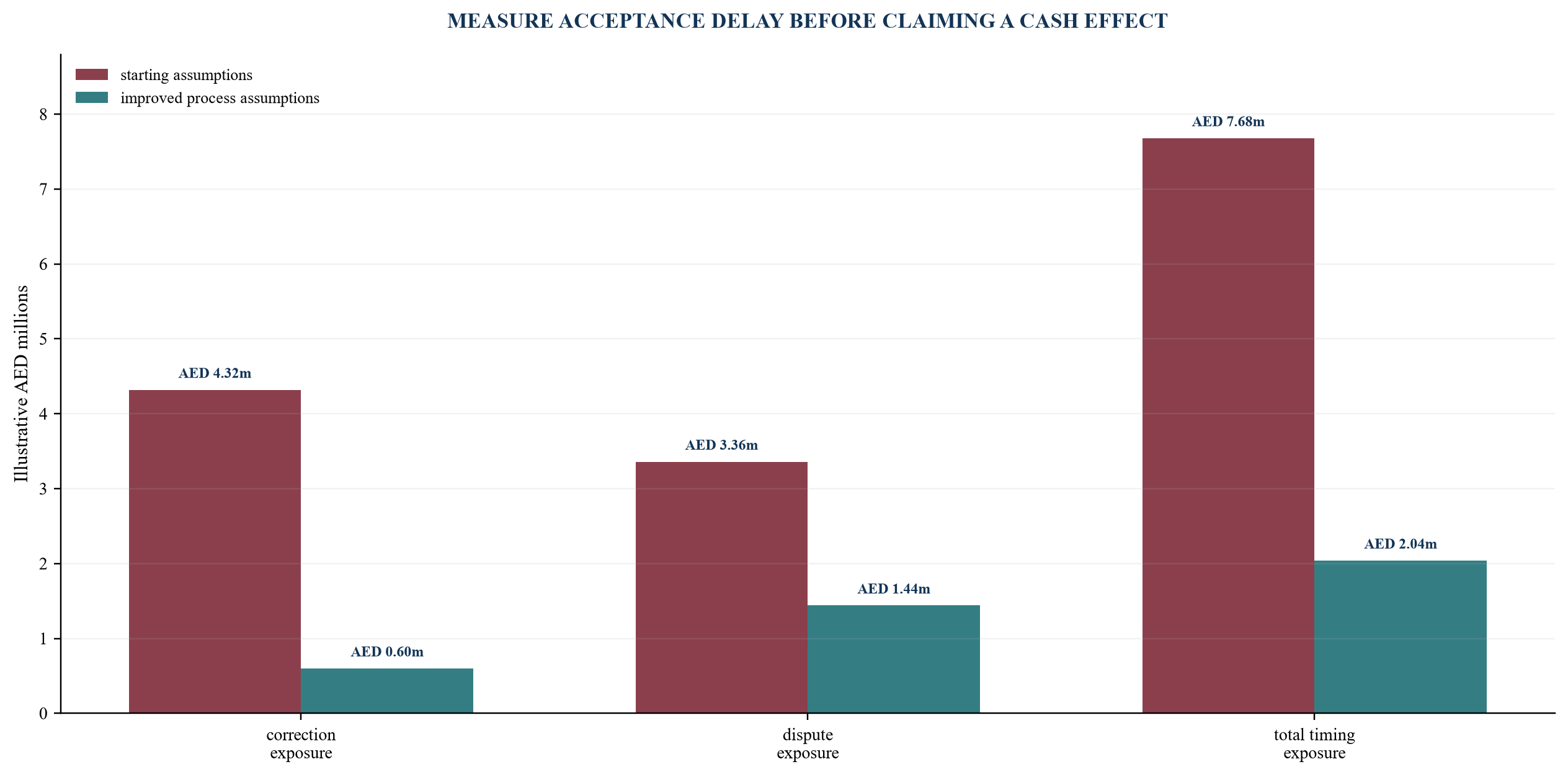
All amounts are management assumptions for method demonstration; the chart is not a forecast.
13. Build the compliance and implementation roadmap
The roadmap should work backwards from the earliest mandatory date and provider milestone. It should include legal-scope confirmation, entity and transaction inventory, data profiling, architecture, provider selection, contracting, mapping, development, testing, user procedures, training, cutover, continuity and operating assurance. Dependencies should be explicit; provider onboarding cannot compensate for missing customer identities or unclear billing triggers.
The company should establish stage gates. The scope gate confirms entities, transactions, dates and exclusions. The design gate approves the transaction catalogue, data model, systems, provider and control design. The build gate confirms interfaces, credentials, security and mapped rules. The acceptance gate uses representative end-to-end transactions and expected failures. The cutover gate confirms readiness, support, continuity and executive authority.
Parallel workstreams need one integrated plan. Tax owns interpretation; finance owns accounting and transaction control; technology owns integration and service management; operations owns delivery evidence; sales and procurement own commercial records; treasury owns payment and cash; security owns identity and cyber controls; legal owns contracts and privacy. The programme office manages dependencies, decisions, risks and evidence.
The plan should include regulatory change capacity. Specifications, provider lists, taxpayer waves and technical guidance can change. The organisation needs a controlled way to assess impact, update configuration, test and release before the effective date. A hard-coded one-time build can become an operating liability.
14. Test end-to-end and define acceptance
Testing should demonstrate business, tax, technical, accounting and cash outcomes. Unit tests validate individual mappings and calculations. Integration tests validate messages between enterprise systems, provider, authority and counterparties. End-to-end tests begin with an approved commercial event and finish with the ledger, tax evidence, customer or supplier status and settlement record.
The test catalogue should include valid standard transactions and deliberate failures. Cases can cover missing identifiers, invalid tax category, duplicate invoice, rounding difference, foreign currency, credit note, cancellation, wrong purchase order, partial delivery, provider outage, timeout, retry, credential expiry and backlog recovery. Each expected result needs an owner and evidence.
Business acceptance should include users who resolve exceptions and reconcile results. Finance should prove that invoice totals, tax, receivable or payable, revenue or expense, exchange status and bank settlement can be traced. Information security should test authentication, privilege, logging, encryption and incident processes. Service management should test monitoring, escalation and vendor support.
Entry and exit criteria prevent calendar-driven cutover. Testing can begin when data, configuration, environments, credentials and scripts are ready. Acceptance occurs when critical cases pass, open defects are classified and approved, reconciliations are complete, performance supports expected volume, continuity is proven and accountable executives sign the result. Any residual manual process should have capacity, control and expiry.
Table 5. End-to-end test and acceptance matrix
| Test domain | Representative case | Required evidence | Acceptance owner |
|---|---|---|---|
| standard sale and purchase | valid invoice, receipt, posting and settlement | message, acknowledgement, ledger, tax and bank trace | finance and tax |
| adjustment lifecycle | credit note, debit note, cancellation and replacement | complete reference chain and reconciled balances | finance and tax |
| master-data failure | missing or invalid identity, item or tax field | controlled rejection, routed correction and audit log | data owner |
| commercial failure | missing purchase order, price or delivery mismatch | dispute status, approved resolution and timing | sales, procurement or operations |
| technical failure | timeout, duplicate, malformed message or interface outage | retry control, no duplication, alert and reconciliation | technology and provider |
| security and continuity | credential expiry, access violation and provider interruption | prevention or detection, incident response and recovery | information security and service management |
Test cases should use current specifications and representative anonymised transactions.
15. Govern cutover, continuity and operating change
Cutover should be treated as a controlled business transition. The company needs an approved scope, production credentials, opening data, provider readiness, user roster, support model, communication plan, transaction freeze where necessary, fallback, reconciliation and executive command structure. High-value and time-sensitive transactions can receive enhanced monitoring during the initial period.
The cutover plan should define what happens to invoices created before the effective date, drafts in progress, rejected messages, credit notes against earlier invoices and transactions in legacy systems. The ledger and tax reporting must remain complete across the boundary. Acquired or decentralised entities should not be assumed ready because the group provider is connected.
Operational continuity requires queue and backlog design. If a provider or enterprise system becomes unavailable, the company should preserve source transactions, prevent duplicate creation, monitor deadlines and communicate with affected counterparties. Recovery should process the backlog in a controlled sequence and reconcile every message. Any alternative method should be verified as permitted under current rules.
The hypercare period should track volume, first-pass validation, delivery, acceptance, exception ageing, customer complaints, supplier interruption, system performance, incidents, manual effort and cash status. Exit from hypercare requires stable performance, resolved critical defects, trained owners, completed documentation and transition to normal governance. Outstanding improvements remain in a controlled backlog.
16. Address M&A, carve-out and financing consequences
E-invoicing readiness can become a diligence issue in an acquisition, sale, carve-out or refinancing. A buyer should identify which legal entities and jurisdictions are in scope, whether required providers are appointed, which systems create invoices, whether production exchange is operating, how exceptions are governed and whether tax, ledger and cash records reconcile. A compliance label without transaction evidence provides limited assurance.
Carve-outs create dependencies. The target may rely on the seller's ERP, customer master, tax engine, provider contract, credentials, shared service centre or archive. A transition-services agreement should identify who can issue and receive invoices, which identity appears, how data and acknowledgements are transferred, how corrections are handled and when the target obtains independent capability. The separation timetable should align with regulatory dates.
Deal models should include implementation cost, remediation, operating fees, duplicated systems, working capital and disruption. Receivables quality can be affected by rejected or disputed invoices; payables completeness can be affected by unprocessed incoming messages. Representations, covenants, indemnities, purchase-price mechanisms and conditions require qualified legal and tax advice based on the transaction.
Lenders may ask whether compliance failure or system interruption can affect cash, tax exposure, covenant reporting or operational continuity. A financing package can include the obligations register, readiness assessment, provider and system architecture, test evidence, control report, exception performance and remediation plan. Conclusions remain company-specific and should be supported by current evidence.
17. Establish a board dashboard and ownership map
The dashboard should show obligation, delivery and cash in one view. Obligation measures include entities confirmed, required dates, provider milestones and regulatory changes. Delivery measures include transactions mapped, fields complete, interfaces built, tests passed and users trained. Operating measures include first-pass validation, delivery, acceptance, exception value, aging, backlog, incidents and reconciliations. Cash measures include invoices awaiting acceptance, disputed value, overdue accepted receivables, supplier invoices blocked and payments at risk.
Each metric needs a definition, system source, owner, target, threshold and action. A high pass rate can conceal a material rejected customer invoice; value and criticality should accompany counts. Green status should require current evidence, not elapsed time or reported activity. The board should see the decisions due before the next meeting.
Decision rights should be explicit. The board approves scope, risk appetite, material provider commitment, funding and cutover. The steering committee approves design and remediation priorities. Tax, finance, technology, security and commercial owners approve their respective controls and evidence. The programme office maintains the integrated plan and escalates cross-functional gaps.
Independent review may be appropriate before a material cutover or transaction. Reviewers should have access to the obligation register, architecture, mappings, test results, defects, reconciliations, incidents and open risks. Assurance should state its scope and period; it should not be presented as a general guarantee of compliance or cash performance.
Table 6. Board dashboard and decision rights
| Domain | Board evidence | Escalation trigger | Accountable decision |
|---|---|---|---|
| scope and regulation | entities, transactions, dates, sources and changes | unresolved applicability near a milestone | obtain advice, change scope or alter timetable |
| data and process | critical-field quality, mapped routes and open gaps | material route lacks reliable source data | remediate, redesign or control the exception |
| provider and technology | accreditation, build, performance, security and continuity | milestone failure, outage or unresolved critical defect | change plan, add capacity or invoke contract governance |
| testing and cutover | pass rate, critical cases, reconciliation and residual risk | critical case fails or continuity is unproven | hold, limit or approve cutover |
| exceptions and cash | rejected or disputed value, aging, due dates and receipts | material customer, supplier or liquidity exposure | assign intervention and executive owner |
| assurance and change | control testing, incidents, releases and regulatory updates | control failure or unassessed rule change | remediate and commission specialist review |
Measures should be sourced from controlled records and accompanied by value and consequence.
18. Convert readiness into a retained execution mandate
A fixed-scope diagnostic can establish the board's current position within four to six weeks, subject to access and complexity. Deliverables can include the dated obligations register, entity and transaction catalogue, order-to-cash and procure-to-pay maps, critical-data profile, system and provider architecture, exception taxonomy, working-capital baseline, control assessment, implementation roadmap, decision log and board paper. The engagement should define client responsibilities, evidence, exclusions, specialist roles and acceptance.
A retained implementation office can then coordinate legal and tax conclusions, data remediation, provider selection, integration, test management, change, cutover, hypercare, cash analytics and steering-committee reporting. Matchpoint can integrate commercial, finance and execution workstreams within an agreed mandate. Legal, regulatory, tax, accounting, cyber, data-protection, technology certification and payment opinions remain with appointed qualified advisers.
The commercial pathway should be measured through a qualified decision-maker, accepted diagnostic scope, signed engagement, invoice, payment, evidence access, approved roadmap, operating milestones and collected fees. Downloads, meetings and proposals are leading indicators. Advisory revenue remains zero until a client signs an engagement, invoices are issued and cash is collected.
The immediate client decision is whether to commission a paid readiness diagnostic with named executive sponsors, entity scope, data access and a board date. The result should identify the compliance path, cash-critical weaknesses, investment sequence and accountable operating model. A retained mandate earns its place by converting obligation into controlled execution and verified transaction outcomes.
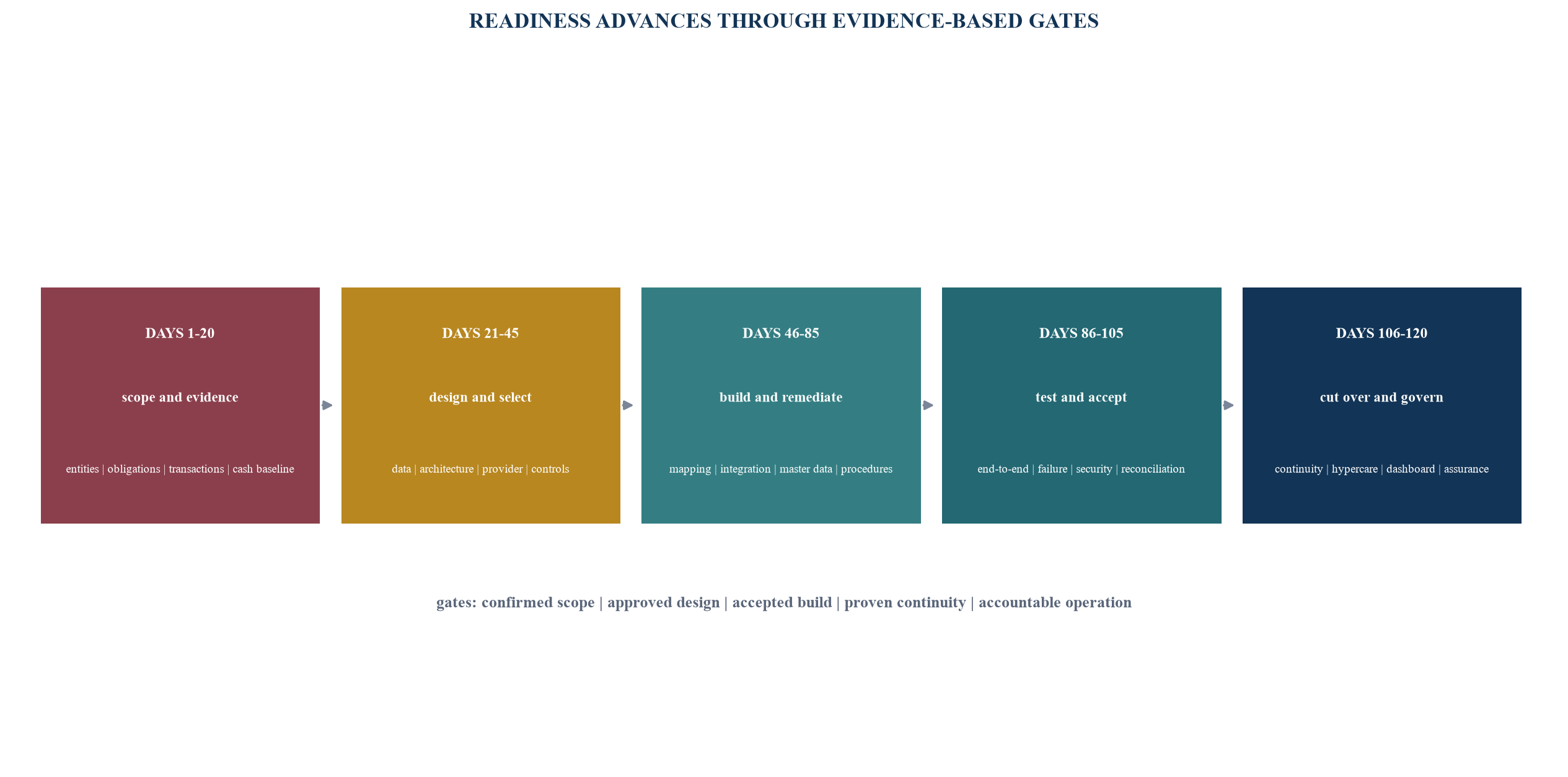
The sequence is illustrative; actual timing follows current statutory dates, provider capacity and system complexity.
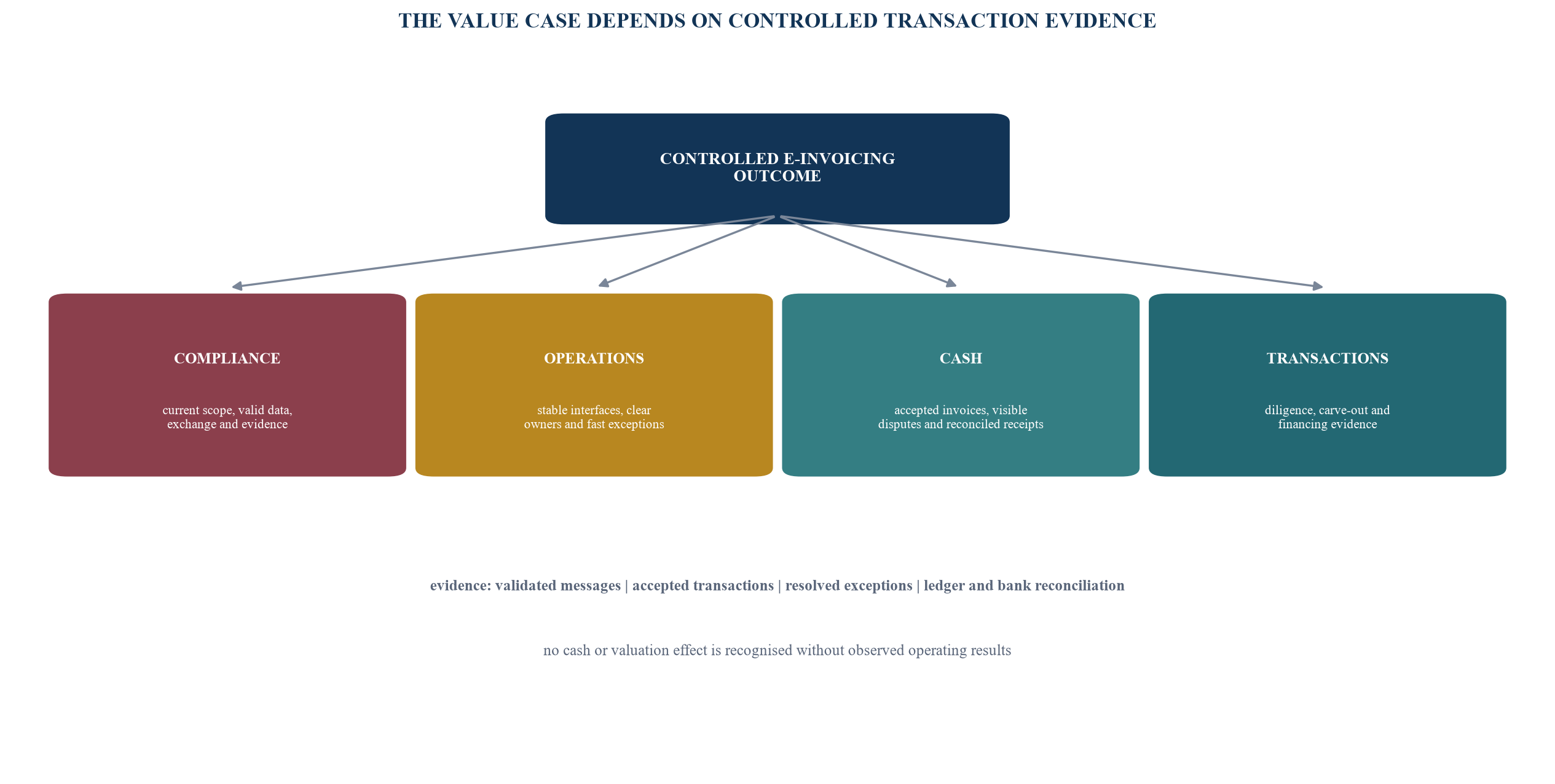
Compliance is mandatory where applicable; operational and cash outcomes require measured evidence.
References
- United Arab Emirates Ministry of Finance, E-Invoicing, https://mof.gov.ae/en/about-us/initiatives/einvoicing/
- United Arab Emirates Ministry of Finance, UAE Electronic Invoicing Guidelines, version 1.0, 23 February 2026, https://mof.gov.ae/wp-content/uploads/2026/02/UAE-Electronic-Invoicing-Guidelines_V-1.0-23Feb2026.pdf
- United Arab Emirates Ministry of Finance, Targeted amendments to E-Invoicing System Decisions, 10 May 2026, https://mof.gov.ae/en/news/ministry-of-finance-announces-targeted-amendments-to-einvoicing-system-decisions/
- United Arab Emirates Ministry of Finance, Introduction of E-Invoicing Four-Corner Model for Businesses, 21 April 2026, https://mof.gov.ae/en/news/uae-marks-milestone-with-introduction-of-einvoicing-4-corner-model-for-businesses/
- United Arab Emirates Ministry of Finance, Ministerial Decision No. 244 of 2025 on the Implementation of the Electronic Invoicing System, https://mof.gov.ae/wp-content/uploads/2025/09/Ministerial-Decision-No.-244-of-2025-on-the-Implementation-of-the-Electronic-Invoicing-System.pdf
- OpenPeppol, Peppol International Invoice Model for the United Arab Emirates, release 1.0.4, 3 June 2026, https://docs.peppol.eu/poac/ae/upcoming/pint-ae/
- Zakat, Tax and Customs Authority, What is E-Invoicing?, https://zatca.gov.sa/en/E-Invoicing/Introduction/Pages/What-is-e-invoicing.aspx
- Zakat, Tax and Customs Authority, E-Invoicing Detailed Guideline, https://zatca.gov.sa/en/E-Invoicing/Introduction/Guidelines/Documents/E-Invoicing_Detailed__Guideline.pdf
- Zakat, Tax and Customs Authority, Wave 25 of E-Invoicing, 24 July 2026, https://zatca.gov.sa/en/MediaCenter/News/Pages/Wave25-E-invoicing.aspx
- Zakat, Tax and Customs Authority, E-Invoicing Implementation Resolution, https://zatca.gov.sa/en/E-Invoicing/Introduction/LawsAndRegulations/Documents/20230519_E-Invoicing%20Implementation%20Resolution%20English.pdf
- Oman Tax Authority, E-Invoicing, https://tms.taxoman.gov.om/portal/en/e-invoicing
- Oman Tax Authority, E-Invoicing Frequently Asked Questions, https://tms.taxoman.gov.om/portal/documents/d/taxportal/faq-s
- Oman Tax Authority, Fawtara, https://fawtara.taxoman.gov.om/
- Bahrain National Bureau for Revenue, Official Portal, https://www.nbr.gov.bh/
- Bahrain National Bureau for Revenue, Guidelines and Publications, https://www.nbr.gov.bh/guidelines_and_publications
- Qatar General Tax Authority, Official Portal, https://www.gta.gov.qa/en/
- Qatar General Tax Authority, Laws, https://www.gta.gov.qa/en/laws
- Organisation for Economic Co-operation and Development, Tax Administration 3.0 and Electronic Invoicing, 2022, https://www.oecd.org/en/publications/tax-administration-3-0-and-electronic-invoicing_2ffc88ed-en.html
- Organisation for Economic Co-operation and Development, Digital Transformation of Tax Administration, https://www.oecd.org/en/topics/sub-issues/digital-transformation-of-tax-administration.html
- European Commission, VAT in the Digital Age, https://taxation-customs.ec.europa.eu/taxation/vat/vat-digital-age-vida_en
- Inland Revenue Board of Malaysia, E-Invoice Implementation Timeline, https://www.hasil.gov.my/en/e-invoice/implementation-of-e-invoicing-in-malaysia/e-invoice-implementation-timeline/
- Inland Revenue Board of Malaysia, Overview of the E-Invoice Model, https://www.hasil.gov.my/en/e-invoice/implementation-of-e-invoicing-in-malaysia/overview-of-the-e-invoice-model/
- National Institute of Standards and Technology, Cybersecurity Framework 2.0, 2024, https://csrc.nist.gov/pubs/cswp/29/the-nist-cybersecurity-framework-csf-20/final
- National Institute of Standards and Technology, Cybersecurity Supply Chain Risk Management Practices for Systems and Organizations, 2024, https://csrc.nist.gov/pubs/sp/1305/final
About the Author
Chennakeshav Adya, Independent Researcher
This research is provided for general information. It is not investment, legal, regulatory, tax, accounting, cyber, data-protection, technology-certification, payment or financing advice. Businesses should obtain current advice from qualified professionals and conduct entity-specific diligence.
