

1. Begin with the facility decision
A borrowing base determines how much credit is available against defined collateral after eligibility exclusions, advance rates, reserves and limits. The immediate decision may be to approve a certificate, fund a draw, impose a reserve, investigate an exception or reduce availability. Each decision requires current evidence and authorised control.
The system should identify the facility, borrower, obligors, collateral classes, test date, reporting cut-off, commitments, outstanding amounts and requested draw. It should preserve the executed agreement and approved amendments as the source of contractual definitions. A model output cannot silently change those terms.
An AI-assisted process can accelerate reconciliation and exception detection. It should present a reproducible calculation, source evidence, rule version, model status, uncertainties and approvals. The accountable lender or agent decides the action within delegated authority.
The funding decision should be separated from the collateral calculation. A mathematically positive borrowing base does not establish that a draw satisfies every condition, representation, event-of-default test or credit requirement. The decision record should show which conditions were checked, which were outside the engine and who confirmed them. This prevents a calculation tool from appearing to provide a legal or credit conclusion.
The borrower and lender also need a shared treatment of timing. A certificate can be accurate at its cut-off and outdated by the funding time after collections, credit notes, shipments or inventory movements. The facility process should define permitted updates, materiality, re-certification and reliance. The copilot can identify intervening events and route them for authorised treatment.
2. Define the collateral perimeter
The perimeter should identify legal entities, jurisdictions, accounts, systems, receivables, inventory, locations, currencies, liens, insurance and custodians. It should show collateral that is pledged, excluded, shared, structurally senior or outside the lender's enforceable reach. Ownership and legal interest require qualified confirmation.
Receivables can differ by product, customer, contract, invoice status, currency and governing law. Inventory can differ by raw material, work in process, finished good, serial number, warehouse, condition and market. Aggregation should not conceal attributes that determine eligibility or recovery.
The perimeter also defines data and decision cut-offs. A sale posted after certification should not appear in the approved version. A payment received after cut-off can inform the next calculation or an authorised adjustment. Version control preserves both records.
3. Construct the controlled eligibility engine
The engine begins with gross collateral records, verifies existence and ownership evidence, applies contractual eligibility rules, calculates concentrations and reserves, applies approved advance rates and reconciles availability with debt and commitments. Exceptions route to named owners and authorities.
Rules should be separated from predictive models. A contractual ageing exclusion can be deterministic. A dispute-risk model can rank invoices for review. A liquidation model can estimate a range. Each component has a different validation, change and approval pathway.
The calculation should remain reproducible without narrative interpretation. Source rows, transformations, exclusions and overrides should be traceable. A concise explanation can support review, while the numerical result should derive from controlled data and approved logic.
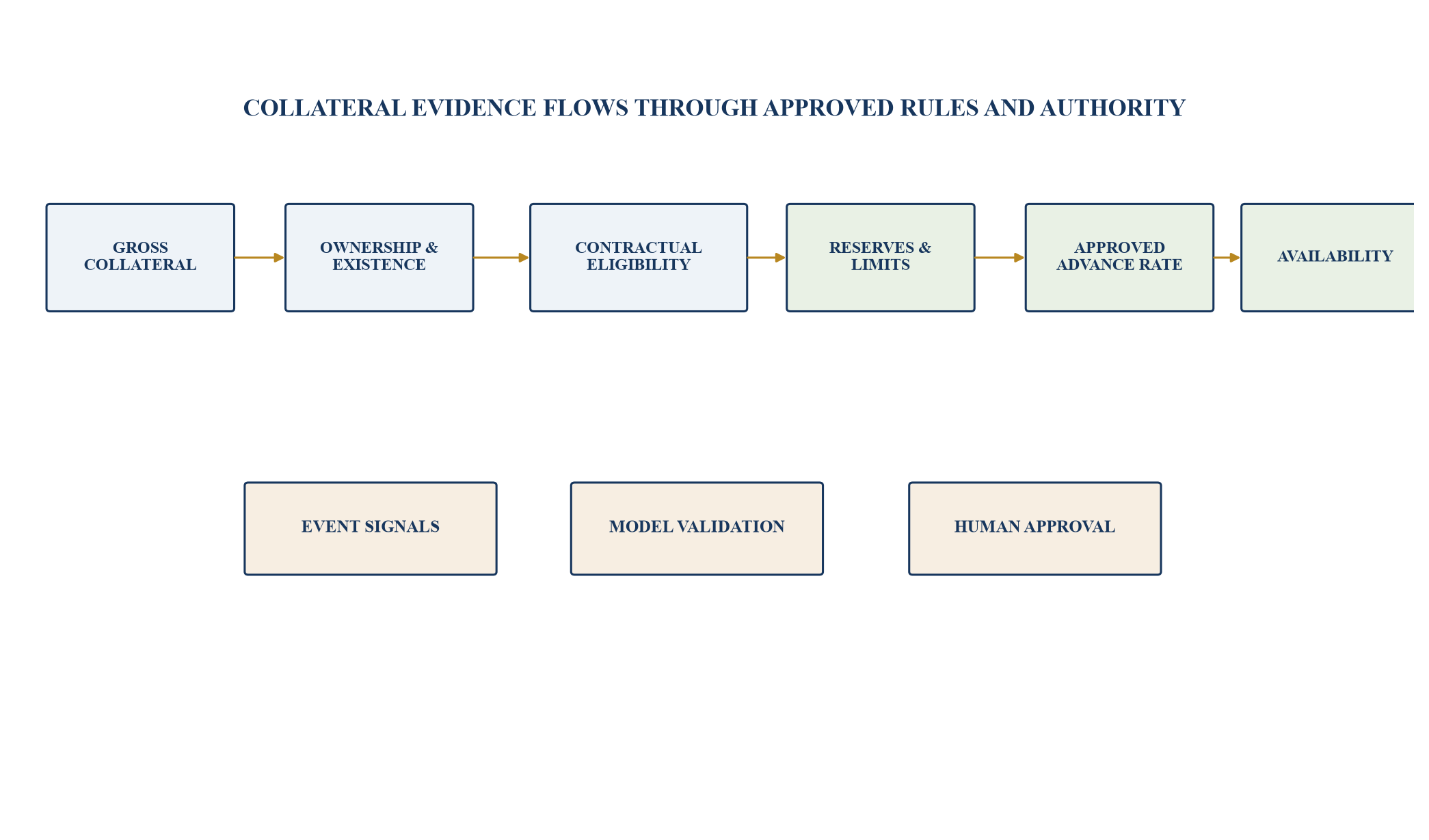
Contractual rules, analytical signals and human authority remain distinct throughout the availability calculation.
Table 1. Minimum borrowing-base decision record
| Field | Required content | Evidence | Control use |
|---|---|---|---|
| facility | agreement, commitment, maturity and parties | executed documents and amendments | legal perimeter |
| collateral | class, owner, location, currency and value | subledger, warehouse and third-party records | gross base |
| eligibility | rule, reason, amount and effective date | approved definition and source attribute | exclusions |
| concentration | obligor, product, location and connected exposure | controlled aggregation | caps and reserves |
| valuation | basis, date, method, cost and recovery assumptions | appraisal and market evidence | advance rate |
| exception | trigger, severity, owner, expiry and action | workflow and supporting documents | governance |
| availability | eligible value, advance, reserves, debt and excess | reproducible calculation | funding decision |
Every availability figure should connect to controlled evidence, approved logic and authority.
4. Establish authoritative source systems
Receivable evidence can originate in order, delivery, contract, invoice, tax, dispute, credit-note, cash-application and bank systems. Inventory evidence can originate in procurement, production, warehouse, transport, sales and costing systems. The source hierarchy should be documented for every material field.
Reconciliations need tolerance, timing and ownership. Accounts-receivable subledgers should reconcile with the ledger and certificate population. Inventory quantities should reconcile across perpetual records, physical counts and third-party warehouses. Differences require classification and resolution before reliance.
Data lineage should preserve original value, transformation, user and timestamp. Manual adjustments need evidence, approval and expiry. Stale or missing fields should reduce confidence or eligibility according to approved policy rather than be filled through an unexplained assumption.
The source hierarchy should resolve conflicts explicitly. A warehouse system may show quantity while a third-party acknowledgement shows a different date or location. An invoice system may show an open amount while bank cash has arrived but remains unapplied. The hierarchy can assign provisional status, require reconciliation and prevent unsupported netting. It should preserve both records and the reason for the selected treatment.
Data-quality measures should be tied to collateral consequence. Completeness, validity, uniqueness, timeliness and reconciliation can be calculated for each source and segment. A failure affecting a small ineligible population differs from one affecting the largest eligible obligor. The dashboard should show affected value and funding impact, allowing reviewers to focus on decision materiality.
5. Verify receivable existence and validity
An invoice is not automatically collectible collateral. The process should connect it to a valid customer, contract or order, delivery or performance evidence, acceptance, invoice issuance and payment terms. Cancellation rights, side agreements and contingent performance can affect validity.
Machine assistance can match records and identify missing links. It can detect duplicate invoices, unusual sequencing, round amounts, backdating or changes in customer details. These signals require investigation and do not establish fraud or ineligibility by themselves.
Confirmation and field examination remain important controls. The lender should determine when external confirmation, document review or site work is required. The system can target samples using risk and materiality while preserving independent selection.
Invoice validity should consider performance obligations and customer acceptance where relevant. A billing record can exist before the borrower has an unconditional right to payment. Contract milestones, acceptance certificates, return rights and cancellation clauses can change collectibility. The engine should record the evidence available and route legal or accounting uncertainty rather than infer entitlement from invoice issuance.
Fraud indicators require careful governance. Duplicate addresses, unusual user activity, round-number invoices or rapid growth can justify investigation. They do not prove misconduct. The interface should use neutral exception language, restrict access and preserve evidence. Escalation should follow the lender's fraud, legal and credit procedures and protect appropriate confidentiality.
6. Track payment behaviour at event level
Payment history should distinguish contractual due date, actual receipt, partial payment, unapplied cash, deduction, reversal and write-off. Customer behaviour can vary by product, geography, invoice size and dispute type. Cohorts can reveal deterioration before a broad ageing bucket changes.
A model can estimate payment timing and expected shortfall. Its output should not replace contractual ageing rules unless the lender formally approves a change. It can identify invoices whose behaviour is inconsistent with their bucket and prioritise review.
Forecast performance should be tested out of sample and across periods. Calibration, bias and tail outcomes matter. A model that predicts average payment well can still miss the large delayed invoices that drive availability risk.
7. Identify disputes, deductions and dilution
Dilution arises when the amount ultimately collected is lower than the invoiced amount because of returns, allowances, discounts, credits, offsets or other adjustments. The analysis should use gross sales and credit events consistently with the facility definition.
Dispute evidence can appear in customer service, email, workflow, credit-note and deduction systems. Language models can classify themes and link documents, while accountable staff confirm material cases. Missing dispute data should be visible.
Historical dilution can inform reserves and advance rates. The method should consider lag because credits issued later can relate to earlier sales. Concentration by customer or product can amplify a process weakness.
The calculation should define the denominator used for dilution. Gross sales, eligible sales and collected receivables can produce different rates. Credits should be linked to the originating sale period where feasible. Otherwise recent growth can temporarily suppress the reported percentage. The method, lag and exclusions need consistency before a reserve is calibrated.
Dispute severity should reflect amount, probability, age and recovery pathway. A routine pricing deduction can differ from a quality dispute that affects an entire product cohort. Text classification can organise themes, while source documents and accountable staff support the final status. Trend analysis should show both newly opened and resolved disputes so that a backlog reduction is not mistaken for improved origination.
8. Apply ageing rules with transparent exceptions
Ageing should follow the agreement's start point, which may be invoice date, due date or another defined event. Re-ageing, extended terms and amended invoices require control. An operational system's ageing label may differ from the legal calculation.
Eligibility rules can exclude past-due receivables, cross-age customers or invoices beyond stated terms. The engine should show the triggering row and amount. Overrides require authority, evidence, duration and treatment in concentration and reserves.
Predictive signals can supplement ageing by showing deterioration within current buckets. They should support monitoring and fieldwork. The contract continues to determine eligibility until changed through the approved legal and credit process.
9. Control obligor and connected-party concentration
A high-quality receivable pool can still create loss severity when exposure is concentrated in one customer or connected group. The calculation should aggregate legal entities according to approved rules and apply concentration caps or reserves from the agreement.
The map can also show product, geography, currency, industry and payment-channel concentration. These views can explain correlated dispute or collection risk. They should not create new contractual exclusions without approval.
Proposed sales and collections can forecast concentration changes. The system can warn when availability will fall because one customer's share increases even though gross receivables rise.
10. Detect contra accounts, offsets and priority claims
A customer that also supplies the borrower may have contractual or legal rights of set-off. The system should identify shared counterparties across receivables and payables and route them for qualified review. Name matching requires controlled entity resolution.
Supplier claims, taxes, employee claims, warehouse liens and purchase-money security interests can affect recovery or priority depending on jurisdiction and facts. The data model should record identified claims and legal status without generating a conclusion.
Reserves and exclusions should follow approved documentation and credit judgement. The engine should show which exposure and collateral are affected and when the evidence was last reviewed.
11. Create receivable collateral cohorts
Cohorts can group invoices by origination month, obligor quality, product, location, terms, dispute status or collection pathway. The purpose is to observe how comparable collateral performs through time. Cohorts can reveal that recent production differs from the history supporting an advance rate.
Performance measures can include payment timing, dilution, default, recovery and eligibility migration. The analysis should preserve exposure weights because a large invoice can matter more than many small invoices. Results need enough observations and clear limitations.
The lender can use cohorts to target field examination, adjust monitoring or review structure. A cohort signal should not bypass contractual eligibility and approval. It creates evidence for a credit decision.
Cohorts need protection against composition effects. A recent period may appear weaker because it contains a different customer mix, longer contractual terms or a seasonal product. The analysis can stratify or standardise populations and show both raw and adjusted results. Adjustments remain assumptions and should not replace the observed curve.
Vintage analysis can also identify migration. It can show how much collateral moves from eligible to ineligible, how long cures take and which reasons dominate. These transitions help estimate operational workload and downside availability. They can also reveal that a stable gross balance is supported by increasingly recent invoices while older collateral is failing to collect.
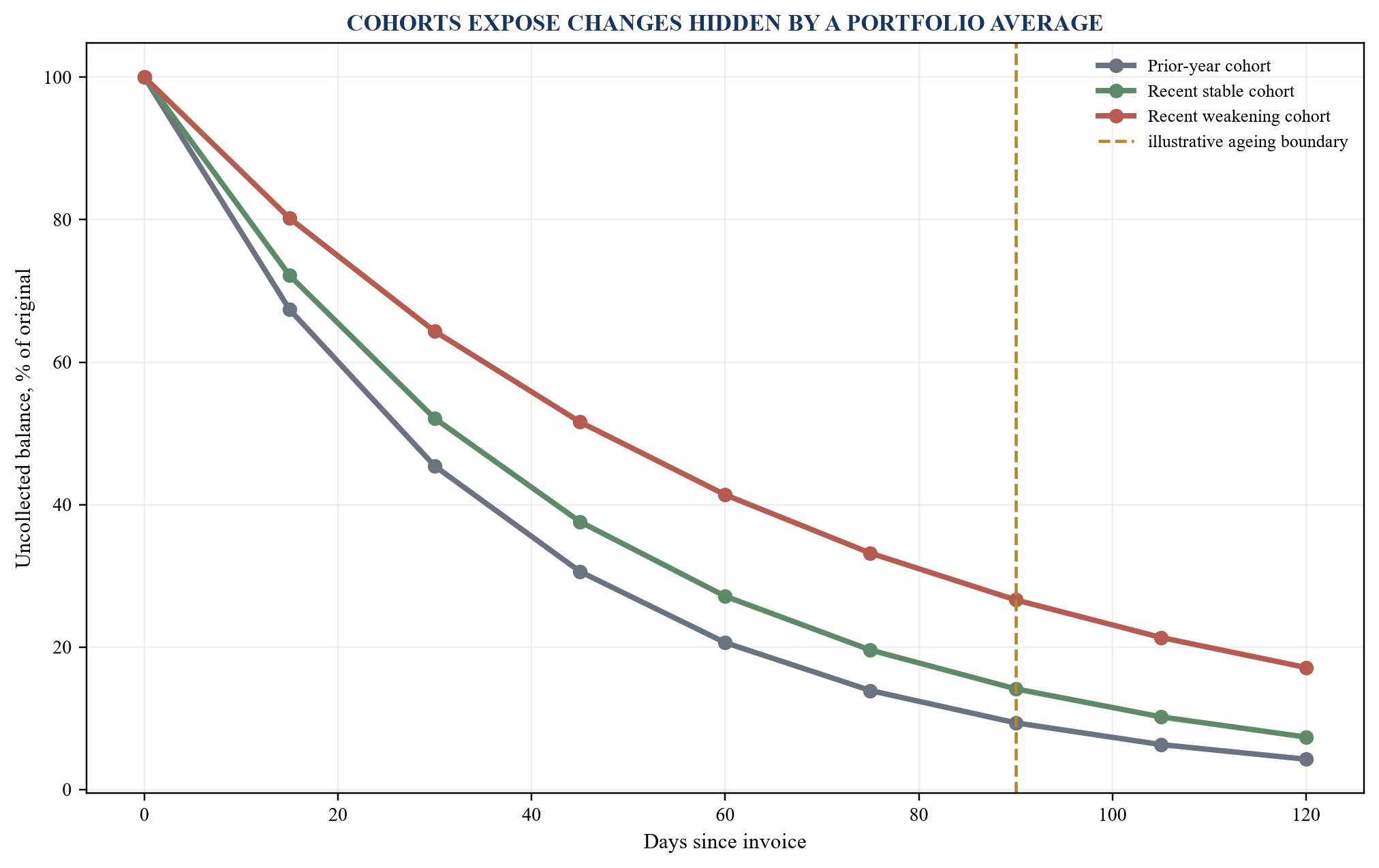
Payment curves and cohort labels are hypothetical assumptions used to show how recent performance can diverge from prior experience.
12. Define inventory ownership and control
Inventory should be owned by the pledged entity and subject to the required legal interest before it enters availability. Consigned goods, customer-owned material and goods subject to competing claims need identification. Title can depend on contracts, delivery terms and jurisdiction.
The record should connect purchase, receipt, serial or batch identity, location and quantity. Goods in transit, at processors or in third-party warehouses require specific evidence. The lender should determine control and inspection requirements.
AI can reconcile descriptions, documents and movements across systems. Ambiguous matches should become exceptions. It should not infer ownership from physical possession alone.
13. Reconcile quantity through the inventory chain
Quantity reconciliation should connect opening stock, receipts, production, transfers, sales, scrap, returns and closing stock. Negative balances, impossible movements, duplicate serial numbers and delayed postings can indicate data weakness or process failure.
Cycle counts and physical examinations provide independent evidence. The system can select samples by value, velocity, anomaly and location while retaining random or examiner-selected elements. Sampling methodology should be documented.
Shrinkage and reconciliation history can inform reserves and monitoring. Improvements should be demonstrated across repeated counts. A clean system balance without physical evidence may be insufficient for material inventory.
14. Classify inventory by recovery pathway
Raw materials, work in process and finished goods have different recovery paths. Commodity-like materials may have wider markets. Specialised components can have limited buyers. Work in process may require further cost and technical capability before sale.
Classification should reflect actual condition, specification, shelf life, certification and marketability. A financial category can be too broad for recovery. The collateral register should preserve attributes that an appraiser or liquidator would need.
The lender can establish eligibility, caps and advance rates by class. Predictive models can estimate sale pathways and stress values, subject to independent valuation and approved policy.
Recovery classification should reflect the party capable of completing or selling the goods. Work in process may have value to the operating borrower and limited value to a lender or third-party buyer. Proprietary tooling, licences, technical files, regulatory approvals and customer certifications can affect completion. The collateral analysis should identify these dependencies and the cost and time required to access them.
Finished goods can also carry hidden completion obligations. Packaging, localisation, installation, warranty or channel access can be necessary before cash is realised. A quoted market price may assume a normal sales process and continued operations. The recovery case should specify whether it assumes orderly operation, going-concern sale, bulk disposition or another premise approved by the lender.
15. Measure velocity and ageing
Inventory ageing should use a defined event such as receipt, manufacture or last meaningful movement. Transfers between locations should not automatically reset age. Rework and repackaging require controlled treatment.
Velocity can be measured through sales, usage and days on hand by item and cohort. Demand seasonality, minimum order quantities and strategic spares can affect interpretation. Slow movement is a signal, not a complete valuation.
The engine should show migration toward eligibility boundaries. Early warning gives the borrower time to sell, redeploy or address data. It also allows the lender to plan fieldwork and reserves before a certificate breach.
16. Detect obsolescence and condition risk
Obsolescence can arise through design change, technology, expiry, regulation, fashion, damage or loss of a customer programme. Evidence can include sales, engineering changes, quality holds, returns, expiry, warranty and disposal records.
Models can rank items using these signals and compare current behaviour with historical recovery. Material classifications require accountable review because an unusual item can be valuable for a specific contract or worthless outside it.
Condition and insurance evidence should be current. Goods under quality hold, damaged inventory or expired insurance may require exclusion or reserve under the approved structure.
17. Estimate net orderly liquidation value
Inventory value for lending should reflect the relevant recovery basis rather than accounting cost alone. Net orderly liquidation value can consider expected sale proceeds, completion, transport, storage, commissions, taxes, time and other recovery costs. Qualified appraisals remain central.
The analytical layer can update drivers between appraisals and identify when assumptions move outside validated ranges. It should show the last appraisal, scope, sampling, market evidence and limitations. A model estimate should not be labelled as an appraisal.
Stress cases should consider volume, time, buyer concentration and correlated disposal. Selling an entire pool can realise less than extrapolating recent small transactions.
Net value should be assessed at the relevant level of aggregation. Item-level estimates can overstate portfolio recovery when many similar units must be sold together. Discounts, storage and time can increase with pool size. A concentration adjustment or portfolio scenario can complement individual estimates, with the appraiser or credit authority determining the appropriate method.
Recovery-cost assumptions should include access, count, security, transport, completion, marketing, commission, taxes and professional costs where relevant. Timing affects discounting and ongoing storage. Each cost needs a source or documented assumption. Historical recoveries can inform calibration while remaining specific to their legal, market and operational circumstances.
18. Map inventory concentration
Concentration can arise by item, family, customer programme, supplier, warehouse, country or recovery channel. A pool with many stock-keeping units can still depend on one buyer or technology. The map should reflect recovery dependencies.
Caps can limit eligible value from specified categories. Analytical warnings can identify emerging concentrations before contractual caps bind. The system should calculate both using distinct labels.
Location concentration also creates operational and catastrophe risk. Insurance, access, control and backup records should accompany the value. Third-party facilities require current agreements and acknowledgements where applicable.
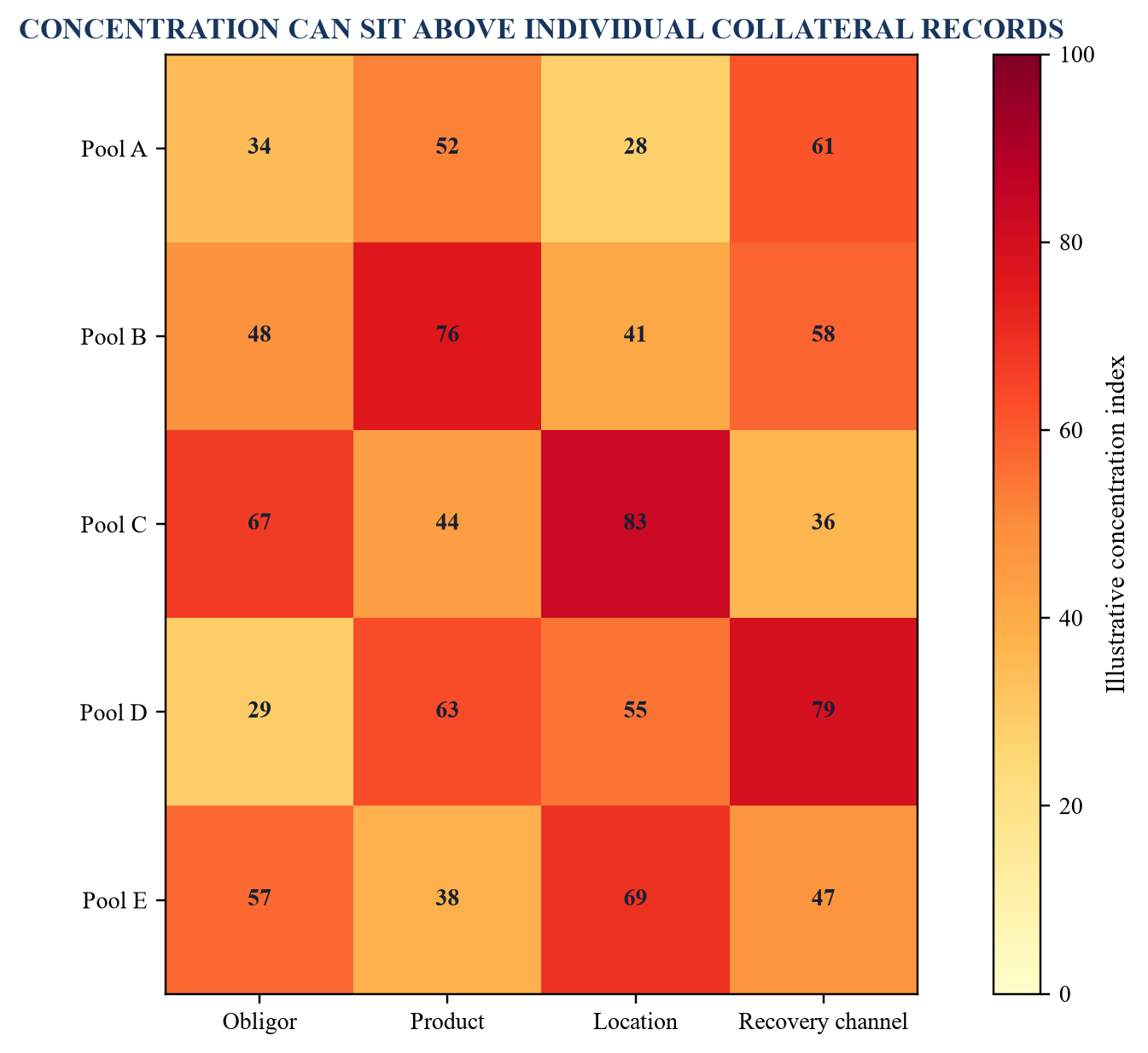
Values and categories are hypothetical assumptions; the map supports review and does not define contractual caps.
Table 2. Receivables and inventory eligibility evidence
| Collateral | Evidence dimension | Typical risk signal | Controlled response |
|---|---|---|---|
| receivable | existence and performance | missing delivery, dispute or cancellation | verify, exclude or reserve |
| receivable | ageing and dilution | re-ageing, late credit or rising deductions | cross-age, reserve or investigate |
| receivable | obligor concentration | connected customers or rapid share increase | apply cap and monitor |
| inventory | ownership and location | consignment, transit or third-party custody | confirm rights and control |
| inventory | condition and velocity | quality hold, expiry or slow movement | inspect, revalue or exclude |
| inventory | recovery value | market change or appraisal limitation | refresh value and haircut |
| both | priority and enforceability | competing claim or missing perfection evidence | block unsupported eligibility |
Contractual language and qualified legal review determine the actual eligibility test.
19. Govern advance rates as credit decisions
An advance rate converts eligible collateral value into availability. It should reflect recovery uncertainty, control quality, monitoring, cost, timing and risk appetite. Historical convention alone is insufficient when collateral, market or control conditions change.
The analytical model can estimate loss distributions and test structure. It should show sensitivity to dilution, default, recovery, appraisal, time and concentration. The lender retains authority to approve the rate and any minimum cushion.
Rates should not adjust automatically from every data movement. A defined review process can use analytical triggers, validation and credit judgement. Emergency reductions require contractual authority and clear governance.
An advance rate should be assessed together with eligibility definitions, concentrations and reserves. A conservative rate can still produce excess risk if weak collateral remains eligible. A higher rate can be consistent with a tightly controlled pool and strong recovery evidence. Reviewing one lever in isolation can obscure the full structure.
Back-testing should compare realised collections and recoveries with the assumptions supporting structure. It should account for changes in borrower operations, markets and enforcement. A favourable period does not prove that the maximum rate is safe. The committee should consider tail outcomes, data limitations and the cost and time of control before changing policy.
20. Construct the advance-rate curve
A curve can connect evidence quality and expected net recovery to a range of potential advance rates. It should include operational and legal uncertainty, not only statistical loss. The structure can impose caps even when a modelled value appears higher.
Receivables and inventory require different curves because their recovery pathways differ. Subclasses can also differ. The model should avoid false precision when appraisals, history or data are weak.
The decision packet should compare current rate, modelled range, policy boundary and proposed rate. It should identify which evidence would change the recommendation.
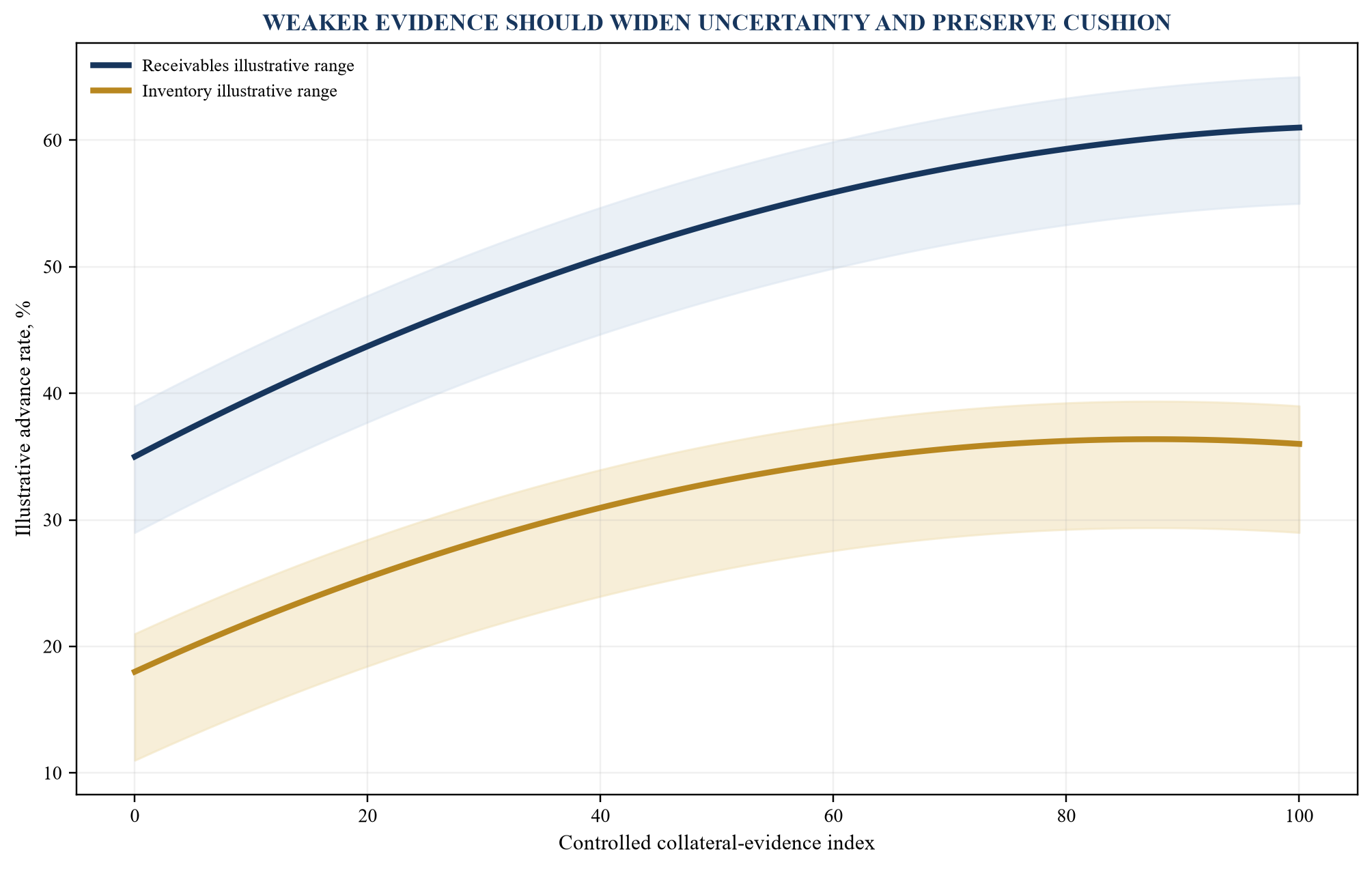
Rates and scores are hypothetical assumptions and do not represent market practice or a lending recommendation.
21. Design reserves by causal risk
Reserves should identify the exposure they protect. Examples can include dilution, rent, taxes, claims, inventory cost, appraisal uncertainty, customer credits, field-exam findings and availability blocks. The executed agreement and approved credit decision determine actual treatment.
A reserve needs formula or amount, evidence, owner, effective date, review and release condition. Combining unrelated concerns into one opaque amount weakens governance and makes cure difficult.
The system can calculate approved reserves and forecast how they change. It should prevent double counting where an exclusion or haircut already addresses the same risk, unless the lender intentionally applies both and records the rationale.
Reserve release should be governed as carefully as creation. A dispute reserve can decline after collection or documented resolution. An appraisal reserve can expire after accepted updated evidence. The workflow should require the named release condition and authority, preventing a reserve from disappearing merely because a reporting period changed.
Portfolio reserves can address risks that cannot be attributed reliably to individual rows. The methodology should define population, driver and allocation. Row-level and portfolio reserves should reconcile to the total certificate. When a model proposes a reserve, the decision record should show its validated range, policy boundary and approved amount.
22. Reconcile collateral with cash dominion
Cash control connects collateral conversion to debt repayment and availability. Collections should reconcile from customer receipt through lockbox, concentration account, application and facility. Unapplied cash and diversion need timely visibility.
The process should distinguish timing breaks from missing cash. Payment references, bank records and remittance data can support automated matching. Material uncertainty routes to review.
Cash dominion terms and operational arrangements require exact implementation. The engine can monitor evidence but cannot establish legal control. Bank acknowledgements, mandates and agreements require qualified confirmation.
23. Monitor availability and overadvance
Availability equals the lesser or combination of contractual commitments and borrowing-base capacity after outstanding debt, reserves and other adjustments. The calculation should show every component and currency treatment.
A forecast can identify when collateral decline, concentration or debt will create low availability or overadvance. It should show the probability range and leading drivers. Management then has time to reduce debt, add eligible collateral, seek amendment or take another authorised action.
An overadvance is a contractual and credit matter. The system should escalate according to policy and preserve decision history. It should not quietly offset the result with forecast collateral that is not yet eligible.
Availability forecasting should distinguish scheduled change from stress. Expected collections and inventory sales can support a central path when the evidence is controlled. Customer failure, dispute escalation, warehouse interruption or price collapse can form named downside scenarios. The output should show when each path crosses internal warning, minimum excess or contractual thresholds and the lead time available for response.
Currency can create additional volatility when collateral, debt and facility limits are denominated differently. The calculation should use the contractually specified rate source, date and treatment. Forecast scenarios can show translation sensitivity without changing the approved certificate method. Hedging or currency reserves require their own authority and documentation.
24. Use event signals without hidden rule changes
Event signals can include payment delay, dispute, credit memo, return, warehouse movement, quality hold, price change and customer deterioration. They can alter a forecast or priority score before a formal eligibility rule is triggered.
The interface should label contractual exclusion, analytical warning and proposed action separately. Users need to know whether an item is legally ineligible, operationally uncertain or statistically unusual. Conflating the categories can deny valid availability or fund unsupported collateral.
Signal thresholds require validation and monitoring. False positives create workload and borrower friction. False negatives can delay protection. Performance should be assessed by consequence and segment.
25. Build the exception hierarchy
Exceptions can be classified by data, eligibility, valuation, concentration, documentation, control and model status. Severity reflects amount, time, legal effect, recoverability and decision consequence. The category determines the owner and authority.
Each exception needs source, affected collateral, proposed treatment, deadline, compensating control and expiry. Repeated extensions should be visible. A temporary waiver should not become an undocumented rule.
The system can group related exceptions and identify root causes. A surge in missing delivery records may indicate an integration failure rather than many independent collateral problems.
Exception ageing matters because temporary uncertainty can become structural. The dashboard should show time open, extensions, prior owners and repeated recurrence. A low-value issue can become material when it affects a control relied upon across the population. Severity therefore combines affected value with control dependency and time.
Borrower remediation should be specific and testable. A promise to improve documentation is weaker than a defined process change, accountable owner, sample test and completion date. The lender should determine whether collateral remains excluded, reserved or otherwise treated during remediation. Closure evidence should be retained for later field examination.
26. Create the lender exception dashboard
The dashboard should begin with funding decisions, material breaches and unresolved evidence. It can show gross collateral, eligible value, availability, excess, reserves, concentrations, cohort movement, model status and field-exam findings.
Users need drill-through to source rows and documents. Aggregate figures without lineage delay review. Data freshness and reconciliation status should appear beside the result.
Role-based views support borrower preparers, lender analysts, credit officers, agents and auditors within their permissions. Approval and edit rights remain separated.
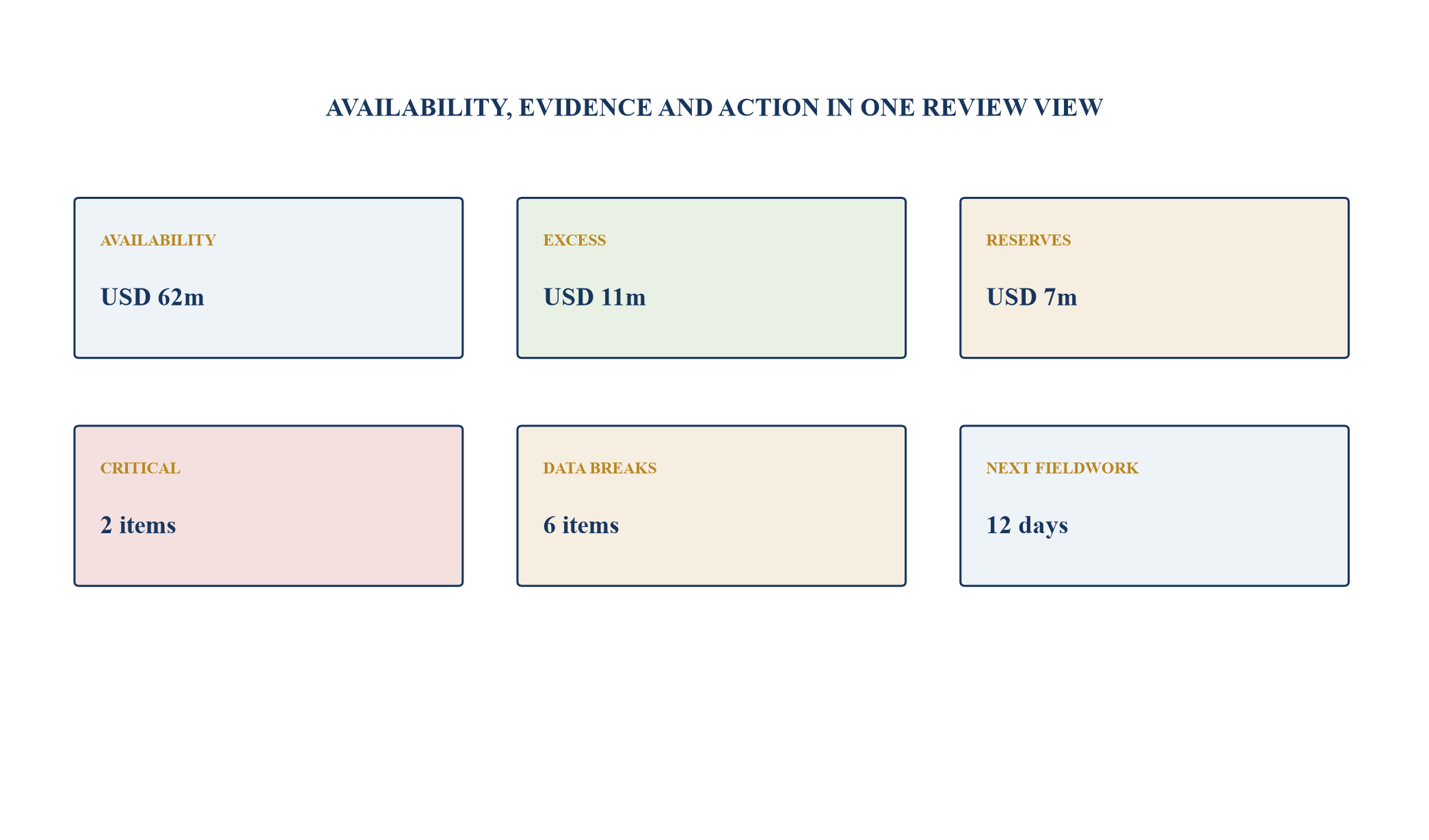
Amounts, counts and statuses are hypothetical assumptions for control-design illustration.
Table 3. Exception decision matrix
| Exception | Immediate treatment | Required evidence | Decision owner |
|---|---|---|---|
| missing source or reconciliation | hold affected collateral | authoritative record and resolved break | operations and lender analyst |
| contractual ineligibility | exclude according to rule | rule, source attribute and calculation | delegated approver |
| potential legal or priority issue | block unsupported reliance | qualified opinion and documentation | legal and credit authority |
| valuation outside tolerance | apply approved conservative treatment | appraisal, market and recovery evidence | credit authority |
| model-performance breach | suspend model-dependent recommendation | validation and remediation | model owner and credit |
| temporary approved exception | apply stated amount and expiry | signed approval and compensating control | authorised exception holder |
Actual authority and treatment depend on the facility documents and approved credit governance.
27. Preserve field examination independence
Field examinations test books, records, collateral and controls. AI can help select samples, reconcile populations and identify anomalies. The examiner should retain independent scope and the ability to pursue unexpected findings.
Model-ranked sampling can miss unfamiliar patterns. The plan should combine material, risk-based and independent selection. Source populations and exclusions need reconciliation before sampling.
Findings should connect to collateral amount, root cause, borrower remediation and availability treatment. Closure requires evidence. The system should preserve the original finding and subsequent versions.
Fieldwork analytics should be tested for selection bias. If the model repeatedly targets the same customers or locations, other areas may receive inadequate coverage. The examination plan can set rotation, minimum random sampling and mandatory categories. Examiners should be able to override the model and record why.
Results should feed model validation without contaminating independence. Confirmed findings can improve labels and rules through controlled change. The model owner should not alter logic during an examination to make prior recommendations appear accurate. Versioned performance preserves the evidence needed for challenge.
28. Govern appraisal and valuation evidence
Appraisals should identify scope, premise, date, assets, methods, markets, assumptions and limitations. The borrowing base should use the approved value and effective date. Unsupported extrapolation across assets or periods should be visible.
Analytical monitoring can detect price, velocity or mix changes that may justify a refresh. It can also compare realised recoveries with prior estimates. Material model deviations need review by valuation and credit professionals.
Independence and conflicts should be managed according to policy. A borrower-provided estimate can inform analysis and should not be presented as an independent appraisal.
29. Validate eligibility and forecasting models
Models should have purpose, owner, inventory, data, methodology, limitations, validation and monitoring. Deterministic rules, entity matching, anomaly detection, payment forecasts and recovery estimates should be assessed according to their role and consequence.
Validation can test implementation, historical performance, stability, sensitivity and overrides. Entity matching should measure false combinations and missed links. Forecast models should assess calibration and tail error. Recovery models should compare with realised outcomes where evidence exists.
Material findings can restrict use, require conservative treatment or suspend a component. Credit decisions should not depend on a failed model while remediation remains open.
Validation should examine the complete decision chain. A well-calibrated payment model can still create poor outcomes if entity matching is wrong, source data are late or users misunderstand the score. Testing should include upstream data, transformation, interface, workflow, override and downstream calculation. End-to-end scenarios can reveal interactions missed by component tests.
Monitoring thresholds should reflect use. A model that ranks fieldwork samples can tolerate different errors from one that proposes reserves affecting funding. Material segments need separate performance because portfolio averages can conceal weakness in foreign receivables, new products or small populations. Breaches require predetermined escalation and permitted-use decisions.
30. Control generated explanations
Language models can summarise disputes, agreements and exceptions. Every material statement should link to source. The calculation should not depend on generated prose.
Prompt injection, malicious documents and confidential data require security controls. External content should be treated as data. Approved environments, access, logging and retention should match sensitivity.
Users should see uncertainty and missing evidence. Generated explanations need accountable review before they enter a credit record or borrower communication.
31. Manage legal and jurisdictional variation
Collateral rights, perfection, priority, set-off, insolvency and enforcement differ by jurisdiction and fact. The engine should store jurisdiction and legal evidence as fields. It should not generalise one legal treatment across a multinational pool.
Foreign receivables can add country, currency, enforcement and transfer risk. Inventory in another jurisdiction or third-party facility can require additional opinions and control. The actual facility documents define conditions.
Legal reviews should have scope, date, assumptions and renewal triggers. Expired or qualified evidence should become an exception rather than remain silently valid.
32. Protect borrower and customer data
Borrowing-base data can contain invoices, customers, prices, disputes, payments and bank information. Access should follow purpose and least privilege. Transfers between borrower, agent, lender, examiner and vendor require approved controls.
Data minimisation can reduce exposure while preserving decision evidence. Customer-facing documents and free text may contain unnecessary personal or confidential information. Retrieval should respect approved scope.
Security incidents can undermine both operations and collateral confidence. Response plans should connect lending, borrower, technology, security and legal owners.
33. Create immutable certification evidence
The certificate record should preserve population, cut-off, source hashes or equivalent controls, rule version, model version, adjustments, approvals and submitted result. A correction creates a new version.
Borrower certification, lender review and funding authorisation should remain distinguishable. Signatories need current authority. Workflow timestamps should respect contractual deadlines.
The evidence package supports audit, field examination and dispute resolution. It also allows retrospective analysis of how data and decisions changed.
Certification should include completeness controls over the submitted population. Record counts, control totals, ledger reconciliation and exception totals can help show that data were not omitted during transfer. Hashes or equivalent integrity controls can demonstrate that the reviewed file matches the submitted version, subject to the organisation's approved technology.
The process should preserve evidence of system availability and fallback. If the automated engine fails near a reporting deadline, the manual calculation needs controlled templates, source extracts, review and reconciliation. Once service returns, the manual result should be compared with the system output and any difference investigated.
34. Measure economic and control outcomes
Performance measures can include processing time, reconciliation breaks, exception closure, fieldwork yield, forecast accuracy, collateral loss, recovery and funding interruption. Each metric needs a controlled definition.
The lender should avoid claiming value from alerts alone. Economic benefit requires a credible counterfactual and attributable pathway, such as avoided overadvance, lower operational cost or better facility utilisation.
Borrower outcomes also matter. Faster, predictable certification can improve liquidity planning. Excessive false positives can create delay and cost. The operating design should measure both risk and friction.
35. Report to the credit committee
The committee should see availability, excess, collateral mix, concentrations, cohort changes, advance rates, reserves, exceptions, fieldwork, model status and downside scenarios. Material changes from the approved case need explanation.
The report should distinguish contractual facts, observed data, forecasts and recommendations. It should show the requested authority and conditions. Legal and valuation uncertainties remain explicit.
Decision minutes should link to evidence and implementation. Conditions remain visible until satisfied or formally changed.
The committee should also see the reliability of the operating process. A strong collateral pool supported by frequent unexplained adjustments, late certificates or unresolved field findings can warrant a different decision from the same numbers produced through stable controls. Data, process and recovery evidence therefore belong beside the headline availability.
Trend reporting should compare like with like. Changes in legal entities, facility terms, advance rates, appraisal basis or portfolio composition can make prior periods incomparable. The report should bridge structural changes separately from collateral performance. This helps the committee identify genuine deterioration and avoids attributing a rule change to borrower behaviour.
36. Run a hypothetical worked example
Consider a hypothetical distributor with USD 92 million receivables and USD 58 million inventory. The facility has a USD 90 million commitment. Illustrative advance rates are 80 per cent for eligible receivables and 50 per cent for eligible inventory, subject to caps and reserves.
The engine excludes an assumed USD 14 million of receivables for ageing, disputes, foreign eligibility and concentration. It excludes USD 18 million of inventory for work in process, obsolescence, location and condition. These figures are assumptions.
Before reserves, the illustrative base is USD 62.4 million receivables availability plus USD 20 million inventory availability after a contractual inventory cap, producing USD 82.4 million.
37. Apply event-level evidence to the example
The payment cohort shows that one recent customer group is collecting later than history. Contractual eligibility has not yet changed. The lender increases monitoring and selects invoices for confirmation rather than applying an automatic exclusion.
Dispute data identify late credit notes linked to one product. The approved method produces an illustrative USD 3 million dilution reserve. Inventory signals identify slow movement at a third-party warehouse, leading to an appraisal review and USD 2 million temporary reserve.
After an additional USD 2 million rent and priority reserve, total illustrative reserves are USD 7 million. Availability becomes USD 75.4 million before debt.
38. Test the funding decision
Assume outstanding debt of USD 64 million and a requested draw of USD 5 million. Current excess availability is USD 11.4 million. After the draw it would be USD 6.4 million under the illustrative case.
A downside scenario applies additional dilution, slower collections and lower inventory recovery. Excess falls below an assumed internal warning but remains positive. The lender can approve, condition, reduce or defer the request according to its documents and authority.
The worked example demonstrates connected evidence. It does not establish an appropriate facility, advance rate or decision for any borrower.
The decision packet should show sensitivity to the largest assumptions. If the dilution reserve rises by two percentage points, one concentrated obligor becomes ineligible or inventory recovery falls by ten per cent, excess availability can change materially. The lender can set monitoring triggers around these drivers and specify when a new certificate or approval is required.
It should also show operational readiness. A positive calculation is of limited use if the lockbox, control account, warehouse access, reporting or signatory arrangements are incomplete. The funding decision can therefore be conditioned on evidence outside the numerical base. Each condition needs an owner and completion status.
39. Implement the framework in ninety days
Days One to Thirty can define the facility perimeter, source hierarchy, rule library, collateral identifiers and decision authority. Teams can reconcile one certificate and document every manual adjustment.
Days Thirty-One to Sixty can build receivable cohorts, inventory movement controls, concentration maps and exception workflow. Models operate in parallel while field examiners and credit staff compare results.
Days Sixty-One to Ninety can run bounded live certification with human approval, validate performance, test fallback and decide whether to expand. Material model or data failure blocks model-dependent scope.
Implementation should select a facility with accessible evidence and material decision value. A highly complex multinational pool can expose every problem at once and delay learning. A narrow first scope can test reconciliation, eligibility, model signals, exception handling, approval and certification end to end. Expansion should add one complexity at a time, such as foreign receivables, third-party inventory or additional facilities.
Readiness also depends on operating capacity. Borrower finance, lender operations, field examination, credit, legal, valuation, model risk, data and security owners need defined responsibilities and response times. The process should be tested across reporting cut-offs and absence of key staff. A system that relies on informal knowledge cannot support a durable collateral control.
Table 4. Ninety-day implementation gates
| Period | Build | Evidence gate | Decision |
|---|---|---|---|
| days 1 to 15 | facility and source register | documents, owners and cut-offs confirmed | approve discovery |
| days 16 to 30 | reconciled certificate and rule library | prior result reproduced | approve analytics |
| days 31 to 45 | cohorts and anomaly detection | representative validation | approve parallel run |
| days 46 to 60 | inventory, concentration and reserves | fieldwork and appraisal controls accepted | approve bounded users |
| days 61 to 75 | live workflow with human approval | stable calculation and exception control | approve bounded use |
| days 76 to 90 | outcome and fallback review | credit, model and operations acceptance | scale, redesign or stop |
Scope should expand only after evidence and control acceptance.
40. Make collateral evidence the source of speed
Dynamic availability does not require uncontrolled rule changes. It requires faster evidence on existence, payment, dispute, dilution, ownership, movement, condition, concentration and recovery. Approved rules and credit authority convert that evidence into a funding decision.
AI can reconcile records, detect patterns, forecast cohorts and focus fieldwork. Its role should remain visible and validated. Legal rights, valuation policy, advance rates, reserves, exceptions and enforcement remain accountable lender decisions.
A durable system preserves source lineage, versioned calculation, independent review and realised outcomes. It can improve speed because reviewers receive a coherent record. It can improve control because every amount has a reason, owner and authority.
The institution should retain the ability to challenge and retire analytical components. Customer behaviour, products, markets, systems and laws change. Periodic review should confirm continued purpose, performance, data quality, control effectiveness and legal relevance. Material weakness can lead to narrower use, stronger reserves, redesign or withdrawal according to authorised governance.
The final discipline is a complete path from collateral event to source record, from source record to approved rule, from rule to availability, and from availability to an authorised funding decision. Realised collections and recoveries then update future analysis. That closed loop creates a learning asset while preserving the distinction between prediction and control.
Borrowers also benefit from transparent causality. When availability declines, the record can show whether the driver was collection, dilution, concentration, inventory ageing, appraisal, reserve or data quality. Management can then address the operating cause rather than negotiate around an unexplained result. The same evidence can support working-capital improvement, customer remediation, stock reduction and more reliable liquidity planning. These wider benefits require separate measurement and should never inflate collateral value or substitute for lender protection.
Consistent reporting also improves dialogue among finance, operations, lenders, examiners and advisers because each party can trace the same controlled evidence.
Table 5. Board and credit-committee monitoring record
| Dimension | Measure | Evidence | Decision use |
|---|---|---|---|
| availability | gross, eligible, reserves, debt and excess | certified calculation | funding capacity |
| quality | ageing, dilution, velocity and obsolescence | event-level cohorts | structure review |
| concentration | obligor, product, location and recovery channel | controlled aggregation | caps and diversification |
| control | reconciliations, exceptions and fieldwork | workflow and examination records | reliance |
| model | validation, drift and overrides | model-risk evidence | permitted use |
| outcome | losses, recoveries, processing and friction | realised records | calibration and redesign |
Measures should connect operating evidence with credit consequence.
References
- Office of the Comptroller of the Currency, Asset-Based Lending, Comptroller's Handbook, 2025. https://www.occ.treas.gov/publications-and-resources/publications/comptrollers-handbook/files/asset-based-lending/pub-ch-asset-based-lending.pdf
- Office of the Comptroller of the Currency, Accounts Receivable and Inventory Financing, Comptroller's Handbook, 2025. https://www.occ.treas.gov/publications-and-resources/publications/comptrollers-handbook/files/accts-rec-inventory-financing/pub-ch-accts-rec-inventory-financing.pdf
- Central Bank of the UAE, Credit Risk Management Regulation, 2024. https://rulebook.centralbank.ae/en/rulebook/credit-risk-management-regulation
- Central Bank of the UAE, Credit Risk Management Standards, 2024. https://rulebook.centralbank.ae/en/rulebook/credit-risk-management-standards
- European Banking Authority, Guidelines on Loan Origination and Monitoring. https://eba.europa.eu/activities/single-rulebook/regulatory-activities/credit-risk/guidelines-loan-origination-and-monitoring
- Basel Committee on Banking Supervision, Principles for the Management of Credit Risk. https://www.bis.org/publ/bcbs75.htm
- Basel Committee on Banking Supervision, Prudential Treatment of Problem Assets. https://www.bis.org/bcbs/publ/d403.htm
- IFRS Foundation, IFRS 9 Financial Instruments. https://www.ifrs.org/issued-standards/list-of-standards/ifrs-9-financial-instruments/
- IFRS Foundation, IFRS 7 Financial Instruments: Disclosures. https://www.ifrs.org/issued-standards/list-of-standards/ifrs-7-financial-instruments-disclosures/
- IFRS Foundation, IAS 2 Inventories. https://www.ifrs.org/issued-standards/list-of-standards/ias-2-inventories/
- IFRS Foundation, IFRS 15 Revenue from Contracts with Customers. https://www.ifrs.org/issued-standards/list-of-standards/ifrs-15-revenue-from-contracts-with-customers/
- Financial Stability Board, The Financial Stability Implications of Artificial Intelligence, 2024. https://www.fsb.org/2024/11/the-financial-stability-implications-of-artificial-intelligence/
- Financial Stability Board, Enhancing Third-Party Risk Management and Oversight, 2023. https://www.fsb.org/2023/12/enhancing-third-party-risk-management-and-oversight-a-toolkit-for-financial-institutions-and-financial-authorities/
- National Institute of Standards and Technology, Artificial Intelligence Risk Management Framework 1.0, 2023. https://doi.org/10.6028/NIST.AI.100-1
- National Institute of Standards and Technology, Generative Artificial Intelligence Profile, 2024. https://doi.org/10.6028/NIST.AI.600-1
- US Federal Reserve and Office of the Comptroller of the Currency, Supervisory Guidance on Model Risk Management SR 11-7 and OCC 2011-12. https://www.federalreserve.gov/supervisionreg/srletters/sr1107.htm
- Bank of England Prudential Regulation Authority, SS1/23 Model Risk Management Principles for Banks. https://www.bankofengland.co.uk/prudential-regulation/publication/2023/may/model-risk-management-principles-for-banks-supervisory-statement
- National Institute of Standards and Technology, Cybersecurity Framework 2.0, 2024. https://doi.org/10.6028/NIST.CSWP.29
- UK National Cyber Security Centre, Guidelines for Secure AI System Development, 2023. https://www.ncsc.gov.uk/collection/guidelines-secure-ai-system-development
- International Organization for Standardization, ISO/IEC 42001 Artificial Intelligence Management System. https://www.iso.org/standard/81230.html
- International Organization for Standardization, ISO 31000 Risk Management. https://www.iso.org/iso-31000-risk-management.html
- Central Bank of the UAE, Guidance Note on Responsible Adoption and Use of Artificial Intelligence and Machine Learning, 2026. https://rulebook.centralbank.ae/en/rulebook/guidance-note-consumer-protection-and-responsible-adoption-and-use-artificial-intelligence
- Dubai Financial Services Authority, AI Survey 2025, 2025. https://www.dfsa.ae/news/new-dfsa-ai-survey-generative-ai-adoption-has-nearly-tripled-within-difc-last-12-months-governance-continues-develop
- Committee of Sponsoring Organizations of the Treadway Commission, Enterprise Risk Management Framework. https://www.coso.org/enterprise-risk-management
- United Nations Commission on International Trade Law, Model Law on Secured Transactions. https://uncitral.un.org/en/texts/securityinterests/modellaw/secured_transactions
