

1. Define the financing decision
Cap-table analysis should begin with the decision the board must make. The proposed amount, instrument, price, timing, use of proceeds, runway, investor rights, employee incentives and next financing path should be explicit. A headline valuation alone cannot show ownership, control or value allocation.
The model should identify the closing state and at least one follow-on state. A financing can appear acceptable at signing and create severe dilution when outstanding instruments convert, the option pool expands and another round is required before the operating milestone is reached. Decision ranges should therefore accompany the single closing case.
2. Establish the source hierarchy
The cap table should be reconstructed from executed instruments, constitutional documents, board and shareholder approvals, the register of members, option records, warrant records, financing ledgers and applicable filings. A spreadsheet supplied without those sources is a claim that requires reconciliation.
Each position should cite its governing record, holder, date, currency, principal or investment amount, class, price, cap, discount, interest, maturity, conversion event, seniority and side rights. Where records conflict, the exception should remain visible until qualified advisers resolve it.
Table 1. Source-controlled instrument ledger
| Field | Evidence | Control |
|---|---|---|
| holder and instrument | executed agreement | unique identifier and source link |
| economic terms | agreement and amendments | effective-date version |
| legal capital | register and constitutional records | reconcile issued shares by class |
| employee awards | approved grant records | grant, vesting and exercise status |
| side rights | side letter or investor rights agreement | map pro rata and consent rights |
| closing treatment | transaction documents | signed definition and formula |
The legal documents and applicable law control; the ledger records the inputs used by the analytical model.
3. Separate legal, economic and fully diluted views
Issued ownership, economic exposure and fully diluted ownership answer different questions. Issued shares identify current legal ownership under the relevant company records. Economic exposure may include rights that convert or participate later. A fully diluted view adds specified instruments under a defined transaction denominator.
The model should label each view and date. It should never present an option, SAFE or convertible note as an issued share before the relevant legal event. The SEC describes a SAFE as a promise of future ownership when a triggering event occurs and distinguishes it from current stock ownership [1].
4. Map the capital stack
The capital stack should display ordinary shares, preferred shares, SAFEs, convertible debt, warrants, options, restricted awards and other rights. Each layer should show cash invested, current legal status, conversion trigger, price mechanism, seniority and participation.
This map prevents instruments from disappearing inside one fully diluted percentage. It also reveals competing claims on authorised shares, future financing proceeds and exit value. The board should understand which instruments require consent, repayment, conversion, amendment or notice at the contemplated closing.
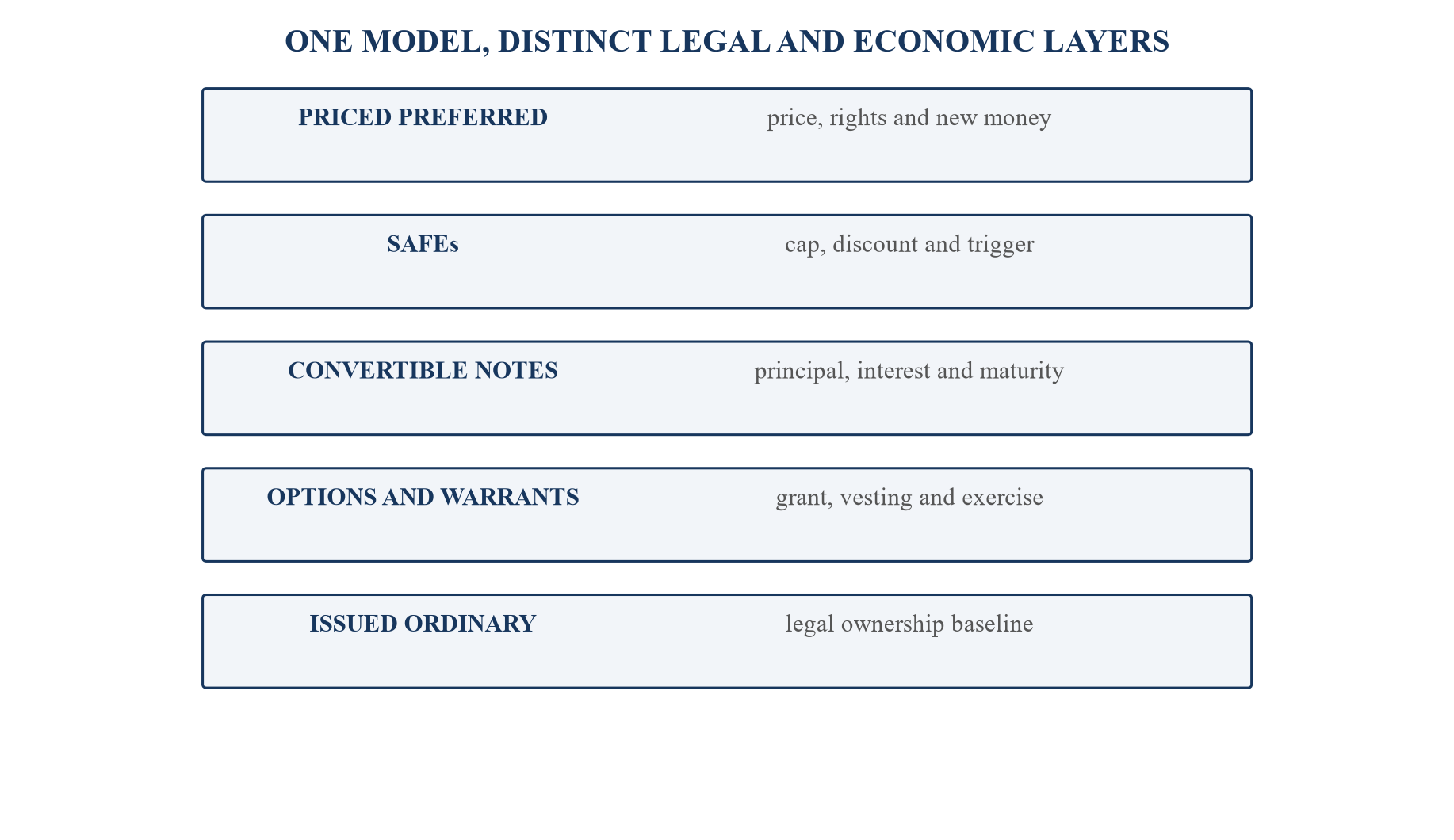
The analytical perimeter includes issued securities and contingent rights while preserving their distinct legal status.
5. Define the transaction denominator
Ownership percentages depend on the denominator. The transaction documents may include issued shares, reserved options, granted options, warrants, converting securities and a pre-closing or post-closing pool increase in different ways. The exact definition controls the calculation.
The model should reproduce the signed denominator and also show an analytical bridge from the current legal capital. Labels such as pre-money and post-money cannot replace the share-count formula. A change in denominator can move value between founders, employees, existing investors and new investors without changing the headline enterprise value.
The denominator should be decomposed into mutually exclusive schedules. One schedule contains issued shares by class; another contains awards and warrants according to the transaction definition; a third calculates conversion securities; and a fourth contains the negotiated pool adjustment. The price-per-share calculation should point to those schedules rather than embed unexplained numbers. This allows a reviewer to determine whether an instrument appears twice, whether an excluded award has been included, and whether the pool is sized on the intended side of the financing. The board pack should show both the contractual denominator and a plain-language reconciliation of who bears each addition.
6. Model post-money SAFEs
Y Combinator describes the post-money SAFE as a security whose valuation cap includes the SAFE investment and states that ownership sold is the investment amount divided by the valuation cap, subject to the document [2]. The official form and user guide should be read together with qualified advice for the relevant jurisdiction [2][3].
The model should calculate each SAFE separately before aggregating. It should identify cap-only, discount-only, most-favoured-nation and other variants, plus any pro rata side letter. Multiple SAFEs can create ownership that is individually predictable while still requiring careful treatment of new money and the option pool at conversion.
The post-money ownership estimate should be tested against the actual conversion provision. A simple investment-divided-by-cap calculation can communicate the basic economics, while the closing share count still depends on the form’s capitalisation definitions, company capital, subsequent instruments and equity-financing price. Side letters can preserve participation rights that require a separate cash decision at the priced round. The model should show the SAFE conversion and any additional pro rata purchase as distinct transactions. It should also test liquidity and dissolution events because a company can be sold or wound down before an equity financing triggers the expected conversion.
7. Model pre-money and non-standard SAFEs
Older or customised SAFEs can use pre-money mechanics or definitions that differ from the current standard form. Their conversion may depend on other convertibles, options or the new financing denominator. A filename or investor summary is insufficient evidence of the operative formula.
The model should classify the form version and amendment history. Where a non-standard term changes liquidity, dissolution, acquisition or conversion treatment, the transaction team should model it directly from the executed language. Legal interpretation remains with qualified counsel.
Comparability should be earned rather than assumed. Two instruments described as SAFEs may define company capital, liquidity consideration or conversion securities differently. One may contain a cap and another a discount; another may carry a most-favoured-nation election that depends on subsequent issuance. The ledger should capture the operative election and evidence that it was made. Where an instrument was assigned or amended, the holder and economic terms should reconcile through the full chain. The closing schedule should identify which provisions are satisfied, waived or carried into the new security.
8. Model convertible notes
A convertible note is debt that can convert into another security. The SEC notes that startup convertible notes commonly convert into preferred stock at a later financing and distinguishes their debt features from SAFEs [1]. Principal, accrued interest, maturity, qualified-financing threshold, cap, discount and repayment terms should be recorded.
The conversion price may be determined by the cap, discount, round price or a negotiated amendment. The model should calculate all applicable alternatives and select the contractual result. It should also show the cash and control consequences if the qualified financing does not occur before maturity.
Debt features introduce claims that do not exist in a standard SAFE. The schedule should reconcile principal to bank receipts and the accounting ledger, accrue interest to the assumed closing date and state whether fees or additional advances enter the conversion amount. Qualified-financing thresholds, majority-holder amendment rights, security, subordination and events of default can affect execution. If notes have different terms, the model should avoid a blended conversion price. Each note should be calculated under its own document and then grouped only after shares and rights are determined. A maturity scenario should identify available cash, required consents and the impact of extension terms.
9. Reconcile cap and discount mechanics
A cap and a discount can produce different conversion prices. The instrument often selects the more favourable price for the investor, subject to its precise terms. The calculation should show round price, discounted price, cap-derived price, selected price and resulting shares.
The cap-derived price requires the correct capitalisation denominator. The discount applies to the defined financing price. These inputs can use different share bases. A controlled model should preserve each intermediate calculation so that an investor, founder and adviser can reproduce the result.
The model should test threshold conditions before price. A note may convert automatically only above a qualified-financing amount and otherwise require an election. A SAFE may convert in any equity financing under its form. The relevant preferred security can be the round class or a separate shadow series designed to preserve equivalent economics after a lower conversion price. Share count, liquidation amount and voting can therefore require separate schedules. Rounding should occur at the point prescribed by the document, because early rounding across many instruments can create a reconciliation difference.
10. Accrue interest and test maturity
Convertible debt may accrue simple or compound interest and may specify whether interest converts, is paid in cash or receives different treatment. Day-count convention, accrual dates and amendments should match the instrument and accounting records.
Maturity creates a decision path rather than an automatic assumption. Repayment, extension, conversion or enforcement can have different consequences. The company should not model perpetual extension unless the relevant parties have agreed it. The runway plan should include cash obligations and transaction timing.
11. Model the priced round
A priced round issues a defined class of shares at an agreed price with negotiated economic and governance rights. NVCA publishes model legal documents that illustrate the integrated set of charter, purchase, investor-rights, voting and related agreements used in venture financings [4]. Actual terms and jurisdiction-specific advice control.
The model should calculate pre-money shares, price per share, new-money shares, conversion shares, pool increase and post-closing ownership in the transaction order. It should then connect ownership with preference, participation, dividends, anti-dilution, voting, protective provisions and information rights.
Transaction order matters because the same components can produce different ownership when sequenced differently. A pre-closing pool top-up enters the price denominator before new shares are sold. Converting instruments may receive a shadow series or the new preferred class with modified rights. New-money shares are then issued at the financing price, followed by any pro rata or oversubscription allocation. The closing model should state the order supported by the documents and calculate cash and shares at each step. It should also distinguish authorised terms from executed allocations; a term sheet or model document does not establish the final cap table until definitive documents and closing actions are complete.
12. Build the conversion engine
The conversion engine should be deterministic. Each instrument passes through eligibility, event, price, denominator, accrued amount, rounding and class-allocation rules. Exceptions should stop the calculation or route the item to review rather than silently applying a default.
The engine should retain an audit table containing inputs, source citations, formulas and outputs. It should support independent recalculation outside the AI layer. Version control matters because a change to one instrument, pool assumption or financing amount can alter every downstream ownership percentage.
The calculation architecture should use exact units and controlled rounding. Monetary values should retain their transaction currency, interest should use the documented day-count convention and share calculations should follow the instrument’s fractional-share provision. Display rounding should remain separate from stored precision. An engine should reject a missing cap denominator, financing price or event date rather than substitute zero or a prior-round value. It should also identify circularity, such as a pool target defined as a percentage of a post-closing total that itself includes the pool. Circular formulas can be solved deterministically, with the equation and solution retained for review.
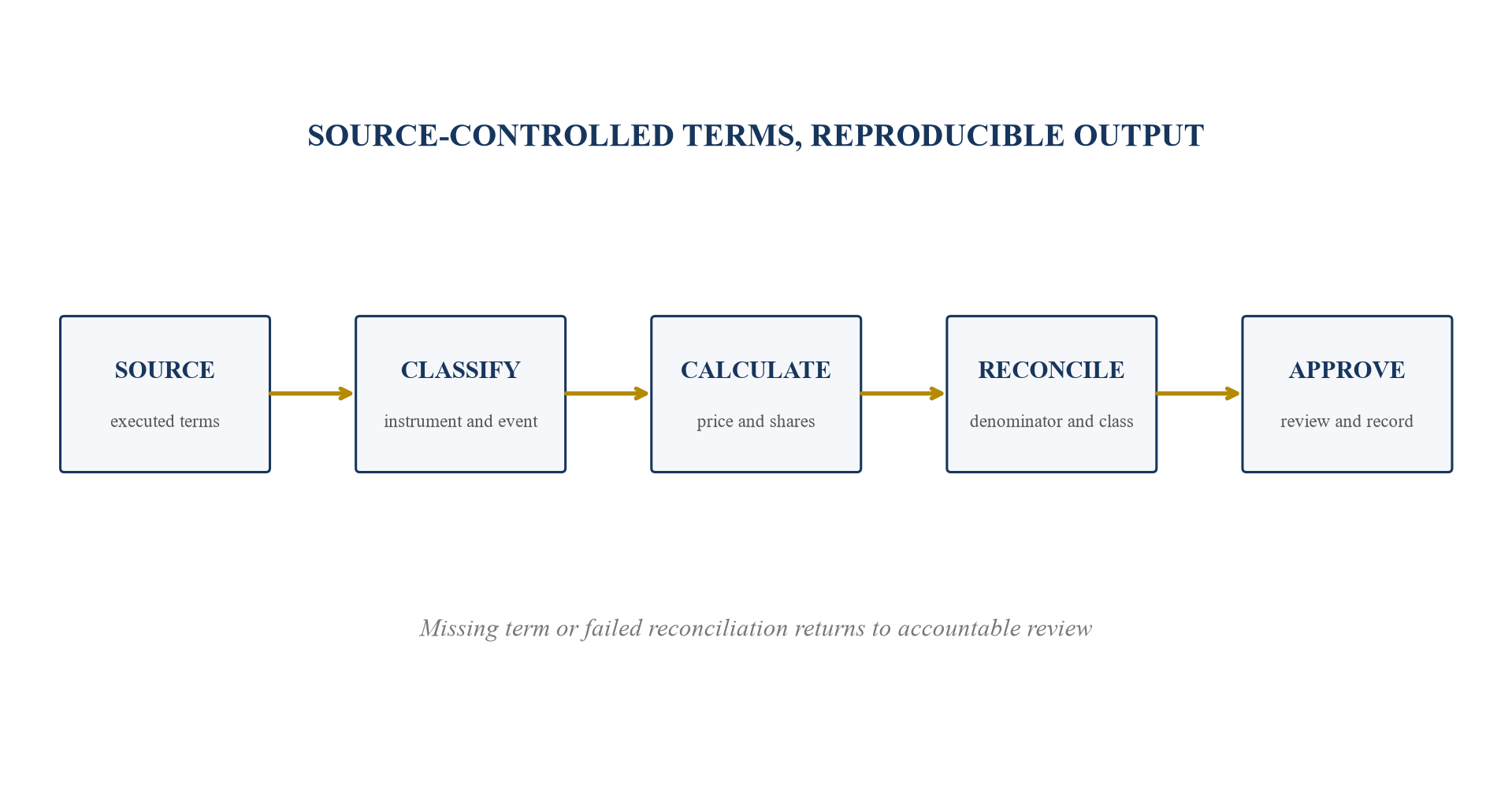
AI-assisted extraction feeds a controlled calculation; exceptions return to source review.
13. Reconstruct the option pool
The option pool should distinguish authorised, reserved, granted, vested, exercised, cancelled, expired and available awards. It should also identify exercise price, award type, vesting schedule, acceleration and any board approval or employee-plan constraint.
A pool percentage without this roll-forward can double count cancelled awards or omit promised grants. The transaction model should specify whether the negotiated pool is measured before or after closing and which holders bear the increase. Employee requirements should be linked to a hiring and retention plan.
The award ledger should reconcile grants to individual approvals and the governing plan. Vested does not mean exercised; exercised does not necessarily mean registered in every jurisdiction; and an expired or cancelled award may return to the reserve only under the plan terms. The company should identify early-exercise, restricted-share, performance and change-of-control provisions that affect the financing or exit waterfall. A role-based hiring model should translate planned hires, grant ranges, refresh awards and retention cases into shares at the expected grant dates. The board can then compare a negotiated pool request with an operating requirement instead of treating the percentage as a market convention.
14. Test the option-pool shuffle
An option-pool increase placed in the pre-money denominator generally dilutes existing holders more than new-money investors. The model should show the ownership bridge with and without the increase, the number of incremental shares and the value transferred at the financing price.
The board should compare the requested pool with a role-by-role grant budget through the next operating milestone. A larger reserve can support recruitment, yet an unsupported percentage can create avoidable dilution. Compensation, tax, securities and employment advice may be required.
Pool sufficiency should be monitored against grant velocity and expected refresh policy. A company can reserve enough shares for headline hiring while overlooking promotions, retention awards, advisory grants or geographic compensation differences. The plan should show opening availability, expected grants, forfeitures and closing headroom by quarter. Scenario analysis can test slower hiring and higher retention needs. The output is a capital-allocation decision: unused reserve still enters ownership where the financing definition includes it, even though no employee has received the award.
15. Include warrants and contingent awards
Warrants can arise from lending, commercial partnerships, accelerators or earlier financings. The model should record exercise price, term, vesting or performance conditions, cashless exercise, adjustments and treatment in a financing or exit.
Contingent awards and promised equity should be separated from legally granted instruments while remaining visible to the decision maker. If management expects a grant, the hiring model and dilution scenario can include it as a case without misrepresenting current legal ownership.
16. Reconcile authorised and issued capacity
The company must have sufficient authority and follow the applicable process to issue shares and reserve awards. The model should compare authorised capital, issued capital, reserved securities and the shares required for conversion and closing.
Jurisdiction matters. Companies House guidance states that UK companies must report changes to share structure and describes the return of allotment process [5][6]. ADGM regulations address allotment and existing-holder pre-emption in their scope [7]. Qualified counsel should confirm the actual company requirements.
17. Model pre-emption and pro rata rights
Pre-emption and pro rata rights can require offers, notices or capacity for existing holders. These rights may arise under law, constitutional documents or side letters. The model should identify eligible holders, percentage basis, response period, waiver and effect on the financing allocation.
Participation changes both proceeds and ownership. A holder that exercises pro rata can maintain a percentage while increasing the company’s financing amount, reducing another investor’s allocation or changing the round size. The scenario model should separate right, intention and signed commitment.
The rights schedule should identify the measurement date and security base used to calculate entitlement. A right may apply to new securities, exclude employee awards or strategic issuances, lapse below an ownership threshold, or require notice within a defined period. The financing allocation should reserve capacity only where the right remains valid and the holder has elected or committed to participate. A scenario can show potential participation before election, labelled accordingly. Waivers should be tied to the correct party and financing. This avoids assuming that silence eliminates a right or that a historical waiver applies to a later issuance.
18. Map consent and governance rights
Financing can require board, shareholder, class or investor consent. Protective provisions, reserved matters, voting agreements and side letters should be indexed alongside economic terms. A mathematically attractive round can remain unavailable without the required approvals.
The closing plan should state each approval, responsible owner, evidence, long-stop date and consequence of failure. Governance rights after closing should also be mapped, including board seats, observers, information rights and future financing controls.
Consent mapping should distinguish authority from support. A shareholder may be economically aligned and still retain a formal approval right. A director may approve an issuance subject to shareholder, class or regulatory conditions. Side-letter rights can require consultation or notice even when they do not provide a veto. The company should avoid treating an unsigned indication as consent. The transaction timetable should include circulation, meeting or written-resolution periods and delivery of final documents. Conflicts should follow the applicable governance process and professional advice.
19. Build the ownership bridge
The ownership bridge should move from current issued shares through option reconciliation, convertible conversion, pool increase, new-money issuance and final fully diluted ownership. Each step should show shares and percentages by stakeholder group.
This sequence makes dilution attributable. Founders can see the effect of earlier instruments, employees can see pool treatment and investors can see conversion and participation. The bridge should reconcile exactly to the post-closing cap table and transaction proceeds.
The bridge should be produced at holder level and summarised by stakeholder group. Holder-level detail is needed to apply distinct instruments and rights; group reporting makes the board decision readable. Each step should provide opening shares, additions, cancellations or conversions and closing shares, with a denominator that agrees to the transaction model. Transfers between holders should change concentration without changing total shares. Exercises can add cash and move an award into issued capital. The model should reconcile these different event types separately. A residual reconciliation line should be zero; any non-zero amount should be traced before the output is used.
Table 2. Ownership bridge structure
| Step | Share movement | Primary driver | Review question |
|---|---|---|---|
| issued baseline | existing shares | legal register | does the register reconcile? |
| award roll-forward | options and warrants | approved grants | what is outstanding and reserved? |
| conversion | SAFE and note shares | cap, discount and interest | which price and denominator apply? |
| pool increase | incremental reserve | hiring plan and term sheet | who bears dilution? |
| new money | preferred shares | price and proceeds | do cash and shares reconcile? |
Percentages require the transaction-specific denominator; values shown in an actual model should reconcile to executed documents.
20. Measure dilution in shares, control and value
Dilution has several dimensions. Ownership dilution reduces a holder’s percentage. Control dilution changes voting or consent power. Economic dilution changes claim on proceeds, while value dilution depends on enterprise value and security rights. These effects should not be collapsed into one percentage.
The board pack should show shares, percentage, votes and exit proceeds under relevant scenarios. A holder may accept percentage dilution when new capital increases enterprise value and runway. The decision still requires visibility into terms, risks and alternative financing paths.
Value creation and value allocation should be shown separately. The financing case can estimate how proceeds affect product, revenue, margin or financing risk, with those management assumptions clearly identified. The cap table and waterfall then allocate the resulting value under the securities. This prevents an assumed operating uplift from concealing an unfavourable allocation term. It also allows the board to compare a smaller round, a larger round and a delayed process using consistent operating and security assumptions.
21. Model liquidation preferences
Preferred shares can have liquidation preference, participation, conversion and dividend rights that affect exit proceeds. The model should calculate the contractual waterfall before relying on pro rata ownership. It should include each seniority layer and the decision to convert where applicable.
Headline post-money value does not determine common-holder proceeds. At lower exits, preference can allocate most or all distributable value to senior securities. At higher exits, conversion may dominate. Actual definitions, deemed-liquidation events and transaction costs require legal review.
Preference analysis should identify original issue price, multiple, seniority, participation cap, accrued dividends and whether each class can elect conversion. Pari passu classes share an applicable pool under their documents, while senior classes are paid first. Participating preferred can receive preference and then share remaining proceeds; non-participating preferred generally compares preference with as-converted value. The model should test election at each exit value rather than assume one treatment across the range. It should also show proceeds before and after transaction costs, debt and other senior claims so that the distribution base agrees to the contemplated event.
22. Build the exit waterfall
The exit waterfall should allocate enterprise value through debt, transaction costs, senior preferences, participating rights and ordinary-equity conversion. It should show cash proceeds and multiples by stakeholder group across a range of exit values.
The model should also test acquisitions before conversion, dissolution treatment for SAFEs and notes, and any change-of-control payment. These outcomes may use different formulas from an equity financing. A separate event engine is safer than forcing every outcome through the priced-round logic.
Event definitions should be read across all instruments. A transaction may qualify as a liquidity event under a SAFE, a deemed liquidation under the charter, a change of control under an option plan and a repayment or conversion event under a note. Those provisions can use different consideration bases, elections and timing. The model should calculate each security under the same transaction facts and then reconcile total distributions to available proceeds. Non-cash consideration, escrow, earn-outs and rollover equity may require additional allocation assumptions and specialist advice. Scenario labels should identify these assumptions rather than present them as agreed terms.
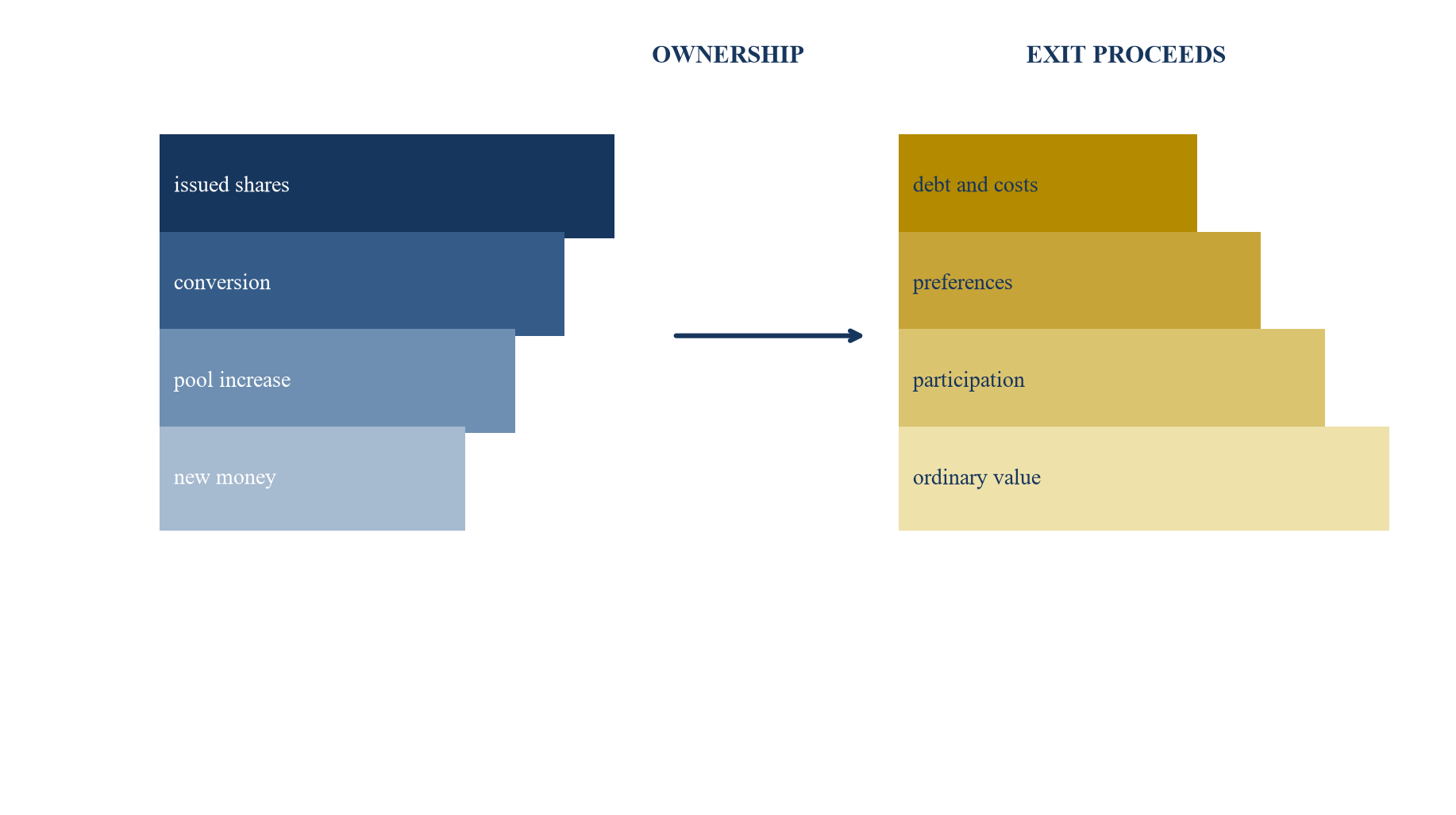
Share ownership flows into a security waterfall; rights and exit value determine proceeds.
23. Model anti-dilution protection
Anti-dilution provisions can adjust conversion price after a down round. The model should identify broad-based or narrow-based weighted-average mechanics, full-ratchet provisions, exclusions, waivers and the securities affected. It should use the formula in the governing documents.
The calculation should show incremental shares and value allocation across scenarios. A future round below the preferred price can affect founders, employees and later investors differently. Legal, accounting and negotiation consequences require qualified advice.
Exclusions can be as important as the formula. Employee grants within an approved plan, strategic issuances, acquisitions, equipment financings or securities issued with holder consent may be excluded from adjustment. The model should classify the future issuance and test whether the exclusion applies. Weighted-average formulas require outstanding share counts and consideration received under defined rules. Full-ratchet provisions can reset price without regard to issuance size. A waiver or amendment should be applied only when properly authorised and documented for the relevant round.
24. Test milestone and bridge financing paths
The company should model the operating milestone that the round is expected to finance and the cash required to reach it. If proceeds are insufficient, a bridge SAFE or note may be needed before the next priced round, creating additional conversion and dilution.
The scenario should integrate burn, timing, financing probability and instrument terms. A lower current dilution can lead to higher cumulative dilution if it produces a short runway and weak bargaining position. Management estimates should remain labelled and sensitivity-tested.
Bridge analysis should connect cash dates to conversion dates. Principal may be received in several closings, interest accrues over different periods and a later priced round can occur at a cap-limited or discount-limited price. The company should show the ownership cost of sufficient runway, a narrower bridge and a delayed financing. It should also model a failed financing that reaches note maturity or requires another SAFE. The purpose is to compare capital sufficiency and cumulative terms. A bridge that preserves today’s headline valuation can still transfer more future ownership if evidence, market access or liquidity deteriorates before the next round.
25. Build future-round scenarios
Future-round analysis should include valuation, new-money amount, pool refresh, instrument conversion, pro rata participation and security rights. At least a base, delayed, lower-valuation and stronger-performance case should be shown.
The purpose is decision preparedness rather than prediction. Each case should identify the operating evidence and financing conditions that could make it relevant. The board should see founder, employee and investor ownership after each path, together with cash runway and exit waterfall.
Scenario design should avoid false precision. Valuation, burn, hiring, milestone date and financing amount should be presented as ranges or discrete cases supported by operating plans and market evidence. The model can calculate exact ownership for each stated case while leaving the likelihood and outcome explicitly uncertain. Decision triggers can link the operating plan to an updated financing response. For example, delayed customer acceptance may reduce hiring and prompt a bridge review, while stronger retention can justify an earlier priced process. The board should approve the trigger framework and revisit it when actual evidence changes.
Table 3. Financing path scenarios
| Scenario | Operating state | Financing event | Dilution question |
|---|---|---|---|
| plan achieved | milestone on schedule | priced follow-on | value step-up and planned pool |
| delayed proof | cash need before milestone | bridge instrument | cumulative conversion exposure |
| lower valuation | adverse market or evidence | down round | anti-dilution and preference effect |
| stronger proof | better retention or economics | larger competitive round | pro rata and pool allocation |
| strategic exit | buyer before follow-on | change of control | conversion and waterfall treatment |
Scenario values are company-specific and should be sourced or clearly identified as management estimates.
26. Connect dilution to valuation
Valuation and dilution should be connected through price per share, denominator and security rights. IFRS 13 provides a market-based fair-value framework [8], while the International Valuation Standards support valuation assignments [9]. Fact-specific qualified valuation advice may be required.
The model should avoid assuming that a higher headline valuation always creates a better founder outcome. A larger pre-money pool, stronger preference, bridge overhang or near-term capital gap can offset the benefit. The complete financing and future path should be compared.
Valuation should be connected to the security sold. Enterprise value, equity value, pre-money value and post-money value are not interchangeable. Debt, excess cash and transaction costs can affect the bridge, while preference and participation change value by class. Recent financing prices may provide evidence, subject to rights, timing and subsequent events. Scenario methods can represent discontinuous startup outcomes and milestone risk. The cap-table model should consume the approved valuation inputs and produce ownership and waterfall outputs; it should not create an unsupported premium or discount merely to reach a preferred dilution result.
27. Account for financial-instrument classification
Accounting classification can differ from transaction labels. IAS 32 distinguishes liabilities and equity based on contractual obligations and settlement features and addresses compound convertible instruments [10]. IFRS 9 and IFRS 7 may also be relevant to measurement and disclosure [11][12].
The company should obtain qualified accounting advice for SAFEs, notes, preferred shares and embedded features. The cap-table model can store the approved classification and carrying amount while remaining separate from the legal ownership and transaction calculations.
28. Address tax and employee-award effects
Employee awards can create valuation, withholding, reporting and individual tax consequences. The applicable regime depends on jurisdiction, award type, holder status, exercise, vesting and liquidity. The financing model should not estimate personal tax without qualified advice.
For US taxpayers, Internal Revenue Code section 409A and related guidance can affect nonqualified deferred compensation and option pricing [13]. UK employee share schemes have separate statutory and HMRC requirements [14]. The model should retain the valuation date, grant approval and source records.
The employee-award schedule should separate company dilution from employee tax and accounting outcomes. The number of shares, exercise price and vesting determine ownership exposure, while award type, residence, employer, grant date and liquidity event can affect separate obligations. A financing may support a new fair-market-value analysis, but the preferred-share price is not automatically the ordinary-share value. Secondary sales, option exercises and cross-border transfers can introduce additional considerations. The board should receive the dilution and retention analysis, with tax positions supplied by qualified advisers and recorded outside unsupported model assumptions.
29. Reconcile filings and company records
The post-closing cap table should reconcile to the register, certificates or electronic records, board approvals, shareholder approvals and required filings. In the UK, Companies House guidance describes share-allotment reporting and the statement of capital [5][6]. Other jurisdictions use their own rules.
Closing checklists should assign each record, owner and deadline. A mathematically correct spreadsheet that is not reflected in the company’s legal records can create diligence, financing and exit problems. Counsel and company secretarial professionals should confirm completion.
30. Design the cap-table data model
The data model should separate parties, instruments, rights, transactions, share classes, awards, approvals and source documents. Stable identifiers should survive name changes, transfers and amendments. Effective dates are essential for historical reconstruction.
Calculated fields should remain downstream from source terms. The model should preserve currency, units, rounding and precision. It should produce the same output when run twice against the same approved inputs and software version.
An event-sourced design can preserve history. Rather than overwrite a holder balance, the system records issuance, transfer, conversion, exercise, cancellation and amendment events with effective date and approval. Current ownership is then a reproducible view of those events. Documents and legal records remain the authority, while the event ledger supports reconciliation and analysis. Corrections should reverse or supersede a prior event under an approved workflow instead of deleting history. This design also allows the team to reconstruct ownership at a diligence date and explain the difference from the current cap table.
31. Use AI for document extraction
AI can identify candidate terms in executed documents, including cap, discount, interest, maturity, conversion event and pro rata rights. Every extracted value should retain page or clause citation, confidence, model version and reviewer status.
Extraction should not become silent interpretation. Ambiguous definitions, cross-references, amendments and jurisdiction-specific language require accountable human review. The approved structured term should be distinguished from the model suggestion and linked to the source image or text.
The extraction workflow should define document boundaries and precedence. An amendment can replace one clause while leaving the rest of the original instrument operative. Side letters can add rights without changing the conversion formula. Optical-character-recognition errors can alter decimal points, dates or defined terms. The system should present the clause and surrounding context to the reviewer, capture the approved value and retain the rejected suggestion. Sensitive documents should remain inside the authorised environment. Model training, retention and third-party processing require assessment under the company’s confidentiality and data-protection controls.
32. Use AI for exception detection
AI-assisted controls can compare the instrument ledger with the cap table, approvals, filings and transaction model. Useful exceptions include unmatched holders, duplicated instruments, missing amendments, inconsistent dates, insufficient authorised shares and conversion totals that do not reconcile.
The control should prioritise material discrepancies and preserve false-positive review. A model can propose the likely source of a break while the owner resolves it. Exceptions should remain open until evidence or an approved decision closes them.
Exception severity should reflect decision consequence. A misspelled holder name may be low impact; an omitted note, unsigned amendment, insufficient share authority or wrong pool denominator can change the transaction. Rules should test totals, dates and unique identifiers before probabilistic checks. AI can cluster related exceptions and identify the documents likely to resolve them, subject to source review. The dashboard should show open amount, affected shares, owner, ageing and blocking status. Closing-critical exceptions should stop the approved output, while non-blocking items remain disclosed with their assessed effect.
33. Keep calculations deterministic
Large language models should not perform the authoritative share calculation through free-form text. Approved terms should enter deterministic formulas or tested code with defined precision, rounding and error handling. The calculation result should be independently reproducible.
AI can explain the bridge, generate scenario requests and flag anomalies around that engine. The governance boundary should prevent generated prose from overwriting source data or formulas. Changes require versioning, tests and approval.
34. Validate the cap-table engine
Validation should include unit tests for each instrument type, known-answer examples, boundary cases, multiple-security interactions, rounding and event sequencing. Independent recalculation should cover material holders and total shares.
Regression testing should run when a formula, template or source parser changes. The output should reconcile shares by class, ownership to one hundred per cent under the stated denominator, financing cash and the exit waterfall. Unresolved differences should block release.
Validation should include adversarial cases. These include multiple caps, a cap and discount tie, interest accrued through a leap year, an option-pool circularity, cashless warrant exercise, partial pro rata participation, a down round, an acquisition before financing and a holder transfer between record dates. The expected output should be approved independently and stored as a test fixture. Production runs should record the engine version, source snapshot and test status. A spreadsheet implementation requires equivalent controls over protected formulas, links, macros and user overrides.
Table 4. Cap-table validation controls
| Control | Test | Failure response |
|---|---|---|
| source completeness | every position has an operative record | obtain or escalate missing evidence |
| formula accuracy | known-answer and independent recalculation | block output and correct engine |
| denominator | signed definition reproduced | reconcile legal and transaction views |
| share total | class and stakeholder totals agree | locate missing or duplicated position |
| cash | proceeds and conversion balances reconcile | review price, interest and fees |
| waterfall | proceeds equal distributable value | review seniority and participation |
Materiality and review depth should reflect the transaction and applicable professional requirements.
35. Govern access and confidentiality
Cap tables contain personal, financial and transaction information. Access should follow role, purpose, confidentiality and applicable data-protection requirements. Exports, investor views and adviser workspaces should contain only the data required for the task.
The system should log access, source changes, calculations and approvals. Sensitive documents may require staged disclosure and privilege controls. Cybersecurity, retention and data-residency requirements should be assessed with qualified advisers.
Investor reporting should use controlled views. A prospective investor may need the fully diluted transaction model and instrument summary, while employee data and unrelated personal details remain restricted. Downloaded files should carry a version and date so that a stale cap table is not reused after another issuance. The company should define the authoritative system, permitted export process and owner responsible for reconciling any external platform. Material model outputs used in negotiation should be archived with the exact source snapshot and assumptions.
36. Build the board decision scorecard
The board scorecard should combine proceeds, runway, ownership, control, preference, dilution path, employee-pool sufficiency, closing conditions and key uncertainties. Each value should link to the approved model and supporting source.
The recommendation should identify alternatives and the consequence of delay. A scorecard can make trade-offs visible while leaving fiduciary judgement, conflicts, legal duties and negotiation with the authorised decision makers.
Alternative structures should use a common comparison date. A priced round, SAFE, note, venture debt facility or strategic investment can deliver cash at different times and create different obligations. The scorecard should include transaction cost, execution probability, minimum closing, cash availability and the next decision point. Where a facility is contingent on milestones or collateral, only available drawings should enter runway. The board can then compare executable capital rather than headline commitments.
The scorecard should separate verified facts, contractual outputs and management scenarios. Verified facts include signed amounts and current legal capital. Contractual outputs include conversion and ownership calculated from approved terms. Scenarios include future valuation, hiring and operating performance. Each category should have a source and date. The board should see sensitivity to round size, pool, valuation and timing, plus the minimum cash required to reach the next credible milestone. Conflicts and related-party positions should be disclosed. The approval should define the permitted negotiating range and the changes that require renewed authority.
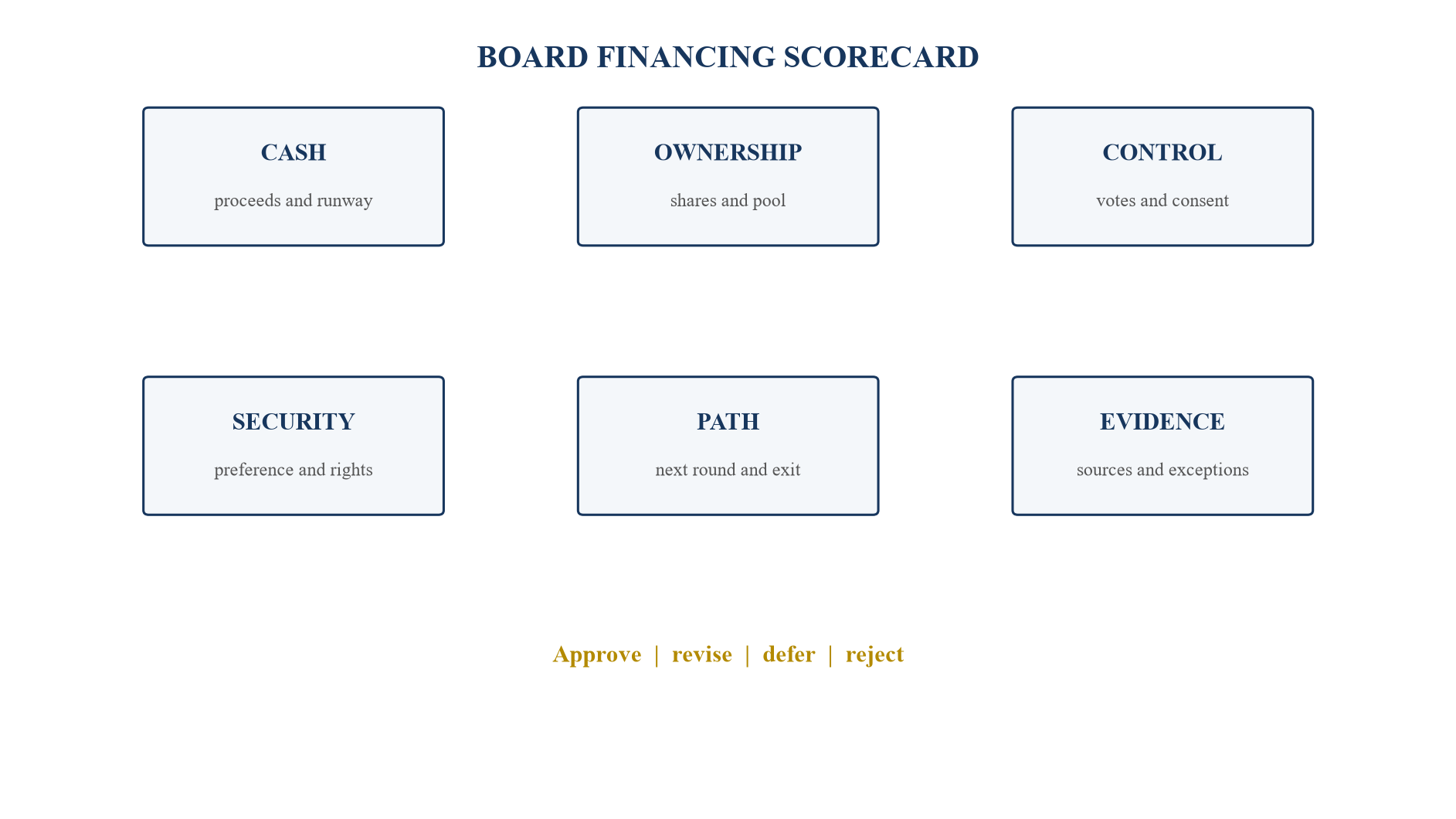
The decision integrates ownership, cash, control, security rights and the next financing path.
37. Prepare the financing data room
The data room should include constitutional documents, registers, approvals, all securities and amendments, employee-plan records, historical cap tables, tax and accounting advice, valuations, investor-rights records and the proposed transaction documents.
The index should link each model input to its source. Missing records, uncertain interpretations and pending approvals should be listed with owner, consequence and target date. A clean folder structure cannot substitute for substantive reconciliation.
The data room should support several review lenses without duplicating truth. Legal reviewers need executed documents and approvals; accountants need classification and ledger reconciliation; tax advisers need award and holder facts; investors need a controlled cap table and waterfall. A common index can route each reviewer to the approved source while protecting privilege and personal data. Superseded cap tables should be retained as history and marked clearly. Before launch, the company should test that every summary number can be traced to a source or deterministic calculation and that every material exception appears in the diligence issues list.
38. Monitor after closing
After closing, the company should update the legal records, option system, accounting ledger, investor reporting and future-round model. New grants, transfers, exercises, cancellations, warrants and bridge instruments should enter through controlled workflows.
The board should receive periodic ownership and pool reporting tied to the hiring plan and runway. Material departures from the financing case should trigger updated scenarios before another instrument is issued.
Post-closing monitoring should include covenant and rights calendars. Pro rata notices, information delivery, board appointments, option-plan approvals and filing deadlines can affect later transactions. The company should compare actual hiring, grant use, burn and milestone progress with the case approved at financing. If another bridge becomes probable, management should update cumulative dilution and maturity exposure before approaching investors. This creates time to reconcile records and evaluate alternatives while the company still has negotiating capacity.
39. Run the ninety-day cap-table readiness sprint
During days one to thirty, reconstruct sources, legal capital, instruments, awards and exceptions. During days thirty-one to sixty, validate formulas, conversion paths, option needs, future rounds, accounting and approvals. During days sixty-one to ninety, complete the board model, data room and transaction process.
Physical legal, tax, valuation and investor work retain their real timelines. The sprint creates a controlled decision system and a prioritised exception list. It should not manufacture certainty where documents or approvals are missing.
Table 5. Ninety-day cap-table readiness outputs
| Period | Core work | Board output |
|---|---|---|
| days 1 to 30 | source ledger and legal-capital reconciliation | approved baseline and exception list |
| days 31 to 60 | conversion, pool, valuation and scenario model | validated financing alternatives |
| days 61 to 90 | approvals, data room and investor process | launch, revise or defer decision |
| ongoing | controlled updates and future-round monitoring | current ownership and runway view |
Owners and dates should be tailored to the company and contemplated transaction.
40. Conclusion
Cap-table intelligence should connect executed instruments, legal capital, deterministic conversion, ownership, control, security rights and future financing. The headline valuation is one input within that system. SAFEs, notes, options, warrants and priced shares require their own terms and a reconciled transaction denominator.
AI can accelerate extraction, exception detection and scenario communication when every material input cites a source and authoritative calculations remain deterministic. The board needs an auditable bridge from current records to closing and follow-on outcomes.
The final decision remains company-specific. It requires approved documents, accurate records, realistic runway, tested alternatives and qualified legal, accounting, tax, valuation and investment advice.
Every approved output should carry its source date, model version and accountable reviewer.
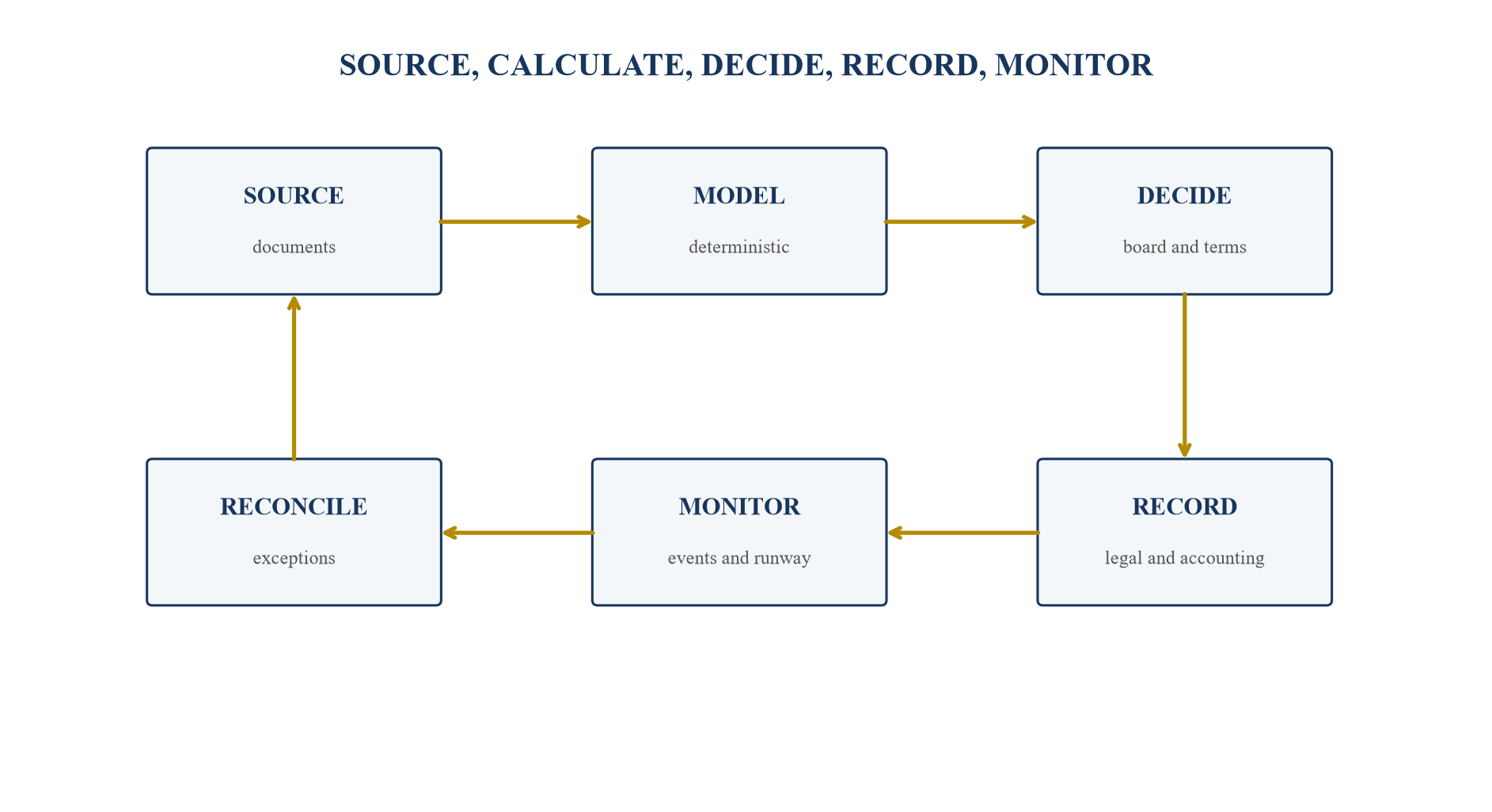
The process returns exceptions and new events to source review before the approved ownership view changes.
References
- U.S. Securities and Exchange Commission, Common Startup Securities, https://www.sec.gov/resources-small-businesses/capital-raising-building-blocks/common-startup-securities
- Y Combinator, The SAFE open standard for startup fundraising, https://www.ycombinator.com/safe
- Y Combinator, Primer for Post-Money SAFE v1.1, https://www.ycombinator.com/assets/ycdc/Primer%20for%20post-money%20safe%20v1.1-2af8129e12effd9638eeab383b7309142c8f415e5cdb0bc210d573f779177a1c.pdf
- National Venture Capital Association, Model Legal Documents, https://nvca.org/model-legal-documents/
- Companies House, Life of a company: event-driven filings, https://www.gov.uk/government/publications/life-of-a-company-event-driven-filings/life-of-a-company-part-2-event-driven-filings
- Companies House, Return of allotment of shares SH01, https://www.gov.uk/government/publications/return-of-allotment-of-shares-sh01
- Abu Dhabi Global Market, Companies Regulations: allotment and pre-emption, https://assets.adgm.com/download/assets/ADGM1547_20963_VER072020.pdf/fb4a15ce5d4111efaccc3653e4bba5a5
- IFRS Foundation, IFRS 13 Fair Value Measurement, https://www.ifrs.org/issued-standards/list-of-standards/ifrs-13-fair-value-measurement/
- International Valuation Standards Council, International Valuation Standards, https://www.ivsc.org/standards/
- IFRS Foundation, IAS 32 Financial Instruments Presentation, https://www.ifrs.org/issued-standards/list-of-standards/ias-32-financial-instruments-presentation/
- IFRS Foundation, IFRS 9 Financial Instruments, https://www.ifrs.org/issued-standards/list-of-standards/ifrs-9-financial-instruments/
- IFRS Foundation, IFRS 7 Financial Instruments Disclosures, https://www.ifrs.org/issued-standards/list-of-standards/ifrs-7-financial-instruments-disclosures/
- U.S. Internal Revenue Service, Internal Revenue Code section 409A and deferred compensation guidance, https://www.irs.gov/retirement-plans/nonqualified-deferred-compensation-plans
- HM Revenue and Customs, Tax-advantaged venture capital schemes and employee share schemes, https://www.gov.uk/topic/business-tax/investment-schemes
- Companies House, Forms to update shares, https://www.gov.uk/government/collections/forms-to-update-shares
- HM Revenue and Customs, Meaning of ordinary share capital and shares, https://www.gov.uk/hmrc-internal-manuals/company-taxation-manual/ctm00513
- U.S. Securities and Exchange Commission, EDGAR company filings database, https://www.sec.gov/edgar/search/
- Financial Accounting Standards Board, Accounting Standards Codification, https://asc.fasb.org/
- International Organization for Standardization, ISO 31000 risk management, https://www.iso.org/iso-31000-risk-management.html
- National Institute of Standards and Technology, AI Risk Management Framework, https://www.nist.gov/itl/ai-risk-management-framework
- Organisation for Economic Co-operation and Development, OECD AI Principles, https://oecd.ai/en/ai-principles
- European Union, Artificial Intelligence Act, https://eur-lex.europa.eu/eli/reg/2024/1689/oj
- UK Information Commissioner's Office, Artificial intelligence and data protection, https://ico.org.uk/for-organisations/uk-gdpr-guidance-and-resources/artificial-intelligence/
- U.S. Securities and Exchange Commission, Private placements and exempt offerings, https://www.sec.gov/resources-small-businesses/exempt-offerings
- U.S. Securities and Exchange Commission, Regulation Crowdfunding dilution disclosures in filed offering materials, https://www.sec.gov/edgar/search/
- Bank for International Settlements, Innovation and financial technology publications, https://www.bis.org/topic/fintech.htm
