

1. Define the financing decision
The plan should begin with the financing objective, instrument, proceeds, runway, decision date and strategic purpose. A primary equity round, convertible instrument, structured equity transaction, venture debt facility or secondary sale creates different evidence requirements and allocations of risk. Management should specify whether the decision concerns enterprise value, equity value, a security price, funding certainty or a combination.
The current cap table, cash, debt, preferences, options, warrants, convertibles and expected pool expansion should be reconciled before discussing valuation. The economic value of common shares can differ from a headline post-money amount when seniority, liquidation preference, participation, anti-dilution or milestone rights apply. The plan should therefore show proceeds, ownership and downside allocation under the actual proposed structure.
The financing question also establishes the evidence date. A claim supported after term-sheet negotiation may have less influence than the same evidence available before investor screening. The work programme should run backwards from the intended launch and preserve enough time for observation, correction and independent review.
2. Translate valuation into testable drivers
Valuation techniques convert expectations about cash flow, growth, risk and market evidence into a range. An uplift plan should identify which operating facts can change those expectations and which remain outside management control. Product quality, successful workflow adoption, retention, contract durability, price, direct cost, concentration, rights and capital efficiency can be measured. Public-market multiples and financing conditions can move independently.
The driver tree should connect each proposed milestone to a financial path. Better task success may improve retention and reduce support. Clear data rights may shorten enterprise diligence. Lower model consumption may improve contribution margin and runway. A signed multi-year contract may improve revenue visibility while creating delivery obligations. Every claimed uplift should identify both benefit and cost.
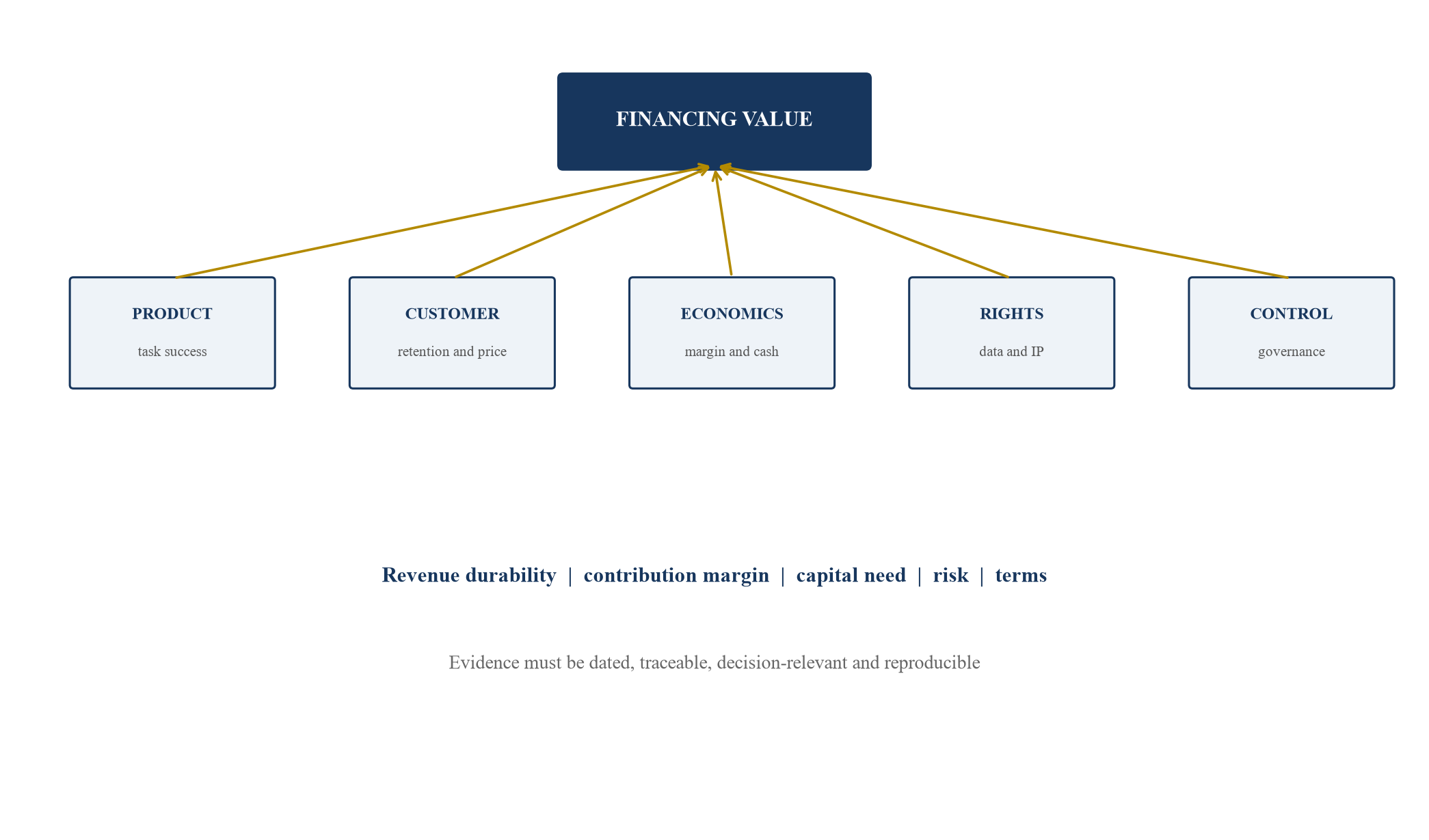
Operating milestones influence value through revenue durability, margin, capital need, risk and financing terms.
Table 1. Valuation-driver evidence map
| Driver | Evidence | Financial path | Principal limitation |
|---|---|---|---|
| task success | evaluated completed workflows | retention, price and support | incomplete or biased evaluation |
| customer retention | contract and cohort outcomes | recurring revenue and cash | immature cohorts |
| contribution margin | revenue-to-direct-cost bridge | cash flow and capital need | omitted labour or credits |
| data and IP rights | executed agreements and provenance | market access and defensibility | jurisdiction and contract scope |
| governance | inventory, controls and monitoring | diligence, incident and adoption risk | documents without operation |
| financing structure | cap table and term waterfall | current shareholder value | future negotiation and market change |
The transaction team should document the mechanism, evidence and remaining uncertainty for each driver.
3. Establish the valuation baseline
Management should record a baseline before selecting improvement initiatives. The baseline includes the measurement date, current recurring and non-recurring revenue, customer cohorts, direct cost, operating expense, cash, commitments, capital structure, forecast and recent financing evidence. Definitions should reconcile to contracts, product data and accounting records.
The baseline is a decision model rather than a public valuation claim. It should triangulate appropriate market and income evidence, document rights and obligations, and state the range of outcomes. IFRS 13 materials on unquoted equity illustrate that multiple valuation techniques and judgement may be relevant. Transaction-specific professional advice may be required.
A baseline prevents management from attributing a later market movement to internal execution. It also reveals where evidence is too weak for a reliable estimate. The plan can then prioritise information whose improvement is both feasible and material.
4. Create an evidence backlog
The evidence backlog converts investor questions into bounded work. Each item should identify the assertion, current evidence, source system, gap, owner, action, cost, completion date, observation period, acceptance threshold and decision use. A document marked complete without tested substance should remain open.
Backlog items should be grouped by product, customer, commercial, financial, technical, rights, governance and transaction workstreams. Dependencies should be visible. A retention claim may require stable cohort definitions, contract reconciliation and sufficient elapsed time. A margin claim may require workload instrumentation, invoice allocation and labour costing.
Priority should reflect value at risk, investor relevance, time to evidence and management capacity. The plan should avoid attempting every possible improvement before launch. A smaller set of credible, decision-relevant milestones can carry greater weight than a broad presentation of unaudited activity.
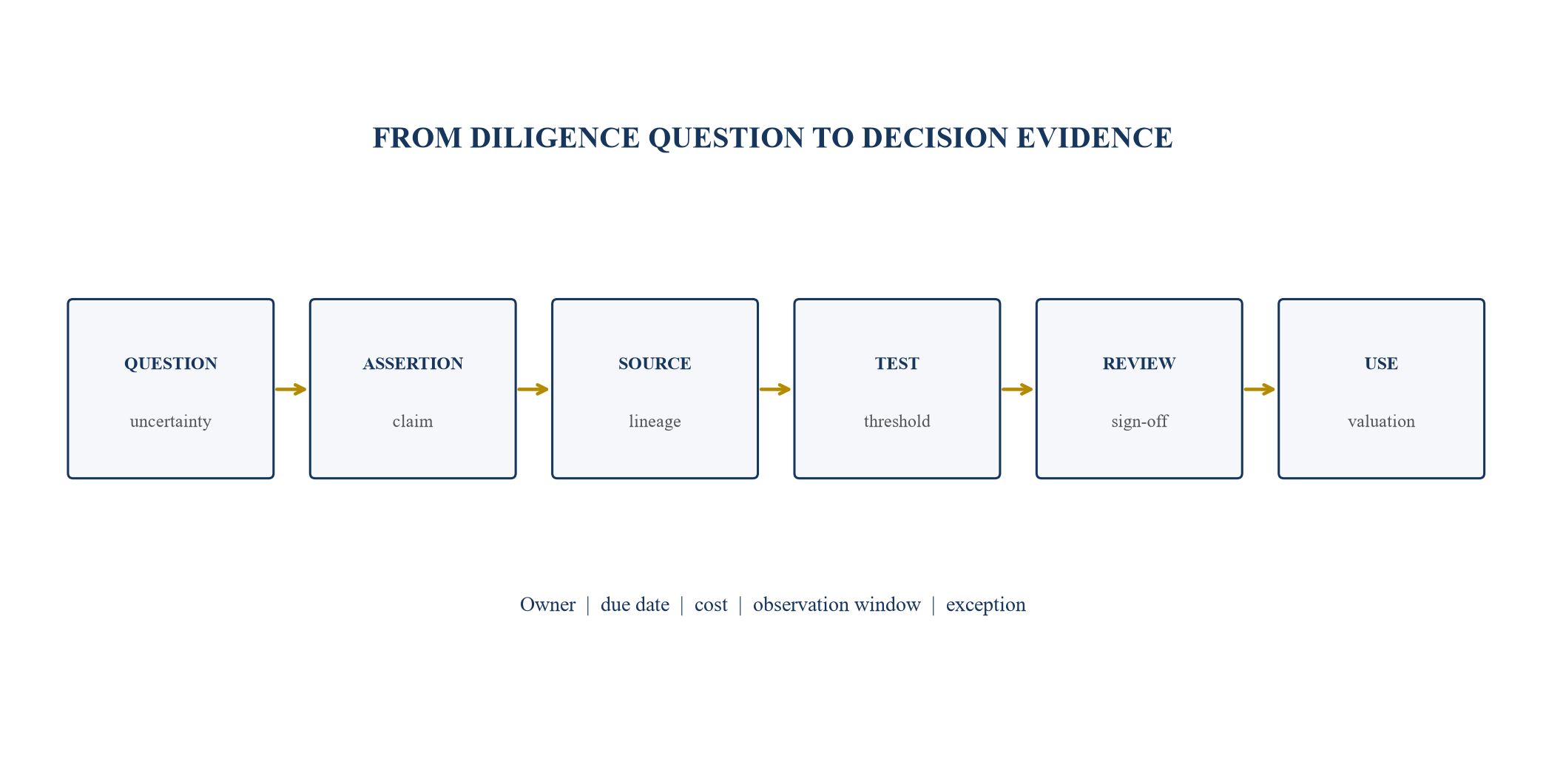
Evidence moves from an investor question through controlled production, review and financing use.
Table 2. Evidence-backlog fields
| Field | Question | Control |
|---|---|---|
| assertion | what is management asking an investor to accept? | use one defined claim |
| source | where does the evidence originate? | preserve lineage and version |
| threshold | what result changes the decision? | approve before observation |
| owner | who produces and signs off? | separate preparation and review where material |
| timing | when can the result be observed? | account for cohort maturity |
| exception | what remains unresolved? | retain in diligence record |
Completion requires tested evidence and sign-off, not a document title alone.
5. Rank milestones by risk retirement
Risk retirement means producing evidence that reduces uncertainty about a material financing assumption. It does not mean removing every business risk. The team should identify the investor decision that could change, the probability or financial input affected, and the strength of the proposed evidence.
High-priority milestones often address customer renewal, successful use, direct cost after credits, concentration, data rights, model dependency, security, runway and cap-table clarity. Their order depends on the company. A regulated enterprise product may prioritise governance and deployment controls; a developer tool may prioritise consumption economics and retained paid use.
The committee should challenge double counting. A verified renewal may affect the revenue forecast and comparable multiple. Applying a separate arbitrary risk premium for the same uncertainty can count the benefit twice. The model should show where each milestone enters.
The ranking process should also recognise reversibility. Instrumentation can often be repaired with limited strategic commitment, while a long-term capacity agreement or market expansion can create fixed obligations. Management should compare evidence value with cash cost, execution distraction and downside if the initiative fails. A milestone earns priority when it addresses a material decision, can be completed before the financing gate, has an accountable owner and produces evidence whose result can be interpreted whether favourable or adverse.
6. Define product-value evidence
Product evidence should connect intended use to an outcome. Registered users, prompts, tokens and demonstrations can provide context while leaving commercial value unresolved. The company should define activation, meaningful use, task attempt, successful outcome, correction, escalation, recurring workflow and customer acceptance.
Test, evaluation, verification and validation should fit the use case. NIST's AI RMF organises voluntary risk-management outcomes around govern, map, measure and manage. Its measurement function emphasises appropriate methods, uncertainty, benchmarking and documentation. The company can use these principles to structure evidence while preserving the requirements of its sector and transaction.
The milestone should include a baseline, target, sample, evaluation method, observation window and failure treatment. A rising task-success rate can support value when it remains reliable across relevant customers and lowers correction, support or churn. A benchmark improvement without production adoption requires a different evidential weight.
7. Prove repeatable customer outcomes
Customer evidence should move from design-partner enthusiasm to repeatable paid outcomes. The transaction team should reconcile contracts, users, workflows, invoices, cash, support and renewals by cohort. Testimonials and pipeline can support commercial context; executed and observed outcomes provide stronger evidence for a reference case.
The company should distinguish pilot conversion, initial production, renewal, expansion, contraction and churn. Contract duration should be separated from enforceable minimum commitment. Discount, implementation work, credits, termination and acceptance conditions should remain visible. A large nominal contract with contingent usage can carry less forecast certainty than a smaller collected commitment.
The milestone may be a minimum number of matured paid cohorts, a renewal threshold, expansion at positive recurring contribution or a reduction in deployment time. Thresholds should reflect the actual sales cycle and avoid moving weak accounts after performance is known.
Customer references require governance. The company should obtain permission, agree the facts that may be shared and distinguish a reference from a contractual commitment. Diligence should test whether the buyer, user and budget owner agree on value. Usage concentrated in one champion can disappear after personnel change. Evidence of embedded workflow, multiple trained users, approved budget and executive sponsorship can provide a more complete account of durability than satisfaction alone.
8. Build data and intellectual-property evidence
The data-rights pack should identify provenance, ownership, licences, consent, permitted use, retention, localisation, confidentiality, customer restrictions, generated outputs and improvement rights. It should connect legal documents to technical flows. Qualified advisers should assess the actual legal and regulatory position.
The company should distinguish owned assets from defensibility. Application code, model tuning, evaluation, workflow integration, distribution, permitted data and operating learning can each contribute. The plan should test whether these assets affect win rate, price, task success, switching cost, margin or market access.
A priority milestone might close missing assignments, document training-data provenance, implement customer-level controls or demonstrate a portable model architecture. The claimed value path should be explicit. A clean rights position can reduce diligence delay and downside exposure; commercial differentiation still requires evidence.
The rights review should extend through suppliers and contractors. Model-provider terms, open-source licences, consultant agreements, university relationships, acquisition documents and former-employer restrictions can affect ownership or permitted use. Technical architecture should identify where data is stored, transformed, logged and used for improvement. Contractual language and system behaviour should agree. Any gap should have a remediation plan, cost, owner and disclosure decision.
9. Operationalise AI governance
Governance evidence should demonstrate operation. Policies without an AI inventory, decision rights, testing records, monitoring, incident handling and supplier controls provide limited comfort. The governance perimeter should reflect product use, customer consequence, applicable requirements and risk tolerance.
The NIST AI RMF describes govern as a cross-cutting function and identifies documented roles, policies, inventory and ongoing review. The plan can map these outcomes to owners and artefacts. For a fundraise, the evidence pack should show which controls operate, how exceptions are escalated and what independent review has occurred.
Governance investment should remain proportionate. The objective is credible risk management and enterprise readiness. The model should include the cost and delivery effect of controls, regional deployments, human oversight, audits and insurance where material.
Control effectiveness needs evidence across time. A model-release approval can be inspected through change records, test results and exceptions. Monitoring can be tested by tracing an alert through triage and remediation. Incident preparedness can be exercised using a realistic scenario. Supplier governance can be shown through due diligence, contractual controls and ongoing review. These records allow an investor to distinguish embedded operating capability from a newly written policy.
10. Reconcile unit economics
Unit economics should follow the way the product creates and bills value. Revenue may be based on seats, usage, capacity, tasks, outcomes or enterprise commitments. Direct cost can include models, compute, storage, retrieval, data, tooling, observability, human review, implementation, support, service credits and reserved capacity.
The company should reconcile product events to billing and collected cash, then allocate cost by customer, product, workload and cohort. Promotional credits and founder labour should be shown separately so sustainable economics remain visible. Gross margin, recurring contribution margin and operating margin require distinct definitions.
Milestones can target cost per successful outcome, margin after credits, support hours per production account, model-routing efficiency, implementation payback or renewal at positive contribution. The target should include quality and reliability constraints; cost reduction that worsens outcomes may weaken value.
Working capital and fixed commitments belong in the economic view. Annual prepayments can improve cash before revenue is recognised. Enterprise payment terms can create receivables and collection exposure. Reserved compute can lower unit price while creating underutilisation risk. Data licences, minimum platform fees and customer service levels may remain payable during slower growth. The financing model should reconcile contribution economics with monthly liquidity and contractual obligations.
11. Test concentration and dependency
Concentration should be measured across customer, sector, geography, channel, model provider, cloud provider, data source, integration and personnel. A diversified user count can coexist with one material contract or technical dependency. The plan should show absolute exposure, trend and contingency.
Dependency evidence includes contract term, price basis, capacity, service levels, switching effort, portability, security, termination and geographic availability. Technical tests should use representative workloads. A migration plan should include engineering, customer validation, data movement, consent and timing.
A milestone might reduce the largest-customer share through high-quality revenue, qualify an alternative provider, renegotiate capacity or remove a key-person bottleneck. The financing model should translate the outcome into forecast probability, cost, capital need or risk rather than apply a generic premium.
12. Construct the milestone map
The milestone map places evidence in sequence. Definitions and instrumentation precede measurement. Measurement precedes observation. Observation precedes a claim. Rights review can precede commercial expansion. Product and governance remediation may need to occur before an enterprise cohort can mature.
Each milestone should have entry criteria, deliverable, threshold, owner, reviewer, decision date and consequence. Dependencies and critical path should be explicit. Management should reserve contingency for delayed contracts, incomplete data, technical failure and external review.
The map should distinguish operating milestones from transaction preparation. A company can improve product evidence while building the data room, forecast, cap table and investor materials in parallel. External launch should occur only when the reference case is supportable and known gaps can be disclosed coherently.
13. Build backwards from the fundraise date
The fundraise calendar should begin with the intended cash receipt date and work backwards through documentation, confirmatory diligence, investment committee, management meetings, data-room access, initial screening and investor preparation. Each stage requires time for questions, internal approvals, legal work and negotiation. Runway should include delay beyond the reference timetable.
Evidence maturity determines when preparation must begin. A twelve-month renewal cannot be created in six weeks. A task-success cohort may require instrumentation, a stable product version and several observation periods. A cost-reduction initiative may require provider negotiation, engineering, production testing and customer acceptance. The critical path should reflect these realities.
Management should define launch gates. These can include a minimum cash runway, reconciled cap table, approved forecast, completed rights review, matured customer evidence, sustainable contribution-margin view and a controlled data room. Exceptions should be approved explicitly with their likely effect on price, structure or execution certainty.
The calendar should include investor decision cycles. Funds may require partner meetings, external references, legal review, reserves analysis and portfolio-construction approval. Strategic investors can require business-unit sponsorship and competition review. Family offices may have different governance and timing. The company should validate the actual process for each priority investor and maintain enough coverage to avoid dependence on a single path. Process assumptions should remain separate from signed commitment.
14. Match evidence to the investor process
Investor screening often begins with a concise narrative, market proposition, team, traction, use of proceeds and financing request. Diligence then moves into customer, product, technology, data, governance, finance, legal and cap-table evidence. The plan should sequence disclosure so each claim can be supported when requested.
The company should avoid giving different definitions to different investors. Annual recurring revenue, active customer, successful task, retention, pipeline and gross margin should have controlled definitions. Investor questions, answers and supporting files should be logged. Material corrections should be communicated consistently.
An evidence item can have several disclosure levels. Aggregated customer cohorts may support early discussion. Named contracts and product logs may require confidentiality and controlled access. Source code, security findings and personal data may require specialist review or secure inspection. The process should balance diligence with legal obligations and commercial sensitivity.
The company should decide which information can be shared before a confidentiality agreement, after agreement and only through controlled specialist review. Customer names, source code, security tests, personal data, pricing and model-provider arrangements may require different treatment. A disclosure matrix can identify the document, recipient class, approval authority and record of access. This protects both process speed and the company's obligations.
15. Design the risk-retirement curve
The risk-retirement curve estimates how decision uncertainty changes as evidence accumulates. Early product demonstrations may establish feasibility. Paid pilots may establish willingness to engage. Production use, renewal, expansion and positive contribution provide progressively stronger commercial evidence. Governance operation and rights clarity can reduce specific downside uncertainty.
The curve should not assume that every milestone adds equal value. Evidence can be duplicative, weak or contradicted. A signed contract may add little if termination is immediate and usage is absent. A technical benchmark may carry limited weight if production quality differs. The transaction team should assign weight based on relevance, reliability, recency and independence.
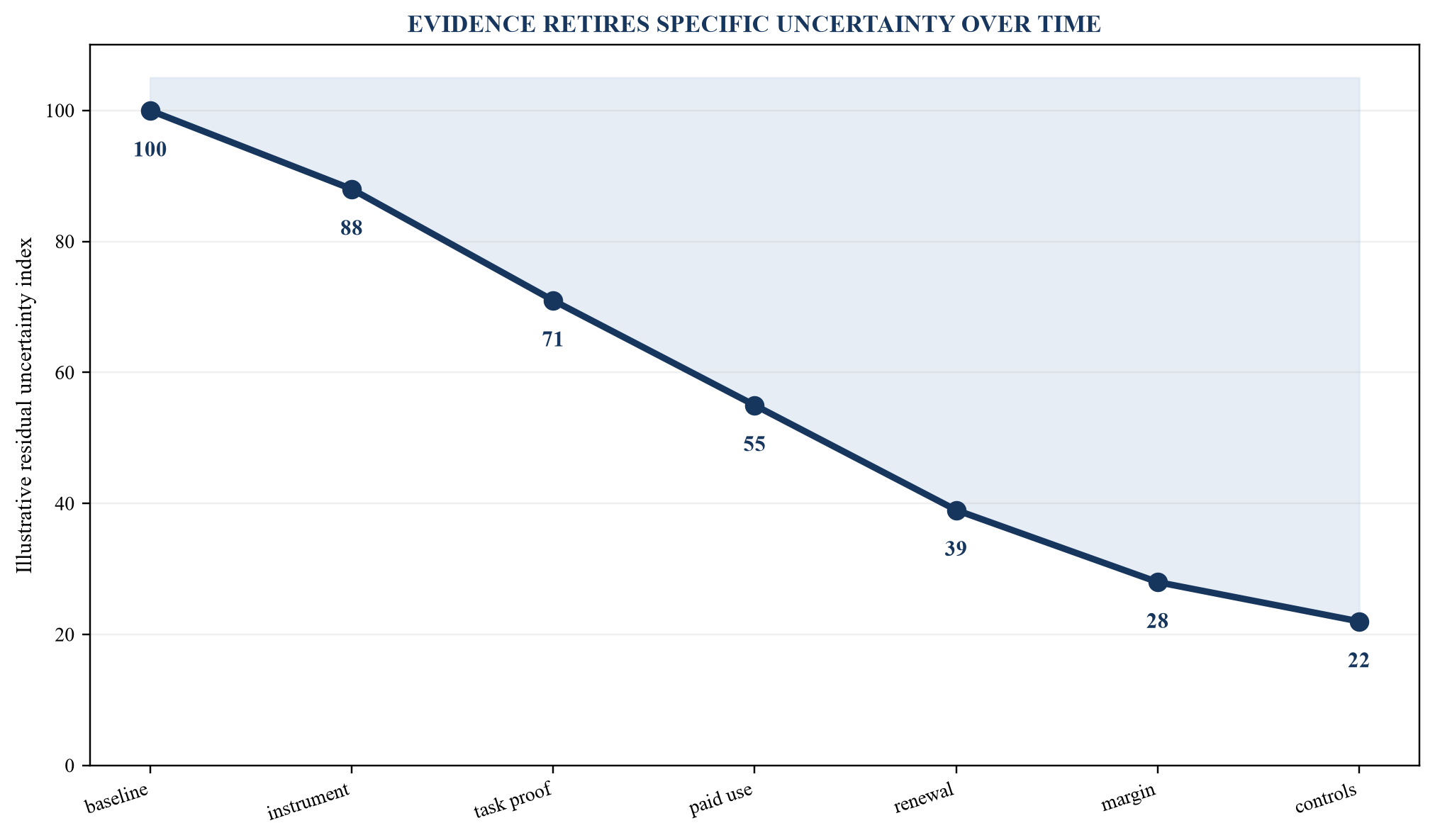
The curve shows a hypothetical sequence; actual financing effects depend on company evidence and market conditions.
Table 3. Risk-retirement milestone tests
| Milestone | Entry condition | Acceptance evidence | Financing question |
|---|---|---|---|
| instrumentation | approved definitions | reconciled event lineage | can operating claims be reproduced? |
| task proof | representative production sample | quality, latency and exceptions | does the product deliver its intended outcome? |
| paid use | executed contract and billing | usage, invoice and collection | will customers pay for the outcome? |
| renewal | matured paid cohort | renewal, contraction and expansion | is revenue durable? |
| margin | full direct-cost allocation | recurring contribution by cohort | can delivery scale economically? |
| controls | risk-based operating system | inventory, tests, monitoring and incidents | can the company manage adoption risk? |
A milestone changes financing readiness only when its evidence is relevant and reproducible.
16. Convert milestones into forecast assumptions
Every valuation milestone should map to a forecast assumption or financing term. Product evidence can influence conversion, retention, price, support and sales cycle. Customer evidence can influence recurring revenue and collection. Unit economics can influence margin, cash burn and capital need. Governance and rights can influence adoption timing, downside cases and diligence certainty.
The model should distinguish observed, contracted and assumed periods. A completed milestone can narrow an assumption range without eliminating uncertainty. One renewal cohort may justify less confidence than four matured cohorts. A verified cost reduction may apply only to one workload. The forecast should preserve scope and maturity.
Change control is essential. The prior forecast, new evidence, revised assumption and valuation effect should be recorded. Management should explain adverse evidence with the same discipline as favourable evidence. This creates a credible bridge rather than a promotional uplift schedule.
Back-testing should compare each forecast vintage with actual performance by driver and cohort. Variance can arise from volume, price, mix, retention, sales timing, consumption, support or definition change. Repeated optimism in one driver should reduce its weight until evidence improves. The board gains information about management's forecasting process as well as the company. This record can support a more credible range and a better-designed use of proceeds.
17. Define customer-cohort milestones
Cohorts can be based on contract start, production deployment, first successful workflow or another economically meaningful event. Calendar cohorts reveal change over time; behavioural cohorts reveal differences in product path. The company should retain account-level and user-level views when both matter.
Milestones should address activation, task success, repeat use, paid conversion, renewal, expansion, contraction, churn and price realisation. Observation windows should match the customer job and contract. A monthly inactivity measure may misclassify a quarterly diligence workflow. The data should show median, distribution and concentration rather than one average.
The financing case should identify the minimum matured cohort evidence required before launch. Recent customers can support pipeline and activation assumptions while remaining too young for renewal conclusions. Cohort maturity should be disclosed clearly.
18. Define product-performance milestones
Product-performance milestones should test the intended workflow under representative conditions. Measures can include completion, accuracy, latency, availability, correction, escalation, harmful failure, human review and economic outcome. The test design, benchmark, sample and limitations should be documented.
The company should preserve failed attempts and outliers. Removing them after observation can overstate quality. Product changes should be versioned because model, prompt, data or orchestration changes can break comparability. Independent review may be useful for material or contested claims.
The milestone should connect performance to customer behaviour or cost. A lower hallucination rate can reduce review cost and improve acceptance. Faster latency can enable a new workflow. Higher benchmark accuracy without customer adoption may remain a technical achievement rather than a financing driver.
19. Define commercial milestones
Commercial milestones should cover market segment, buyer, use case, channel, sales cycle, price, contract, implementation, collection and expansion. Pipeline stages require objective entry and exit criteria. Management should separate signed, conditional, verbal and forecast opportunities.
Price realisation should reconcile list price, contract price, discount, credit, implementation fee, usage allowance, overage, refund and collection. A price increase can support value when win rate, adoption and retention remain acceptable. An enterprise contract may improve visibility while adding service, security and capacity obligations.
The plan should identify evidence that can be observed before launch. Examples include converted pilots, reduced deployment time, signed production minimums, referenceable customers or a repeatable partner channel. Each milestone should show its effect on revenue timing and delivery cost.
20. Define economic milestones
Economic milestones should begin with a reconciled revenue-to-cash and cost-to-delivery model. Revenue quality, direct model cost, data, infrastructure, review, support, service credits, implementation and reserved capacity should be visible. Founder and specialist labour should be measured economically.
Contribution margin should be reported by customer, product, workload and cohort where material. Aggregate margin can hide a loss-making large account or one unusually profitable contract. The model should show margin at acquisition, activation, production, renewal and expansion.
Milestones can include sustainable margin after credits, model cost per successful task, support hours per account, implementation payback, cash collection or reduced capacity mismatch. The company should protect task quality, reliability and customer outcomes while improving cost.
Economics should be segmented where delivery models differ. A self-service developer cohort may have low sales cost and variable infrastructure use. A regulated enterprise cohort may carry implementation, review, security and support obligations. Combining the two can produce a margin that describes neither. Segment forecasts should reconcile to the consolidated plan and show which mix assumptions drive operating leverage.
21. Define governance milestones
Governance milestones should reflect the AI inventory, intended uses, risk classification, decision rights, data controls, testing, monitoring, change management, incident response, third-party management and human oversight. Evidence should include operation and exceptions, not only policy text.
The company should identify material laws, contracts, sector requirements and standards with qualified advice. NIST AI RMF is voluntary and use-case agnostic; it can provide an organising structure. ISO/IEC 42001 may provide relevant management-system context. Neither replaces transaction-specific legal, technical or regulatory assessment.
A governance milestone may be an approved inventory, documented risk acceptance, production evaluation, supplier review, incident exercise or controlled model release. The financing relevance can include enterprise adoption, diligence readiness, customer trust, operating cost and downside containment.
22. Define data-room readiness
The data room should be indexed around the investor's decision. Core areas include corporate records, cap table, financing instruments, financial statements, forecast, tax, customer contracts, revenue bridge, product evidence, technology architecture, security, data rights, intellectual property, governance, personnel and material disputes.
Every file should have an owner, date, version and disclosure level. The team should identify inconsistencies before external access. A metric in the presentation should reconcile to the model and source evidence. Superseded documents should be archived outside the active room.
Access should follow least privilege, confidentiality, permitted use, watermarking where appropriate and a disclosure log. Personal data, source code and security findings may need specialised handling. The company should obtain advice for its actual obligations.
Data-room quality includes responsiveness. Questions should be assigned, answered from approved sources and reviewed before transmission. New files should have version control and an audit trail. The team should track unanswered questions, contradictory answers and missing evidence. A mock diligence exercise can reveal whether management can locate, explain and reconcile material information under realistic time pressure.
23. Prepare the management evidence narrative
The narrative should explain what the company does, for whom, why the outcome matters, how product evidence supports adoption, how revenue becomes cash, how delivery scales and how capital creates the next evidence milestone. It should distinguish observed facts, contracted amounts and forecast assumptions.
Management should present limitations directly. Immature cohorts, concentration, credits, model dependency and unresolved rights can be incorporated into scenarios and mitigation. Clear treatment can improve process credibility even when the issue remains.
The narrative should remain consistent across the deck, model, data room and answers. Changes require a controlled source and communication plan. Investor materials should avoid selectively annualising recent growth, combining incompatible metrics or presenting hypothetical values as observed performance.
The use-of-proceeds narrative should connect cash with evidence. Hiring, compute, security, sales and geographic expansion should identify the operational capacity created, the milestone reached and the time required. A plan that assumes simultaneous expansion across product, market and geography can exceed management capacity. Sequencing should reflect dependencies, recruitment lead time, customer procurement and the possibility that early results change later allocation.
Management credibility also depends on explaining prior capital. The company should reconcile historical proceeds with product, customer, revenue and capability outcomes. Variance from the prior plan should be addressed with evidence and learning. An investor can then assess whether the new capital programme is grounded in observed execution and whether governance is capable of reallocating resources when assumptions change.
24. Build financing scenarios
At least three coherent scenarios can connect evidence with financing. A stress case can model weaker conversion, delayed renewal, higher model cost, concentration loss or financing delay. A reference case can use evidence-weighted assumptions. An execution case can include only improvements with credible owners, cost, timing and mechanism.
Each scenario should show revenue, contribution margin, operating expense, cash burn, funding date, proceeds, security terms, dilution and runway to the next milestone. Faster growth may require more capital. Better unit economics may extend runway. Stronger evidence may affect price and structure, while external market conditions remain uncertain.
Scenario triggers should be monitored before and during the process. A missed renewal, delayed enterprise deployment or margin deterioration may require a revised financing request. Governance protects credibility and liquidity.
The scenarios should also test investor terms. A lower price, larger preference, milestone tranche, expanded option pool or delayed close can affect current ownership and runway. The operating response should remain coherent. Reducing spend may extend cash and postpone the evidence required for the next round. Accepting more capital can reduce near-term risk and increase dilution. Decision makers need both company and security-level outcomes.
25. Model security-level value
Enterprise value does not determine the value of each security by itself. The cap table should include common shares, preferred classes, options, warrants, convertibles and debt. The model should reflect liquidation preferences, participation, seniority, anti-dilution, conversion, interest, maturity and proposed pool changes.
A higher headline valuation can coexist with less favourable current-shareholder economics if investors receive stronger downside rights or the company expands the option pool before financing. Tranches can reduce initial dilution and introduce milestone risk. Venture debt can extend runway and create fixed obligations, covenants and warrants.
The board should compare proceeds, ownership, control and downside across scenarios. The evidence plan can target milestones that reduce the need for structural protection, although actual terms depend on negotiation and market conditions.
26. Estimate capital need to the next proof point
The company should size financing to reach a clearly defined proof point with contingency. Uses can include product, sales, implementation, compute, data, security, governance, working capital and transaction cost. Monthly cash flow should include collection timing, committed capacity, debt service and minimum cash.
The next proof point might be two matured renewal cohorts, contribution-margin breakeven, regulated deployment, a contracted revenue threshold or a repeatable international channel. Its evidential value, timing and cost should be tested. A vague use of proceeds can weaken financing discipline.
The model should include a delayed-close case and a downside operating response. Spending reductions can protect liquidity and delay milestones. Bridge capital can create senior claims or negotiation pressure. The board should approve a plan before runway becomes critical.
27. Assign decision rights and accountability
Every workstream needs an executive owner, evidence producer, reviewer and approval authority. Product should not approve its own contested performance claim without review. Finance should reconcile operating metrics to contracts and accounts. Legal and technical specialists should assess matters within their remit.
The financing committee should approve metric definitions, forecast, valuation range, investor materials, disclosure gates, term priorities and material corrections. A decision log should show evidence considered, exceptions, owner and date.
Accountability should extend after launch. Investor questions, commitments, conflicts, data-room access and term changes require controlled routing. Named people remain responsible for external representations and final decisions.
28. Run an investor-grade evidence review
The review should test completeness, accuracy, consistency, lineage, recency and decision relevance. Sampling can trace presentation claims to product events, contracts, invoices, bank receipts and accounting records. Technical evidence can be rerun on representative workloads. Rights can be traced to executed agreements.
The team should record exceptions and their consequence. A missing document may delay diligence. A metric-definition inconsistency may require restatement. A weak cohort may affect one forecast assumption. Material issues should enter scenarios and disclosure.
The review is not an audit unless conducted under the applicable professional framework. The company should describe the actual scope. Independent work can strengthen evidence while retaining clear limitations.
The review team should test cut-off. A contract signed after the measurement date, a renewal agreed during diligence or a product result generated under a later version may remain relevant while requiring separate treatment. The evidence date should appear in the model and materials. Post-date developments can be disclosed as subsequent events or scenario information according to the transaction context and professional advice.
29. Avoid cosmetic uplift
Cosmetic uplift changes presentation without improving the evidence that supports value. Examples include renaming revenue, annualising a recent month without sensitivity, counting registered users as active, excluding direct labour, moving churned accounts, presenting pipeline as contracted or treating a policy as an operating control.
These practices can create diligence findings and reduce trust. The plan should favour reproducible definitions, reconciliations and observed outcomes. Adverse results should remain visible.
Brand, narrative and design still matter because investors need a clear decision case. Their role is to communicate evidence accurately. The committee should challenge every material claim with three questions: what does it mean, where does it come from and how does it affect the financing decision?
30. Monitor the plan through a scorecard
The scorecard should show milestone, owner, due date, status, evidence threshold, actual result, remaining uncertainty and financing effect. Status should distinguish not started, in progress, observed, reviewed, accepted and failed. Completion requires the approved evidence.
Leading indicators can include instrumentation coverage, evaluation completion, deployment time, support load and data-room readiness. Outcome indicators can include task success, paid conversion, renewal, price, contribution margin and cash. The team should avoid combining unrelated measures into an opaque score.
The board should receive trend, exceptions and decisions. A milestone that fails should trigger a forecast or process response. The scorecard should not become a substitute for the underlying evidence.
31. Connect the plan to valuation sensitivity
Sensitivity analysis should identify which milestones materially influence the range. Retention can affect lifetime revenue. Contribution margin can affect cash flow and financing need. Deployment time can affect growth and burn. Governance can affect enterprise sales and downside exposure.
Ranges should be grounded in observed dispersion, contracts, provider quotes, benchmarks and operating history where available. Sparse evidence requires wider sensitivity. Correlated downside should be tested because product failure can reduce retention, increase support and delay financing simultaneously.
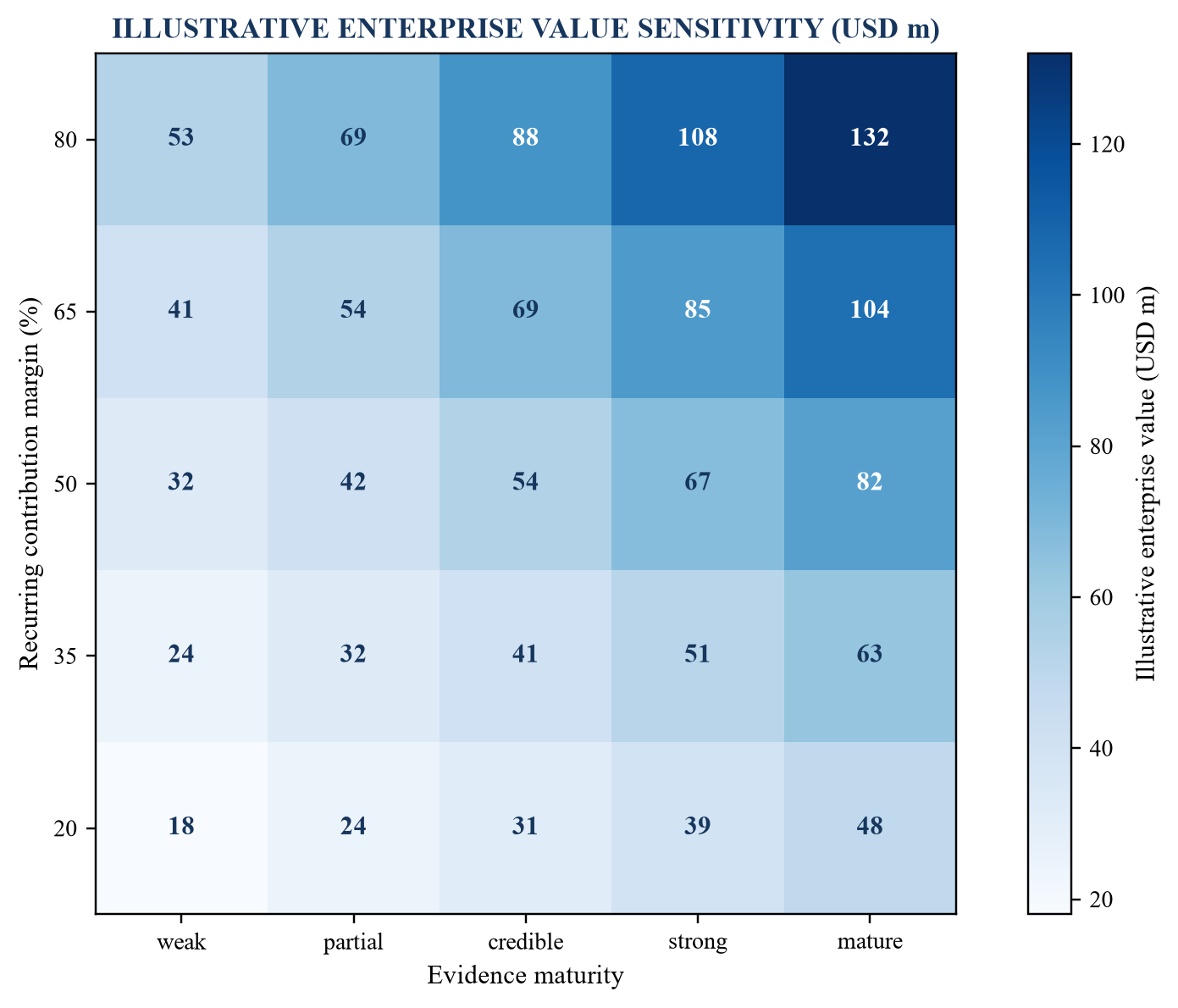
The grid is hypothetical and does not represent an observed company or financing conclusion.
Table 4. Milestone-to-sensitivity bridge
| Milestone | Reference input | Stress test | Evidence required |
|---|---|---|---|
| renewal cohort | retention and revenue | delayed or contracted renewal | contract, usage, invoice and collection |
| model optimisation | direct cost | higher consumption or price | representative production benchmark |
| data rights | addressable market and downside | restricted use or remediation | executed rights and technical lineage |
| governance operation | sales timing and risk | delayed enterprise approval | controls, monitoring and exceptions |
| financing readiness | close date and terms | delay, lower price or stronger preference | data room, model and decision log |
Management should avoid counting one improvement in several valuation inputs without reconciliation.
32. Define the hypothetical company
Consider a hypothetical enterprise AI company seeking a primary equity round in nine months. It sells workflow software to regulated and professional-services customers. It has annual recurring revenue of USD 6.0 million, ten paid production customers, four pilots, cash of USD 4.0 million and no debt. Every figure is invented for framework demonstration.
The company reports strong usage growth while its task-success definition, direct-cost allocation and data-rights file remain incomplete. Two customer cohorts will reach renewal before the intended launch. Promotional cloud credits expire in six months. The cap table includes one preferred class and an option pool.
The board wants sufficient capital to reach two years of runway and a broader enterprise customer base. The example does not estimate an actual company and does not provide investment or valuation advice.
33. Establish the hypothetical baseline
The illustrative baseline assumes 70 per cent activation, 61 per cent successful-task conversion among activated users, 82 per cent gross revenue retention and 44 per cent recurring contribution margin after economic labour. The company expects USD 2.0 million of annual cloud credits to expire. Customer and provider concentration are material.
The reference forecast assumes year-three revenue of USD 17 million and requires USD 11 million of new capital. A wide illustrative enterprise-value range reflects immature retention and margin evidence. Security allocation remains subject to proposed terms.
The evidence backlog identifies five priorities: stable task-success measurement, two paid renewals, sustainable margin after credits, documented data rights and operating AI governance. These priorities enter the plan because they influence revenue durability, cost, enterprise adoption and execution risk.
34. Sequence the hypothetical milestones
During months one and two, the company approves definitions, repairs product instrumentation, allocates direct cost and completes the rights map. During months three and four, it observes task success and support across representative production workflows, closes governance gaps and prepares renewal plans.
During months five and six, it measures renewal, expansion and margin after reduced credits. The forecast is back-tested. During months seven and eight, the company completes independent reviews, assembles the data room, approves scenarios and prepares investor materials. Launch occurs in month nine only if the reference gates pass.
The sequence preserves observation time. A missed renewal or weak sustainable margin triggers a revised case and potentially a different financing size or instrument. The company does not manufacture completion by moving the threshold.
35. Analyse hypothetical evidence outcomes
Assume task success improves from 61 to 74 per cent, correction falls, two customers renew and one expands. Sustainable recurring contribution margin reaches 57 per cent after credits, below the initial management target of 62 per cent. Data rights and governance reviews close the highest-priority gaps while retaining documented exceptions.
The evidence supports a stronger reference forecast for retention and margin. It does not support the full execution case because the cohort count remains small and concentration persists. The financing committee narrows the range and preserves downside sensitivity.
This treatment demonstrates disciplined uplift. Positive evidence changes selected inputs. Remaining uncertainty continues to affect scenarios, terms and the capital plan.
36. Compare hypothetical financing scenarios
The stress case assumes 75 per cent gross retention, 40 per cent contribution margin and a delayed close. The reference case assumes the observed renewal evidence, 55 per cent margin and measured expansion. The execution case assumes further cohorts validate 65 per cent margin and broader enterprise adoption.
Table 5. Hypothetical financing scenarios
| Metric | Stress | Reference | Execution |
|---|---|---|---|
| year-three revenue, USD m | 11 | 17 | 24 |
| recurring contribution margin | 40% | 55% | 65% |
| new capital required, USD m | 14 | 11 | 9 |
| illustrative enterprise-value range, USD m | 28-42 | 58-82 | 92-128 |
| financing response | bridge or structured round | primary equity round | equity with stronger pricing evidence |
All values are invented for framework demonstration; enterprise-value ranges precede security allocation.
The board compares ownership, runway, preference and milestone coverage under each case. Market conditions and negotiation can change every outcome. The scenario table is a decision structure rather than a promise.
37. Build the investment-committee pack
The pack should state the financing decision, current liquidity, evidence milestones, forecast, valuation methods, capital need, security waterfall, risks, terms and approvals. It should include the original evidence rather than only management summaries.
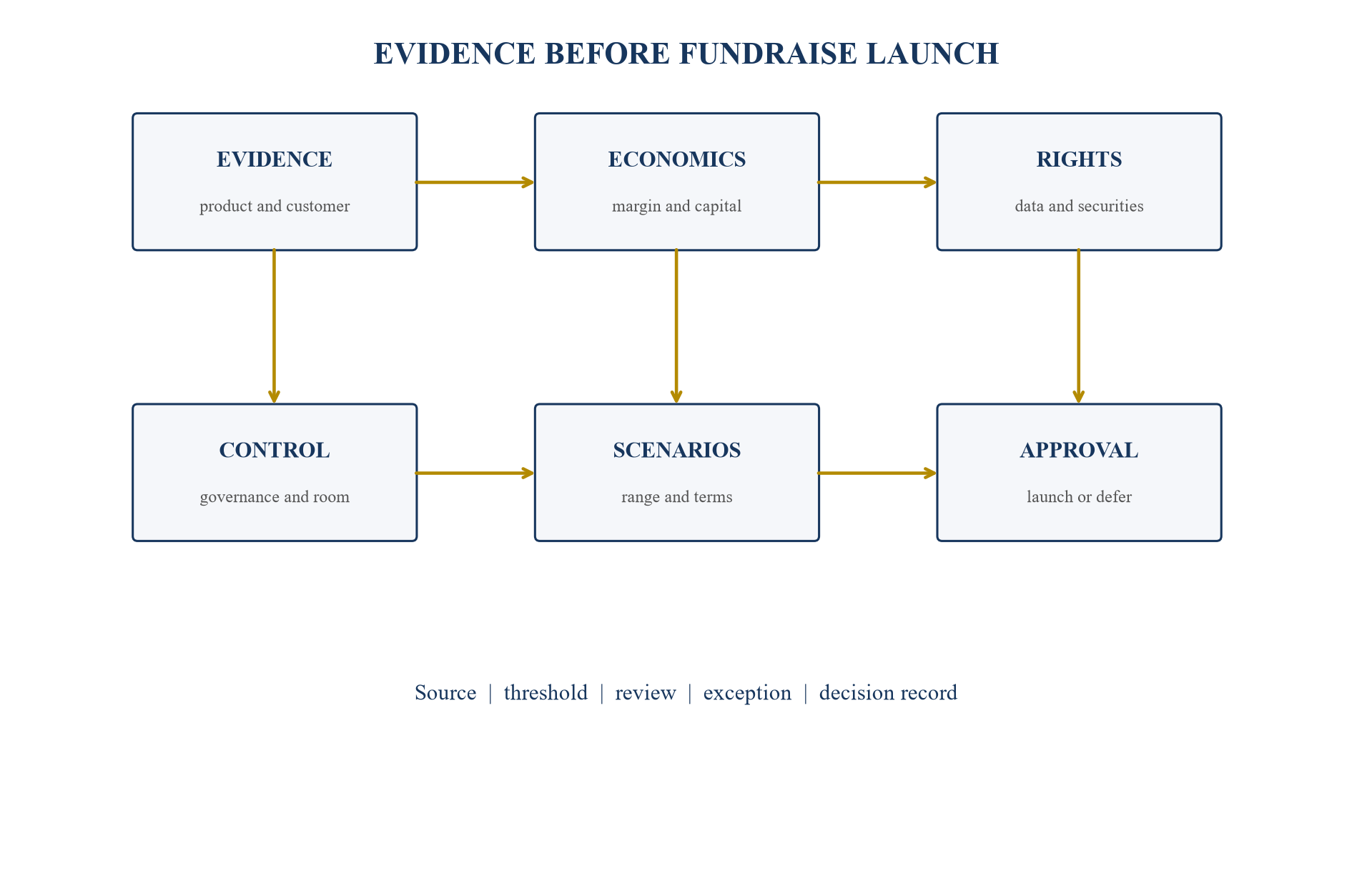
Investment readiness joins evidence, economics, rights, governance, scenarios and formal approval.
The committee should be able to reproduce the bridge from operating evidence to financing range. Dissent, limitations and conditions should be recorded. Launch approval should include authority for investor contact, disclosure and negotiation.
38. Execute the 90-day readiness sprint
During days 1 to 30, management should approve definitions, baseline the model, map rights and dependencies, prioritise the evidence backlog and establish the data-room index. Instrumentation and reconciliation gaps should be assigned.
During days 31 to 60, teams should run production evaluations, analyse cohorts, allocate direct cost, test governance controls and prepare contract and cap-table evidence. Finance should back-test forecast assumptions. Material issues should enter scenarios.
During days 61 to 90, the company should complete reviews, approve the forecast and range, test the security waterfall, prepare materials and run a mock diligence process. Milestones that require longer observation remain on the critical path beyond the sprint.
39. Maintain readiness during fundraising
Operating performance continues while fundraising is active. The company should refresh cohorts, cash, forecast and pipeline on a controlled cadence. New material events should be reflected consistently in investor communication and the data room.
The team should monitor runway, process coverage, investor feedback, diligence topics, term changes and closing dependencies. Management time should be protected so operating deterioration does not undermine the case. A single source of truth reduces inconsistent answers.
The board should have a stop, revise or proceed decision if evidence changes materially. Financing certainty, price and structure should be evaluated together. A disciplined process can preserve options under uncertainty.
Closing readiness requires equal attention. Conditions precedent, regulatory or shareholder approvals, intellectual-property assignments, employment matters, disclosure schedules, bank details and funds flow should have owners and dates. A signed term sheet does not provide cash. The liquidity model should extend through documentation and receipt. Material changes between approval and closing should return to the authorised decision makers.
After closing, commitments made during the process should move into the operating plan. Investor information rights, board reporting, covenants, milestone tranches and use-of-proceeds controls need accountable owners. The evidence architecture can continue as a performance system for the next financing or strategic transaction.
40. Conclusion
An AI valuation-uplift plan is an evidence programme tied to financing decisions. It identifies the uncertainties that affect revenue durability, margin, capital need, risk and terms, then sequences product, customer, data, governance and economic milestones before launch.
The plan requires controlled definitions, traceable sources, observation time, accountable owners, decision thresholds and coherent scenarios. It preserves adverse evidence and known limitations. Market conditions and investor judgement remain material.
The board should retain the original baseline and every approved revision. This record allows later reviewers to separate operating improvement, financing structure and external market movement. It also provides a disciplined foundation for post-closing reporting and the next capital decision, with clear evidence ownership.
For boards and founders, the practical objective is financing readiness: a reproducible operating thesis, a credible forecast, a clear capital requirement, an understood security waterfall and a data room that can withstand diligence. Evidence built early can improve both the quality of the business and the quality of the financing decision.
References
- IFRS Foundation, IFRS 13 Fair Value Measurement, https://www.ifrs.org/issued-standards/list-of-standards/ifrs-13-fair-value-measurement/
- IFRS Foundation, Educational material on measuring the fair value of unquoted equity instruments, https://www.ifrs.org/content/dam/ifrs/supporting-implementation/ifrs-13/education-ifrs-13-eng.pdf
- IFRS Foundation, IFRS 15 Revenue from Contracts with Customers, https://www.ifrs.org/issued-standards/list-of-standards/ifrs-15-revenue-from-contracts-with-customers/
- International Valuation Standards Council, International Valuation Standards, https://www.ivsc.org/standards/
- National Institute of Standards and Technology, Artificial Intelligence Risk Management Framework 1.0, https://www.nist.gov/publications/artificial-intelligence-risk-management-framework-ai-rmf-10
- National Institute of Standards and Technology, AI RMF Core, https://airc.nist.gov/airmf-resources/airmf/5-sec-core/
- National Institute of Standards and Technology, AI RMF Playbook, https://airc.nist.gov/airmf-resources/playbook/
- National Institute of Standards and Technology, Generative Artificial Intelligence Profile, https://nvlpubs.nist.gov/nistpubs/ai/NIST.AI.600-1.pdf
- National Institute of Standards and Technology, TEVV-Athlon Framework for Evaluating AI Systems, https://www.nist.gov/artificial-intelligence/ai-research/tevv-athlon-framework-evaluating-ai-systems
- U.S. Securities and Exchange Commission, Remarks at the Roundtable on Artificial Intelligence in the Financial Industry, 27 March 2025, https://www.sec.gov/newsroom/speeches-statements/crenshaw-remarks-ai-roundtable-032725
- U.S. Securities and Exchange Commission, EDGAR company filings database, https://www.sec.gov/edgar/search/
- Organisation for Economic Co-operation and Development, OECD AI Principles, https://oecd.ai/en/ai-principles
- European Commission, Regulatory framework for artificial intelligence, https://digital-strategy.ec.europa.eu/en/policies/regulatory-framework-ai
- International Organization for Standardization, ISO/IEC 42001 artificial intelligence management systems, https://www.iso.org/standard/81230.html
- Snowflake Inc., Annual reports and SEC filings, https://investors.snowflake.com/financials/sec-filings/default.aspx
- Snowflake Inc., investor relations results and materials, https://investors.snowflake.com/
- C3.ai Inc., annual reports and SEC filings, https://ir.c3.ai/financials/sec-filings/default.aspx
- C3.ai Inc., investor relations financial information, https://ir.c3.ai/
- CoreWeave Inc., annual reports and SEC filings, https://investors.coreweave.com/financials/sec-filings/
- CoreWeave Inc., investor relations financial information, https://investors.coreweave.com/
- Microsoft Corporation, annual reports, https://www.microsoft.com/en-us/Investor/annual-reports.aspx
- Microsoft Corporation, SEC filings, https://www.sec.gov/edgar/browse/?CIK=789019&owner=exclude
- NVIDIA Corporation, financial reports and SEC filings, https://investor.nvidia.com/financial-info/financial-reports-and-sec-filings/default.aspx
- Amplitude Inc., annual reports and SEC filings, https://investors.amplitude.com/financial-information/sec-filings
- Financial Accounting Standards Board, Accounting Standards Codification Topic 606, https://asc.fasb.org/topic&trid=2129938
- Bank for International Settlements, Artificial intelligence topic publications, https://www.bis.org/topic/artificial_intelligence.htm
