

1. Revenue quality is an evidence chain
AI revenue diligence begins with the economic promise. A customer may reserve compute, subscribe to software, commit to a minimum spend, pay for tokens, buy a licence, fund implementation or purchase an outcome. Each promise creates a different relationship among contract value, delivery, recognition, cash and cost.
A booking records a commercial event under a company's internal definition. It is not a standardised accounting measure. The booking can include cancellable amounts, options, estimated consumption, renewal periods, implementation, pass-through infrastructure or future capacity that remains unavailable. The diligence team should obtain the definition, policy, approval trail and source contract for every material booking.
Recognised revenue reflects the applicable accounting framework and policy. Cash can precede or follow recognition. Remaining performance obligations can include contracted consideration that is still unbilled or undelivered. Usage can be lower than reserved capacity. Compute or data obligations can arise before the related customer workload is ready.
Quality therefore means more than accounting compliance. A high-quality revenue stream has identified customers, enforceable rights, clear performance obligations, evidence of delivery, sustainable renewal behaviour, collectable invoices, manageable concentration and positive contribution after the resources required to serve it. Its definition and controls remain consistent across periods.
For a transaction, the evidence chain should support valuation, debt capacity, working capital, earnout design, representations, warranties and integration planning. Breaks in the chain become quantified diligence adjustments or closing conditions rather than narrative caveats.
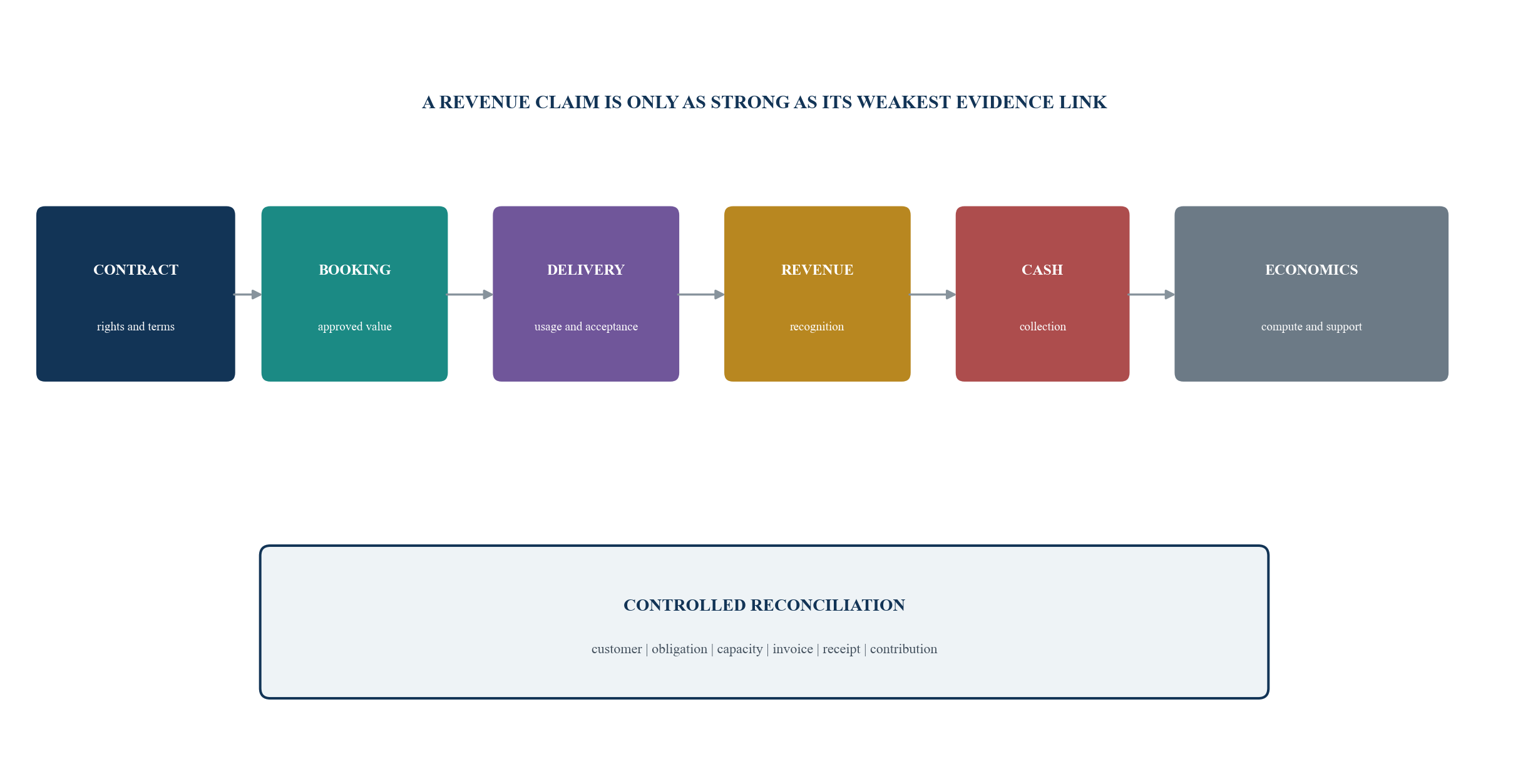
Each commercial claim should reconcile through delivery, accounting, cash and service economics.
2. Define the company, product and revenue perimeter
The perimeter identifies every entity that contracts, invoices, collects, hosts, licenses technology, employs delivery teams or incurs infrastructure costs. It maps parent, subsidiaries, variable-interest entities, resellers and related parties. Intercompany revenue and cost should be eliminated consistently.
The product map distinguishes foundation models, applications, agents, developer platforms, data products, AI cloud, specialised hardware, implementation and managed services. A single customer agreement can contain several products and performance obligations with different margins and recognition patterns.
The route to market matters. Direct enterprise contracts, hyperscaler marketplaces, resellers, system integrators, embedded distribution and government procurement create different rights, fees, credit exposure and evidence. The named end user may differ from the accounting customer and invoiced counterparty.
The diligence period should include at least monthly actuals for a sufficient historical range, the current forecast, budget and forward contract schedule. Rapidly changing companies need weekly or daily usage and capacity data. The cut-off date should be common across CRM, billing, general ledger, bank, data warehouse and cloud systems.
Currency, geography and tax treatment should be explicit. Revenue can be recorded in one entity while compute, people and cash sit elsewhere. Foreign-exchange movements, withholding, indirect tax and transfer pricing can affect reported growth and cash conversion.
The output is one controlled revenue universe. Every metric, sample and model should reconcile to that universe or show the documented reason for exclusion.
3. Build a metric dictionary before accepting the dashboard
Management dashboards often place bookings, annual recurring revenue, total contract value, backlog and remaining performance obligations on one page. Each metric needs a written definition, system source, approval, calculation, period treatment and reconciliation to accounting records.
Bookings can represent signed value, purchase orders, expected consumption or approved opportunities. Annual recurring revenue can use current monthly revenue, contracted recurring value or annualised usage. Net retention can include or exclude price, services, inactive customers, acquisitions and currency. Gross retention can be calculated on revenue, annual recurring revenue or customers.
The diligence team should reproduce each metric from transaction-level data. It should retain the original dashboard and a corrected version. Definition changes belong in a dated policy log and historical series should be restated when comparability is material.
Table 1. AI company commercial-metric dictionary
| Metric | Decision it supports | Required definition | Primary evidence |
|---|---|---|---|
| bookings | sales momentum and pipeline conversion | signed, approved and included contract value | executed agreement and approval record |
| total contract value | maximum contracted economics | fixed, variable, optional and cancellable components | contract, order forms and amendments |
| remaining performance obligations | contracted revenue not recognised | accounting-policy inclusion and timing | revenue subledger and disclosure workpaper |
| annual recurring revenue | recurring run-rate indicator | product scope, annualisation and exclusions | customer-product monthly bridge |
| usage | service delivered or consumed | unit, source, free tier and credits | immutable product and metering logs |
| recognised revenue | accounting performance | policy, performance obligation and cut-off | general ledger and contract workpaper |
| billings | invoicing and working capital | gross invoice, credits, tax and timing | billing system and invoice register |
| cash collection | liquidity conversion | settled amount, currency and allocation | bank receipt and accounts-receivable match |
| gross retention | protected customer base | cohort, denominator and contraction treatment | customer cohort bridge |
| net retention | expansion economics | cohort, expansion, contraction, churn and currency | customer-product movement file |
Definitions are transaction-specific and should be reconciled to source systems and accounting records.
4. Read the contract before scoring the booking
The contract file should contain the master agreement, order forms, statements of work, service levels, data-processing terms, security schedule, amendments, purchase orders and side correspondence that changes rights. Electronic signature, authority and counterparty identity should be verified.
The review identifies fixed and variable consideration, minimum spend, reserved capacity, usage price, term, renewal, termination, convenience rights, refund, acceptance, credit, penalty, most-favoured pricing and payment terms. It distinguishes binding purchases from options, forecasts and non-binding memoranda.
Delivery dependencies should be explicit. An AI cloud contract can begin on a fixed date or when specified capacity is available. Software revenue can depend on deployment, integration, customer data, security approval or production acceptance. A signed value that cannot start without unresolved capacity or customer prerequisites has a different timing profile.
Counterparty credit and strategic dependence matter. The customer may be a start-up supported by the same investor, a reseller without an end-customer commitment or a special-purpose entity. Parent guarantees, deposits, collateral and termination payments should be evidenced.
Table 2. Contract-to-booking evidence test
| Contract feature | Diligence question | Revenue-quality effect | Evidence |
|---|---|---|---|
| minimum commitment | must the customer pay without consuming? | strengthens visibility when enforceable and collectable | signed order and remedy clause |
| termination right | can either party exit without substantive penalty? | reduces reliable contracted value | termination schedule and notice history |
| capacity condition | when does service become available? | defers start and can create service credits | acceptance and readiness records |
| variable usage | what drives quantity and price? | increases volume and forecast uncertainty | metering, rate card and usage history |
| acceptance | who confirms completion and when? | creates cut-off and dispute risk | signed milestone certificate |
| service level | what credits or refunds follow failure? | reduces transaction price and margin | uptime logs and credit ledger |
| renewal | is renewal automatic, optional or negotiated? | changes recurring-value interpretation | renewal clause and cohort history |
| channel | who controls service before transfer? | affects gross or net presentation | reseller and end-customer agreements |
| related party | are ownership or funding links present? | requires enhanced substance and disclosure review | ownership and conflict records |
Legal and accounting advisers should determine enforceability and recognition for the actual contract and jurisdiction.
5. Apply the revenue-recognition model at obligation level
IFRS 15 requires an entity to identify the contract and distinct performance obligations, determine transaction price, allocate that price and recognise revenue when each obligation is satisfied. The standard addresses variable consideration, significant financing components, licences, contract costs and principal-versus-agent judgements. US GAAP Topic 606 shares the core five-step model, with framework-specific requirements and interpretations.
The diligence team should obtain the accounting policy, contract memos, stand-alone selling-price analysis, deferred-revenue schedules, remaining-obligation workpapers and auditor correspondence. It should select material, unusual, late-period and high-growth contracts for reperformance.
AI arrangements often combine platform access, usage, implementation, model customisation, support and licences. The analysis tests whether each promise is distinct and whether implementation changes the customer's asset or merely enables access. Recognition can occur over time, at a point in time or as usage occurs.
Variable consideration includes usage, performance bonuses, refunds, service credits and penalties. IFRS 15 constrains amounts when a significant reversal is probable under the standard's threshold. The transaction model should show the history of credits and the sensitivity of revenue to availability or performance failures.
Principal-versus-agent analysis is particularly relevant for marketplaces, resold cloud, third-party models and data. Gross presentation can overstate scale and suppress reported margin when the company arranges rather than controls the specified service. The conclusion should be supported for each material stream.
The SEC's non-GAAP guidance warns against changing the pattern of revenue recognition or presenting gross revenue when net presentation is required, and the inverse. Diligence should reconcile investor metrics to the accounting basis and explain every adjustment.
6. Reconcile bookings, obligations, revenue, invoices and cash
The master bridge begins with executed gross contract value. It removes cancellation rights, optional periods, uncommitted consumption, contingent amounts and unsupported bookings. It then maps the enforceable balance to performance obligations and expected timing.
Remaining performance obligations are an accounting measure, not a cash balance. A current SEC filing by CoreWeave states that its RPO includes billed and unbilled consideration and reflects estimated variable consideration, including service credits and delivery delays. A current C3.ai filing describes RPO as contracted future revenue not yet recognised, including deferred and non-cancellable amounts that will be invoiced later. The definitions and business models differ.
Google's 2025 annual filing states that revenue-backlog timing depends on contract duration, delivery and customer utilisation. This illustrates why backlog alone cannot establish near-term revenue or cash.
The bridge should reconcile opening and closing balances by new contracts, expansion, contraction, cancellation, delivery, recognition, credit, foreign exchange and acquisition. Every movement should identify the customer, contract, product and approval.
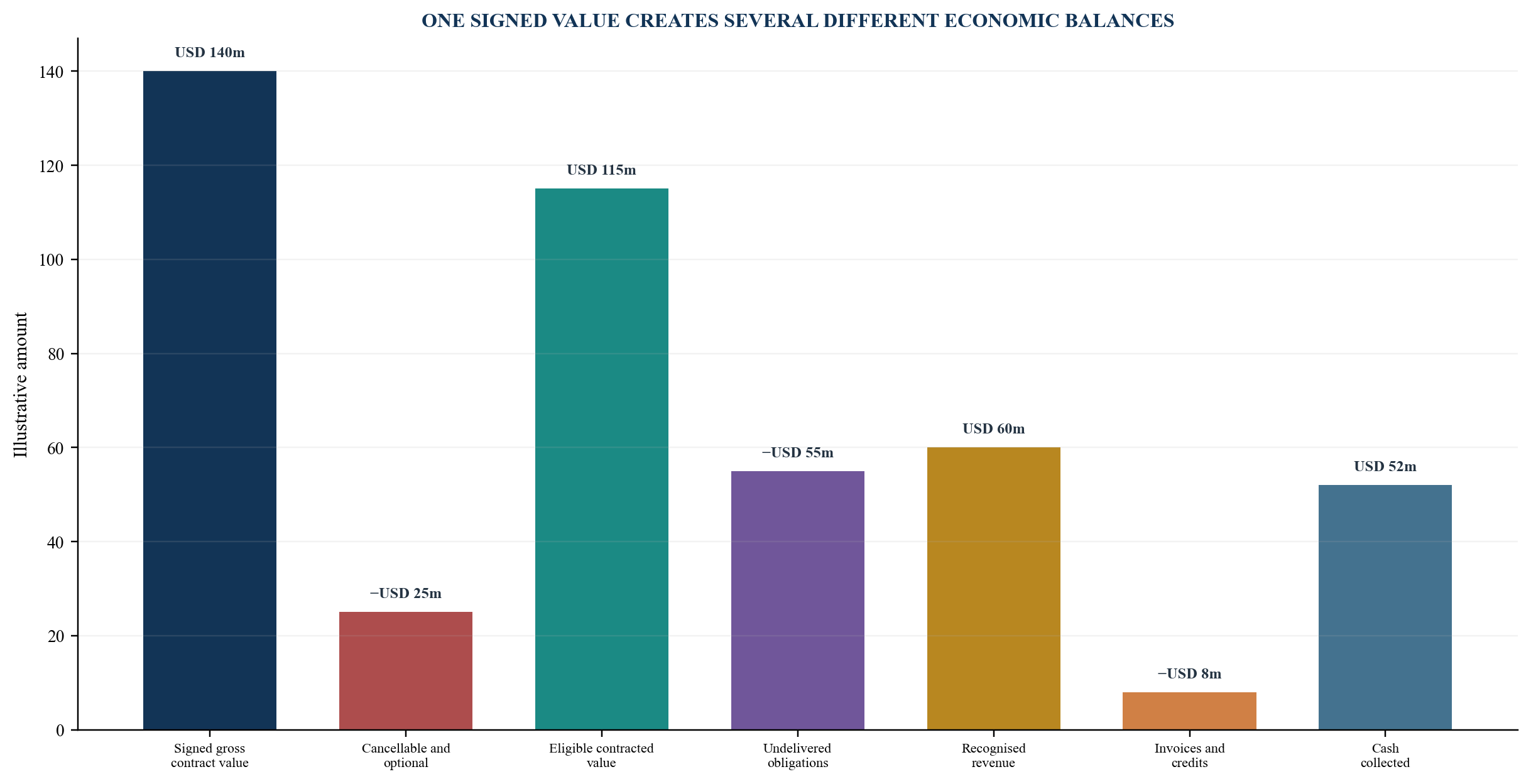
Values are management assumptions and do not represent an observed company or transaction.
7. Separate committed, consumption and services economics
A committed contract reserves capacity or access for a fixed term and price, often with minimum payment. A consumption contract recognises value as usage occurs. A subscription grants access over time. A licence can create point-in-time or over-time revenue depending on rights and obligations. Professional services depend on milestones, time or outcomes.
The portfolio should be segmented by model because visibility and cost differ. Committed revenue can improve forecastability while creating capacity obligations and customer concentration. Consumption revenue can have lower contractual visibility but reveal genuine product use. Services can accelerate adoption while carrying lower margins and people dependency.
CoreWeave's 2025 filing describes multi-year take-or-pay contracts, RPO and significant infrastructure deployment. Oracle's fiscal 2026 filing describes consumption revenue recognised as services are performed. These disclosures illustrate two elements of a broad market; actual economics require contract-level work.
The diligence model should calculate contracted minimum, expected usage, actual usage, unused capacity, credits, renewal and gross margin separately. It should identify any free, subsidised or investor-funded usage.
Table 3. Revenue-model quality map
| Model | Visibility strength | Primary risk | Core test |
|---|---|---|---|
| take-or-pay compute | enforceable minimum and term | delivery capacity, concentration and credit | reconcile reserved capacity, readiness, billing and cash |
| consumption compute or API | observable usage | volatility, price decline and abuse | verify metering, rate, credits and unit cost |
| software subscription | recurring access | shelfware, renewal and implementation delay | connect active use, seats, renewal and support cost |
| licence | contractual right | recognition timing and upgrade obligations | identify licence nature and remaining promises |
| professional services | statement-of-work value | milestone acceptance and people intensity | verify time, completion, acceptance and margin |
| channel or marketplace | distribution reach | gross-versus-net and end-customer opacity | establish control, fees, end use and collectability |
| outcome-based AI | alignment to customer value | measurement, dispute and variable consideration | validate baseline, attribution, acceptance and constraint |
The assessment depends on executed terms, delivery evidence, customer behaviour and the applicable accounting policy.
8. Prove that capacity can deliver the contracted revenue
AI revenue can depend on GPUs, data-centre space, power, networking, cloud reservations, third-party models, licensed data and specialist teams. A booking becomes operationally valuable when the required capacity is available, accepted and economically matched to the contract.
The capacity ledger should identify owned, leased, reserved and spot resources by region and date. It should show vendor commitments, minimum purchases, cancellation, prepayment, price escalation, useful life, financing and security interests. Customer workloads should map to the same units.
Contract start dates may depend on delivery. The team should compare promised and actual readiness, commissioning, customer acceptance, uptime and service credits. A delayed cluster can push revenue while facility, financing and procurement costs continue.
Capacity fungibility matters. A resource reserved for one architecture, region, security level or customer may not be redeployable. The diligence model should separate technically usable capacity from contractually and operationally available capacity.
Utilisation should be measured at the appropriate bottleneck: accelerator hours, tokens, requests, memory, power, rack, storage, network or delivery team. A single blended percentage can conceal stranded resources.
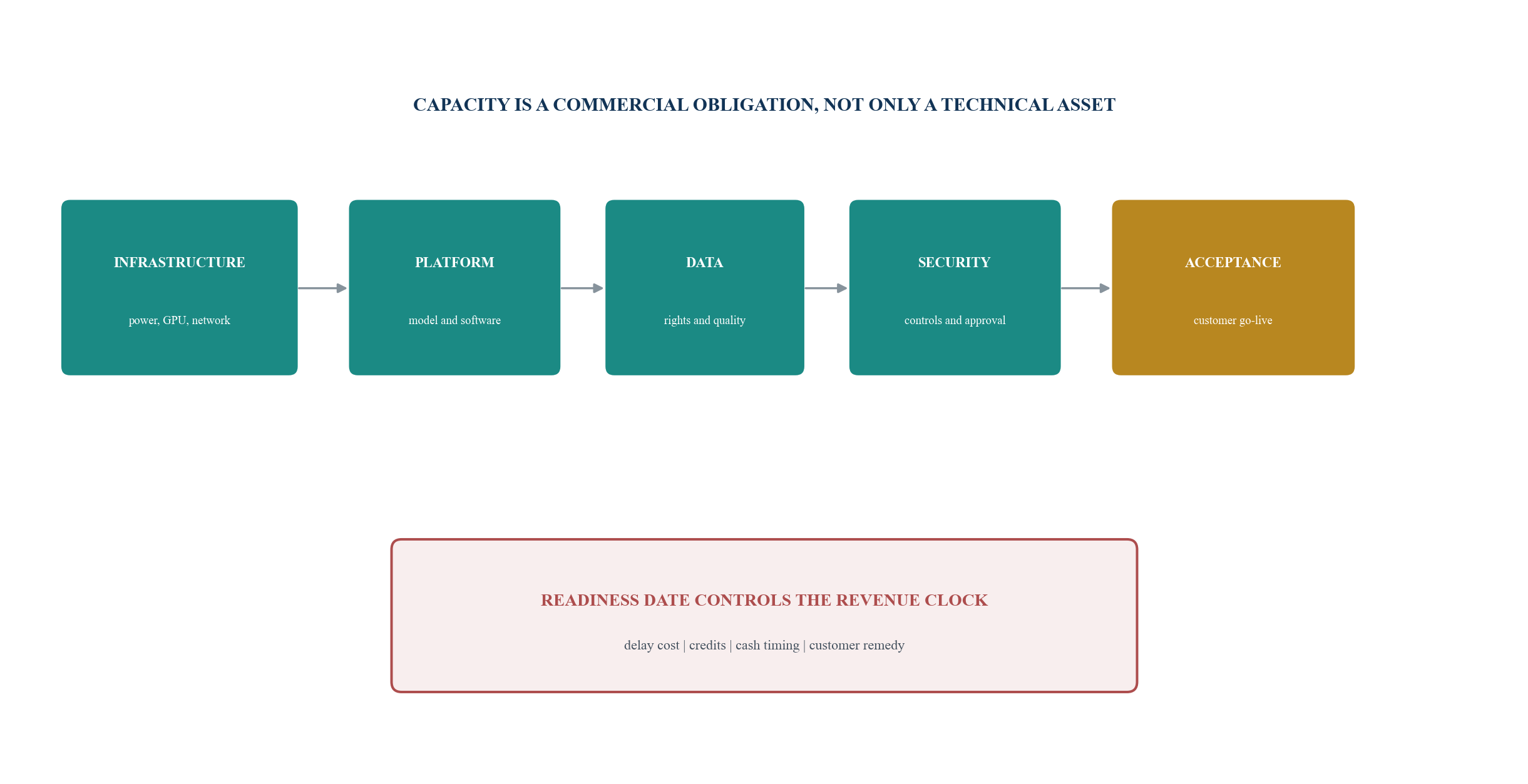
Contracted revenue becomes deliverable only when infrastructure, software, data, security and customer acceptance align.
9. Calculate compute contribution at customer and workload level
Reported cost of revenue may include third-party cloud, colocation, power, depreciation, data, inference, support and operations. Some infrastructure expense can sit in research and development or another operating line. Diligence should construct an economic cost view alongside the accounting presentation.
The unit depends on the product. AI cloud can use accelerator hour, reserved cluster or megawatt. Model APIs can use input and output tokens, requests or compute seconds. Applications can use user, workflow, task or outcome. Each unit should connect price, utilisation and cost.
Direct compute cost includes committed capacity used and unused. A customer can show positive margin on consumed units while an associated minimum cloud commitment remains stranded. The customer-product ledger should allocate reserved-cost exposure using a documented rule and show sensitivity.
Model training and inference need separation. Training can support future products and be classified outside current cost of revenue, subject to accounting policy. Inference serves current customer usage. Fine-tuning, retrieval, data licences, observability, safety, support and human review can be material.
The output is a contribution bridge by customer, product, geography and cohort. It distinguishes reported gross margin, adjusted contribution and cash contribution after capacity commitments.
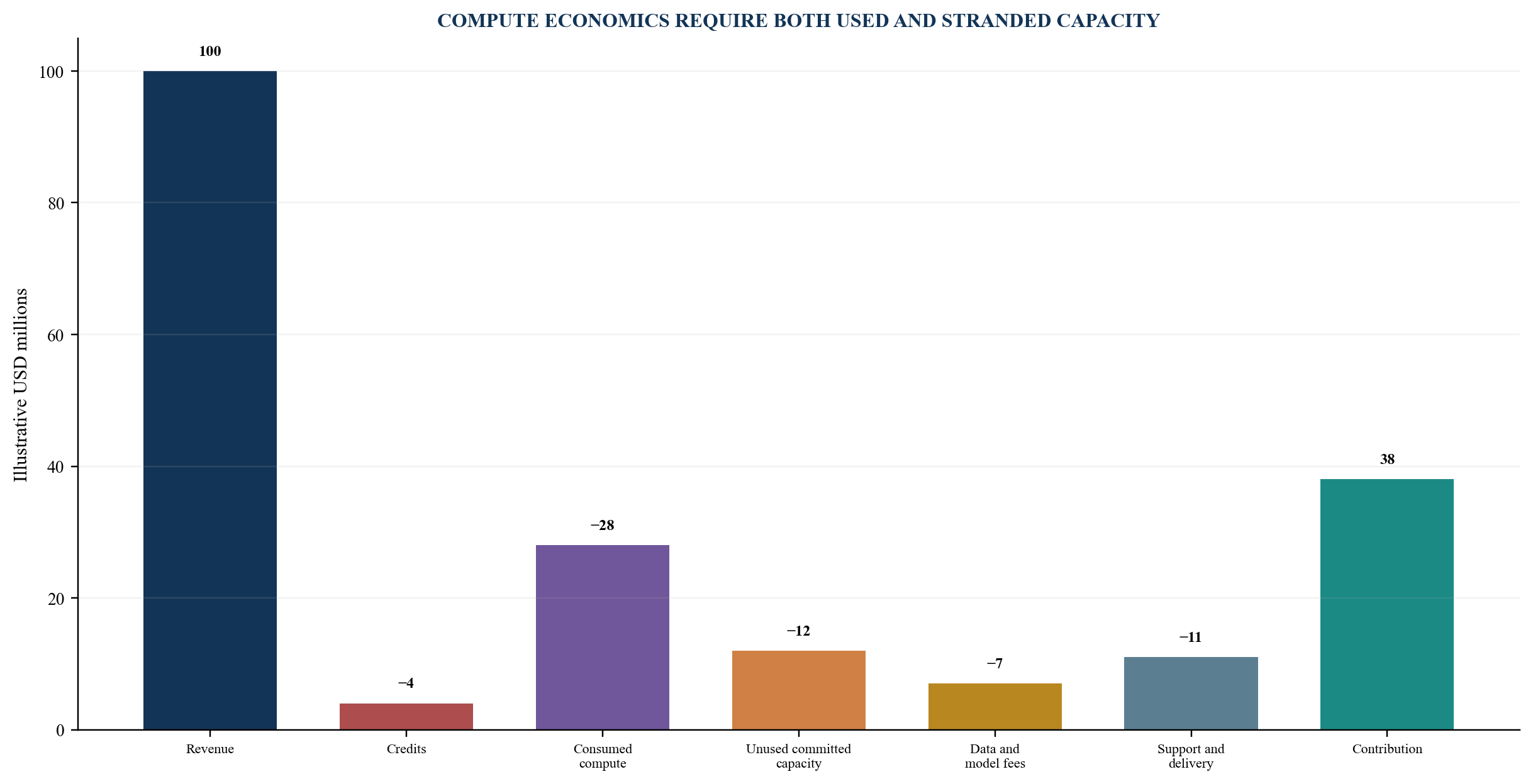
Values are management assumptions and do not represent an observed company or transaction.
10. Normalise gross margin without losing the operating truth
The gross-margin bridge begins with reported revenue and reported cost of revenue. It identifies reclassifications, capitalisation, credits, pass-through items, stock compensation, depreciation, cloud commitments, free usage, professional services and one-time migration.
The objective is a repeatable operating view, not a preferred percentage. Costs that recur to deliver the product should remain visible even when accounting classification places them elsewhere. Temporary launch inefficiency can be shown separately with evidence and a dated remediation plan.
The model should show price and cost by customer cohort. Early strategic customers may receive discounts, capacity priority, free services or warrants. Expansion can improve margin through utilisation or weaken it through bespoke work and support.
Infrastructure useful lives and depreciation assumptions affect reported margin. Cash economics also depend on equipment purchases, prepayments, leases, financing and minimum cloud commitments. Reported and cash contribution should be presented together.
Table 4. Illustrative gross-margin normalisation
| Bridge item | Reported treatment | Diligence treatment | Illustrative effect |
|---|---|---|---|
| reported revenue | accounting revenue | starting point | USD 100m |
| service credits | netted or accrued | reconcile to incident and contract | negative USD 4m |
| direct compute | cost of revenue | retain by customer and workload | negative USD 28m |
| unused commitment | operating or infrastructure cost | attribute to contracted capacity and portfolio | negative USD 12m |
| third-party model and data | cost or operating expense | retain when required for delivery | negative USD 7m |
| delivery and support | split across cost and operating expense | include recurring customer-serving cost | negative USD 11m |
| economic contribution | derived measure | revenue less recurring delivery resources | USD 38m |
| growth investment | research, sales and platform | disclose separately from current delivery | assessed outside contribution |
Values and classifications are management assumptions for method demonstration; the actual accounting treatment requires current professional analysis.
11. Measure concentration across customer, counterparty and dependency
Customer concentration should be measured on revenue, bookings, remaining obligations, receivables, cash and contribution. A customer can represent a small share of current revenue and a large share of contracted future capacity. Another can represent high revenue and low contribution.
The analysis should aggregate related entities and end customers. Marketplace, reseller and integrator channels can obscure underlying dependence. Credit exposure belongs to the invoiced counterparty, while product and renewal dependence can sit with the end user.
Current SEC filings demonstrate the range of disclosure. Ambiq's 2026 registration filing reported substantial end-customer concentration for its disclosed periods. CoreWeave's filings discuss large committed customers, take-or-pay arrangements and changing backlog concentration. C3.ai's fiscal 2026 filing reports revenue and receivable concentration by customer entity. These are company-specific disclosures rather than sector benchmarks.
Concentration can be strategically rational during early scale. Transaction value still depends on contract durability, counterparty quality, renewal, bargaining power, capacity dedication and substitution time. The model should test loss, contraction, price reset, payment delay and workload migration.
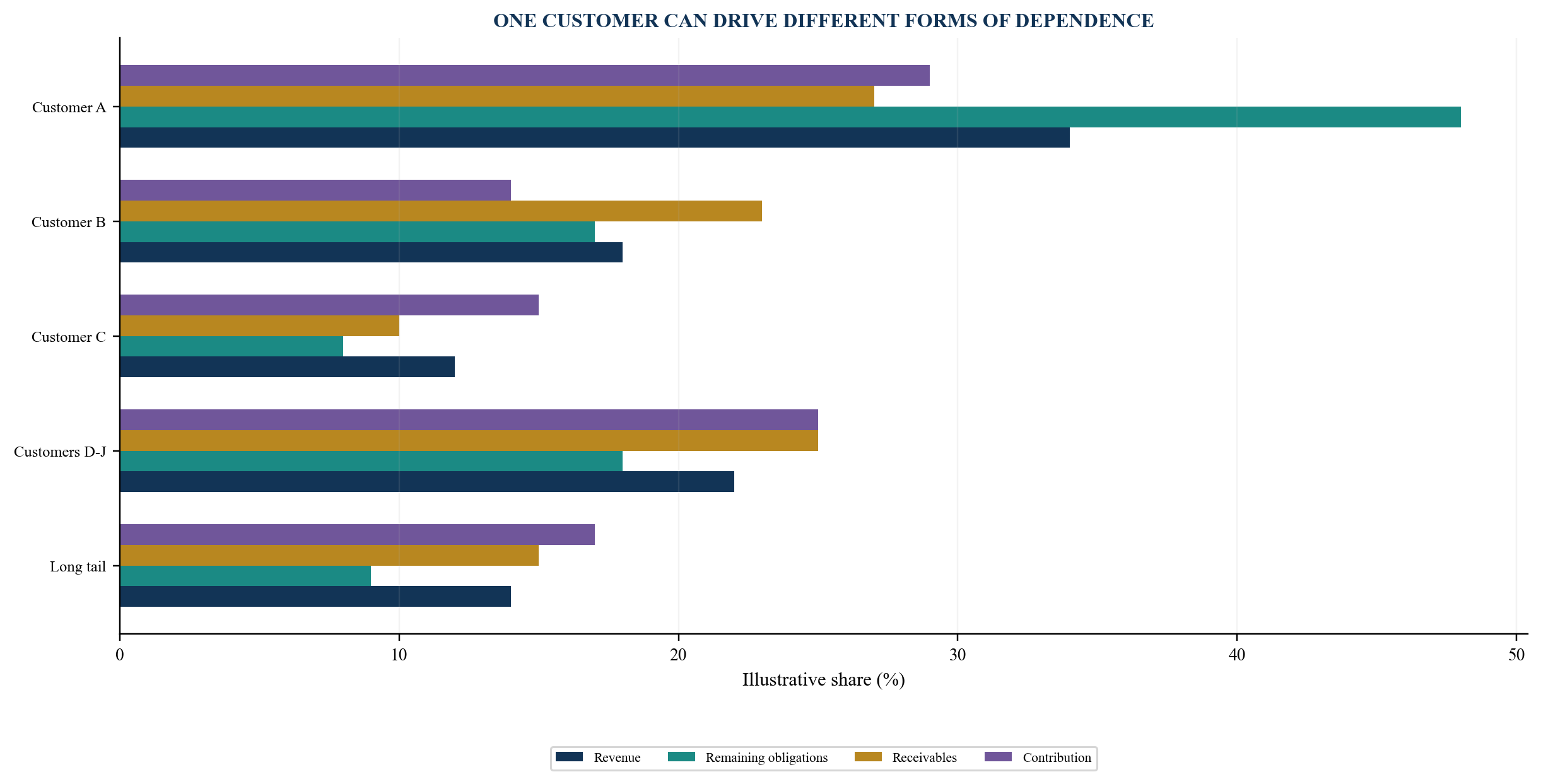
Shares are management assumptions and do not represent an observed company or transaction.
12. Test cohorts, usage, renewal and expansion
Customer-level cohorts reveal whether growth comes from durable use, price, expansion, new logos or services. The file should show opening recurring value, expansion, contraction, churn, reactivation, currency and closing value by month.
Usage belongs beside contract value. Active users, workloads, tokens, accelerator hours, production deployments and business processes provide different evidence. A paid contract with low use can be strategically valid during deployment, yet extended shelfware increases renewal risk.
Renewal analysis should control for contract term and eligibility. Early-stage companies can report high retention from a small or immature cohort. Multi-year contracts delay the first renewal observation. Concentration can cause net retention to move sharply with one account.
Expansion should be decomposed into volume, price, new product, acquired revenue and contract extension. A renewal signed early can increase bookings without changing near-term consumption. A customer-funded implementation can increase revenue while masking product friction.
The diligence team should interview selected customers with authorised access and a controlled script. Evidence should cover procurement, decision owner, production use, value achieved, alternatives, security, service, roadmap, renewal and pricing. Management-selected references should be identified as such.
The resulting score combines contractual durability, actual adoption, business criticality, switching cost, realised value, budget ownership, satisfaction and competitive position. It should retain the supporting evidence and unanswered questions.
13. Examine channel, related-party and circular economics
AI companies can sell through hyperscaler marketplaces, system integrators, distributors, affiliates and portfolio-company relationships. The diligence perimeter should identify who contracts, pays, consumes, provides the service and bears performance risk.
Principal-versus-agent conclusions affect gross or net revenue. The accounting memo should identify the specified service and whether the company controls it before transfer. Pricing discretion alone may not determine the conclusion. Marketplace fees and reseller discounts belong in customer economics.
Related-party revenue requires enhanced review of substance, arm's-length terms, collectability and disclosure. Investor-funded customers, reciprocal commercial arrangements or capacity purchases linked to financing can create growth that depends on the capital relationship. The review should trace ownership, board links, funding and side agreements.
Cloud credits and partner incentives can subsidise delivery or customer adoption. The model should identify expiry, restrictions and replacement cost. A gross-margin profile supported by temporary credits should show the post-credit economics.
Barter, warrants, marketing funds, referral payments and reciprocal procurement should be analysed together. The objective is to establish the independent economic exchange and cash consequence.
The transaction report should list every material channel and related-party adjustment with its effect on revenue, contribution, cash and valuation. Legal, tax, accounting and disclosure advice remains jurisdiction-specific.
14. Reconcile receivables, deferred revenue and cash conversion
Revenue quality reaches the bank account through invoicing and collection. The diligence team should obtain invoice-level accounts receivable, cash application, credit notes, disputes, days-sales-outstanding, write-offs and subsequent receipts.
Unbilled receivables can arise when revenue is recognised before the right to invoice becomes unconditional. Contract assets should be reconciled by customer, obligation and ageing. Deferred revenue represents consideration received or billed before recognition under the policy; it is not automatically free cash because future service costs remain.
Large prepayments can support infrastructure deployment while creating performance and refund obligations. CoreWeave's 2025 filing describes customer prepayments within its committed-contract model. The actual cash benefit depends on delivery, restrictions, security, credits and required capital expenditure.
Collections should be traced from customer invoice to bank receipt and general ledger. Concentrated customers can negotiate extended terms, dispute service levels or offset credits. Government and channel customers can have longer administrative cycles.
The working-capital model should separate invoicing cadence, contractual payment date, actual payment, tax, currency, credit and financing. It should forecast cash under base, delayed-delivery, credit and customer-loss cases.
Transaction mechanisms should address the identified risk. Options include normalised working-capital targets, specific indemnities, escrow, earnouts tied to collected contribution, deferred consideration, debt covenants or closing conditions. Each mechanism requires legal and tax design.
Earnout definitions should avoid reproducing the metric ambiguity found in diligence. The schedule should specify the customer and product perimeter, accounting policy, permitted contract changes, revenue and cost cut-off, credits, bad debt, infrastructure allocation, foreign exchange, acquisitions, discontinued products and dispute procedure. Collected contribution can be more decision-useful than bookings when the commercial concern is conversion into cash and sustainable margin. The selected measure remains transaction-specific.
A buyer should also preserve the source data and calculation environment used at signing. Post-close changes to CRM stages, billing logic, cloud allocation or customer identifiers can make a historical earnout difficult to reproduce. A controlled baseline, access rights, monthly certificates and an independent review route improve the evidential record. These provisions require drafting by the parties' current advisers.
15. Stress revenue, capacity and cash together
A revenue stress should change price, volume, delivery timing, service credits, churn, customer concentration, cloud price, utilisation and cash timing in one model. Testing only revenue growth can miss a larger cost or liquidity effect.
The base case should reconcile to executed contracts, delivery capacity, pipeline conversion, historical cohorts and board-approved forecast. Upside should require named evidence. Downside should include events that are plausible for the product and customer set.
The model should calculate revenue, gross contribution, cash, capacity commitments, headroom and covenant effects. It should identify the first date at which an action is required and the owner.
Table 5. Illustrative integrated AI revenue stress matrix
| Scenario | Revenue effect | Cost and capacity effect | Cash effect | Transaction implication |
|---|---|---|---|---|
| base delivery | contracted starts and cohort trend | planned utilisation and support | agreed billing and collection | valuation follows evidenced plan |
| largest customer delays | recognition shifts six months | dedicated capacity remains payable | prepayment or invoice timing moves | working-capital and concentration protection |
| consumption falls 30% | usage revenue declines | minimum cloud spend remains | lower receipts with fixed outflow | contribution and liquidity adjustment |
| service availability failure | credits reduce transaction price | remediation and duplicate capacity rise | refunds or offsets delay cash | warranty, reserve and control remediation |
| compute price rises 20% | price response may lag | direct unit cost increases | supplier cash precedes repricing | margin adjustment and pricing covenant |
| renewal loss | forward recurring value declines | stranded people and capacity remain | collections fall after contract end | earnout and retention condition |
| collection delay | accounting revenue may remain | delivery continues | receivables and funding need rise | debt headroom and working-capital adjustment |
Values are management assumptions for method demonstration and require replacement with transaction evidence.
16. Run a ten-day revenue-quality diagnostic
Days one and two define the entities, products, customers, revenue models, accounting frameworks and source systems. The team freezes the cut-off and gathers contracts, CRM, usage, billing, general ledger, bank, infrastructure and customer-success data.
Days three and four build the metric dictionary and contract universe. Material bookings, amendments, side letters, cancellation, acceptance, service levels, payment and channel terms are indexed.
Days five and six reconcile bookings, remaining obligations, revenue, invoices, credits and cash. The team re-performs selected recognition conclusions and period cut-off.
Days seven and eight build customer-product contribution, capacity, cohort, concentration and cash-conversion models. It tests reported margin against compute, data, support and stranded commitments.
Day nine runs integrated downside scenarios and ranks accounting, commercial, technical, customer, capacity and liquidity gaps. Day ten is the transaction gate: proceed; reprice; restructure; add protection; obtain evidence; defer; or decline.
The ten-day period is a management target. Complex contract populations, incomplete data, multiple jurisdictions, specialist accounting or technical testing can require longer. Unresolved items should remain explicit.
Table 6. Ten-day AI revenue-quality diagnostic
| Period | Workstream | Decision | Completion evidence |
|---|---|---|---|
| days 1-2 | perimeter and data freeze | what business and records are being diligenced? | entity, product, customer and system map |
| days 3-4 | definitions and contracts | what is binding, cancellable and deliverable? | metric dictionary and contract register |
| days 5-6 | accounting and cash bridge | what converts to revenue, invoice and receipt? | seven-ledger reconciliation and sample workpapers |
| days 7-8 | economics and concentration | which customers and workloads create contribution? | customer-product margin, cohort and capacity models |
| day 9 | integrated stress | what event breaks value or liquidity first? | scenario matrix and severity-ranked gaps |
| day 10 | transaction gate | proceed, reprice, protect, remediate or decline? | signed decision and conditions |
Scope, owners and timing should be adapted to the company and transaction.
17. Implement a thirty-day revenue-control office
The first week establishes governance, definitions, data ownership and a controlled customer-contract master. Sales, finance, product, infrastructure, legal and customer success agree the metric dictionary and exception process.
The second week connects CRM, contract, metering, billing, revenue subledger, receivables, bank and compute-cost data. Customer and product identifiers are reconciled. Access, change and approval controls are tested.
The third week implements dashboards for bookings quality, obligations, delivery, credits, recognition, invoices, collections, capacity, contribution, concentration, cohorts and renewal. Maker-checker controls cover material contracts and period-end cut-off.
The fourth week runs close, forecast and transaction simulations. Teams test a late contract, delayed capacity, service credit, disputed invoice, customer loss, price change, renewal and supplier-cost shock. Failed controls enter a dated remediation plan.
Ongoing retained work can include monthly revenue and contribution review, contract and metric governance, customer and cohort monitoring, infrastructure-cost optimisation, forecast challenge, lender or investor reporting, transaction preparation and post-close integration. The engagement scope and evidence standard should be explicit.
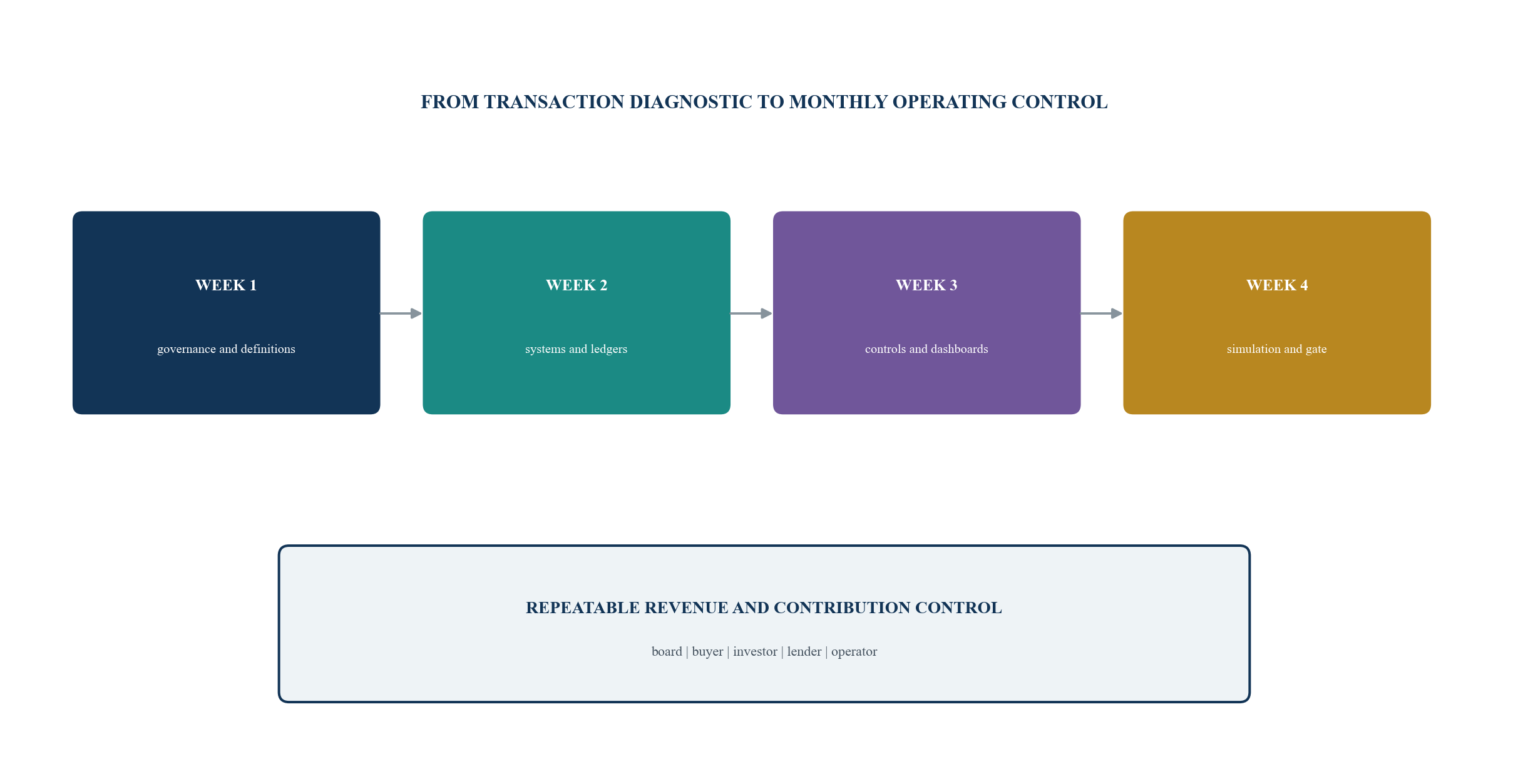
A controlled revenue model links commercial momentum to delivery, accounting, cash and transaction decisions.
18. Conclusion
AI company revenue quality sits at the intersection of contract, delivery, accounting, cash and compute economics. Bookings, remaining obligations, annual recurring revenue, recognised revenue and cash should retain distinct definitions and reconcile through one controlled customer-product model.
The framework begins with the legal and product perimeter, tests contracts and performance obligations, and connects every material booking to delivery capacity. It then calculates customer and workload contribution after compute, data, model, support and unused commitments. Cohort, concentration, channel, related-party, receivables and cash analysis establish whether growth is durable and financeable.
IFRS 15, SEC guidance and PCAOB standards reinforce disciplined definitions, recognition, presentation and revenue-risk controls. Current issuer filings show how committed AI cloud, consumption, software and hardware models disclose obligations, customer dependence and infrastructure costs. Their facts cannot replace company-specific diligence.
For buyers and investors, the result is an evidence-based valuation and protection map. For lenders, it connects contracted cash visibility to capacity, contribution and collection. For boards and operators, it provides a route from ten-day diagnostic to a thirty-day revenue-control office and ongoing performance management. Commercial demand and fees remain unverified until evidenced by signed engagements and collected payments.
References
- IFRS Foundation. IFRS 15 Revenue from Contracts with Customers. https://www.ifrs.org/issued-standards/list-of-standards/ifrs-15-revenue-from-contracts-with-customers/
- IFRS Foundation. Post-implementation Review of IFRS 15 Revenue from Contracts with Customers. 30 September 2024. https://www.ifrs.org/projects/completed-projects/2024/post-implementation-review-of-ifrs-15-revenue-from-contracts-with-customers/
- IFRS Interpretations Committee. Principal versus Agent: Software Reseller. April 2022. https://www.ifrs.org/news-and-events/updates/ifric/2022/ifric-update-april-2022/
- US Securities and Exchange Commission. Non-GAAP Financial Measures: Compliance and Disclosure Interpretations. https://www.sec.gov/rules-regulations/staff-guidance/corporation-finance-interpretations/non-gaap-financial-measures
- Public Company Accounting Oversight Board. AS 2110: Identifying and Assessing Risks of Material Misstatement. https://pcaobus.org/oversight/standards/auditing-standards/details/AS2110
- CoreWeave, Inc. Annual Report on Form 10-K for the year ended 31 December 2025. https://www.sec.gov/Archives/edgar/data/1769628/000176962826000104/crwv-20251231.htm
- CoreWeave, Inc. Registration Statement on Form S-1/A. 2025. https://www.sec.gov/Archives/edgar/data/1769628/000119312525058309/d899798ds1a.htm
- C3.ai, Inc. Annual Report on Form 10-K for the year ended 30 April 2026. https://www.sec.gov/Archives/edgar/data/1577526/000157752626000078/ai-20260430.htm
- Alphabet Inc. Annual Report on Form 10-K for the year ended 31 December 2025. https://www.sec.gov/Archives/edgar/data/1652044/000165204426000018/goog-20251231.htm
- Oracle Corporation. Annual Report on Form 10-K for the year ended 31 May 2026. https://www.sec.gov/Archives/edgar/data/1341439/000119312526277521/orcl-20260531.htm
- Ambiq Micro, Inc. Registration Statement on Form S-1. 2026. https://www.sec.gov/Archives/edgar/data/1500412/000119312526017240/d62272ds1.htm
- Pure Storage, Inc. Annual Report on Form 10-K for fiscal 2026. https://www.sec.gov/Archives/edgar/data/1474432/000147443226000043/a10kfy2026.htm
About the Author
Chennakeshav Adya, Independent Researcher
