

1. The cap table is an event history, not a static answer
A cap table summarises ownership at a chosen time. Every number on it should be the result of one or more corporate events: incorporation, issuance, transfer, exercise, conversion, split, consolidation, redemption, repurchase, cancellation, vesting, lapse, amendment or reclassification. The cap table becomes reliable when those events form a complete, authorised and reconciled chain.
Private-company records often develop across several systems. Board minutes authorise issuances. Subscription and award documents define quantities and rights. A company secretary or registered agent maintains legal records. Finance records consideration. Human-resources systems track vesting. A valuation model builds a fully diluted view. A transaction data room contains copies with different dates. A spreadsheet tries to join them.
The main risk is false precision. A spreadsheet can sum perfectly while using an invalid issuance, stale conversion ratio, unrecorded split, expired option pool, duplicated transfer or outdated preference. A buyer can calculate price per share against one denominator while the issuer calculates another. A seller can present a certificate issued before a split. A board can approve a transaction without a current rights map.
The control objective is event completeness. Each change should identify authority, effective date, affected security, before quantity, after quantity, rights change, consideration, registered owner, supporting documents and current record. An exception remains visible until corrected, ratified, waived or reflected in transaction terms.
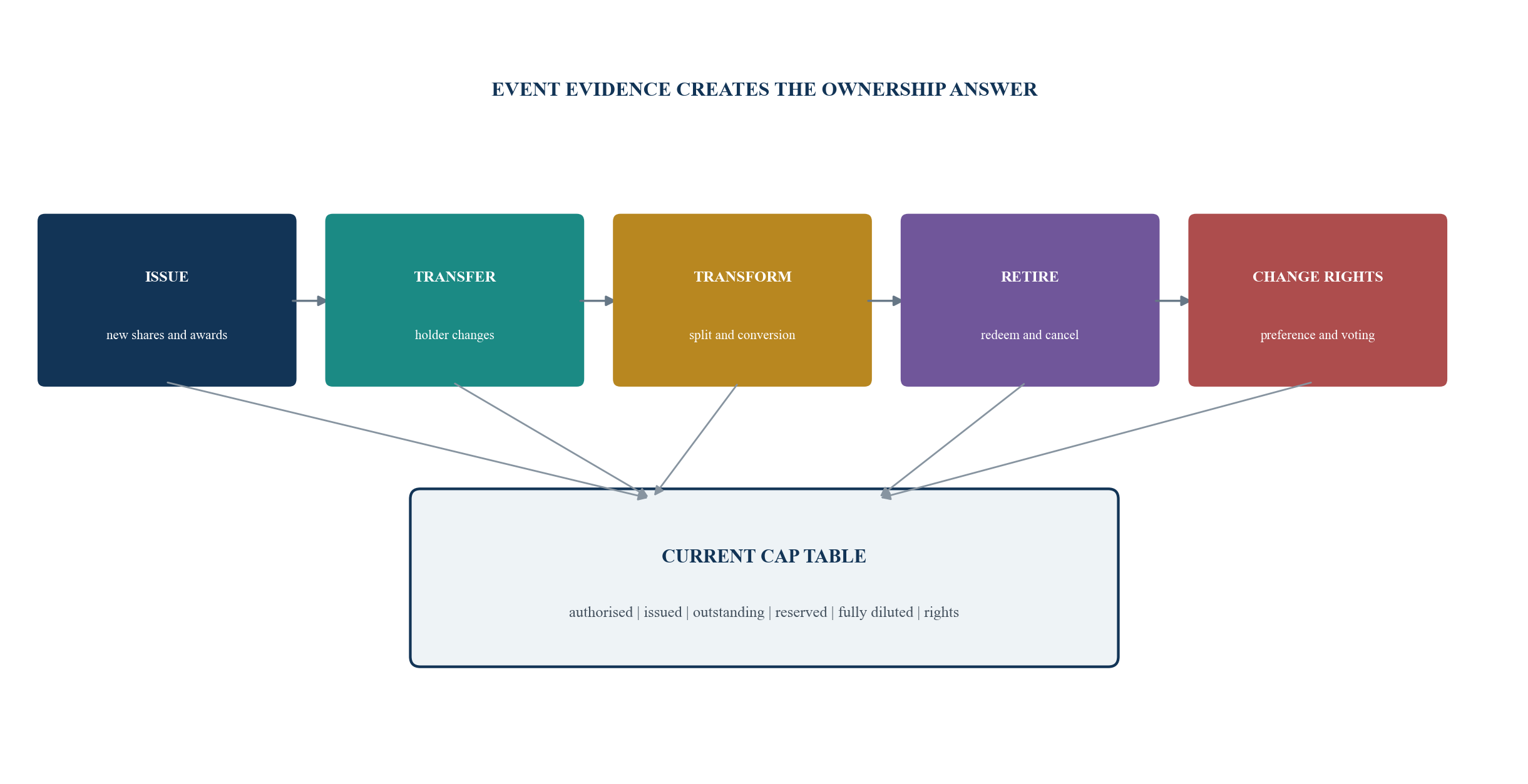
Each event requires authority, terms, effective date and evidence before it updates the current position.
2. Define six quantities before discussing dilution
Dilution discussions become confused when participants use the word “shares” for different quantities. The reconciliation should distinguish authorised, issued, outstanding, treasury or retired, reserved, and fully diluted or as-converted quantities.
Authorised shares are the maximum that the constitutional documents permit within the relevant class or series, subject to jurisdiction and amendments. Issued shares are those legally issued. Outstanding shares remove shares that have been repurchased and held as treasury or cancelled, depending on the regime. Reserved shares are authorised for future issuance under option plans, warrants, conversion rights or financing commitments. Fully diluted shares typically add outstanding shares and specified potential issuances, but the definition varies by document and purpose. As-converted quantities apply conversion terms to convertible securities.
The denominator used for price, ownership or voting may differ. A financing can define “fully diluted capitalisation” in its documents. A liquidation waterfall may use as-converted participation while preserving a preference alternative. A voting agreement may count classes differently. An employee ownership percentage can be quoted before or after the unallocated option pool.
The reconciliation should document purpose, definition and source for every denominator. A single total without this context is not decision-grade evidence.
Table 1. Share-count definitions and control questions
| Quantity | Core meaning | Primary evidence | Common error |
|---|---|---|---|
| authorised | maximum permitted by constitutional authority | certificate, articles, amendments and resolutions | using an old authorised limit after amendment |
| issued | shares validly allotted or issued | board authority, subscription or award and legal record | counting an approval without completed issuance |
| outstanding | issued shares currently held outside treasury or cancellation | ledger and retirement events | leaving repurchased or cancelled shares in circulation |
| reserved | shares committed for future issuance | option plan, warrants, convertibles and financing terms | treating the entire plan as granted or ignoring refresh |
| fully diluted | purpose-specific potential total | defined term plus security schedule | mixing treasury-stock, if-converted and contractual methods |
| as converted | shares resulting from conversion terms | class instrument and current conversion ratio | using original 1:1 ratio after adjustment events |
The governing documents and applicable law determine the exact definition.
3. Classify every corporate action by what it changes
The event ledger should classify corporate actions into five families. Issuance events create securities or rights: share allotments, option grants, warrant issuances and convertible instruments. Transfer events change the holder without necessarily changing total shares. Transformation events change form or quantity: conversions, exercises, subdivisions, consolidations and reclassifications. Retirement events remove or isolate shares through redemption, repurchase, treasury treatment, forfeiture or cancellation. Rights-change events alter voting, preference, participation, conversion, redemption, protective or information rights.
An event can belong to more than one family. A financing can issue preferred shares, expand an option pool, amend protective provisions and change conversion mechanics. A restructuring can convert debt, split shares, create a new class and cancel old certificates. The ledger should break the transaction into linked components so each effect reconciles.
Delaware law permits one or more classes and series with different voting powers, preferences, special rights, qualifications and restrictions. It also permits convertible or exchangeable stock on stated terms. Amendments can increase or decrease authorised shares, change designations and preferences, reclassify, subdivide or combine shares, and create new classes subject to the applicable approval rules.
The United Kingdom uses event-driven filings for allotments, consolidations, subdivisions, redemptions, cancellations and other capital changes. Companies House states that capital statements accompanying relevant forms should show total shares, nominal value and class rights. Singapore's ACRA describes conversion as changing existing shares into another class and requires constitutional authority or appropriate approval and filing.
The classification therefore serves two purposes: it determines the arithmetic transformation and identifies the legal evidence required.
4. Establish an evidence hierarchy
A cap table should show where each fact came from. Evidence strength depends on the question. Constitutional documents establish authorised capital and class rights. Board and shareholder resolutions establish approvals. Subscription, grant, exercise, conversion and transfer documents establish transaction terms. The stock ledger or register identifies registered ownership. Government filings can corroborate capital changes, while their scope and timing may differ from internal legal records.
Bank records or accounting entries can confirm consideration but do not by themselves establish valid issuance. A signed term sheet can describe intended economics but may not complete an amendment or allotment. A valuation model can calculate dilution but cannot cure missing authority.
Evidence should be current and complete. A certificate of incorporation without later amendments is weak evidence of current Delaware class rights. UK articles without filed resolutions or capital changes may be stale. A Singapore business profile may reflect registered changes while underlying instruments remain necessary to understand rights.
The hierarchy should also record conflicts. When the ledger, legal documents, government filing and spreadsheet disagree, the team should not select the most convenient number. It should identify the legal and factual cause and obtain counsel's conclusion or corrective action.
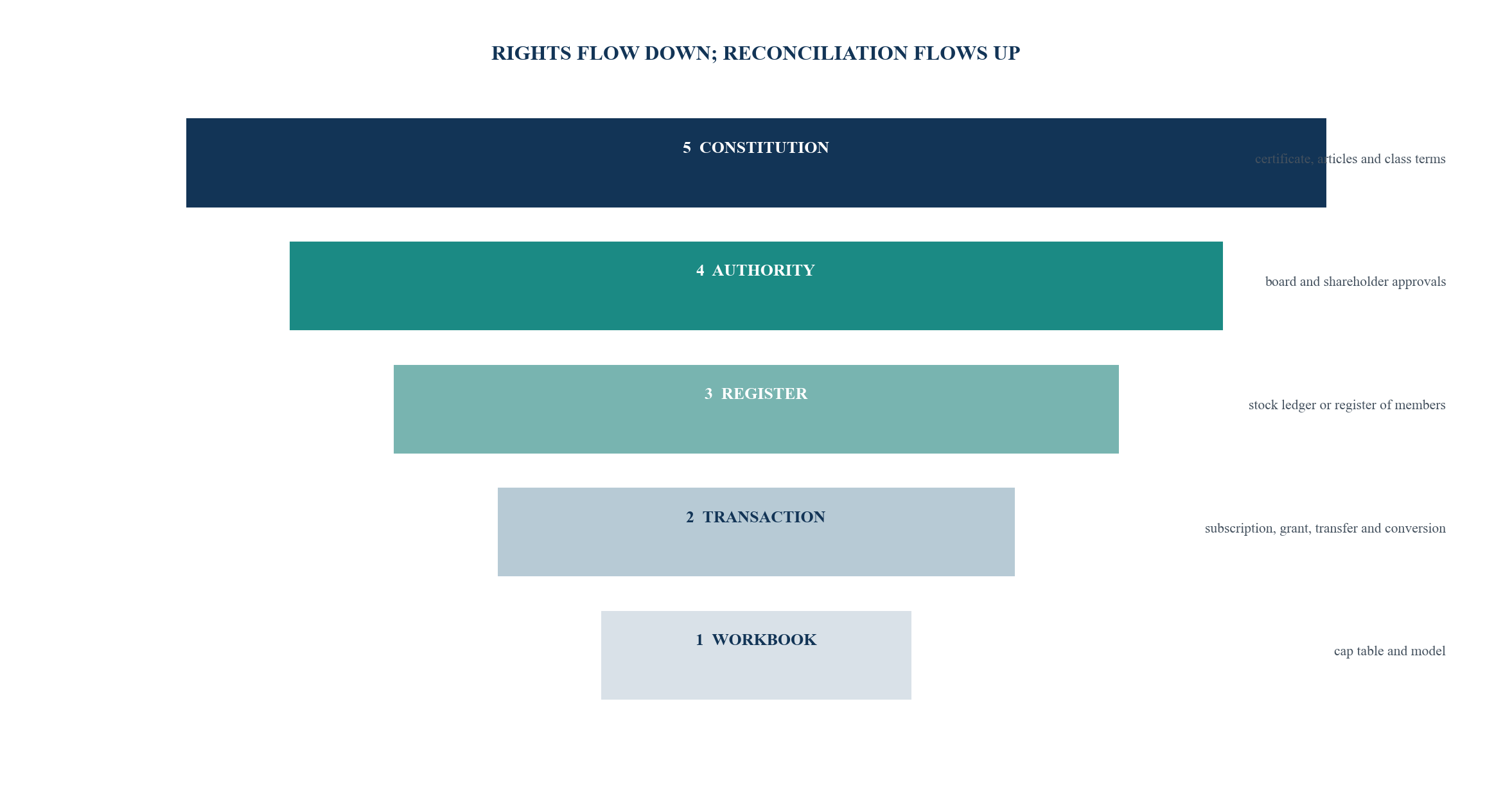
Higher levels answer authority and rights questions; lower levels support reconciliation and explanation.
5. Reconcile issuances and authorised capacity
Every issuance should connect authority, security terms, consideration, recipient and registration. The first control asks whether the company had sufficient authorised capacity in the relevant class. The second asks whether the board or other required body approved the issuance on the recorded terms. The third asks whether conditions, payment and documentation were completed. The fourth asks whether the ledger and certificate or notice were updated.
An approval to issue up to a number of shares is not the same as an issuance. A signed subscription with an unmet condition may not be issued. An option grant is a contractual right rather than an outstanding share until exercise under the relevant terms. Convertible debt can create a reserved or potential share claim before conversion.
Pre-emption and participation rights can affect validity, liability or economics. The UK Companies Act provides existing shareholders with pre-emption rights for certain equity allotments, subject to exceptions and permitted exclusions or disapplications. Contractual pre-emption can also apply. A cap table that adds the new shares without recording waivers or participation can conceal a claim.
The issuance bridge should begin with authorised capacity, deduct existing issued shares and reservations that legally constrain availability, and test the proposed issuance. If capacity or approval is insufficient, the transaction should pause for legal analysis and corrective action.
Table 2. Issuance reconciliation checklist
| Control | Question | Evidence | Hard-stop example |
|---|---|---|---|
| authorised capacity | was the class and quantity available? | current constitutional documents and amendments | issuance exceeds authorised class |
| corporate approval | was the correct body and vote obtained? | board and shareholder resolutions | missing class vote or board authority |
| pre-emption | were statutory and contractual rights satisfied? | offer, expiry, waiver or disapplication | eligible holder omitted without valid basis |
| consideration | was required value delivered or recorded? | bank, set-off, service or asset evidence | shares marked paid without support |
| conditions | did the issuance become effective? | closing certificate and completed deliverables | unfulfilled financing condition |
| registration | does the current record reflect the issuance? | stock ledger or register of members | signed documents absent from register |
A completed row should cite the exact document and effective date.
6. Convert splits and consolidations through an event bridge
A subdivision or stock split increases the number of shares while generally preserving proportional ownership immediately before other effects. A consolidation or reverse split reduces the number. The event can require treatment of fractional shares, certificates, options, warrants, conversion ratios, authorised capital, nominal value and plan reserves.
The reconciliation should never multiply only the outstanding common shares. Every affected instrument must be identified. Preferred shares can have conversion ratios adjusted. Option exercise prices and quantities can change. Warrants may contain anti-dilution adjustments. Convertible notes may define adjustments to conversion mechanics. Employee records and certificates need consistent treatment.
Delaware amendments can provide for subdivisions or combinations and changes to authorised shares under the applicable approval rules. UK Companies House uses form SH02 for consolidation, subdivision, redemption or reconversion of stock into shares. The associated capital statement records the resulting structure. The legal effective date may differ from the date a spreadsheet was edited.
The event bridge should show before quantity, ratio, fractions, after quantity and evidence. It should then reconcile totals across the ledger, plan administrator, legal register and transaction model.
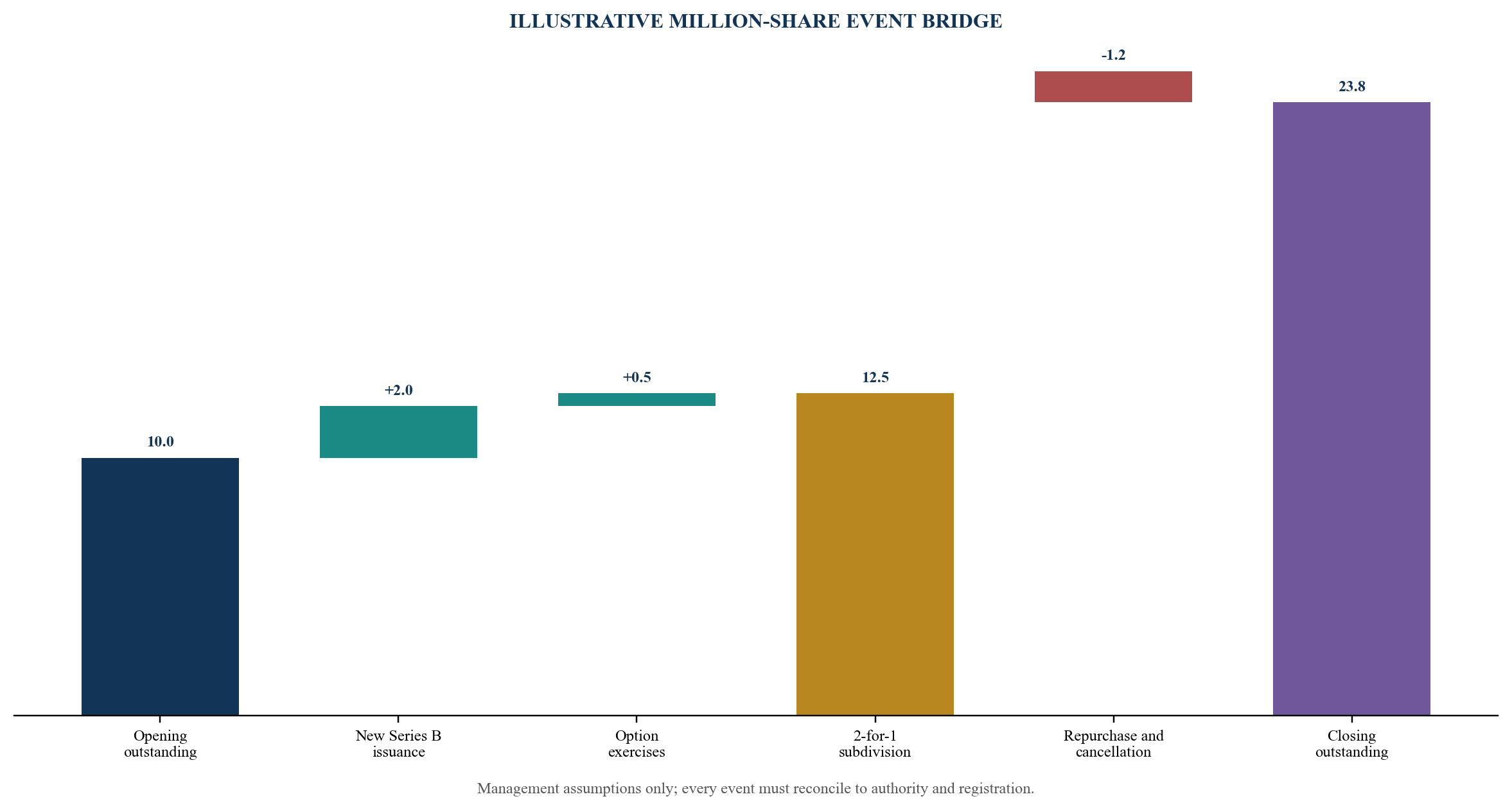
Quantities are illustrative management assumptions and exclude transaction-specific fractional treatment.
7. Recalculate conversions after every relevant event
Convertible preferred shares, notes, SAFEs, options and warrants can produce different share quantities depending on timing and terms. The conversion ratio may begin at 1:1 and later change through stock splits, stock dividends, price-based anti-dilution, recapitalisations or negotiated amendments. Accrued interest, valuation caps, discounts and qualified-financing definitions can affect convertible instruments.
The cap table should store conversion formulas and variables, not only current outputs. Each variable should have a source and effective date. A financing model that hard-codes an old ratio can misstate ownership and proceeds even when the total formula is mathematically correct.
Delaware law permits classes and series to be convertible or exchangeable at stated prices or rates with stated adjustments. Filed security terms show that liquidation preferences and conversion prices can adjust for stock splits, combinations and related events. These examples illustrate document design; a private company requires its own governing terms.
The conversion review should identify optional, automatic and event-triggered conversion. It should determine who can elect, when conversion becomes effective, what notices are required, how fractions are treated and whether the security retains preference until the relevant event closes.
For a transaction, the model should present at least three views: current legal outstanding; as-converted under current terms; and pro forma conversion triggered by the proposed transaction. These views should not be collapsed into one number.
Table 3. Conversion-variable register
| Variable | Source | Current input | Sensitivity | Control |
|---|---|---|---|---|
| original conversion price | class instrument | USD 4.00 | base reference | verify executed certificate or articles |
| split adjustment | corporate-action terms | 2-for-1 | doubles as-converted quantity if applicable | apply to every affected instrument |
| price-based anti-dilution | financing terms | weighted-average formula | depends on issue price and quantity | preserve formula and authorised inputs |
| accrued convertible interest | note instrument | USD 0.4m | increases conversion amount | reconcile finance ledger and cut-off date |
| valuation cap or discount | SAFE/note terms | cap USD 40m; discount 20% | select contractual conversion price | test qualified-financing definition |
| fractional treatment | class terms and law | round down with cash adjustment | affects holder-level totals | reconcile aggregate and holder schedules |
The register should retain formula, source, effective date and reviewer.
8. Model anti-dilution and option-pool effects explicitly
Dilution can arise through new money, employee incentives, conversions, warrants, acquisitions and restructuring. The percentage impact depends on the denominator and security terms. Investors should distinguish economic dilution, voting dilution and preference dilution.
An option-pool increase can be negotiated pre-money or post-money. If created before a financing, existing holders can bear more of the dilution. A pool number should be separated into granted, vested, exercised, forfeited, expired and unallocated amounts. Treating the full authorised plan as outstanding can overstate current voting shares while remaining relevant to fully diluted ownership.
Price-based anti-dilution can adjust the conversion price of preferred securities when new shares issue below a defined price. Full-ratchet and weighted-average approaches produce different outcomes. Definitions can exclude employee plans, strategic issuances or other permitted transactions. The model should use the executed terms rather than a generic formula.
Pre-emption or participation rights can allow investors to maintain ownership by purchasing additional shares. Failure to offer the right can create legal or contractual exposure. The cap table should record the right, offer, election and resulting allocation.
The dilution waterfall should show each event separately and preserve before and after ownership. It should also show value per security under relevant preferences.
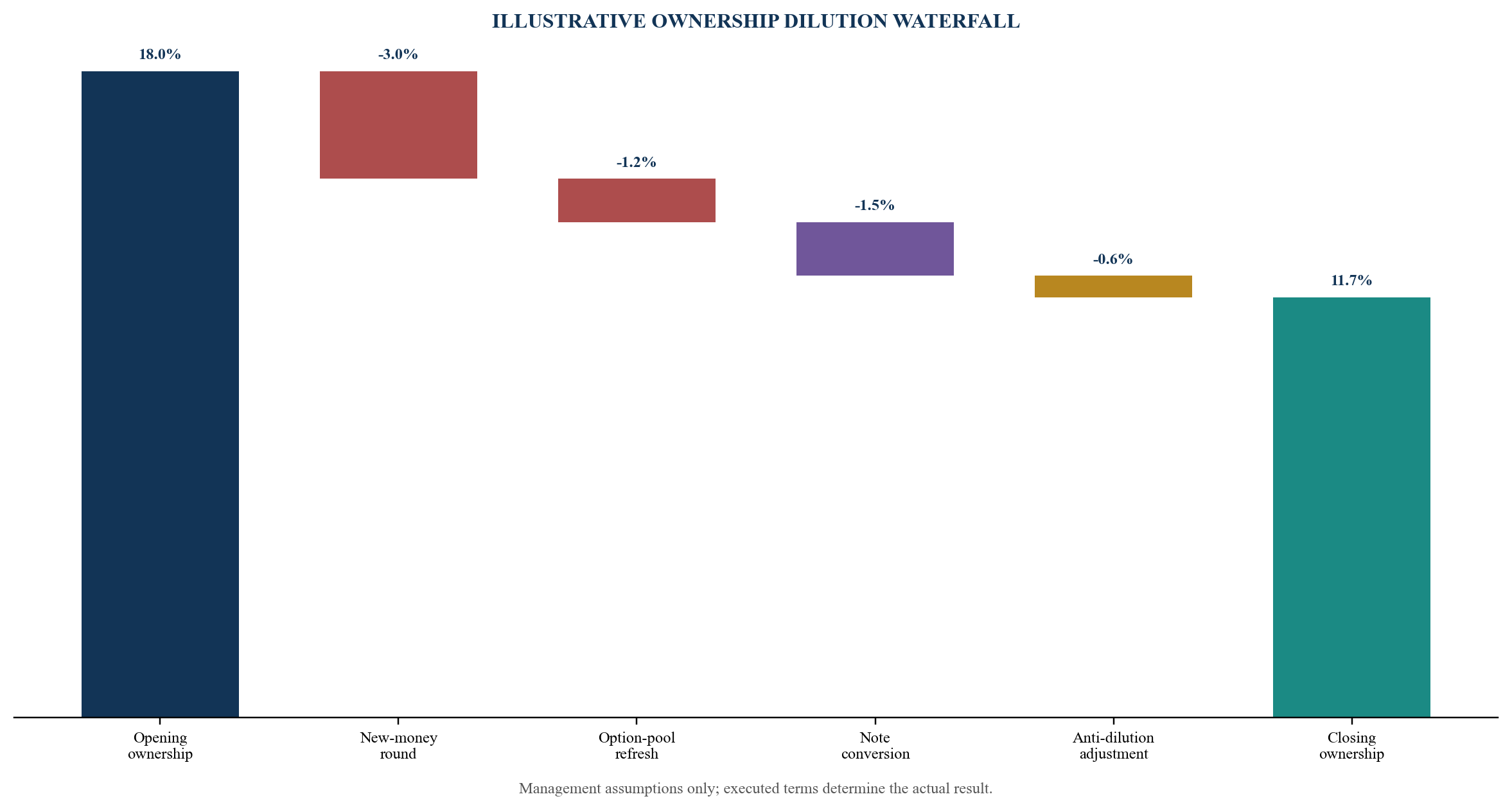
Percentages are management assumptions and do not represent an observed company.
9. Map preferences before calculating exit value
Ownership percentage does not determine exit proceeds when securities carry different preferences. The model should map seniority, liquidation amount, participation, caps, dividends, conversion choice, redemption and deemed-liquidation provisions for every class and series.
A non-participating preferred holder may choose between its preference and as-converted proceeds. A participating security may receive a preference and then share in the remainder, potentially subject to a cap. Senior series can be paid before junior preferred and common. Accrued dividends or multiples can increase claims. A deemed-liquidation definition can bring specified mergers or asset sales into the waterfall.
Preference terms can change through amendments, waivers, pay-to-play provisions, conversions or new senior financing. The cap table and waterfall should use the same effective rights map. A financing spreadsheet copied from an earlier round can silently preserve obsolete seniority.
The legal rights map should identify approval requirements for variation. Delaware class or series voting rights can apply to adverse amendments under specified circumstances. The UK Companies Act contains procedures for variation of class rights. Singapore conversion can require constitutional authority and special resolution where the constitution does not permit it.
The transaction model should calculate at several exit values and identify the conversion breakpoints. It should also test the proposed transaction's effect on rights.
Table 4. Preference and rights map
| Security | Seniority | Preference | Participation | Conversion | Key approval or trigger |
|---|---|---|---|---|---|
| Series B preferred | 1 | 1.0x invested capital plus declared dividends | non-participating | optional; automatic on qualified IPO | Series B class consent for adverse change |
| Series A preferred | 2 | 1.0x invested capital | participating to 2.0x cap | optional | majority of Series A for specified waiver |
| common shares | 3 | none | residual | not applicable | common vote where required |
| employee options | based on exercised security | none before exercise | residual after exercise | exercise at strike | plan and grant conditions |
| convertible note | contractual position before conversion | debt claim until conversion | defined by converted security | financing or maturity formula | noteholder threshold and qualified-financing trigger |
Terms are illustrative management assumptions and must be replaced with executed rights.
10. Detect defective acts and putative stock early
A cap-table discrepancy can be administrative or legal. A certificate number typo differs from an issuance that lacked required authority. A missing filing differs from a class created without sufficient approval. The review should triage the nature and consequence rather than describe every issue as a clean-up item.
Delaware sections 204 and 205 provide mechanisms for ratification or judicial validation of defective corporate acts and putative stock in specified circumstances. The statute requires a defined process and evidence. Its existence does not make every defect immaterial or automatically cured.
Potential defects include issuance above authorised capital, missing board approval, incorrect class, failed consideration, absent shareholder or class vote, inconsistent effective date and unimplemented split or conversion. The transaction team should identify affected shares, holders, votes, financings and downstream corporate acts.
Corrective action should be led by qualified counsel. It can require board and shareholder resolutions, notice, filings, updated instruments, replacement certificates, ledger corrections or court involvement. The cap table should preserve the original event and correction rather than rewrite history without an audit trail.
A pending transaction should set a hard gate. Material defects can affect seller title, buyer ownership, voting approvals, option exercises and purchase price. Closing conditions, indemnities or holdbacks cannot substitute for a valid legal route when validity is essential.
11. Reconcile the model to the legal register and finance records
Three-way reconciliation compares the legal register, transaction ledger and financial records. The legal register identifies issued ownership. The transaction ledger explains how it changed. Finance records support consideration, repurchases, exercises, debt conversion and equity accounting. The cap-table model provides ownership and scenario calculations.
Differences should be classified by amount, security, holder, date and cause. Timing differences can arise when an approved transaction has not become legally effective. Classification differences can arise when an instrument is treated as equity in one model and as a potential security in another. Data errors can arise from duplicate names, trusts, nominee accounts and currency conversions.
The reconciliation should work at holder and security level, not only in aggregate. Two equal and opposite errors can leave total shares unchanged while misallocating ownership. A split can preserve the total economic percentage while certificates and holder schedules remain wrong.
The team should define a controlling record for each field. Legal counsel or company secretary can own class rights and registered ownership. Finance can own consideration and accounting. Human resources can own vesting status. The transaction team can own the pro forma model. A named cap-table owner coordinates the complete view.
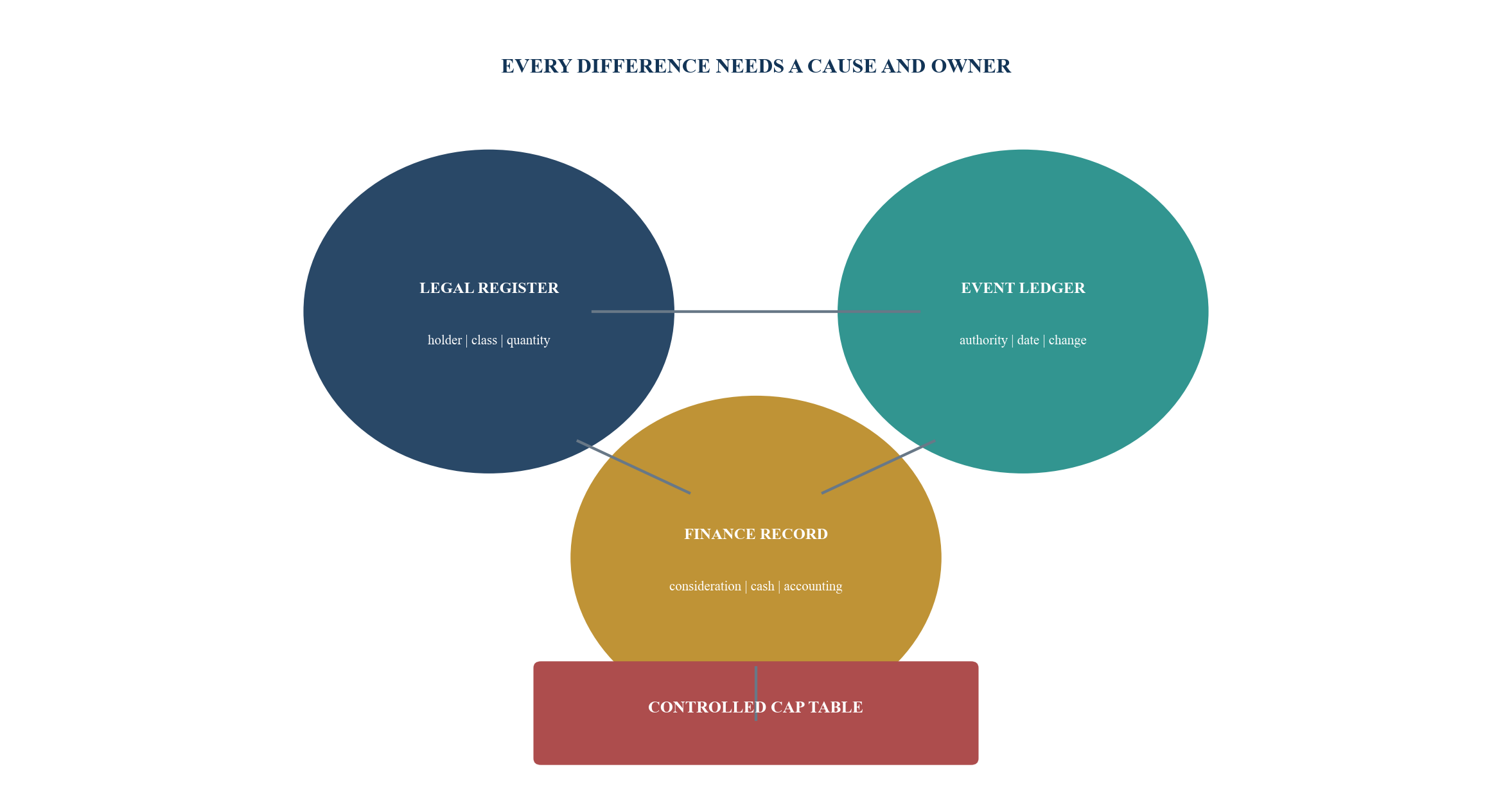
The current cap table is accepted only when legal, event and financial records explain each other.
12. Build an exception score with hard stops
The exception register should rank issues by legal validity, economic impact, closing dependency, affected holders and evidence quality. A large arithmetic variance is not always the highest risk. A small class-right error can change approval or preference outcomes.
Each exception can score severity, probability, detectability and time to cure. The score guides prioritisation. Hard stops override the total. Examples include unresolved validity, uncertainty about the seller's class or quantity, an unapproved rights change, a missing conversion instrument and a closing denominator that cannot be reconciled.
The register should state issue, evidence, affected security, before and after amounts, responsible owner, corrective route, target date and status. It should preserve superseded explanations.
The board and investment committee need a concise view. They should see aggregate reconciled ownership, material rights, open hard stops, quantified dilution range, waterfall sensitivities and recommended conditions.
Table 5. Illustrative corporate-action exception score
| Exception | Legal severity (1-5) | Economic impact (1-5) | Closing dependency (1-5) | Evidence confidence (1-5) | Action |
|---|---|---|---|---|---|
| Series A conversion ratio not updated after split | 4 | 4 | 5 | 2 | hard stop; reconcile terms and ledger |
| two expired options remain in fully diluted model | 2 | 2 | 2 | 4 | correct model and document lapse |
| common certificate uses pre-split quantity | 3 | 2 | 4 | 3 | replace certificate and confirm register |
| option-pool refresh approved but not granted | 2 | 3 | 3 | 5 | separate reserved from granted shares |
| new class rights differ between term sheet and filed instrument | 5 | 5 | 5 | 2 | hard stop; determine executed legal rights |
| holder name differs through documented trust transfer | 3 | 2 | 4 | 3 | complete nominee/trust reconciliation |
Scores are management assumptions; material legal defects require counsel's judgement.
13. Bring down the cap table at signing and closing
A cap table reviewed at the start of diligence can become stale before signing or closing. The company may grant options, accept exercises, issue shares, convert debt, repurchase stock or amend rights. The transaction should define a permitted corporate-action window and bring-down process.
The bring-down should cover all events since the reconciliation date. The company provides an updated event ledger, resolutions, instruments, register extract, option and warrant schedule, convertible schedule and rights confirmation. The deal team reruns dilution and waterfall models.
Transaction documents should define the capitalisation representation carefully. It can cover authorised, issued, outstanding, reserved and rights to acquire shares, as well as liens and commitments. Disclosure schedules identify exceptions. The representation should align with the model rather than use undefined “fully diluted” language.
Closing deliverables can include an officer certificate, current cap table, legal opinion where appropriate, updated ledger instruction and confirmation that specified corporate actions have not occurred. Post-close ownership should be reconciled immediately after registration.
If the transaction itself triggers conversion, exercise, cancellation or rights changes, the closing memorandum should sequence them. The model should show each step and effective time. Simultaneous events can produce different outcomes if ordered differently.
14. Run a ten-day cap-table diagnostic
Days one and two establish the perimeter. The team collects current constitutional documents, amendments, class instruments, ledger, cap table, option and warrant schedules, convertible instruments and recent transaction documents. It defines the valuation or transaction date.
Days three and four build the event ledger from incorporation or the last independently validated baseline. The team classifies issuances, transfers, transformations, retirements and rights changes. It records authority and effective date.
Days five and six reconcile quantities across authorised, issued, outstanding, reserved, fully diluted and as-converted views. It tests splits, exercises, conversions, cancellations and holder-level totals.
Days seven and eight map class rights and run dilution and exit waterfalls. It identifies approvals and hard stops. Counsel reviews potential defects and corrective routes.
Day nine produces the exception score and pro forma transaction bridge. Day ten is the gate meeting: accept the cap table; accept subject to documented conditions; reprice or restructure; delay for cure; or stop.
The ten-day schedule is an operating target. Old companies, multiple jurisdictions, paper records, estates and prior restructurings can require longer. The target creates early transparency about effort and risk.
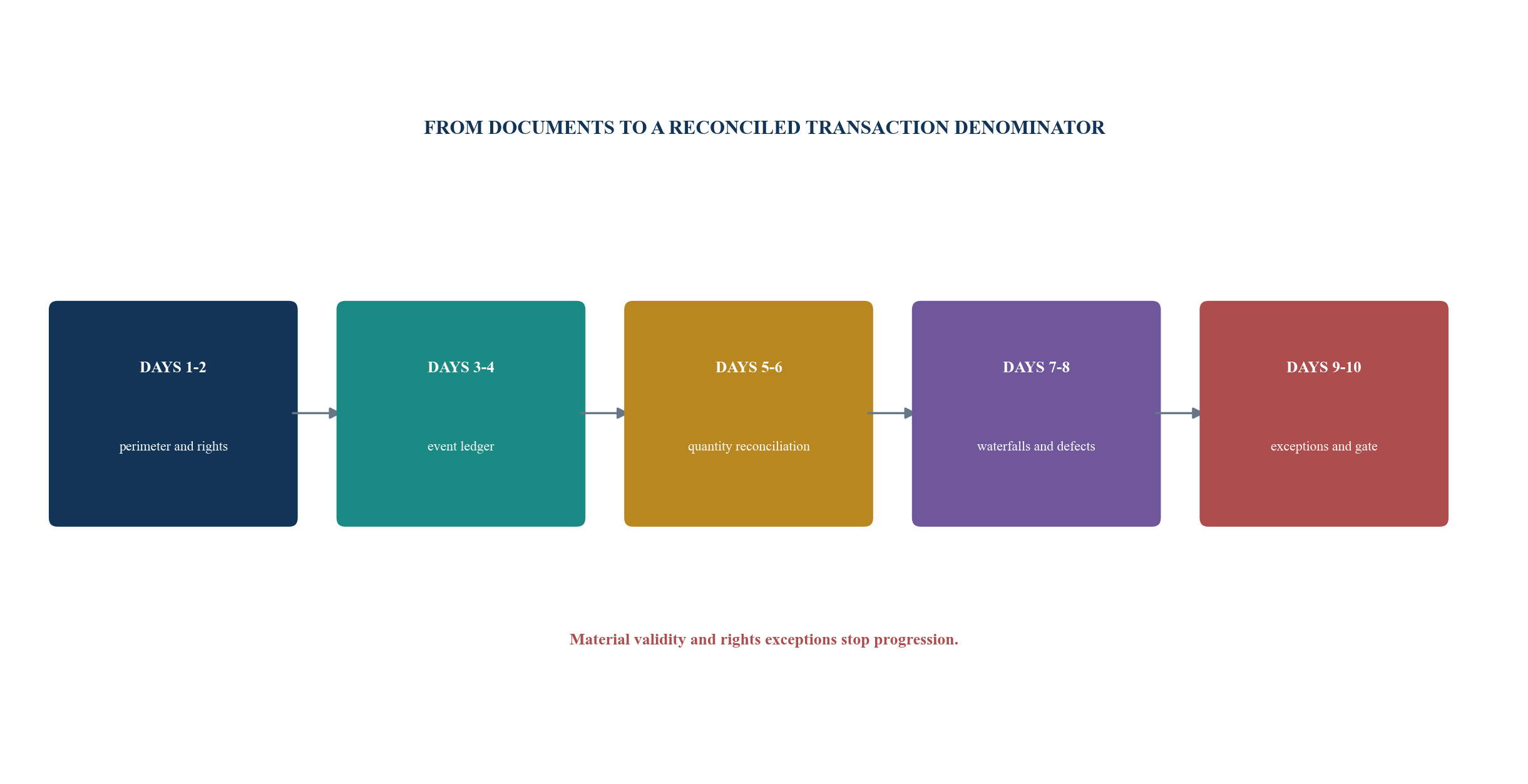
The timetable is an illustrative management target and should be adapted to complexity.
15. Implement a thirty-day control system
The first week establishes ownership and definitions. The company appoints a cap-table owner, legal owner, finance owner and plan-administration owner. It approves share-count definitions, evidence hierarchy, event taxonomy and hard stops.
The second week builds the controlled event ledger and migrates major historical events. Current constitutional documents, class rights, issuances, transfers, splits, conversions, repurchases and cancellations are linked. Open exceptions remain visible.
The third week integrates operating processes. New grants, exercises, financings and transfers cannot update the cap table without an event packet. The company defines approval, effective date, registration, accounting and document-retention steps. Systems receive a unique event identifier.
The fourth week runs a transaction simulation. The team produces a current cap table, fully diluted view, as-converted view, dilution waterfall and exit waterfall; then executes a mock bring-down. Exceptions and elapsed time inform revision.
The control system should be proportionate. A small company can use a well-governed workbook and document repository. A complex company can use specialist software. Technology does not replace legal evidence or accountable ownership.
Table 6. Thirty-day cap-table control implementation plan
| Period | Output | Decision | Evidence of completion |
|---|---|---|---|
| days 1-5 | ownership, definitions and evidence rules | who controls each field and exception? | signed responsibility and data dictionary |
| days 6-10 | event taxonomy and document index | which events change quantity, holder or rights? | approved event templates and source map |
| days 11-15 | historical reconciliation | where do legal, model and finance records differ? | exception register and counsel workplan |
| days 16-20 | workflow integration | what must occur before a system update? | tested approval-to-register workflow |
| days 21-25 | dilution and waterfall models | do rights and denominators reconcile? | reviewed scenario outputs |
| days 26-30 | closing bring-down simulation | can the company support a live transaction? | signed readiness report and remediation plan |
Owners and dates should be assigned for the actual company.
16. Measure transaction readiness and commercial value
Operational metrics include time to record an approved event, percentage of events with complete packets, unreconciled share count, exception ageing, holder-level differences, stale rights documents, and days to produce a closing cap table.
Transaction metrics include time to validate a seller's quantity, time to refresh the fully diluted denominator, number of purchase-price adjustments caused by cap-table issues, closing delays, post-close corrections and disputes.
Commercial metrics include diagnostic mandates, retained remediation work, issuer-readiness engagements, transaction execution mandates, mandate conversion and collected fees. Revenue and demand should be reported from signed and paid evidence. Traffic, downloads and enquiries remain leading indicators.
The control system can create several client services: a ten-day cap-table diagnostic; a corporate-action remediation office; financing or M&A cap-table readiness; option and convertible reconciliation; exit-waterfall analysis; and a closing bring-down workstream. Service scope should identify the roles of legal, tax, accounting and valuation professionals.
The diagnostic should also produce a transaction-dependency map. A debt raise may depend on clean ownership, valid board approvals and evidence that pledged shares or warrants exist. An equity financing may depend on authorised capacity, pre-emption, option-pool treatment and conversion mechanics. A sale process may depend on drag-along thresholds, class votes, rollover quantities and the sequence of preference conversion. A secondary purchase may depend on the seller's precise registered quantity after every split, exercise and transfer. Mapping these dependencies converts remediation from general housekeeping into a closing workplan.
Retained execution can then be divided into controlled workstreams. The evidence workstream assembles and indexes source documents. The reconciliation workstream rebuilds the event ledger and share-count bridge. The rights workstream maintains the class and preference map with counsel. The valuation workstream runs dilution and waterfall sensitivities. The transaction office owns actions, dependencies, approvals and bring-downs. Each workstream should have a defined output, review standard and hand-off.
Ongoing monitoring matters after the immediate transaction. A company that cures historical issues but returns to informal event recording recreates the risk. Monthly or quarterly review can reconcile new grants, exercises, conversions, transfers, cancellations and amendments. Board packs can include an exception dashboard and forthcoming authorised-capital or option-pool needs. A financing or exit process then begins from a maintained baseline rather than another reconstruction.
Quality should be reviewed through completed and failed transactions. The purpose is a defensible ownership and rights answer that supports decisions, not a clean-looking spreadsheet.
17. Conclusion
A private-company cap table is trustworthy when every number can be traced through authorised corporate actions to current legal and economic rights. Issuances, transfers, splits, conversions, redemptions, cancellations and preference amendments each change a different part of the ownership answer.
The corporate-action framework converts a static cap table into an event ledger. It separates share-count definitions, maps evidence, applies transformation rules, preserves class rights, quantifies dilution, models preferences and keeps material exceptions visible.
Jurisdiction affects authority, filings, registration and correction. Delaware, UK and Singapore materials illustrate the need to connect the actual company and security to current law and professional advice.
For investors and deal teams, early reconciliation protects price, voting, title and settlement. For companies, it improves financing and exit readiness. For advisers, it creates a retained path from diagnostic through remediation and transaction execution. Commercial demand and fees remain unverified until evidenced by signed engagements and collected payments.
References
- Delaware Code. Title 8, Chapter 1, Subchapter V: Stock and Dividends, including section 151. https://www.delcode.delaware.gov/title8/c001/sc05/index.html
- Delaware Code. Title 8, Chapter 1, Subchapter VI, including sections 204 and 205. https://delcode.delaware.gov/title8/c001/sc06/
- Delaware Code. Title 8, Chapter 1, Subchapter VIII, including section 242. https://delcode.delaware.gov/title8/c001/sc08/index.html
- UK Parliament. Companies Act 2006. https://www.legislation.gov.uk/ukpga/2006/46/contents
- Companies House. Forms to Update Shares. https://www.gov.uk/government/collections/forms-to-update-shares
- Companies House. Consolidate, Sub-divide, Redeem Shares or Re-convert Stock into Shares, SH02. https://www.gov.uk/government/publications/consolidate-sub-divide-redeem-shares-or-re-convert-stock-into-shares-sh02
- Companies House. Life of a Company, Event-driven Filings. https://www.gov.uk/government/publications/life-of-a-company-event-driven-filings/life-of-a-company-part-2-event-driven-filings
- UK Government. Make Changes to Your Private Limited Company: Shares. https://www.gov.uk/make-changes-to-your-limited-company/share-structure
- Accounting and Corporate Regulatory Authority Singapore. Filing a Conversion of Shares. https://www.acra.gov.sg/manage/companies/shares/conversion-of-shares/
- Accounting and Corporate Regulatory Authority Singapore. Filing a Transfer of Shares. https://www.acra.gov.sg/manage/companies/shares/transfer-of-shares/
- Accounting and Corporate Regulatory Authority Singapore. Company Registers: Requirements and Deadlines. https://www.acra.gov.sg/manage/companies/legal-requirements-common-offences/maintaining-local-companys-information-registers/company-registers/
- US Securities and Exchange Commission. Private Secondary Markets. https://www.sec.gov/resources-small-businesses/capital-raising-building-blocks/private-secondary-markets
- US Securities and Exchange Commission. Filed securities terms illustrating conversion and anti-dilution provisions. https://www.sec.gov/Archives/edgar/data/1703956/000114420418048609/tv502224_ex10-6.htm
- US Securities and Exchange Commission. Filed securities terms illustrating liquidation preference adjustments. https://www.sec.gov/Archives/edgar/data/1640967/000162828025039176/R18.htm
About the Author
Chennakeshav Adya, Independent Researcher
