

1. Deliverability is the first investment question
A pre-IPO secondary transaction joins two private assets: a security that may be difficult to identify and transfer, and cash that may be conditional, restricted or operationally unavailable. Price negotiation can proceed for weeks while these basic facts remain unproved. The result is false momentum. The parties agree valuation, commission advisers and disclose information, then discover that the seller is not the registered holder, the issuer will not consent, a right of first refusal has not run, the buyer lacks authority, or the proposed settlement account cannot receive or release the assets.
Possession in this paper means the demonstrated ability to cause valid delivery under the actual transaction documents and applicable law. It is broader than holding a certificate or showing a bank screenshot. A seller must connect economic ownership to legal title, security identity, transferability and settlement instruction. A buyer must connect capital to identity, authority, source, availability and a controlled payment route.
The first decision is therefore whether both sides can perform. Valuation belongs after that evidence reaches a defined threshold. This sequence protects scarce diligence time, reduces unnecessary disclosure, limits fraud exposure and gives the issuer a cleaner consent request.
The framework has four gates. Gate one identifies the asset and parties. Gate two proves the seller's chain of title and transfer path. Gate three proves the buyer's authority and funds-control path. Gate four joins cash and title in a settlement architecture. A transaction advances to detailed price negotiation only when material exceptions have an owner, evidence request and resolution date.
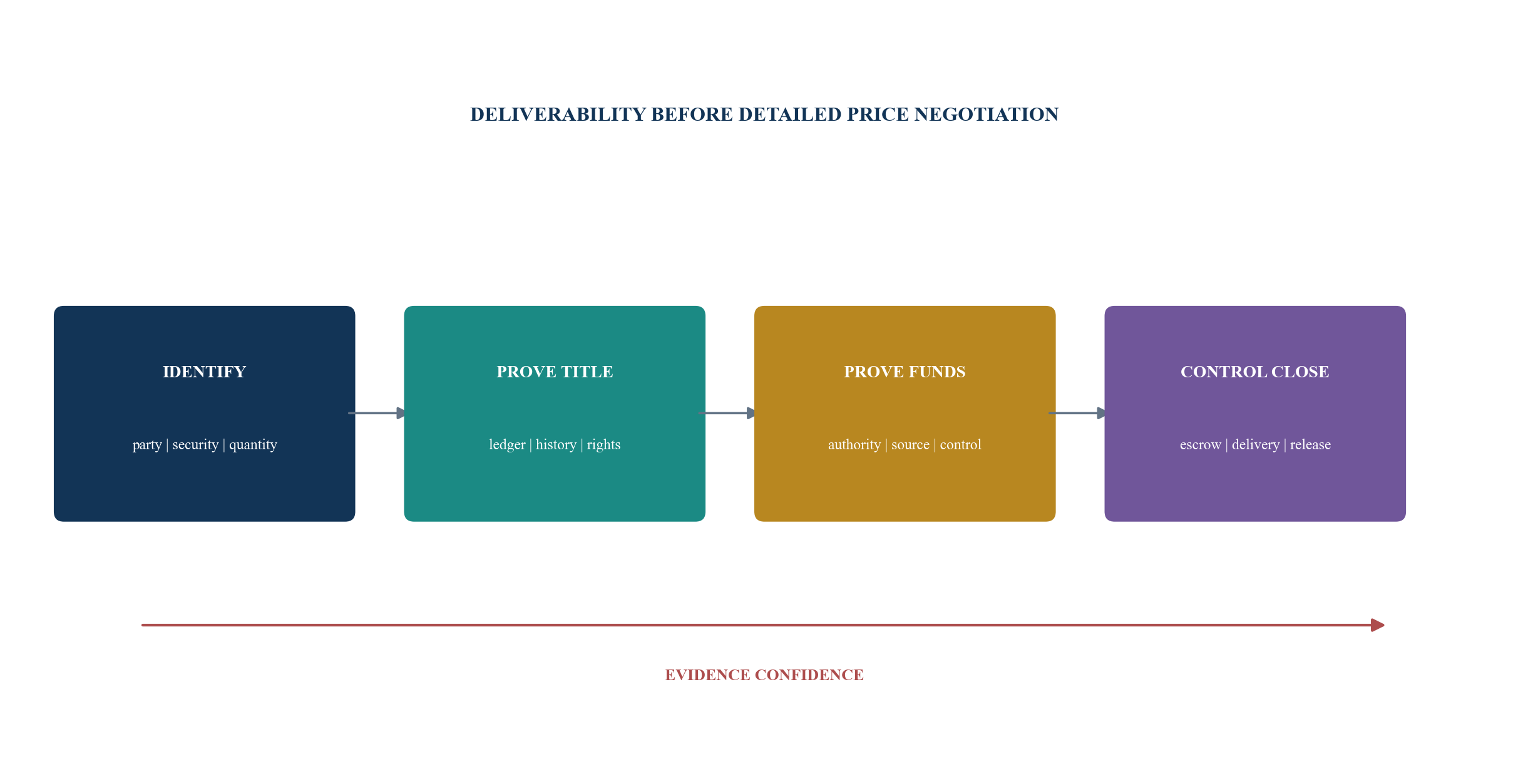
Each gate requires transaction-specific evidence; progression is conditional on resolving material exceptions.
2. Separate economic exposure, legal title, transferability and control
The phrase “I own the shares” can describe several different positions. A person may be the registered holder on the company's stock ledger. The person may be the beneficial owner behind a nominee. The person may own interests in a vehicle that owns the company shares. An employee may hold vested options that have not been exercised. A broker or platform account may display an economic position while another entity holds legal title. A forward contract can create economic exposure without current ownership of the underlying shares.
These positions are not interchangeable. The Delaware General Corporation Law defines the stock ledger as records containing stockholders of record and the shares registered to them. Transfer restrictions can arise from the certificate of incorporation, bylaws or agreements and may bind a transferee in specified circumstances. In the United Kingdom, the register of members records registered share ownership; official model articles state that the transferor remains the holder until the transferee enters that register. In Singapore, ACRA states that a private-company transfer takes effect when the Electronic Register of Members is updated.
Transferability is a separate question. Registered title does not remove a right of first refusal, board-consent requirement, co-sale provision, securities-law restriction, lien, pledge or contractual prohibition. A valid contract between buyer and seller may still require issuer action before legal title changes.
Control is the final layer. The seller must be able to execute the required instrument, obtain necessary consent and instruct the relevant registrar, custodian, nominee or vehicle. The buyer must be able to transmit cleared funds from an acceptable account through an agreed settlement route. Each layer needs its own evidence.
Table 1. Four layers of possession
| Layer | Core question | Typical evidence | Frequent failure |
|---|---|---|---|
| economic exposure | who bears gains and losses? | subscription, award, option, trust, nominee, vehicle or derivative documents | exposure described as direct share ownership |
| legal title | whose name appears in the controlling ownership record? | issuer ledger, register of members, custodian statement or vehicle register | certificate or platform display conflicts with register |
| transferability | may this asset move to this buyer now? | constitutional documents, shareholder agreements, legends, waivers and legal analysis | consent, right of first refusal, holding period or lien overlooked |
| settlement control | can the parties cause asset and cash delivery? | authorised instructions, account verification, escrow agreement and closing checklist | signer lacks authority or account cannot support settlement |
The applicable evidence depends on the security, holding route and jurisdiction.
3. Define the transaction perimeter before requesting documents
Evidence requests should follow the proposed transaction. A direct sale of common shares by a registered holder differs from a sale of preferred shares, exercised employee shares, unexercised options, restricted stock units, warrants, fund interests or units in a special-purpose vehicle. The identity of the asset determines which register matters, which consents apply and which rights move.
The parties also matter. An individual, trust, estate, partnership, fund, nominee and corporate seller present different authority and beneficial-ownership questions. A buyer using its own balance sheet differs from a fund subject to mandate limits, a special-purpose vehicle awaiting subscriptions, or a financed buyer whose lender controls drawdown.
The perimeter should specify issuer jurisdiction, security class, quantity, acquisition history, current registered holder, beneficial owner, proposed buyer, funding source, intermediary roles, governing agreements and target closing route. It should also identify whether the issuer is participating, consenting, providing information or remaining outside the negotiation.
The SEC describes private secondary markets as transactions in which investors sell private securities to other investors and explains that restricted securities are not freely tradable merely because a willing buyer exists. A resale route under federal securities law, including a possible Rule 144 pathway or another exemption, must be established for the specific facts. State law and contractual restrictions can remain relevant.
The perimeter memo should remain short. Its purpose is to stop the parties from collecting impressive but irrelevant documents. A direct share sale needs evidence about the issuer ledger and transfer path. A vehicle-interest sale needs the vehicle register, governing agreement, underlying ownership evidence and a clear statement of which rights remain at each layer.
4. Build the seller's proof packet
A seller proof packet should trace the asset from issuance or acquisition to current delivery. The minimum file normally begins with the acquisition instrument: subscription agreement, grant notice, exercise notice, purchase agreement, transfer form, distribution document or conversion evidence. It then records payment, vesting or exercise; subsequent splits, conversions and recapitalisations; transfers to trusts or vehicles; and the current registered position.
The issuer ledger or legally relevant register has priority over a seller-created spreadsheet. A share certificate can support the chain, but it may be stale, replaced, cancelled, pledged or inconsistent with later corporate actions. The seller should reconcile certificate numbers, class, quantity and holder name to the current register.
Authority evidence depends on the seller. A company may require constitutional documents, board authority and authorised signatories. A fund may require general-partner or investment-manager authority. A trust may require the trust instrument and trustee authority. An estate may require probate or equivalent evidence. A nominee arrangement needs the agreement linking registered and beneficial owners and defining who can instruct transfer.
The packet should include transfer restrictions and evidence of compliance. These can include board consent, issuer consent, rights of first refusal, co-sale notices, lock-ups, investor-rights provisions, shareholder approvals, waiver letters and securities-law analysis. The absence of a visible restriction on one document does not establish unrestricted transferability.
Each document should be independently sourced or confirmed where proportionate. The deal team should obtain issuer or registrar confirmation through a verified channel, check entity records and verify signatories. A redacted preliminary packet can protect sensitive data; unredacted evidence may be released to counsel, escrow or another controlled reviewer at the relevant gate.
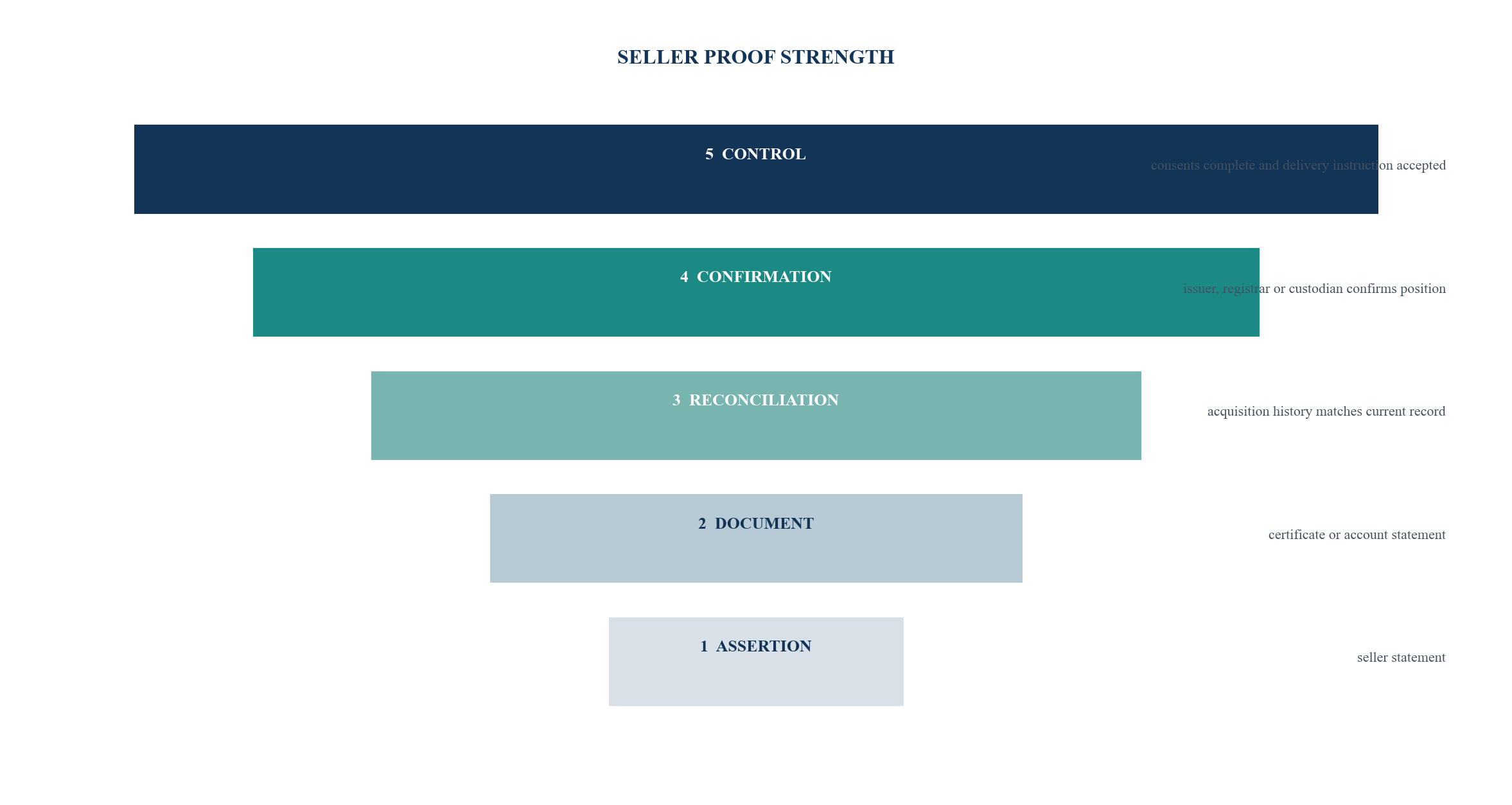
Higher levels provide stronger evidence; transaction-specific legal analysis remains required.
5. Treat transfer restrictions as an execution path
Transfer restrictions should be converted from legal prose into an execution sequence. A right of first refusal can require notice, a waiting period, matching mechanics and evidence of waiver. Board consent can require a meeting, written resolution or delegated approval. A co-sale right can change the available quantity. A prohibition on transfers to competitors, sanctioned persons or specified investor types can disqualify the proposed buyer.
Delaware law permits specified restrictions on transfer or registration, including requirements to offer securities to the corporation or other holders and requirements for consent or approval. The actual restriction can sit in several documents. The deal team should map the hierarchy and confirm that the holder and transferee received legally relevant notice.
The UK path can require an executed stock transfer form, stamp-duty analysis and registration by the company. HMRC guidance states that the buyer may need to pay Stamp Duty within 30 days and send the transfer form and relevant evidence to the registrar so the new ownership can be registered. Company articles can permit directors to refuse registration. The commercial closing schedule must allow for these steps.
Singapore presents another registration model. ACRA states that shares must be fully paid, the transfer must comply with the constitution, and the transfer takes effect after the Electronic Register of Members reflects it. The process requires a proper instrument of transfer and specified information. A signed sale agreement alone does not complete the ownership change.
The transfer map should identify condition, evidence, responsible party, decision-maker, earliest action date, outside date and consequence of failure. Price can then reflect known execution friction rather than a vague “illiquidity discount.”
Table 2. Transfer-path control matrix
| Control | Evidence | Owner | Timing consequence | Closing treatment |
|---|---|---|---|---|
| issuer or board consent | signed resolution or consent letter | issuer counsel/company secretary | meeting or notice period | condition precedent |
| right of first refusal | compliant notice, expiry or waiver | seller counsel | contractual election period | outside date and termination right |
| co-sale or participation | eligible-holder notices and final quantity | issuer/seller | quantity remains variable | price and quantity adjustment |
| securities-law route | current legal memorandum or opinion | transaction counsel | holding period or disclosure work | condition and representation |
| stamp or transfer tax | calculation, payment and confirmation | tax adviser/buyer | registration may wait | cash reserve and delivery evidence |
| register update | accepted instruction and updated record | registrar/company secretary | legal title changes only after entry in some regimes | release condition or post-close covenant |
The matrix should be completed by qualified advisers for the specific transaction.
6. Replace proof of funds with proof of funds control
A bank statement shows a balance at a point in time. It may not show who can use the money, whether it is pledged, whether it sits in the proposed buyer's account, whether an investment committee must approve the transaction, whether subscriptions are callable, whether financing conditions remain, or whether the bank will process the payment.
The buyer proof packet should connect six facts. First, the legal buyer and the account holder must reconcile. Second, the beneficial owner and source of funds must be understood to the level required by law and risk policy. Third, the buyer must have authority under its governing documents and mandate. Fourth, the amount must be available after fees, tax, hedging and reserves. Fifth, any financing or capital call must have satisfied its conditions. Sixth, the payment route must be operationally verified.
Proof should advance through stages. A preliminary bank letter or custodian statement can support initial screening. Investment-committee approval, a binding capital-call response, an executed financing agreement or funds placed in escrow provides stronger evidence. The strongest point is cleared money under an agreed release mechanism.
FATF guidance emphasises adequate, accurate and current beneficial-ownership information for legal persons. That principle is directly relevant when a buying vehicle sits within a multi-jurisdictional ownership chain. Source-of-funds and beneficial-ownership checks should begin before sensitive issuer information is released.
Bank evidence should be exchanged through secure channels. Account numbers and personal information should be minimised. Independent callback or portal verification should use contact details obtained separately from the evidence under review. Screenshots and forwarded emails should remain weak evidence until independently confirmed.
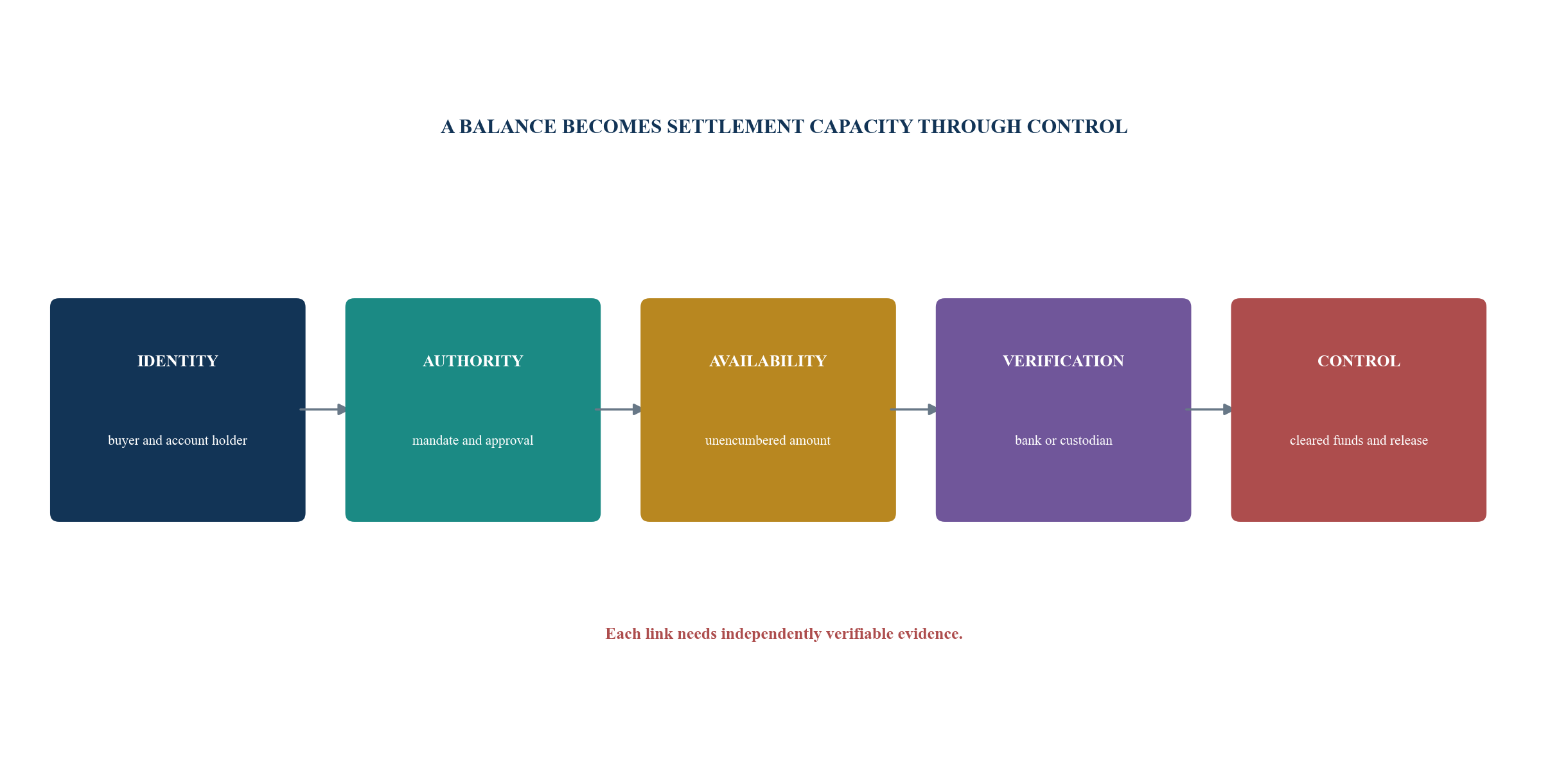
The strength of evidence increases from left to right; requirements vary by buyer and transaction.
7. Score two-sided deliverability before releasing full diligence
A deliverability score converts the evidence file into a controlled decision. It should not replace legal judgement. It should make gaps visible and prevent a strong valuation story from obscuring an inability to close.
The seller side can score asset identity, registered title, acquisition history, authority, transfer permissions, securities status and delivery route. The buyer side can score identity, beneficial ownership, mandate, approval, funds availability, independent verification and payment route. Each category can receive a score from zero to three: absent, asserted, documented or independently confirmed and controlled.
Material items should also carry hard stops. An unresolved registered-holder mismatch, suspected forgery, missing transfer authority, unverified buyer identity or request to pay an unrelated third party should stop progression regardless of aggregate score. A high total cannot average away a critical defect.
The information-release protocol can follow the score. A low-confidence counterparty receives public or limited information. A medium-confidence party may receive a redacted data room after confidentiality and identity checks. Full transaction materials follow completion of defined evidence and compliance gates. This sequencing reduces data leakage and signals discipline to serious counterparties.
The score should record evidence date and reviewer. Private-company evidence can become stale quickly. Capital can move, approvals can expire, corporate actions can change quantities, and a proposed buyer vehicle can be replaced. Refresh rules should be set at the start.
Table 3. Illustrative two-sided deliverability score
| Domain | Weight | Seller score (0-3) | Buyer score (0-3) | Weighted result | Required action |
|---|---|---|---|---|---|
| identity and authority | 20% | 3 | 2 | 1.67 / 2.00 | complete buyer approval evidence |
| asset or funds existence | 25% | 2 | 2 | 1.67 / 2.50 | obtain issuer and bank confirmation |
| transfer or payment route | 20% | 1 | 2 | 1.00 / 2.00 | resolve consent and registrar sequence |
| legal and compliance route | 15% | 2 | 2 | 1.00 / 1.50 | finalise transaction-specific advice |
| settlement control | 20% | 1 | 1 | 0.67 / 2.00 | execute escrow and release instructions |
| total | 100% | 6.01 / 10.00 | remain in conditional diligence |
Scores are management assumptions created solely to demonstrate the method. Critical defects override the total.
8. Design settlement around simultaneous control
The settlement objective is to minimise the period in which one party has delivered while the other has not. Public markets achieve this through standardised infrastructure. Private-company transactions often rely on bespoke documents, issuer action, escrow, custodians, company secretaries and manual instructions.
A controlled close begins with a closing memorandum. It identifies every deliverable, responsible party, recipient, form, verification method and release condition. It distinguishes documents that can be signed in advance from items that must be current at closing. It defines which party determines satisfaction and what happens if a condition fails.
Escrow can reduce principal risk when structured for the transaction. The escrow agent's role, account, permitted investments, fees, identity checks, dispute procedure and release instructions should be documented. The parties should understand whether the agent holds money, documents, securities or only instructions. A generic “funds in escrow” statement does not establish that the shares can be delivered.
Where regulated intermediaries hold client money or safe-custody assets, applicable rules matter. The FCA states that firms holding or controlling client money or custody assets must follow its Client Assets Sourcebook. SEC customer-protection requirements address possession or control of specified customer securities and reserve treatment for customer cash in the regulated broker-dealer context. These regimes should not be assumed to apply to every private transaction; the service provider's status and actual activity determine the analysis.
Release can follow a delivery-versus-payment logic: cash is confirmed in the agreed account; transfer documents and consents are complete; the registrar, issuer or custodian accepts the instruction; and the release authority confirms the conditions. In jurisdictions where registration occurs after the instruction, the agreement needs appropriate holdback, undertaking, trust or reversal mechanics based on legal advice.
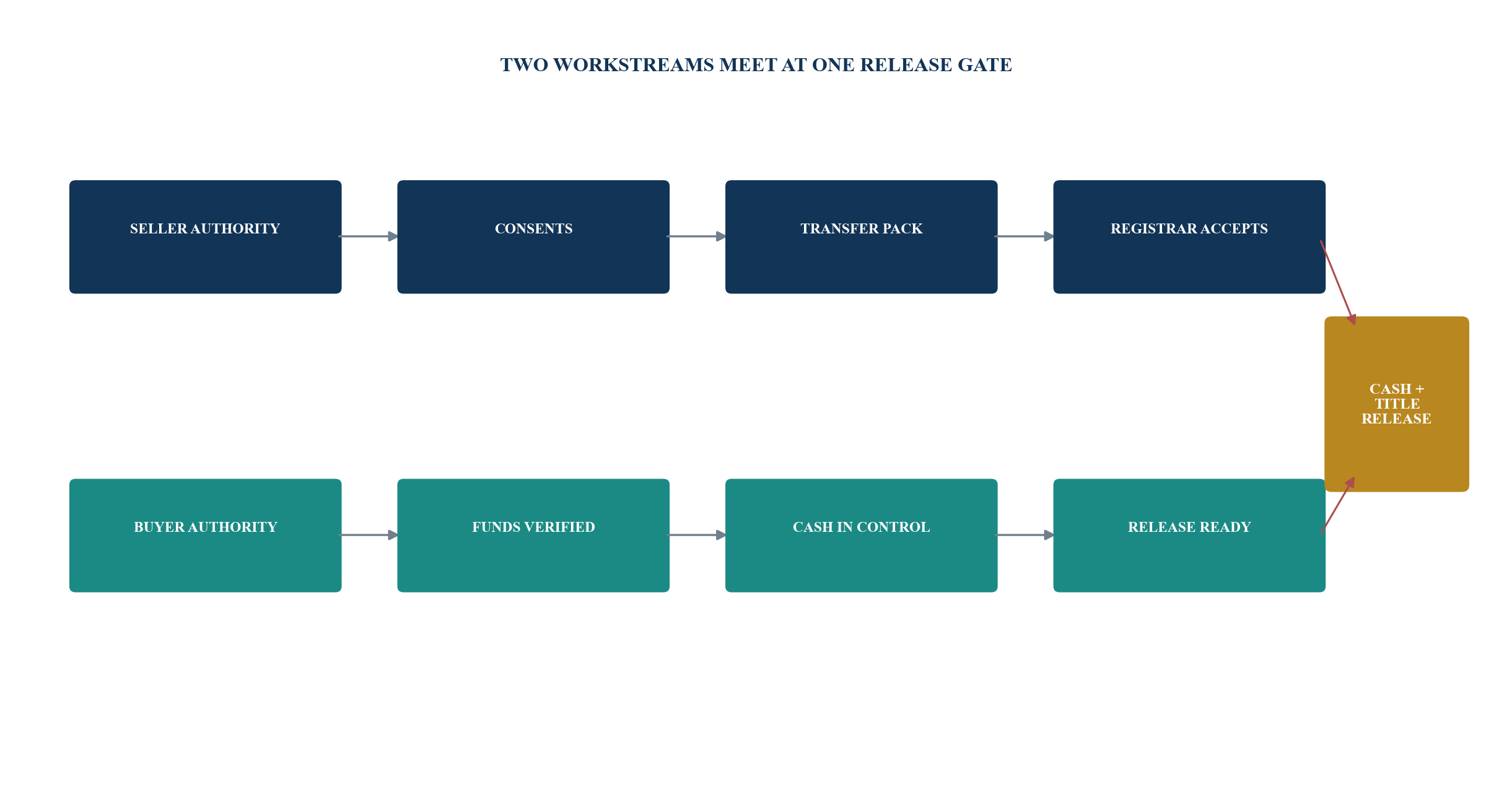
The ordering is illustrative; local law and service-provider procedures determine the final sequence.
9. Control intermediaries, custody and client assets
Private-company transactions can involve brokers, finders, platforms, placement agents, custodians, escrow agents, transfer agents, company secretaries and lawyers. A familiar brand or polished portal does not answer which entity is contracting, regulated, holding assets or responsible for settlement.
The parties should map each intermediary's legal entity, jurisdiction, licence or registration where applicable, contractual role, compensation, conflicts, custody responsibility, professional indemnity and complaint route. They should verify the entity through official registers and use independently sourced contact details.
FINRA states that firms recommending private placements must conduct adequate due diligence and a reasonable inquiry of the issuer and offering. Its materials also identify escrow handling and independent verification as relevant controls in applicable transactions. These obligations do not transfer automatically to every adviser; they illustrate the importance of knowing who owes which duty.
Custody language requires precision. An adviser who introduces parties may not hold client assets. A platform may provide workflow while a separate regulated firm holds cash or securities. An escrow agent may hold only funds. A nominee may remain the registered holder after the economic interest changes. The closing memorandum should reflect the actual allocation.
Fee flows need the same scrutiny as principal. Commissions, platform fees, legal fees, taxes and withholding should have documented recipients and calculations. Requests to redirect fees or proceeds shortly before closing are high-risk exceptions and should trigger independent reverification.
10. Look through vehicles, nominees and beneficial owners
Layered holding structures are common in private markets. They can support administration, pooling, succession, regulatory treatment or co-investment. They also create a risk that the marketed asset differs from the legal asset. A seller of vehicle units may describe exposure to a company while the buyer receives rights only under the vehicle agreement.
The evidence file should map every layer from natural-person beneficial owners through holding companies, trusts, partnerships, nominees and special-purpose vehicles to the underlying security. It should show voting, economic, information, distribution and transfer rights at each layer. It should also identify leverage, liens, side letters, carried interest, fees and other claims on proceeds.
FATF's beneficial-ownership guidance supports adequate, accurate and up-to-date information on the true owners of legal persons. For a transaction, that information helps compliance teams understand who controls the buyer and seller, who benefits from proceeds and whether sanctions, anti-money-laundering or conflict checks reveal concerns.
Nominee evidence should include the nominee agreement, beneficial-owner record, instruction rights and any restriction on disclosure or transfer. The issuer may recognise only the nominee. The buyer should understand whether it will become a beneficial owner under the same nominee, acquire direct title, or acquire an interest in a new vehicle.
The vehicle documents should define the closing asset precisely. If the underlying shares will remain in place, issuer consent to a vehicle-interest transfer may still be required under change-of-control, indirect-transfer or beneficial-ownership provisions. The relevant agreement and counsel advice should decide.
Table 4. Look-through evidence for layered ownership
| Layer | Registered holder | Beneficial owner | Transfer instrument | Key control |
|---|---|---|---|---|
| operating company | nominee or vehicle | vehicle investors indirectly | issuer share-transfer instrument | issuer register, consent and security restrictions |
| special-purpose vehicle | general partner, manager or member record | fund, family office or individuals | unit or interest transfer | governing agreement and manager approval |
| nominee account | nominee | named beneficial holder | nominee instruction | verified beneficial-owner ledger and authority |
| trust | trustee | beneficiaries under trust terms | trustee instrument or underlying transfer | trustee powers and relevant approvals |
| buyer vehicle | newly incorporated entity | sponsor and investors | subscription and funding documents | beneficial ownership, mandate and bank account |
The table distinguishes the legal asset from the marketed economic exposure.
11. Negotiate price after a deliverability range is known
Possession evidence changes value. A directly registered, consented and settlement-ready share can have lower execution risk than an indirect interest with uncertain rights, unresolved title or a long approval path. A fully funded buyer with completed authority offers greater closing certainty than a higher-priced buyer dependent on uncommitted capital.
The price bridge should therefore include security rights, transfer friction, expected time, probability of closing, settlement costs and residual claims. It should distinguish a price discount from an expected-value adjustment. A low-quality asset should not be made investable through a larger discount when ownership or legality remains unresolved.
Seller certainty also has value. A seller may accept a lower price from a verified buyer who can close promptly, preserve confidentiality and meet issuer requirements. The trade-off should be quantified. The seller can compare headline price, probability of completion, time to cash, fees, tax, financing risk and information leakage.
The buyer should calculate expected delivered value rather than advertised value. If a USD 10 million block has an 80% probability of consent, 90% probability of seller delivery after consent and 95% probability of buyer funding, the joint probability under a simplified independent-events assumption is 68.4%. That calculation is a management scenario, not an observed probability, and the independence assumption may be unrealistic. Its purpose is to expose the cost of unresolved gates.
Once both sides reach the evidence threshold, negotiation can focus on business value, security economics and allocation of known risks. Repricing remains available if evidence later changes.
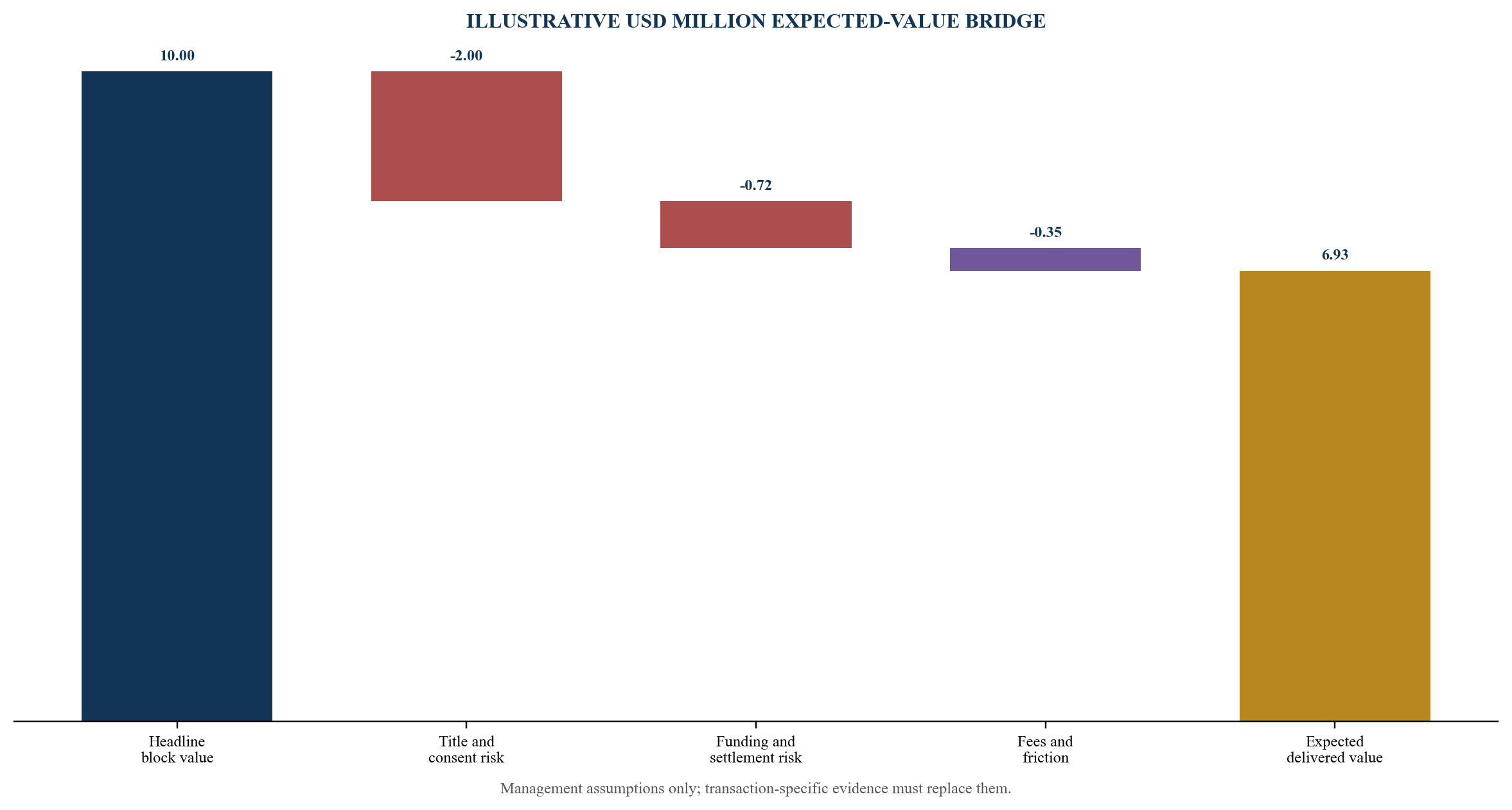
Values and probabilities are illustrative management assumptions; dependencies between risks can change the result.
12. Use a red-flag protocol that pauses the deal
Certain exceptions require a pause rather than another explanatory email. Seller red flags include a mismatch between the marketed holder and issuer ledger, altered certificates, unexplained breaks in acquisition history, refusal to permit issuer confirmation, inconsistent quantities, undisclosed liens, pressure to avoid consent and instructions to pay an unrelated account.
Buyer red flags include identity changes, newly substituted vehicles, bank evidence that cannot be independently verified, capital subject to undisclosed approval, unexplained third-party funds, requests for excessive issuer information before identity checks, refusal to use controlled settlement, and urgent changes to payment routing.
Intermediary red flags include unclear legal entity, unverifiable registration, payment to personal accounts, fee changes near closing, reluctance to disclose conflicts, use of free email accounts for sensitive instructions, and claims of guaranteed issuer consent or guaranteed allocation.
The protocol should define who can pause the transaction, who investigates, what evidence resolves the issue and how the decision is recorded. Compliance, legal, transaction and senior-management roles should be explicit. The team should preserve documents and communication rather than confronting a suspected fraudster in a way that destroys evidence or increases risk.
Cyber controls are part of settlement. Payment instructions should be verified using an independent channel. Last-minute changes should trigger enhanced review. Access to the data room should be role-based, logged and revoked after the process. Sensitive identity and bank evidence should have a defined retention and deletion policy.
Table 5. Stop, investigate and release protocol
| Trigger | Immediate control | Evidence required to release | Decision owner |
|---|---|---|---|
| holder mismatch | pause diligence and settlement | issuer or registrar confirmation plus chain reconciliation | transaction counsel |
| payment-route change | freeze instruction | independent callback and verified written authority | finance/compliance |
| unexplained third-party funds | reject transfer pending review | beneficial owner, source and lawful payment rationale | compliance officer |
| altered or inconsistent document | preserve file and stop reliance | original-source confirmation and forensic review where proportionate | legal/compliance |
| substituted buyer vehicle | suspend information access | refreshed identity, mandate, ownership and funds evidence | deal lead/compliance |
| unresolved consent | no binding close or cash release | executed consent, waiver or legally supported alternative | issuer/transaction counsel |
Regulatory and law-enforcement escalation depends on the facts and jurisdiction.
13. Design the evidence room around decisions
The evidence room should support decisions rather than accumulate files. A structured index can use five workstreams: party identity and authority; asset identity and title; transferability and compliance; funds and payment route; settlement and post-close registration.
Each item should have owner, source, date, status, reviewer and exception. Status should distinguish missing, received, reviewed, independently confirmed, superseded and closed. The team should avoid labelling a document “verified” when it was only received.
Evidence provenance matters. An issuer-supplied ledger extract has different weight from a seller spreadsheet. A bank letter delivered through a verified institution channel differs from an image embedded in an email. A government register can confirm entity facts while leaving beneficial ownership, authority or asset ownership unanswered.
The data room should contain a decision log. It records why the asset was accepted, which restrictions apply, how funds were verified, who approved exceptions and which conditions remain. This improves handover and creates a defensible record if personnel change or closing is delayed.
Access should follow need. Preliminary counterparties receive limited materials. Counsel, compliance and escrow can receive controlled identity and account evidence. Highly sensitive documents can be viewed without download. Watermarking, access logs and expiry can reduce leakage.
14. Run a ten-day possession diagnostic
The diagnostic begins with a one-page perimeter memo and evidence request. Days one and two identify the asset, parties, jurisdiction, holding route, proposed consideration and target settlement. The team opens the evidence matrix and applies the first hard-stop screen.
Days three and four reconcile seller title. Acquisition documents, payment, corporate actions, ledger or register, nominee arrangements and transfer restrictions are compared. The team identifies necessary issuer, registrar, custodian or manager confirmations.
Days five and six assess the buyer. Identity, beneficial ownership, mandate, approval path, source, availability and payment route are documented. Preliminary compliance checks and independent contact verification are completed.
Days seven and eight map the transfer and settlement path. Counsel identifies consents, notices, taxes, instruments and registration steps. Escrow or custody providers confirm procedures and timing. The team drafts the closing memorandum.
Day nine applies the deliverability score and critical-defect review. The parties receive a concise exception list with evidence required, owner and date. Day ten is the gate meeting: proceed to detailed commercial diligence and price; remain in conditional diligence; restructure the asset or settlement route; or stop.
The ten-day period is an operating target, not a legal deadline. Complex estates, trusts, old employee grants, multi-layer vehicles and cross-border approvals can require longer. The benefit is early visibility, not forced certainty.
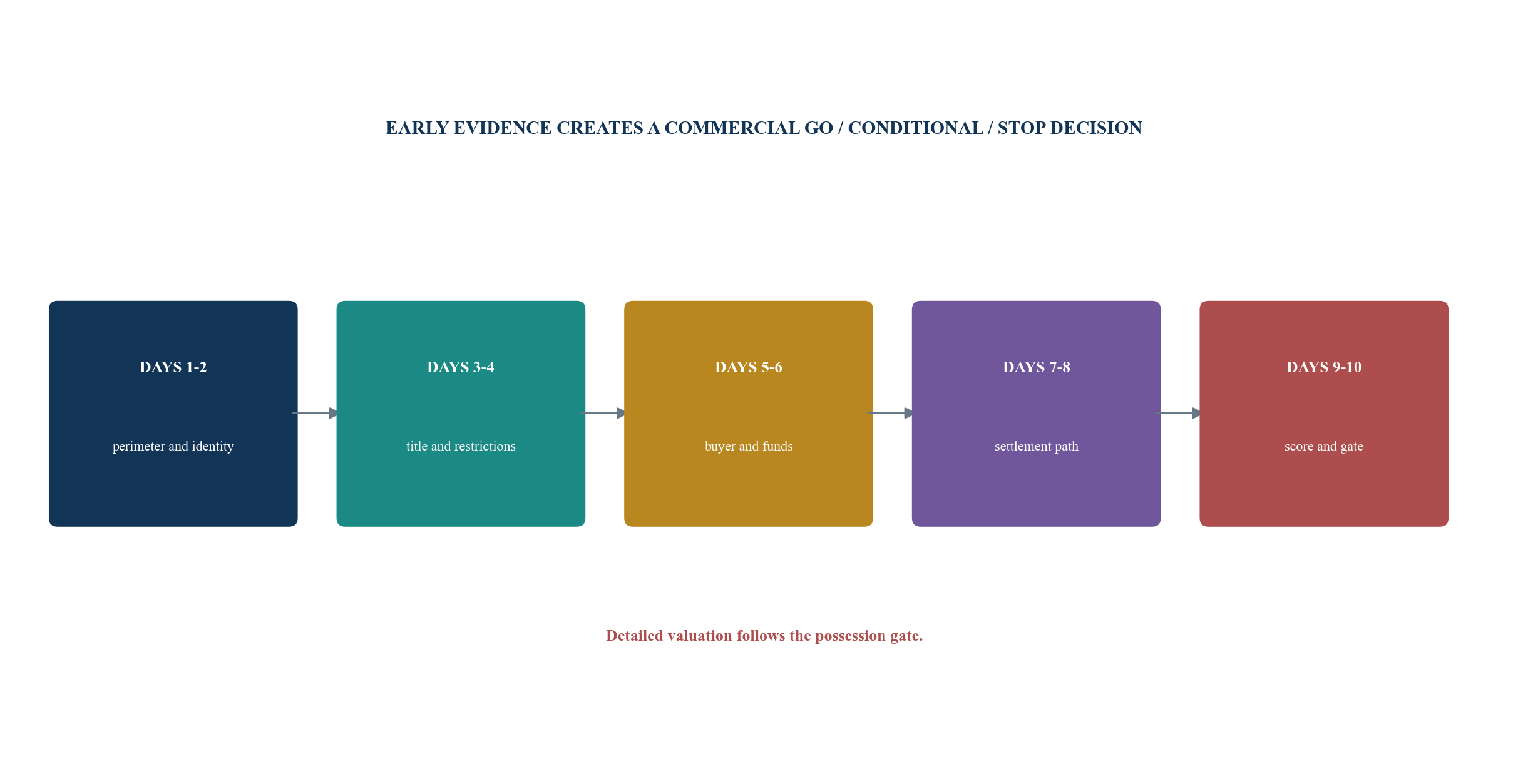
The timetable is an illustrative management operating target and should be adapted to complexity.
15. Implement a thirty-day transaction-control system
The first week establishes governance. The sponsor appoints a transaction lead, legal lead, compliance reviewer, finance owner and settlement owner. The team approves the perimeter template, hard stops, evidence matrix, information-release tiers and escalation protocol.
The second week standardises seller and buyer proof packets. The team creates document requests for direct shares, employee securities, trusts, estates, nominees and vehicle interests. It creates buyer requests for balance-sheet capital, funds, special-purpose vehicles and financed buyers. Templates remain adaptable to jurisdiction.
The third week integrates service providers. Issuer, registrar, company secretary, custodian, escrow, bank and adviser roles are mapped. Secure verification channels are tested. The closing memorandum, payment callback, data-room permissions and incident response are rehearsed.
The fourth week runs a live or simulated case. The team measures elapsed time, missing evidence, reviewer effort, exceptions, counterparties lost and control failures. It then updates the thresholds and templates.
Implementation should preserve judgement. A checklist can identify absence but cannot determine every legal effect. Qualified advisers should interpret securities, company, tax, sanctions, anti-money-laundering, custody and data-protection requirements.
The system should serve commercial conversion. Serious counterparties receive a clear route to readiness. Weak or fraudulent processes become visible before the firm invests extensive senior time. The evidence system can also support an issuer-consent package, investment-committee memorandum, settlement workplan and post-close record.
Table 6. Thirty-day implementation plan
| Period | Output | Decision | Evidence of completion |
|---|---|---|---|
| days 1-5 | governance, hard stops and perimeter template | who can progress, pause and approve exceptions? | signed responsibility matrix and protocol |
| days 6-10 | seller and buyer proof packets | which evidence is mandatory by asset and buyer type? | approved request lists and secure channels |
| days 11-15 | deliverability score and release tiers | when does detailed information and valuation begin? | tested scoring and access rules |
| days 16-20 | transfer and settlement playbooks | how do cash and title reach control? | provider-confirmed closing memorandum |
| days 21-25 | simulated or live pilot | where does the process fail? | exception and elapsed-time report |
| days 26-30 | revision and operating launch | which controls become standard? | approved version, training and review calendar |
Owners and dates should be assigned for the actual organisation.
16. Measure conversion, control and closing quality
Metrics should distinguish commercial activity from transaction readiness. Enquiries, introductions and signed confidentiality agreements are leading indicators. Verified counterparties, completed proof packets, issuer-consent readiness, investment-committee approval, controlled funds, executed trades and collected fees show deeper progression.
Useful process metrics include time to perimeter memo, time to independently confirmed title, time to verified funds authority, exception count, exception ageing, issuer response time, settlement breaks, payment-instruction changes and post-close register completion.
Commercial metrics include qualified-opportunity rate, mandate conversion, retained-fee conversion, success-fee conversion, average senior hours before the possession gate, and collected fees per completed transaction. These measures show whether the operating system is concentrating effort on counterparties and transactions with evidence of deliverability.
The firm should review false positives and false negatives. A process that rejects viable counterparties wastes opportunity. A process that advances non-deliverable parties wastes diligence and creates risk. Thresholds should be calibrated using documented outcomes.
No metric should reward bypassing control. Faster closing has value only when identity, title, transfer and payment evidence remain adequate. Quality review should examine a sample of completed and abandoned files.
17. Conclusion
Private-company secondary value cannot be separated from delivery. A seller's economic exposure, registered title, transferability and settlement control are different facts. A buyer's balance, authority, source, availability and payment control are also different facts. Each needs evidence.
The possession-before-price framework creates a disciplined sequence: define the asset and parties; prove title; prove funds control; design settlement; then invest fully in price and detailed diligence. It supports faster rejection of weak processes and clearer progression for serious counterparties.
Jurisdiction matters. Delaware stock-ledger and transfer rules, UK registration and stamp processes, Singapore's electronic register, and regulated client-asset regimes illustrate why a generic checklist is insufficient. The operating system must connect current official sources and professional advice to the actual security, parties and closing route.
For advisers, the commercial value lies in execution. The framework can become a retained possession diagnostic, issuer-consent workstream, buyer-readiness package, settlement control office or end-to-end secondary transaction mandate. Fees and demand remain unverified until evidenced by signed engagements and collected payments.
References
- US Securities and Exchange Commission. Private Secondary Markets. https://www.sec.gov/resources-small-businesses/capital-raising-building-blocks/private-secondary-markets
- US Securities and Exchange Commission. Rule 144: Selling Restricted and Control Securities. https://www.sec.gov/reports/rule-144-selling-restricted-control-securities
- US Securities and Exchange Commission. Guide to Broker-Dealer Registration. https://www.sec.gov/about/divisions-offices/division-trading-markets/division-trading-markets-compliance-guides/guide-broker-dealer-registration
- US Securities and Exchange Commission. Daily Computation of Customer and Broker-Dealer Reserve Requirements under the Broker-Dealer Customer Protection Rule. https://www.sec.gov/files/rules/final/2024/34-102022.pdf
- Financial Industry Regulatory Authority. Private Placements. https://www.finra.org/rules-guidance/key-topics/private-placements
- Financial Industry Regulatory Authority. Regulatory Notice 23-08. https://www.finra.org/rules-guidance/notices/23-08
- Financial Industry Regulatory Authority. 2026 Annual Regulatory Oversight Report. https://www.finra.org/sites/default/files/2025-12/2026-annual-regulatory-oversight-report.pdf
- Delaware Code. Title 8, Chapter 1, Subchapter VI: Stock Transfers. https://delcode.delaware.gov/title8/c001/sc06/
- Delaware Code. Title 8, Chapter 1, Subchapter VII: Meetings, Elections, Voting and Notice. https://delcode.delaware.gov/title8/c001/sc07/
- UK Financial Conduct Authority. Client Money and Assets. https://www.fca.org.uk/firms/client-money-assets
- UK Financial Conduct Authority Handbook. Client Assets Sourcebook. https://handbook.fca.org.uk/handbook/CASS/
- HM Revenue & Customs. Completing a Stock Transfer Form. https://www.gov.uk/guidance/stamp-duty-on-shares
- HM Revenue & Customs. Evidence of Ownership: Registered Shares. https://www.gov.uk/hmrc-internal-manuals/stamp-taxes-shares-manual/stsm071040
- UK Government. Model Articles for Private Companies Limited by Shares. https://www.gov.uk/government/publications/model-articles-for-private-companies-limited-by-shares/model-articles-for-private-companies-limited-by-shares
- UK Parliament. Companies Act 2006. https://www.legislation.gov.uk/ukpga/2006/46/contents
- Accounting and Corporate Regulatory Authority Singapore. Filing a Transfer of Shares. https://www.acra.gov.sg/manage/companies/shares/transfer-of-shares/
- Accounting and Corporate Regulatory Authority Singapore. Overview of Share Transactions. https://www.acra.gov.sg/manage/companies/shares/overview-share-transactions/
- Financial Action Task Force. Guidance on Beneficial Ownership of Legal Persons. https://www.fatf-gafi.org/content/fatf-gafi/en/publications/Fatfrecommendations/Guidance-Beneficial-Ownership-Legal-Persons.html
About the Author
Chennakeshav Adya, Independent Researcher
