

1. The liquidity window begins before the offer opens
A company-sponsored liquidity event creates a defined route for existing holders to sell some or all of an eligible position. The buyer may be the company, an affiliate, an employee ownership vehicle, a new or existing investor, or a special-purpose vehicle arranged with company participation. The transaction may be described as a tender, repurchase, buyback, liquidity programme or organised secondary. Those labels do not establish the applicable legal regime. The facts, securities, parties and jurisdiction do.
The event can serve several objectives. Employees may need diversification or cash for tax. Early investors may need distributions. A company may want to clean its capitalisation table, retain staff, admit a strategic investor or defer an initial public offering without leaving all holders locked in. A buyer may obtain a block with company-supported diligence and transfer consent.
The visible deadline encourages a narrow question: sell or hold? The better decision begins with six questions. Is the holder legally and contractually able to transfer? Is the holder eligible? What exactly is being purchased? How was the price set? What percentage is likely to be accepted if the offer is oversubscribed? What does the residual position look like after settlement?
The company faces a parallel set of questions. Does it have authority and capacity to execute? Is the funding committed? Are participation and allocation rules defensible? Can all holders receive the information required by the applicable regime? Can the administrator reconcile elections, ownership and settlement without improvisation?
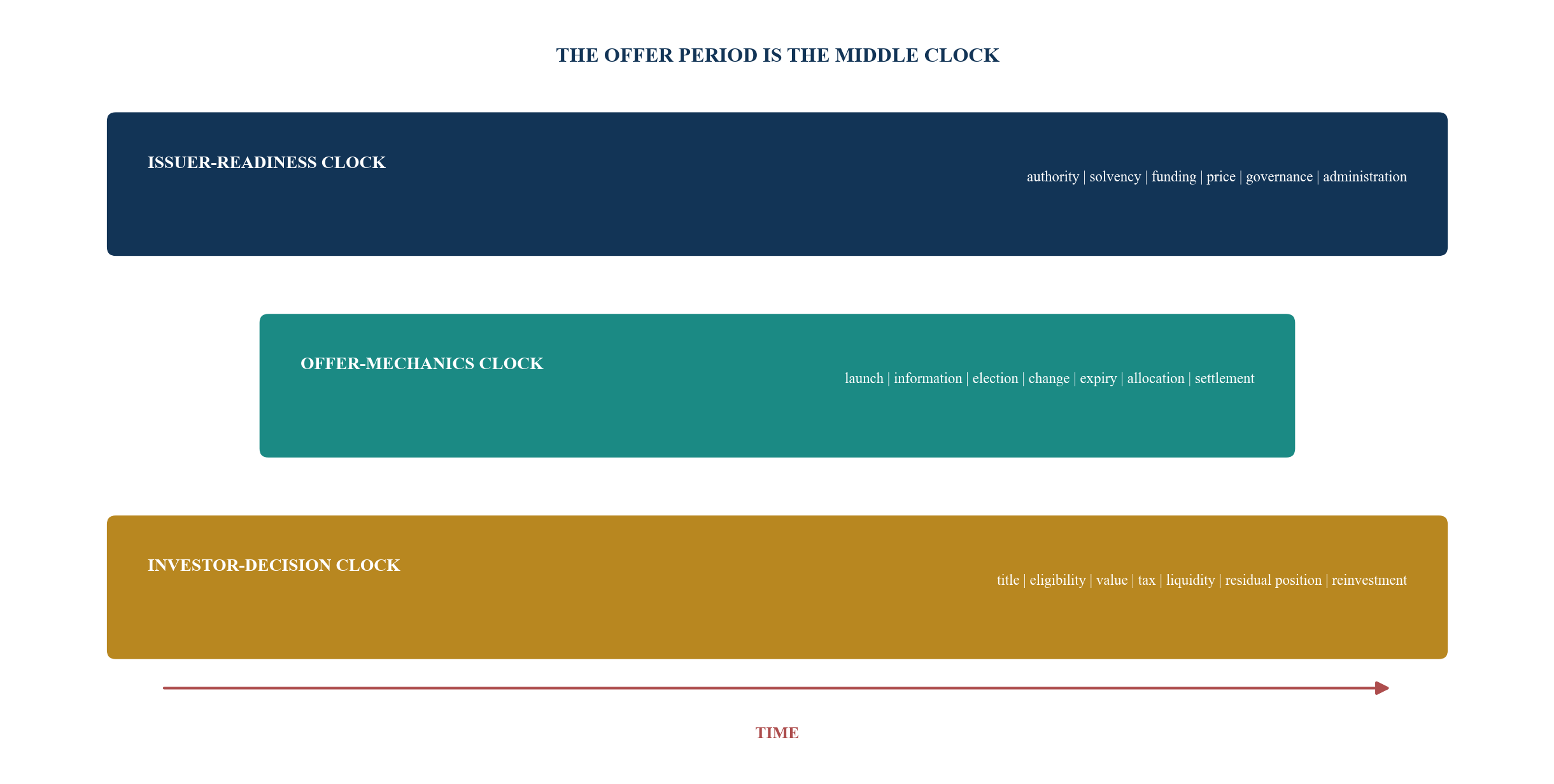
The investor clock begins before launch and continues after the cash settles.
2. Define the transaction perimeter before analysing price
The first task is classification. An issuer-funded repurchase has different corporate-law, disclosure, capital-maintenance and tax consequences from a purchase funded by a third-party investor. A programme open to a defined employee population may raise different questions from an offer to an entire class. A transfer of shares, exercise and sale of options, cancellation of awards and sale through a special-purpose vehicle are economically related but legally distinct.
The security matters. Common shares, preferred shares, options, restricted stock, restricted stock units, warrants and beneficial interests can have different rights and settlement paths. An investor who holds through a nominee or layered vehicle may tender an interest in that vehicle rather than direct company shares. The economic exposure, legal title and voting rights should be reconciled before an election is made.
The US Securities and Exchange Commission explains that private-company securities may be restricted and are not necessarily freely tradable. Its private-secondary resource identifies several federal pathways that may support resales, each with conditions, and also notes the potential relevance of state law. Rule 144 is one possible safe harbour; it is not the only route. Holding period, issuer reporting status and affiliate status can matter.
In the United Kingdom, Part 18 of the Companies Act 2006 governs company purchases of their own shares. HMRC guidance describes restrictions on own-share purchases and funding routes. An off-market purchase can require advance shareholder approval of the contract. Capital and tax treatment require specific review. A process designed for a Delaware company should not be copied into a UK company without a new legal workstream.
Table 1. Transaction-perimeter map
| Perimeter field | Governing question | Evidence required |
|---|---|---|
| buyer | company, affiliate, existing investor, new investor or special-purpose vehicle? | constitutional documents, board papers, funding documents and transaction agreement |
| security | shares, options, units, warrants or indirect vehicle interests? | grant documents, certificates, ledger, plan terms and cap table |
| seller population | all holders, a class, employees, former employees or invited holders? | eligibility schedule, governing rule and documented rationale |
| legal route | which corporate, securities and transfer rules apply? | issuer jurisdiction, holder status, security history and current counsel advice |
| funding | corporate cash, debt, new equity or buyer funds? | committed source, maximum purchase amount and closing mechanics |
| consideration | cash, securities, deferred amount or combination? | offer terms, currency, withholding and settlement schedule |
| residual interest | what rights, preferences and concentration remain after sale? | post-transaction cap table and security-rights analysis |
The deal team should complete the map before launching valuation or election work.
3. Build a three-clock calendar
The issuer-readiness clock begins when the board first considers liquidity. It covers objective, authority, funding, solvency, price method, conflicts, eligibility, administrator selection, data readiness, communication and legal analysis. A launch date selected before these workstreams are complete creates pressure to solve material questions inside the offer period.
The offer-mechanics clock begins at formal commencement under the applicable documents and regime. It covers dissemination, information access, holder questions, election submission, withdrawal rights where applicable, amendments, extensions, expiration, allocation, confirmation and settlement. The precise legal clock varies. US tender-offer rules can impose minimum periods and requirements around material changes, prompt payment and withdrawal. Applicability to a private-company programme requires current legal analysis.
The investor-decision clock begins when a potential liquidity event becomes reasonably actionable. A disciplined holder gathers award agreements, subscription documents, transfer restrictions, tax basis, prior valuations, financing obligations and portfolio information early. The holder can then respond to a short election period without relying on memory or incomplete records.
The three clocks meet at readiness gates. The company should not launch until the source of funds, legal authority, holder data and operating process can support the maximum contemplated outcome. The investor should not elect until ownership, eligibility, economic terms and tax treatment are understood to the level required for the decision.
After settlement, the company should reconcile the cap table, accounting, tax reporting, cancelled instruments and communications. Investors should verify proceeds, withholding, residual ownership and documentation. Timing discipline continues through these close-out tasks.
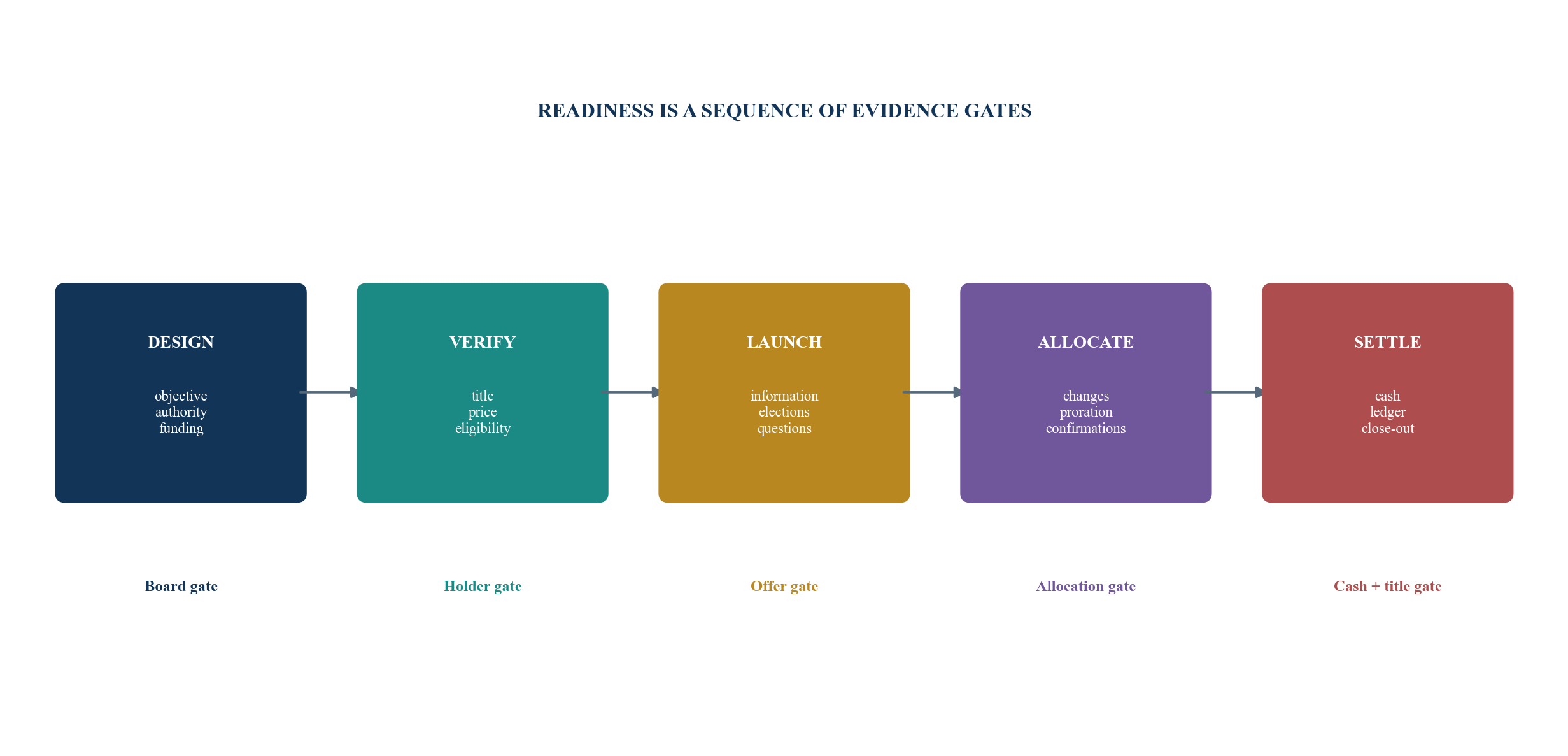
Durations are illustrative management assumptions and must be replaced by the applicable legal and operational calendar.
4. Establish chain of title and transferability
An investor cannot sell an economic story. The seller must deliver the security or interest specified in the offer. That requires a chain-of-title file from acquisition or grant through exercise, conversion, split, transfer, trust, nominee arrangement and current registration.
The company's ledger may differ from the investor's records. A former employee may have exercised options but lack a completed certificate or electronic update. A family trust may be the registered holder while the individual makes the decision. A special-purpose vehicle may hold the company shares while the investor owns units with separate transfer restrictions. Every mismatch can delay or invalidate settlement.
Transferability is a second layer. Articles, bylaws, shareholder agreements, investor-rights agreements, right-of-first-refusal provisions, co-sale rights, board consent, legends, securities-law restrictions and platform terms may apply. Company sponsorship can streamline consent; it does not erase legal or contractual requirements.
The investor should assemble documents before an offer is announced. The company should run a cap-table exception review before launch and define how discrepancies will be cured. A clear escalation path is essential because title questions often involve legal judgement, old records and time-sensitive signatures.
Table 2. Chain-of-title and transfer-readiness checklist
| Test | Green evidence | Common exception |
|---|---|---|
| registered owner | ledger and holder records agree | trust, nominee, estate or old address mismatch |
| acquisition history | signed subscription, grant or transfer documents | missing exercise proof or incomplete prior transfer |
| security identity | class, series, units and rights reconcile | conversion, split or recapitalisation not reflected |
| payment and basis | acquisition payment and basis records available | mixed lots, gifts, exercises or incomplete tax records |
| transfer permission | consents, waivers and approvals mapped | right of first refusal, board consent or co-sale condition |
| securities status | counsel identifies applicable resale route | affiliate, restricted legend or holding-period issue |
| settlement account | verified account and identity match | third-party payment request or unresolved ownership |
A red status requires resolution or a documented exclusion before the election deadline.
5. Build a price bridge rather than anchor on the headline price
Private-company price is an opinion supported by evidence, a negotiated outcome or both. It is rarely a continuously observable market price. The last primary financing round may include preferences, protections or strategic considerations absent from common shares. A recent secondary may involve a small block, a distressed seller, an information-rich buyer or a different security. An independent valuation may serve a specific tax, accounting or governance purpose.
The price bridge should begin with the security being sold. It should reconcile enterprise value, net debt or cash, fully diluted shares, liquidation preferences, participation rights, conversion, seniority and any expected transaction changes. It should then address time, performance, market conditions, information rights, block size, transfer friction and buyer concentration.
The offer price can sit below the last preferred round and still be economically reasonable for common shares. It can also sit above a stale common-share valuation if company performance and market evidence support the change. The task is to explain the bridge and its uncertainty.
Investors should calculate proceeds after accepted quantity, exercise cost, platform or administration cost, withholding and estimated tax. They should also value what remains. A partial sale changes concentration, voting, future participation and exposure to preferences. The decision is a portfolio rebalancing decision, not a simple comparison between price and a remembered headline valuation.
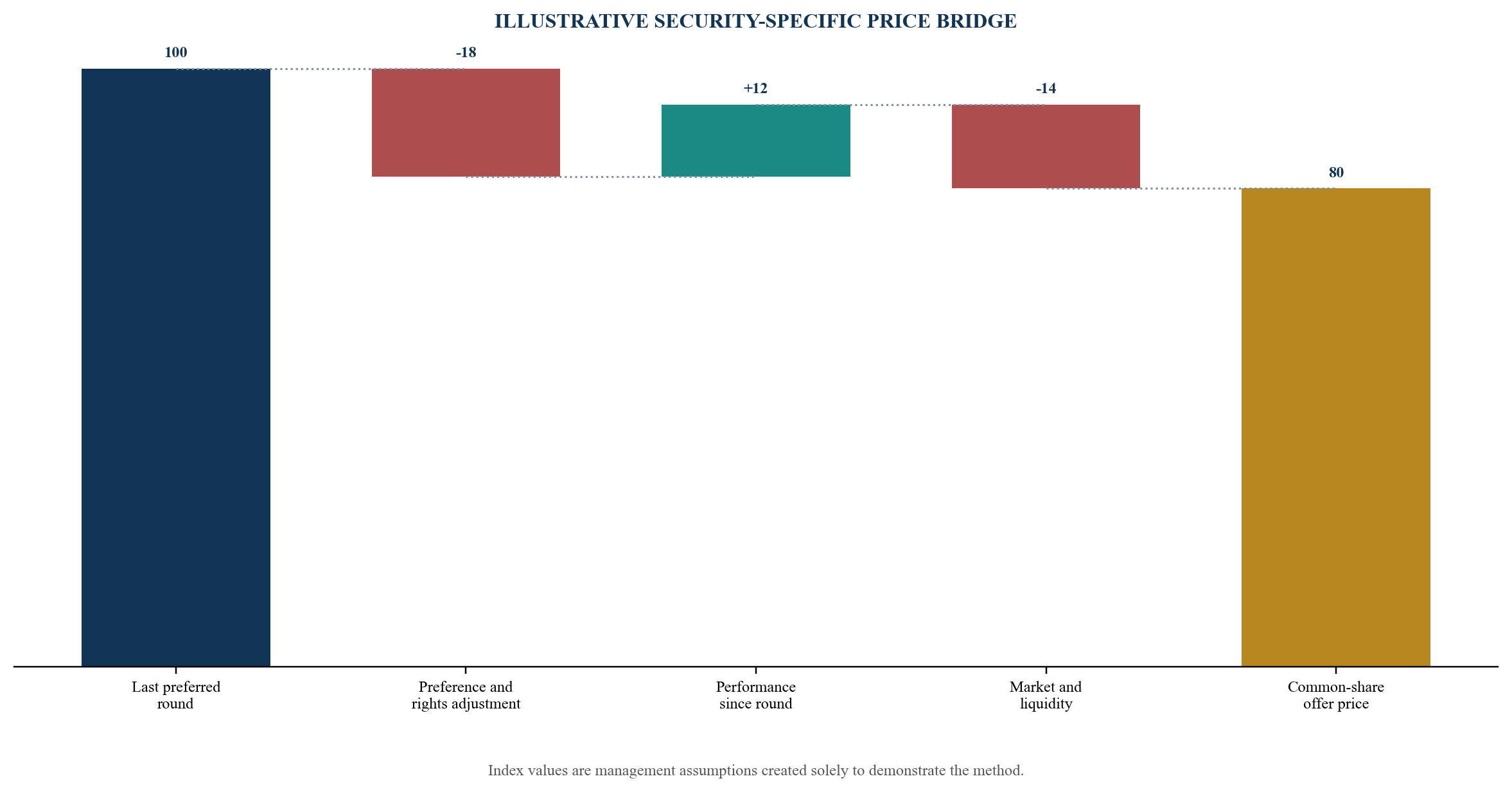
Values are illustrative management assumptions and do not represent an observed company or offer.
6. Time entry around the next liquidity path
An investor considering entry before a possible company-sponsored liquidity event should avoid treating the rumour of a tender as an assured exit. The company may change timing, size, buyer, price, eligibility or objective. Corporate authority, funding and market conditions can change. Transfer approval for entry does not establish eligibility for a later offer.
The entry case should stand on the underlying investment. The investor should assess business quality, security rights, price, dilution, capital needs, governance, information, transfer constraints and loss capacity. A possible tender belongs in the liquidity scenario, with an explicit probability and acceptance assumption.
The investor should map the holding period and resale path applicable to the security and holder. In the United States, Rule 144 conditions can differ by issuer reporting status and affiliate status. Other exemption pathways may be relevant. Company documents can impose additional restrictions even when a securities-law route exists.
Information asymmetry matters. A company-supported process may give eligible holders access to specified materials. A buyer entering earlier through a broker, platform or private negotiation may receive less information, different representations and no assurance that later buyers will accept the same chain of title.
Entry price should therefore reflect both business risk and liquidity friction. A discount is not automatically value. It may compensate for an uncertain security, weak information, concentrated ownership, transfer risk, fee layering or a long wait. The investment memorandum should separate expected operating return from the assumed liquidity-event return.
Table 3. Entry decision matrix before a potential liquidity event
| Decision domain | Base case | Liquidity-event scenario | Evidence gate |
|---|---|---|---|
| company value | operating performance and financing capacity | offer valuation and security bridge | current financial and security evidence |
| time | investment horizon based on company pathway | estimated window with explicit probability | board-authorised or documented programme evidence |
| eligibility | no assumption of future inclusion | class, holder and holding-date rules | written offer terms when available |
| accepted quantity | no planned near-term sale | estimated proration or cap | maximum offer size and allocation rule |
| transfer | current entry can settle | later exit has a lawful route | consent, exemption and document review |
| downside | loss and extended illiquidity | cancelled, delayed or repriced event | funded liquidity reserve and position limit |
| return | business value creation | incremental liquidity-event proceeds | separate scenario attribution |
The tender scenario should remain separate from the base underwriting case.
7. Time exit by comparing cash, concentration and residual option value
The exit decision should compare three positions: sell the maximum accepted amount, sell a partial amount and hold. Each position has a different cash outcome, concentration, tax cost and residual option value. The right answer can vary by holder even under identical offer terms.
A founder with most wealth in one company faces a different concentration problem from a diversified fund. An employee may need liquidity for tax or a home purchase. A fund may be approaching its own term or distribution targets. A strategic investor may value continued information and governance rights. The decision framework should identify the binding objective.
The investor should examine the company's next financing need, cash runway and use of corporate funds. An issuer-funded repurchase can reduce cash available for growth. A third-party purchase may leave company cash untouched but introduce a new holder and negotiated rights. The offer can signal confidence, capital discipline, retention strategy or a shortage of alternative exit routes; the evidence must decide which interpretation is supported.
Residual option value depends on security rights, dilution, future capital requirements and credible exit pathways. A partial tender can reduce risk while preserving upside. It can also leave a small, administratively burdensome position with reduced influence. The investor should model ownership and rights after the proposed sale and expected company actions.
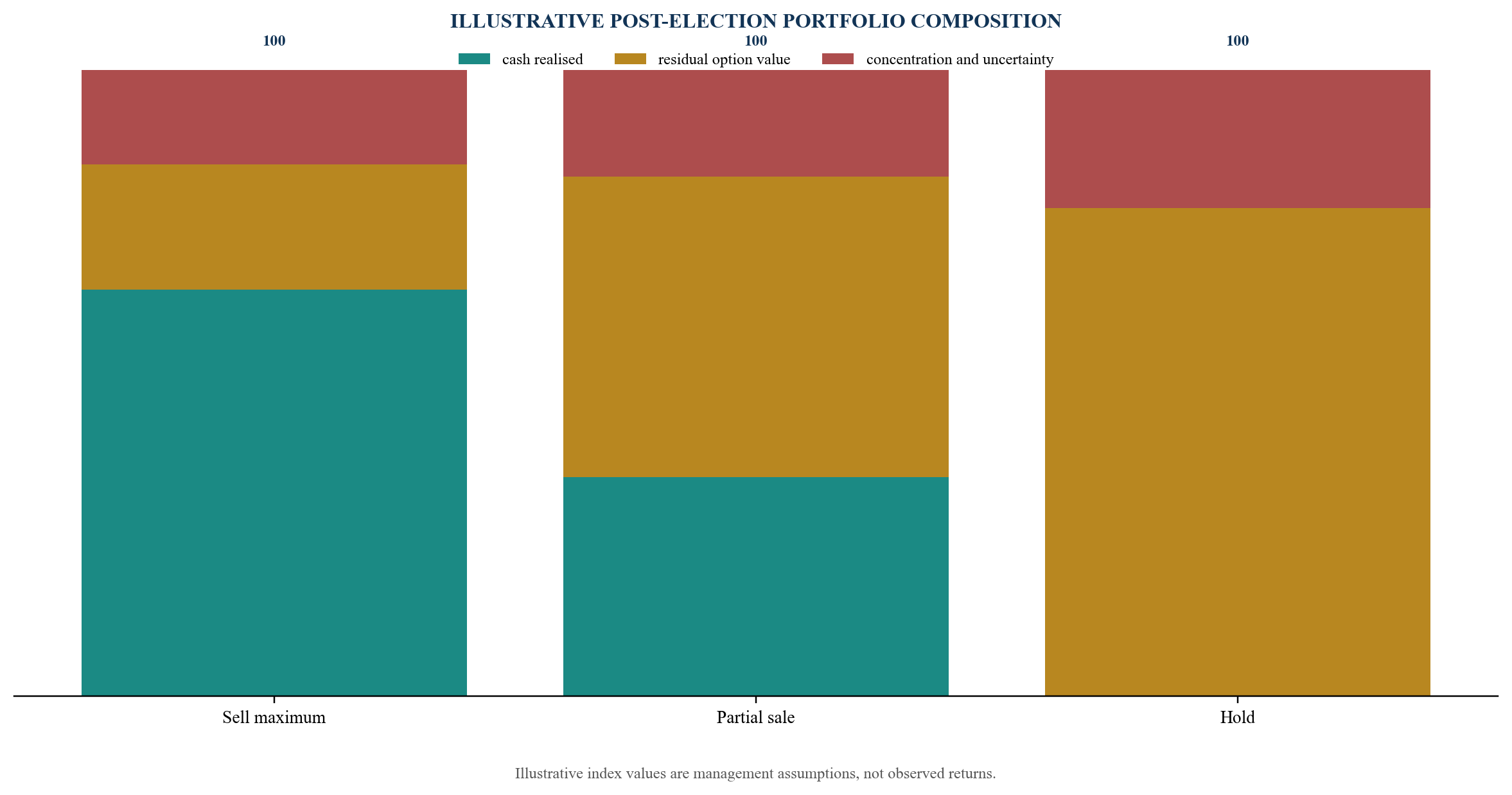
The example uses management assumptions and excludes investor-specific tax advice.
8. Model oversubscription, proration and accepted proceeds
The amount offered for sale may differ materially from the amount accepted. A company can cap total purchases, individual participation or both, subject to the applicable law and offer terms. If elections exceed capacity, the administrator may apply proration, priority rules, minimum-lot treatment or another disclosed allocation method.
An investor should not plan liquidity from submitted shares alone. Expected proceeds should use an accepted-quantity range. The range can be informed by total eligible shares, maximum offer size, likely participation and the stated allocation formula. These variables can remain unknown until the offer closes.
The company should test the formula before launch. It should simulate low, base and high participation; special cases; fractional outcomes; options requiring exercise; invalid elections; withdrawal; and holder-level caps. The allocation result should reconcile to the maximum consideration and the post-transaction cap table.
Fairness needs more than arithmetic. If the programme favours employees, small holders or a defined class, the rationale and authority should be documented. Conflicted directors and holders may require additional governance. Communication should avoid suggesting that submitted quantity will be accepted in full unless the terms support that result.
Table 4. Hypothetical proration and proceeds model
| Scenario | Total shares tendered | Offer capacity | Estimated acceptance | Shares submitted by holder | Estimated shares accepted | Gross proceeds at USD 32 |
|---|---|---|---|---|---|---|
| low participation | 2,000,000 | 2,500,000 | 100% | 100,000 | 100,000 | 3,200,000 |
| base participation | 4,000,000 | 2,500,000 | 62.5% | 100,000 | 62,500 | 2,000,000 |
| high participation | 6,250,000 | 2,500,000 | 40% | 100,000 | 40,000 | 1,280,000 |
| capped holder | 4,000,000 | 2,500,000 | subject to holder cap | 100,000 | 25,000 | 800,000 |
All amounts are management assumptions. Taxes, fees and withholding are excluded from the table.
9. Protect company capital and funding certainty
A company-sponsored event is also a capital-allocation decision. The board should compare liquidity spending with runway, product investment, acquisitions, debt service, regulatory capital, employee retention and the next financing round. The process needs a post-transaction liquidity forecast and downside cases.
If the company purchases its own shares, corporate-law constraints can limit the source and amount of funds. Delaware law permits a corporation to acquire its own shares subject to restrictions, including limits connected with capital impairment. UK law contains capital-maintenance, approval and funding requirements. The relevant legal analysis must be completed for the actual company and transaction.
Committed financing matters. SEC staff guidance updated in 2026 discusses funding certainty in tender offers and treats a binding commitment letter differently from a highly confident letter in the context addressed by that guidance. A company should avoid opening an offer with a funding plan that cannot support the maximum contemplated purchase.
The board paper should explain why the programme creates value. Possible benefits include employee retention, reduced concentration for key holders, cap-table simplification and investor transition. Costs include cash use, administration, legal work, tax, valuation, information preparation, management time and potential signalling effects.
The company should define conditions objectively and obtain advice on any ability to waive them. An offer that depends on subjective or controllable conditions can create legal and trust risks. The operating team should know which changes require amendment, extension or renewed holder communication.
10. Govern conflicts, fairness and information asymmetry
Company-sponsored liquidity can place directors, management, controlling holders, employees and outside investors in different positions. Some may be buyers, sellers, decision-makers or information holders at the same time. The governance process should identify each role and apply recusal, independent advice, committee review or holder approval where appropriate.
Price fairness cannot be established by one valuation output. The board should understand method, security rights, date, assumptions, sensitivity and who commissioned the work. It should consider recent primary and secondary transactions, current performance, financing needs and known corporate developments. The record should explain why the selected price and rules serve the company's objective.
Information asymmetry increases near major financing, customer, litigation, regulatory or strategic events. The company should obtain advice on required disclosure and antifraud obligations. Investors should ask what information is current, what period it covers, which material limitations are stated and whether the company expects to provide updates during the offer.
Participation rules should be written before elections are known. Changing eligibility or allocation after seeing who wants liquidity can undermine confidence and may raise legal issues. Exceptions should follow a documented authority and rationale.
The board should also consider the holders left behind. A transaction that changes control, voting concentration, preference overhang or future financing dynamics can affect residual holders. Post-transaction ownership and rights belong in the approval analysis.
11. Build an offer data room for decisions, not volume
An effective information package answers the decision questions without forcing holders to reconstruct the company from disconnected files. It should identify the buyer, securities, price, maximum amount, eligibility, allocation, conditions, election process, withdrawal or change process where applicable, expiration, settlement, tax limitations, contact route and treatment of residual holdings.
Financial information should be current enough for the decision and accompanied by accounting scope and limitations. The package should explain capital structure, security rights, recent financing, material debt, liquidity and expected use of funds where relevant. A company may need to protect competitively sensitive data while meeting its obligations. Controlled access, watermarking, holder verification and a clear question process can help.
The company should maintain one source of truth. Contradictory dates or share counts across email, platform and documents create avoidable errors. Amendments should be versioned, disseminated and logged. Material questions and answers should be handled consistently across similarly situated holders, subject to counsel.
The investor should keep a decision file containing the materials relied upon, questions asked, responses, calculations and approval. This creates an audit trail for a fund, family office or fiduciary and supports later tax and accounting work.
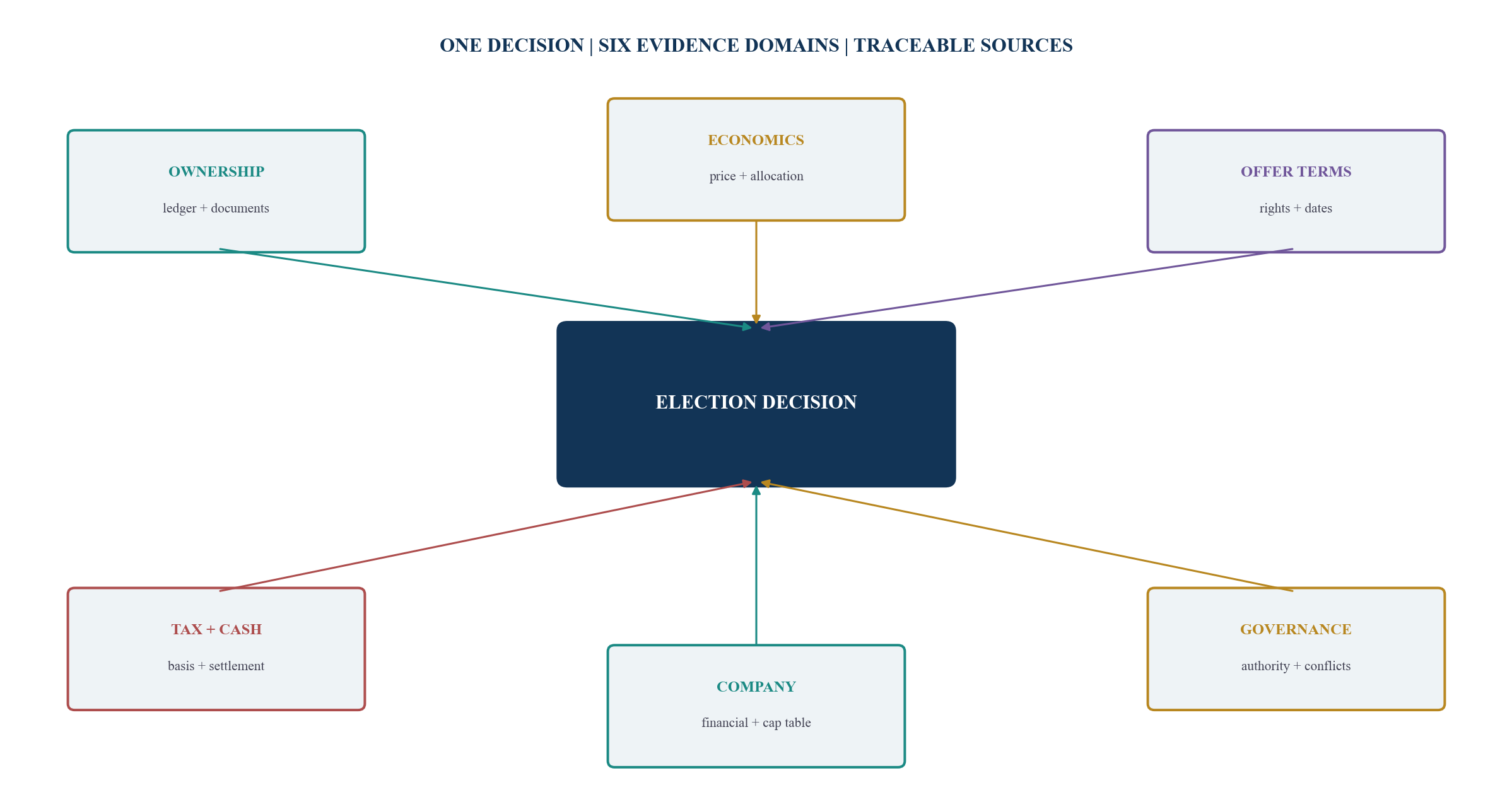
A complete file records the evidence available at the time of election.
12. Create a jurisdiction, tax and reporting workstream
Corporate law, securities law, employment arrangements, tax and reporting can interact. The company and investor need separate advice because their interests and facts differ. The offer materials should state the limits of any general tax discussion and avoid presenting it as holder-specific advice.
In the United States, the analysis can include security acquisition history, option exercise, compensation treatment, basis, holding period, federal and state tax, withholding and information reporting. Rule 144 and other resale pathways address securities-law questions; they do not determine tax outcome.
In the United Kingdom, an own-share purchase can be treated differently depending on statutory conditions and facts. HMRC provides a clearance process for qualifying unquoted trading-company purchases in certain circumstances. Stamp duty, capital treatment, distribution treatment, employment-related securities and reporting may require review.
Cross-border holders add residence, source, treaty, foreign-exchange, controlled-entity and reporting questions. The payment account, legal owner and beneficial owner should reconcile. The investor should model tax as a range until advice is complete and keep sufficient liquidity for liabilities that may arise after settlement.
Table 5. Jurisdiction and tax workstream
| Workstream | Company question | Investor question |
|---|---|---|
| corporate authority | can the buyer acquire the securities and from which funds? | is the transfer valid and effective? |
| securities route | which offer, resale and disclosure rules apply? | which exemption, holding period and holder-status tests apply? |
| employment equity | how are options, awards and leavers treated? | does exercise or sale create compensation or withholding? |
| tax character | what withholding, reporting and company treatment applies? | income, distribution or capital treatment; basis and timing? |
| transfer taxes | which stamp, transfer or similar taxes apply? | who bears cost and which filing is required? |
| cross-border | which residence, treaty, sanctions and payment rules apply? | which jurisdictions require reporting or payment? |
| records | what statements and confirmations will be issued? | which evidence supports basis, proceeds and residual title? |
The table identifies questions for qualified advisers and does not provide legal or tax advice.
13. Treat settlement as a controlled transfer of cash and title
Settlement joins four records: the election, accepted quantity, legal transfer and cash payment. The administrator should reconcile each before release. A mismatch in name, account, security, tax form or signature should move to an exception queue with a named owner.
The company should publish realistic settlement timing and identify conditions. It should avoid promising a date dependent on unresolved approvals or funding. If the transaction requires share cancellation, treasury treatment, new certificates or nominee updates, the post-settlement ledger steps should be documented.
Payment controls matter because a liquidity event creates an attractive fraud opportunity. Account changes should receive independent verification. The process should prevent one person from changing settlement instructions and approving payment. Sensitive identity and tax data require controlled access and retention.
Investors should verify the gross accepted amount, deductions, currency, account, value date and residual position. They should preserve the offer, election, acceptance, transfer, payment and tax documents. A fund or family office should reconcile the cash to its investment ledger and valuation records.
The company should close the loop with an after-action review. Exceptions, late changes, failed settlements and holder questions can reveal weaknesses in cap-table data, award administration, communication or governance that should be corrected before the next window.
14. Integrate the tender with portfolio liquidity and reinvestment
For an investor, the proceeds enter a broader liquidity system. Expected cash should not be committed until acceptance and settlement are sufficiently certain. Proration, delay, conditions and failed documentation can reduce or postpone proceeds.
The investor should classify proceeds by purpose: tax, liabilities, reserves, distributions, rebalancing or reinvestment. A fund should consider mandate, recycling rules, term, distribution obligations and performance measurement. A family office should consider concentration, currency, spending and strategic allocations.
Reinvestment discipline matters because an illiquidity discount can be replaced by cash drag or a rushed purchase. The decision memo should define a use-of-proceeds hierarchy before cash arrives. If the position is sold primarily to reduce concentration, redeploying into a closely correlated private asset may not achieve the objective.
Performance attribution should separate business return, security selection, entry discount, dilution, tender price and timing. This prevents a successful liquidity event from obscuring weak underlying underwriting or a strong company outcome from being attributed entirely to tender timing.
15. Worked hypothetical case: a partial company-sponsored liquidity window
Consider a management-assumed private software company with 100 million fully diluted common-equivalent shares. It has recently raised preferred capital at USD 40 per share with rights that differ from common. The board sponsors a liquidity programme for up to 2.5 million common shares at USD 32 per share, funded by a new investor. Eligible current and former employees can submit shares, subject to the offer terms and applicable transfer requirements.
A former executive holds 300,000 common shares acquired in multiple lots. The holder wants USD 2 million for diversification and tax reserves while preserving exposure to a possible future exit. Chain-of-title review identifies one 40,000-share lot held by a family trust and 260,000 shares held directly. The offer documents permit both holders if each completes verification.
The holder tenders 100,000 shares. Under a base participation case, total tenders reach 4 million shares and simple proration would produce 62,500 accepted shares. Gross proceeds would be USD 2 million before taxes and costs. The result meets the cash objective while leaving 237,500 shares across the direct and trust holdings.
The decision memo stress-tests acceptance between 40 and 100 percent, tax timing, a two-week settlement delay and future dilution. It also compares the residual rights with the post-transaction cap table. Every figure is a management assumption and serves only to demonstrate the framework.
16. Run a 90-day liquidity programme with defined gates
Days 1 to 20 establish the objective, structure and authority. The board identifies why liquidity is being offered, who may buy and sell, which securities are in scope, how much capital is available and which advisers are required. Management begins cap-table and title exception work.
Days 21 to 45 build the economic and governance case. The company develops the security-specific price bridge, funding evidence, post-transaction liquidity forecast, eligibility rules, conflict map and allocation simulations. Counsel reviews the legal route and required approvals. Tax advisers define company-level questions and the limits of holder guidance.
Days 46 to 65 build and test operations. The administrator loads holder records, verifies workflows, prepares communications, runs election and proration tests, establishes payment controls and completes a mock settlement. The company creates one version-controlled source of truth for terms, dates and questions.
Days 66 to 90 cover approval, launch readiness and execution preparation. The board receives the final paper, exceptions, downside cases and launch recommendation. The company confirms funding, signs approvals, freezes the eligible ledger as appropriate and releases the offer through the approved channel. The detailed offer clock then follows the applicable terms and legal regime.
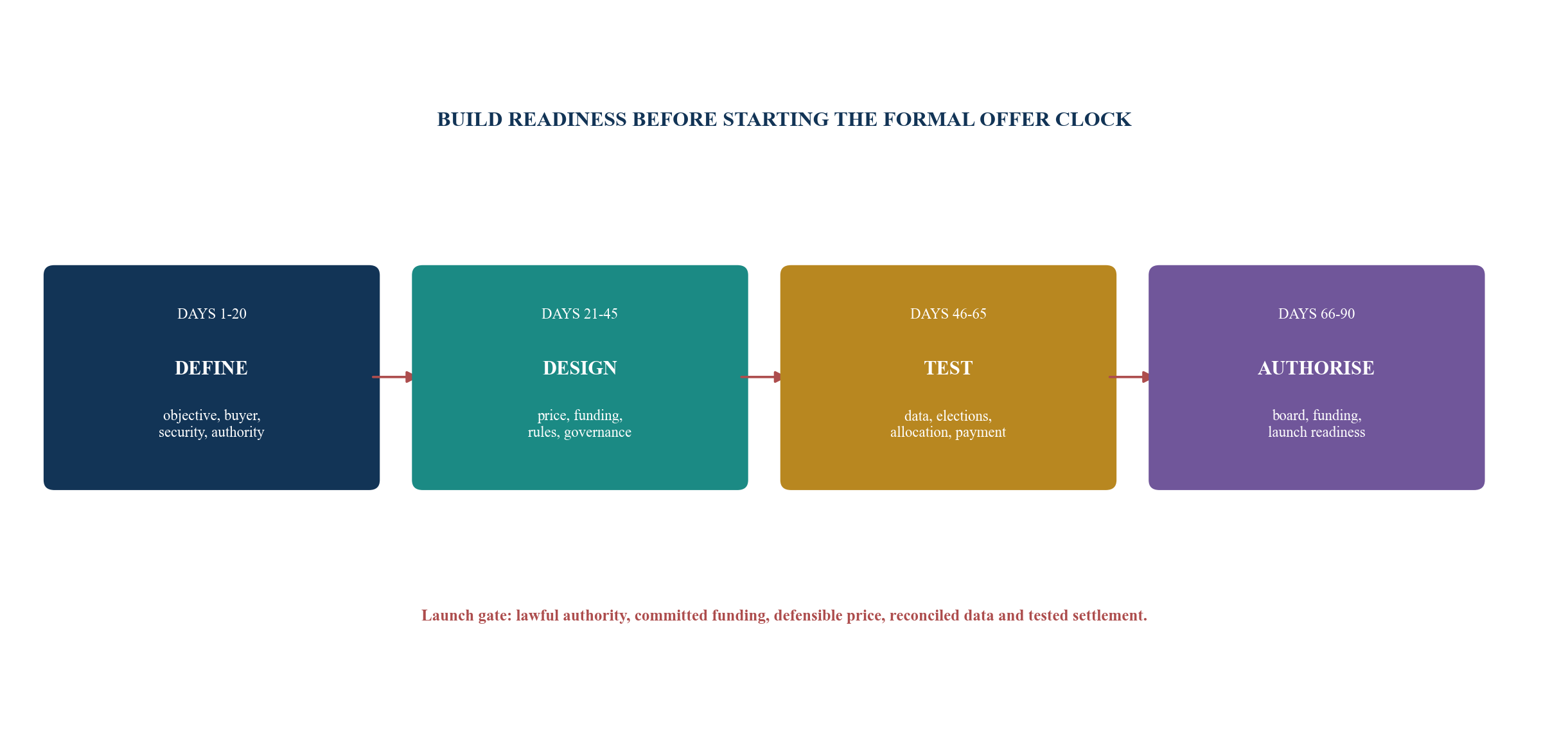
The implementation sequence precedes the formal offer calendar and uses illustrative management timing.
17. Give boards and investors a decision scorecard
The board should approve the programme only when purpose, authority, funding, price, fairness, information and operations form a coherent transaction. Investors should elect only when ownership, transferability, value, allocation, tax, settlement and residual exposure meet their decision standard.
Table 6. Board and investor tender-offer scorecard
| Domain | Board acceptance evidence | Investor acceptance evidence |
|---|---|---|
| purpose | documented capital-allocation and stakeholder objective | stated personal, fund or portfolio liquidity objective |
| authority | corporate, holder and transaction approvals | valid title and authority to transfer |
| funding | maximum consideration and costs are committed and affordable | no use of proceeds before settlement confidence is adequate |
| price | security-specific bridge, valuation evidence and sensitivities | after-tax proceeds and residual option value comparison |
| eligibility | objective rules, complete population and exception process | written confirmation of holder and security eligibility |
| allocation | tested formula, caps, special cases and reconciliation | accepted-quantity range and proration sensitivity |
| information | current materials, controlled Q&A and amendment process | decision file records sources, limits and open questions |
| tax and law | current company advice and holder disclaimer | holder-specific legal and tax advice where required |
| settlement | mock settlement, account verification and ledger controls | verified account, documents and residual-position reconciliation |
| governance | conflicts, recusal, independent review and record | fiduciary or investment approval and documented rationale |
Every material exception should have an owner, advice route and resolution date.
The tender-offer clock is therefore a system of evidence and decisions. The company controls readiness, structure and execution. The investor controls preparation, analysis and election. Both sides create value by starting before launch, separating price from security rights, modelling accepted quantity, protecting cash and title, and completing the post-settlement record.
References
- US Securities and Exchange Commission, What Is a Private Secondary Market?, 2026, https://www.sec.gov/file/private-secondary-markets-building-block
- US Securities and Exchange Commission, Tender Offer Rules and Schedules, updated 9 July 2026, https://www.sec.gov/rules-regulations/staff-guidance/corporation-finance-interpretations/tender-offer-rules-schedules
- US Securities and Exchange Commission, Information for Certain Types of Transactions and Filers, https://www.sec.gov/about/divisions-offices/division-corporation-finance/information-certain-types-transactions-filers
- US Securities and Exchange Commission, Rule 144: Selling Restricted and Control Securities, https://www.sec.gov/reports/rule-144-selling-restricted-control-securities
- US Securities and Exchange Commission, Frequently Asked Questions About Exempt Offerings, https://www.sec.gov/resources-small-businesses/exempt-offerings/frequently-asked-questions-about-exempt-offerings
- Delaware General Corporation Law, Title 8, Section 160, Corporation's Powers Respecting Ownership of Its Own Stock, https://www.delcode.delaware.gov/title8/c001/sc05/index.html
- Delaware General Corporation Law, Title 8, Section 202, Restrictions on Transfer and Ownership of Securities, https://www.delcode.delaware.gov/title8/c001/sc06/
- United Kingdom, Companies Act 2006, Part 18, Acquisition by Limited Company of Its Own Shares, https://www.legislation.gov.uk/ukpga/2006/46/part/18
- HM Revenue & Customs, Companies and Shareholders: Company's Purchase of Own Shares: Legal Restrictions, updated 20 July 2026, https://www.gov.uk/hmrc-internal-manuals/stamp-taxes-shares-manual/stsm075010
- HM Revenue & Customs, Clearance Applications and Exempt Distribution When a Company Purchases Its Own Shares, https://www.gov.uk/guidance/clearance-applications-and-exempt-distribution-when-a-company-purchases-its-own-shares
- Companies House, Return of Purchase of Own Shares, Form SH03, https://www.gov.uk/government/publications/return-of-purchase-of-own-shares-sh03
- Financial Industry Regulatory Authority, Private Placements, 2026 Annual Regulatory Oversight Report, https://www.finra.org/rules-guidance/guidance/reports/2026-finra-annual-regulatory-oversight-report/private-placements
About the Author
Chennakeshav Adya is an independent researcher and Managing Partner of Matchpoint Partners. His work examines strategy, capital formation, valuation, transactions and operating execution across private and public markets.
