

Introduction
AI infrastructure combines characteristics of project finance, equipment finance, real-estate finance and technology credit. A project can own or lease a powered data-centre shell, purchase specialised processors and networking equipment, operate a cloud platform and sell capacity under multi-year contracts. Each layer has a different construction sequence, useful life, counterparty and enforcement route. A capacity contract can connect the layers to revenue, yet it can also transfer substantial delivery and performance risk back to the project company.
Public disclosures show the emerging model. CoreWeave states that customers generally purchase specified capacity under multi-year take-or-pay contracts and that it primarily finances infrastructure development through asset-level debt supported by those contracts [1-4]. Public filings also describe prepayments, remaining performance obligations, availability credits, delivery delays, concentration and the right to resell certain capacity. Core Scientific has disclosed long-term infrastructure arrangements with fixed payments, annual escalators, capital responsibilities and customer-linked remedies [5-7]. These disclosures illustrate possible structures and risks; they do not provide a template for another project.
The demand environment is large and location-specific. The IEA reported approximately 415 TWh of global data-centre electricity consumption in 2024 and projected substantial growth through 2030 [8-11]. The US Department of Energy reported approximately 176 TWh of US data-centre electricity use in 2023 and projected a range of 325 TWh to 580 TWh in 2028 [12-14]. National demand does not establish power availability, customer demand or financeability at an individual site.
This paper is designed for project sponsors, AI-cloud operators, data-centre developers, infrastructure investors, commercial banks, private-credit funds, equipment financiers, customers and advisers. It provides a transaction and credit framework. It does not provide legal, tax, accounting, regulatory, engineering, cybersecurity or investment advice. The relevant specialists should assess the executed documents, jurisdiction, technology, counterparties and project.
1 Define the capacity product before valuing the contract
The first task is to define what the customer has committed to buy. Capacity can refer to reserved electrical load, critical IT megawatts, accelerator count, accelerator hours, cluster access, storage, network throughput, platform services or a bundle. A headline contract value has limited credit meaning until the unit, location, start date, performance standard, price, escalation and billing basis are clear.
The project should maintain a capacity-unit schedule. It should reconcile contracted megawatts to racks, processors, memory, networking, cooling and power. It should identify whether capacity is dedicated or pooled, whether the provider may substitute hardware, whether the customer can move workloads between sites, and whether unused capacity can be resold. The schedule should separate installed, tested, available, customer-accepted, reserved, billable and utilised capacity.
Take-or-pay language should be analysed within the complete bargain. A customer can have an unconditional minimum payment after acceptance and still retain rights before acceptance, for chronic service failure, force majeure, security breach, regulatory change or provider default. A termination payment may be capped, discounted, subject to mitigation or disputed. Lenders should model the enforceable net payment under each relevant state rather than the marketing label.
| Dimension | Evidence | Credit question | Model treatment |
|---|---|---|---|
| capacity unit | schedule, architecture and order form | what exact service is reserved | convert to one controlled unit register |
| location | site list and relocation right | must service come from one facility | test site-specific completion and portability |
| commencement | readiness, acceptance and long-stop terms | when does minimum payment begin | recognise cash only after supported trigger |
| availability | service level and measurement method | what performance earns the reservation charge | deduct realistic credits and outages |
| price | fixed charge, usage, pass-through and escalation | which cash is predictable | separate fixed, variable and reimbursable cash |
| substitution | hardware and platform flexibility | can obsolete assets be replaced without consent | model upgrade cost and approval risk |
| resale | provider remarketing right | can unused capacity serve another customer | recognise only executable residual demand |
Proposed diligence structure; contract interpretation requires qualified counsel.
The output should be a capacity register that reconciles legal terms, engineering configuration and financial model. Every revenue line should point to a defined capacity unit and payment obligation.
2 Convert take-or-pay language into a cash-flow schedule
A lender needs a contract-to-cash schedule, not total contract value. The schedule should show reservation charges, usage charges, power reimbursement, implementation fees, prepayments, credits, taxes, pass-through items, billing dates, payment terms and security. It should identify amounts that can be netted, withheld, disputed or refunded.
Remaining performance obligations are an accounting disclosure and can provide useful evidence of committed revenue. They do not automatically equal lender cash flow. Timing, variable consideration, service credits, termination, delivery delay and accounting recognition affect conversion [1-4,38-42]. A credit model should begin from executed payment obligations and operating capability rather than an aggregate RPO balance.
The model should distinguish prepayment from free cash. A customer deposit may fund equipment, reduce future invoices, support a refund obligation or sit in a restricted account. It can improve liquidity and create performance exposure. The financing documents should state its permitted use, ranking, refund conditions and treatment on termination.
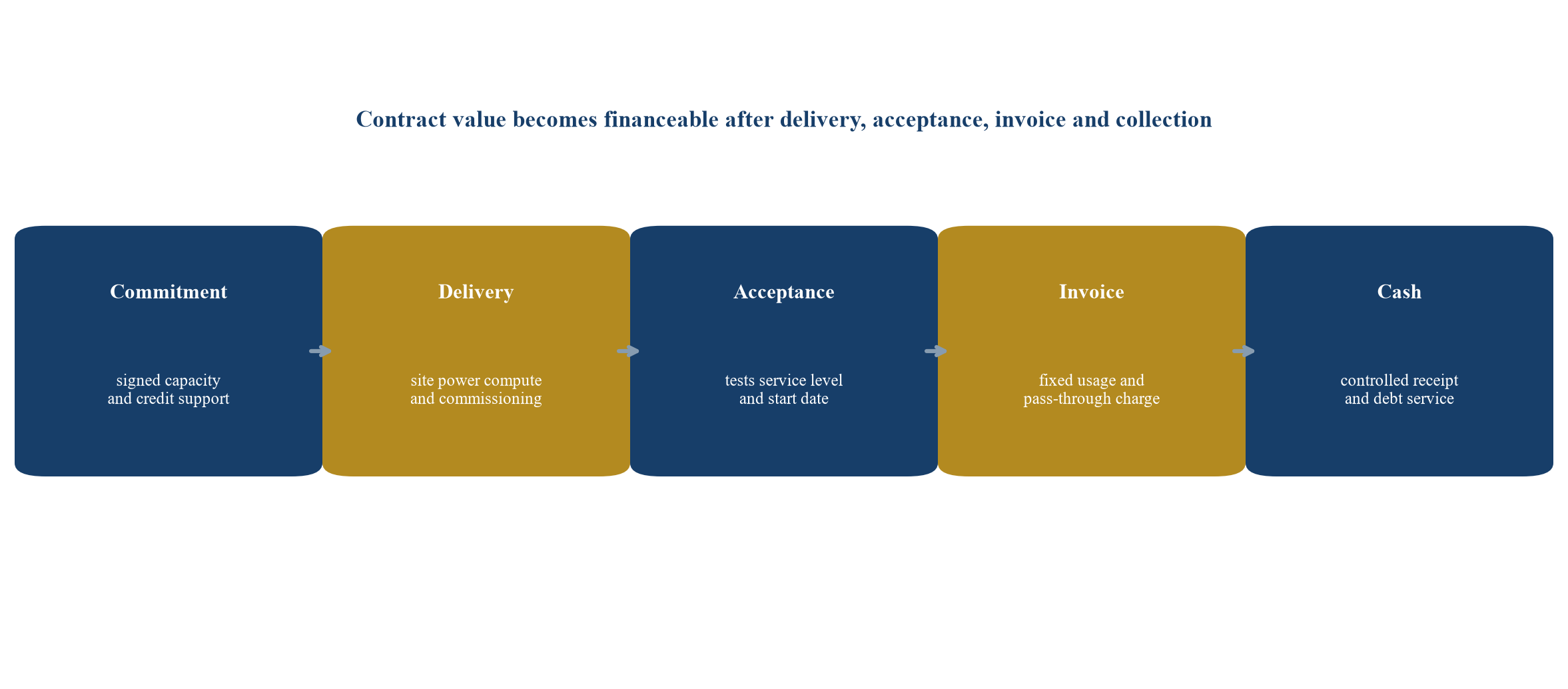
Proposed project-finance sequence; each transition requires executed evidence and operating performance.
The cash schedule should include a monthly bridge from gross contracted charges to collected cash available for debt service. This exposes timing gaps that annual revenue forecasts can hide.
3 Underwrite customer credit and concentration
The value of a minimum payment depends on the obligor. The underwriting file should identify the legal customer, parent, guarantor, credit-support provider and source of payment. A strong brand does not substitute for an executed obligation from the relevant entity. The lender should assess financial capacity, business dependence on the service, competing commitments and structural subordination.
Customer concentration can create a project-finance strength and a refinancing weakness. One investment-grade or well-capitalised counterparty can support construction and simplify operations. A single customer can also control acceptance, disputes, renewals and facility value. The model should show debt service after the largest customer, largest site and largest capacity block are stressed.
The diligence team should examine reciprocity and circularity. A customer may invest in the sponsor, supply technology, provide cloud distribution, lease capacity or receive warrants. Those relationships can align incentives and can cause the same economic support to be counted more than once. Every equity contribution, prepayment, purchase obligation, guarantee and receivable should be traced to its ultimate funding source.
| Dimension | Evidence | Downside question | Facility response |
|---|---|---|---|
| obligor identity | executed contract and entity records | which entity must pay | lend against named enforceable obligation |
| financial capacity | audited accounts, filings and liquidity | can the obligor pay through a downturn | set eligibility and reporting thresholds |
| guarantee | form, cap, tenor and governing law | does support cover all payment obligations | require direct enforceable support |
| concentration | revenue, capacity and site shares | what happens after the largest exposure fails | haircut, reserve or diversification covenant |
| strategic dependence | workload migration and alternatives | will the customer preserve the contract | test switching and replacement economics |
| reciprocal exposure | equity, supply, warrants and resale | is support funded by the project itself | remove circular value from borrowing base |
| dispute history | credits, claims and payment record | how reliably does invoiced cash convert | use collected-cash performance tests |
Proposed credit record; ratings and legal conclusions require current evidence.
The customer score should drive advance rate, amortisation and reserve requirements. It should be refreshed when financial condition, contract use or strategic relationships change.
4 Reconcile delivery obligations with customer remedies
Take-or-pay begins to support debt only when the provider satisfies its delivery obligations. The contract should define facility, capacity, hardware, software, network, power, commissioning, security, compliance and service commencement. Customer dependencies should also be stated, including forecasts, technical information, testing, connectivity and timely decisions.
Acceptance can be objective, deemed or discretionary. Objective tests reduce ambiguity when they specify measurement period, workload, benchmark, tolerance, retest and evidence. Deemed acceptance can protect the provider when a customer delays testing, provided the mechanism is enforceable. A broad customer-satisfaction condition can defer payment and weaken the contract.
Remedies require a complete hierarchy. Service credits can reduce revenue. Chronic failure can create termination. Delivery delay can trigger liquidated damages, refund, alternative capacity or cancellation. Security events can create suspension or termination. A liability cap may exclude defined matters. The lender should model remedies before treating the minimum charge as fixed.
| Event | Provider obligation | Customer remedy | Credit control |
|---|---|---|---|
| delayed site | deliver by milestone and long-stop date | refund, damages or termination | completion support and delayed draw |
| failed acceptance | satisfy objective technical tests | retest, remediation or rejection | independent testing and contingency |
| availability shortfall | meet measured uptime and performance | service credit or fee reduction | revenue haircut and performance covenant |
| chronic failure | restore sustained service | termination or migration support | reserve, cure plan and replacement operator |
| security breach | protect systems and notify | suspension, damages or termination | cyber controls, insurance and event reporting |
| regulatory restriction | maintain lawful service | relocation, change or termination | jurisdictional review and portability plan |
| customer delay | provide access, tests or information | schedule relief or deemed acceptance | documented dependency and notice process |
Proposed contract review; enforceability depends on drafting, facts and governing law.
The remedy model should connect each event to cash, reserve, covenant and default treatment. This prevents a contractual protection from being mentioned in diligence and omitted from debt sizing.
5 Make power and site readiness conditions to capacity debt
AI compute cannot be delivered without a controlled site, firm enough power, cooling, fibre and operating approvals. The credit file should distinguish requested, studied, reserved, contracted, energised and operating power. It should identify network upgrades, deposits, cost responsibility, curtailment, backup and long-stop dates. FERC and NERC materials demonstrate the growing attention to large-load interconnection, co-location, reliability and cost allocation [15-21].
Site readiness includes property rights, permits, access, environmental conditions, water or cooling strategy, network diversity and insurance. A capacity contract may specify a location or allow relocation. A relocation right has value only when alternative powered capacity, hardware, approvals and connectivity can be delivered within the contractual time.
The lender should require a dated dependency schedule covering utility, landlord, contractor, equipment vendor, network carrier, platform and customer. Each dependency should identify evidence, remaining cost, responsible party, remedy and latest safe date. A customer commitment that starts before the physical chain can be delivered creates liability rather than collateral.
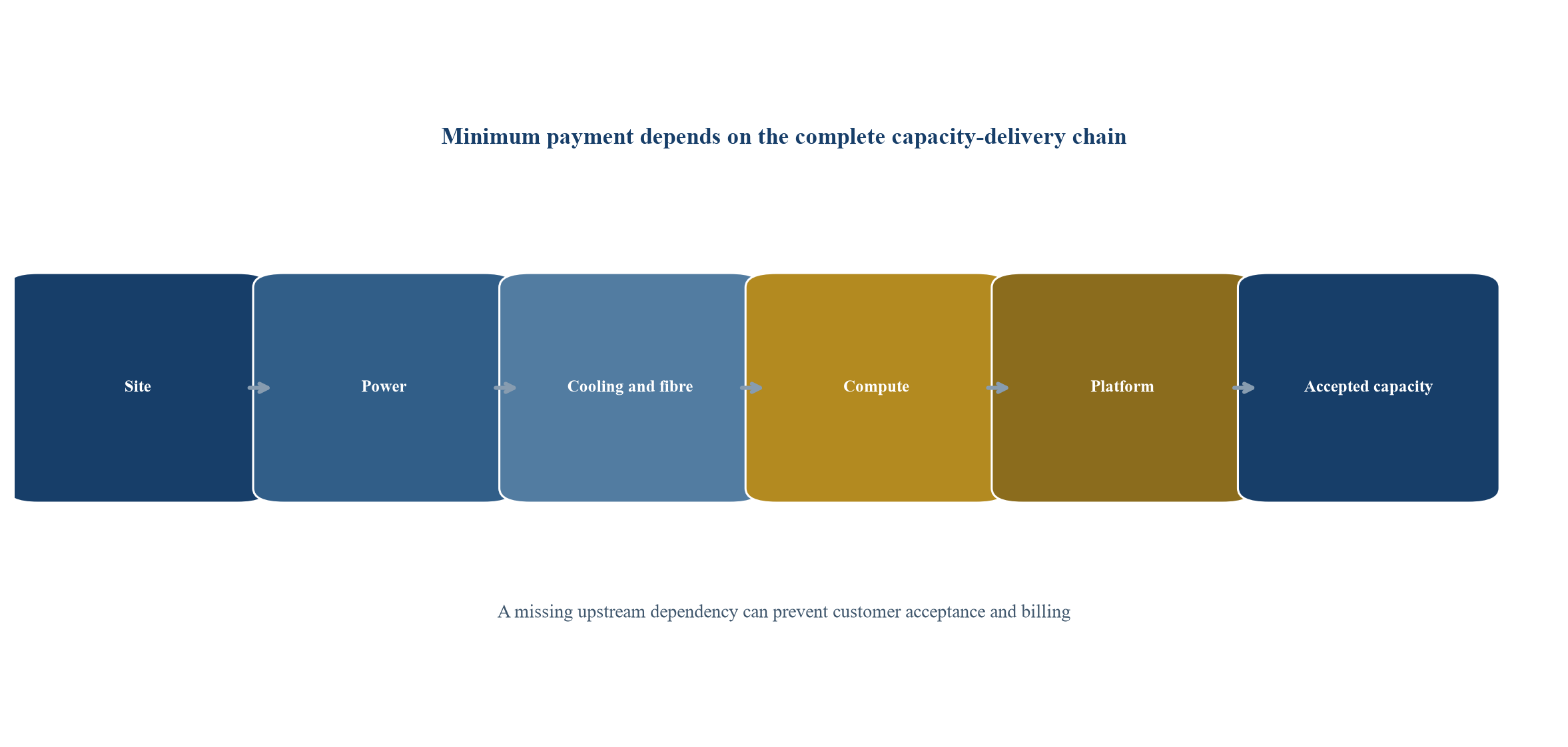
Proposed dependency architecture; project evidence should establish every link.
Power and site conditions should be satisfied before the matching debt tranche becomes available. This aligns funding with assets that can support the contracted service.
6 Build a controlled sources-and-uses stack
The funding plan should separate real estate, power, compute, platform and reserves. Long-lived property and grid assets can support longer-dated capital after completion and transferability are proved. Compute equipment needs amortisation within a conservative economic life. Platform development and customer-acquisition costs usually require equity or subordinated capital because their recovery depends on execution.
Each source should identify borrower, commitment, use, availability, tenor, repayment, security, guarantee and intercreditor position. Customer prepayments should not be counted simultaneously as unrestricted equity, revenue and debt-service cash. Sponsor equity should be funded in a sequence that preserves completion incentives. Public incentives should be recognised only when controlled and transferable.
Management assumes a USD 1.20 billion illustrative project comprising USD 300 million of site, shell and cooling; USD 160 million of power and network infrastructure; USD 570 million of compute and platform assets; and USD 170 million of fees, interest, working capital and reserves. Funding comprises USD 510 million of construction debt, USD 260 million of equipment debt, USD 290 million of sponsor equity and USD 140 million of customer cash. These are management assumptions.
| Source | Amount | Primary use | Key availability control |
|---|---|---|---|
| construction facility | 510 | site, shell, cooling, power and network | monitor-certified cost and completion tests |
| equipment facility | 260 | accelerators, networking and installation | delivery, title, serial record and acceptance |
| sponsor equity | 290 | first-loss cost, platform and contingency | funded ahead of or proportionately with debt |
| customer prepayment | 140 | contract-specific capacity build | restricted use and refund reserve |
| total | 1,200 | complete project and reserves | sources equal controlled uses |
All amounts are management assumptions in USD millions.
Intercreditor arrangements should allocate security, proceeds, cure rights, enforcement control and asset-release conditions. A project-wide default can require coordinated operation even when lenders finance different layers.
7 Size debt from deliverable and billable capacity
Debt sizing should begin with capacity that can be delivered, accepted and billed within the contract period. The model should not apply an advance rate to headline total contract value. It should deduct pass-through costs, service credits, taxes, operating cost, maintenance, upgrade expenditure, reserve funding and senior claims before debt service.
Management assumes 96 megawatts of critical IT capacity and a six-year commitment for 72 megawatts. The central ramp reaches 24 megawatts at service commencement, 48 megawatts after six months and 72 megawatts after twelve months. The remaining 24 megawatts is uncontracted and receives no debt value until supported by an eligible commitment or collected merchant revenue.
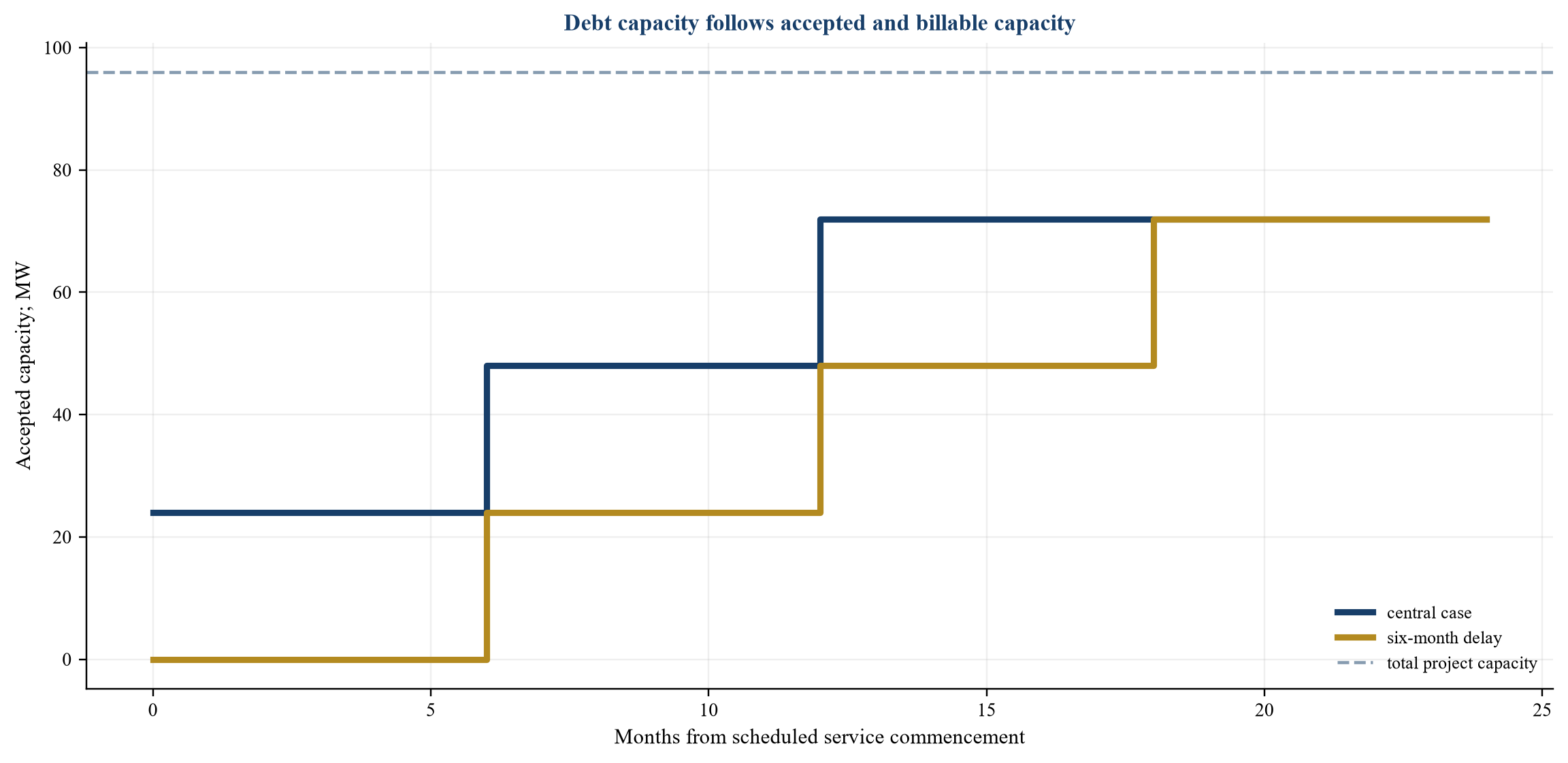
Capacity and timing are management assumptions and do not describe an identified project.
The model should calculate debt capacity under contracted, delayed, partially accepted, service-credit and customer-default cases. Advance rates can vary by customer credit, contract term, delivery status and residual asset value. The lowest supported constraint should govern.
8 Model utilisation separately from minimum payment
A take-or-pay charge can reduce revenue volatility while utilisation continues to affect cost, performance, renewal and residual value. The project should model reserved capacity, actual workload, billable usage, power consumption and gross margin separately. Underutilised dedicated equipment can still earn a reservation fee and lose relevance before renewal.
High utilisation can create another risk. Capacity can exceed cooling, network or reliability limits. Bursty workloads can affect power and service performance. The operator needs scheduling, observability, maintenance and spare capacity. Customer contracts should define how performance is measured during demand spikes and maintenance.
The renewal case should not assume that paid but unused capacity will renew. The customer may reduce commitment, migrate to a different platform, adopt more efficient models or benefit from lower market pricing. The lender should amortise debt within the firm contract and conservative equipment life, leaving a manageable refinancing exposure.
| State | Contract status | Operating condition | Credit implication |
|---|---|---|---|
| reserved and accepted | fixed charge payable | capacity ready, low workload | near-term cash supported; renewal risk remains |
| reserved and utilised | fixed and usage charges | active workload and proven service | strongest evidence of strategic dependence |
| installed and unaccepted | payment not yet triggered | testing or defect unresolved | completion exposure, not operating cash |
| accepted with credits | charge reduced by performance remedy | service issue persists | haircut revenue and test cure plan |
| uncontracted available | no minimum payment | merchant or remarketing option | exclude until demand is evidenced |
| obsolete or stranded | contract ended or asset rejected | limited compatible demand | use tested liquidation or redeployment value |
Proposed operating and credit classification.
Utilisation reporting should be cohort-based by hardware, site and customer. Aggregates can conceal underperforming assets and concentrated workloads.
9 Build the debt-service and reserve model
Cash available for debt service should begin with collected customer cash. It should deduct power, hosting, network, maintenance, software, staffing, taxes, working capital and required capital expenditure. Pass-through power reimbursement should be matched to actual cost and timing. A gross invoice that includes reimbursed electricity should not inflate debt-service coverage.
The waterfall should allocate operating cost, taxes, senior debt service, reserve replenishment, required capital expenditure, junior debt and distributions. Prepayments and termination payments require separate treatment. Cash should move through controlled accounts with defined permitted withdrawals.
Management assumes minimum central-case debt-service coverage of 1.47 times after ramp. A downside with six months of delay, service credits, additional operating cost and slower collection reduces minimum coverage to 0.93 times before reserve use and amortisation controls. A debt-service reserve, interest during construction, completion support and cash sweep are assumed to restore liquidity while preserving lender remedies.
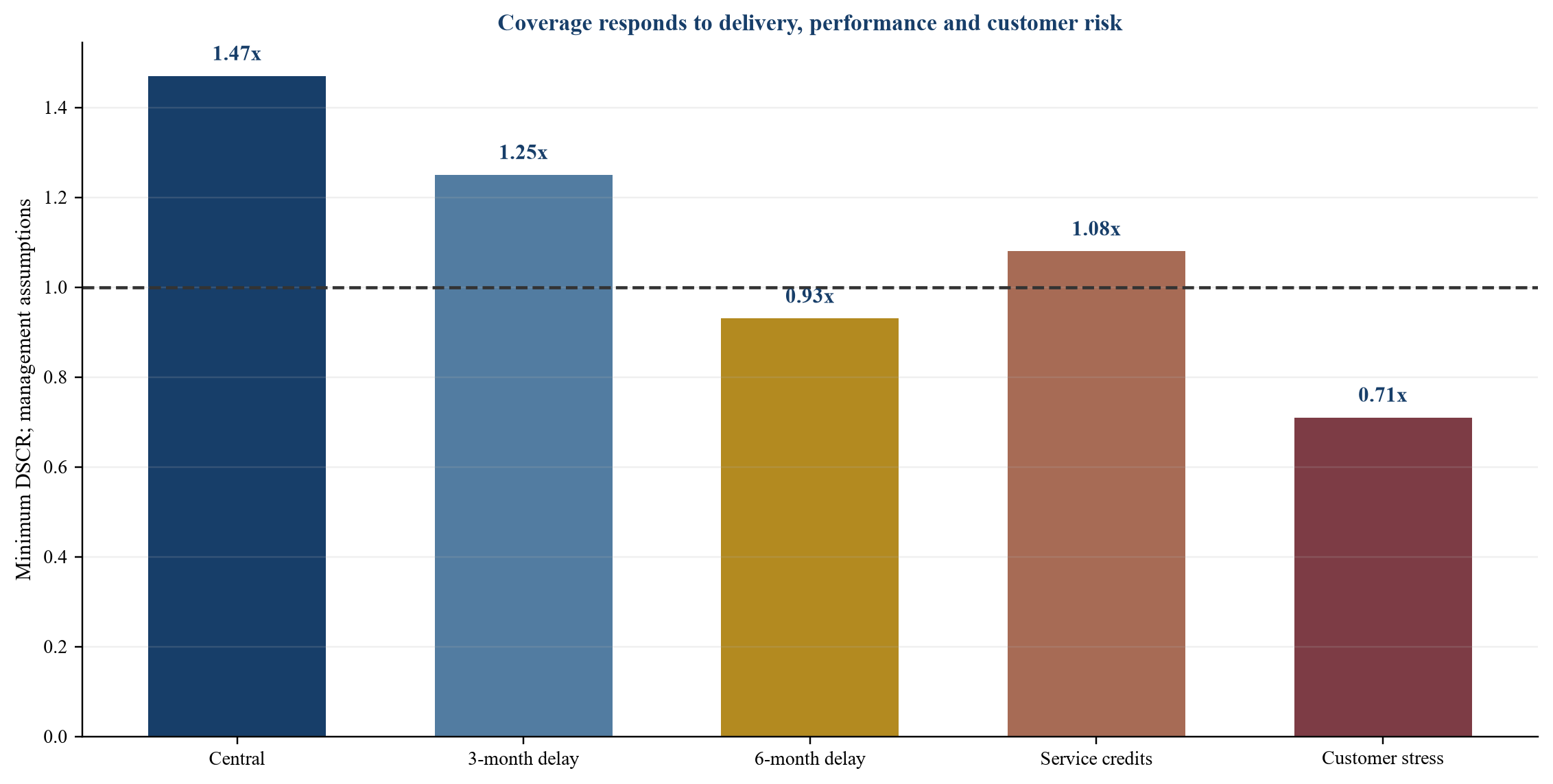
All ratios are management assumptions and do not describe an identified financing.
Coverage should be calculated on forward and historical bases, with clear treatment of restricted cash, one-off receipts and maintenance capital. Lock-up and default thresholds should provide time for corrective action.
10 Design a covenant and borrowing-base package
The covenant package should connect contractual performance to credit control. Financial covenants can include debt-service coverage, liquidity, leverage and reserve requirements. Operating covenants can include available capacity, service levels, customer concentration, eligible contract value, power readiness, equipment maintenance, insurance, security and reporting.
A borrowing base can recognise eligible contracted cash flow after haircuts for customer credit, remaining term, delivery status, performance, concentration and dispute. Unaccepted capacity, disputed invoices, cancellable options and unsupported residual value should be excluded. The borrowing base should decline as contract term shortens unless amortisation reduces debt at least as quickly.
| Control | Measurement | Early-warning trigger | Possible response |
|---|---|---|---|
| eligible contracted cash | present value of supported net receipts | contract amendment or credit downgrade | haircut and mandatory prepayment |
| delivery coverage | accepted capacity versus scheduled capacity | milestone delay or failed test | stop draw and require cure plan |
| service performance | availability and credit rate | rising credits or chronic failure | reserve, remediation and cash trap |
| customer concentration | eligible cash by obligor | exposure above approved limit | reduced advance rate or diversification |
| DSCR | cash available versus debt service | forward ratio below lock-up | distribution block and cash sweep |
| liquidity | unrestricted and controlled reserves | reserve below minimum | sponsor cure or draw stop |
| asset condition | cohort age, utilisation and maintenance | obsolescence or unsupported hardware | accelerated amortisation and upgrade plan |
Proposed structure; thresholds require project-specific modelling and legal drafting.
Information rights should include contracts, invoices, collections, utilisation, service credits, incidents, power status, equipment records, customer credit and forecasts. Data definitions should be fixed and auditable.
11 Control completion, ramp and technology risk
Completion requires an integrated test across building, power, cooling, network, compute and platform. A shell can be physically complete while the project cannot deliver the contracted workload. The independent engineer should review design, procurement, construction, commissioning, capacity tests, schedule, cost to complete and contingency.
Technology risk requires cohort analysis. Accelerator generations, networking, memory, software and workload compatibility can change within the debt tenor. The project should maintain serial-level records, warranties, vendor support, spares, maintenance and upgrade paths. Residual value should be based on tested redeployment or sale routes rather than original cost.
Contract flexibility can mitigate obsolescence when the provider may substitute equivalent or better hardware and move workloads. It can create capital risk when equivalence is disputed or upgrades are unfunded. The financing plan should include maintenance and refresh capital consistent with the service promise.
Completion support should cover delay, cost overrun, failed tests and refund obligations until an objective completion date. Support can come from sponsor equity, standby facilities, guarantees, performance bonds, liquidated damages and insurance. The lender should assess the source, amount, expiry and enforceability of each support instrument.
12 Address revenue recognition and financial reporting
Financial reporting can inform credit and should not replace contract analysis. IFRS 15 requires identification of contracts, performance obligations, transaction price and satisfaction of obligations [38-40]. Variable consideration, service credits, prepayments, contract modifications and significant financing components may affect timing. US GAAP disclosures can provide related evidence for SEC registrants [1-7,41-42].
The project should reconcile contract billing, revenue recognition, deferred revenue, RPO, receivables and cash collection. Differences should be explained by timing, performance, variable consideration and accounting policy. The lender's debt-service model should use cash available under financing documents.
Debt, leases and financial guarantees require accounting review under applicable standards [43-46]. Special-purpose entities, related-party arrangements and customer financing should be transparent. A structure can be off the sponsor's consolidated balance sheet and remain economically dependent on sponsor or customer support.
Auditor, valuation and tax advice should be obtained for the actual project. The credit committee should retain its own view of cash, asset control and downside recovery.
13 Prepare the downside transfer and enforcement plan
Project debt requires a credible route after default. Lenders should know whether contracts, power rights, site interests, licences, equipment, data and staff can transfer to a replacement operator. Consent, cure, assignment and step-in provisions should be aligned across documents. A direct agreement with the customer can preserve service while lenders cure or transfer.
The downside plan should distinguish a temporary operating failure from a failed business model. A replacement operator may restore service when assets and contracts remain viable. Remarketing can help when hardware and power are transferable. Liquidation value can be weak when equipment is specialised, obsolete, encumbered or expensive to remove.
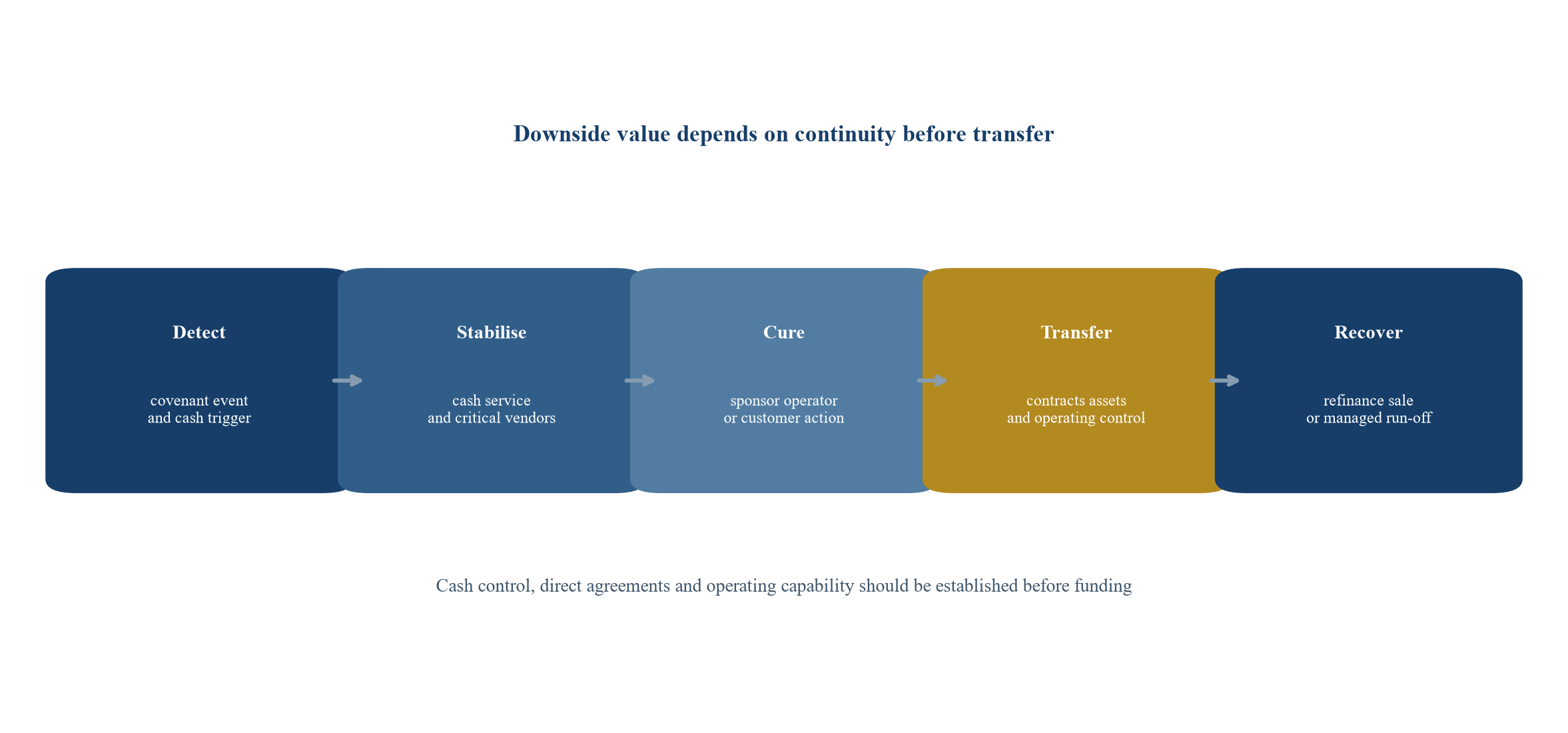
Proposed enforcement roadmap; execution depends on contracts, law, assets and operating capability.
Cybersecurity and operational resilience matter during enforcement. Access keys, monitoring, incident response, customer data and vendor support must remain controlled. NIST and CISA frameworks can inform governance and recovery planning [31-37].
14 Apply the board decision framework and conclude
The board and credit committee should receive one evidence-based decision paper. It should contain the capacity register, contract-rights matrix, customer-credit analysis, dependency schedule, sources and uses, construction plan, utilisation curves, cash waterfall, debt sizing, covenants and downside transfer plan. Verified facts, specialist opinions, management assumptions and unresolved items should remain separate.
Five questions govern the decision. First, which capacity is legally committed and physically deliverable? Second, when does the customer's minimum payment become unconditional and what remedies can reduce it? Third, how do customer credit, concentration and reciprocal relationships affect net support? Fourth, does debt amortise within the firm contract and conservative asset life? Fifth, can lenders preserve service or transfer the platform after default?
The approval should state maximum debt, required equity, reserve levels, completion support, advance rates, covenant thresholds, permitted distributions and conditions precedent. It should record the downside cases that remain acceptable and the events that require repricing, prepayment or stop-funding.
Implementation should follow staged gates. Before first draw, the project should evidence site control, permits, power route, executed customer contract, customer credit, equity and cost-to-complete. Before equipment debt, it should evidence purchase orders, title, delivery, insurance and compatible facility readiness. Before term conversion, it should evidence commissioning, customer acceptance, billing, collection and sustained service.
Practical execution controls
The project should begin with one controlled term sheet that reconciles the commercial contract and financing model. The term sheet should state the committed capacity unit, delivery location, contract term, price, escalation, power treatment, prepayment, service commencement, acceptance, availability standard, credits, termination, guarantee and transfer rights. The sponsor, customer, technical adviser and lenders should use the same defined terms. Differences between sales, engineering and finance definitions should be resolved before debt sizing.
A contract abstract should sit beside the executed documents. It should quote or cite the operative clause for every model input. The abstract should identify amendments, side letters, order forms, service schedules and negotiated exceptions. It should also record governing law, dispute process, notice addresses and consent requirements. Model inputs that cannot be traced to an executed document should remain management assumptions and receive no borrowing-base value until verified.
The delivery baseline should join the contractor schedule, utility programme, equipment plan, platform release and customer test. Each milestone should have a planned date, contractual date, evidence source, responsible party, predecessor, available float and remedy. An integrated schedule allows the credit committee to see whether customer payment begins before the project can satisfy its own dependencies. It also allows contingency to be placed on the actual critical path.
Procurement controls should distinguish reservation, purchase order, vendor acceptance, manufacture, shipment, title, delivery, installation, commissioning and warranty. Accelerators and network equipment can require early deposits. The facility should release those deposits only against approved vendors, documented specifications, refund or security rights and a site schedule capable of receiving the assets. Serial-level records should follow the equipment into the collateral register.
Cost control should reconcile committed, incurred, paid, forecast and remaining amounts. Contingency should be allocated by risk and remain controlled. A percentage-complete report can mislead when expensive equipment is delivered while power or cooling remains incomplete. The independent monitor should report physical progress, critical-path progress, cost to complete, contingency sufficiency and the effect of each change on contractual delivery.
Customer acceptance should be rehearsed. The operator should use the agreed workload, measurement window, test data, software version and performance thresholds. The rehearsal should record defects, cure time, customer dependencies and evidence format. A successful internal benchmark provides useful preparation and does not replace acceptance when the contract requires customer action or an independent certificate.
Billing readiness requires more than acceptance. The project should test meter data, capacity records, power pass-through, service credits, tax, invoice format, purchase-order references and customer portals. It should confirm who approves the invoice and how disputes are escalated. A billing rehearsal can identify administrative failures that delay cash despite operating service.
Collections should be monitored at invoice level. Reporting should show issue date, due date, amount, deductions, dispute, receipt and controlled-account credit. Unexplained late payment should reduce eligibility. Cash collected outside the controlled account should be swept promptly. The lender should have visibility into offsets, credits and refunds that can reduce later receipts.
Capacity remarketing should be evidenced before receiving downside value. The project should identify compatible workloads, sales lead time, price, migration effort, customer acquisition cost and any contractual restriction. A general claim of strong AI demand does not establish replacement revenue at the site, hardware generation and service level in question. Residual value should use observed transactions or executable demand with appropriate cost and timing deductions.
The technology-refresh plan should identify which components can be upgraded without changing power, cooling, network, software or customer acceptance. It should show capital cost, downtime, vendor dependencies and treatment under the customer contract. A reserve or equity commitment should fund required refreshes. Optional upgrades should pass a return test and should not consume cash required for debt service or contractual performance.
Power cost needs a separate control account when it is passed through. Meter boundaries, loss factors, demand charges, network charges, balancing, certificates, taxes and backup generation should reconcile to the customer formula. Timing differences can create working-capital exposure even when the customer ultimately reimburses cost. The model should include the largest monthly cash gap and the facility should fund it.
Service-level management should link operating data to financial consequences. The operator should calculate availability using the contractual method, classify exclusions, identify affected capacity, estimate credits and issue customer reports. Credit calculations should be reconciled to invoices. A rising credit trend should trigger technical review and a forward DSCR test before it becomes a chronic-failure event.
Cybersecurity reporting should reflect the customer's contract and the lender's continuity interest. The project should maintain access governance, vulnerability management, incident response, backup, recovery, vendor controls and customer notification. A material incident can affect service, termination and reputation even when physical capacity remains available. The financing documents should require prompt event notice and a funded remediation plan.
Insurance should be mapped to the risk timeline. Builder's risk, delay in start-up, property damage, machinery breakdown, cyber, business interruption and liability cover can respond to different events. The insured entity, period, limit, deductible, exclusions, loss-payee status and reinstatement need review. Insurance proceeds should enter the controlled waterfall and support restoration or mandatory prepayment under defined conditions.
The sponsor should prepare a quarterly evidence pack. It should include the capacity register, delivery schedule, cost report, customer-credit update, service performance, invoices, collections, utilisation, equipment condition, power status, covenant calculations, reserves and forecasts. Each item should reconcile to source systems and name an accountable owner. The pack should preserve prior periods so that trend and model drift can be observed.
Stress testing should be linked to actions. The project should model delay, partial acceptance, service credits, customer downgrade, payment delay, power-cost mismatch, equipment failure and contract termination. Each case should state liquidity, DSCR, covenant date, reserve use and management response. Compound cases matter because delay can coincide with higher interest, lower equipment value and customer renegotiation.
Distribution policy should remain subordinate to evidence. Dividends should require historical and forward coverage, funded reserves, no default, current delivery and performance, and a compliant borrowing base. A cash sweep should accelerate debt when utilisation, customer credit or contract term weakens. This preserves flexibility before a refinancing deadline becomes unavoidable.
The project should also maintain a refinancing and exit calendar. It should identify debt maturities, contract expiry, renewal windows, hardware refresh, power-renewal dates and customer notice periods. Refinancing preparation should begin while the remaining contract term still supports credit. Waiting until the customer can reduce or terminate the commitment can materially weaken lender options.
Finally, the board should establish a stop-funding rule. Additional debt should stop when a required contract, power, construction, equipment, acceptance, credit or liquidity condition is not evidenced within the approved threshold. The rule should identify who can authorise a cure, the maximum cure period and the capital source. This converts governance from retrospective reporting into an active protection for project value.
Independent verification should be proportionate to the risk. The engineer can verify construction, power, cooling, compute installation and acceptance evidence. The model auditor can test formulas, timing, tax, reserves and covenant calculations. Counsel can analyse the contract, security, direct agreements, permits and transfer rights. Cybersecurity specialists can test the controls relevant to service continuity. Each adviser should state scope, assumptions, reliance and unresolved matters.
The financing model should retain an audit trail from source evidence to output. Contract rates, capacity, dates, power assumptions, operating costs and remedies should have source references. Formula changes should be controlled. Scenario inputs should be separated from observed results. A model that cannot reproduce the lender case from approved evidence should not govern a draw or distribution decision.
Related-party arrangements require specific review. A sponsor affiliate may develop the site, supply power, lease equipment, operate the platform or purchase capacity. The structure should document pricing, service, payment priority, termination, transfer and conflicts. The credit case should remove cash or guarantees that depend on circular funding within the same group. Independent customer cash and externally enforceable support should remain visible.
Environmental and community obligations can affect construction and operation. Water, backup generation, noise, emissions, grid cost and land use can influence permits, tariffs and stakeholder acceptance. The cost plan should fund the applicable controls and monitoring. Sustainability-linked claims should be supported by the actual power and operating arrangement rather than a generic corporate commitment.
Tax and jurisdiction also affect the cash chain. Withholding, value-added tax, customs, import duties, permanent establishment, transfer pricing and incentive conditions can change project cash. Cross-border guarantees, account security and equipment ownership require local analysis. The model should use after-tax cash available in the borrower structure and should not rely on an incentive until eligibility and transferability are evidenced.
A transaction readiness room should be organised around lender questions. Core folders should cover contracts, customer credit, corporate structure, site, permits, power, engineering, construction, equipment, platform, cybersecurity, insurance, environment, financial model, tax, accounting, security and enforcement. Every material model input should link to a document or named management assumption. This structure reduces rework and exposes evidence gaps before formal underwriting.
The board should refresh the approval when a material assumption changes. Triggers can include customer downgrade, contract amendment, site relocation, delivery delay, power change, hardware substitution, cost overrun, service incident, regulatory action or financing change. The refreshed decision should show the previous case, new evidence, financial effect, mitigation and requested authority. This preserves accountability as a fast-moving compute project evolves.
| Gate | Required evidence | Decision | Failure response |
|---|---|---|---|
| contract | executed capacity, payment, remedies and direct agreement | include eligible cash | exclude or haircut unsupported value |
| customer | obligor credit, guarantee and concentration | set advance rate | reserve, diversify or reduce debt |
| construction | fixed scope, schedule, permits and funded contingency | open construction tranche | stop draw and require support |
| power | enforceable service route and funded upgrades | recognise deliverable capacity | delay equipment and revenue credit |
| acceptance | independent tests and customer confirmation | start term debt | cure, retest or restructure |
| performance | availability, credits, invoices and collection | permit distributions | cash trap and remediation |
| downside | transfer consents, operator and recovery analysis | approve residual reliance | accelerate amortisation |
Proposed approval record; each gate requires project-specific evidence.
In the illustrative case, central minimum DSCR of 1.47 times supports the proposed structure only within management's assumptions. The delayed case falls below 1.00 times before controls. The decision therefore depends on tranching, completion support, reserves, cash sweeps and direct contractual rights. A real project should replace every assumption with executed evidence and current specialist advice.
Take-or-pay capacity can support AI compute project finance when the contract and the physical system are underwritten as one cash chain. The relevant collateral is the ability to deliver accepted service, issue enforceable invoices, collect cash and preserve operations through stress. A disciplined structure converts the headline commitment into eligible cash, funds the risks that precede it and gives lenders control when performance departs from plan.
Sources
- CoreWeave, Annual Report on Form 10-K for 2025, Read the primary source
- CoreWeave, Registration Statement on Form S-1, Read the primary source
- CoreWeave, Quarterly Reports and filings, Read the primary source
- CoreWeave, Annual Report filing exhibits, Read the primary source
- Core Scientific, Annual and quarterly filings, Read the primary source
- Core Scientific, 2026 investor materials describing CoreWeave contracts, Read the primary source
- Core Scientific, Current Reports and material agreements, Read the primary source
- International Energy Agency, Energy and AI, Read the primary source
- International Energy Agency, Energy and AI executive summary, Read the primary source
- International Energy Agency, Energy demand from AI, Read the primary source
- International Energy Agency, Energy supply for AI, Read the primary source
- US Department of Energy, 2024 United States Data Center Energy Usage Report, Read the primary source
- Lawrence Berkeley National Laboratory, 2024 United States Data Center Energy Usage Report, Read the primary source
- US Department of Energy, Electricity Demand Growth Resource Hub, Read the primary source
- Federal Energy Regulatory Commission, PJM co-location order, Read the primary source
- Federal Energy Regulatory Commission, large-load interconnection proceeding EL26-67-000, Read the primary source
- Federal Energy Regulatory Commission, State of the Markets 2026, Read the primary source
- North American Electric Reliability Corporation, 2025 Long-Term Reliability Assessment, Read the primary source
- North American Electric Reliability Corporation, Characteristics and Risks of Emerging Large Loads, Read the primary source
- PJM Interconnection, Data Center Load and System Planning, Read the primary source
- Electric Reliability Council of Texas, Large Load Interconnection, Read the primary source
- World Bank, Guidance on PPP Contractual Provisions, Read the primary source
- World Bank, Project Finance and PPP Reference Guide, Read the primary source
- International Finance Corporation, Performance Standards, Read the primary source
- International Finance Corporation, Environmental, Health and Safety Guidelines for Telecommunications, Read the primary source
- International Finance Corporation, Environmental, Health and Safety General Guidelines, Read the primary source
- European Investment Bank, Project and infrastructure finance, Read the primary source
- Office of the Comptroller of the Currency, Comptroller's Handbook: Project Finance, Read the primary source
- Federal Deposit Insurance Corporation, Risk Management Manual of Examination Policies, Read the primary source
- Basel Committee on Banking Supervision, Principles for the Management of Credit Risk, Read the primary source
- NIST, Cybersecurity Framework 2.0, Read the primary source
- NIST, AI Risk Management Framework, Read the primary source
- NIST, Secure Software Development Framework, Read the primary source
- Cybersecurity and Infrastructure Security Agency, Secure by Design, Read the primary source
- Cybersecurity and Infrastructure Security Agency, Cross-Sector Cybersecurity Performance Goals, Read the primary source
- ISO, ISO/IEC 27001 Information Security Management, Read the primary source
- ISO, ISO 22301 Business Continuity Management, Read the primary source
- IFRS Foundation, IFRS 15 Revenue from Contracts with Customers, Read the primary source
- IFRS Foundation, IFRS 15 supporting materials, Read the primary source
- IFRS Foundation, IAS 37 Provisions, Contingent Liabilities and Contingent Assets, Read the primary source
- US Financial Accounting Standards Board, Topic 606 Revenue from Contracts with Customers, Read the primary source
- US Securities and Exchange Commission, Commission Guidance Regarding Management's Discussion and Analysis, Read the primary source
- IFRS Foundation, IFRS 9 Financial Instruments, Read the primary source
- IFRS Foundation, IFRS 16 Leases, Read the primary source
- IFRS Foundation, IFRS 10 Consolidated Financial Statements, Read the primary source
- IFRS Foundation, IFRS 12 Disclosure of Interests in Other Entities, Read the primary source
- US Uniform Commercial Code, Article 9 Secured Transactions, Read the primary source
- International Bar Association, Principles for a Just Transition in Development Finance, Read the primary source
- Equator Principles Association, The Equator Principles EP4, Read the primary source
- International Capital Market Association, Green Bond Principles, Read the primary source
