

1. Define the decision before collecting data
Construction analytics becomes useful when the transaction decision is explicit. An acquirer may need to determine whether reported project earnings are sustainable. A lender may need to decide whether a draw should be released. An investor may need to test whether equity has funded the agreed milestones. A developer may need to assess a contractor acquisition whose value depends on backlog, work in progress, claims and completion capability. Each decision has a different materiality threshold, evidence standard and consequence.
The diligence mandate should identify the legal entities, projects, contracts, reporting periods and value drivers in scope. It should state whether the analysis supports purchase price, net debt and working capital, debt sizing, conditions precedent, drawdown certification, covenant testing, completion support or post-close monitoring. The reviewer should also identify which conclusions require independent engineer, quantity surveyor, accountant, lawyer, insurer or technical specialist input.
A falsifiable question improves discipline. Examples include whether the project is physically complete to the percentage reported; whether certified value supports the receivable; whether forecast remaining cost includes all committed and probable obligations; whether the critical path supports the stated completion date; and whether the next capital release remains protected after plausible delay and cost escalation. The evidence plan then follows the question.
Materiality should reflect both amount and mechanism. A small unsupported activity can be material when it lies on the critical path. A modest certification delay can trigger a liquidity shortfall. A change order can be immaterial to contract value while carrying a large margin or dispute effect. The diligence plan should therefore combine value thresholds with risk-based sampling.
2. Establish the project and contract perimeter
The project universe should reconcile the commercial register, project system, general ledger, board reporting and legal contract population. Every project receives a stable identifier linked to customer, employer, contractor, joint venture, special-purpose vehicle, site, contract, currency and reporting unit. Acquisitions with multiple systems require a crosswalk that preserves source identifiers and records mapping decisions.
The contract perimeter includes the executed agreement, scope, bills of quantities, drawings, specifications, programme, notices to proceed, amendments, approved variations, payment terms, retention, performance security, insurance, warranties, delay damages, termination rights, dispute provisions and governing law. Purchase orders, subcontracts and consultant appointments create obligations that can sit outside the headline contract value.
The financial perimeter should distinguish approved contract value, variable consideration, claims, provisional sums, customer options, escalation, taxes, pass-through amounts and related-party balances. The schedule perimeter should distinguish baseline, accepted revisions, recovery programmes and internal working schedules. A model trained or tested against one perimeter should not be compared with a management percentage derived from another.
The reviewer should freeze a dated diligence snapshot. Subsequent changes remain visible through a controlled movement log. This prevents a late programme revision, cost transfer or retrospective certificate from overwriting the evidence that informed an earlier decision. The snapshot also creates a reproducible basis for post-close testing.
3. Build an evidence lineage from source to decision
Evidence lineage records where each decision input originated, how it was transformed, who reviewed it and which exceptions remain. A schedule percentage can be traced to activities, quantities, dates and update status. An image-based estimate can be traced to the file, capture time, location, camera, model version and validation result. A cost forecast can be traced to ledger lines, commitments, quantities and assumptions.
The lineage register should capture source owner, system, extraction date, file hash or immutable identifier, reporting period, access restrictions, transformation rule, reviewer and approval. Manual overrides need the previous value, revised value, reason and approver. Derived features should retain enough information to reproduce the calculation without exposing unnecessary personal or commercially restricted data.
AI can accelerate classification, matching and exception detection. It can identify duplicate invoices, connect payment applications with certificates, compare drawing revisions, extract quantities from documents and flag schedule-image inconsistencies. The output should remain an analytical lead until the underlying source and business meaning are reviewed. A high-confidence classifier does not establish contract enforceability or engineering completion.
The final transaction memo should separate sourced fact, calculated result, professional judgement and hypothetical scenario. This structure makes uncertainty visible and enables a decision-maker to challenge the weakest link. It also supports later review if the project outcome differs from the diligence case.
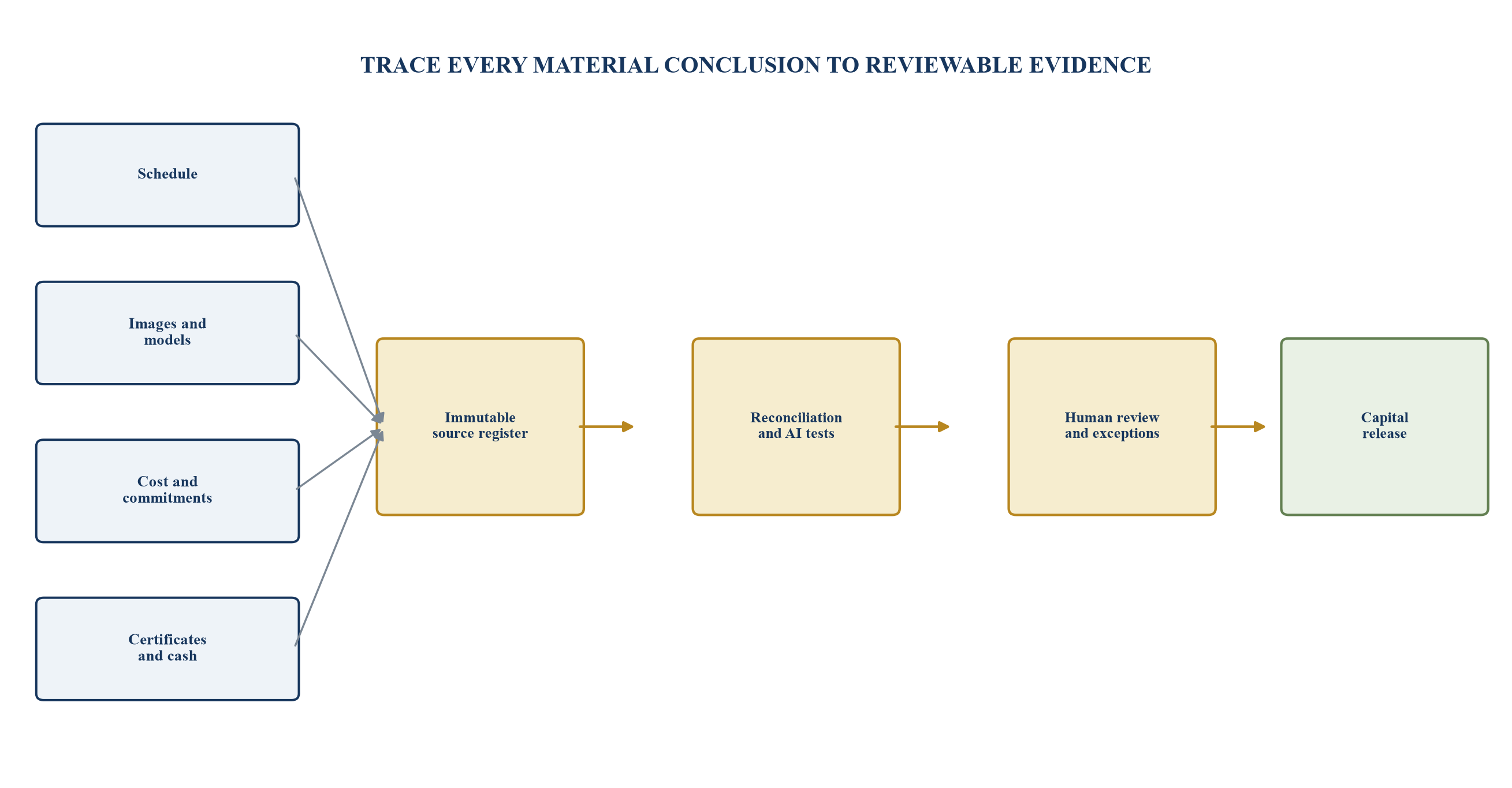
Each transformation retains provenance, validation and exception ownership.
4. Separate the five meanings of progress
Physical progress measures installed or completed work. Schedule progress measures activity status against time. Cost progress measures incurred cost relative to forecast total cost. Certified progress measures value accepted under the contract. Cash progress measures amounts collected after billing. These measures can move in different directions for legitimate reasons.
Early procurement can raise cost progress before installation. Front-loaded mobilisation can raise certified value before visible output. Stored materials may qualify for payment under specific conditions. A schedule can record an activity as substantially complete while defects, testing or documentation remain. Revenue can be recognised over time while cash remains conditional on certification or collection.
The diligence model should preserve each measure, explain the basis and reconcile the gaps. A single consolidated progress percentage hides timing, quality and cash risk. The reviewer should identify which measure drives purchase price, earn-out, drawdown, covenant or valuation and test whether that measure is appropriate for the decision.
IFRS 15 requires an entity recognising revenue over time to select an appropriate measure of progress. That accounting objective informs the analysis while transaction diligence adds contract, completion, collectability and downside questions. A valid accounting policy does not remove the need to test physical delivery or future cash.
Table 1. Five progress measures and their diligence use
| Progress measure | Primary source | What it can support | Principal limitation |
|---|---|---|---|
| physical | quantities, inspection, imagery and testing | installed work and completion status | hidden work, quality and access |
| schedule | baseline, updates, logic and critical path | timing and delay analysis | subjective status and weak logic |
| cost | ledger, commitments and estimate at completion | burn, margin and remaining funding | spend can precede or lag output |
| certified | payment application and independent certificate | contractual acceptance and billing | lag, exclusions and dispute |
| cash | invoice, bank receipt and allocation | liquidity and collection | timing, set-off and restricted cash |
Each measure requires its own source, reconciliation and tolerance.
5. Test schedule provenance and critical-path integrity
A schedule review begins with the approved baseline, contractual milestones and accepted revisions. The reviewer should identify calendars, constraints, activity logic, float, progress method, update date and data date. Activities without predecessors or successors, excessive constraints, negative float, out-of-sequence progress and long-duration summary activities can reduce confidence.
Status should be traced to evidence. Actual starts and finishes can be checked against permits, site records, delivery tickets, inspection requests, timesheets and imagery. Remaining duration should reflect current productivity and access. A recovery programme deserves separate treatment from an accepted contractual baseline, because it can show management intent without changing contractual entitlement.
Critical-path analysis should identify the chain controlling completion and the sensitivity of that chain to delayed design, approvals, equipment, utility connections, testing and commissioning. Near-critical paths matter because a small delay can consume float and become controlling. AI can rank anomalies and compare schedule narratives across thousands of activities, while an experienced planner interprets logic and construction sequence.
The diligence output should show schedule confidence by work package and milestone. A low-confidence activity on the critical path receives more attention than a larger non-critical activity. The reviewer should also test schedule movement across prior updates to identify repeated deferral, retroactive status and unexplained logic changes.
Schedule analytics should also preserve the difference between contractual entitlement and expected delivery. A contractor may forecast completion later than the contractual date while reserving its rights on delay events. A recovery plan may improve the forecast while depending on access, approvals or additional labour that has not been secured. The diligence model should therefore retain the contractual baseline, current forecast, management recovery case and reviewer downside as separate timelines. Milestone consequences, liquidated damages, bonus, prolongation cost and financing need can then be attached to the appropriate dates without implying a legal conclusion.
6. Use images as governed evidence
Site photographs, video, drones, fixed cameras, laser scans and satellite imagery can provide wide coverage. Their value depends on capture governance. The reviewer should know when and where an image was taken, who controlled the device, whether metadata is intact, whether the scene is representative, and whether the file has been altered or selectively supplied.
Computer vision can classify work elements, segment areas, detect objects, compare time-series images and estimate visible quantities. The model should be validated for the actual asset type, camera geometry, lighting, occlusion and site conditions. A model trained on repetitive residential structures may perform poorly on industrial process equipment or underground works.
Image evidence has natural blind spots. It may not prove embedded quality, material specification, reinforcement, testing, commissioning, documentation or legal acceptance. Progress behind walls or underground needs inspection records, scans or quantity evidence. Images can confirm presence without confirming ownership, payment or compliance.
A defensible workflow preserves originals, records transformations, uses defined sampling and routes uncertain cases to human review. The output should include confidence bands and exception images rather than a single authoritative percentage. The reviewer should also test whether the image population covers the complete project or a curated subset.
7. Reconcile imagery, quantities and the information model
The model and drawing environment provides design intent, asset breakdown and quantity structure. ISO 19650-1 describes a framework for exchanging, recording, versioning and organising information across the built-asset life cycle. Diligence should identify the authorised information model, revision status, approval state and relationship to the contract.
Quantities extracted from BIM, drawings or point clouds should be mapped to schedule activities, cost codes and payment items. The mapping needs stable work-package identifiers and rules for partial completion. A model quantity can differ from procured, installed, accepted and paid quantity. Each state should remain visible.
AI can compare revisions, identify missing attributes and link objects to activities. Geometric progress can be estimated by comparing as-built scans with design. Accuracy should be tested against field measurements and known completed areas. Tolerances need to reflect measurement technique, asset type and decision materiality.
The reviewer should isolate design change from construction progress. A revised model can reduce or increase quantities without physical movement. An unapproved design change can create rework and claim exposure. The change register therefore connects model revisions to instructions, price, schedule and remaining cost.
8. Create a progress-variance map
A progress-variance map compares management, schedule, physical, cost and certified percentages by work package. The purpose is to identify where measures diverge beyond an agreed tolerance. The map should retain absolute value, criticality, evidence quality and expected timing lag.
Some differences are expected. Procurement cost may lead physical installation. Certification may lag completed work. Testing may create little visible quantity while controlling completion. The reviewer should document the mechanism and expected convergence date. Persistent or unexplained divergence becomes an exception.
Anomaly detection can rank work packages by unusual combinations. A package with high reported progress, low visible quantity, low certification and rising remaining cost deserves review. A package with high physical progress and low cost may reflect missing invoices or cost transfer. The model should surface both favourable and adverse inconsistencies.
The output should support sampling. The diligence team selects high-value, critical and anomalous packages, then adds a representative random sample. This approach avoids reviewing only management-selected areas and provides a basis for estimating the potential range of unsupported progress.
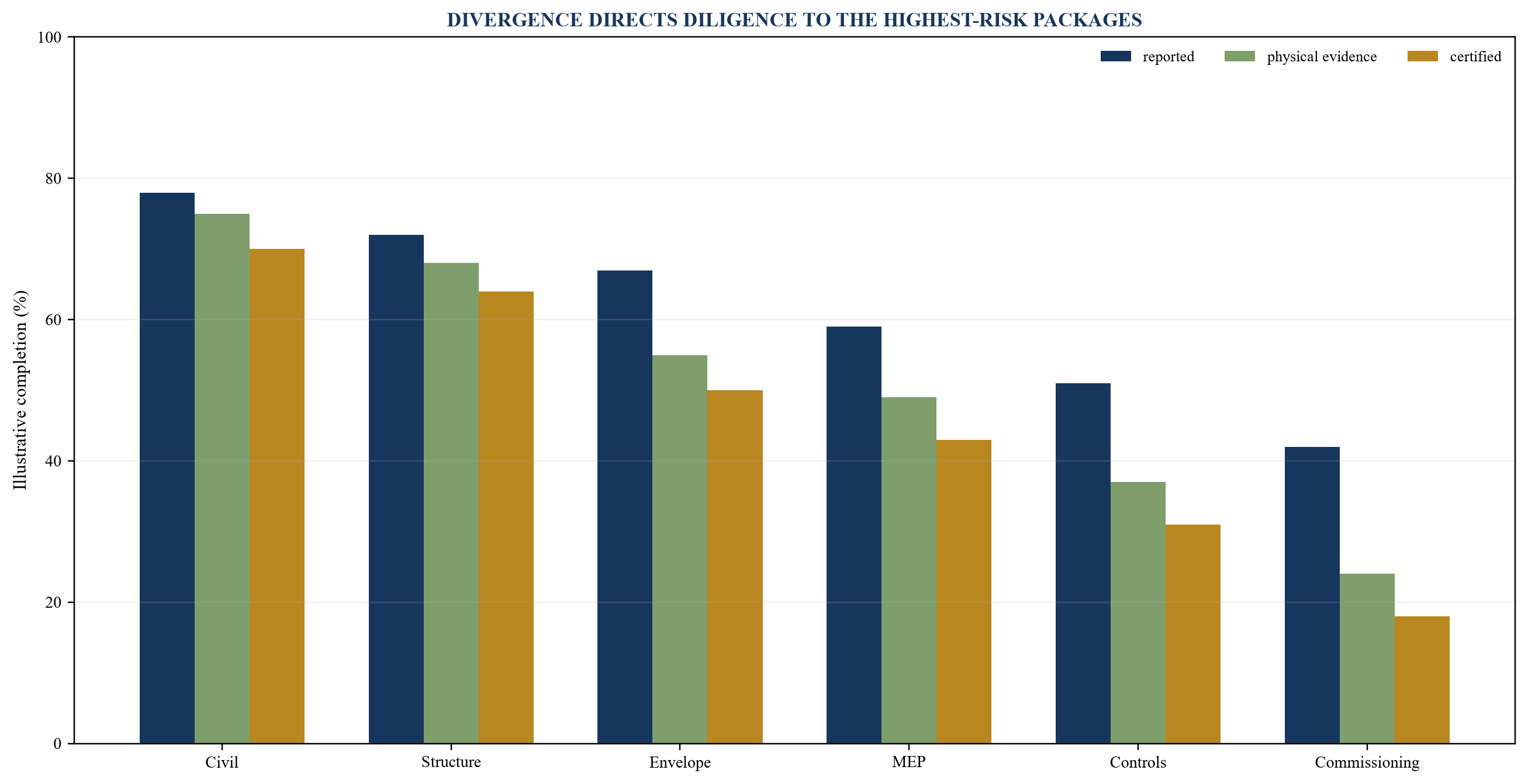
Percentages are hypothetical analytical assumptions and do not represent an actual project.
9. Reconcile the cost ledger to physical work
The cost ledger should be mapped to project, contract, work package, cost code, supplier and accounting period. The reviewer should reconcile opening work in progress, current cost, accruals, transfers, capitalised amounts, provisions and closing balances to the general ledger. Unsupported journals and late reallocations require separate review.
Cost incurred does not equal value created. Deposits, stored materials, mobilisation, design, preliminaries and procurement can lead installation. Missing supplier invoices, unrecorded labour, claims and retention can make cost lag work. The mapping should therefore classify each line by economic purpose and physical state.
AI can standardise supplier names, classify descriptions, detect duplicates, identify unusual timing and connect invoice lines to purchase orders, delivery records and quantities. The model should preserve uncertain matches and expose the criteria used. A false match can distort both progress and remaining cost.
The reviewer should test cut-off around the diligence date and subsequent settlement. Accrual reversals, credit notes, disputed invoices and intercompany transfers can change reported margin. Bank movements and supplier statements provide independent evidence where material. The resulting ledger becomes the starting point for a revised estimate at completion.
10. Build a cost-to-complete bridge
Cost-to-complete should begin with remaining physical quantities and resource requirements. Committed purchase orders and subcontracts provide one evidence layer. The model then adds uncommitted scope, productivity, escalation, design development, testing, commissioning, defects, claims defence, insurance, financing and contingency. Each assumption needs an owner and source.
The bridge should reconcile the prior estimate at completion to the current estimate. Changes can arise from quantity, rate, productivity, schedule, scope, procurement, currency, claim, risk retirement and management action. A net increase can hide adverse movements offset by released contingency. The reviewer should show gross movements before netting.
Schedule and cost are linked. Delay can extend site overhead, supervision, equipment hire, insurance and financing. Acceleration can add shifts, premiums and inefficiency. Supply disruption can affect both rate and sequence. The model should calculate time-dependent cost from the revised schedule rather than apply a broad percentage.
Contingency should be tied to identified and residual risk. A project near physical completion can retain material commissioning, defects and claims exposure. A large unallocated contingency can provide flexibility while obscuring the underlying risk register. Diligence should show which risks remain, their treatment and the evidence required for release.
Forecast ownership should be explicit. Quantity surveyors, planners, engineers, procurement, commercial managers and finance may each control part of the estimate. Their data can use different cut-off dates and assumptions. A controlled estimate-at-completion meeting should reconcile these inputs package by package and record disagreements. The transaction team should avoid accepting a spreadsheet simply because it balances to the board forecast. A reproducible estimate shows source quantities, rates, timing, risk and approval, and it explains how late invoices, disputed liabilities and potential recoveries were treated.
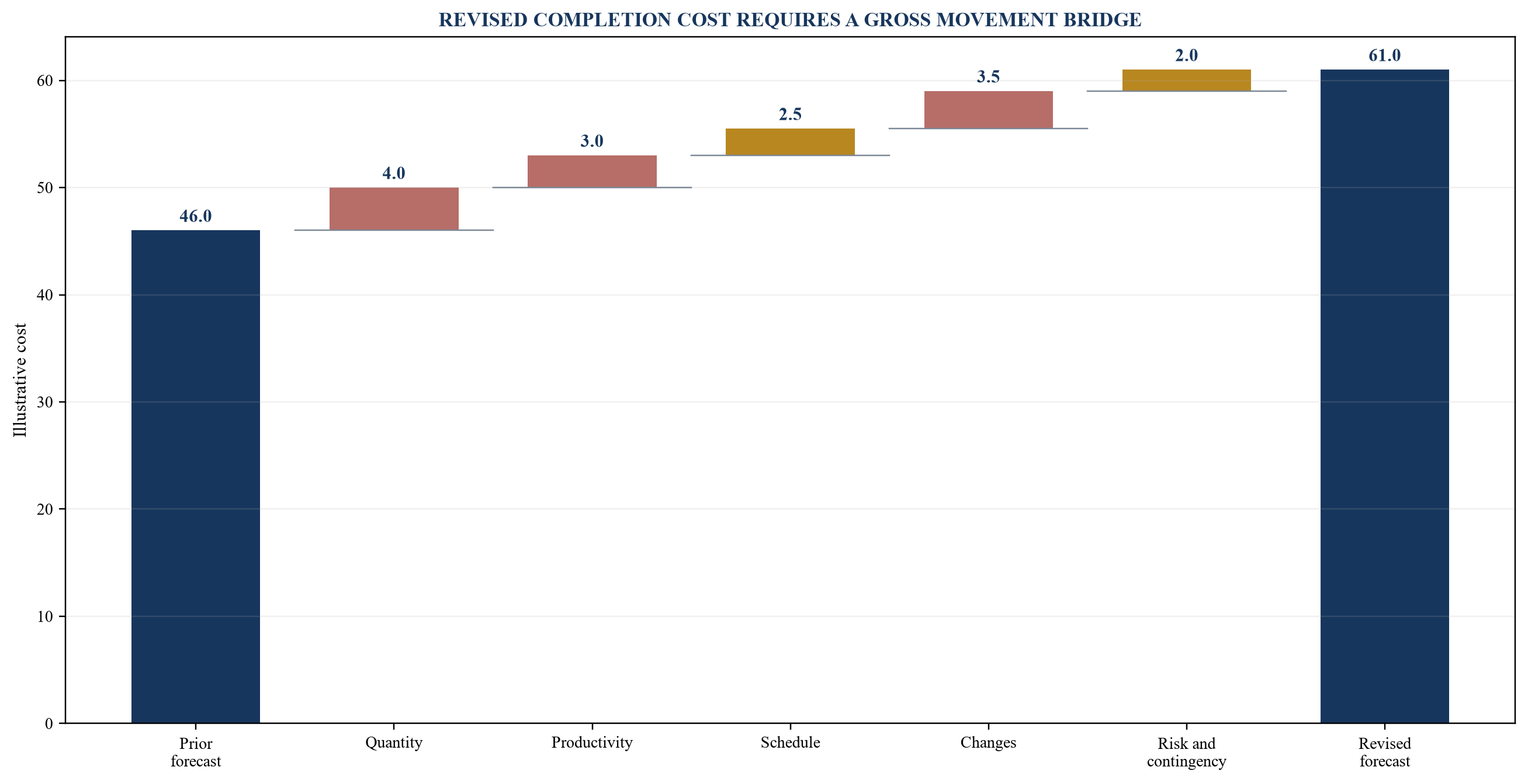
Amounts are hypothetical analytical assumptions and are shown only to demonstrate the bridge.
Table 2. Cost-to-complete evidence hierarchy
| Cost component | Stronger evidence | Diligence test | Typical reserve trigger |
|---|---|---|---|
| committed procurement | executed order, quantity, rate and delivery | completeness, title and escalation | missing delivery or uncertain variation |
| labour | resource-loaded schedule and recent productivity | remaining hours and learning curve | unsupported productivity improvement |
| subcontract | signed scope, progress and forecast final account | omissions, claims and insolvency | unresolved final account or weak counterparty |
| delay cost | revised schedule and time-related rate build-up | critical path and duration | unapproved recovery assumption |
| contingency | risk register with owner and retirement rule | coverage, correlation and release | unidentified residual exposure |
The hierarchy helps identify which assumptions require reserve or specialist review.
11. Reconcile payment applications and certificates
Payment applications should be reconstructed from contract value, approved change, prior certified value, current claimed value, retention, deductions, taxes and net amount. Each line should map to quantities, milestones or cost evidence. The reviewer should identify who prepares, checks, recommends and certifies the application.
Certification is strong evidence when the certifier is independent, the scope is clear and subsequent dispute is absent. It can still lag physical work, exclude materials, reserve rights or rely on provisional quantities. Certification should be read with the supporting measurement and correspondence rather than treated as a complete engineering opinion.
The reconciliation should distinguish claimed, assessed, certified, invoiced, paid and retained values. Differences can reveal optimistic applications, disputed quantities, missing documentation, set-off or customer liquidity stress. Aging should start from the correct contractual trigger, which may be certificate, invoice or acceptance.
AI can compare line items across applications, detect repeated quantities and match certificates to invoices and receipts. Human review remains important for contractual interpretation, change entitlement and quality. The output should identify both unsupported claim and unclaimed completed work because each affects working capital and purchase price.
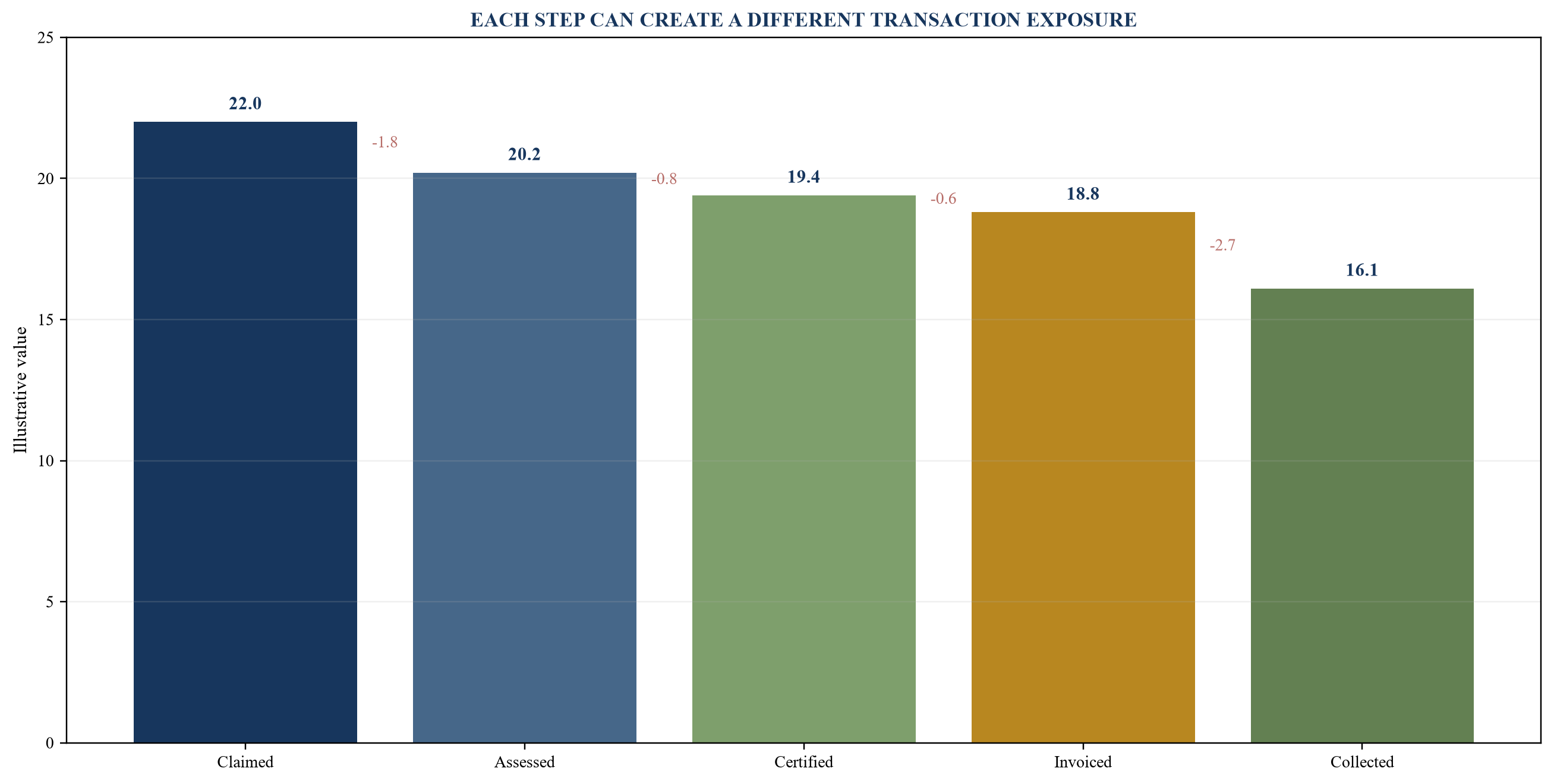
Values are hypothetical analytical assumptions.
12. Test change orders, claims and contractual entitlement
The change register should include instruction date, description, scope, status, submitted value, assessed value, approved value, cost incurred, forecast cost, schedule effect, correspondence and owner. The register should reconcile to contract value, programme, revenue, margin and cost-to-complete.
An approved change can still carry execution risk. An unapproved change can represent genuine work without contractual entitlement. A claim can include concurrency, notice, substantiation and causation issues requiring specialist legal and delay analysis. Diligence should avoid applying one probability to a mixed population.
AI can classify correspondence, build timelines, identify notice references and compare submitted narratives. It can help locate contradictory dates or missing documents. Legal rights depend on the contract, governing law and complete factual record, so automated extraction supports review rather than determining entitlement.
The transaction model should classify changes as approved, instructed but unpriced, submitted, under assessment, disputed or rejected. Revenue, receivable and value treatment should follow the evidence and applicable accounting policy. Downside cases should remove or delay uncertain recovery and retain the associated completion cost where the work remains necessary.
13. Test procurement and subcontractor exposure
Remaining cost depends on whether critical materials, equipment and specialist subcontracts are secured. The procurement register should show package scope, budget, tender status, supplier, order date, currency, escalation, delivery, payment, title, warranty and interface responsibility. Schedule activities should link to required procurement dates.
Purchase-order value can understate final cost when quantity is provisional, scope is incomplete or variation remains. It can overstate exposure when cancellable or duplicated. Supplier financial distress can create replacement cost and delay. The reviewer should identify sole-source equipment, long-lead items and advance payments.
Subcontractor progress should be reconciled to the main contract, site evidence, payment applications and final-account forecast. Payables aging and disputed deductions can affect site continuity. Retention and bond recoverability require contract and counterparty review. A low ledger balance can signal unrecorded work or delayed invoices.
AI can compare package scopes, identify gaps and duplicates, monitor supplier alerts and match deliveries to site records. The decision model should treat procurement certainty as a separate variable from cost spent. A work package can be physically advanced while a missing component still controls completion.
14. Measure labour productivity and remaining effort
Labour productivity links installed quantity to hours. The reviewer should use comparable work fronts, crews, shifts and conditions. Recent actual productivity usually provides a stronger starting point than original tender assumptions. Changes in congestion, access, weather, sequence and learning should be explicit.
Timesheets, access records, equipment logs and progress quantities can be reconciled. AI can identify unusual patterns, incomplete coding and mismatch between workforce and reported output. Personal data should be minimised and processed lawfully. Individual monitoring may create employment and privacy implications beyond transaction analysis.
Remaining effort should include supervision, engineering, quality, safety, planning, commercial, commissioning and close-out work. Headcount decline near completion can be appropriate while unresolved testing and documentation demand specialist labour. A simple remaining-quantity ratio can therefore understate effort.
The cost model should test productivity at current, recovery and downside levels. Recovery may require overtime or additional crews and can introduce inefficiency. The schedule should reflect practical work fronts and dependencies. The diligence conclusion should state which productivity improvements are evidenced and which remain management actions.
15. Reconcile accounting progress and margin
IFRS 15 establishes principles for identifying contracts and performance obligations, determining and allocating transaction price, and recognising revenue when obligations are satisfied. For obligations satisfied over time, the entity selects an appropriate progress measure. Diligence should understand the selected method, its consistency and its relationship to physical and certified evidence.
Input methods based on cost can be sensitive to uninstalled materials, inefficiencies, waste and changes in total estimated cost. Output methods can depend on surveys, milestones or units delivered. The reviewer should test whether the method faithfully depicts performance and whether estimates were updated when conditions changed.
Contract assets, receivables, contract liabilities, retention and provisions need separate analysis. Revenue can exceed billing. Billing can exceed revenue. A receivable can be unconditional while collection risk remains. Loss-making obligations and probable claims may require recognition under the applicable standards and facts.
Margin diligence should bridge opening forecast, current-period revenue and cost, estimate changes, claims, variations, provisions and closing forecast. The reviewer should test for late profit recognition, cost transfers, contingency release and inconsistent treatment across projects. Accounting compliance, audit evidence and transaction value are related questions with distinct conclusions.
16. Validate the AI system for the decision use
NIST's AI Risk Management Framework organises risk activity around govern, map, measure and manage. A construction-diligence deployment should define the task, user, affected decision, error cost, operating context and oversight. The system may include document extraction, entity matching, computer vision, anomaly detection and language models with different failure modes.
Test, evaluation, verification and validation should use representative project data. Performance should be measured by work type, site condition, document quality and materiality band. Precision and recall matter differently across tasks. A model used to prioritise review can tolerate more false positives than one used to block a capital release.
The validation set should be independent of development data and include difficult cases. Human reviewers should examine both errors and correct outputs. Data leakage, label inconsistency and class imbalance can create misleading aggregate accuracy. The team should also test robustness to revised documents, missing metadata and deliberately misleading inputs.
Model changes require version control and revalidation. The decision record should retain model version, prompt or rule configuration, input population, thresholds, output and reviewer disposition. This makes the analytical path reproducible and supports later challenge.
Table 3. AI control matrix for construction diligence
| AI task | Principal error | Required control | Decision use |
|---|---|---|---|
| document extraction | omitted or wrong field | sampled ground-truth and exception rules | data-room population |
| entity matching | false project or supplier match | stable identifiers and reviewer approval | ledger reconciliation |
| image classification | false completion signal | representative validation and confidence band | review prioritisation |
| anomaly detection | noisy or biased alerts | back-test, materiality and human triage | exception selection |
| narrative synthesis | unsupported conclusion | source-linked output and accountable reviewer | draft decision memo |
Control intensity should reflect the consequence of an error.
17. Control data quality, drift and coverage
Data quality should be assessed before model performance. Missing dates, inconsistent codes, duplicate documents, incomplete image coverage and retrospective schedule changes can create systematic error. The team should quantify completeness by project, period, work package and source rather than report one overall score.
Coverage matters because construction evidence is spatial and temporal. A weekly drone flight may omit internal work. Fixed cameras may show only active fronts. Payment records may arrive monthly. The model should show where evidence exists and where a conclusion depends on interpolation.
Drift can arise when the project moves from structure to fit-out and commissioning, when cameras move, when document templates change or when a new contractor joins. Performance monitoring should therefore use phase-specific tests and trigger review after material changes. A model that performed well during repetitive installation may lose reliability during complex close-out.
Exceptions should remain visible. Imputation and normalisation can improve analysis while hiding absence. The decision-maker needs to know which conclusions are supported by complete evidence, which use partial coverage and which remain unresolved. Capital conditions can then target the missing evidence.
18. Protect integrity, confidentiality and cyber security
Construction data can include commercially sensitive prices, site security, critical infrastructure, personal information and intellectual property. Access should follow least privilege. The diligence environment should record users, permissions, transfers and retention. External model services require review of data use, storage, jurisdiction and contractual protection.
The NCSC guidelines for secure AI system development cover secure design, development, deployment, operation and maintenance. A transaction workflow should threat-model manipulated images, altered metadata, poisoned data, malicious documents, prompt injection, credential compromise and unauthorised export. Source files should be scanned and preserved before automated processing.
Integrity controls include hashes, immutable storage, version history and separation of source from transformed data. Sensitive identifiers can be minimised or pseudonymised where the decision does not require them. Model outputs should avoid reproducing confidential content beyond the authorised audience.
Incident response should define who can suspend the system, preserve evidence, notify affected parties and revert to manual review. A security event near signing or drawdown can invalidate part of the evidence set. The transaction timetable should allow the team to re-establish trusted sources before relying on the result.
19. Address legal, privacy and contractual boundaries
The diligence team should identify rights to access and process project records. Customer contracts, subcontracts, confidentiality agreements, data-room rules and procurement requirements can restrict use. Images may capture workers, neighbouring property or protected locations. Legal advice is required for the specific jurisdiction and transaction.
The ICO's AI and data-protection guidance addresses accountability, transparency, lawfulness, accuracy, fairness, security, data minimisation and individual rights. A data-protection impact assessment may be appropriate where processing creates high risk. The workflow should define purpose, lawful basis, retention and access for personal data.
Automated output should not be presented as an independent certificate unless the responsible professional has performed the required work and accepts responsibility. Engineering, valuation, accounting and audit opinions have professional standards and liability implications. The report should state its scope and reliance.
Contract drafting can allocate information rights, inspection, model access, audit, reporting, change control and step-in support. These rights are more effective when agreed before distress or dispute. In an acquisition, the buyer should assess whether necessary licences, data rights and supplier arrangements transfer at closing.
20. Translate findings into purchase-price mechanics
Construction-progress findings can affect enterprise value, net debt, working capital, provisions, earn-out and indemnity. The buyer should avoid double counting. A revised cost-to-complete can affect forecast EBITDA and working capital. An unsupported receivable may already be captured in debt-like items or a specific provision. The transaction model should show each pathway.
Normalised earnings should remove profit that depends on unsupported progress or uncertain claims where the evidence does not support the seller case. Backlog valuation should consider remaining margin, conversion, concentration, cancellation and execution capacity. A high reported backlog can carry negative value when completion obligations exceed recoverable revenue.
Completion accounts should define treatment of contract assets, retention, disputed receivables, customer advances, unpaid suppliers, performance security, provisions and claims. Locked-box structures require leakage and value-deterioration protections. Earn-outs tied to project outcomes need clear measurement, conduct and dispute provisions.
The price bridge should distinguish factual correction, accounting-policy alignment, forecast adjustment, risk reserve and negotiated allocation. This helps the board understand why value changed and reduces reliance on one opaque haircut. Transaction-specific legal, tax, accounting and valuation advice remains essential.
Table 4. Transaction response to construction-progress findings
| Finding | Valuation effect | Possible protection | Post-close control |
|---|---|---|---|
| unsupported progress | earnings and work-in-progress correction | price adjustment or specific reserve | monthly evidence reconciliation |
| omitted remaining cost | lower forecast margin and cash | escrow, retention or completion support | estimate-at-completion review |
| uncertain change recovery | lower receivable or claim value | contingent value or exclusion | claim milestone reporting |
| certification delay | working-capital and liquidity pressure | working-capital target or funding buffer | certificate-to-cash dashboard |
| critical-path slippage | later completion and higher time cost | earn-out, covenant or draw condition | milestone and schedule assurance |
The appropriate mechanism depends on evidence, materiality and deal structure.
21. Convert findings into debt and capital-release gates
Financing decisions should connect evidence to a defined gate. A draw can require accepted baseline, minimum evidence coverage, certified milestone, revised cost-to-complete, funded contingency, no material default and sufficient liquidity. The conditions should be objective enough to administer and flexible enough to address genuine project variation.
The lender should distinguish conditions precedent, representations, undertakings, covenants, draw stops, reserves and events of default. A documentation gap can support a temporary draw condition. A structural funding shortfall may require new equity, sponsor support or facility resizing. The response should reflect mechanism and severity.
Release amounts should consider the full funding path to the next independently verifiable milestone. Releasing only the immediate invoice amount can leave a partially completed asset without enough capital to reach the next value point. Releasing too much before evidence catches up transfers risk to the capital provider.
Monitoring frequency should match risk velocity. Critical schedule, certification, cash and contingency can require weekly or monthly review. Model performance and data coverage should be reported with project metrics. A material exception should trigger review by the named decision authority rather than automatic approval or rejection.
The release certificate should reconcile opening committed funds, prior draws, eligible expenditure, verified progress, remaining committed sources, forecast remaining uses and minimum reserve. It should identify restricted cash, unpaid equity commitments and funding that depends on future approval. The arithmetic can be automated, while eligibility and source reliability receive independent review. A facility that appears fully funded at headline level can still face a timing gap if equity, customer receipts or refinancing arrive after critical procurement dates.
Remedies should preserve completion value where practical. A draw stop protects the capital provider while potentially worsening a project if it interrupts critical work. Documents can provide escalation, cure, targeted reserve, controlled-account payment, direct supplier payment, sponsor support or step-in pathways. The decision authority should compare the loss avoided by withholding capital with the value protected by a controlled release. This analysis requires current cost, schedule and legal advice.
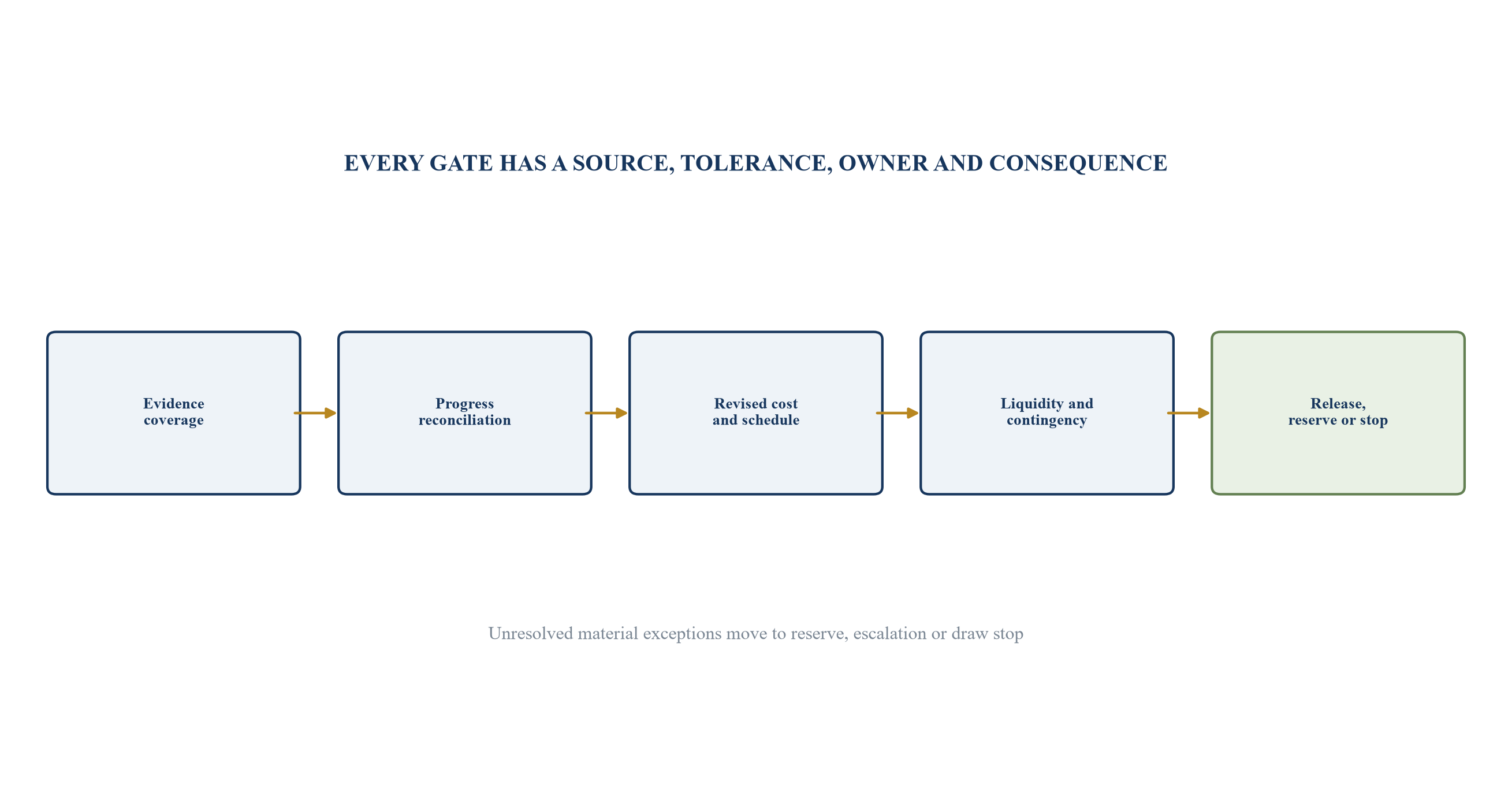
Thresholds are illustrative; actual gates require transaction-specific approval.
22. Run a reproducible diligence workflow
The first phase establishes scope, materiality, source rights and project identifiers. The team obtains the contract, baseline programme, latest update, cost ledger, commitments, payment applications, certificates, bank evidence, change register, risk register, models, drawings and image population. Each source enters the lineage register.
The second phase performs population-level tests. Documents are classified, schedules compared, costs mapped, certificates reconciled and imagery indexed. AI identifies exceptions and gaps. The team tests the model on representative samples and calibrates thresholds before using the results to select deeper review.
The third phase conducts specialist review. Planners assess logic and critical path. Engineers and quantity surveyors assess physical progress, quantities and remaining work. Accountants test revenue, margin and working capital. Lawyers assess contract, entitlement and transaction protections. The integrated team resolves cross-discipline inconsistencies.
The fourth phase builds the transaction bridge. Corrected progress, revised cost, schedule, certification and cash flow into price, financing and release mechanics. Open items retain owner, consequence and deadline. The final memo states the evidence date and conditions required before reliance.
The workflow should include independent confirmation where the consequence justifies it. Customer, certifier, supplier and subcontractor evidence can test whether documents remain current and whether amounts are disputed. Confirmation procedures need consent, confidentiality safeguards and careful design. A response that confirms an invoice exists may not confirm acceptance, entitlement, collectability or final account. The request should identify the specific assertion being tested and the period covered.
Sampling should combine monetary coverage, risk indicators and random selection. Reviewing only the largest balances can miss repeated control failure in smaller packages. Reviewing only anomalies can overstate the apparent error rate. The team should report the population, sampling method, coverage, exceptions and extrapolation limits. Where a finding cannot be projected reliably, the decision model can use a specific reserve or require broader testing.
23. Apply the framework to a worked example
Consider a hypothetical project with a reported completion of 68 per cent and an original forecast total cost of 100 monetary units. Management reports cost incurred of 64, certified value of 61 and a planned completion date in eight months. These values are analytical assumptions created solely to demonstrate the framework.
The evidence review identifies three adjustments. First, activities representing six percentage points lack sufficient physical or documentary support. Second, four percentage points relate to work visible on site but not yet tested or accepted. Third, an approved design change increases remaining quantity and moves a near-critical package onto the critical path. The evidence-supported physical range becomes 58 to 62 per cent pending inspection.
The cost bridge adds three units of omitted committed procurement, four units of productivity and rework exposure, two units of extended site cost, and three units for approved change and testing. It releases one unit of risk that has been retired. The revised hypothetical total cost becomes 111. Delay extends the model by three months and increases the peak funding need.
The certification reconciliation shows 61 claimed, 57 assessed, 55 certified, 52 invoiced and 47 collected. The gap is explained by retention, pending documents and customer payment timing. A portion of the contract asset therefore cannot support immediate liquidity. The buyer and lender should avoid treating reported revenue, certified value and available cash as equivalent.
The illustrative decision is a conditional release. Funds cover critical procurement and the next verified milestone, with a reserve for unresolved testing and a requirement for an independently reviewed schedule and cost forecast. This example demonstrates the logic of a gate. Actual conclusions require verified project data and accountable professional review.
The committee should also test sequencing risk. A funding release tied only to aggregate completion can arrive too late for a long-lead item that controls commissioning. A larger early release can increase exposure if title, storage, insurance and delivery are weak. The capital plan should therefore trace each draw to the procurement and work packages needed to reach the next value-protecting milestone. It should identify the evidence available before release, the evidence produced after expenditure and the remedy if a supplier, contractor or certifier does not perform as expected.
Sensitivity analysis should show which assumptions control the decision. In the example, physical progress, productivity, delay duration, change recovery, certification lag and collection time can each be varied separately before connected stresses are applied. A tornado view or scenario table can identify whether one assumption dominates. The committee can then direct further diligence toward the evidence with the greatest value, rather than expand every workstream equally.
The example should also be reconciled to transaction documents. If a facility defines eligible project cost differently from the diligence model, the release calculation follows the agreed definition while the board retains the broader risk view. If the purchase agreement allocates a claim to the seller, the buyer still needs a completion funding plan. Contract allocation changes who bears value risk; it does not change the physical work or cash required to complete it.
24. Establish governance for recurring use
The board or investment committee should approve the purpose, risk appetite, evidence standard and decision authority. Business owners remain accountable for schedule, cost, certification and cash. Model owners remain accountable for validation, monitoring and change control. Independent reviewers should have authority to escalate material exceptions.
A model register should record use case, owner, data, version, validation, limitations, approved users and review date. A source register should record the project evidence. A decision register should link approvals to both. These three records create an auditable chain without requiring decision-makers to inspect every underlying file.
Management information should show project metrics and analytical controls together. Useful fields include evidence coverage, unsupported progress, schedule confidence, revised cost, contingency coverage, certification gap, cash gap, model exceptions and open actions. The dashboard should link to the detailed record rather than replace it.
Periodic back-testing compares diligence estimates with subsequent physical progress, final cost, certification, collection and completion. Variance can improve assumptions and identify model drift. It also reveals whether review teams consistently accepted optimistic explanations or created excessive false alarms.
Governance should define tolerance changes. Teams can be tempted to relax a threshold when a project repeatedly fails it or tighten one after an adverse event. Any change should state the evidence, expected effect, approval and effective date. Historic results should remain reproducible under the threshold used at the time. This avoids retrospective optimisation and preserves comparability across projects and transactions.
Third-party providers require oversight. Contracts should address service levels, confidentiality, data location, security, model change, subcontracting, audit support, incident notification, continuity and exit. The organisation should retain enough documentation and data to reproduce material decisions if a provider becomes unavailable. Provider assurance can support the control environment while transaction responsibility remains with the appointed decision-makers and professionals.
25. Use a final decision checklist
The decision record should answer whether the project and contract population is complete; whether progress measures reconcile; whether schedule and physical evidence support the reported milestone; whether remaining cost includes committed and probable obligations; whether certification and cash support liquidity; and whether model performance is adequate for the intended use.
Each unresolved item should have a value, schedule or evidence consequence. The team should state whether the item changes price, working capital, reserve, draw condition, covenant, indemnity, earn-out or monitoring. Items without decision impact can remain in the diligence log. Material items need an accountable owner and deadline.
The committee should receive a base case, downside case and evidence range. The range should reflect data coverage and measurement uncertainty rather than a generic confidence label. The report should also state which conclusions rely on engineering, accounting, legal or valuation judgement.
AI construction analytics can increase coverage and shorten reconciliation time when evidence lineage and governance are strong. It can also create false precision when a model score replaces source review. A disciplined framework keeps the technology inside a controlled decision process and directs capital toward milestones supported by traceable evidence.
The final memo should include a limitations section tailored to the assignment. It should identify inaccessible areas, incomplete periods, unaudited records, restricted documents, model coverage, reliance on third parties and unresolved professional opinions. It should also state the period for which conclusions remain relevant. Construction conditions can change quickly after the evidence date, so a draw or signing decision may require a bring-down review.
Post-close integration should preserve the controls that proved useful during diligence. Stable project identifiers, source lineage, schedule-cost reconciliation, certificate-to-cash tracking and estimate-at-completion governance can become the operating baseline. The buyer or lender should assign ownership, reporting frequency and remediation deadlines before the transaction team disbands. This converts diligence from a one-time investigation into an early-warning system for value protection.
A mature process also records evidence that contradicted the final conclusion. Investment committees benefit from knowing which plausible alternative explanations were tested and why they were rejected. This reduces confirmation bias and improves later accountability. Where evidence supports more than one reasonable outcome, the report can present the range, conditions and financial effect rather than force a single precise estimate.
The evidence pack should remain accessible for subsequent assurance, dispute review and lessons learned, subject to agreed confidentiality, retention and legal requirements.
The closing approval should record the evidence cut-off, material changes since review and the named person responsible for confirming that release conditions remain satisfied on the decision date.
Table 5. Final construction-diligence decision record
| Decision area | Required evidence | Downside question | Decision response |
|---|---|---|---|
| progress | schedule, quantity, image and inspection reconciliation | how much reported progress lacks support? | correction, reserve or further inspection |
| completion cost | quantities, commitments, productivity and risk bridge | what funding reaches the next verified milestone? | price, equity or facility adjustment |
| certification and cash | application, certificate, invoice and receipt | which value remains conditional or delayed? | working-capital treatment and liquidity buffer |
| AI reliability | representative validation, coverage and exceptions | which errors could change the decision? | human review, threshold or restricted use |
| governance | named owners, approvals and monitoring | who acts when evidence deteriorates? | covenant, escalation and draw control |
Every approval field should link to evidence and an accountable reviewer.
References
- IFRS Foundation, IFRS 15 Revenue from Contracts with Customers, https://www.ifrs.org/issued-standards/list-of-standards/ifrs-15-revenue-from-contracts-with-customers/
- IFRS Interpretations Committee, Costs to Fulfil a Contract (IFRS 15), June 2019, https://www.ifrs.org/content/dam/ifrs/supporting-implementation/agenda-decisions/2019/ifrs-15-costs-to-fulfil-a-contract-june-2019.pdf
- IFRS Foundation, IFRS 9 Financial Instruments, https://www.ifrs.org/issued-standards/list-of-standards/ifrs-9-financial-instruments/
- IFRS Foundation, IFRS 3 Business Combinations, https://www.ifrs.org/issued-standards/list-of-standards/ifrs-3-business-combinations/
- IFRS Foundation, IAS 37 Provisions, Contingent Liabilities and Contingent Assets, https://www.ifrs.org/issued-standards/list-of-standards/ias-37-provisions-contingent-liabilities-and-contingent-assets/
- IFRS Foundation, IFRS 13 Fair Value Measurement, https://www.ifrs.org/issued-standards/list-of-standards/ifrs-13-fair-value-measurement/
- Cabinet Office, The Construction Playbook, updated 11 July 2023, https://www.gov.uk/government/publications/the-construction-playbook
- Government Project Delivery, Government Functional Standard GovS 002: Project Delivery, updated 17 September 2025, https://www.gov.uk/government/publications/project-delivery-functional-standard
- Infrastructure and Projects Authority, Cost Estimating Guidance, 17 March 2021, https://www.gov.uk/government/publications/cost-estimating-guidance
- Infrastructure and Projects Authority, Project Routemap: Setting up projects for success, updated 28 February 2022, https://www.gov.uk/government/publications/improving-infrastructure-delivery-project-initiation-routemap
- Infrastructure and Projects Authority, Transforming Infrastructure Performance: Roadmap to 2030, 13 September 2021, https://www.gov.uk/government/publications/transforming-infrastructure-performance-roadmap-to-2030/transforming-infrastructure-performance-roadmap-to-2030
- HM Treasury, The Green Book: appraisal and evaluation in central government, https://www.gov.uk/government/publications/the-green-book-appraisal-and-evaluation-in-central-government
- National Institute of Standards and Technology, Artificial Intelligence Risk Management Framework 1.0, 26 January 2023, https://www.nist.gov/publications/artificial-intelligence-risk-management-framework-ai-rmf-10
- National Institute of Standards and Technology, AI RMF Core, https://airc.nist.gov/airmf-resources/airmf/5-sec-core/
- National Institute of Standards and Technology, TEVV-Athlon Framework for Evaluating AI Systems, public draft announced 7 August 2026, https://www.nist.gov/artificial-intelligence/ai-research/tevv-athlon-framework-evaluating-ai-systems
- National Cyber Security Centre, Guidelines for secure AI system development, 27 November 2023, https://www.ncsc.gov.uk/collection/guidelines-secure-ai-system-development
- Information Commissioner's Office, Guidance on AI and data protection, under review following the Data (Use and Access) Act, https://ico.org.uk/for-organisations/uk-gdpr-guidance-and-resources/artificial-intelligence/guidance-on-ai-and-data-protection/
- International Organization for Standardization, ISO 19650-1:2018, information management using building information modelling, https://www.iso.org/standard/68078.html
- International Organization for Standardization, ISO 19650-2:2018, delivery phase of assets, https://www.iso.org/standard/68080.html
- International Organization for Standardization, ISO 21502:2020, project, programme and portfolio management guidance, https://www.iso.org/standard/74947.html
- International Organization for Standardization, ISO/IEC 42001:2023, artificial intelligence management systems, https://www.iso.org/standard/81230.html
- International Organization for Standardization, ISO/IEC 23894:2023, guidance on risk management for artificial intelligence, https://www.iso.org/standard/77304.html
- Office for National Statistics, Construction output in Great Britain: June 2026, new orders and Construction Output Price Indices, April to June 2026, 13 August 2026, https://www.ons.gov.uk/businessindustryandtrade/constructionindustry/bulletins/constructionoutputingreatbritain/latest
- Tutor Perini Corporation, 2025 Annual Report on Form 10-K, filed 2026, https://www.sec.gov/Archives/edgar/data/77543/000007754326000028/tpc-20251231.htm
- AECOM, 2025 Annual Report on Form 10-K, filed 2026, https://www.sec.gov/Archives/edgar/data/868857/000086885726000008/aecom2025_arx10k.pdf
- RICS, International Valuation Standards, effective 31 January 2022, https://www.rics.org/content/dam/ricsglobal/documents/standards/ivsc_effective_31_jan_2022.pdf
- UK Parliament, Procurement Act 2023, https://www.legislation.gov.uk/ukpga/2023/54/contents
