

1. Define the debt case at contract-line level
The first lending question is the source and timing of cash available for debt service. A ConTech company may describe itself as software-as-a-service while a meaningful share of revenue depends on implementation labour, project milestones, hardware delivery or construction activity. The credit case should therefore begin below the consolidated income statement. Every contract line should be assigned to a defined revenue population with its own invoicing, collection, margin and cancellation behaviour.
The classification should identify subscriptions, support, implementation, custom development, project analytics, transaction fees, data services, owned equipment, resold hardware and pass-through expenditure. It should also record the legal customer, ultimate customer group, currency, contract term, termination rights, performance obligations, acceptance conditions, payment terms, renewal mechanism, security obligations and historic collection record. The purpose is to connect an accounting label to an enforceable right and an observable cash path.
An underwriting perimeter should exclude values that depend on unsigned orders, non-binding pipeline, management probability, customer options, unapproved change requests or future equity. Related-party revenue and reciprocal commercial arrangements require separate identification. Revenue from a financially stressed customer can remain contracted while its cash value deteriorates. A clean perimeter lets the lender price the actual asset rather than a blended narrative.
The credit memo should state which populations support scheduled debt service, which support only additional availability, and which receive no value. Stable collected subscriptions may support a term facility. Eligible receivables may support a revolving line. Identifiable equipment may support an asset tranche. Project backlog may support conditional drawings after margin and milestone tests. This segmented statement becomes the controlling logic for diligence, documentation and monitoring.
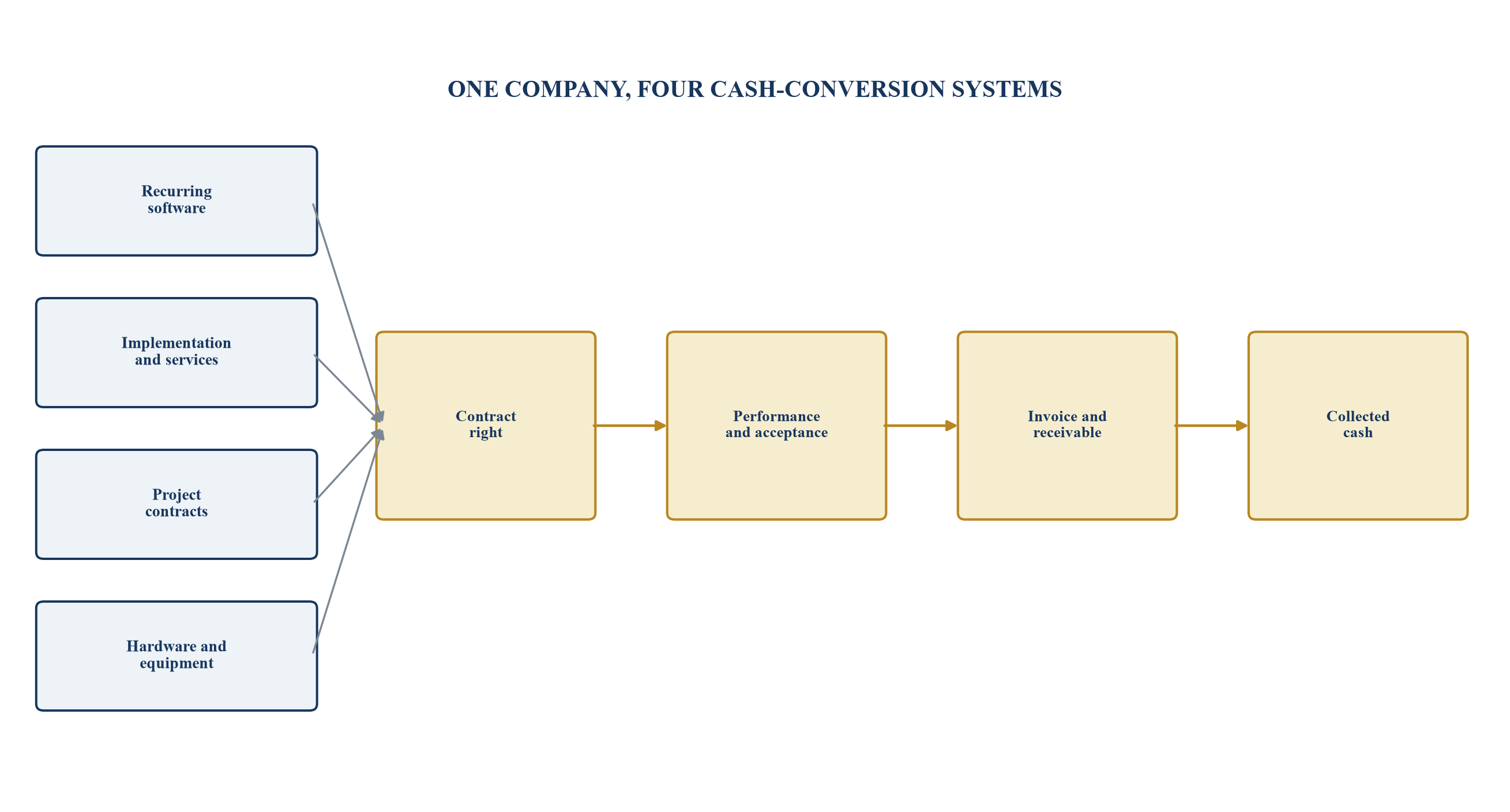
Each stream follows a separate evidence path before it contributes to debt capacity.
2. Separate recurring software from recurring work
Recurring software revenue requires more than repeated billing. The lender should identify a signed contract, a defined service period, enforceable fees, customer access to a functioning product, and a history of invoice and collection. Implementation retainers, managed services and repeat project work can recur commercially while remaining dependent on people, scope and customer activity. They may contribute to cash flow, yet they deserve different stress assumptions from hosted subscription revenue.
The metric policy should define annual recurring revenue and monthly recurring revenue before they enter a borrowing calculation. It should address usage fees, contractual minimums, annual prepayments, free periods, ramped pricing, discounts, early termination, suspended customers, overdue accounts, currency translation and related parties. Expansion not yet contracted belongs in forecast revenue. A customer option is not a commitment. An invoice does not prove collection.
Contract amendments require chronological reconstruction. A multi-year headline term can contain annual break rights, termination for convenience, project dependencies or customer acceptance gates. A subscription connected to a specific construction project may end when the project completes. Revenue sold through an integrator can depend on the partner's contract and credit rather than the end user. These conditions affect duration, concentration and recovery.
The lender should reconcile the recurring-revenue bridge to contracts, billing records, deferred revenue, receivables and bank receipts. Opening recurring revenue plus new logos, expansion and price, less contraction and churn, should equal closing recurring revenue under a consistent policy. Cash retention should be tested alongside revenue retention. This exercise prevents forecast bookings, unpaid invoices and non-recurring work from entering the debt base as though they were equivalent.
Table 1. Revenue-population underwriting map
| Revenue population | Evidence test | Principal risk | Possible facility treatment |
|---|---|---|---|
| hosted subscription | signed term, live access, billing and collection | churn, concentration, service failure | recurring-revenue term debt |
| implementation and services | scoped order, staffing, acceptance and margin | utilisation, rework, delayed acceptance | cash-flow support with reserve |
| project analytics | funded project, milestone, right to payment and cost-to-complete | cancellation, delay, margin erosion | conditional backlog or receivables line |
| hardware resale | purchase order, title, delivery and customer payment | inventory, warranty, obsolescence | limited inventory or receivables value |
| owned equipment | ownership, location, condition and resale evidence | depreciation and recoverability | separate equipment tranche |
Eligibility and advance rates are lender decisions based on verified evidence.
3. Build a contract universe before measuring backlog
Backlog should begin with a complete contract universe, not a sales-report total. The company should extract every signed customer contract, statement of work, purchase order, change order and termination notice. Each item should link to the customer master, invoice ledger, project ledger and cash collection. The population should distinguish original award, approved variation, renewal, extension and forecast opportunity so that value is not counted twice.
The register should capture remaining committed value and the conditions that must occur before the company can invoice or retain payment. Relevant fields include notice to proceed, customer funding, site access, dependencies, performance bonds, insurance, delivery schedule, milestone certification, customer acceptance, liquidated damages, retention, warranty, payment application and dispute rights. A contract can be legally binding while cash timing remains highly uncertain.
Backlog age and movement deserve the same attention as its closing balance. Opening backlog plus new awards and approved variations, less recognised revenue, cancellations, scope reductions and currency movement, should equal closing backlog. Repeated rescheduling can hide weak conversion. A large increase near a financing date requires contract and customer confirmation. The lender should sample both high-value items and a statistically useful spread of smaller contracts.
Management should state its backlog definition in writing and reconcile it to external reporting and board materials. Remaining performance obligations under the applicable accounting framework can inform the analysis, but the lending definition may be narrower. IFRS 15 requires attention to contracts, performance obligations, transaction price and recognition. The lender needs the additional questions of cancellation, margin, collectability and recovery.
4. Score backlog for enforceability and conversion
A backlog score should convert contract evidence into a transparent financing classification. The score can assess six dimensions: legal commitment, cancellation protection, delivery readiness, margin visibility, milestone and acceptance clarity, and customer collectability. Each dimension should link to a source document and named reviewer. A total score without evidence creates false precision.
Legal commitment asks whether the customer is obliged to buy and pay. Cancellation protection considers termination for convenience, compensation, customer options and refund exposure. Delivery readiness considers notice to proceed, permits, data, site access and third-party dependencies. Margin visibility tests remaining cost, subcontractor exposure and price escalation. Acceptance clarity tests certification and dispute mechanics. Collectability tests customer credit, payment history and funding.
Weights should reflect the product. A pure subscription contract may place greater weight on cancellation and renewal. A project-analytics contract may depend on data access and milestone certification. A hardware-enabled installation may depend on supply chain, title and acceptance. The scoring policy should prohibit users from compensating for a failed legal test with a high commercial score.
The output should place each item into an eligibility band. Eligible backlog may receive conditional recognition in liquidity planning. Watchlist backlog may require a reserve or draw condition. Excluded backlog receives no financing value. The model should also show expected conversion by month, gross margin and cash lag. This gives the lender a schedule that can be tested against actual performance after closing.
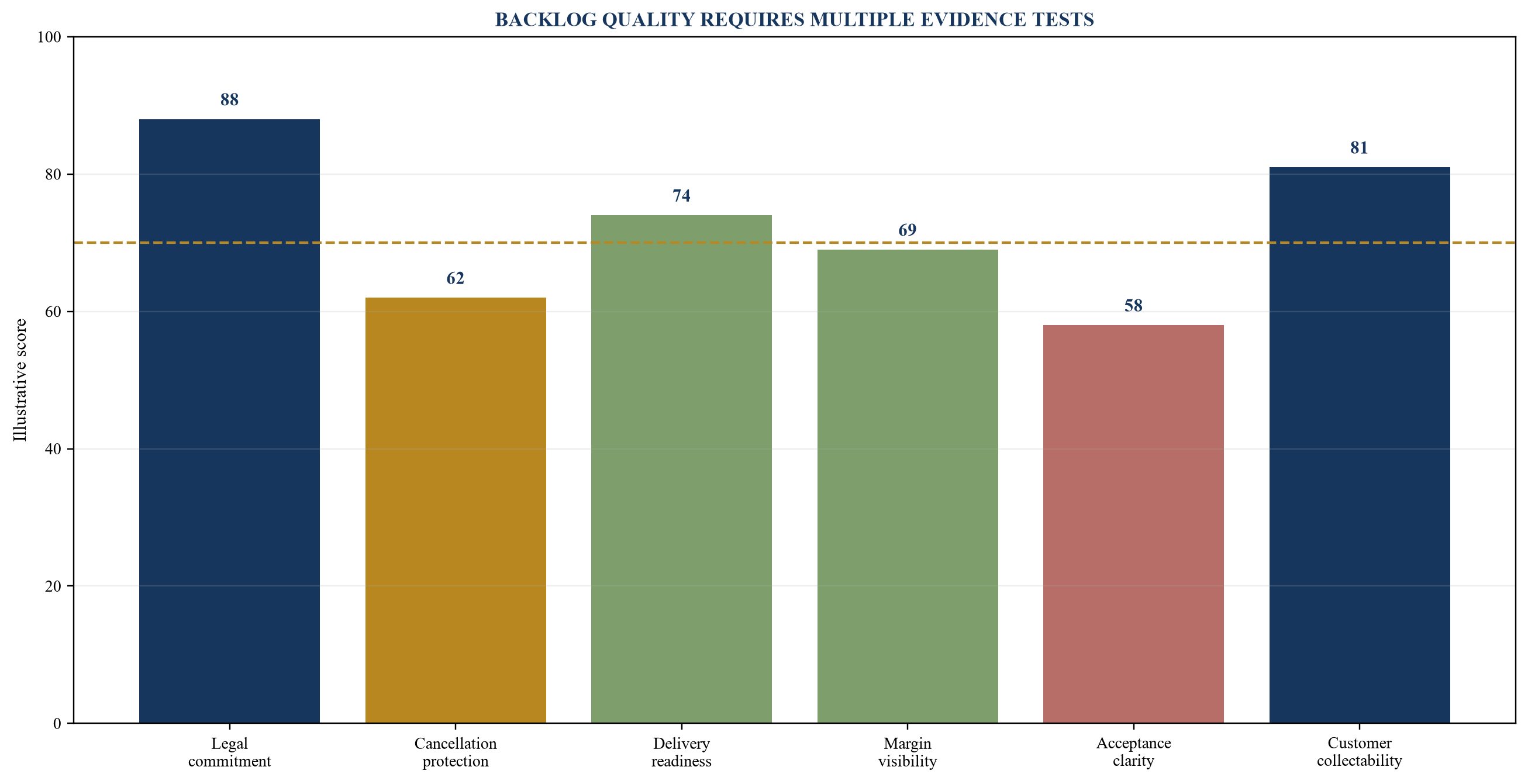
Scores are hypothetical analytical assumptions and do not represent a borrower or credit decision.
5. Convert backlog into monthly cash
Backlog becomes useful for debt analysis when it is converted into a monthly schedule of work, invoices and collections. The model should begin with remaining contract value, subtract value subject to unexercised options, and allocate delivery according to a resource-loaded plan. Revenue recognition, invoicing and cash collection should appear as separate lines. Each has a different trigger and can occur in a different month.
The schedule should incorporate mobilisation, milestone, retention and final-acceptance mechanics. Project analytics may be billed monthly but paid only after a certificate. Hardware may require deposits to suppliers before the customer pays. A customer can withhold payment for disputed work while undisputed work remains collectible. The cash model should show these mechanics rather than apply a uniform days-sales-outstanding assumption.
Cost-to-complete should be linked to the same delivery schedule. Internal labour, subcontractors, cloud usage, data acquisition, travel, hardware, insurance and warranty costs may occur before billing. Gross margin can deteriorate when a project is delayed or requires rework. A lender should test remaining contribution after unavoidable cost, because backlog value without cost can overstate liquidity.
Actual performance should refresh the schedule monthly. The borrower should explain movement caused by new awards, delays, scope changes, disputes, cancellations, cost revisions and collections. Forecast accuracy by horizon is itself an underwriting metric. A company that repeatedly moves cash into later months may require lower availability, higher reserves or milestone-based drawings even when the closing backlog remains large.
6. Test the SaaS cohort and cash bridge
Subscription underwriting should use customer cohorts rather than aggregate growth alone. Customers should be grouped by start date, product, segment, contract source and construction exposure. The lender can then observe activation, gross retention, expansion, price, contraction, churn, overdue balance and collected cash over comparable periods. A blended result can hide deterioration in recent cohorts.
Construction-linked software may face special volatility. A customer can reduce contracted construction volume, finish a project, consolidate tools or fail financially. Usage can fall before renewal. Products serving project teams may show many users while the economic buyer controls a smaller number of portfolio contracts. The data model should therefore connect user activity to contract ownership, renewal date and payment status.
Gross revenue retention should exclude expansion and show the survival of the opening base. Net revenue retention adds expansion and price. Logo retention shows customer survival. Cash retention compares collected recurring cash from the opening cohort with the prior period. Each measure should have a written denominator. Past-due accounts and disputed invoices should not be treated as healthy recurring revenue merely because the contract remains open.
The lender should run a cohort stress that increases churn, delays expansion, extends collections and removes the largest customer group. The result should flow through liquidity, debt service and covenant headroom. This test connects commercial quality to financeability and identifies whether a term loan depends on continued rapid growth or can survive a slower operating case.
7. Identify project exposure inside the software model
A ConTech platform can carry project risk even when it does not perform construction. Its subscription may be priced against active project value, its implementation may depend on site access, and its users may disappear when projects finish. Data feeds, sensor installation and analytics can depend on the main contractor and project schedule. The lender should map these transmission channels explicitly.
The customer register should identify revenue by underlying construction project, not only by legal customer. Several contracts with one contractor can depend on the same large project. Several customers can also depend on the same developer, public budget or infrastructure programme. This creates hidden concentration that legal-entity analysis misses. The map should show project owner, main contractor, funding status, expected completion and the company's role.
Project exposure also affects receivables. Pay-when-paid clauses, certification delays, retention, disputed variation and contractor insolvency can transmit through the chain. The legal enforceability of such terms requires advice in the relevant contract and jurisdiction. Operationally, the lender should identify who certifies delivery, what evidence is required, how long approval takes and whether the company can suspend service for non-payment.
Downside modelling should pause or delay the largest projects and measure the effect on subscription, services, receivables and implementation capacity. The test may reveal that apparently recurring revenue is concentrated in project cycles. The result does not automatically preclude debt. It informs tenor, amortisation, reserves, draw conditions and the balance between term and revolving capacity.
8. Distinguish owned equipment, inventory and pass-through hardware
Hardware needs a title and recovery analysis before it supports borrowing. Owned sensors, scanners, gateways or devices deployed under a service contract may remain company assets. Inventory held for resale may be subject to supplier title retention, obsolescence and customer-specific configuration. Pass-through hardware may never belong economically to the company. These categories should not share one collateral value.
The asset register should record supplier, serial number, purchase date, cost, title, location, customer, condition, insurance, liens, maintenance, remaining useful life and resale evidence. Equipment installed on a site can become difficult to access or remove. Devices can contain customer data or require decommissioning. A recovery value should include collection, testing, refurbishment, storage and remarketing costs.
Inventory availability should exclude obsolete, damaged, consigned, customer-specific, unpaid or disputed goods. Supplier concentration and lead times affect working capital. A company may need to prepay components well before customer installation. Foreign currency and tariff exposure can change cash requirements. Customer deposits can reduce financing need but may be restricted by contract or accounting treatment.
Equipment financing can be separated from venture debt so that amortisation follows useful life and deployment. A borrowing base can apply lower values to specialised or installed assets. The main venture facility should avoid relying on optimistic hardware recovery when the core credit case is recurring software. This separation also makes pricing and monitoring more transparent for both borrower and lender.
9. Construct a segmented borrowing base
A segmented borrowing base translates verified assets and cash flows into conditional availability. It can include eligible recurring revenue, eligible trade receivables, selected project milestones, and qualifying equipment or inventory. Each pool needs its own eligibility rules, advance rate, concentration limit and reserve. The total should also be capped by the facility commitment and the company's ability to service debt.
Recurring-revenue eligibility can require a signed non-cancellable contract, live service, acceptable payment history, limited past due exposure and an approved customer. Receivables eligibility can exclude aged, disputed, related-party, contra, foreign-law or contingent balances. Project-milestone eligibility can require independent certification, positive remaining margin and no default. Equipment eligibility can require title, insurance, location control and verified recovery evidence.
Reserves should address obligations that rank ahead of, reduce or delay recoveries. Examples include customer credits, retention, warranty, taxes, employee obligations, supplier title claims, data-remediation cost, project completion cost and concentration. The legal position varies with the asset and transaction. The model should identify the economic reserve and obtain legal advice on security and priority.
The certificate should be reproducible from source systems. A lender should be able to trace every included amount to contract, invoice, asset record and bank evidence. Availability should decline automatically when an account ages, a project is delayed or a customer exceeds its concentration cap. A cure can involve cash collateral, repayment, new eligible assets or an agreed waiver; it should not involve changing definitions after the result is known.
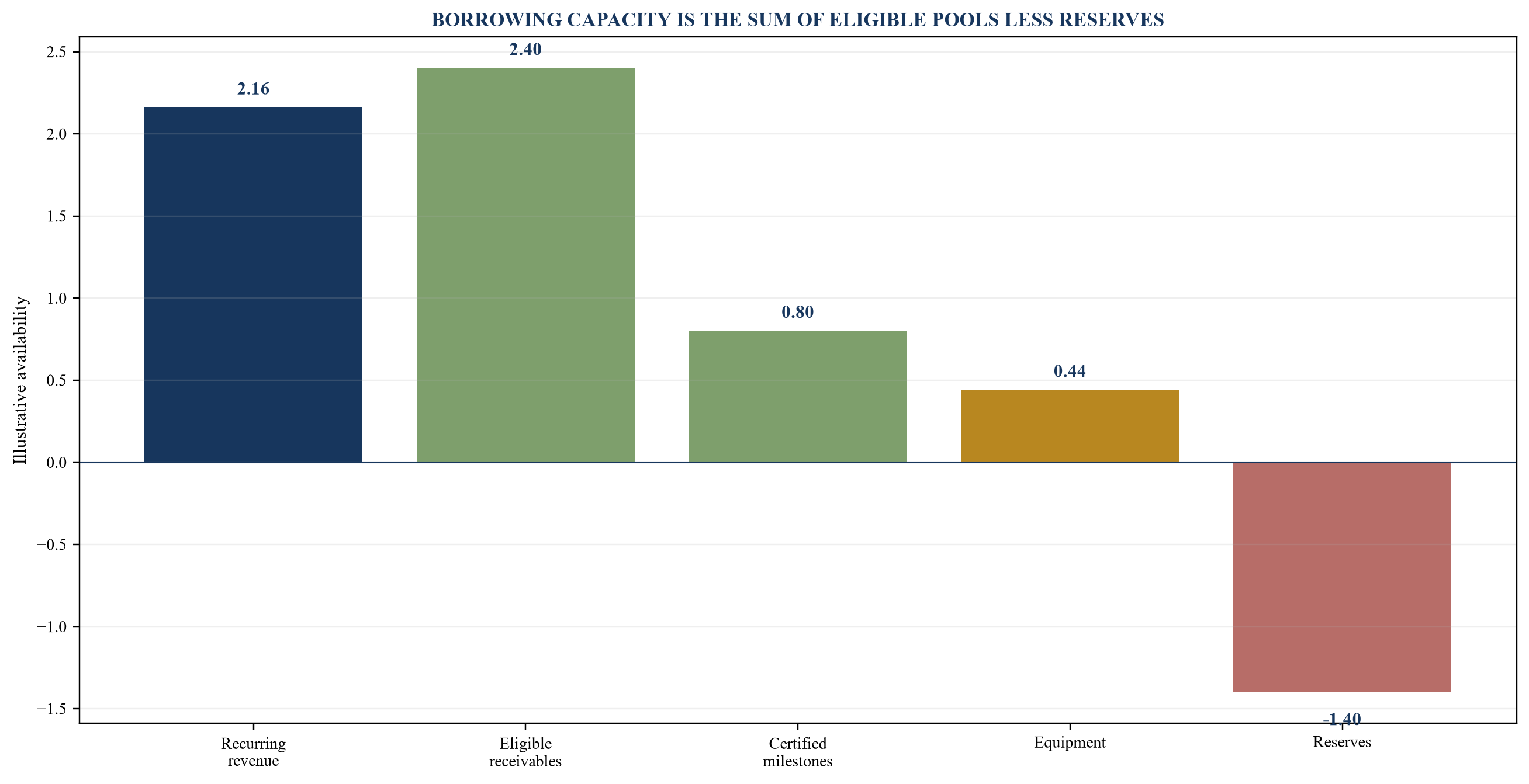
Amounts, advance rates and availability are hypothetical analytical assumptions.
10. Set eligibility rules before negotiating advance rates
Advance rates cannot compensate for weak eligibility. An asset with uncertain legal ownership, disputed acceptance or poor collection should be excluded before a percentage is applied. The lender and borrower should agree definitions while the data room is being built, then test them against historical performance. This reveals how much of the reported asset base survives disciplined classification.
Eligibility rules should be objective and capable of monthly application. Receivables may be excluded after a defined age, upon dispute, when subject to set-off, or when the customer becomes insolvent. Recurring revenue may become ineligible when service is suspended, the customer terminates, payment is materially overdue or the contract depends on an unfulfilled project condition. Equipment may become ineligible when location, insurance or title cannot be verified.
Concentration limits should operate at several levels: legal customer, ultimate group, underlying project, product, geography and channel. A borrower can satisfy a single-customer limit while remaining exposed to one public programme or developer group. The model should cap the excess rather than assume diversification from invoice count.
Historical back-testing is essential. The company should apply proposed rules to prior months and compare calculated availability with subsequent cash collection and losses. A rule that would have financed disputed or cancelled amounts needs revision. Back-testing also reveals operational burden. If the borrower cannot produce a reliable certificate within the reporting timetable, the facility may need simpler definitions or lower reliance on monitored collateral.
Table 2. Illustrative borrowing-base eligibility rules
| Asset pool | Core inclusion rule | Principal exclusion | Monitoring evidence |
|---|---|---|---|
| recurring software | live contracted service and acceptable collection | cancellation, suspension, material arrears | contract, usage, invoice and cash |
| trade receivable | completed and accepted delivery to approved customer | dispute, ageing, set-off or related party | invoice, acceptance and ledger |
| project milestone | certified work with positive remaining margin | uncertified, delayed or loss-making work | certificate and cost-to-complete |
| equipment | clear title, controlled location and insurance | installed, obsolete, encumbered or inaccessible asset | register, serial record and inspection |
| inventory | saleable standard stock with clear title | consigned, customer-specific or aged goods | stock report and supplier evidence |
Final definitions require lender approval and transaction-specific legal analysis.
11. Map debt into purpose-specific tranches
One facility can contain multiple tranches with different borrowing logic. A recurring-revenue term loan can fund product and commercial investment over a defined runway. A receivables revolver can fund timing gaps between invoice and collection. An equipment tranche can finance owned devices over useful life. A delayed-draw tranche can release capital after customer, recurring-revenue or project milestones.
The maturity and amortisation of each tranche should follow its repayment source. Receivables capacity should revolve as eligible balances convert to cash. Equipment debt should amortise within conservative useful life. A term loan funding operating burn needs a credible route to cash break-even, refinancing or equity; future fundraising alone is an uncertain repayment source. Delayed draws can reduce idle cash and lender exposure while preserving committed capacity.
Cross-default, security and covenant provisions connect the tranches. A problem in a large project can affect liquidity available for subscription operations. A borrowing-base shortfall can trigger repayment even when the term tranche remains in compliance. The documentation should describe how cash receipts are applied, which accounts are controlled, and whether availability is blocked after default.
The borrower should compare tranche architecture with a simpler facility. Complexity has a cost in reporting, legal work and operational controls. Multiple tranches are useful when they align genuinely different assets and reduce total pricing or dilution. They become counterproductive when the company lacks the systems to calculate, certify and monitor each pool accurately.
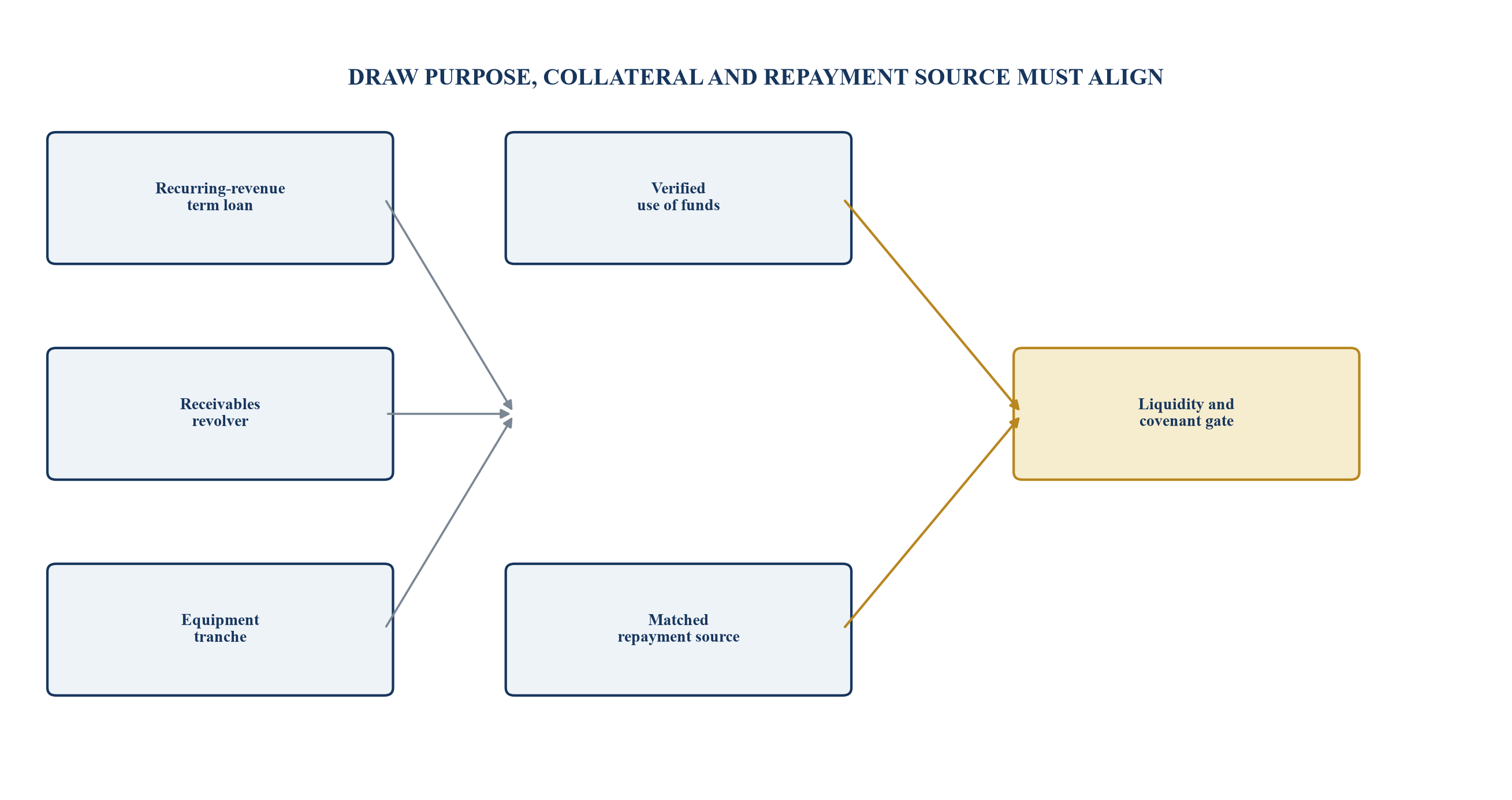
The sequence links each draw to a verified use and repayment source.
12. Size the recurring-revenue term loan
Term-loan sizing should begin with liquidity and debt service under a downside case. A recurring-revenue multiple can be a cross-check, not the primary answer. The model should show opening cash, operating receipts, operating payments, interest, fees, amortisation, capital expenditure, tax and minimum liquidity. It should then apply slower growth, higher churn, delayed collections and reduced project contribution.
The loan should create sufficient runway to reach a financeable milestone. The milestone may be cash break-even, a defined recurring-revenue base, a renewal cohort, a product release or a committed equity round. It should be measurable and within management control where possible. A financing plan that requires favourable market conditions at one exact date creates refinancing risk.
Interest-only periods can preserve early liquidity, but they concentrate repayment later. Payment-in-kind interest increases principal. Warrants or equity participation create dilution and require cap-table modelling. Fees, exit payments and undrawn commitment costs should be included in the effective financing cost. The company should compare this cost with the dilution and execution risk of equity.
Sizing should also consider lender remedies. A loan that can be accelerated after a covenant breach may create a liquidity cliff before the scheduled maturity. The borrower should model cure periods, equity cure rights, draw stops and required prepayments. The board needs a complete downside path, including the operational decisions required if growth or fundraising is delayed.
13. Design the receivables revolver
A receivables revolver funds the interval between an earned invoice and customer cash. It should not fund work that has not been completed or accepted unless the lender expressly includes another asset pool. The invoice ledger must reconcile to contracts, delivery evidence, acceptance, general ledger and bank receipts. Credit notes and disputes should be captured promptly.
The lender should analyse ageing by customer, project, invoice type and reason. A high-quality public or investment-grade customer can still pay slowly because certification or procurement steps are incomplete. Long contractual terms, retention and milestone disputes are structural rather than administrative. The facility should distinguish expected payment timing from a borrower assumption that every invoice is current.
Collections may flow through a controlled account or be swept against the revolver. The borrower should understand the effect on working liquidity and customer communications. Notification, assignment and confidentiality requirements need legal review. Some contracts restrict assignment or create set-off rights. Cross-border customers introduce law, currency and enforcement questions.
The borrowing certificate should include a roll-forward of opening eligible receivables, new invoices, collections, credits, write-offs, exclusions and closing availability. A dilution reserve can address credits and adjustments. Concentration reserves can address large customers. Regular testing of the top balances provides more protection than relying solely on an ageing report generated from unreconciled data.
14. Treat project facilities as completion finance
Project-linked debt should ask what capital is required to complete the contracted scope and collect the resulting cash. The model needs remaining revenue, remaining cost, contingency, timing, milestone evidence and customer credit. A positive gross margin at award can turn negative after delay, scope creep, subcontractor changes or hardware inflation. Availability should respond to current cost-to-complete rather than original budget.
Draw conditions can require an executed contract, notice to proceed, approved baseline programme, budget, supplier commitments, insurance and customer funding evidence. Later draws can depend on independent or customer certification, updated cost-to-complete and absence of dispute. This creates a controlled release process. It also reduces the risk that project cash is diverted to unrelated operating burn.
Completion support can take several forms, including sponsor equity, cash reserve, guarantee, performance bond or undrawn contingency. Its value depends on enforceability and provider capacity. A lender should avoid assuming that a venture investor will fund overruns without a documented commitment. The borrower should show who absorbs downside and how decisions are made when a project falls behind.
The facility should also address termination and step-in economics. The company may own software and data while the customer owns project outputs. Another provider may not be able to complete the work without staff, licences or consent. Recovery therefore depends on continuity planning as well as legal security. A completion plan should identify critical people, suppliers, access rights and transferable documentation.
15. Link covenants to the actual risk architecture
Covenants should provide early warning and protect liquidity without creating avoidable volatility. A ConTech borrower can require minimum liquidity, minimum recurring revenue, gross-retention, customer-concentration, borrowing-base, project-margin and reporting tests. The selected set should correspond to the cash flows and assets supporting the facility. A covenant unrelated to the credit case adds burden without improving control.
Definitions matter as much as thresholds. Minimum recurring revenue should use the approved eligibility policy. Project gross margin should use a current cost-to-complete process. Liquidity should identify unrestricted cash and permitted accounts. Concentration should aggregate related customer groups and underlying projects. Covenant calculations should reconcile to the same source systems used in underwriting.
Headroom should be modelled monthly under base and downside cases. The model should identify the first breach, the operational driver, available cure and cash consequence. Growth covenants can become harder to satisfy precisely when the business is conserving cash. A minimum-liquidity covenant can provide a clearer protection if the lender has reliable visibility into cash and borrowing-base quality.
Reporting dates, cure periods, equity cures, waiver process and draw stops should be explicit. A waiver is a lender decision, not an operating assumption. The board pack should show actual result, threshold, headroom, forecast and responsible owner. This turns covenants into management controls and reduces the risk of discovering a technical breach after the reporting deadline.
16. Model covenant headroom as a connected system
Covenants interact. A delayed project can reduce milestone availability, increase receivables ageing, consume cash and lower project margin. A large customer loss can reduce recurring revenue and concentration eligibility at the same time. The model should therefore calculate all tests from one integrated monthly scenario rather than maintain separate schedules with inconsistent assumptions.
The base case should reconcile to the board-approved operating plan. The downside case should stress the mechanisms that matter: slower new sales, higher churn, delayed project starts, lower project margin, hardware prepayments, extended collections and a later equity round. Severe but plausible combinations should be tested. The purpose is to see the sequence of pressure, not to predict one outcome.
Management actions should be dated and costed. Hiring freezes, reduced marketing, project reprioritisation and supplier negotiations take time and can affect growth. Additional equity requires investor decision and execution. A cash-preservation action that breaches a customer obligation can worsen the case. The model should separate actions within management control from external support.
The finance committee should approve trigger levels above the legal covenant. These internal thresholds create time to act before a breach. A minimum-liquidity alert, concentration watchlist and backlog-conversion variance can form a connected dashboard. The lender reporting package can then use the same data and definitions, reducing reconciliation work and surprise.
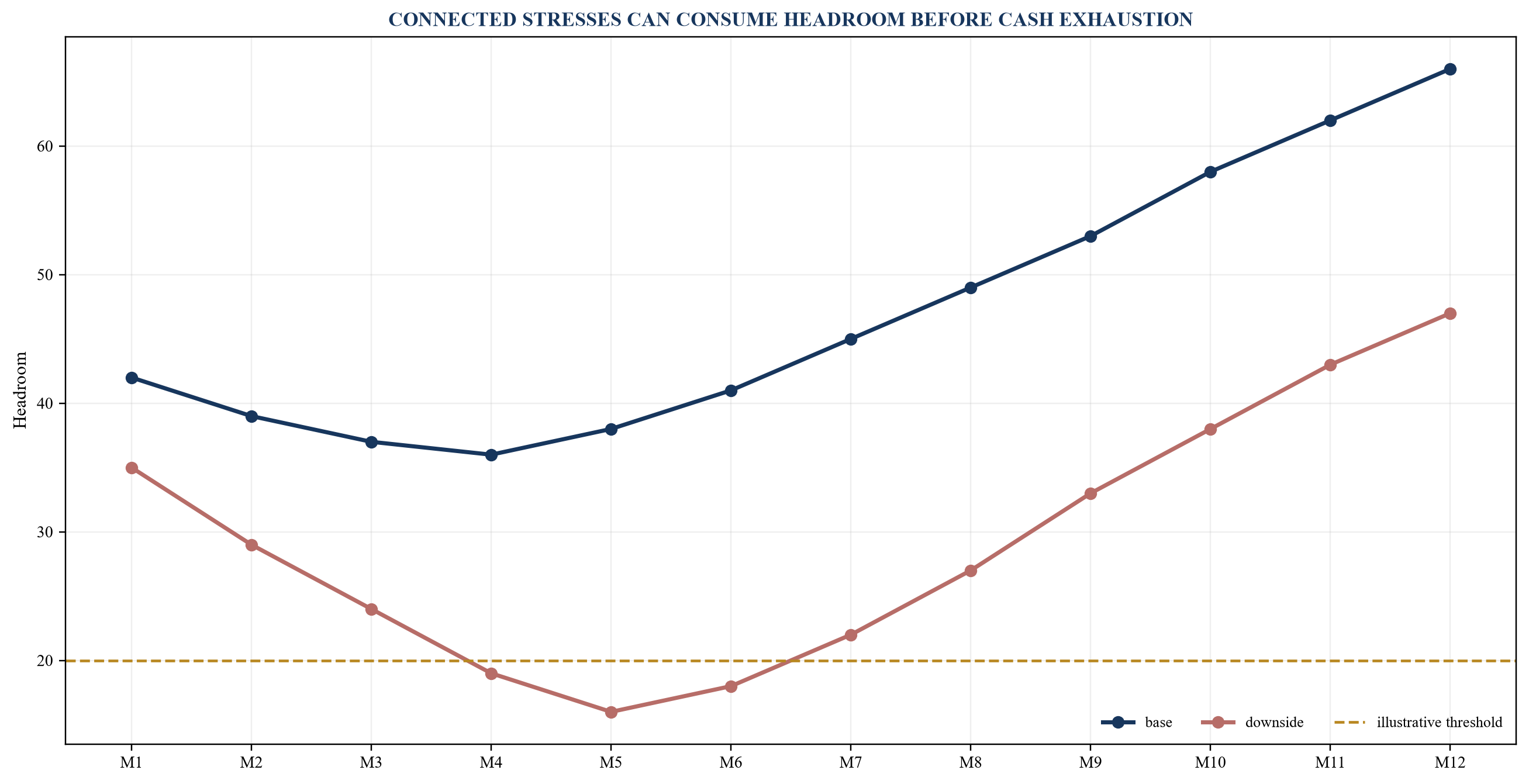
Values and thresholds are hypothetical analytical assumptions.
17. Use a 13-week cash flow for near-term control
The annual plan is too coarse for a borrower with project milestones, hardware purchases and constrained runway. A rolling 13-week cash flow should show opening bank balance, expected customer receipts, payroll, tax, suppliers, cloud costs, project expenditure, capital expenditure, debt service and closing liquidity by account. Every material receipt should link to an invoice or contractual trigger.
Receipt probability should reflect evidence. Certified and undisputed invoices with established payment history can receive a different treatment from forecast milestones, unsigned variations and equity proceeds. The model should preserve gross expected amounts and show timing adjustments separately. This makes forecast bias visible and avoids replacing source values with management confidence.
The forecast should reconcile weekly to actual cash. Variances should be classified as timing, amount, scope, dispute, customer credit or internal execution. Repeated positive variance from delayed payments deserves a reserve. Repeated negative variance from postponed expenditure can indicate operational slippage rather than efficiency. The lender and board need the reason, not only the net result.
The 13-week model should connect to covenant headroom and borrowing availability. A receivable becoming ineligible can require a revolver repayment in the same week that its cash receipt is delayed. A project draw may be unavailable until certification. These interactions create a liquidity risk that a monthly profit-and-loss forecast can miss. A weekly control process is therefore central to debt readiness.
Table 3. Integrated covenant and liquidity controls
| Control | Source population | Early-warning use | Possible response |
|---|---|---|---|
| minimum liquidity | unrestricted bank cash and committed availability | identifies runway pressure | reduce spend, accelerate collection or add equity |
| recurring revenue | eligible contracted and collected cohort | identifies churn or concentration | customer plan and revised draw pace |
| borrowing base | eligible receivables, revenue and assets less reserves | identifies collateral shortfall | repay, substitute collateral or seek waiver |
| project margin | updated remaining revenue and cost-to-complete | identifies completion risk | reserve, reprice, restructure or stop |
| concentration | ultimate group and underlying project | identifies single-event exposure | cap availability and diversify |
Thresholds should be calibrated to verified volatility and facility documents.
18. Reconcile accounting, operating and lending metrics
Accounting revenue, annual recurring revenue, bookings, backlog, billings, deferred revenue, contract assets, receivables and cash describe different points in the commercial cycle. They should not be combined without a bridge. IFRS 15 establishes principles for contracts, performance obligations, transaction price and revenue recognition. The lending model adds eligibility, collectability, cancellation and recovery tests.
The company should maintain a metric dictionary with owner, source, calculation, exclusions and reconciliation. Contract assets deserve attention because revenue can be recognised before the right to invoice becomes unconditional. Deferred revenue can represent cash billed or received before service delivery. Neither balance alone proves future free cash flow. The cash impact depends on service cost, refund rights and remaining obligations.
IFRS 9 expected-credit-loss analysis can inform receivables diligence. The standard requires probability-weighted measurement using past events, current conditions and reasonable and supportable forecasts. A lender may apply a separate eligibility policy, but differences should be understood. A receivable with a small accounting provision can still be excluded from a borrowing base because of age, dispute or concentration.
Monthly reporting should bridge each metric to the general ledger and source records. Changes in policy should be approved and disclosed with prior periods restated where practical. This discipline helps the lender distinguish business movement from measurement movement. It also improves the quality of board, investor and audit conversations.
19. Perfect and monitor UK security carefully
Security scope and priority require transaction-specific legal advice. A UK venture-debt package may include a debenture with fixed and floating charges, assignments, account control, share security, intellectual-property security and contractual undertakings. The practical value depends on ownership, existing liens, contractual restrictions, governing law and the ability to preserve or sell the asset.
Companies House guidance states that a company charge should be registered within 21 days. Late registration can affect recovery in insolvency and may require a court order. The filing is one part of perfection; the underlying instrument, asset description, notices and other formalities also matter. The lender should search existing charges and understand negative pledges, intercreditor terms and priority.
Software and data create special recovery questions. Source code, repositories, cloud infrastructure, domains, customer contracts, licences and employee or contractor intellectual property should be mapped. Open-source obligations and third-party licences can limit transfer. Customer data is subject to contractual and regulatory duties. A receiver may need operational access and specialist support to preserve value.
Floating-charge recoveries are subject to statutory priorities and the prescribed-part regime. Asset values can also fall sharply during distress. The credit case should therefore rely primarily on sustainable cash flow and controlled liquidity, with security providing additional protection. Recovery analysis should deduct enforcement time, continuity cost, customer attrition and professional fees.
20. Protect intellectual property and service continuity
ConTech customers can depend on a platform for drawings, project records, compliance evidence and operational workflows. A service interruption can damage renewal, create claims and reduce collateral value. The lender should review hosting architecture, backups, disaster recovery, incident response, privileged access, software escrow where relevant and the ability to transfer operations.
Intellectual-property ownership should be traced from founders, employees, contractors, acquisitions and research partners. Assignment documents, moral rights, licences and invention policies should be complete. Custom development for a customer can create ownership or licence rights that differ from the core platform. The company should separate reusable product from customer-specific deliverables.
Cyber and data risks belong in the cash model. An incident can cause remediation cost, service credits, delayed sales, churn and regulatory exposure. Insurance coverage should be examined for scope, exclusions, limits and claims process. The lender may require notification of material incidents and evidence that remediation is funded.
Continuity planning should identify critical staff, suppliers, cloud services and credentials. A key-person departure can slow delivery and customer support. A single cloud or data provider can create concentration. The plan should show alternative access, documented procedures and decision authority. These controls protect both enterprise value and the reliability of debt service.
21. Test customer and project concentration together
Concentration should be calculated by legal customer, ultimate group, underlying project, public programme, product and channel. A platform may bill several contractors working on one infrastructure programme. It may serve several entities controlled by one developer. A reseller can aggregate many end users while holding the payment obligation. Each view reveals a different correlated loss.
The analysis should measure recurring revenue, backlog, receivables, gross margin and cash by concentration unit. It should also show renewal, project completion and payment dates. A large exposure ending within the loan tenor can create a step-down in cash even without a default. The lender should distinguish scheduled completion from unexpected churn.
Stress tests should remove the largest ultimate group and delay the largest underlying project. A combined test can be appropriate when the same sponsor supports several contracts. The model should show effects on borrowing-base eligibility, liquidity, covenant headroom, implementation utilisation and customer referenceability.
Concentration limits can cap availability above a threshold. The borrower can reduce exposure by diversifying customers, securing deposits, shortening receivable terms, obtaining direct agreements or allocating less debt against the concentrated pool. The appropriate response depends on commercial reality. A lender should not force uneconomic diversification that weakens the company, but it should price and control genuine single-event risk.
22. Match monitoring frequency to risk velocity
Fast-moving assets require frequent monitoring. Cash and revolver availability may need weekly review. Receivables, recurring revenue, backlog conversion and covenant headroom may require monthly certificates. Equipment can be reviewed quarterly or after material deployment. Annual accounts provide assurance but arrive too late to manage an emerging liquidity problem.
The reporting pack should have a controlled data lineage. Finance, sales and project systems should reconcile through stable customer, contract and project identifiers. Manual adjustments should retain an owner, reason, source and approval. The lender should receive both the output and enough bridge information to understand movement.
Trigger events can include a material customer loss, project cancellation, adverse margin revision, cyber incident, key-person departure, failed equity raise, new lien, litigation, tax arrears or auditor qualification. Notification should be prompt and proportionate. The agreement should avoid vague language that creates uncertainty while capturing events that can affect repayment or collateral.
Monitoring should support decisions rather than produce an expanding list of spreadsheets. A concise dashboard can show liquidity, availability, recurring-revenue bridge, churn, concentration, backlog conversion, cost-to-complete, receivables ageing and forecast variance. Supporting schedules remain available for review. The board and lender should use the same definitions so that differences focus on judgement, not data reconciliation.
23. Prepare a lender-ready data room
The data room should permit a reviewer to reproduce the credit case. Core folders include corporate records, cap table, existing debt, board-approved plan, monthly accounts, bank statements, customer contracts, revenue bridge, backlog register, receivables ledger, project cost-to-complete, equipment register, intellectual property, cyber controls, tax, insurance, litigation and people. Every schedule should identify its source date and owner.
The contract population should reconcile to revenue and backlog. The receivables ledger should reconcile to the general ledger and subsequent cash. The recurring-revenue bridge should reconcile to contracts and billing. The project schedule should reconcile to recognised revenue, invoices and remaining cost. The asset register should reconcile to purchase records and physical evidence. Reconciliation is more valuable than volume.
Customer evidence should include a lender-selected sample of confirmations or reference calls where appropriate and consented. The purpose is to test contract status, delivery, acceptance, payment, renewal and dependence on the underlying project. Confidentiality and data-protection obligations should be respected. Redacted documents can be supplemented by counsel or accountant confirmation when full disclosure is restricted.
Open issues should be logged with owner, evidence required, impact and deadline. A disciplined exceptions register improves credibility. It also lets the lender distinguish remediable documentation gaps from structural risks. Missing evidence should reduce eligibility or delay a draw until resolved; it should not be filled with narrative assumptions.
Table 4. Lender data-room reconciliation map
| Schedule | Reconciles to | Critical test | Common exception |
|---|---|---|---|
| recurring-revenue bridge | contracts, billing and bank receipts | eligible opening cohort and cash retention | forecast expansion included as contracted |
| backlog register | signed orders, project ledger and revenue | remaining value, cancellation and margin | pipeline or customer option included |
| receivables ageing | general ledger and subsequent cash | acceptance, dispute and collection | credit note recorded after certificate date |
| cost-to-complete | project plan, payroll and supplier commitments | remaining contribution and contingency | original budget retained after delay |
| equipment register | invoices, serial records and inspection | title, location and recoverability | customer-specific installed asset valued at cost |
Each schedule should identify period, source system, owner and last refresh.
24. Sequence a 100-day debt-readiness programme
The first 20 days should freeze definitions and populations. Management approves the customer, contract, recurring-revenue, backlog, receivables, project and asset registers. Finance reconciles each to the general ledger and bank receipts. Legal advisers identify contract and security questions. The board approves the downside case and minimum operating liquidity.
Days 21 to 45 should test quality. The team samples contracts, traces source-to-cash, scores backlog, updates cost-to-complete, analyses cohorts, ages receivables and inspects equipment. Exceptions are classified by impact and remediation. A preliminary borrowing base shows which reported assets are genuinely financeable.
Days 46 to 75 should design the facility and operating controls. The borrower compares term, revolver, equipment and delayed-draw structures. It models debt service, covenant headroom, fees, warrants and refinancing. Reporting processes are rehearsed using historic periods. Lender materials explain both the opportunity and the downside controls.
Days 76 to 100 should conduct lender diligence, negotiate documents and close verified gaps. Final facility size follows evidence rather than the opening request. Management confirms use of funds, draw conditions, reporting calendar and responsible owners. The board receives a closing decision paper showing base, downside, covenant, dilution and remedy paths.
The programme should use one controlled issue register. Each issue records the affected contract, customer, project, asset or covenant; the evidence required; the provisional financing effect; the responsible executive; and the completion date. Items that affect eligibility or liquidity receive priority. This prevents a large data-room upload from obscuring the few issues that control credit capacity.
A weekly steering meeting should reconcile commercial, project, finance and legal work. Sales confirms contract status and renewal; delivery confirms programme and cost-to-complete; finance confirms billing, collection and cash; counsel confirms enforceability and security. Decisions are recorded with the evidence available at the time. This routine is designed to continue after closing as part of the reporting process.
Readiness also requires a communication plan. Customer confirmations, account notices and security filings can affect relationships and should be sequenced carefully with advisers and the lender. Employees and suppliers may need limited information to complete diligence while confidentiality is preserved. The board should approve who can communicate financing terms, covenant position and unresolved matters.
25. Use a final venture-debt decision checklist
The credit decision should answer five linked questions. First, which cash flows are recurring, contracted, collectible and available for debt service? Second, how much backlog survives enforceability, margin, timing and customer-credit tests? Third, which receivables and assets can support revolving or equipment availability? Fourth, can the company maintain minimum liquidity and covenant headroom under connected downside stresses? Fifth, are security, reporting and governance controls executable?
The decision record should state exclusions and unresolved issues. It should identify every hypothetical assumption used in sizing and replace it with verified borrower data before approval. It should show the effect of removing the largest customer group, delaying the largest project, increasing churn and postponing equity. A single headline multiple should never substitute for this evidence.
The facility should then align purpose, collateral and repayment source. Recurring software can support a term tranche when retention and collection evidence are robust. Receivables can support a revolver when acceptance and dilution are controlled. Equipment can support a separate tranche when title and recovery are clear. Project backlog can support conditional drawings when completion and margin are independently tested.
The board should approve debt only when the company can operate the controls after closing. Reporting, cash forecasting, contract governance, project margin and customer collection are part of the financing system. A well-structured facility creates runway and flexibility while preserving an early-warning mechanism. The final result remains lender-specific and requires legal, accounting, tax and security advice.
Table 5. Final venture-debt approval record
| Decision area | Approval evidence | Downside question | Required owner |
|---|---|---|---|
| recurring cash flow | contract, cohort, invoice and collection bridge | does opening cash survive churn and delay? | chief financial officer |
| backlog and projects | signed population, score and cost-to-complete | what happens if the largest project slips? | finance and delivery leaders |
| collateral and availability | borrowing-base certificate and legal review | which assets become ineligible first? | finance and counsel |
| covenants and liquidity | integrated monthly and 13-week model | when is the first internal or legal trigger? | board finance committee |
| execution and governance | reporting calendar, controls and data room | can the company comply every period? | chief executive and board |
Every approval field should link to verified evidence and an accountable owner.
References
- Office for National Statistics, Construction output in Great Britain: June 2026, new orders and Construction Output Price Indices, April to June 2026, 13 August 2026, https://www.ons.gov.uk/businessindustryandtrade/constructionindustry/bulletins/constructionoutputingreatbritain/latest
- Office for National Statistics, Construction statistics, Great Britain: 2024, 19 February 2026, https://www.ons.gov.uk/businessindustryandtrade/constructionindustry/articles/constructionstatistics/latest
- Office for National Statistics, Construction statistics: sources and outputs, 18 November 2022, https://www.ons.gov.uk/businessindustryandtrade/constructionindustry/methodologies/constructionstatisticssourcesandoutputs
- Bank of England, Credit Conditions Survey: 2026 Q2, 2 July 2026, https://www.bankofengland.co.uk/credit-conditions-survey/2026/2026-q2
- Bank of England, Financial Stability Report, July 2026, https://www.bankofengland.co.uk/financial-stability-report/2026/july-2026
- British Business Bank, Small Business Finance Markets Report 2026, 17 March 2026, https://www.british-business-bank.co.uk/about/research-and-publications/small-business-finance-markets-report-2026
- Cabinet Office, The Construction Playbook, updated 11 July 2023, https://www.gov.uk/government/publications/the-construction-playbook
- IFRS Foundation, IFRS 15 Revenue from Contracts with Customers, https://www.ifrs.org/issued-standards/list-of-standards/ifrs-15-revenue-from-contracts-with-customers/
- IFRS Foundation, IFRS 9 Financial Instruments, issued standard, https://www.ifrs.org/issued-standards/list-of-standards/ifrs-9-financial-instruments/
- Companies House, Register a charge for a limited company, updated 1 February 2026, https://www.gov.uk/guidance/register-a-charge-mortgage-for-a-limited-company
- Companies House, How to complete paper form MR01, updated 5 March 2026, https://www.gov.uk/government/publications/register-particulars-of-a-charge-mr01/how-to-complete-paper-form-mr01
- Companies House, Forms for mortgages and loans, https://www.gov.uk/government/collections/forms-for-mortgages-and-loans
- Insolvency Service, Technical guidance for Official Receivers: distributions, https://www.gov.uk/guidance/technical-guidance-for-official-receivers/49-distributions
- UK Parliament, Insolvency Act 1986, https://www.legislation.gov.uk/ukpga/1986/45/contents
- UK Parliament, Companies Act 2006, https://www.legislation.gov.uk/ukpga/2006/46/contents
- Procore Technologies, 2025 Annual Report on Form 10-K, filed 2026, https://www.sec.gov/Archives/edgar/data/1611052/000162828026011055/pcor-20251231.htm
- Bentley Systems, 2025 Annual Report on Form 10-K, filed 2026, https://www.sec.gov/Archives/edgar/data/1031308/000103130826000007/bsy-20251231.htm
- Primoris Services Corporation, 2025 Annual Report on Form 10-K, filed 2026, https://www.sec.gov/Archives/edgar/data/1361538/000110465926018677/prim-20251231x10k.htm
- Babcock & Wilcox Enterprises, 2025 Annual Report on Form 10-K, filed 2026, https://www.sec.gov/Archives/edgar/data/1630805/000163080526000018/bw-20251231.htm
- UK Government, Make changes to your private limited company: mortgages and loan guarantees, https://www.gov.uk/make-changes-to-your-limited-company/mortgages-and-loan-guarantees
- UK Government, Procurement Act 2023, https://www.legislation.gov.uk/ukpga/2023/54/contents
- Information Commissioner's Office, Guide to the UK GDPR, https://ico.org.uk/for-organisations/uk-gdpr-guidance-and-resources/
- National Cyber Security Centre, Cyber security guidance, https://www.ncsc.gov.uk/section/advice-guidance/all-topics
- HM Treasury, UK Government Green Book, https://www.gov.uk/government/publications/the-green-book-appraisal-and-evaluation-in-central-government
- UK Government, Prompt Payment Code, https://www.smallbusinesscommissioner.gov.uk/ppc/
- Financial Reporting Council, UK Corporate Governance Code 2024, https://www.frc.org.uk/library/standards-codes-policy/corporate-governance/uk-corporate-governance-code/
- International Organization for Standardization, ISO 19650 information management using building information modelling, https://www.iso.org/standard/68078.html
