

1. Begin with the decision that the warning must support
An early-warning system should shorten the time between credible evidence of deterioration and an authorised credit response. Its output may support a borrower discussion, information request, enhanced monitoring, watch-list decision, covenant reset, waiver process, amendment, liquidity action or formal remedy. Each response requires different evidence and authority.
The system should identify the facility, obligor, group, reporting period, covenant definitions, compliance dates, information undertakings, security, guarantors and decision owners. It should preserve executed documents and approved amendments as the source of contractual rights. An analytical alert cannot create a covenant, breach or remedy.
The decision design should also recognise lead time. A monthly report that reveals a breach after quarter end may be contractually important yet provide little operational warning. Daily cash, weekly collections or order data may identify stress earlier, but can be volatile and incomplete. The framework should specify which evidence supports immediate attention, which requires corroboration and which can support a formal credit decision.
Materiality is borrower-specific. A small variance can be critical when liquidity is thin, access to capital is constrained or a cure period is short. A larger variance may be manageable when the business has resilient cash, committed support and executable options. The system should connect signal size with balance-sheet capacity, contractual timing and decision reversibility.
AI can assemble evidence and rank signals. The accountable lender determines whether a signal is credible, material and relevant to repayment or contractual protection. The decision record should distinguish observed facts, forecasts, model outputs, borrower explanations, legal conclusions and approved actions.
2. Separate covenant compliance from early warning
Covenant compliance tests an agreed definition at an agreed time. Early warning examines whether repayment capacity, liquidity, collateral, enterprise resilience or information quality may be deteriorating before the test date. The two processes should connect without being conflated.
A borrower can remain compliant while headroom narrows rapidly. A breach can also arise from a temporary or technical event with limited credit consequence. The system therefore needs both contractual accuracy and forward-looking judgement.
Definitions can diverge from reported accounting metrics. Covenant EBITDA, net debt, cash, interest, permitted acquisitions and exceptional items may follow negotiated terms. The monitoring engine should maintain a definition register and bridge every calculation to source data. Changes in accounting policy, acquisition perimeter or permitted adjustments should be shown separately from operating performance.
Covenant-lite structures increase the importance of other protections and evidence. Information undertakings, liquidity, collateral, incurrence tests, maturity concentration and market access can become more informative than a maintenance ratio. The signal architecture should reflect the actual structure.
The European Banking Authority identifies covenant adherence and timely compliance certificates as early-warning tools while also requiring broader quantitative and qualitative indicators, defined triggers, escalation procedures and watch lists. The design should preserve that wider context.
3. Define the monitored perimeter
The perimeter should cover facilities, obligors, consolidated groups, guarantors, material subsidiaries, jurisdictions, currencies, collateral, hedges and intercreditor positions. It should map each covenant and undertaking to its source, frequency, calculation owner and review authority.
Portfolio and sector signals matter alongside borrower data. Commodity prices, rates, foreign exchange, customer concentration, supply disruption and regulatory change can affect several exposures before company reporting captures the effect. Aggregation should retain the legal and economic distinctions relevant to each facility.
Data cut-offs need control. A forecast prepared after the test date may be useful for risk assessment while remaining outside the contractual calculation. The record should show which evidence supports compliance, warning, classification and intervention.
The perimeter should address structural subordination and cash mobility. Consolidated performance can conceal liquidity trapped in subsidiaries, minority interests, regulatory restrictions or debt outside the monitored facility. Intercompany balances and guarantees need evidence before they are treated as support.
Acquisitions, disposals and reorganisations can change comparability. The system should retain pre-event and pro forma views, identify permitted adjustments and document which entities are included at each date.
4. Build the governed signal architecture
The architecture should connect source evidence, validation, signal calculation, threshold logic, model output, human review, escalation and action. Each component needs version control and an accountable owner.
Deterministic rules and predictive models should remain separate. A missed certificate date is an observed event. A projected covenant breach is a forecast. A model-generated deterioration score is an analytical estimate. Their meanings, error modes and permitted uses differ.
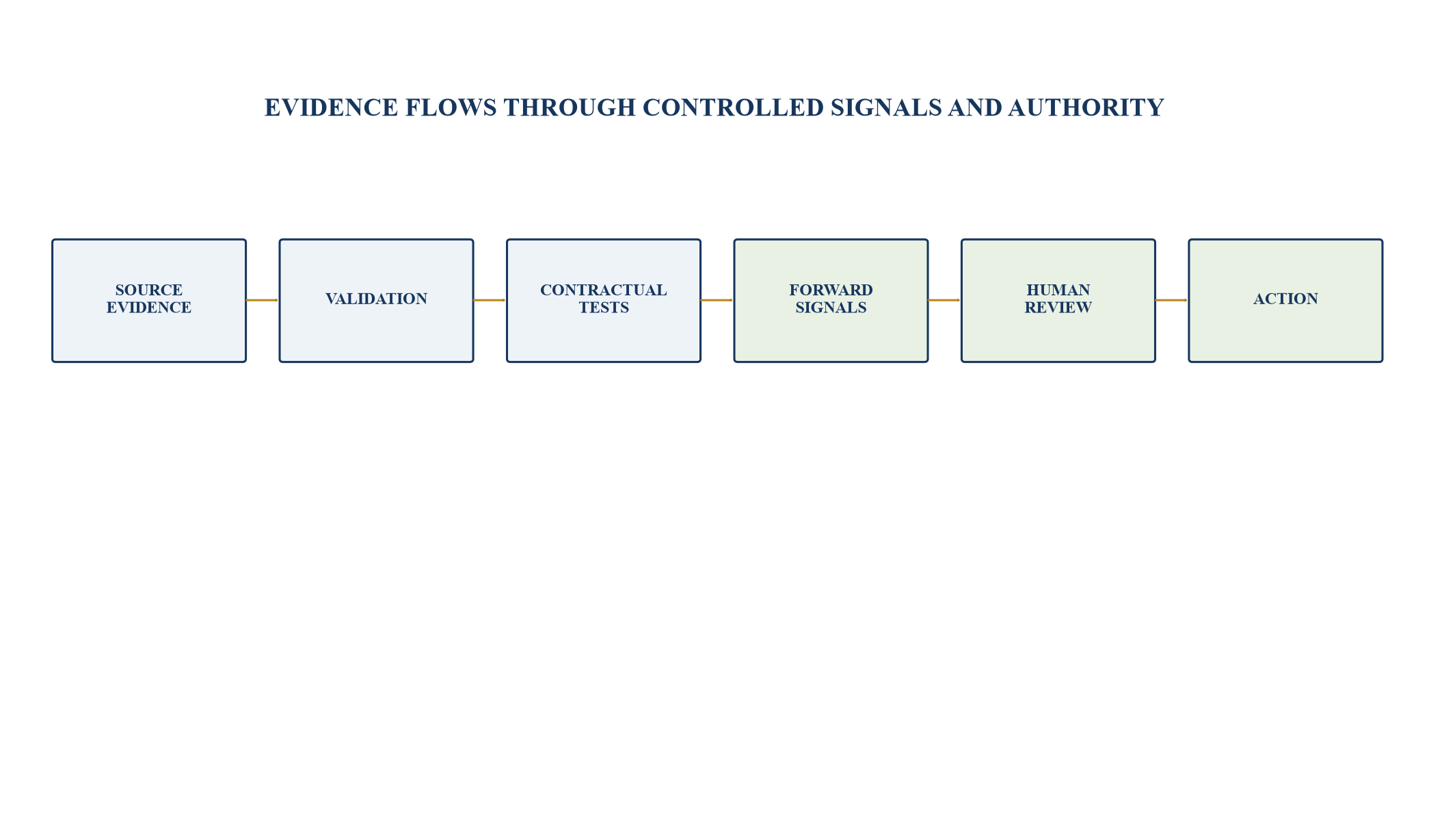
Signals inform review; authorised people determine classification and action.
Table 1. Minimum signal-control record
| Field | Required content | Control purpose | Decision use |
|---|---|---|---|
| signal | definition, population and frequency | consistent measurement | monitoring |
| source | system, owner and cut-off | lineage and completeness | reliance |
| threshold | level, direction and rationale | controlled trigger | escalation |
| model | version, validation and limits | permitted analytical use | prioritisation |
| review | owner, evidence and deadline | accountable assessment | classification |
| override | reason, authority and expiry | exception control | temporary treatment |
| action | right, owner and status | execution evidence | intervention |
Every indicator should have an evidence and decision path.
5. Establish authoritative source systems
Financial signals may originate in ledgers, management accounts, forecasts, treasury systems, covenant models and compliance certificates. Operating signals may originate in sales, procurement, production, workforce, service, project and asset systems. Behavioural evidence may include reporting delays, information gaps, management access and payment conduct.
Reconciliations should test completeness, consistency and timing. Management accounts should bridge to reported figures. Forecast versions should remain identifiable. Manual adjustments need an owner, evidence, approval and expiry.
Data-quality indicators can include missing records, late feeds, duplicate entries, unexplained changes, stale forecasts and failed reconciliations. These measures should sit beside credit signals because unreliable data reduces confidence in compliance and warning conclusions.
Source ownership should be explicit. Borrower submissions, agent calculations, third-party reports, public information and lender-created estimates carry different responsibilities and limitations. The review record should identify provenance and permitted reliance.
Source conflicts should become visible exceptions. The system should preserve both records and the reason for the selected treatment rather than silently choosing the more favourable value.
6. Monitor covenant headroom as a trajectory
Headroom should be measured under the contractual definition and projected across reporting and testing dates. The analysis should identify the numerator, denominator, permitted adjustments, currency treatment, pro forma events and information dependencies.
A point estimate can conceal volatility. Forecast ranges should show the probability and timing of threshold contact, the drivers of change and the sensitivity to assumptions. A warning can arise from declining resilience even when the central forecast remains compliant.
Historic forecast error should inform confidence. Repeated optimistic bias, late adjustments or weak cash conversion can justify closer review without rewriting the contractual test.
Headroom analysis should decompose change into operating performance, working capital, financing, currency, acquisitions, disposals, definition changes and one-off adjustments. A bridge from prior forecast to current result makes deterioration explainable.
The system should also model test-date clustering and seasonality. Average and minimum liquidity, intra-period debt use and post-period reversals can add relevant context subject to contractual and evidential limits.
7. Connect earnings quality to covenant risk
EBITDA-based covenants depend on accounting and contractual definitions. Revenue recognition, capitalisation, provisions, exceptional items, run-rate benefits and acquisition adjustments can materially affect reported headroom.
The process should reconcile management reporting to the covenant calculation and flag changes in adjustment composition. Machine assistance can identify unusual classifications and period-on-period movements. Accountable finance, audit, legal and credit reviewers determine treatment.
Cash evidence provides an independent lens. Weak operating cash flow, rising receivables or supplier stretch can contradict apparently stable earnings and should enter the warning assessment.
Adjustment governance matters when definitions permit add-backs for synergies, restructuring or cost savings. The record should show eligibility, amount, timing, cap, evidence and subsequent realisation. A repeated gap between adjusted earnings and realised cash may signal execution risk.
Revenue quality should also be examined. Concentrated contracts, acceptance conditions, cancellation rights, rebates and deferred obligations can affect the durability of earnings. Machine assistance can flag unusual movements for qualified review.
8. Use liquidity signals before cash becomes critical
Liquidity monitoring should connect cash, committed facilities, availability, working capital, debt service, collateral, hedges and restricted balances. Forecasts need legal-entity, currency and timing granularity.
Signals can include falling cash buffers, increased revolver use, delayed supplier payments, concentration of receipts, margin calls, rejected payments and dependence on uncommitted lines. Each signal needs validation and materiality.
The warning process should link projected shortfalls to executable actions and decision lead times. A theoretical source of liquidity should not be counted without evidence of availability, authority and completion conditions.
Liquidity scenarios should reflect interactions. Lower earnings can reduce headroom, increase pricing, restrict drawings and weaken supplier confidence at the same time. A covenant event may affect hedges, leases, trade instruments or other contracts.
Contingency actions require sequencing. Collections, inventory reduction and discretionary spending may act quickly; asset sales, equity and refinancing can require months and remain uncertain. The committee should see timing, evidence and completion conditions.
9. Track working-capital deterioration
Receivable ageing, disputes, credit notes, inventory velocity, purchase commitments and payable behaviour can reveal stress before a covenant ratio moves. Cohort analysis can separate seasonality from structural deterioration.
AI can detect changes in collection curves, unusual deductions, stock accumulation and supplier terms. These patterns support investigation. They do not establish misconduct, insolvency or breach.
The lender should assess whether working-capital movements reflect growth, operating weakness, customer concentration, supply disruption or deliberate cash preservation. The explanation and evidence belong in the decision record.
Borrower operating teams can often explain drivers earlier than financial reporting. Sales, procurement, operations and treasury evidence should connect through defined owners and controlled data. The system should record whether corrective action has begun and whether subsequent cohorts show improvement.
Cash preservation can transfer risk. Stretching suppliers may improve near-term liquidity while threatening supply continuity or triggering retention-of-title, credit-insurance or trade-instrument consequences.
10. Detect revenue and customer concentration shocks
Order intake, backlog conversion, cancellations, renewals, churn, price concessions and customer payment behaviour can change repayment capacity. Aggregate revenue can remain stable while a critical cohort deteriorates.
The signal design should identify customer, product, geography, channel and contract dependencies. Forecasts should avoid double counting pipeline and contracted revenue.
Material customer events require a defined review pathway. Public news, alternative data and borrower-provided evidence need provenance, permitted-use controls and human verification.
Backlog quality should be distinguished from headline value. Order status, cancellation rights, milestones, customer financing, delivery capacity and margin determine conversion. A model can identify changes in historical conversion and concentration, while contract evidence remains necessary.
Customer dependency can extend beyond revenue. A strategic customer may provide technology access, certification, distribution or reference value. The system should document the dependency and avoid translating a qualitative concern directly into an unsupported numerical adjustment.
11. Monitor cost and margin pressure
Input prices, labour, energy, logistics, tariffs and foreign exchange can compress margins before financial reporting catches up. The analysis should connect exposures to pricing power, hedges, contract terms and operational response.
Signals should distinguish temporary volatility from structural cost changes. Scenario ranges can show the effect on covenant headroom and liquidity while preserving uncertainty.
Management actions should be tested for timing, cost, capacity and evidence. An unapproved or unimplemented plan should not be treated as realised mitigation.
Hedge effectiveness and pass-through mechanisms deserve separate treatment. Contractual indexation may lag or apply only to part of the cost base. Hedges can expire, require collateral or introduce counterparty exposure.
Cost reduction can weaken future capacity. Deferred maintenance, reduced selling effort or cancelled development may preserve short-term EBITDA while increasing operational and strategic risk. The credit review should distinguish durable efficiency from deferred cost or risk.
12. Include management and governance evidence
Leadership turnover, owner disagreement, delayed board information, weak controls, auditor changes and repeated forecast misses can affect credit quality. These indicators require careful documentation and proportionate interpretation.
The system should avoid converting subjective impressions into opaque scores. Reviewers should record the observed event, relevance, corroboration, alternative explanations and action.
Borrower dialogue remains central. A timely, evidenced explanation can resolve a signal; inconsistent or incomplete information may justify enhanced monitoring.
13. Capture documentation and reporting behaviour
Late certificates, missing schedules, unexplained adjustments and repeated data corrections can weaken reliance. Timeliness should be assessed against contractual obligations and operational materiality.
Automation can track submission status, reconcile versions and identify unresolved questions. It should preserve a complete correspondence and approval trail subject to confidentiality and retention controls.
Reporting behaviour should inform the warning assessment without mechanically creating a default conclusion. Contractual consequences require document-specific and qualified review.
14. Construct comparable borrower cohorts
Cohorts can group exposures by sector, size, leverage, structure, geography, sponsor, maturity or operating model. Their purpose is to identify changes that may be hidden in a single borrower history.
Peer comparisons need controlled definitions and sufficient observations. A company can differ legitimately from its cohort. The analysis should show raw and adjusted results and retain outliers.
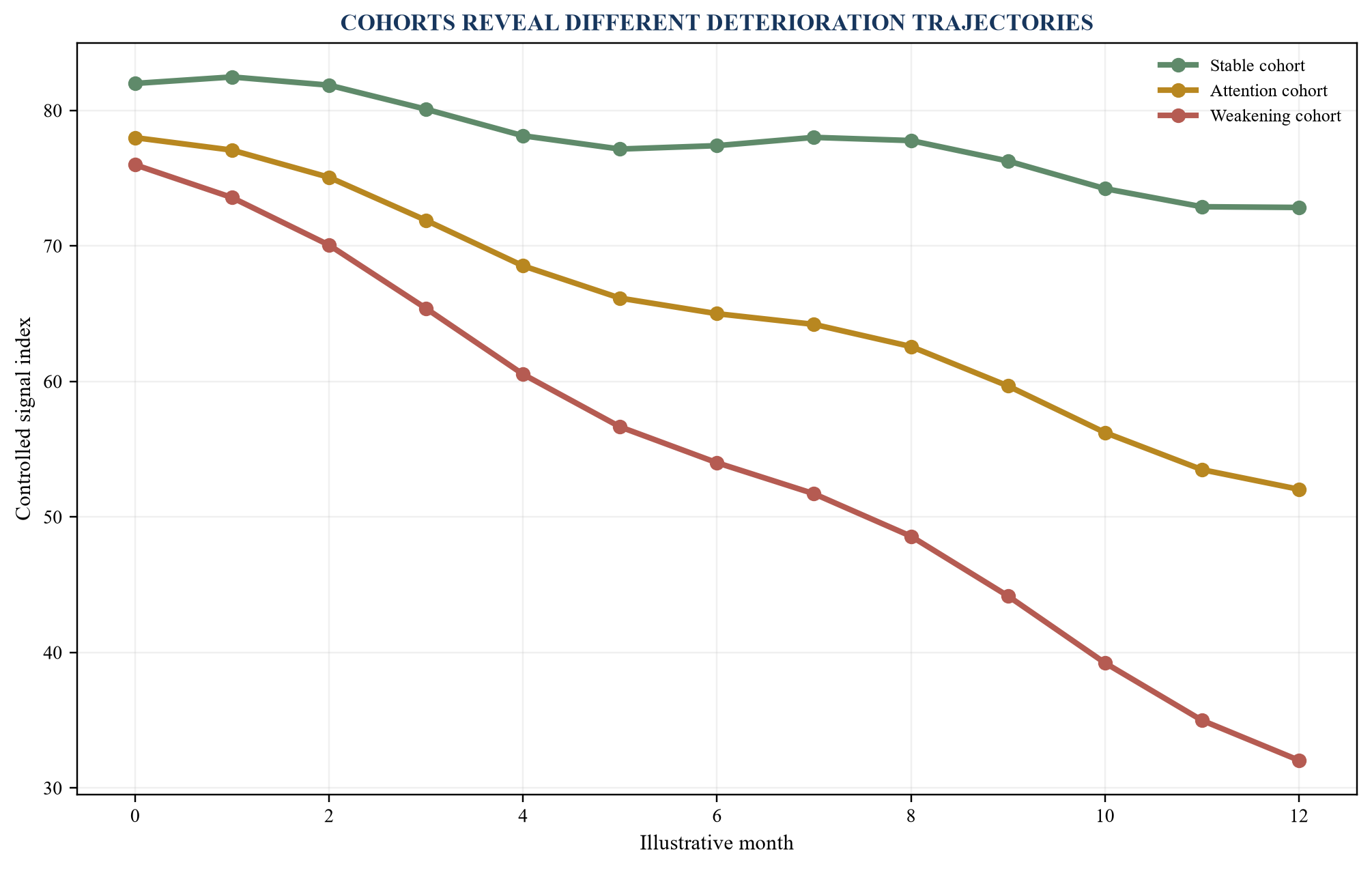
Values are hypothetical assumptions used to demonstrate relative change.
15. Design the warning ladder
The warning ladder should connect signal severity, corroboration, persistence and credit consequence to a defined response. It may progress from routine review through enhanced monitoring, watch list, senior escalation and formal action.
Severity should consider both current impact and plausible trajectory. A missed document may be low value in isolation yet material when it blocks covenant verification during a liquidity decline. A market signal may be noisy alone yet important when confirmed by customer, cash and management evidence. The system should support connected judgement without obscuring each component.
Escalation clocks should reflect decision windows. If a reporting event has a short cure period or a refinancing requires months, delay has asymmetric cost. The ladder should therefore show time remaining, evidence outstanding and the authority required at the next stage.
Thresholds should reflect risk appetite, portfolio characteristics and facility structure. A single indicator may warrant review; multiple connected indicators can justify faster escalation.
The ladder needs clear entry, movement and exit criteria. Alerts should not remain open indefinitely or disappear without closure evidence.
Table 2. Warning ladder and minimum response
| Level | Evidence pattern | Minimum response | Authority |
|---|---|---|---|
| routine | stable signals and reporting | normal monitoring | relationship and credit teams |
| attention | isolated adverse change | validate and discuss | named reviewer |
| enhanced | corroborated or persistent weakness | action plan and increased frequency | credit authority |
| watch list | material deterioration | formal monitoring and downside case | designated committee |
| critical | imminent shortfall or contractual event | rights and liquidity review | senior credit and legal authority |
Actual rights and actions depend on executed documents and authorised judgement.
16. Calibrate thresholds to consequence
A threshold should identify the value, direction, observation window, population, persistence and action. It should be linked to a credible credit consequence rather than statistical novelty alone.
Static thresholds can be complemented by rate-of-change and peer measures. Dynamic methods require validation and change control because gradual recalibration can alter alert behaviour without an obvious policy decision.
Back-testing should examine missed deterioration, false positives, warning lead time and segment performance. Threshold changes need documented evidence and approval.
Calibration samples should reflect the intended portfolio and outcome. Defaults alone may be too rare or too late; relevant outcomes can include watch-list entry, covenant stress, payment difficulty, restructuring or realised loss, each with a controlled definition. Selection bias and changed lending standards should be disclosed.
Threshold interaction needs testing. Several individually weak signals can create excessive alerts when correlated, while a single high-consequence event may deserve immediate escalation. Scenario tests should examine both combinations and isolated shocks. Reviewers should understand whether the trigger arose from absolute level, rate of change, peer deviation or model estimate.
17. Combine signals without hiding causality
A composite score can support prioritisation when its components remain visible. Reviewers should see which signals moved, their reliability, interactions and sensitivity.
Correlation does not establish cause. A score should not convert unrelated weak indicators into an unsupported conclusion. Material drivers require source evidence and borrower-specific review.
The model should permit drill-down from portfolio ranking to source record. Credit decisions should reference the underlying evidence, not only the score.
Aggregation should preserve missingness and uncertainty. Treating missing data as neutral can reward weak reporting; treating it automatically as distress can create bias. The policy should state how missing, stale and disputed values affect confidence, ranking and action.
Explainability should match the decision. Portfolio triage may use a compact ranking with component contributions. A waiver or classification decision requires borrower-specific evidence and documented judgement. The interface should prevent a persuasive visual from being mistaken for contractual or legal proof.
18. Govern forecast and classification models
Models should have purpose, owner, tier, data, methodology, limitations, validation, monitoring and change records. Their governance should reflect decision consequence and complexity.
Validation can test discrimination, calibration, stability, bias, data quality and operational implementation. Performance should be assessed across time, sectors and borrower types.
Material weakness can lead to restricted use, conservative treatment, remediation or withdrawal. Manual fallback should be tested before it is needed.
Implementation validation should confirm that production code, source mappings, thresholds and user workflows match the approved design. A sound model can fail through stale feeds, transformation errors, access problems or misunderstood output. End-to-end tests should include adverse, missing-data and override cases.
Monitoring should identify drift in borrower populations, economic conditions, products and user behaviour. A change in lending strategy can alter the data distribution and outcome rate. Performance thresholds and escalation routes should be approved before breaches occur.
19. Control language-model use
Language models can summarise reports, extract covenant terms, connect questions to evidence and draft review notes. Every material statement should link to a source.
Prompt injection, malicious files, confidentiality and hallucinated content require security and review controls. External content should be treated as data within an approved environment.
Generated prose should not determine compliance, classification or legal rights. An accountable reviewer verifies the evidence and signs the decision record.
Retrieval should use an approved document set with access controls and version identifiers. Covenant extraction needs comparison with executed documents, amendments and definitions because similar facilities can use different language. Material clauses should be confirmed by qualified reviewers.
The system should retain prompts, retrieved sources, model version, output and edits when the record supports a decision. Monitoring can test citation accuracy, unsupported statements, sensitive-data leakage and user overreliance. Failure should route work to a controlled manual process.
20. Create the override framework
An override may correct data, recognise new evidence, apply approved judgement or temporarily change an alert treatment. It should identify the original output, proposed treatment, reason, evidence, owner, authority, effective date, expiry and review condition.
Override types should be coded separately. A data correction restores the intended input; a policy exception changes treatment; a judgemental adjustment reflects evidence outside the model; and a temporary suppression manages an alert while investigation proceeds. Combining them under one label weakens performance analysis and accountability.
Authority should rise with consequence. An override that changes portfolio ordering differs from one that delays a watch-list decision or affects classification. Independent challenge should examine both the immediate case and whether the rationale is applied consistently across comparable borrowers.
Overrides should remain visible in performance testing. Excluding them can make a weak model appear accurate. Repeated overrides may reveal a data, rule, segment or governance problem.
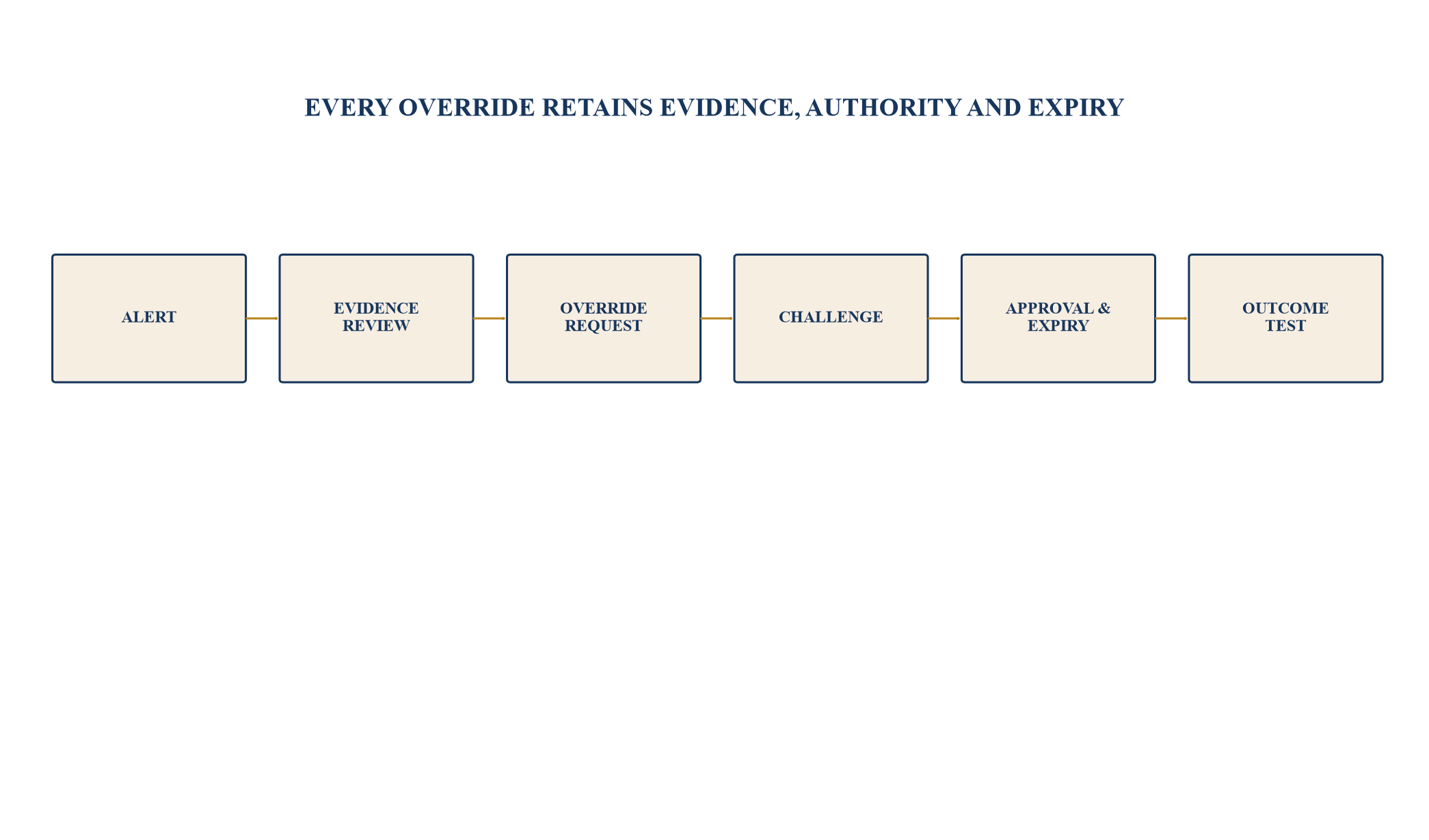
Temporary treatment remains visible until reviewed, replaced or closed.
21. Separate false positives from uncomfortable truths
A false positive is an alert that does not correspond to the defined risk outcome after appropriate review. A signal that management dislikes or that requires work is not therefore false.
Review should examine source quality, definition, timing, borrower context and subsequent outcome. The closure reason should be coded consistently.
False-positive cost matters because excessive alerts can delay response to material cases. Calibration should measure workload alongside credit consequence.
22. Preserve independent challenge
The relationship team contributes borrower knowledge and context. Independent credit, model-risk, legal and other control functions provide challenge according to their roles.
Borrower explanations should be tested respectfully and consistently. Management may possess current information unavailable in systems, while also having incentives to present an optimistic case. The process should request corroborating evidence proportionate to consequence and record unresolved differences.
Independent challenge should have sufficient time, expertise and access. A formal review performed after commercial commitment provides limited protection. Escalation timelines should preserve the opportunity to challenge before rights expire or funding decisions become difficult to reverse.
Incentives should be visible. Origination or relationship objectives can create pressure to defer escalation. Decision authority and minutes should protect the integrity of classification and action.
Committee materials should show dissent, conditions and unresolved evidence. A consensus label should not erase material uncertainty.
23. Map intervention rights before stress
The rights map should identify information undertakings, reporting frequency, consultation, inspections, draw stops, cash controls, additional security, cure, waiver, amendment, pricing, reservation of rights and remedies.
Rights can be conditional, shared or time-limited. An agent may require lender instruction; an intercreditor agreement may constrain action; local law may affect notice or enforcement; and conduct obligations may shape communication. The map should record dependencies and route questions to qualified advisers.
Commercial strategy should sit beside legal availability. Exercising a right can protect value, accelerate deterioration or affect other stakeholders. The committee should compare alternatives, likely borrower response, liquidity runway, enterprise value and execution risk while preserving formal rights.
Availability of a right depends on executed documents, facts, jurisdiction, intercreditor arrangements and qualified advice. The analytical system should record evidence and route the issue; it should not declare a legal conclusion.
Preparation before stress reduces delay. Owners, approval paths, notice requirements and communications should be known and tested.
24. Link each warning to a permitted response
An observed reporting delay may justify an information request. A forecast shortfall may justify enhanced monitoring and a liquidity plan. A confirmed breach may trigger a document-specific rights process.
Responses should be proportionate, time-bound and recorded. The system should show actions completed, evidence received, conditions outstanding and next decision dates.
Borrower engagement should preserve clarity. Questions, requested evidence and consequences should be stated accurately and consistently with the lender's authority.
25. Build the cure pathway
A cure pathway should define the problem, evidence, accountable owners, milestones, liquidity effect, covenant consequence and closure test. It should distinguish operational remediation from contractual cure.
Milestones should be measurable and sequenced. A plan to improve collections needs named accounts, actions, expected dates and bank evidence. A cost programme needs approved measures, implementation cost and realised run-rate tracking. Equity support needs commitment, documentation, funding conditions and cash receipt.
Closure should require both completion and sustainability. A one-period covenant pass may not resolve the underlying weakness. The system should define observation periods, reporting frequency and conditions for returning to routine monitoring.
Plans may include working-capital action, cost reduction, equity, asset sales, refinancing, amendment or other measures. Their feasibility depends on timing, approvals, market conditions and execution capacity.
The lender should measure progress through completed evidence rather than narrative assurance. Failed milestones should return to the warning ladder and decision authority.
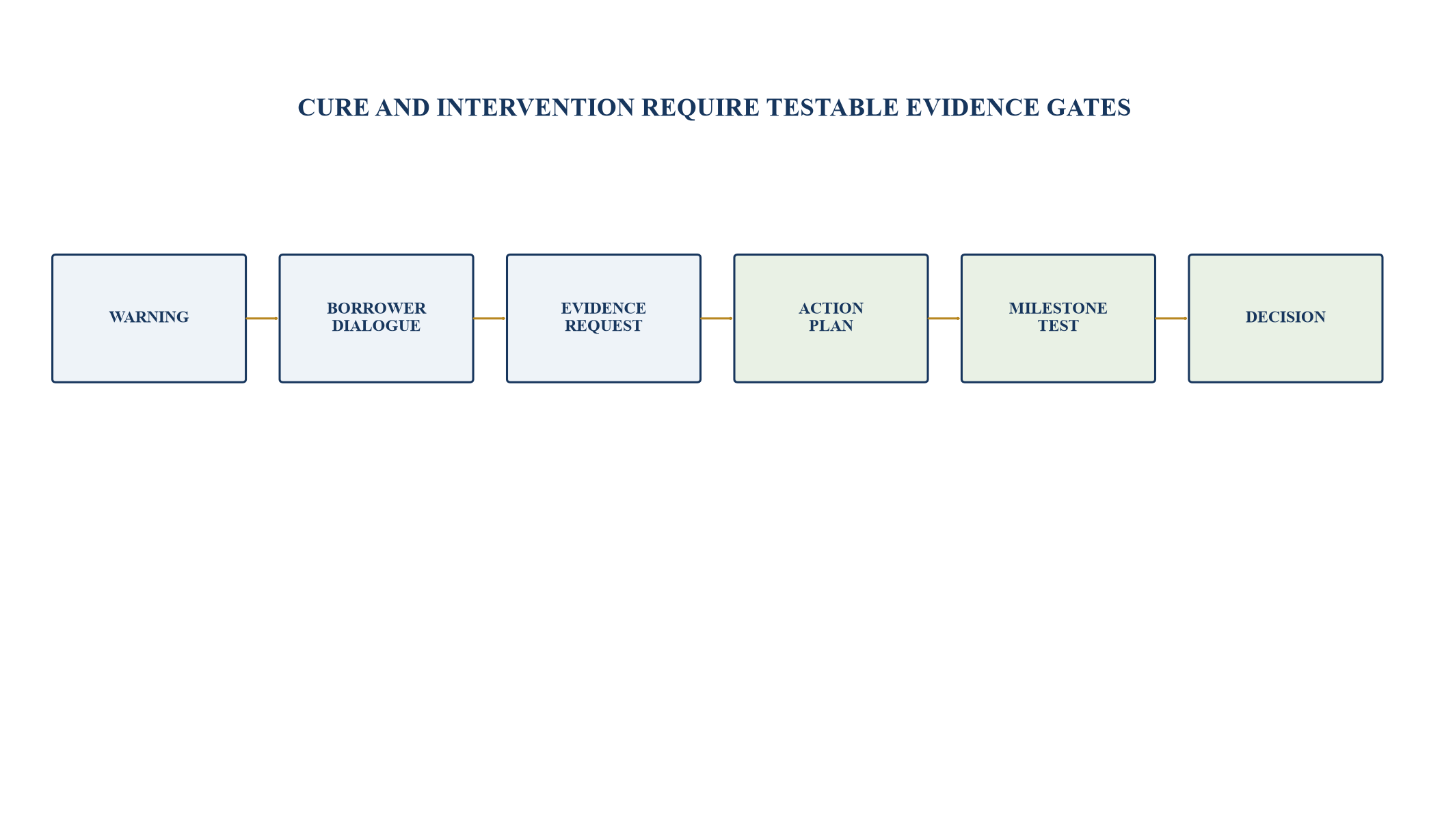
Each stage requires an owner, deadline, evidence gate and authorised decision.
26. Govern waivers and amendments
A waiver addresses a defined matter under approved terms. An amendment changes contractual terms. The process should preserve the request, analysis, consideration, conditions, authority, effective date and continuing obligations.
The system should prevent a temporary waiver from becoming an undocumented operating norm. Expiry, recurring conditions and subsequent tests need visibility.
Pricing or fee outcomes should not substitute for credit analysis. The decision record should address repayment capacity, liquidity, structure, downside and alternatives.
Amendment analysis should compare the proposed structure with realistic alternatives. A revised covenant may provide useful operating room when it reflects sustainable capacity and preserves monitoring. It may also defer recognition of a deeper capital problem. The paper should show forecast ranges, liquidity, maturity, security, ranking, sponsor or shareholder support, fees, pricing and implementation conditions without treating consideration as proof of improved credit quality.
Consent processes need a controlled timetable. Borrower information, lender questions, legal drafting, valuation or diligence, committee approval and signature may proceed on different tracks. The workflow should show dependencies and prevent an assumed approval from entering the forecast before completion.
27. Coordinate lender groups and agents
Syndicated and club facilities require accurate information flows among agent, lenders, security trustee and advisers. Voting thresholds, sacred rights, consultation and notice provisions affect timing.
The system should show which party holds each responsibility and which decisions remain pending. Confidentiality and inside-information controls may restrict distribution.
Analytical consistency supports dialogue while each lender retains its rights and governance. A shared dashboard should not imply shared judgement beyond the documents.
Information asymmetry can increase during stress. Some lenders may hold bilateral exposures, hedges or trade instruments that change incentives and voting. The agent record should distinguish common facility information from lender-specific positions and observe applicable confidentiality constraints.
Decision records should preserve instructions and voting outcomes. Silence, abstention and conditional consent can have different effects under the documents. Operational accuracy matters because a correct credit view can still fail if notices, thresholds or deadlines are handled incorrectly.
28. Connect early warning to accounting classification
Credit monitoring can inform assessment of significant increases in credit risk, expected credit losses and problem-exposure classification. Accounting conclusions follow applicable standards, policies and evidence.
The system should distinguish contractual breach, internal watch-list status, regulatory classification and accounting stage. These concepts can interact without being interchangeable.
Data, assumptions and approvals should be traceable so finance, risk and audit functions can reconcile their respective outputs.
Forward-looking information should be reasonable, supportable and consistent across risk and finance where the same facts are used. Differences may remain because purposes, policies and definitions vary. Those differences should be reconciled and explained rather than forced into a single result.
Forbearance and non-performing exposure assessments can involve events beyond covenant compliance. Payment status, concessions, unlikeliness to pay, financial difficulty and restructuring terms require their own controlled evidence. The dashboard should route relevant facts to the responsible function without asserting the conclusion.
29. Protect borrower and confidential data
Financial, operational, customer, employee and transaction data should follow purpose, access, retention and transfer controls. Least privilege and segregation should reflect role and sensitivity.
Free text and external documents can contain unnecessary or malicious content. Retrieval, logging and model access need approved security controls.
Incident response should connect credit, operations, technology, security, legal and borrower communication owners.
Data minimisation can preserve decision evidence while reducing exposure. The system may not need full customer or employee details when aggregated or pseudonymised fields support the credit question. Retrieval and model prompts should follow approved purpose and access boundaries.
Third-party providers require diligence, contractual controls, resilience planning and exit arrangements proportionate to service criticality. The lender should retain access to its records, model documentation and fallback process. Vendor confidence scores should not replace independent governance.
30. Create immutable review evidence
The review record should preserve source cut-offs, data versions, calculations, model versions, alerts, overrides, correspondence, approvals and actions. Corrections create a new version.
Integrity controls can demonstrate that the reviewed file matches the submitted record. Workflow timestamps should support contractual and policy deadlines.
Fallback procedures need controlled templates, source extracts, review and reconciliation. Results produced during an outage should be compared with restored systems.
The evidence record should include what the reviewer saw at the time. Later data can clarify an outcome, but should not overwrite the original decision context. Versioned snapshots support audit, challenge and fair evaluation of judgement under uncertainty.
Retention should reflect contractual, regulatory, litigation, privacy and operational requirements. Disposal needs controlled authority. The system should prevent undocumented deletion of adverse evidence or expired overrides while avoiding indefinite retention without purpose.
31. Measure warning-system performance
Measures can include warning lead time, missed deterioration, false positives, alert ageing, review completion, override frequency, watch-list movement, cure success, loss and recovery.
Performance should be segmented by facility, borrower, sector, geography and model use. Portfolio averages can conceal material weaknesses.
Review should also examine action effectiveness. A timely alert can still produce poor results when the response is delayed, unclear or infeasible. The record should distinguish detection lead time from decision lead time and execution lead time. This allows management to identify whether improvement is needed in data, models, committees, documentation or borrower engagement.
Capacity metrics matter during portfolio stress. The number and complexity of active cases, reviewer workload, legal support and monitoring frequency can affect control quality. Scenario planning should test whether the institution can operate the warning and intervention process when several correlated exposures deteriorate together.
Quality assurance should sample alerts across severity levels, including cases that were never escalated. Reviewers should test source accuracy, threshold operation, evidence sufficiency, override discipline, decision timing and completion of actions. Findings need owners, deadlines and retesting. This broader sample helps identify silent failures that would remain hidden if assurance examined only defaults, losses or prominent watch-list cases.
Assurance results should reach the credit committee and control owners through a tracked remediation record with clear acceptance criteria.
Economic claims require a credible counterfactual and attributable pathway. An alert count does not establish value.
Outcome windows should match the risk. Some warnings concern an imminent liquidity event; others relate to gradual deterioration over several quarters. The evaluation method should specify when an outcome is observed and how intervening actions affect interpretation.
Human decisions also require review. A model may provide a timely signal that is dismissed, or a weak signal may be escalated prudently because of external evidence. Performance analysis should therefore separate data, model, workflow and judgement outcomes. This supports focused remediation rather than blaming one component for the entire process.
32. Build the portfolio dashboard
The dashboard should show exposure, headroom, liquidity, signal severity, corroboration, trend, watch-list status, overrides, actions, deadlines and accountable owners.
Users need drill-down to evidence and decision history. Stale data, missing submissions and unresolved reconciliation should appear beside scores.
Views should reflect role and authority. Relationship teams may need borrower tasks and questions; credit officers need evidence, sensitivities and conditions; committees need material changes and decisions; model-risk teams need performance and restrictions. Common source data should support each view without exposing unnecessary confidential information.
Portfolio aggregation should reveal correlated risk. Common customers, sponsors, suppliers, commodities, currencies and refinancing windows can create simultaneous deterioration. Concentration views should connect shared drivers to affected exposures and show where action capacity may be constrained.
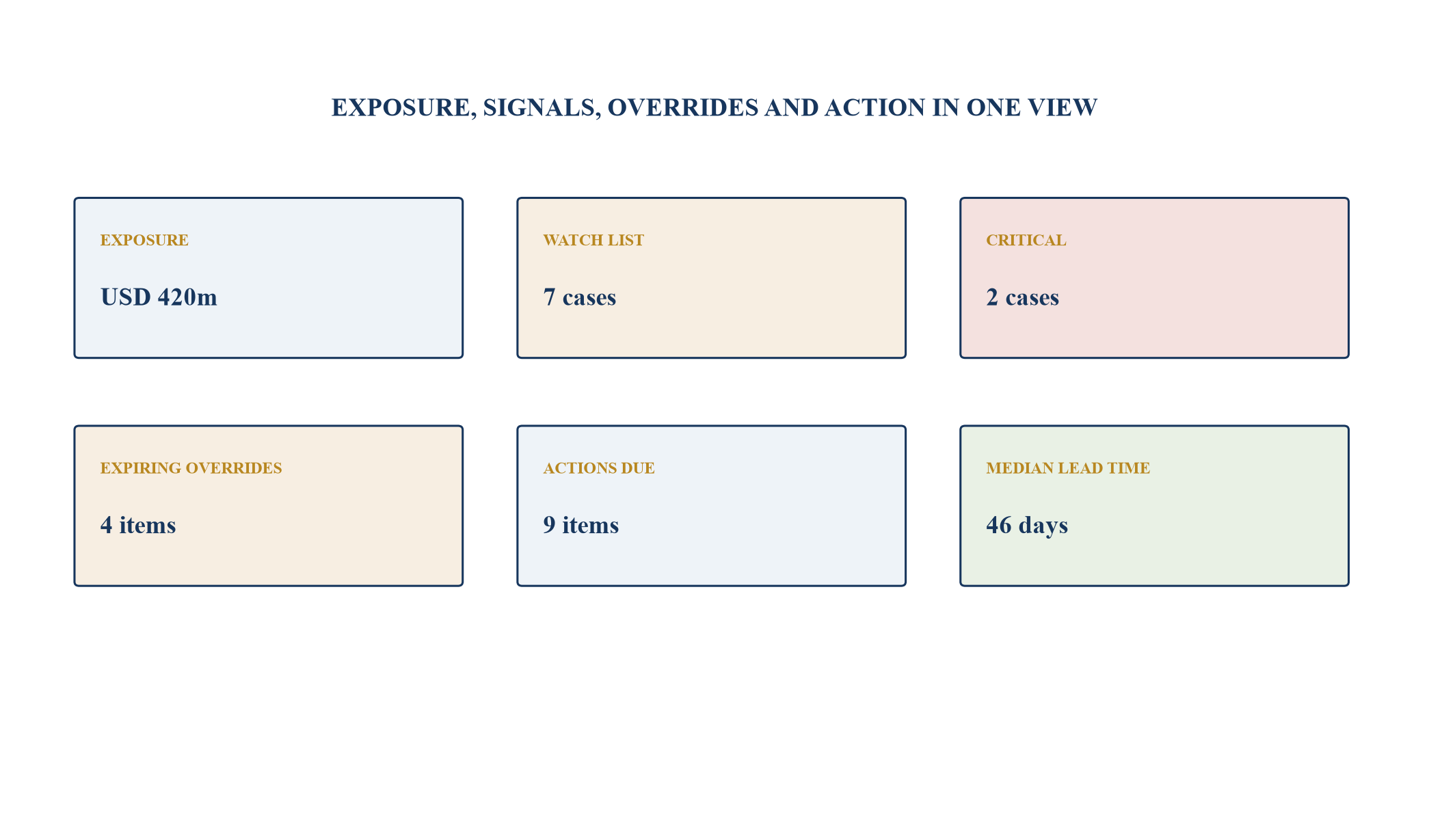
Amounts, scores and statuses are hypothetical assumptions for control-design illustration.
Table 3. Portfolio dashboard decision fields
| Dimension | Measure | Evidence | Decision use |
|---|---|---|---|
| exposure | debt, commitment and maturity | facility records | materiality |
| headroom | current and forecast range | covenant model | trajectory |
| liquidity | cash, availability and shortfall | treasury evidence | intervention timing |
| signals | severity, persistence and corroboration | source-linked alerts | prioritisation |
| override | reason, authority and expiry | decision record | exception control |
| action | owner, deadline and status | workflow evidence | execution |
The dashboard should connect alert evidence to authority and action.
33. Report to the credit committee
The committee should see material facts, forecasts, model outputs, borrower explanations, legal uncertainties, proposed actions and requested authority. Changes since the previous review require explanation.
The paper should distinguish base, downside and severe but plausible cases. Each case needs consistent assumptions across earnings, working capital, liquidity, debt, covenants and management actions. Double-counting benefits or applying downside selectively can distort the decision.
The committee should also see data and process reliability. Late feeds, unresolved reconciliations, model restrictions and expiring overrides can justify caution even when headline headroom appears adequate. Confidence in the process forms part of the credit judgement.
Scenario analysis should identify the largest drivers and executable options. Conditions and dissent remain visible until resolved.
Minutes should link decisions to evidence and implementation owners. A label without action or follow-up provides weak control.
34. Run a hypothetical worked example
Consider a hypothetical company with USD 180 million revenue, USD 24 million EBITDA and USD 72 million net debt. Its maintenance covenant permits maximum net leverage of 3.5 times and minimum interest cover of 2.5 times. The values are illustrative assumptions.
The latest reported leverage is 3.0 times. A revised forecast shows EBITDA ranging from USD 18 million to USD 22 million because of customer delay and margin pressure. Net debt may rise to USD 78 million as working capital absorbs cash.
Under the central forecast, leverage approaches 3.7 times at the next test date. The downside exceeds 4.2 times. Contractual treatment requires the approved definitions and documents; the forecast supports early review rather than a breach conclusion.
35. Apply the signal and override framework
The system identifies four connected signals: delayed customer receipts, falling order conversion, increased revolver use and a late management-reporting pack. Source checks confirm the events and expose one duplicate receivable record, which is corrected.
The relationship team proposes an override because a large receipt is expected. Credit review requires bank evidence, customer confirmation and a five-day expiry. The receipt arrives partly and later than forecast, so the signal remains open.
The exposure moves to enhanced monitoring. The borrower provides a thirteen-week cash flow, customer plan and weekly reporting. Legal and credit teams map information and amendment pathways without asserting a remedy.
36. Test intervention choices
The lender compares continued monitoring, a limited waiver, covenant amendment, liquidity condition and formal escalation. Each choice is assessed for evidence, timing, authority, borrower feasibility and downside protection.
The comparison should state the counterfactual. Continued monitoring preserves optionality but can consume lead time. An amendment can create a sustainable structure when assumptions and consideration are credible. Formal escalation may protect rights while introducing disruption, cost and value leakage. These outcomes depend on the facts and documents.
Conditions should be operationally testable. Requirements such as weekly cash reporting, sponsor support, adviser appointment or asset-sale milestones need exact evidence, owners and deadlines. Ambiguous conditions create later disagreement and weaken enforcement of the decision.
The central case assumes customer collections and margin action restore headroom within two quarters. The downside assumes further delay and a liquidity shortfall. Neither case is a forecast of actual performance.
The committee authorises enhanced monitoring and preparation of amendment terms subject to evidence and documentation. The decision has owners, deadlines and conditions.
Table 4. Hypothetical intervention decision matrix
| Option | Evidence gate | Potential benefit | Key risk |
|---|---|---|---|
| monitor | verified liquidity and timely reporting | preserves flexibility | delay if deterioration accelerates |
| waiver | defined event and temporary treatment | resolves limited issue | repeated dependency |
| amendment | sustainable structure and consideration | aligns terms with capacity | weak assumptions or execution |
| liquidity condition | executable cash source | protects runway | source unavailable or delayed |
| formal escalation | confirmed rights and authority | preserves remedies | value loss and disruption |
Values and outcomes are illustrative assumptions; actual decisions require facility-specific review.
37. Implement in ninety days
Days One to Thirty can define facilities, covenants, sources, owners, warning taxonomy and decision rights. Teams should reproduce a prior covenant test and document adjustments.
Days Thirty-One to Sixty can build indicators, forecast ranges, watch-list workflow and override controls. Models should run in parallel with existing credit review.
Days Sixty-One to Ninety can operate a bounded portfolio, validate alerts, test fallback and review outcomes. Expansion follows evidence and control acceptance.
The initial portfolio should contain meaningful variation without overwhelming the control design. A small set of facilities with accessible data, material exposure and different covenant structures can test the end-to-end process. Cases already in acute distress may offer little opportunity to evaluate warning lead time.
Implementation should measure user behaviour as well as model performance. Review completion, evidence retrieval, override quality, committee acceptance and borrower-response times reveal whether the operating model works. Technology that produces accurate alerts without timely action has not achieved the control objective.
38. Establish operating roles
Borrower-facing teams, credit, portfolio management, finance, legal, model risk, data, technology, security and operations need defined responsibilities and service levels.
Escalation routes should work across reporting cut-offs, staff absence and urgent events. Informal knowledge should be converted into controlled process.
Training should address covenant definitions, signal interpretation, uncertainty, overrides, confidentiality and decision documentation.
39. Use outcome evidence to recalibrate
Subsequent cash flow, covenant results, classifications, losses, recoveries and borrower actions provide outcome evidence. The institution should compare them with prior signals and decisions.
Recalibration requires controlled analysis. A recent benign outcome should not erase a signal with a sound causal basis, and a loss should not automatically validate every preceding alert.
Changes to data, thresholds, models or workflows need testing, approval and version history. The process should preserve comparability or disclose breaks.
40. Make warning lead time actionable
The value of early warning depends on credible evidence, sufficient lead time and an authorised response. Faster detection without decision ownership can create noise rather than control.
An effective system traces each material signal to source, validation, interpretation, escalation, right, action and outcome. It preserves the distinction between contractual facts, observations, forecasts and recommendations.
AI can reconcile records, connect weak signals and focus review. Accountable people retain covenant interpretation, credit classification, override, waiver, amendment and enforcement decisions. The resulting closed loop can improve portfolio learning while preserving lender authority and borrower-specific judgement.
Borrowers can also benefit from transparent causality. When concern arises, the record can show whether it relates to cash, reporting, earnings quality, customer concentration, forecast bias or another driver. Clear evidence can support earlier remedial action and more focused dialogue. These benefits should be measured separately from lender protection and should not inflate the credit case.
The institution should retain the ability to challenge and retire every analytical component. Markets, borrower behaviour, documents, systems and laws change. Periodic review should confirm continued purpose, data quality, performance, control effectiveness and legal relevance. Material weakness can lead to narrower use, stronger manual review, recalibration, redesign or withdrawal through authorised governance.
The final discipline is a complete path from observed event to verified source, from verified source to controlled signal, from signal to accountable review, and from review to authorised action. Subsequent borrower performance, covenant results, liquidity, losses and recoveries should update future analysis. That sequence creates a durable learning record while keeping prediction, contractual interpretation and decision authority distinct. Its effectiveness depends on evidence quality, timely judgement and consistent execution across the full credit lifecycle.
Periodic assurance should sample closed alerts as well as active cases. Reviewers should test whether source evidence was complete, thresholds operated as approved, overrides expired correctly, borrower explanations were corroborated and committee actions were completed. Lessons should feed policy, training, data controls and model validation through documented change governance. This provides evidence that the system supports repeatable decisions across changing staff, market conditions and portfolio composition.
Table 5. Board and credit-committee assurance record
| Dimension | Measure | Evidence | Governance use |
|---|---|---|---|
| coverage | facilities, borrowers and source completeness | controlled register | scope assurance |
| timeliness | reporting, alert and action lead times | workflow timestamps | responsiveness |
| accuracy | missed events and false positives | outcome testing | calibration |
| overrides | frequency, reason and expiry | approval records | exception governance |
| intervention | actions, milestones and closure | decision evidence | execution oversight |
| outcome | classification, loss, recovery and friction | realised records | redesign |
Assurance should connect system performance with credit consequence.
References
- European Banking Authority, Guidelines on Loan Origination and Monitoring. https://eba.europa.eu/activities/single-rulebook/regulatory-activities/credit-risk/guidelines-loan-origination-and-monitoring
- Central Bank of the UAE, Credit Risk Management Regulation, 2024. https://rulebook.centralbank.ae/en/rulebook/credit-risk-management-regulation
- Central Bank of the UAE, Credit Risk Management Standards, 2024. https://rulebook.centralbank.ae/en/rulebook/credit-risk-management-standards
- Basel Committee on Banking Supervision, Principles for the Management of Credit Risk, 2025. https://www.bis.org/bcbs/publ/d595.pdf
- Basel Committee on Banking Supervision, General Credit Risk Management. https://www.bis.org/committees/bcbs/basel-consolidated-guidelines/module/cri/10
- IFRS Foundation, IFRS 9 Financial Instruments. https://www.ifrs.org/issued-standards/list-of-standards/ifrs-9-financial-instruments/
- IFRS Foundation, IFRS 7 Financial Instruments: Disclosures. https://www.ifrs.org/issued-standards/list-of-standards/ifrs-7-financial-instruments-disclosures/
- Bank of England Prudential Regulation Authority, SS1/23 Model Risk Management Principles for Banks, 2026. https://www.bankofengland.co.uk/prudential-regulation/publication/2023/may/model-risk-management-principles-for-banks-ss
- US Federal Reserve and Office of the Comptroller of the Currency, Supervisory Guidance on Model Risk Management SR 11-7 and OCC 2011-12. https://www.federalreserve.gov/supervisionreg/srletters/sr1107.htm
- Financial Stability Board, The Financial Stability Implications of Artificial Intelligence, 2024. https://www.fsb.org/2024/11/the-financial-stability-implications-of-artificial-intelligence/
- Financial Stability Board, Enhancing Third-Party Risk Management and Oversight, 2023. https://www.fsb.org/2023/12/enhancing-third-party-risk-management-and-oversight-a-toolkit-for-financial-institutions-and-financial-authorities/
- National Institute of Standards and Technology, Artificial Intelligence Risk Management Framework 1.0, 2023. https://doi.org/10.6028/NIST.AI.100-1
- National Institute of Standards and Technology, Generative Artificial Intelligence Profile, 2024. https://doi.org/10.6028/NIST.AI.600-1
- National Institute of Standards and Technology, Cybersecurity Framework 2.0, 2024. https://doi.org/10.6028/NIST.CSWP.29
- UK National Cyber Security Centre, Guidelines for Secure AI System Development, 2023. https://www.ncsc.gov.uk/collection/guidelines-secure-ai-system-development
- International Organization for Standardization, ISO/IEC 42001 Artificial Intelligence Management System. https://www.iso.org/standard/81230.html
- International Organization for Standardization, ISO 31000 Risk Management. https://www.iso.org/iso-31000-risk-management.html
- Central Bank of the UAE, Guidance Note on Responsible Adoption and Use of Artificial Intelligence and Machine Learning, 2026. https://rulebook.centralbank.ae/en/rulebook/guidance-note-consumer-protection-and-responsible-adoption-and-use-artificial-intelligence
- Dubai Financial Services Authority, AI Survey 2025, 2025. https://www.dfsa.ae/news/new-dfsa-ai-survey-generative-ai-adoption-has-nearly-tripled-within-difc-last-12-months-governance-continues-develop
- Committee of Sponsoring Organizations of the Treadway Commission, Enterprise Risk Management Framework. https://www.coso.org/enterprise-risk-management
- Office of the Comptroller of the Currency, Leveraged Lending, Comptroller's Handbook. https://www.occ.treas.gov/publications-and-resources/publications/comptrollers-handbook/files/leveraged-lending/pub-ch-leveraged-lending.pdf
- Office of the Comptroller of the Currency, Rating Credit Risk, Comptroller's Handbook. https://www.occ.treas.gov/publications-and-resources/publications/comptrollers-handbook/files/rating-credit-risk/pub-ch-rating-credit-risk.pdf
- European Central Bank, Guidance to Banks on Non-Performing Loans. https://www.bankingsupervision.europa.eu/ecb/pub/pdf/guidance_on_npl.en.pdf
- European Banking Authority, Guidelines on Management of Non-Performing and Forborne Exposures. https://www.eba.europa.eu/activities/single-rulebook/regulatory-activities/credit-risk/guidelines-management-non-performing
- International Capital Market Association, Sustainability-Linked Loan Principles. https://www.lsta.org/content/sustainability-linked-loan-principles-sllp/
