
Introduction
The commercial proposition for an AI data centre can be expressed in a single sentence: deliver reliable computing capacity where customers need it. The financing proposition is more complicated. The campus joins land, permits, a grid connection, generation, storage, substations, cooling, buildings, servers, networks, software and customer contracts. These components have different construction schedules, useful lives, counterparties, security packages and residual values. Their risks also interact. A completed shell without energisation cannot generate contracted computing revenue. Secured power without committed demand can strand capital. A customer contract may look bankable until its service-level obligations exceed the power and cooling design.
Global data-centre electricity consumption was estimated by the International Energy Agency at about 415 terawatt hours in 2024. Its Base Case projects roughly 945 terawatt hours in 2030, while recognising material uncertainty in AI adoption, hardware efficiency and energy bottlenecks. The same analysis observes that data centres can be delivered faster than much of the supporting energy infrastructure. This timing mismatch makes power availability a development constraint and a financing variable.
The central conclusion of this paper is that separating power from compute can improve financeability only when the contracts reconnect the operational system. Legal ring-fencing does not remove interface risk. It identifies the entity in which a risk sits and gives lenders, investors, operators and customers a basis for pricing, monitoring and remedying it. A viable structure aligns asset ownership, cash flows, control rights and technical responsibility across the full power-to-compute chain.
1 Define the financed service
The first financing decision is the service being sold. A wholesale facility may provide powered shell capacity under a long lease. A colocation operator may sell cabinets, connectivity and managed services. A hyperscale arrangement may dedicate halls and electrical capacity to one customer. A GPU infrastructure provider may sell computing time while leasing the facility. Each model produces a different revenue claim and leaves a different residual asset for lenders.
The definition should state the delivery point. If the facility SPV sells available megawatts at the rack, it carries responsibility for the grid interface, electrical conversion, cooling and physical uptime. If a power SPV sells firm electricity at the high-voltage boundary, the facility SPV carries downstream losses and availability. If the compute operator sells processing capacity, customer remedies may flow through several entities. Financing documents need a common measurement hierarchy so that a failure is attributed consistently.
The service definition also fixes the unit of underwriting. Lenders may analyse contracted megawatts, critical IT load, available rack capacity, reserved computing clusters, energy throughput or recurring service revenue. Mixing these units without reconciliation can obscure the real constraint.
2 Map the power-to-compute asset stack
The campus should be decomposed before entities are selected. The land and permitting layer includes title, zoning, water rights, easements and environmental approvals. The connection layer includes queue position, interconnection studies, network upgrades, capacity rights and metering. The supply layer can include utility service, renewable contracts, on-site generation, fuel and battery storage. The facility layer includes civil works, substations, switchgear, uninterruptible power systems, cooling, fire systems, security and fibre routes. The compute layer includes servers, accelerators, storage, networks and orchestration software.
Each asset needs an owner, operator, construction counterparty, revenue source, maintenance regime, insurance treatment and security route. Rights that cannot be transferred or pledged require special attention. A connection agreement held by a sponsor affiliate may be operationally essential while remaining outside the lender security perimeter. A land lease may terminate on a default in another agreement. A software licence may be non-transferable after enforcement. These are structural issues rather than drafting details.
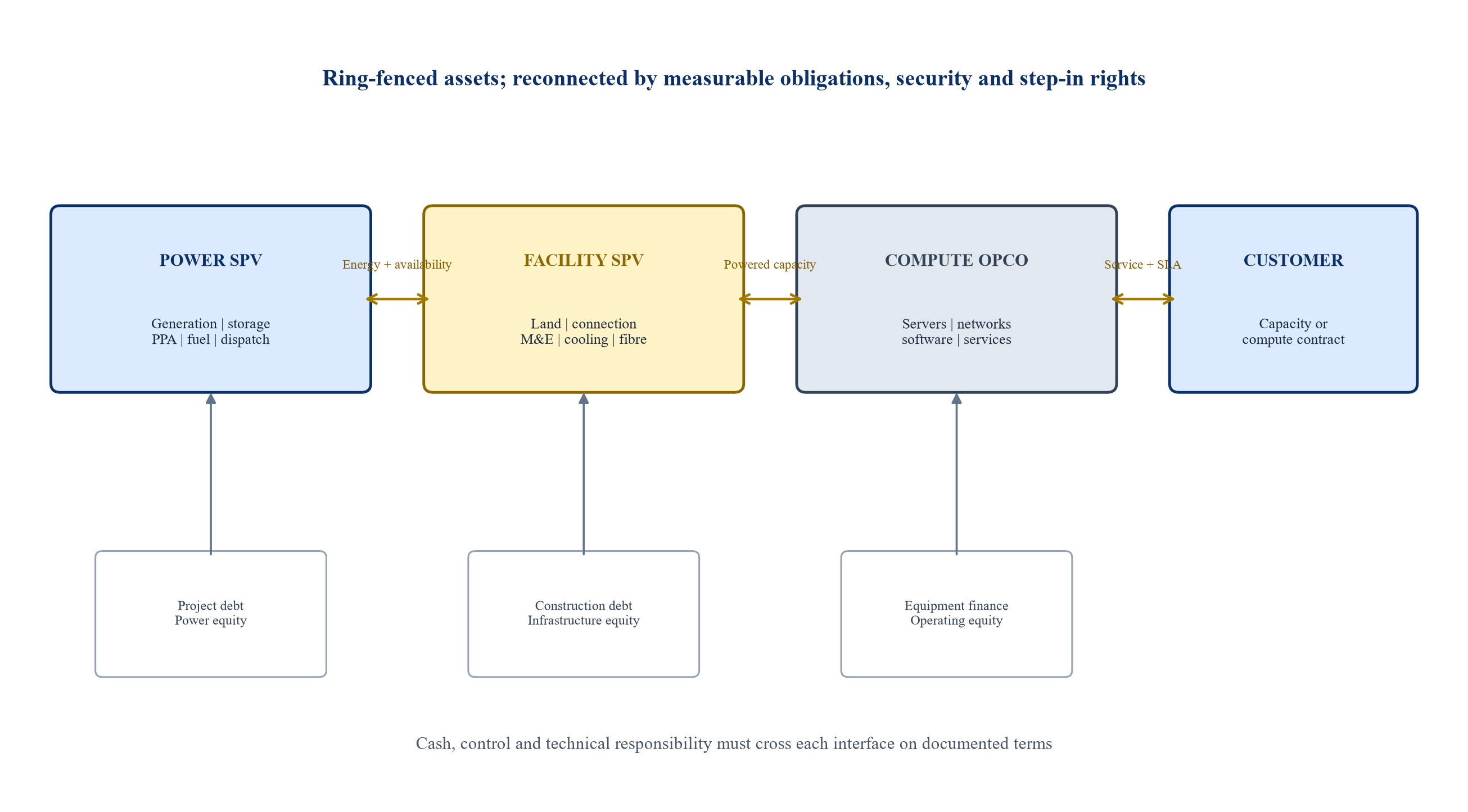
The architecture is an author-developed framework. Entity boundaries and contracts require project-specific legal, regulatory, technical, tax and accounting advice.
3 Choose the entity architecture
A unified project company owns the site, connection, facility and possibly computing equipment. It reduces intercompany interfaces and can simplify construction governance. It also exposes long-lived infrastructure lenders to rapid equipment obsolescence and operating volatility. The balance between simplicity and risk contamination depends on the customer contract, sponsor strength and intended refinancing market.
A two-SPV structure separates power assets from the facility. A third compute operating company can own equipment and customer relationships. This can match debt tenor to asset life and allow specialist investors to fund each layer. It creates dependency on energy-supply, access, maintenance, data and direct agreements. A tenant-owned-compute structure moves technology risk toward the customer while the facility SPV earns contracted infrastructure revenue. A co-located-generation structure may accelerate supply in some markets, while grid rights, standby service, export restrictions and reliability obligations become central.
The entity chart should follow controllable risks and financeable cash flows. It should not be driven by an assumption that an SPV automatically produces off-balance-sheet treatment. IFRS 10 bases consolidation on control. IFRS 12 requires disclosures about interests in structured entities and associated risks. Accounting, tax, insolvency and regulatory consequences require independent professional analysis.
Table 1. Comparison of four financing architectures
| Architecture | Principal revenue | Main advantage | Main interface risk | Likely capital fit |
|---|---|---|---|---|
| Unified project company | Lease, colocation or compute revenue | One asset and contract perimeter | Technology and operating volatility contaminate infrastructure cash flow | Sponsor equity, construction loan, corporate or asset-backed debt |
| Power SPV plus facility SPV | Energy payment plus powered-capacity rent | Separates generation tenor and operating risk | Availability, curtailment, metering and pass-through terms | Project debt for power; infrastructure debt for facility |
| Infrastructure platform plus tenant-owned compute | Long-term powered-shell or colocation rent | Limits equipment obsolescence exposure | Tenant concentration, power reservation and renewal | Real-asset equity, mortgage or infrastructure debt |
| Co-located generation plus constrained grid import | Energy and capacity contracts | Can align new generation with new load | Grid withdrawal, export, outage and regulatory treatment | Project finance with tailored utility and market agreements |
The comparison is an author-developed screening tool and does not determine accounting, legal, regulatory or tax treatment.
4 Treat the grid connection as a financed asset
A connection is a bundle of rights, obligations and milestones. It may require deposits, studies, network upgrades, security, energisation tests and continuing compliance. Queue position alone does not establish deliverable capacity or a date. The financier should identify the legal holder, transfer restrictions, termination events, upgrade responsibility, curtailment regime, cost-sharing mechanism and consequences of load changes.
The North American Electric Reliability Corporation has highlighted the scale and unusual behaviour of emerging large loads. Its 2025 white paper explains that data centres can present new planning and operational risks, including rapid load changes and responses to grid disturbances. The lender therefore needs more than a utility letter. Technical diligence should test load profile, ramping, ride-through, protection, harmonics, backup transitions, forecast accuracy and operating coordination.
Connection risk also affects valuation. A site with credible near-term power can command development value. That value depends on enforceable rights and remaining obligations. The financing model should avoid capitalising an unverified headline capacity as though it were operational megawatts.
5 Build a credible supply portfolio
Supply can combine grid electricity, power-purchase agreements, on-site generation, storage, backup systems and demand flexibility. Each resource serves a different function. Renewable contracts can support energy and sustainability objectives while their production profile may not match a continuous computing load. Storage can manage short-duration variability, peaks and transitions but has finite energy and degradation. On-site generation can improve autonomy while adding fuel, emissions, maintenance and permitting risks. Grid service can provide diversity and market access while exposing the campus to tariffs, congestion and network constraints.
The International Energy Agency projects renewables to meet nearly half of the additional electricity generation supplying data centres between 2024 and 2030 in its Base Case. The financing case should translate that system outlook into project-level contracts. Annual renewable matching does not establish hourly availability. A long-term power price does not establish physical deliverability. A capacity payment does not establish fuel security.
The underwritten portfolio should state firm capacity, energy volume, duration, response time, correlated outage exposure, price indexation, carbon attributes and replacement rights. The required portfolio depends on the service-level promise and the customer's tolerance for interruption or workload shifting.
6 Match asset life to capital tenor
Land, electrical infrastructure and buildings may support decades of use. Cooling systems and power-distribution equipment require periodic renewal. Computing equipment can lose economic competitiveness much faster. A single long-dated amortisation schedule can hide refinancing and replacement needs.
The capital plan should separate development expenditure, enabling works, base building, power infrastructure, customer-specific fit-out and computing equipment. Development equity bears early site, permit and connection risk. Construction debt can fund defined works after conditions precedent are met. Equipment finance, vendor finance or operating leases can follow delivery and acceptance of servers. Long-term project or infrastructure debt becomes more credible after energisation, completion testing and contracted occupancy. Securitisation or portfolio refinancing may become possible once cash flows diversify and performance history exists.
Tenor should be linked to the shorter of asset usefulness, contract duration and demonstrated cash-flow visibility. Balloon risk, replacement capital and customer renewal assumptions remain explicit.
7 Use staged notice-to-proceed gates
Large campuses are often delivered in phases. The financing should prevent one unresolved dependency from drawing the full capital stack. A development facility can cover studies, design and deposits within a capped exposure. Limited notice to proceed can secure long-lead equipment after supplier, design and cancellation protections are agreed. Full construction funding can follow enforceable land rights, permits, connection milestones, offtake conditions, fixed or bounded construction exposure, contingency and sponsor support.
Each gate should have evidence rather than labels. “Power secured” should identify contracted capacity, energisation path, remaining upgrades and remedies. “Customer committed” should identify termination rights, credit support, ramp schedule and acceptance conditions. “Design complete” should identify rack density, cooling technology, redundancy and interface control documents.
Staging preserves optionality. It also makes the sponsor's completion obligation measurable. Capital providers can price the risk they enter instead of relying on a blended probability across the entire programme.
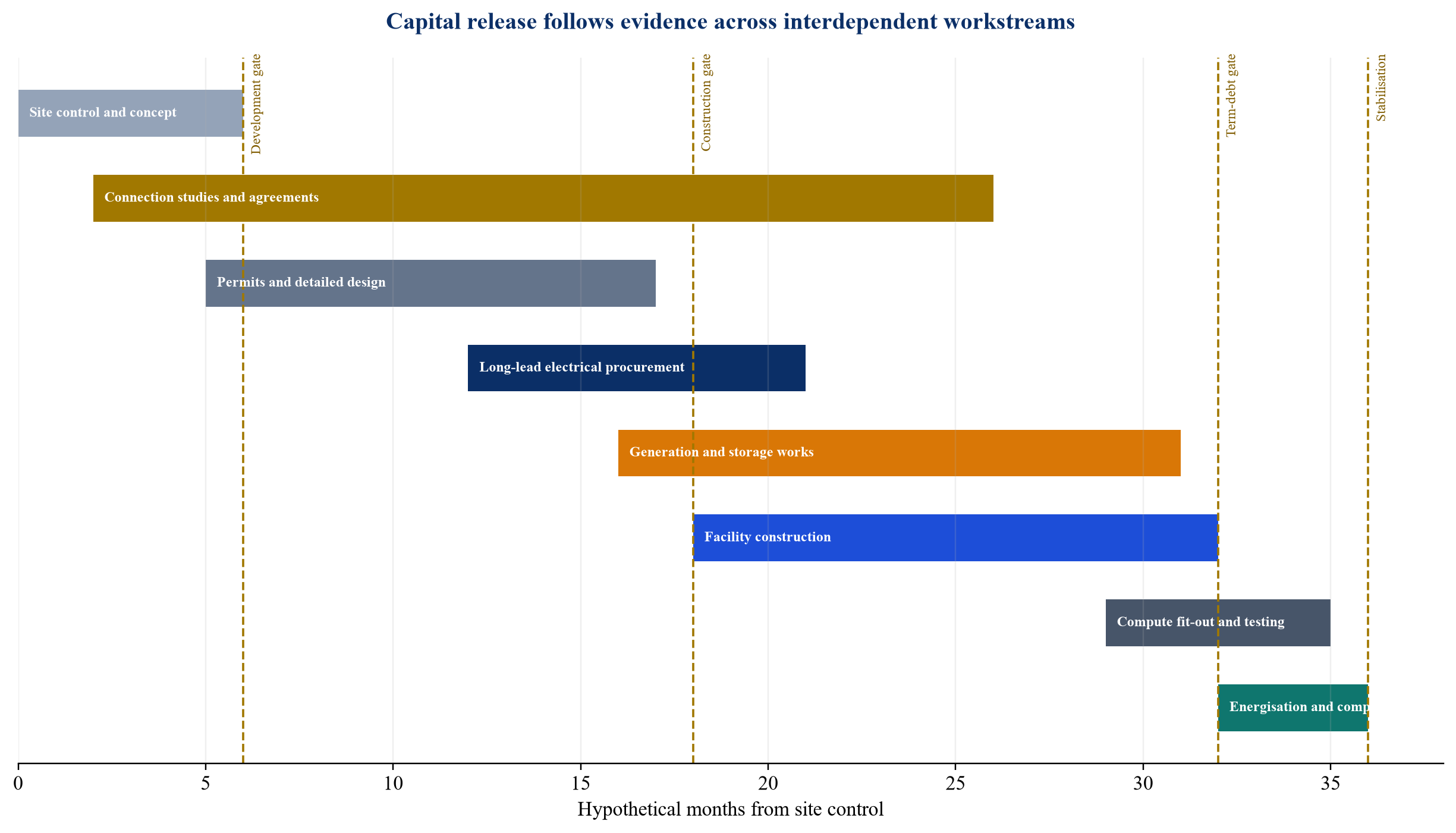
Durations are hypothetical author-developed assumptions. Actual timing depends on jurisdiction, grid studies, procurement, permits, design, contracting and construction.
8 Contract the power-facility interface
The power agreement between SPVs should define delivery point, available capacity, energy quality, scheduled and forced outages, curtailment, metering, losses, maintenance coordination, expansion rights and emergency operation. Payment may combine fixed availability, capacity reservation, energy pass-through and performance adjustments. The formula should avoid making the power SPV dependent on compute utilisation when its capital cost is fixed, unless that demand risk is consciously accepted.
The agreement also needs remedies that reflect financing. A short power interruption may trigger customer service credits long before it impairs a power-asset covenant. Repeated underperformance can damage the facility's revenue and lender confidence. Liquidated damages, reserve support, insurance and termination rights should be calibrated to the actual downstream exposure. An unlimited cross-default can defeat ring-fencing. A weak remedy can leave one SPV solvent while another fails.
Direct agreements can give lenders notice, cure and step-in rights. Step-in works only when licences, staff, suppliers, data, controls and access can support an alternative operator.
9 Contract the facility-compute interface
The facility must deliver environmental and electrical conditions compatible with the equipment. Rack density, cooling inlet temperatures, humidity, water quality, power quality, redundancy, network diversity and maintenance windows should be measurable. A generic “industry standard” can be inadequate for high-density AI clusters.
The compute operator should provide load forecasts, commissioning plans, equipment specifications and change notices. Rapid hardware changes can alter thermal and electrical requirements after the facility design is fixed. The facility SPV needs approval rights where a change could impair capacity, warranties, permits or lender assumptions. The compute operator needs expansion and technology-refresh rights within a defined envelope.
Acceptance testing should join both layers. Passing a building test without representative IT load may leave dynamic behaviour untested. Passing a compute benchmark without sustained thermal and power conditions may understate facility risk. Integrated testing should cover normal operation, grid disturbance, backup transitions, cooling loss, network failure and recovery.
10 Align customer contracts with financed obligations
Customer contracts create the revenue base and define the service promise. Underwriting should examine contracted capacity, ramp dates, minimum payments, usage variability, indexation, renewal, termination, service credits, force majeure, data obligations, change rights and customer credit support. A long headline term can provide limited protection if the customer can terminate for convenience, delay acceptance or reduce capacity.
Revenue should be traced through the entity stack. If the compute operator receives customer cash and pays facility rent, lenders to the facility depend on operating-company performance and intercompany payment priority. A lockbox, assignment or direct payment arrangement may reduce leakage. The structure also needs a credible treatment of customer refunds and service credits.
Concentration can be acceptable when the counterparty is strong and the contract is robust. It still creates renewal, pricing and re-letting exposure. Technical specificity can make a dedicated facility difficult to repurpose. Residual value should reflect conversion cost and available demand.
11 Allocate construction and completion risk
Completion is a system state rather than a certificate for one contract. The facility can be physically complete while power, fibre or customer acceptance remains outstanding. The financing should define minimum completion, final completion and stabilisation across the full chain.
Construction risk allocation begins with scope. Fixed-price, date-certain engineering and construction terms can reduce exposure when the design is mature. They do not eliminate owner changes, grid works, exceptional events, supplier insolvency or interface gaps. Long-lead transformers, switchgear, cooling equipment and generators require vendor diligence, inspection and replacement planning.
Completion support can include sponsor equity, contingent equity, letters of credit, cost-overrun undertakings and contractor security. Its amount should be related to credible downside cases. The release test should include energisation, integrated performance, permits, insurance, contracted revenue commencement, funded reserves and absence of material claims.
12 Separate availability from utilisation
Infrastructure cash flow is most financeable when payment reflects availability that the asset owner controls. Compute utilisation can depend on customer workloads, accelerator economics, software performance and market competition. Passing pure utilisation risk to a facility SPV can make long-lived debt depend on a volatile operating metric.
A balanced contract can use a fixed capacity reservation plus variable energy and service charges. The fixed portion supports debt service and fixed operating cost. Variable components allocate usage-linked costs. Performance deductions apply to failures within the provider's control. Relief events address customer changes, upstream outages and agreed force majeure.
The model should test whether fixed payments cover required debt service and reserve funding under the contracted ramp. A structure that depends on speculative utilisation for base debt service remains exposed even if the market outlook is strong.
13 Design the cash waterfall
A project-finance waterfall turns contractual priorities into cash control. Receipts enter controlled accounts. Taxes and essential operating costs are paid first according to agreed limits. Senior interest and principal follow. Required reserves are funded or replenished. Hedging, permitted subordinated debt and other obligations are paid in the agreed order. Distributions occur only after tests are met.
Separate SPVs require separate waterfalls and rules for intercompany payments. The power SPV may need stable availability revenue before the facility SPV can distribute cash. The facility SPV may need to preserve customer service while enforcing a dispute against the compute operator. Payment suspension, set-off and termination rules must align with lender rights.
Reserve accounts can cover debt service, maintenance, equipment replacement, power-price volatility, decommissioning and customer obligations. Reserve sizing should follow exposure and replenishment ability. Cash trapping can respond to falling coverage, delayed completion, customer deterioration, unresolved claims or loss of required power capacity.
Table 2. Illustrative cash-flow and control package by entity
| Entity | Primary receipts | Core operating payments | Typical reserves | Key distribution tests |
|---|---|---|---|---|
| Power SPV | Availability, capacity and energy payments | Fuel, market purchases, operations, maintenance and network charges | Debt service, major maintenance, fuel or price volatility, decommissioning | Coverage ratio, availability, permit and contract status |
| Facility SPV | Powered-capacity rent, colocation and pass-through charges | Utilities, facility operations, water, maintenance, insurance and property cost | Debt service, lifecycle replacement, customer credits, power security | Occupancy, contracted MW, coverage, completion and customer concentration |
| Compute operating company | Reserved compute, usage and managed-service revenue | Equipment leases, facility rent, software, network and staff | Equipment refresh, customer refunds, working capital | Liquidity, utilisation, customer retention and equipment covenants |
Terms are author-developed examples. They are not recommendations for a particular financing.
14 Size debt to contracted cash flow
Debt capacity should be derived from cash flow after operating cost, maintenance, taxes, reserves and required intercompany payments. The base case should use contracted ramp and defensible availability. Uncontracted expansion, merchant energy optimisation and speculative utilisation can be shown separately.
Coverage metrics require precise definitions. EBITDA can ignore lifecycle replacement and working capital. A debt-service coverage ratio should state the cash available and debt obligations included. Loan-life coverage can reveal reliance on terminal value. Project life should stop at the earlier of land rights, permits, key contracts, asset life or a conservative refinancing boundary.
The model should reconcile power, capacity and revenue units. Contracted megawatts may refer to utility supply, critical IT load or nameplate equipment. Power usage effectiveness changes the relationship. A model that applies rent to one measure and cost to another can overstate cash flow.
15 Test capacity economics
Capacity economics combine fixed capital, contracted revenue, energy cost, operating cost, utilisation and replacement. The critical question is which variables the financed entity controls. A facility SPV may control uptime and efficiency while having limited control over wholesale electricity prices or customer utilisation. A power SPV may control plant availability while facing fuel or market basis risk.
Sensitivity analysis should examine energisation delay, slower customer ramp, lower contracted price, higher power cost, reduced availability, cooling inefficiency, construction overrun and increased capital cost. Correlations matter. A regional grid constraint can delay connection and increase power prices. A technology change can increase rack density and require additional cooling investment. Customer distress can reduce revenue while leaving reserved power costs.
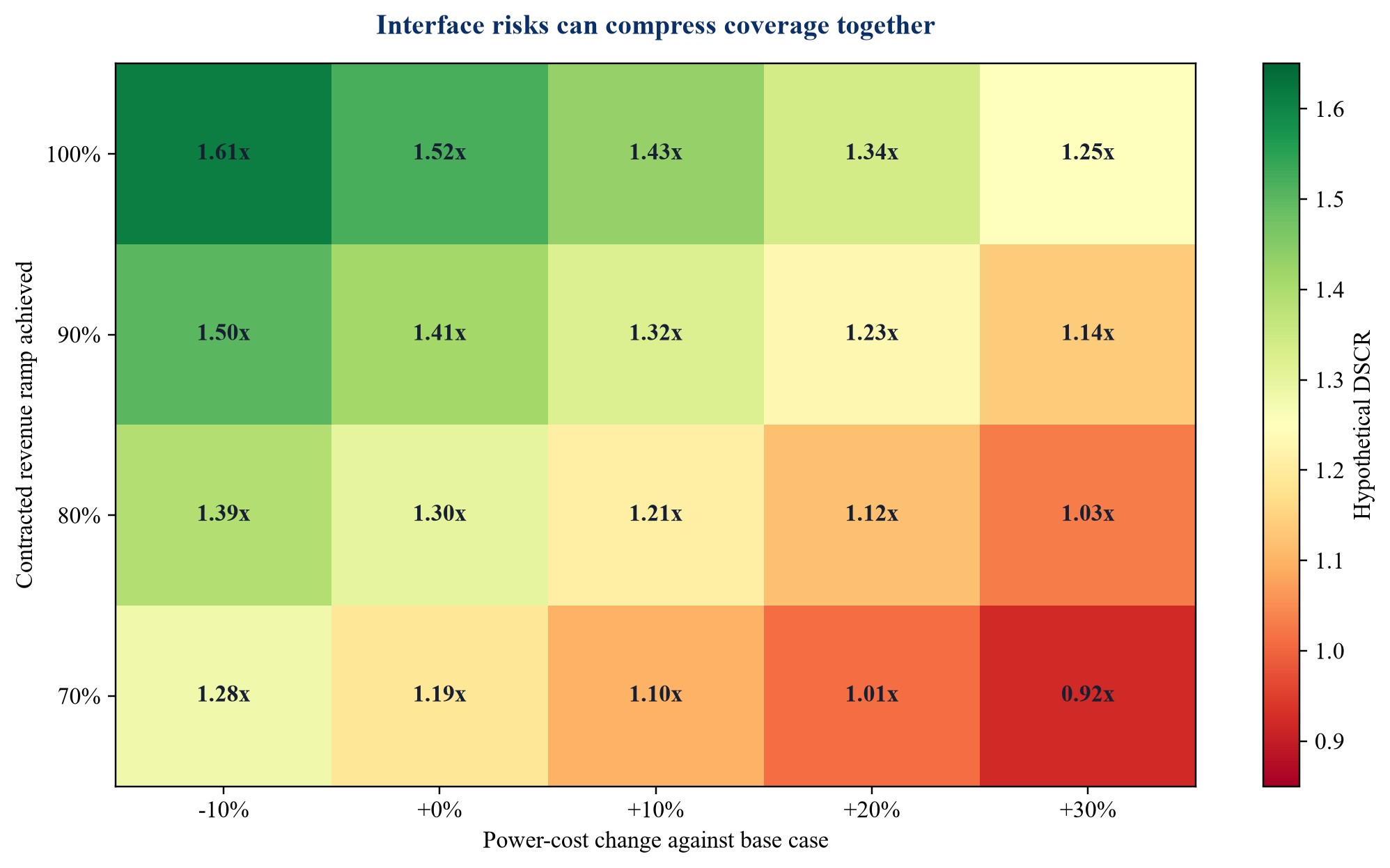
Values are hypothetical author-developed assumptions and do not represent a forecast, financing proposal or expected performance.
16 Underwrite energisation delay explicitly
Energisation can be the critical path. The model should distinguish delays caused by the utility, transmission owner, contractor, equipment supplier, project company and force majeure. Each category can have different remedies and financing consequences.
The delay case should include extended interest during construction, commitment fees, security renewal, site cost, equipment storage, warranty erosion, customer damages and lost revenue. Equipment delivered before power may require controlled storage and periodic maintenance. Computing hardware purchased too early can depreciate before service begins.
Mitigation can include phased energisation, temporary supply, modular construction, delayed equipment orders, contractual long-stop dates, customer ramp flexibility and sponsor liquidity. Temporary arrangements should be tested for capacity, emissions, fuel, permits and service quality. They should not be treated as equivalent to permanent power without evidence.
17 Manage curtailment and grid-service risk
Curtailment can arise from transmission constraints, generation shortage, utility instructions or contracted service characteristics. The agreement should distinguish economic curtailment, emergency interruption, maintenance and provider failure. It should state notice, duration, priority, compensation, load-shedding sequence and restoration.
Some computing workloads can shift in time or location. Flexibility can reduce cost and support the grid when customer architecture permits it. The financing model should value only flexibility that is contractually available, technically proven and operationally governed. Critical services may have little tolerance for interruption.
FERC's 2025 direction to PJM on co-located loads illustrates the regulatory importance of transparent service and reliability rules. Project participants should monitor how their jurisdiction treats grid withdrawals, behind-the-meter generation, standby service, capacity obligations, cost allocation and consumer protection. Regulatory change can alter economics after construction.
18 Control technology and obsolescence risk
The compute layer faces rapid product cycles, performance changes and supply concentration. A facility designed for one cooling method or rack density may require investment to support the next generation. The owner should establish a technology envelope and a funded change process.
Equipment lenders focus on title, location, serial records, acceptance, insurance, maintenance, residual value and remarketing. Facility lenders focus on whether removal damages the building or interrupts other tenants. Intercreditor arrangements should allocate access, removal, reinstatement and proceeds. Fixtures law and insolvency treatment require jurisdiction-specific advice.
Obsolescence risk also affects customer credit. A compute operator may remain solvent while its installed equipment becomes uneconomic. Renewal and replacement capital should be modelled as operating requirements rather than optional growth where the revenue depends on current performance.
19 Address water and cooling dependencies
Cooling design affects efficiency, water use, planning, community impact and operating resilience. The SPV should secure water rights and quality where required, test drought or restriction exposure, and evaluate alternative modes. Water consumption metrics need consistent boundaries. A facility can report efficient cooling while relying on water-intensive upstream electricity.
Customer contracts should state environmental conditions and responsibility for density changes. Cooling performance guarantees should use measurable conditions and include degradation, fouling, ambient extremes and maintenance. Backup modes should be tested for duration and fuel or water availability.
Environmental and social diligence should address cumulative impact, local infrastructure, noise, air emissions, water, land, biodiversity, labour, safety and community engagement. These factors can affect permits, schedule, cost and the social licence to operate.
20 Preserve fibre and digital connectivity
Power alone does not create usable computing capacity. Diverse fibre routes, carrier access, latency, cross-connects and network security can determine customer value. The facility SPV should identify which rights are owned, leased or dependent on third parties. Route diversity should be physical as well as contractual.
Network contracts can have shorter terms than facility debt. Renewal and price exposure should be assessed. A customer may require specific cloud on-ramps or exchange access. The financing case should distinguish essential connectivity from optional services.
Enforcement planning should preserve network licences and operational data. A lender that can take control of a building without the credentials, monitoring, carrier relationships or staff needed to operate it has incomplete security.
21 Build an insurance and force-majeure map
Insurance should follow the full asset and revenue chain. Construction cover, delay in start-up, property damage, business interruption, machinery breakdown, cyber, environmental and liability policies may sit in different entities. Deductibles, waiting periods, exclusions and claim proceeds should align with financing documents.
A force-majeure event can affect power, facility and compute contracts differently. Relief should be coordinated so that one entity is not required to pay while its own revenue is excused. Extended events need termination, buyout and debt treatment. Political, regulatory and utility actions may require separate allocation.
Insurance does not replace operational resilience. Coverage availability and wording can change. The project should maintain prevention, response and recovery controls, with periodic broker and lender review.
22 Protect lender step-in and continuity
Step-in rights are valuable when a default can be cured through operational control or replacement. They require notice, cure periods, access, licences, cooperation and a replacement process. Power, facility and customer agreements should recognise the relevant secured parties and avoid automatic termination before cure.
The practical plan should identify critical staff, operating systems, passwords, spare parts, supplier contracts, permits and data. It should state whether an independent operator could take over and how quickly. Proprietary compute software may remain outside the project perimeter; the facility still needs a safe shutdown and preservation plan.
Direct agreements should balance continuity with counterparty protection. A customer should not be forced to accept indefinite underperformance. A utility should retain reliability authority. The negotiated remedy should reflect the service and the time needed for a credible cure.
23 Establish governance across entities
Ring-fencing can fragment decisions. A campus governance agreement should coordinate construction, maintenance, outages, emergencies, expansion, cybersecurity, environmental performance and reporting. Reserved matters should identify decisions requiring lender, shareholder, customer or counterparty consent.
Boards should receive a common operating pack with capacity, power, availability, construction, customer, safety, environmental, liquidity and covenant information. Definitions should be consistent across entities. An outage classified differently by the power SPV and compute operator undermines accountability.
Related-party contracts require arm's-length terms, conflict controls and approval. Transfer pricing and tax consequences need professional advice. Changes that move value or risk between entities should be transparent to capital providers.
24 Use a consolidated risk register
Each SPV needs its own risk register. The financing also needs a consolidated interface register. It should list the event, cause, affected entities, contractual allocation, financial exposure, control, evidence, owner, indicator and remedy. Dependencies should be explicit.
Priority should consider probability, consequence, velocity and detectability. A rare transformer failure can have a long replacement time. A small recurring power-quality problem can damage equipment or trigger customer credits. A regulatory decision can change the service model.
The register should connect to model sensitivities and covenant thresholds. Risks that cannot be quantified still need scenarios and decision rules. Review continues after financial close because customer, technology and grid conditions change.
25 Define completion and stabilisation tests
Minimum completion can require legal ownership, permits, connection, mechanical completion, integrated testing, insurance, operating agreements, customer acceptance and funded reserves. Final completion can include punch-list closure, claims resolution and performance evidence. Stabilisation can require a period of contracted revenue, availability and covenant compliance.
Tests should reflect the financed service. A powered-shell transaction may stabilise after tenant commencement and facility availability. A compute-service transaction may also require cluster acceptance, utilisation and customer-performance evidence. The independent technical adviser should have a clear scope and access to underlying tests.
Debt conversion or refinancing should occur only after the relevant evidence exists. Refinancing assumptions should not substitute for a viable construction-period liquidity plan.
26 Plan refinancing and asset rotation
Different layers may refinance at different times. Power assets can move to long-term project debt after completion and operating history. The facility can refinance after occupancy and customer concentration meet thresholds. Computing equipment may remain under shorter leases or revolving facilities. Portfolio aggregation can diversify site and customer risk.
Asset sales need consent, release and continuity provisions. Selling the power SPV to an infrastructure investor while retaining the facility can create a durable related-party interface. The contract should survive ownership changes and protect expansion rights. Change-of-control provisions should avoid giving a customer an unintended free option while preserving legitimate credit protection.
The sponsor should model fees, break costs, hedging termination, taxes and reserve releases. A headline valuation uplift does not equal distributable cash.
27 Apply a due-diligence evidence hierarchy
Financing decisions should distinguish executed rights from proposals. Highest-weight evidence includes registered title, permits, executed connection and power contracts, customer agreements, equipment orders, test records, insurance and audited financial information. Studies, letters of intent and management plans support diligence while carrying less certainty.
Technical, commercial, legal, insurance, environmental, cybersecurity, accounting and tax workstreams should share assumptions. A technical adviser may model an energisation date that the connection agreement does not support. A financial model may assume transfer of a permit that the legal review identifies as non-transferable. An interface log closes these gaps.
Open items should have owners, due dates, financing consequences and conditions precedent or subsequent. Material uncertainty should remain visible in the investment paper.
Table 3. Power-to-compute financing evidence gate
| Gate | Required evidence | Principal failure signal | Financing response |
|---|---|---|---|
| Site and rights | Title or lease, permits path, easements, water and fibre rights | Non-transferable or short-duration right | Reduce exposure; obtain consent or redesign perimeter |
| Connection and supply | Executed agreements, studies, deposits, upgrade scope, delivery and curtailment terms | Capacity or timing remains indicative | Hold full construction draw; fund only capped development work |
| Construction | Mature design, interface matrix, procurement, contingency and completion support | Undefined scope or unsupported long-lead assumptions | Increase equity, contingency or contractual protection |
| Revenue | Executed customer terms, credit support, ramp, acceptance and remedies | Termination or delay rights weaken fixed cash flow | Reduce debt sizing or require stronger support |
| Operations | Integrated tests, permits, insurance, staff, suppliers and monitoring | Facility cannot operate independently after default | Delay term conversion; strengthen step-in package |
| Stabilisation | Contracted receipts, availability, reserves and covenant headroom | Cash flow depends on speculative utilisation | Trap cash, defer distribution or resize debt |
This author-developed checklist supports diligence planning. It does not replace professional advice or lender requirements.
28 Use a decision sequence
The sponsor should begin with the service, asset stack and timeline. It then identifies entity alternatives, maps contracts and allocates risks. A preliminary model tests whether each entity has adequate revenue and capital. Diligence validates rights and assumptions. Financing terms are negotiated against the evidence. Construction draw controls preserve alignment. Completion and stabilisation tests support long-term capital.
The sequence is iterative. A customer demand for higher density can alter cooling, power and equipment finance. A connection delay can change the construction plan. A lender covenant can require a stronger capacity payment. The structure should be revised while preserving a common source of assumptions.
The board's approval should state the chosen architecture, reasons, unresolved exposures, sponsor support, stop conditions and authorities. It should avoid treating legal separation as risk elimination.
29 Recognise common failure modes
Common failures include buying compute equipment before power timing is credible; counting queue position as firm capacity; financing long-lived assets from short or cancellable revenue; passing utility risk to an entity unable to control it; using customer deposits as unrestricted construction liquidity; assuming that a fixed-price contract covers incomplete scope; and allowing intercompany terms to move cash ahead of senior obligations.
Other failures include designing step-in rights without operational capability, ignoring fibre and water dependencies, treating annual renewable procurement as continuous physical supply, using nameplate megawatts inconsistently, and modelling refinancing as certain. An SPV can also fail its purpose when accounting control, tax, insolvency or regulatory treatment differs from the commercial assumption.
The remedy is disciplined evidence, contract alignment, staged exposure and integrated testing.
30 Limitations
This paper is a general analytical framework. It does not establish that a specific data-centre, generation, storage, grid connection, customer contract, SPV or financing is technically feasible, financeable, compliant or commercially attractive. Outcomes depend on jurisdiction, market rules, site, counterparties, technology, contracts, permits, environmental conditions, taxes, accounting, insolvency law and capital markets.
The figures and tables use hypothetical author-developed assumptions. They do not represent measured construction timing, cost, tariff, availability, debt capacity, coverage, valuation or return. Professional legal, regulatory, technical, environmental, insurance, accounting, tax and investment advice is required for an actual transaction.
Conclusion
An AI data-centre campus is a chain of assets and obligations. Power, connection, physical infrastructure and compute can attract different pools of capital because they have different lives and risks. Separation can make those differences visible and protect one capital layer from another. It also creates interfaces that must be financed with the same care as physical assets.
The Power-to-Compute SPV Framework begins with the service and delivery point, maps the asset stack, chooses an entity architecture, aligns contracts, stages capital, controls cash and tests downside. It treats the grid connection as a financed right, completion as an integrated system state, and step-in as an operational capability. The result is a structure in which ownership, revenue, responsibility, security and remedies remain connected from generation to customer service.
References
- International Energy Agency, Energy and AI: Energy demand from AI, 2025. https://www.iea.org/reports/energy-and-ai/energy-demand-from-ai
- International Energy Agency, Energy and AI: Energy supply for AI, 2025. https://www.iea.org/reports/energy-and-ai/energy-supply-for-ai
- International Energy Agency, Energy and AI data product, 2025. https://www.iea.org/data-and-statistics/data-product/energy-and-ai
- International Energy Agency, Data centre electricity use surged in 2025, 2026. https://www.iea.org/news/data-centre-electricity-use-surged-in-2025-even-with-tightening-bottlenecks-driving-a-scramble-for-solutions
- US Department of Energy Secretary of Energy Advisory Board, Recommendations on Powering Artificial Intelligence and Data Center Infrastructure, 2024. https://www.energy.gov/sites/default/files/2024-08/Powering%20AI%20and%20Data%20Center%20Infrastructure%20Recommendations%20July%202024.pdf
- US Department of Energy, Powering America's AI Future: Data Center Resource Hub, 2026. https://www.energy.gov/powering-americas-ai-future-data-center-resource-hub
- Lawrence Berkeley National Laboratory, 2024 United States Data Center Energy Usage Report, 2024. https://eta-publications.lbl.gov/publications/2024-lbnl-data-center-energy-usage-report
- North American Electric Reliability Corporation, Characteristics and Risks of Emerging Large Loads, 2025. https://www.nerc.com/globalassets/who-we-are/standing-committees/rstc/whitepaper-characteristics-and-risks-of-emerging-large-loads.pdf
- Federal Energy Regulatory Commission, FERC Directs Nation's Largest Grid Operator to Create New Rules to Embrace Innovation and Protect Consumers, 2025. https://ferc.gov/news-events/news/fact-sheet-ferc-directs-nations-largest-grid-operator-create-new-rules-embrace
- Federal Energy Regulatory Commission, Order on Co-Location Arrangements, Docket EL25-49-000 et al., 2025. https://www.ferc.gov/sites/default/files/2025-12/E-1%20EL25-49-000.pdf
- Federal Energy Regulatory Commission, State of the Markets Report 2026. https://www.ferc.gov/sites/default/files/2026-03/26_State-of-the-Market_0324_1430.pdf
- World Bank Group, Infrastructure Finance. https://ppp.worldbank.org/infrastructure-finance
- World Bank Group, Project Finance: Key Concepts. https://ppp.worldbank.org/financing/project-finance-concepts
- World Bank Group, Finance Structures for PPP. https://ppp.worldbank.org/finance-structures-ppp
- World Bank Group and partner institutions, PPP Reference Guide Version 3. https://ppp.worldbank.org/PPP-Reference-Guide
- World Bank Group, Risk Allocation in Public-Private Partnerships. https://ppp.worldbank.org/allocating-risks
- World Bank Group, PPP Risk Allocation Tool 2019. https://ppp.worldbank.org/library/ppp-risk-allocation-tool-2019
- IFRS Foundation, IFRS 10 Consolidated Financial Statements. https://www.ifrs.org/issued-standards/list-of-standards/ifrs-10-consolidated-financial-statements/
- IFRS Foundation, IFRS 12 Disclosure of Interests in Other Entities, 2021 issued standard. https://www.ifrs.org/content/dam/ifrs/publications/pdf-standards/english/2021/issued/part-a/ifrs-12-disclosure-of-interests-in-other-entities.pdf
- Digital Realty Trust, Annual Report on Form 10-K for the year ended 31 December 2025. https://www.sec.gov/Archives/edgar/data/1297996/000110465926015365/dlr-20251231x10k.htm
- Equinix, Annual reports and proxy statements. https://investor.equinix.com/financial-info/annual-reports-and-proxy/default.aspx
- European Commission, Energy efficiency in data centres. https://energy.ec.europa.eu/topics/energy-efficiency/energy-efficient-products/energy-efficiency-data-centres_en
- European Commission, Commission Delegated Regulation (EU) 2024/1364 on data-centre reporting. https://eur-lex.europa.eu/eli/reg_del/2024/1364/oj
- Uptime Institute, Tier Standard: Topology. https://uptimeinstitute.com/tiers
- ASHRAE, Data Center Resources. https://www.ashrae.org/technical-resources/bookstore/datacom-series
- International Finance Corporation, Environmental, Health, and Safety Guidelines for Telecommunications. https://www.ifc.org/content/dam/ifc/doc/2000/2007-telecommunications-ehs-guidelines-en.pdf
- International Finance Corporation, Performance Standards on Environmental and Social Sustainability, 2012. https://www.ifc.org/en/insights-reports/2012/ifc-performance-standards
- National Institute of Standards and Technology, Guide to Operational Technology Security, SP 800-82 Revision 3, 2023. https://doi.org/10.6028/NIST.SP.800-82r3
- National Institute of Standards and Technology, Cybersecurity Framework 2.0, 2024. https://doi.org/10.6028/NIST.CSWP.29
- Cybersecurity and Infrastructure Security Agency, Secure by Design. https://www.cisa.gov/securebydesign
- International Organization for Standardization, ISO 50001 Energy management systems. https://www.iso.org/iso-50001-energy-management.html
- International Organization for Standardization, ISO 55001 Asset management systems. https://www.iso.org/standard/83054.html
- International Electrotechnical Commission, IEC 62443 Industrial communication networks and system security. https://www.iec.ch/blog/understanding-iec-62443
- International Renewable Energy Agency, Corporate sourcing of renewables: market and industry trends. https://www.irena.org/Publications/2018/May/Corporate-Sourcing-of-Renewable-Energy
- US Environmental Protection Agency, ENERGY STAR Data Centers. https://www.energystar.gov/buildings/resources-audience/data-center-owners-and-operators
- US Energy Information Administration, Electric power data. https://www.eia.gov/electricity/data.php
- Federal Energy Regulatory Commission, Electric Reliability. https://www.ferc.gov/industries-data/electric/electric-reliability
- PJM Interconnection, Data Center Planning. https://www.pjm.com/planning/service-requests/data-center-planning
- European Investment Bank, EIB Project Finance Guide. https://www.eib.org/en/publications/eib-project-finance-guide
- Organisation for Economic Co-operation and Development, Due Diligence Guidance for Responsible Business Conduct, 2018. https://mneguidelines.oecd.org/due-diligence-guidance-for-responsible-business-conduct.htm
About the Author
Chennakeshav (CK) is a corporate finance and investment banking executive with 25+ years of global experience in deal origination, structuring and execution across M&A, growth capital and corporate strategy. He has led value-creation mandates for founders, corporates and funds — bridging the boardroom view to hands-on execution and close.
His career spans Morgan Stanley, HSBC, Lloyds Banking Group, EWEC, ADQ portfolio companies and Emirates Growth Fund, across TMT, real estate, fintech, deeptech, cleantech, infrastructure and energy. He has partnered with C-suite leaders, private equity and venture funds, sovereign wealth funds and family offices to finance complex fund raises and scale-up ventures, and has led M&A due diligence, post-merger integration and business-transformation initiatives to create value.
At Matchpoint Partners he is Managing Partner, leading the firm's corporate finance, M&A and capital-raising practice. He holds an MBA from London Business School, an engineering degree from VTU and a Master of Laws (LLM, in progress) from UCL London.
An active start-up mentor, CK mentors at Techstars, DIFC FinTech Hive, Startup Grind, Founder Institute and IN5, serves as Entrepreneur Mentor in Residence (EMiR) at London Business School, and judges the Entrepreneurship World Cup.
