

Introduction
Infrastructure inspection is constrained by scale, access, safety, cost and specialist capacity. A bridge contains surfaces that are difficult to reach. A transmission corridor stretches across difficult terrain. Solar modules, wind-turbine blades, water networks, rail assets and data-centre plant require different sensors and engineering standards. Manual inspection remains essential, yet periodic site visits can leave long intervals during which defects emerge or deteriorate.
Drones, satellites, fixed cameras, thermal sensors, LiDAR and robotic platforms can collect more evidence at lower marginal effort. Computer vision can organise that evidence, flag anomalies and compare conditions over time. Public agencies already recognise both the benefit and the limitation. The United States Federal Highway Administration permits unmanned aircraft systems to supplement portions of bridge inspections while explaining that they cannot replace tactile examination, auditory cues or other required techniques. The International Energy Agency identifies drones and satellite technologies as tools that can reduce inspection effort and staff exposure in electricity networks. European Space Agency material demonstrates how repeated radar observations can reveal ground deformation across wide areas.
These capabilities create a capital-allocation question. A detected crack, hotspot, leak signature, deformation pattern or vegetation encroachment has no independent financial value. Value emerges when reliable evidence changes an engineering decision. The owner may repair earlier, avoid an outage, defer unnecessary replacement, negotiate a warranty claim, protect availability payments, price an acquisition risk or support a lender's monitoring requirement. The paper therefore begins with the decision and works backwards to the sensor and model.
1 Distinguish detection from inspection
Detection is a model output. Inspection is an accountable process that establishes asset condition under a defined method, competence standard and evidence record. A bounding box around a surface anomaly may support inspection; it does not establish structural significance. The distinction matters because investors can otherwise treat model accuracy as proof of asset knowledge.
An inspection process defines scope, coverage, sensor suitability, environmental conditions, calibration, evidence quality, review, escalation and engineering disposition. It also states what the method cannot observe. Visual systems may miss subsurface deterioration, internal corrosion, loose connections, hidden moisture or defects obscured by coatings and geometry. Thermal imaging may indicate abnormal heat without establishing root cause. Satellite deformation can identify movement over an area while requiring local investigation.
Computer vision should therefore serve as an evidence and prioritisation layer. It can increase frequency, consistency and traceability; direct people to the highest-risk locations; and preserve comparable records. A competent engineer or authorised inspector remains responsible for the required conclusion where law, standards or asset risk demand that judgment.
2 Start with the economic decision
The useful design question is: which decision will change when better inspection evidence arrives? Candidate decisions include whether to dispatch a crew, isolate equipment, claim under a warranty, advance maintenance, defer replacement, reprice a reserve, amend a capital plan or suspend operation. Each decision has a value of information and a consequence of error.
Management should define the decision owner, decision deadline, minimum evidence, permitted action and financial account. A defect detected after the maintenance window may have limited value. A low-confidence anomaly that triggers an unnecessary shutdown can destroy value. A missed defect in a safety-critical component can produce loss far beyond inspection savings.
The business case should measure changes in decisions, not images processed. Relevant outcomes include time from observation to disposition, proportion of alerts confirmed, avoided repeat visits, reduction in unplanned outage hours, warranty recoveries, prioritised capital expenditure, improved reserve accuracy and documented risk reduction. These outcomes can then be connected to cash flow and financing.
3 Build the Defect-to-Cash chain
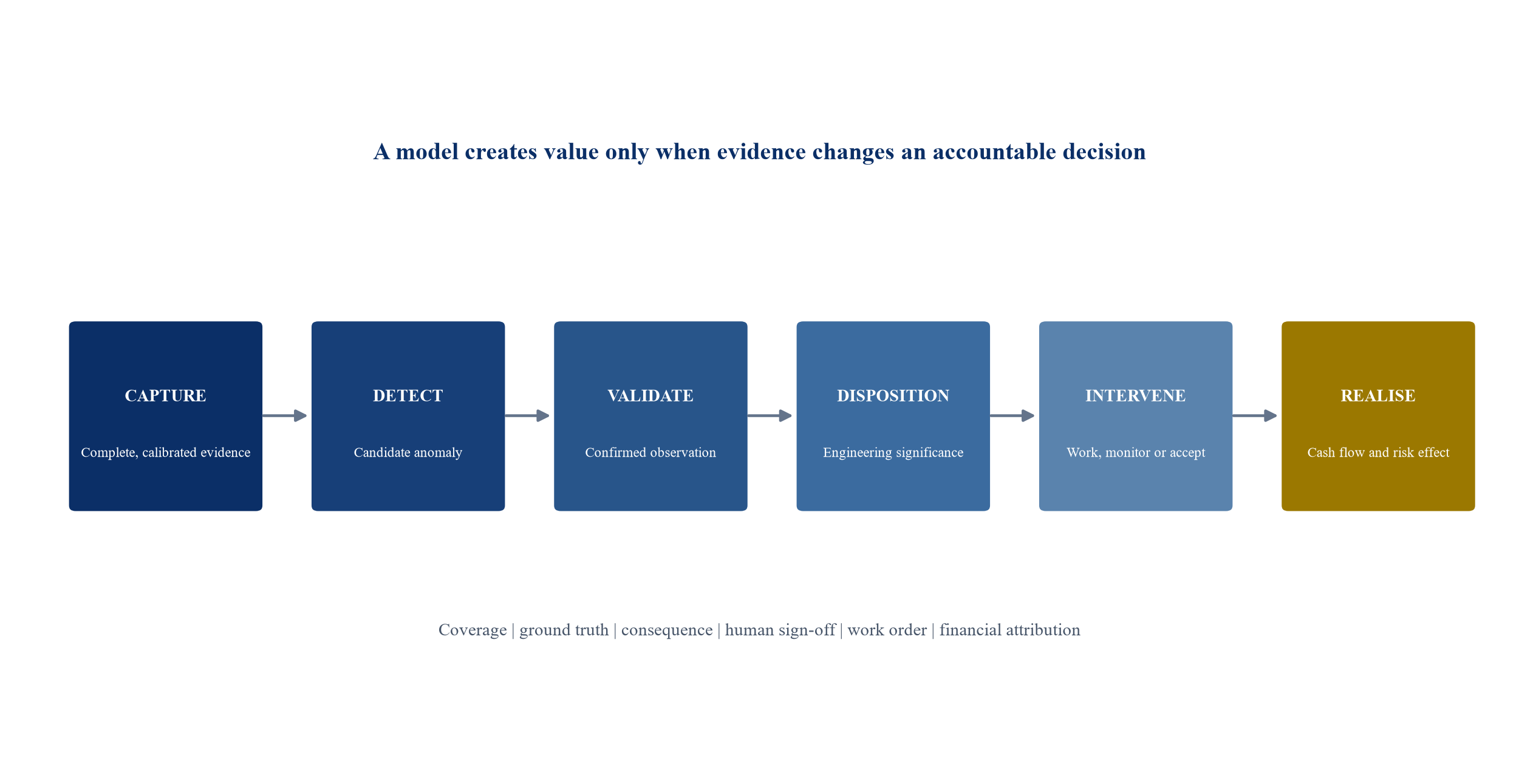
The figure is an author-developed framework. Each arrow requires documented ownership, acceptance criteria and an auditable record.
The chain begins with capture quality. The system then detects a candidate anomaly. Validation confirms that the signal is real and correctly located. Engineering disposition determines severity, cause, action and deadline. Intervention converts the conclusion into a work order, monitoring plan or documented acceptance. Value realisation records the operational and financial consequence.
Every handoff needs an owner and acceptance test. A technology provider may own capture and detection. The asset operator may own validation and work management. A qualified engineer may own disposition. Finance should own value attribution. The evidence record should connect every stage through a stable asset identifier and timestamp.
A chain-level service level is more useful than a promise about inference speed. The owner needs to know whether high-consequence observations reach a competent reviewer within the decision window and whether approved work is executed. Procurement should therefore include workflow completion, not only software availability.
4 Define the asset hierarchy and inspection unit
Computer vision fails commercially when images cannot be linked to the asset register. The inspection programme should use a hierarchy that connects portfolio, site, system, asset, component and inspection location. Stable identifiers should survive changes in vendors and software. Geospatial coordinates alone may be insufficient when components are replaced or share a location.
The inspection unit should match the engineering decision. A transmission-tower image can contain insulators, conductors, fasteners, corrosion zones and vegetation clearances. A data-centre thermal scan can include switchgear, busbars, cable terminations, cooling equipment and rack-level patterns. Each observation needs the component, orientation, time, capture method and operating state.
Asset-master reconciliation is an early deployment gate. Missing or inconsistent identifiers prevent trend analysis, duplicate defects and weaken transaction diligence. Management should allocate effort to taxonomy, geospatial referencing and data ownership before scaling automated detection.
5 Match sensing technology to the defect
Table 1. Sensing-method decision map
| Method | Strongest use | Principal limitation | Typical decision horizon | Required corroboration |
|---|---|---|---|---|
| RGB drone imagery | Detailed visible surfaces, towers, roofs, facades, blades and bridges | Occlusion, lighting, access rules and limited subsurface evidence | Hours to weeks | Inspector review and targeted physical examination |
| Thermal drone or fixed imaging | Electrical hotspots, insulation anomalies, moisture patterns and solar-module differences | Operating state and ambient conditions can distort interpretation | Minutes to days | Load data, calibration and electrical or mechanical testing |
| LiDAR | Geometry, clearance, deformation and three-dimensional condition records | Cost, processing complexity and reflective or obstructed surfaces | Days to months | Survey control and engineering thresholds |
| Satellite optical | Wide-area change, land use, flood impact and corridor context | Cloud, resolution and revisit constraints | Days to months | Local imagery or site inspection |
| Satellite radar | Ground movement, subsidence and all-weather change detection | Interpretation, decorrelation and indirect component evidence | Days to years | Geotechnical review and ground measurements |
| Fixed cameras | Frequent observation of known locations and process conditions | Limited field of view, fouling and cyber exposure | Seconds to days | Sensor health checks and periodic manual validation |
| Robotic or crawler systems | Confined, hazardous or repetitive close-range inspection | Access, mobilisation and platform reliability | Hours to weeks | Specialist review and physical tests where needed |
The table is an author-developed comparison. Suitability depends on asset design, environment, regulation, access and the required engineering standard.
Sensor selection should begin with failure mode. Surface corrosion and ground subsidence require different evidence. Thermal anomalies may require the asset to operate under a representative load. Vegetation management requires seasonal and species context. Water leakage may need acoustic, pressure or flow evidence alongside imagery.
Multimodal evidence can improve confidence, yet more sensors add integration cost and possible conflict. The programme should specify which source is authoritative, how disagreement is resolved and when a second method becomes mandatory. Sensor fusion should support a decision rule rather than become an open-ended data project.
6 Design coverage before accuracy
Accuracy metrics apply only to the images and labels evaluated. Asset owners also need to know whether the system looked at the right place, at the right time, under usable conditions. Coverage should therefore be measured across assets, components, required views, environmental conditions and inspection intervals.
A model can achieve high precision on clear images while providing weak portfolio assurance if difficult surfaces are systematically missing. Coverage gaps may cluster around the highest-risk locations because they are hard to access. Dashboards should show uninspected, unprocessable and low-confidence areas rather than reporting only completed missions.
The coverage plan should define minimum image overlap, ground sampling distance, viewing angle, thermal calibration, weather limits, lighting and permissible obstruction. Failed captures should trigger a repeat process. The owner should retain the raw evidence and metadata needed to challenge the result.
7 Establish ground truth that reflects engineering reality
Training labels can be inconsistent when annotators do not share engineering definitions. A crack label may ignore width, depth, orientation, material and structural context. Corrosion classes may reflect visual appearance rather than section loss. Thermal hotspots may be labelled without load or ambient information.
The ground-truth protocol should define defect ontology, severity criteria, ambiguous cases and adjudication. Qualified specialists should review safety-critical classes. Sample selection should include ordinary conditions, rare severe defects, difficult backgrounds, seasons, asset ages, vendors and capture devices. Data from one geography or asset type should not be assumed to generalise.
Ground truth also needs negative examples. Clean surfaces, shadows, staining, repair marks, birds, vegetation and sensor artefacts can produce false alarms. The test set should remain independent of training and should be versioned. Confirmed field outcomes should flow back through controlled learning rather than informal relabelling.
8 Use consequence-weighted performance measures
Precision, recall and intersection-over-union are useful technical measures. Infrastructure decisions require consequence-weighted measures. Missing a cosmetic stain and missing a high-consequence conductor defect should not carry equal weight. False alarms can also matter when they trigger shutdowns, access equipment or specialist mobilisation.
Each defect class should have an economic and safety loss function. The validation report can then show expected loss under different thresholds. High-consequence defects may require a lower alert threshold, independent review or a different sensing method. Low-consequence classes may tolerate automated closure after sampling.
Calibration matters because decision rules often use confidence. A stated probability should correspond to observed frequency in comparable conditions. Performance should be reported by asset type, geography, season, sensor, capture condition and defect severity. A portfolio average can conceal weak performance in the exact segment where the model is used.
9 Connect severity to engineering disposition
Table 2. Defect and economic-severity matrix
| Evidence class | Engineering question | Illustrative response | Financial treatment | Escalation control |
|---|---|---|---|---|
| Suspected low consequence | Is the observation real and progressing? | Retain evidence and rescan at the next planned interval | No immediate value claim; include monitoring cost | Random specialist sample and trend threshold |
| Confirmed maintainable | Can planned work arrest deterioration? | Create work order within approved maintenance window | Budget planned maintenance and expected downtime | Engineering approval of method and completion evidence |
| Material operational | Could condition impair output or availability? | Expedite site verification and intervention plan | Update outage scenario, reserve and warranty position | Named operations and engineering sign-off |
| Safety or integrity critical | Is immediate restriction or isolation required? | Activate emergency procedure and physical examination | Recognise potential loss exposure; suspend speculative benefit | Independent competent authority and incident record |
| Portfolio pattern | Does repeated evidence indicate systemic design or vendor risk? | Expand sample, investigate common cause and notify counterparties | Reassess capex, provisions, insurance and valuation | Board-level risk ownership and legal review |
Categories and response times are hypothetical author-developed examples. Asset-specific engineering standards and competent-authority requirements control actual decisions.
Disposition converts an observation into a controlled conclusion. The record should state defect type, location, severity, likely cause, confidence, required action, deadline and reviewer. Where evidence is insufficient, the correct disposition may be further inspection rather than a forced classification.
Common-cause analysis is particularly important. Repeated anomalies across similar assets can indicate installation, design, material or vendor issues. A model that groups patterns across the portfolio may create value beyond individual detection. Management should define the threshold for expanding inspection and preserving warranty rights.
10 Preserve competent human sign-off
Human review should be designed around consequence and competence. A general operator may validate whether an image is clear. An engineer may determine structural significance. A licensed inspector or regulatory authority may be required for a statutory conclusion. The workflow should route evidence to the correct role.
Review interfaces should display original evidence, model location, prior inspections, asset history, operating condition and uncertainty. Reviewers should be able to disagree, request new capture and record reasons. A forced approve-or-reject interface can conceal uncertainty.
Automation bias should be tested. Reviewers may accept model outputs after a long sequence of correct alerts or ignore a system that produces excessive false positives. Blind samples, double review of critical classes and periodic competence tests can measure review quality. The human decision should remain visible in the evidence ledger.
11 Create a complete data lineage
An investor or regulator should be able to trace a conclusion to the source evidence. The lineage should include asset identifier, capture device, calibration, operator, flight or mission, time, location, environmental conditions, file hash, preprocessing, model version, threshold, reviewer and final disposition.
Derived images should not replace originals. Compression, cropping, contrast adjustment and thermal palettes can change interpretation. The system should retain raw data where lawful and practical, record transformations, and define retention. Access controls should protect infrastructure-sensitive information.
Lineage also supports vendor transition. Owners should avoid dependence on a proprietary interface that cannot export evidence, annotations and history. Contractual data rights should cover raw captures, derived data, labels, metadata, decisions and model outputs in usable formats.
12 Control drone operations as part of the inspection system
Drone economics depend on lawful and repeatable access. In the United States, commercial operations under Part 107 include pilot certification, registration, visual-line-of-sight and airspace requirements, with waivers available for specified operations. Other jurisdictions apply their own aviation, privacy, security and critical-infrastructure rules.
The operating concept should address airspace, permissions, weather, people, roads, electromagnetic conditions, take-off sites, battery management, lost-link response and incident reporting. Beyond-visual-line-of-sight operations may improve corridor economics; they also require the necessary regulatory authority and operating controls.
Flight plans should be reproducible so that change detection compares similar views. Mission software, navigation accuracy and camera settings become part of measurement assurance. The owner should know when a capture deviated from plan and whether the evidence remains acceptable.
13 Use satellites for screening and change, with local confirmation
Satellite systems can provide wide-area context and repeated observation. Optical imagery supports land-use, vegetation, flood and visible-change analysis. Synthetic-aperture radar can operate through cloud and darkness and can support deformation monitoring. ESA material describes repeated Sentinel-1 observations used to map subsidence and feed regional risk management.
Spatial resolution, revisit time, viewing geometry, atmospheric effects and processing choices limit what can be concluded. Satellite evidence is strongest when used to screen corridors, identify movement patterns, prioritise local inspection and maintain context between site visits. It should not be presented as a direct component diagnosis when the resolution and physics do not support that conclusion.
Procurement should specify latency, historical archive, continuity, geographic rights and processing transparency. A financing use case may require evidence that remains available after a vendor contract ends. Owners should test whether the service can reproduce prior results.
14 Integrate thermal, acoustic and operational data
Visual evidence can become materially stronger when combined with operating context. A thermal anomaly in switchgear depends on load, ambient temperature, emissivity and viewing angle. Solar-module inspection depends on irradiance and electrical state. Cooling-system observations depend on set points, airflow and demand.
The evidence package should therefore link imagery with telemetry and work history. Time synchronisation is important. An anomaly detected at one operating condition may disappear or reverse under another. Models should avoid learning operational shortcuts that do not represent asset condition.
Multimodal corroboration can reduce unnecessary intervention. A thermal alert combined with rising resistance, vibration or pressure evidence may justify rapid action. A visual anomaly with stable operational data may justify closer inspection without immediate shutdown. The rule should remain documented and subject to engineering approval.
15 Address data-centre inspection use cases
Data centres combine electrical, mechanical, cooling, fire, structural and security systems under high availability requirements. Computer vision can support thermal inspection of electrical connections, detection of leaks or condensation, roof and facade surveys, cooling-equipment condition, construction-to-as-built comparison and controlled visual rounds.
The commercial value comes from preserving availability and directing maintenance while respecting operational restrictions. Capture devices can create cyber, privacy and physical-security exposure. Imagery may reveal layouts, equipment labels or access controls. Deployment should use approved devices, segmented networks, controlled retention and strict access.
An inspection alert should integrate with the data-centre infrastructure management and maintenance systems. The work order needs equipment identity, redundancy state, permissible maintenance window and evidence of closure. A lender or buyer should receive aggregated assurance without unnecessary disclosure of security-sensitive detail.
16 Apply the framework to power networks
Transmission and distribution owners can use imagery for conductor, insulator, structure, vegetation and corridor conditions. IEA analysis highlights the role of drones and satellites while also emphasising integration of asset data with trusted operational workflows. The inspection system should therefore connect to asset management and outage planning.
Network consequence is highly location-dependent. A similar physical defect can have different importance based on redundancy, loading, weather exposure, access time and customer impact. Risk ranking should combine condition with system criticality. Models trained only on appearance cannot supply the complete priority.
Vegetation analytics require growth, season, conductor sag, rights of way and local rules. Storm response requires rapid capture and triage while evidence quality may be lower. The programme should define an emergency mode with different thresholds, review capacity and communication paths.
17 Apply the framework to renewable-energy assets
Solar and wind portfolios offer repeatable geometry and large inspection volumes. Thermal and visual systems can identify module anomalies, soiling patterns, tracker issues, blade damage and tower or balance-of-plant conditions. Portfolio-scale comparison can reveal vendor, batch or installation patterns.
Production loss attribution remains difficult. An observed defect may not cause measurable loss; reduced output may have multiple causes. The owner should reconcile inspection evidence with performance data, curtailment, irradiance or wind resource, downtime and repair outcome. Benefit claims should use controlled baselines.
Warranty strategy is a material use case. Evidence should meet notice periods, documentation requirements and causation standards in the relevant contract. The technology procurement and warranty process should be aligned so that valuable evidence is not rejected because it was collected or interpreted outside the agreed method.
18 Apply the framework to water infrastructure
Water systems include treatment plants, reservoirs, pipelines, canals, dams and pumping assets. Computer vision can support visible leakage, corrosion, concrete condition, embankment change, vegetation, surface-water context and equipment monitoring. Satellite evidence can help screen subsidence and broad environmental change.
Many failure mechanisms remain hidden. Pressure, acoustic, flow, water-quality and geotechnical evidence may be required. The inspection programme should state which risks remain outside visual coverage. A visually clean asset should not be treated as proof of internal integrity.
Value may arise from reduced non-revenue water, avoided failure, energy efficiency, prioritised renewal and improved regulatory evidence. Financial attribution should separate model contribution from the wider detection and repair programme. The business case should include excavation, access and repair capacity; detection without response can increase recorded backlog without reducing loss.
19 Apply the framework to transport assets
Bridges, roads, rail, tunnels, ports and airports combine public-safety obligations with access constraints. FHWA guidance illustrates an important principle: drones can supplement bridge inspection and reduce exposure or access-equipment time, while tactile examination and other methods remain necessary for some conclusions.
Transport inspections should follow the governing standard and competent-inspector requirements. Computer vision can support inventory, surface mapping, change detection, measurement and evidence retrieval. It should not silently redefine the statutory inspection scope.
The economic model should include traffic management, possession time, access equipment, crew safety, repeat mobilisation and disruption. A high-quality digital record can also improve design and maintenance planning. Benefits should be measured against the full inspection and intervention process.
20 Integrate observations with work management
An alert outside the maintenance system is operationally weak. Integration should create or enrich a work request using the asset identifier, location, evidence, severity, deadline and required competence. Duplicate alerts should be consolidated. Closure should require completion evidence and, where appropriate, a post-repair image or test.
The workflow should distinguish observation, defect, work request, work order and completed intervention. These are different states. Dashboards that count detections as repaired defects overstate progress. Ageing reports should expose items waiting for validation, engineering decision, materials, access or execution.
Feedback from closure can improve models and economics. The final record should capture whether the alert was confirmed, what action occurred, cost, downtime and outcome. This creates the basis for controlled learning and financial attribution.
21 Build an inspection-economics model
The economic model should compare the existing process with the proposed end-to-end process. Costs include equipment, operators, permissions, data services, storage, integration, annotation, validation, engineering review, cybersecurity, training, insurance and change management. Transition periods may require parallel inspection.
Benefits can include reduced access cost, fewer repeat visits, improved coverage, shorter outage, planned rather than emergency work, warranty recovery and better capital prioritisation. Each benefit needs an observable baseline and attribution rule. Safety improvement may be material even when difficult to monetise; it should be reported separately rather than converted into an unsupported cash value.
The model should test adoption, false alarms, missed defects, response capacity and benefit delay. A detection system can produce negative value when it overwhelms reviewers or maintenance teams. Capacity constraints belong in the base case.
22 Illustrate the value bridge conservatively
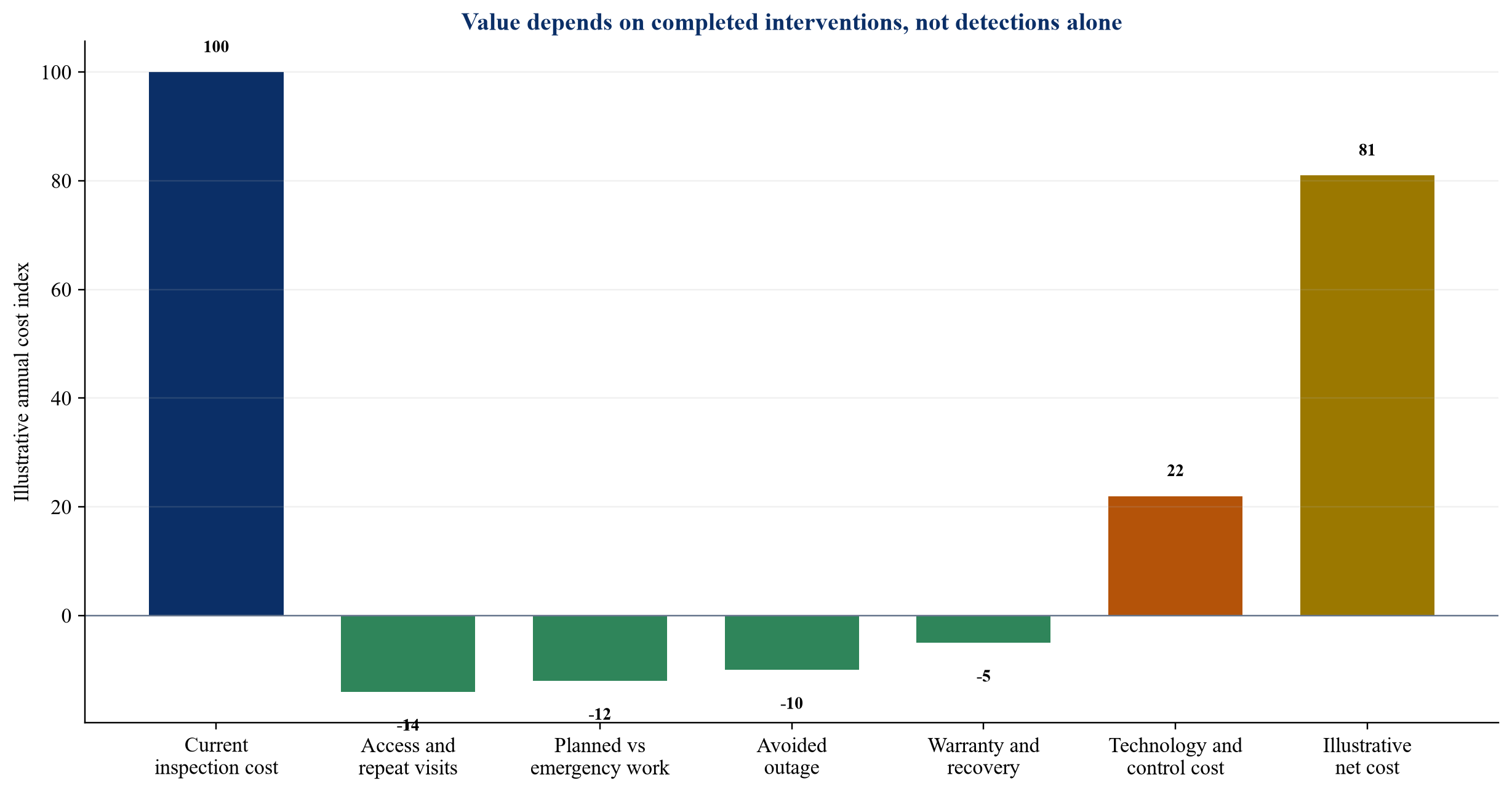
Values are hypothetical author-developed assumptions in index points. They illustrate the method and are not forecasts, quotations or client results.
The bridge begins with an annual cost index of 100. Hypothetical improvements reduce access and repeat-visit cost, shift work from emergency to planned execution, reduce outage and improve recoveries. Technology, review and control costs add 22 points, producing an illustrative net cost of 81.
The example does not assume that every detection creates value. Benefits should be recognised only when the workflow records the relevant decision and outcome. Management should present gross benefit, programme cost, implementation cost and residual risk separately.
For financing purposes, lenders may exclude unproven benefit from the base case while recognising contracted cost reductions after evidence accumulates. Equity investors can model upside with probability and delay. A staged deployment helps convert uncertainty into operating evidence.
23 Link inspection evidence to capital planning
Condition evidence should affect the capital plan through a transparent rule. Assets with high consequence and deteriorating condition may move forward. Low-consequence assets with stable evidence may remain under monitoring. The rule should avoid replacing engineering judgment with a single score.
Portfolio optimisation can compare intervention cost, expected deterioration, outage window, access mobilisation and system criticality. Evidence quality should be visible. A high-priority recommendation based on weak coverage should trigger further inspection rather than automatic capital commitment.
Boards should see how the programme changes deferred maintenance and risk. A falling number of open alerts can be misleading if inspection coverage also falls. Reporting should combine coverage, validated defects, overdue dispositions, overdue interventions and residual exposure.
24 Use the evidence in transactions and valuation
Digital inspection history can improve acquisition diligence by making condition trends and intervention records accessible. Buyers should still test provenance, coverage, model version, reviewer competence and selection bias. A seller may have inspected only accessible or well-performing assets.
Valuation should reflect cash-flow consequences. Better evidence can change maintenance forecasts, outage assumptions, useful life, decommissioning cost, warranty recovery and risk premium. It does not create an automatic valuation uplift. The adjustment should be tied to a supportable change in expected cash flow or uncertainty.
Transaction documents can address known defects, data rights, model access, warranties, indemnities and post-close cooperation. The buyer should secure continued access to evidence and software or have a transition plan. Proprietary dependency can reduce the value of the historical record.
25 Make the system financeable
Lenders focus on availability, operating cost, major maintenance, insurance, compliance and continuity. The inspection programme can support these areas when evidence is reliable and integrated. It can also create new dependencies on operators, software, communications and data providers.
Financing diligence should examine whether inspections required by law, concession, insurance or contract remain compliant. It should test continuity if the technology provider fails. The borrower should retain an approved fallback method and sufficient budget to use it.
Covenants should avoid vague obligations to use artificial intelligence. Useful requirements concern inspection coverage, statutory compliance, critical-defect escalation, remediation funding, evidence retention and reporting. A lender should receive concise condition and action information rather than unrestricted access to security-sensitive raw data.
26 Address insurance and liability
Liability can arise from flight operations, privacy, property damage, professional judgment, defective technology, missed defects, false shutdowns, cyber incidents and contractual breach. The allocation should follow control and applicable law. A model vendor cannot control a maintenance backlog; an owner should not accept responsibility for undisclosed software defects.
Contracts should define intended use, excluded conclusions, performance testing, data rights, incident notice, audit, change control, service continuity, insurance and indemnities. Liability caps should be reviewed against plausible loss pathways. Professional and aviation requirements may require separate treatment.
Insurers may value improved evidence while requiring proof of governance. Owners should agree how inspection records can support claims without creating inaccurate representations. Material alerts should follow established notification duties.
27 Protect critical-infrastructure data
Images, thermal maps and three-dimensional models can reveal asset layout, condition and vulnerabilities. Security classification should occur before capture and cloud upload. The architecture should minimise collection, restrict access, encrypt data, log use and define retention.
Devices and software introduce supply-chain risk. Owners should assess firmware, updates, communications, storage location, subcontractors and remote access. Operational technology should remain segmented. Models should not receive unrestricted credentials or network access.
Privacy rules may apply when cameras capture workers, vehicles, neighbouring property or public areas. Flight and capture plans should incorporate lawful basis, notices, masking and retention where required. Security and privacy controls belong in the inspection design rather than a later policy document.
28 Govern artificial intelligence risk
The NIST AI Risk Management Framework organises risk activity around govern, map, measure and manage. For infrastructure inspection, governance should define accountable roles and approved use; mapping should identify asset, people and system consequences; measurement should test validity, reliability, safety, security and context; management should set thresholds, controls and response.
The European Union AI Act may classify some systems used as safety components in critical infrastructure as high risk, depending on purpose and application. Applicable legal analysis should consider the actual use, jurisdiction and implementation timetable. Technical documentation, logs, data governance, human oversight and monitoring are commercially sensible even where a specific legal classification does not apply.
AI governance should connect to asset-management and engineering governance. A separate AI committee cannot approve a bridge conclusion or electrical isolation. The operating function retains responsibility for the asset decision.
29 Monitor model and workflow drift
Changes in cameras, weather, coatings, asset vendors, maintenance practices and defect prevalence can alter performance. Drift monitoring should cover inputs, detections, reviewer outcomes and downstream decisions. A stable model metric can conceal a deteriorating workflow when review or repair capacity changes.
Thresholds should trigger investigation, reduced authority, increased sampling or retraining. Material model, preprocessing or ontology changes should pass controlled validation. Automatic vendor updates should not enter a high-consequence workflow without assessment.
The owner should maintain a representative benchmark set and recent field sample. Performance should be segmented. Periodic physical inspection can test whether the digital programme is missing systematic classes of defect.
30 Procure outcomes and evidence
Procurement should specify scope, coverage, decision latency, evidence quality, integration and exit. Model accuracy remains one acceptance measure. The contract should also address mission completion, unprocessable evidence, false-negative testing, review service levels, work-order integration and export.
Pricing can combine mobilisation, area or asset coverage, data service and validated workflow. Outcome-based fees require care because the provider may not control maintenance execution or failure incidence. Incentives should avoid encouraging excessive alerts or unsupported benefit claims.
The owner should retain audit rights, test data, change notice, incident cooperation and transition assistance. Subcontractors and cloud providers should be visible. Termination should preserve the usable inspection history.
31 Stage deployment through evidence gates
A first stage should establish the asset hierarchy, decision use case, baseline cost and ground-truth protocol. A pilot can then compare digital and established inspection on a representative sample. The sample should include difficult conditions and relevant defects.
The second stage should run in parallel, with model outputs reviewed and downstream decisions recorded. The third can integrate work orders and extend coverage after performance and capacity gates pass. The fourth can support financing or transaction reporting after a sufficient operating history exists.
Scale gates should include coverage, consequence-weighted recall, false-alarm burden, review time, intervention completion, cyber controls and evidence export. Failure should lead to remediation or a narrower scope. A pilot should not become permanent shadow infrastructure without a decision.
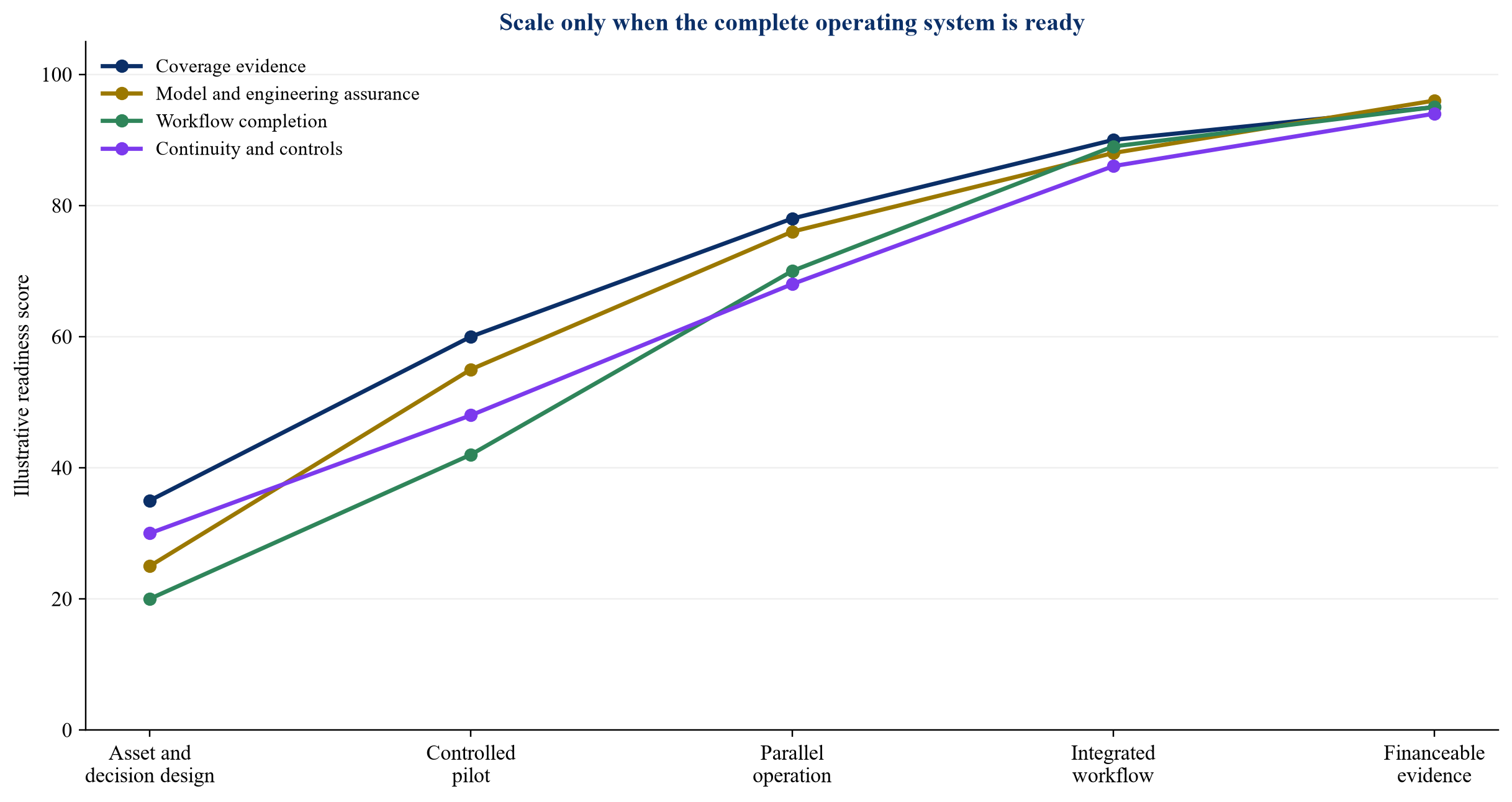
Scores are hypothetical author-developed values on a 0 to 100 scale. They show the evidence expected before progression and are not performance claims.
32 Set explicit stop conditions
Operations should stop or revert when critical sensors are out of calibration, coverage falls below the approved threshold, data lineage breaks, model performance deteriorates, cyber integrity is uncertain, competent review is unavailable or the system produces an unexplained cluster of alerts.
The fallback may be manual inspection, an alternative sensor or a reduced operating scope. It should be budgeted and exercised. A fallback that requires unavailable people or equipment is not credible.
Incident procedures should preserve evidence, stabilise the asset, notify required parties and prevent uncontrolled model changes. Restart should require named approval and documented remediation.
33 Give boards a decision-quality dashboard
Board reporting should connect inspection activity to exposure and action. Useful measures include portfolio coverage, high-consequence areas uninspected, validated critical defects, time to disposition, overdue intervention, recurring patterns, programme cost, verified benefit and significant incidents.
Accuracy should be reported with context and consequence. A single percentage can mislead. The board should see critical false negatives found through audit, false alarms causing material action, performance by asset class and the confidence range around value.
Management should also report dependencies: aviation permissions, specialist capacity, technology concentration, data rights, cyber posture and fallback readiness. These determine whether the programme can operate through stress.
34 Provide lenders and investors with a focused diligence pack
Table 3. Inspection-system diligence pack
| Diligence area | Evidence requested | Principal question | Red flag |
|---|---|---|---|
| Scope and coverage | Asset hierarchy, mission plan and gap report | Does the programme inspect the risk it claims to cover? | Difficult or critical locations systematically absent |
| Model performance | Segmented validation and field-audit results | Are errors measured by consequence and operating context? | Portfolio average with no severe-defect analysis |
| Engineering control | Competence matrix, dispositions and escalation | Who accepts the condition conclusion and action? | Model output treated as final engineering sign-off |
| Workflow execution | Work-order linkage and closure evidence | Do alerts result in timely intervention? | Growing unvalidated or unremediated backlog |
| Data and cyber | Lineage, access, architecture and incident tests | Can evidence be trusted and protected? | Missing originals, uncontrolled devices or vendor lock-in |
| Economics | Baseline, attribution and realised outcomes | Which cash-flow assumptions are proven? | Detection counts presented as savings |
| Continuity | Exit plan, exports and fallback inspection | Can the asset comply if the service fails? | No usable data export or manual capacity |
The table is an author-developed checklist and does not replace technical, legal, regulatory, insurance or financial advice.
The pack should be proportionate to asset consequence. A small non-critical use case may require a short control set. A safety-critical or covenant-linked programme requires independent technical review and deeper evidence.
Investors should reconcile the diligence pack with site visits, engineering reports, maintenance systems and financial models. Conflicts should be investigated. Digital volume does not establish truth when collection or classification is weak.
35 Convert inspection capability into durable value
Durable value arises from better decisions and institutional learning. Repeated evidence can improve deterioration models, maintenance planning, procurement specifications and warranty strategy. It can reveal portfolio patterns that individual site teams cannot see.
The data asset requires stewardship. Taxonomy, provenance, rights, security and interoperability determine whether history remains usable. Owners should avoid allowing each new vendor to create a disconnected inspection archive.
The strongest commercial position combines technology with engineering and operating discipline. Computer vision can extend scarce expertise and direct it. The owner still needs people, maintenance capacity, capital and accountability to act.
Conclusion
Computer vision can improve infrastructure inspection by increasing coverage, repeatability and speed. Its value is realised through a complete evidence chain. Capture must be fit for purpose; detection must be validated; engineering significance must be assigned; intervention must occur; and the operational or financial consequence must be measured.
The Defect-to-Cash Framework gives owners, operators, lenders and investors a way to underwrite that chain. It separates detection from inspection, makes coverage visible, weights errors by consequence, preserves competent sign-off, integrates work orders and connects evidence to capital planning, financing and valuation.
Deployment should progress through evidence gates. Drones and satellites can supplement established methods. Multimodal data can improve confidence. Artificial intelligence can prioritise large volumes of evidence. Safety-critical conclusions and statutory obligations remain governed by applicable engineering standards, qualified people and public authorities. The investable system is the complete operating workflow, supported by durable evidence and a tested fallback.
References
- Federal Highway Administration, Collection of Data with Unmanned Aerial Systems for Bridge Inspection and Construction Inspection, FHWA-HRT-21-086, 2021. https://www.fhwa.dot.gov/publications/research/infrastructure/structures/bridge/21086/21086.pdf
- Federal Highway Administration, National Bridge Inspection Standards: UAS and drones in bridge inspection, updated 2023. https://www.fhwa.dot.gov/bridge/nbis2022/qanda/08.cfm
- Federal Highway Administration, National Bridge Inspection Standards, 23 CFR Part 650. https://www.fhwa.dot.gov/bridge/nbis.cfm
- Federal Aviation Administration, Small Unmanned Aircraft Systems Regulations Part 107, updated 2026. https://www.faa.gov/newsroom/small-unmanned-aircraft-systems-uas-regulations-part-107
- Federal Aviation Administration, Part 107 Waivers. https://www.faa.gov/uas/commercial_operators/part_107_waivers
- Federal Aviation Administration, Drone Integration Concept of Operations, 2025. https://www.faa.gov/uas/resources/policy_library/Drone-Integration-Concept-of-Operations-May-2025.pdf
- International Energy Agency, Modernising Grids in the Age of Electricity: Monitoring and control systems, 2026. https://www.iea.org/reports/modernising-grids-in-the-age-of-electricity/monitoring-and-control-systems
- International Energy Agency, Electricity Grids and Secure Energy Transitions, 2023. https://www.iea.org/reports/electricity-grids-and-secure-energy-transitions
- European Space Agency, Monitoring Earth's shifting land, 2019. https://www.esa.int/Applications/Observing_the_Earth/Copernicus/Sentinel-1/Monitoring_Earth_s_shifting_land
- European Space Agency, Sentinel-1 Emergency response. https://www.esa.int/Applications/Observing_the_Earth/Copernicus/Sentinel-1/Emergency_response
- European Space Agency, Copernicus Sentinel-1 mission. https://www.esa.int/Applications/Observing_the_Earth/Copernicus/Sentinel-1
- European Commission, Copernicus Land Monitoring Service. https://land.copernicus.eu/
- World Bank, Transport Infrastructure Asset Management for Climate Resilience and Road Safety, 2022. https://documents1.worldbank.org/curated/en/099630105062225369/pdf/P1568780c3f15a0d60955c0aafb2cdf6cb4.pdf
- World Bank, Road Asset Management Systems and Performance-Based Road Maintenance Contracts. https://www.worldbank.org/en/topic/transport
- International Finance Corporation, Utility-Scale Solar Photovoltaic Power Plants: A Project Developer's Guide, 2015. https://www.ifc.org/en/insights-reports/2015/utility-scale-solar-photovoltaic-power-plants
- National Institute of Standards and Technology, Artificial Intelligence Risk Management Framework 1.0, 2023. https://nvlpubs.nist.gov/nistpubs/ai/NIST.AI.100-1.pdf
- National Institute of Standards and Technology, AI RMF Playbook. https://airc.nist.gov/AI_RMF_Knowledge_Base/Playbook
- National Institute of Standards and Technology, Concept Note: AI RMF Profile on Trustworthy AI in Critical Infrastructure, 2026. https://www.nist.gov/programs-projects/concept-note-ai-rmf-profile-trustworthy-ai-critical-infrastructure
- National Institute of Standards and Technology, Cybersecurity Framework 2.0, 2024. https://www.nist.gov/cyberframework
- Cybersecurity and Infrastructure Security Agency, Industrial Control Systems. https://www.cisa.gov/topics/industrial-control-systems
- Cybersecurity and Infrastructure Security Agency, Secure by Design. https://www.cisa.gov/securebydesign
- European Union, Regulation EU 2024/1689 laying down harmonised rules on artificial intelligence. https://eur-lex.europa.eu/eli/reg/2024/1689/oj
- European Union Agency for Cybersecurity, Cybersecurity for smart infrastructures. https://www.enisa.europa.eu/topics/critical-information-infrastructures-and-services
- International Organization for Standardization, ISO 55000 Asset management. https://www.iso.org/standard/83053.html
- International Organization for Standardization, ISO 31000 Risk management. https://www.iso.org/iso-31000-risk-management.html
- International Organization for Standardization, ISO IEC 42001 Artificial intelligence management systems. https://www.iso.org/standard/81230.html
- International Electrotechnical Commission, Asset management and condition monitoring standards. https://www.iec.ch/
- Institute of Electrical and Electronics Engineers, IEEE Guide for Electric Power Distribution Reliability Indices. https://standards.ieee.org/
- American Society of Civil Engineers, 2025 Report Card for America's Infrastructure. https://infrastructurereportcard.org/
- United States Geological Survey, Landsat Missions. https://www.usgs.gov/landsat-missions
- National Aeronautics and Space Administration, Earthdata Remote Sensing Data. https://www.earthdata.nasa.gov/
- European Union Aviation Safety Agency, Civil drones regulatory framework. https://www.easa.europa.eu/en/domains/civil-drones-rpas
- United Kingdom Civil Aviation Authority, Commercial drone operations. https://www.caa.co.uk/drones/
- United Kingdom Department for Transport, Code of Practice for the Cyber Security of Commercial Maritime Autonomous Surface Ships and Workboats. https://www.gov.uk/government/publications/maritime-autonomous-surface-ships-cyber-security-code-of-practice
- Organisation for Economic Co-operation and Development, OECD AI Principles. https://oecd.ai/en/ai-principles
- Basel Committee on Banking Supervision, Principles for Operational Resilience, 2021. https://www.bis.org/bcbs/publ/d516.htm
- Global Infrastructure Hub, Infrastructure Risk Allocation. https://www.gihub.org/resources/publications/infrastructure-risk-allocation-contract-management-report/
- World Bank, Guidance on PPP Contractual Provisions. https://ppp.worldbank.org/public-private-partnership/library/guidance-ppp-contractual-provisions
About the Author
Chennakeshav (CK) is a corporate finance and investment banking executive with 25+ years of global experience in deal origination, structuring and execution across M&A, growth capital and corporate strategy. He has led value-creation mandates for founders, corporates and funds — bridging the boardroom view to hands-on execution and close.
His career spans Morgan Stanley, HSBC, Lloyds Banking Group, EWEC, ADQ portfolio companies and Emirates Growth Fund, across TMT, real estate, fintech, deeptech, cleantech, infrastructure and energy. He has partnered with C-suite leaders, private equity and venture funds, sovereign wealth funds and family offices to finance complex fund raises and scale-up ventures, and has led M&A due diligence, post-merger integration and business-transformation initiatives to create value.
At Matchpoint Partners he is Managing Partner, leading the firm's corporate finance, M&A and capital-raising practice. He holds an MBA from London Business School, an engineering degree from VTU and a Master of Laws (LLM, in progress) from UCL London.
An active start-up mentor, CK mentors at Techstars, DIFC FinTech Hive, Startup Grind, Founder Institute and IN5, serves as Entrepreneur Mentor in Residence (EMiR) at London Business School, and judges the Entrepreneurship World Cup.
