

1. Origination is an evidence chain
An origination engine should answer a sequence of accountable questions. What transaction problem might exist? Which dated evidence supports that view? Which legal entity and decision maker are relevant? Why does the problem matter now? What advisory intervention could create value? Which facts remain unknown? Who approves contact? What happened after contact? The engine has value when those questions remain connected from the first signal to the commercial outcome.
A conventional list begins with company names and adds attributes. A governed engine begins with a thesis. The thesis states the transaction type, strategic pressure, observable trigger, economic mechanism, likely decision owner and disqualifying evidence. A target enters the system because new information increases the probability that the thesis applies. Company size, sector or geography alone does not establish need.
The system should retain source, publication time, retrieval time, entity, event date, excerpt, licence, analyst interpretation, confidence and review status. The evidence record should distinguish a source fact from an analytical conclusion. A filing, ownership record or regulatory notice can establish an event. The proposition that the event creates an M&A need remains a professional hypothesis until management confirms it.
An accountable chain also creates a stopping rule. A record should leave the queue when the entity cannot be resolved, the signal is stale, the strategic mechanism is absent, the apparent need is already addressed, the contact basis is unacceptable, a conflict exists or the expected advisory value cannot justify further work. Suppression is a productive outcome because it protects senior time and institutional reputation.
Table 1. Evidence hierarchy for an AI-enabled origination engine
| Evidence tier | Illustrative source | Appropriate use | Required control |
|---|---|---|---|
| primary regulatory and corporate record | filing, registry, court record, official tender or company announcement | establish entity, event, ownership, financial or legal fact | retrieve date, immutable citation and entity match |
| contractual or client-authorised record | mandate material, data room, management information or approved CRM note | validate need, authority, timing and transaction readiness | access control, confidentiality and purpose limitation |
| licensed market data | ownership, pricing, transaction, credit or people database | screen, compare and enrich | licence scope, provenance and refresh date |
| reputable reported source | established news or specialist publication | identify event and context | corroboration, publication date and quotation discipline |
| professional relationship evidence | verified meeting, referral or prior engagement | assess access and relationship path | consent, note ownership and conflict check |
| open-web or social signal | website change, job advert, post, forum or event appearance | generate a hypothesis | corroborate before scoring as fact |
| model-generated output | classification, summary, ranking or draft | accelerate analysis | human review, source link and no unsupported factual elevation |
Source rights, jurisdiction and transaction context require case-specific review.
2. Define the buyer problem before collecting signals
The origination brief should describe one decision that a board, shareholder, investor or lender may need to make. Examples include acquiring capability, selling a non-core asset, preparing a founder transition, financing consolidation, reviewing strategic alternatives, resolving a capital structure, finding a partner or protecting value during a market disruption. The brief should state the value at stake and the evidence that would make the decision timely.
A useful hypothesis is falsifiable. A thesis that every company in a growing sector may need M&A advice cannot rank attention. A stronger thesis may state that founder-controlled software businesses with repeated senior hiring, international channel investment and a material product adjacency could face a build-versus-buy decision within a defined planning period. The research task then tests ownership, investment pattern, adjacency, capability gap and decision access.
The brief should also identify who can buy the service. The economic buyer may be a chief executive, shareholder, board, chief financial officer, corporate-development lead, general partner, family-office principal, lender or special committee. A person with interest but without authority or budget may still provide information; the conversation should not be counted as qualified until authority and an executable route are understood.
Service design belongs in the thesis. If the observed problem requires a rapid strategic-options review, a full sell-side process may be premature. A diagnostic retainer, valuation review, target-screening sprint, financing options paper or board workshop can create a proportionate first engagement. Origination improves when the service entry point matches the buyer's current decision.
3. Build a signal taxonomy tied to decisions
Signals should be organised by the decision they can affect. Structural signals include market fragmentation, supply-chain concentration, new regulation, technology substitution, capital scarcity or shifting trade corridors. Financial signals include refinancing pressure, cash accumulation, margin compression, impairment, covenant pressure, valuation dispersion or public-market discount. Strategic signals include new geography, portfolio simplification, vertical integration, capability gaps or competitor combinations.
Ownership signals include founder succession, shareholder concentration, sponsor hold period, fund maturity, estate planning, activist position or strategic investor change. Operating signals include executive hiring, plant closure, capacity expansion, product withdrawal, customer loss, channel investment or a change in research intensity. Event signals include earnings, filings, financing, litigation, tender awards, licence changes and announced transactions. Relationship signals include a verified referral, prior meeting, adviser connection or credible shared network.
Signals should be directional rather than conclusive. A chief financial officer appointment can support growth, remediation, public-market preparation or succession. A debt maturity can create refinancing work and still have no M&A implication. The engine should combine independent signals into a mechanism and record competing explanations.
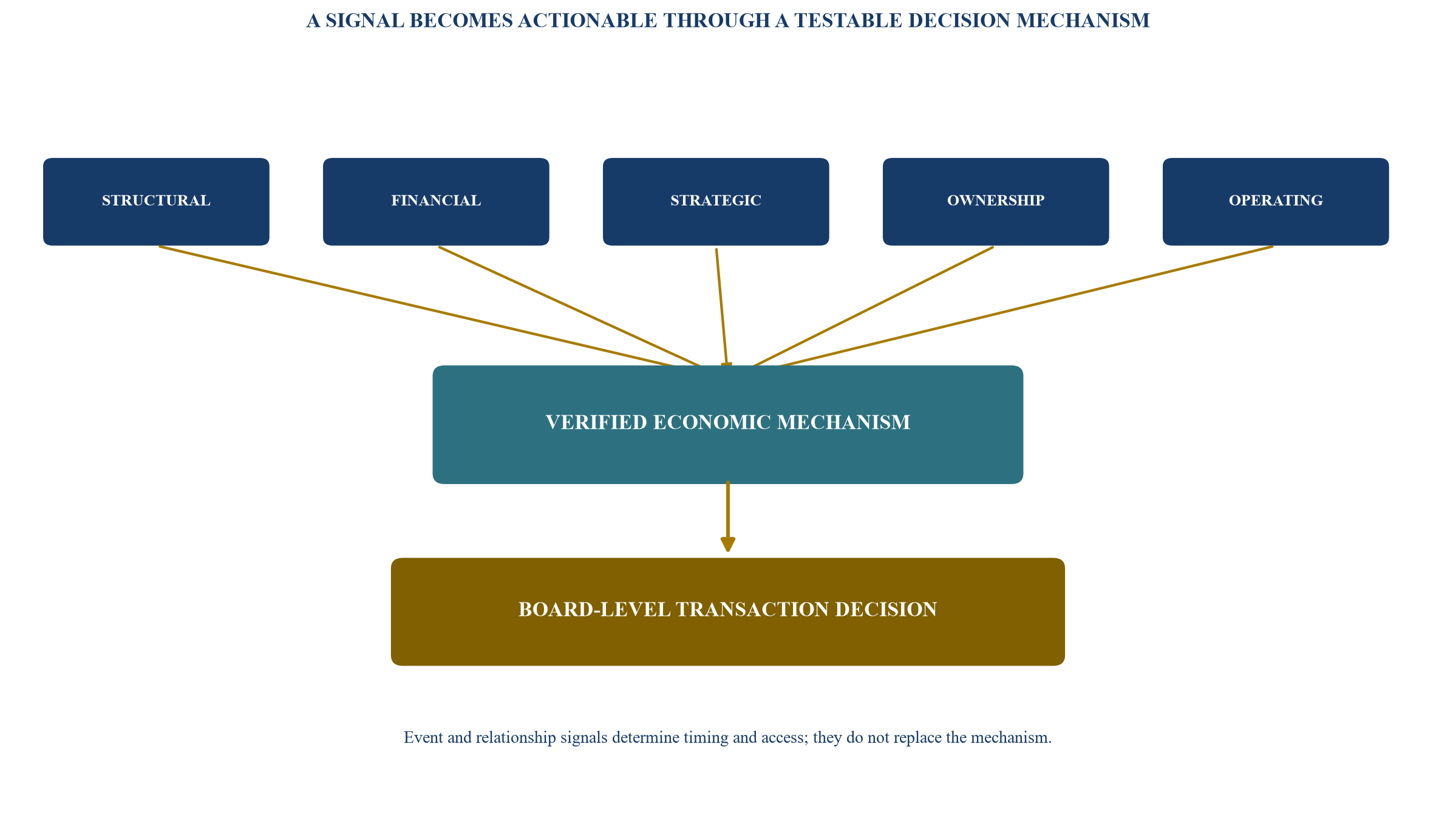
Signals support a hypothesis only when they connect through an economic mechanism to an identifiable decision.
Table 2. Signal classes, questions and disqualifiers
| Signal class | Decision question | Corroborating evidence | Common disqualifier |
|---|---|---|---|
| structural | has the market changed the value of scale, scope or ownership? | regulation, capacity, market shares and transaction evidence | trend lacks company-specific consequence |
| financial | does the balance sheet create strategic urgency or capacity? | filings, maturities, cash flow and lender evidence | liquidity or covenant interpretation is unsupported |
| strategic | is management entering, exiting or defending a position? | announcements, investment, products and resource allocation | activity is ordinary execution of an existing plan |
| ownership | is control, time horizon or succession changing? | registry, fund life, public statement and authorised dialogue | ownership inference cannot be verified |
| operating | does execution reveal a capability gap or stranded asset? | hiring, capacity, customers, margins and asset utilisation | indicator is temporary or immaterial |
| event | has a dated occurrence created a decision window? | official notice, filing, award, transaction or financing | event is stale, completed or already advised |
| relationship | is there a credible and permissioned access route? | referral, prior engagement, shared adviser or event | relationship is assumed or contact is restricted |
A single signal rarely supports outreach without corroboration.
4. Resolve companies into legal entities and ownership
Names are weak identifiers. A brand can represent several legal entities, operating subsidiaries, holding companies and jurisdictions. Similar names can belong to unrelated businesses. A target record should include legal name, registration number, jurisdiction, status, registered address, trading names, parent, ultimate parent, material subsidiaries, website and verified identifiers.
The SEC's data APIs provide JSON submissions history and extracted XBRL data without an API key, updated throughout the day as submissions are disseminated.[1] Companies House provides live, real-time public company information through its API.[2] GLEIF provides full-text and single-field searches, fuzzy matching and access to legal-entity and ownership data, including parent and child relationships where available.[3] These sources can strengthen identity resolution, though coverage and legal meaning differ.
Ownership should not be inferred from a similar address, director name or website. Corporate groups can include minority interests, joint ventures, nominee arrangements and entities whose accounting parent differs from their legal controller. FATF guidance emphasises adequate, accurate and up-to-date beneficial-ownership information and the distinction between legal and beneficial ownership.[4]
Entity resolution needs confidence and exceptions. Exact registration or LEI matches can receive high confidence. Name-and-address matches may require analyst review. Unresolved parentage, dissolved entities, conflicting identifiers and recent reorganisations should block automatic advancement.
5. Create an evidence-weighted target scorecard
Scoring should allocate scarce research and senior attention. It should not produce a claim that a target will transact. The score should measure how strongly current evidence supports a timely, valuable and accessible advisory problem.
Six dimensions are useful. Strategic relevance tests the fit between the observed situation and the advisory thesis. Evidence quality tests provenance, recency, independence and entity match. Economic stakes estimate whether the decision can affect enterprise value, liquidity, control or strategic position. Timing tests whether a board-level window is open. Access tests whether a credible, permissioned path exists. Execution readiness tests management bandwidth, data, governance and financing feasibility.
Weights should be thesis-specific and approved. A distressed situation may emphasise timing and solvability. A proprietary buy-side programme may emphasise strategic fit and access. Missing sanctions, conflicts or contact-law clearance should remain a hard gate rather than a score that other dimensions can offset.
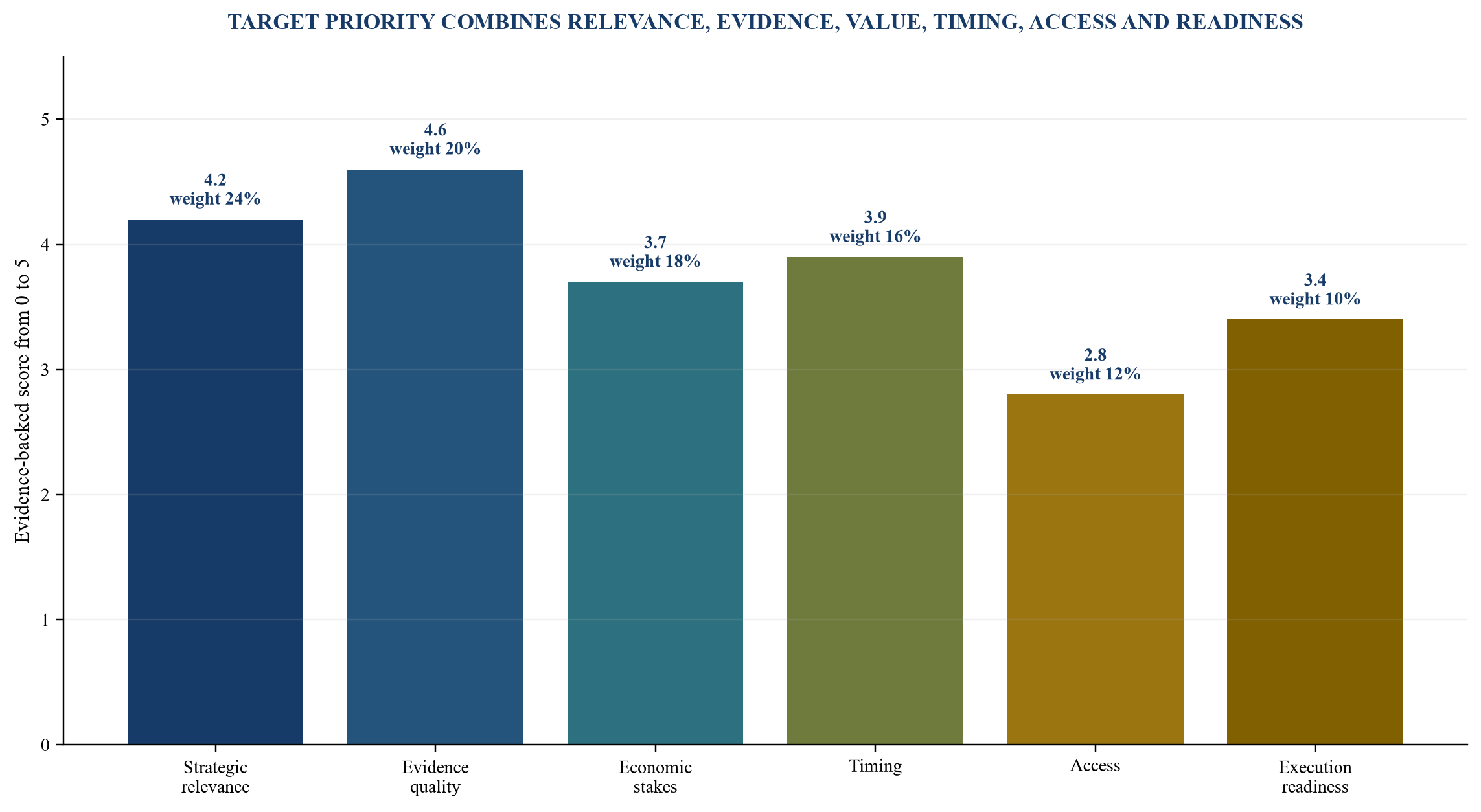
The illustrative weights are hypothetical management assumptions and should be recalibrated using observed outcomes.
Table 3. Illustrative target-scorecard design
| Dimension | Illustrative weight | Evidence question | Score-zero condition |
|---|---|---|---|
| strategic relevance | 24% | does the verified situation fit a specific transaction thesis? | only sector or size fit exists |
| evidence quality | 20% | are facts current, primary, independently corroborated and entity-matched? | identity or critical fact is unresolved |
| economic stakes | 18% | can the decision materially affect value, cash, control or resilience? | value mechanism is absent |
| timing | 16% | is a decision window observable and still open? | event is stale or completed |
| access | 12% | is there a credible, lawful and permissioned route to the decision owner? | contact basis is unacceptable |
| execution readiness | 10% | could the company govern, finance and execute an engagement or transaction? | known barrier makes action infeasible |
All weights and thresholds are hypothetical management assumptions for method demonstration.
6. Use confidence separately from priority
A target can be strategically attractive and weakly evidenced. Another can have excellent evidence and modest advisory value. Combining those ideas in one number hides the difference. The system should store priority and confidence separately.
Confidence should reflect source quality, entity resolution, corroboration, recency and interpretive ambiguity. A high-priority, low-confidence record deserves additional research rather than immediate outreach. A low-priority, high-confidence record may remain monitored. A high-priority, high-confidence record can enter human approval. A low-priority, low-confidence record should normally be suppressed.
The engine should show the contribution of each signal and the evidence that would change the result. Analysts should be able to remove a stale event, correct an entity or challenge an interpretation. Version history matters because a later outcome should be compared with the information available at the time of the decision.
Model output should not create artificial certainty. A classifier can suggest that a filing relates to portfolio simplification. The evidence capsule should link to the filing, quote the relevant passage within permitted limits and record the analyst's interpretation. Confidence increases through corroboration and professional review.
7. Produce a research capsule before outreach
The research capsule should be short enough for an executive to review and complete enough to support a decision. It should state the legal entity, ownership, verified situation, dated signals, transaction hypothesis, value mechanism, likely decision owners, existing advisers if known, relevant service, conflicts status, contact basis, uncertainties and recommended next step.
The capsule should include a counter-thesis. If the company is expanding capacity, the M&A hypothesis may be acquisition of a scarce capability. The counter-thesis may be that management has already chosen organic investment and has no appetite for a transaction. The outreach question can then test the decision rather than assert a need.
The capsule should avoid sensitive personal profiling, scraped private content and unnecessary personal data. Business role, official contact channel and public professional statements may be relevant. Personal circumstances, protected characteristics and unrelated behaviour should remain outside the record.
An analyst should sign the capsule and an accountable senior professional should approve it. The approval should be dated. If the signal changes, the capsule should be refreshed rather than silently overwritten.
8. Put human approval gates around AI
NIST's AI Risk Management Framework organises risk work through Govern, Map, Measure and Manage, and its Playbook provides voluntary suggested actions for those functions.[5][6] An origination engine can translate this structure into operational gates.
Govern defines purpose, ownership, acceptable sources, prohibited use, review authority, record retention and escalation. Map identifies stakeholders, jurisdictions, data flows, harms, failure modes and context. Measure tests entity accuracy, extraction, ranking, bias, false positives, drift, security and downstream outcomes. Manage determines whether deployment should proceed, which risks require treatment and when a model or workflow should be restricted.
Human approval should cover six decisions: identity, evidence, relevance, compliance, message and channel. Identity confirms the legal entity and person. Evidence confirms that the capsule accurately represents sources. Relevance confirms a credible buyer problem and service response. Compliance confirms conflicts, privacy, marketing law, sanctions and local requirements. Message approval confirms accuracy and tone. Channel approval confirms that the selected route is permissioned and appropriate.
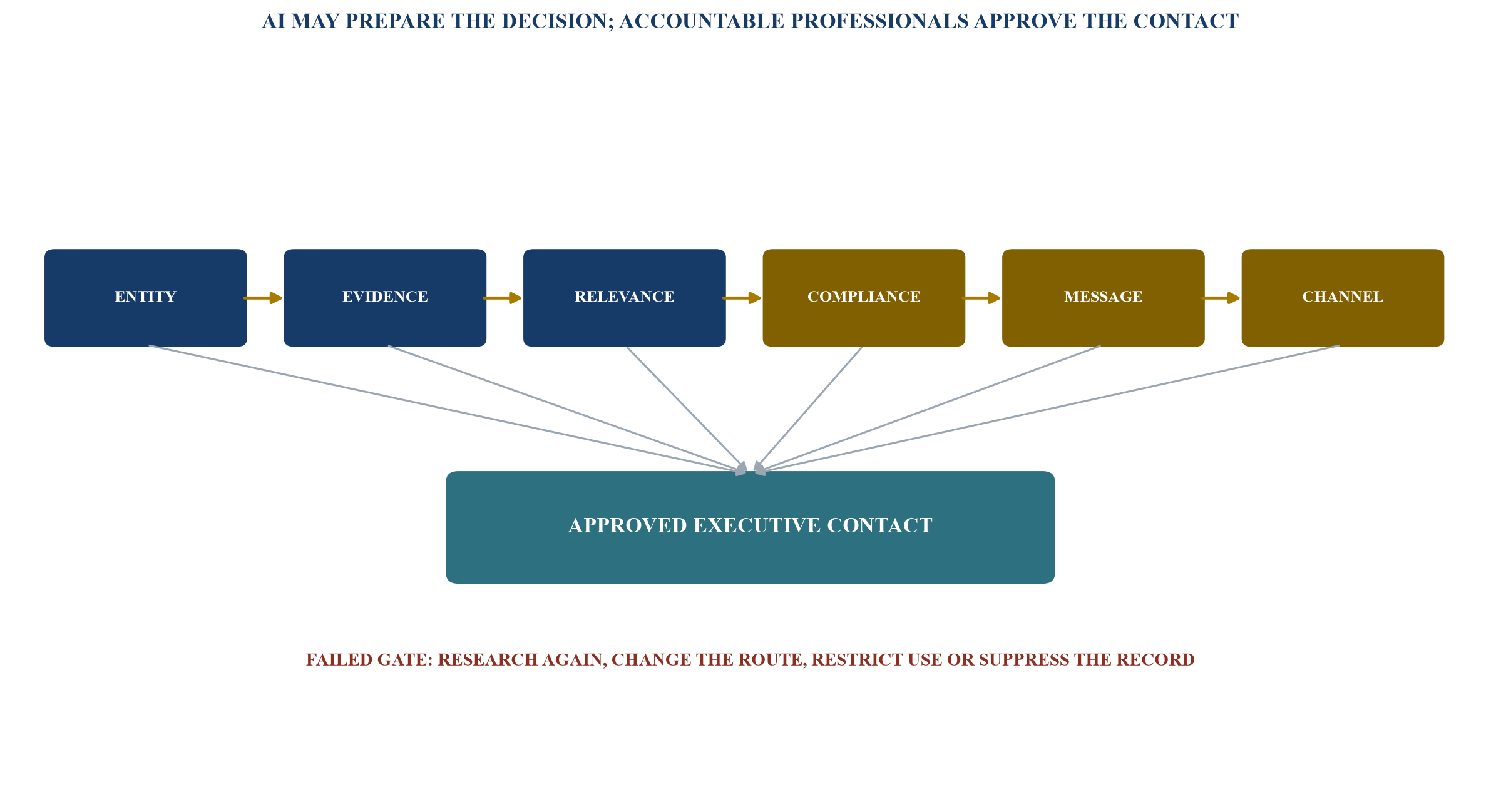
Any failed gate returns the record for research, restriction or suppression.
Table 4. Human-approval and compliance controls
| Gate | Required evidence | Approver | Stop condition |
|---|---|---|---|
| entity and ownership | registry identifiers, status, group and beneficial-ownership assessment | research lead | identity or control unresolved |
| evidence and interpretation | dated sources, provenance, extracts, counter-thesis and confidence | sector or transaction specialist | material claim unsupported or stale |
| commercial relevance | buyer problem, value mechanism, service path and decision owner | responsible partner | generic proposition or no economic stake |
| conflicts, sanctions and privacy | conflicts search, current screening, lawful basis and data minimisation | compliance or authorised delegate | hit, uncertainty or prohibited use |
| message | accurate, proportionate content with no confidential or misleading claim | responsible partner | assertion exceeds evidence or approval scope |
| channel and timing | permission, suppression list, local rules and appropriate route | campaign owner | opt-out, restricted channel or excessive frequency |
Legal advice is required for each jurisdiction, channel, data source and campaign design.
9. Treat compliance as workflow design
Electronic outreach rules vary by jurisdiction, recipient type, channel and purpose. The ICO explains that UK business-to-business marketing can engage both the Privacy and Electronic Communications Regulations and data-protection law. Where consent is not required under the applicable PECR rule, legitimate interests may be relevant only after purpose, necessity and balancing assessments.[7][9] Corporate subscribers, sole traders and some partnerships can be treated differently. Current legal advice should determine the route.
The FTC states that the US CAN-SPAM Act covers commercial messages, including business-to-business email. It requires accurate headers, non-deceptive subject lines, identification, a valid postal address, a clear opt-out method and timely honouring of opt-outs.[8] Outsourcing delivery does not remove responsibility.
The engine should store jurisdiction, recipient type, purpose, source of contact details, lawful-basis assessment, notice status, suppression status, prior contact and channel permission. A central suppression list should override a model recommendation. Message frequency should reflect relevance and relationship context, with legal and reputational limits documented.
Compliance should also cover anti-bribery, market abuse, confidentiality, competition, professional conduct and data licences. A model should not transform material non-public information, confidential client data or improperly obtained records into an outreach advantage.
10. Screen sanctions, ownership and conflicts before contact
Sanctions screening should use current official or appropriately licensed data and qualified review. OFAC's search tool uses fuzzy logic across the Specially Designated Nationals list and consolidated non-SDN lists.[10] A fuzzy match is an alert, not a conclusion. Name, address, nationality, date of birth, identifiers, ownership and control require review.
Ownership matters because a target may be controlled through a parent, intermediary or beneficial owner. FATF guidance supports access to adequate, accurate and up-to-date information on true owners.[4] The origination record should state which ownership evidence was available and which questions remain open.
Conflicts screening should cover the legal entity, group, shareholders, counterparties, known advisers, lenders and relevant individuals. A prior or current engagement can restrict contact, information use or service scope. The system should show clearance status without exposing unrelated confidential matters.
Screening should be repeated before substantive engagement and transaction acceptance. Lists, ownership and relationships change. A prior clearance should not be treated as permanent.
11. Design the outreach around a decision question
The first message should demonstrate relevance through a concise verified observation and a useful question. It should not reveal an intrusive research process, imply access to confidential information or manufacture urgency. The purpose is to earn a conversation about a decision.
A strong structure has four parts. First, identify the public or permissioned context. Second, state the strategic mechanism in careful language. Third, offer one relevant analytical contribution. Fourth, ask a proportionate question or propose a short discussion. The message should contain enough specificity to distinguish it from mass marketing.
The engine can draft variants by role. A chief executive may care about strategic control and speed. A chief financial officer may care about funding, leverage and valuation. A shareholder may care about liquidity, succession and process risk. The factual core should remain consistent.
Human review should remove jargon, unsupported personalisation and excessive detail. A referral or warm introduction should be used according to the referrer's permission. Public contact channels can be appropriate when the legal and professional basis is clear.
12. Convert interest into a qualified conversation
A positive reply is not yet a qualified opportunity. Qualification should establish a real decision, economic stakes, authority, timing, readiness and willingness to procure advice. The conversation should also identify constraints and the smallest valuable next engagement.
The adviser should test what changed, which decision is unresolved, who owns it, what happens if no action is taken, what evidence exists, what governance is required, which advisers are involved and how a mandate would be approved. The discussion should respect confidentiality and avoid requesting sensitive information before engagement terms and controls are in place.
A useful route can begin with a paid diagnostic. Examples include a strategic-options paper, valuation range, acquisition thesis, target landscape, financing diagnostic, exit-readiness review or board workshop. The deliverable should answer a bounded decision and create evidence for any larger mandate.
Table 5. Conversation qualification and mandate route
| Qualification dimension | Core question | Evidence sought | Potential first mandate |
|---|---|---|---|
| decision | what board-level choice is unresolved? | decision calendar, alternatives and owner | strategic-options review |
| economic stakes | how can action or delay affect value, cash, control or resilience? | financial exposure, operating consequence and scenario | value-at-stake diagnostic |
| authority | who can approve scope, budget and information access? | governance, sponsor and procurement route | sponsor-aligned workplan |
| timing | which event creates the decision window? | refinancing, budget, succession, regulation or competitive move | rapid readiness sprint |
| readiness | which data, management time and counterparties are available? | data inventory, team and adviser map | data and readiness assessment |
| willingness to procure | what paid intervention is useful now? | approved need, budget route and contracting steps | bounded retainer with acceptance criteria |
Commercial qualification requires verified client evidence; no illustrative score establishes willingness to retain an adviser.
13. Operate a controlled signal-to-conversation funnel
Each funnel stage should have an entry rule and an exit rule. An ingested signal requires a source and date. A resolved entity requires identifiers and group mapping. A prioritised target requires evidence and a score. An approved target requires all gates. A contacted target requires a retained message and channel record. A qualified conversation requires evidence of decision, stakes, authority, timing and readiness. A proposal requires scope, value, governance, commercial terms and a decision path. A mandate requires executed terms and required onboarding. A collected fee requires bank or accounting evidence.
Stage conversion should be calculated by cohort and thesis, not mixed across unrelated campaigns. Time to advance and reasons for loss are as important as percentage conversion. A thesis that produces many replies and no paid work should be revised.
The system should distinguish inactivity from disqualification. A target can remain monitored when timing is premature. A target should be closed when the problem is absent, access is restricted, the service does not fit or the buyer declines. Re-contact rules should be explicit and based on a new material signal.

Volumes are deliberately omitted; each organisation should measure observed cohort performance.
14. Connect CRM records to evidence and decisions
The CRM should be the operational record of company, contact, signal, thesis, capsule, activity, qualification, proposal, mandate and fee. It should not become a repository of uncontrolled copied text. Each object should have a defined owner and retention rule.
Company records need verified identifiers and parent-child associations. Contact records need role, source, permissions and suppression status. Opportunity records need the buyer problem, economic stakes, decision owner, timing, service route, next decision and supporting evidence. Notes should distinguish direct statements from adviser interpretation.
Automation should create tasks when evidence expires, a material new signal appears, a stage lacks required data or an approved follow-up becomes due. It should not send messages or change opportunity stages without authorised rules and human review.
Data quality is a commercial control. Duplicate companies fragment the relationship history. Incorrect associations expose confidential information. Stale owners create missed decisions. Required fields should be few, meaningful and validated against source records.
15. Learn from false positives and false negatives
False positives consume research and executive attention. They occur when signals are generic, entity matching is wrong, timing is stale, a public event is overinterpreted or the service does not fit. Loss reasons should feed the taxonomy and weights.
False negatives are valuable targets or problems that the engine missed. They can be identified from mandates won through other routes, announced transactions absent from the queue, referrals that reveal an unmonitored signal or sectors where known activity did not produce targets. Analysts should reconstruct which evidence was available before the event.
The evaluation set should be time-stamped. Training on later outcomes can create hindsight leakage. A model should be tested on what was knowable at the scoring date. Performance should be segmented by thesis, geography, source and company type.
Senior review should assess whether the engine favours companies with richer public data and overlooks private, smaller or emerging businesses. Coverage bias may require alternate authorised sources and relationship-led research rather than a lower evidence standard.
16. Measure model quality and workflow risk
Model metrics should match the task. Entity resolution needs precision, recall and exception rate. Extraction needs factual accuracy and citation coverage. Classification needs confusion matrices by signal class. Ranking needs precision among the targets actually reviewed. Drafting needs unsupported-claim rate, approval edits and policy exceptions.
Workflow metrics include time from signal to review, capsule completion, gate failures, suppression, contact approval, reply classification and qualification quality. Security metrics include access exceptions, sensitive-data incidents, licence violations and retention breaches.
The engine should use a controlled model and prompt registry. Changes to models, instructions, sources, thresholds and data transformations should be tested on a retained evaluation set. Material changes require approval and rollback capability.
Drift can appear when language, markets, filing practices or company behaviour change. Monitoring should compare recent outputs with the evaluation baseline and with reviewer decisions. A rising disagreement rate can trigger retraining, rule change or temporary restriction.
17. Protect confidential and personal data
Origination should use the minimum data needed for the approved purpose. Public availability does not remove privacy, licence, fairness or professional obligations. The system should document source, purpose, access, retention and deletion.
Client data, mandates and relationship notes require segregation. A model used for general origination should not receive confidential material unless the deployment, contract, security and purpose have been approved. Retrieval should enforce access at the source and output stages.
Personal data should focus on professional role and business relevance. Sensitive categories and unrelated personal circumstances should be excluded. Contact data should be corrected when inaccurate and suppressed when required.
Prompts, outputs and logs can contain evidence. Their retention and access should be governed. Model providers, processors and sub-processors require diligence appropriate to the information handled.
18. Build an origination KPI tree that ends in cash
The engine should separate production, quality, commercial and financial measures. Production includes signals processed and capsules completed. Quality includes verified entity rate, citation coverage, gate-pass rate and false-positive rate. Commercial measures include approved contacts, qualified conversations, paid diagnostics, proposals and signed mandates. Financial measures include contracted fees, invoiced fees, collected fees, collection time and contribution after delivery cost.
Traffic, impressions, opens, replies and meetings can help diagnose a stage. They should not be presented as revenue. A target that produces a meeting without a real decision remains unqualified. A signed mandate without collected fees remains subject to delivery and credit risk.
Attribution should recognise multiple touches. Research, referral, event, existing relationship and direct outreach can jointly create a mandate. The CRM should retain the sequence and allow management to review assisted and primary contributions without double counting fees.
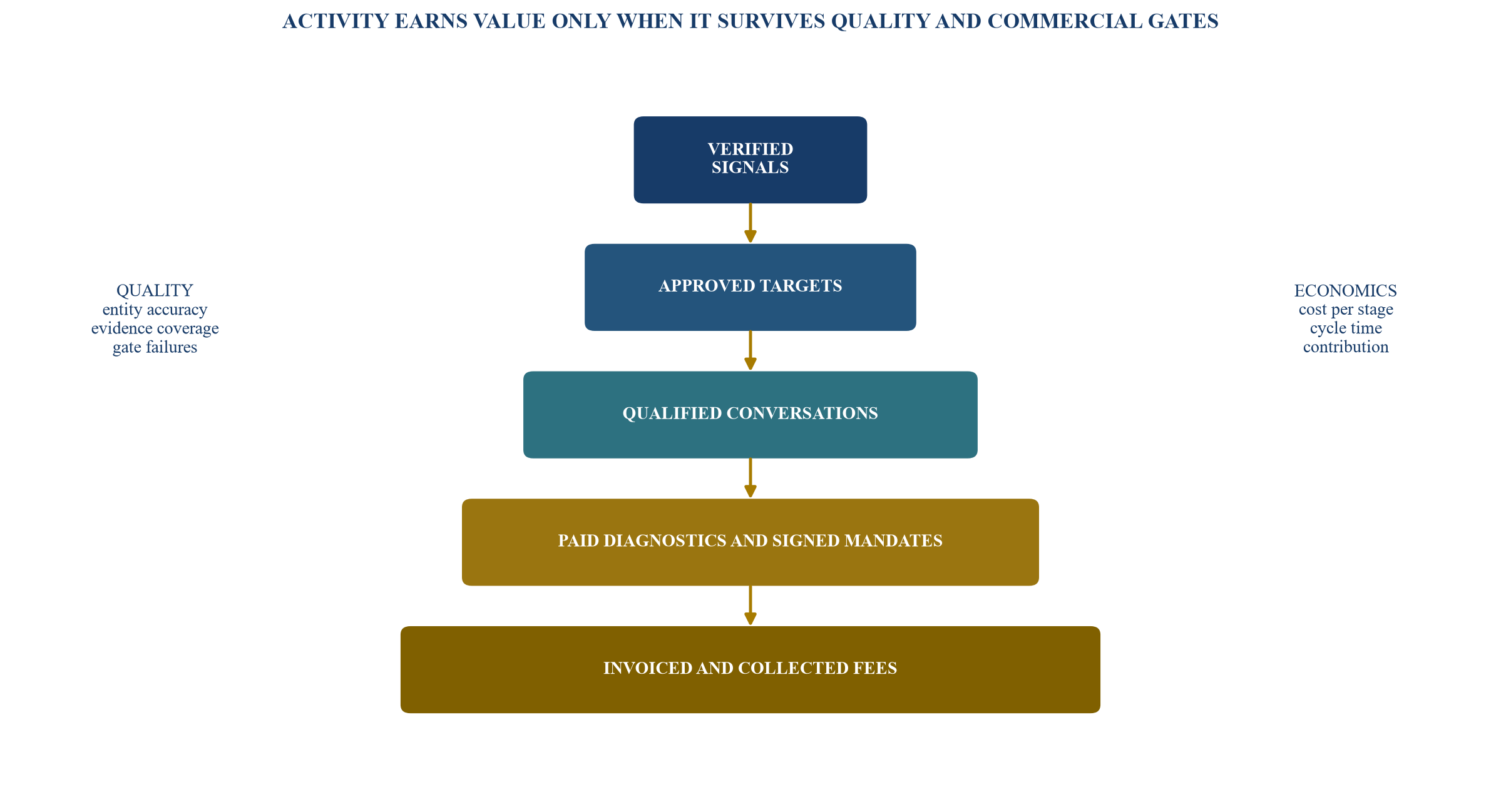
Financial outcomes require accounting or bank evidence and should be reconciled without double counting.
19. Model economics without inventing conversion benchmarks
Management should calculate cost per verified target, approved contact, qualified conversation, paid diagnostic, proposal, signed mandate and collected fee. Cost includes data, technology, research, senior review, compliance, events, travel, delivery and the opportunity cost of attention.
The model should use observed cohort data. Early planning can use hypothetical assumptions, clearly labelled and sensitised. Published response or conversion benchmarks rarely match a specific advisory proposition, relationship base, jurisdiction and target population.
Unit economics should include loss and delay. A mandate can require months of unpaid development and a long collection period. Success-fee potential should be probability-weighted only for internal planning and should never be treated as earned revenue before the contractual and transaction conditions are met.
Retainer design can align the first paid work with the buyer's decision. A bounded diagnostic with named outputs, data requirements, governance and acceptance criteria can fund professional effort and test mutual readiness. Larger execution work should follow verified need and approved terms.
20. Assign decision rights and service levels
Research operations can own source ingestion, entity resolution and first-pass capsules. Sector and transaction specialists can own interpretation. Compliance can own policy, conflicts and escalation. Partners can own contact, qualification and commercial terms. Finance can own invoicing and collection evidence.
Decision rights should state who can approve a source, score, contact, message, proposal and mandate. Emergency or senior overrides should be recorded with rationale. A model should never become the accountable approver.
Service levels should reflect signal decay. A formal filing may remain relevant for weeks. A live competitive process may require same-day review. Faster response should not shorten mandatory checks.
Capacity should be managed. A queue larger than the review team can process creates stale evidence and uncontrolled follow-up. The engine should prioritise, defer and suppress within the available approval capacity.
21. Implement through a controlled pilot
The pilot should use one transaction thesis, one jurisdictional route, a bounded target population and a small approved source set. Historical evaluation should establish entity accuracy, signal precision and review burden before live contact.
During shadow operation, the engine produces rankings and capsules without outreach. Reviewers record approvals, changes and disqualifiers. The pilot can advance when identity, evidence and policy performance meet approved thresholds and residual risks are documented.
Live operation should begin with a small cohort and manual approval at every gate. Management should review messages, responses, complaints, suppression, qualification and commercial outcomes. The system should preserve the ability to stop a source, model, thesis or channel independently.
Scale should follow evidence of quality and buyer relevance. More automation can be added to low-risk collection, deduplication and formatting tasks after control performance is observed. Judgement-heavy steps should remain accountable and reviewable.
22. Deliver a one-hundred-and-twenty-day operating build
Days one to twenty should define the commercial thesis, service entry point, target population, source rights, decision owners and prohibited uses. The team should create the data model and approval matrix.
Days twenty-one to forty should connect primary and licensed sources, build entity resolution, create the signal taxonomy and prepare the evaluation set. Security, privacy, conflicts and retention reviews should run in parallel.
Days forty-one to sixty should implement the scorecard, confidence model, research capsule and human gates. Reviewers should test historical cases and record false positives and missed opportunities.
Days sixty-one to eighty should integrate the controlled funnel and CRM fields, build dashboards and run shadow operation. Days eighty-one to one hundred should conduct a small live pilot after approval. Days one hundred and one to one hundred and twenty should review outcomes, recalibrate, document residual risks and decide whether to expand, restrict or stop.
Table 6. One-hundred-and-twenty-day AI origination implementation
| Period | Primary work | Required output | Approval gate |
|---|---|---|---|
| days 1-20 | thesis, service path, purpose, sources and decision rights | approved operating charter and data map | purpose and authority are explicit |
| days 21-40 | source connection, entity resolution and evaluation set | dated evidence pipeline and test corpus | rights, security and identity controls pass |
| days 41-60 | taxonomy, scorecard, capsule and human gates | reviewable target dossiers | factual accuracy and policy performance pass |
| days 61-80 | CRM, funnel, dashboards and shadow operation | controlled workflow without external contact | reviewers accept quality and workload |
| days 81-100 | bounded live pilot with manual approval | contact and qualification evidence | no unresolved compliance or control failure |
| days 101-120 | outcome review, recalibration and operating decision | scale, restrict or stop recommendation | accountable owners approve residual risk |
Timing depends on systems, legal review, source licences, data quality and governance capacity.
23. Apply a final approval gate
Before a target enters outreach, the approval paper should answer twelve questions. Which legal entity and group are involved? Which dated evidence supports the hypothesis? Which alternative explanation was considered? What board-level decision may exist? What economic value is at stake? Who can own and approve that decision? Which advisory service fits the current stage? Which conflicts, sanctions and privacy checks are complete? Which message is approved? Which channel and timing are permitted? What new evidence would stop contact? How will the outcome be recorded?
The target should be suppressed when identity is unresolved, material claims lack evidence, ownership is unclear, the decision mechanism is generic, a conflict or sanctions issue remains open, contact permission is inadequate, the recipient has opted out, the proposed message overstates facts or the team lacks capacity to respond professionally.
The engine should also stop when success criteria become activity goals. Large message volume, high open rates or numerous meetings can conceal a weak proposition. Management should return to the buyer problem and observe whether qualified conversations lead to paid work and collected fees.
Conclusion
An AI-enabled deal-origination engine can make market coverage more systematic. Its commercial value depends on an evidence chain that connects a real corporate-finance problem to a verified entity, a timely decision, accountable human contact and a measured mandate path.
The engine starts with a falsifiable transaction thesis. It classifies signals by their economic meaning, resolves companies into legal entities and ownership structures, scores relevance separately from confidence and prepares a concise research capsule. Public filings, registries, legal-entity data and authoritative regulatory resources strengthen the factual base.
AI accelerates ingestion, extraction, entity matching, classification, ranking and drafting. Human gates remain responsible for identity, interpretation, commercial relevance, conflicts, sanctions, privacy, message and channel. The workflow records source facts and professional hypotheses separately.
The funnel requires evidence at every stage. A qualified conversation contains a real decision, economic stakes, authority, timing, readiness and an executable procurement route. A paid diagnostic can create a proportionate first mandate. Signed mandates, invoices and collected fees provide the final commercial evidence.
The engine therefore behaves as a governed operating system rather than an automated messaging tool. It protects attention, reputation and compliance while improving the probability that proprietary research becomes a useful executive conversation.
