

1. Define the capital and operating decision
The analysis should begin with the decision being funded. Acquisition, project finance, refinancing, equity investment, optimisation-contract procurement and route-to-market selection require different evidence and risk allocation. The valuation date, asset perimeter, market, duration, interconnection, ownership, dispatch authority, contract term and decision horizon should be explicit.
The central question is whether the battery can convert finite flexibility into repeatable cash while preserving safety, availability, warranty and future capability. A high back-tested revenue figure is insufficient when it relies on unavailable market access, perfect foresight, unlimited cycling, omitted imbalance cost or a state-of-charge path that the asset cannot deliver.
Evidence should be frozen at a defined date. Resolvable gaps belong in diligence; residual uncertainty belongs in scenarios, reserves, covenants, sizing or price. The investment case should distinguish contractual cash, observed merchant cash, executable forecasts and management aspirations.
2. Establish the asset and dispatch perimeter
The asset perimeter should identify cells, modules, racks, battery-management system, power-conversion system, transformer, metering, controls, communications, fire protection, site balance, interconnection and shared infrastructure. Nameplate power and energy should remain separate from available and warranted capability at the grid connection point.
The dispatch perimeter should state who forecasts, bids, nominates, instructs, overrides and settles. Owner, optimiser, trader, aggregator, system operator, network operator and offtaker can each control part of the chain. Contractual rights should match technical access and market registration.
The economic perimeter should reconcile gross market receipts, charging energy, losses, network charges, market fees, imbalance, optimisation fees, maintenance, augmentation, insurance, tax and working capital. Related-party arrangements and shared-site costs require transparent allocation.
3. Build the operating-state ledger
Table 1. Battery dispatch evidence ledger
| Layer | Controlled record | Decision test |
|---|---|---|
| physical state | power, energy, state of charge, temperature and alarms | was dispatch feasible and safe? |
| market state | prices, awards, activations, constraints and rules | was the opportunity accessible? |
| decision | forecast, bid, optimisation run and override | why was the action chosen? |
| delivery | meter, telemetry, response and availability | was the service delivered? |
| settlement | invoice, charge, penalty and cash receipt | what value was realised? |
| life impact | throughput, cycles, capacity and resistance | what future capability was consumed? |
Each commercial claim should link to time-stamped physical, market and settlement evidence.
The ledger should preserve source, timestamp, unit, time zone, granularity, version and owner. Corrections should retain the original record and approval history. Market intervals, telemetry intervals and settlement intervals often differ; reconciliation should use explicit aggregation rules.
A reviewer should be able to select a cash receipt and trace it backwards through settlement, award, bid, model, asset state and meter. The same chain should expose non-delivery, curtailment, data gaps and operator overrides.
4. Describe the market opportunity set
Revenue opportunities should be mapped by jurisdiction and product. Energy arbitrage, capacity, frequency response, reserves, balancing actions, voltage support, congestion products, network contracts and tolling arrangements have different qualification, duration, availability, performance, settlement and penalty terms.
Market access can change. FERC Order No. 841 required organised US wholesale markets to create storage participation models that recognise physical characteristics. Great Britain has expanded bulk battery dispatch through the Open Balancing Platform and introduced information for limited-duration assets. Each case shows that rules and control systems are material commercial variables.
The opportunity set should state registration status, tested capability, bid floor, telemetry, metering, credit, collateral, dispatch latency and stacking restrictions. A theoretical product should remain outside the base case until access and delivery are evidenced.
5. Reconcile the physical operating envelope
Power, usable energy and duration form the basic envelope. The model should then incorporate minimum and maximum state of charge, charge and discharge efficiency, auxiliary load, ramp rate, response time, temperature, inverter limits, interconnection export and import limits, outage, maintenance and control reservations.
The envelope changes with age, temperature, recent operation and fault state. A static power-and-energy rectangle can overstate response near state-of-charge boundaries or after intensive cycling. Available capability should be estimated from controlled measurements and reconciled to meter performance.
Physical protection should remain independent of commercial optimisation. A bid should never compel the battery-management system to cross engineered safety limits. Constraint breaches, forced derates and overrides require investigation and model feedback.
6. Construct the state-of-charge truth model
State of charge is estimated rather than directly observed. Voltage, current, temperature, cell behaviour and model assumptions contribute to the estimate. Error can accumulate during operation and become commercially material when a market award relies on energy near a boundary.
The truth model should reconcile battery-management estimates with metered charge and discharge, losses, rest periods, recalibration events and capacity tests. Confidence bands should widen when data quality deteriorates or operating conditions move beyond validated ranges.
Dispatch should reserve headroom for estimation error, activation uncertainty and required recovery. The cost of reserve can be compared with the expected cost of non-delivery, forced buyback, warranty breach and lost market access.
7. Create the dispatch-control chain
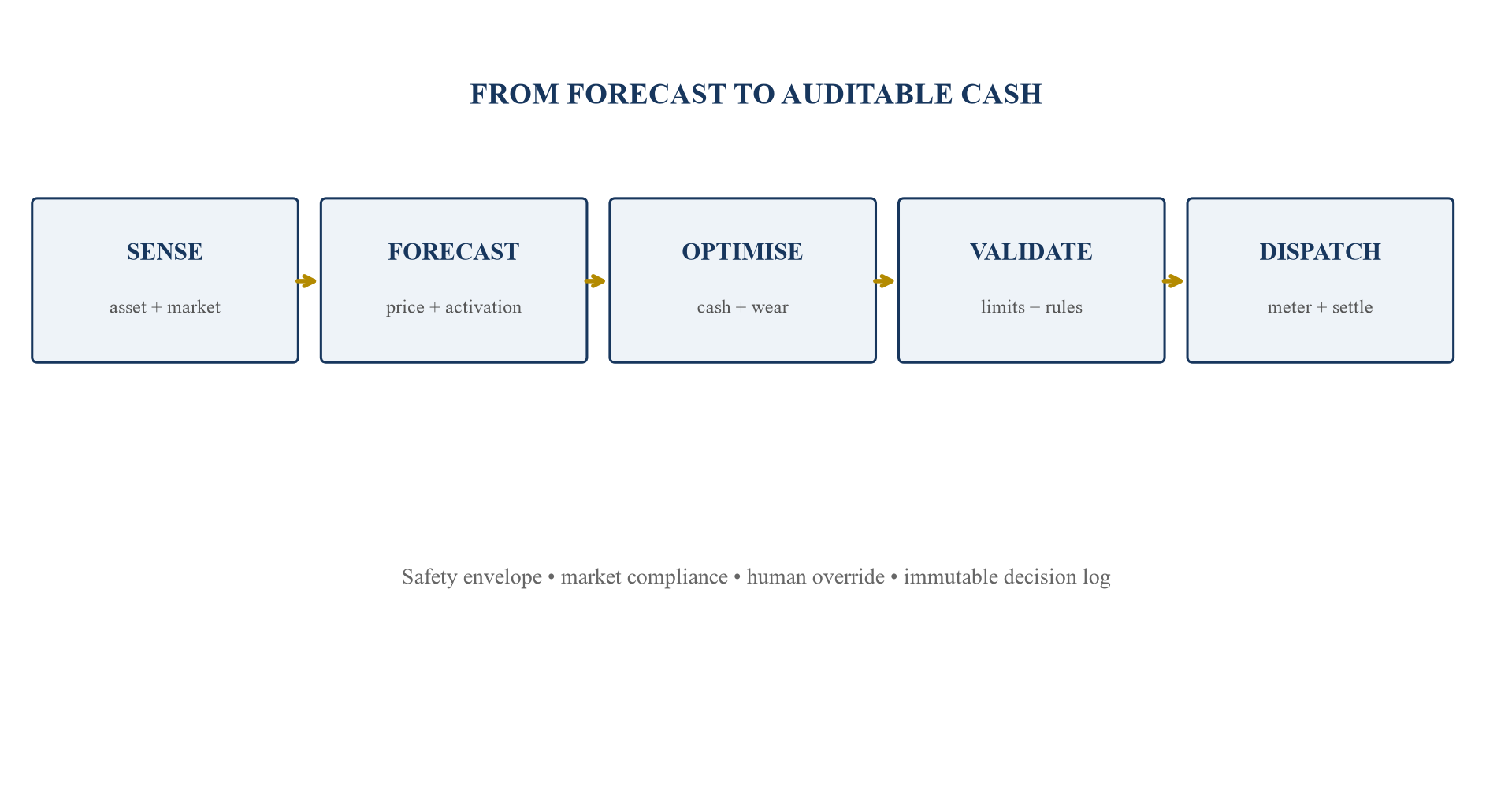
Each automated decision should retain data lineage, feasibility checks and accountable override authority.
The control chain should separate sensing, forecasting, optimisation, validation, instruction and settlement. Model output should not bypass eligibility, safety, interconnection or warranty checks. Every instruction needs a timestamp, version, input snapshot and accountable owner.
Human override should be available for safety, abnormal markets, communication failure and model uncertainty. Override frequency and reason are performance signals; repeated manual correction can reveal missing constraints or poor confidence calibration.
8. Forecast prices and activations without leakage
Forecasts can use weather, demand, renewable output, outages, congestion, fuel, interconnector, bid-stack and calendar information. Ancillary-service value also depends on procurement volume, clearing design, activation, performance and saturation. Inputs should be available at the actual decision time.
Back-tests should prevent future information from entering features, labels, model selection or parameter tuning. Training, validation and test periods should respect chronology and structural breaks. Results should be compared with simple benchmarks and reported after fees, losses, imbalance and degradation.
Forecast accuracy alone does not establish value. The relevant test is incremental feasible cash and risk after the forecast changes a bid or dispatch. Error during scarcity, negative prices or constraint events can matter more than average error.
Evaluation should follow the complete decision pipeline. Price forecasts need direction, magnitude and calibration tests; activation forecasts need probability, volume and duration tests; dispatch decisions need feasibility and cash tests. Results should be segmented by hour, season, price regime, state-of-charge band, product and asset condition. A model can appear sound at portfolio level while repeatedly failing during evening ramps or prolonged activation. Confidence should be compared with realised error so position limits can respond to uncertainty.
Transaction diligence should reproduce a representative set of forecasts from the raw information set. Feature timestamps, publication delays, revised weather data and outage announcements should be inspected. The reviewer should confirm which version entered production, how missing inputs were handled and whether retraining incorporated periods previously described as out-of-sample. Reported model value should reconcile to executed bids and settled cash; simulated opportunities that the optimiser declined, the trader overrode or the asset could not deliver should remain outside realised performance.
9. Model uncertainty and regime change
Price distributions can be skewed, spiky and state-dependent. Historical averages can conceal a small number of intervals that drive annual value. Market reforms, new storage entry, renewable penetration, transmission, fuel prices and bidding behaviour can change relationships used by a model.
Forecasts should produce calibrated distributions or scenarios rather than one path. The optimiser can then compare expected value with downside, tail exposure and state-of-charge optionality. Scenario weights should not imply precision unsupported by evidence.
Monitoring should detect feature drift, residual drift, performance decay and new regimes. Material changes should trigger review, reduced risk limits or fallback rules before retraining and redeployment.
10. Co-optimise the revenue stack
Services share power, energy, state of charge, availability, telemetry and interconnection. Capacity held for response cannot always earn simultaneous energy revenue. Activation in one product can consume energy required for another. Contract terms may prohibit or restrict stacking.
The optimisation should schedule mutually feasible awards through time. It should model reservation, expected activation, rebound, charging, efficiency, duration, penalties and recovery. Independent gross forecasts should not be summed.
Co-optimisation should also preserve option value. Discharging now can forgo a later scarcity opportunity; charging can consume import capacity or create exposure to a higher price. The marginal decision should account for the value of the next unit of stored energy.
A practical formulation should use a time-indexed energy balance with charge, discharge, reserve, activation and state variables. Constraints should prevent simultaneous incompatible actions, respect ramp and duration, and carry expected activation into state transitions. Binary or disjunctive terms may be required where tariff, commitment or operating logic is non-convex. Solver tolerances, horizon length and terminal-state treatment should be documented because they can materially change the apparent optimum.
Optimisation under uncertainty can use scenarios, stochastic programming, robust limits or receding-horizon control. The chosen method should match data quality and decision speed. Overly conservative rules can leave value unused; narrow deterministic schedules can create buyback and non-delivery exposure. Shadow prices are useful: they show the marginal value of energy, power, interconnection, warranty headroom and other scarce constraints. Persistent shadow value can direct augmentation, connection or contract decisions toward the true bottleneck.
11. Price degradation as a dispatch cost
Degradation includes calendar and cycling effects. Depth of discharge, state of charge, temperature, rate, dwell and chemistry can influence capacity loss and resistance growth. A single cost per megawatt-hour is a simplification that should be tested against operating evidence and warranty terms.
The dispatch model should estimate the incremental present value of wear from a proposed action. That cost includes expected capacity loss, efficiency change, augmentation, downtime and residual-value effect. It should remain distinct from accounting depreciation.
A profitable cycle requires marginal revenue above charging cost, losses, market fees, imbalance, incremental wear and lost future option value. This test can reject apparently attractive spreads that consume disproportionate life.
Degradation evidence should combine manufacturer curves, independent tests and observed operation. Calendar and cycle effects interact; summing two standalone estimates can double-count stress. Equivalent full cycles are useful for communication and can conceal depth, rate, temperature and dwell. Capacity tests should follow consistent procedures, while operational estimates should state uncertainty and the influence of recent use. Cell dispersion and rack imbalance can constrain usable asset energy before average cell capacity reaches a headline threshold.
Economic wear cost should be reconciled at least quarterly. If observed capacity falls faster than expected, the optimiser may need higher dispatch hurdles, narrower state windows or a revised augmentation plan. If warranty or replacement cost changes, historical optimality does not establish future optimality. Finance models should distinguish maintenance intended to preserve availability from augmentation that restores or expands capability, and should avoid treating the same life consumption both as a dispatch cost and an unadjusted capital deduction.
12. Build a degradation-aware frontier
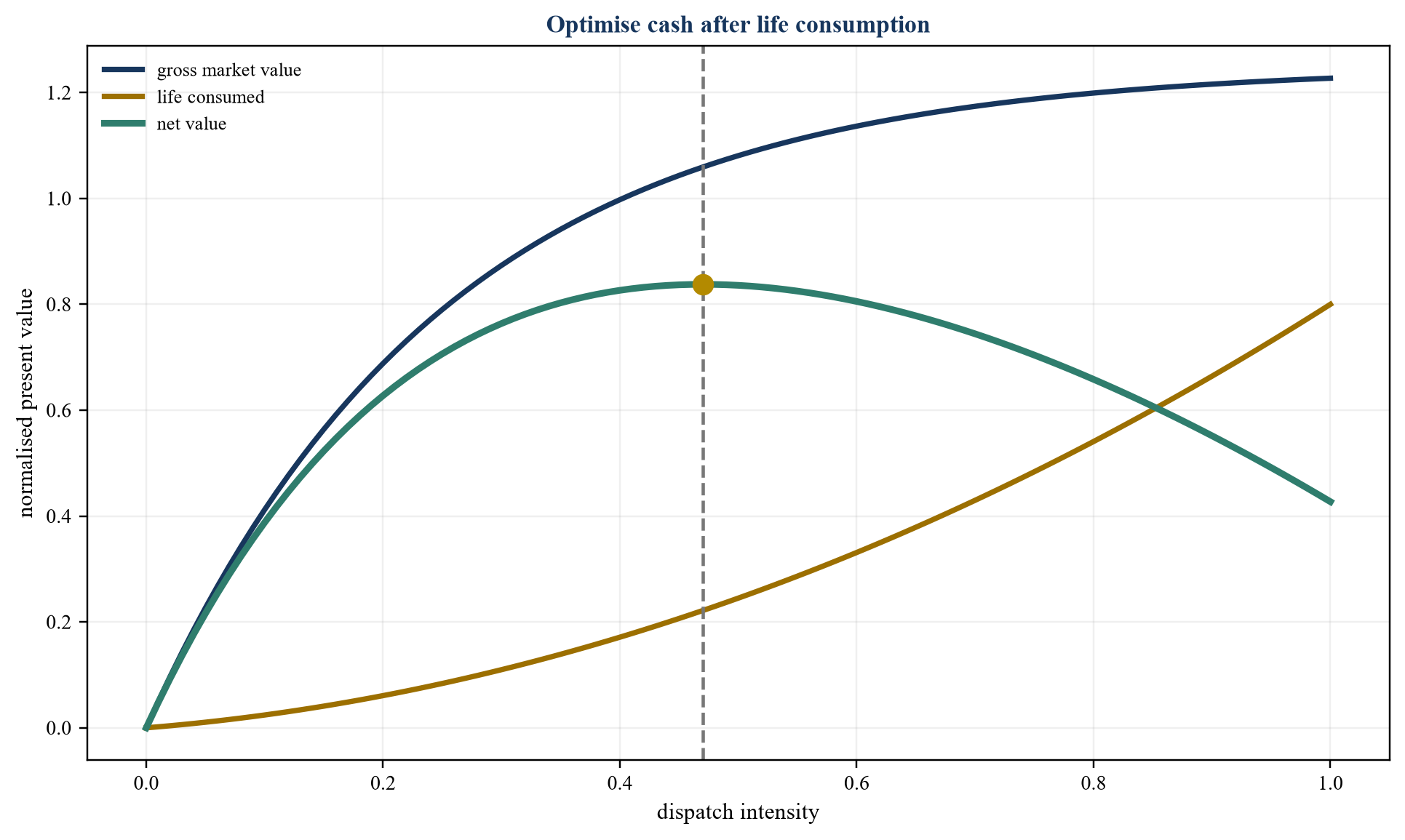
Replace the curves with asset-specific operating, warranty and market evidence.
The frontier compares gross market value with the present value of life consumed. At low activity, additional dispatch can create substantial value. At higher intensity, saturation, poorer opportunities and accelerating wear can reduce net value.
The optimum changes with price volatility, warranty headroom, augmentation cost, financing horizon and residual value. It should be recalculated as observed capacity and market conditions change.
13. Translate warranties into operating constraints
Warranties can specify time, throughput, cycles, operating window, temperature, availability, capacity retention, exclusions and required records. Commercial optimisation should encode relevant limits and preserve evidence required to support a claim.
Warranty headroom is not free capacity. Consuming it can reduce future flexibility or leave the owner exposed after an adverse year. The model should show expected and stressed use against each binding measure.
Responsibility for a breach should align with dispatch authority. Optimiser agreements should address instructions, records, exclusions, lost warranty, liability caps and dispute evidence. A revenue guarantee cannot be evaluated separately from the operating freedom it assumes.
14. Value efficiency and auxiliary consumption
Round-trip efficiency varies with power, state of charge, temperature, ageing, inverter performance and auxiliary load. One annual percentage can misstate charging requirements and net margin, particularly for short-duration or low-spread trades.
The model should apply directional losses at the appropriate meter boundary. Cooling, heating, controls, standby and transformer losses should be assigned consistently. Import and export network charges can amplify the financial effect.
Efficiency drift is both a cost and a diagnostic signal. Changes should be compared with temperature, operating rate, equipment condition and meter quality before attribution to cell degradation.
15. Control bidding and market conduct
Automated bids should comply with applicable market rules, licence duties, dispatch instructions, outage reporting and conduct standards. Algorithms can produce undesirable outcomes when objectives omit reliability, physical feasibility or rules governing economic withholding and state-of-charge representation.
Pre-trade controls should test price, volume, position, credit, eligibility, state, duration and conflict limits. Post-trade surveillance should identify anomalous bids, repeated buybacks, infeasible awards, unexplained overrides and patterns that require legal or compliance review.
Model developers, traders and control-room staff need distinct permissions. Code, parameters and production deployment should follow approval, testing, rollback and incident procedures.
Conduct analysis should examine both individual bids and portfolio effects. Common ownership, optimiser concentration, coordinated constraints and shared forecasts can create correlated behaviour. Controls should identify capacity withheld through unavailable-state declarations, bids inconsistent with technical cost, strategic state-of-charge positioning and repeated settlement outcomes that depend on uplift or make-whole rules. Flags are prompts for competent review rather than conclusions about intent.
Change in law belongs in commercial governance. Market operators can revise qualification, bidding parameters, state management, settlement, penalty and dispatch priority. Contracts should allocate implementation cost, revenue impact and termination rights. The optimiser should maintain a rule inventory that maps each encoded constraint to a current source and effective date. When rules conflict across energy, ancillary and distribution arrangements, legal interpretation should be resolved before automated execution.
16. Reconcile awards, delivery and settlement
Table 2. Dispatch-to-cash reconciliation
| Stage | Evidence | Control |
|---|---|---|
| bid | submitted price, volume and timestamp | reconcile to approved model run |
| award | cleared quantity and obligation | test eligibility and reservation |
| activation | instruction and response | verify latency, power and duration |
| meter | import, export and losses | reconcile revenue meter to telemetry |
| settlement | price, fee, penalty and adjustment | recalculate independently |
| cash | invoice, collateral and receipt | reconcile ledger to bank |
Settlement controls should preserve gross and net values by interval, product and counterparty.
Dispatch value should be measured from settled cash rather than modelled gross revenue. Missing telemetry, baseline disputes, meter corrections, imbalance and resettlement can change value after the operating day.
Exceptions should remain visible by cause and financial consequence. Repeated settlement leakage may justify changes to data capture, contracts, bidding or market selection.
17. Measure performance with cash-backed attribution
Performance should compare actual cash with a controlled counterfactual. Gross revenue growth can reflect higher volatility, greater availability or a larger asset rather than better optimisation. Attribution should separate market opportunity, asset capability, forecast, bid, execution, settlement and cost.
The benchmark should be executable with information available at the time. Perfect hindsight is unsuitable. Simple rule-based strategies, incumbent optimiser performance and independently reproduced runs can provide useful comparators.
Fees and incentives should use metrics that the provider can influence and the owner can verify. Revenue share can reward excessive cycling unless degradation, warranty and downside are included.
18. Stress congestion, curtailment and locational risk
Locational value depends on nodal or zonal prices, constraints, losses, import and export rights and network rules. Congestion can create opportunity and can also strand a charging or discharging schedule. Historical spreads may compress after transmission or competing storage enters.
The model should include local price basis, constraint frequency, outage, curtailment, negative pricing and interconnection availability. A co-located renewable asset can create charging benefits while sharing a constrained export connection.
Downside cases should combine related changes where appropriate: lower volatility, increased storage competition, network reinforcement and declining ancillary prices can occur together as a market matures.
19. Model availability and forced outage
Availability should be measured at the capability required by each product. A battery can be technically online yet unable to deliver full duration, response or export. Planned maintenance, cell derate, inverter fault, communication loss and market suspension should remain distinguishable.
Forecasts should use observed component reliability, repair duration, spares, service agreements and access constraints. Correlated failures across common equipment or software deserve separate stress.
Contractual availability definitions should reconcile to operational measures. Exclusions, deemed availability and force-majeure treatment can change both revenue and penalty without changing physical performance.
20. Optimise maintenance and augmentation
Predictive maintenance can combine alarms, temperatures, voltages, impedance, switching, inverter and environmental data to rank inspection or intervention. Benefits require validated reduction in failure, downtime, parts or safety exposure.
Augmentation decisions should compare restored capability with capital cost, installation downtime, integration, warranty, tax, residual life and market value. Replacing energy capacity may not relieve an inverter or interconnection bottleneck.
The dispatch and augmentation models should share capacity and degradation definitions. Otherwise the optimiser can consume life against one curve while the investment model funds replacement against another.
21. Govern telemetry, time and data quality
Telemetry quality determines whether the optimiser sees the true asset state and whether delivery can be proven. Required channels, resolution, latency, accuracy, availability and retention should be specified by market and contract. Clock synchronisation matters when response is measured in seconds.
Data-quality rules should identify stale values, gaps, duplicates, unit changes, impossible states and sensor disagreement. Substitution and interpolation require flags and limits. Commercial decisions should not silently rely on repaired data that would be rejected for settlement or warranty evidence.
Raw records should be retained alongside curated datasets. Access, encryption, backups and recovery should reflect the operational and financial consequence of loss or manipulation.
22. Validate AI and optimisation models
Validation should cover forecast accuracy, decision quality, constraint feasibility, stability, calibration, tail behaviour and cash outcome. Independent reviewers should reproduce representative runs from frozen code, data, parameters and market rules.
Testing should include normal periods, scarcity, negative prices, outages, communication failure, boundary state of charge and unseen regimes. A model that performs well on average can fail precisely when exposure is largest.
Approval should specify permitted markets, assets, limits, fallback and monitoring. Material code, feature, objective or constraint changes should trigger proportionate revalidation.
Validation governance should classify models by potential safety, market, financial and legal impact. Inventory records should identify owner, purpose, version, dependencies, training window, limitations and approval. Independent challenge should have access to code, data and subject-matter expertise. Exceptions require an expiry date and compensating control. Production access should be separated from research environments, and deployment artefacts should be cryptographically or procedurally linked to the approved version.
Ongoing monitoring should combine leading and lagging indicators. Data drift, solver infeasibility, constraint slack, forecast calibration and override frequency can signal trouble before cash loss appears. Settlement variance, non-delivery, warranty exceptions and realised degradation confirm outcome. Thresholds should trigger defined actions rather than dashboards alone. Periodic review should ask whether the model remains needed, whether simpler controls perform similarly and whether accumulated market changes require redevelopment rather than another local patch.
23. Separate forecast, optimiser and execution risk
Forecast risk arises when prices or activations differ from expectations. Optimiser risk arises when the objective, constraints or solver select an unsuitable action. Execution risk arises when bids, communications, controls or the physical asset fail to implement the decision.
These risks need separate diagnostics. A good forecast can produce poor cash through omitted degradation; a sound schedule can fail through telemetry; a profitable action can settle poorly through an incorrect market mapping.
Loss attribution should assign cause, controllability and remediation. Blended model-performance metrics can conceal repeated operational or contractual leakage.
24. Design fallback and incident control
Fallback strategies should be simple, feasible and tested. They can include holding a conservative state of charge, withdrawing from selected products, following a fixed schedule or transferring control to an approved operator. Safety protection remains primary.
Trigger conditions should include data loss, model failure, infeasible output, market disorder, cyber incident, settlement anomaly and repeated forecast breach. The fallback owner, authority, communication and restoration criteria should be documented.
Incident review should preserve evidence, quantify cash and life impact, identify root causes and approve corrective action. A rapid return to automated operation should not precede safe containment and understanding.
25. Manage cyber and control-system exposure
Storage combines operational technology, cloud services, trading interfaces and market communications. Compromise can affect safety, availability, positions, confidential data and grid operations. Asset owners should map identities, privileges, dependencies and remote access.
Controls should include segmentation, strong authentication, least privilege, signed changes, monitored access, patch governance, backups and tested recovery. Third-party optimisers and equipment vendors require contractual security, incident notification and exit provisions.
Cyber scenarios should enter liquidity and availability stress. Insurance, indemnity and liability caps may not cover the full operational or market consequence.
26. Evaluate route-to-market contracts
Table 3. Route-to-market commercial comparison
| Model | Owner exposure | Key diligence |
|---|---|---|
| merchant self-dispatch | market, people and systems | capability, controls and trading governance |
| optimiser revenue share | market and incentive alignment | benchmark, wear, audit and termination |
| floor plus upside | counterparty and formula | floor security, exclusions and upside calculation |
| toll or fixed availability | counterparty and performance | dispatch rights, availability and pass-through cost |
| hybrid portfolio | allocation and basis | stacking, priority, collateral and conflicts |
Terms should be assessed together with control rights, risk and evidence access.
The contract should define markets, authority, bid limits, availability, degradation, warranty, fees, collateral, data, audit, liability, change in law and termination. Revenue claims should be modelled under the exact waterfall.
Counterparty credit and replacement risk matter because route-to-market capability can be difficult to transfer during market stress. Data portability and transition assistance preserve option value.
27. Underwrite counterparty, collateral and liquidity
Market participation can require collateral and expose the owner to settlement timing, margin calls, negative invoices and resettlement. Optimiser, offtaker, supplier and service-provider failure can interrupt revenue or require replacement liquidity.
The model should forecast gross collateral, variation, payment lag, tax and working capital by scenario. Liquidity facilities should cover plausible stress without assuming immediate distributions from another project entity.
Credit support should be legally effective and matched to the exposure. Guarantees, letters of credit, reserves and termination payments have different timing and enforceability.
28. Convert dispatch into project cash flow
Revenue should be modelled by product and interval, then aggregated through charging cost, losses, network charges, market fees, optimiser fees, penalties and operating cost. Degradation and augmentation should enter cash flow on a basis consistent with dispatch.
Contracted and merchant cash should remain separate. Merchant cases require transparent price, activation, saturation and competition assumptions. Tax, accounting and distributable cash can differ from operating cash.
The model should reconcile historical periods to invoices and bank receipts before forecasting. Unexplained gaps weaken both valuation and debt sizing.
Historical reconstruction should use a common interval calendar and preserve daylight-saving, missing-price and resettlement treatment. Revenue should be split between market movement and operator action. A favourable year can result from exceptional volatility rather than repeatable decision quality. The model should show gross opportunity, feasible opportunity, nominated position, dispatch, meter, initial settlement, final settlement and cash. Differences should be assigned to a documented cause rather than absorbed into a generic capture rate.
Forecast cases should also show capital timing. Cell or module augmentation, inverter replacement, control-system renewal, fire-system upgrades and grid-compliance work can occur at different dates. Deferring work can preserve near-term cash while reducing availability or increasing risk. Funding should be consistent with distributions and covenants. Where an optimiser claims that improved dispatch can defer augmentation, the claim should be supported by an approved operating policy and observed degradation response rather than a parallel unconstrained model.
29. Size debt against constrained downside
Debt capacity should rely on cash available for debt service after physically feasible dispatch, operating cost, augmentation, tax, working capital and required reserves. Gross revenue or EBITDA before life replacement can overstate repayment capacity.
Lenders may apply different treatment to contracted availability, capacity, ancillary and merchant arbitrage. Haircuts should reflect term, counterparty, rule change, volatility, saturation, basis, operating evidence and control rights.
Debt service coverage, lock-up, reserve and distribution tests should use consistent definitions. The model should also test refinancing and terminal exposure when the contract or warranty ends before debt maturity.
The base case should use a dispatch policy that can actually be implemented over the financing horizon. Perfect-foresight revenue should be converted through an evidenced capture rate and constrained back-test. Lender cases should stress energy spreads, ancillary saturation, activation, availability, usable capacity, efficiency, charging price, fees, penalty, optimiser replacement and augmentation. Correlated stresses should reflect market mechanisms: declining ancillary prices can prompt a shift into deeper cycling, which raises wear and may still fail to restore margin.
Cash traps and reserves should respond to risks with observable indicators. A degradation reserve can be linked to measured capacity and funded augmentation; a liquidity reserve can cover collateral and settlement timing; a debt-service reserve addresses payment continuity. Broad reserves should not mask a structurally weak revenue case. Security analysis should include permits, connection rights, equipment title, software and data access, material contracts, accounts and step-in arrangements. Enforcement value depends on whether an incoming controller can safely operate and retain market access.
30. Build the lender downside waterfall
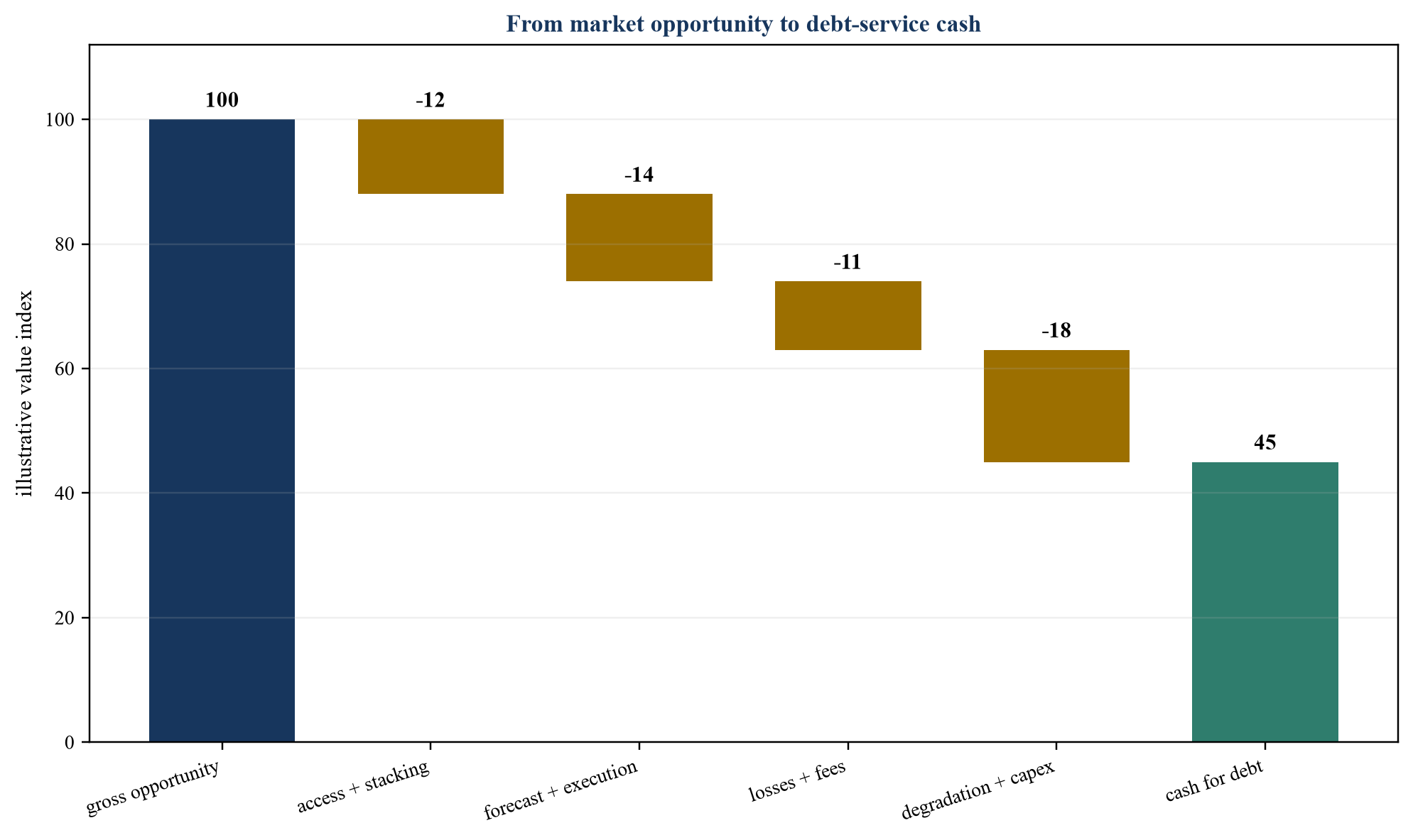
The illustration shows causal deductions; transaction values should come from controlled evidence.
The waterfall should begin with an observable opportunity set and deduct access limits, shared constraints, forecast error, delivery leakage, charging, losses, fees, degradation, augmentation and working capital. Each deduction needs an owner and evidence source.
Downside should preserve causal relationships. Lower volatility can reduce arbitrage and optimiser fees; high activation can raise ancillary revenue and wear together. Mechanical independent haircuts can create inconsistent cases.
31. Stress market saturation and cannibalisation
Additional storage can reduce spreads and ancillary prices while increasing competition for charging windows and network capacity. Entry is often correlated with the same renewable growth that creates initial volatility.
The forecast should model announced and probable capacity, commissioning delay, duration, location, bidding behaviour and product depth. Historical scarcity value should not be extended unchanged into a materially different fleet.
Long-term value may migrate from saturated fast-response services toward energy shifting, capacity, congestion or contracted reliability. The asset's duration, connection and control flexibility determine whether it can follow.
Cannibalisation analysis should link fleet growth to product depth. A megawatt of new two-hour storage does not compete equally in every service or location. Qualification, duration, cycling strategy, network constraint and portfolio control influence effective supply. The model should distinguish installed, commissioned, registered, available and actively bidding capacity. Announcements without connection, equipment or finance should carry lower weight; projects under construction can affect expectations before operation.
Revenue diversification can reduce concentration and can introduce new correlations. Energy spreads, reserve prices and balancing actions often respond to the same weather, demand and fleet conditions. Contracted floors can protect cash while exposing the owner to counterparty, availability and opportunity-cost risk. The downside case should model migration cost, including systems, registration, testing, collateral, lower initial performance and contract change. Strategic flexibility has value when the asset can exercise it within its remaining duration and warranty.
32. Compare jurisdictions without false equivalence
Market products with similar names can differ in procurement, activation, pay-as-bid or clearing-price treatment, performance, duration, baselines, penalties and stacking. Dispatch logic should use the actual rulebook and settlement system.
California ISO reporting illustrates state-of-charge and bid-cost-recovery issues in a deep wholesale market. Great Britain's work on skip rates, bulk dispatch and limited-duration parameters shows how control-room capability affects accessible value. These observations support diligence questions; they do not provide interchangeable revenue assumptions.
Cross-market portfolios need local models, controls and legal review with a common governance layer. Currency, tax, credit and data rules also affect consolidated value.
33. Value co-located renewable storage
Co-location can reduce curtailment, shift generation, share interconnection and support capacity value. It can also create competition for export capacity, charging-source restrictions, tax-credit conditions, meter complexity and allocation disputes.
The optimiser should co-optimise renewable forecast, battery state, market prices, connection and contract obligations. Separate renewable and battery models can double-count export or charging opportunity.
Value attribution should distinguish avoided curtailment, captured spread, capacity, ancillary service and contract benefit. Shared costs and losses should follow an approved allocation policy.
34. Protect residual and terminal value
Residual value depends on remaining capacity, power, efficiency, warranty, safety record, augmentation, software rights, connection, permits, contracts and future market access. A battery's remaining throughput alone does not establish saleable value.
Dispatch can trade current cash against terminal capability. The optimisation horizon should include expected ownership, refinancing and sale, with a terminal function grounded in plausible uses and costs.
Decommissioning, recycling, site restoration and equipment removal should be included where obligations transfer. Salvage assumptions require current evidence and should remain separate from avoided liabilities.
35. Create the investment and lender data room
Table 4. Battery dispatch diligence data room
| Workstream | Priority evidence | Reproducibility test |
|---|---|---|
| asset | design, tests, warranty and operating history | recreate available envelope |
| market | registrations, rules, bids and awards | recreate opportunity and obligations |
| models | code, data, parameters and validation | rerun representative decisions |
| delivery | telemetry, meter, alarms and outages | reconcile instruction to response |
| finance | settlements, invoices, cash and capex | reconcile dispatch to cash |
| governance | approvals, access, incidents and audits | identify accountable control owners |
Completeness should be tested against the transaction perimeter and reporting cut-off.
The data room should preserve native files, versions, owners and dates. Curated summaries should link to source evidence. Samples should cover profitable, loss-making, high-activation, outage and settlement-exception periods.
An independent reviewer should reproduce state, forecast, constraint, instruction and cash for selected intervals. Gaps should enter conditions, valuation or structure rather than disappear in narrative.
36. Design board and lender reporting
Reporting should connect physical capability, market access, dispatch, life consumption and cash. Useful measures include available power and energy, state-of-charge confidence, awarded and delivered volume, cash margin, settlement leakage, degradation, warranty headroom, outages, overrides and model drift.
Metrics need stable definitions, period cut-offs and reconciliation. A dashboard should allow movement from portfolio totals to asset, market, product and interval evidence.
Thresholds should trigger named actions. Reporting that identifies a breach without authority, funding or timing provides limited control value.
Board reporting should include concentration by market, product, counterparty, optimiser and price event. It should also show how much value depends on the highest-revenue intervals, how often the asset approached physical or warranty limits, and whether collateral or working capital constrained otherwise feasible action. Forecast-versus-actual analysis should retain the original forecast and avoid retrospective rebasing. Management commentary should separate measured outcomes, approved model estimates and forward assumptions.
Lender reporting can use a controlled subset with covenant definitions, cash waterfall, reserve movements, available capacity, warranty headroom, material outages, incidents, contract changes and model exceptions. Data should reconcile to statutory or management accounts at an agreed boundary. If an operating metric is revised, prior periods should remain available and the covenant effect should be documented. A stable evidence chain reduces debate after a weak period and supports earlier intervention when physical, market or financial performance diverges.
37. Use a risk-adjusted valuation bridge
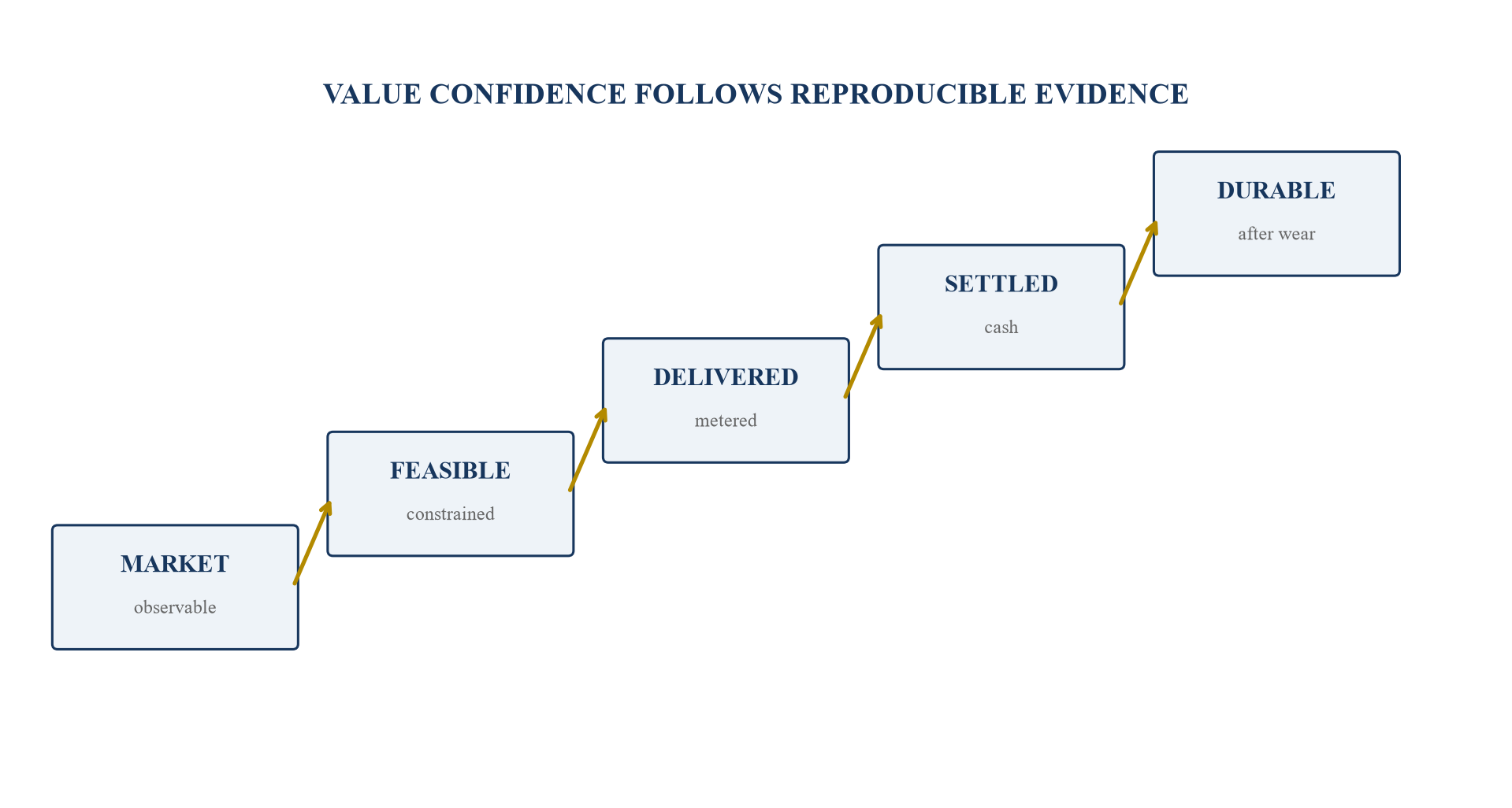
Confidence should rise only as access, delivery, settlement and durability are independently evidenced.
Valuation should begin with feasible cash, then adjust for evidence quality, concentration, volatility, rule change, counterparty, model, operating and terminal risk. Contracted revenue still requires performance and credit analysis.
Observed improvement can support value when it persists after market normalisation, wear and cost. Forecast benefits should retain probability, implementation cost and time.
Table 5. Risk-adjusted battery-dispatch valuation bridge
| Value layer | Evidence required | Common adjustment |
|---|---|---|
| gross opportunity | market depth, prices and accessible products | saturation and basis |
| feasible capture | envelope, stacking and execution back-test | capture-rate haircut |
| settled margin | invoices, fees, charging and penalties | leakage and working capital |
| durable cash | degradation, augmentation and warranty | life-consumption deduction |
| financeable cash | contracts, credit, governance and downside | structure and discount rate |
| terminal value | remaining capability, rights and obligations | exit and decommissioning |
Adjustments should be evidence-led, mutually consistent and traceable to cash-flow scenarios.
The bridge should avoid overlapping adjustments. Lower feasible capture should not be penalised again through an identical revenue haircut and a higher discount rate unless the residual risk differs. Scenario cash flows should carry risks that can be modelled credibly; the discount rate or valuation range can address remaining uncertainty. Contracted revenue can reduce volatility and may reduce upside or introduce counterparty concentration. Terminal value should be consistent with the degradation and augmentation schedule already embedded in annual cash.
Transaction structure can convert uncertainty into contingent value. Earn-outs, holdbacks, performance tests, staged equity, reserves, warranties and covenants can allocate specific gaps. These mechanisms require measurable definitions and enforceable cash or control. They should not replace diligence on safety, legality or fundamental feasibility. The valuation conclusion should state which evidence changed value, which assumptions remain sensitive and which protections are required before capital is committed.
38. Structure governance and incentives
The board should approve risk appetite, market scope, delegation, model policy, warranty strategy, liquidity and incident thresholds. Management should assign accountable owners across asset, trading, technology, finance, legal, compliance and safety.
Optimiser incentives should reward net durable value. Measures can include settled margin after charging, fees and wear; availability; forecast and delivery quality; warranty compliance; settlement accuracy; and downside limits.
Audit rights should include data, code versions, decision logs, invoices and subcontractors. Termination should preserve safe control, data portability and market continuity.
39. Execute a one-hundred-day value plan
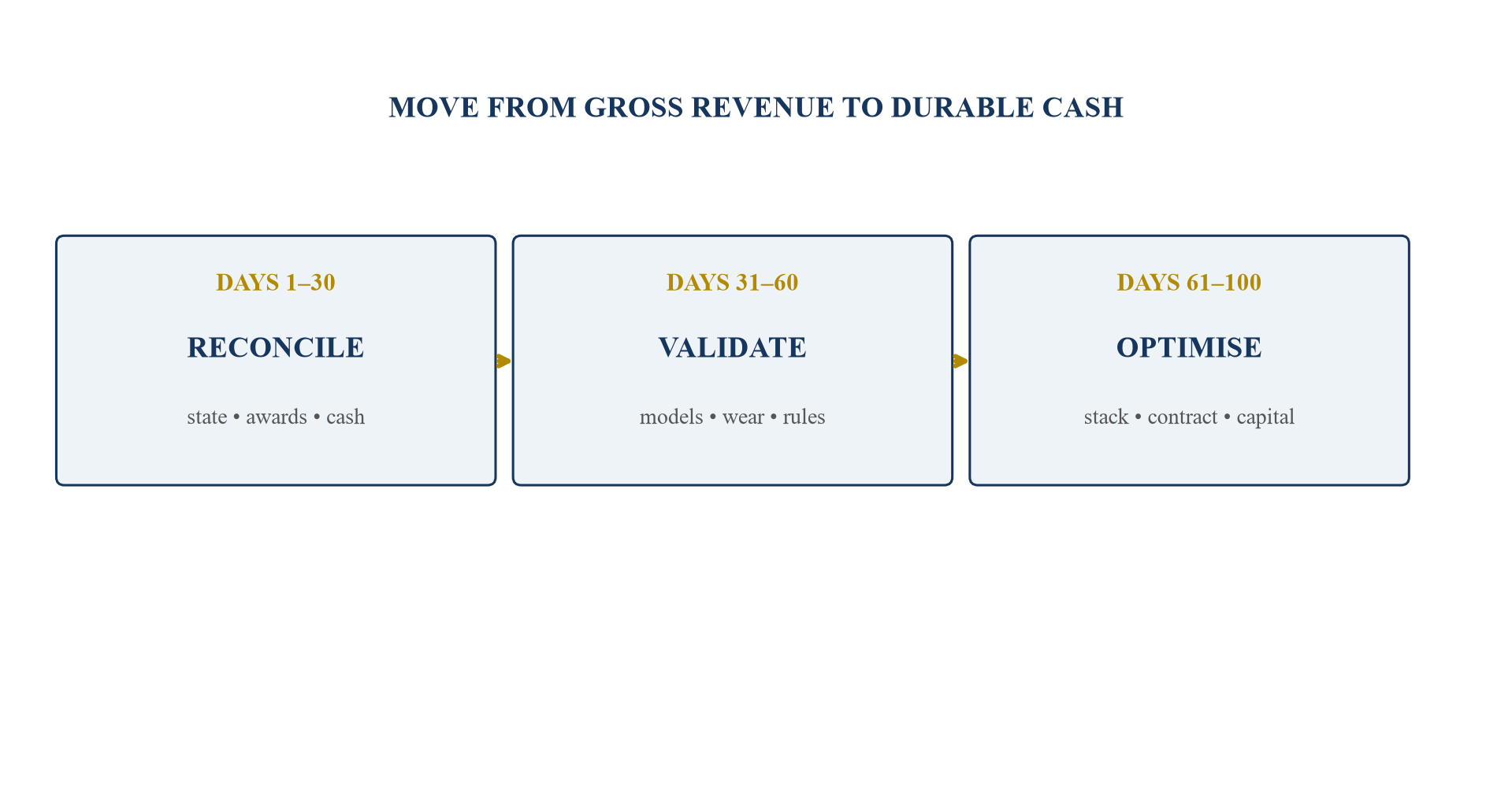
Sequence should reflect transaction timing, safety priorities, evidence gaps and market access.
The first month should reconcile asset state, market access, contracts, bids, awards, telemetry, settlements, warranty and liquidity. Immediate safety, data and control gaps take priority.
The second month should reproduce representative decisions, validate constraints and degradation, quantify leakage and stress downside. The final phase should implement approved changes with owners, funding, baselines and monitoring.
40. Conclusion
Battery-storage value arises from controlled conversion of finite flexibility into cash. Market opportunity, physical feasibility, state estimation, dispatch, delivery, settlement and life consumption should reconcile through one evidence chain.
Artificial intelligence can improve forecasts, bids, co-optimisation, anomaly detection and maintenance. It creates durable value when decisions remain safe, lawful, feasible, auditable and profitable after degradation, fees, imbalance and lost option value.
Revenue stacks should be co-optimised rather than added. Degradation should be priced as an economic decision variable. Warranty, liquidity and terminal capability should remain inside the model rather than appear as later adjustments.
Lenders and investors should underwrite cash that can be reproduced from controlled records and survived under coherent downside. Weak evidence should reduce value, increase protection or delay capital. Strong evidence can support efficient financing and disciplined operating freedom.
The practical standard is interval-level reproducibility. An independent reviewer should be able to recover the information available at a decision time, rerun the approved model, verify feasibility and delivery, recalculate settlement, price life consumed and trace the result to cash. That standard aligns technology, trading, operations and finance around durable value.
Implementation should remain proportionate to the asset and transaction. A contracted battery with limited dispatch freedom needs a different control design from a merchant portfolio trading several products across jurisdictions. Both require explicit authority, reliable state, enforceable operating limits, settlement reconciliation and a funded path through degradation. As evidence accumulates, the owner can replace conservative assumptions with observed capture, activation, wear and cash. Model sophistication should follow the economic decision and data quality; it should not become a substitute for physical control or commercial accountability.
The strongest investment case explains where each unit of value comes from, what capability it consumes, which party controls the outcome and how downside is contained. It also identifies the point at which more dispatch reduces rather than increases enterprise value. This discipline turns battery optimisation from a headline revenue claim into an operating and financing system that can be tested, governed and improved.
References
- International Energy Agency, Global Energy Review 2026: Technology: Battery storage, https://www.iea.org/reports/global-energy-review-2026/technology-battery-storage
- International Energy Agency, Batteries and Secure Energy Transitions, https://www.iea.org/reports/batteries-and-secure-energy-transitions
- Federal Energy Regulatory Commission, Order No. 841: Electric Storage Participation in Markets Operated by RTOs and ISOs, https://www.ferc.gov/media/order-no-841
- Federal Energy Regulatory Commission, Order No. 2222: Participation of Distributed Energy Resource Aggregations in Markets Operated by RTOs and ISOs, https://www.ferc.gov/media/ferc-order-no-2222-fact-sheet
- California ISO Department of Market Monitoring, 2023 Special Report on Battery Storage, https://www.caiso.com/documents/2023-special-report-on-battery-storage-jul-16-2024.pdf
- California ISO, Storage bid cost recovery and default energy bid enhancements, https://stakeholdercenter.caiso.com/StakeholderInitiatives/storage-bid-cost-recovery-and-default-energy-bids-enhancements
- California ISO, Today's Outlook, https://www.caiso.com/todays-outlook
- National Energy System Operator, Battery storage, https://www.neso.energy/industry-information/balancing-services/battery-storage
- National Energy System Operator, 2025 Annual Balancing Costs Report, https://www.neso.energy/document/362561/download
- National Energy System Operator, GC0166 goes live: enabling smarter use of limited duration assets, https://www.neso.energy/news/gc0166-goes-live-enabling-smarter-use-limited-duration-assets
- National Energy System Operator, First stages of Open Balancing Platform go live, https://www.neso.energy/news/first-stages-open-balancing-platform-go-live
- National Energy System Operator, Power Responsive Annual Report 2023, https://www.neso.energy/document/320951/download
- United States Department of Energy, Exploring the Design Space of PV-plus-Battery System Configurations Under Evolving Grid Conditions, https://www.energy.gov/cmei/exploring-design-space-pv-plus-battery-system-configurations-under-evolving-grid-conditions
- National Renewable Energy Laboratory, System Advisor Model Battery Storage, https://sam.nrel.gov/battery-storage.html
- National Renewable Energy Laboratory, Battery Lifetime Analysis and Simulation Tool Suite, https://www.nrel.gov/transportation/battery-lifespan.html
- United States Department of Energy, Long Duration Storage Shot, https://www.energy.gov/oe/long-duration-storage-shot
- United States Energy Information Administration, Battery Storage in the United States: An Update on Market Trends, https://www.eia.gov/analysis/studies/electricity/batterystorage/
- Australian Energy Market Operator, 2024 Integrated System Plan, https://aemo.com.au/energy-systems/major-publications/integrated-system-plan-isp/2024-integrated-system-plan-isp
- Australian Energy Market Operator, Quarterly Energy Dynamics, https://aemo.com.au/energy-systems/major-publications/quarterly-energy-dynamics-qed
- PJM Interconnection, Manual 12: Balancing Operations, https://www.pjm.com/-/media/DotCom/documents/manuals/m12.ashx
- Midcontinent Independent System Operator, Electric Storage Resource participation, https://www.misoenergy.org/markets-and-operations/new-resource-integration/electric-storage-resource/
- European Union, Regulation (EU) 2024/1747 amending the Union electricity market design, https://eur-lex.europa.eu/eli/reg/2024/1747/oj
- Agency for the Cooperation of Energy Regulators, Market Monitoring Report, https://www.acer.europa.eu/monitoring/MMR
- International Electrotechnical Commission, IEC 62933 electrical energy storage systems, https://www.iec.ch/basecamp/electrical-energy-storage
- International Organization for Standardization, ISO/IEC 42001 Artificial intelligence management systems, https://www.iso.org/standard/81230.html
- International Valuation Standards Council, International Valuation Standards, https://ivsc.org/standards/
