

1. Define the scouting mandate
Specify the fund, strategy, geography, allocator classes, permitted research, outreach boundary and commercial outcome.
Controlled evidence includes fund; strategy; allocator class; geography; activity; authority; owner; outcome. The immediate decision is to approve scope before collecting or ranking signals.
Emerging managers should preserve the distinction between an addressable institution, a research lead, a permitted target, an active relationship and a qualified opportunity. Each transition needs dated evidence and a named owner. Allocation targets or public interest can support research, yet they do not by themselves establish budget, timing, access or willingness to invest.
The operating record should connect the institution, plan, strategy, vehicle, person, source, event, communication and outcome. Reviewers need to see what moved the priority, what remains unknown and which hard gate applies. Overrides should retain the reason, author, timestamp and later result so that the programme can learn from disciplined exceptions.
2. Define a qualified LP pipeline
Set evidence-based stages from eligible universe through research, approved target, engagement, diligence, committee progress and commitment.
Controlled evidence includes stage; entry; exit; evidence; owner; date; amount; reason. The immediate decision is to prevent contact counts from being reported as fundraising progress.
The operating record should connect the institution, plan, strategy, vehicle, person, source, event, communication and outcome. Reviewers need to see what moved the priority, what remains unknown and which hard gate applies. Overrides should retain the reason, author, timestamp and later result so that the programme can learn from disciplined exceptions.
Negative outcomes form part of the evidence population. Closed programmes, rejections, delayed searches, missing diligence, unresponsive contacts and weak propositions should remain in cohort analysis. Omitting them would overstate precision, conversion and economics, especially where relationship teams concentrate on institutions that were already accessible.
3. Translate the emerging-manager proposition
Express the portfolio role, differentiators, team evidence, realised experience, terms, capacity, risks and unresolved diligence points.
Controlled evidence includes claim; portfolio role; evidence; comparator; risk; owner; approval; version. The immediate decision is to create an investable proposition that can survive allocator diligence.
Negative outcomes form part of the evidence population. Closed programmes, rejections, delayed searches, missing diligence, unresponsive contacts and weak propositions should remain in cohort analysis. Omitting them would overstate precision, conversion and economics, especially where relationship teams concentrate on institutions that were already accessible.
Review should remain allocator-, vehicle-, strategy-, jurisdiction- and period-specific. A signal from one office or pool should not be generalised across an institution without evidence. Comparisons should control for fund maturity, strategy, size, team evidence, access route, market conditions and the effort invested by senior coverage professionals.
4. Build an addressable allocator universe
Construct a legal-entity-resolved population across institutional, private-wealth, consultant, platform and fund-of-funds channels.
Controlled evidence includes entity; type; jurisdiction; plan; adviser; source; status; owner. The immediate decision is to approve the research universe and retain excluded institutions.
Review should remain allocator-, vehicle-, strategy-, jurisdiction- and period-specific. A signal from one office or pool should not be generalised across an institution without evidence. Comparisons should control for fund maturity, strategy, size, team evidence, access route, market conditions and the effort invested by senior coverage professionals.
Emerging managers should preserve the distinction between an addressable institution, a research lead, a permitted target, an active relationship and a qualified opportunity. Each transition needs dated evidence and a named owner. Allocation targets or public interest can support research, yet they do not by themselves establish budget, timing, access or willingness to invest.
5. Resolve entities, plans and people
Connect names and aliases to legal entities, investment pools, offices, advisers, committees and current decision makers.
Controlled evidence includes entity; alias; plan; office; person; role; source; effective date. The immediate decision is to attach evidence and activity to the correct institution.
Emerging managers should preserve the distinction between an addressable institution, a research lead, a permitted target, an active relationship and a qualified opportunity. Each transition needs dated evidence and a named owner. Allocation targets or public interest can support research, yet they do not by themselves establish budget, timing, access or willingness to invest.
The operating record should connect the institution, plan, strategy, vehicle, person, source, event, communication and outcome. Reviewers need to see what moved the priority, what remains unknown and which hard gate applies. Overrides should retain the reason, author, timestamp and later result so that the programme can learn from disciplined exceptions.
Table 1. Emerging-manager scouting stages
| Stage | Evidence | Gate |
|---|---|---|
| universe | resolved entity | eligible for research |
| approved target | fit and permitted route | human approval |
| engagement | response or meeting | qualified interaction |
| diligence | documented process | evidence readiness |
Illustrative classifications require institution-specific evidence and approved treatment.
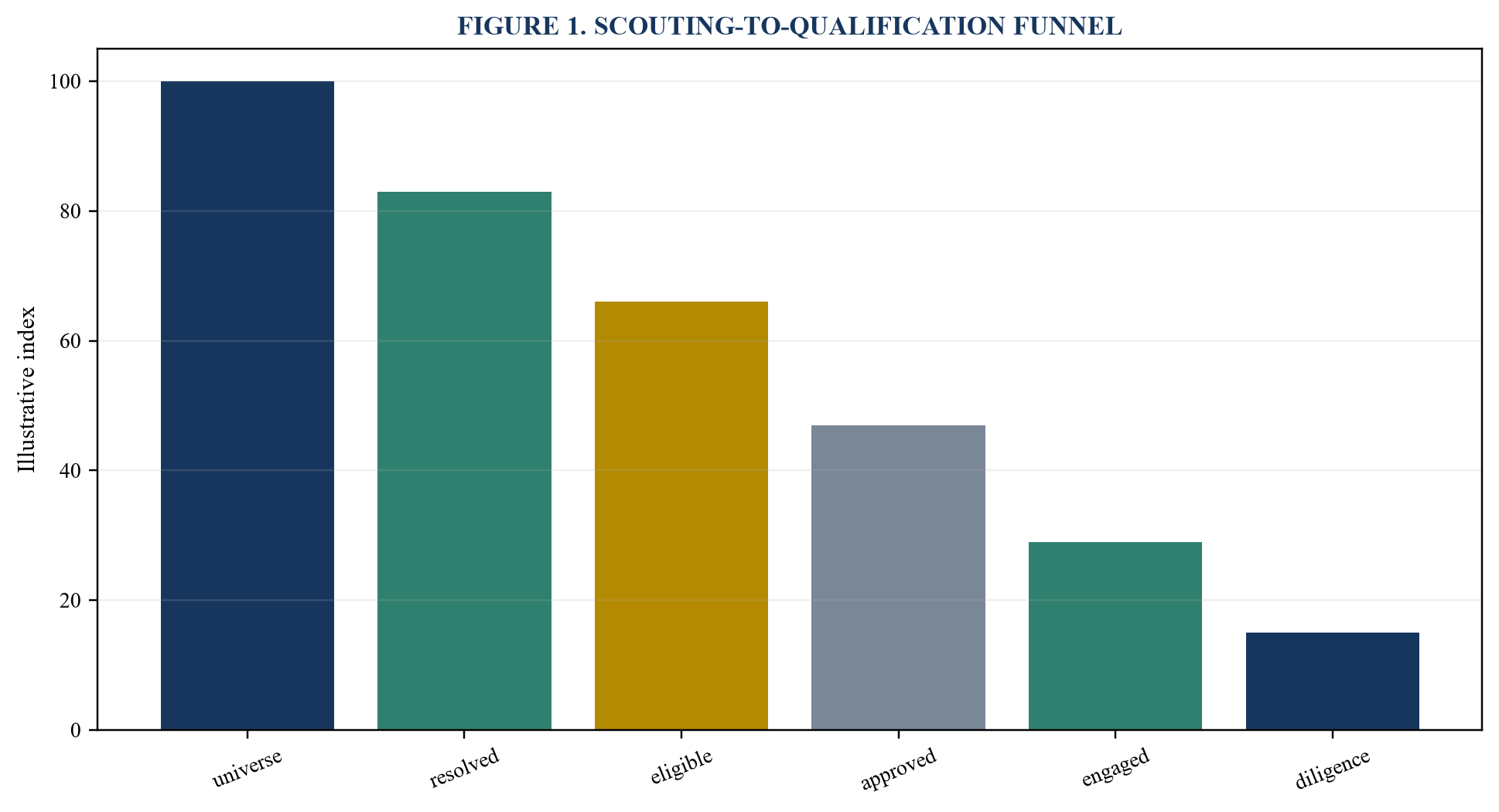
Values are illustrative indices for framework explanation and require allocator-specific evidence.
6. Create a signal hierarchy
Rank direct searches, mandates and approved programmes above allocation gaps, public commentary and weak behavioural traces.
Controlled evidence includes signal; class; source; date; directness; corroboration; confidence; expiry. The immediate decision is to distinguish observable demand from a research hypothesis.
The operating record should connect the institution, plan, strategy, vehicle, person, source, event, communication and outcome. Reviewers need to see what moved the priority, what remains unknown and which hard gate applies. Overrides should retain the reason, author, timestamp and later result so that the programme can learn from disciplined exceptions.
Negative outcomes form part of the evidence population. Closed programmes, rejections, delayed searches, missing diligence, unresponsive contacts and weak propositions should remain in cohort analysis. Omitting them would overstate precision, conversion and economics, especially where relationship teams concentrate on institutions that were already accessible.
7. Apply legal and eligibility gates
Test investor qualification, vehicle eligibility, marketing rules, sanctions, geography, minimum commitment and other hard constraints.
Controlled evidence includes allocator; vehicle; jurisdiction; rule; gate; evidence; counsel; review. The immediate decision is to remove prohibited and structurally impossible routes.
Negative outcomes form part of the evidence population. Closed programmes, rejections, delayed searches, missing diligence, unresponsive contacts and weak propositions should remain in cohort analysis. Omitting them would overstate precision, conversion and economics, especially where relationship teams concentrate on institutions that were already accessible.
Review should remain allocator-, vehicle-, strategy-, jurisdiction- and period-specific. A signal from one office or pool should not be generalised across an institution without evidence. Comparisons should control for fund maturity, strategy, size, team evidence, access route, market conditions and the effort invested by senior coverage professionals.
8. Score mandate alignment
Compare strategy, sector, stage, geography, structure, liquidity, duration, return and sustainability attributes.
Controlled evidence includes attribute; allocator requirement; fund attribute; match; evidence; gap; reviewer; version. The immediate decision is to rank structural fit using transparent comparisons.
Review should remain allocator-, vehicle-, strategy-, jurisdiction- and period-specific. A signal from one office or pool should not be generalised across an institution without evidence. Comparisons should control for fund maturity, strategy, size, team evidence, access route, market conditions and the effort invested by senior coverage professionals.
Emerging managers should preserve the distinction between an addressable institution, a research lead, a permitted target, an active relationship and a qualified opportunity. Each transition needs dated evidence and a named owner. Allocation targets or public interest can support research, yet they do not by themselves establish budget, timing, access or willingness to invest.
9. Read current portfolio exposure
Map disclosed managers, strategies, vintages, concentrations, adjacent programmes and gaps with point-in-time evidence.
Controlled evidence includes allocator; manager; fund; strategy; vintage; exposure; date; source. The immediate decision is to explain the proposed fund's plausible portfolio role.
Emerging managers should preserve the distinction between an addressable institution, a research lead, a permitted target, an active relationship and a qualified opportunity. Each transition needs dated evidence and a named owner. Allocation targets or public interest can support research, yet they do not by themselves establish budget, timing, access or willingness to invest.
The operating record should connect the institution, plan, strategy, vehicle, person, source, event, communication and outcome. Reviewers need to see what moved the priority, what remains unknown and which hard gate applies. Overrides should retain the reason, author, timestamp and later result so that the programme can learn from disciplined exceptions.
10. Estimate pacing and capacity
Combine targets, commitments, calls, distributions, liquidity, budgets and programme maturity into bounded capacity hypotheses.
Controlled evidence includes target; actual; commitment; cash flow; budget; period; range; confidence. The immediate decision is to identify plausible commitment windows without claiming intent.
The operating record should connect the institution, plan, strategy, vehicle, person, source, event, communication and outcome. Reviewers need to see what moved the priority, what remains unknown and which hard gate applies. Overrides should retain the reason, author, timestamp and later result so that the programme can learn from disciplined exceptions.
Negative outcomes form part of the evidence population. Closed programmes, rejections, delayed searches, missing diligence, unresponsive contacts and weak propositions should remain in cohort analysis. Omitting them would overstate precision, conversion and economics, especially where relationship teams concentrate on institutions that were already accessible.
11. Map consultants and access channels
Identify gatekeepers, outsourced CIOs, platforms, advisers, introducers and verified relationship owners.
Controlled evidence includes allocator; gatekeeper; role; relationship; permission; recency; source; owner. The immediate decision is to select a credible and authorised route to each institution.
Negative outcomes form part of the evidence population. Closed programmes, rejections, delayed searches, missing diligence, unresponsive contacts and weak propositions should remain in cohort analysis. Omitting them would overstate precision, conversion and economics, especially where relationship teams concentrate on institutions that were already accessible.
Review should remain allocator-, vehicle-, strategy-, jurisdiction- and period-specific. A signal from one office or pool should not be generalised across an institution without evidence. Comparisons should control for fund maturity, strategy, size, team evidence, access route, market conditions and the effort invested by senior coverage professionals.
12. Track people and governance events
Monitor investment leadership, committee, board, consultant and team changes that may alter priorities or decision timing.
Controlled evidence includes person; role; body; event; date; source; consequence; review. The immediate decision is to keep coverage aligned with current authority.
Review should remain allocator-, vehicle-, strategy-, jurisdiction- and period-specific. A signal from one office or pool should not be generalised across an institution without evidence. Comparisons should control for fund maturity, strategy, size, team evidence, access route, market conditions and the effort invested by senior coverage professionals.
Emerging managers should preserve the distinction between an addressable institution, a research lead, a permitted target, an active relationship and a qualified opportunity. Each transition needs dated evidence and a named owner. Allocation targets or public interest can support research, yet they do not by themselves establish budget, timing, access or willingness to invest.
Table 2. Signal hierarchy and use
| Signal | Interpretation | Control |
|---|---|---|
| formal search | explicit process | verify eligibility and deadline |
| approved programme | strategic direction | test pacing and delegation |
| allocation gap | capacity hypothesis | reconcile commitments |
| public statement | context | corroborate and expire |
Illustrative classifications require institution-specific evidence and approved treatment.
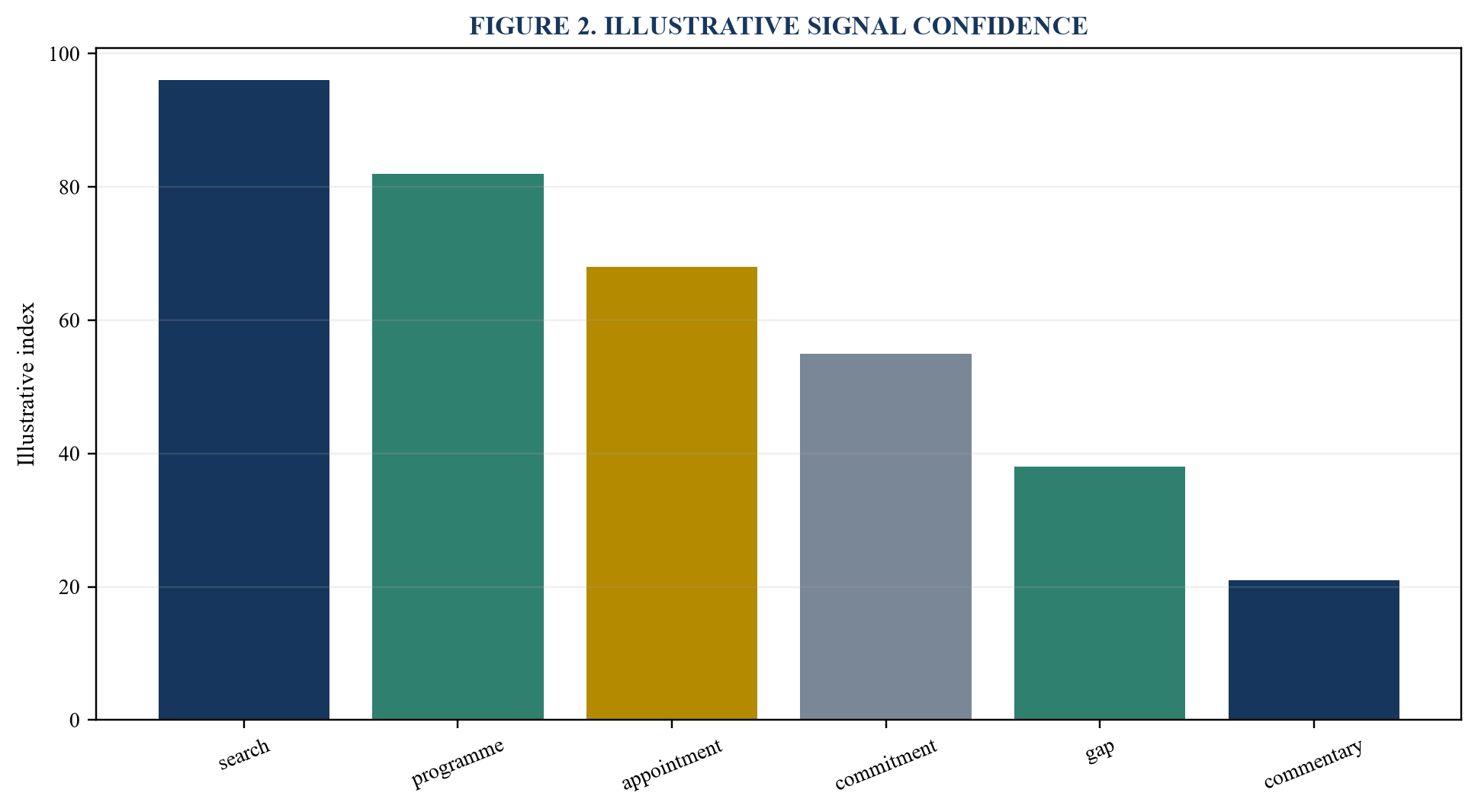
Values are illustrative indices for framework explanation and require allocator-specific evidence.
13. Capture searches and procurement
Record formal searches, requests for proposals, procurement notices and board mandates with requirements and deadlines.
Controlled evidence includes issuer; search; strategy; requirement; deadline; process; source; status. The immediate decision is to prioritise explicit processes under their published rules.
Emerging managers should preserve the distinction between an addressable institution, a research lead, a permitted target, an active relationship and a qualified opportunity. Each transition needs dated evidence and a named owner. Allocation targets or public interest can support research, yet they do not by themselves establish budget, timing, access or willingness to invest.
The operating record should connect the institution, plan, strategy, vehicle, person, source, event, communication and outcome. Reviewers need to see what moved the priority, what remains unknown and which hard gate applies. Overrides should retain the reason, author, timestamp and later result so that the programme can learn from disciplined exceptions.
14. Interpret strategic plans and public statements
Extract sourced themes, portfolio priorities and implementation intentions from official plans, reports and speeches.
Controlled evidence includes issuer; statement; theme; horizon; condition; source; date; confidence. The immediate decision is to form a time-bounded relevance hypothesis.
The operating record should connect the institution, plan, strategy, vehicle, person, source, event, communication and outcome. Reviewers need to see what moved the priority, what remains unknown and which hard gate applies. Overrides should retain the reason, author, timestamp and later result so that the programme can learn from disciplined exceptions.
Negative outcomes form part of the evidence population. Closed programmes, rejections, delayed searches, missing diligence, unresponsive contacts and weak propositions should remain in cohort analysis. Omitting them would overstate precision, conversion and economics, especially where relationship teams concentrate on institutions that were already accessible.
15. Verify relationship evidence
Separate introductions, meetings and permissions from scraped contact data, assumed familiarity or outdated employment links.
Controlled evidence includes parties; interaction; permission; source; date; owner; status; next action. The immediate decision is to prevent invented access from inflating pipeline quality.
Negative outcomes form part of the evidence population. Closed programmes, rejections, delayed searches, missing diligence, unresponsive contacts and weak propositions should remain in cohort analysis. Omitting them would overstate precision, conversion and economics, especially where relationship teams concentrate on institutions that were already accessible.
Review should remain allocator-, vehicle-, strategy-, jurisdiction- and period-specific. A signal from one office or pool should not be generalised across an institution without evidence. Comparisons should control for fund maturity, strategy, size, team evidence, access route, market conditions and the effort invested by senior coverage professionals.
16. Control source rights
Register licensing, terms of use, confidentiality, permitted purpose, retention and restrictions for each research source.
Controlled evidence includes source; owner; licence; purpose; restriction; retention; approval; review. The immediate decision is to use only data the manager is entitled to process.
Review should remain allocator-, vehicle-, strategy-, jurisdiction- and period-specific. A signal from one office or pool should not be generalised across an institution without evidence. Comparisons should control for fund maturity, strategy, size, team evidence, access route, market conditions and the effort invested by senior coverage professionals.
Emerging managers should preserve the distinction between an addressable institution, a research lead, a permitted target, an active relationship and a qualified opportunity. Each transition needs dated evidence and a named owner. Allocation targets or public interest can support research, yet they do not by themselves establish budget, timing, access or willingness to invest.
17. Govern personal data
Apply lawful-basis, minimisation, accuracy, objection, suppression, security and retention controls to business-contact information.
Controlled evidence includes person; data; purpose; lawful basis; source; notice; retention; suppression. The immediate decision is to protect individual rights through the research and outreach lifecycle.
Emerging managers should preserve the distinction between an addressable institution, a research lead, a permitted target, an active relationship and a qualified opportunity. Each transition needs dated evidence and a named owner. Allocation targets or public interest can support research, yet they do not by themselves establish budget, timing, access or willingness to invest.
The operating record should connect the institution, plan, strategy, vehicle, person, source, event, communication and outcome. Reviewers need to see what moved the priority, what remains unknown and which hard gate applies. Overrides should retain the reason, author, timestamp and later result so that the programme can learn from disciplined exceptions.
18. Map marketing jurisdictions
Connect each prospective communication to the vehicle, recipient type, location, marketing status, exemption and approval route.
Controlled evidence includes communication; vehicle; recipient; jurisdiction; status; exemption; counsel; approval. The immediate decision is to stop outreach that lacks a permitted regulatory path.
The operating record should connect the institution, plan, strategy, vehicle, person, source, event, communication and outcome. Reviewers need to see what moved the priority, what remains unknown and which hard gate applies. Overrides should retain the reason, author, timestamp and later result so that the programme can learn from disciplined exceptions.
Negative outcomes form part of the evidence population. Closed programmes, rejections, delayed searches, missing diligence, unresponsive contacts and weak propositions should remain in cohort analysis. Omitting them would overstate precision, conversion and economics, especially where relationship teams concentrate on institutions that were already accessible.
19. Substantiate fund claims
Link track record, attribution, team experience, performance, examples, comparisons and sustainability statements to approved evidence.
Controlled evidence includes claim; source; calculation; period; disclosure; reviewer; version; retention. The immediate decision is to ensure communications remain supportable and balanced.
Negative outcomes form part of the evidence population. Closed programmes, rejections, delayed searches, missing diligence, unresponsive contacts and weak propositions should remain in cohort analysis. Omitting them would overstate precision, conversion and economics, especially where relationship teams concentrate on institutions that were already accessible.
Review should remain allocator-, vehicle-, strategy-, jurisdiction- and period-specific. A signal from one office or pool should not be generalised across an institution without evidence. Comparisons should control for fund maturity, strategy, size, team evidence, access route, market conditions and the effort invested by senior coverage professionals.
20. Build the scouting evidence graph
Connect allocators, people, mandates, portfolios, events, relationships, communications and outcomes through typed links.
Controlled evidence includes node; edge; type; source; date; confidence; owner; version. The immediate decision is to make every priority and rationale traceable.
Review should remain allocator-, vehicle-, strategy-, jurisdiction- and period-specific. A signal from one office or pool should not be generalised across an institution without evidence. Comparisons should control for fund maturity, strategy, size, team evidence, access route, market conditions and the effort invested by senior coverage professionals.
Emerging managers should preserve the distinction between an addressable institution, a research lead, a permitted target, an active relationship and a qualified opportunity. Each transition needs dated evidence and a named owner. Allocation targets or public interest can support research, yet they do not by themselves establish budget, timing, access or willingness to invest.
Table 3. Outreach control matrix
| Layer | Required evidence | Failure risk |
|---|---|---|
| recipient | identity and eligibility | wrong party |
| jurisdiction | marketing status | prohibited approach |
| claim | source and disclosure | misleading communication |
| relationship | permission and owner | invented access |
Illustrative classifications require institution-specific evidence and approved treatment.
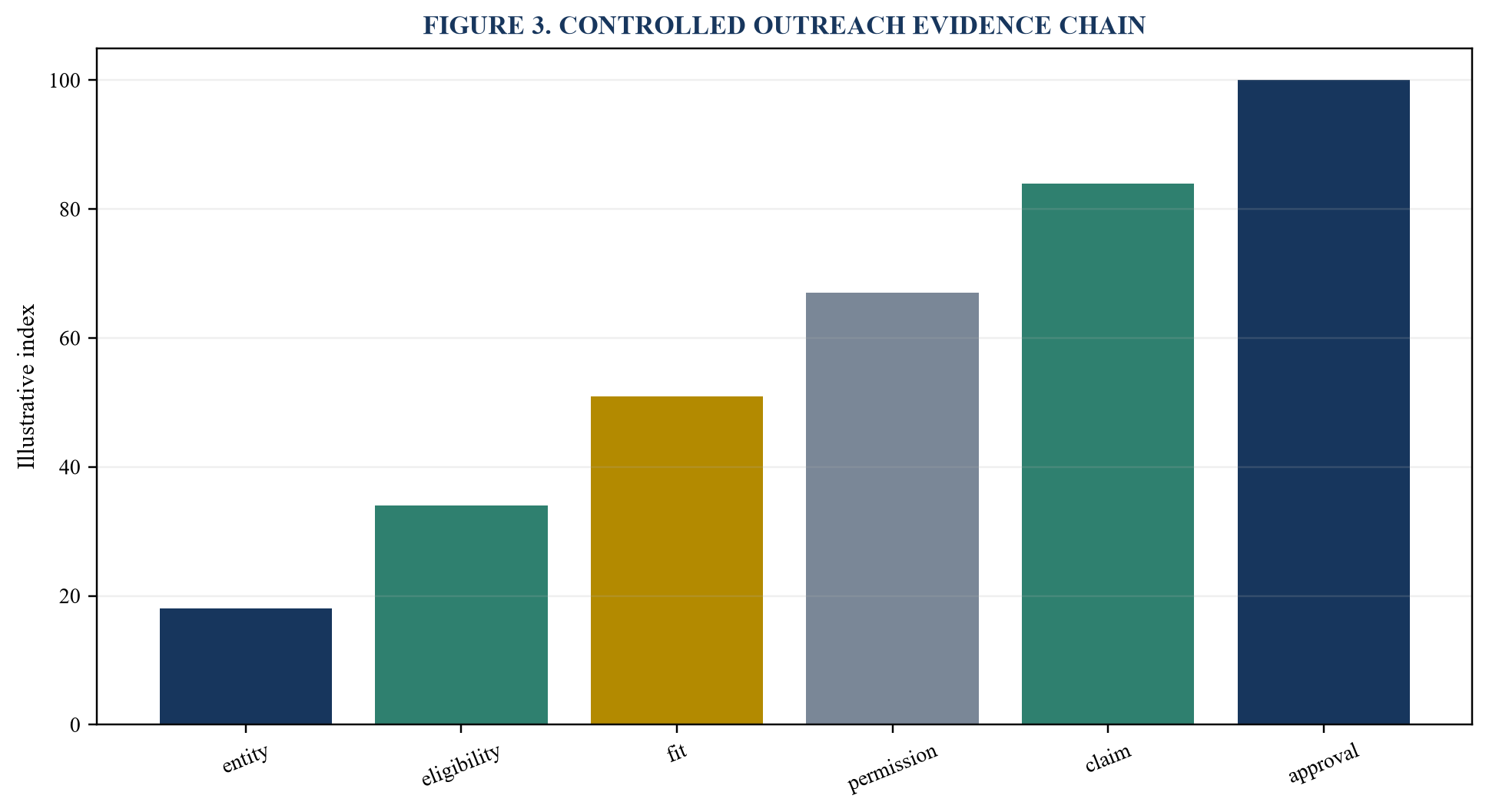
Values are illustrative indices for framework explanation and require allocator-specific evidence.
21. Separate fact, estimate and hypothesis
Label verified records, calculated values, model outputs and coverage hypotheses with distinct confidence and expiry.
Controlled evidence includes statement; class; source; method; confidence; expiry; reviewer; action. The immediate decision is to keep inference visible to the internal decision maker.
Emerging managers should preserve the distinction between an addressable institution, a research lead, a permitted target, an active relationship and a qualified opportunity. Each transition needs dated evidence and a named owner. Allocation targets or public interest can support research, yet they do not by themselves establish budget, timing, access or willingness to invest.
The operating record should connect the institution, plan, strategy, vehicle, person, source, event, communication and outcome. Reviewers need to see what moved the priority, what remains unknown and which hard gate applies. Overrides should retain the reason, author, timestamp and later result so that the programme can learn from disciplined exceptions.
22. Preserve point-in-time history
Store effective, publication and retrieval dates together with superseded values and model versions.
Controlled evidence includes record; effective date; published date; retrieved date; version; prior value; source; hash. The immediate decision is to reproduce the evidence available when a target was ranked.
The operating record should connect the institution, plan, strategy, vehicle, person, source, event, communication and outcome. Reviewers need to see what moved the priority, what remains unknown and which hard gate applies. Overrides should retain the reason, author, timestamp and later result so that the programme can learn from disciplined exceptions.
Negative outcomes form part of the evidence population. Closed programmes, rejections, delayed searches, missing diligence, unresponsive contacts and weak propositions should remain in cohort analysis. Omitting them would overstate precision, conversion and economics, especially where relationship teams concentrate on institutions that were already accessible.
23. Design a qualification score
Combine eligibility, fit, portfolio role, capacity, timing, access and manager readiness while keeping vetoes explicit.
Controlled evidence includes factor; definition; value; weight; evidence; veto; sensitivity; approval. The immediate decision is to rank research priorities without obscuring hard constraints.
Negative outcomes form part of the evidence population. Closed programmes, rejections, delayed searches, missing diligence, unresponsive contacts and weak propositions should remain in cohort analysis. Omitting them would overstate precision, conversion and economics, especially where relationship teams concentrate on institutions that were already accessible.
Review should remain allocator-, vehicle-, strategy-, jurisdiction- and period-specific. A signal from one office or pool should not be generalised across an institution without evidence. Comparisons should control for fund maturity, strategy, size, team evidence, access route, market conditions and the effort invested by senior coverage professionals.
24. Apply confidence and time decay
Reduce the weight of indirect, old, contradicted or weakly sourced signals and surface unresolved uncertainty.
Controlled evidence includes signal; age; source tier; corroboration; contradiction; decay; confidence; review. The immediate decision is to prevent stale evidence from driving current coverage.
Review should remain allocator-, vehicle-, strategy-, jurisdiction- and period-specific. A signal from one office or pool should not be generalised across an institution without evidence. Comparisons should control for fund maturity, strategy, size, team evidence, access route, market conditions and the effort invested by senior coverage professionals.
Emerging managers should preserve the distinction between an addressable institution, a research lead, a permitted target, an active relationship and a qualified opportunity. Each transition needs dated evidence and a named owner. Allocation targets or public interest can support research, yet they do not by themselves establish budget, timing, access or willingness to invest.
25. Model relationship readiness
Score current ownership, permission, route quality, recency, relevance and conflicts separately from investment fit.
Controlled evidence includes relationship; owner; permission; route; recency; relevance; conflict; evidence. The immediate decision is to avoid confusing access with allocator demand.
Emerging managers should preserve the distinction between an addressable institution, a research lead, a permitted target, an active relationship and a qualified opportunity. Each transition needs dated evidence and a named owner. Allocation targets or public interest can support research, yet they do not by themselves establish budget, timing, access or willingness to invest.
The operating record should connect the institution, plan, strategy, vehicle, person, source, event, communication and outcome. Reviewers need to see what moved the priority, what remains unknown and which hard gate applies. Overrides should retain the reason, author, timestamp and later result so that the programme can learn from disciplined exceptions.
26. Retain negative and missing evidence
Preserve explicit rejections, closed programmes, failed searches, unanswered approaches, known constraints and research gaps.
Controlled evidence includes event; negative evidence; missing field; date; owner; consequence; resolution; expiry. The immediate decision is to counter optimism and selection bias.
The operating record should connect the institution, plan, strategy, vehicle, person, source, event, communication and outcome. Reviewers need to see what moved the priority, what remains unknown and which hard gate applies. Overrides should retain the reason, author, timestamp and later result so that the programme can learn from disciplined exceptions.
Negative outcomes form part of the evidence population. Closed programmes, rejections, delayed searches, missing diligence, unresponsive contacts and weak propositions should remain in cohort analysis. Omitting them would overstate precision, conversion and economics, especially where relationship teams concentrate on institutions that were already accessible.
27. Use AI for bounded extraction
Extract entities, mandates, holdings, dates and events from approved documents with source spans and reviewer corrections.
Controlled evidence includes document; span; extraction; model; version; reviewer; correction; approval. The immediate decision is to accelerate research while retaining evidence lineage.
Negative outcomes form part of the evidence population. Closed programmes, rejections, delayed searches, missing diligence, unresponsive contacts and weak propositions should remain in cohort analysis. Omitting them would overstate precision, conversion and economics, especially where relationship teams concentrate on institutions that were already accessible.
Review should remain allocator-, vehicle-, strategy-, jurisdiction- and period-specific. A signal from one office or pool should not be generalised across an institution without evidence. Comparisons should control for fund maturity, strategy, size, team evidence, access route, market conditions and the effort invested by senior coverage professionals.
28. Ground summaries through retrieval
Generate allocator briefs and relevance rationales only from approved point-in-time records selected for that institution.
Controlled evidence includes query; corpus; retrieved record; response; citation; uncertainty; reviewer; approval. The immediate decision is to keep generated analysis connected to its source.
Review should remain allocator-, vehicle-, strategy-, jurisdiction- and period-specific. A signal from one office or pool should not be generalised across an institution without evidence. Comparisons should control for fund maturity, strategy, size, team evidence, access route, market conditions and the effort invested by senior coverage professionals.
Emerging managers should preserve the distinction between an addressable institution, a research lead, a permitted target, an active relationship and a qualified opportunity. Each transition needs dated evidence and a named owner. Allocation targets or public interest can support research, yet they do not by themselves establish budget, timing, access or willingness to invest.
29. Validate the ranking model
Back-test historical cohorts, compare simple rules and human judgment, and measure calibration by allocator segment.
Controlled evidence includes population; period; label; score; benchmark; error; segment; outcome. The immediate decision is to approve the score only for demonstrated decisions.
Emerging managers should preserve the distinction between an addressable institution, a research lead, a permitted target, an active relationship and a qualified opportunity. Each transition needs dated evidence and a named owner. Allocation targets or public interest can support research, yet they do not by themselves establish budget, timing, access or willingness to invest.
The operating record should connect the institution, plan, strategy, vehicle, person, source, event, communication and outcome. Reviewers need to see what moved the priority, what remains unknown and which hard gate applies. Overrides should retain the reason, author, timestamp and later result so that the programme can learn from disciplined exceptions.
30. Test disclosure and relationship bias
Assess whether institution size, language, geography, public disclosure or existing networks distort selection.
Controlled evidence includes segment; data coverage; score; selection; outcome; disparity; cause; remedy. The immediate decision is to avoid excluding suitable quieter institutions.
The operating record should connect the institution, plan, strategy, vehicle, person, source, event, communication and outcome. Reviewers need to see what moved the priority, what remains unknown and which hard gate applies. Overrides should retain the reason, author, timestamp and later result so that the programme can learn from disciplined exceptions.
Negative outcomes form part of the evidence population. Closed programmes, rejections, delayed searches, missing diligence, unresponsive contacts and weak propositions should remain in cohort analysis. Omitting them would overstate precision, conversion and economics, especially where relationship teams concentrate on institutions that were already accessible.
Table 4. Ranking validation
| Test | Measure | Decision |
|---|---|---|
| discrimination | precision and recall | approve bounded use |
| calibration | outcome by score band | set confidence |
| bias | coverage and selection gaps | remediate |
| economics | qualified conversion after cost | scale or stop |
Illustrative classifications require institution-specific evidence and approved treatment.
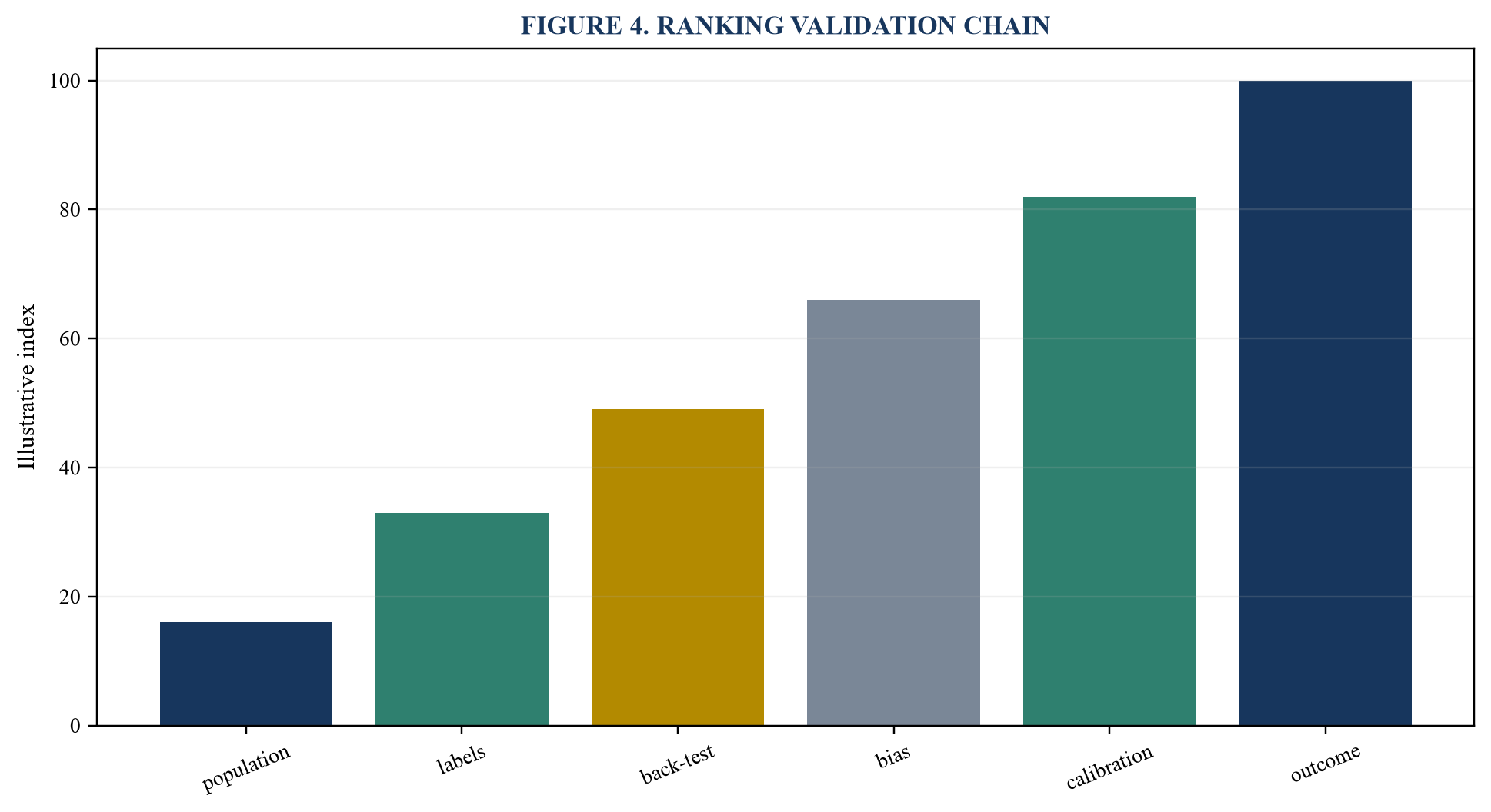
Values are illustrative indices for framework explanation and require allocator-specific evidence.
31. Require human verification
Give a named reviewer the source evidence, uncertainties, vetoes and authority to approve, amend or reject each priority.
Controlled evidence includes target; evidence; rationale; uncertainty; reviewer; decision; timestamp; outcome. The immediate decision is to make qualification accountable.
Negative outcomes form part of the evidence population. Closed programmes, rejections, delayed searches, missing diligence, unresponsive contacts and weak propositions should remain in cohort analysis. Omitting them would overstate precision, conversion and economics, especially where relationship teams concentrate on institutions that were already accessible.
Review should remain allocator-, vehicle-, strategy-, jurisdiction- and period-specific. A signal from one office or pool should not be generalised across an institution without evidence. Comparisons should control for fund maturity, strategy, size, team evidence, access route, market conditions and the effort invested by senior coverage professionals.
32. Create compliant outreach priorities
Translate verified rank into a permitted channel, relationship owner, specific relevance case, evidence request and next action.
Controlled evidence includes allocator; owner; channel; permission; rationale; action; deadline; approval. The immediate decision is to turn research into controlled engagement.
Review should remain allocator-, vehicle-, strategy-, jurisdiction- and period-specific. A signal from one office or pool should not be generalised across an institution without evidence. Comparisons should control for fund maturity, strategy, size, team evidence, access route, market conditions and the effort invested by senior coverage professionals.
Emerging managers should preserve the distinction between an addressable institution, a research lead, a permitted target, an active relationship and a qualified opportunity. Each transition needs dated evidence and a named owner. Allocation targets or public interest can support research, yet they do not by themselves establish budget, timing, access or willingness to invest.
33. Prepare institution-specific communication
Draft concise communication that reflects the allocator's published mandate and the fund's evidenced portfolio role.
Controlled evidence includes recipient; context; claim; source; risk; disclosure; reviewer; version. The immediate decision is to improve relevance without manufacturing familiarity.
Emerging managers should preserve the distinction between an addressable institution, a research lead, a permitted target, an active relationship and a qualified opportunity. Each transition needs dated evidence and a named owner. Allocation targets or public interest can support research, yet they do not by themselves establish budget, timing, access or willingness to invest.
The operating record should connect the institution, plan, strategy, vehicle, person, source, event, communication and outcome. Reviewers need to see what moved the priority, what remains unknown and which hard gate applies. Overrides should retain the reason, author, timestamp and later result so that the programme can learn from disciplined exceptions.
34. Capture meeting and response intelligence
Record the questions, objections, decision process, evidence requests, timeline and permission arising from human interactions.
Controlled evidence includes meeting; participant; question; objection; request; timeline; permission; owner. The immediate decision is to convert dialogue into governed relationship intelligence.
The operating record should connect the institution, plan, strategy, vehicle, person, source, event, communication and outcome. Reviewers need to see what moved the priority, what remains unknown and which hard gate applies. Overrides should retain the reason, author, timestamp and later result so that the programme can learn from disciplined exceptions.
Negative outcomes form part of the evidence population. Closed programmes, rejections, delayed searches, missing diligence, unresponsive contacts and weak propositions should remain in cohort analysis. Omitting them would overstate precision, conversion and economics, especially where relationship teams concentrate on institutions that were already accessible.
35. Gate progression on diligence readiness
Compare LP requests with fund documents, operations, track record, valuation, cyber, governance and reporting evidence.
Controlled evidence includes request; evidence; owner; freshness; gap; remediation; reviewer; status. The immediate decision is to advance only opportunities the manager can support.
Negative outcomes form part of the evidence population. Closed programmes, rejections, delayed searches, missing diligence, unresponsive contacts and weak propositions should remain in cohort analysis. Omitting them would overstate precision, conversion and economics, especially where relationship teams concentrate on institutions that were already accessible.
Review should remain allocator-, vehicle-, strategy-, jurisdiction- and period-specific. A signal from one office or pool should not be generalised across an institution without evidence. Comparisons should control for fund maturity, strategy, size, team evidence, access route, market conditions and the effort invested by senior coverage professionals.
36. Measure the verified pipeline
Track eligible accounts, approved targets, responses, meetings, diligence, committee progression, commitments and collected outcomes.
Controlled evidence includes stage; opening; closing; period; owner; amount; reason; evidence. The immediate decision is to report conversion using stable definitions.
Review should remain allocator-, vehicle-, strategy-, jurisdiction- and period-specific. A signal from one office or pool should not be generalised across an institution without evidence. Comparisons should control for fund maturity, strategy, size, team evidence, access route, market conditions and the effort invested by senior coverage professionals.
Emerging managers should preserve the distinction between an addressable institution, a research lead, a permitted target, an active relationship and a qualified opportunity. Each transition needs dated evidence and a named owner. Allocation targets or public interest can support research, yet they do not by themselves establish budget, timing, access or willingness to invest.
37. Measure cost and commercial value
Include data, technology, research, compliance, senior time, travel, diligence and placement costs in cohort economics.
Controlled evidence includes cohort; cost; activity; outcome; commitment; fee; cash; period. The immediate decision is to assess whether scouting creates sustainable value.
Emerging managers should preserve the distinction between an addressable institution, a research lead, a permitted target, an active relationship and a qualified opportunity. Each transition needs dated evidence and a named owner. Allocation targets or public interest can support research, yet they do not by themselves establish budget, timing, access or willingness to invest.
The operating record should connect the institution, plan, strategy, vehicle, person, source, event, communication and outcome. Reviewers need to see what moved the priority, what remains unknown and which hard gate applies. Overrides should retain the reason, author, timestamp and later result so that the programme can learn from disciplined exceptions.
38. Monitor drift and stale records
Detect mandate, portfolio, personnel, relationship, regulation and model changes that invalidate prior priorities.
Controlled evidence includes record; prior state; new state; contradiction; age; impact; owner; resolution. The immediate decision is to refresh or suspend affected targets.
The operating record should connect the institution, plan, strategy, vehicle, person, source, event, communication and outcome. Reviewers need to see what moved the priority, what remains unknown and which hard gate applies. Overrides should retain the reason, author, timestamp and later result so that the programme can learn from disciplined exceptions.
Negative outcomes form part of the evidence population. Closed programmes, rejections, delayed searches, missing diligence, unresponsive contacts and weak propositions should remain in cohort analysis. Omitting them would overstate precision, conversion and economics, especially where relationship teams concentrate on institutions that were already accessible.
39. Govern management information and assurance
Reconcile research quality, pipeline conversion, conduct, exceptions, cost and realised outcomes for leadership review.
Controlled evidence includes metric; definition; population; source; reconciliation; threshold; owner; action. The immediate decision is to manage the programme through decision-useful evidence.
Negative outcomes form part of the evidence population. Closed programmes, rejections, delayed searches, missing diligence, unresponsive contacts and weak propositions should remain in cohort analysis. Omitting them would overstate precision, conversion and economics, especially where relationship teams concentrate on institutions that were already accessible.
Review should remain allocator-, vehicle-, strategy-, jurisdiction- and period-specific. A signal from one office or pool should not be generalised across an institution without evidence. Comparisons should control for fund maturity, strategy, size, team evidence, access route, market conditions and the effort invested by senior coverage professionals.
Table 5. Evidence-gated rollout
| Period | Primary work | Gate |
|---|---|---|
| days 1-30 | universe, rights and qualification | approve baseline |
| days 31-60 | graph, scoring and back-test | approve pilot |
| days 61-100 | outreach workflow and outcomes | approve scale |
Illustrative classifications require institution-specific evidence and approved treatment.
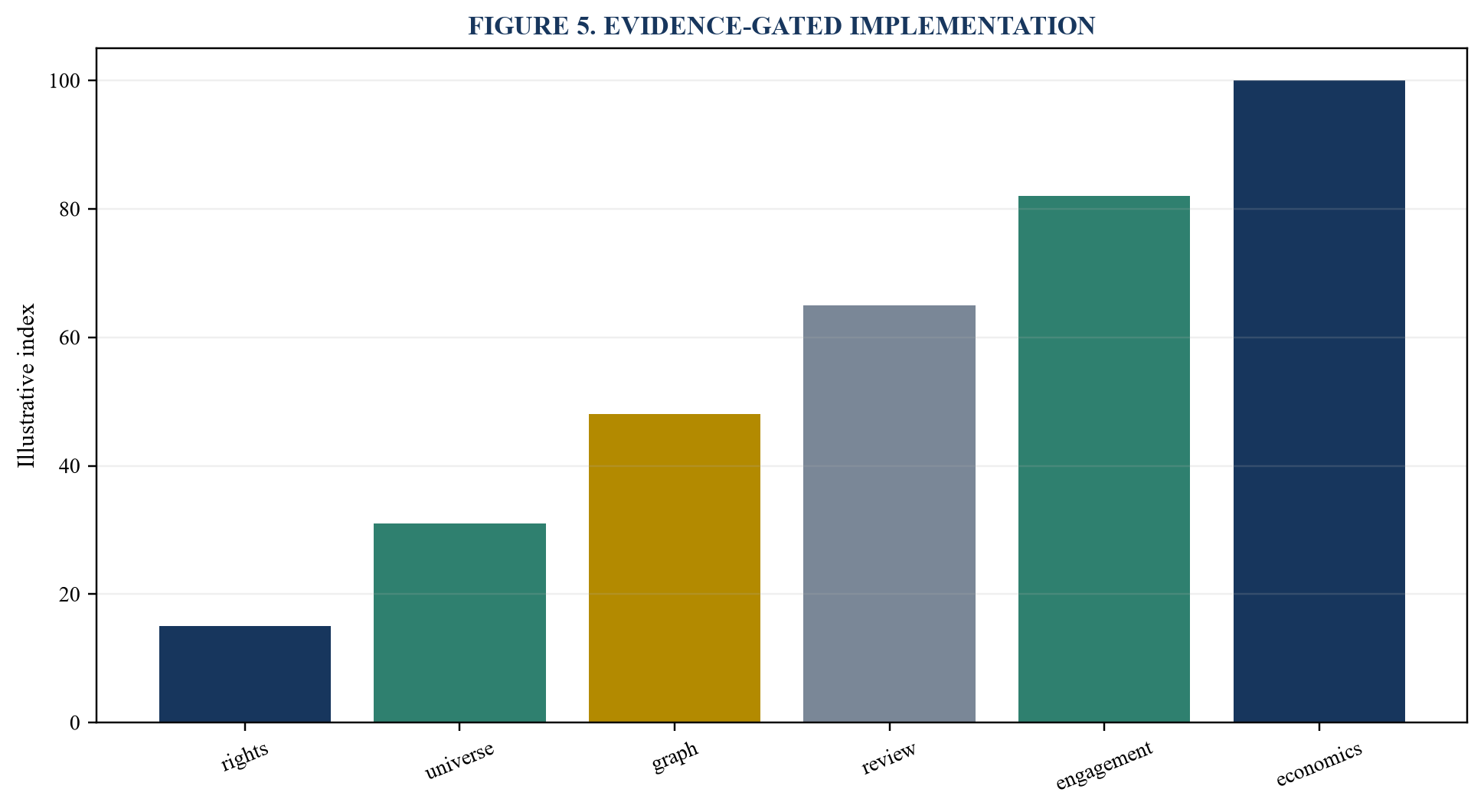
Values are illustrative indices for framework explanation and require allocator-specific evidence.
40. Implement through evidence-gated cohorts
Pilot a bounded strategy and allocator class, verify records and outcomes, then expand through explicit gates.
Controlled evidence includes cohort; scope; owner; test; threshold; exception; benefit; gate. The immediate decision is to scale only after evidence, conduct and economic tests pass.
Review should remain allocator-, vehicle-, strategy-, jurisdiction- and period-specific. A signal from one office or pool should not be generalised across an institution without evidence. Comparisons should control for fund maturity, strategy, size, team evidence, access route, market conditions and the effort invested by senior coverage professionals.
Emerging managers should preserve the distinction between an addressable institution, a research lead, a permitted target, an active relationship and a qualified opportunity. Each transition needs dated evidence and a named owner. Allocation targets or public interest can support research, yet they do not by themselves establish budget, timing, access or willingness to invest.
The pilot should use a historical snapshot containing successful, unsuccessful and ambiguous institutions. Independent reviewers should reconstruct the available evidence, compare the model and human decisions, and record where entity resolution, eligibility, signal interpretation, relationship assumptions or proposition quality changed the result.
A scale gate should require acceptable data rights, point-in-time reproducibility, qualification accuracy, conduct review, reviewer capacity and cohort economics. Expansion to another jurisdiction or allocator class creates a new evidence distribution and therefore needs renewed validation, marketing review and operating ownership.
References
- Institutional Limited Partners Association, Due Diligence Questionnaire 2.0, https://ilpa.org/resources-tools/resource-library/due-diligence-questionnaire/
- Institutional Limited Partners Association, Principles 3.0, https://ilpa.org/industry-guidance/principles-best-practices/ilpa-principles/
- International Organization of Securities Commissions, Artificial Intelligence in Capital Markets, https://www.iosco.org/library/pubdocs/pdf/IOSCOPD813.pdf
- US Securities and Exchange Commission, Investment Adviser Marketing, https://www.sec.gov/resources-small-businesses/small-business-compliance-guides/investment-adviser-marketing
- US Securities and Exchange Commission, Marketing Compliance Frequently Asked Questions, https://www.sec.gov/rules-regulations/staff-guidance/division-investment-management-frequently-asked-questions/marketing-compliance-frequently-asked-questions
- US Securities and Exchange Commission, Form ADV and Investment Advisers Act Rules, https://www.sec.gov/rules-regulations/2016/08/form-adv-investment-advisers-act-rules
- US Securities and Exchange Commission, Private Fund Adviser Overview, https://www.sec.gov/about/divisions-offices/division-investment-management/private-fund-adviser-overview
- European Securities and Markets Authority, Guidelines on Marketing Communications, https://www.esma.europa.eu/document/guidelines-marketing-communications-under-regulation-cross-border-distribution-funds
- European Securities and Markets Authority, Fund Management and Cross-Border Distribution, https://www.esma.europa.eu/esmas-activities/investors-and-issuers/fund-management
- European Commission, Alternative Investment Fund Managers Directive, https://finance.ec.europa.eu/regulation-and-supervision/financial-services-legislation/implementing-and-delegated-acts/alternative-investment-fund-managers-directive_en
- Financial Conduct Authority, Financial Promotions and Adverts, https://www.fca.org.uk/firms/financial-promotions-adverts
- Financial Conduct Authority, Social Media Financial Promotions Guidance, https://www.fca.org.uk/news/press-releases/fca-warns-firms-and-finfluencers-keep-their-social-media-ads-lawful
- Financial Conduct Authority, Artificial Intelligence Approach, https://www.fca.org.uk/firms/innovation/ai-approach
- Information Commissioner's Office, Direct Marketing Guidance, https://ico.org.uk/for-organisations/direct-marketing-and-privacy-and-electronic-communications/
- Information Commissioner's Office, Guidance on AI and Data Protection, https://ico.org.uk/for-organisations/uk-gdpr-guidance-and-resources/artificial-intelligence/
- OECD, Pension Markets in Focus 2025, https://www.oecd.org/en/publications/pension-markets-in-focus-2025_b095d0a0-en.html
- OECD, Pensions at a Glance 2025: Allocation of Assets, https://www.oecd.org/en/publications/pensions-at-a-glance-2025_e40274c1-en/full-report/allocation-of-assets_2cfd1e66.html
- OECD, Asset Allocation of Pension Funds and Other Pension Providers, https://data-explorer.oecd.org/vis?df%5Bag%5D=OECD.DAF.CM&df%5Bds%5D=dsDisseminateFinalDMZ&df%5Bid%5D=DSD_FP%40DF_WI&df%5Bvs%5D=1.0
- CalPERS, Investment Committee June 2026, https://www.calpers.ca.gov/about/board/board-meetings/invest-202606
- California State Teachers' Retirement System, Investment Policies, https://www.calstrs.com/investment-policies
- New York State Common Retirement Fund, Annual Reports, https://www.osc.ny.gov/common-retirement-fund/reports
- Australian Future Fund, Investment Mandate, https://www.futurefund.gov.au/about-us/investment-mandate
- National Institute of Standards and Technology, AI Risk Management Framework, https://www.nist.gov/itl/ai-risk-management-framework
- Financial Stability Board, Financial Stability Implications of Artificial Intelligence, https://www.fsb.org/2024/11/the-financial-stability-implications-of-artificial-intelligence/
- OECD, AI Principles, https://oecd.ai/en/ai-principles
- CFA Institute, Global Investment Performance Standards, https://www.gipsstandards.org/standards/
