

1. Define the board decision
The board needs to decide how the firm will protect revenue and rebuild margin as artificial intelligence changes the amount and type of work required to deliver professional services. The decision covers the service portfolio, commercial model, workforce, technology investment, risk, cash and client relationships. Treating AI as a software procurement choice leaves these connected issues unresolved.
The economic question begins at service-line level. A firm may deliver strategy advice, tax work, engineering design, financial diligence, managed operations, implementation, legal analysis or technology development. Each service contains different tasks, review standards and contractual promises. Some tasks can be accelerated through AI. Others depend on source evidence, professional judgment, physical inspection, negotiation or accountable decisions. A single firm-wide productivity assumption cannot represent that variation.
Management should define the period and decision thresholds. A useful first cycle covers the next 12 to 24 months and asks which revenue is exposed to lower billed effort, which costs can be changed without damaging delivery, which new offers can earn client budget, and which investments are required before scale. The analysis should identify both an operating case and a downside case.
The starting point is a reconciled baseline by service line, client and contract. It should show revenue, price basis, volume, delivery hours, contribution margin, grade mix, utilisation, write-offs, external spend, working capital and renewal or pipeline. The firm then overlays workflow evidence, observed AI usage, client insourcing signals and required assurance.
The board output is a margin-reset charter. It names the executive sponsor, service-line owners, finance lead, technology owner and risk owner. It sets the reporting period, investment envelope, client and quality protections, workforce principles and authority for changing offers, price and capacity. It also records which conclusions remain dependent on pilot evidence.
2. Read the evidence without converting exposure into a forecast
Recent evidence shows meaningful use of generative AI in knowledge work, together with substantial variation. The OECD surveyed more than 5,000 small and medium-sized enterprises across seven countries in late 2024. It reported that 31 percent used generative AI, 65 percent of users associated it with improved employee performance, 14 percent reported reduced reliance on external contractors and 83 percent reported no change in overall staff need [1]. These results describe reported experience in the surveyed population. They do not establish a margin outcome for a professional-services firm.
The United Kingdom's Business Data Use and Productivity Study reported that 56 percent of businesses handling digital data in the professional, scientific and technical sector used AI technologies [2]. The survey also found that research, summarisation and information collation were common purposes. A later UK Business Data Survey found that formal AI policies remained limited in the same sector, while informal guidance was more common [3]. Adoption can therefore precede a complete control system.
Experimental evidence helps identify task effects. A study of 758 management consultants found that access to GPT-4 increased speed, task completion and assessed quality for tasks within the tested capability frontier. Performance fell on a task selected to be outside that frontier [4]. A separate field experiment across 66 firms and 7,137 knowledge workers found that active users spent about two fewer hours on email each week, while the researchers did not detect a broader change in task composition from individual access alone [5].
The International Labour Organization and Poland's NASK estimated that one in four jobs globally had some potential exposure to generative AI in 2025, with a higher share in high-income countries [6]. The report explicitly distinguishes occupational exposure from job loss. Professional and technical roles have become more exposed as models handle more digitised tasks, while work design, institutions and adoption determine the realised effect.
Management should use this evidence to identify what must be tested. It should avoid importing a headline percentage into a budget. The firm needs its own measures of eligible work, actual use, output quality, review effort, cycle time, client response and financial conversion.
3. Build the margin transmission chain
AI affects profit through a sequence of operating and commercial events. First, a task becomes technically suitable for assistance or automation. Second, the workflow changes. Third, human effort, quality or throughput changes. Fourth, the client notices a different delivery experience or receives a different output. Fifth, the contract and price determine how the benefit is shared. Sixth, management changes capacity, redeploys people or sells more work. Margin changes only after this chain produces a financial result.
A reduction in task time can create several outcomes. The same team may deliver more work, finish earlier, improve the output, expand the scope, reduce overtime, defer hiring or remain underutilised. The provider may retain a fixed fee, bill fewer hours, accept a lower price, sell a subscription or charge for a verified outcome. Each path creates a different revenue, cost and cash effect.
The firm should therefore separate four measures. Technical productivity records the change in time or output for an eligible task. Workflow productivity measures the end-to-end service, including review, exceptions, coordination and rework. Capacity conversion shows whether released effort becomes additional billable work, avoided hiring, lower external spend or headcount action. Financial conversion records the resulting revenue, cost, cash and risk.
Quality belongs inside the chain. A faster draft that requires more senior review may shift cost rather than reduce it. A plausible but unsupported analysis can create rework, liability or lost trust. NIST's Generative AI Profile recommends governance, testing, content provenance, incident management and monitoring as part of responsible adoption [7]. Those controls consume time and money and should be included in the service economics.
Management can create a margin transmission ledger for each use case. The ledger records the baseline task, eligible volume, user group, tool, control, observed time, quality, review, cost, client consequence and financial treatment. Finance should reject savings entries that cannot be connected to a budget, capacity decision or recorded transaction.
4. Map service-line exposure
The exposure map should combine commercial and operating dimensions. Task suitability alone is insufficient. A highly automatable task may support a fixed-fee margin gain, create a time-billing loss, invite client insourcing or require costly assurance. The same tool can therefore improve or weaken economics depending on the offer.
Five dimensions are especially useful. Task exposure measures how much of the workflow can be assisted under current evidence. Price exposure measures whether revenue depends on hours, team size or another visible input. Insourcing exposure measures whether the client can perform the work with accessible tools and internal data. Quality consequence measures the cost of error and required oversight. Differentiation measures whether the provider owns distinctive data, workflow, judgment, access or accountability.
A sixth dimension is evidence maturity. A demonstration, individual productivity report, controlled pilot and scaled operating record have different weight. The map should show the strongest available evidence and its date. A service line should not be redesigned from a vendor demonstration alone.
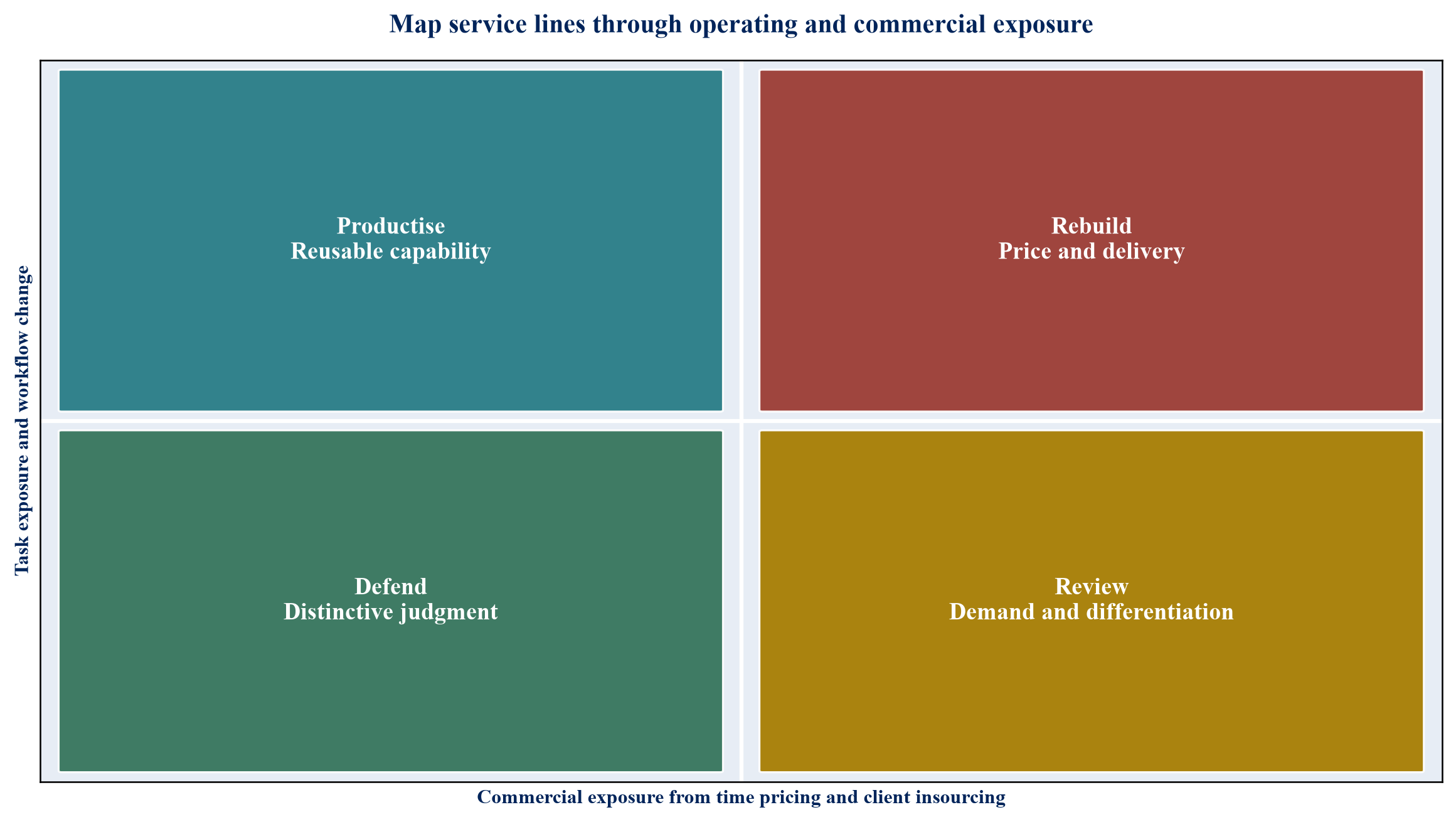
Management should score each service line using observed workflow evidence and current contract data.
Table 1. Service-line exposure and response matrix
| Exposure pattern | Evidence to collect | Principal risk | Initial response |
|---|---|---|---|
| High task exposure and time-based price | Hours, write-offs, client rate pressure and eligible volume | Revenue falls before capacity changes | Redesign scope and price; control capacity |
| High task exposure and fixed fee | End-to-end effort, quality, exceptions and renewal behaviour | Savings remain theoretical or invite repricing | Retain efficiency; improve value evidence |
| High insourcing exposure | Client tool adoption, data access, procurement and make-or-buy plans | External work moves inside the client | Shift to accountable outcomes, integration or assurance |
| High quality consequence | Error severity, review intensity, source traceability and professional rules | Rework, claims and loss of trust | Bound automation; strengthen review and evidence |
| Strong proprietary differentiation | Reusable data, workflow, rights, specialist judgment and client outcomes | Underinvestment or weak monetisation | Productise and protect the capability |
The response follows the combined commercial and operating position rather than task exposure alone.
The map should produce a service-line decision. Defend means the current offer and price remain credible. Rebuild means the client problem remains valuable but the workflow or price must change. Productise means a reusable capability can support recurring or usage economics. Retire means demand, differentiation or margin no longer justifies investment. These decisions should be reviewed against client evidence and portfolio dependencies.
5. Separate effort release from cost removal
Professional-service firms often account for people as the main delivery cost. A task-level time reduction can look like an immediate saving when the employees remain, pay continues and the released hours are not sold. Finance should distinguish theoretical effort release, available capacity and realised cost reduction.
Theoretical release equals baseline eligible hours multiplied by the measured time reduction. Available capacity deducts adoption gaps, training, review, coordination, exceptions and demand timing. Realised benefit then depends on a management action. The firm may avoid a planned hire, reduce contractors, raise utilisation, redeploy people to new revenue, increase throughput or change permanent capacity through a lawful and considered workforce process.
Timing matters. Client contracts, employee notice, project duration and annual promotion cycles can delay conversion. A budget may carry duplicate cost while the firm invests in tools and training before the old process can be retired. Transition cost should be visible rather than netted against an uncertain future saving.
Capacity quality also matters. Two hundred released junior hours are not automatically equivalent to two hundred senior selling hours. The firm should map the grade, location, skill, security clearance, client access and time period of released effort. It should identify whether the demand pipeline can absorb that capacity.
The capacity register should include an expiry date. Hours released in one month cannot be stored for a later project. If management has not assigned them to a priced opportunity, delivery improvement or capacity action, the benefit is at risk of disappearing through lower utilisation.
Finance can report four separate values: gross task hours released, net service hours released, capacity converted and cost or revenue realised. This reporting makes operational progress visible without claiming margin that has not entered the accounts.
6. Rebuild the offer portfolio around client decisions
Clients pay professional firms to resolve decisions, execute difficult work, provide independent assurance, access specialist capability and accept defined responsibility. When accessible AI tools reduce the effort required for basic research or drafting, an offer described mainly by activities becomes easier to compare with internal delivery.
The firm should restate each offer around a client decision and accepted output. A diligence offer can promise a governed evidence process, issue prioritisation and a decision-ready report. An engineering offer can combine design options, verified calculations, regulatory evidence and implementation control. A legal service can define the advice, source record, review authority and response time. The description should match the firm's actual competence and contractual responsibility.
Reusable components can reduce delivery effort while improving consistency. Examples include taxonomies, evaluation sets, workflow templates, source connectors, calculation engines, clause libraries and quality checks. Each component needs ownership, permitted use, maintenance, security and evidence of performance. A collection of prompts used informally by individuals does not create a reliable service asset.
New offers can address the transition itself. Clients may need workflow redesign, AI controls, data readiness, make-or-buy analysis, vendor selection, value measurement, workforce planning, independent testing and assurance. The provider should sell only work it can perform competently and substantiate.
Portfolio governance should prevent uncontrolled customisation. Every offer needs a service boundary, target buyer, required inputs, delivery method, quality standard, price architecture, evidence package, contract schedule and owner. Variations should be priced and recorded so the reusable core is protected.
The offer portfolio should be small enough for sales and delivery to understand. Management can retain bespoke judgment while standardising common production and evidence. Productisation is useful when it makes the promise, economics and control clearer.
7. Protect revenue through price architecture
Time remains a useful commercial unit when scope is uncertain, work is exploratory or the client controls demand. It becomes vulnerable when AI reduces visible hours for repeatable work and procurement expects the saving to pass through. The firm needs a price architecture that connects the client outcome, service output, cost and risk.
Fixed fees can let the provider retain efficiency when scope and acceptance are bounded. Subscriptions can fund continuing access, updates and assurance. Usage charges can link price to cases, transactions, documents, assets or another auditable unit. Outcome consideration can share verified financial value. Hybrid structures can combine mobilisation, recurring capacity, usage bands, service levels and a capped outcome component.
The choice should follow evidence and risk. A provider should avoid outcome exposure when the client controls the result or when the baseline cannot be reconstructed. A subscription needs usage visibility, renewal evidence and boundaries. A fixed fee needs volume, complexity and change controls. A usage model needs a unit the client can understand and both parties can audit.
Price should cover the full delivery system. Costs include professional time, model and cloud usage, integration, data, evaluation, security, review, support, governance, insurance and liability. The firm should also recover investment in reusable capability where the client receives continuing value.
Discount governance is important during transition. A client may expect a lower price because a task appears easier. The provider should show the accepted output, accountability, quality evidence and total service economics. A concession can be exchanged for term, volume, standardisation, faster payment, reference rights or narrower service levels. Every discount should have an approved rationale and expiry.
IFRS 15 requires an entity to identify performance obligations, determine and allocate the transaction price, and recognise revenue as obligations are satisfied [8]. Variable consideration and multi-component services can require significant judgment. Finance and accounting advisers should review the specific contract before launch.
8. Redesign the workforce pyramid
The traditional professional-services pyramid combines leverage, apprenticeship, review and progression. Junior staff perform research, analysis and production. Managers coordinate work and review. Partners originate, frame, decide and carry client responsibility. AI can change effort at each level and may compress some junior tasks.
A smaller entry cohort can improve short-term cost while weakening the future manager and partner pipeline. Removing routine work can also remove the repetition through which professionals learn facts, patterns and standards. Workforce redesign should preserve deliberate learning, supervised judgment and exposure to clients.
The firm should model roles as collections of tasks and accountabilities. It should record which tasks are retained, assisted, automated, newly created or retired. New work can include workflow design, data stewardship, evaluation, source verification, exception review, product ownership, model-risk management and client adoption. These activities need clear career value and performance measures.
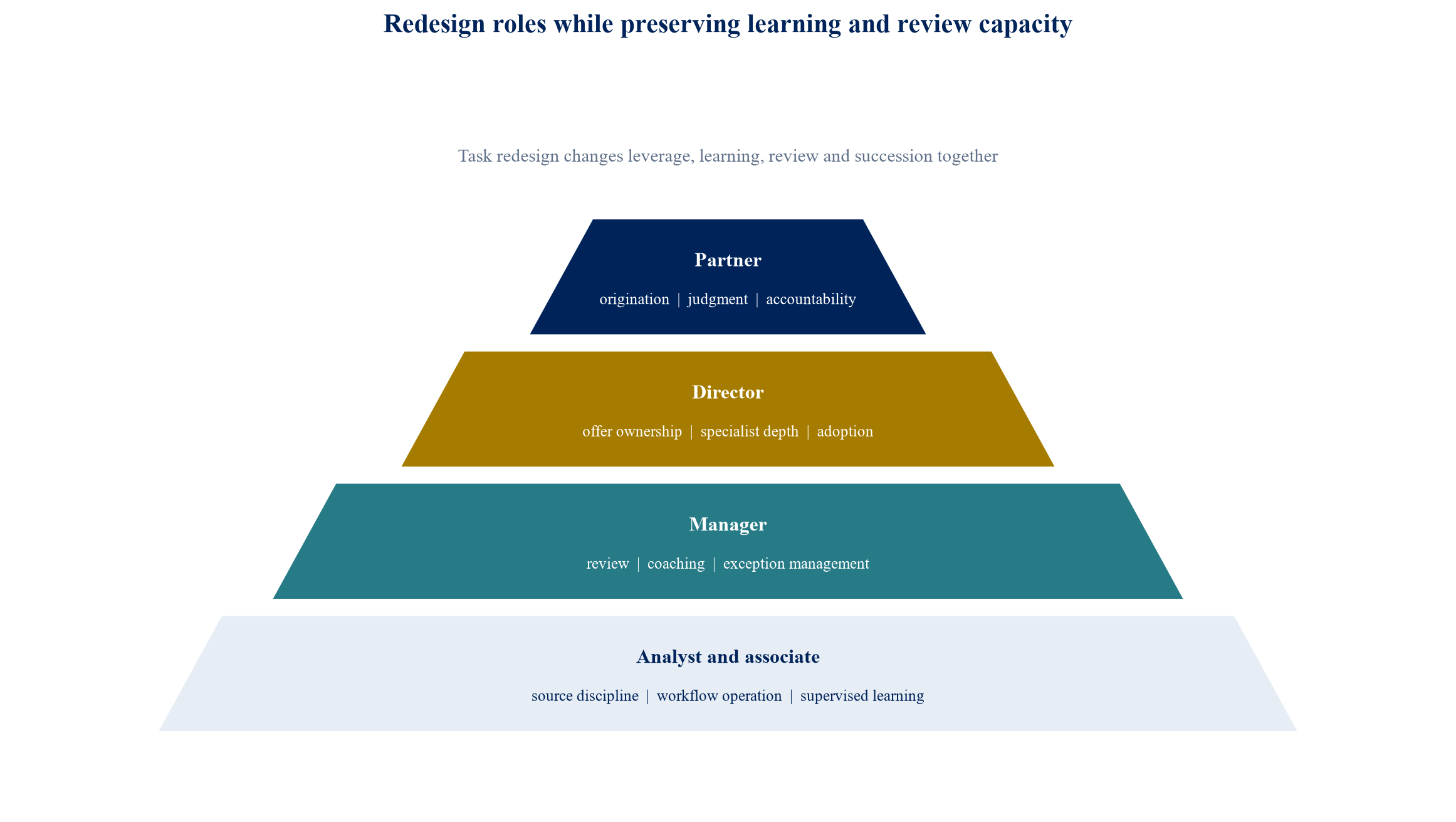
Workforce decisions should connect role content, learning, review capacity, demand and succession.
Table 2. Workforce design decisions by grade
| Grade | Work likely to change | Capability to preserve | New operating requirement |
|---|---|---|---|
| Analyst and associate | Research, first drafts, classification and routine analysis | Source discipline, modelling, writing and professional foundations | Structured verification, workflow operation and supervised client exposure |
| Manager | Work allocation, review, synthesis and project control | Judgment, coaching, issue resolution and commercial control | Evaluation design, exception management and human-agent coordination |
| Director | Solution design, quality ownership and senior client delivery | Specialist depth, negotiation and cross-workstream integration | Offer ownership, product economics and adoption leadership |
| Partner | Origination, framing, accountability and relationship leadership | Trust, judgment, sector access and risk acceptance | Portfolio choices, investment governance and evidence-led pricing |
The exact design depends on the service, jurisdiction, professional obligations and evidence from live work.
Span of control should follow review demand. Faster production can create more outputs for managers to check. Without improved evidence and triage, the review bottleneck moves upward and senior staff become overloaded. The workforce model should calculate review minutes, exception rates and escalation by work type.
Compensation and utilisation measures may also need revision. A professional who builds a reusable control or trains a workflow can reduce future hours while creating value. Performance systems should recognise sales, client outcomes, quality, knowledge assets, adoption and financial conversion alongside billable time.
9. Redesign the delivery workflow
The workflow is the unit of operating change. Individual access to a general tool can save time without changing handoffs, approvals, systems or the client experience. The 66-firm field experiment that found reduced email time without a broader detectable task shift illustrates this distinction [5].
Management should map the existing workflow from request through evidence, analysis, review, acceptance, billing and archive. It should identify waiting time, repeated entry, unstructured handoffs, error points, source systems and decisions. AI should be placed where it can change the end-to-end process under controlled conditions.
Each step needs an authority level. The system may retrieve evidence, classify, calculate, draft, recommend, prepare an action or execute a reversible task. A person should retain authority for commitments and high-consequence judgments according to the service and applicable law. Access should follow least privilege, and the workflow should record inputs, versions, outputs, reviews and overrides.
Exception design determines scale. Standard cases can follow a bounded route, while unusual or material cases are escalated. The firm should define exception triggers through evidence, uncertainty, value, client type, jurisdiction and consequence. It should measure whether the exception rate falls, remains stable or grows as volume increases.
The revised workflow should remove redundant steps only after quality evidence supports the change. Running a manual and automated process together for too long creates duplicate cost. Removing the old process before the new controls work creates service risk. The transition plan needs explicit entry, review and retirement criteria.
The firm should document the operating procedure in language that delivery teams can use. It should name the source of truth, required evidence, review role, escalation path, recovery process and record-retention rule. Training should use representative cases and known failure modes rather than a generic tool demonstration.
10. Build a trusted quality system
Professional-services revenue depends on trust in the output and the people responsible for it. AI can make an answer fluent while the source, calculation or instruction is wrong. Quality control should therefore test the complete service rather than the apparent quality of a draft.
An evaluation set should represent the work the firm expects to perform. It should include common cases, material exceptions, adverse conditions, ambiguous inputs and cases that require refusal or escalation. The set needs expected outcomes, scoring rules, reviewers and version control. Confidential client material should be handled under approved rights, privacy and security controls.
Quality measures should match consequence. Useful measures include source accuracy, calculation accuracy, precision, recall, first-time acceptance, rework, severity-weighted error, override, escalation and client correction. A single average score can conceal rare but serious failures.
Human review should be designed as a control. The reviewer needs evidence, competence, time, authority and a method to reject or stop the output. Review effort belongs in the cost model. A nominal approval step that routinely accepts output without examination does not establish effective oversight.
NIST's AI Risk Management Framework organises activity through Govern, Map, Measure and Manage [9]. Its Generative AI Profile adds considerations such as confabulation, data privacy, information integrity and human-AI configuration [7]. ISO/IEC 42001 provides a management-system standard for organisational AI governance [10]. These sources can inform controls, while the firm remains responsible for applying relevant legal and professional requirements to each service.
The quality system should feed commercial decisions. Observed accuracy, review effort, exceptions and incidents affect scope, price, staffing and contract terms. Sales claims should come from an approved evidence register with a source, population, date, context and owner.
11. Respond to client insourcing
Accessible AI can change the client's make-or-buy decision. The OECD survey found that 14 percent of surveyed SME users reported less reliance on external contractors [1]. The result does not establish the effect for a particular service, yet it gives providers a reason to monitor insourcing directly.
Clients are most likely to insource work when the problem is recurring, data is already internal, tools are accessible, consequences are manageable and the external provider adds little distinctive value. They may retain outside support for independent judgment, complex integration, specialist capacity, regulatory assurance, transaction execution or accountability.
The provider should ask where the client wants ownership. Some clients will buy a completed service. Others will buy technology enablement, workflow design, training, assurance or surge capacity. A modular offer can support several models while preserving clear boundaries and economics.
Insourcing can create advisory opportunity and cannibalisation. A firm may earn implementation revenue while reducing a recurring service. Management should compare the present value, relationship effect, competitive risk and follow-on potential. It should avoid protecting an old revenue line when the client has already changed its operating model.
Data and knowledge transfer require explicit treatment. The contract should address client data, provider methods, generated work product, configuration, evaluation records, transition support and continuing access. The parties should obtain legal advice on the relevant rights and professional duties.
The client-insourcing register should track requests for tool access, price challenges, reduced scope, capability hiring, procurement changes, data-room questions and renewal language. Sales and delivery teams should record these signals consistently. Portfolio review can then distinguish an isolated negotiation from a structural change.
12. Build the revenue bridge
The revenue bridge should show how the existing portfolio moves to the future portfolio. It begins with current recurring and project revenue, then separates price compression, lower billed effort, client insourcing, lost work, new AI-enabled offers, higher throughput, expanded scope and cross-sell. Every movement needs an owner, evidence basis, period and probability.
Price compression and billed-effort reduction are different. A fixed-fee engagement can retain price while using fewer hours. A time-based engagement may report fewer hours even if the rate is unchanged. A client can also negotiate a lower fixed fee after learning that the workflow changed. The bridge should record the mechanism.
New revenue should meet a higher evidence standard than an internal concept. The firm should identify the buyer, budget, problem, offer, price, sales stage, expected start, delivery capacity and conversion probability. Pipeline should not be treated as contracted revenue.
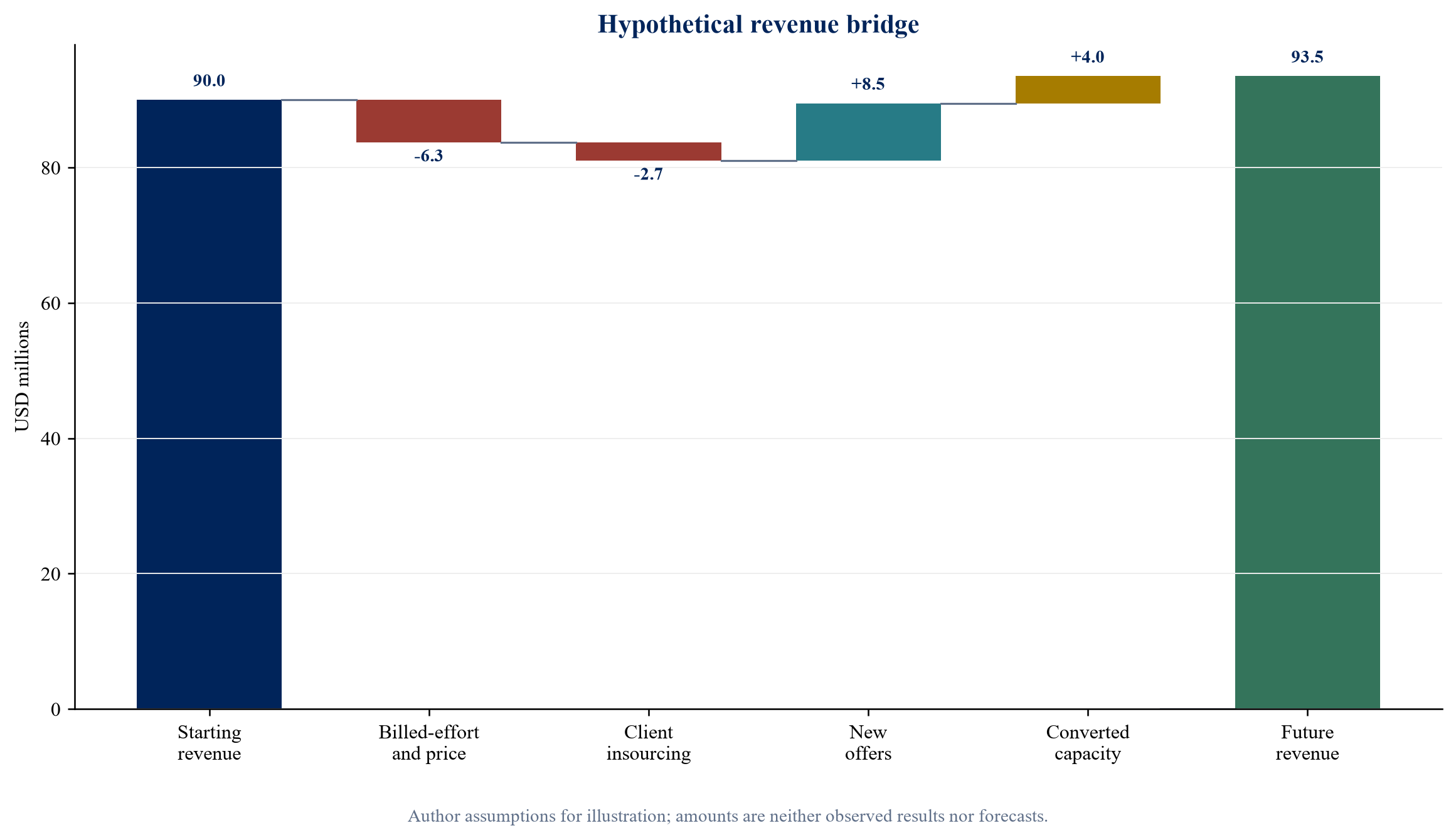
The bridge should reconcile to the budget and distinguish contracted revenue from probability-weighted pipeline.
Table 3. Revenue and margin telemetry
| Measure | Definition | Evidence source | Management use |
|---|---|---|---|
| Revenue at exposure | Revenue linked to materially changing workflows or price units | Contract and service-line ledger | Size the transition portfolio |
| Price leakage | Change in realised price for comparable accepted output | Contract, invoice and scope comparison | Improve pricing and negotiation |
| Capacity conversion | Released service hours assigned to sold work, avoided hiring or cost action | Workflow telemetry, staffing and budget | Test margin realisation |
| New-offer revenue | Contracted revenue from approved AI-enabled offers | Signed contract and billing records | Fund and scale credible offers |
| Assurance cost | Evaluation, review, security, compliance and incident cost | Time, vendor and finance records | Price the complete service |
| Contribution margin | Revenue less attributable delivery and assurance cost | Finance ledger and cost model | Reallocate investment and capacity |
Finance should report financial conversion separately from operational productivity.
The bridge should connect to cash. A subscription paid in advance, a milestone project, a usage invoice and an outcome fee have different billing and collection profiles. A service can improve accounting margin while worsening cash conversion if payment terms or acceptance are weak.
13. Manage accounting and cash through the transition
New commercial models can change performance obligations, variable consideration, measures of progress, contract assets and billing. IFRS 15 establishes the core principles for revenue from customer contracts [8]. The accounting conclusion depends on the exact promises and facts, and management should obtain current accounting advice.
Technology expenditure also requires classification. Some spending supports research, training, data preparation, implementation, software development or continuing service. IAS 38 distinguishes research from development and sets criteria for recognising an internally generated intangible asset [11]. A management label such as platform or product does not determine the accounting treatment.
Cash planning should identify the period of duplicate cost. The firm may continue funding the existing workforce and systems while paying for models, integration, evaluation and training. New revenue can lag investment. A transition budget should therefore show monthly cash, working capital, implementation recovery and downside headroom.
Contract acceptance should be measurable. Delayed client approval can defer billing or collection. The service schedule should define outputs, acceptance, deemed acceptance where legally appropriate, dispute, usage records, service levels and invoice evidence. Finance should be able to reconstruct each invoice from operating records.
Outcome consideration creates additional uncertainty. The parties need a baseline, source system, attribution method, client dependencies, quality floor, cap, review period and settlement process. The provider should avoid funding continuing delivery from a contingent fee that cannot be measured or collected promptly.
The investment committee should review accounting and cash alongside technical merit. A project can be strategically attractive and still require staged funding, client co-investment, a paid pilot or narrower scope. Stop criteria should be set before sunk cost makes the decision harder.
14. Govern reusable technology data and intellectual property
A professional-services firm can create reusable value through software, data structures, evaluation sets, workflow configuration, methods and accumulated operating evidence. Management needs an inventory that records ownership, permitted use, security, maintenance cost, dependency and commercial use.
The inventory should separate client-owned material, provider methods, licensed components, open-source software, model services and generated work product. Rights can differ by contract and jurisdiction. The firm should not assume that repeated use or payment for a tool creates ownership.
Supplier concentration affects margin and continuity. A workflow may depend on one model, cloud, data provider, identity system or connector. Management should record price, terms, service levels, geographic processing, retention, model changes, exit and tested alternatives. A diagram showing a second provider does not prove operational portability.
Technology cost should be allocated to the service that consumes it. Shared infrastructure can use activity drivers such as cases, users, model calls, storage, evaluation runs or reserved capacity. The allocation should support commercial decisions without creating false precision.
Product governance should assign an owner, roadmap, service lines, users, cost, quality measures, incidents and retirement plan. Each release should pass technical, security, legal, quality and commercial review appropriate to its consequence. Material model or workflow changes should trigger revalidation.
The portfolio should fund maintenance. A successful pilot creates continuing work in monitoring, updates, evaluation, training, security and client support. Price and budgets need to cover that lifecycle. A capability that no longer has a viable client problem, evidence base or funding source should be retired in a controlled manner.
15. Apply the framework to a hypothetical firm
Consider a hypothetical 500-person professional-services firm with annual revenue of USD 90 million. The author assumes that 55 percent of revenue comes from time-based projects, 25 percent from fixed-fee or managed services and 20 percent from recurring data, software-supported or outcome-linked offers. Direct delivery cost is assumed at USD 54 million, operating overhead at USD 22.5 million and operating profit at USD 13.5 million. These figures are analytical assumptions.
The exposure review assumes that workflows representing USD 36 million of revenue contain material research, drafting, analysis or administration that could change. Management estimates task-level effort reductions between 10 and 35 percent, depending on the workflow. It does not treat these values as immediate cost savings.
The downside revenue case assumes USD 6.3 million of erosion from fewer billed hours and price pressure, plus USD 2.7 million from client insourcing or lost scope. The transition plan assumes USD 8.5 million of contracted and probability-weighted new offers and USD 4 million from additional volume using released capacity. The resulting revenue is USD 93.5 million. Each value would need client, contract and pipeline evidence in a real firm.
The cost case assumes a reduction of USD 7.8 million in direct delivery cost through contractor reduction, avoided hiring, attrition management and role redesign. It adds USD 3.8 million for technology, data, evaluation, security and assurance, leaving direct and assurance cost of USD 50 million. Overhead rises by USD 1.5 million during transition. Under these assumptions, operating profit becomes USD 20 million, or 21.4 percent of revenue.
The result is sensitive to conversion. If new revenue reaches only half of the assumed amount and capacity action is delayed, operating profit can remain near the starting position despite technical productivity. If price erosion is lower and the firm converts capacity into demand quickly, margin can improve more strongly. The case demonstrates the bridge and should not be read as a forecast.
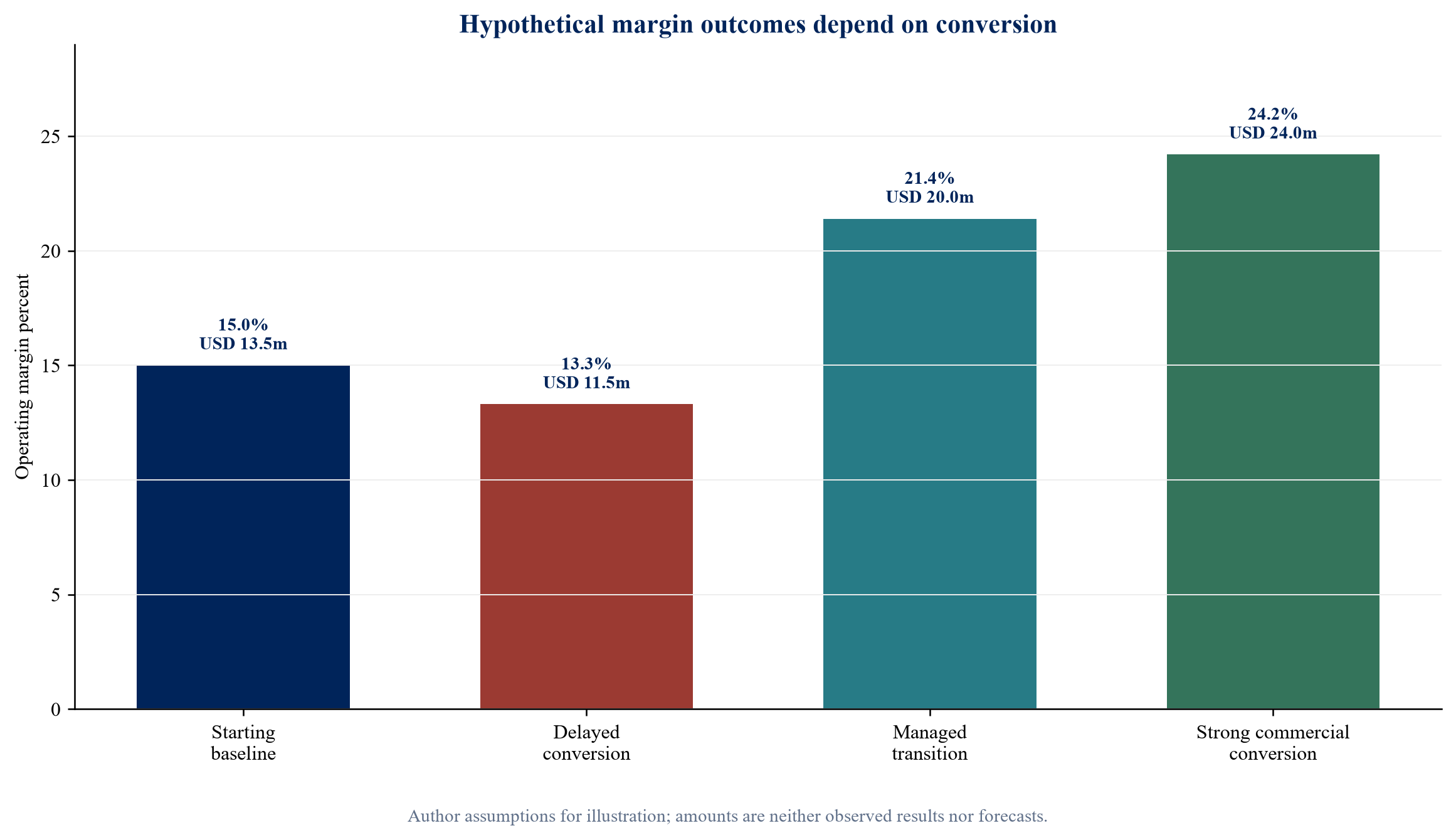
All values are author assumptions used to demonstrate the framework; they are neither observed firm data nor forecasts.
Table 4. Hypothetical transition cases
| Case | Revenue | Direct and assurance cost | Overhead | Operating profit | Operating margin |
|---|---|---|---|---|---|
| Starting baseline | 90.0 | 54.0 | 22.5 | 13.5 | 15.0 percent |
| Delayed conversion | 86.5 | 51.5 | 23.5 | 11.5 | 13.3 percent |
| Managed transition | 93.5 | 50.0 | 23.5 | 20.0 | 21.4 percent |
| Strong commercial conversion | 99.0 | 51.0 | 24.0 | 24.0 | 24.2 percent |
Values are author assumptions in USD millions and require replacement with verified company evidence.
The board should use the case to test break-even conditions. It can calculate the minimum new revenue, price retention and capacity action required to fund transition cost. It should also test quality incidents, slower adoption, supplier cost changes and working-capital delay.
16. Run a one-hundred-day transition
During days 1 to 20, management should establish the baseline and charter. Finance reconciles service-line revenue, price, hours, grade mix, contribution, utilisation and cash. Delivery maps the highest-exposure workflows. Sales records client signals and contract terms. Technology and risk inventory tools, data, rights and controls.
During days 21 to 45, the firm should select a small number of representative workflows. Each pilot needs a named client problem, approved data, baseline, evaluation set, operating procedure, review role, cost model, user group, stop conditions and success measures. The firm should include a difficult or adverse case rather than testing only favourable examples.
During days 46 to 70, management should redesign offers and commercial terms. It builds the service-line exposure map, price architecture, workforce task model, product inventory and revenue bridge. Finance tests monthly cash and margin scenarios. Legal, accounting, security and professional-risk advisers review the relevant facts.
During days 71 to 90, the firm applies the revised design to a controlled client offer, renewal or internal service. Delivery captures end-to-end time, quality, review, exceptions, usage and acceptance. Sales records client response and price. Finance reconciles the operating events to invoices, staffing and cost.
During days 91 to 100, the executive committee decides what to scale, revise or stop. It approves service boundaries, price, capacity actions, investment, workforce changes, controls and reporting. It should state which assumptions remain open and the evidence required for the next release.
The transition should protect current delivery. Client obligations, confidentiality, data access, professional duties and quality standards continue while the operating model changes. Material changes should be communicated and approved through the contract and governance process.
17. Use a recurring management system
The executive committee should review the transition as a commercial portfolio. A monthly pack can show revenue at exposure, price leakage, client insourcing, new-offer bookings, pipeline evidence, capacity conversion, direct cost, assurance cost, contribution margin, cash, quality and incidents.
Service-line owners should be accountable for both delivery and economics. Technology owners should report reliability, usage, supplier changes, security and roadmap. Workforce leaders should report role content, learning, utilisation, attrition, hiring and succession. Risk owners should report quality, regulatory obligations, client claims and control performance.
A product and pricing council can approve reusable capabilities, offer designs, price corridors and investment. A deal desk applies those standards to client proposals. Exceptions need a quantified impact, approver and expiry.
The board should distinguish leading and realised indicators. Pilots, users, task time and pipeline show progress. Contracted revenue, collected cash, cost action, contribution margin and renewal show financial conversion. Both are useful when reported separately.
Quarterly review should revisit the exposure map. Model capability, supplier price, client adoption and regulation can change. A previously protected service may become exposed, while an unpromising workflow may become viable. Evidence dates and version history allow management to see why a decision changed.
The system should create learning rather than a permanent transformation office. Mature offers and controls move into normal operations. Unresolved high-risk issues remain visible. Temporary governance can then contract as ownership becomes stable.
18. Recognise limitations and open questions
Published studies measure particular tools, tasks, populations and periods. Results from consultants, customer-support workers or office software users may not transfer to every professional service. Model capability and user practice also change. Firm-specific pilots and operating data remain necessary.
Survey responses record reported adoption and benefits. They may not show the magnitude, durability or financial conversion of the effect. Sector classifications also contain diverse businesses. Management should avoid treating a sector percentage as a benchmark for a specific firm.
Client demand can change for reasons outside AI. Economic conditions, regulation, competition, procurement, staffing and transaction volume affect revenue and price. A revenue bridge should preserve these drivers where evidence permits and avoid attributing every change to technology.
Workforce effects depend on labour law, professional regulation, location, skills and the firm's promotion model. Role redesign, consultation and capacity action require current legal and human-resources advice. A financial model cannot determine an individual employment decision.
Quality measurement remains difficult for bespoke judgment. Reviewers can disagree, and a completed project may not reveal a latent error. The firm should combine evaluation, source evidence, process controls, client feedback and incident data rather than relying on one score.
Accounting, tax, data protection, intellectual property, competition and professional obligations depend on the facts and jurisdiction. This paper provides a management framework and does not determine a legal, accounting, tax or regulatory conclusion.
The hypothetical case uses assumed values. It demonstrates the calculations and decision sequence. It does not establish achievable revenue, savings, headcount, margin, client demand or timing.
19. Conclusion
Artificial intelligence can reduce effort in parts of professional-service delivery, while revenue and margin depend on the complete commercial system. The firm must connect task evidence to workflow performance, client value, price, capacity and recorded financial outcomes.
The service-line exposure map gives management a disciplined starting point. It identifies where time-based revenue, client insourcing, quality consequence and weak differentiation create risk. It also identifies where fixed fees, reusable capabilities and accountable outcomes can support stronger economics.
Offer design, price and workforce should change together. A new workflow needs a clear client promise, evidence, review and cost model. A changed price needs an auditable unit and risk allocation. A changed pyramid needs learning, succession, review capacity and new roles.
The revenue bridge makes the transition accountable. It separates erosion, client loss, new offers, throughput and conversion. Finance can then test whether released capacity becomes revenue, avoided hiring, lower external spend or actual cost action.
The operating system continues after the initial programme. Management should review quality, client response, supplier dependency, workforce effects, cash and contribution margin. It should scale evidence-backed services, revise weak designs and stop investments that cannot meet their commercial and control thresholds.
The board can test progress with six questions. Which revenue is exposed? Which client problem remains worth funding? What evidence proves the workflow? How is price reconstructed? Where does released capacity go? Which financial result entered the accounts? The margin reset becomes credible when the answers agree across contracts, delivery records, staffing and finance.
References
- OECD. Generative AI and the SME Workforce: New Survey Evidence. 2025. https://doi.org/10.1787/2d08b99d-en
- UK Department for Science Innovation and Technology. Business Data Use and Productivity Study Wave 2: Statistical Report. 2026. https://www.gov.uk/government/publications/business-data-use-and-productivity-study-wave-2/business-data-use-and-productivity-study-wave-2-statistical-report
- UK Department for Science Innovation and Technology. UK Business Data Survey 2026. 2026. https://www.gov.uk/government/statistics/uk-business-data-survey-2026/uk-business-data-survey-2026
- Dell'Acqua, F. et al. Navigating the Jagged Technological Frontier: Field Experimental Evidence of the Effects of Artificial Intelligence on Knowledge Worker Productivity and Quality. Organization Science. 2026. https://doi.org/10.1287/orsc.2025.21838
- Dillon, E., Jaffe, S., Immorlica, N. and Stanton, C. Shifting Work Patterns with Generative AI. NBER Working Paper 33795. Revised 2025. https://doi.org/10.3386/w33795
- Gmyrek, P. et al. Generative AI and Jobs: A Refined Global Index of Occupational Exposure. International Labour Organization and NASK. 2025. https://www.ilo.org/publications/generative-ai-and-jobs-refined-global-index-occupational-exposure
- National Institute of Standards and Technology. Artificial Intelligence Risk Management Framework: Generative Artificial Intelligence Profile. NIST AI 600-1. 2024. https://doi.org/10.6028/NIST.AI.600-1
- IFRS Foundation. IFRS 15 Revenue from Contracts with Customers. https://www.ifrs.org/issued-standards/list-of-standards/ifrs-15-revenue-from-contracts-with-customers/
- National Institute of Standards and Technology. Artificial Intelligence Risk Management Framework AI RMF 1.0. 2023. https://doi.org/10.6028/NIST.AI.100-1
- International Organization for Standardization. ISO IEC 42001 2023 Information technology Artificial intelligence Management system. https://www.iso.org/standard/81230.html
- IFRS Foundation. IAS 38 Intangible Assets. https://www.ifrs.org/issued-standards/list-of-standards/ias-38-intangible-assets/
- International Labour Organization. Artificial Intelligence Adoption and Its Impact on Jobs. 2025. https://www.ilo.org/publications/artificial-intelligence-adoption-and-its-impact-jobs
- United States Census Bureau. Business Trends and Outlook Survey Data. Updated 27 August 2026. https://www.census.gov/hfp/btos/data
- United States Census Bureau. Large Firms With at Least 20 Employees Biggest AI Users. 2026. https://www.census.gov/library/stories/2026/05/ai-use-businesses.html
- Brynjolfsson, E., Li, D. and Raymond, L. R. Generative AI at Work. Quarterly Journal of Economics 140(2). 2025. https://www.nber.org/papers/w31161
- European Union. Regulation EU 2024/1689 laying down harmonised rules on artificial intelligence. https://eur-lex.europa.eu/eli/reg/2024/1689/oj
- Information Commissioner's Office. Artificial intelligence contracts and third parties. https://ico.org.uk/for-organisations/advice-and-services/audits/data-protection-audit-framework/toolkits/artificial-intelligence/contracts-and-third-parties/
- Information Commissioner's Office. Data protection by design and by default. Updated 2026. https://ico.org.uk/for-organisations/uk-gdpr-guidance-and-resources/accountability-and-governance/guide-to-accountability-and-governance/data-protection-by-design-and-by-default/
- Accenture plc. Annual Report on Form 10-K for the fiscal year ended 31 August 2025. 2025. https://www.sec.gov/Archives/edgar/data/1467373/000146737325000217/acn-20250831.htm
- Accenture plc. Fourth Quarter and Full Year Fiscal 2025 Results. 2025. https://www.sec.gov/Archives/edgar/data/1467373/000146737325000213/q4fy25earnings8-kexhibit.htm
- OECD. The Effects of Generative AI on Productivity Innovation and Entrepreneurship. OECD Artificial Intelligence Papers. 2025. https://doi.org/10.1787/b21df222-en
- UK Department for Science Innovation and Technology. AI Management Essentials Tool. Updated 2026. https://www.gov.uk/government/consultations/ai-management-essentials-tool/ai-management-essentials-tool-accessible
- US Federal Trade Commission. AI Companies: Uphold Your Privacy and Confidentiality Commitments. 2024. https://www.ftc.gov/business-guidance/blog/2024/01/ai-companies-uphold-your-privacy-confidentiality-commitments
- UK Competition and Markets Authority. AI Foundation Models Update Paper. 2024. https://www.gov.uk/government/publications/ai-foundation-models-update-paper
