

1. Introduction
Artificial intelligence can enter a private-wealth organisation through a formal programme, a bank platform, a portfolio system, an external manager, a software update or an employee's browser. A family office can therefore use AI before its governing body has approved an AI strategy.
The exposure extends beyond investment models. A meeting assistant can process family discussions. A document tool can read trust, foundation, passport, health or succession records. A research assistant can generate unsupported claims for an investment paper. An accounts system can identify anomalous invoices. A cyber platform can prioritise threats. A relationship tool can profile family members or counterparties. An agent can take actions across email, files and workflow systems.
The policy has to govern these uses as systems. A system includes the business purpose, people, model, prompts, data sources, retrieval layer, integrations, output, downstream decision, vendor, infrastructure and monitoring. Changing one component can change the risk without changing the model name.
The UAE has several data-protection and financial-services regimes. Federal Decree-Law No. 45 of 2021 establishes personal-data requirements within its scope, including transparency about decisions based on automated processing, impact assessment for specified high-risk processing and rights concerning automated decisions.[1] DIFC has its own Data Protection Law and Regulation 10 for processing personal data through autonomous and semi-autonomous systems.[2][3] ADGM has Data Protection Regulations 2021 and official guidance covering lawful processing, rights, privacy by design, impact assessments, security, breaches and international transfers.[4]
Financial-services expectations add another layer. UAE regulators jointly issued enabling-technology guidance covering big-data analytics and AI, among other technologies.[5] The DFSA listed regulatory expectations on AI risk management in the DIFC in June 2026 after AI surveys in 2024 and 2025.[6] The exact obligations and supervisory expectations applicable to an organisation should be read from current rules and communications.
An effective policy converts these overlapping considerations into a decision system. It tells the institution which uses are allowed, which require assessment, which need independent validation, who can approve them, what evidence must exist and when a system must be suspended.
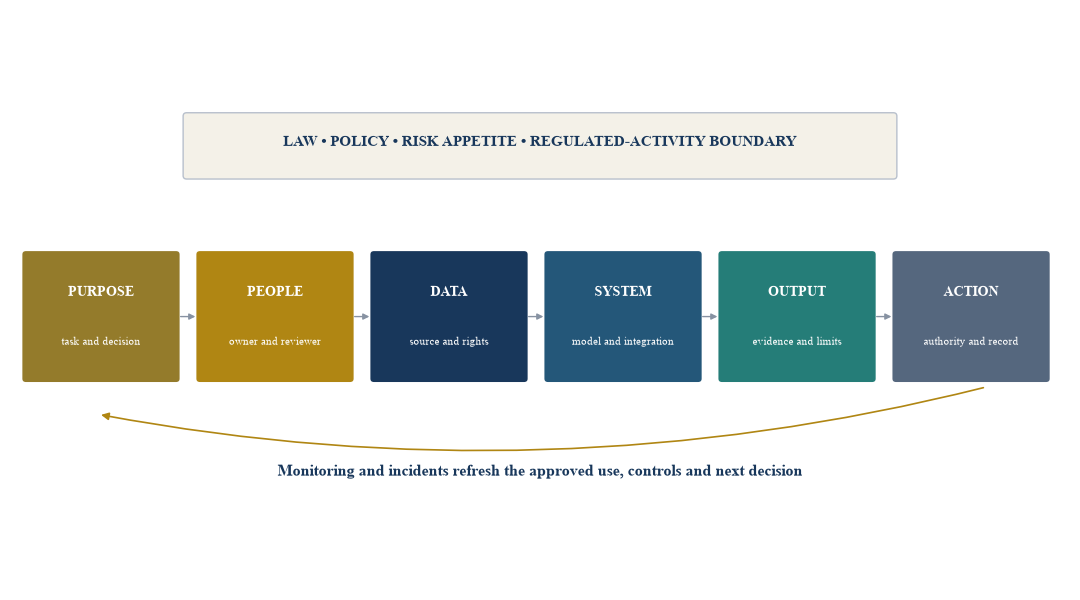
Author framework. The perimeter covers the complete system and decision context rather than the model name alone.
2. Define the policy unit as a use case
A model inventory is insufficient when one model supports several activities. The policy unit should be a use case with a defined owner, purpose, data, output and downstream decision.
A general-purpose language model can support public-source research, confidential document review and portfolio recommendations. Public-source summarisation can have low privacy risk and meaningful accuracy risk. Reviewing succession documents can have high confidentiality, transfer and access risk. Recommending asset sales can create material investment, suitability, authority and recordkeeping consequences. Each use requires a separate entry.
The register records whether a use is exploratory, pilot, production, suspended or retired. It names the legal entity using the system, the affected people, data categories, locations, provider and subprocessors. It identifies whether the output informs, recommends, decides or executes.
The institution should capture shadow use through periodic attestations, technical controls, procurement review, expense monitoring, browser and software inventories and an accessible approval process. Staff need a safe path to disclose existing experiments. An amnesty period can help establish the baseline, subject to legal and security advice.
Prohibited uses should be explicit. Examples can include uploading credentials or highly sensitive family records into unapproved public tools, allowing an unapproved agent to initiate payments, presenting generated facts as verified evidence, impersonating a person, bypassing regulated-advice controls or using biometric and behavioural data without an approved legal and ethical basis.
Table 1. Minimum private-wealth AI use-case register
| Field | Required record | Decision value | Evidence owner |
|---|---|---|---|
| Use and purpose | exact task, expected benefit and excluded purposes | prevents a general model approval from becoming unlimited permission | business owner |
| Decision effect | informs, recommends, decides or executes; affected person or capital | establishes materiality and autonomy | decision owner |
| Data | categories, sensitivity, source, legal entity, location and retention | supports privacy, confidentiality and transfer analysis | data owner |
| System | model, version, retrieval, prompts, integrations and infrastructure | defines what is actually being assessed | technical owner |
| Provider | contracting entity, subprocessors, training terms, security and exit | exposes third-party dependency and rights | vendor owner |
| Risk tier | impact, autonomy, reversibility, data and control score | assigns approval and assurance requirements | risk owner |
| Human control | reviewer, authority, evidence, time and override route | tests whether oversight is operational | decision owner |
| Validation | tests, limitations, thresholds, findings and independent challenge | supports release and continued use | validator |
| Status | experiment, pilot, production, restricted, suspended or retired | controls permitted access and action | policy owner |
| Lifecycle evidence | approvals, changes, monitoring, incidents and review date | creates accountability and auditability | record owner |
The register should link to current approvals, assessments, contracts, validation evidence, incidents and retirement records.
3. Map the applicable legal and regulatory regimes
The legal map begins with entity and activity. A family office can include a mainland company, DIFC or ADGM entity, foundation, holding company, regulated investment firm and external providers. One workflow can process data for several controllers and cross borders through a cloud provider.
Federal personal-data law defines personal data broadly and establishes processing principles, security, controller and processor obligations, data-subject rights, impact assessment and cross-border provisions within its scope.[1] Article 13 includes information concerning decisions made through automated processing, including profiling. Article 18 addresses objections to decisions resulting from automated processing, subject to stated exceptions and safeguards. The law also requires a data-protection impact assessment for specified processing, including systematic and comprehensive assessment using automated processing where legal consequences or serious impact can result.
DIFC Data Protection Law No. 5 of 2020 applies within its stated jurisdictional scope. The DIFC Commissioner provides guidance and assessment tools for lawful processing, high-risk processing, data-protection officers, impact assessments, controllers and processors, transfers, individual rights and breaches.[2] Regulation 10, enacted in 2023, addresses processing personal data through autonomous and semi-autonomous systems. DIFC announced a consultation in June 2026 on proposed amendments concerning safety, certification and the Autonomous Systems Officer. A consultation is a proposal and should not be treated as enacted law.[7]
ADGM's Data Protection Regulations 2021 apply to ADGM entities processing personal data. ADGM's Office of Data Protection publishes official guidance in eight parts, including impact assessments, security, breaches and international transfers.[4] The applicable transfer mechanism, contract and data location need verification when a provider uses infrastructure outside the relevant jurisdiction.
Financial-services regulation depends on the activity and conduct. Generating research, advising on investments, managing assets, arranging transactions, communicating promotions, monitoring suitability or executing trades can engage permissions and conduct obligations. An AI policy should route uncertain cases to current regulatory advice before deployment.
Table 2. Jurisdiction and privacy decision map
| Layer | Verified source | Policy question | Required evidence |
|---|---|---|---|
| UAE federal personal-data law | Federal Decree-Law No. 45 of 2021 | does the law apply, what is the lawful basis, and do automated-decision or impact-assessment provisions apply? | entity and processing map, advice, notice, basis and assessment |
| DIFC data protection | DIFC DP Law 2020, Regulations and Commissioner guidance | is a DIFC controller or processor involved, and does Regulation 10 apply? | processing record, system assessment, notice, contract, DPIA and transfer analysis |
| ADGM data protection | ADGM DPR 2021 and ODP guidance | is an ADGM entity a controller or processor, and which design, rights, breach and transfer duties apply? | processing record, lawful basis, DPIA, security, contract and transfer safeguard |
| Financial services | current CBUAE, SCA, DFSA or FSRA rules and guidance as applicable | does the use perform, support or materially affect a regulated activity? | activity analysis, permission, responsible function and conduct controls |
| Other jurisdictions | law where entities, people, providers or data are located | do extra-territorial privacy, employment, consumer, intellectual-property or AI rules apply? | counsel scope, data map, provider location and conflict analysis |
| Confidentiality and contract | foundation documents, employment, banking, manager and vendor agreements | can the information be disclosed to and processed by the system? | authority, confidentiality terms, consent where relevant and provider restrictions |
This map provides research orientation. Current legal advice should determine scope, obligations and transfer mechanisms for the particular entities, people, data and processing.
4. Classify risk through impact and control dependence
The risk tier should follow the consequence of failure. A low-cost error in an internal draft differs from an error that changes a portfolio, rejects a person, discloses family data or moves money.
The classification considers eight dimensions: decision materiality, individual impact, data sensitivity, autonomy, reversibility, explainability, external communication and third-party concentration. The highest credible dimension can determine the minimum tier where averaging would hide a severe risk.
Tier one covers bounded assistance using approved data where a competent person verifies the output before limited internal use. Tier two covers operational or analytical support with moderate consequences, controlled data and documented review. Tier three covers material recommendations, sensitive data, client or family communications, regulated workflows or substantial operational dependence. Tier four covers decisions or actions that can materially affect people, assets, rights, confidentiality or financial integrity and therefore require governing-body approval, strong independent assurance and strict authority limits. Some tier-four uses can remain prohibited.
Risk acceptance does not convert an unlawful or unauthorised use into an approved use. Legal basis, permission and authority are entry conditions. The tier controls the depth of assurance after those entry conditions are met.
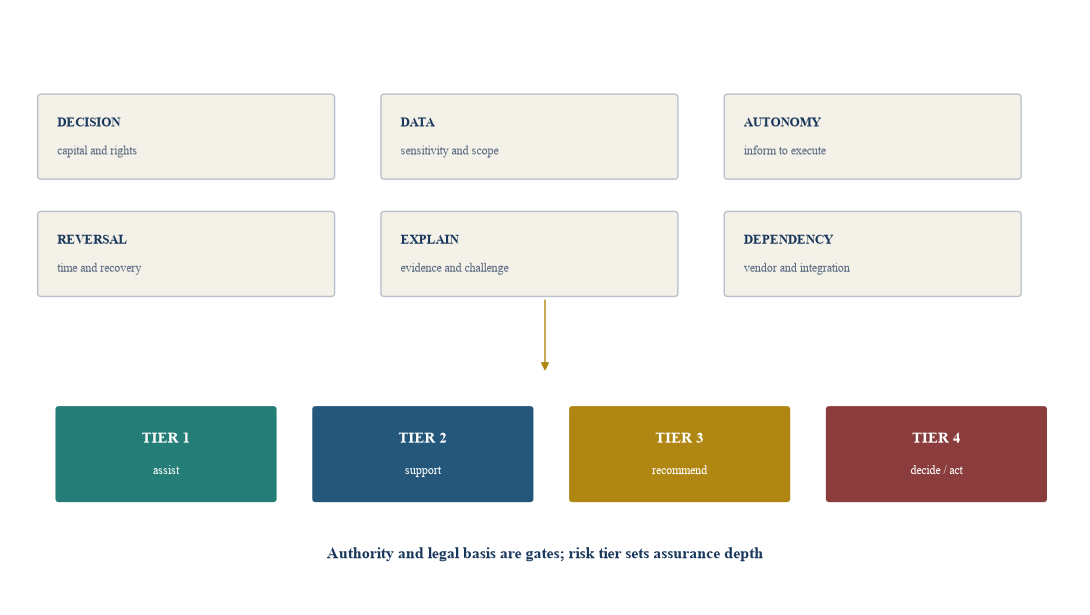
Author framework. The highest material consequence can set the minimum tier even when other dimensions score lower.
5. Control private data before it reaches a model
Private-wealth data can reveal identity, family relationships, health, behaviour, location, financial position, ownership, succession, disputes, security arrangements and investment intentions. A single document can contain data about several people and entities.
The data owner first confirms purpose and authority. The privacy analysis identifies controller and processor roles, lawful basis, notice, special or sensitive categories, data-subject rights, impact-assessment requirements, retention and transfers. Contractual confidentiality and foundation or trust restrictions can impose additional limits.
Data minimisation occurs before prompt construction or model ingestion. The system receives the least information required for the approved purpose. Names and identifiers can be removed where the task does not need them. A retrieval system can provide narrow, permission-aware passages rather than an entire data room.
The provider terms require close reading. The institution should determine whether prompts or outputs are retained, used for training, reviewed by people, transferred, logged or provided to subprocessors. Enterprise settings can differ from consumer settings. A contractual promise needs technical configuration and testing.
Access follows source permissions. An AI search interface should not allow a user to retrieve records that the underlying repository would deny. The organisation should test permission inheritance, caching, embeddings, logs, exports and administrator access.
Deletion and retention must cover derived records. Prompts, outputs, embeddings, fine-tuning data, evaluation sets, traces and backups can persist after the source document is deleted. The retention schedule assigns each artefact to an owner and verified deletion route.
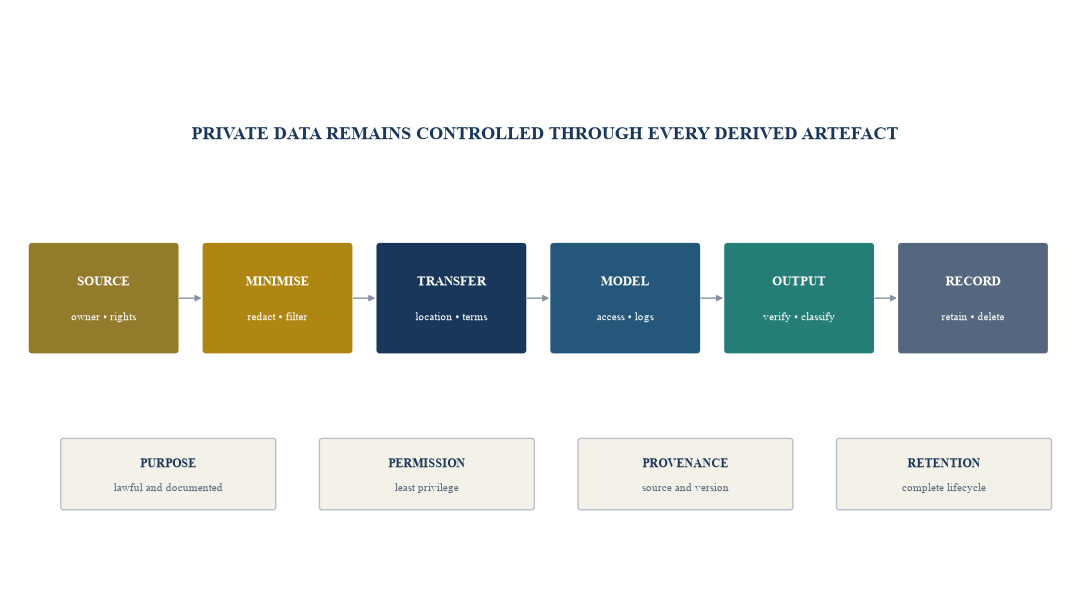
Author framework. Each transfer should retain purpose, authority, access and evidence consistent with the applicable regime.
6. Treat the model as one component of the control system
Model risk arises when a system produces inaccurate, unstable, biased, insecure or misunderstood outputs that are used in a material decision. The risk can come from the model, data, prompt, retrieval, integration, human interpretation or changed environment.
Current US interagency model-risk guidance issued in April 2026 emphasises a risk-based approach, development and use, validation and monitoring, governance and third-party products. It expressly excludes generative and agentic AI from its scope while observing that broader risk governance should guide tools outside the document.[8] Its principles can inform control design, but the guidance does not bind a private family office and should not be presented as UAE law.
The validation begins with intended use. The system card records what the system is expected to do, what it cannot do and which decisions it may affect. Test data should represent expected and adverse conditions, including languages, document formats, market regimes and incomplete evidence relevant to the approved use.
Accuracy alone is insufficient. A research system can cite an authoritative source while misreading its date or scope. A document extractor can produce a high aggregate score while missing one change-of-control clause. A portfolio assistant can calculate correctly while using stale positions. Testing therefore follows the actual harm path.
Independent challenge should be proportionate and genuinely independent from the owner seeking deployment. The challenger reviews conceptual fit, data, design, performance, limitations, security and controls. A small family office can use a qualified external reviewer, provided that the reviewer has access to adequate evidence and no material conflict.
Monitoring includes input drift, output quality, override rates, exceptions, incidents, provider changes, model versions, latency, cost and user behaviour. Threshold breaches can trigger restricted use, added review, rollback or suspension.
Table 3. AI control standard by risk tier
| Control | Tier 1: assist | Tier 2: support | Tier 3: recommend | Tier 4: decide or act |
|---|---|---|---|---|
| Owner and register | named owner and approved entry | owner, data and technical roles | executive sponsor and risk owner | governing-body sponsor and accountable executive |
| Data | approved low-sensitivity sources | classified sources and access control | DPIA or equivalent assessment where required | enhanced legal review, minimisation and continuous access assurance |
| Validation | user acceptance and source checks | documented test set and limitations | independent challenge and adverse testing | independent validation, scenario testing and release committee |
| Human control | user verifies before use | trained reviewer signs material output | authorised decision-maker reviews source evidence | dual control, stop authority and no silent automation |
| Monitoring | periodic owner review | quality and incident metrics | thresholds, drift, overrides and quarterly review | continuous monitoring, rapid suspension and governing-body reporting |
| Change | material changes recorded | re-test model or integration changes | formal change approval and regression testing | version lock, controlled release and rollback test |
| Vendor | approved terms and security | contract, retention and subprocessor review | concentration, assurance and exit test | source continuity, contingency, portability and tested fallback |
| Action authority | no autonomous external action | bounded workflow only | recommendation within stated limit | explicit mandate, transaction limits, segregation and reconciliation |
Higher tiers inherit the controls below them. Specific legal, regulatory, cyber and investment requirements can require stronger controls.
7. Add generative-AI controls for provenance and fabrication
Generative AI can produce fluent output without a reliable connection to evidence. The policy should assume that plausibility and confidence are different qualities.
The NIST Generative AI Profile identifies risks that are novel to or intensified by generative systems and provides suggested actions organised around the AI RMF functions of govern, map, measure and manage.[9] NIST describes the framework as voluntary. The institution can use it as a control reference while mapping each action to its own risks and legal duties.
For research, every material factual claim should link to a source retained in the decision file. The reviewer checks authority, date, jurisdiction, context and whether the source actually supports the claim. A generated citation that cannot be opened and verified is excluded.
For document review, the output should preserve page or clause location. The reviewer compares critical provisions with the original. Extraction coverage matters alongside accuracy. The system should state when a document is unreadable, incomplete or outside the supported format.
For drafting, the workflow separates source facts, authorised assumptions and proposed language. Generated text cannot create approval, authority, consent or a professional conclusion. Legal, tax, investment and regulatory conclusions require the responsible qualified person.
For code and analytics, generated output requires review, tests, controlled data and change management. A correct result on one example does not establish reliability across the approved range.
Prompt-injection and data-exfiltration testing is important when a system retrieves external or uploaded content. Instructions embedded in documents, websites or messages should not override system policy or disclose protected information. Tool permissions should be minimal, segmented and reversible.
8. Make human accountability operational
The phrase human in the loop can conceal weak governance. A person can click approve without understanding the model, evidence or consequence.
An accountable reviewer needs five conditions. The person has authority for the decision. The person understands the domain and the system's limitations. The person receives enough source evidence and time. The person can require correction, choose an alternative or stop the workflow. The decision and rationale are recorded.
Automation bias is a governance risk when people defer to a confident output. Review design should reveal uncertainty, limitations, source age and contradictory evidence. The interface should avoid language or visual cues that overstate precision.
Material decisions need a clear allocation of responsibility. The business owner owns purpose and benefit. The data owner owns lawful and controlled data use. The technical owner owns configuration and reliability. The validator provides effective challenge. The privacy, legal, cyber and compliance functions assess their domains. The authorised decision-maker owns the decision. A vendor remains responsible for its contractual duties while the institution retains responsibility for its own use.
Committee minutes should state the system used, material output, evidence reviewed, human judgement, dissent, conditions and authority. The record should allow a later reviewer to reconstruct why the decision was reasonable at the time.
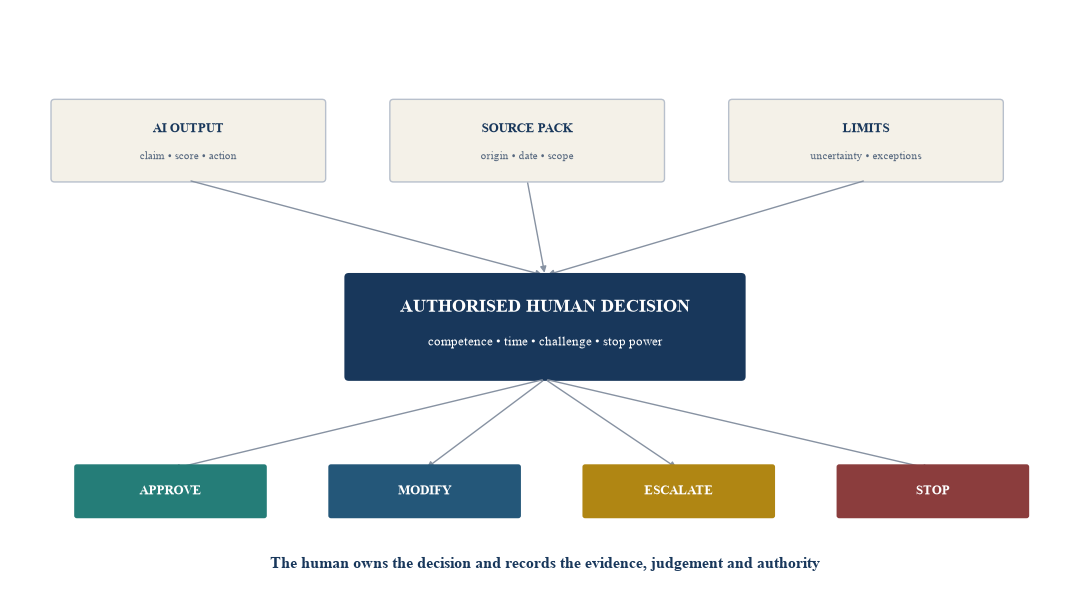
Author framework. Human review is effective only when authority, competence, evidence, time and override power are present.
Table 4. Test for meaningful human accountability
| Condition | Evidence question | Weak implementation | Acceptable evidence |
|---|---|---|---|
| Authority | can this person approve, reject or stop this decision? | reviewer can comment but cannot change the result | current mandate, limit and escalation path |
| Competence | does the reviewer understand the domain, system and limitations? | general training with no use-specific assessment | role requirements, training and demonstrated review capability |
| Evidence | can the reviewer inspect the sources and material assumptions? | output presented without provenance or contradictory facts | linked sources, data date, limitations and alternatives |
| Time | is review possible before the action becomes irreversible? | approval requested after execution or under artificial urgency | defined decision window and emergency process |
| Independence | can the reviewer challenge the owner and provider? | reviewer shares the deployment incentive and no second line exists | independent challenge, conflicts record and escalation |
| Override | can the person correct, defer, use another method or suspend? | interface offers only accept | editable output, reject route, fallback and kill switch |
| Record | can a later reviewer reconstruct the decision? | click log without rationale | output, evidence, judgement, authority, conditions and timestamp |
| Accountability | is one person or body answerable for the final decision? | responsibility spread across user, vendor and committee | named decision owner and governing forum |
A control is incomplete when the designated reviewer lacks any condition required for the specific decision.
9. Govern vendors, models and concentration together
Many private-wealth institutions rely on external models and cloud services. Procurement therefore becomes part of AI governance.
The vendor review covers corporate identity, contracting entity, service description, model providers, data location, subprocessors, retention, training use, security, incident response, assurance reports, access, intellectual-property terms, liability, service levels, change notice, audit rights and termination.
Technical diligence should test the deployed configuration. Marketing descriptions do not prove that the institution's tenant, model, region and integrations meet the required controls. The institution retains configuration evidence and repeats tests after material changes.
Concentration can occur across several applications that depend on one model, cloud, identity service or data platform. The aggregate inventory should reveal common dependencies. A provider outage, model withdrawal, price change or terms change can affect several critical processes at once.
Exit design starts before contracting. The institution identifies which prompts, evaluation sets, embeddings, logs, fine-tuning artefacts and records it can export. It tests whether critical workflows can continue through a manual or alternative route. Deletion confirmation should cover all relevant artefacts and subprocessors.
Table 5. Third-party AI diligence and contracting schedule
| Domain | Diligence question | Contract or control evidence | Ongoing test |
|---|---|---|---|
| Service chain | which entities provide the application, model, cloud and support? | complete provider and subprocessor schedule | quarterly change review |
| Data use | are prompts, files, outputs or metadata retained, reviewed or used for training? | purpose, prohibition, retention and deletion clauses plus settings | configuration and sample-log test |
| Location and transfer | where are data and support access located? | approved regions and transfer mechanism | region and access-log review |
| Security | how are identity, encryption, isolation, vulnerabilities and incidents controlled? | assurance reports, testing rights and notification duty | annual assurance and incident exercise |
| Model change | can the provider change models, safety settings or features without approval? | notice, version control and termination rights | regression test before acceptance |
| Performance | what is measured for the institution's use case? | service levels, limitations and remediation | approved evaluation set and drift review |
| Intellectual property | who owns inputs, outputs, configurations and derived assets? | ownership, licence, indemnity and restricted-use terms | legal review after feature changes |
| Audit and evidence | can the institution obtain evidence needed for governance and regulators? | access, audit, cooperation and record-retention clauses | evidence request simulation |
| Resilience | what happens during outage, compromise or provider failure? | continuity, recovery, support and data-access terms | fallback and recovery exercise |
| Exit | can data, configuration and records be exported and deleted? | portability, transition, deletion and assistance | annual exit test for material systems |
The scope should be proportionate to the use and supplemented by current legal, cyber, privacy and regulatory advice.
10. Secure tools, agents and integrations
An AI assistant with no system access can generate poor content. An agent with email, document, portfolio or payment access can create operational loss at speed. Permission design should therefore follow the maximum action available to the system.
Tool access uses least privilege. Read and write permissions are separated. High-risk actions require step-up authentication and human approval outside the model's own interface. Payment creation and payment release remain segregated. Investment order preparation and execution follow the institution's authority matrix.
Secrets, credentials and personal tokens stay outside prompts and retrievable content. The system should use managed identities and scoped service accounts. Logs record tool calls, parameters, responses, approvals and errors without creating an uncontrolled copy of sensitive data.
Prompt injection can arrive through external web pages, emails and uploaded documents. The system treats retrieved content as data rather than trusted instruction. It isolates tools, constrains output formats, applies allowlists and validates actions independently.
The NIST AI RMF identifies secure and resilient operation as a trustworthiness characteristic, and its Generative AI Profile addresses risks across the lifecycle.[9] NIST's 2025 preliminary Cyber AI Profile also organises work around securing AI components, using AI in defence and addressing AI-enabled attacks; it remained a draft at the time referenced and should be treated accordingly.[10]
Cyber incident planning connects the AI owner, security team, privacy officer, legal counsel, decision owner, vendor and governing body. The plan covers model compromise, data exposure, unauthorised action, poisoned retrieval, account takeover, deepfake-enabled fraud and loss of service.
11. Preserve regulated and professional accountability
AI does not create a new permission for a regulated activity. The organisation should analyse what the system and people actually do.
An investment research tool can support an authorised professional. A personalised recommendation can affect suitability, disclosure, conflicts and recordkeeping. A tool that ranks prospects, drafts promotions, manages portfolios or executes orders can intersect with different rules. The responsible firm and authorised individuals remain accountable for their regulated conduct.
The joint UAE enabling-technology guidance describes cross-sectoral principles and good practices for financial institutions adopting technologies including big-data analytics and AI.[5] The BIS Financial Stability Institute observed in 2024 that AI can intensify existing risks and highlighted governance, expertise, model risk, data governance and third-party providers as areas requiring attention.[11] These materials support a structured control approach while the binding requirements come from the applicable law, regulator and permissions.
Professional judgement also needs protection. Legal, tax, valuation, investment and cyber advisers should define where AI can assist and where a qualified person must perform the analysis. The output should disclose material system use when required by law, professional standards, contract or policy.
The AI policy cross-references investment policy, conflicts policy, data-protection programme, cyber framework, outsourcing policy, records policy, valuation policy and business continuity. Conflicts between policies go to a named governing forum.
12. Manage change across the complete lifecycle
Approval applies to a defined version and configuration. A provider model update, new retrieval source, prompt change, tool permission, jurisdiction, user group or decision use can require reassessment.
The lifecycle begins with need and alternatives. The owner states the problem and considers a non-AI method. The map phase identifies stakeholders, data, harms, dependencies and legal conditions. The measure phase tests performance and controls. The manage phase decides whether to deploy, restrict, improve or stop. Governance operates throughout. This sequence aligns with the structure of the NIST AI RMF while remaining adapted to private wealth.[9]
Change management defines materiality. A cosmetic interface update may require a basic check. A new model, data source or autonomous action can require full validation and approval. Emergency vendor changes receive temporary limits and a retrospective review within a defined period.
Retirement removes access, integrations, credentials and scheduled processes. It exports required records and completes contractual deletion. The institution preserves the decision evidence required by law and policy without keeping unnecessary personal data.
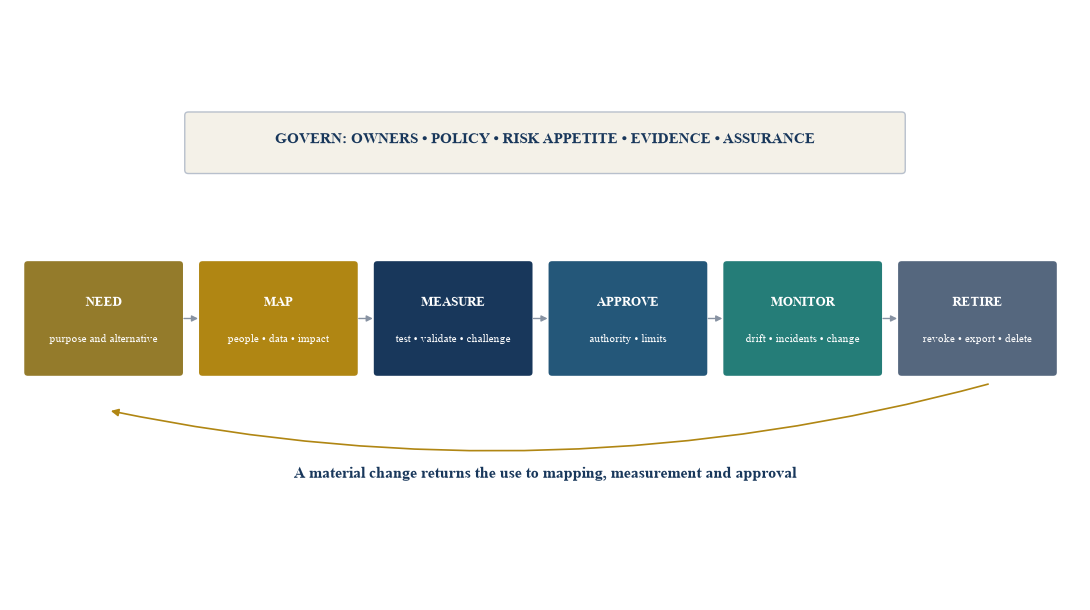
Author framework adapted to the govern, map, measure and manage structure of the NIST AI Risk Management Framework.
13. Respond to incidents through decision impact
An incident includes more than a technical outage. It can involve unauthorised disclosure, fabricated evidence, discriminatory output, incorrect recommendation, unauthorised action, provider breach, model change, inability to explain a material decision or repeated circumvention of policy.
The first response protects people and assets. The institution can disable a use case, revoke tokens, isolate data, halt actions, preserve evidence and invoke manual procedures. Payment, trading and external communication incidents receive urgent escalation through existing authority structures.
The incident owner determines which entities, people, data, jurisdictions, systems and decisions are affected. Privacy and regulatory notification duties require current analysis. Contractual notification to clients, families, insurers, banks or providers may also apply.
Decision remediation traces all material outputs during the affected period. The institution identifies which investment papers, communications, valuations, approvals or actions relied on the system and whether they need re-review or correction.
Root-cause analysis covers model, prompt, data, integration, access, process, human review, vendor and governance. The closure record states containment, affected decisions, notifications, corrections, control changes, residual risk and reactivation authority.
Exercises should use credible private-wealth scenarios: a deepfake payment instruction, a confidential data-room leak, a fabricated legal citation in an investment paper, a provider model change that alters risk scores and an agent sending an unauthorised external message.
14. Demonstrate the policy with a hypothetical family office
Consider a hypothetical UAE single-family office with 28 staff, four legal entities and management-estimated assets of AED 4.6 billion. It uses one enterprise generative-AI service, an AI-enabled portfolio platform, a document-review tool and an accounts-payable anomaly system.
Every value and circumstance in this example is a management assumption created solely to demonstrate the policy. It does not describe a client, portfolio, technology recommendation or regulatory conclusion.
The initial inventory identifies 34 use cases. Fifteen are bounded productivity uses. Ten support operations or research. Seven touch sensitive data or material recommendations. Two can initiate workflow actions. The office applies the risk-tier method to each use rather than approving the four products as a whole.
Public-market news summarisation is tier one when it uses public sources and a trained analyst verifies all material claims. Drafting an investment-committee memorandum is tier three because the output can influence a material capital decision. Reviewing foundation and succession documents is tier three because of sensitive family data, confidentiality and legal impact. Preparing a payment instruction is tier four; autonomous release remains prohibited under the assumed policy.
The office discovers that the enterprise language model is configured not to use customer content for training under its contract, but browser access allows users to reach an unapproved consumer service. Technical controls and training close the gap. The document tool stores derived indexes in a different region from the original files, triggering a transfer and contract review.
Validation of the investment-memorandum workflow uses 60 historic and synthetic cases. This quantity is a management assumption for illustration. Tests cover factual support, citation validity, stale information, contradictory evidence, calculation, confidential-data leakage and prompt injection. The committee requires source links for every material factual claim and records when generated drafting was used.
The office establishes a monthly operating dashboard and quarterly risk review. One tier-three use is suspended after a provider update reduces citation reliability below its approved threshold. The manual research process continues while the owner tests a corrected configuration.
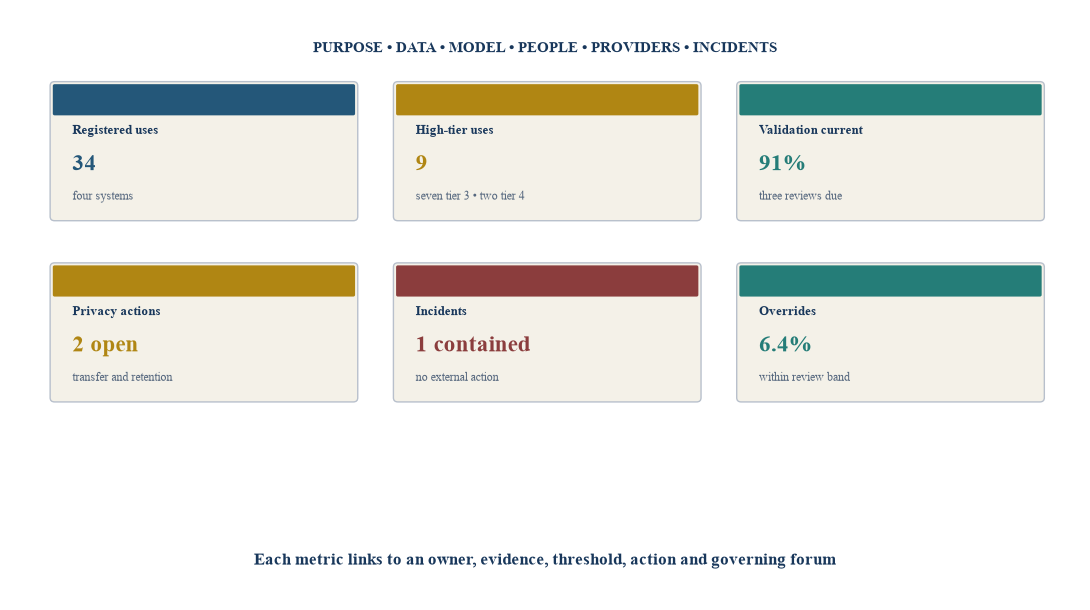
Every displayed value is an illustrative management assumption used solely to show dashboard design.
15. Build a board-ready monitoring system
The governing body needs a concise view of exposure and control health. It does not need a catalogue of technical metrics without decision relevance.
The dashboard begins with inventory completeness. It shows production and pilot uses by tier, legal entity, decision domain and common provider. It identifies unregistered discoveries and overdue reviews.
Performance metrics follow approved use. Research systems report unsupported claims, invalid citations and correction rates. Extraction systems report critical-field misses and unreadable documents. Portfolio tools report input freshness, reconciliation, overrides and outcome analysis. Agents report proposed, approved, rejected, failed and reversed actions.
Risk metrics include sensitive-data use, transfers, access exceptions, unresolved validation findings, vendor concentration, provider changes, incidents and policy breaches. A green average should not obscure one severe open issue.
The dashboard distinguishes management estimates from verified events. Benefits such as hours saved, cost avoided or decision improvement require defined measurement and a source. A generated estimate should never be presented as realised performance.
The governing body approves risk appetite, prohibited uses, tier-four deployments, material exceptions and the policy. Management owns implementation. Independent assurance reviews the design and operation. The review schedule can be more frequent during rapid adoption or material change.
16. Implement the policy in 100 days
Days one to 20 establish governance and inventory. The sponsor, policy owner, privacy, legal, cyber, compliance, investment, operations and technology roles agree definitions and an interim safe-use standard. Staff disclose current tools and uses.
Days 21 to 40 map entities, data, jurisdictions, providers, regulated activities and decision consequences. The institution classifies use cases and stops or restricts uses that lack authority or present unacceptable exposure.
Days 41 to 60 build controls. The team completes priority impact assessments, vendor reviews, access changes, validation plans, human-accountability assignments, incident routes and record standards.
Days 61 to 80 validate the highest-risk production uses and run a pilot through the complete approval process. Monitoring, change control, fallback and suspension are tested.
Days 81 to 100 perform an incident exercise, reconcile the register, close critical findings and present the policy, risk appetite, dashboard and unresolved actions to the governing body.
Table 6. One-hundred-day private-wealth AI policy implementation
| Days | Workstream | Controlled deliverable | Gate |
|---|---|---|---|
| 1 to 10 | sponsorship and interim standard | named owners, definitions, prohibited data and action rules | governing sponsor and escalation route confirmed |
| 11 to 20 | discovery | product, use-case, data, integration and provider inventory | staff attestation and technical discovery reconciled |
| 21 to 30 | legal and privacy map | entities, roles, lawful basis, notices, DPIAs, transfers and records | counsel and privacy actions assigned |
| 31 to 40 | classification | risk tiers, regulated-activity flags and critical dependencies | highest-risk uses stopped, restricted or sponsored |
| 41 to 55 | control design | data, access, human review, model, vendor and record controls | owners accept requirements and evidence |
| 56 to 70 | validation | test sets, adverse cases, independent challenge and findings | release authority accepts limits and remediation |
| 71 to 80 | deployment and monitoring | approved configuration, thresholds, dashboard and fallback | production access matches approved use |
| 81 to 90 | incident and exit exercise | containment, notification analysis, manual continuity and deletion test | critical gaps have owners and deadlines |
| 91 to 100 | governance acceptance | policy, risk appetite, register, dashboard and assurance plan | governing body records decisions and open actions |
The timetable is illustrative. Legal analysis, provider negotiation, remediation and independent validation can require longer periods.
17. Limitations and conclusion
AI systems and regulatory frameworks change quickly. Current law, regulation, guidance, provider terms, model versions and technical configuration should be verified before deployment and at each material change.
The applicable UAE personal-data regime depends on the entities, jurisdiction and processing. Other jurisdictions can apply through people, providers, data and activities. Current legal advice should determine scope, lawful basis, rights, impact assessment, transfers, notification and enforcement exposure.
Model and system performance is use-specific. A benchmark, vendor assurance report or successful pilot cannot establish fitness for every private-wealth task. Validation requires representative data, adverse cases, limitations and ongoing outcome analysis.
Human review can fail through weak authority, competence, evidence, time or challenge. The institution should test the operation of oversight rather than relying on policy language.
The hypothetical office contains management assumptions solely for method demonstration. It does not describe a family, client, asset allocation, realised benefit or recommended provider.
A durable AI policy connects purpose to action. Every use has a business purpose and owner. Every data flow has authority and control. Every material system has a risk tier, validation record and approved boundary. Every human reviewer can challenge and stop. Every vendor dependency has evidence and an exit route. Every incident traces affected people, data and decisions. Every governing report links a metric to an action.
This architecture allows a private-wealth institution to use AI while preserving confidentiality, investment discipline and accountable human judgement. The policy becomes a living control system across family governance, investment activity and operations.
References
- [1] United Arab Emirates, Federal Decree-Law No. 45 of 2021 Concerning the Protection of Personal Data, effective 2 January 2022; official text accessed 12 August 2026. https://uaelegislation.gov.ae/en/legislations/1972
- [2] Dubai International Financial Centre, Data Protection Law DIFC Law No. 5 of 2020 and Commissioner guidance, accessed 12 August 2026. https://www.difc.com/business/registrars-and-commissioners/commissioner-of-data-protection/guidance
- [3] Dubai International Financial Centre, Regulation 10: Processing Personal Data through Autonomous and Semi-autonomous Systems, accessed 12 August 2026. https://www.difc.com/business/registrars-and-commissioners/commissioner-of-data-protection/regulation-10
- [4] Abu Dhabi Global Market, Office of Data Protection Guidance on Data Protection Regulations 2021, accessed 12 August 2026. https://www.adgm.com/operating-in-adgm/office-of-data-protection/guidance
- [5] Central Bank of the UAE, Securities and Commodities Authority, Dubai Financial Services Authority and Financial Services Regulatory Authority, Guidelines for Financial Institutions Adopting Enabling Technologies, 15 November 2021. https://www.dfsa.ae/news/uae-regulatory-authorities-jointly-issue-guidelines-financial-institutions-adopting-enabling-technologies
- [6] Dubai Financial Services Authority, Regulatory expectations on artificial intelligence risk management in the DIFC, SEO Letter listing dated 4 June 2026, accessed 12 August 2026. https://www.dfsa.ae/your-resources/publications-reports/seo-letters-1
- [7] Dubai International Financial Centre, Consultation of amended DIFC Data Protection Regulations, 18 June 2026. https://www.difc.com/whats-on/news/difc-consultation-amended-data-protection-regulations
- [8] Board of Governors of the Federal Reserve System, Office of the Comptroller of the Currency and Federal Deposit Insurance Corporation, Revised Guidance on Model Risk Management, 17 April 2026. https://www.federalreserve.gov/supervisionreg/srletters/SR2602.htm
- [9] National Institute of Standards and Technology, AI Risk Management Framework 1.0 and Generative Artificial Intelligence Profile NIST AI 600-1, 2023 and 2024. https://www.nist.gov/itl/ai-risk-management-framework and https://nvlpubs.nist.gov/nistpubs/ai/NIST.AI.600-1.pdf
- [10] National Institute of Standards and Technology, Cybersecurity Framework Profile for Artificial Intelligence, NIST IR 8596 Initial Preliminary Draft, 16 December 2025. https://csrc.nist.gov/pubs/ir/8596/iprd
- [11] Bank for International Settlements Financial Stability Institute, Regulating AI in the financial sector: recent developments and main challenges, FSI Insights No. 63, 12 December 2024. https://www.bis.org/fsi/publ/insights63.htm
- [12] Organisation for Economic Co-operation and Development, OECD AI Principles, adopted 2019 and updated 2024, accessed 12 August 2026. https://www.oecd.org/en/topics/ai-principles.html
About the Author
Chennakeshav Adya is an independent researcher and Managing Partner of Matchpoint Partners. His research focuses on investment strategy, capital formation, transaction execution, governance and operating-model design across the Gulf and international markets.
