

1. Introduction
A foundation can own a portfolio while its decision system remains incomplete. The charter may state objects. The by-laws may identify the council, guardian, qualified recipients or beneficiaries and reserved powers. Banks and investment managers may hold mandates. An investment committee may meet. None of those facts alone demonstrates that capital decisions follow a complete and authorised chain.
The chain begins with legal ownership. Assets transferred to a foundation belong to the foundation under the relevant regime. The council manages and administers those assets under the foundation's constitutional documents and applicable law. A guardian, where appointed or required, performs an oversight role defined by law and the documents. Family members can have economic expectations or defined rights without owning the underlying assets personally.
The chain continues through investment governance. The family needs objectives, liabilities, liquidity, risk capacity, constraints, strategic allocation, decision rights, execution controls and reporting. An investment committee can bring specialist judgement and repeatable process. Its authority must derive from the correct legal body and remain within the foundation's objects, documents and law.
The UAE context makes the connection commercially significant. DIFC's 2025 Annual Report states that 1,115 foundations were established by DIFC-based families, an increase of 66 per cent year on year, while family-related entities increased to 1,289.[1] ADGM and DIFC both provide foundation regimes. UAE Federal Decree-Law No. 37 of 2022 also recognises family councils, family offices, family investments, conflict control and the separation of family-asset governance from family-business governance.[2]
The legal and regulatory analysis is structure-specific. A foundation's place of establishment, current law, charter, by-laws, licences, activities, service providers, asset location and decision facts all matter. This paper provides an operating framework for turning verified legal authority into controlled investment decisions.
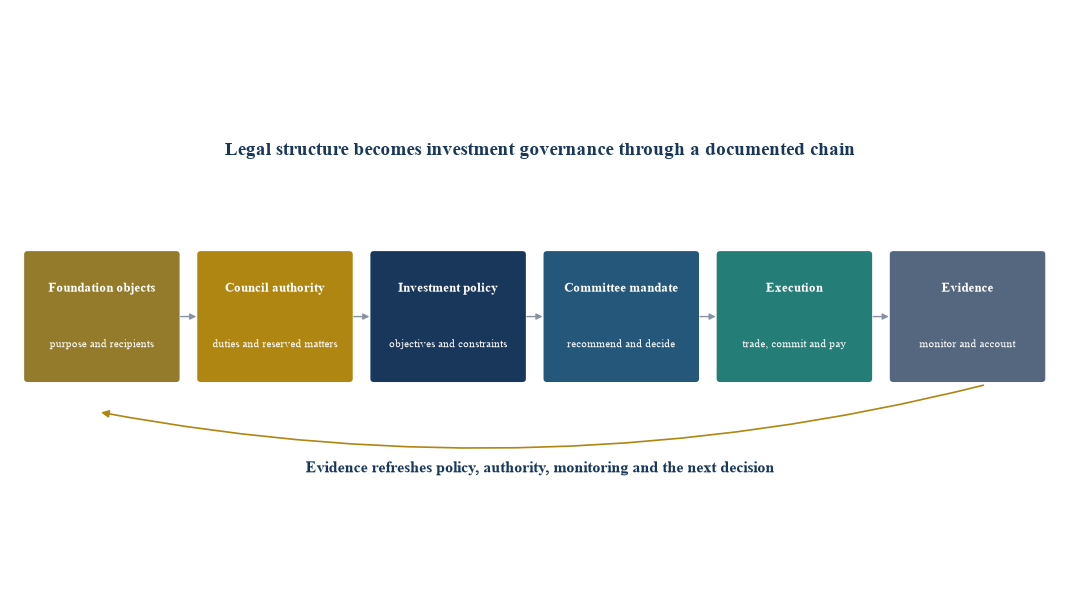
Author framework. Actual authority depends on current law, constitutional documents, licences and approved delegations.
2. Read the legal layers precisely
The two UAE international financial centres have their own legal frameworks. The applicable foundation law and current amendments should be read directly for the actual entity.
ADGM's Foundations Regulations require a council. The council carries out the foundation's objects, manages and administers its assets and performs other acts required by the charter, by-laws or regulations. Councillors must act in accordance with the charter, use powers for their proper purpose, act honestly and in good faith in the foundation's best interests and exercise independent judgement.[3]
ADGM's public guidance describes the council as performing a role equivalent to a company board. It states that a guardian supervises the council and seeks compliance with the charter and by-laws. Guardian appointment is compulsory after the founder's death and optional during the founder's lifetime under the circumstances described by ADGM.[4] The current regulations and documents determine the exact position.
DIFC's current Foundations Law provides that council members must act honestly and in good faith with a view to the foundation's best interests, exercise reasonable care, diligence and skill and declare interests in foundation transactions. It states that the good-faith duty is fiduciary. A guardian must take reasonable steps to ensure that the council carries out its functions and may require the council to account for administration of property and advancement of the objects.[5]
A foundation council and an investment committee therefore have different legal positions. The council is a governing organ of the foundation. An investment committee is a designed forum whose powers depend on the documents and a valid delegation or reservation. A committee title cannot displace the council's duties.
The foundation also sits within wider obligations. ADGM announced commercial-legislation amendments in May 2026, including changes affecting Foundations Regulations and beneficial ownership.[6] ADGM states that applicable entities must maintain current beneficial-ownership records and report changes within the required period.[7] DIFC, ADGM and other relevant authorities have their own registration, accounting, licensing, AML and compliance requirements.
Financial-services regulation remains a separate analysis. The DFSA regulates financial services conducted in or from the DIFC, including asset management, investment advice, dealing, funds and custody.[8] The legal ownership of assets by a foundation does not determine whether another person needs permission to advise, arrange, manage or deal.
Table 1. Legal and governance evidence map
| Evidence | Observed rule or fact | Investment-governance implication | Boundary |
|---|---|---|---|
| DIFC Annual Report 2025 | 1,115 foundations and 1,289 family-related entities | operating governance must scale with ownership structures and family capital | ecosystem counts do not assess individual governance quality |
| ADGM Foundations Regulations | council manages foundation assets and councillors have stated duties | council authority and accountability must remain visible in every investment delegation | current consolidated law and documents control |
| DIFC Foundations Law | council members have good-faith, care and conflict duties; guardian oversight is defined | committee recommendations and decisions require a valid path to the council | exact powers depend on law, charter and by-laws |
| UAE Family Businesses Decree-Law | family governance bodies may supervise investments and separate family assets from family business | ownership, family and business forums should have distinct remits and interfaces | application and legal effect require current advice |
| DFSA regulatory mandate | asset management, advice, dealing, funds and custody are regulated domains in or from DIFC | provider scope and permissions should be confirmed separately from foundation formation | regulatory status depends on activity and facts |
| ADGM beneficial-ownership guidance | applicable entities maintain and update beneficial-ownership records | the governance calendar should connect ownership changes to filings and authority | requirements can change and must be checked currently |
| CFA Institute governance research | authority should follow skill, capacity, time and position | committee design should match actual decision capability | institutional guidance needs adaptation to foundation facts |
This table is a research map. Current legal advice should confirm the law and documents applicable to the specific foundation and activity.
3. Translate objects into an investment mandate
Foundation objects describe the legal purpose. An investment mandate converts that purpose into objectives and constraints that can govern capital. The translation should remain faithful to the documents.
The translation begins with recipients and time horizon. A foundation can support people, classes of people, charitable or non-charitable purposes depending on its regime and documents. Investment policy should identify expected distributions, timing, currency, discretion and contingencies without assuming rights that the documents do not create.
The mandate then defines capital objectives. These can include maintaining real value, funding distributions, supporting education or healthcare, providing entrepreneurial capital, preserving strategic shareholdings, meeting philanthropy or holding assets across generations. Each objective needs a horizon and priority.
Risk capacity derives from the complete position. A foundation holding one operating company has a different risk profile from a diversified financial portfolio. Guarantees, debt, commitments, property expenditure, tax and beneficiary distributions affect the amount of loss and illiquidity the structure can absorb.
Constraints link law and family policy to execution. They can include prohibited assets, leverage, currency, concentration, related parties, liquidity floors, ethical or Sharia requirements, direct-investment limits, jurisdictions, custody and approval thresholds. Legal advice should identify which terms are binding, reserved or amendable and by whom.
Table 2. Governing-document translation into investment policy
| Source layer | Question | Policy output | Evidence retained |
|---|---|---|---|
| Objects | what purposes and persons can the foundation serve? | objective hierarchy and eligible uses of capital | current charter and legal interpretation |
| By-laws | how are benefits, powers, meetings and approvals governed? | distribution assumptions, authority and reserved matters | controlled by-laws and amendment history |
| Council duties | what must councillors consider and how must they act? | council review, challenge, conflicts and decision record | law, minutes and council papers |
| Guardian provisions | when is a guardian required and what oversight powers apply? | notice, information, consent or escalation steps | appointment, powers, papers and communications |
| Family governance | which family views or policies inform the foundation? | consultation rights and non-binding family inputs where applicable | family charter and forum records |
| Entity and asset documents | which entity owns each asset and which rights attach? | eligible portfolio, control, liquidity and voting map | registers, agreements and ownership evidence |
| Regulation and provider terms | which activities require permission and what is delegated? | provider perimeter, execution route and oversight | registers, licences, contracts and current advice |
The source document and adviser conclusion should be retained for each translated requirement.
4. Build the foundation economic balance sheet
The legal balance sheet records assets and liabilities of the foundation. The economic balance sheet adds exposures that shape investment decisions even when they sit in controlled subsidiaries, related entities or contingent obligations.
Every asset record identifies the legal owner, holding chain, jurisdiction, currency, valuation date, source, method, control rights, liquidity, encumbrance and decision authority. The foundation may own a holding company whose subsidiaries own operating businesses and property. The portfolio view should avoid treating the foundation as direct owner when governance and cash must travel through intermediate entities.
Liabilities include debt, guarantees, remaining fund commitments, approved distributions, tax, contractual obligations and contingent support. A family expectation becomes a forecast only when its status and authority are clear. The budget distinguishes legal obligations, approved commitments, management estimates and opportunities.
Look-through exposures support risk decisions. A foundation can hold a diversified fund portfolio whose underlying companies concentrate in the same geography or sector as the family business. It can hold cash in one entity while an obligation belongs to another. The balance-sheet map makes those relationships visible.
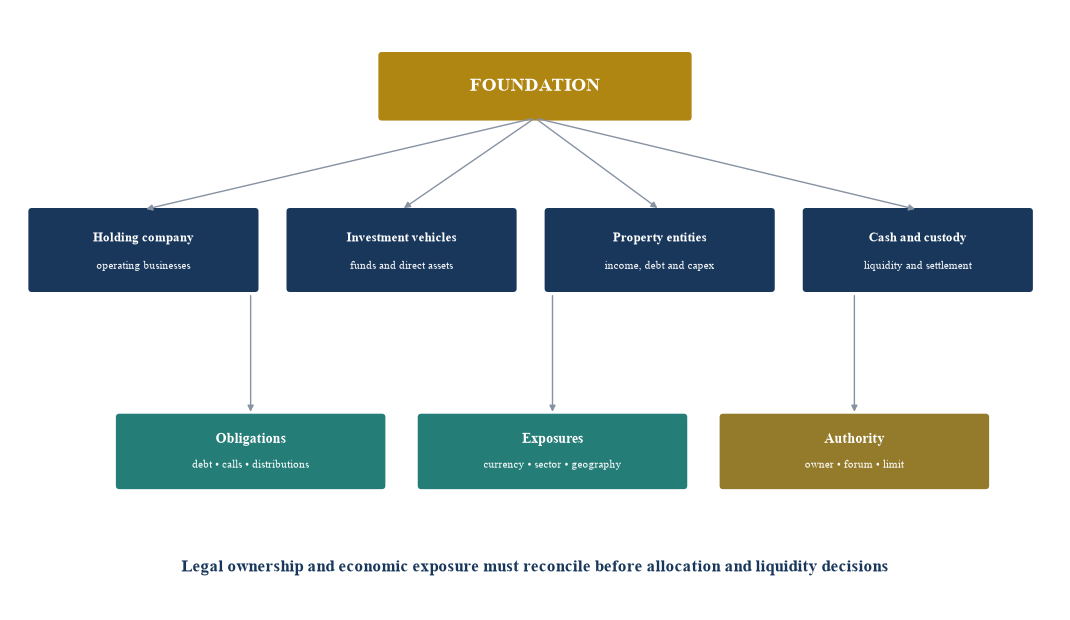
Author framework. Ownership, control, valuation and availability require current source evidence.
5. Create an authority cascade
Authority should flow from the law and constitutional documents into controlled delegations. Each layer states what it retains, delegates, receives and reports.
The foundation council approves matters reserved to it, supervises the investment arrangement and accounts for administration of the assets. The guardian receives the notice, information, consent or escalation rights defined by law and documents. The family council can express family purpose or coordinate family matters where its role is validly established. Its preference is not automatically a foundation decision.
The investment committee operates under a written charter approved through the proper authority. It can be advisory, decision-making within limits or a mixture. Its remit covers policy, allocation, liquidity, managers, direct investments, risk and performance only to the extent authorised.
The CIO or investment lead recommends and implements. External providers advise or exercise discretion under contract and within their permissions. Finance and operations execute cash under segregated controls. Legal, tax and compliance advisers support their defined domains.
The matrix should avoid implied authority. Attendance at a committee does not create a vote. A founder's historic practice does not necessarily override the documents. A bank mandate does not validate a foundation decision that lacked internal authority.
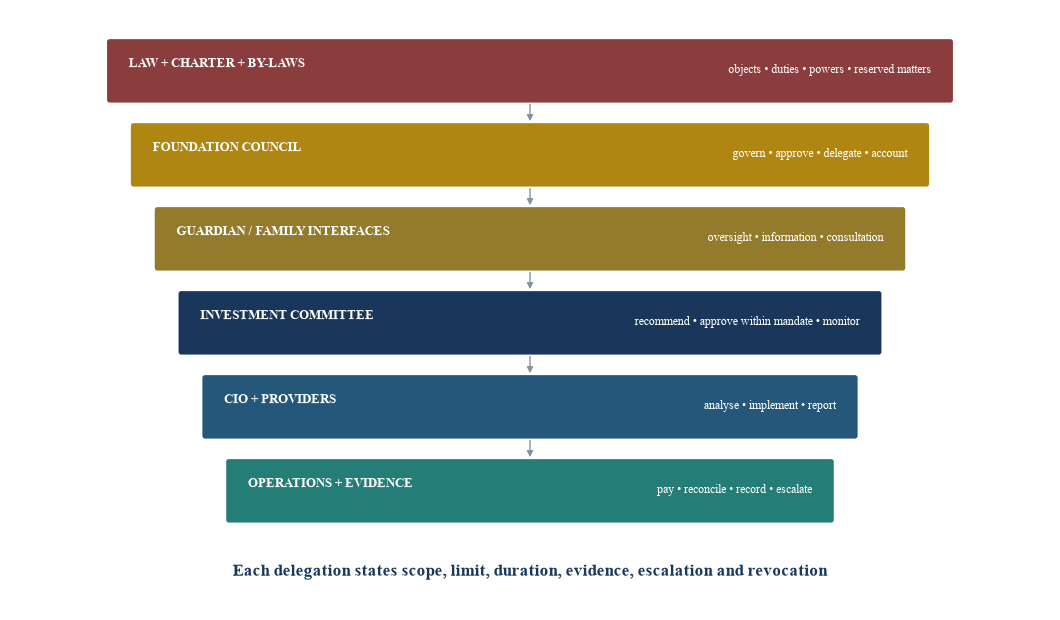
Author framework. Actual roles and powers require current legal confirmation.
Table 3. Illustrative foundation investment decision-rights matrix
| Decision | Foundation council | Guardian or family interface | Investment committee | CIO or provider | Control evidence |
|---|---|---|---|---|---|
| Objects and constitutional change | reserve and act through required process | rights defined by documents | inform | no authority | legal advice, resolution and filing |
| Investment policy | approve and review | receive, challenge or consent where applicable | recommend | draft and implement | controlled policy and council minutes |
| Strategic allocation | reserve material changes or delegate within limits | information or consent as defined | approve within mandate | recommend | allocation paper, limits and resolution |
| Rebalancing | set ranges and delegation | monitor through reporting | oversee or approve exceptions | execute within bands | pre-trade rule, ticket and post-trade report |
| Manager appointment | reserve above threshold | disclose conflicts or receive notice | approve within mandate | diligence and recommend | diligence, fees, conflicts and contract |
| Direct investment | reserve specified transactions | defined notice, consultation or consent | recommend or approve within limit | originate, underwrite and monitor | investment memorandum and transaction file |
| Distribution and liquidity | approve policy and material action | beneficiary or family input as documented | test portfolio effect | forecast and execute approved actions | cash budget, legal owner and approval |
| Borrowing and security | reserve policy and material facilities | rights defined by documents | recommend | analyse and administer | terms, covenants, stress and resolution |
| Payment | establish bank authority and segregation | no operational role unless documented | no unilateral payment | confirm authorised purpose | dual approval, callback and reconciliation |
| Performance and risk | receive, challenge and direct action | receive defined reporting | monitor and escalate | calculate and explain | source data, methodology and exception log |
This matrix is an operating example. Governing documents and legal advice determine the actual allocation of power.
6. Charter the investment committee around decisions
The investment-committee charter states purpose, authority, membership, skill requirements, chair, quorum, voting, conflicts, papers, minutes, urgent decisions, reporting and review. It should identify the approving foundation body and any guardian interaction.
Committee composition should reflect the mandate. Relevant capabilities can include total-portfolio construction, private markets, operating businesses, liquidity, risk, transaction execution, legal structures and the family's context. Independence and challenge should be designed rather than assumed.
The charter distinguishes recommendation from decision. A committee can recommend a policy to the council while approving manager changes within an allocated sleeve. It can monitor a direct investment while the council reserves the acquisition. Minutes should state the authority used for each decision.
CFA Institute's investment-governance work stresses allocating decisions to people with the necessary skill, capacity, time and position.[9] Its 2026 research on investment committees also highlights the risk of hierarchy, anchoring and weak accountability in group decisions.[10] A foundation committee can mitigate these risks through pre-read submissions, recorded alternatives, independent views, explicit criteria and post-decision review.
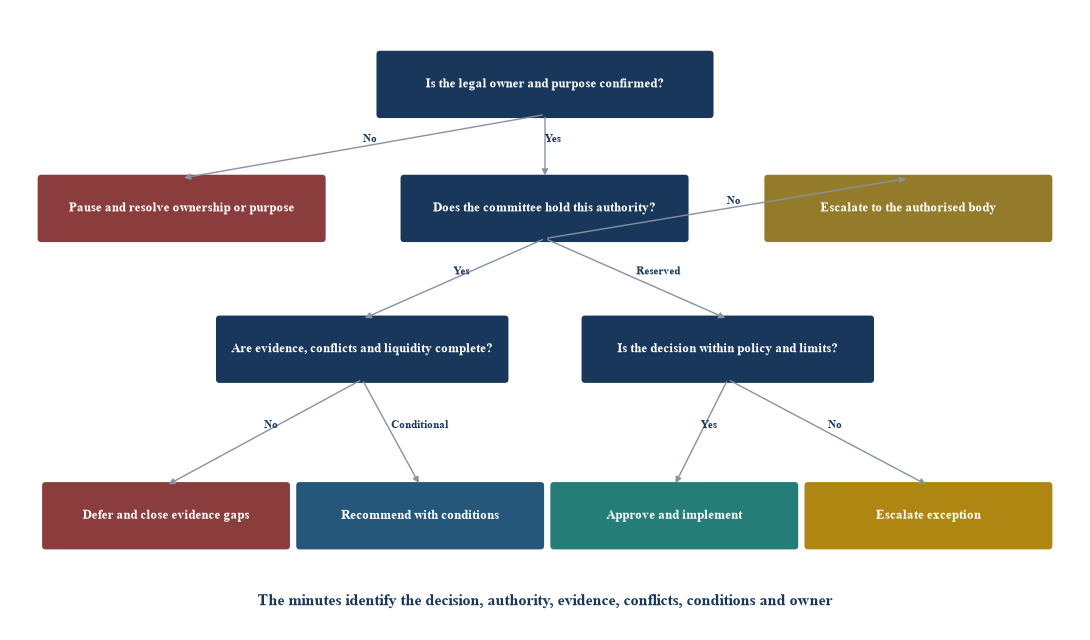
Author framework. The committee proceeds only when the legal owner and authority are confirmed.
7. Design the committee paper as an evidence record
A standard decision paper improves comparability and creates an audit trail. It begins with the exact decision requested, legal owner, authority, deadline and recommendation.
The paper describes the objective and fit with the foundation's objects and investment policy. It covers financial terms, valuation, expected return, downside, liquidity, concentration, currency, leverage, tax and exit. It identifies alternatives, including doing nothing.
Evidence has a source and date. Management estimates are labelled in reader-friendly terms and separated from verified contractual or market data. Missing evidence remains visible. Adviser conclusions state scope and qualifications.
Conflicts include family relationships, council or committee interests, provider compensation, related parties, allocation among entities, personal co-investment and use of affiliated products. The paper records disclosure, recusal, independent review and approval path.
Table 4. Minimum investment-committee decision pack
| Section | Required content | Evidence test | Decision output |
|---|---|---|---|
| Decision and authority | exact ask, legal owner, forum, limit and deadline | current delegation and governing document cited | approve, reject, defer, recommend or escalate |
| Purpose and policy | object, objective, allocation, constraints and recipients | policy version and fit documented | policy compliance or identified exception |
| Investment case | economics, valuation, cash flow, risks, sensitivity and exit | claims traced to dated source | base, downside and severe outcomes |
| Whole-balance-sheet effect | liquidity, commitments, leverage, concentration and operating-business overlap | consolidated data and measurement dates | post-decision exposure and headroom |
| Legal, tax and regulation | structure, contracts, permissions and tax treatment | scoped current adviser conclusions | conditions precedent and retained risk |
| Conflicts and related parties | interests, economics, allocations and recusals | complete declarations and independent review | mitigation, consent and minutes |
| Execution and control | counterparties, custody, payment, settlement and documentation | duties segregated and provider authority checked | named owners, sequence and stop conditions |
| Monitoring and exit | thesis, milestones, valuation, reporting, breach and exit | metrics have source, frequency and owner | dashboard, review date and escalation trigger |
Additional requirements apply to particular asset classes, transactions, jurisdictions and regulated activities.
8. Separate governance from regulated activity
The council and committee can make owner decisions. External or internal parties performing financial services can require regulatory permission depending on jurisdiction and activity.
The provider map should identify legal entity, location, contracted client, service, discretion, custody or account access, remuneration, licence and regulator. The family should verify the relevant public register and obtain advice for unclear activities.
An advisory investment committee does not automatically become a regulated asset manager. Its actual conduct, personnel, compensation, location and authority matter. A family employee making decisions for the employer's foundation, an independent consultant advising, a multi-family office managing assets and a bank executing a discretionary mandate can have different regulatory positions.
The contract should mirror the internal authority. A provider should not receive discretion beyond what the council validly delegated. Bank signatories should not rely on informal committee practice. The family should ensure that termination or incapacity can revoke authority promptly.
9. Connect liquidity to legal ownership
A foundation-level allocation can look liquid while cash remains unavailable where required. The liquidity system maps each obligation to the liable entity and each source to the legal owner.
Sources include unrestricted cash, short-duration assets, listed securities, operating-company dividends, property income, receivables and committed facilities. Each has availability, currency, settlement, restriction, tax, consent and authority. Restricted or encumbered assets remain outside immediate liquidity.
Obligations include approved distributions, debt, tax, private-market calls, operating costs, property expenditure and contingencies. The investment committee monitors portfolio liquidity while the council approves material distribution and borrowing decisions as required.
The liquidity ladder ranks funding sources by certainty, time, economic cost and strategic cost. It should identify when the committee can act and when council or other entity approval is required.
10. Control conflicts across family, council and providers
Family capital creates overlapping roles. A family member can be a founder, council member, qualified recipient or beneficiary, operating-company director, investment-committee member, seller, borrower or co-investor. The governance system should identify the role relevant to each decision.
The conflicts register covers direct and indirect financial interests, family relationships, provider economics, board positions, competing opportunities, allocations, gifts and confidential information. Declarations refresh periodically and before each decision.
Mitigation can include disclosure, recusal, independent valuation, independent committee members, competitive process, separate legal advice, allocation policy, enhanced approval and guardian involvement where applicable. The appropriate measure depends on the documents, law and facts.
ILPA's principles emphasise alignment, governance and transparency in private-market relationships.[11] Those disciplines support foundation oversight of managers, co-investments and related transactions. Fee and expense information should reveal all material economic relationships.
Table 5. Foundation investment-conflict control map
| Conflict type | Example | Detection evidence | Control response |
|---|---|---|---|
| Role conflict | council member is also seller, director or recipient | role and interest declarations | recusal, independent review and correct approval forum |
| Related-party transaction | foundation buys from or lends to a family-controlled entity | ownership map and transaction perimeter | independent terms, valuation, advice and enhanced approval |
| Opportunity allocation | direct deal can be taken personally, by foundation or by operating company | opportunity and allocation register | pre-approved allocation policy and documented rationale |
| Provider incentive | adviser receives product, placement or transaction economics | fee and affiliation disclosure | open comparison, offset, consent and monitoring |
| Information conflict | committee member holds confidential company or manager information | role map and information classification | access controls, restricted list and legal advice |
| Personal co-investment | family or staff invest alongside the foundation | subscription and ownership records | eligibility, terms parity, allocation and approval policy |
| Valuation conflict | seller, manager or related party supplies the decisive valuation | source and methodology map | independent valuation or challenge and sensitivity |
| Beneficiary preference | one recipient seeks a distribution or risk choice affecting others | request, objects and distribution policy | separate family input from council decision and record reasons |
Legal advice should determine duties, disclosure, consent and validity for the specific transaction.
11. Build an operating model with one accountable owner per activity
The target operating model contains four governance domains.
Foundation governance covers objects, constitutional documents, council, guardian, ownership, distributions, accounting and compliance. Family governance covers purpose, education, communication, family policy and dispute processes. Investment governance covers policy, allocation, liquidity, managers, direct deals, risk and performance. Operating governance covers cash, books, custody, data, cyber, providers and records.
Interfaces connect the domains. A proposed family distribution moves from family request through document and liquidity analysis to the council. An investment opportunity moves from CIO screening through committee analysis to the authorised decision body. A cash payment moves from approved purpose to segregated bank execution and reconciliation.
One owner is accountable for each activity. Advice can come from several specialists. Execution can be distributed. Accountability remains clear.
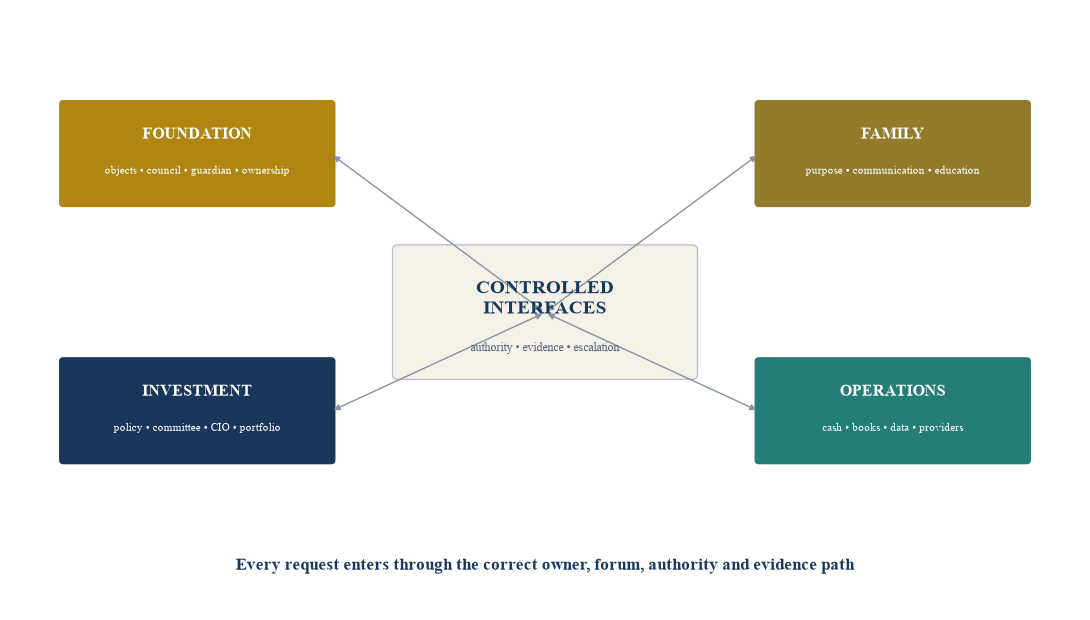
Author framework. Legal, family, investment and operating governance have distinct remits and controlled interfaces.
12. Control data, records and committee memory
The foundation needs an evidence architecture that survives changes in people and providers. It includes current constitutional documents, appointments, ownership records, delegations, policies, investment papers, minutes, contracts, positions, valuations, cash, commitments, performance, conflicts and exceptions.
Each record has an owner, source, effective date, version, access classification and retention rule. Sensitive family information is available only to authorised roles. The guardian and council receive information consistent with their rights and duties.
The portfolio system should reconcile to custody, bank, administrator, general ledger and manager records. Valuations retain measurement date and method. Private assets and operating businesses need a controlled update cycle.
Committee memory includes the original thesis, alternatives considered, assumptions, conditions and subsequent outcome. Post-decision reviews compare results with the decision evidence without using hindsight to rewrite the original record.
13. Prepare succession and incapacity before authority fails
Foundations are intended to support continuity. The investment system should operate through founder, councillor, guardian, committee, CIO and provider changes.
The authority register shows current officeholders, term, appointment source, delegated limits, bank rights, system access and replacement process. A change in one role triggers review of related access, filings, contracts and committee composition.
The incapacity plan identifies who can call a meeting, approve urgent liquidity, communicate with banks, act on capital calls and preserve critical operations. It distinguishes temporary cover from permanent appointment.
ADGM's 2026 beneficial-ownership and commercial-legislation updates demonstrate that compliance requirements can change.[6][7] The governance calendar should assign responsibility for legal updates and document review rather than treating formation documents as static.
14. Demonstrate the framework with a hypothetical UAE foundation
Consider a hypothetical UAE foundation with management-estimated assets of AED 3.2 billion. The illustrative structure owns a holding company valued at AED 1.55 billion, AED 620 million of global public investments, AED 410 million of private funds, AED 280 million of property investments, AED 190 million of direct investments and AED 150 million of cash and short-duration assets. Debt and guarantees total AED 360 million. Remaining fund commitments total AED 170 million.
The charter and by-laws establish family-benefit and long-term preservation purposes, a three-member council and defined guardian rights. The family council discusses education, distributions and family-enterprise priorities. A five-member investment committee exists, but its minutes do not consistently state whether it advises or decides.
Every value and circumstance in this example is a management assumption created solely to demonstrate the framework. It does not describe a client, legal structure, target allocation or recommendation.
The legal and authority review identifies three gaps. The investment policy was approved informally before the current council appointments. Bank mandates give execution authority to two executives without a consolidated limit schedule. Direct investments have been approved by the committee even though the by-laws reserve material acquisitions to the council.
The remediation begins with legal advice on the current documents and past decisions. The council re-approves a controlled investment policy within the proper process, adopts a committee charter and authority matrix, and aligns bank mandates with the approved delegation. The investment committee becomes advisory for direct investments above the council threshold and decision-making for manager changes and rebalancing within defined bands.
The office builds an economic balance sheet and 24-month liquidity budget. The committee receives a quarterly dashboard. The guardian receives the information and meeting rights confirmed by the documents. Conflicts, exceptions and actions appear in a controlled register.
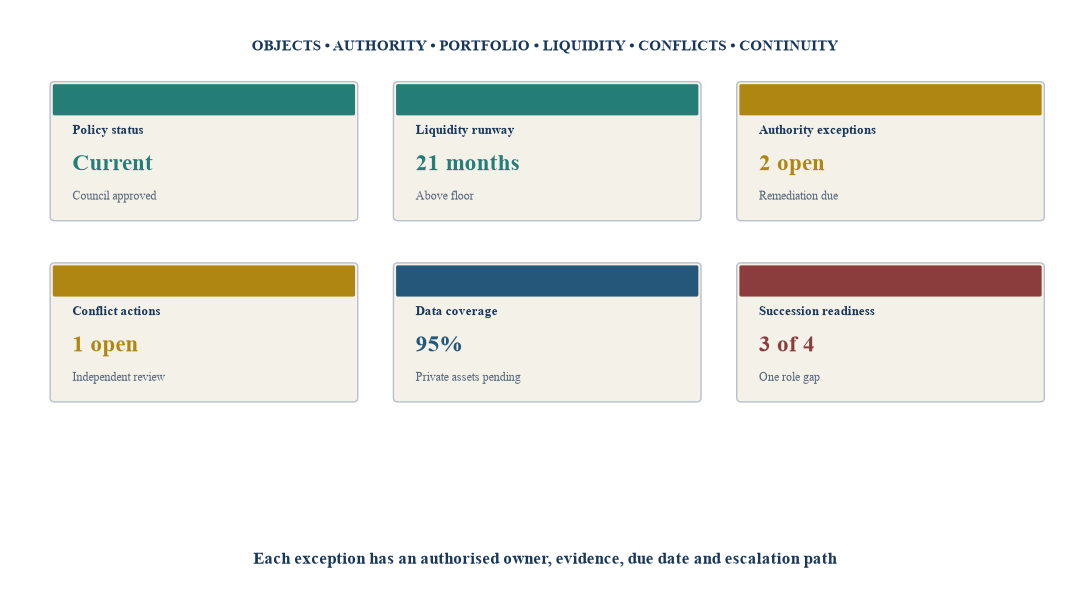
Every displayed value is an illustrative management assumption used solely to show dashboard design.
15. Implement the architecture in 100 days
Days one to 20 establish the legal and factual baseline. Counsel reviews the current law, charter, by-laws, appointments, guardian provisions, reserved matters, licences, provider contracts and open decisions. The office inventories assets, entities, obligations and authorities.
Days 21 to 40 translate the documents into an owner mandate, economic balance sheet, investment policy and decision-rights matrix. The council resolves priorities and evidence gaps through the proper process.
Days 41 to 60 charter the investment committee and align providers. Membership, skills, conflicts, meetings, papers, voting, urgent authority and reporting are approved. Provider scope and permissions are verified.
Days 61 to 80 configure the operating system. The office implements the liquidity budget, committee paper, dashboards, conflicts register, document control, bank authority, payment segregation and exception workflow.
Days 81 to 100 run parallel governance. A historic decision and one live or simulated decision are processed through the new architecture. The council, committee, operations team and guardian interface test notices, evidence, escalation and records. The council signs off open actions and the next review cycle.
Table 6. One-hundred-day foundation-to-investment-committee implementation
| Days | Workstream | Controlled deliverable | Gate |
|---|---|---|---|
| 1 to 20 | legal and factual baseline | current documents, roles, assets, obligations, licences and issue log | counsel scope and council sponsor confirmed |
| 21 to 30 | objects and mandate | purpose translation, recipient needs, objectives and constraints | objects and legal interpretation accepted |
| 31 to 40 | balance sheet and policy | economic balance sheet, liquidity view and investment policy | council approves policy through proper authority |
| 41 to 50 | authority design | reserved matters, delegation and decision-rights matrix | council and guardian interfaces confirmed |
| 51 to 60 | committee charter | membership, skills, voting, conflicts, papers and urgent process | charter and appointments validly approved |
| 61 to 75 | operations and evidence | bank rights, payments, records, provider map and data controls | authority and system access reconcile |
| 76 to 85 | reporting and escalation | dashboard, exception log, action register and review calendar | owners, triggers and forums tested |
| 86 to 100 | parallel run and assurance | completed decision files, simulation, open actions and sign-off | council accepts operating readiness and remediation plan |
The timetable is illustrative. Legal advice, amendments, appointments, filings, banking and provider changes can require longer periods.
16. Limitations and conclusion
Foundation law, regulations and registry requirements can change. The current consolidated legislation, constitutional documents, appointments, licences and facts should be verified for every implementation and material decision.
Family foundations differ in objects, recipients, reserved powers, guardian design, assets, jurisdictions and provider arrangements. A template authority matrix or committee charter cannot determine legal power.
Investment governance does not replace legal, tax, regulatory, accounting or financial-services advice. Provider permissions depend on activities, location, contracting parties and conduct. Asset ownership and transfer can create consequences beyond the scope of this framework.
The hypothetical example contains management assumptions solely for method demonstration. It does not describe a family or recommend a foundation, allocation, investment, distribution, delegation or provider.
A foundation becomes an investment institution through a connected decision system. Its objects establish purpose. Its council governs the assets. Its guardian performs the oversight defined by law and documents. Its investment committee applies specialist judgement within a valid mandate. Its CIO and providers implement through controlled authority. Its records allow the council to account for every material decision.
The operating standard is clear. Every asset has a legal owner. Every decision has a purpose and authorised forum. Every delegation has limits. Every conflict is visible. Every payment reconciles. Every portfolio report connects to objects, liquidity and risk. Every change in people or providers preserves institutional memory.
That architecture connects legal structure to capital decisions and allows family wealth to remain governed across people, entities, markets and generations.
References
- [1] Dubai International Financial Centre, Annual Report 2025, April 2026. https://assets.difc.com/v1/media/edge/images/dubaiintern0078-difcexperie96c5-production-3253/media/project/difcexperiences/difc/difcwebsite/documents/media-section/publications/annual-review/annual-report-2025.pdf
- [2] United Arab Emirates, Federal Decree-Law No. 37 of 2022 Concerning Family Businesses. https://uaelegislation.gov.ae/en/legislations/1608
- [3] Abu Dhabi Global Market, Foundations Regulations 2017, current regulations accessed 12 August 2026. https://assets.adgm.com/download/assets/foundations-regulations-2017.pdf/a9b58092643811efb33122e97052245a
- [4] Abu Dhabi Global Market, Setting Up FAQs: Foundations, accessed 12 August 2026. https://www.adgm.com/faqs/setting-up
- [5] Dubai International Financial Centre, Foundations Law DIFC Law No. 3 of 2018, current consolidated law accessed 12 August 2026. https://assets.difc.com/v1/media/edge/images/dubaiintern0078-difcexperie96c5-production-3253/media/project/difcexperiences/difc/difcwebsite/documents/laws--regulations/foundations-law-difc-law-no-3-of-2018_updated.pdf
- [6] Abu Dhabi Global Market, Registration Authority Publishes Amendments to the Commercial Legislation, 1 May 2026. https://www.adgm.com/media/announcements/adgm-registration-authority-publishes-amendments-to-the-commercial-legislation
- [7] Abu Dhabi Global Market, Beneficial Ownership and Control, accessed 12 August 2026. https://www.adgm.com/operating-in-adgm/obligations-of-adgm-registered-entities/beneficial-ownership-and-control
- [8] Dubai Financial Services Authority, The DFSA, accessed 12 August 2026. https://www.dfsa.ae/about-dfsa/who-we-are/the-dfsa
- [9] CFA Institute, Overview of Asset Allocation, 2026 Curriculum. https://www.cfainstitute.org/insights/professional-learning/refresher-readings/2026/overview-asset-allocation
- [10] CFA Institute Research Foundation, Investment Committees: Governance and Design Choices, 23 June 2026. https://rpc.cfainstitute.org/research/foundation/2026/investment-committees-governance-design-choices
- [11] Institutional Limited Partners Association, ILPA Principles 3.0. https://ilpa.org/industry-guidance/principles-best-practices/ilpa-principles/
- [12] UBS, Global Family Office Report 2026, 28 May 2026. https://www.ubs.com/global/en/media/display-page-ndp/en-20260528-global-family-office-report-2026.html
About the Author
Chennakeshav Adya is an independent researcher and Managing Partner of Matchpoint Partners. His research focuses on investment strategy, capital formation, transaction execution, governance and operating-model design across the Gulf and international markets.
