

1. The financing decision begins with cash that can be controlled
AI businesses increasingly sell three distinct forms of commercial value: committed inference capacity, software subscriptions and data services. Each can produce recurring revenue. Each also carries a different relationship between signed contract value, recognised revenue, billings, collections, contribution margin and cash available for debt service. The financing decision is therefore specific: which contracted cash flows can enter a borrowing base, at what advance rate, with what reserves, and under which cash-control and performance triggers?
This paper develops a structured-credit framework for that decision. It starts with contract enforceability and payment obligations, then adjusts eligible value for delivery conditions, consumption variability, renewal dependence, credits, counterparty concentration, compute cost, model dependency and operational continuity. A lender advances only against cash flows that remain identifiable, measurable and controllable after those deductions. The company retains access to growth capital while the lender receives evidence before exposure increases.
2. Define the three revenue families
Committed inference contracts reserve compute capacity or service output for a customer, often through minimum-spend, reserved-capacity or take-or-pay mechanics. Software subscriptions provide access to an application or platform for a stated period and fee. Data services can cover licensed datasets, enrichment, retrieval, annotation, monitoring or analytical outputs. A single customer agreement may contain all three.
The labels do not determine credit quality. A capacity commitment can depend on delivery and availability. A subscription can include termination rights or service credits. A data arrangement can depend on licences, privacy permissions and continuing source access. Underwriting should map each performance obligation, invoice rule, payment condition, cancellation right and cost dependency. This map establishes what the customer must pay, when payment becomes due and which events can reduce or delay the amount.
Table 1. Proposed eligibility tests by AI revenue family
| Revenue family | Core evidence | Principal uncertainty | Proposed eligibility response |
|---|---|---|---|
| Committed inference | Executed capacity schedule, service commencement and minimum payment | Availability credits, delayed deployment and customer concentration | Include only delivered, accepted and enforceable minimums |
| Software subscription | Order form, subscription term, billing schedule and usage rights | Cancellation, renewal and implementation dependency | Include non-cancellable contracted periods after reserves |
| Data service | Licence, provenance, delivery standard and payment terms | Source interruption, privacy restriction and quality dispute | Include only lawful, transferable collection rights |
| Usage overage | Metered consumption reconciled to invoices | Volatility and customer discretion | Include billed receivables; forecast use supports cash-flow stress only |
| Professional services | Accepted milestones and invoices | Delivery, dispute and labour intensity | Include only completed and accepted amounts |
Eligibility depends on the executed contract, governing law, counterparty and current performance evidence.
3. Separate backlog, remaining performance obligations and receivables
Backlog can include management-defined measures. Remaining performance obligations arise from accounting rules and can exclude certain variable consideration or short-duration contracts. Receivables reflect invoiced amounts, although an invoice can still be disputed, offset or uncollectible. These measures answer different questions and should never be combined without reconciliation.
CoreWeave reported USD 60.7 billion of remaining performance obligations at 31 December 2025 and a weighted-average committed contract duration of approximately five years [1]. Snowflake reported USD 9.77 billion of remaining performance obligations at 31 January 2026 while describing a consumption-based platform [2]. Datadog disclosed USD 3.46 billion of remaining performance obligations at 31 December 2025 and noted uncertainty in revenue timing for drawdown contracts [3]. These public examples show the need to inspect contractual mechanics behind headline values.
4. Accounting recognition does not create collateral by itself
IFRS 15 requires an entity to identify the contract, identify performance obligations, determine and allocate the transaction price, and recognise revenue as promised goods or services transfer to the customer [4]. These principles provide a useful diligence architecture. They do not answer whether a lender has an enforceable assignment, priority, cash control or adequate margin after service delivery costs.
The underwriting model should reconcile four ledgers: contract value, accounting revenue, billings and cash collections. Differences should have named causes and ageing. Deferred revenue can indicate advance billing, while remaining performance obligations can extend beyond the debt tenor. Unbilled amounts may depend on future service. The eligible pool should start from contract-level cash due within a defined horizon and apply legal, performance, counterparty and cost tests before an advance rate is considered.
5. Build a contract data tape
A financeable pool requires a contract data tape that can be tested and refreshed. Each row should identify the customer, legal obligor, contract and order form, product family, geography, currency, commencement, expiry, renewal, minimum commitment, usage component, invoice cadence, payment terms, termination rights, credits, disputes, assignment restrictions, governing law and linked delivery infrastructure.
The tape should reconcile to the general ledger, billing system, bank receipts and customer-success records. Amendments and side letters belong in the same evidence chain. Customer names should be aggregated where entities share a parent, guarantor or common economic source. Contract values should be split into delivered, deliverable and option-dependent amounts. This structure allows the lender to distinguish a collectible obligation from a commercial forecast.
6. Make enforceability a threshold condition
The first eligibility test asks whether a valid customer obligation exists and can be enforced. The lender and counsel should confirm authority, execution, consideration, performance conditions, rights of set-off, contractual defences, assignment restrictions, notification mechanics and insolvency implications. A customer promise subject to unresolved conditions precedent should remain outside the pool.
Legal treatment varies by jurisdiction and transaction form. A true sale of receivables, security assignment and floating or fixed charge can produce different outcomes. The paper provides a commercial-control framework and no legal opinion. Transaction counsel should determine attachment, perfection, priority, notice, data-transfer and enforcement requirements. The facility should include a jurisdiction schedule that records the conclusion, evidence and continuing obligations for each material contract group.
7. Distinguish committed value from optional value
AI contracts can contain minimum commitments, customer options, provider expansion rights and expected overages. Only unconditional or sufficiently controlled commitments should support contracted-revenue eligibility. Options and discretionary usage can support commercial upside and stress analysis; they should not be treated as current collateral until exercised and otherwise eligible.
Palantir stated that many customer contracts contain termination-for-convenience provisions and that it may not realise full deal value [5]. This disclosure illustrates a general underwriting issue. The legal maximum, management's deal value and expected revenue can diverge. The lender should identify the amount payable after a customer termination at each date, including wind-down charges, committed capacity, refunds and credits. A termination-value curve is more useful for credit than a single total-contract-value figure.
8. Establish an eligibility horizon
Long contracts can extend beyond the period in which the provider can reliably demonstrate capacity, cost and customer credit. An eligibility horizon limits the months included in the borrowing base. The horizon can be shorter than the legal term and should reflect debt tenor, invoice cycle, service-delivery visibility, compute procurement, customer rating and historical renewal evidence.
A lender may include contracted payments due during the next twelve months, add a smaller portion from months thirteen to twenty-four, and exclude later periods from asset-based availability. Longer cash flows can remain relevant to enterprise debt capacity. The distinction protects against advancing today on distant service obligations whose cost and technology dependency are difficult to lock. The horizon should roll forward only after performance, cash collection and resource coverage are confirmed.
9. Reconcile minimum spend to delivery capacity
A contractual minimum supports credit only when the provider can make the promised service available. Capacity depends on accelerators, cloud reservations, power, networking, software orchestration, model endpoints, data pipelines and skilled operations. The contract may excuse payment or grant credits when availability falls below a service level.
CoreWeave states that committed contracts generally require customers to purchase specified capacity on a take-or-pay basis [1]. It also describes substantial infrastructure requirements and customer concentration. A smaller provider requires direct evidence that each minimum commitment is matched to commissioned and controlled resources. The contract tape should link revenue rows to delivery assets or third-party capacity. Unfunded expansion obligations should be modelled as conditions to future eligibility.
10. Treat consumption revenue as a distribution
Consumption-based revenue varies with customer workloads. Snowflake explains that customers pay for compute, storage and data-transfer resources consumed, with capacity arrangements commonly lasting one to four years and on-demand use billed monthly in arrears [2]. Datadog describes ratable commitments, delivered-as-used commitments and monthly usage subscriptions [3]. These structures can produce strong retention and uneven monthly cash generation.
The lender should model committed floor, expected use and stressed use separately. Historical consumption cohorts should show customer-level volatility, seasonality, ramp, contraction and overage. Forecast consumption above the enforceable floor should support cash-flow capacity after a haircut; billed and performing overages may enter receivables eligibility. A pool should not depend on a smooth annual average when customer workloads can change quickly.
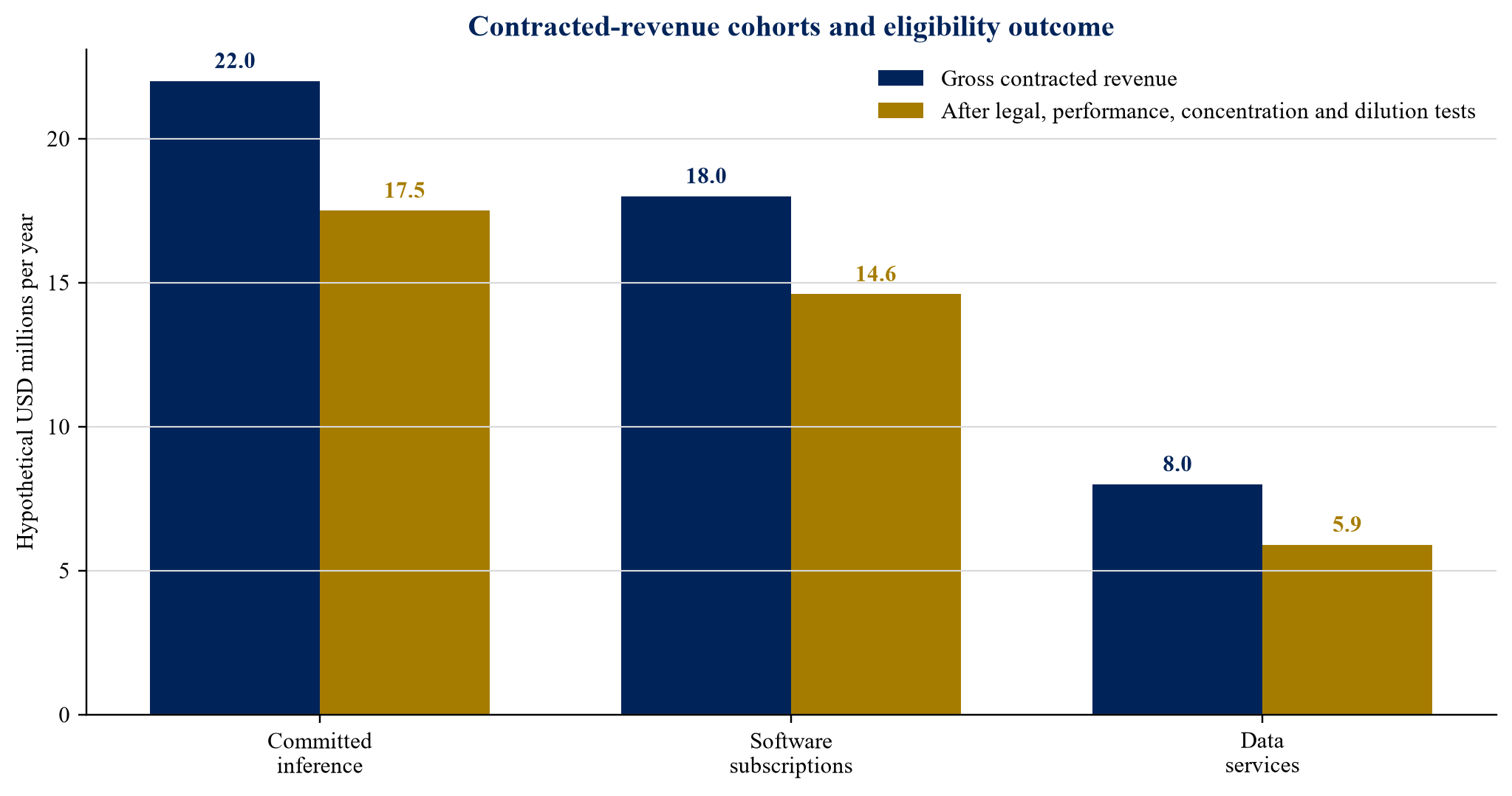
Amounts are author assumptions used solely to demonstrate the framework.
11. Measure renewal risk explicitly
Renewal risk begins before contract expiry. A customer can reduce workloads, negotiate price, migrate to another model, consolidate vendors or bring capability in-house. The underwriting model should therefore track gross retention, net retention, renewal timing, committed quantity, realised price and contribution margin by cohort. A single logo-retention percentage is insufficient.
The facility can exclude anticipated renewals from contracted eligibility and use them only in enterprise cash-flow scenarios. It can also step down advance rates as contracts approach expiry unless signed renewals are received. Renewal concentration matters: a large share of annualised revenue expiring in one quarter can create a refinancing cliff. The reporting pack should include a twelve- to twenty-four-month renewal calendar with customer owner, status and commercial risk.
12. Deduct compute cost before sizing debt
AI revenue can carry material variable and semi-fixed costs. These include third-party cloud charges, accelerator leases, electricity, data-centre capacity, network, model-provider fees, data licences, customer support and inference optimisation. A revenue-based advance can overstate capacity if the provider must spend most of each receipt to deliver the service.
NVIDIA disclosed USD 27 billion of multi-year cloud-service commitments at 25 January 2026 and extensive supply and capacity commitments [6]. The IEA identifies AI and data centres as important drivers of electricity demand and power-system investment [7]. These facts show the scale of resource commitments in the sector. Each borrower still requires a contract-level contribution model that matches revenue to avoidable and committed delivery cost.
13. Construct a compute-cost bridge
The compute-cost bridge begins with gross contracted collections. It deducts taxes, credits, refunds, payment fees, third-party model charges, cloud or colocation cost, power, data licences, network and direct support. The result is eligible contribution cash before corporate overhead and debt service. Items should be classified by contract and by variability.
Committed resource costs deserve particular attention. A provider may owe cloud or capacity payments even when customer usage falls. The model should show take-or-pay revenue and take-or-pay cost together. Cost pass-throughs should be tested for timing, caps and customer dispute. Currency differences between customer receipts and compute costs create a separate exposure. The borrowing base should use a conservative net contribution measure when gross margins vary materially across products.
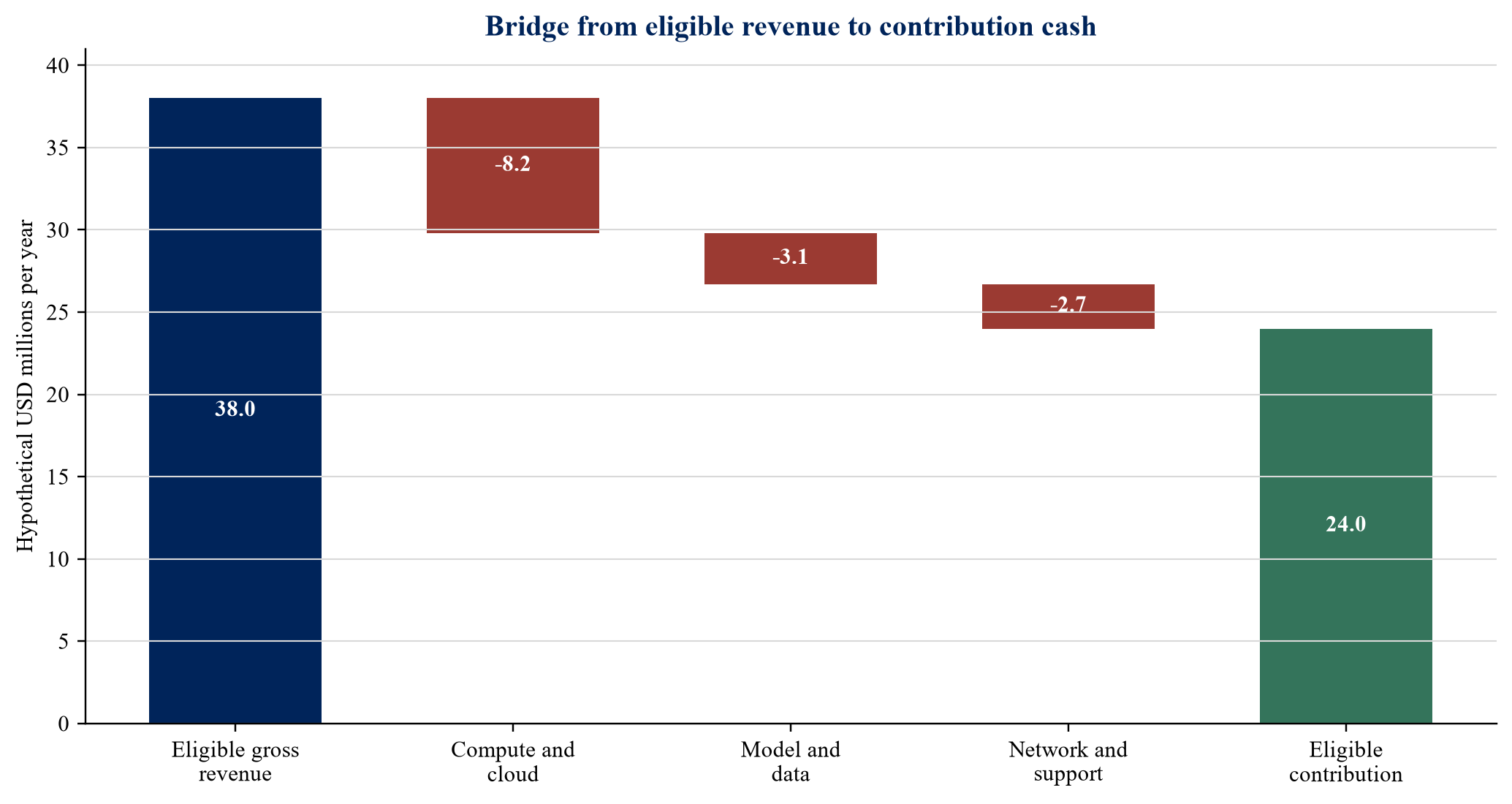
Amounts and cost assumptions are illustrative author estimates without empirical calibration.
14. Define contribution coverage
Contribution coverage measures eligible contract cash after direct delivery costs against interest, scheduled principal and required reserves. The numerator should exclude optional usage and anticipated renewals unless a separate stress case supports them. It should include customer credits and collection timing. The denominator should include hedging, trustee, servicing and account-control costs where material.
Coverage should be tested monthly and quarterly because annual totals can conceal a cash trough. A structure may set minimum trailing and forward contribution coverage. Forward coverage relies on eligible contracts, resource commitments and customer credit. A breach can reduce new advances, trap cash or require prepayment. The ratio should complement a borrowing base and liquidity covenant, since each measures a different failure mode.
15. Assign contract-quality tiers
Contract-quality tiers can translate legal and commercial evidence into advance rates. A top tier may require a creditworthy obligor, non-cancellable minimum, delivered service, clear assignment, short payment terms, limited credits and controlled collections. A lower tier may include concentration, usage variability, termination rights or unproven performance. An ineligible tier contains disputed, related-party, sanctioned, delinquent or option-dependent amounts.
The score should remain transparent. Each factor should have evidence, owner and review date. A composite score can hide a fatal defect, so threshold conditions should be tested before scoring. The lender should reserve discretion for newly identified legal or operational risks. The borrower should receive a clear path for curing exclusions, such as completing acceptance, obtaining consent, resolving a dispute or strengthening reporting.
Table 2. Proposed contract-quality tier matrix
| Tier | Required characteristics | Typical treatment | Monitoring focus |
|---|---|---|---|
| Tier 1 | Enforceable minimum, delivered service, strong obligor, controlled cash | Highest permitted advance band | Payment, availability and concentration |
| Tier 2 | Sound contract with defined variability or moderate concentration | Lower advance plus specific reserve | Usage, renewal and cost bridge |
| Tier 3 | Material termination, assignment, dispute or performance uncertainty | Excluded until cured or cash received | Legal and commercial remediation |
| Ineligible | Delinquent, related-party, prohibited, cancelled or unperformed | Zero borrowing-base value | Recovery and pool removal |
Advance rates and thresholds require transaction-specific calibration.
16. Cap customer concentration
Customer concentration can produce visible contracted revenue and fragile repayment capacity. A single customer may represent several contracts, products and legal entities while remaining one economic risk. The lender should aggregate exposure by parent, guarantor, sector, funding source and correlated use case. Government appropriations and venture-funded customers require distinct analysis.
Concentration can be controlled through a maximum eligible share, a reserve above the cap, a lower advance rate or credit insurance where effective. The cap should reflect obligor strength, termination rights, historic collections and alternative demand for the delivery capacity. A large high-quality customer can still create operational bargaining power and a renewal cliff. Concentration testing should cover both gross revenue and eligible contribution cash.
17. Underwrite customer credit and funding source
Customer credit analysis should identify the legal payer and the source of funds. Public-company credit, government budget, sponsor support, venture liquidity and project financing produce different risks. An AI start-up buying compute through a large commitment can have substantial contractual liability and limited cash runway. A corporate group may route payments through an operating subsidiary without a parent guarantee.
The lender should obtain financial statements, credit reports, payment history and public filings where available. Private counterparties may require periodic evidence or contractual information rights. Unrated does not mean weak, and a prominent name does not remove collection risk. The credit decision should record the maximum eligible exposure and any dependency on equity funding, customer financing or an external programme.
18. Measure dilution and service credits
Dilution is the gap between gross invoiced receivables and cash ultimately collected because of credits, refunds, disputes, offsets, taxes, errors or concessions. Federal Reserve examination guidance states that lenders should understand the amounts and causes of dilution and use that knowledge in selecting receivables advance rates [8]. AI services add availability credits, latency penalties, output-quality disputes and data-related claims.
The data tape should calculate gross and net dilution by customer, product, reason and month. One-off implementation credits should be separated from recurring service failure. A reserve can cover recent peak dilution or a stressed percentile, subject to transaction design. Contracts with uncapped service credits or broad set-off rights may require exclusion. Credit-note approval and billing adjustments should be controlled and independently reviewed.
19. Control disputed and aged amounts
Disputed receivables should leave the eligible pool until resolved and collected. Ageing thresholds should reflect contractual terms and observed payment behaviour. A receivable that is current under extended terms can still indicate weak collection or hidden restructuring. The lender should monitor invoice-date and due-date ageing, promises to pay, credit notes and customer correspondence.
The OCC describes a borrowing base as a collateral base governed by eligibility and advance rates and emphasises collateral verification and monitoring [9]. AI contract finance should apply the same discipline to digital-service receivables. The facility can exclude cross-aged customers when one material invoice becomes delinquent, subject to approved exceptions. Exceptions need a documented amount, reason, owner and expiry.
20. Make assignment and notification operational
Assignment provisions affect the lender's ability to control and collect cash flows. Some contracts prohibit assignment, require consent or permit assignment of receivables but not performance obligations. Public-sector and cross-border contracts can add statutory restrictions. Counsel should map the permitted route and the consequences of notice.
Operational readiness matters as much as legal form. The collection account, invoice instructions, customer master data and remittance process should align. A silent assignment can preserve the customer relationship while requiring springing notice after a trigger. A notified structure can provide stronger control and clearer payment direction. The selected mechanism should be tested before closing with sample invoices, account details and reconciliation procedures.
21. Establish cash dominion
Cash dominion connects eligible assets to repayment. The OCC defines full cash dominion as customer receipts entering a lender-controlled lockbox and being applied to the loan before funds are released; it also recognises springing arrangements [9]. The structure should specify the accounts, currencies, authorised transfers, application timing and permitted operating releases.
For AI revenue, collections may arrive through bank transfer, card processor, cloud marketplace, reseller or distributor. Each channel requires a control path. Marketplace deductions and settlement delays should be reconciled. Cash received into an uncontrolled operating account should trigger a cure and may reduce availability. The reporting system should match each receipt to the contract and invoice data tape.
22. Design the cash waterfall
The waterfall allocates controlled receipts in a fixed sequence. It can first pay taxes, refunds and permitted customer credits; then fund essential delivery costs and operating reserves; then pay servicing, interest and scheduled principal; then top up liquidity and debt-service reserves; and finally release residual cash subject to covenants. The order should preserve service continuity and lender protection.
The delivery-cost reserve needs careful calibration. Underfunding compute can cause service failure and destroy the revenue pool. Overfunding operating releases can weaken debt amortisation. The model should identify resource payments that protect eligible contracts, including cloud, power, model and data costs. Related-party payments and discretionary growth expenditure should sit outside protected essential costs unless specifically approved.
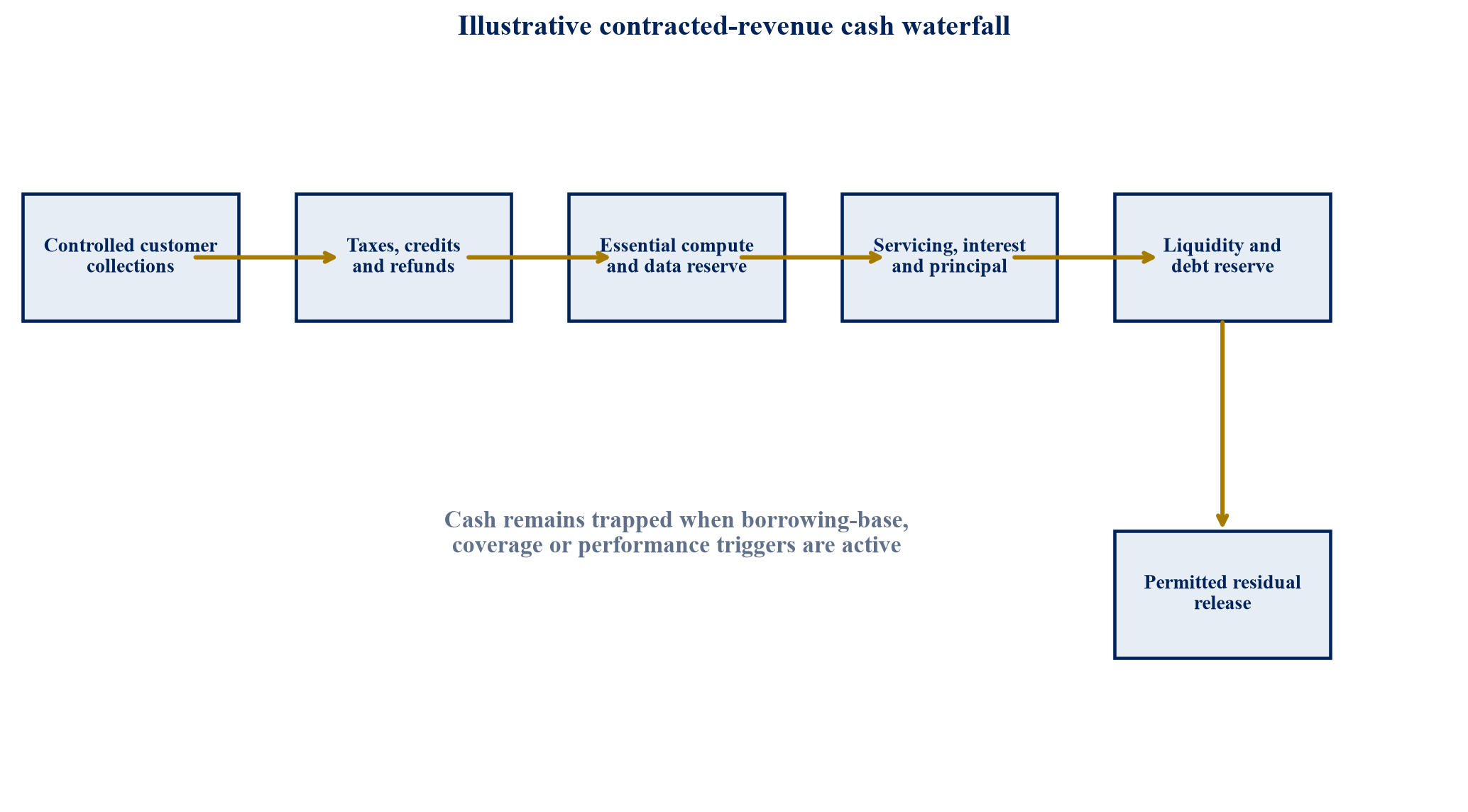
The sequence is illustrative and requires legal, tax and operational adaptation.
23. Build an eligibility pool from net cash
The hypothetical model assumes USD 48.0 million of annual contracted revenue across committed inference, software subscriptions and data services. All amounts are author assumptions without empirical calibration. Legal and performance exclusions remove USD 4.0 million. Concentration limits remove USD 5.0 million. Expected credits and dilution reserve USD 1.2 million. Direct compute and data-delivery costs attributable to the remaining pool equal USD 13.8 million.
The resulting eligible contribution pool is USD 24.0 million before overhead, debt service and liquidity reserves. The model applies different advance rates by contract tier and then compares the result with forward contribution coverage. This process prevents gross contract value from becoming the sole financing metric. Every transaction requires borrower-specific contracts, costs, legal analysis and stress calibration.
Table 3. Hypothetical annual eligibility-pool calculation
| Step | Inference | Software | Data services | Total |
|---|---|---|---|---|
| Gross contracted revenue | USD 22.0m | USD 18.0m | USD 8.0m | USD 48.0m |
| Legal and performance exclusions | (1.5m) | (1.5m) | (1.0m) | (4.0m) |
| Concentration exclusions | (3.0m) | (1.5m) | (0.5m) | (5.0m) |
| Credits and dilution reserve | (0.6m) | (0.4m) | (0.2m) | (1.2m) |
| Direct delivery cost | (7.9m) | (3.9m) | (2.0m) | (13.8m) |
| Eligible contribution cash | USD 9.0m | USD 10.7m | USD 4.3m | USD 24.0m |
All amounts are author assumptions and do not represent market terms or a financing quote.
24. Apply advance rates after eligibility
Advance rates should follow eligibility and cost deductions. In the hypothetical model, Tier 1 eligible contribution cash of USD 15.0 million receives a 55% advance rate. Tier 2 contribution cash of USD 9.0 million receives 35%. Preliminary availability is therefore USD 11.4 million. A further USD 1.4 million of concentration, performance and data-rights reserves reduces net availability to USD 10.0 million.
The lender then applies a forward cash-flow cap. If stressed contribution cash after overhead supports only USD 9.2 million of debt at the required coverage, effective availability is USD 9.2 million. This dual test recognises the asset value of contracts and the operating reality required to deliver them. Advance rates shown here are author assumptions and have no market calibration.
25. Treat model dependency as a credit risk
An application can depend on one foundation-model provider, API, licence or model family. A price increase, deprecation, policy change, service interruption or loss of access can reduce margin and service quality. The borrower should maintain a model-dependency register linking each revenue contract to model providers, versions, licence rights, fallback routes and switching time.
The lender should test whether customer contracts permit substitution and whether outputs remain acceptable after a change. A provider with multi-model routing, owned models or tested fallback may have lower continuity risk. The borrowing base can apply a reserve when eligible revenue depends materially on one external model without a tested alternative. The analysis should include data, orchestration and evaluation dependencies alongside the model endpoint.
26. Treat data rights as a continuing condition
Data-service and AI-software revenue can depend on lawful access to customer, licensed or public data. The underwriting file should identify data owner, permitted use, geographic restrictions, retention, deletion, sublicensing, model-training rights and termination consequences. A contract can continue legally while a critical data source becomes unavailable.
The lender needs evidence that the provider can continue delivering eligible services during the debt period. Material data licences should be scheduled, monitored and stress tested. Customer disputes concerning provenance, privacy or output rights can create offsets and reputational damage. A reserve or exclusion may be appropriate where rights are short-dated, contestable or non-transferable. Specialist legal advice remains necessary.
27. Link technology continuity to cash-flow eligibility
Technology continuity covers infrastructure redundancy, cyber security, incident response, model evaluation, release management and business continuity. A recurring-revenue facility depends on the provider's ability to keep serving customers. The National Institute of Standards and Technology AI Risk Management Framework identifies governance, mapping, measurement and management functions for AI risk [10]. Its structure can inform diligence without replacing transaction-specific controls.
The lender should identify critical systems, recovery objectives, third-party dependencies, incident history and tested contingency plans. Reporting triggers can include material outage, security breach, model withdrawal, regulatory restriction or failed recovery exercise. A serious event can suspend new advances and require a reserve while the operational effect is assessed. The response should be calibrated to cash impact and customer rights.
28. Monitor service-level performance
Service-level indicators should connect directly to contractual credits and termination rights. Availability, latency, throughput, accuracy, support response and data freshness may each matter. The monitoring pack should show target, actual performance, customer measurement rights, credits accrued and disputes. Metrics should reconcile to the systems used for customer billing.
A lender can set early-warning thresholds before a formal contract breach. Repeated near-misses can indicate rising compute pressure or weak operations. The facility should avoid using an operational metric with no defined calculation or audit trail. Each test needs a source system, owner, observation period and exception procedure. Independent technical review can be triggered when performance deterioration affects a material portion of eligible cash.
29. Integrate energy and capacity risk
AI inference can be sensitive to power price, data-centre availability and capacity procurement. The IEA's Electricity 2026 analysis describes rising power demand linked to AI and data centres [7]. A provider using its own or dedicated infrastructure should map eligible revenue to power and cooling. A provider buying cloud capacity should map it to reservation terms and provider concentration.
Energy and capacity risk enters the model through direct cost, availability and replacement time. Fixed-price customer revenue paired with variable power or cloud cost can compress contribution. A shortage can prevent delivery even when demand remains strong. The lender should track unhedged cost exposure, reservation utilisation, capacity expiry and geographic concentration. Future eligibility can depend on confirmed resource coverage.
30. Address foreign exchange and cross-border collection
Customer revenue and compute cost can arise in different currencies. The facility should identify contract currency, invoice currency, collection account, tax withholding, conversion timing and hedging. An apparently stable gross margin can weaken when receipts depreciate against cloud or model costs. The stress model should combine currency movement with consumption and renewal pressure.
Cross-border collections also raise legal, sanctions, tax and data-transfer questions. The structure should define eligible jurisdictions and account-control arrangements. Local restrictions may delay assignment or remittance. Customers subject to withholding should be measured on net collectible cash unless gross-up is enforceable and creditworthy. Transaction counsel and tax advisers should confirm the applicable treatment.
31. Create a trigger ladder
Triggers should progress from warning to cash control and amortisation. Early-warning indicators can include falling committed utilisation, rising credits, customer concentration, delayed invoices, gross-margin compression, model-provider dependence and renewal clustering. Each has a defined observation window and evidence source.
A borrowing-base trigger can reduce advance rates or exclude a contract. A cash trigger can activate dominion, trap residual cash or increase reserves. A performance trigger can require an independent review and remediation plan. A hard default can stop funding and accelerate according to the documents. The ladder should allow proportionate action while preserving essential service delivery and value.
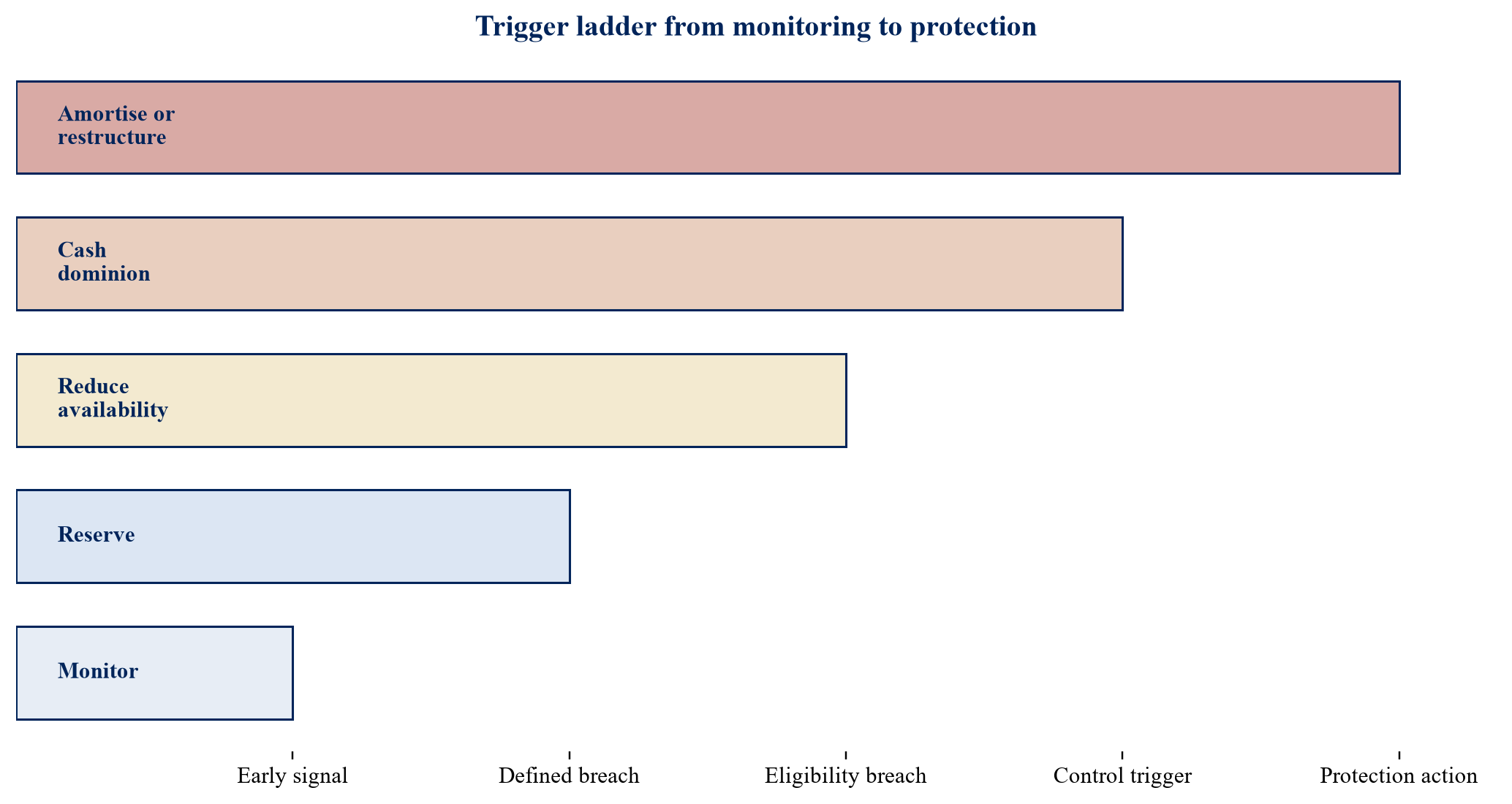
Thresholds and remedies require transaction-specific agreement.
32. Match reporting frequency to volatility
Monthly reporting can cover the contract tape, billings, collections, dilution, eligible contribution, customer concentration, capacity coverage, service levels, renewals and covenant calculations. Weekly reporting may be needed during rapid growth, a trigger period or springing cash dominion. Quarterly reporting can add management accounts, customer credit review, technology-dependency assessment and independent testing.
The reporting burden should remain usable. Automated extracts can support speed if the definitions, access and reconciliation controls are reliable. A signed borrowing-base certificate should identify exceptions and manual adjustments. Late or incomplete reporting can lead to a temporary reserve. The lender should retain audit rights and a defined sampling protocol for contracts, invoices, receipts and system data.
33. Establish data integrity controls
The contract tape, billing platform and bank data can drift. Customer identifiers change, amendments arrive outside the contract repository and marketplace settlements aggregate multiple invoices. Data integrity therefore requires ownership, version control, reconciliation, access logs and change approval. A lender should understand how source data becomes a borrowing-base certificate.
Sample testing should trace selected cash flows from executed order form through performance, invoice, receipt and ledger entry. Exceptions should be quantified across the population where possible. Management adjustments should be logged with supporting evidence. A facility relying on automated reporting should include interface monitoring and fallback procedures. Reliable data reduces the need for broad reserves and supports faster additional funding.
34. Size liquidity for delivery and collection timing
The borrower must pay delivery costs before some customer cash arrives. A liquidity reserve can cover the gap between compute, payroll and data payments and contractual collections. The model should consider billing cadence, payment terms, marketplace settlement, disputed amounts, annual prepayments and resource deposits. It should also include the cost of maintaining service during a customer remediation period.
Liquidity can be held as cash, undrawn committed equity or a separate revolving line, subject to availability and control. The required amount should be tested under delayed collection, customer loss, cost inflation and capacity underutilisation. The reserve should not be counted twice as both unrestricted liquidity and lender collateral. Release conditions should reflect forward requirements.
35. Separate asset-based availability from enterprise capacity
Contracted-revenue availability measures eligible and controlled cash flows. Enterprise capacity considers the wider business, including uncontracted revenue, growth expenditure, corporate overhead, taxes, capital expenditure and other debt. Both matter. A borrowing base can be fully covered while the company remains unable to fund losses elsewhere.
The lender should maintain an integrated three-statement and cash model. Facility draws, interest, amortisation, restricted cash and waterfall releases should reconcile to the balance sheet and cash flow. Enterprise covenants can include minimum liquidity, leverage and fixed-charge coverage. The credit committee should see asset-based and enterprise results together, with any intercompany leakage or structurally senior claim identified.
36. Consider a true-sale or secured-loan structure
A secured loan can take security over receivables, contracts, accounts and related rights while the originator retains the assets. A true-sale structure transfers eligible receivables to a special-purpose entity, subject to legal and accounting analysis. A capital-markets securitisation adds disclosure, servicing, risk-retention and investor requirements. The chosen form should match pool scale, diversity, maturity and operational capability.
The SEC describes an asset-backed security as one serviced primarily by cash flows of a discrete pool of receivables or other financial assets that convert into cash within a finite period [11]. SEC interpretations also address single-asset pools and servicing disclosure [12]. EU rules impose due diligence, risk retention and transparency requirements for securitisations [13]. Specialist advice is essential before applying any regulatory classification.
37. Design the special-purpose vehicle carefully
An SPV can isolate eligible assets and cash flows, subject to true-sale, consolidation, tax, insolvency and corporate-benefit analysis. The structure should define asset transfer, eligibility representations, repurchase obligations, servicing, commingling, replacement, account control and residual distributions. Operational continuity remains critical because customers still require service.
The SPV should not acquire future revenue that depends on unfunded performance without addressing the associated delivery obligations. Servicing replacement must be realistic for specialised AI services. A back-up servicer can manage invoices and collections while lacking the ability to operate models or infrastructure. The transaction should therefore separate financial servicing from technical continuity and provide a plan for both.
38. Test a correlated downside
A credible downside combines risks. One anchor customer reduces consumption, two renewals are delayed, a model provider raises prices, cloud credits expire, service-level penalties rise and collections slow. These events reduce revenue, margin and liquidity together. A single-variable sensitivity can understate the cash impact.
The model should show eligible pool, borrowing base, contribution coverage, liquidity runway, trapped cash, required equity and lender loss under each case. Recovery assumptions should include collection delay, disputes and servicing cost. Scenario probabilities may be used only when supported. Transparent severities and breakpoints provide a more useful committee discussion than a precise expected value built on weak data.
Table 4. Hypothetical correlated stress cases
| Variable | Base case | Downside case | Severe case |
|---|---|---|---|
| Eligible contracted revenue | USD 38.0m | USD 31.0m | USD 24.0m |
| Direct delivery cost as % of eligible revenue | 36% | 43% | 52% |
| Net dilution | 3% | 6% | 10% |
| Largest customer share | 28% | 34% | 41% |
| Collection delay beyond terms | 8 days | 24 days | 45 days |
| Effective debt availability | USD 9.2m | USD 6.4m | USD 2.8m |
All changes and outputs are illustrative author assumptions.
39. Use covenant definitions that can be audited
Every covenant needs a calculation source and stable definition. Contracted revenue should specify treatment of options, tax, credits, foreign exchange and amendments. Eligible contribution should define direct costs and allocations. Customer concentration should aggregate connected entities. Renewal should distinguish signed renewal from active negotiation. Model dependency should specify the relevant provider and fallback test.
The facility agreement should include sample calculations. Reporting dates, cure periods, exclusions and lender discretion should be clear. Definitions should remain aligned with the borrower's systems while preserving credit meaning. A change in accounting policy or product packaging should not automatically change availability. Governance should require approval before a metric definition or source system changes.
40. Establish a credit committee sequence
The committee should first approve the primary repayment source and facility purpose. It should then review contract enforceability, delivery capacity, customer credit, concentration, compute cost, data and model dependencies, eligibility, advance rates, reserves, cash controls, enterprise liquidity, covenants and enforcement planning. Unresolved conditions should be listed with owners and completion dates.
The approval can distinguish total commitment, current availability and future accordion capacity. This protects against treating a headline commitment as funded debt. Additional availability should require new eligible contracts, delivery resources and reporting evidence. Exceptions should remain visible and time-limited. The final memorandum should show how each material risk changes cash, eligibility or control.
41. Execute through a ninety-day plan
During the first thirty days, the parties can assemble contracts and amendments, build the data tape, map revenue to resources, reconcile billings and collections, and commission legal, accounting and technical reviews. The borrower can identify consent, assignment and account-control requirements. The lender can define model fields and sampling.
During days thirty-one to sixty, the team can complete contract testing, customer credit work, contribution-margin analysis, dilution review, stress cases, SPV analysis and draft documentation. During days sixty-one to ninety, it can complete perfection, consents, controlled accounts, reporting interfaces, sample certificates and closing conditions. The timetable is illustrative. Complex jurisdictions, public-sector contracts or new data systems can require more time.
42. Recognise the framework's limits
AI revenue structures change quickly and private contract terms are rarely visible. Public filings show examples, not market-wide underwriting standards. Accounting measures do not establish enforceability, assignability or collection control. Model, data, cloud, power and regulation risks vary by product and jurisdiction. Customer credit can also change during the contract term.
The hypothetical model in this paper has no empirical calibration. It does not provide a financing quote, legal opinion, accounting conclusion, tax advice, valuation or investment recommendation. A live transaction requires executed-contract review, current customer and borrower financial evidence, specialist legal advice, technical diligence, data-rights analysis and an integrated cash model. The framework's purpose is to make those decisions testable.
43. Conclude with a controlled financing proposition
Contracted AI revenue can support structured debt when the lender can identify the obligation, verify delivery, measure net contribution, control collections and respond before deterioration consumes liquidity. Committed inference, software and data cash flows deserve different treatment. Eligibility begins with enforceability and performance, then reflects concentration, dilution, compute cost, renewal, model and data dependency.
The proposed structure combines a contract data tape, eligibility horizon, contract-quality tiers, contribution-cost bridge, concentration caps, reserves, cash dominion, waterfall, enterprise cash-flow cap and trigger ladder. It gives a capable borrower a route to monetise contracted demand while preserving the resources required to serve customers. It gives the lender a disciplined connection between legal cash flows, operational evidence and debt exposure.
References
- CoreWeave, Inc. Annual Report on Form 10-K for the year ended 31 December 2025. Filed with the US Securities and Exchange Commission in 2026. https://www.sec.gov/Archives/edgar/data/1769628/000176962826000104/crwv-20251231.htm
- Snowflake Inc. Annual Report on Form 10-K for the fiscal year ended 31 January 2026. Filed with the US Securities and Exchange Commission in 2026. https://www.sec.gov/Archives/edgar/data/1640147/000164014726000008/snow-20260131.htm
- Datadog, Inc. Annual Report on Form 10-K for the year ended 31 December 2025. Filed with the US Securities and Exchange Commission in 2026. https://www.sec.gov/Archives/edgar/data/1561550/000162828026008819/ddog-20251231.htm
- IFRS Foundation. IFRS 15 Revenue from Contracts with Customers. Accessed 6 September 2026. https://www.ifrs.org/issued-standards/list-of-standards/ifrs-15-revenue-from-contracts-with-customers/
- Palantir Technologies Inc. Annual Report on Form 10-K for the year ended 31 December 2025. Filed with the US Securities and Exchange Commission in 2026. https://www.sec.gov/Archives/edgar/data/1321655/000132165526000011/pltr-20251231.htm
- NVIDIA Corporation. Annual Report on Form 10-K for the fiscal year ended 25 January 2026. Filed with the US Securities and Exchange Commission in 2026. https://www.sec.gov/Archives/edgar/data/1045810/000104581026000021/nvda-20260125.htm
- International Energy Agency. Electricity 2026. 2026. https://www.iea.org/reports/electricity-2026
- Board of Governors of the Federal Reserve System. Commercial Bank Examination Manual, Section 2160.1, Asset-Based Lending. October 2023. https://www.federalreserve.gov/publications/files/cbem-2000-202310.pdf
- Office of the Comptroller of the Currency. Asset-Based Lending, Comptroller's Handbook, Version 1.1. January 2017. https://www.occ.treas.gov/publications-and-resources/publications/comptrollers-handbook/files/asset-based-lending/pub-ch-asset-based-lending.pdf
- National Institute of Standards and Technology. Artificial Intelligence Risk Management Framework, AI RMF 1.0. January 2023. https://nvlpubs.nist.gov/nistpubs/ai/NIST.AI.100-1.pdf
- US Securities and Exchange Commission. Financial Reporting Manual, Topic 2, Regulation AB background. Updated through June 2026. https://www.sec.gov/corpfin/cf-manual/topic-2
- US Securities and Exchange Commission. Asset-Backed Securities Compliance and Disclosure Interpretations. Updated 23 March 2026. https://www.sec.gov/rules-regulations/staff-guidance/corporation-finance-interpretations-cfis/asset-backed-securities
- European Banking Authority. Securitisation Regulation, Regulation (EU) 2017/2402, interactive single rulebook. Accessed 6 September 2026. https://www.eba.europa.eu/regulation-and-policy/single-rulebook/interactive-single-rulebook/14471
- European Banking Authority. Securitisation and Covered Bonds. Accessed 6 September 2026. https://www.eba.europa.eu/regulation-and-policy/securitisation-and-covered-bonds
- Core Scientific, Inc. Quarterly Report on Form 10-Q for the quarter ended 30 June 2026. Filed with the US Securities and Exchange Commission in 2026. https://www.sec.gov/Archives/edgar/data/1839341/000183934126000014/core-20260630.htm
- US Securities and Exchange Commission. Regulation AB final rule, Release Nos. 33-8518 and 34-50905. 22 December 2004. https://www.sec.gov/files/rules/final/33-8518fr.pdf
