

1. Define the financing decision
Milestone financing should begin with the capital decision. The parties should define the proposed amount, security, initial funding, later tranches, ownership, governance, use of proceeds, target end state and follow-on strategy. A general plan to fund development in stages can leave the company underfunded and the investor without objective release criteria.
The financing thesis should state which uncertainties prevent a single fully funded round. They may concern technical performance, integration, manufacturing yield, certification, customer acceptance, price, direct cost or market timing. Each uncertainty should connect to an evidence-producing programme and a decision that can change when the evidence arrives.
The investment committee should identify permissible responses. A milestone result may release capital, require a cure, revise the plan, change terms, trigger an off-ramp or stop funding. Those responses depend on the legal documents and applicable duties. The analytical framework should make the economic logic visible before documents are negotiated.
2. Distinguish readiness dimensions
Technology readiness describes technical maturity under defined conditions. Manufacturing readiness addresses the capability to produce repeatedly at required quality, rate and cost. Regulatory and certification readiness concern applicable approvals and evidence. Commercial readiness concerns customer problem, acceptance and purchase. Economic readiness concerns margin, cash and capital intensity.
These dimensions can progress at different speeds. A prototype may perform in a relevant environment while using a process that cannot achieve planned yield. A certified product may lack a repeatable sales or service model. A customer pilot may be successful while requiring uneconomic engineering support. The financing plan should preserve those differences.
NASA describes nine technology readiness levels from early principles to proven operation [1]. GAO describes technology-readiness assessment as a systematic evidence-based process that can illuminate concerns at key resource decisions [2]. Those frameworks provide useful structure; the company and investor must define transaction-specific performance, environment and acceptance.
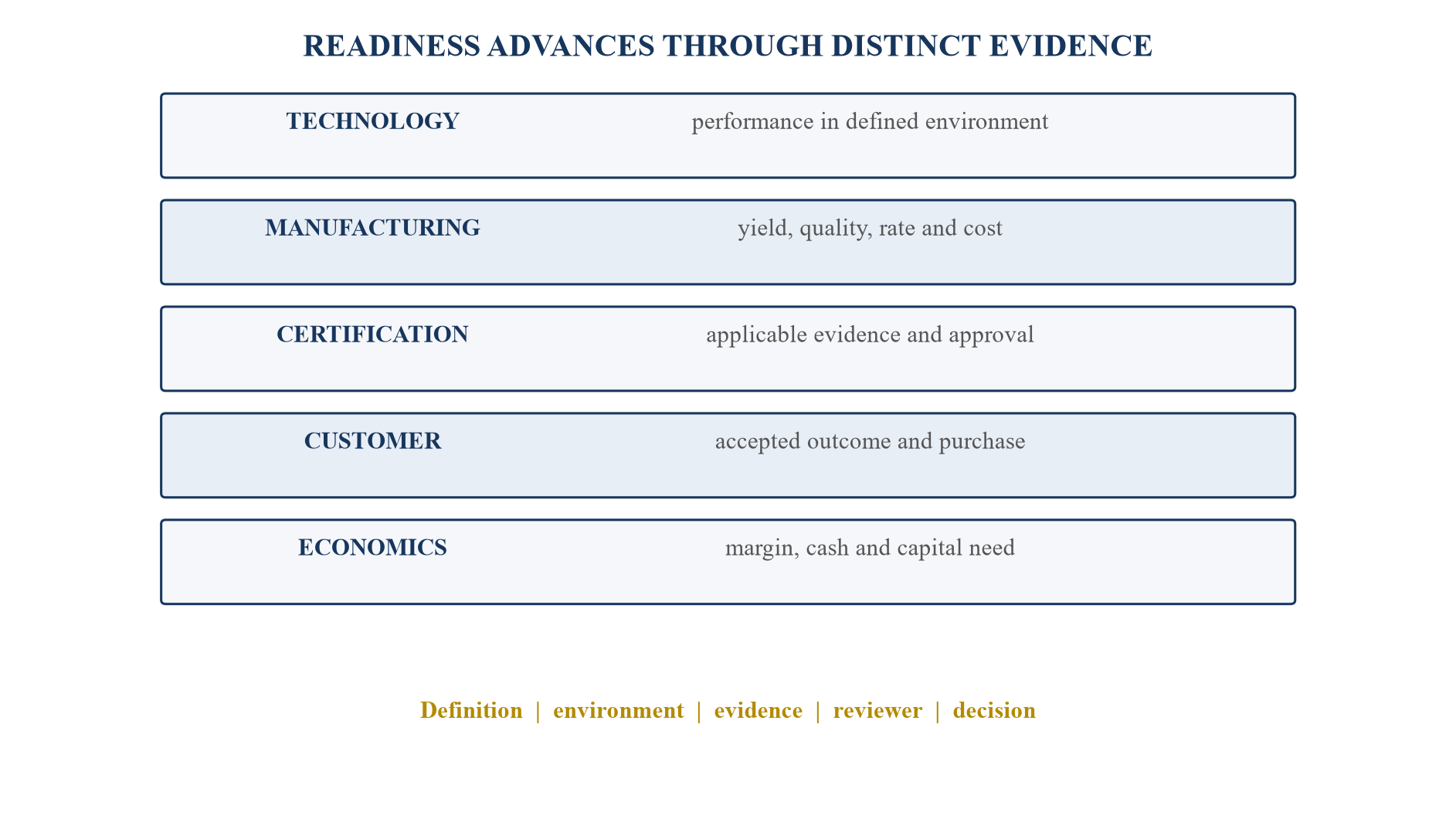
A financing gate should assess the dimensions relevant to the next funded state rather than relying on one aggregate readiness label.
3. Establish the evidence hierarchy
Milestone evidence should be classified by source and strength. A management statement, internal calculation, witnessed test, customer acceptance, certification report and repeated production record do not provide equivalent support. The classification should reflect the decision and risk rather than a universal ranking.
Each evidence item should state object tested, configuration, environment, method, sample, instrument, operator, date, result, deviation and limitation. Source records should be preserved. A summary slide can communicate the finding while leaving the underlying record necessary for acceptance and later audit.
Independent review should be proportionate. High-consequence technical, safety, regulatory or financing claims may require qualified external review. Independence does not remove uncertainty. The reviewer’s scope, methods, assumptions and exclusions should remain visible in the decision pack.
Table 1. Milestone evidence record
| Field | Question | Control |
|---|---|---|
| result | what must be demonstrated? | use measurable acceptance criteria |
| configuration | what exact system is tested? | retain version and bill of materials |
| environment | where and under what conditions? | define representative conditions |
| method | how is the result measured? | record procedure and instruments |
| review | who validates the result? | state independence and scope |
| consequence | what decision can change? | map release, cure, revise or stop |
Acceptance requires the evidence defined for the decision; completion of an activity alone is insufficient.
4. Identify critical technologies
The programme should identify the technologies whose maturity governs system performance, cost, schedule or certification. A broad product label can conceal a small number of components, materials, algorithms, interfaces or processes that carry the dominant risk. The system architecture should show how those elements interact.
GAO’s readiness guidance focuses on critical technologies and documented maturation plans [2]. The investor should examine current state, required end state, development tasks, test environment, alternatives, responsible organisation, schedule, cost and off-ramps. A readiness number without that evidence can create false precision.
Criticality can change during development. A component that performs well may expose an integration or manufacturing constraint. The register should be updated under change control. New critical items should enter the capital and schedule model, with the effect on the next financing gate stated.
5. Define the system and configuration baseline
A milestone applies to a defined configuration. The company should record hardware, software, materials, data, process, supplier, tolerances, interfaces and operating conditions that produce the claimed result. Results from materially different configurations should not be combined without a justified bridge.
Configuration control becomes increasingly important as technical and commercial teams run parallel work. A customer pilot may use a hand-built unit, while the manufacturing plan assumes a redesigned component. The financing committee should understand which result carries forward and which must be repeated.
The baseline should include approved deviations and known limitations. A temporary laboratory instrument or specialist operator may be appropriate for an early test, but the plan should state how that dependency is removed or industrialised. The cost and schedule of the bridge belong in the funded plan.
6. Set technology-readiness exit criteria
Technology-readiness exit criteria should define performance, environment and evidence. NASA’s framework distinguishes laboratory validation, relevant-environment demonstration, operational-environment demonstration and proven operation [1]. The applicable interpretation depends on the technology and use case.
The team should avoid treating completion of a prototype as proof of readiness. The prototype must demonstrate specified critical functions under the conditions required for the claimed state. Test coverage, repeatability, failure modes, scaling and integration should be explicit.
The exit criterion should also state residual risk. Passing a defined test does not establish every aspect of performance or commercial viability. The financing decision should identify which uncertainties were reduced, which remain and what evidence the next tranche is intended to produce.
7. Define manufacturing readiness
Manufacturing readiness should cover process capability, supply chain, tooling, workforce, quality, yield, throughput, traceability, test, rework, scrap and cost. A prototype process can depend on exceptional skill and inspection. Scale requires repeatable control across planned volume.
GAO has reported the value of manufacturing criteria and disciplined risk management before major commitments [5]. The company should define the production state required for each gate, including representative equipment, suppliers, lot size and quality controls. A pilot line result should not be represented as full-rate production evidence.
The financing plan should include equipment lead times, qualification, supplier development, inventory and working capital. Technical success can increase capital need when it unlocks orders that require production investment. The tranche map should anticipate this transition rather than wait until the company reaches the gate.
8. Measure yield, quality and throughput
Manufacturing milestones should specify the denominator and observation period. First-pass yield, final yield, defect rate, rework, cycle time, uptime and throughput answer different questions. The data should retain lot, configuration, supplier, operator and test method where relevant.
Small samples can support learning while leaving scale uncertainty. The committee should see confidence, failure distribution and the plan for larger runs. A favourable average may conceal a critical tail failure. Quality evidence should connect defect severity with customer, safety, warranty and regulatory consequence.
Cost should be measured alongside yield. A process can meet performance through repeated rework or expensive screening. The unit-economic model should allocate scrap, rework, test, warranty and support under relevant volume. Improvements should be supported by deployed process changes and sustained observation.
9. Map certification and regulatory requirements
The certification map should identify applicable authority, standard, classification, submission, evidence, test facility, audit, lead time, dependency and renewal. The company should obtain qualified advice for the actual product and jurisdictions. A generic regulatory summary cannot establish the path.
The programme should distinguish company-controlled work from authority-controlled timing. Test availability, questions, inspections and third-party conformity assessment can affect schedule. The financing plan should include credible ranges, resubmission risk and the cost of parallel market paths where relevant.
Claims to customers and investors should match status. A planned submission, accepted application, completed test and granted approval are different states. The evidence ledger should preserve official correspondence and conditions. Certification may be necessary for market access while leaving customer demand and margin unresolved.
10. Validate the customer problem
Commercial proof begins with a defined problem, buyer, user, workflow, alternative and consequence. Deep-tech novelty does not establish willingness to adopt or pay. The team should identify who controls budget, who bears switching cost and which evidence the customer requires.
Customer discovery should preserve sample, segment, geography, status and source. Interviews can identify needs and objections; they do not equal purchase commitments. Letters of intent, pilots, purchase orders and contracts require review of conditions, termination, exclusivity, pricing and acceptance.
The milestone should describe the customer decision that can change. It may be approval for a paid pilot, acceptance of defined performance, conversion to production, repeat order or contracted minimum. The evidence should connect the technical configuration with the commercial promise.
11. Structure customer validation
A customer-validation milestone should define eligible customers, product configuration, use environment, support model, duration, acceptance criteria, price and evidence. The team should separate company-measured performance from customer-confirmed acceptance. Both can be useful.
Pilot design should address representativeness. A subsidised deployment with founder support may prove technical relevance while leaving delivery economics unresolved. The record should capture implementation hours, custom work, uptime, failures, customer resources and follow-on requirements.
The committee should test concentration. One strategic customer may provide strong technical evidence and create bargaining, exclusivity or programme risk. A portfolio of smaller pilots can provide broader evidence while consuming capacity. The capital plan should reflect the chosen validation strategy.
12. Define commercial proof
Commercial proof should connect accepted value with enforceable economics. Relevant evidence may include contracted price, deposit, non-cancellable order, renewal, repeat purchase, paid usage or production award. The strength depends on conditions and the customer’s ability and willingness to perform.
The team should reconcile commercial records to cash and revenue-recognition policy. IFRS 15 provides principles for revenue from customer contracts [8]. The actual treatment requires fact-specific accounting advice. Bookings, backlog, revenue and cash should remain distinct.
The milestone should account for delivery obligations. A large order can validate demand while creating inventory, capacity, warranty and working-capital requirements. The financing response may release growth capital, revise price, require customer funding or stage production. Commercial success can increase near-term liquidity risk.
13. Build the unit-economic bridge
Unit economics should follow the delivered product or service. Revenue, material, labour, test, scrap, rework, warranty, logistics, installation, cloud, expert support, licence and service obligations should be included according to a defined perimeter. The calculation should reconcile to accounting records where applicable.
Early units may be intentionally uneconomic. The financing case should show the bridge from current to target cost, with each improvement linked to design, volume, supplier, yield, automation or service change. Cost reductions without an accountable operating mechanism remain assumptions.
The model should test customer value and price beside cost. A technically superior product can face a price ceiling set by the customer’s alternative. Volume discounts may arrive before manufacturing savings. The milestone should define the evidence required to support both price and cost at the next scale.
Table 2. Unit-economic evidence bridge
| Driver | Current evidence | Scale mechanism | Decision effect |
|---|---|---|---|
| selling price | executed terms or paid pilot | value proof and segment mix | revenue range |
| material cost | bill of materials and invoices | redesign, volume or supplier | gross margin |
| conversion cost | time, yield and test records | process control and automation | capacity and cash |
| quality cost | scrap, rework and warranty | capability and prevention | margin and risk |
| delivery cost | installation and support records | standardisation and training | recurring economics |
| working capital | order and payment terms | deposits, inventory and cycle | funding need |
The perimeter should match the product, contract and stage; early negative contribution may be planned but must remain funded.
14. Create the milestone tree
The milestone tree decomposes the target financing state into technical, manufacturing, certification, customer and economic results. Dependencies should show which evidence must precede another result. The tree should avoid hundreds of activities that obscure the few decision-changing gates.
Each milestone should have a result, baseline, threshold, configuration, environment, evidence, owner, reviewer, budget, start, expected date, range, dependency and response. The team should identify the latest responsible decision point for long-lead commitments. A supplier order may need approval before the preceding technical gate closes.
The tree should include negative results. A test can fail and still produce valuable evidence if it supports a feasible cure or alternative. The programme should state which outcomes justify continued investment and which indicate that the current path no longer supports the financing thesis.
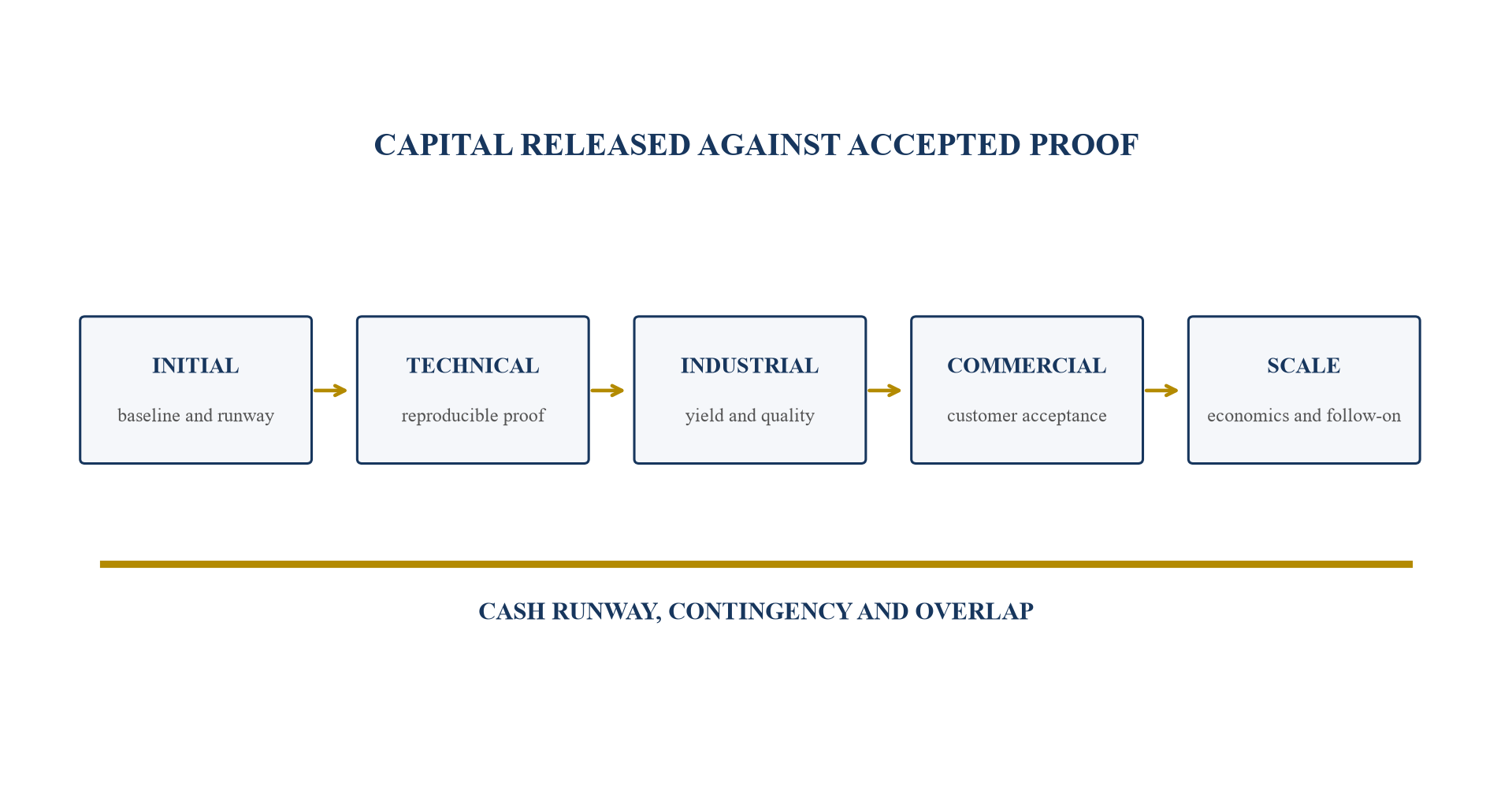
Funding follows accepted decision evidence while initial liquidity and overlapping dependencies remain explicitly financed.
15. Design the initial tranche
The initial tranche should fund the company to the first credible decision point with appropriate reserve. It should include development, test, people, suppliers, certification, working capital, governance and transaction costs. A narrow amount that assumes perfect schedule and result can transfer risk into distress.
The investor should test whether management can execute the milestone before cash becomes constraining. Suppliers may require deposits and test facilities may require advance booking. The company may need to preserve customer service and intellectual property while the programme runs. Minimum liquidity should be explicit.
The initial tranche also establishes bargaining conditions for the next release. If the company has no alternative financing or runway when evidence is reviewed, negotiation may become coercive and programme decisions may be distorted. Structure, fiduciary duties and legal enforceability require qualified advice.
16. Define the technical tranche
The technical tranche should be linked to reproducible performance for a controlled configuration in a stated environment. Thresholds should include the critical parameters required for the next system state. Testing should use approved methods and retain raw data, deviations and failure analysis.
The milestone should address scaling and integration. A component result may not establish system performance. The team should identify interfaces, loads, environmental conditions, software, calibration and operator dependence. Independent witnessing or replication may be appropriate for a material claim.
Release should follow acceptance by the authorised body. A partial pass should not silently become completion. The documents may permit cure, waiver or reduced funding under defined authority. The investment model should show the capital and value consequences of each path.
17. Define the manufacturing tranche
The manufacturing tranche should correspond to a defined production state. Evidence may include qualified process, approved suppliers, tooling acceptance, representative lot, yield, throughput, quality, traceability and target cost. The sample and observation period should be specified.
Capital equipment can require commitment before all evidence is available. The programme should distinguish reversible engineering spend from long-lead fixed commitments. Options, staged purchase orders, customer tooling contributions or equipment finance may reduce cash exposure, subject to commercial and legal feasibility.
The release decision should include demand and inventory. Building capacity without validated orders can create idle assets; delaying capacity after commercial proof can lose customers. The milestone map should connect manufacturing investment with customer and cash evidence.
18. Define the certification tranche
The certification tranche should be linked to the actual approval path. Evidence can include completed design dossier, pre-submission feedback, passed accredited tests, accepted application, audit closure or granted approval. Each state has different residual timing and risk.
The team should define who controls the decision. Authorities and notified or accredited bodies operate on their own procedures. A funding condition based solely on a date outside company control can create avoidable default. The structure can use company-controlled deliverables and retain discretion for external timing.
The budget should include retest, remediation, documentation, facility and specialist costs. A failed test may require redesign that affects manufacturing and customer commitments. The integrated programme should show that dependency rather than isolate certification as an administrative task.
19. Define the customer tranche
The customer tranche should require a defined form of acceptance. A paid pilot, signed production contract, repeat order or customer-confirmed performance can support different conclusions. The milestone should state price, conditions, termination, configuration, delivery and customer obligations.
The committee should assess evidence quality and concentration. A transaction with a related party or strategic partner may support development while leaving market pricing unresolved. A competitive win can provide strong evidence but may contain onerous customisation or liability. Contract review is necessary.
Funding may need to precede cash collection. The capital model should include inventory, installation, acceptance and receivables. Customer deposits, milestone billing, guarantees or supply-chain finance can affect the structure. Their availability and terms should be verified rather than assumed.
20. Define the economic tranche
The economic tranche should be based on evidence that the product can create sustainable contribution at the intended operating scale. It may require a target cost, yield, price, service burden, working-capital cycle and order profile. The perimeter and calculation should be approved.
The team should avoid a target margin based only on one favourable batch or customer. Cohorts, lots and customer segments may differ. The record should show volume, mix, exceptions and the mechanism expected to persist. Credits, grants and supplier concessions should be separated from recurring economics.
The release can fund expansion once the economic bridge is credible. It should also consider cash conversion and capital expenditure. Positive product contribution does not establish self-funding if growth consumes inventory, receivables and capacity capital.
21. Score milestone evidence
The evidence scorecard should separate result from confidence. A test can exceed the performance threshold with limited representativeness; another can narrowly pass with strong replication. The committee should see both. It should also see residual risk and the proposed response.
Scores should follow documented rubrics for configuration, environment, method, sample, repeatability, independence, deviation and source integrity. The scorecard should link to the underlying record. A weighted total should not override a critical failure or legal condition.
The authorised body should record dissent and waiver. A waiver may be rational when new evidence changes the relevance of a criterion. The reason, authority, conditions and financial consequence should remain in the investment record.
Table 3. Milestone evidence scorecard
| Dimension | Evidence question | Possible response |
|---|---|---|
| result | did performance meet the approved threshold? | pass, cure, revise or stop |
| representativeness | did configuration and environment match the claim? | repeat or limit conclusion |
| repeatability | was the result reproduced across relevant samples? | expand testing |
| independence | was material evidence reviewed within stated scope? | obtain additional review |
| residual risk | what uncertainty remains after the result? | price, protect or fund action |
| cash effect | what is required to reach the next state? | release, resize or seek co-finance |
Result, confidence and consequence should be assessed separately.
22. Build the cash-runway model
The cash-runway model should follow programme activities, commitments and financing receipts by month. It should include payroll, suppliers, testing, equipment, certification, inventory, receivables, debt, taxes, transaction cost and reserve. The timing of each tranche should reflect acceptance and transfer.
Schedule uncertainty should be modelled. Technical learning, supplier delay, test availability, authority review and customer acceptance can extend the gate. Cost contingency alone does not cover time if the company continues to incur fixed costs. The model should show both.
The liquidity floor should permit safe decisions. Management should not be forced to skip tests or accept harmful terms to avoid insolvency. The board should have triggers for cost control, alternative finance, scope reduction and off-ramp. Applicable duties and insolvency law require qualified advice.
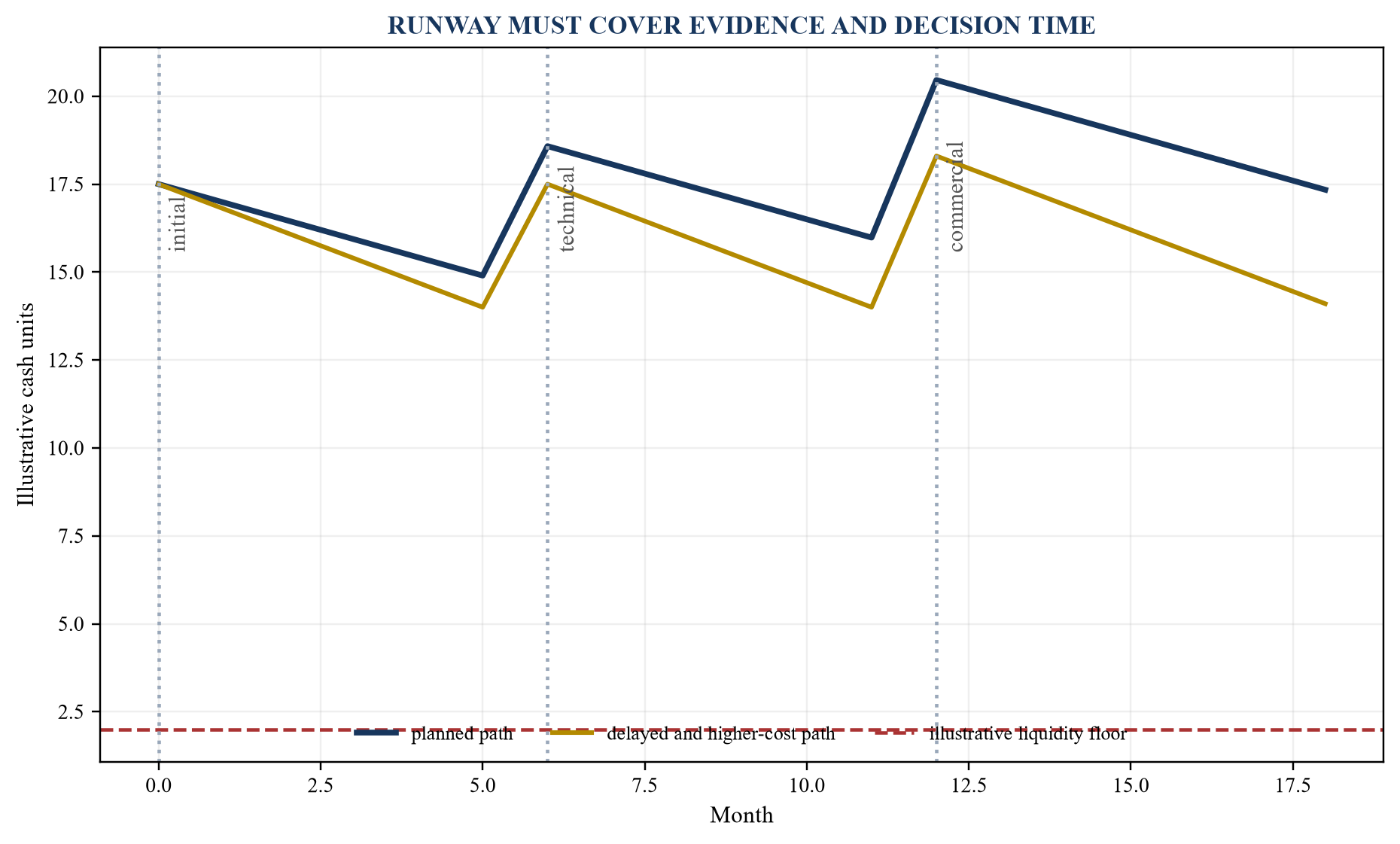
The values are hypothetical and illustrate the need to fund timing ranges, decision periods and contingency.
23. Model cost and schedule together
Milestone cost should be integrated with schedule. A late test can extend payroll, facility and supplier cost even when the test budget is unchanged. A redesign can create direct cost and invalidate parallel certification or manufacturing work. The model should identify correlated effects.
GAO’s technology maturation guidance calls for objectives, tasks, results, responsible organisations, readiness goals, cost, schedule, risks, alternatives and off-ramps [3]. This provides a useful structure for a financed maturation plan. Company-specific estimates still require evidence and accountable review.
The committee should see critical path and float. Activities that can proceed safely in parallel should be distinguished from premature commitments. Schedule ranges should be based on source evidence where available. A single management date should not conceal known uncertainty.
Supplier capacity should be modelled as a dated constraint. A component can be technically suitable and unavailable within the financing window. Long-lead reservations, deposits, cancellation rights, substitutes and requalification work should therefore appear in the integrated schedule. The committee can then distinguish cash needed to preserve an option from cash committed to full production.
The integrated model should distinguish committed cost, avoidable cost and contingent cost. Committed cost includes signed supplier orders, non-cancellable facility obligations and payroll required during notice periods. Avoidable cost can be stopped if a gate fails. Contingent cost arises only after a defined event, such as a redesign, additional qualification campaign or accelerated tooling decision. This classification makes the financing consequence of a delay more transparent. It also helps the board identify which commitments should wait until evidence is available and which must start early to protect the critical path.
Decision latency belongs in the schedule. Test completion, report preparation, specialist review, board circulation, investor approval, legal notice and cash transfer can occupy separate periods. A company that models only the engineering activity can pass the technical gate and still experience a liquidity shortfall before funds arrive. The runway should therefore cover the evidence-production cycle and the release-administration cycle, plus a contingency calibrated to the volatility of the programme. The board should compare this reserve with the cost of raising a larger initial tranche and the dilution or control consequences of doing so.
24. Establish off-ramps and alternatives
An off-ramp is a planned response when evidence no longer supports the current path. It may involve an alternative technology, narrower market, licence, partnership, asset sale, programme pause or orderly wind-down. The plan should identify trigger, authority, cost, timing and value preservation.
Alternatives should be tested before they are needed. A second supplier or technical route can require qualification and intellectual-property rights. A strategic partnership can require customer or regulatory consent. A nominal alternative without time and cash does not protect runway.
Off-ramp planning improves decision quality. It allows adverse evidence to be accepted without forcing continuation to justify sunk cost. The investment documents should address rights and obligations; the operating model should address people, customers, suppliers, data and assets.
25. Govern scope and change
Programme scope should be baselined at financing. Changes to configuration, milestone, budget, schedule or market should follow named authority. The change record should state reason, evidence, effect on other workstreams and proposed financing response.
Deep-tech learning makes change likely. Control should support adaptation without allowing the milestone to move after results are known. Acceptance thresholds can be revised when the original criterion becomes irrelevant, but the committee should see the original, new rationale and economic consequence.
Reserved matters and delegated authority require transaction-specific legal advice. The operating system should give management enough authority to execute while ensuring material changes return to investors or the board under approved rules.
26. Assign owners and reviewers
Each milestone should have an operating owner, evidence preparer, technical reviewer, financial reviewer and decision authority as appropriate. Roles should reflect competence and independence. One person can hold several roles in a small company, with the resulting limitation disclosed.
The owner is accountable for the programme, not for producing a favourable result. Incentives should avoid pressure to suppress failures or redefine metrics. The evidence ledger should preserve deviations and unsuccessful tests. Whistleblowing and escalation channels may be relevant for high-consequence programmes.
External reviewers should have clear scopes, access and deliverables. Their work should be scheduled and funded. A late independent review can delay capital release even when the underlying test is complete. The tranche model should include decision preparation and review time.
27. Select the financing instrument
Milestone finance can use equity, preferred equity, convertible instruments, debt, grants, customer funding, strategic investment or combinations. Instrument choice affects ownership, control, cash obligation, security, accounting, tax and future financing. Qualified advice is required for the actual transaction.
The instrument should match evidence and cash risk. Debt with fixed service can be unsuitable before revenue and technical proof; secured equipment finance may fit identifiable assets and contracts. Convertible funding can defer pricing while creating cap, discount, interest and maturity effects. Preferred equity can allocate downside and control through negotiated rights.
The committee should model the full security, not the label. Participation, liquidation preference, anti-dilution, tranche price changes, warrants, redemption, covenants and conversion can materially affect proceeds and returns. The legal documents control.
Instrument selection should also reflect the asset created by each tranche. Equipment with an identifiable resale market may support asset finance; research expenditure, bespoke prototypes and certification work may offer little conventional collateral. Customer prepayments can validate demand while creating delivery obligations and refund exposure. Strategic investment can add distribution, technical capability or supply assurance, yet exclusivity and information rights may constrain future partnerships. Grant funding can reduce dilution, subject to eligibility, reporting, eligible-cost and timing requirements. The financing plan should value these operational effects alongside headline price and coupon.
Hybrid structures require a consolidated cash and control model. A company may receive grant reimbursement after expenditure, customer cash against delivery milestones, equipment debt against accepted assets and equity for the remaining development risk. Each source can use a different definition of completion and may restrict the same intellectual property, bank account or asset. The board should map priority, conditions, covenants, reporting dates, permitted use and default consequences across the entire stack. This prevents one funding source from appearing available when another agreement blocks its use or when the timing leaves a temporary cash gap.
28. Draft objective release conditions
A release condition should identify the result, evidence, reviewer, decision body, timing and permitted responses. It should avoid vague satisfaction language where an objective test can be used. Some matters require judgement; the documents should state who exercises it and within what process.
Conditions should be within a coherent control boundary. External certification timing or customer signature can be partly outside company control. A structure may combine company deliverables with investor discretion or long-stop dates. The economic consequences of delay should be modelled.
The condition should be administratively executable. Notices, evidence packages, review periods, information rights, cure and transfer mechanics should fit the company’s runway. A theoretically precise milestone can still fail if the release process takes longer than available cash.
29. Design cure and waiver mechanics
Cure mechanics allow a company to address a defined shortfall. The structure should state cure period, permitted spend, evidence required, decision authority and funding during cure. A cure without liquidity can be illusory. Repeated cures can also consume value and delay an inevitable stop.
Waiver mechanics should preserve accountability. The investor may decide that a missed criterion is no longer material because other evidence changed the thesis. The record should explain the basis, conflicts, revised economics and conditions. Applicable rights and duties require legal advice.
Partial acceptance may be possible when milestones contain separable results. The tranche can be resized if documents permit and the remaining programme stays financeable. The revised cash and dilution model should be approved before release.
30. Protect against hold-up risk
Tranches can create hold-up risk when the company depends on one investor for survival and milestone interpretation. The financing should define decision rights, objective evidence, timing and remedies with sufficient clarity. The initial runway should allow orderly review and alternatives.
Investors also face hold-up if later capital is essential after substantial sunk cost. Conditions, governance, information, co-investment and follow-on rights can address that exposure. Terms should remain proportionate to the risk and must be negotiated with qualified advisers.
The board should understand incentives under each scenario. A structure that encourages premature declarations or delays bad news can damage both parties. Evidence governance and credible off-ramps support earlier, more useful disclosure.
31. Model dilution scenarios
Dilution should be modelled across initial and later tranches, option-pool changes, convertibles, preferences, warrants and follow-on rounds. The model should use actual definitions for pre-money or post-money treatment, price, ownership and conversion. Transaction costs and employee incentives may also affect the result.
Milestone success can increase enterprise value before a later tranche. The documents may fix the price, reset it or use a formula. Each approach allocates evidence value differently. The committee should compare incentives, certainty and negotiation risk.
The model should show founder, employee, existing investor and new investor outcomes across operating and financing scenarios. A higher headline valuation can coexist with stronger preference or dilution. Security value should follow the complete waterfall.
Table 4. Illustrative dilution scenario structure
| Scenario | Initial tranche | Later price basis | Follow-on need | Key dilution driver |
|---|---|---|---|---|
| milestones on plan | 40% of round | agreed step-up | moderate | planned option pool |
| technical delay | 40% of round | unchanged | higher | bridge capital |
| partial commercial proof | 40% of round | reviewed range | higher | lower price or preference |
| strong proof and co-investment | 40% of round | market round | lower | larger enterprise value |
| off-ramp | initial only | not applicable | wind-down reserve | security waterfall |
The values are hypothetical and exclude many transaction-specific rights; actual documents and qualified advice control.
32. Translate evidence into valuation
Valuation should connect milestone evidence to forecast, risk, capital need and security rights. IFRS 13 establishes a market-based fair-value measurement framework [7], while International Valuation Standards provide standards relevant to valuation assignments [9]. Fact-specific qualified valuation advice may be required.
Technical proof can change probability, time, cost or market access. Manufacturing proof can change margin and capital intensity. Customer proof can change revenue and price. The model should identify where each result enters rather than apply arbitrary discounts that double count the same risk.
Market and income approaches can be used as appropriate. Comparable companies may be at different readiness and scale. Scenario analysis can represent discontinuous outcomes. Recent financings can provide context while requiring review of rights, market conditions and subsequent evidence.
The valuation bridge should start with the operating mechanism affected by the milestone. A reproducible performance result may reduce technical failure probability; a stable manufacturing yield may reduce unit cost, working capital and capital expenditure; a certification result may bring forward market entry; and a customer acceptance result may change price, volume or sales-cycle assumptions. The model should show the affected input, the evidence supporting the change and the effect on enterprise value. This discipline allows the committee to challenge one assumption without reopening every part of the valuation.
Milestones can create option value as well as forecast value. A platform technology may open an adjacent application, licensing route or strategic-buyer universe after a specific proof point. Those pathways should be treated as scenarios with explicit probability, incremental investment, timing and ownership requirements. They should not be added as an unsupported premium. The same method applies to downside: a failed primary application may leave intellectual property, data, equipment or a narrower product with recoverable value. The security waterfall and off-ramp plan should use a consistent view of those assets.
33. Build the security waterfall
The security waterfall should allocate enterprise value among cash, debt, convertibles, preferences, participation, warrants, options and ordinary shares. It should show the effect of each tranche and follow-on financing. Actual legal definitions control the calculation.
Downside analysis should include failure before later tranches, asset or intellectual-property sale, liquidation cost, grants, secured claims and employee obligations. Recovery estimates should remain evidence-based. Technical assets can have strategic value while being difficult to sell under time pressure.
The investor should evaluate return across value and timing scenarios. Delayed proof can reduce internal rate of return even when terminal value holds. The company should understand how rights affect incentives and future investors. The waterfall should be reproducible and approved with the financing recommendation.
34. Plan co-investment and follow-on capital
Deep-tech programmes can require capital beyond one investor’s capacity or mandate. The plan should identify likely lead, co-investors, strategic parties, grants, lenders and customer finance. Each source has eligibility, diligence, timing, rights and confidentiality implications.
The EIC describes deep-tech investments, co-investment and milestone-based follow-on structures, including current 2026 scale-up programmes [10][11]. These programme-specific sources illustrate available structures in their eligible scope. They do not establish funding for a particular company.
The company should plan evidence that makes the next round financeable. Data-room readiness, technical review, customer proof, governance and runway should be built before the next process begins. A milestone can be passed operationally while the company remains unable to close follow-on capital in time.
The syndication plan should separate investors by mandate and contribution. A specialist deep-tech investor may underwrite technical risk; a sector corporate may assess integration and route to market; a growth investor may focus on repeatability and scale; and a lender may require contracted cash flow or eligible assets. Management should identify which evidence each party needs, who can lead documentation, what reserve capacity exists and whether strategic rights conflict. The financing timeline should account for independent diligence, investment-committee calendars, regulatory approvals and the possibility that a proposed co-investor does not participate.
Follow-on readiness should be measured through executable alternatives. For each plausible capital source, the company should maintain an owner, engagement status, expected decision path, information requirements, minimum and maximum cheque, likely conditions and earliest cash date. These are planning fields, not commitments. The board should test whether the company remains financeable if the preferred lead declines, a grant decision slips or a customer order is delayed. Where no credible alternative covers the gap, the initial tranche, programme scope or cost base requires reconsideration before documents are signed.
35. Prepare the milestone data room
The data room should mirror the milestone architecture. It should include corporate, cap table, financing, intellectual property, technical baseline, test, manufacturing, quality, certification, customer, financial, tax, security, people, supplier and programme records. Access should follow confidentiality and privilege controls.
Each material claim should link to a source. Version and date matter because configurations and forecasts change. The company should retain superseded evidence where it explains the decision history. Missing documents and open questions should be visible.
The data room should support efficient specialist review without misrepresenting scope. A test report can establish a defined result; it does not establish rights, market demand or valuation. Indexing by milestone and decision consequence helps integrate workstreams.
Evidence quality should be tested before diligence begins. For every gate, the company should confirm that the cited artefact identifies the tested configuration, method, date, operator, equipment, calibration status, raw data, exceptions, reviewer and conclusion. Commercial records should distinguish expressions of interest, paid pilots, purchase orders, contracted backlog, acceptance and cash collection. Manufacturing records should reconcile prototype results with planned production process, supplier capability and quality controls. Financial schedules should link unit assumptions to technical and commercial evidence. This cross-reference reduces the risk that several workstreams rely on different versions of the product or plan.
The index should also expose unresolved matters. A missing freedom-to-operate review, incomplete chain of title, expired quotation, unverified yield assumption or customer dependency should have an owner, consequence and target resolution date. Access logs and staged disclosure may protect sensitive information, subject to legal advice, while still allowing the investor to understand what exists. Management should prepare a concise evidence map for the investment committee and retain the underlying material for specialist examination. A clean index cannot compensate for missing proof, but it can make the limits and next actions visible before they become closing delays.
36. Build the investment committee scorecard
The scorecard should combine readiness result, evidence confidence, residual risk, cash requirement, value effect and proposed response. It should keep technical, manufacturing, certification, customer and economic dimensions separate before presenting the integrated recommendation.
Each assessment should link to source evidence and an approved rubric. A single aggregate score can conceal a critical failure. Stop conditions and legal requirements should remain visible. Dissent and limitations should be recorded.
The committee should see initial tranche, later commitments, follow-on need, security waterfall and return scenarios. Approval should define delegated authority for documents and identify changes that require renewed review. The scorecard supports judgement; it does not replace it.
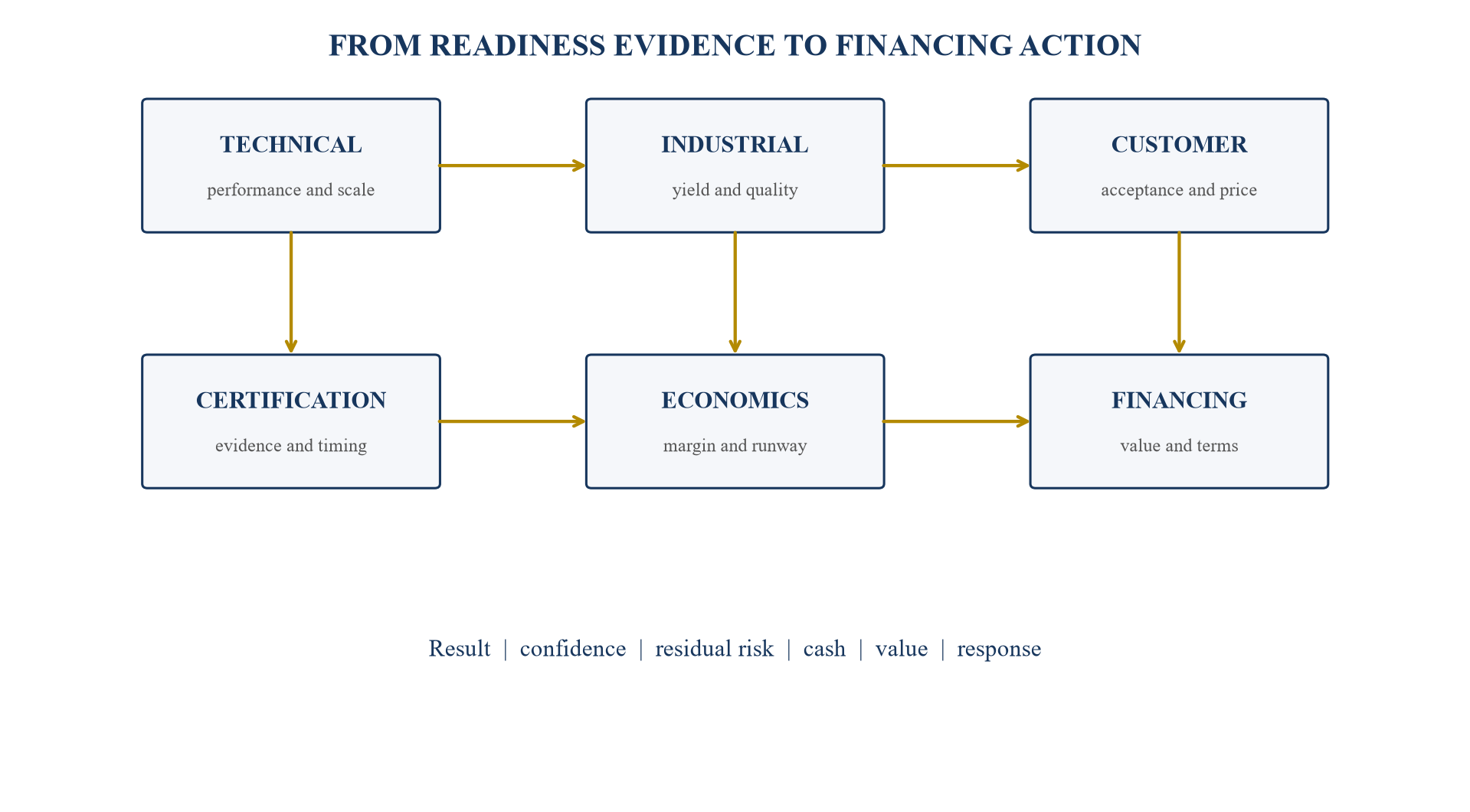
Each readiness dimension is assessed through result, confidence, residual risk, cash need and financing response.
37. Monitor after each tranche
Post-release monitoring should continue the evidence system. The board should receive programme status, configuration, test results, manufacturing, certification, customers, cost, schedule, cash, risks, changes and next gate. Definitions should remain stable or show a bridge.
Monitoring should focus on leading evidence and decision thresholds. Activity completion can be reported while remaining separate from milestone acceptance. The team should forecast cash to the next decision point and update contingency. Supplier and customer commitments should be linked.
Material adverse results should be escalated early. The board can then activate cure, resize, alternative finance or off-ramp before liquidity becomes critical. Information rights and governance follow the transaction documents and applicable law.
38. Prepare the next financing
The next financing should begin before the current runway reaches the milestone date. Investor mapping, materials, diligence readiness, approvals and closing require time. The programme should identify the evidence package and market window required for the next round.
The company should update valuation and security analysis after each major result. Favourable proof may support a broader investor universe; delays may require a bridge or narrower plan. The board should compare funding certainty, price, rights and strategic contribution.
Public or grant programmes have their own rules and timing. The EIC’s 2026 applicant guidance discusses investment readiness, technical and commercial milestones and investor interest in its eligible programme [12]. A company should verify current eligibility and obtain programme-specific advice.
39. Run the ninety-day financing-readiness sprint
During days one to thirty, the company should baseline configuration, critical technologies, readiness dimensions, milestone tree, cost, schedule, runway, cap table and source records. The board should approve the financing objective and decision rights. Missing evidence should receive owners.
During days thirty-one to sixty, teams should test milestone definitions, supplier and customer dependencies, certification path, unit economics, legal terms and alternative finance. The company should prepare the evidence scorecard, dilution scenarios and data-room index. Specialist reviews should begin.
During days sixty-one to ninety, management should finalise the integrated model, term parameters, committee pack, diligence responses and process plan. Long-lead technical evidence continues on its real schedule. The sprint creates financing readiness; it does not compress physical proof into an artificial deadline.
Table 5. Ninety-day financing-readiness outputs
| Period | Core work | Board output |
|---|---|---|
| days 1 to 30 | baseline scope, evidence, cash and governance | approved financing objective |
| days 31 to 60 | test milestones, dependencies and terms | integrated risk and scenario review |
| days 61 to 90 | complete model, data room and process | launch, revise or defer decision |
| ongoing | execute technical and commercial proof | accepted gate evidence |
Physical development and regulatory work retain their real timelines; the sprint prepares the financing control system.
40. Conclusion
Deep-tech milestone financing should fund evidence, decision time and the path to the next financeable state. Technology, manufacturing, certification, customer and economic readiness require distinct definitions and evidence. One readiness label cannot represent the complete investment risk.
Tranches should use objective results, controlled configurations, representative environments, source records, accountable review and clear consequences. Initial liquidity, schedule ranges, contingency, cure and off-ramps are part of the structure. Underfunded milestones can distort both technical and financing decisions.
The investment committee needs a reproducible bridge from readiness to cash, value, dilution and security rights. The milestone tree, evidence scorecard, runway model, dilution scenarios and post-tranche reporting create that record. Final decisions remain company-specific and require professional judgement and qualified technical, legal, accounting, tax, regulatory and valuation advice.
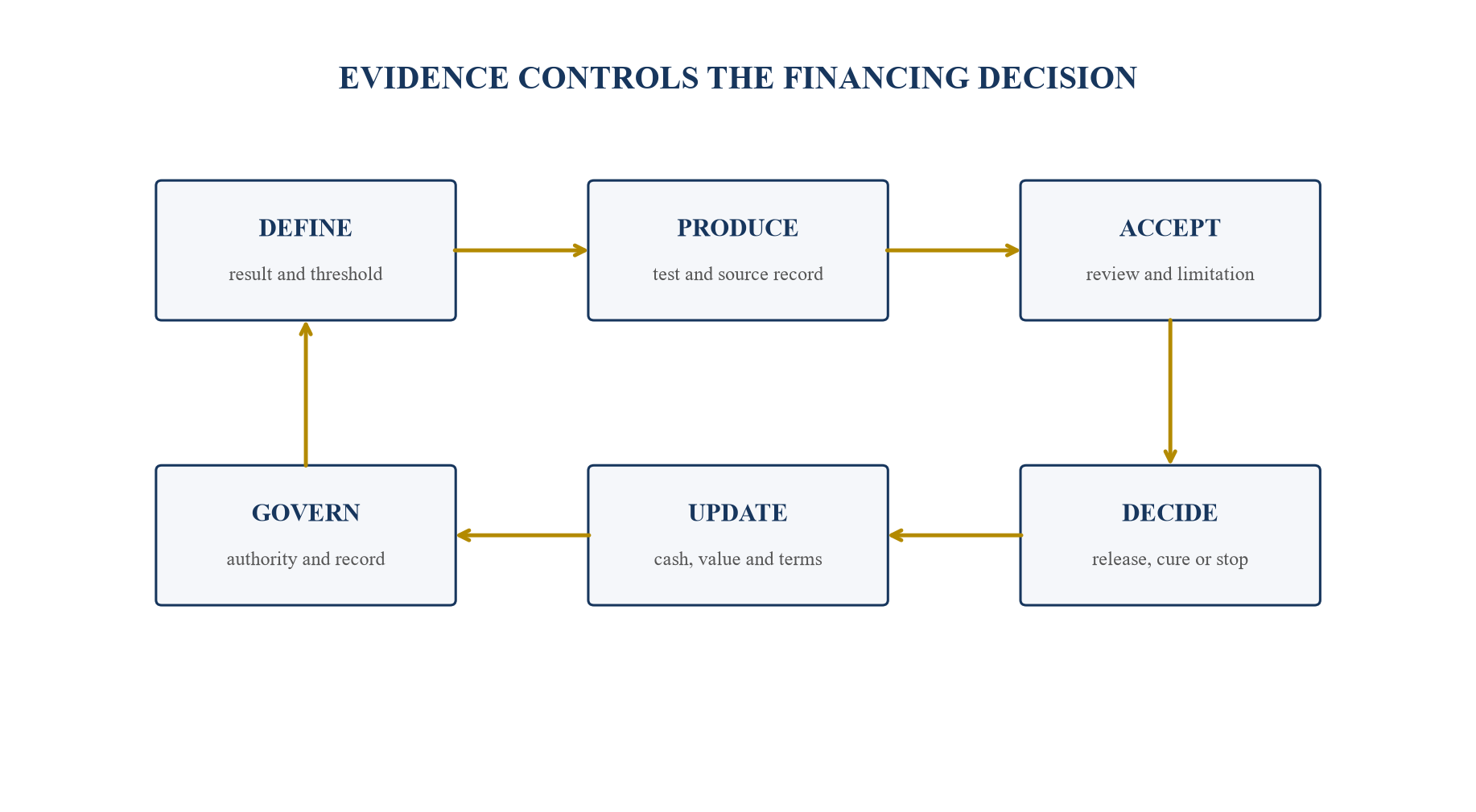
Evidence is accepted, translated into cash and value, and used to release, cure, revise or stop under authorised governance.
References
- National Aeronautics and Space Administration, Technology Readiness Levels, https://www.nasa.gov/directorates/somd/space-communications-navigation-program/technology-readiness-levels/
- U.S. Government Accountability Office, Technology Readiness Assessment Guide, GAO-16-410G, https://www.gao.gov/products/gao-16-410g
- U.S. Government Accountability Office, Technology Readiness Assessment Guide full report, https://www.gao.gov/assets/gao-16-410g.pdf
- National Aeronautics and Space Administration, Technology Readiness Levels Demystified, https://www.nasa.gov/aeronautics/technology-readiness-levels-demystified/
- U.S. Government Accountability Office, DOD Can Achieve Better Outcomes by Standardizing the Way Manufacturing Risks Are Managed, GAO-10-439, https://www.gao.gov/assets/a303517.html
- National Aeronautics and Space Administration, Systems Engineering Processes and Requirements, NPR 7123.1C, https://nodis3.gsfc.nasa.gov/displayAll.cfm?Internal_ID=N_PR_7123_001C_&page_name=all
- IFRS Foundation, IFRS 13 Fair Value Measurement, https://www.ifrs.org/issued-standards/list-of-standards/ifrs-13-fair-value-measurement/
- IFRS Foundation, IFRS 15 Revenue from Contracts with Customers, https://www.ifrs.org/issued-standards/list-of-standards/ifrs-15-revenue-from-contracts-with-customers/
- International Valuation Standards Council, International Valuation Standards, https://www.ivsc.org/standards/
- European Innovation Council, EIC Fund Investment Guidelines and Approach, https://eic.ec.europa.eu/eic-fund/eic-fund-investment-guidelines-approach_en
- European Innovation Council, Co-investing with the EIC Fund, https://eic.ec.europa.eu/eic-fund/co-investing-eic-fund_en
- European Innovation Council, EIC Accelerator Guide for Applicants 2026, https://eic.ec.europa.eu/document/download/9d96fbf3-4d85-4ad0-9483-c77ce348111d_en?filename=EIC+Accelerator+guide+for+applicants_WP26.pdf
- European Innovation Council, STEP Scale Up, https://eic.ec.europa.eu/eic-funding-opportunities/step-scale_en
- European Innovation Council, Frequently Asked Questions on EIC Investments, https://eic.ec.europa.eu/eic-frequently-asked-questions/faqs-eic-investments_en
- European Innovation Council, Updated EIC Fund Investment Guidelines for 2026, https://eic.ec.europa.eu/news/european-commission-updates-eic-fund-investment-guidelines-eic-accelerator-and-step-scaleup-2026-08-27_en
- IFRS Foundation, Educational material on measuring the fair value of unquoted equity instruments, https://www.ifrs.org/content/dam/ifrs/supporting-implementation/ifrs-13/education-ifrs-13-eng.pdf
- U.S. Securities and Exchange Commission, EDGAR company filings database, https://www.sec.gov/edgar/search/
- Financial Accounting Standards Board, Accounting Standards Codification Topic 606, https://asc.fasb.org/topic&trid=2129938
- Organisation for Economic Co-operation and Development, OECD Due Diligence Guidance for Responsible Business Conduct, https://mneguidelines.oecd.org/due-diligence-guidance-for-responsible-business-conduct.htm
- International Organization for Standardization, ISO 9001 quality management systems, https://www.iso.org/iso-9001-quality-management.html
- International Organization for Standardization, ISO 31000 risk management, https://www.iso.org/iso-31000-risk-management.html
- National Institute of Standards and Technology, Engineering Laboratory publications and resources, https://www.nist.gov/el
- U.S. Department of Energy, Office of Technology Transitions, Technology Commercialization Fund, https://www.energy.gov/technologytransitions/technology-commercialization-fund
- European Commission, Horizon Europe strategic plan 2025 to 2027, https://research-and-innovation.ec.europa.eu/funding/funding-opportunities/funding-programmes-and-open-calls/horizon-europe/strategic-plan_en
- World Intellectual Property Organization, IP for Business, https://www.wipo.int/sme/en/
- Bank for International Settlements, Innovation and financial technology publications, https://www.bis.org/topic/fintech.htm
