

1. Frame the decision around the business service
The decision should begin with the business service supported by the platform. Management needs to identify the users, customers, decisions, workflows, data, jurisdictions, operating hours and consequences of disruption. The service baseline should record current volume, quality, latency, availability, human review, unit cost, incidents and contractual commitments. This creates a common denominator for every alternative.
A vendor-centred question can obscure the outcome the enterprise needs. A platform may host several models, retrieval services, orchestration tools and workflow components, while the business depends on only a subset. Conversely, a licence may appear replaceable while undocumented prompts, data transformations and operating routines make the delivered service difficult to reproduce. The analysis should therefore follow the service from input to accepted outcome.
The trigger should be documented. Relevant triggers include material price or term changes, deteriorating service, concentration risk, loss of strategic control, inadequate data rights, regulatory obligations, a vendor product sunset, an acquisition, a security event or a superior internal capability. The trigger affects urgency and bargaining leverage. A planned cost review allows different actions from an abrupt termination.
Decision criteria should be approved before alternatives are evaluated. They can include customer continuity, regulatory compliance, security, performance, strategic control, time, cash exposure, operating capability and future option value. Weighting these criteria after vendor proposals arrive can favour a preferred narrative. A pre-agreed baseline also allows the board to distinguish evidence from advocacy.
The baseline period should reflect seasonality and growth. Workloads, model consumption and support demands can vary across reporting cycles, campaigns or customer cohorts. Management should preserve raw measures and adjustment rules so a successor is not credited for a volume decline or penalised for an expanded scope. Where the platform supports several services, shared costs and dependencies should be shown both by service and for the enterprise as a whole.
The decision memorandum should also specify what remains outside scope. A takeout may address the application layer while leaving cloud, data or identity dependencies unchanged. Those retained exposures should remain visible with owners and future review dates. Clear boundaries prevent a limited migration from being presented as complete strategic independence.
2. Define the four credible end states
The current state remains an alternative and should be evaluated honestly. Staying can preserve continuity, supplier innovation, proven controls and committed-spend utilisation. Its cost includes expected price progression, unresolved dependency, concentration and limits on strategic flexibility. A status-quo case that assumes no contractual or technical change understates exposure.
Renegotiation can change price, minimum commitments, service levels, data rights, audit access, portability support, model choice, termination assistance and liability allocation. It is strongest when management has a credible alternative, a complete dependency record and sufficient time before renewal. A discount without structural changes may defer the same decision.
Rebuilding can mean an internal platform, an open architecture, a new managed service or a combination. The term should specify what is truly rebuilt. Replacing a model endpoint while retaining the original vendor's identity, data, monitoring or workflow layer produces a partial takeout. The successor design should state which dependencies are removed, transferred or intentionally retained.
Retirement is appropriate when the supported workflow no longer creates enough value, can return to a simpler process or can be absorbed by another platform. Retirement still requires records, data disposition, customer communication, control closure and contract termination. It can release cost and complexity more effectively than funding a replacement for a weak use case.
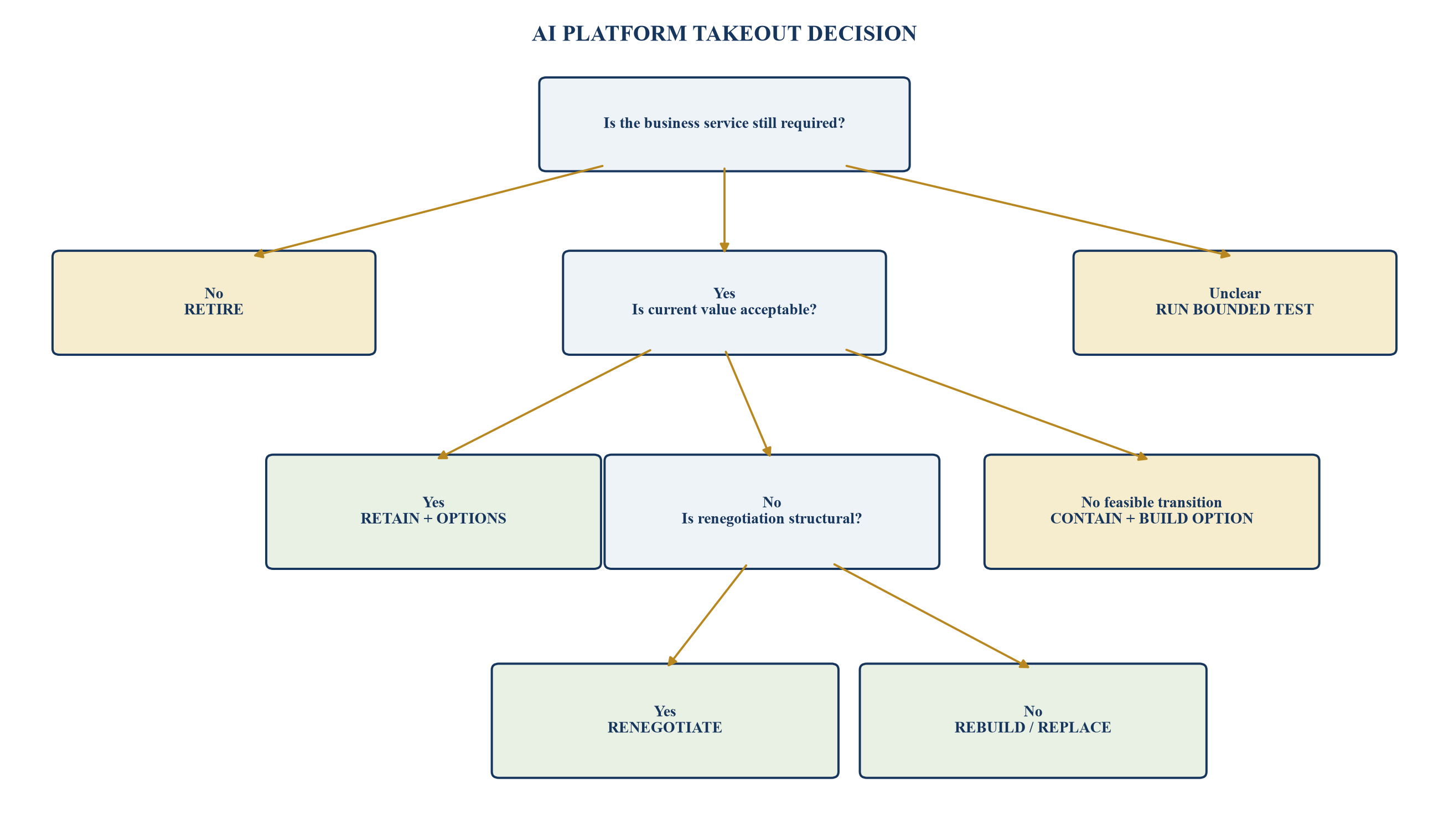
The decision follows service necessity, evidence of underperformance, credible alternatives and transition feasibility.
Table 1. Decision gate for the four end states
| End state | Required evidence | Main advantage | Principal exposure |
|---|---|---|---|
| retain | acceptable value, controls and service outlook | continuity and supplier innovation | dependency and future terms |
| renegotiate | leverage, competitive benchmark and enforceable changes | lower disruption with improved economics | cosmetic concessions |
| rebuild or replace | proven successor, skills and funded transition | strategic control and architecture reset | execution and continuity |
| retire | weak use case or viable simpler process | releases cost and complexity | loss of capability or records |
Every alternative is assessed against the same service baseline and downside case.
3. Map the dependency system
Dependency begins with the technical stack. The map should include models, embeddings, vector stores, orchestration, agents, application services, integration middleware, identity, logging, monitoring, security tooling, cloud infrastructure and development pipelines. Each component should show owner, version, interface, location, throughput, service level and replacement route.
Data dependencies require separate treatment. Source data, derived features, labels, prompts, retrieval corpora, evaluation sets, model outputs, logs and feedback can have different rights and formats. Management should know which data can be exported, in what schema, at what cost and within what time. The ability to download records does not prove that the successor system can interpret them.
Operational knowledge often creates the most underestimated lock-in. Specialists know exception patterns, undocumented configuration, prompt behaviour, customer-specific workarounds and incident routines. The register should identify key-person dependencies, vendor-managed procedures and knowledge that has never been converted into an enterprise-controlled artefact.
Commercial and legal dependencies include committed spend, credits, volume tiers, bundled licences, intellectual-property rights, confidentiality, data use, subcontractors, termination notice, transition support and dispute provisions. A platform can appear expensive in isolation while being economically linked to a wider cloud or software commitment. The takeout case must measure the bundle.
Customer-facing dependencies should be mapped to representations and service commitments. Proposals, diligence responses, contracts and operating manuals may refer to a named model, hosting location, certification, data practice or service level. The transition office should identify which statements are binding, which require notification and which can be changed through ordinary configuration management. This review can reveal obligations that are absent from the technology inventory.
The dependency map should record evidence strength. A confirmed contract right, completed portability test and current runbook provide stronger support than an employee recollection or vendor presentation. Low-confidence items with high consequence should become immediate diligence tasks. This prevents a visually complete map from implying that every route has been proved.
4. Distinguish useful specialisation from avoidable lock-in
Specialisation can create real value. Proprietary models, managed infrastructure, integrated controls and vendor expertise may improve speed, quality or reliability. Requiring every component to be portable can increase current cost and slow innovation. The relevant question is whether the value of specialisation exceeds the expected cost and risk of dependence.
Avoidable lock-in arises when switching friction does not create commensurate service value. Examples include undocumented interfaces, unnecessarily proprietary data structures, punitive extraction charges, restrictive licensing, credentials controlled only by the vendor and contracts that omit transition support. Competition authorities have examined egress fees, interoperability and licensing practices because they can constrain switching and multi-cloud use.
The enterprise should measure dependency by consequence and reversibility. A component with a substitute may still be critical if migration takes longer than the organisation can tolerate. A highly proprietary component may be acceptable when it is non-critical and economically replaceable. Dependency scores should therefore combine criticality, time to substitute, evidence of portability, skills and contractual support.
The architecture decision should state where specialisation is intentional. Those choices can be protected through modular boundaries, owned data, versioned interfaces, tested exports, escrow where appropriate and current operating documentation. This preserves access to vendor innovation while retaining credible strategic options.
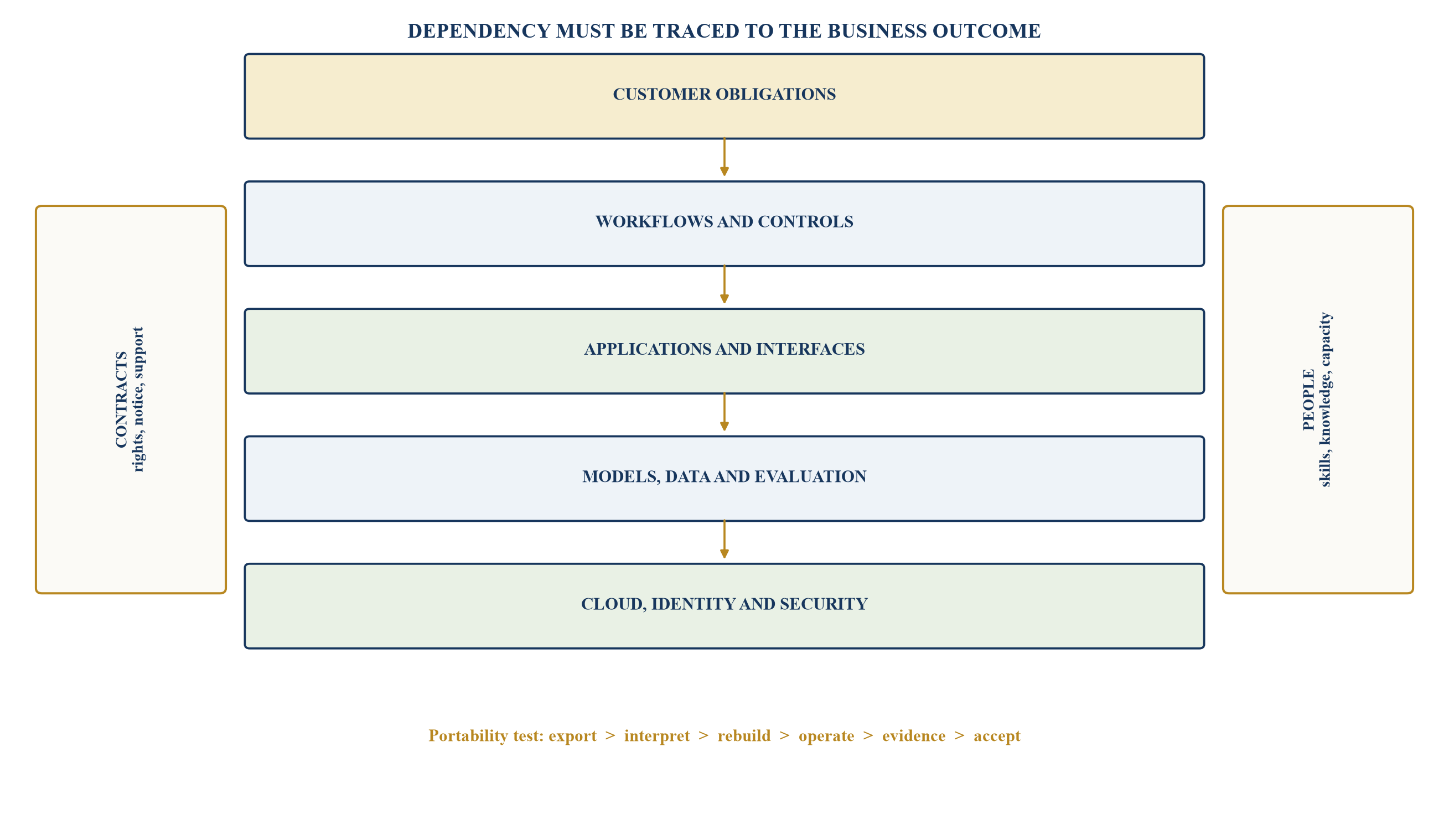
Exit difficulty is created across technology, data, people, controls, contracts and customer obligations.
Table 2. Dependency register
| Dependency | Evidence to collect | Reversibility test | Management response |
|---|---|---|---|
| model and API | versions, limits, terms, performance | run approved use case on alternative | abstraction, fallback, validation |
| data and features | rights, schema, lineage, volume | export and reconstruct sample | owned dictionary and conversion |
| workflow logic | prompts, rules, exceptions, approvals | reproduce accepted outcome | versioned enterprise repository |
| security and identity | roles, keys, logs, controls | operate successor access model | dual control and cutover plan |
| operating knowledge | runbooks, owners, incident history | execute with enterprise team | transfer, rehearsal and staffing |
| contract and spend | notice, credits, bundles, assistance | calculate exit cash and rights | renegotiate or reserve funding |
Criticality and reversibility are recorded separately.
5. Build the evidence architecture before choosing
The decision file should connect every material claim to a source. Contract terms should link to executed documents. Usage and performance should reconcile to system records. Costs should reconcile to invoices, payroll and allocation rules. Incidents, exceptions and customer commitments should link to approved registers. This creates a reproducible baseline for procurement, technology, risk and finance.
Alternatives should be evaluated with comparable definitions. If the current platform cost excludes internal support while the rebuild includes a complete operating team, the comparison is biased. If successor performance is measured on a clean sample while incumbent performance reflects production complexity, the result is similarly unreliable. The evidence dictionary should define periods, workloads, quality measures and allocation methods.
Unknowns should be visible. A range or unresolved item can be entered with an owner, test and decision date. Concealing uncertainty inside a point estimate makes the board case appear more precise while reducing its usefulness. High-impact unknowns should determine the next diligence activity and capital gate.
The evidence architecture also supports negotiation. A vendor is more likely to address a specific, evidenced issue than a general complaint about cost or lock-in. A complete baseline allows the enterprise to request changes in price, rights, service, portability and transition support that correspond to measurable exposures.
6. Test portability as an operating capability
Portability requires more than an export clause. The enterprise should extract a representative data set, verify completeness, transform it into a documented schema, load it into a controlled alternative and reproduce selected outputs. Timing, personnel, defects and vendor assistance should be recorded. A successful test creates evidence about practical reversibility.
The test population should include difficult records. Historical formats, multilingual content, customer-specific configuration, deleted-user artefacts, audit logs, embeddings and derived features can expose hidden dependence. The organisation should define which artefacts must remain reproducible for legal, customer, control and analytical purposes.
Application portability should test interfaces and workflow behaviour. Equivalent API syntax does not establish equivalent service. Model outputs, rate limits, latency, content filters, context management, observability and failure handling can change the business outcome. The successor needs contextual validation inside the actual workflow.
Portability evidence should be refreshed after material changes. New features, integrations, model versions and data volumes can invalidate an earlier test. A recurring exercise supports both operational resilience and commercial leverage by keeping the cost and timing of alternatives visible.
7. Establish the minimum viable successor
The successor should preserve the minimum service needed through transition. Attempting to reproduce every incumbent feature can expand scope before the critical path is understood. Management should classify functions as mandatory at cutover, required soon after, optional improvements and candidates for retirement.
The minimum viable successor includes controls. Identity, access, logging, data protection, human review, monitoring, incident response, records and customer commitments are part of the service. A technically working application without these components is a prototype and cannot provide a sound cutover basis.
Acceptance tests should be defined before build or procurement. They should cover representative workloads, performance, security, resilience, data reconciliation, operating procedures, customer obligations and cost. Thresholds can differ by use case and risk. Exceptions should have accountable acceptance and a bounded remediation period.
The design should preserve future options. Modular interfaces, enterprise-controlled data definitions, portable evaluation sets and observable cost units allow models or providers to change without rebuilding the complete service. This architecture has an upfront cost that should be compared with the expected value of flexibility.
8. Create the transition critical path
The critical path begins with contractual dates. Renewal windows, notice periods, committed-spend expiry, support obligations and termination rights determine the available time. Technical plans that ignore these dates can strand cash or leave the enterprise dependent after contractual support ends.
Dependencies should be sequenced. Data extraction may precede transformation. Identity and security approval may precede production access. Validation may require a stable successor release. Customer notification may depend on legal interpretation and completed assurance. The plan should show the earliest and latest dates for every item that can delay cutover.
Parallel operation creates evidence and cost. The enterprise can compare outputs, service levels, incidents and operating effort while retaining fallback. The duration should follow business criticality, variability and reversibility. A short parallel period can miss rare failure modes, while an open-ended period can preserve duplicate cost and weak accountability.
The cutover plan should define decision authority, command structure, rollback, communication and post-cutover monitoring. A scheduled date alone does not create readiness. The accountable executive should approve cutover only when mandatory evidence is complete or explicit residual exposure has been accepted.
Integrated scheduling should include resource contention. The same engineers, risk specialists and business users may support current operations, successor build, validation and customer work. Assigning them at full capacity to each stream creates a mathematically complete plan that cannot be executed. The transition office should model available hours, critical skills, leave, supplier availability and decision lead times, then protect capacity for incidents in the existing service.
Change control should stabilise the transition baseline. New incumbent features, business requirements and customer configurations can keep moving the target. Each proposed change should show its service value, effect on portability, testing and critical-path date. Mandatory regulatory or customer changes may proceed, while discretionary additions can be placed into the successor backlog after cutover.
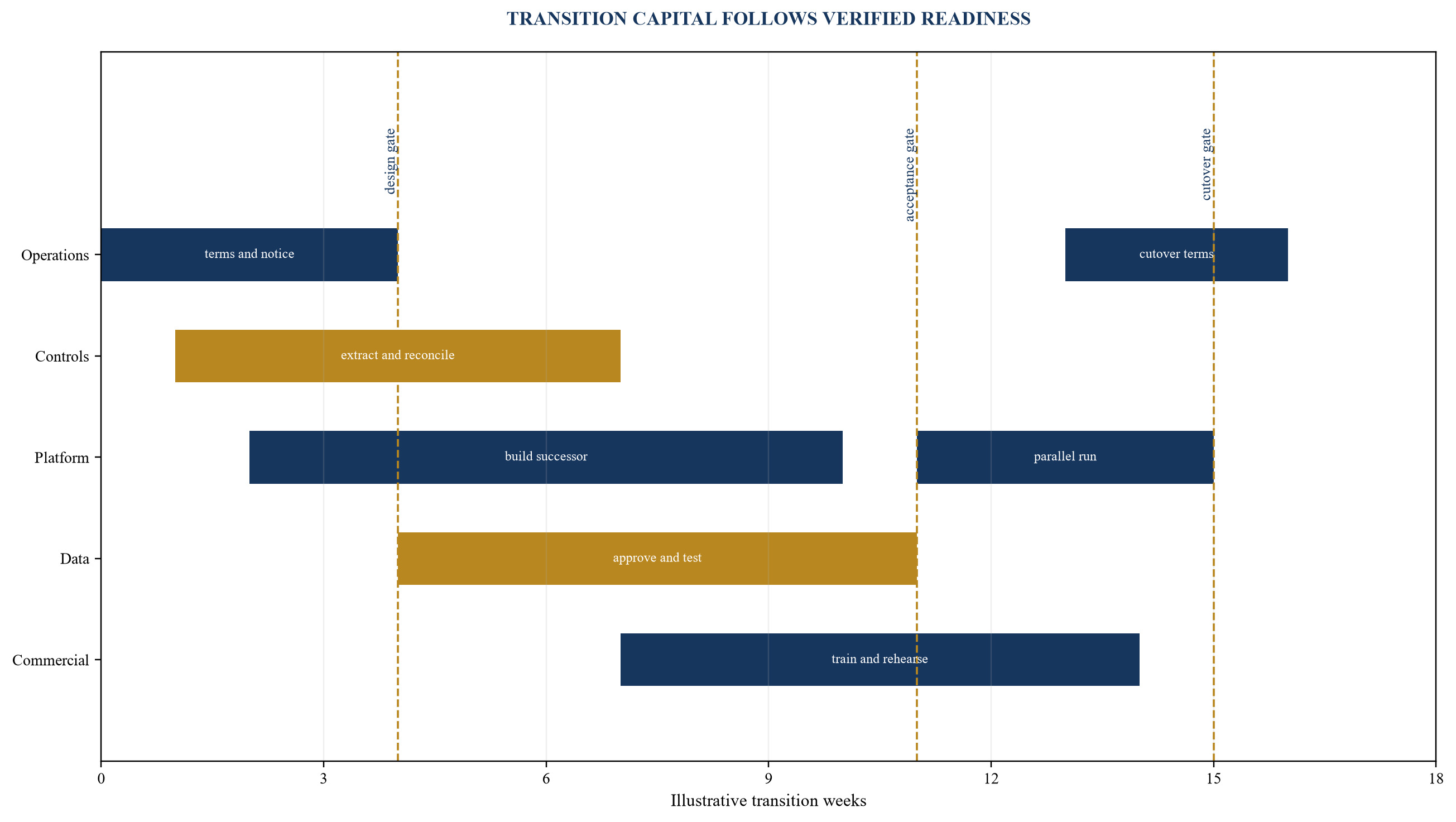
Commercial, technical and control workstreams converge before cutover.
Table 3. Transition critical-path controls
| Workstream | Mandatory output | Gate evidence | Failure response |
|---|---|---|---|
| commercial | notices, rights, spend and assistance | approved contract position | renegotiate timing or reserve cost |
| data | complete export, dictionary and reconciliation | signed data-control totals | remediate before irreversible change |
| platform | released successor and interfaces | contextual acceptance tests | contain scope or redesign |
| controls | security, risk, records and approvals | no unresolved mandatory control | defer cutover |
| operations | people, runbooks, support and rollback | successful rehearsal | extend parallel run and train |
| customers | obligations and communication | required acceptance completed | segment or defer affected customers |
The transition office owns the integrated plan and source evidence.
9. Price the full lifecycle
The economic baseline should begin with cash paid to the incumbent and the internal resources required to operate the service. It should include licence, usage, cloud, support, implementation, integration, assurance, incident response, procurement, finance and business-user time. Shared commitments should be allocated transparently and also shown at enterprise level.
Transition costs include discovery, extraction, remediation, architecture, development, procurement, validation, security, parallel running, training, customer assurance, termination and post-cutover stabilisation. Lost productivity and delayed initiatives can be material even when they do not appear in the technology budget. The case should state which costs are cash, absorbed capacity or opportunity cost.
The successor steady state should include the complete operating model. Internal capability requires product, engineering, data, security, risk, support and vendor-management resources. A lower unit model price may coexist with higher integration or assurance effort. Costs should be modelled by workload and customer cohort so scale effects are visible.
Stranded commitments and residual dependence should remain explicit. Cloud credits, minimum spend, long-term licences and capitalised assets may survive the cutover. A successor can also retain exposure to the same cloud, model or data provider through another layer. Economic comparison should follow the whole enterprise position.
Cost ranges should reflect evidence maturity. Contracted rates and current invoices may support narrow ranges. Data-remediation effort, customer exceptions and stabilisation duration may remain wider until tests are complete. The model should show base, downside and severe but plausible cases with the operational event that drives each difference. Sensitivity analysis can identify whether the decision depends on a small number of uncertain assumptions.
Unit economics should follow an accepted business output, not a convenient technical unit. Token, call or compute costs can be useful operating measures, while customers and business leaders may value a completed case, approved decision or resolved exception. Connecting both levels reveals whether technical efficiency converts into service value and whether a successor changes human-review or failure costs.
10. Model cash, accounting and financing consequences
The board should see cash timing by month or quarter. Transition expenditure usually precedes savings, and parallel operation creates a temporary peak. Contract notice, termination payments, committed spend and supplier payment terms can move that peak. A positive long-term net present value does not establish that the organisation can fund the transition safely.
Accounting treatment requires qualified review under the enterprise's policies and applicable standards. Configuration, customisation, internal development, termination, impairment and contract-modification costs can have different recognition patterns. The decision model should present operating economics separately from accounting conclusions so one does not conceal the other.
Financing capacity can be affected by earnings, cash conversion, covenants and lender consent. A transition that reduces future run-rate cost may still depress near-term cash and reported measures. Finance should connect the approved plan to liquidity headroom and downside triggers.
Benefits should be classified. Contracted savings, avoided price increases, released capacity, reduced risk and strategic option value have different evidence strength. The case should avoid presenting all benefits as cash. Each benefit needs an owner, baseline, measurement method and realisation date.
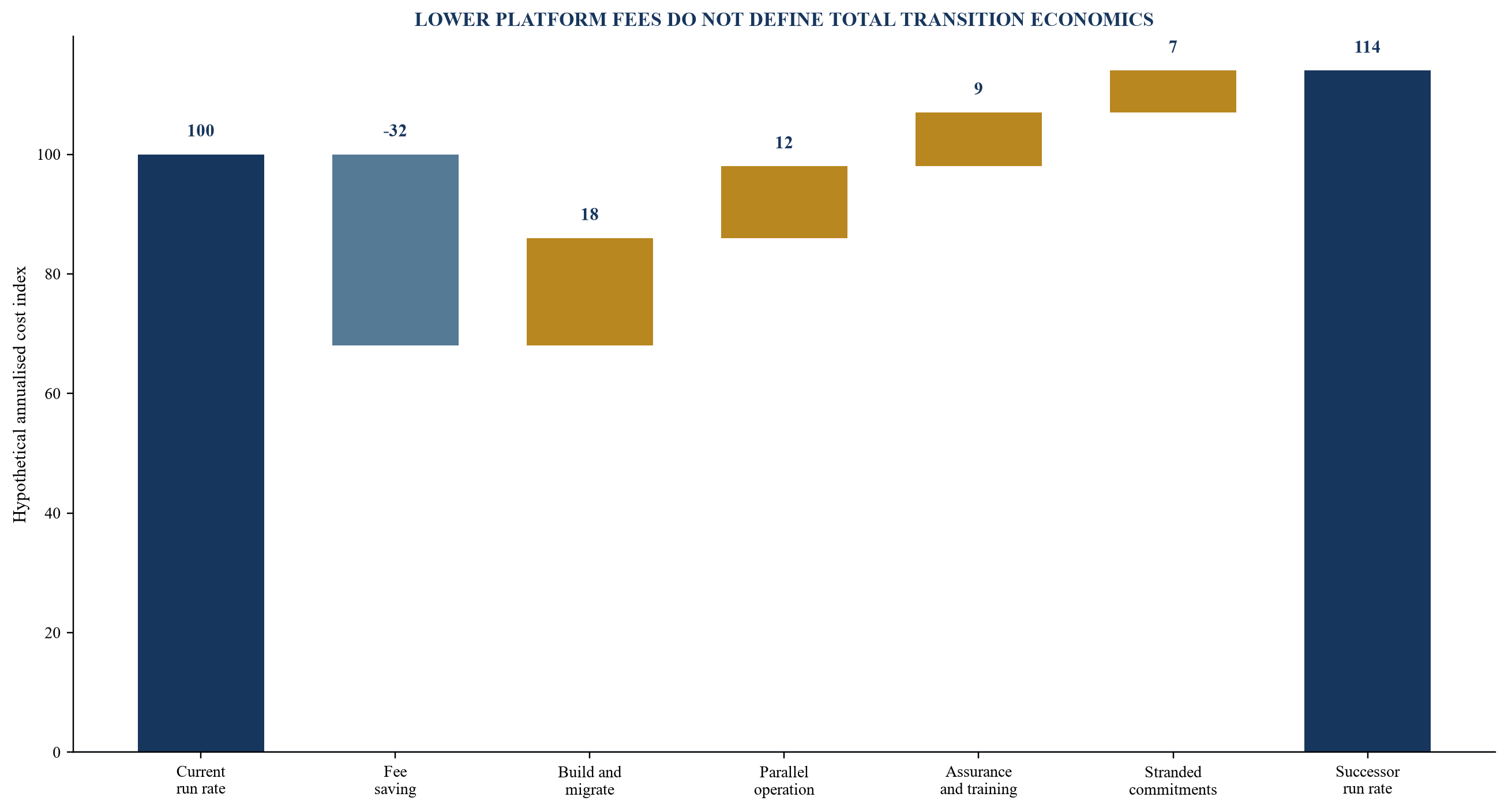
Hypothetical index values show how transition and residual costs can offset lower successor fees.
11. Use negotiation to change structure
Negotiation should address the exposures shown by the dependency and cost registers. Price remains relevant, together with minimum commitments, ramp profiles, credits, renewal caps, service levels, portability, support, audit, data rights, model choice, subcontractors, security, change control, termination assistance and liability. The objective is an arrangement whose economics and reversibility match the service.
Leverage comes from credible preparation. A tested export, qualified alternative, approved budget and known decision timetable are stronger than an unsupported threat to leave. The enterprise should know its best alternative, switching cost, walk-away conditions and the items it can trade.
Concessions should be valued across the lifecycle. Temporary credits can have less value than lower recurring commitments or stronger termination rights. Bundled discounts may increase dependence on another service. Each proposal should be entered into the same model used for the takeout case.
The final agreement should be translated into operating controls. An export right needs an owner and test cadence. A service level needs data and remedies. A portability commitment needs formats, timing, cost and assistance. Negotiated value is realised when the enterprise can exercise the right.
Benchmarking should compare commercial substance. Public list prices, reseller quotations and peer anecdotes may exclude workload shape, support, data transfer, reserved capacity, implementation and risk allocation. Procurement should normalise proposals to the approved demand profile and state the confidence of every adjustment. A lower comparable price can strengthen negotiation, while an unreliable benchmark can undermine credibility.
Governance should also prevent fragmented negotiation. Business units may agree separate pilots, credits or features that increase aggregate commitments and complicate exit. A consolidated vendor position should reconcile every contract, forecast workload and strategic requirement. Local needs can remain visible within a coordinated enterprise mandate.
12. Design contracts for an executable exit
The contract register should identify notice dates, termination events, transition duration, assistance scope, rates, knowledge transfer, data return, deletion, format, subcontractors, intellectual property, audit and continued service. Relevant rights can sit across master agreements, orders, product terms and online policies. The executed hierarchy should be clear.
Exit support should specify deliverables and timing. General cooperation language can leave uncertainty about personnel, data, documentation, interfaces, testing and customer obligations. The enterprise should define the evidence required to prove completion and the process for unresolved items.
Change rights matter during the term. Model substitutions, product sunsets, data-use changes, revised limits and new subprocessors can alter the service before renewal. Notification, approval, testing and termination provisions should match the criticality of the change.
Legal interpretation depends on facts, jurisdiction and contract language. The transition office should obtain qualified advice where required and convert the approved position into dates, actions and dependencies. The commercial model should use those approved facts rather than assumptions about enforceability.
13. Protect data rights and lineage
The data inventory should distinguish enterprise, customer, licensed, public, vendor-generated and derived information. Rights can differ for training, retrieval, evaluation, support, monitoring and product improvement. The successor plan needs a lawful and contractually permitted route for every data category it expects to use.
Lineage should connect source, transformation, model, output and accepted business decision. Migration can break this chain if identifiers, timestamps, versions or audit logs are lost. Reconciliation should test counts, control totals, samples and exception populations, together with the ability to reproduce material historical outcomes where required.
Deletion should be proved. The incumbent may hold data in production, backup, logs, support systems and subprocessors. The enterprise should identify contractual and regulatory requirements, obtain appropriate evidence and preserve records of the disposition decision.
The successor's data design should reduce unnecessary dependence. Enterprise-controlled schemas, catalogues, retention rules and evaluation sets improve portability and governance. They also help management understand whether a perceived model advantage is actually created by proprietary enterprise data or workflow knowledge.
14. Revalidate models and business outcomes
Model substitution changes the delivered system. Accuracy, calibration, abstention, latency, safety behaviour, content filtering, context limits, explainability and cost can differ. Validation should use the approved use cases, representative populations and failure modes rather than a generic benchmark.
The comparator should include the incumbent production service and the current human or rules-based process where relevant. A successor that outperforms a laboratory benchmark may still underperform the service customers receive. Test design should state thresholds, confidence, exclusions and operating controls.
Business acceptance is distinct from technical performance. Users need to complete the workflow, understand exceptions and trust the evidence. The transition should measure cycle time, review effort, overrides, defects, customer outcomes and operational incidents alongside model metrics.
Validation evidence should be versioned. Model, prompt, retrieval corpus, tools, workflow rules and human-review policy can each change the outcome. The cutover approval should identify the tested configuration and conditions that trigger revalidation.
15. Secure the software supply chain
Software acquisition should examine supplier governance, development practices, dependencies, vulnerability management, deployment assumptions and incident handling. Official secure-acquisition guidance encourages customers to use procurement questions and contract criteria to assess supplier practices. The same discipline applies to a successor built internally or assembled from open-source components.
The bill of materials should include models, libraries, containers, APIs, data services and material subcontractors. Ownership, version, provenance, licence, vulnerability and update routes should be recorded. An internal rebuild can broaden the enterprise's responsibility for components previously managed by the vendor.
Threat modelling should cover the changed architecture. Relevant risks include data leakage, prompt injection, insecure tool use, compromised dependencies, excessive permissions, model manipulation, service denial and loss of logging. Controls should be tested in the deployed configuration.
Security acceptance should have mandatory conditions, accountable sign-off and a post-cutover monitoring plan. Deferred issues should be visible with containment and dates. Schedule pressure should not convert an unknown critical exposure into an implied approval.
16. Preserve operational resilience
The enterprise remains accountable for important services that depend on third parties. Service mapping should connect the AI platform to people, processes, technology, facilities, information and downstream providers. Impact tolerances and customer consequences should inform the transition design.
The exit plan should be realistic, feasible and aligned with contract timing. Regulatory guidance for financial services emphasises technical plans, alternative arrangements, required skills, costs, data transfer and testing. These principles provide a useful management standard beyond regulated firms.
Business continuity and long-term exit have different roles. Continuity arrangements can sustain a short disruption through fallback, manual work or capacity reserves. The exit plan establishes a viable enduring state. A temporary workaround cannot support indefinite operations without reassessing risk and economics.
Rehearsals should test plausible failure modes, including abrupt incumbent loss, corrupted export, successor instability, key-person absence and rollback. Results should update time estimates, resource plans and customer communication. Evidence from a rehearsal is stronger than an untested document.
Resilience analysis should include concentration below the contracted vendor. Several apparent alternatives can depend on the same cloud region, model provider, identity service, open-source library or specialist support firm. The transition may move the commercial relationship while preserving a common point of failure. Architecture and supplier records should identify these shared dependencies and define appropriate diversification or contingency.
Manual fallback deserves an economic and operational test. A documented process may still fail at production volume, require unavailable expertise or create unacceptable delay. Rehearsals should measure sustainable throughput, error, control evidence and staff welfare. The resulting capacity limit informs impact tolerances and the maximum period the fallback can support.
17. Manage people and knowledge transfer
The capability plan should identify roles required to design, operate, control and improve the successor. It should distinguish permanent operating capacity from temporary migration specialists. Recruiting assumptions need lead times, costs and availability evidence.
Knowledge transfer should be organised around artefacts and demonstrated tasks. Runbooks, architecture decisions, data dictionaries, prompts, tests, incident records and customer configurations should be enterprise-controlled. A workshop without usable documentation and observed execution creates weak continuity.
Key-person exposure should be measured. The plan should show who can perform critical tasks, who can approve changes and what happens during absence. Pairing, rotation and rehearsals can test whether knowledge has transferred.
Incentives need attention. Incumbent vendor staff, internal platform teams and business users can have different interests. Governance should define decisions, evidence and conflict escalation. Communication should explain the service objective, timing and role expectations without making unsupported claims about outcomes.
18. Segment customers and obligations
Customers may have different contracts, data locations, security conditions, acceptance criteria and tolerance for change. A single cutover can create avoidable risk. The transition office should segment customers and identify which can move together, which require consent or assurance and which need a separate plan.
Commitments made during sales should reconcile to the deployed configuration. Model providers, data processing, service levels, certifications, audit rights and named features may be reflected in agreements or diligence responses. The successor should meet those commitments or follow an approved change route.
Customer communication should be accurate and timed to contractual and operational needs. It can explain continuity, relevant changes, required actions and support. Technical detail should be proportionate to customer impact and agreed disclosure.
Acceptance evidence should be retained. It can include completed tests, reconciled data, customer approval, successful transactions or expiry of an agreed observation period. Open exceptions should have owners and treatment before the customer is considered migrated.
19. Govern the transition office
The transition office should integrate commercial, technology, data, security, risk, legal, finance, operations and customer workstreams. It owns the master plan, decision log, dependency register, evidence index, budget and issue escalation. Workstream reports should use the same dates and definitions.
Decision rights should be explicit. Technical owners approve releases within authority. Control owners assess security, data and operational exposure. Finance owns the economic baseline and liquidity. Commercial owners manage vendor and customer positions. The accountable executive approves capital gates and cutover.
Weekly governance should focus on critical-path movement, new dependencies, unresolved mandatory evidence, cost and service indicators. A high volume of completed tasks can conceal a single item that prevents safe transition. Reporting should show the forecast date range and evidence quality for each gate.
Independent challenge can test assumptions, architecture, contract interpretation, validation and readiness. Findings should be resolved or accepted by the appropriate authority. Assurance should be scheduled early enough to change the plan.
20. Release capital through evidence gates
Discovery funding should establish the service baseline, dependency map, alternatives, contractual position and preliminary economics. It should remain bounded until management knows whether a credible transition exists. This prevents a strategic preference from becoming an open-ended technology programme.
Design funding should produce the target architecture, operating model, acceptance tests, transition plan and updated cost range. Build funding follows when critical rights, resources and interfaces are sufficiently understood. Cutover funding follows completed mandatory evidence and an approved downside plan.
Each gate should state the capital at risk, learning objective, deliverables, owner and stop conditions. Sunk cost should not determine the next decision. Evidence that a successor is uneconomic can support renegotiation or retirement and still create value.
Contingency should be linked to named uncertainties. A general reserve can conceal weak planning. Examples include data remediation, vendor assistance, extended parallel running, customer-specific work and additional security treatment. Release should require evidence that the relevant uncertainty occurred.
21. Measure value at risk
Value at risk should connect operational events to financial and customer consequences. Relevant scenarios include service interruption, data loss, performance deterioration, control failure, customer breach, delayed cutover, stranded spend and inability to hire. The model should identify exposure duration and mitigation.
Probability estimates can be uncertain. The board can still use scenario severity, reversibility and evidence quality to prioritise action. A low-frequency event with intolerable customer consequence may require a mandatory control even when expected-value economics appear favourable.
Risk reduction should not be double counted. A transition may reduce vendor concentration while increasing internal execution, security or key-person risk. The matrix should compare the current, transition and successor states across the same categories.
Risk appetite should translate into conditions. Examples include maximum tolerated outage, data-reconciliation threshold, unresolved critical vulnerabilities, customer exceptions and liquidity headroom. These conditions make the cutover decision observable.
The matrix should record risk velocity and detection. A cost overrun may emerge over months and allow corrective action. A data or security event can create immediate customer and regulatory consequences before management receives complete information. Faster risks require earlier indicators, pre-authorised containment and shorter escalation routes.
Risk ownership should follow control, rather than organisational convenience. Technology may operate the platform while a business executive owns the service outcome, finance owns liquidity and control functions own defined approvals. The integrated register should show a single accountable owner for each response and the contributors required to execute it. Acceptance of residual exposure should sit with the authority capable of bearing its consequence.
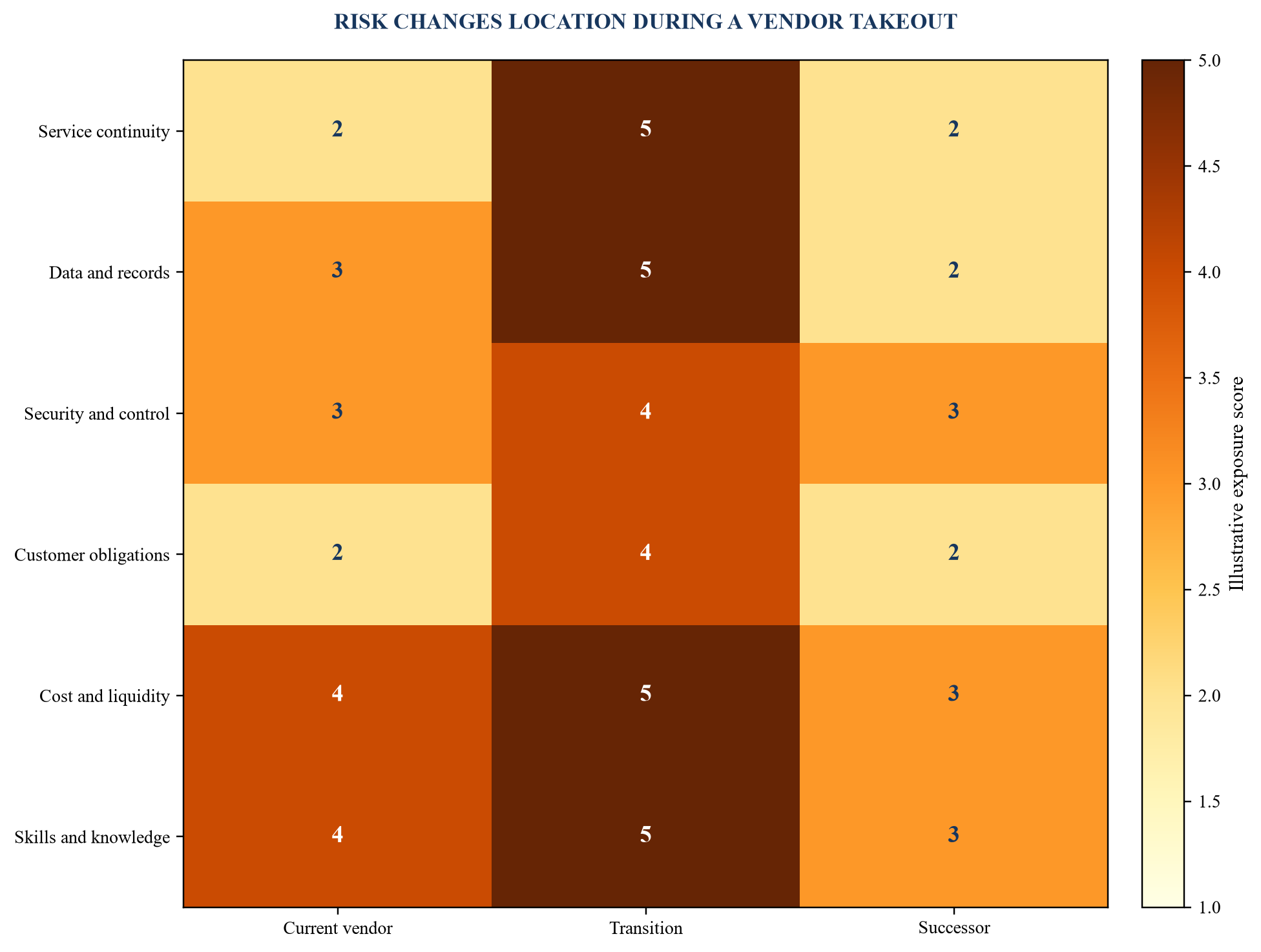
Illustrative scores show exposure migrating between categories rather than disappearing.
Table 4. Value-at-risk matrix and control response
| Risk | Current-state exposure | Transition exposure | Successor control |
|---|---|---|---|
| continuity | vendor outage or product change | cutover and parallel-run failure | tested fallback and monitoring |
| data | limited export or lineage | loss during conversion | reconciled controls and owned schema |
| security | opaque supplier dependency | new interfaces and permissions | threat model and release controls |
| customer | vendor-specific commitments | consent and acceptance delays | segmented migration evidence |
| economics | price and commitment escalation | peak cash and stranded spend | cohort cost and benefits tracking |
| people | vendor or specialist concentration | temporary capacity constraint | documented roles and rehearsals |
Severity, reversibility and evidence quality guide action where probabilities are uncertain.
22. Set cutover and rollback conditions
Cutover conditions should cover service, data, performance, security, controls, people, customers, contracts and liquidity. Mandatory conditions remain binary. Other measures can use thresholds and observation periods. A strong average score should not offset an unresolved critical vulnerability or unreconciled customer data.
Rollback should be technically and commercially possible for a defined period. The plan should identify the data synchronisation method, authority, trigger, communication and maximum decision time. An incumbent environment that cannot receive updated records may cease to be a viable fallback after cutover.
The cutover command structure should provide one source of truth. Issues, decisions, system status and customer communication should be recorded. Specialist teams need clear escalation routes and pre-approved responses for common scenarios.
Post-cutover stabilisation should monitor service, defects, overrides, costs, support demand, customer outcomes and residual tasks. Exit from stabilisation requires evidence that the successor operates within the approved envelope. Project closure before operating ownership is established can leave hidden risk.
23. Build the board scorecard
The scorecard should present service outcomes, dependency, economics, transition readiness, risk, customer status and decisions required. Measures need definitions, sources, periods, owners and thresholds. Trend and exception information is more useful than a static traffic-light summary.
The economic view should reconcile approved budget, committed cash, forecast-at-completion, current run rate, successor run rate and realised benefits. It should separate cash, accounting and capacity effects. Variance explanations should identify whether scope, volume, rates, defects or timing changed.
Readiness should show evidence quality. A task can be marked complete while its output remains untested. The scorecard should distinguish drafted, reviewed, tested and accepted artefacts. Mandatory evidence should link to the source record.
The board decision record should state the selected end state, alternatives considered, assumptions, residual exposure, capital authorised and next gate. This protects institutional memory and supports later review of whether the expected value was realised.
Leading indicators should show whether the transition is becoming more or less credible. Examples include the age of the last successful export, percentage of critical interfaces documented, acceptance-test pass rate, unresolved mandatory controls, data exceptions, trained-role coverage, customer approvals, forecast cash peak and rollback duration. Lagging indicators such as realised savings and service incidents remain important after cutover. Using both types gives the board an early warning without presenting readiness before evidence exists.
The scorecard should retain failed tests and revised assumptions. Removing superseded results can make the programme appear cleaner while weakening the audit trail. A controlled history shows what management learned, why scope or timing changed and whether a prior concern was resolved. It also supports external diligence without requiring reviewers to reconstruct decisions from emails and presentations.
Table 5. Board decision and readiness scorecard
| Domain | Board evidence | Mandatory condition | Post-decision measure |
|---|---|---|---|
| service | baseline, target and customer effect | required service preserved | quality, latency and availability |
| dependency | map, portability and alternatives | critical dependencies owned | test age and concentration |
| economics | cash, lifecycle cost and downside | liquidity headroom approved | forecast and realised benefit |
| technology | successor release and interfaces | contextual acceptance passed | defects and performance |
| controls | security, data, records and resilience | no unresolved critical gap | incidents and exceptions |
| people | operating model and rehearsals | accountable team in place | workload and key-person exposure |
| customers | segmentation and acceptance | required obligations satisfied | complaints, adoption and retention |
Mandatory conditions prevent progress reporting from masking a critical gap.
24. Run a worked hypothetical comparison
Consider an enterprise using an AI platform for document classification, retrieval and first-pass case preparation. The service supports several business units and has become linked to the incumbent cloud, identity service, data store and monitoring tools. Management is concerned about a forthcoming renewal, rising usage cost and limited model choice.
Assume the current annual cost index is 100. A replacement platform offers an apparent fee saving of 32. Discovery identifies hypothetical transition costs of 18 for build and migration, 12 for parallel operation, 9 for assurance and training, and 7 for stranded commitments during the first comparison period. The resulting cost index is 114 before any risk adjustment. These values are analytical assumptions and do not represent an observed enterprise.
The dependency test also finds that customer-specific workflow rules and evaluation sets are poorly documented. A direct replacement would create material service risk. Management funds a bounded evidence phase that reconstructs the workflow, tests data export and validates two alternative models. This work improves the credibility of both a takeout and a negotiation.
The incumbent then offers lower minimum commitments, model portability, funded transition assistance and defined data-export service levels. The enterprise compares that structural renegotiation with a staged rebuild. It selects a two-year modularisation programme with immediate contract improvements and retained options. The example shows why the decision should follow evidence and lifecycle economics rather than headline licence price.
25. Operate the post-decision value office
The selected end state needs operating ownership. A renegotiated contract requires service, spend and portability controls. A rebuild requires product management, architecture, security, support and supplier governance. Retirement requires confirmation that cost, data, access and customer obligations were closed.
The value office should reconcile expected and realised outcomes. Measures include cash paid, unit cost, service quality, incidents, support effort, time released, customer outcomes, portability tests and option use. Benefits should remain linked to the original baseline and adjusted transparently for volume or scope changes.
Residual dependencies should be monitored. New providers, open-source components and internal specialists can create different concentration. The register should be updated after material architecture, contract or operating changes. An annual portability or exit exercise can keep the strategic option credible.
Lessons should update procurement standards. Repeated issues can become requirements for data schemas, interface documentation, model substitution, audit, termination assistance, observability and knowledge transfer. The organisation then reduces the cost of future platform decisions across its estate.
26. Translate the framework into transaction diligence
AI vendor dependence affects acquisitions, divestitures, carve-outs, financing and valuation. Diligence should identify whether revenue, operations or intellectual property depend on a platform that the target does not control. The buyer needs the contracts, architecture, data rights, costs, skills, portability evidence and customer commitments.
In a carve-out, the seller's enterprise agreements, identities, data services or personnel may not transfer. Transitional service agreements should specify scope, duration, pricing, security, data and exit milestones. The standalone operating model should include the complete cost of replacing shared capability.
Quality-of-earnings analysis should test whether vendor credits, temporary discounts, absorbed implementation effort or capitalised costs affect reported margins. A renewal or usage step-up can change future economics. The analysis should connect platform consumption to customer revenue and workload.
Transaction documents and valuation conclusions require qualified advisers and case-specific facts. The framework provides an evidence structure for those decisions. It helps management distinguish a valuable proprietary capability from an enterprise service whose economics and continuity depend on a third party.
27. Establish an enterprise vendor-takeout playbook
The playbook should contain a service-baseline template, dependency register, portability test, contract checklist, lifecycle-cost model, transition plan, acceptance criteria, cutover protocol and board scorecard. Each template should identify owner, evidence source, effective date and approval.
The playbook should include a triage route for urgent events. A vendor failure, security incident, sanctions issue or immediate product withdrawal can remove the time available for ordinary diligence. Predefined containment, data-preservation, legal escalation, customer communication and emergency procurement steps help the enterprise protect the service while the longer-term end state is decided. The urgent route should still preserve a decision log and explicit residual-risk acceptance.
The process should be proportionate to criticality. A low-risk productivity tool may require a short data and access closure. A platform supporting customer decisions, regulated activity or critical operations requires deeper evidence, testing and governance. Proportionality changes depth while retaining the core questions.
Procurement and architecture can apply the playbook before initial purchase. Upfront design of data rights, interfaces, observability, model choice, transition support and operating knowledge reduces future takeout cost. Contract renewal becomes a recurring strategic option review rather than an administrative event.
The final decision should answer whether the service remains necessary, whether the current arrangement creates acceptable value, whether structural renegotiation can resolve the material exposures, whether a successor can operate within approved conditions and whether the enterprise can fund the transition under downside scenarios. Evidence across those questions supports a disciplined retain, renegotiate, rebuild or retire decision.
Conclusion
An AI vendor takeout is an enterprise-service decision. Technology, data, controls, contracts, people, customers and cash must move as one integrated operating system. A lower platform price cannot establish value when migration, assurance, disruption, stranded commitments and residual dependence remain outside the comparison.
The framework begins with a measured service baseline and a complete dependency map. It tests practical portability, defines a minimum viable successor, integrates commercial and technical dates, values the full lifecycle and releases transition capital through evidence gates. Cutover follows accepted service, data, control, customer and operating evidence.
The resulting discipline also improves the incumbent relationship. A credible alternative and specific exposure register can support structural renegotiation. Retirement remains available when the use case cannot justify its complexity. Rebuild becomes appropriate when strategic control and lifecycle value exceed the funded transition risk. The board retains a clear record of evidence, assumptions and residual exposure for each path.
References
- UK Competition and Markets Authority. Cloud services market investigation. https://www.gov.uk/cma-cases/cloud-services-market-investigation
- UK Competition and Markets Authority. CMA announces package of actions on business software and cloud services. https://www.gov.uk/government/news/cma-announces-package-of-actions-on-business-software-and-cloud-services
- European Commission. Data Act explained. https://digital-strategy.ec.europa.eu/en/factpages/data-act-explained
- European Union. Regulation (EU) 2023/2854 on harmonised rules on fair access to and use of data. https://eur-lex.europa.eu/legal-content/EN/TXT/?uri=CELEX:32023R2854
- European Commission. Results of the study on interoperability of data processing services. https://digital-strategy.ec.europa.eu/en/library/results-study-interoperability-data-processing-services
- National Institute of Standards and Technology. Artificial Intelligence Risk Management Framework. https://www.nist.gov/itl/ai-risk-management-framework
- National Institute of Standards and Technology. AI Risk Management Framework 1.0. https://nvlpubs.nist.gov/nistpubs/ai/NIST.AI.100-1.pdf
- National Institute of Standards and Technology. Generative Artificial Intelligence Profile. https://nvlpubs.nist.gov/nistpubs/ai/NIST.AI.600-1.pdf
- National Institute of Standards and Technology. Cybersecurity Supply Chain Risk Management Due Diligence Quick-Start Guide. https://csrc.nist.gov/pubs/sp/1326/final
- National Institute of Standards and Technology. Security, Privacy and Cybersecurity Supply Chain Risk Management Plans. https://www.nist.gov/news-events/news/2026/06/security-privacy-and-c-scrm-risk-management-plans-nist-releases-sp-800-18r2
- Cybersecurity and Infrastructure Security Agency. Software Acquisition Guide for Government Enterprise Consumers. https://www.cisa.gov/sites/default/files/2024-07/PDM24050%20Software%20Acquisition%20Guide%20for%20Government%20Enterprise%20ConsumersV2_508c.pdf
- Cybersecurity and Infrastructure Security Agency. Operationalizing Vendor Supply Chain Risk Management Template for Small and Medium-Sized Businesses. https://www.cisa.gov/resources-tools/resources/operationalizing-vendor-scrm-template-smbs
- Cybersecurity and Infrastructure Security Agency. Recommended Practices Guide for Customers. https://www.cisa.gov/news-events/alerts/2022/11/17/cisa-nsa-and-odni-release-guidance-customers-securing-software-supply-chain
- UK Financial Conduct Authority. Outsourcing and operational resilience. https://www.fca.org.uk/firms/outsourcing-and-operational-resilience
- UK Financial Conduct Authority. Operational resilience insights and observations for firms. https://www.fca.org.uk/firms/operational-resilience/insights-observations
- UK Financial Conduct Authority. CTPS 4 Operational risk and resilience requirements. https://handbook.fca.org.uk/handbook/ctps4
- European Central Bank. Guide on outsourcing cloud services to cloud service providers. https://www.bankingsupervision.europa.eu/ecb/pub/pdf/ssm.supervisory_guides202507.en.pdf
- European Banking Authority. Guidelines on outsourcing arrangements. https://www.eba.europa.eu/publications-and-media/press-releases/eba-publishes-revised-guidelines-outsourcing-arrangements
- European Union. Regulation (EU) 2022/2554 on digital operational resilience for the financial sector. https://eur-lex.europa.eu/eli/reg/2022/2554/oj
- UK National Cyber Security Centre. Guidelines for Secure AI System Development. https://www.ncsc.gov.uk/collection/guidelines-secure-ai-system-development
- Central Bank of the United Arab Emirates. Guidance Note on Consumer Protection and Responsible Adoption and Use of Artificial Intelligence and Machine Learning. https://rulebook.centralbank.ae/en/rulebook/guidance-note-consumer-protection-and-responsible-adoption-and-use-artificial-intelligence
- Dubai Financial Services Authority. AI Survey 2025. https://www.dfsa.ae/news/new-dfsa-ai-survey-generative-ai-adoption-has-nearly-tripled-within-difc-last-12-months-governance-continues-develop
- Organisation for Economic Co-operation and Development. OECD AI Principles. https://oecd.ai/en/ai-principles
- International Organization for Standardization. ISO/IEC 42001 Artificial intelligence management systems. https://www.iso.org/standard/81230.html
- UK Prudential Regulation Authority. Supervisory Statement SS2/21 Outsourcing and third party risk management. https://www.bankofengland.co.uk/prudential-regulation/publication/2021/march/outsourcing-and-third-party-risk-management-ss
