

1. Define the enterprise problem before funding the model
Research should begin with a decision or workflow whose economics can be observed. A useful product definition identifies the customer, user, affected parties, current process, decision frequency, baseline cost, delay, error consequence and required evidence. The research question then becomes narrower and commercially testable: whether an AI-enabled system can improve a defined outcome under stated operating and control conditions.
The customer problem should be separated from the technical method. A model can change while the workflow remains stable. Beginning with the method can make the team search for uses that fit a technical artefact. Beginning with the workflow creates a durable specification for accuracy, latency, interpretability, availability, integration and human review. It also allows a conventional process, rules engine or purchased capability to remain a valid comparator.
The baseline must include the full cost of the current process. Labour hours alone omit queueing, rework, quality review, customer loss, compliance effort, working capital and the value of decisions not taken. The product case should record who bears each cost and who can authorise spending. A user who benefits without budget authority cannot, by itself, establish demand.
The first investment memorandum should state disconfirming evidence. Examples include inadequate data rights, performance below the workflow threshold, excessive human review, integration that cannot be standardised, an unacceptable failure mode, customer procurement resistance or unit economics that do not improve with scale. A research programme with no stop conditions can accumulate sunk cost while preserving an untested commercial narrative.
2. Map the complete product system
An enterprise AI product is a system of data, models, software, infrastructure, controls, people, contracts and operating procedures. The product boundary should include every component required to produce and accept an output. This avoids attributing performance to a model while excluding the retrieval layer, human correction, external data, workflow rules or customer-specific configuration that made the result usable.
The system map should identify ownership and dependency. Components can be owned, open source, licensed, customer-provided or delivered by a subcontractor. Each category creates different rights, costs, service levels and change risks. Model-provider terms, cloud regions, data-retention settings, software licences and customer consents must support the intended production use and future scale.
Human roles should be explicit. Domain experts may define labels, review outputs, resolve exceptions and communicate decisions. Product managers translate the workflow into requirements. Security, legal, risk and compliance teams establish operating constraints. Sales and customer-success teams gather commercial evidence. The map should show which human actions are part of the product and which are temporary research support.
The product specification should be versioned. Model, prompt, retrieval corpus, workflow rules, interface, controls and human-review policy can each change performance. A release record should connect the version to test evidence, approved use cases, customer deployments and incidents. Without configuration lineage, the organisation cannot explain why a result changed or whether a prior validation remains relevant.
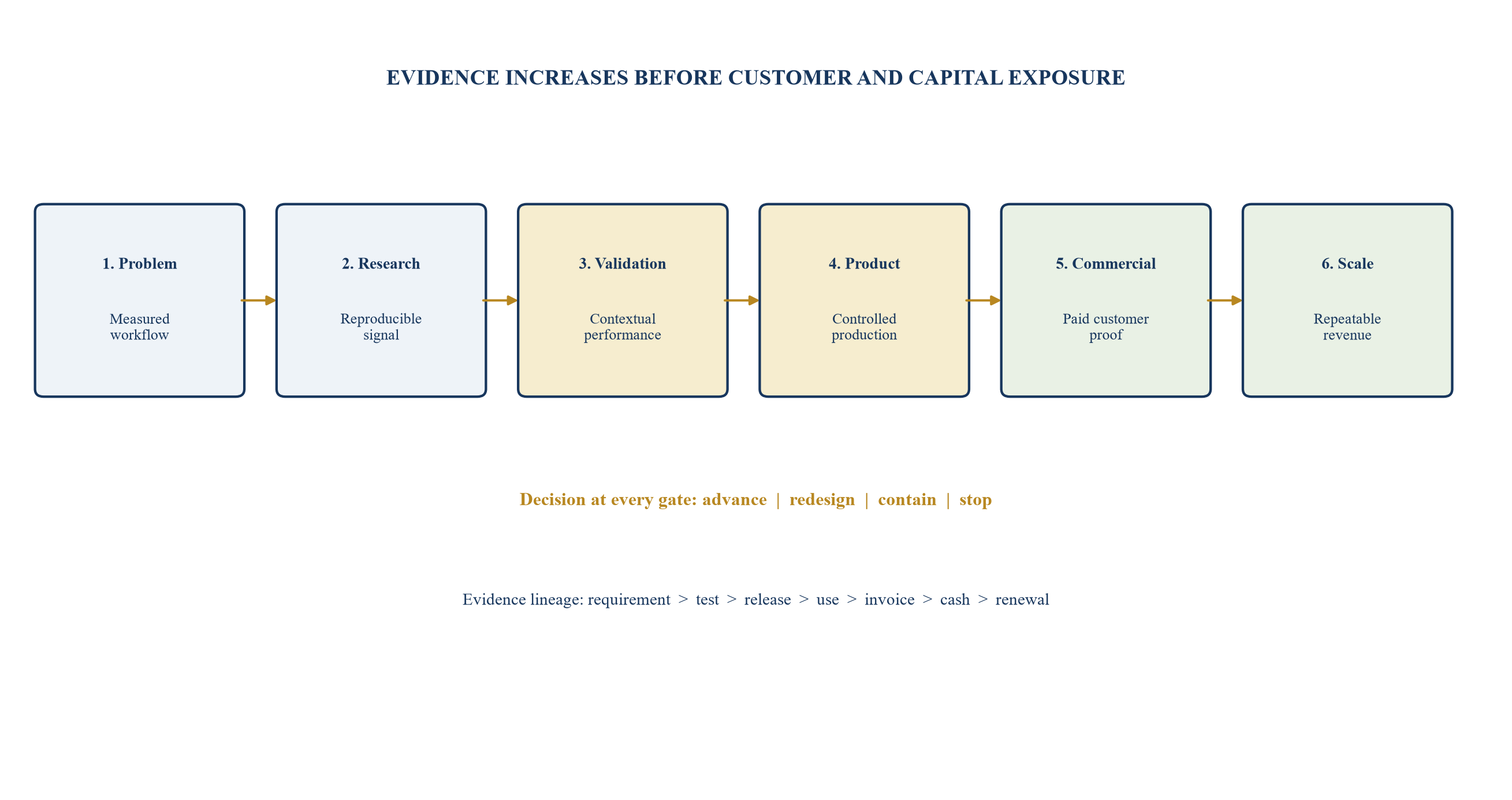
Evidence and exposure increase together; each gate has a distinct decision and stopping rule.
Table 1. Gate definitions, evidence and decisions
| Gate | Required evidence | Main decision | Stop or redesign signal |
|---|---|---|---|
| problem | measured workflow, owner, baseline and consequence | fund research question | no material or fundable customer problem |
| research | reproducible signal and comparator | fund contextual validation | signal is unstable or uneconomic |
| validation | performance by cohort and failure mode | build controlled product | unacceptable residual risk or review burden |
| product | secure release, integration and operating controls | permit bounded production | rights, security or reliability gap |
| commercial | paid use, acceptance, invoice and cash | invest in repeatability | pilot interest without paid adoption |
| scale | retention, margin, support and renewal cohorts | add capacity and distribution | economics deteriorate with volume |
The gate controls the next exposure rather than certifying the product forever.
3. Establish an evidence architecture
Every claim in the product case should connect to a defined source, owner, date, version and decision. Research metrics should connect to test data. Product claims should connect to the released configuration. Commercial claims should connect to contracts, usage, invoices and cash. Governance claims should connect to controls, logs, approvals and incident evidence.
Evidence quality has several dimensions. Provenance asks where the record came from. Relevance asks whether it represents the intended users and conditions. Reproducibility asks whether an independent team can obtain a comparable result. Completeness asks what exclusions could alter the conclusion. Freshness asks whether drift, changed data or a changed model has reduced the evidence value.
The evidence store should preserve negative results and exceptions. Selection of successful demonstrations can overstate capability. Failed tests, overridden outputs, unsupported use cases and withdrawn customers explain the operating boundary. They also improve the design of controls, pricing and customer qualification.
Decision records should state which evidence was considered and which uncertainty was accepted. A launch decision is a commercial and risk allocation decision, not a declaration that uncertainty has ended. The record should identify the accountable executive, approval scope, limits, monitoring triggers and reconsideration date.
4. Use an evidence maturity ladder
Evidence should mature from assertion to observed outcome. An assertion describes a proposed mechanism. A demonstration shows that a configured system can produce an output. A controlled test estimates performance against a defined benchmark. A bounded production deployment shows behaviour in a real workflow. A paid cohort demonstrates customer acceptance. Renewal, expansion and cash collection demonstrate commercial durability.
Different claims can sit at different maturity levels. Model performance may be validated while integration remains a prototype. Security may be tested while customer willingness to pay remains an assertion. A single maturity label for the whole venture conceals these differences. The ladder should therefore score customer problem, technical performance, workflow adoption, governance, commercial proof and unit economics separately.
Evidence should become more independent as exposure rises. Early research can be evaluated by the technical team. Later gates need domain, security, risk, customer and financial review. Claims used in marketing, procurement or financing require documented substantiation because the audience relies on them for a decision.
The maturity ladder should have expiry conditions. A model change, material data shift, new jurisdiction, new affected population, new workflow or change in the human-review policy can make earlier evidence insufficient. The product register should identify which evidence must be refreshed after each class of change.
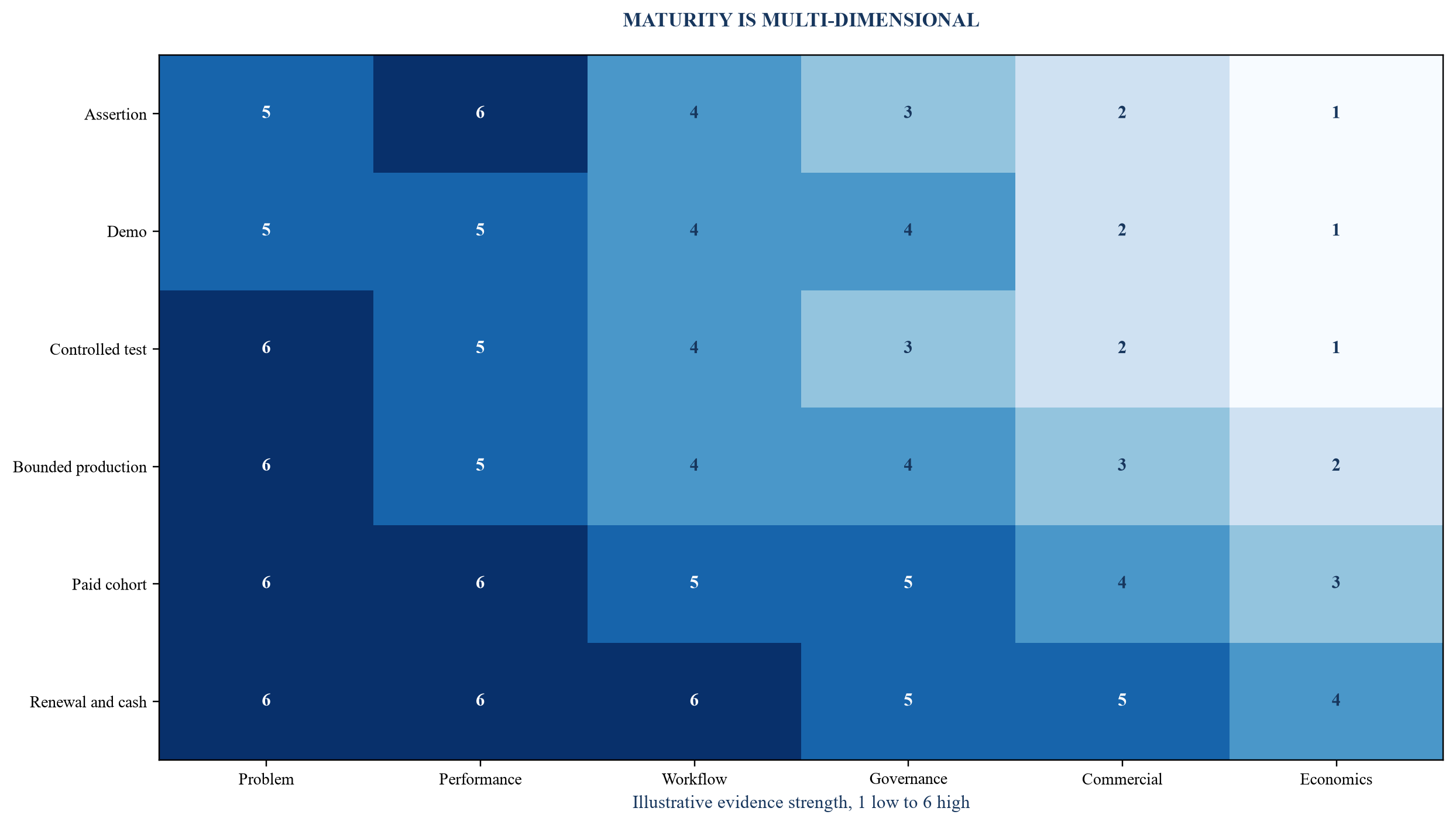
Commercial confidence depends on several evidence streams maturing together.
Table 2. Evidence maturity tests
| Stage | Evidence | Appropriate claim | Prohibited leap |
|---|---|---|---|
| assertion | documented hypothesis | mechanism to be tested | market or performance fact |
| demonstration | reproducible configured output | technical possibility | production reliability |
| controlled test | benchmark and cohort results | measured test performance | customer outcome |
| bounded production | logs, exceptions and acceptance | observed workflow behaviour | portfolio-wide scalability |
| paid cohort | contract, usage, invoice and cash | paid customer proof | durable recurring revenue |
| renewal and expansion | cohort retention and margin | observed commercial durability | universal demand |
A higher stage requires traceable evidence rather than a larger volume of assertions.
5. Validate the model in the context of use
Aggregate accuracy can hide commercially material failure. Validation should be organised by use case, population, input quality, operating environment and consequence. The threshold for an internal drafting aid differs from the threshold for an output that affects credit, health, employment, safety or access to a service.
The test plan should specify the intended benefit and foreseeable harm. It should measure false positives, false negatives, calibration, robustness, latency, abstention, uncertainty communication and the performance of the combined human-machine system. For generative systems, factuality, groundedness, instruction following, harmful output, prompt injection, data leakage and tool-use behaviour may be relevant.
Comparators should include the current process and credible alternatives. A model that outperforms a weak benchmark may still fail the customer requirement. Human review should be measured as part of the system rather than treated as a free correction layer. Review time, reviewer disagreement and exception escalation directly affect cost and reliability.
Validation should produce an operating envelope. The envelope states permitted inputs, users, jurisdictions, decisions, autonomy, confidence thresholds and review requirements. Outputs outside that envelope should be blocked, labelled or routed. Expansion requires new evidence rather than a silent widening of use.
6. Test data rights, quality and lineage
The right to access data for research may differ from the right to train a model, operate a service, improve a product or reuse outputs. The product team should record source, ownership, consent, licence, purpose, retention, residency, deletion, onward transfer and model-provider access for each material dataset.
Data quality should be evaluated against the use case. Completeness, representation, label reliability, temporal relevance and measurement error can change model behaviour. A large dataset can remain unsuitable when it reflects a different population, process or incentive. The analysis should explain known gaps and how production monitoring will detect their consequences.
Lineage must survive transformation. Cleaning, labelling, augmentation, embedding, retrieval and synthetic generation should be documented. The organisation should be able to identify which data and code contributed to a release and which customers were affected. This supports incident response, deletion, model retraining and evidence refresh.
Customer-provided data creates additional boundaries. Contracts and architecture should specify segregation, permitted learning, retention and return. A product whose economics depend on pooling customer data should test whether customers will grant those rights. An assumed data network effect is not a commercial asset until the rights and contribution mechanism exist.
7. Design human oversight as an operating control
Human oversight should have a defined purpose. A reviewer may confirm factual support, apply domain judgement, approve a consequential decision or manage exceptions. A general statement that a human remains in the loop does not establish that the review is competent, timely or capable of detecting the relevant failure.
The design should specify reviewer qualifications, information, authority, workload and escalation. Automation bias can reduce effective challenge when reviewers see a confident answer without uncertainty or supporting evidence. Interfaces should help the reviewer identify why the system reached an output, what evidence supports it and when abstention is appropriate.
Review burden should be measured by case cohort. A system that requires review of every output may still create value when it shortens preparation. A system whose difficult cases consume disproportionate expert time may worsen throughput. The product model should distinguish nominal automation from cash-releasing capacity.
Oversight can change as evidence matures. Low-risk cases may move to sample review after stable production evidence. High-consequence cases may retain mandatory approval. Any change should be treated as a product release with validation, monitoring and rollback criteria.
8. Build the product risk register
The risk register should connect a failure mode to cause, affected party, consequence, control, evidence, owner and residual exposure. Categories can include performance, bias, privacy, security, intellectual property, safety, consumer protection, contractual failure, provider dependency, operational resilience and misleading claims.
Risk should be assessed before and after controls. A high inherent risk can be acceptable within a bounded product when controls are effective and the residual exposure is within appetite. A low-frequency catastrophic outcome requires different treatment from a frequent reversible error. Scores should support prioritisation while preserving the underlying scenario.
Controls need evidence. A policy without monitoring, access control, test record or incident response cannot support a strong residual-risk conclusion. Preventive, detective and corrective controls should be distinguished. The register should identify control dependencies and single points of failure.
Commercial terms are part of risk design. Scope, acceptable use, service levels, customer responsibilities, output qualification, liability, audit, suspension and incident provisions allocate responsibilities. Contract language should correspond to the product that is actually delivered and the control evidence available.
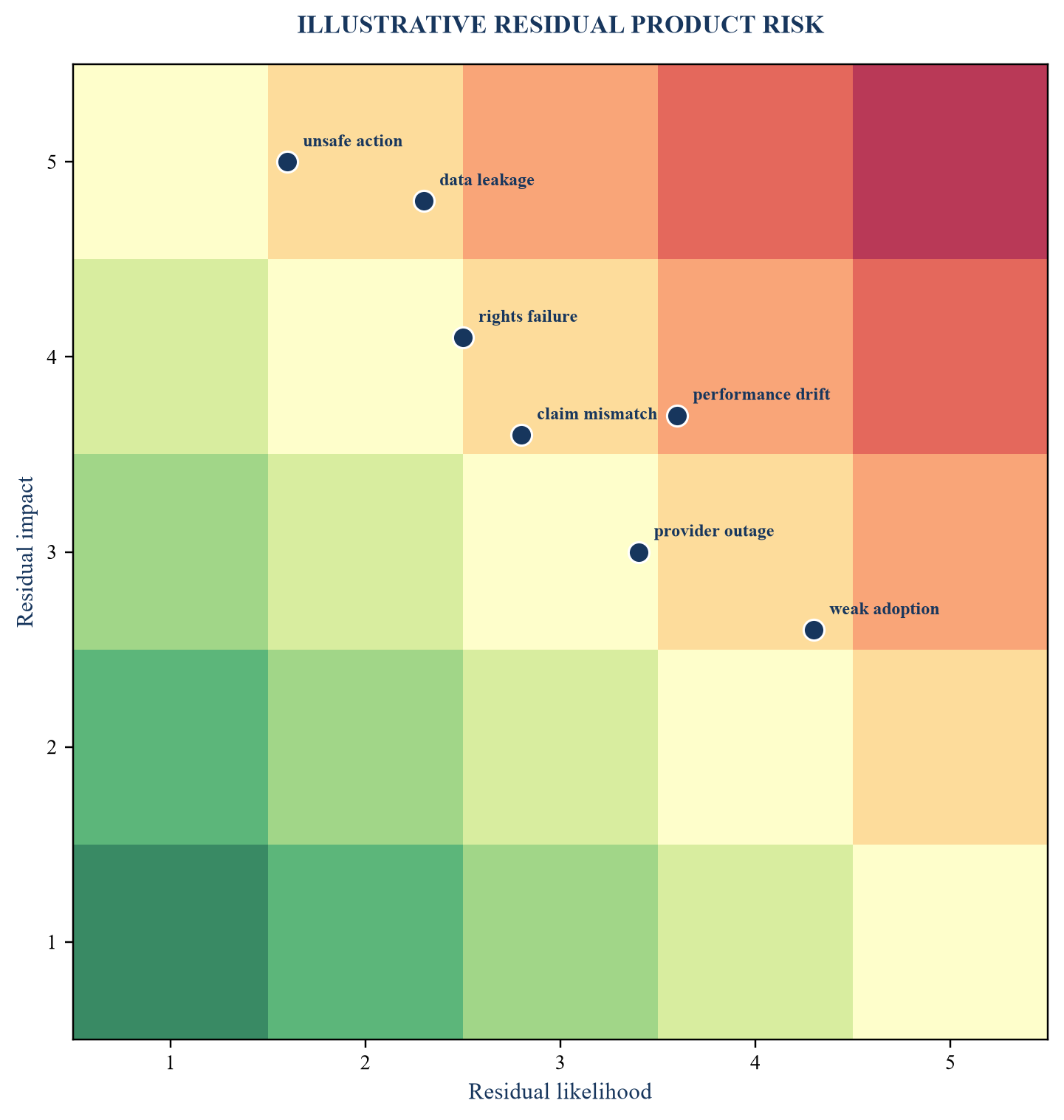
The illustrative register prioritises scenarios by residual likelihood and impact after controls.
Table 3. Product validation and control register
| Risk | Evidence test | Control | Release condition |
|---|---|---|---|
| performance outside scope | cohort and edge-case tests | operating envelope and abstention | threshold met for permitted use |
| data leakage | red-team and access review | segregation, filtering and logging | no unresolved critical finding |
| unsupported output | groundedness and citation test | retrieval, source display and review | acceptance threshold met |
| provider dependency | failover and cost sensitivity | abstraction, limits and contingency | tolerable outage and margin case |
| misleading product claim | claim-to-evidence register | legal and product approval | every material claim substantiated |
| weak adoption | task completion and user observation | workflow redesign and training | repeat use in target cohort |
Each material control must have an owner and observable evidence.
9. Engineer security through the lifecycle
Secure design begins with threat modelling of the complete system. Relevant actors include external attackers, malicious users, compromised suppliers, insiders and autonomous components. Assets include models, prompts, credentials, training data, retrieval stores, customer data, outputs, logs and connected tools.
Development controls should cover repositories, dependencies, environments, secrets, data access and release approvals. Model and data artefacts require integrity checks and version control. Third-party models and libraries should be evaluated for provenance, licence, vulnerability and update risk. Technical debt should be recorded because rapid prototypes can carry hidden production exposure.
Deployment should minimise privilege, isolate tenants, protect interfaces, validate tool calls and preserve audit logs. A model connected to email, finance, code or operational systems can convert an unreliable instruction into an external action. Permission design, approval gates, rate limits and rollback are therefore product features.
Operation requires monitoring, incident classification, customer communication, patching and retirement. Security tests should be repeated after material changes. The product plan should fund these activities as recurring operating cost rather than assuming that security ends at launch.
10. Translate regulation into product requirements
Regulatory analysis should begin with the use case, jurisdiction, role and affected parties. The same model can support an internal low-consequence task or a regulated decision. The product team should identify whether the organisation is a provider, deployer, importer, distributor or another actor, and which obligations attach to that role.
Requirements should be converted into design controls and evidence. Transparency can require notices, documentation or explanation. Risk management can require testing, monitoring and governance. Data protection can require purpose limitation, security and rights handling. Consumer protection can require fair treatment, substantiated claims and accessible redress.
The regulatory register should include application dates and change triggers. The EU AI Act applies progressively, and official 2026 materials set later application dates for specified high-risk rules. Product roadmaps serving multiple jurisdictions should plan evidence and architecture before the relevant launch, contract or scale decision.
Sector guidance adds context. CBUAE's 2026 guidance for licensed financial institutions addresses transparency, bias, ethics, accountability, explainability and data privacy. A product sold into a regulated customer should be able to support the customer's own governance and evidence duties.
11. Fit the AI product into the customer workflow
Workflow fit asks whether the product can be used where the decision occurs. The team should map triggers, inputs, systems, users, approvals, exceptions, outputs and downstream actions. Integration effort should be measured by customer rather than described as a generic connector.
The product should reduce or improve a complete task. A faster model can create limited value when a user must copy data, reconcile formats, repeat quality checks and update another system. Time-and-motion observation, task completion, exception rates and user interviews provide stronger evidence than feature preferences alone.
Adoption depends on incentives and accountability. A user may avoid a tool that creates additional liability or threatens professional standing. A manager may support a pilot while withholding process ownership. The product team should identify who benefits, who changes behaviour, who carries risk and who approves the result.
Implementation should be decomposed into standard and customer-specific work. Configuration that repeats across a segment can become product. Bespoke data remediation, policy interpretation or integration may remain a service. The commercial model should price both and avoid presenting services as recurring software margin.
12. Qualify the customer and use case
Commercial qualification should test urgency, budget, authority, workflow ownership, data readiness, integration capacity, risk appetite and procurement path. A customer with strong curiosity and no accountable sponsor can consume significant pilot effort without creating a route to revenue.
Use cases should be ranked by value, feasibility and consequence. An adjacent lower-risk workflow can establish evidence and trust before the product enters a high-consequence decision. This sequencing can shorten procurement and create production data, provided the initial use case has independent economic value.
The qualification process should identify excluded customers. A highly customised environment, unavailable data, incompatible security standard or requirement for unsupported autonomy can make an opportunity uneconomic. A clear exclusion policy protects product focus and improves forecast quality.
Customer discovery should preserve evidence. Interview notes, observed workflows, objections, procurement requirements and lost-deal reasons should feed the product register. Repeated objections can reveal a missing control, unclear value case or unsuitable segment rather than a sales execution problem.
13. Design a bounded pilot
A pilot should answer specified uncertainties under a defined time, population, workflow and risk boundary. It should state the current baseline, target metrics, required evidence, customer responsibilities, acceptance decision and route to paid production. A pilot framed as broad exploration can end without a decision.
The pilot contract should address data, security, intellectual property, permitted use, support, publicity and deletion. Free pilots should have an explicit commercial rationale and a limit on provider effort. A paid pilot can test budget authority and procurement while contributing to cost recovery.
Success metrics should include technical, operational, user, control and economic outcomes. Accuracy without task completion can fail the workflow. User satisfaction without repeat use can fail adoption. Time saved without capacity release or improved outcome can fail the economic case.
The closeout should produce a decision memorandum. Outcomes include paid production, targeted redesign, a new evidence period or termination. The memorandum should record evidence, unresolved risks, customer acceptance, product changes and the assumptions used in the commercial proposal.
14. Convert pilot evidence into product requirements
Pilot learning should be classified as common, segment-specific or customer-specific. Common needs become core product requirements. Segment needs can become configurable modules. Customer-specific needs should be priced, rejected or delivered through a separate service layer.
The product backlog should preserve links to evidence. Each requirement should identify the workflow problem, affected customers, expected outcome, control implication and acceptance test. Feature requests with no decision consequence or observed need should compete transparently for scarce capacity.
Reliability requirements should reflect the customer's process. Availability, response time, recovery, data freshness and support hours need explicit targets. A product supporting a periodic analytical task differs from one embedded in a real-time operational decision.
Documentation should be designed alongside the product. Customers may need system descriptions, data information, validation results, control evidence, change notices and operating guidance for procurement and oversight. Evidence that is expensive to reconstruct later can delay revenue even when the technology works.
15. Define the minimum governable product
The minimum governable product is the smallest production configuration that can deliver the target outcome within an approved risk envelope. It includes monitoring, logging, access, support, incident response, documentation and customer controls. These elements are part of the product cost and release scope.
The release committee should review technical performance, residual risk, security, rights, customer readiness, support and commercial terms. Approval should state the customer population, use cases, autonomy, volume, duration and monitoring triggers. A bounded approval supports learning while limiting exposure.
Rollback must be operationally credible. The team should know how to suspend a model, revert a version, disable a tool action, restore a prior workflow and notify affected customers. A theoretical kill switch provides limited protection when no owner, test or communication process exists.
Launch documentation should distinguish known limitations from promotional positioning. Claims should be specific enough to test and supported by the released evidence. FTC and SEC actions concerning unsubstantiated or misleading AI claims illustrate the commercial and enforcement relevance of claim discipline.
16. Build service reliability and support economics
Enterprise customers buy continuity as well as functionality. The operating model should define incident severity, support channel, response, restoration, root-cause analysis and customer communication. Model failures, data failures, integration failures and ordinary software outages require coordinated ownership.
Support effort should be recorded by customer, issue type and product version. Early cohorts can require substantial expert intervention. The economic model should distinguish temporary learning cost from a structural service requirement. Persistent domain support can remain valuable when it is priced and staffed transparently.
Monitoring should combine technical and business signals. Drift, error, latency and security alerts should be connected to usage, task completion, overrides, complaints and customer outcomes. A technically stable system can still fail commercially when users route around it.
Capacity planning should include model limits, data pipelines, human review, implementation and customer success. Scale can expose a bottleneck outside the model. The investment gate should fund the constrained component supported by observed demand rather than adding broad capacity against an unqualified pipeline.
17. Price the complete outcome
Pricing should begin with the customer's economic alternative and the product's delivered outcome. Relevant measures can include cost avoided, capacity created, revenue enabled, risk reduced, time shortened or service quality improved. The provider should identify which benefits are measurable, attributable and controlled by the product.
The pricing metric should align value with usage while remaining understandable and auditable. Per user can fit a productivity tool. Per transaction, document, decision or asset can fit a workflow product. Outcome-based pricing can share value but creates attribution, timing and control questions. A platform fee plus usage can balance commitment and variable consumption.
Price must cover the full delivery model. Model consumption, cloud, data, implementation, assurance, review, support, sales, customer success and expected incident cost all affect contribution. Gross margin should be reconstructed by cohort because averages can conceal bespoke early customers or loss-making high-use accounts.
Discounting should purchase evidence or commitment. A launch discount can be exchanged for term, reference rights, standard scope, implementation cooperation or measured case evidence. Indefinite discounts can reset willingness to pay and obscure whether customers value the product.
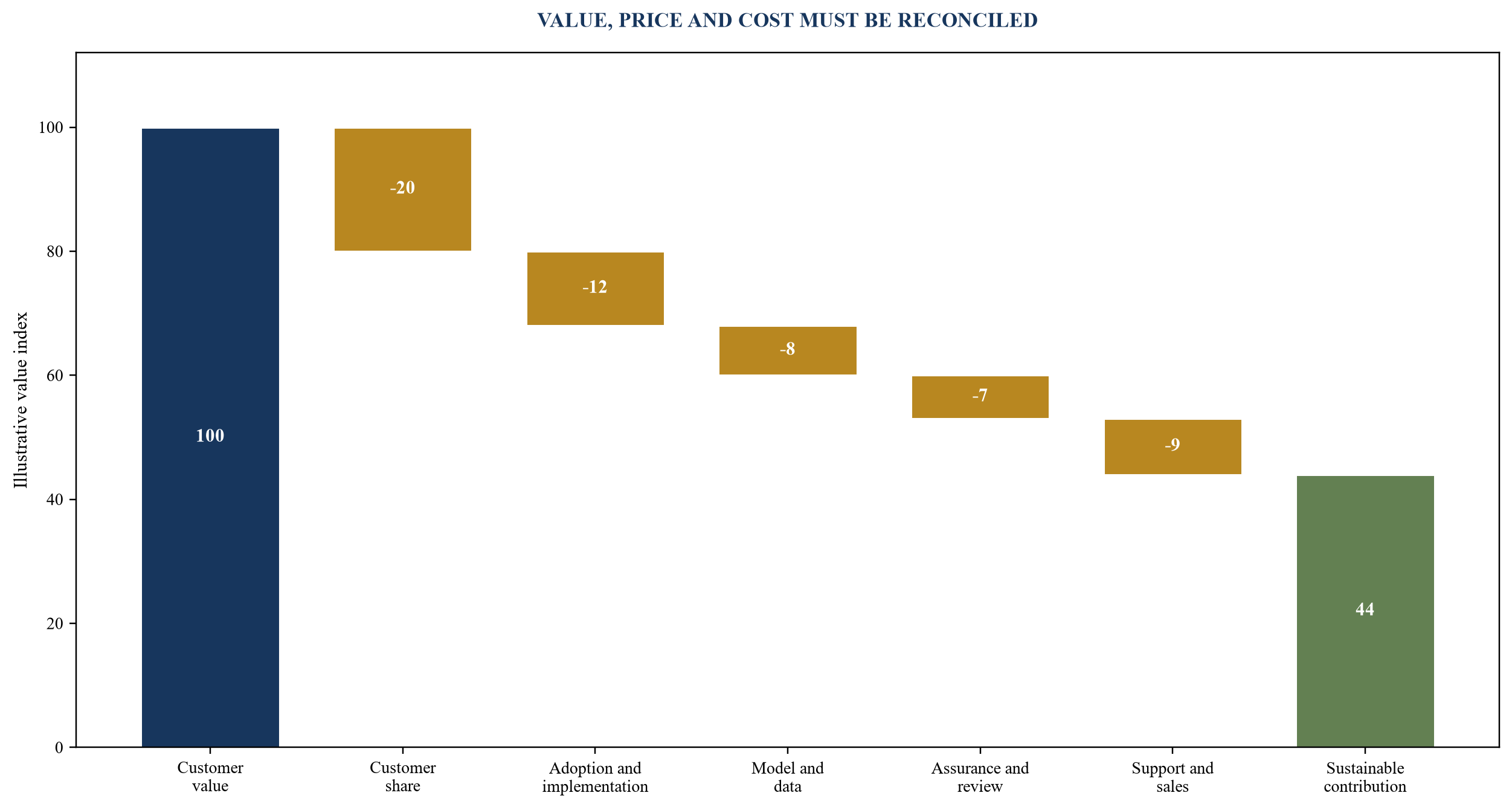
The worked amounts are hypothetical analytical assumptions expressed as index points.
Table 4. Pricing and customer-proof cohort
| Dimension | Required record | Commercial question | Decision use |
|---|---|---|---|
| scope | users, workflow, volume and version | what was actually purchased? | comparable cohort definition |
| adoption | activation, repeat use and task completion | did the workflow change? | renewal and success investment |
| value | baseline and observed outcome | was value realised and attributable? | price and proposition |
| cost | implementation, model, review and support | what did delivery consume? | margin and segment choice |
| contract | term, commitment, rights and acceptance | how durable is the revenue? | forecast and financing |
| cash | invoice, collection and credits | did contractual value convert? | revenue quality and scale gate |
The cohort should connect product use to commercial and cash evidence.
18. Prove willingness to pay
Expressions of interest, pilot participation and letters of intent have different evidential value from a signed contract and collected cash. The commercial register should record each stage precisely. Forecast probability should be back-tested against actual conversion by segment and use case.
A design partner can create valuable product evidence. The relationship should state the expected contribution, decision timetable, commercial terms and reference rights. A partner with unusual requirements can also pull the roadmap away from a repeatable market.
Procurement evidence matters. Security review, data protection, legal terms, vendor onboarding and budget approval can define the true sales cycle. The product team should collect repeated requirements and build reusable evidence packs. Completing these steps is part of productisation rather than an administrative event after product completion.
Paid adoption should be analysed by cohort. Contracted annual value can overstate proof when termination rights, minimums, credits, implementation dependency or unused capacity remain material. Usage, acceptance, invoices, cash, renewal and expansion together provide a stronger view.
19. Reconstruct unit economics by customer cohort
Revenue should be separated into subscription, usage, implementation, professional services, support and contingent elements. Costs should follow the same customer and period. Model and infrastructure cost can vary with workload, context size, latency and provider. Human review and support can vary with use-case difficulty.
Implementation should be measured as hours, external spend, elapsed time and customer dependency. A product with low software cost can have weak economics when onboarding requires repeated data remediation and workflow redesign. Standardisation should be demonstrated through declining effort for comparable cohorts.
Retention should be interpreted alongside adoption and value. A contract can renew because switching is difficult while usage declines. A high-use customer can remain unprofitable. The scale decision should combine net revenue retention, gross margin, support intensity, cash collection and product risk.
Acquisition economics should use observed sales cycles and conversion. Pipeline value should not fund fixed capacity without a conversion history and delivery plan. Customer acquisition cost should include technical presales, pilots, procurement support and founder time where these activities remain necessary.
20. Build the commercial evidence bridge
The bridge should start with qualified opportunities and end with collected cash and renewal. Each stage needs an entry and exit definition: qualified problem, approved budget, validated workflow, accepted proposal, signed contract, deployed product, accepted service, invoice, cash and renewal decision.
Stage movement should require evidence. A verbal indication should not become committed revenue. A signed pilot should not become recurring product revenue without a defined production conversion. A multi-year headline should be analysed for termination, usage, acceptance and minimum commitment.
The bridge should reconcile product metrics with finance records. Usage should connect to the entitled customer and released version. Invoice data should connect to contract scope and acceptance. Credits, refunds, service failures and delayed collections should remain visible.
Forecast reviews should examine why opportunities moved, stalled or closed. Product gaps, security requirements, weak economics and segment mismatch require different actions. Back-testing forecast accuracy improves capital allocation and reduces the temptation to replace missing evidence with a larger top-of-funnel number.
21. Govern marketing and product claims
Every material product claim should have an owner, exact wording, evidence source, applicable version, permitted audience and expiry condition. Claims about accuracy, autonomy, safety, bias, savings, revenue, customers and proprietary technology need particular discipline because they influence purchasing and financing decisions.
The register should distinguish test results from production outcomes. A percentage achieved on a benchmark should identify the benchmark, population, comparator, date and limitations. A customer result should identify whether it is representative and whether the customer approved disclosure.
Sales materials, website copy, procurement responses and investor communications should draw from the same approved register. This reduces inconsistency and allows product changes to trigger a review. Legal approval is more efficient when the underlying evidence is structured and current.
Substantiation supports trust and valuation. A company that can show how claims connect to tests, releases, customers and cash provides stronger diligence evidence than one relying on broad AI language. Claim discipline therefore serves both compliance and enterprise value.
22. Allocate capital through gates
Capital should be committed in tranches aligned to the next uncertainty. Early research funding buys a reproducible signal. Validation funding buys contextual performance evidence. Product funding buys integration, control and reliability. Commercial funding buys paid customer proof. Scale funding buys repeatable distribution and delivery capacity.
Each tranche should state the evidence expected, maximum exposure, owner and decision date. The budget should include the full cost of validation, security, compliance, implementation and support. Excluding these costs can make a research success appear financially attractive while leaving the production system unfunded.
Fixed cost should follow observed repeatability. Hiring sales, implementation or support capacity against unqualified demand can create pressure to accept unsuitable customers and make unsupported claims. A constrained team can use partners or variable capacity while commercial evidence matures.
Stopping preserves capital and evidence. A stopped programme can still produce reusable data, methods, controls and customer learning. The decision record should identify which assets remain valid and which assumptions failed. This turns termination into portfolio learning rather than an unrecorded loss.
23. Prepare the launch readiness scorecard
Launch readiness should be assessed across problem, evidence, product, risk, customer, economics and operations. A high average can conceal a critical gap, so the scorecard should include mandatory conditions. Data rights, critical security findings, operating ownership and customer acceptance may be binary gates.
Scores should have definitions and supporting links. A score of four for validation could mean required thresholds were met across target cohorts with documented exceptions. The same number without a rubric adds presentational confidence rather than decision quality.
The launch committee should examine residual uncertainty and exposure. A bounded release to two customers can be appropriate with a lower maturity score than a general release. The decision should specify scope, monitoring, rollback, customer communication and evidence to be collected.
Readiness should be reviewed after launch. Production evidence may increase or reduce confidence. Incidents, provider changes, drift, customer behaviour and regulatory developments can alter the operating envelope. The scorecard is a live governance instrument.
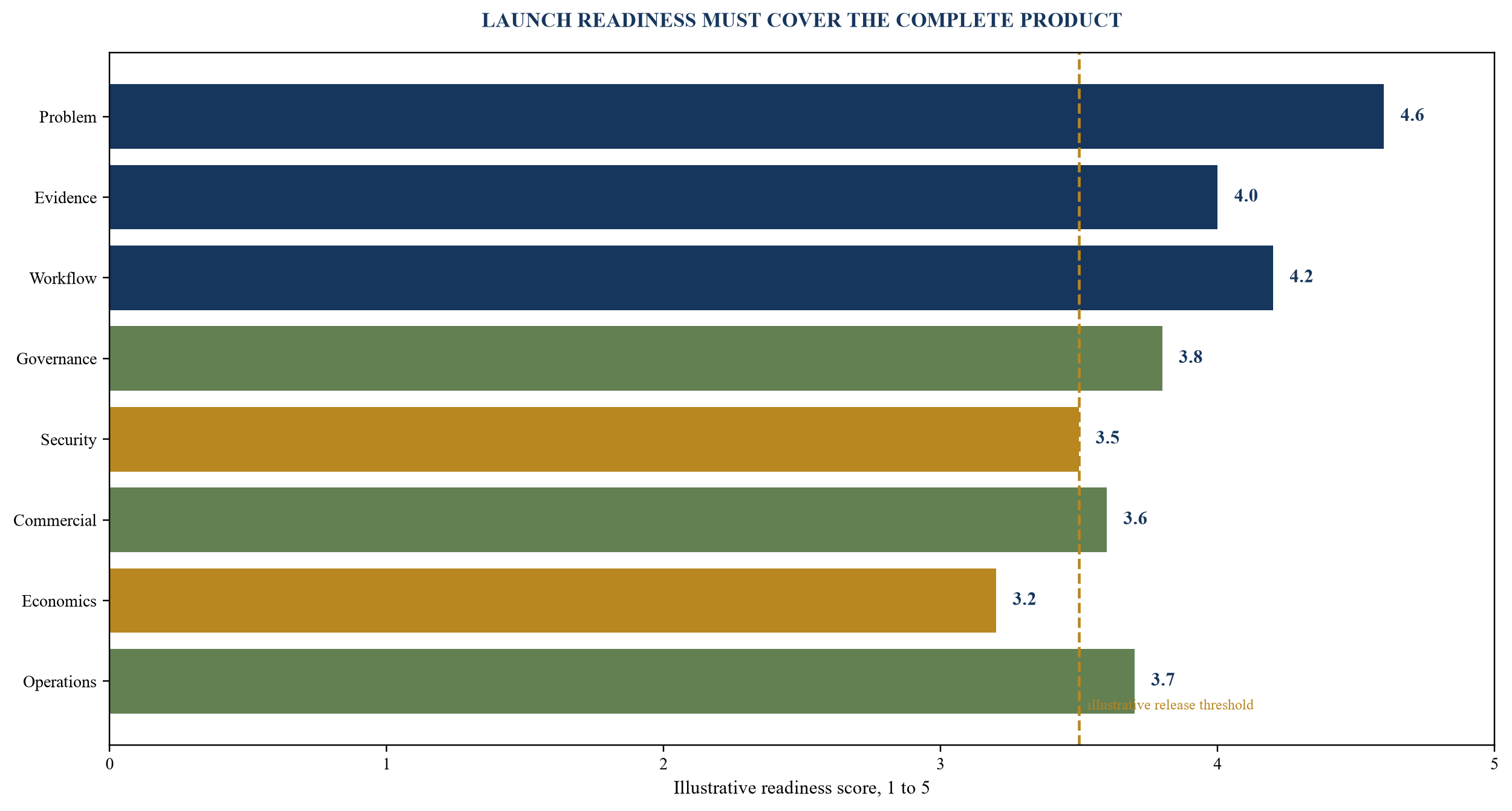
The scores are hypothetical and illustrate how a critical gap can constrain an otherwise strong launch case.
Table 5. Launch readiness scorecard
| Domain | Readiness evidence | Mandatory condition | Post-launch indicator |
|---|---|---|---|
| problem | measured baseline and accountable buyer | funded priority exists | realised workflow outcome |
| validation | cohort tests and operating envelope | required threshold met | drift, override and exception |
| governance | owner, register, approval and monitoring | residual risk accepted | incidents and control performance |
| security | threat model, test and response | no unresolved critical issue | vulnerability and response time |
| commercial | scope, contract, adoption and acceptance | paid production route | usage, invoice, cash and renewal |
| economics | cohort contribution and sensitivities | viable bounded case | margin and implementation effort |
| operations | support, capacity, rollback and documentation | named operating owner | service level and support load |
Mandatory conditions prevent a strong average from masking a critical control failure.
24. Worked hypothetical example
Consider an AI product designed to prepare a first-pass enterprise risk assessment from customer documents. The research team reports strong performance on a curated benchmark. The first gate confirms that target customers spend material professional time assembling evidence and that an accountable risk executive owns the workflow. This establishes a problem worthy of validation, not a finished product.
The contextual test uses customer-permitted documents across several defined cohorts. Performance remains strong for standard files and falls for incomplete, multilingual and scanned material. The product introduces document-quality checks, source display, abstention and mandatory expert approval. The approved operating envelope excludes final autonomous decisions.
A bounded pilot with three hypothetical customers records adoption, review time, exceptions, support and acceptance. Assume a value index of 100. Customer-retained benefit is 20, implementation and adoption consume 12, model and data consume 8, assurance and review consume 7, and support and sales consume 9. The resulting hypothetical contribution index is 44. These figures are analytical assumptions and do not describe an observed company.
One customer converts to a paid annual commitment, one requests further integration and one stops because its data cannot be standardised economically. The commercial decision funds the reusable integration and excludes the unsuitable segment. Scale funding remains contingent on two additional paid cohorts, stable review burden, collected cash and renewal evidence.
25. Operate the research-to-revenue governance cadence
Weekly product governance should review tests, releases, incidents, customer evidence and critical dependencies. Monthly commercial governance should reconcile qualified pipeline, contracts, deployments, invoices, cash, usage, support and margin. Quarterly portfolio governance should decide which products receive additional capital, remain bounded, require redesign or stop.
The evidence pack should use common identifiers for product version, customer, use case and period. This allows technical, operational and financial records to reconcile. Dashboards should link to source records and preserve definitions, exclusions and revisions.
Decision rights must remain clear during pressure to launch. Research leads own scientific integrity. Product leaders own requirements and release coordination. Risk and security owners approve within their authority. Commercial leaders own customer evidence and claims. Finance owns revenue, cost and cash reconciliation. The accountable executive accepts the combined residual exposure.
The cadence should reward disconfirming evidence. Teams should be able to report a failed segment, expensive control or weak pilot without converting it into a favourable narrative. Early recognition protects customer trust and capital. It also concentrates investment on products whose evidence, workflow and economics mature together.
26. Translate the gate into board and financing decisions
The board pack should separate current evidence, approved exposure and future option value. Current evidence includes the validated operating envelope, production cohorts, signed terms, recognised revenue, cash, support effort and incidents. Approved exposure includes the customers, jurisdictions, autonomy, contractual obligations and capital already authorised. Future option value includes unvalidated use cases, new markets, wider autonomy and potential data advantages. Keeping these categories distinct prevents a possible future state from being presented as current performance.
Financing should follow the maturity and cash characteristics of the product. Research and early validation are exposed to technical and market discontinuation and usually require risk-bearing capital. Paid deployment with repeatable implementation can support working-capital planning. Contracted recurring revenue can support a stronger financing case when termination, acceptance, concentration, service credits, gross margin and cash collection are understood. The financing memorandum should show which evidence supports each source and use of funds.
The board should examine concentration in the complete product stack. Dependence can arise from a model provider, cloud platform, specialist employee, data licensor, design partner, distribution channel or single large customer. Scenario analysis should estimate the time, cost and customer consequence of replacing each critical dependency. A contingency that requires rebuilding the product while serving customers should be treated differently from a tested alternative configuration.
Product valuation should connect to evidence and cash. Research assets, code, datasets, contracts, customer relationships, documented controls and operating capability can contribute differently to value. A premium for AI capability should be supported by an observed effect on price, win rate, retention, delivery cost, risk or growth, with the investment needed to sustain that effect included. Broad technology labels do not remove the need to reconcile revenue quality, margin and capital requirements.
The board should approve a downside plan before scaling. It should state how costs, customer obligations and operations change if conversion slows, a major provider changes terms, validation fails in a new segment or a control incident narrows the operating envelope. Triggers should be observable and linked to actions. This protects liquidity and avoids forcing the commercial team to sell outside the validated product boundary.
Management incentives should align with durable evidence. Measures can include accepted deployments, customer outcomes, collected cash, gross contribution, renewal, control performance and successful knowledge transfer. Bookings without acceptance, usage or cash can encourage premature contracting. Technical milestones without workflow adoption can encourage research that does not create a product. Balanced measures support responsible progression through the gates.
External diligence should be reproducible from the evidence architecture. A customer, investor, lender or acquirer should be able to trace product claims to releases, tests, customer cohorts, contracts, financial records and governance decisions without receiving inappropriate confidential data. A well-structured diligence pack shortens repeated explanation and demonstrates that the operating system can survive beyond individual founders or researchers.
The board's final scale decision should answer five questions. Does the product solve a funded problem? Does the released system operate inside a validated and governed envelope? Do customers accept, use and pay for it? Do contribution economics improve across comparable cohorts? Can the organisation meet its obligations under plausible downside scenarios? Scale capital is justified when the evidence answers these questions within the board's stated risk appetite.
27. Build an enterprise diligence and customer-assurance pack
Enterprise revenue often depends on the supplier's ability to answer diligence questions with current evidence. The pack should be assembled as a product output, with an owner, version, access policy and refresh schedule. It can include the system description, approved use cases, architecture, data flows, model and provider register, security controls, validation summary, operating envelope, human-oversight design, incident process, business continuity, customer responsibilities and material limitations.
The pack should distinguish reusable evidence from customer-specific evidence. Reusable evidence supports common security, legal, risk and procurement questions. Customer-specific evidence addresses the customer's data, workflow, configuration, jurisdiction and acceptance. This separation reduces repeated work while preventing a generic assurance statement from being applied to a configuration that was not assessed.
Validation summaries should explain the test population, comparator, metrics, thresholds, exclusions and version. Detailed test data may remain confidential or restricted. A structured summary can still allow a customer to understand what was measured, where performance is weaker and which controls apply. The summary should state the conditions that require revalidation and the process for notifying customers of a material change.
Security evidence should include the threat model scope, development controls, penetration or red-team testing, vulnerability handling, access model, logging, encryption, tenant isolation, supplier dependencies and incident response. Certifications can support the pack where relevant, but they should be mapped to the delivered service. A certificate does not explain a product-specific model threat, connected tool permission or customer configuration.
The data schedule should identify data categories, purpose, source, location, retention, deletion, subprocessors and model-provider treatment. It should explain whether customer data is used to train or improve the product and how that setting is controlled. Customers should be able to reconcile contractual commitments with the implemented architecture and operating process.
The commercial section should define service scope, implementation, acceptance, availability, support, usage measurement, change control and customer obligations. It should identify which performance statements are service commitments, which are observed test results and which are targets. Clear classification reduces disputes and helps finance recognise the economic substance of the arrangement.
Assurance requests should be tracked as product evidence. Repeated customer questions may identify a missing document, control or architectural capability. Time spent answering them should be measured as part of customer acquisition and implementation cost. A declining response burden across comparable customers is evidence that the venture is becoming enterprise-ready.
Access to the pack should be controlled. Highly sensitive security, model, customer and data information should be disclosed according to diligence stage, need and confidentiality. The index can show that evidence exists without releasing every underlying record. Material discrepancies discovered during diligence should trigger correction of the source register and any affected claims.
The pack also supports financing and transaction readiness. Investors, lenders and acquirers can examine how research claims became product requirements, how releases were approved, how customers adopted the product and how revenue converted to cash. This creates a traceable chain from intellectual capability to commercial asset while preserving the limitations and dependencies that affect value.
A response library should connect every standard diligence question to the approved evidence source and accountable owner. Responses should carry an effective date and product version. When an answer changes, the team should identify affected proposals, contracts and customers. This prevents an obsolete statement from remaining in circulation after a provider, architecture, control or operating envelope changes.
Management should measure the diligence funnel. Relevant indicators include time from first request to complete response, open exceptions, duplicated questions, customer review cycles, security or legal conditions, approval rates and conversion after diligence. These measures reveal whether assurance has become a repeatable commercial capability. They also show where additional investment in documentation, architecture or control evidence can shorten the route to contracted revenue.
The final customer-assurance record should reconcile commitments made during sales with the signed agreement and deployed configuration. Any exception should have an owner, resolution date and customer acceptance where required. This closeout connects the commercial promise to delivery and gives customer success, risk, finance and product teams a common operating baseline.
Conclusion
High-risk AI becomes an enterprise product through a sequence of evidence-backed decisions. The research-to-revenue gate begins with a measurable workflow, establishes reproducible technical evidence, validates the system in context, builds a minimum governable product, proves paid adoption and releases scale capital only after commercial and operating repeatability emerge.
The central management task is alignment. Model, data, workflow, control, contract, price, support and financial evidence should describe the same released product. The evidence maturity ladder prevents demonstrations from being treated as production proof. The product risk register turns failure modes into owned controls. The pricing waterfall reconciles customer value with the cost of assurance and delivery. The launch scorecard makes critical gaps visible.
This discipline supports innovation by creating bounded exposure and explicit learning. Capital follows the next uncertainty. Customer claims follow substantiated evidence. Revenue quality follows contracts, usage, invoices, cash and renewal. Products that cannot cross a gate can be redesigned or stopped before they consume scale capital or customer trust.
References
- National Institute of Standards and Technology. Artificial Intelligence Risk Management Framework. https://www.nist.gov/itl/ai-risk-management-framework
- National Institute of Standards and Technology. AI Risk Management Framework 1.0. https://nvlpubs.nist.gov/nistpubs/ai/NIST.AI.100-1.pdf
- National Institute of Standards and Technology. Artificial Intelligence Risk Management Framework: Generative Artificial Intelligence Profile. https://nvlpubs.nist.gov/nistpubs/ai/NIST.AI.600-1.pdf
- National Institute of Standards and Technology. AI Resource Center. https://airc.nist.gov/
- National Institute of Standards and Technology. AI RMF Playbook. https://airc.nist.gov/airmf-resources/playbook/
- National Institute of Standards and Technology. The TEVV-Athlon Framework for Evaluating AI Systems. https://www.nist.gov/artificial-intelligence/ai-research/tevv-athlon-framework-evaluating-ai-systems
- UK Department for Science, Innovation and Technology. Responsible AI Toolkit. https://www.gov.uk/government/collections/responsible-ai-toolkit
- UK Department for Science, Innovation and Technology. Introduction to AI Assurance. https://www.gov.uk/government/publications/introduction-to-ai-assurance/introduction-to-ai-assurance
- UK Department for Science, Innovation and Technology. Portfolio of AI Assurance Techniques. https://www.gov.uk/guidance/portfolio-of-ai-assurance-techniques
- UK Government. Data and AI Ethics Framework. https://www.gov.uk/government/publications/data-ethics-framework/data-and-ai-ethics-framework
- UK National Cyber Security Centre. Guidelines for Secure AI System Development. https://www.ncsc.gov.uk/collection/guidelines-secure-ai-system-development
- UK National Cyber Security Centre. AI and Cyber Security: What You Need to Know. https://www.ncsc.gov.uk/guidance/ai-and-cyber-security-what-you-need-to-know
- European Union. Regulation (EU) 2024/1689 laying down harmonised rules on artificial intelligence. https://eur-lex.europa.eu/eli/reg/2024/1689/oj
- European Commission. AI Act Service Desk: implementation timeline. https://ai-act-service-desk.ec.europa.eu/en/ai-act/eu-ai-act-implementation-timeline
- Council of the European Union. Artificial intelligence policy timeline. https://www.consilium.europa.eu/en/policies/artificial-intelligence-act/timeline-artificial-intelligence/
- Central Bank of the United Arab Emirates. Guidance Note on Consumer Protection and Responsible Adoption and Use of Artificial Intelligence and Machine Learning. https://rulebook.centralbank.ae/en/rulebook/guidance-note-consumer-protection-and-responsible-adoption-and-use-artificial-intelligence
- Dubai Financial Services Authority. AI Survey 2025. https://www.dfsa.ae/news/new-dfsa-ai-survey-generative-ai-adoption-has-nearly-tripled-within-difc-last-12-months-governance-continues-develop
- Federal Trade Commission. Operation AI Comply. https://www.ftc.gov/news-events/news/press-releases/2024/09/ftc-announces-crackdown-deceptive-ai-claims-schemes
- Federal Trade Commission. Decision and Order concerning Workado, LLC. https://www.ftc.gov/system/files/ftc_gov/pdf/ContentatScaleAI-DecisionandOrder.pdf
- U.S. Securities and Exchange Commission. SEC Charges Two Investment Advisers with False and Misleading Statements About AI. https://www.sec.gov/newsroom/press-releases/2024-36
- Organisation for Economic Co-operation and Development. OECD AI Principles. https://oecd.ai/en/ai-principles
- International Organization for Standardization. ISO/IEC 42001 Artificial intelligence management systems. https://www.iso.org/standard/81230.html
- U.S. Food and Drug Administration. Good Machine Learning Practice for Medical Device Development. https://www.fda.gov/medical-devices/software-medical-device-samd/good-machine-learning-practice-medical-device-development-guiding-principles
- Monetary Authority of Singapore. FEAT Principles. https://www.mas.gov.sg/publications/monographs-or-information-paper/2018/feat
- UK Financial Conduct Authority. AI Lab. https://www.fca.org.uk/firms/innovation/ai-lab
