

1. Define the transaction decision
A drone-delivery transaction should begin with the decision the board needs to make. A buyer may seek an operating certificate, aircraft technology, a safety case, route approvals, customer contracts, launch sites, traffic-management integrations, trained personnel or a network that already completes paid missions. Each objective creates a different asset perimeter, capital requirement and liability profile. Combining them in one platform narrative can obscure which assets actually support revenue.
The proposed economic unit is a completed, accepted and paid delivery mission within an approved operating perimeter at complete cost. Complete cost includes the aircraft, battery or energy system, payload handling, maintenance, communications, navigation, surveillance, remote operations, launch and recovery nodes, airspace services, insurance, customer operations, failed missions, incident response and working capital. Test flights, promotional demonstrations and unpaid missions should remain outside the base case unless they produce transferable evidence required for commercial operations.
The board should compare acquisition with licensing, a joint venture, a minority investment, a route-specific operating agreement and a contracted service. Full ownership can be justified when control of the operating certificate, engineering configuration, safety evidence and customer experience is essential. A staged structure can protect capital where approval transferability, route utilisation or failure cost remains uncertain.
The investment memorandum should state excluded value. Unsigned customers, unopened routes, approvals that do not cover the intended configuration, assumed regulatory change and aircraft generations without operational evidence belong in a separately probability-weighted case. The base case should include only missions that the combined organisation can lawfully execute and economically support.
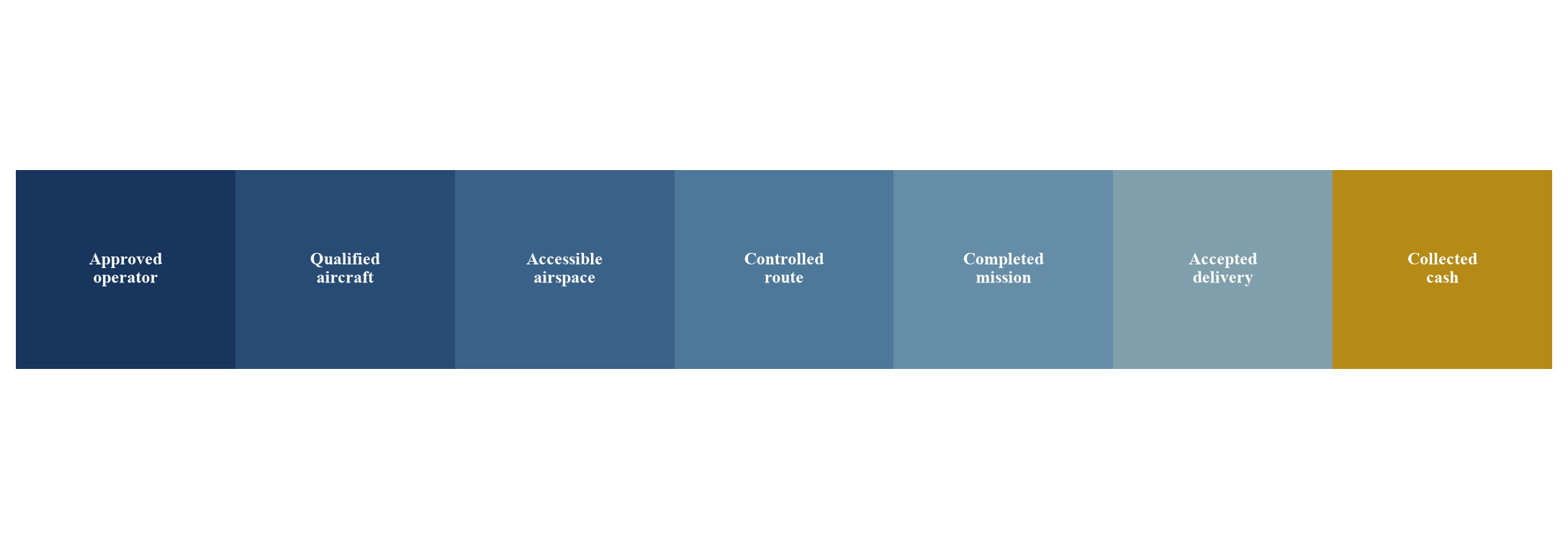
The proposed chain connects operating approval, airspace access and route capacity to accepted delivery and collected cash.
2. Map the regulatory operating perimeter
Regulatory approval should be translated into an operating perimeter, not recorded as a binary licence. In the United States, the FAA describes Part 135 certification as the route for small-package delivery for compensation beyond visual line of sight. Operators may also require exemptions, waivers, airspace authorisations, aircraft certification or other operating permissions. Part 107 remains relevant to other commercial small-UAS activity, with waivers available for specified provisions where an equivalent level of safety is demonstrated.[1][4][5]
In the European Union, the open, specific and certified categories allocate requirements according to risk. SORA provides a structured method for classifying the intended specific-category operation, identifying mitigations and defining operational safety objectives. U-space rules establish services intended to support safe and efficient drone use in designated airspace.[2][6][7] In the United Kingdom, CAP 722, operating-safety-case guidance and the CAA's BVLOS technical strategy form part of the applicable evidence environment.[3][8][9]
The buyer should create an approval register by legal entity, jurisdiction, aircraft, route, airspace class, altitude, operating mode, payload, crew model and validity period. Conditions, limitations, reporting duties, named personnel, continuing-airworthiness obligations and change notifications need their own fields. An approval that supports one aircraft, one site or one concept of operations cannot automatically support a wider network.
Transferability is a central transaction issue. A certificate or waiver may remain with the holder, depend on nominated personnel, require regulator acceptance after a change of control or rely on manuals and evidence that must continue unchanged. Counsel and aviation specialists should verify the precise effect of the proposed structure before value is attributed.
| Right or approval | Controlled scope | Evidence required | Transaction treatment |
|---|---|---|---|
| Operator or carrier authority | legal entity and service | certificate, operations specifications and manuals | test continuity after change of control |
| Aircraft approval | model, configuration and software | declaration, exemption, airworthiness or type evidence | include qualified configurations only |
| BVLOS authority | route, concept and mitigations | waiver, authorisation or safety case | value only within approved conditions |
| Airspace access | class, altitude, location and time | authorisation, coordination and constraint data | measure usable capacity and renewal risk |
| Ground-risk approval | population and containment | route assessment and mitigations | include diversion and closure rules |
| Radio and connectivity | frequency, equipment and coverage | licences, equipment identity and tests | price coverage gaps and redundancy |
| Payload permission | mass, goods and handling | approved procedures and restrictions | exclude prohibited or unqualified revenue |
The register connects each permission to its evidence, limitations and transaction treatment.
3. Treat airspace as constrained operating capacity
Airspace is economically useful when the operator can schedule and complete missions under the governing constraints. The FAA's UTM concept describes cooperative interaction between operators and the regulator, with operators managing safe activity within real-time constraints rather than receiving conventional positive air-traffic-control service for every low-altitude mission. NASA's UTM research similarly used shared digital flight information, conflict management and dynamic constraints to coordinate multiple operations.[1][10][11]
The transaction team should avoid describing airspace as owned territory unless a legally enforceable property or contractual right exists. In most delivery models, the platform possesses permissions and capabilities to operate under defined rules. Those permissions can be non-exclusive, conditional, interruptible and dependent on third-party services. The economically relevant question is how much reliable mission capacity the permissions create.
A route-right ledger should record origin, destination, corridor, altitude band, operating window, airspace class, constraints, ground-risk classification, weather envelope, surveillance, communications, emergency landing options and priority rules. Each route receives an executable status, evidence owner and last validation date. Planned routes remain separate from approved routes.
Capacity should be measured after restrictions. A corridor theoretically capable of 100 daily movements may support fewer commercial missions after weather, noise, temporary restrictions, aircraft separation, battery turnaround, launch-pad availability and remote-crew capacity. The buyer should reconcile authorised capacity with actual scheduled, launched and completed missions.
4. Build the route and node ledger
The route ledger is the commercial spine of the platform. It should connect route geometry to aircraft, payload, approval, customer, price, service level, mission history and cash. Each record should identify whether the route is tested, approved, contracted, launched or economically mature. Marketing maps and announced cities do not provide this evidence.
The node ledger covers fulfilment centres, launch and recovery points, charging or battery exchange, maintenance, storage, communications, weather sensing, security, payload hand-off and emergency-response coverage. Ownership, lease terms, permissions, capacity and dependency on a single counterparty should be visible. Node reuse across multiple routes can create operating leverage, while a constrained node can cap network utilisation.
Route and node records must reconcile with flight logs, maintenance records, customer orders, delivery confirmation, invoices and cash. This chain distinguishes flight activity from paid delivery. It also identifies operational leakage: cancelled orders, payload rejection, failed hand-off, return missions and refunds.
The ledger supports post-acquisition integration. Duplicate nodes can be consolidated only after capacity, approvals, customer service and emergency coverage are tested. Routes that appear geographically adjacent may require different evidence because of airspace, population, terrain or communications.
5. Test aircraft and configuration control
Aircraft economics depend on the exact configuration that conducts the mission. The ledger should identify airframe, propulsion, battery, payload module, sensors, navigation, communications, remote-identification equipment, software release and maintenance state. FAA Remote ID requirements apply to registered drones unless an exception or authorisation applies; each eligible device and its identity should reconcile with the operating fleet.[12][13]
Configuration control matters because approval evidence can attach to a specific design and concept of operations. A supplier substitution, battery change, payload increase, navigation update or communications modification may require additional analysis, testing or regulator engagement. The buyer should review the change-control board, release records, affected approvals and operational rollback procedure.
Availability should be separated into calendar availability, maintenance availability, regulatory availability, weather availability and mission readiness. A large fleet can produce little capacity if aircraft wait for parts, batteries, software release, inspections or approval. Spare ratios should reflect failure and repair history rather than a single engineering target.
The acquisition model should also identify ownership and encumbrances. Aircraft can be owned, leased, vendor-financed or supplied through a service agreement. Intellectual-property rights, source-code access, tooling, battery warranties and continued supply need independent treatment.
6. Convert the safety case into transaction evidence
A safety case is a structured argument supported by evidence that the intended operation is acceptably safe. SORA formalises ground and air risk, mitigations, containment and operational safety objectives for relevant European operations. UK operating-safety-case guidance provides a related evidence route. FAA waivers require applicants to show how the proposed operation reaches the required safety level.[2][5][8]
The buyer should inspect the claim structure, not rely on a presentation summary. Claims can address aircraft reliability, navigation, detect and avoid, containment, communications, remote crew, maintenance, ground operations, human factors, cyber security and emergency response. Each claim needs scope, evidence, acceptance criteria, reviewer, exceptions and closure status.
Evidence must match the acquired operation. A rural route with low ground exposure cannot prove an urban delivery network. A small payload cannot establish performance at a higher mass. A test team can operate differently from commercial crews. The diligence team should therefore create an evidence matrix across configuration, geography, population, weather, airspace and mission type.
Evidence also ages. Software, suppliers, aircraft, routes and procedures change. The valuation model should include the recurring cost of maintaining the safety case, conducting assurance, closing findings and supporting regulator reviews.
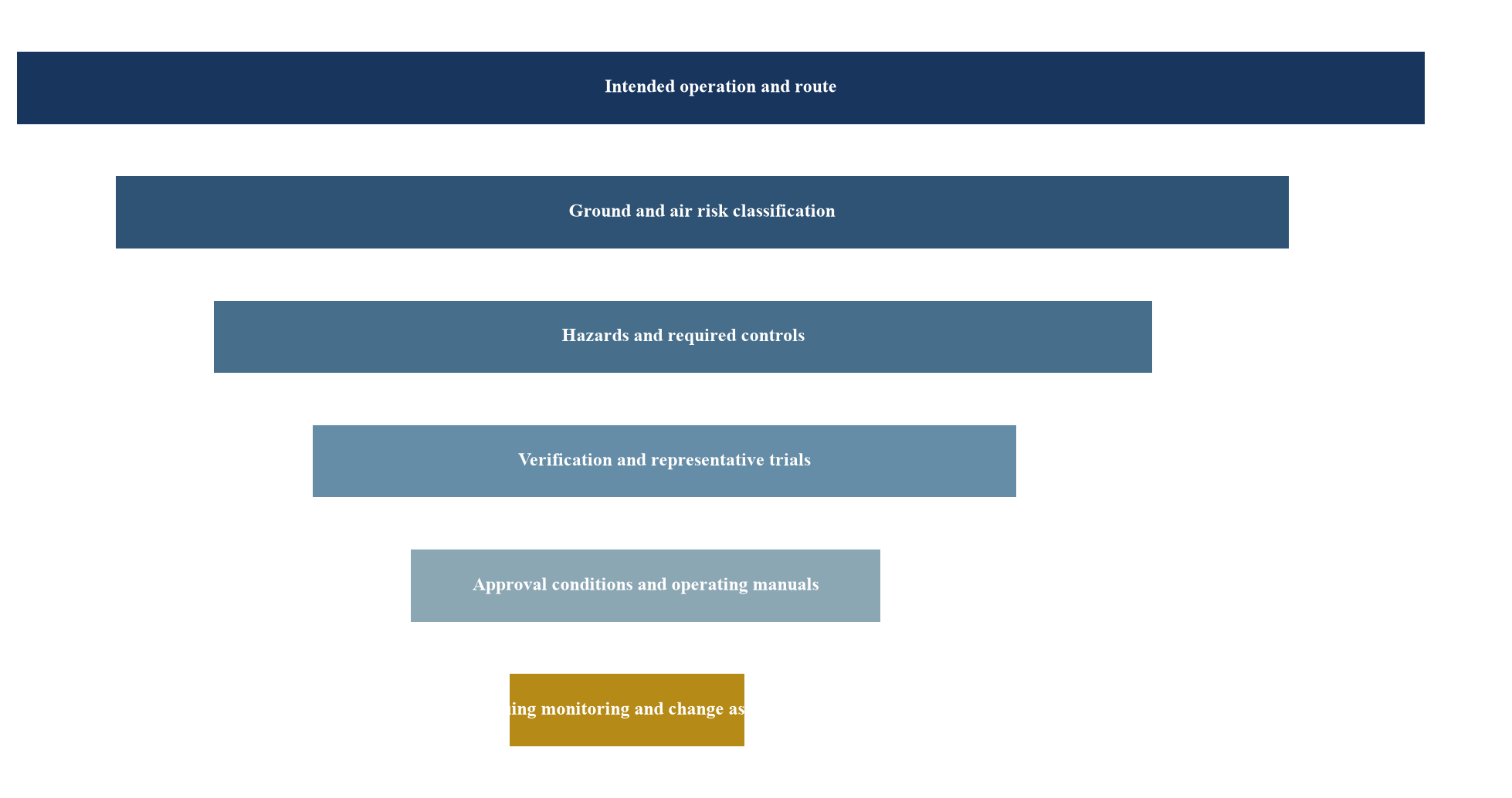
The proposed stack moves from the intended operation through hazards, controls, verification and continuing assurance.
| Evidence level | Required record | Diligence question | Failure signal |
|---|---|---|---|
| Intended operation | routes, aircraft, people and procedures | what activity is being approved | ambiguous commercial scope |
| Hazard analysis | credible failure modes and controls | what can go wrong | missing ground or air interactions |
| Verification | requirements and test results | was the system built correctly | incomplete configuration trace |
| Validation | representative operating evidence | is it suitable for intended use | trials outside target conditions |
| Operations | dispatch, maintenance and response | can safety persist in service | uncontrolled workarounds |
| Assurance | challenge, findings and closure | who accepted residual risk | material open exceptions |
The hierarchy separates assertions from controlled evidence suitable for transaction review.
7. Measure route utilisation
Route utilisation should begin with the authorised operating window and end with accepted paid missions. Useful intermediate measures include scheduled missions, released missions, launches, completed flights, successful hand-offs, accepted deliveries and paid orders. Each step has a distinct loss rate and cause.
Payload yield matters alongside mission count. A route can operate frequently with low payload utilisation or weak order density. The model should track available payload mass and volume, loaded payload, revenue payload and delivery value. Aircraft range and reserve requirements can reduce usable payload under adverse weather or diversion assumptions.
Remote-crew productivity is another constraint. One-to-many supervision can improve economics only when the approval, system design, workload evidence and exception rate support it. Staffing ratios should be measured during normal and correlated abnormal conditions. A network that needs intensive intervention during weather or communications degradation may lose the assumed labour advantage.
The buyer should calculate utilisation by route, hour, day, node, aircraft generation and customer. Aggregate fleet averages can hide mature routes subsidising new routes. Cohort analysis shows how quickly each route moves from approval to stable paid utilisation.
| Dimension | Measure | Source | Transaction question |
|---|---|---|---|
| Approval capacity | permitted missions and windows | approvals and operating specifications | what can lawfully be scheduled |
| Schedule conversion | launches divided by scheduled missions | dispatch records | how much planned capacity is usable |
| Completion | completed divided by launched missions | flight logs | how reliable is physical execution |
| Delivery acceptance | accepted orders divided by completed flights | customer records | does flight output become service revenue |
| Payload yield | revenue payload divided by available payload | manifest and aircraft data | is capacity economically filled |
| Node productivity | missions per launch position and hour | site systems | where does infrastructure constrain growth |
| Crew productivity | completed missions per supervised hour | rostering and event logs | is automation reducing labour intensity |
The ledger converts authorised capacity into completed commercial output.
8. Price weather, terrain and local operating conditions
Weather is a capacity variable. Wind, gusts, precipitation, temperature, visibility, icing and convective activity can affect aircraft performance, payload, battery endurance, communications and emergency landing. The operating envelope should specify measured thresholds and the evidence supporting them.
The route model should use observed local distributions rather than annual averages alone. NOAA and national meteorological services provide historical and forecast data, while the company should preserve the actual weather values associated with each mission decision.[14][15] Dispatch records should show when missions were released, delayed, diverted or cancelled and whether crews followed the approved thresholds.
Terrain, buildings, vegetation and electromagnetic conditions can alter navigation, command-and-control coverage and emergency options. Urban-canyon operations differ from rural corridors. A route that is short in distance may be expensive because it crosses dense ground exposure or constrained airspace.
The investment case should therefore calculate weather-adjusted and condition-adjusted capacity. Expansion value can be overstated when management applies mature-route availability to new geographies without matched evidence.
9. Test communications, navigation and surveillance
Commercial BVLOS operations depend on reliable command and control, navigation, surveillance and operational communications. The diligence team should map primary and backup links, coverage, latency, authentication, encryption, interference, outage procedures and provider dependencies. Equipment identity and radio authorisations should reconcile with approved configurations.
Lost-link behaviour must be evaluated within the route. A return-to-home action can create a new ground or air risk if the path crosses people, vehicles or restricted airspace. FAA waiver guidance explicitly identifies communications failure and the need to preserve compliance during the response.[5]
Navigation integrity should cover GNSS availability, spoofing and jamming, map quality, geofencing and alternative positioning. Surveillance can include cooperative and non-cooperative traffic information, visual observers, ground-based systems or onboard detect-and-avoid. The buyer should distinguish demonstrated capability from planned integration.
Service-level agreements with connectivity, UTM and surveillance providers need economic treatment. Minimum volumes, termination rights, data access, liability limits and change controls can influence scalability and transaction risk.
10. Model detect-and-avoid and traffic-management dependencies
Detect-and-avoid capability supports separation from other aircraft and hazards. Its performance depends on the target, environment, sensor, alerting logic, manoeuvre authority and operating concept. A generic statement that the system can detect traffic does not establish the required level of safety for every route.
UTM services can support strategic deconfliction, constraint information, conformance monitoring and shared situational awareness. NASA and FAA materials describe a federated environment in which operators and service suppliers exchange operational information.[10][11][16] U-space provides a regulated European service framework for designated airspace.[7]
The buyer should map dependencies by route: flight-planning service, airspace-authorisation service, weather, network identification, surveillance, conformance monitoring and emergency coordination. Each dependency needs an owner, service level, fallback and data-retention policy.
The valuation should separate current operational capability from future ecosystem benefits. A route that depends on an unimplemented service belongs outside the base case until the service and associated approval pathway are available.
11. Calculate complete mission economics
Mission contribution begins with recognised delivery revenue and deducts all costs required to produce an accepted delivery. Direct costs include energy, battery degradation, aircraft maintenance, payload handling, communications, airspace services, remote operations, insurance and customer support. Route-level costs include nodes, mapping, local approvals, weather systems, response coverage and community engagement.
Aircraft depreciation should reflect useful life, utilisation and replacement cost. Battery cost should reflect cycle life under actual temperature, payload and charging conditions. Spare aircraft and parts belong in capacity economics even when they are not used on every mission.
Corporate engineering and continuing approval cost can be allocated separately to show route contribution and platform economics. Both views are needed. A route can show positive direct contribution while the network remains cash-consuming because new approvals and engineering require sustained investment.
Cash timing matters. Customer payment can follow delivery while aircraft, batteries, sites, insurance and staff are funded in advance. Growth may therefore increase working capital and validation spend before route cohorts mature.
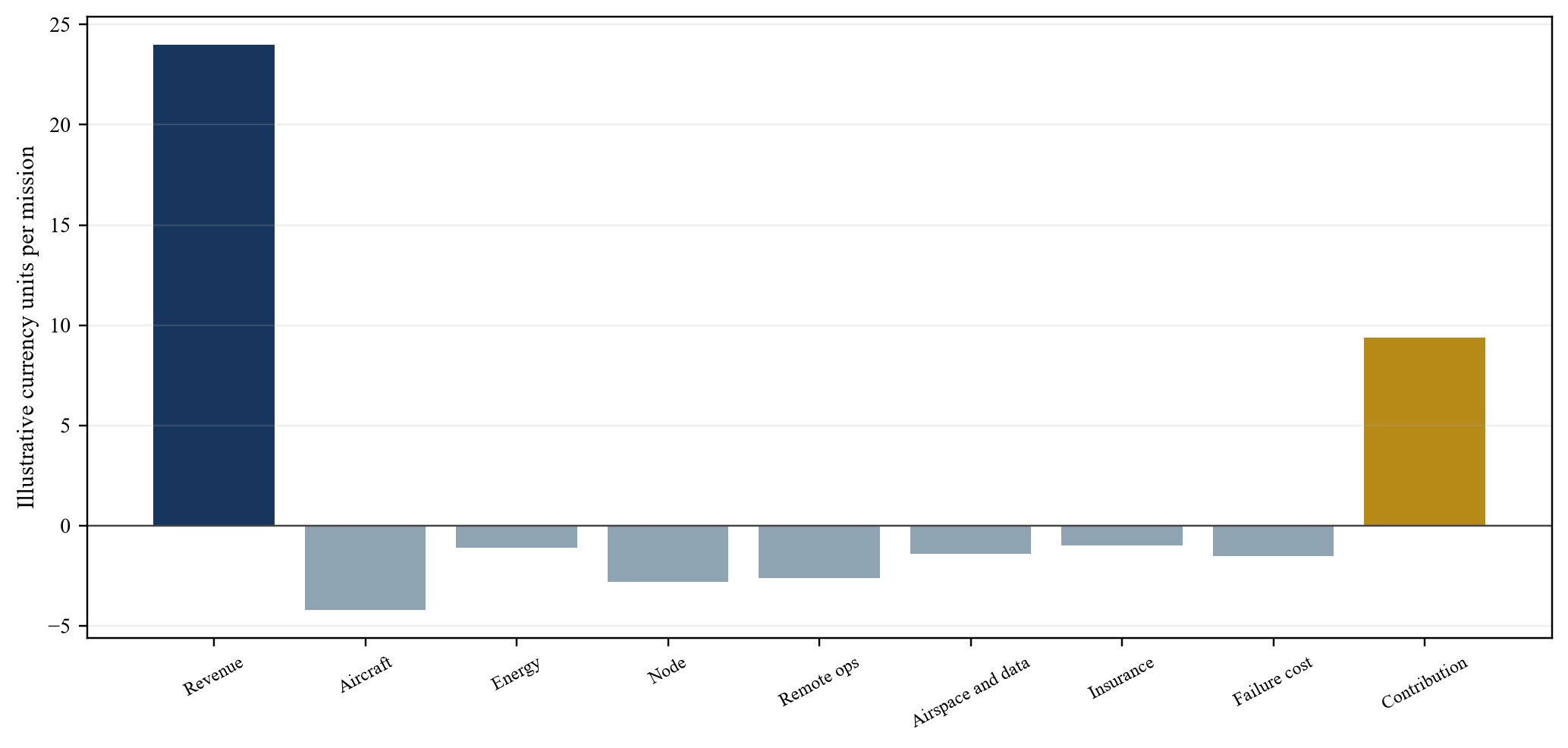
The illustrative waterfall connects delivery revenue to complete failure-adjusted mission contribution.
12. Build failure-adjusted economics
A failed mission can create more than lost revenue. Costs can include a replacement delivery, refund, payload loss, aircraft damage, recovery, site response, third-party property damage, injury, investigation, regulator notification, customer remediation, increased insurance cost and suspended operations. Severe events can affect the entire network.
The buyer should create a failure taxonomy. Categories can include pre-launch cancellation, launch abort, in-flight diversion, precautionary landing, loss of command and control, containment breach, hard landing, payload release failure, navigation deviation, collision, ground injury and cyber event. Definitions and severity levels should remain consistent.
Expected failure cost equals frequency multiplied by severity for each category, adjusted for exposure and tail risk. Sparse severe events require scenarios, insurance analysis and engineering judgement. Management estimates should remain identified as assumptions rather than observed rates.
Recovery time deserves separate measurement. The platform may restore one aircraft quickly while a regulator, insurer or customer requires broader evidence before service resumes. The model should include local and network-wide downtime.
| Failure class | Immediate cost | Downstream cost | Required evidence |
|---|---|---|---|
| Pre-launch cancellation | handling and customer remedy | lost utilisation | reason code and weather or system record |
| Diversion or precautionary landing | recovery and replacement delivery | route delay and crew time | flight log and response record |
| Aircraft damage | repair or replacement | capacity loss and higher spares | maintenance and causal analysis |
| Payload loss | goods, refund and claims | customer confidence | manifest and custody evidence |
| Ground or air incident | response, defence and insured loss | approval and network interruption | preserved evidence and investigation |
| Cyber event | containment and restoration | trust, privacy and service loss | security logs and incident response |
| Approval suspension | idle fleet and sites | revenue and revalidation cost | regulator correspondence and closure plan |
The register connects operational events to immediate, downstream and network consequences.
13. Analyse insurance and liability allocation
Drone-delivery risk can touch aviation hull and liability, cargo, product liability, technology errors and omissions, cyber, premises, workers' compensation and directors' liability. The programme should match the operator, aircraft, routes, payloads and contractual obligations. Premium alone does not show protection; exclusions, deductibles, limits, aggregation, territorial scope and claims cooperation matter.
Contracts allocate responsibility among aircraft manufacturers, software providers, operators, customers, fulfilment sites, UTM suppliers, connectivity providers and maintenance organisations. The buyer should reconcile indemnities and insurance requirements across the chain. A party can accept liability that its policy excludes or that exceeds the counterparty's resources.
Claims files provide transaction evidence. The team should reconcile notices, reserves, paid amounts, coverage positions, recoveries and engineering actions. Near misses and service interruptions should also be reviewed even when they do not create claims.
Insurance renewal assumptions should be evidence based. A larger fleet and denser network can diversify some risks and aggregate others. Common software, weather, connectivity or battery defects can create correlated loss.
14. Test customer demand and service acceptance
Customer contracts should define the service, geography, operating window, payload, order interface, custody, delivery confirmation, service levels, price, minimum volume, exclusivity, liability, data rights and termination. Announced partnerships and pilot memoranda need separate treatment from binding paid commitments.
Demand should be measured at the order level. The route model should capture eligible orders, offered orders, accepted missions, completed deliveries, customer acceptance, refunds and repeat usage. A high technical completion rate can coexist with low order density or weak willingness to pay.
Drone delivery competes with vans, couriers, collection, lockers and other local fulfilment options. The relevant customer value may be speed, urgent access, reduced inventory, geographic reach, service resilience or labour substitution. The buyer should identify the use case by route rather than apply one general premium.
Concentration requires attention. One retailer, healthcare network or logistics partner can provide density and bargaining power. Contract renewal, data portability and direct customer access influence the durability of the network.
15. Underwrite community, privacy and nuisance risk
Low-altitude operations interact with communities. Noise, visual presence, perceived surveillance, landing-site activity and fairness in route placement can affect acceptance and local permissions. Community engagement should be treated as operating evidence, with complaints, response times, route adjustments and commitments recorded.
Privacy controls should limit collection, use, retention and access to imagery, location and customer data. The system should distinguish data required for safe operations and delivery proof from incidental collection. Applicable privacy laws, customer contracts and regulator expectations vary by jurisdiction.[17][18]
Noise should be measured under representative conditions and linked to route design, altitude, time and aircraft configuration. Engineering targets do not replace local evidence. Repeated complaints can constrain usable operating windows and reduce capacity.
The transaction model should price mitigation: route changes, quieter operations, restricted hours, site redesign, community support and additional compliance. Social acceptance can become a capacity constraint even when aviation approval remains valid.
16. Secure cyber, identity and operational data
Drone delivery is a connected operational system. Threats can affect aircraft control, navigation, software supply chains, remote-crew accounts, customer interfaces, UTM links, maintenance tools and operational data. NIST's Cybersecurity Framework 2.0 and AI Risk Management Framework provide general governance structures that can support diligence, while aviation-specific analysis remains necessary.[19][20]
The buyer should map identities, privileges, cryptographic keys, software signing, update paths, device inventory, logging, detection, incident response and recovery. Remote access to aircraft or operating systems needs strong authentication and controlled support procedures. Third-party components and open-source software should be inventoried.
Operational logs are both safety evidence and sensitive data. Retention should support incident investigation, approval obligations, insurance and customer disputes. Integrity, time synchronisation and chain of custody matter. The buyer should confirm rights to retain and use data after a transaction.
Cyber events need economic treatment. A containment action may ground aircraft or disable routes. The downside case should include fleet-wide restoration, key rotation, software validation and regulator or customer notification.
17. Build a hypothetical regional network
Consider a hypothetical network with two launch nodes and four approved routes. The network completes 420 paid missions per day across 30 aircraft. Average recognised revenue is 24 currency units per paid mission. Complete variable and route cost before expected failure cost is 13.1 units. Expected failure cost is 1.5 units, leaving 9.4 units of contribution per paid mission.
These inputs are management assumptions created only to demonstrate the framework. They are not observed market data. Route A is mature and carries high order density. Route B has weather volatility. Route C has low backhaul-equivalent utilisation because return capacity is unproductive. Route D has a customer contract but remains in an approval ramp.
The model should preserve the distinction between approved capacity and used capacity. The network is authorised for 720 daily missions but schedules 560, launches 500 and completes 460. Customer acceptance and payment reduce the paid count to 420. The conversion from authorised capacity to paid output is 58.3 per cent.
The network can improve through demand density, node throughput, weather resilience and reduced mission failure. Each improvement has a different evidence and capital requirement.
| Route | Approved missions per day | Paid missions per day | Revenue per paid mission | Failure cost per paid mission | Contribution per paid mission |
|---|---|---|---|---|---|
| A mature medical | 220 | 160 | 27.0 | 1.1 | 11.2 |
| B retail weather-sensitive | 180 | 110 | 22.0 | 1.8 | 7.4 |
| C suburban convenience | 160 | 95 | 20.0 | 1.4 | 6.8 |
| D urgent-parts ramp | 160 | 55 | 30.0 | 2.3 | 12.0 |
| Network | 720 | 420 | 24.0 weighted | 1.5 weighted | 9.4 weighted |
Every value is a management assumption used solely to illustrate the calculation.
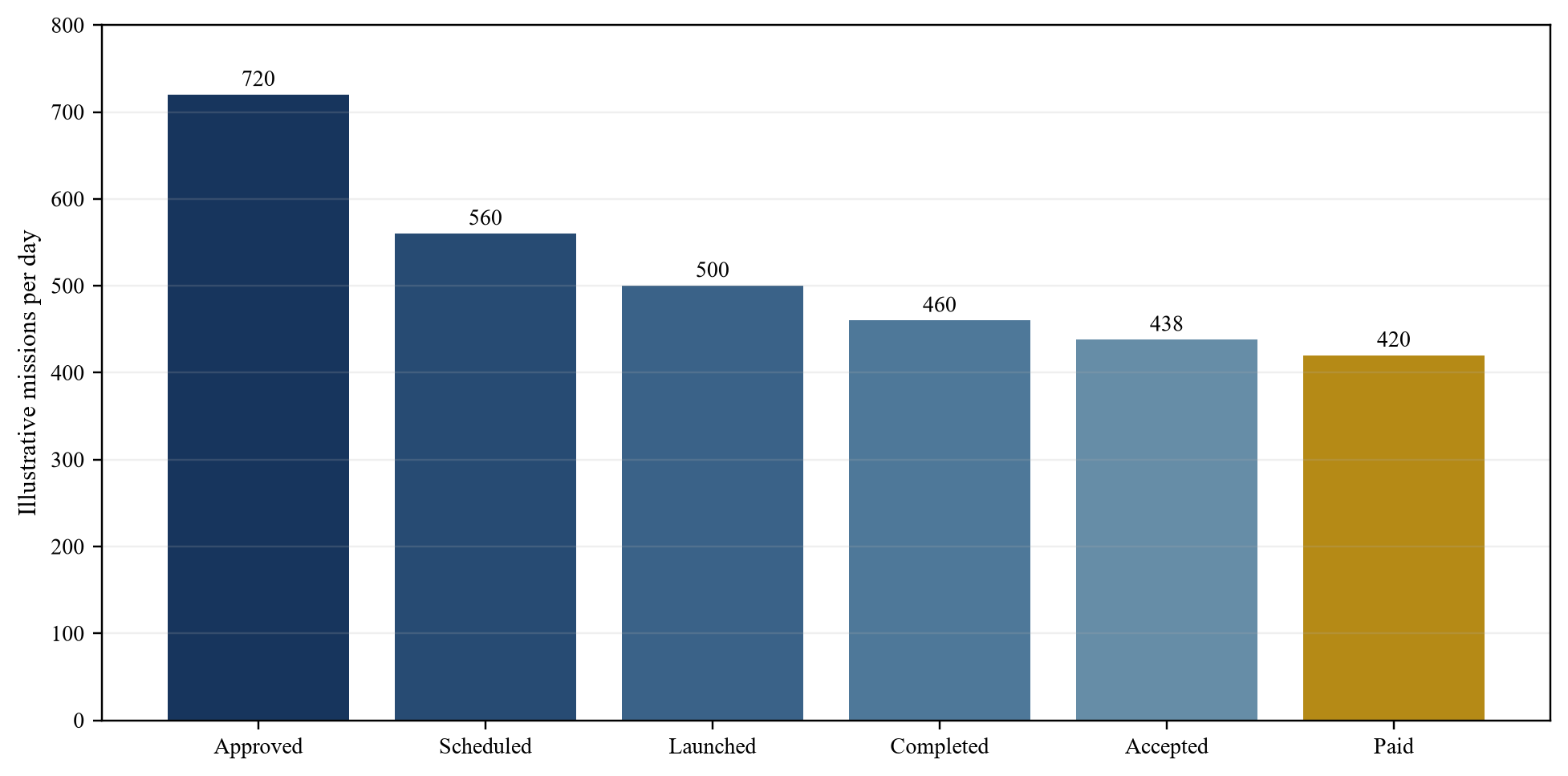
The illustrative funnel shows how approval capacity is reduced by scheduling, launch, completion, acceptance and payment.
18. Stress the operating model
The downside case should stress approval, weather, demand, failure, capacity and cost together. These variables can be correlated. A serious incident can reduce approval capacity, increase insurance cost, slow customer adoption and require additional engineering.
The hypothetical base case produces 420 paid missions per day and 9.4 units of contribution per mission. A utilisation downside reduces paid missions to 300 while node and remote-operation costs remain substantially fixed. A weather downside removes 18 per cent of operating windows. A failure downside triples expected failure cost and creates 15 days of network interruption. An approval downside delays Route D for nine months.
Management should also test an upside that requires evidence rather than optimistic scaling. A credible upside can arise when approved one-to-many supervision, node automation and contracted order density improve together. Each condition receives a gate and validation date.
The board should focus on cash runway and covenant headroom under the combined downside. Route-level contribution does not protect the company when fixed engineering, insurance and approval costs continue during a grounding.
| Case | Operating change | Economic consequence | Required response |
|---|---|---|---|
| Utilisation | paid missions fall from 420 to 300 | fixed node and crew cost per mission rises | consolidate windows and secure volume |
| Weather | 18 per cent of windows unavailable | lower revenue and customer reliability | add route resilience and revised service levels |
| Failure | expected failure cost triples | contribution contracts and claims rise | contain, investigate and revalidate |
| Approval | Route D delayed nine months | contract and expansion value deferred | milestone consideration and funding gate |
| Connectivity | correlated outage across two routes | cancellations and recovery cost | diversify links and test fallback |
| Combined | utilisation, weather and failure overlap | cash burn and covenant pressure | ring-fenced liquidity and stop conditions |
The cases are management assumptions and demonstrate how connected risks affect value.
19. Value the platform in layers
Transaction valuation should separate verified operations, contracted near-term expansion, reusable platform capability and strategic options. The verified layer includes paid missions within current approvals and complete economics. The contracted layer includes customer commitments supported by a defined approval and deployment path. The platform layer includes reusable aircraft, software, safety evidence, nodes and operating processes. Strategic options cover routes and services that remain conditional.
An income approach can value mature route cohorts using failure-adjusted cash flow. An asset approach can support aircraft, equipment and selected infrastructure. A market approach requires careful normalisation because peer companies differ in certificates, aircraft, geography, mission type, maturity and capital intensity. IFRS 13 and IVS provide valuation frameworks; IFRS 3, IAS 36 and IAS 38 guide accounting analysis for business combinations, impairment and intangible assets.[21][22][23][24][25]
Operating rights may contribute to value without constituting a separately transferable asset. The legal and accounting analysis should reflect the specific approval. Customer relationships, technology, data and workforce require separate support.
The valuation should deduct sustaining approval, safety, cyber and fleet investment. Expansion capital remains outside mature-route cash flow. Probability weighting should be tied to observable gates, not a single management percentage.
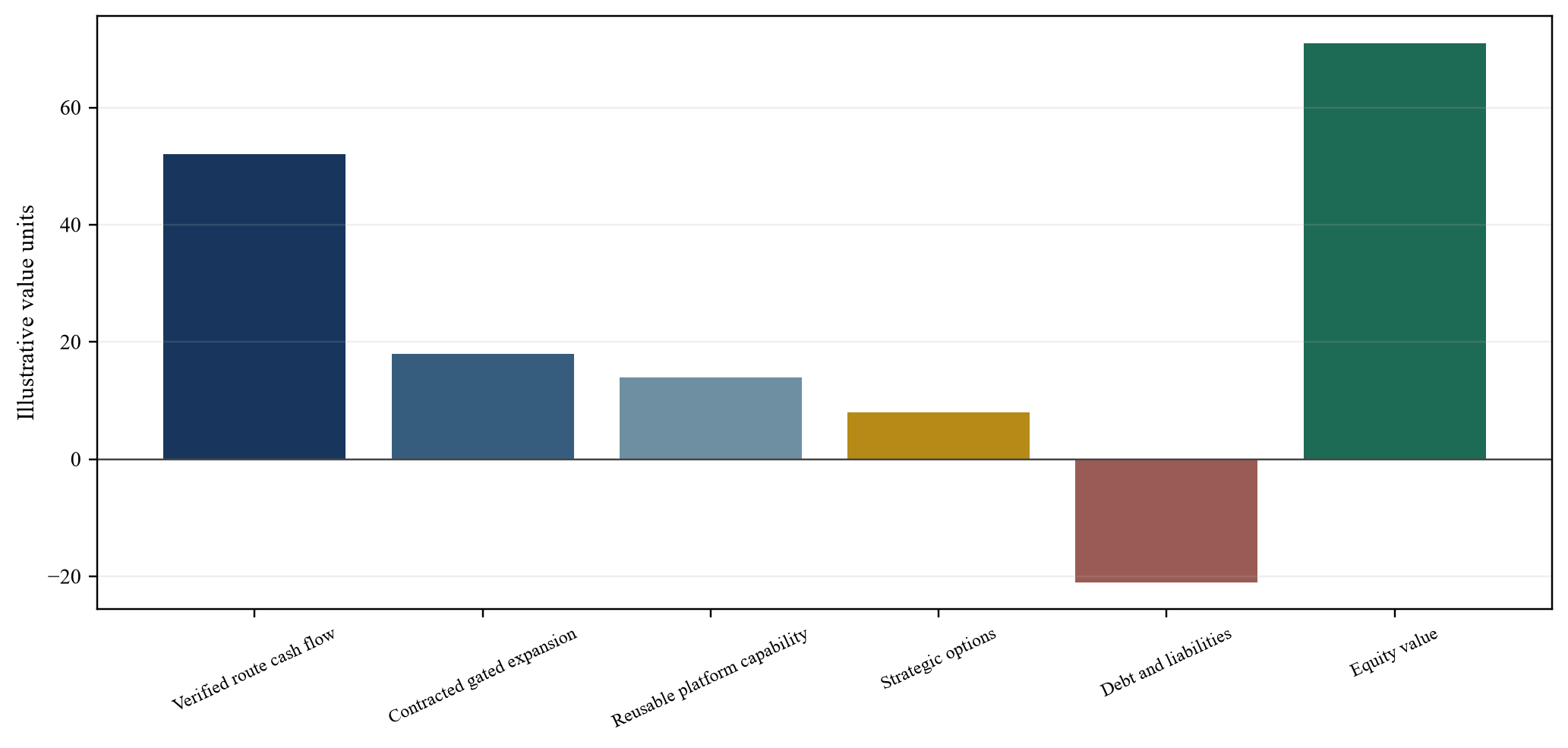
The illustrative bridge separates verified route economics from conditional expansion and strategic options.
20. Structure consideration around evidence
Transaction structure can align payment with operating evidence. Closing consideration can reflect verified routes, aircraft, nodes, customer contracts and liabilities. Deferred or contingent consideration can attach to approval continuity, paid-mission thresholds, customer retention, failure-cost limits and collected cash.
Milestones should be independently verifiable and within the relevant party's control. An approval milestone needs a defined authority, scope, aircraft, route and deadline. A utilisation milestone should use paid accepted missions, not gross flights. A safety milestone should avoid rewarding under-reporting; it can combine complete reporting, closed investigations and defined exposure-adjusted outcomes.
Escrow or indemnity may address open incidents, claims, approval breaches, product defects, privacy matters or tax exposures. Representations should cover the completeness of approvals, operational records, customer contracts, incident reporting, aircraft configuration, intellectual property and data rights.
Integration covenants should preserve the safety case and approvals. Rapid system consolidation can change manuals, personnel, software, vendors or operating procedures. The integration plan should identify which changes require regulator, insurer or customer engagement.
21. Execute a 180-day validation programme
The first 30 days should establish control of the approval, aircraft, route, node, incident, contract and cash ledgers. The team should freeze unsupported changes, confirm accountable executives and preserve safety evidence. Critical approvals and change-of-control obligations receive immediate legal and regulatory review.
Days 31 to 60 should reconcile route operations. Flight logs, dispatch, customer orders, acceptance, invoices and cash should connect. Configuration and maintenance sampling should confirm that commercial missions used qualified aircraft and software. Insurance policies and claims should be matched to operations.
Days 61 to 120 should validate route cohorts and failure economics. Management should measure utilisation, payload yield, intervention, weather loss, node capacity, recovery time and customer retention. Expansion routes should pass technical, regulatory, commercial and capital gates.
Days 121 to 180 should support the board decision. The team should produce a verified base case, downside cases, integration sequence, consideration mechanics and funding plan. Open evidence remains visible with owners and deadlines.
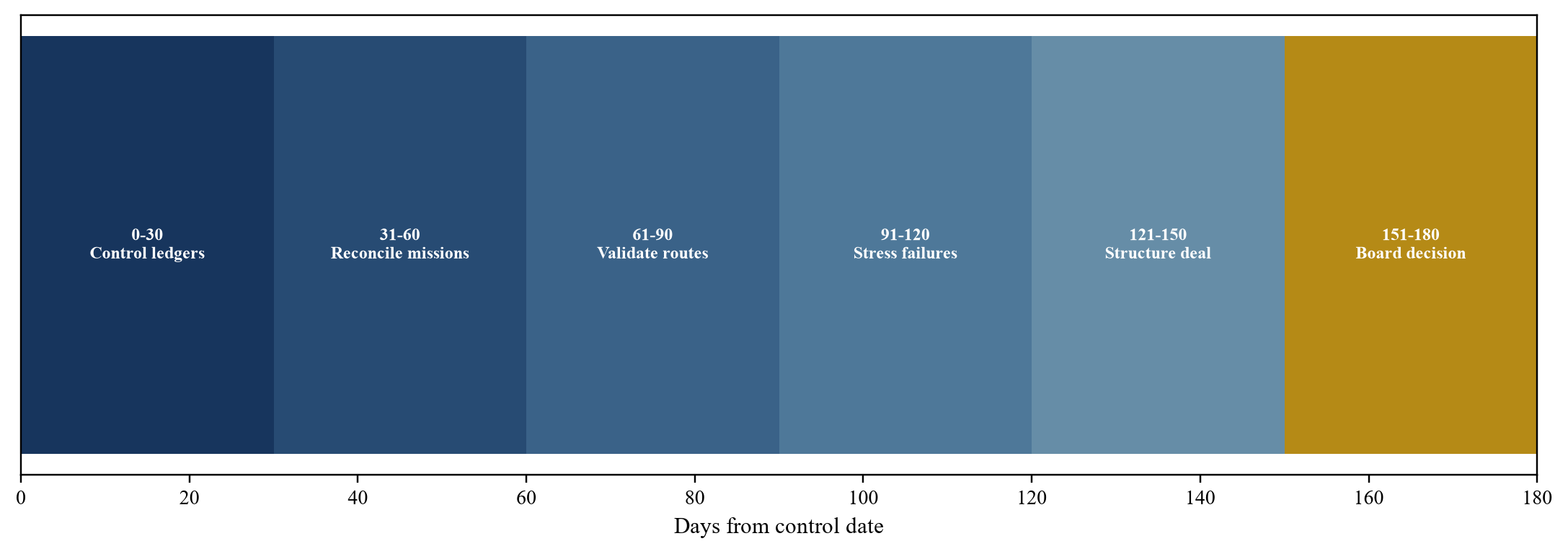
The programme moves from evidence control to route reconciliation, operating validation and board decision.
| Board question | Core measure | Evidence owner | Decision trigger |
|---|---|---|---|
| Can the missions lawfully operate | qualified routes and aircraft | accountable aviation executive | unresolved approval or transfer condition |
| Is the network being used | paid missions divided by approved capacity | chief operating officer | cohort below agreed utilisation gate |
| Is service reliable | completion, acceptance and recovery time | operations and customer leaders | persistent route-level failure |
| Is risk contained | exposure-adjusted events and open findings | safety accountable manager | material open safety claim |
| Are economics complete | contribution after failure and sustaining cost | chief financial officer | route remains negative after maturity gate |
| Is cash protected | runway and downside liquidity | board and finance | covenant or funding threshold approached |
| Can expansion repeat | evidence and capital per added route | integration leader | gate not met before deployment spend |
The dashboard keeps regulatory, operational, commercial and financial evidence in one decision view.
22. Integrate without breaking operating authority
Integration should be designed as an aviation change programme. The acquired platform's approvals, manuals, nominated personnel, maintenance arrangements, flight-control systems, data services and safety responsibilities form one operating system. Changing several components at once can make it difficult to show that the approved safety argument remains valid.
The integration leader should create a controlled change register. Each proposed change should identify the affected approval, safety claim, aircraft configuration, route, supplier, customer commitment, insurance policy and system record. The accountable aviation executive should determine whether the change can proceed under existing procedures or requires additional analysis, testing, notification or approval. Evidence should be retained before and after implementation.
Technology integration requires particular restraint. Replacing dispatch, identity, communications, maintenance or customer-order systems can alter data lineage and operational control. A migration plan should preserve route constraints, aircraft identity, remote-crew authority, event timestamps and audit history. Parallel operation and reconciled outputs can reduce the risk of losing evidence during cutover.
People and governance also need continuity. Certificate holders and safety cases can depend on nominated managers, competent remote pilots, maintenance personnel and established lines of accountability. Retention arrangements should cover critical roles while successors are assessed and accepted. The combined organisation should publish one decision matrix for dispatch, safety stop, incident escalation, regulator contact and return to service.
Commercial integration should follow operating validation. Customer interfaces, pricing and brands can be consolidated in stages while underlying routes continue under controlled configurations. Synergies should be released only after service reliability, approval continuity and data integrity are demonstrated. The integration budget should include duplicated systems and personnel during this period.
The board should receive a weekly integration evidence pack for material changes and a monthly view of route utilisation, incidents, open safety findings, customer acceptance, cash and approval activity. This discipline protects the asset that justified the acquisition: a repeatable approval-to-cash system.
23. Decision and conclusion
The acquisition case should be approved only when the buyer can identify the missions it will own, the permissions that support them, the evidence required to preserve those permissions, the demand that fills the routes and the complete cost of normal and failed operations. Airspace access becomes valuable through execution.
Three decisions follow. First, value current routes through accepted paid missions and complete failure-adjusted contribution. Second, value expansion through explicit technical, approval, commercial and capital gates. Third, structure consideration and integration around evidence continuity.
This method gives boards a practical way to distinguish a functioning delivery network from a collection of aircraft, demonstrations and announced geographies. It also identifies where capital creates value: approvals that unlock repeatable missions, node and route density that raises utilisation, controls that reduce failure cost, and operating evidence that supports customers, insurers and regulators.
The final investment memorandum should retain limitations. Approval continuity, market demand, insurance pricing, severe-event frequency and future airspace services can remain uncertain. Those uncertainties should be represented through conditions, ranges, scenarios and transaction protections rather than hidden inside one valuation multiple.
Sources
- Federal Aviation Administration. Package Delivery by Drone, Part 135. Read the primary source
- European Union Aviation Safety Agency. Specific Operations Risk Assessment. Read the primary source
- UK Civil Aviation Authority. Drone regulations, consultations and CAA publications. Read the primary source
- Federal Aviation Administration. Small Unmanned Aircraft Systems Regulations, Part 107. Read the primary source
- Federal Aviation Administration. Part 107 Waiver Section Specific Evaluation Information. Read the primary source
- European Union Aviation Safety Agency. Easy Access Rules for Unmanned Aircraft Systems. Read the primary source
- European Union Aviation Safety Agency. Easy Access Rules for U-space. Read the primary source
- UK Civil Aviation Authority. CAP 722A Unmanned Aircraft System Operations in UK Airspace Operating Safety Cases. Read the primary source
- UK Civil Aviation Authority. CAP 3038 Delivering Scalable UAS BVLOS in the Specific Category. Read the primary source
- Federal Aviation Administration. UAS Traffic Management Concept of Operations version 2.0. Read the primary source
- National Aeronautics and Space Administration. UAS Traffic Management Project. Read the primary source
- Federal Aviation Administration. Remote Identification of Drones. Read the primary source
- Electronic Code of Federal Regulations. 14 CFR Part 89 Remote Identification of Unmanned Aircraft. Read the primary source
- National Oceanic and Atmospheric Administration. National Centers for Environmental Information. Read the primary source
- World Meteorological Organization. Guide to Instruments and Methods of Observation. Read the primary source
- National Aeronautics and Space Administration. UAS Traffic Management Technical Documents. Read the primary source
- UK Information Commissioner's Office. Drones and data protection. Read the primary source
- European Data Protection Board. Guidelines 3/2019 on processing of personal data through video devices. Read the primary source
- National Institute of Standards and Technology. Cybersecurity Framework 2.0. Read the primary source
- National Institute of Standards and Technology. Artificial Intelligence Risk Management Framework. Read the primary source
- IFRS Foundation. IFRS 13 Fair Value Measurement. Read the primary source
- International Valuation Standards Council. International Valuation Standards. Read the primary source
- IFRS Foundation. IFRS 3 Business Combinations. Read the primary source
- IFRS Foundation. IAS 36 Impairment of Assets. Read the primary source
- IFRS Foundation. IAS 38 Intangible Assets. Read the primary source
- Federal Aviation Administration. Part 107 Airspace Authorizations. Read the primary source
- Federal Aviation Administration. Instructions for Certificate of Waiver or Authorization. Read the primary source
- Federal Aviation Administration. Section 927 Waiver Process for Unmanned Aircraft Systems. Read the primary source
- Federal Aviation Administration. BEYOND programme. Read the primary source
- Federal Aviation Administration. BVLOS Aviation Rulemaking Committee Final Report. Read the primary source
- Joint Authorities for Rulemaking on Unmanned Systems. SORA publications. Read the primary source
- International Civil Aviation Organization. Unmanned Aviation. Read the primary source
- Federal Aviation Administration. Drone Registration. Read the primary source
- Federal Aviation Administration. UAS Facility Maps. Read the primary source
- Federal Aviation Administration. Low Altitude Authorization and Notification Capability. Read the primary source
- Federal Aviation Administration. Drone Safety Tips. Read the primary source
- National Transportation Safety Board. Aviation Accident Database and Synopses. Read the primary source
- National Transportation Safety Board. Unmanned Aircraft Systems Investigations. Read the primary source
- Cybersecurity and Infrastructure Security Agency. Unmanned Aircraft Systems Security. Read the primary source
- Federal Communications Commission. Equipment Authorization. Read the primary source
- ASTM International. Unmanned Aircraft Systems Standards. Read the primary source
- RTCA. Special Committee 228 Minimum Performance Standards for Unmanned Aircraft Systems. Read the primary source
- International Organization for Standardization. ISO 21384 Unmanned Aircraft Systems. Read the primary source
- Federal Trade Commission and Department of Justice. 2023 Merger Guidelines. Read the primary source
- US Department of Justice. Antitrust Division Manual. Read the primary source
- European Commission. EU Merger Control. Read the primary source
- UK Competition and Markets Authority. Merger Assessment Guidelines. Read the primary source
- Federal Aviation Administration. Type Certification. Read the primary source
- Federal Aviation Administration. Aircraft Certification for Unmanned Aircraft Systems. Read the primary source
- Federal Aviation Administration. National Airspace System Status. Read the primary source
