

1. Convert family purpose into an annual decision
An annual deployment plan should begin with the family outcomes that capital is expected to serve. Those outcomes can include preserving control of an operating business, maintaining spending and philanthropic capacity, supporting entrepreneurship, diversifying a concentrated balance sheet, funding future generations or building institutional investment capability. A statement such as “invest for the long term” provides limited operating direction. Management needs a dated and measurable interpretation.
The plan should state the planning horizon, legal owners, expected inflows, required outflows, existing exposures, strategic reserves, approved risk capacity and decisions due during the year. It should also identify what remains outside the investment programme. An operating company, personal residence, art collection, philanthropic foundation and discretionary portfolio can form part of family wealth while following different legal, liquidity and governance rules.
Conviction should be converted into an investment belief that can be challenged. A family can believe that control investments create comparative advantage because it brings sector expertise and networks. The plan should then specify the sectors, geographies, ownership rights, operating resources, concentration limit and evidence required to act. A preference for private markets should similarly connect to illiquidity capacity, manager selection, pacing, valuation and cash-call readiness.
The annual process is a governance cycle. The family approves purpose and boundaries; the investment committee approves mandates; the office executes within authority; finance reconciles cash and ownership; and the governing body reviews outcomes. Material events should return the plan to the relevant decision maker.
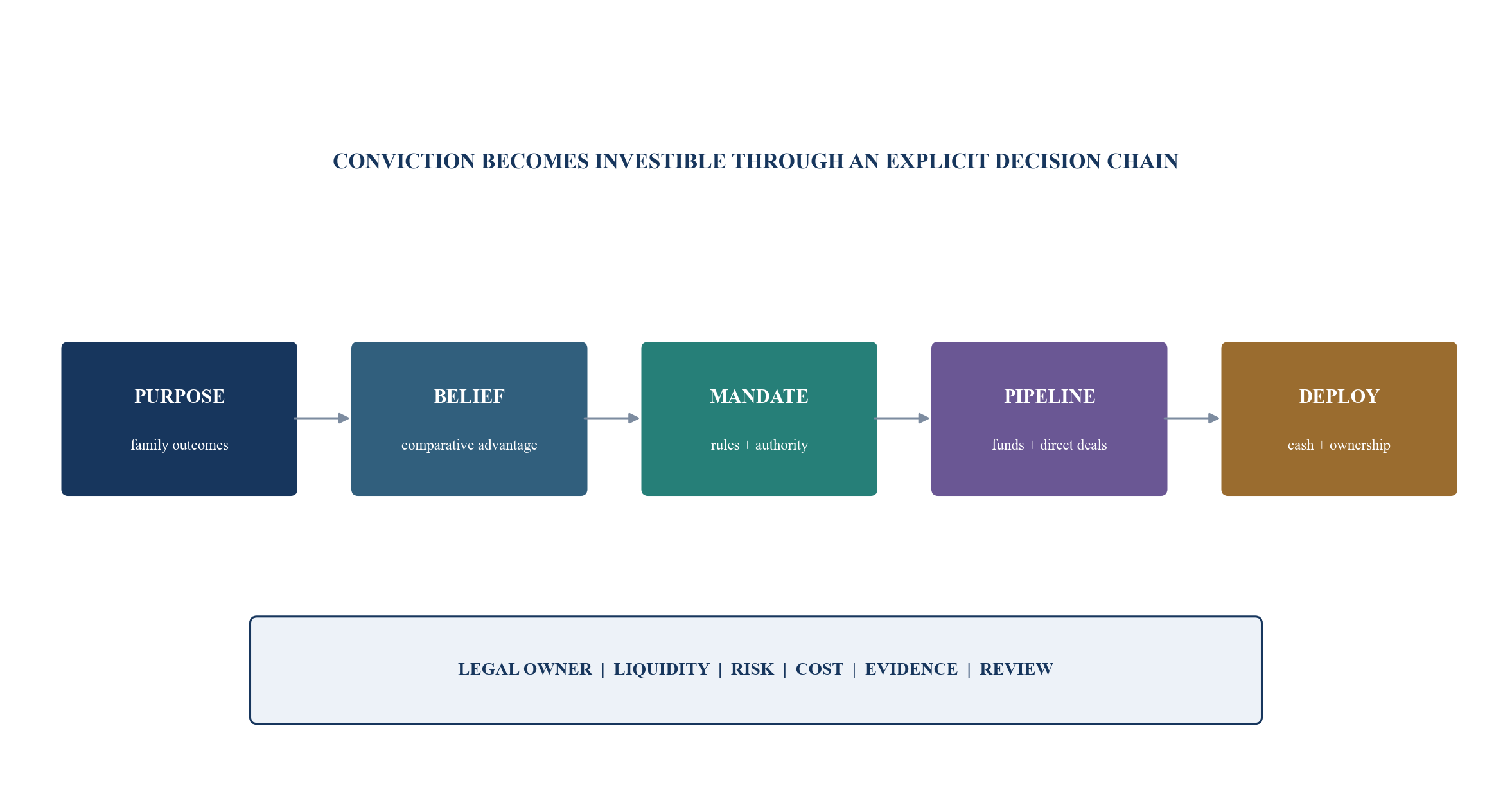
Author framework. Every transition requires an accountable owner, evidence and approval.
2. Map the family balance sheet by legal owner
The family balance sheet should preserve legal ownership. Personal accounts, foundations, trusts, holding companies, operating businesses, special-purpose vehicles and philanthropic entities can pursue related family objectives while retaining different powers, beneficiaries, liabilities, tax positions and reporting duties. A consolidated view can support strategy; it should never imply that assets are interchangeable or that one decision maker can direct every account.
The map should record each entity and person, ownership chain, purpose, governing law, decision body, signatories, accounts, assets, liabilities, guarantees, cash restrictions, reporting, valuation source and review date. It should identify cross-collateralisation, related-party balances and operating-company dependencies.
The legal owner determines which mandate applies. A foundation may invest for multi-generational distributions under its constitutional powers. A holding company may preserve control and reinvest business proceeds. An individual may require personal liquidity. A philanthropic vehicle may have restricted purposes. The family investment committee should know whether it decides, advises, recommends or merely receives information for each owner.
Family-office frameworks illustrate the need for precision. DIFC offers family-office, foundation, holding-company and other structures within its family-wealth ecosystem. Hong Kong's family-owned investment holding vehicle regime defines ownership, management, assets, activities and record requirements for its tax concession. Singapore's fund incentives and related administrative materials distinguish fund vehicle, manager and annual declarations. The United States SEC family-office rule defines conditions for exclusion from the Investment Advisers Act. These frameworks serve different legal purposes and should not be treated as interchangeable investment labels.
Table 1. Legal-owner capital map
| Layer | Evidence to maintain | Deployment consequence |
|---|---|---|
| family purpose | charter, constitution, family decisions and beneficiary needs | defines outcomes and boundaries |
| legal owner | title, ownership chain, governing law and capacity | determines who can invest and bear risk |
| authority | board, council, trustee, committee, delegation and signatories | determines valid approval and execution |
| liquidity | cash, liabilities, distributions, calls and restrictions | determines deployable capital by date |
| exposure | operating company, funds, direct assets, property and guarantees | reveals concentration and loss pathways |
| reporting | accounts, valuations, tax classifications and data permissions | determines measurement and disclosure |
| continuity | successor roles, records, providers and emergency powers | determines whether the plan survives change |
Entity treatment depends on governing documents, law and facts.
3. Separate strategic capital from annual deployable capital
Strategic wealth and annual deployable capital are different measures. Strategic wealth can include illiquid businesses, property, art, carried interests, trust assets and future inheritances. Annual deployable capital consists of resources that the relevant legal owner can lawfully and practically commit during the planning period after reserves, liabilities and existing obligations.
The opening reconciliation should begin with verified cash and securities, expected operating-company dividends, known asset sales, loan proceeds, distributions from funds and other inflows. It should deduct family spending, tax, philanthropy, debt service, business support, property expenditure, capital calls, existing contractual commitments and minimum reserves. Timing, currency, entity and certainty matter as much as the annual total.
Management should distinguish committed, expected and contingent resources. A signed asset sale with conditions outstanding is not cash. An expected dividend depends on the operating company's legal and financial capacity. A private-fund distribution is uncertain until declared and received. Credit lines can provide contingency liquidity while creating covenants, collateral and refinancing exposure.
The plan should also identify restricted pools. Cash held within an operating company may be required for working capital or regulated capital. Foundation assets may follow constitutional purposes. Trust assets follow trustee powers and duties. Collateral cannot be counted as freely deployable without considering security terms. This discipline prevents a family-level allocation from exceeding entity-level capacity.
4. Translate beliefs into mandate cards
Each investment programme needs a mandate card. The card should state the legal owner, purpose, decision authority, target exposure, eligible investments, prohibited activities, geography, currency, return objective, benchmark, risk budget, concentration, liquidity, leverage, valuation, fees, conflicts, reporting and review triggers. The mandate creates an operational bridge between the family constitution or investment policy and actual transactions.
The mandate should identify comparative advantage. A family with expertise in logistics may approve direct control or co-investments where it can contribute sector knowledge. That advantage should be defined through team capacity, sourcing access, diligence skill, governance rights and post-investment support. Familiarity with a sector is not by itself a repeatable edge.
Boundaries should be explicit. A global-equity mandate can specify permissible vehicles, active or passive approach, currency policy and rebalancing bands. A private-credit mandate can set borrower, security, leverage, covenant, duration and concentration standards. A venture mandate can define stage, cheque size, follow-on reserve and loss tolerance. A direct real-estate mandate can specify asset type, location, leverage, development risk and operating partner.
CFA Institute's investment-governance work highlights alignment, clarity and the role of an investment policy statement in recording objectives and constraints. The annual plan should preserve that discipline while adding a dated execution layer. Every pipeline item should map to an approved mandate before resources are spent on advanced diligence or negotiation.
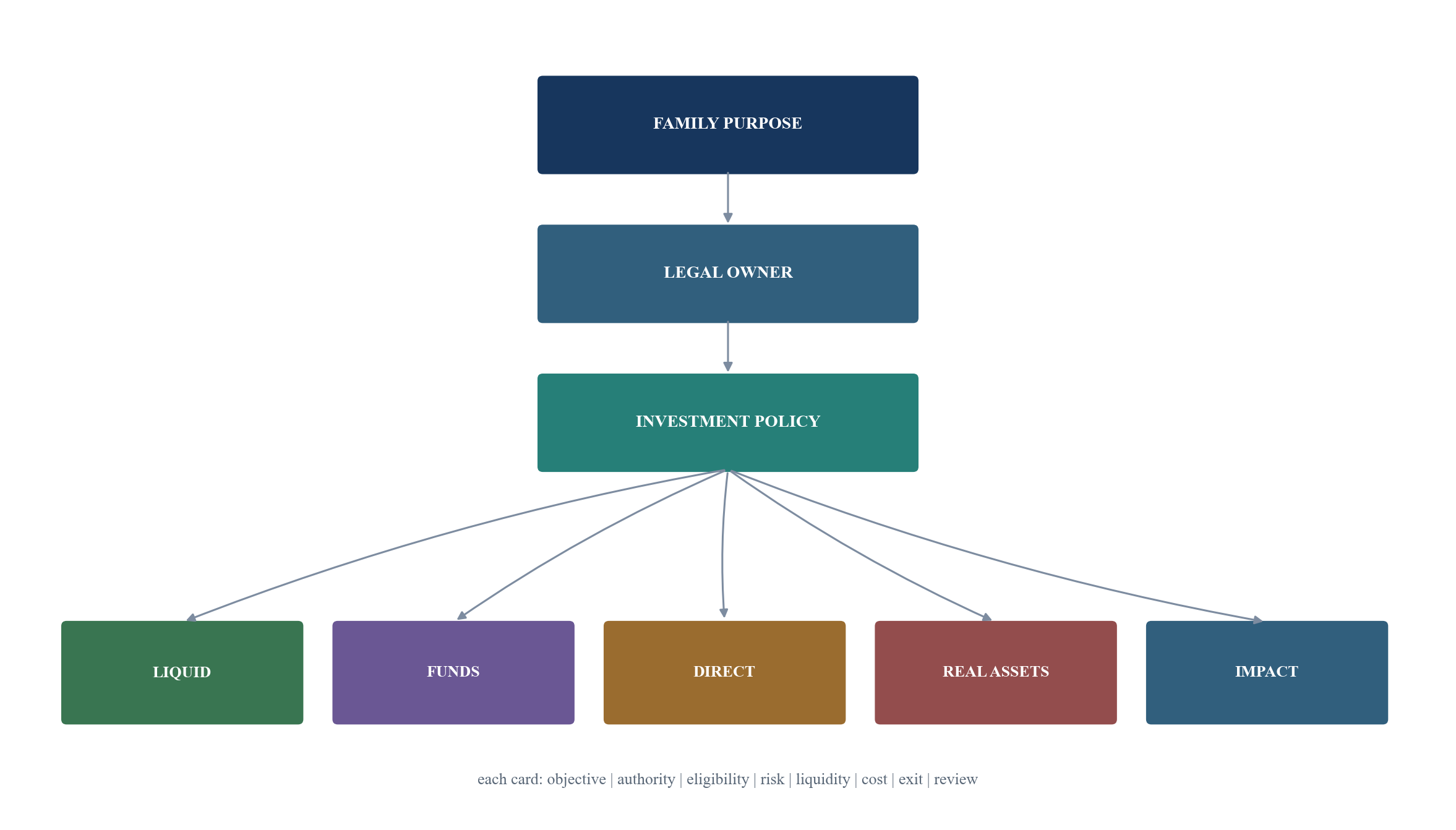
Author framework. A transaction inherits the boundaries of its legal owner and mandate.
5. Build the strategic allocation from risk roles
Asset classes should be assigned a portfolio role. Cash and short-duration assets can fund obligations and optionality. Public markets can provide liquid growth, income and rebalancing capacity. Private funds can access specialist managers and less liquid return streams. Direct investments can provide control or influence while increasing concentration and operating demands. Real assets can serve income, inflation sensitivity or strategic use. Philanthropic and mission capital can pursue defined non-financial outcomes under separate authority.
The allocation should connect each role to an economic risk driver. Public and private labels can hide common exposure to growth, rates, credit, commodities, technology, policy or a family operating company. Existing concentration should be combined with proposed exposure.
Risk capacity should be assessed across the complete family system. The ability to tolerate market volatility differs from the ability to fund a capital call, absorb a private-company failure, support a business during recession or maintain distributions through a multi-year drought. Leverage and guarantees can connect apparently separate assets.
The plan should state target ranges rather than false precision. Ranges allow controlled response to market movement and cash flows. Rebalancing rules should distinguish drift caused by prices, valuations, calls, distributions, new cash and strategic decisions. Private assets require particular care because appraisal values can adjust slowly and the denominator can move before reported net asset values do.
Table 2. Mandate architecture by capital role
| Capital role | Primary decision question | Operating evidence |
|---|---|---|
| liquidity reserve | which dated obligations must be met under stress? | entity cash ladder, currencies, restrictions and contingencies |
| liquid portfolio | which risks and returns can be obtained with rebalancing capacity? | benchmark, vehicles, costs, custody and drift bands |
| private funds | which specialist capabilities justify fees and illiquidity? | manager diligence, terms, pacing, calls, valuations and exit evidence |
| direct investments | where does the family have a repeatable ownership advantage? | sourcing, diligence, governance rights, operating plan and exit route |
| real assets | which income, use or resilience objective is served? | title, leverage, capex, operating data, valuation and liquidity |
| mission capital | which social or environmental outcome has authorised priority? | purpose, instrument, measurement, conflict and reporting rules |
Illustrative roles require family- and entity-specific approval.
6. Reconcile the allocation with a dated liquidity budget
The liquidity budget converts target weights into feasible actions. It should show opening cash by entity and currency, expected inflows, contractual outflows, capital calls, distributions, debt service, tax, philanthropy, family spending, business support and minimum reserves across monthly or weekly periods. It should record the source and confidence of every material assumption.
Private-market calls require a commitment model. The family should maintain every fund, commitment date, total commitment, funded amount, unfunded balance, expected call pattern, distributions, recycling provisions, extension terms, currency and notice period. Scenario ranges should capture faster calls, delayed distributions, subscription facilities, follow-on vehicles and foreign-exchange movement.
ILPA's updated Capital Call and Distribution Template seeks standardised visibility into the accounting details and transaction components needed to monitor fund activity. The family office should use consistent transaction categories and reconcile notices to legal documents, bank movements, fund records and the commitment ledger. Netting a call and distribution can obscure gross funding requirements.
Liquidity sources should be ranked. Unrestricted cash differs from listed securities that may need to be sold, distributions that have not been declared, credit subject to covenants and capital expected from another entity. A liquidity reserve should be held by the legal owner that faces the obligation or supported by documented, lawful transfer arrangements.
7. Pace private-market commitments across vintages
The private-market plan should target exposure and cash-flow resilience rather than annual commitment volume alone. Commitments create future calls, fees and concentration before capital is fully invested. Distributions depend on realisations and financing conditions. Net asset value can continue rising while cash returns slow.
Pacing should begin with the existing portfolio. The office should assess unfunded commitments, expected calls, maturity, manager concentration, strategy, geography, currency, valuation quality and likely exits. New commitments should be tested against base, accelerated-call and distribution-drought scenarios. The plan should reserve capacity for follow-ons and avoid assuming that every manager returns on schedule.
Vintage diversification can reduce dependence on one market entry point. It does not remove strategy, manager or economic-cycle concentration. A family can spread commitments across years while repeatedly buying the same technology, leverage or exit exposure. The risk dashboard should therefore combine vintage with underlying drivers.
The commitment rule should state approval authority, annual ceiling, manager and strategy limits, minimum liquidity coverage and pause events. A reserve breach or operating-company deterioration may require temporary reduction.
Table 3. Hypothetical private-market pacing test
| Item | Base case | Stressed case | Governance response |
|---|---|---|---|
| opening unrestricted liquidity | USD 75m | USD 75m | verify by legal owner and currency |
| twelve-month capital calls | USD 26m | USD 42m | reserve for accelerated funding |
| twelve-month distributions | USD 22m | USD 8m | do not fund obligations from unreceived cash |
| family and tax outflows | USD 14m | USD 18m | preserve priority payments and contingency |
| approved new commitments | USD 35m | USD 12m | reduce pacing when stressed coverage falls |
| minimum closing reserve | USD 32m | USD 28m | pause commitments if the approved floor is breached |
All amounts are hypothetical management assumptions used solely to demonstrate the method.
8. Build a direct-deal funnel with independent gates
Direct investing attracts family conviction because it offers ownership, influence and proximity to entrepreneurs. It also concentrates selection, valuation, governance, financing and execution risk. The annual plan should define which direct opportunities deserve attention before individual relationships create momentum.
The funnel should begin with mandate fit. A deal outside approved sector, geography, stage, cheque size, control rights or risk appetite should be rejected or returned for a mandate decision. Initial screening should then test business quality, ownership, management, financial profile, capital need, valuation, legal route, conflicts and the family's genuine ability to add value.
Advanced diligence should be independent of the sponsor of the idea. Commercial, financial, legal, tax, technology, operational, cyber, regulatory and integrity work should converge in one issue register. The decision paper should distinguish verified facts, management representations, open issues, assumptions, downside cases and conditions.
Execution requires a complete ownership plan: instrument, rights, funding, approvals, conditions, governance, reporting, value-creation resources, follow-on capacity and exit. The family should state who will represent it, how conflicts are managed and which decisions return to the investment committee. A relationship should not substitute for evidence.
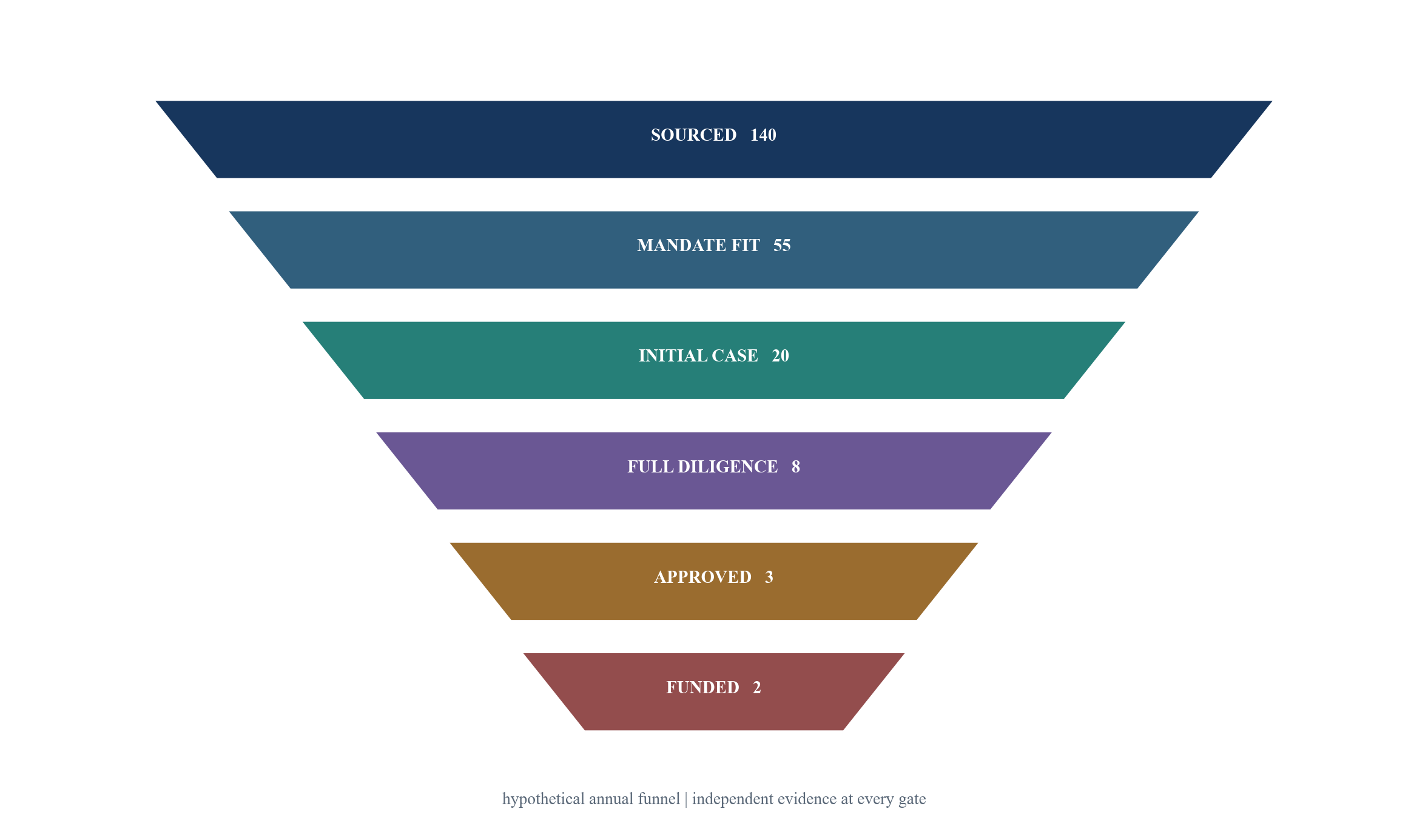
Author framework. Opportunity count falls as evidence and capital at risk increase.
9. Govern manager selection as an allocation decision
Fund selection should follow the role defined in the mandate. A strong manager can still be unsuitable for the family if strategy, liquidity, currency, concentration, access route, fees or governance do not fit. The investment case should explain why a fund improves the complete portfolio rather than presenting past performance in isolation.
Diligence should cover organisation, ownership, team, strategy, decision process, portfolio, performance, valuation, risk, leverage, liquidity, fees, conflicts, service providers, operations, cyber resilience, responsible-investment claims, legal terms and reporting. Track-record analysis should reconcile cash flows and separate realised and unrealised value. Attribution should distinguish market exposure, leverage, operating improvement, multiple change and manager selection where evidence permits.
ILPA Principles emphasise alignment, governance and transparency between limited and general partners. The family should translate those themes into specific questions on key-person provisions, continuation vehicles, allocation of opportunities, cross-fund transactions, subscription facilities, expenses, co-investments, advisory committees and amendments.
Approval should include implementation. The office needs subscription documents, tax and legal analysis, funding instructions, custody or recordkeeping, reporting feeds, valuation dates and monitoring owners. A fund commitment is incomplete until the family can receive notices, validate instructions, fund safely, reconcile ownership and monitor the mandate.
10. Match financing to the legal owner and purpose
Financing can preserve liquidity, bridge timing or increase exposure. It can also transmit risk between family entities and undermine the reserve intended to protect obligations. The plan should identify every borrower, guarantor, pledgor, beneficiary of proceeds, security asset, covenant and repayment source.
Portfolio-backed facilities can support short timing gaps when assets are liquid, valuations are reliable and collateral terms are understood. A facility used to finance long-duration private commitments creates refinancing and margin risk. Borrowing against a concentrated operating-company stake can increase sensitivity to the same business that generates family cash flow.
Financing returns should be shown after interest, fees, tax and hedging. Coverage, loan-to-value, margin calls, currency mismatch, recourse and lender control should be stressed. Borrowing and pledge authority should remain specific to the relevant legal owner.
11. Make cross-border structure an operating input
An annual investment plan can span residence, citizenship, domicile, entity location, asset location, adviser location and custody. Each dimension can affect legal capacity, licensing, promotion, tax, reporting, data, sanctions and succession. The plan should route these questions to qualified advisers before an investment becomes time-critical.
Hong Kong's family-office tax concession illustrates the connection between ownership, normal management or control, an eligible single family office, minimum assets, qualifying transactions, substantial activities and records. Its government gazetted a 2026 bill proposing enhancements to preferential regimes; a proposal should remain separate from enacted law until the legislative process is complete.
Singapore's Sections 13O and 13U fund incentives have approval and annual-declaration dimensions reflected in official IRAS materials, while the precise conditions belong to current law and MAS administration. The United States family-office exclusion under the Investment Advisers Act turns on the rule's definition and conditions. DIFC offers a family-wealth ecosystem and several legal structures. None of these regimes determines portfolio suitability or authorises activity in another jurisdiction.
The office should maintain a jurisdiction register for every mandate and transaction. It should state the legal owner, service provider, activity, permission, tax advice, reporting classification, data route, source, effective date, owner and review trigger. A registration or tax incentive should not be treated as a substitute for investment governance.
12. Build one risk dashboard with evidence behind every signal
The risk dashboard should connect family outcomes with legal owners and investment mandates. It should show liquidity coverage, concentration, leverage, currency, unfunded commitments, valuation age, public-market drawdown, private-market exposure, direct-deal performance, counterparty dependencies, exceptions and succession readiness.
Scores are useful only when their construction is visible. A green liquidity indicator should link to current bank balances, restrictions, dated obligations, approved facilities and stress assumptions. A private-asset value should show the valuation date, method, source, material events and uncertainty. A concentration measure should include look-through where evidence is available and disclose gaps.
IOSCO's 2025 work on liquidity management distinguishes liquid, less liquid and illiquid assets and emphasises the relationship between liquidity classification and portfolio management. IFRS 13 provides a fair-value framework, while IPEV guidance supports consistent private-capital valuation practice. Family reporting should identify which basis applies and avoid presenting appraisal precision as sale certainty.
The dashboard should support decisions. Each threshold needs an owner, action and authority. A breach may pause new commitments, increase cash, reduce leverage, seek a secondary sale, refresh a valuation, require independent advice or escalate to the governing body. Informational colour without a response rule provides limited control.
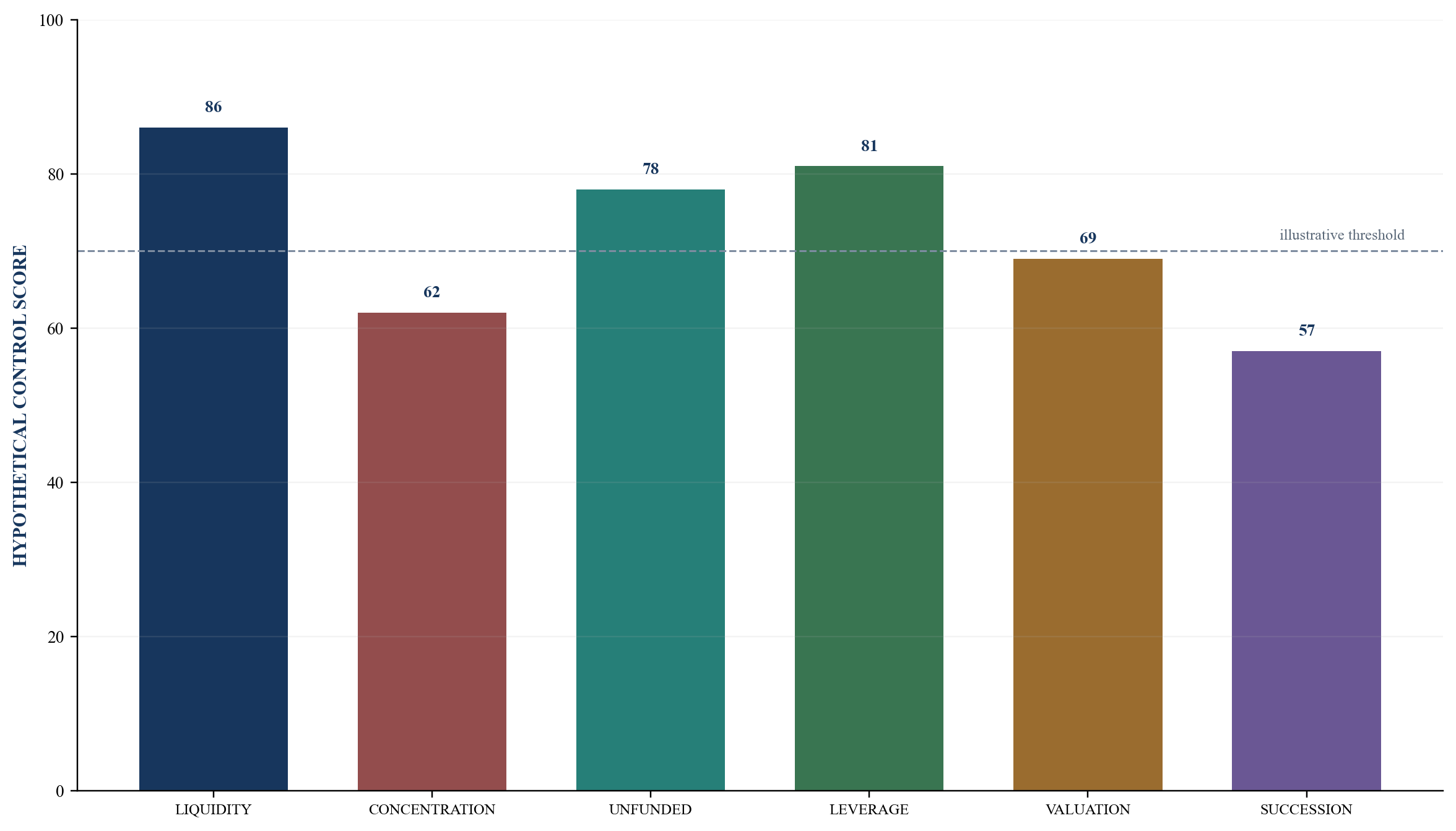
Author framework. Scores and the threshold are hypothetical and require family-specific evidence and approval.
13. Measure results against purpose and mandate
Performance reporting should begin with the objective. A liquidity reserve should be assessed for availability, preservation, yield and service of obligations. A public portfolio should be assessed against its benchmark, risk budget, cost and rebalancing role. A private programme should be assessed through timed cash flows, multiples, valuation quality, liquidity and portfolio contribution. A direct investment should connect operating outcomes, cash, governance and exit value.
Return calculations require consistent data. The office should reconcile contributions, distributions, fees, valuations, income, foreign exchange and ownership. Gross and net results should be distinguished. Internal rate of return, multiples and public-market-equivalent measures answer different questions. No single metric proves skill or mandate success.
The family should review complete economics. External manager fees, performance allocations, fund expenses, platform charges, custody, advice, tax, transaction costs, financing, hedging, internal staff and technology all consume resources. The legal owner paying each cost should be visible.
Outcome review should include decisions that were declined, delayed or exited. Governance value can arise from avoiding a concentrated exposure, preserving liquidity or resolving a conflict. The annual review should compare assumptions with actual cash flows, exposure, risk, cost and family outcomes.
Table 4. Annual mandate scorecard
| Domain | Review question | Decision evidence |
|---|---|---|
| purpose | did capital serve the documented family outcome? | distributions, ownership, services and beneficiary outcomes |
| allocation | did actual exposure remain within approved ranges? | reconciled holdings, look-through, drift and exceptions |
| liquidity | were obligations funded under base and stress conditions? | dated cash ledger, calls, reserves and facilities |
| return | did results compensate for risk, liquidity and cost? | cash flows, benchmarks, valuations and attribution |
| governance | were decisions valid, timely and documented? | minutes, delegations, conflicts, conditions and actions |
| continuity | can the programme survive role or ownership change? | successor appointments, access, records and tested procedures |
Measures should be approved for each legal owner and mandate.
14. Govern valuation uncertainty
Private assets should be valued under an approved policy that identifies responsibility, frequency, methodology, evidence, review and challenge. The investment team can provide operating information and context; independent governance should challenge assumptions and consistency where material conflicts exist.
The office should maintain valuation bridges from the last approved value, showing cash flows, earnings, leverage, market multiples, milestones, currency, dilution and material events. Models should state inputs and sensitivities; manager values should retain source and date.
Fair value does not state the time, certainty or cost of sale. The plan should use approved liquidity haircuts and timing assumptions. When private values are stale or uncertain, the committee may use commitment, cost, stress value, cash-flow or range-based views alongside reported fair value.
15. Manage conflicts and related-party opportunities
Family capital can create overlapping roles. A family member may sponsor a deal, control the seller, sit on the investment committee, receive fees and become a portfolio executive. The family office may select an affiliated manager or allocate an opportunity between personal, foundation and company accounts. These relationships require explicit governance.
The conflict register should identify parties, economic interests, decision roles, affected legal owners and safeguards. Safeguards can include disclosure, recusal, independent advice, external valuation, competitive process, allocation rules and disinterested approval.
Related-party transactions should be assessed against the mandate and complete economics. A family relationship does not prove that price, terms, risk or allocation are fair. The decision paper should show alternatives and conditions. Any continuing service, board role, monitoring fee, carried interest or guarantee should remain visible after closing.
Confidentiality should be preserved by legal account and role. Consolidated family reporting does not give every family member access to every entity or personal account. Systems and meeting packs should implement the approved information boundaries.
16. Embed succession in the deployment plan
Succession affects investment horizon, liquidity, authority, ownership and risk tolerance. A plan that depends on one founder's judgement or signature can fail when incapacity, death, dispute or transition occurs. Succession should therefore be treated as an operating constraint during ordinary investment decisions.
The office should map every critical role: family principal, board or council member, trustee, investment-committee chair, chief investment officer, authorised signatory, bank contact, portfolio-company director and provider owner. It should record appointment and removal, quorum, reserved matters, alternates, access, information and emergency authority.
Portfolio design should consider transition. A large direct investment can create governance and funding duties for successors. Concentrated or illiquid assets may conflict with distributions or branch-level fairness. Personal guarantees and undocumented loans can create disputes. The annual plan should identify which exposures require simplification, liquidity, independent governance or successor education.
Next-generation participation should follow capability and authority. Education, observer roles, mandate ownership and supervised decisions can build competence. Family status alone should not grant transaction authority in systems. The succession pathway should link learning to defined responsibilities and evidence.
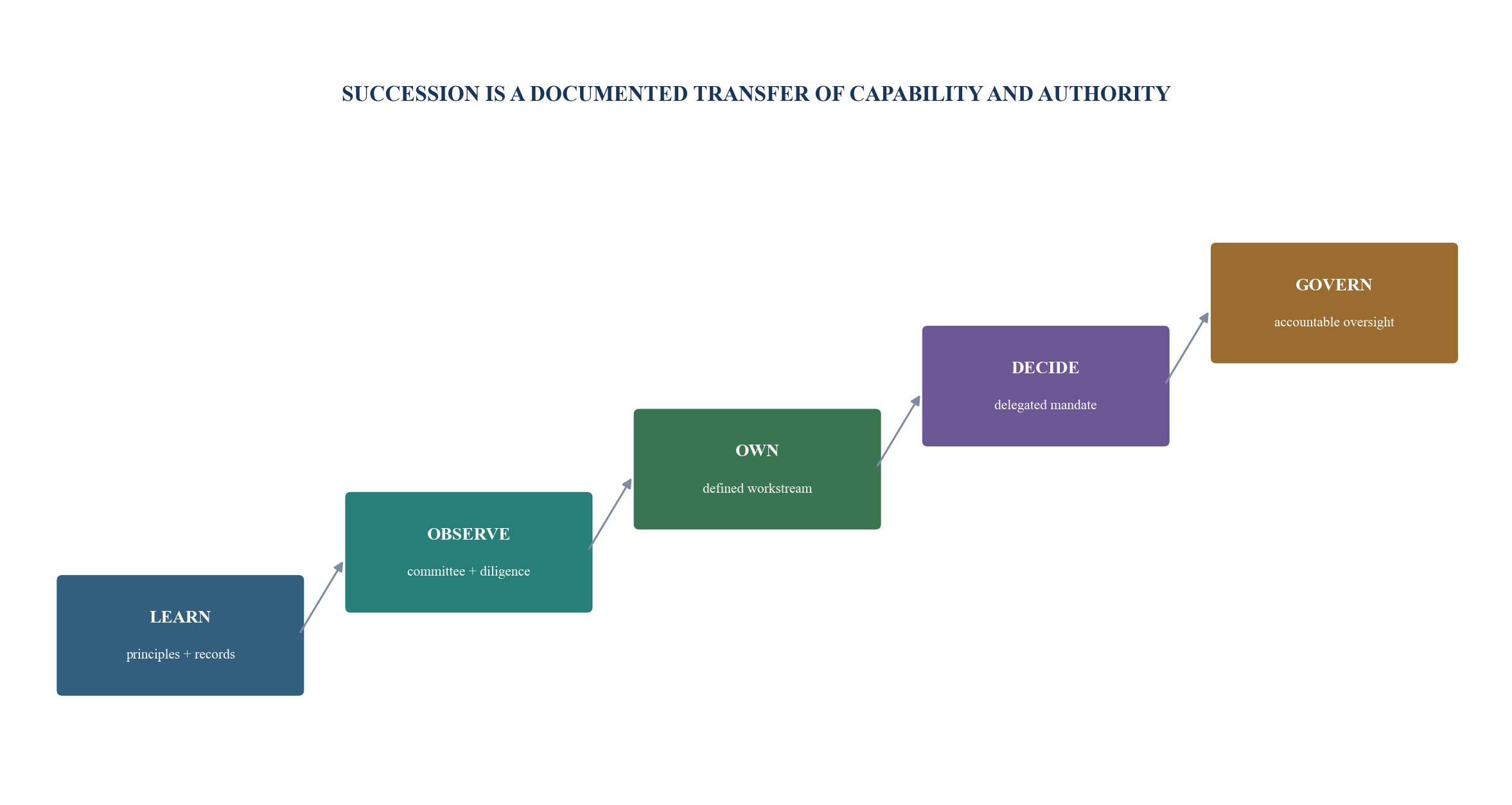
Author framework. Progression depends on competence, mandate need and valid appointment.
17. Run a governance calendar that produces decisions
The annual calendar should sequence decisions before capital becomes urgent. The first quarter can approve purpose, legal-owner maps, policy, liquidity reserve and mandates. Subsequent meetings can review pipelines, pacing, direct deals, valuations and risk. Mid-year and year-end reviews should compare outcomes with plan.
Meeting frequency should follow the decision set. A monthly investment committee can review allocation, liquidity and pipelines. A quarterly governing body can approve material changes and strategic exposures. Finance may require weekly cash and capital-call control.
Each meeting should have a defined input, authority and output. A pipeline discussion can provide direction without approving an investment. An allocation review can approve ranges without authorising an individual transaction. Minutes should record decisions, conditions, dissent, recusals, owners and due dates.
The calendar should include external events: fund closes, capital-call windows, reporting dates, tax filings, debt maturities, option expiries, portfolio-company budgets, family distributions and succession milestones. This view helps the office allocate analytical and decision capacity before deadlines collide.
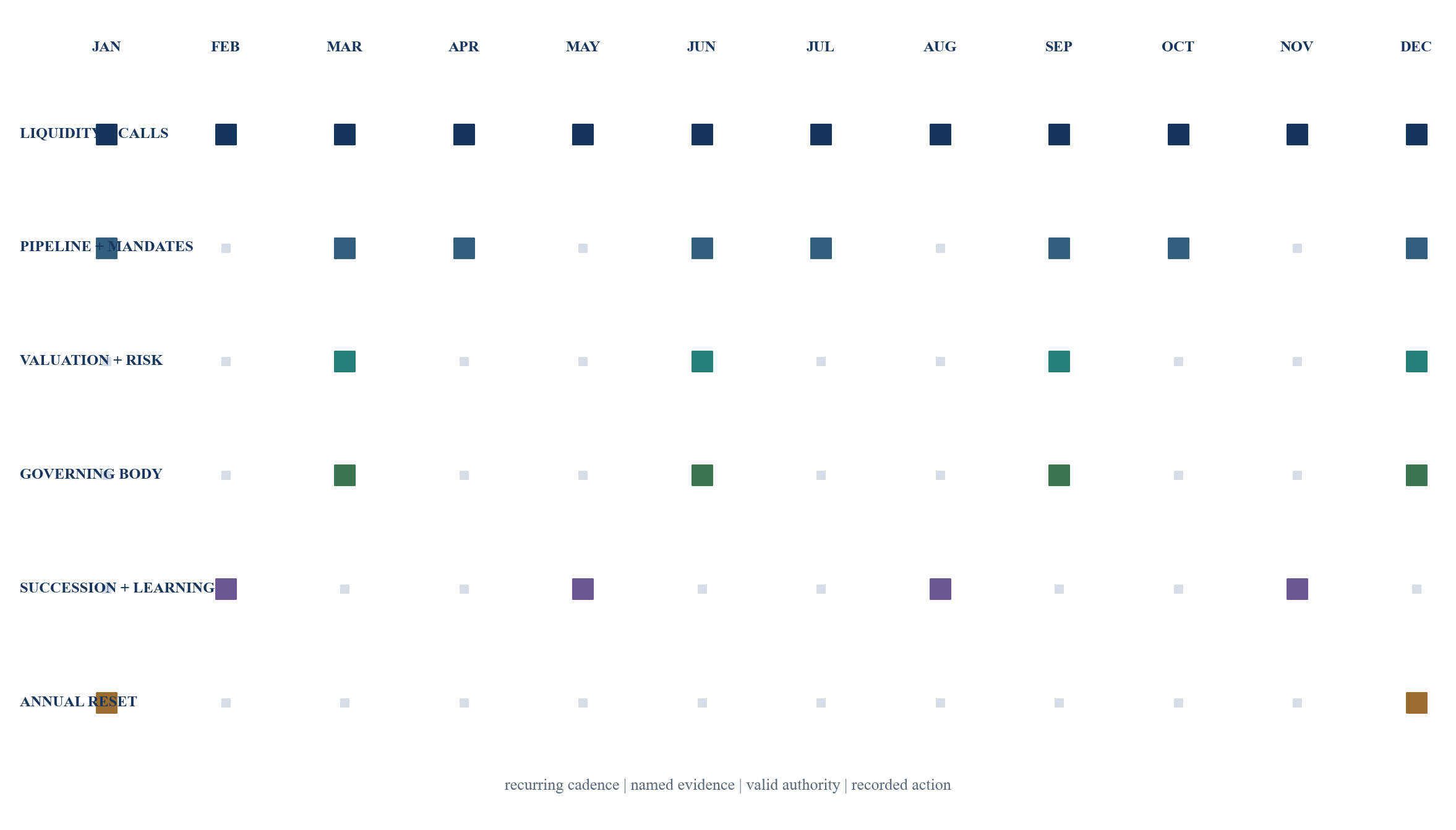
Author framework. Event-driven meetings supplement the recurring cadence.
18. Implement the plan through a 100-day sequence
Days 1 to 20 should establish scope. The team should confirm family purpose, legal owners, authority, existing policies, accounts, assets, liabilities, guarantees, commitments, expected cash flows, providers and known disputes. It should define the authoritative data sources and open an issue register.
Days 21 to 40 should build the family balance sheet and liquidity ladder. The office should reconcile ownership, valuations, cash, debt, commitments and restrictions; map currency and entity; and define base and stress cases. Missing or conflicting data should remain visible.
Days 41 to 60 should approve mandate cards and the strategic allocation. The committee should record objectives, ranges, eligible investments, risk, liquidity, leverage, valuation, costs, conflicts, benchmarks and review triggers. Pipeline work should be mapped to those mandates.
Days 61 to 80 should configure execution. The office should establish the direct-deal funnel, manager diligence, capital-call control, custody, funding, legal and tax routes, meeting calendar, decision papers, dashboards and reporting. Users and signatories should have approved system access.
Days 81 to 100 should test and launch. Management should run an accelerated capital-call case, distribution drought, market drawdown, direct-deal conflict, stale valuation, founder incapacity and provider outage. Material gaps should be closed or accepted by the authorised body with conditions and due dates.
The initial plan should be limited to evidence-supported activity. Expansion can follow after the office demonstrates valid decisions, funding control, reconciliation and reporting.
Table 5. One-hundred-day implementation sequence
| Period | Principal output | Acceptance gate |
|---|---|---|
| days 1-20 | scope, family purpose, legal-owner and authority maps | governing body confirms objective and decision perimeter |
| days 21-40 | reconciled balance sheet, liquidity ladder and issue register | finance and owners accept data coverage and limitations |
| days 41-60 | investment policy, mandate cards and allocation ranges | investment committee approves boundaries and review rules |
| days 61-80 | pipelines, diligence, controls, calendar and dashboard | legal, operations and investment owners accept execution design |
| days 81-100 | scenarios, training, launch conditions and action register | authorised body approves limited launch and unresolved conditions |
Timing should be adapted to legal, data and family complexity.
19. Give the governing body a decision scorecard
The governing body needs a concise view of family outcomes, legal capacity, capital, liquidity, risk, economics, governance and continuity. Aggregate net worth is insufficient when a transaction lacks authority, obligations cannot be funded or control depends on one person.
Leading indicators should include stale ownership records, expired delegations, cash coverage, unfunded commitments, concentration, leverage, valuation age, pipeline exceptions, unresolved diligence, related-party conflicts, provider incidents and successor readiness. Outcome measures should include funded obligations, mandate delivery, net performance, complete cost, cash distributions, portfolio resilience and continuity through events.
Thresholds should define action. A breach may pause a commitment, defer a direct deal, require independent valuation, reduce leverage, increase reserves, change a manager, restrict a signatory or escalate a succession decision. Every action should have an owner and due date.
The scorecard should retain a path to the legal-owner map, liquidity ledger, mandate, decision paper, valuation bridge and conflict record.
Table 6. Governing-body scorecard for annual capital deployment
| Domain | Governing question | Decision evidence |
|---|---|---|
| purpose and ownership | whose capital is being deployed and for which outcome? | family decisions, legal title, constitutional documents and mandate |
| authority | can every decision and instruction be traced to valid power? | delegations, minutes, signatories and system access |
| liquidity | can every dated obligation be met under stress? | cash ladder, commitments, facilities and scenario results |
| portfolio risk | where are concentration, leverage, currency and illiquidity? | reconciled exposures, look-through, valuations and limits |
| investment quality | does each manager or deal meet the approved evidence standard? | diligence, decision papers, conditions and monitoring |
| economics | are returns, fees, financing and internal costs complete? | cash flows, ledgers, contracts, attribution and benchmarks |
| continuity | can the programme continue through role or ownership change? | successor appointments, records, access and tested procedures |
Thresholds and risk appetite require family- and entity-specific approval.
20. Keep capital deployment continuously governed
The annual plan should change when family circumstances, ownership, law, markets, assets or obligations change. Material triggers include a business sale, dividend reduction, major acquisition, family distribution, death or incapacity, residence change, new beneficiary, tax reclassification, large capital call, fund extension, valuation event, breach, sanctions exposure or provider failure.
The durable operating principle is traceability. Management should be able to show which legal owner supplied capital, which purpose and mandate applied, who approved, what evidence was reviewed, how the transaction was funded, which rights were obtained, how value and risk were measured, what costs were incurred and how the decision served the family outcome.
One accountable investment-office leader can coordinate the process. Family governing bodies, company boards, foundation councils, trustees, investment committees, legal, tax, finance, operations and external advisers retain their respective authority and professional duties. Coordination should make those boundaries usable rather than invisible.
The annual governing question is whether the family can reproduce the path from purpose and legal ownership through mandate, approval, funding, monitoring, distribution and succession. Missing links require remediation before expansion.
References
- Dubai International Financial Centre, DIFC Family Wealth Centre, https://www.difc.com/ecosystem/difc-family-wealth-centre
- Dubai International Financial Centre, Family Businesses, https://www.difc.com/business/establish-a-business/family-businesses
- Dubai International Financial Centre, Wealth and Asset Management, https://www.difc.com/business/establish-a-business/wealth-and-asset-management
- Dubai International Financial Centre, Family Arrangements Regulations, https://assets.difc.com/v1/media/edge/images/dubaiintern0078-difcexperie96c5-production-3253/media/project/difcexperiences/difc/difcwebsite/documents/familydocs/family_arrangements_regulations_updated_april23.pdf
- Inland Revenue Department, Hong Kong, Tax Concessions for Family-owned Investment Holding Vehicles, https://www.ird.gov.hk/eng/tax/bus_fihv.htm
- Hong Kong Government, Inland Revenue Amendment Preferential Tax Regimes for Funds, Family-owned Investment Holding Vehicles and Carried Interest Bill 2026 gazetted, 12 June 2026, https://www.info.gov.hk/gia/general/202606/12/P2026061200200.htm
- FamilyOfficeHK, Setting Up a Family Office in Hong Kong, https://www.familyofficehk.gov.hk/media/ejleayol/e_family-office-booklet.pdf
- Hong Kong New Capital Investment Entrant Scheme, New measure effective from 1 March 2026, https://www.newcies.gov.hk/en/new-measures/
- Inland Revenue Authority of Singapore, Finance: GST remission for funds including Sections 13O and 13U, https://www.iras.gov.sg/taxes/goods-services-tax-%28gst%29/specific-business-sectors/finance
- Inland Revenue Authority of Singapore, Budget 2024 Overview of Tax Changes, https://www.iras.gov.sg/docs/default-source/budget-2024/budget-2024---overview-of-tax-changes.pdf
- Inland Revenue Authority of Singapore, Advance Ruling Summary No. 17/2025, https://www.iras.gov.sg/media/docs/default-source/uploadedfiles/pdf/advance-ruling-summary-no-17-2025.pdf
- United States Securities and Exchange Commission, Family Offices, Final Rule IA-3220, https://www.sec.gov/rules-regulations/2011/06/family-offices
- United States Securities and Exchange Commission, Staff Responses to Questions About the Family Office Rule, https://www.sec.gov/rules-regulations/staff-guidance/division-investment-management-frequently-asked-questions/staff-responses-questions-about-family-office-rule
- CFA Institute Research Foundation, Investment Governance for Fiduciaries, https://rpc.cfainstitute.org/-/media/documents/book/rf-publication/2019/investment-governance-for-fiduciaries.pdf
- CFA Institute, Basics of Portfolio Planning and Construction, 2026, https://www.cfainstitute.org/insights/professional-learning/refresher-readings/2026/basics-of-portfolio-planning-and-construction
- Institutional Limited Partners Association, ILPA Principles 3.0, https://ilpa.org/resources-tools/resource-library/ilpa-principles-3-0-english/
- Institutional Limited Partners Association, Capital Call and Distribution Template, https://ilpa.org/industry-guidance/templates-standards-model-documents/ilpa-templates-hub/ilpa-capital-call-distribution-template/
- International Organization of Securities Commissions, Revised Recommendations for Liquidity Risk Management for Collective Investment Schemes, 26 May 2025, https://www.iosco.org/library/pubdocs/pdf/IOSCOPD798.pdf
- International Organization of Securities Commissions, Guidance for Open-ended Funds for Effective Implementation of the Recommendations for Liquidity Risk Management, 26 May 2025, https://www.iosco.org/library/pubdocs/pdf/IOSCOPD799.pdf
- International Organization of Securities Commissions, Thematic Analysis: Emerging Risks in Private Finance, 14 September 2023, https://www.iosco.org/library/pubdocs/pdf/IOSCOPD745.pdf
- International Organization of Securities Commissions, Valuing Collective Investment Scheme Assets, 2025, https://www.iosco.org/library/pubdocs/pdf/IOSCOPD811.pdf
- International Private Equity and Venture Capital Valuation Board, International Private Equity and Venture Capital Valuation Guidelines 2025, https://www.privateequityvaluation.com/valuation-guidelines
- IFRS Foundation, IFRS 13 Fair Value Measurement, https://www.ifrs.org/issued-standards/list-of-standards/ifrs-13-fair-value-measurement/
- Organisation for Economic Co-operation and Development, G20/OECD Principles of Corporate Governance 2023, https://www.oecd.org/en/publications/g20-oecd-principles-of-corporate-governance-2023_ed750b30-en.html
- Organisation for Economic Co-operation and Development, Methodology for Assessing the Implementation of the G20/OECD Principles of Corporate Governance 2025, https://www.oecd.org/en/publications/methodology-for-assessing-the-implementation-of-the-g20-oecd-principles-of-corporate-governance-2025_80996ea9-en.html
About the Author
Chennakeshav Adya is an independent researcher and Managing Partner of Matchpoint Partners. His work examines strategy, capital formation, valuation, transactions and operating execution across private and public markets.
