

1. Define the Direct-Deal Office as a governed capability
A Direct-Deal Office is the people, mandate, relationships, data, process, authority and controls used to identify and execute private investment opportunities outside a blind-pool allocation. Its purpose is to create decision-ready access that fits the family's strategy. It is not defined by the number of introductions received or by a claim of proprietary deal flow.
The capability should begin with an approved mandate. The mandate identifies legal owners, eligible instruments, sectors, geographies, stages, cheque ranges, concentration limits, liquidity needs, return objectives, prohibited exposures, governance-right requirements and follow-on capacity. It also defines whether the office may lead, co-lead, co-invest, syndicate, acquire control, provide credit or make minority investments. A pipeline cannot be evaluated consistently when these boundaries remain implicit.
Origination should then be separated from approval. A relationship owner can develop a channel and collect information. An opportunity owner can coordinate screening and diligence. Risk, legal, tax, compliance and external specialists can provide independent challenge. The investment committee authorises capital for the relevant legal owner. This separation reduces the influence of hierarchy, familiarity and social obligation on the investment decision.
The office also needs a record of why an opportunity entered the system, who introduced it, what the introducer expects, which communications and compensation arrangements apply, and whether the family or an affiliate has another relationship with the issuer. The record protects the family and the relationship. It allows a respectful decline to rely on an approved mandate and evidence standard rather than a personal judgement about the source.
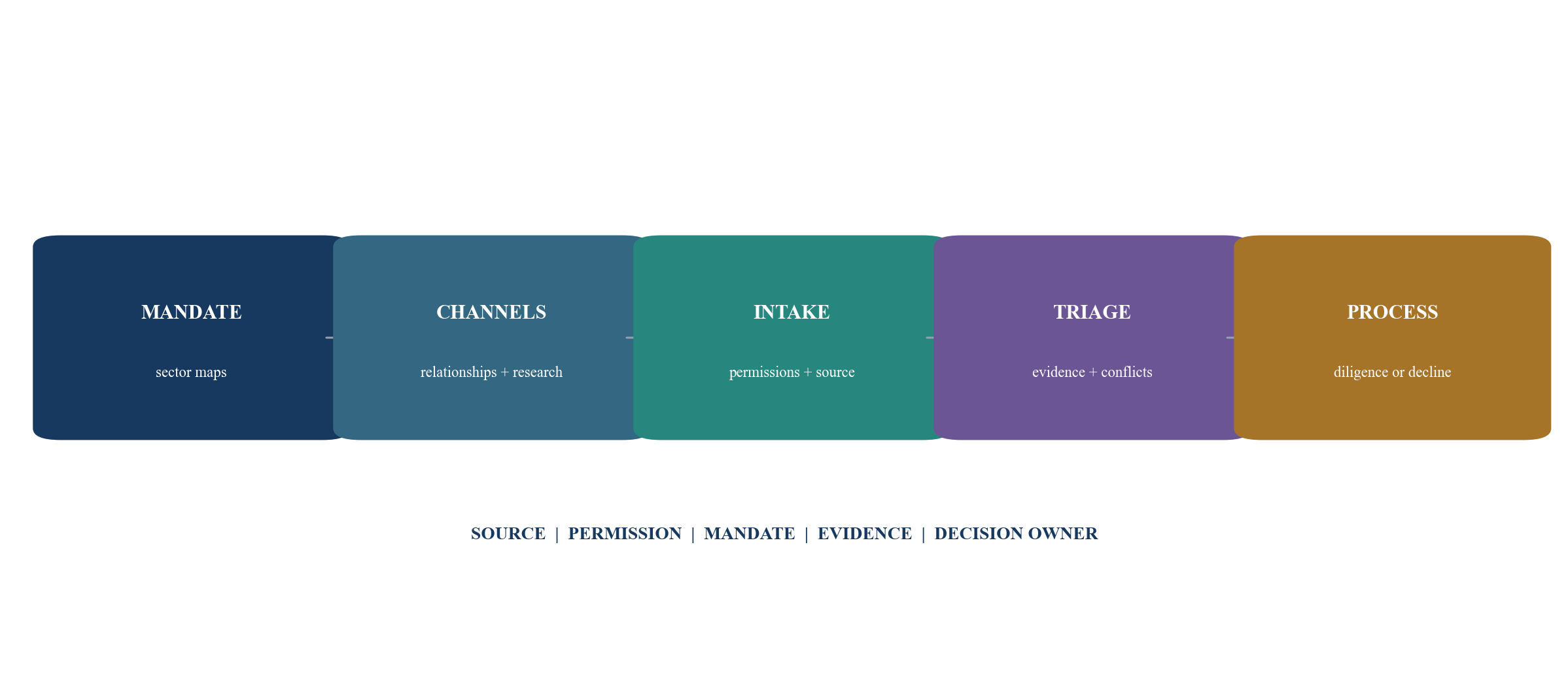
Relationship channels feed a controlled intake and evidence layer before any investment process begins.
2. Convert family conviction into searchable mandates
An annual capital-allocation plan can state that the family wants exposure to healthcare, industrial technology, energy transition, private credit or growth companies. An origination mandate must be more searchable. It translates conviction into observable company, asset, sponsor and transaction attributes.
Each mandate should define the problem the office wants to solve. A control-investment mandate might seek profitable founder-owned businesses with a succession catalyst. A growth mandate might seek recurring revenue, validated unit economics and a specific expansion use. A private-credit mandate might seek contractual cash flows, collateral, covenants and a short path to repayment. The office then creates a market map showing relevant subsectors, value-chain positions, ownership patterns, likely catalysts and credible access routes.
The legal owner matters throughout. Different family entities can have different investment powers, tax positions, currencies, duration, liquidity and reporting needs. An opportunity that fits the family's narrative can still be unsuitable for the entity expected to fund it. The capital-allocation map therefore connects purpose, owner, mandate, reserve, transaction route, governance and monitoring before origination activity is authorised.
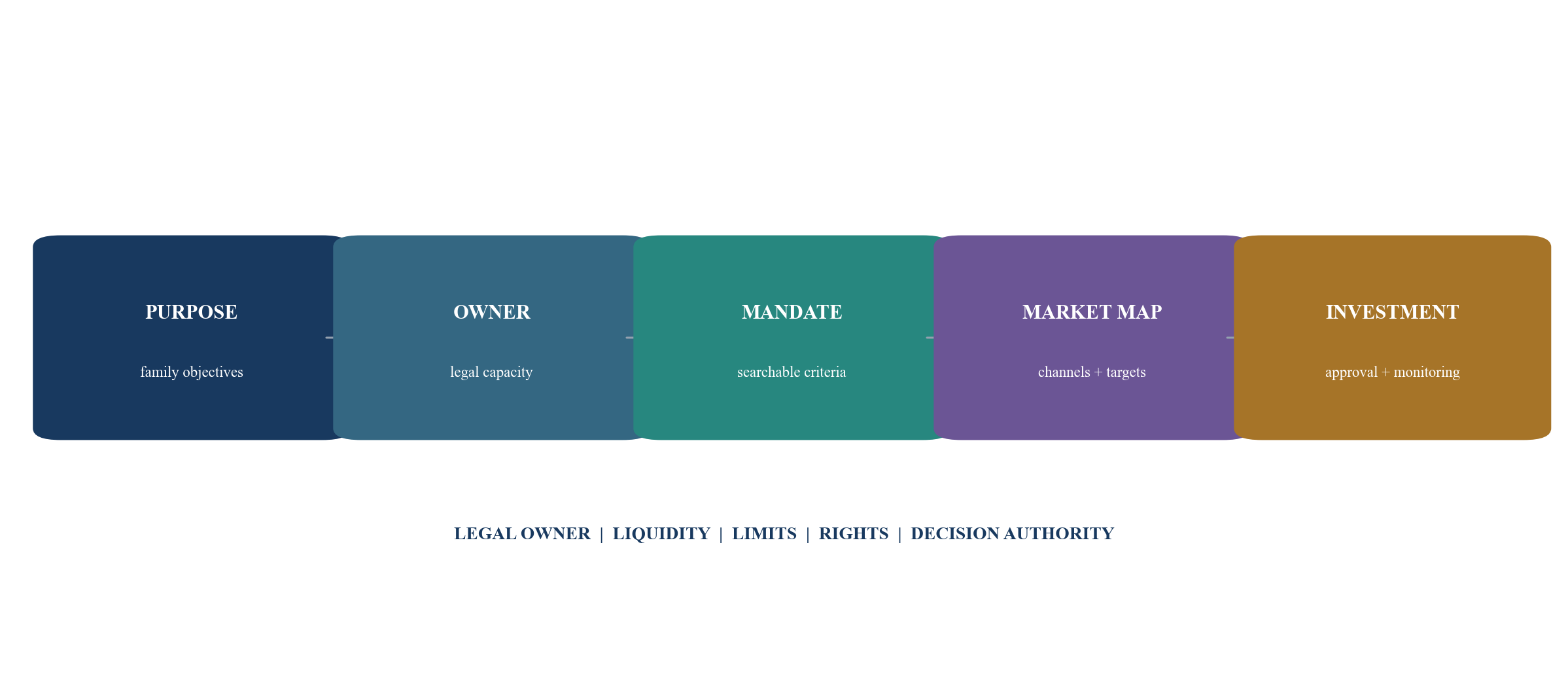
Origination begins only after purpose, legal owner, mandate, capacity and decision authority are connected.
The mandate also states what the office will not pursue. Exclusions can cover sectors, jurisdictions, security types, minority positions without information rights, single-asset concentration, projects before key permits, transactions dependent on unresolved litigation or arrangements whose beneficial ownership cannot be verified. Clear exclusions conserve attention and make channel feedback more useful.
3. Build a portfolio of origination channels
A resilient office develops several channels with different strengths and failure modes. Founder and executive networks can provide trust and early context. Fund managers can provide co-investments with an established sponsor process. Investment banks and corporate-finance advisers can offer structured transactions. Lawyers, accountants and consultants can identify succession, restructuring or strategic catalysts, subject to professional and confidentiality obligations. Universities, accelerators and industry bodies can support thematic discovery. Data providers and public filings can identify companies before an active process. Direct research and targeted outreach can develop relationships independent of an intermediary.
Every channel requires an operating thesis. The office should state which mandates the channel serves, what the source can lawfully and ethically share, how information is received, whether compensation applies, who owns the relationship, how conflicts are disclosed and what feedback the source receives. A large contact list without these elements is a directory rather than an origination system.
Table 1. Direct-deal channel design
| Channel | Comparative strength | Common limitation | Required control |
|---|---|---|---|
| founders and executives | operating context and trusted access | selection shaped by personal proximity | mandate fit, conflict declaration and independent screening |
| fund managers and sponsors | diligenced co-investment or syndication process | allocation, timing and information asymmetry | allocation policy, sponsor diligence and decision window |
| banks and corporate-finance advisers | structured process and execution capability | competitive pricing and transaction incentives | permissions, fee transparency and independent valuation |
| professional advisers | insight into ownership and strategic catalysts | confidentiality and professional restrictions | valid consent, role clarity and information protocol |
| industry and innovation networks | thematic breadth and new company formation | variable evidence and maturity | source verification and staged qualification |
| data-led market mapping | repeatable coverage beyond relationships | incomplete, stale or decontextualised data | provenance, refresh date and human validation |
| direct research and outreach | mandate-specific coverage and learning | time, response and communication risk | approved scripts, permissions and documented engagement |
Legal and regulatory review should be applied to the actual activities and jurisdictions.
Channel concentration should be measured. The office can track what share of eligible opportunities, invested capital and realised value originates from each source, sector, geography and relationship owner. High concentration is not automatically poor. It becomes a governance issue when the family cannot explain the dependence, replace the source or challenge its selection effects.
4. Create a controlled opportunity intake
Every opportunity should enter through one minimum record, even when the chair or principal makes the introduction. The record captures the issuer, legal owner, beneficial ownership information available, transaction, instrument, stage, sector, geography, capital sought, proposed use, timing, source, relationship, compensation, confidentiality status, conflicts and initial evidence. It also records the recipient legal entity and the people authorised to see the material.
FATF's beneficial-ownership guidance emphasises adequate, accurate and up-to-date information and supports a multi-pronged approach. A Direct-Deal Office should therefore avoid treating a single registry extract, organisation chart or source statement as complete ownership evidence. Initial intake can record what is known and what remains to be verified. Full diligence can reconcile official records, constitutional documents, registers, agreements, control rights, nominees and reliable identity evidence as appropriate.
Table 2. Minimum opportunity intake record
| Field | Minimum entry | Evidence status |
|---|---|---|
| issuer and transaction | legal name, jurisdiction, instrument, capital sought and use | stated by source or supported by current document |
| ownership and control | registered owners, stated beneficial owners and material control rights | source identified and verification gap recorded |
| mandate attributes | sector, geography, stage, cheque, return engine and liquidity | mapped to approved mandate taxonomy |
| source and relationship | introducer, relationship owner, date, context and expectations | confirmed with responsible owner |
| permissions | confidentiality, data use, onward sharing and communication route | document or approval linked |
| economics | issuer, investor and third-party fees or benefits | payer, basis and contingent element identified |
| conflicts | family, employee, affiliate, portfolio and adviser relationships | declaration and reviewer recorded |
| evidence | deck, financials, ownership, contracts, references and data room | provenance and date recorded |
Intake records a proposition for screening; it does not confirm the accuracy of submitted information.
The intake form should be short enough to use and strict enough to route the opportunity. Missing information does not always require rejection. It should affect evidence status, permissible circulation and the next action. A confidential teaser, a founder conversation and a formal information memorandum require different handling.
5. Govern communications, introductions and compensation
Direct origination crosses legal and regulatory perimeters that vary by activity and jurisdiction. The office should obtain qualified advice on the specific facts before soliciting, promoting, recommending, arranging, negotiating or receiving outcome-linked compensation in relation to securities or investments.
The SEC's broker-dealer registration guide identifies activities such as participating in solicitation, negotiation or execution and receiving transaction-related compensation as relevant questions. The FCA Handbook sets detailed conditions around financial promotions and investor categories in the United Kingdom. SEC investment-adviser marketing guidance establishes general prohibitions against untrue, unsubstantiated or materially misleading advertisements and conditions for testimonials and endorsements. These materials demonstrate why a global family office cannot apply one informal introduction policy everywhere.
Table 3. Activity and permissions perimeter
| Activity | Question before action | Evidence retained |
|---|---|---|
| receiving an introduction | can the information be received and used for the stated purpose? | consent, confidentiality terms and source record |
| approaching an issuer | is the outreach approved, accurate and permitted in the relevant jurisdiction? | mandate, script, recipient and communication log |
| circulating an opportunity | who may receive it and under which promotion, offering or professional-client route? | classification, approval and distribution list |
| recommending or advising | which entity and authorised person can provide the service? | scope, licence analysis and client relationship |
| arranging or negotiating | does participation cross an intermediation or broker perimeter? | legal analysis, role description and counterparties |
| paying an introducer | is the basis lawful, disclosed, conflict-managed and documented? | agreement, due diligence, approval and payment record |
| accepting transaction-linked value | which permissions, disclosures and prohibitions apply? | legal opinion, contract, invoice and conflict record |
This is an issue-spotting control. Qualified advisers should determine the applicable law and required permissions.
The office should keep a permissions matrix by country, entity, activity, instrument, investor type and communication route. The matrix records the responsible legal or compliance adviser and last review date. A disclaimer cannot replace valid permissions, and a familiar source cannot waive the office's obligations.
6. Separate relationship coverage from opportunity selection
Origination staff need to cultivate trust over time. Investment selection requires challenge and comparability. Combining both roles without safeguards can create advocacy bias. The relationship owner can feel responsible for defending an opportunity because declining it may affect the source relationship.
The office can address this with a two-owner model. The relationship owner remains accountable for source quality, permissions, expectations and feedback. An opportunity owner, selected for relevant expertise and independence, manages screening and diligence. The investment committee receives the source and conflict record alongside the investment analysis.
Declines should be coded and communicated consistently. Common reasons include mandate mismatch, stage, valuation, evidence, governance, concentration, liquidity, timing, rights, compliance, resource capacity and adverse diligence. A relationship owner can explain the decision within approved confidentiality boundaries and state what would need to change for reconsideration. This creates learning without disclosing committee deliberations or encouraging negotiation around hard controls.
The office should also protect challenge from hierarchy. Opportunities introduced by a principal, family member or senior adviser pass the same intake and screening gates. An expedited timetable can be approved when evidence and authority allow it. Senior sponsorship should remain visible as a potential influence, never as a substitute for evidence.
7. Use a fast, documented screen
The first screen should test whether a deeper process is justified. It should be completed quickly, use a standard evidence threshold and lead to one of four outcomes: decline, hold for specified information, advance to focused diligence or advance to full diligence.
Screening criteria should cover mandate fit, transaction clarity, source and permission quality, ownership transparency, market need, business or asset quality, financial condition, valuation or pricing context, governance, downside, portfolio interaction and execution feasibility. Each conclusion should distinguish submitted claims, independently verified facts, analytical judgement and open questions.
Table 4. Direct-deal screening scorecard
| Domain | Screening question | Evidence required to advance |
|---|---|---|
| mandate | does the opportunity fit an approved owner, instrument, sector, geography, cheque and concentration limit? | mandate mapping and available capacity |
| source and permissions | can the office receive, use and circulate the information and participate in the process? | source record and permission review |
| ownership and integrity | are ownership, control, counterparties and material conflicts sufficiently transparent? | initial records, declarations and red-flag search |
| proposition | is there a credible customer, asset, contract, technology or strategic need? | attributable operating or market evidence |
| economics | are historical results, funding needs and value drivers coherent enough to test? | reconciled headline financials and assumptions |
| price and structure | can valuation, downside, dilution, priority, rights and exit be evaluated? | proposed terms or a bounded range |
| portfolio | does the exposure improve or weaken concentration, liquidity and follow-on capacity? | current exposure and scenario view |
| execution | can the office diligence, approve, fund and close within the available window? | timetable, resource owner and decision path |
Scores organise challenge. A material permission, integrity or ownership issue can override a high total.
A numeric score can aid consistency but should not create false precision. The office should use vetoes for unresolved legal authority, prohibited activity, unreliable ownership, integrity concerns, unacceptable conflicts or an inability to access minimum evidence. The scorecard becomes useful when reviewers record the evidence and rationale behind it.
8. Turn the pipeline into a decision funnel
Pipeline reporting often inflates activity by counting introductions as deals. A decision funnel uses distinct stages and entry criteria. A possible company identified through research is a mapped target. An authorised conversation with minimum context is an engaged target. A submitted opportunity with an intake record is received. A mandate-fit and permissioned opportunity is qualified. An opportunity approved for diligence is active. A committee-approved opportunity is authorised. A signed and funded transaction is invested.
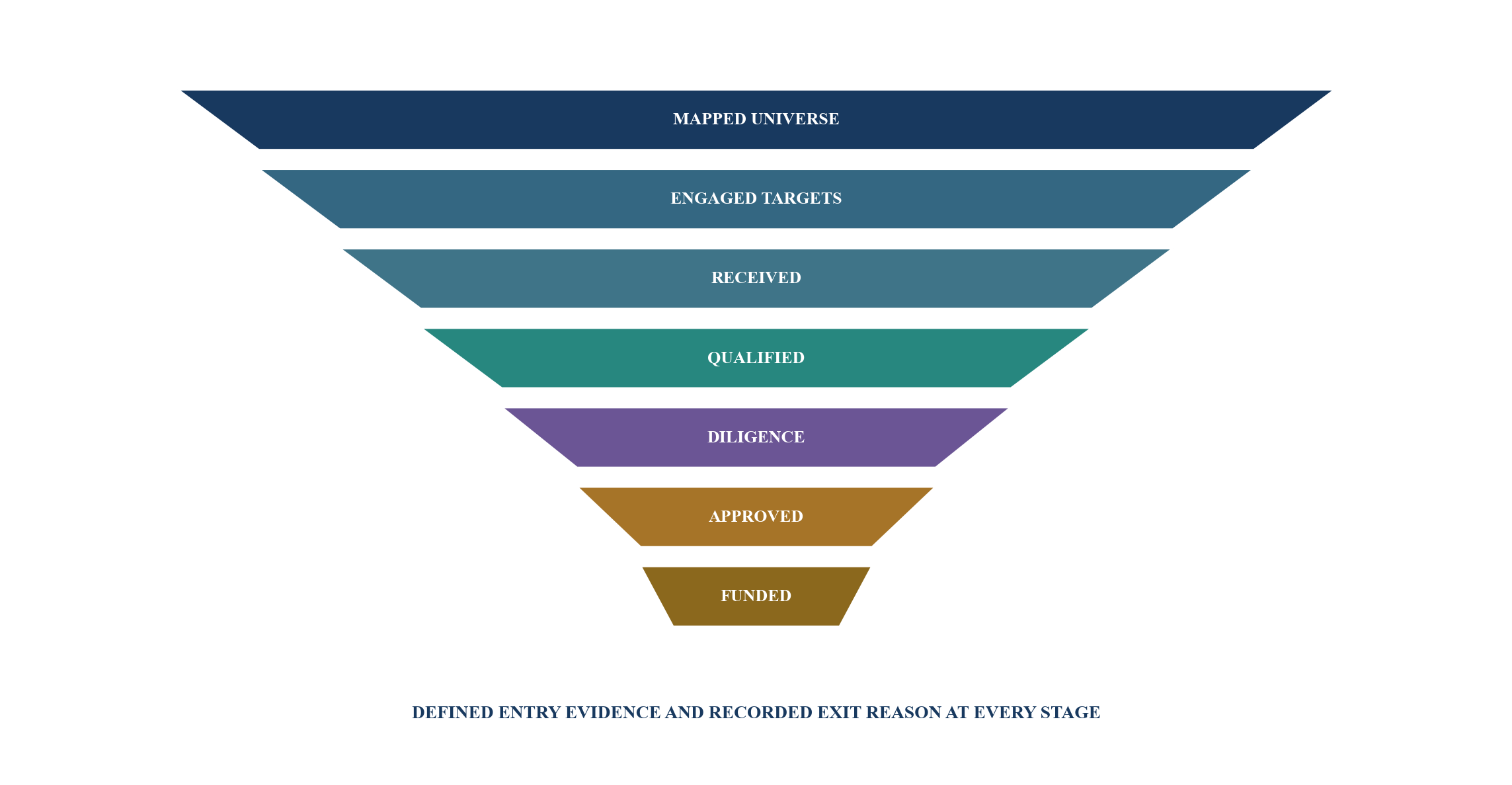
Each stage requires defined evidence; volume is not treated as investment quality.
The funnel should record exits as well as advances. The office can analyse decline reasons by channel, mandate and stage. A channel that produces many introductions and no qualified opportunities needs different action from a channel that produces few opportunities with strong evidence and high conversion.
Time matters. The office should measure days in stage, response deadlines and ageing. A slow decline wastes internal and external time. A rushed approval can weaken diligence. Service levels can state when the source will receive acknowledgement, screening feedback and a final decision, subject to information and committee timing.
9. Design diligence around the investment thesis
Due diligence should test the specific return and loss pathways, not merely complete a generic checklist. The investment team first writes a falsifiable thesis: what must be true about the company, market, asset, counterparties, management, price, structure and exit for the investment to work? The diligence plan assigns evidence, specialist, owner, timing and decision effect to each proposition.
ILPA's Due Diligence Questionnaire provides an established private-markets taxonomy covering organisation, strategy, performance, risk, service providers, governance, co-investments, conflicts and expenses. The OECD Due Diligence Guidance for Responsible Business Conduct provides a risk-based process for identifying and addressing adverse impacts. These sources can inform coverage while the deal team tailors work to the transaction.
Evidence should be attributable and reconciled. Management statements, data-room documents, external records, customer or supplier references, specialist reports and analytical estimates have different weights. Material contradictions should be logged, resolved where possible and presented to the decision body.
The office should control adviser scope. Commercial, financial, tax, legal, regulatory, technical, cyber, environmental and human-capital workstreams can overlap or leave gaps. The diligence map identifies what each adviser will answer, which documents they rely on, what is excluded and how issues reach the integrated investment case.
10. Test price, structure and governance together
A good business can become a poor investment through price, capital structure, minority rights, dilution, follow-on needs or an unrealistic exit. The Direct-Deal Office should model enterprise value, security economics, priority, conversion, anti-dilution, pre-emption, information, board, consent, transfer, liquidity and exit rights as one system.
The National Venture Capital Association's model legal documents illustrate how financing terms connect across the certificate, purchase agreement, investor rights, voting and transfer arrangements. They are starting points and require transaction-specific legal advice. In other markets and instruments, the office should use locally valid documents and relevant market practice.
Scenario analysis should include the next financing round, delayed profitability, covenant pressure, a down round, management departure, strategic sale, partial liquidity and failure. The office records which rights provide information or influence, which protections transfer economic value and which terms may complicate later financing or exit.
Governance rights require an operating plan. A board seat has limited value when the office lacks a prepared representative, reporting standard, conflict protocol and escalation route. Observer rights, reserved matters and information rights should link to named owners and recurring monitoring.
11. Allocate scarce diligence and capital capacity
The direct-deal pipeline competes for investment-team time, adviser budget, committee attention, liquidity and portfolio risk. The office should therefore reserve capacity before advancing opportunities. Each active diligence case should have a budget, team, target decision date, expected cheque, follow-on assumption and concentration effect.
An opportunity can be attractive and still arrive when the office lacks the capacity to assess or fund it responsibly. The decision can be to pause, syndicate, co-invest with a qualified lead, narrow the scope or decline. This is a resource decision, and the reason should be visible.
Capital allocation also affects channel credibility. An office that repeatedly requests access and then lacks decision capacity can damage relationships. Mandates and channel messages should reflect actual appetite, cheque range and timing. A credible "no" often protects a network better than an indefinite process.
12. Build a risk dashboard that challenges pipeline optimism
The dashboard should separate activity, evidence, risk and outcomes. Activity measures mapped targets, authorised outreach, received opportunities and current diligence. Evidence measures intake completeness, source verification, ownership transparency and data-room readiness. Risk measures concentration by source, relationship owner, sector, geography and instrument; permissions issues; conflicts; ageing; and decision-capacity utilisation. Outcomes measure qualified conversion, approved capital, funded capital, follow-on needs and realised performance where available.
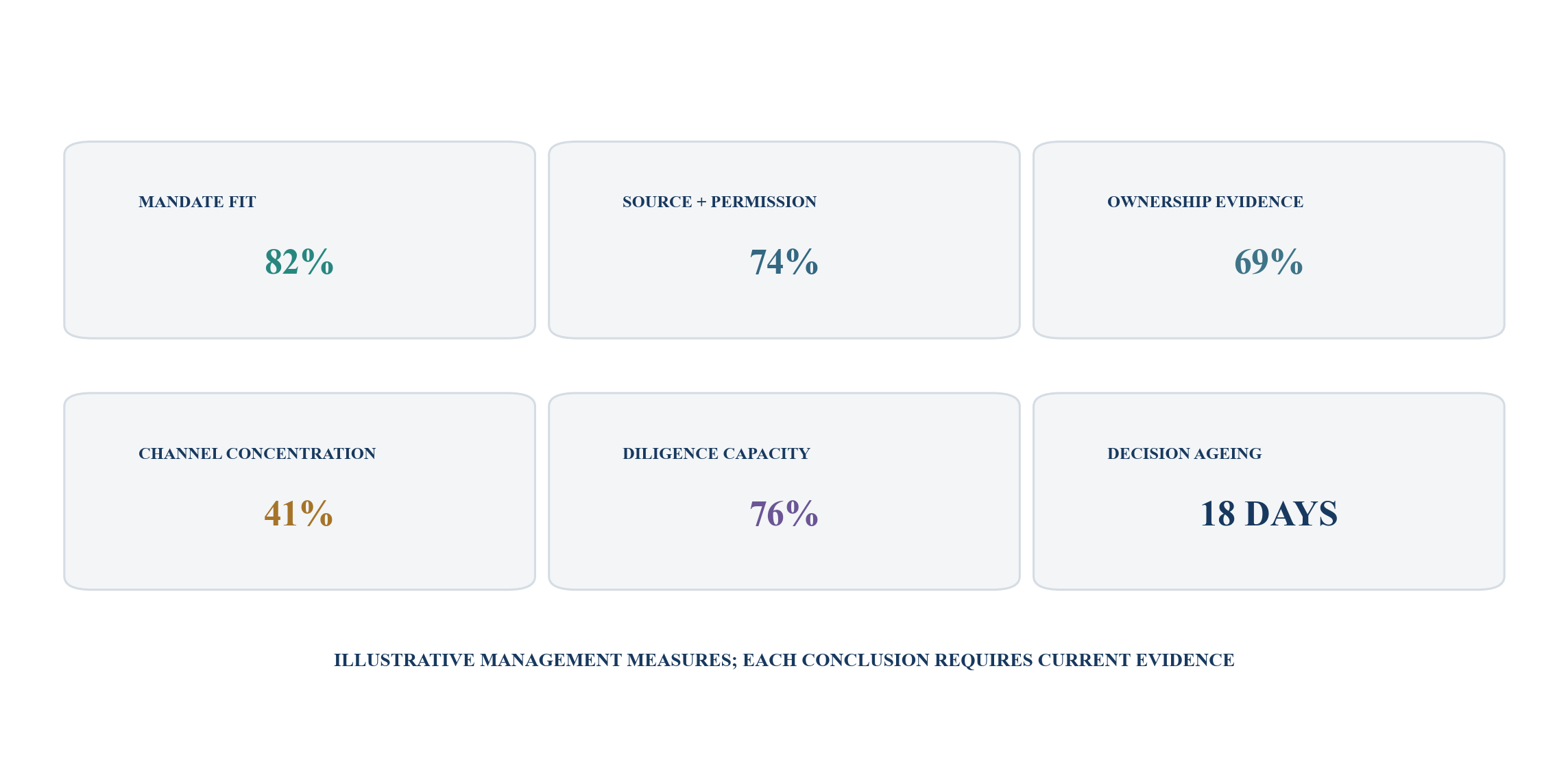
Illustrative measures are shown as governance categories; thresholds should be approved for the actual mandate.
The office should avoid rewarding staff only for opportunities submitted or capital deployed. Incentives can influence screening, valuation and risk escalation. Balanced evaluation can include mandate-quality coverage, evidence completeness, timely declines, portfolio contribution, governance performance and post-investment learning.
Red indicators require owners and actions. A high share of pipeline from one intermediary can trigger channel development. Ageing can trigger a decline or decision deadline. Incomplete ownership can stop circulation. Repeated diligence surprises from one source can change its evidence rating.
13. Govern co-investments and syndication
Co-investments can provide access, sponsor alignment, reduced fee layers or concentrated exposure. They can also compress the decision window and create information, allocation, expense and conflict questions. The office should diligence the sponsor and the asset, understand why the opportunity is being offered and identify how allocation changed from the sponsor's original process.
The intake should record sponsor investment, fund investment, proposed co-investment allocation, governance, economics, broken-deal expenses, follow-on arrangements, conflicts and information rights. ILPA materials ask about co-investment policy and broken-deal expense treatment, which supports a transparent review of these mechanics.
Syndication led by the family office requires additional controls. The office should establish its role, permissions, communication responsibilities, allocation policy, confidentiality, adviser and arranger status, compensation, conflicts, documentation and ongoing investor reporting before approaching others. It should avoid presenting a family investment decision as an assurance to another investor.
Allocation decisions should be documented when family entities, affiliates, employees or outside investors want the same opportunity. The policy can address priority, eligibility, capacity, pro rata treatment, strategic considerations, minimum allocations and committee authority. Exceptions should record the reason and affected parties.
14. Protect information and institutional memory
Direct-deal information can include personal data, trade secrets, customer contracts, pricing, source identities and market-sensitive plans. The office needs a data classification and access model from the first contact. The model states where files may be stored, who may see them, how external advisers receive access, what may be copied into portfolio systems and when information must be returned or deleted.
Permissions should follow the data, including after a team member leaves or an opportunity is declined. Personal email, messaging applications and informal file transfers can create fragmented evidence and retention risk. Approved communication routes and a central opportunity record preserve context without giving every user access to every document.
Institutional memory requires more than archived deal rooms. The office should retain the source history, mandate mapping, stage changes, key evidence, decision rationale, conflicts, adviser conclusions and post-investment review. Confidential material should remain subject to the governing agreement and applicable law.
15. Make succession operational
A personal network can disappear when a principal, senior adviser or origination lead becomes unavailable. The office should map critical relationships and the knowledge required to continue them. The map covers relationship history, mandate relevance, confidentiality, pending opportunities, expected communication and an approved secondary owner.
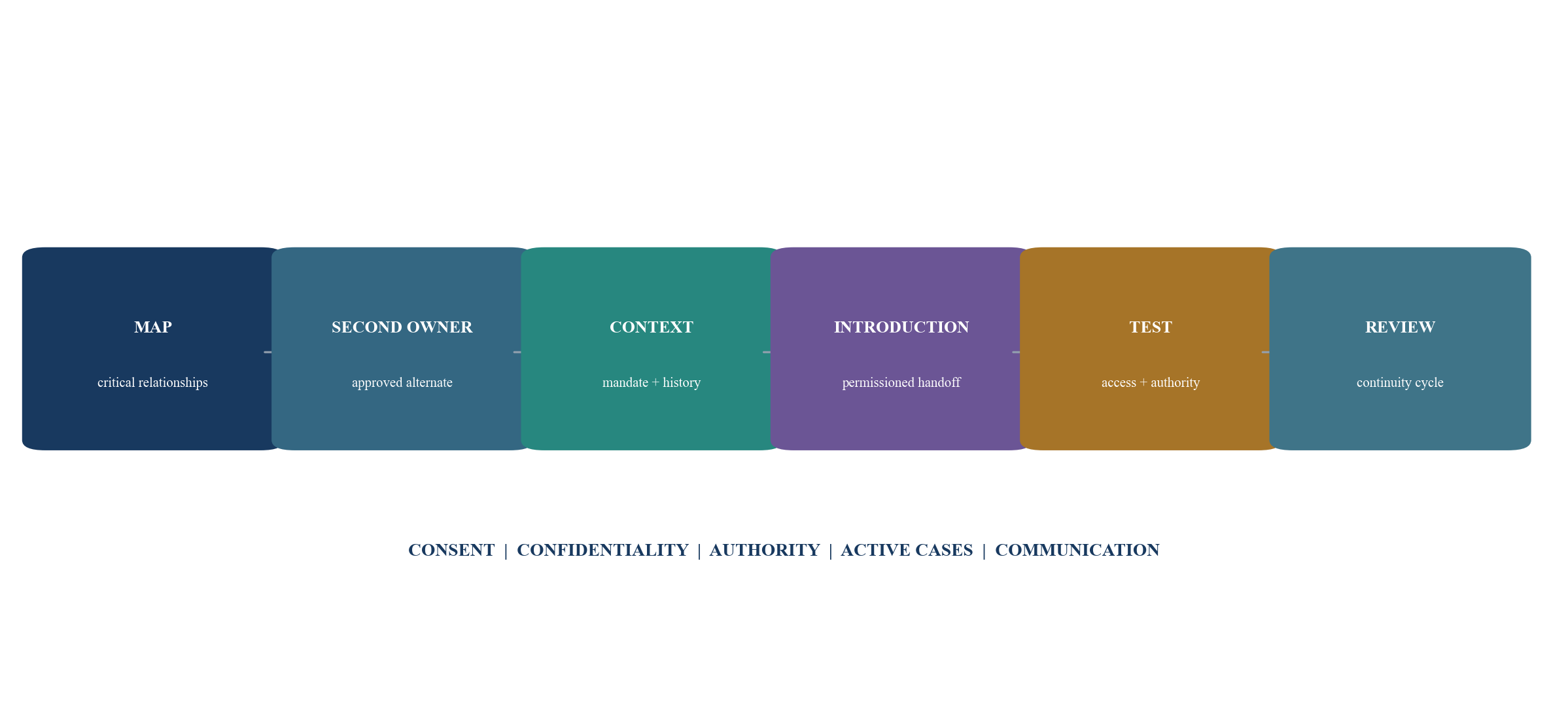
The pathway transfers valid authority and context; it does not transfer confidential information without permission.
Succession should respect consent. A relationship belongs to the people involved, and confidential information may not be transferable. The office can request permission for a secondary contact, include authorised colleagues in suitable meetings and document business context without claiming ownership of a personal relationship.
Key-person tests can simulate the absence of a principal, investment lead, legal approver or operations contact. The office checks whether it can identify active opportunities, honour confidentiality, make payments, meet deadlines, communicate with sources and protect portfolio companies. Gaps become actions with owners and dates.
16. Demonstrate the framework with a hypothetical office
Consider a hypothetical international family investment office with USD 900 million of investible assets and an approved annual direct-deal budget of USD 60 million. It pursues minority growth equity, selected control investments and private credit across North America, Europe, Asia and the Middle East. These values, cases and outcomes are management assumptions created only to demonstrate the framework.
The office maps 420 potential companies and sponsors across its active mandates. It authorises outreach or relationship coverage for 150. During the year, 84 opportunities enter controlled intake. Fifty meet basic permission and evidence requirements, 26 pass the documented screen, 12 enter full diligence, five receive committee approval and four close for USD 38 million in total. One approved transaction does not close because a condition precedent is not satisfied.
Table 5. Hypothetical annual Direct-Deal Office funnel
| Stage | Illustrative count | Decision evidence | Illustrative capacity effect |
|---|---|---|---|
| mapped universe | 420 | market map and mandate attributes | research coverage |
| authorised coverage | 150 | approved target and communication route | relationship-owner time |
| controlled intake | 84 | minimum record and permissions | screening capacity |
| qualified screen | 26 | mandate, evidence, conflict and initial economics | opportunity-owner capacity |
| full diligence | 12 | approved thesis, scope, budget and timetable | adviser and committee capacity |
| committee approved | 5 | integrated case, terms, funding and authority | USD 46 million reserved |
| funded | 4 | signed documents and satisfied conditions | USD 38 million invested |
Every value is an illustrative management assumption; the table does not estimate market conversion or returns.
The channel review shows that fund managers produced fewer opportunities but stronger ownership and data-room evidence. Direct research produced broader sector coverage but a longer development cycle. Professional advisers produced two high-quality succession situations subject to strict confidentiality. A family network produced many submissions and one investment; consistent screening protected the relationships by making decline reasons predictable.
The office does not present the funnel as a target conversion rate. It uses the evidence to adjust channel coverage, resource capacity and mandate language for the next year. Investment outcomes will be reviewed over the actual holding periods.
17. Implement the office in one hundred days
The first twenty days establish authority. The family approves the legal owners, mandates, exclusions, cheque and concentration ranges, governance, activity perimeter and implementation sponsor. The office inventories existing relationships, active opportunities, systems and contracts.
Days twenty-one to forty design the operating model. The team creates market maps, channel theses, intake, permission and conflict records, screening gates, stage definitions, data classification, service levels and committee materials. Legal and compliance advisers review activities, jurisdictions, communications and compensation.
Days forty-one to sixty build the controlled pipeline. Existing opportunities are migrated and deduplicated. Sources, permissions, evidence and conflicts are refreshed. The office identifies priority channel gaps, assigns relationship and opportunity owners and trains users on approved communication and storage routes.
Days sixty-one to eighty run live cases through the system. The office times screens, tests escalation, commissions focused diligence, records declines and produces the first dashboard. It reviews whether the stages, criteria and evidence requirements support actual decisions.
Days eighty-one to one hundred close material control gaps, approve the operating memorandum and establish the annual calendar. The governing body receives the mandate register, pipeline, capacity view, issues, relationship concentration and succession test results.
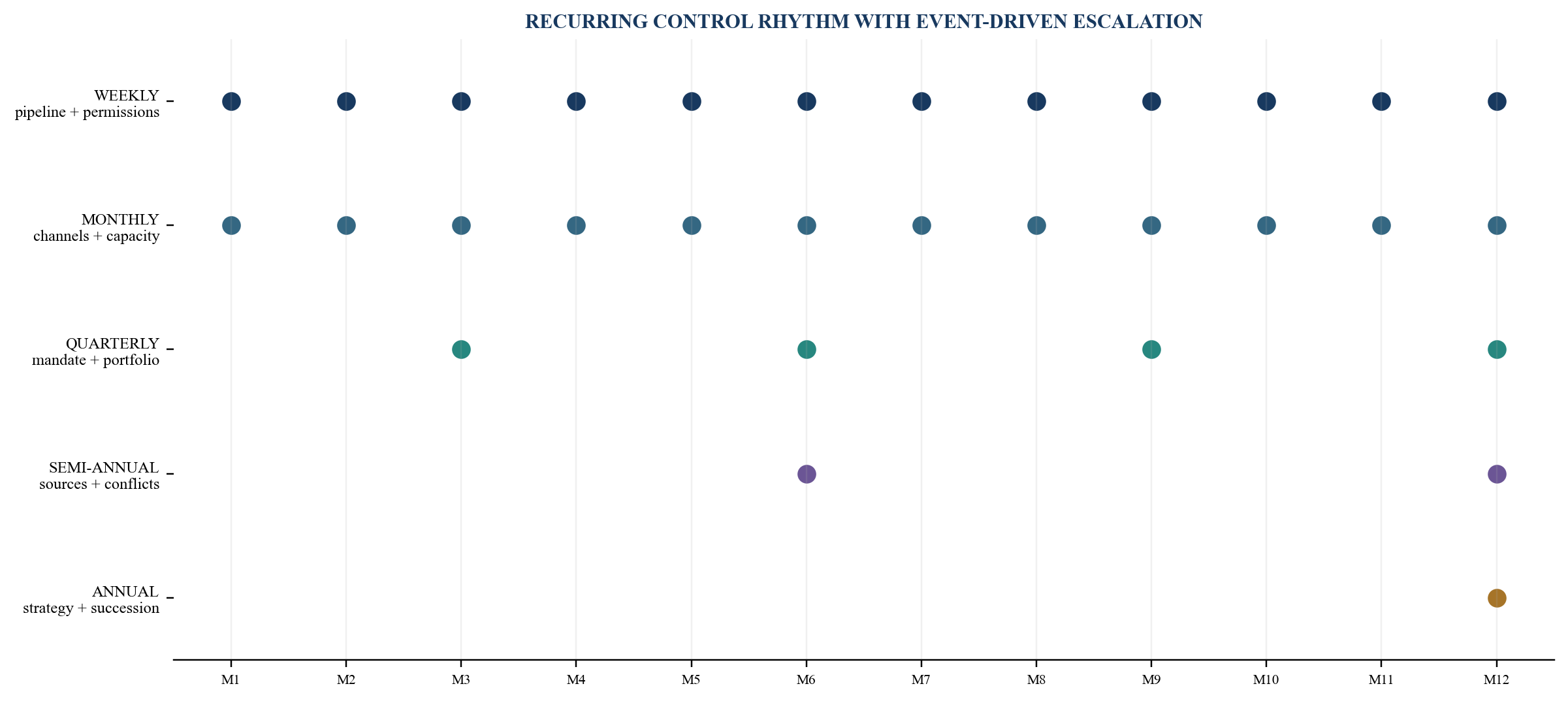
Event-driven reviews supplement the recurring cadence whenever mandates, permissions, conflicts or key relationships change.
18. Give the governing body a decision scorecard
The governing body should receive conclusions, evidence, exceptions, owners and actions. A single pipeline value can conceal permission failures, channel concentration, weak ownership evidence or excessive diligence load. The scorecard should keep these domains separate.
Table 6. Governing-body Direct-Deal Office scorecard
| Domain | Governing question | Acceptance evidence |
|---|---|---|
| mandate | is origination tied to approved owners, exposures, limits and capacity? | mandate register and capital-allocation map |
| channels | does the office have diversified, permissioned and accountable access routes? | channel theses, ownership and concentration report |
| intake and permissions | can every active case be traced to valid source, use, circulation and compensation records? | complete intake and permissions matrix |
| screening | are advance, hold and decline decisions comparable and evidenced? | scorecards, vetoes and decline analysis |
| diligence | does each active case test the investment's return and loss pathways? | thesis, workplan, evidence and integrated issues |
| conflicts and allocation | are related interests, fees and competing demands identified and governed? | register, disclosures, recusals and allocation decisions |
| capacity | can the office diligence, approve, fund and monitor its live pipeline? | resource, adviser, liquidity and committee calendar |
| continuity | can critical relationships and active cases continue through a key-person event? | secondary owners, permissions and simulation results |
| learning | do channel, investment and post-deal outcomes improve the next mandate cycle? | attribution, post-investment review and approved actions |
Acceptance requires current evidence and named accountability for material exceptions.
19. Make origination a learning system
Repeatability comes from feedback. The office should compare each investment thesis with post-close evidence. It should review whether the source's initial claims held, which diligence findings mattered, how governance rights operated, whether follow-on capital matched the plan and which channel attributes predicted useful access.
The review should include declined opportunities. A later financing, sale, failure or operating development can reveal whether a decision was well founded. The office should avoid judging quality only by whether an asset later increased in value. A disciplined decline can be correct when the opportunity fell outside the mandate, evidence was unavailable or risk could not be governed at the decision date.
Channel relationships benefit from accurate feedback. The office can tell a source which mandates are active, what evidence is required, how decisions work and when capacity changes. It should avoid implied commitments and unsupported claims about speed, capital or sector appetite.
A mature Direct-Deal Office broadens access while protecting family capital and relationships. It connects purpose, legal ownership, permissioned channels, evidence, independent screening, diligence, terms, portfolio capacity, succession and learning. That operating connection turns personal networks into one valuable component of an institutional origination system.
References
- Institutional Limited Partners Association, Due Diligence Questionnaire 2.0, 2021, https://ilpa.org/wp-content/uploads/2021/11/ILPA-DDQ-2.0.pdf
- Institutional Limited Partners Association, ILPA Principles 3.0, https://ilpa.org/industry-guidance/principles-best-practices/ilpa-principles/
- United States Securities and Exchange Commission, Guide to Broker-Dealer Registration, https://www.sec.gov/about/divisions-offices/division-trading-markets/division-trading-markets-compliance-guides/guide-broker-dealer-registration
- United States Securities and Exchange Commission, Investment Adviser Marketing: Small Entity Compliance Guide, https://www.sec.gov/resources-small-businesses/small-business-compliance-guides/investment-adviser-marketing
- United States Securities and Exchange Commission, Marketing Compliance Frequently Asked Questions, updated 15 January 2026, https://www.sec.gov/rules-regulations/staff-guidance/division-investment-management-frequently-asked-questions/marketing-compliance-frequently-asked-questions
- United States Securities and Exchange Commission, Family Offices, Final Rule IA-3220, https://www.sec.gov/rules-regulations/2011/06/family-offices
- Financial Action Task Force, Guidance on Beneficial Ownership of Legal Persons, 10 March 2023, https://www.fatf-gafi.org/content/fatf-gafi/en/publications/Fatfrecommendations/Guidance-Beneficial-Ownership-Legal-Persons.html
- Financial Action Task Force, Guidance on Beneficial Ownership and Transparency of Legal Arrangements, March 2024, https://www.fatf-gafi.org/content/dam/fatf-gafi/recommendations/Guidance-Beneficial-Ownership-Transparency-Legal-Arrangements.pdf
- Financial Conduct Authority, PERG 8: Financial Promotion and Related Activities, https://handbook.fca.org.uk/handbook/perg8
- Financial Conduct Authority, COBS 4: Communicating with Clients, Including Financial Promotions, https://handbook.fca.org.uk/handbook/cobs4
- Organisation for Economic Co-operation and Development, Due Diligence Guidance for Responsible Business Conduct, 2018, https://www.oecd.org/en/publications/oecd-due-diligence-guidance-for-responsible-business-conduct_15f5f4b3-en.html
- Organisation for Economic Co-operation and Development, Due Diligence Essentials for Responsible Banking and Capital Markets, 6 April 2026, https://www.oecd.org/en/publications/responsible-business-conduct-spotlights_03a75bf9-en/due-diligence-essentials-for-responsible-banking-and-capital-markets_289fae4b-en.html
- International Finance Corporation, Family Business Governance Handbook, https://www.ifc.org/en/insights-reports/2011/ifc-family-business-governance-handbook
- International Finance Corporation, Family Business Governance, https://www.ifc.org/en/what-we-do/sector-expertise/corporate-governance/family-business-governance
- National Venture Capital Association, Model Legal Documents, current revisions through 2026, https://nvca.org/model-legal-documents/
About the Author
Chennakeshav Adya is an independent researcher and Managing Partner of Matchpoint Partners. His work examines strategy, capital formation, valuation, transactions and operating execution across private and public markets.
