

1. Define the legal-recognition decision
The first question is not whether the family identifies emotionally with the enterprise. It is which legal status, filing or structure is being considered and which authority administers it. A company can already possess legal personality, licences and contractual capacity while remaining outside a specialist family-business register. Entry into that register can add a recognised family-business status and make a distinct statutory regime available. A foundation, trust, holding company or family-office licence performs a different function.
The decision paper should name the applicant, existing company form, issuing authority, proposed register, eligibility rule, effective date, required approvals, documents to be filed, information that becomes public or accessible, continuing obligations and exit conditions. It should distinguish the registration of an operating company from the creation of a holding entity and from the licensing of an office that serves family entities.
The UAE framework illustrates the distinction. Federal Decree-Law No. 37 of 2022 concerns qualifying family businesses and regulates matters including capital, share transfers, redemption, classes and governance. The Ministry of Economy operates a unified registry through applications submitted to the relevant licensing authority. DIFC Family Arrangements Regulations separately address family businesses, family entities, family structures and family offices within their scope. Each route has its own object, test and consequence.
Legal recognition should therefore begin with a status map. The map should record what changes on registration, what remains governed by existing company law and documents, and what needs a separate transaction. A registry entry does not automatically move assets, release guarantees, amend bank mandates or change the ownership of a subsidiary. Those actions need their own valid instruments and approvals.
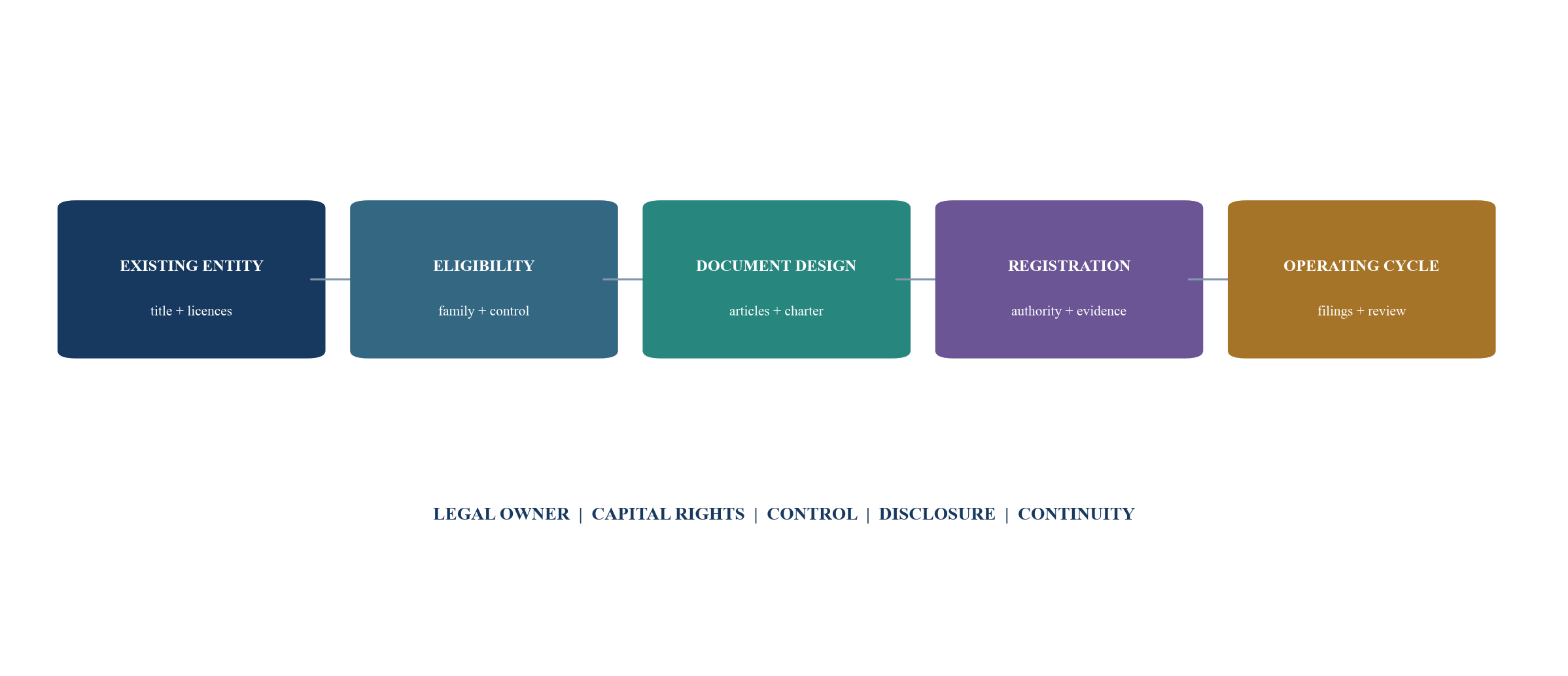
Author framework. Every transition requires current legal advice, valid approvals and evidence.
2. Establish the enterprise perimeter
A family enterprise can contain operating companies, holding companies, real estate, intellectual property, investment vehicles, trusts, foundations, personal assets and philanthropic entities across several jurisdictions. Registering one company does not necessarily register the complete economic group. The family should define the perimeter before it selects a status or drafts a charter.
The perimeter schedule should list every entity and material asset, legal owner, registration number, jurisdiction, licence, business activity, shareholders, voting rights, directors, beneficiaries, controlling agreements, guarantees, debt, security, tax residence and reporting route. It should identify dormant entities, nominee arrangements, assets held personally for business use, undocumented intercompany balances and intellectual property used without a licence.
The schedule needs a purpose column. An operating company may employ people and contract with customers. A holding company may own shares and allocate capital. A property company may isolate a site or borrowing. A foundation may serve succession objectives. An investment vehicle may hold liquid or private-market assets. Similar ownership does not make these entities interchangeable.
The proposed registered perimeter should then be overlaid on the existing group. The analysis should show subsidiaries included directly or indirectly, entities outside scope, family branches represented, regulated activities, foreign operations and contractual consents. It should also show which enterprise-level statements are consolidated management views and which are legal-entity facts.
The final perimeter should be accepted by legal, finance, tax, company-secretarial and operating owners before the family proceeds.
Table 1. Family-enterprise legal perimeter
| Layer | Evidence | Registration question |
|---|---|---|
| family | identity, relationships, branches, family decisions | who meets the applicable family definition? |
| ownership | members, shares, options, trusts, nominees | who owns and controls each legal entity? |
| operations | licences, employees, contracts, sites | which entity conducts each activity? |
| capital | equity, debt, guarantees, security, distributions | where are rights and obligations legally located? |
| governance | articles, agreements, boards, delegations | which decisions are valid at each level? |
| continuity | wills, foundations, transfer rules, alternates | how can ownership and authority change? |
The schedule should be completed from current registers, documents and reconciled accounts.
3. Reconcile legal title, beneficial ownership and control
Registration requires the family to separate three related concepts. Legal title identifies the person or entity recorded as owner. Beneficial ownership looks through arrangements to the natural persons who ultimately own or control. Corporate control can also arise through voting rights, board appointment, agreements, vetoes, trusts or significant influence. One percentage does not always answer all three questions.
The ownership file should begin with official registers of members and securities. It should reconcile share certificates, transfer instruments, constitutional documents, shareholder agreements, option plans, convertible instruments, pledges, court or probate orders, trust and foundation documents and the general ledger. Differences should remain visible until resolved by competent advisers and valid documentation.
Global register rules reinforce the need for precision. UK Companies House identifies significant control through ownership, voting, board-appointment and influence tests. Singapore ACRA requires controller and, unless exempt, nominee registers. Hong Kong companies within scope maintain a significant controllers register. FATF guidance seeks adequate, accurate and current information on the true owners of legal persons.
The family should prepare an ownership-and-control matrix for every entity. The matrix should show registered holder, beneficial owner, percentage of economics, votes, board rights, reserved matters, nominee status, trust or foundation role, security interest, source document and verification date. Indirect chains should be calculated and checked against contractual control.
Registration should pause when material title or control evidence conflicts. Filing an elegant family chart over unresolved ownership can create regulatory, banking, tax and dispute risk. The recognised status should rest on a defensible evidence chain.
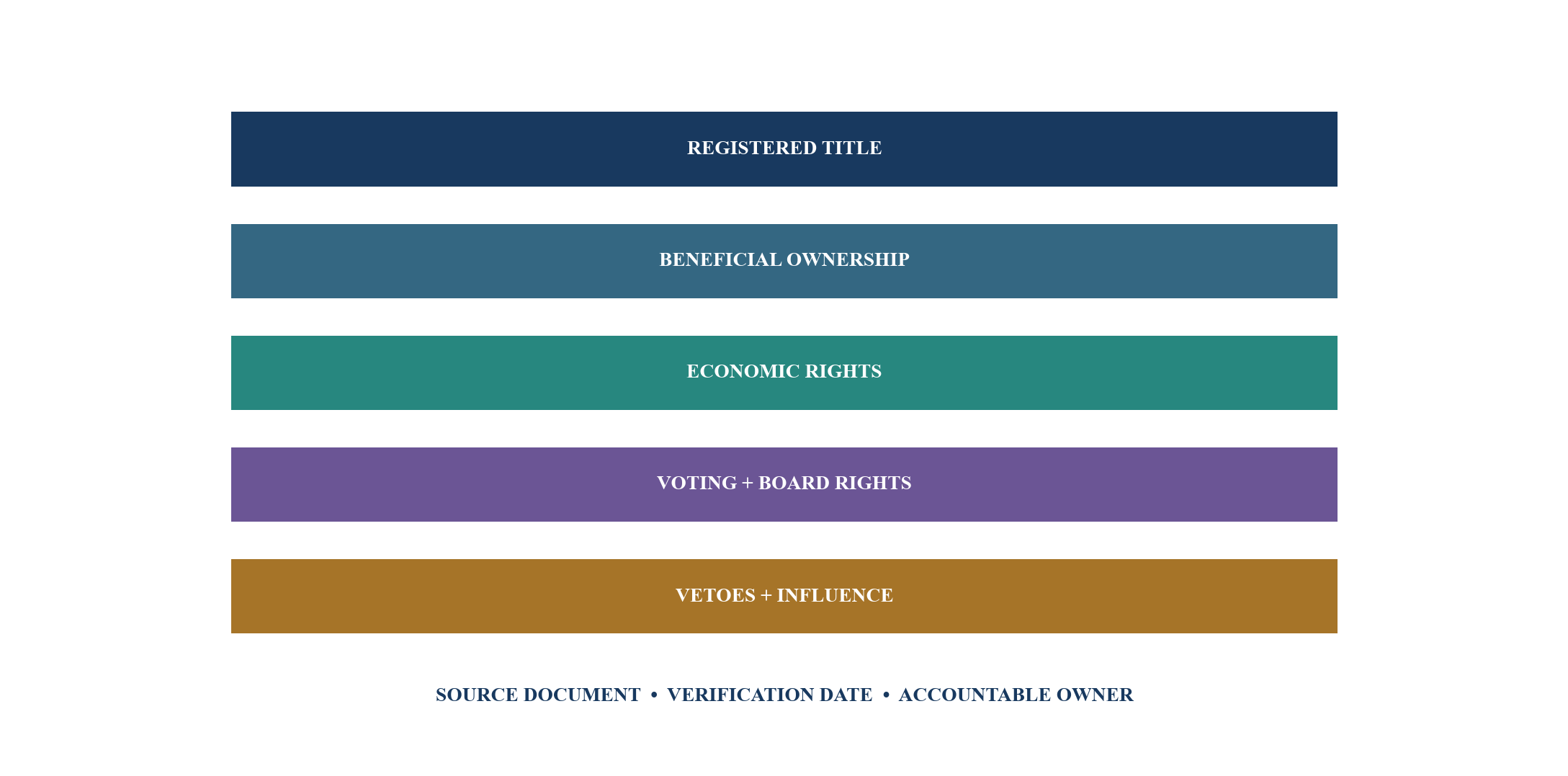
Author framework. Legal title, economics and decision rights should be reconciled separately.
4. Test eligibility without assuming the outcome
Every specialist regime has a legal definition of the family, the business and the required degree of ownership or control. Eligibility should be tested against the current text and the enterprise's actual documents. Public descriptions can explain the policy objective; the filing decision needs advice on the operative legislation and administrative requirements.
The eligibility memorandum should address the relevant common ancestor or relationship test, family ownership threshold, permitted legal forms, place of incorporation, licensing authority, activity, control test, excluded entities, minimum assets where applicable, existing regulatory permissions and required consents. It should identify evidence for each element and record open legal questions.
The DIFC rules, for example, define a family, family members, family entities, control and family structures for their own purposes. They also distinguish entry of a family business in the register from licensing a family office. UAE federal registration follows the federal law and implementing decisions through the relevant licensing authority and Ministry. A family should not move a definition from one regime into another.
A board-ready conclusion can have four outcomes: eligible on current evidence; eligible after specified document or ownership changes; uncertain pending an authority or legal determination; or outside the regime. The memorandum should avoid treating a commercial preference as a legal conclusion. The final application should be filed only after the evidence owner confirms every required document and representation.
5. Design capital rights as a complete architecture
Family-business capital is often described by the number of shares held by each branch. A workable architecture has more dimensions. Shares can carry different economic, voting, information, appointment, transfer, redemption and liquidation rights. Debt, preferred instruments, options and guarantees can alter control and value without changing ordinary-share percentages.
The capital register should show each class and instrument, holder, paid amount, votes, dividend entitlement, priority, conversion, redemption, transfer limits, pre-emption, drag, tag, valuation method, information rights and security. It should reconcile to constitutional documents and accounts. Rights that exist only in side letters or informal understandings should be identified for legal review.
The UAE family-business law expressly contemplates capital composed of shares with equal or different profit rights as agreed in the articles and regulates disposals subject to the law. This creates design choices that must be documented coherently. A family can seek continuity through transfer restrictions while preserving a fair economic route for members who do not work in the business. The design should be tested for enforceability, funding and minority treatment.
Capital classes should correspond to a legitimate purpose. Founder voting control, branch representation, employee participation, growth capital and passive family income can require different solutions. Excessive complexity can make financing, valuation, administration and succession harder. The decision paper should explain why every difference exists and when it ends.
Table 2. Capital-rights design matrix
| Dimension | Design question | Evidence required |
|---|---|---|
| economics | who receives dividends, sale proceeds and residual value? | class rights, accounts, distribution policy |
| votes | which matters follow ordinary or enhanced approval? | articles, shareholder agreement, statute |
| appointments | who appoints directors and committee members? | nomination and removal provisions |
| transfer | who may sell, buy, inherit, pledge or redeem? | transfer instruments, restrictions, consents |
| information | what does each holder receive and when? | reporting covenant and access policy |
| new capital | how are price, dilution and outside investment governed? | capital policy, valuation and approvals |
Rights must be confirmed in current governing documents and applicable law.
6. Convert the family charter into an operating document
A family charter can record purpose, values, family membership, employment, governance, distributions, ownership, succession, dispute resolution and philanthropy. Its legal effect depends on the governing regime, its relationship with constitutional documents and the way parties approve and implement it. Aspirational language and enforceable rights should be distinguished.
The charter architecture should contain three layers. The first is family policy: purpose, values, education, conduct and family participation. The second is enterprise governance: family council, owner forum, board interface, nomination, information and dispute routes. The third is legal implementation: provisions that need to appear in articles, shareholder agreements, trust or foundation documents, employment contracts, wills, powers or policies.
Federal Decree-Law No. 37 of 2022 permits a family charter and addresses its relationship with the articles. Ministry materials state that a charter may be deposited in the unified registry and can cover ownership, objectives, values, share valuation and profit distribution. The family should obtain advice on which provisions are binding, which document prevails and which amendments require corporate or family approval.
The charter should use decision language. Each provision needs an owner, decision body, threshold, evidence, implementation instrument, review date and route for exceptions. A statement that family members should be treated fairly needs a defined process for dividends, employment, information, liquidity and conflict. A commitment to professional management needs board authority, role criteria and performance review.
The family should maintain a charter-to-document matrix. It should identify every promise and the document or operating process that gives it effect. Gaps should become an implementation backlog. Depositing a charter should follow this reconciliation; otherwise the enterprise risks registering a narrative that its legal and operating systems cannot perform.
7. Separate family, owner and corporate governance
Family governance discusses relationships, values, education, participation and shared purpose. Owner governance exercises shareholder rights. Corporate governance directs and oversees the company through its valid organs. The same people may participate in all three, but the authority of each forum is different.
The governance map should identify the family assembly or council, owners' forum, general meeting, board, board committees, executive management, investment committee, foundation council or trustees and dispute body. For each forum it should state membership, appointment, quorum, voting, reserved matters, conflicts, minutes, information rights and escalation.
Legal recognition can make family structures more visible. It should not allow a family council to instruct a company where the council lacks corporate authority. Strategic recommendations need to reach the shareholder or board body that can validly decide. Directors should understand their duties to the company and all shareholders under applicable law, including when the appointing branch has a preference.
The OECD Principles emphasise board responsibility, equitable shareholder treatment, disclosure and management of conflicts including related-party transactions. IFC's family-business governance materials highlight the overlapping roles of family, ownership and management and the need for clearer institutions as the enterprise moves from founder to sibling and cousin stages.
The map should be tested with real decisions: appointing a chief executive, approving debt, selling a subsidiary, changing dividends, admitting an investor, employing a family member and resolving a related-party transaction. The test passes when participants can identify the competent body, required information, vote, conflict rule and implementation owner without relying on the founder's informal authority.
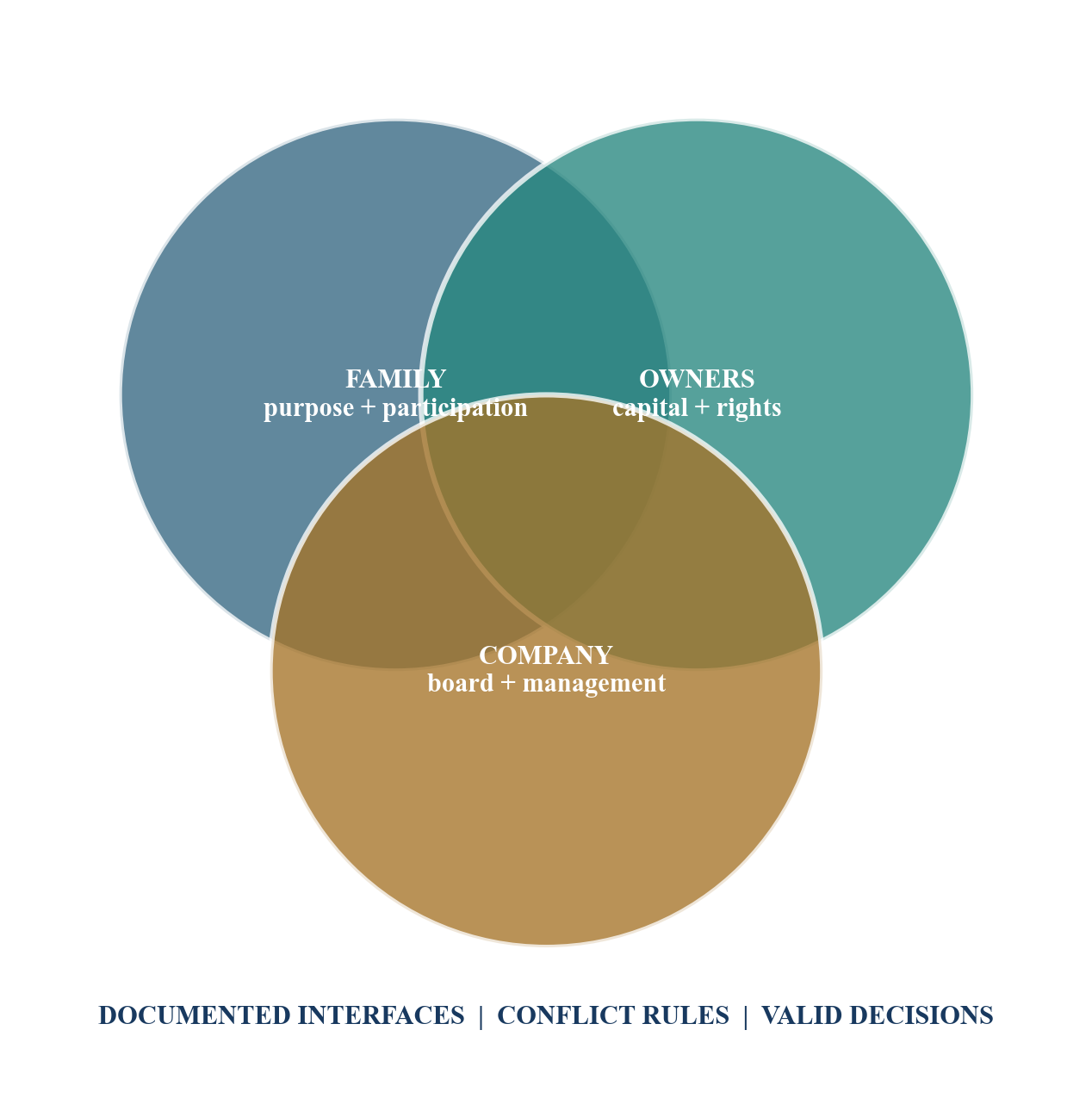
Author framework. Coordination should preserve the lawful authority of each decision body.
8. Protect minority and branch-level rights
Registration can strengthen continuity for the controlling family while creating concern for smaller branches, non-working owners, spouses, heirs, trusts or outside shareholders. The design should make their economic and governance position explicit. Stability that depends on trapping capital or withholding information can generate future disputes.
The minority-protection review should cover pre-emption, class consent, enhanced majorities, board representation, information, dividends, related-party transactions, valuation, liquidity, tag rights, dispute resolution and remedies. It should distinguish statutory rights from negotiated protections and family-policy commitments.
Related-party transactions require particular discipline. Family members can be landlords, lenders, suppliers, executives, customers or acquirers. The decision file should disclose the relationship, commercial rationale, alternatives, valuation, terms, conflicts, abstentions and approval. Independent review can be valuable where the transaction is material or affects a minority.
Exit design is part of protection. Transfer restrictions should have a workable valuation and funding route. A theoretical redemption right provides little liquidity if the company cannot lawfully or prudently finance it. The family should model instalments, insurance, reserves, external financing and secondary buyers while preserving solvency and covenants.
The registration decision should include a branch impact statement. It should show who gains or loses votes, liquidity, information, appointment rights or economic priority. Approval is stronger when that distribution is understood before documents are signed.
9. Build a transfer and succession pathway
Family-enterprise continuity depends on how ownership and authority move after death, incapacity, retirement, divorce, dispute or voluntary sale. Registration can make transfer restrictions and governance arrangements legally relevant. It cannot replace coordinated estate, matrimonial, tax and corporate planning.
The succession map should start with each legal owner and instrument. It should identify what passes by corporate transfer, inheritance, will, trust, foundation, survivorship, nomination or court order. It should record restrictions, pre-emption, valuation, funding, consents, probate dependencies and interim voting or dividend rights.
The family-business charter can provide principles for branch representation, education and leadership. The articles and other governing instruments need to give effect to relevant rights. Personal wills and powers need to coordinate with the company structure. Foreign assets and family members can introduce multiple legal systems, forced-heirship, probate and tax questions requiring specialist advice.
The pathway should be rehearsed through scenarios. The founder becomes incapacitated before registration completes. A shareholder dies while shares are pledged. An heir wants cash rather than shares. A branch falls below the family ownership threshold. A chief executive and family chair leave together. Each scenario should produce an owner, authority, cash need, document route, notification and decision timeline.
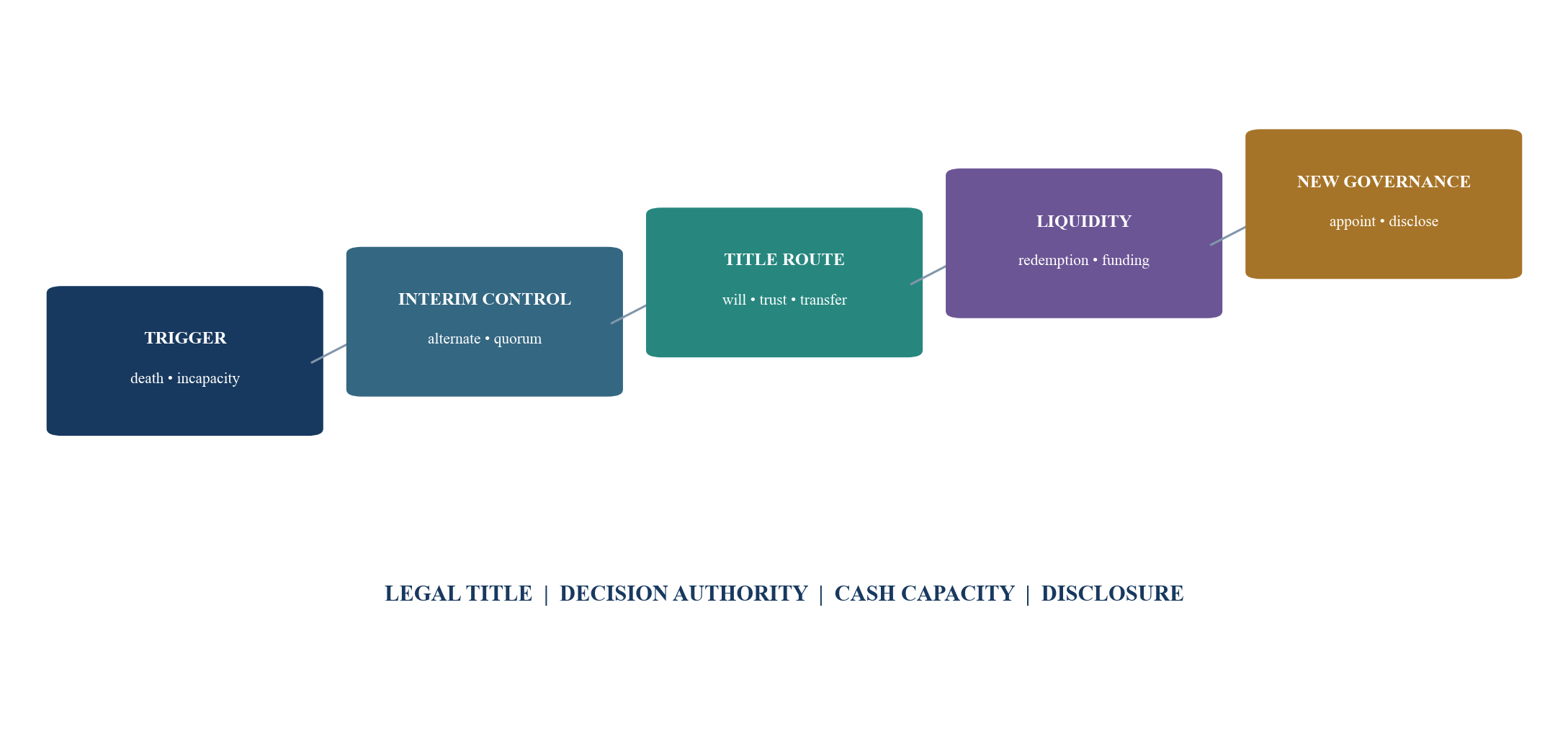
Author framework. Capability, appointment and funding should be tested before a transition event.
10. Make valuation and liquidity operational
Transfer restrictions, redemption rights, buybacks, inheritance settlements and new share issues depend on valuation. A family charter can state a principle; the enterprise needs an operating policy that works under time pressure and conflict.
The valuation policy should identify the subject interest, basis of value, standard, date, information, methodology, treatment of debt and non-operating assets, discounts or premiums, tax assumptions, currency, independent expert, challenge process and cost allocation. It should distinguish enterprise value, equity value and the value of a particular class or minority interest.
The policy should also address information asymmetry. Working family executives may have current forecasts while passive holders receive periodic accounts. A transfer price should rely on an approved information set and manage confidential information consistently. Material events between the valuation date and completion need a defined treatment.
Liquidity requires a separate funding plan. The family should forecast voluntary transfers, death-related redemptions, disputes and employee exits. Funding sources can include company cash, reserves, insurance, instalments, shareholder loans, external debt or approved buyers. Each route affects solvency, covenants, tax and control.
The worked test should combine valuation and funding. Assume an illustrative enterprise equity value of USD 240 million and a branch interest of 12 percent. A USD 28.8 million headline pro-rata value does not establish the transaction price or available cash. The board must consider the governing valuation rule, class rights, legal ability to buy back, debt capacity, payment schedule and ongoing investment needs. All amounts in this example are hypothetical.
Table 3. Hypothetical redemption funding test
| Item | Base case | Stress case | Governance response |
|---|---|---|---|
| enterprise equity reference | USD 240m | USD 180m | obtain approved valuation under current policy |
| illustrative branch percentage | 12% | 12% | confirm class and transfer rights |
| gross pro-rata reference | USD 28.8m | USD 21.6m | do not treat as agreed transaction price |
| available unrestricted cash | USD 14m | USD 7m | preserve operating and covenant reserves |
| annual free cash after investment | USD 11m | USD 5m | model instalments and downside capacity |
| proposed first-year payment cap | USD 8m | USD 3m | require board, lender and legal approvals |
All amounts are hypothetical management assumptions used solely to demonstrate the method.
11. Preserve financing capacity
Banks and private-credit providers underwrite the legal borrower, cash flow, collateral, guarantees, ownership, management and control rights. Family-business registration may improve governance evidence. It can also introduce transfer restrictions, new approval bodies or succession arrangements that lenders need to understand.
The financing review should list every borrower, guarantor, pledgor, facility, covenant, security, negative pledge, change-of-control clause, restricted payment, information duty and consent. It should identify whether registration, charter adoption, share reclassification, holding-company insertion or foundation transfer triggers notice, consent, prepayment or security changes.
Control needs precise treatment. A family can retain majority economics while changing board appointment or veto rights. A lender definition can differ from the statutory registration test. The transaction team should compare every relevant control definition and obtain written advice or consent where required.
The charter and dividend policy should be consistent with financing obligations. A family promise to distribute a fixed share of profit may conflict with covenants, working-capital needs or board duties. A redemption mechanism can create additional leverage or cash leakage. The documents should preserve lawful discretion and explicit priority for solvency and binding obligations.
The financing gate passes when the group can show that recognition does not unintentionally breach existing facilities, that proposed capital and control rules are financeable, and that new funding can be raised without dismantling core continuity protections.
12. Test the structure against M&A and outside capital
A family enterprise may seek a minority investor, joint venture, acquisition facility, partial sale, initial public offering or full exit. Registration and transfer protections should be assessed against those strategic routes. A structure designed solely to prevent change can reduce the family's options and bargaining power.
The M&A test should consider buyer eligibility, rights of first offer or refusal, pre-emption, consent thresholds, drag and tag, class votes, valuation, confidentiality, due diligence access, warranties, restrictive covenants and treatment of family governance after closing. It should identify which rights survive a sale and which registration conditions may cease.
Outside investors will diligence the relationship between the family charter, articles, shareholder agreement and board. They will seek clarity on related-party transactions, management appointments, dividend policy, information, reserved matters and dispute resolution. Any inconsistency can delay the process or shift risk into price and conditions.
The enterprise should preserve a transaction-ready data room. Core materials include entity charts, registers, constitutional documents, charters, shareholder agreements, beneficial-owner evidence, minutes, cap tables, options, debt, security, licences, material contracts, intellectual property, disputes, succession provisions and related-party schedules. Every document should have an owner and refresh date.
Table 4. Strategic transaction compatibility test
| Scenario | Principal control question | Required preparation |
|---|---|---|
| minority investment | which rights can an investor receive without losing family objectives? | class rights, reserved matters, governance and status test |
| acquisition | who approves capital, debt, guarantees and integration? | authority map, financing consent and board process |
| branch exit | how are price, buyer and funding determined? | transfer policy, valuation, liquidity and tax route |
| sale of control | which restrictions, consents and family rights apply? | drag, class vote, registry and lender analysis |
| public listing | how do disclosure, board independence and liquidity change? | governance transition and regulatory readiness |
| joint venture | which decisions remain with the family enterprise? | JV agreement, conflict policy and reporting route |
Actual consequences require current transaction, legal, regulatory and tax advice.
13. Design privacy with lawful transparency
Family enterprises value confidentiality. Registration and beneficial-ownership rules can require information to be filed, maintained or made available to authorities, regulated firms or the public. The family should understand the precise disclosure perimeter before filing.
The data map should classify information as public, authority-accessible, regulated-party-accessible, shareholder-accessible, board-confidential or restricted by role. It should cover names, addresses, dates of birth, identification, family relationships, ownership, control, nominees, source of wealth, financial information, minutes and charter content. Protection applications and private-register mechanisms should be assessed under the relevant law.
Different jurisdictions take different approaches. UK PSC information is largely public subject to specified protections and personal-data limits. Singapore maintains corporate registers and central controller and nominee information with differentiated access. Hong Kong's significant controllers register is kept by the company and accessible to specified law-enforcement officers rather than filed as a general public register. DIFC rules contain provisions on a private register for relevant arrangements within their scope.
Privacy should not be achieved through inaccurate or incomplete filings. The enterprise needs lawful data minimisation, access controls, retention, cybersecurity and response procedures. It should identify the registered office or records location, designated representative or equivalent contact, and the people authorised to respond to official requests.
14. Integrate tax, residence and cross-border ownership
Registration as a family business does not determine tax residence, permanent establishment, beneficial entitlement, inheritance treatment or the tax consequences of a transfer. Those conclusions depend on specific law and facts. A structure can create legal continuity while producing unintended tax or reporting effects if jurisdictions are analysed separately.
The cross-border register should list every company, shareholder, beneficiary, director, key decision maker, office, employee, bank account, asset and adviser by jurisdiction. It should record incorporation, tax residence, management and control, permanent-establishment exposure, withholding, controlled-foreign-company or equivalent analysis, transfer pricing, economic substance, reporting and succession considerations.
Every proposed step needs a transaction sequence. Moving shares into a holding company or foundation may require valuation, transfer instruments, consent, tax clearance, stamp or registration, accounting and bank updates. Adopting new share classes can affect rights and valuation. Changing board location or authority can affect residence analysis. A family member's migration can change personal tax and estate planning.
The enterprise should obtain coordinated advice across the relevant jurisdictions and identify assumptions that advisers use. A conclusion based on a founder remaining resident in one country should have a review trigger if residence changes. The governance calendar should include filing, reporting and advice-refresh dates.
15. Create a registration data room and evidence standard
A robust application is the visible output of an evidence system. The family should assemble the system before it completes forms or makes representations. Every material statement should be traceable to an authoritative document, current register, reconciled account or qualified professional conclusion.
The data room should have workstreams for entity and licence, family eligibility, ownership and control, capital, governance, beneficial ownership, financial information, source of wealth and funds where required, tax, disputes, financing, succession, privacy and application correspondence. Each file should have a title, entity, date, version, owner and status.
An issue register should classify gaps. A missing share certificate differs from a disputed beneficial owner. An expired passport differs from an inconsistent shareholder agreement. The register should state materiality, decision impact, responsible owner, external adviser, action, due date and closure evidence.
The filing pack should be frozen at an approved cut-off date, with a change protocol until the authority decides. New transfers, deaths, appointments, financing or disputes during the process should be assessed for notification. The final pack should include an approval memorandum showing who authorised submission and the evidence relied upon.
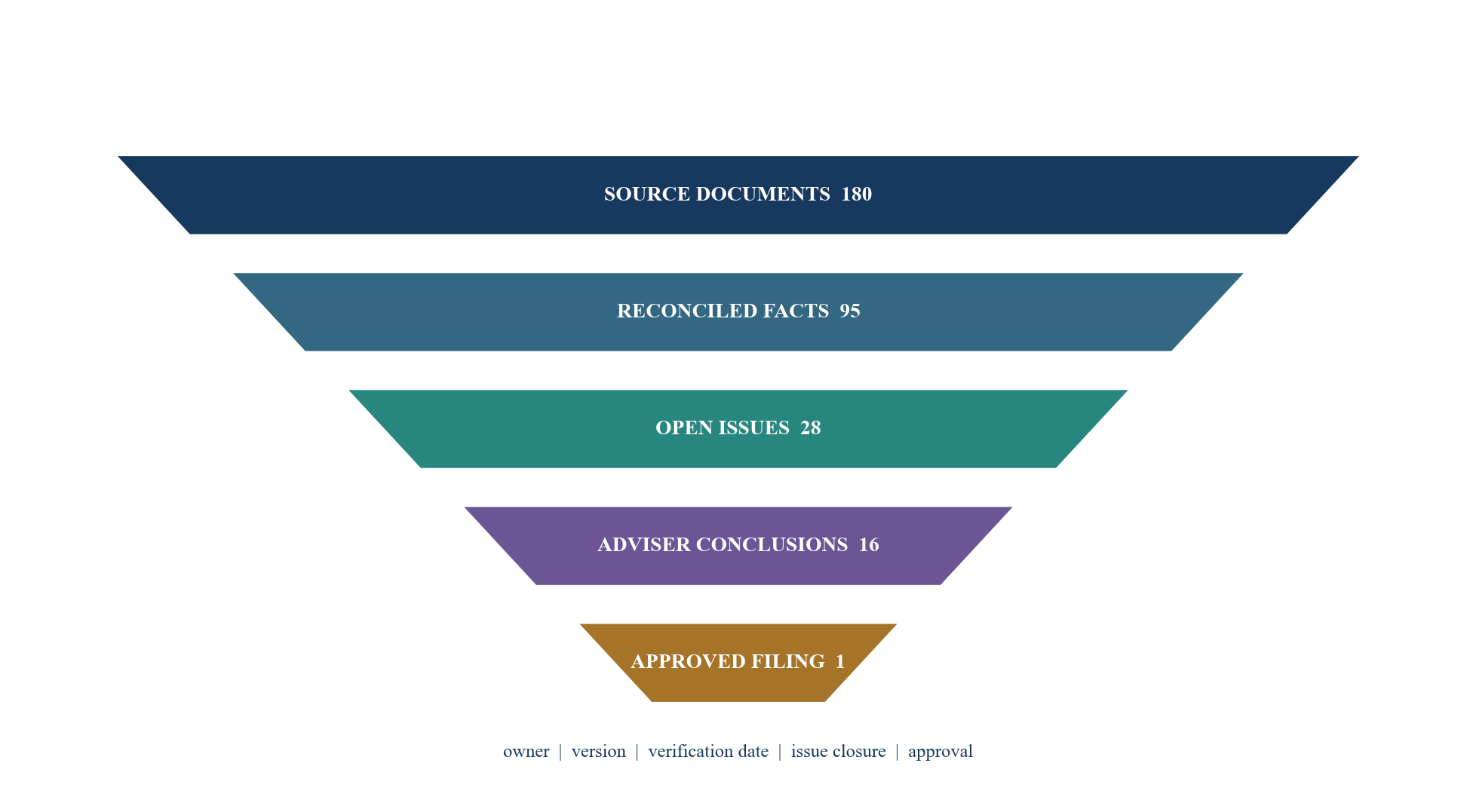
Author framework. The filing should contain only resolved and authority-ready evidence.
16. Run a 100-day recognition programme
The implementation should proceed through gated work rather than parallel drafting without a reconciled baseline. The first twenty days establish scope, authority, family objectives, enterprise perimeter, current registers and advisers. The team should agree the legal question and open the issue register.
Days twenty-one to forty reconcile family eligibility, ownership, beneficial control, capital instruments, licences, debt and guarantees. The output is a signed factual baseline and a list of legal or evidential gaps. Material conflicts should stop document design until an authorised resolution route is agreed.
Days forty-one to sixty design the future state. The family develops capital classes, transfer and liquidity rules, charter architecture, governance bodies, minority protections, succession, privacy and reporting. Legal and tax advisers test the design against mandatory rules and cross-border consequences.
Days sixty-one to eighty execute documents and readiness actions. The enterprise amends or prepares articles, agreements, charter, policies, registers, board and shareholder approvals, lender consents, data-room materials and application forms. Owners train decision makers and test the governance interfaces.
Days eighty-one to one hundred complete independent checks, approve and submit. The team verifies every representation, closes or discloses issues, freezes the filing pack and establishes the post-registration calendar. If material eligibility, ownership, consent or cross-border questions remain, the governing body should defer filing or approve a limited path supported by qualified advice.
Table 5. One-hundred-day legal-recognition sequence
| Period | Principal output | Acceptance gate |
|---|---|---|
| days 1-20 | scope, perimeter, authority, objectives, advisers | governing body confirms decision perimeter |
| days 21-40 | ownership, control, capital and evidence baseline | legal and finance owners accept factual record |
| days 41-60 | future capital, charter and governance design | family and corporate bodies approve design principles |
| days 61-80 | documents, consents, registers, application pack | advisers confirm execution and filing readiness |
| days 81-100 | independent check, approval, submission, calendar | authorised body approves representations and residual issues |
Timing should be adapted to authority process, group complexity and open legal issues.
17. Govern the recognised enterprise after registration
Recognition creates an ongoing evidence and governance obligation. Ownership, control, family eligibility, directors, licences, documents and beneficial owners can change. A register that was accurate at filing can become misleading when operating records do not update it.
The annual calendar should include confirmation statements or equivalent filings, accounts, beneficial-owner and nominee reviews, licence renewals, charter review, shareholder and board meetings, valuation, dividend decision, succession review, insurance, lender reporting and data-room refresh. Event-driven triggers should supplement the calendar.
Triggers include a birth, death, marriage, divorce, incapacity, share transfer, pledge, new class, option grant, external investment, new director, change of control, new jurisdiction, acquisition, disposal, borrowing, dispute, sanctions exposure or regulatory change. Each trigger needs an owner, assessment timeline and notification route.
The board should receive a concise dashboard. It should show family ownership percentage, unresolved title issues, beneficial-owner confirmation, control changes, transfer requests, valuation age, liquidity for redemptions, charter implementation, related-party matters, succession readiness, filings and conditions of registration.
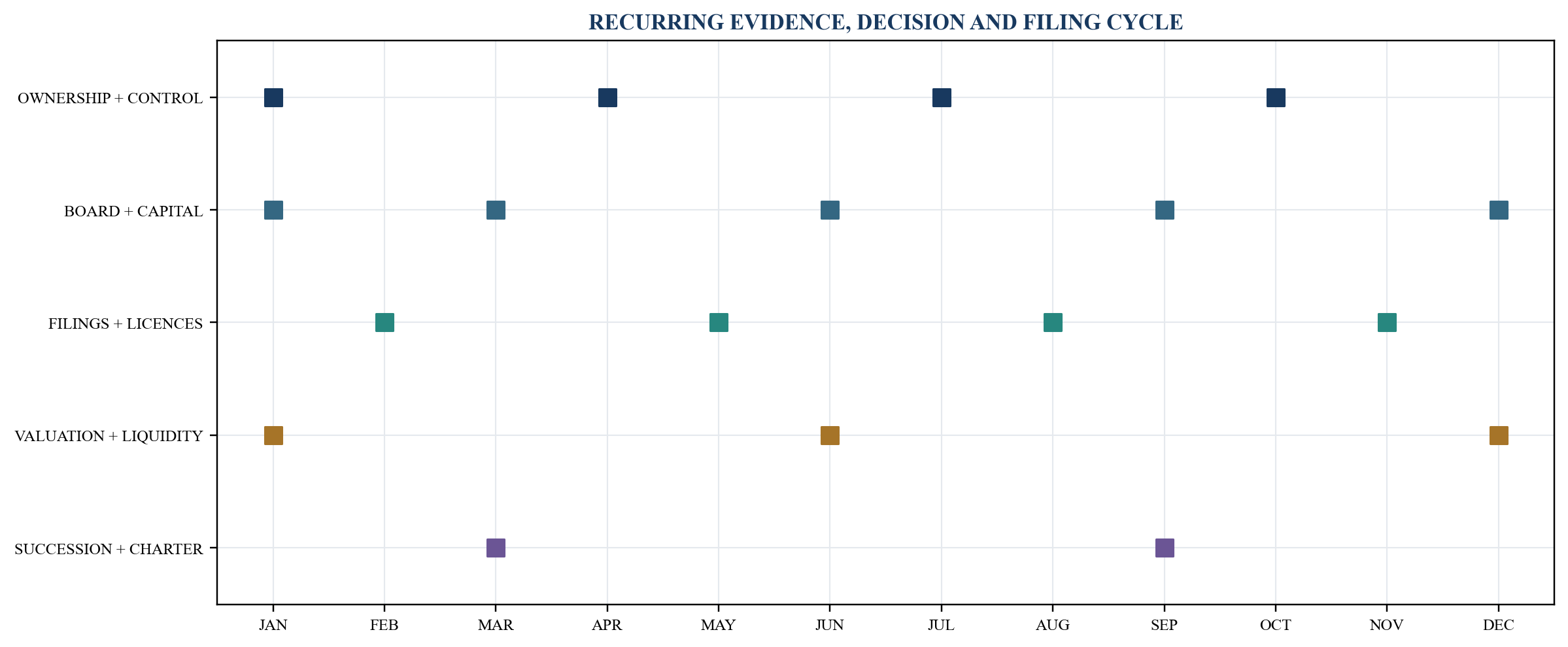
Author framework. Event-driven reviews should supplement the recurring cadence.
18. Give the governing body a decision scorecard
The registration decision should end with a scorecard whose answers can be evidenced. It should avoid a single readiness percentage that conceals material legal gaps. A red ownership or eligibility issue can outweigh several completed administrative tasks.
The scorecard should cover legal fit, perimeter, ownership, capital, governance, charter, minority protection, succession, financing, M&A, privacy, tax, evidence and operating readiness. Each domain needs a governing question, evidence owner, current conclusion, open issue, action and approval status.
Decision conditions should be explicit. The governing body can approve filing when eligibility is supported, title and control are reconciled, documents are coherent, required consents are in hand, representations are verified and ongoing responsibilities have owners. It can approve a conditional programme when specific actions have valid sequencing and no filing statement becomes inaccurate. It should defer when material facts or consequences remain unresolved.
The board should also record what registration is expected to accomplish. Objectives can include continuity of ownership, enforceable transfer rules, clearer succession, improved governance evidence or access to a particular legal framework. Outcomes should be reviewed after registration. The company should not attribute financing, valuation or growth outcomes to status without evidence.
Table 6. Governing-body registration scorecard
| Domain | Governing question | Decision evidence |
|---|---|---|
| eligibility | does the enterprise meet the current legal definition and threshold? | legislation, authority guidance, legal memorandum |
| ownership | are title, beneficial ownership and control reconciled? | registers, instruments, control matrix |
| capital | are economics, votes, transfer, valuation and funding workable? | articles, agreements, capital and liquidity plan |
| governance | do family, owner and corporate bodies have valid interfaces? | charters, delegations, minutes and policies |
| continuity | can ownership and authority survive foreseeable events? | succession map, wills, entity documents, alternates |
| execution | can representations be filed and kept current? | data room, issue register, approvals and calendar |
Every conclusion should link to current evidence and qualified advice where required.
19. Keep legal recognition connected to enterprise strategy
Legal recognition is most useful when it supports a defined enterprise strategy. The family should be able to explain how the chosen status improves decision quality, ownership continuity, capital formation, transaction readiness or succession. The explanation should use specific mechanisms rather than general claims about reputation.
For a growth-oriented enterprise, the structure should enable acquisitions, management incentives, debt and outside capital while preserving agreed family rights. For a mature dividend business, it should balance distributions, reinvestment and branch liquidity. For a group approaching succession, it should connect ownership transfer with board and executive continuity. For a family considering a sale, it should improve title, authority and data-room readiness.
The family should review the structure when strategy changes. An external investor, public listing, cross-border move, large acquisition or branch exit can alter eligibility and governance. The annual strategy process should include a legal-status impact assessment before transactions become urgent.
The durable test is operational. The enterprise should be able to trace who owns the capital, who controls each decision, which document governs, how a transfer is valued and funded, how minorities are protected, how succession occurs and how changes reach the relevant register. Legal recognition then becomes part of a repeatable enterprise system.
References
- United Arab Emirates Legislation, Federal Decree by Law No. 37 of 2022 Concerning Family Businesses, https://uaelegislation.gov.ae/en/legislations/1608
- United Arab Emirates Legislation, Federal Decree by Law No. 37 of 2022 download, https://uaelegislation.gov.ae/en/legislations/1608/download
- UAE Ministry of Economy, Family Business, https://www.moec.gov.ae/en/family-business
- UAE Ministry of Economy, Ministry starts accepting applications for registration of family businesses in the unified registry, 22 May 2024, https://www.moec.gov.ae/en/-/ministry-of-economy-starts-accepting-applications-for-registration-of-family-businesses-in-the-unified-registry
- UAE Ministry of Economy, Companies' Legislations and family-business implementing materials, https://www.moec.gov.ae/companies-legislations
- Dubai International Financial Centre, Family Arrangements Regulations 2023, https://assets.difc.com/v1/media/edge/images/dubaiintern0078-difcexperie96c5-production-3253/media/project/difcexperiences/difc/difcwebsite/documents/familydocs/family_arrangements_regulations_updated_april23.pdf
- Dubai International Financial Centre, Family Wealth Centre, https://www.difc.com/ecosystem/difc-family-wealth-centre
- Abu Dhabi Global Market Registration Authority, Circulars including beneficial ownership compliance expectations, https://www.adgm.com/registration-authority/circulars/
- UK Companies House, People with significant control, updated 18 November 2025, https://www.gov.uk/guidance/people-with-significant-control-pscs
- UK Department for Business and Trade and Companies House, Summary guidance for companies: register of people with significant control, https://www.gov.uk/government/publications/people-with-significant-control-summary-guidance/summary-guidance-for-companies-register-of-people-with-significant-control-pscs
- UK Companies House, Company information you must report, https://www.gov.uk/running-a-limited-company/company-changes-you-must-report
- Singapore Accounting and Corporate Regulatory Authority, Company registers: requirements and deadlines, updated 29 January 2026, https://www.acra.gov.sg/manage/companies/legal-requirements-common-offences/maintaining-local-companys-information-registers/company-registers/
- Singapore Accounting and Corporate Regulatory Authority, Filing with the Central Registers of Nominee Directors and Nominee Shareholders, updated 12 June 2026, https://www.acra.gov.sg/manage/companies/legal-requirements-common-offences/maintaining-local-companys-information-registers/rond-rons/filing-to-the-central-rond-rons/
- Hong Kong Companies Registry, Significant Controllers Register frequently asked questions, https://www.cr.gov.hk/en/legislation/scr/faq.htm
- Hong Kong Companies Registry, Guideline on the Keeping of Significant Controllers Registers by Companies, https://www.cr.gov.hk/en/publications/docs/Guidelines_scr_e.pdf
- Financial Action Task Force, Guidance on Beneficial Ownership of Legal Persons, 10 March 2023, https://www.fatf-gafi.org/content/fatf-gafi/en/publications/Fatfrecommendations/Guidance-Beneficial-Ownership-Legal-Persons.html
- Organisation for Economic Co-operation and Development, G20/OECD Principles of Corporate Governance 2023, https://www.oecd.org/en/publications/g20-oecd-principles-of-corporate-governance-2023_ed750b30-en.html
- International Finance Corporation, Family Business Governance Handbook, https://www.ifc.org/en/insights-reports/2011/ifc-family-business-governance-handbook
About the Author
Chennakeshav Adya is an independent researcher and Managing Partner of Matchpoint Partners. His work examines strategy, capital formation, valuation, transactions and operating execution across private and public markets.
