

1. Define the reserve as governed capacity
A family liquidity reserve should answer a practical question: which resources can a particular legal owner use, by a stated date, for an approved purpose, under base and stressed conditions? The answer requires more than a bank balance. It requires legal ownership, settlement time, currency, transferability, collateral status, approvals, tax and covenant effects, execution capability and evidence.
The reserve has three components. The first is immediately available cash in controlled accounts. The second is readily realisable assets whose expected proceeds, sale period and downside haircut have been tested. The third is committed funding capacity whose draw conditions, collateral, maturity, covenants, purpose restrictions and authority are current. Indicative borrowing capacity, unapproved asset sales and forecast distributions remain outside hard reserve capacity until their conditions are satisfied.
The family should also define the obligations covered. A core reserve can protect tax, debt service, payroll, essential family expenditure and binding capital calls. A strategic reserve can fund approved acquisitions, direct investments or operating-company support. A contingency reserve can address market, health, litigation, security, cyber, natural-hazard or succession events. Combining the categories without priority rules allows discretionary spending to consume capacity needed for hard obligations.
Governance begins with purpose. The family council can recommend lifestyle and family priorities. Each legal owner must approve its own distributions, investments, borrowing and support within valid documents and duties. The investment committee can implement approved portfolio decisions. Treasury verifies settlement and access. The reserve memorandum should identify each decision body and prevent a consolidated dashboard from becoming unauthorised transaction power.
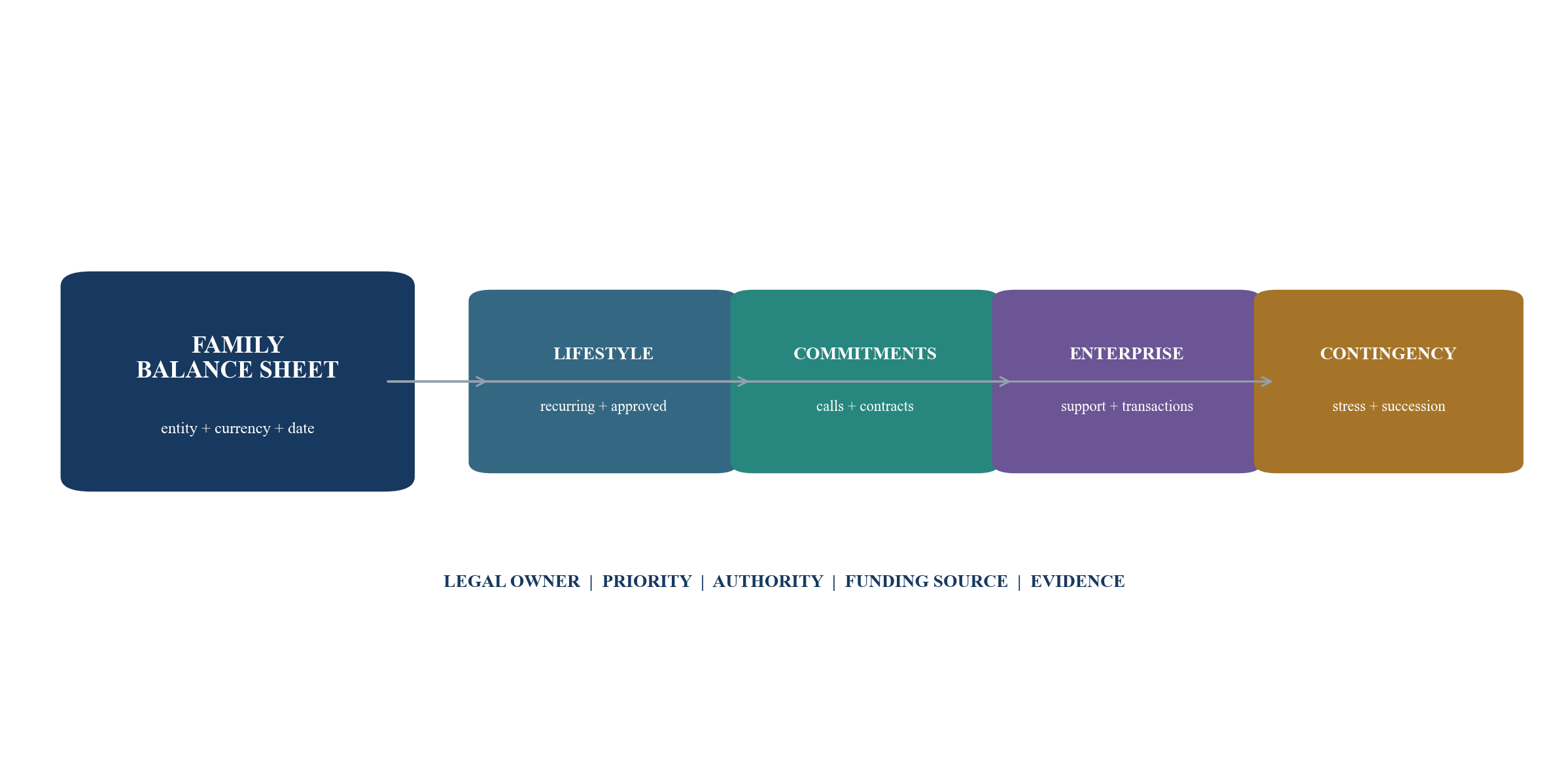
Author framework. Each use should have a legal owner, priority, authority, funding source and evidence record.
2. Separate wealth, solvency, liquidity and access
Net worth measures assets less liabilities at stated values. Solvency asks whether obligations can be met over the relevant horizon. Liquidity asks whether cash can be produced by the required dates. Access asks whether the person or body making the payment has valid operational authority. The four concepts should remain distinct.
A family can own valuable private companies, property, funds and concentrated listed shares while having little unencumbered cash. A holding company can be solvent while a personal trust faces a tax payment. A foundation can own liquid securities while its council cannot convene quickly. A bank can display available credit while a draw remains subject to representations, collateral, notice and lender discretion. Each distinction changes the reserve.
The consolidated wealth statement should therefore contain an availability overlay. Every asset needs a legal owner, custody location, currency, valuation date, liquidity class, expected execution time, transfer restrictions, security interest, tax consequence, responsible operator and approving authority. Every liability needs a legal obligor, due date, seniority, currency, covenant and funding source.
The availability overlay should calculate gross liquidity and deduct amounts that are encumbered, operationally inaccessible, legally restricted, already allocated or exposed to a correlated haircut. A family member's personal securities should not fund a company obligation without a documented transaction. Cash in a regulated entity should not be assumed distributable. Assets held through trusts, foundations and partnerships require their own powers and beneficiary or fiduciary analysis.
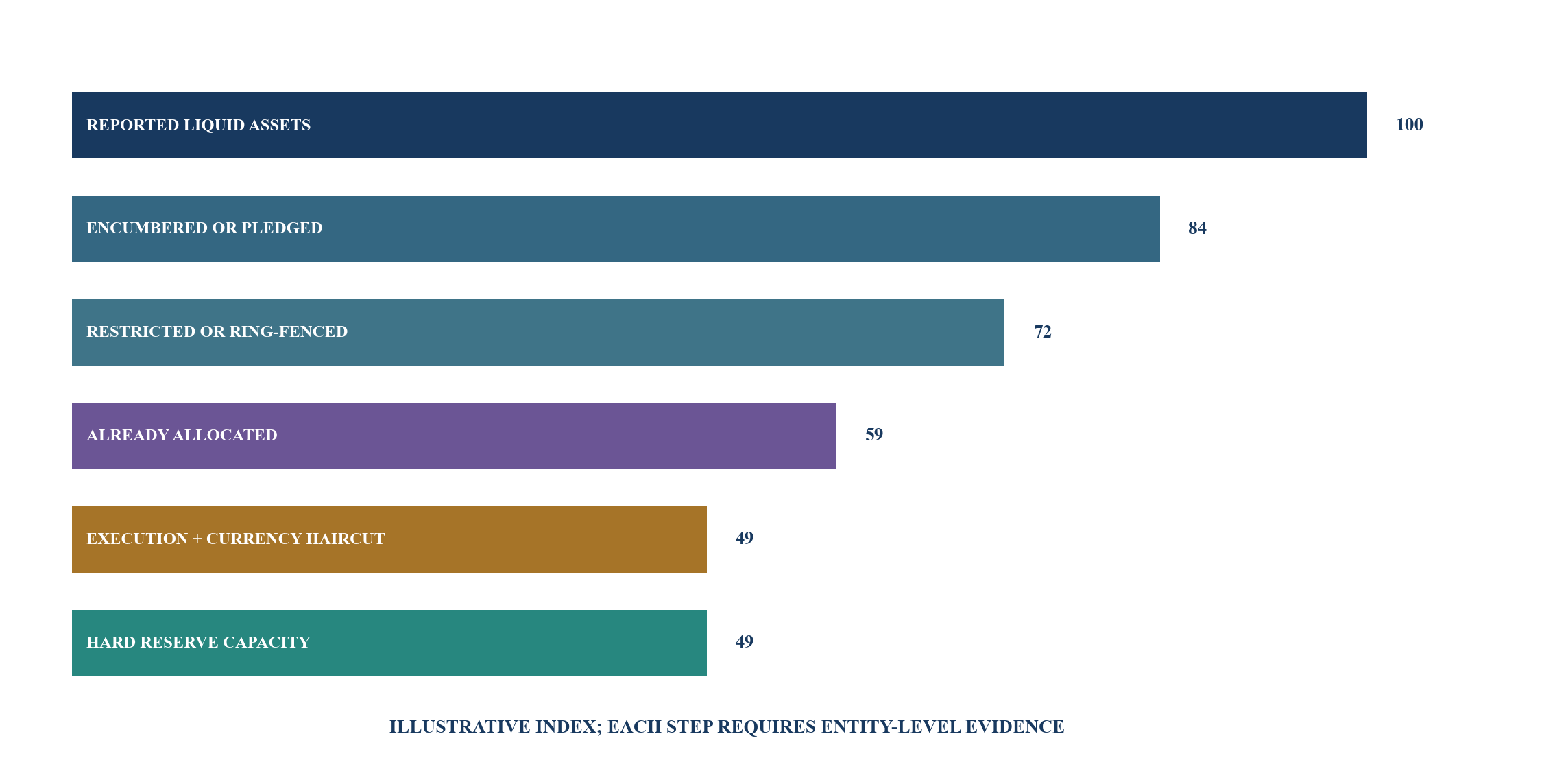
Author framework. Each deduction should be supported by current documents, account evidence and responsible-owner confirmation.
3. Establish the legal and operating perimeter
The reserve should cover every entity whose obligations or assets can affect family liquidity. The perimeter can include individuals, trusts, foundations, holding companies, investment vehicles, operating businesses, property companies and philanthropic entities. Consolidation is useful for risk visibility. It does not merge ownership or authority.
The perimeter schedule should identify legal name, jurisdiction, purpose, owners or beneficiaries, controllers, bank and custody accounts, base currency, tax residence, directors or fiduciaries, distribution powers, borrowing powers, guarantees, pledges, liquidity obligations and emergency alternates. It should reconcile to legal documents, official registers, accounts and bank mandates.
Cross-border structures create timing and conversion issues. A transfer can require board or trustee approval, banking documentation, foreign-exchange execution, withholding analysis or notification. Sanctions and financial-crime controls can interrupt a payment even when ownership is clear. The reserve should include the operational steps and time required to move money lawfully between permitted entities.
The United States family-office rule illustrates why ownership and control boundaries matter. The SEC rule identifies conditions around family clients, ownership and exclusive family control for the exclusion it administers. Those regulatory conditions do not determine a family's global liquidity design. They show that the legal identity of clients, owners and controllers must remain visible when a family office provides services.
Table 1. Family liquidity legal perimeter
| Layer | Minimum record | Reserve question |
|---|---|---|
| individual and household | residence, accounts, tax, recurring spending, powers, insurance | which personal obligations are approved and who can pay them? |
| trust or foundation | governing law, council or trustees, beneficiaries, purposes, distribution powers | can assets be applied to this purpose and by which decision? |
| investment vehicle | owners, mandate, commitments, custody, leverage, distributions | which calls and market obligations sit here? |
| holding company | subsidiaries, dividends, debt, guarantees, distributable reserves | which cash is legally available after enterprise needs? |
| operating company | payroll, suppliers, tax, debt, capex, covenants, contingency plan | when can family capital support the business? |
| philanthropic entity | charitable purpose, restrictions, grants, endowment policy | which funds are ring-fenced from family uses? |
The perimeter should be reconciled to current legal, accounting, banking and custody evidence.
4. Put every use of cash on one dated calendar
The reserve should be built from obligations rather than a target cash percentage. Each use needs an amount or range, due date, currency, legal obligor, priority, evidence, confidence, decision owner and funding source. Monthly totals conceal short settlement windows. The operating calendar should preserve actual dates and notice periods.
Hard obligations include tax, debt service, payroll, insurance, contractual capital calls and legally committed purchases. Essential but adjustable uses can include education, health, security, core property expenditure and approved family distributions. Strategic uses include new investments, acquisitions, philanthropy and expansion capital. Contingent uses include litigation, margin calls, guarantees, natural hazards, cyber events, succession and emergency family needs.
Recurring lifestyle expenditure should be forecast independently of portfolio income. A family distribution policy can identify an annual envelope, payment dates, inflation assumptions, one-off approvals and adjustment rules. The policy should state whether distributions depend on realised income, total return, operating-company dividends or a multi-year smoothing mechanism. It should also address tax, currency and branch equity.
Large one-off lifestyle purchases require their own capital decision. A property purchase, aircraft, yacht or concentrated personal investment changes not only cash but also recurring operating cost, tax, leverage and future liquidity. Approval should show total lifecycle cost and the assets or obligations displaced.
Table 2. Family liquidity obligation taxonomy
| Use | Evidence | Timing feature | Default priority |
|---|---|---|---|
| tax and regulatory payments | filed return, adviser schedule, authority notice | statutory date and possible instalments | hard |
| debt, payroll and essential operations | facility, payroll and supplier schedules | contractual dates and covenant interactions | hard |
| private-market capital calls | fund agreement, notice, remaining commitment | notice period, currency and possible recall | hard when valid |
| core family lifestyle | approved household and branch budgets | recurring with controlled exceptions | protected envelope |
| operating-company support | board request, cash forecast, alternatives and terms | urgent request can precede complete evidence | gated strategic |
| new investments and philanthropy | mandate, diligence, approval and grant documents | discretionary until valid commitment | deferrable |
| litigation, health, security and succession | adviser estimate, insurance and contingency plan | uncertain amount and timing | contingency |
Priority is a governance classification and should be approved before stress arises.
5. Build a lifestyle funding rule that preserves fairness
Lifestyle funding is often governed through history: last year's spending becomes this year's expectation. A durable rule starts with purpose, legal source, affordability and family agreement. It should distinguish shared family infrastructure from household spending, branch distributions, employment compensation, shareholder dividends and loans.
The family should prepare a three-year lifestyle budget with recurring, periodic and one-off categories. Each category needs a payer, beneficiary, currency, tax treatment, approval threshold and evidence standard. Shared services such as security, residences, education administration and family events should have allocation rules. Personal use of enterprise assets should be documented under applicable law and policy.
Fairness does not require identical cash. Branch size, age, disability, education, family service and ownership can justify different arrangements when the governing principles are explicit. The policy should identify which payments are needs-based, ownership-based, role-based or discretionary. Disagreements should follow a defined information and dispute route.
The funding rule should use a smoothing mechanism rather than assume current-year investment distributions. One approach can set a protected base from a multi-year measure of realised portfolio resources, subject to reserve coverage and governing-body approval. Every formula remains a management choice. Tax, fiduciary, minority, creditor and legal constraints require qualified advice.
Lifestyle spending should also have stress responses. Green can permit the approved envelope. Amber can defer one-off expenditure and require additional approval. Red can protect essential payments while suspending discretionary purchases. The triggers should be linked to reserve coverage, forecast confidence and access, rather than a single market index.
6. Turn private-market commitments into a dated liability system
An unfunded commitment is a contractual maximum rather than a forecast date. The reserve should contain a position-level commitment register showing fund, legal investor, currency, original and remaining commitment, recallable distributions, notice terms, investment period, expected calls, expected distributions, forecast source, evidence date and confidence.
ILPA's updated Capital Call and Distribution Template was released in 2025 to improve uniformity and transparency in notices. ILPA states that funds adopting the Performance Template should use it for funds launched on or after the first quarter of 2026, while other adopting funds move forward from the first quarter of 2027. A family office can map notices into its internal register while retaining the governing fund documents and actual notice as controlling evidence.
Forecasts should separate contractual exposure from the cash case. Base assumptions can use manager guidance and portfolio schedules. Stress can accelerate calls, delay distributions, include recallable amounts and apply foreign-exchange movements. A severe case can add secondary-market delays, borrowing haircuts or overlapping enterprise needs. The family should identify concentration by manager, strategy, vintage, currency, jurisdiction and call window.
Distributions should never be netted against calls before settlement. Gross flows belong on the calendar because the source, legal entity, currency, tax and timing can differ. A forecast distribution should carry a confidence classification and supporting evidence. Realised cash updates the register and remaining commitment.
Table 3. Minimum private-market commitment record
| Field | Control purpose | Evidence |
|---|---|---|
| legal investor and currency | locates the obligation and settlement account | subscription and account documents |
| original and remaining commitment | establishes contractual exposure | fund agreement, administrator statement |
| recallable amount and notice period | captures additional timing risk | distribution notice and governing terms |
| expected calls by month | creates the cash case | manager forecast and portfolio model |
| expected distributions by month | records timing with confidence | manager evidence and asset-level review |
| funding source and alternate | assigns operational readiness | approved reserve and account test |
| authority and payment workflow | prevents unauthorised settlement | delegation, dual control and checklist |
| last reconciliation and owner | makes data accountability visible | signed control record |
The register should reconcile to fund documents, administrator records, notices, cash and the general ledger.
7. Gate operating-company support as a capital decision
A family operating company can face a temporary working-capital gap, covenant pressure, acquisition opportunity or structural loss. The family reserve should not treat each request as an emergency withdrawal. Support requires a transaction file that separates enterprise need, shareholder preference and family welfare.
The request should identify the legal recipient, purpose, amount, currency, runway, existing lenders, security, covenants, alternatives, operational plan, governance, conflicts, valuation and repayment or return. It should distinguish equity, shareholder loan, guarantee, asset purchase, dividend waiver and third-party financing. Each route changes risk, priority, tax, control and creditor outcomes.
The business board should own its forecast and turnaround or investment plan. The family or holding-company body decides whether support fits its mandate and capacity. Conflicted directors or family members should disclose interests and follow the applicable approval route. Minority holders, lenders and other stakeholders may have rights that the family cannot bypass.
Support should be staged against evidence. A first tranche can protect an immediate critical need. Further funding can depend on cash controls, lender agreement, asset sales, cost actions, milestones and independent monitoring. The reserve should record total exposure across equity, loans, guarantees, pledged assets and foregone distributions.
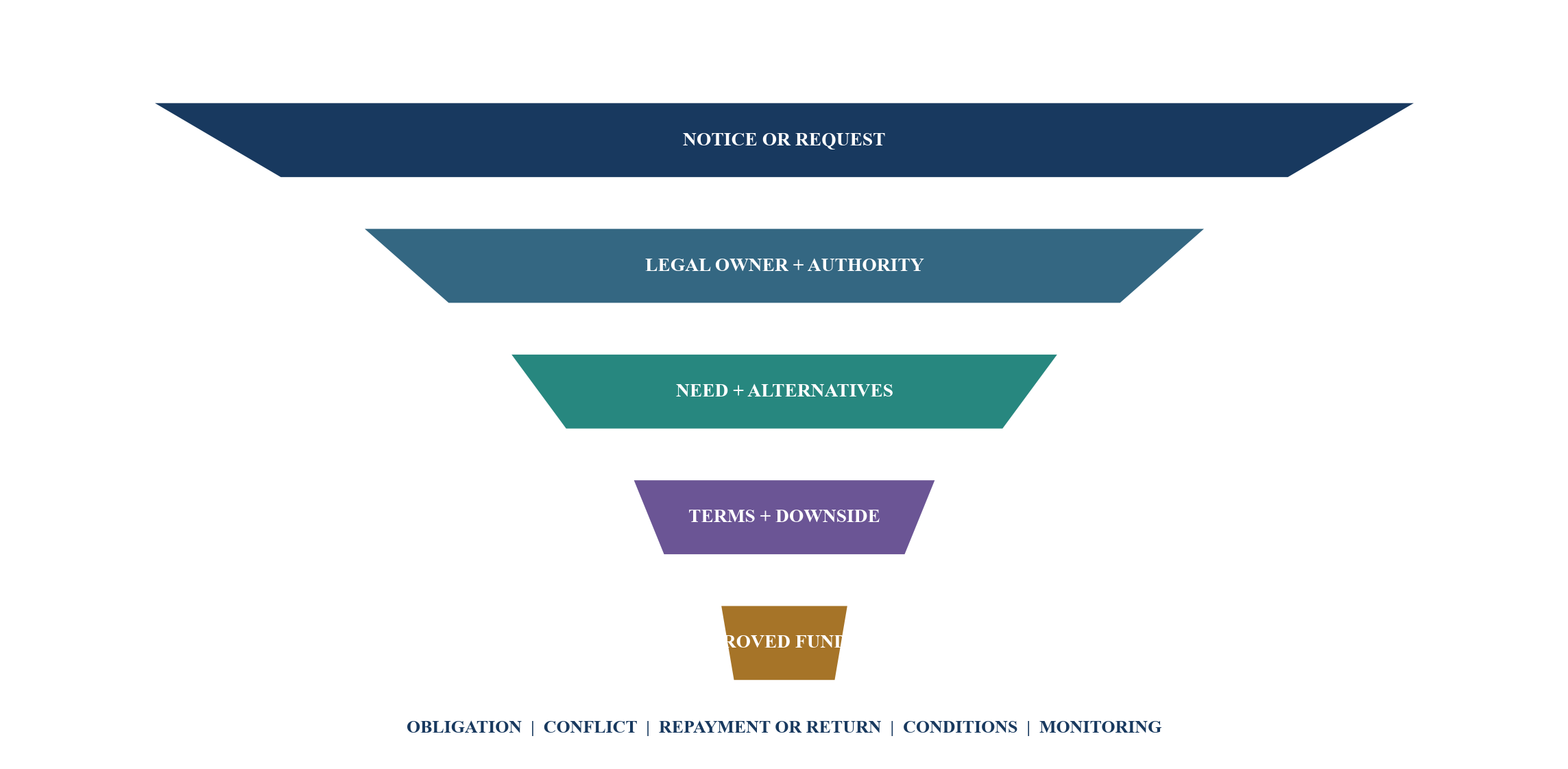
Author framework. Contractual obligations and discretionary support follow distinct evidence and approval routes.
8. Include margin, collateral and guarantee liquidity
Derivative hedges, securities finance, pledged portfolios and guarantees can generate liquidity needs outside the investment calendar. The Financial Stability Board's 2024 final report states that unexpected margin and collateral calls can amplify liquidity demand. Its recommendations cover governance, liquidity-risk tolerance, contingency funding, regular review, stress testing, liquid assets, collateral arrangements and operational interaction with counterparties. The FSB identifies family offices among the non-bank participants to which the recommendations can be relevant.
The reserve should list every derivative, margin agreement, securities-backed loan, repo, pledge and guarantee. The record should include counterparty, legal entity, collateral currency, eligible assets, haircuts, thresholds, call timing, settlement method, concentration, wrong-way risk, cure period and responsible operator. Treasury should know which accounts and assets can meet a same-day or next-day call.
Collateral capacity should be stressed with the underlying market. A concentrated listed holding can decline while its lending haircut rises. Currency hedges can require cash during a rapid move. Operating-company guarantees can crystallise as portfolio values fall. These correlated effects make gross borrowing limits unreliable as hard reserve.
The family should conduct periodic call simulations. The exercise should validate counterparty contacts, notice intake, valuation challenge, approval, collateral selection, payment, accounting and escalation. An emergency contact list and alternate signatories should be tested. The results should change the reserve if settlement cannot be completed inside the required window.
9. Construct a tiered reserve ladder
The reserve ladder should match source quality to obligation timing. Tier one can contain operational cash and immediately transferable deposits for the next thirty days. Tier two can contain high-quality short-duration instruments for the next quarter. Tier three can contain listed assets whose sale capacity and concentration have been tested for the twelve-month horizon. Tier four can contain committed facilities with verified draw conditions. Strategic sales, secondaries and new financing belong to the contingency plan until executable.
Each tier requires a minimum and a cap. Excess cash can have opportunity cost, credit concentration and inflation risk. Insufficient cash can force sales or borrowing. The governing body should select thresholds from actual obligations, stress tests and risk tolerance. The reserve should be measured by legal entity and currency as well as consolidated.
IOSCO's revised 2025 recommendations concern collective investment schemes rather than a private family balance sheet. Their attention to governance, portfolio liquidity, liability profile, stress, monitoring and tools provides useful design disciplines when a family vehicle holds redeemable investments. The family should apply standards proportionately and respect the actual legal and regulatory perimeter.
Reserve assets should be operationally diversified. Several accounts at one banking group can share risk. A custody account can contain liquid securities without immediate payment capability. Money-market funds can have dealing cut-offs. Foreign currency can require conversion and settlement. The ladder should show execution facts rather than product labels.
10. Design scenarios that combine the shocks
Liquidity stress rarely arrives as one variable. A market decline can reduce sale proceeds and collateral while private funds call capital. A family operating company can need support as dividends stop. Tax can fall due while an estate is being administered. The scenario engine should combine correlated uses and constrained sources.
The base case should use approved obligations and evidence-weighted forecasts. The downside case can delay private-market distributions, accelerate calls, reduce listed-asset values, increase haircuts, weaken operating-company dividends and add selected enterprise support. The severe case can combine a market shock, collateral call, business interruption, currency move, succession event and restricted operational access.
Scenarios need dates. A twelve-month annual total cannot identify a three-day shortfall. The model should calculate daily or weekly liquidity for the immediate period, monthly coverage for one to two years and annual structural capacity thereafter. It should distinguish forecast cash from funds already settled.
Management assumptions should be transparent. The family should record the source, owner, date, confidence and sensitivity of each input. Market data can inform haircuts and timing; it cannot determine the actual facts of a private family portfolio. Qualified advisers should review legal, tax, regulatory and financing consequences.
Table 4. Hypothetical combined liquidity scenarios
| Variable | Base | Downside | Severe |
|---|---|---|---|
| private-market calls over twelve months | 42 | 67 | 91 |
| private-market distributions | 38 | 16 | 5 |
| protected family and tax uses | 24 | 27 | 31 |
| operating-company support | 0 | 20 | 45 |
| collateral and guarantee calls | 0 | 9 | 24 |
| listed-asset execution haircut | 3% | 14% | 28% |
| committed-facility availability | 60 | 45 | 22 |
| operational-access delay | none | five days | twenty days |
Every figure is a hypothetical management assumption created solely to demonstrate the method.
11. Measure reserve coverage and decision risk
The dashboard should show several measures. Hard-obligation coverage divides tier-one and tier-two capacity by hard uses over a stated period. Total reserve coverage includes approved contingent sources after haircuts. Minimum runway identifies the first date on which available sources fall below protected uses. Concentration shows dependence on one bank, currency, asset, manager, borrower or signatory.
Forecast confidence should sit beside the number. A twelve-month ratio built on speculative distributions can appear strong. The dashboard should separate settled cash, contractual inflows, high-confidence forecasts and low-confidence forecasts. It should state when data were reconciled and which obligations remain estimated.
The risk dashboard can use green, amber and red classifications. Green means coverage and operations exceed approved thresholds. Amber identifies declining headroom, concentrated sources, stale data or forecast dependence. Red identifies a missed or imminent hard obligation, invalid access, covenant breach, insufficient collateral or unauthorised action. One red legal or operational issue can outweigh an average numeric score.
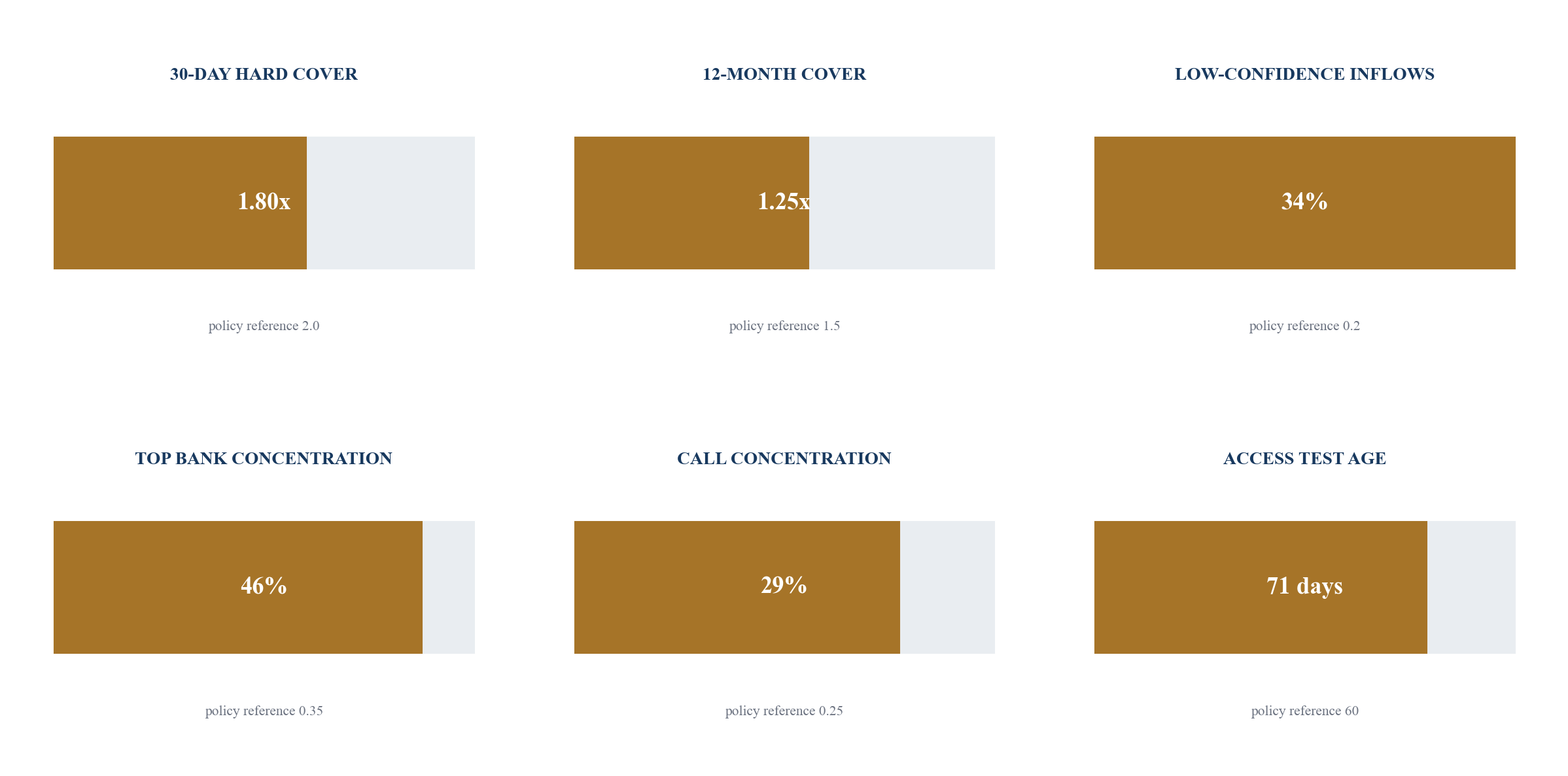
Hypothetical indicators demonstrate the dashboard design and do not describe a family or portfolio.
12. Govern financing as a contingent source
Financing can bridge timing, preserve assets and fund strategic opportunities. It also adds interest, maturity, collateral, covenants, information duties, recourse and refinancing risk. The reserve should compare sources by complete economics and downside capacity.
A securities-backed facility can execute quickly against eligible liquid assets. Its capacity can fall with market value and lender haircuts. A property loan can provide longer duration but requires valuation, security and closing work. A shareholder or holding-company facility can change related-party balances and creditor priority. NAV-based fund finance operates at fund level and can alter portfolio risk and distributions. ILPA's NAV-facility guidance emphasises transparency, legal permissions, LP engagement, use, terms, conflicts and disclosure.
The family should maintain a financing register. It should show borrower, lender, purpose, limit, drawn amount, availability, collateral, margin, covenants, maturity, amortisation, cost, guarantees, permitted distributions, change-of-control provisions and repayment source. The register should distinguish a signed commitment from an indicative term sheet.
Before a draw, the decision body should review use, alternatives, stressed collateral, repayment and exit. Borrowing to preserve long-term assets can be rational when repayment is visible. Repeated borrowing to fund structural lifestyle excess or an unviable business can defer the underlying decision and transfer risk to pledged assets.
Table 5. Funding-route assessment
| Route | Strength | Principal risk | Required evidence |
|---|---|---|---|
| controlled cash and deposits | immediate and transparent | opportunity cost, bank and currency concentration | account ownership, access and protection |
| short-duration securities | high-quality secondary liquidity | market, settlement and sale-capacity risk | holdings, depth, haircut and tax review |
| listed-asset sale | converts value without new debt | price impact and strategic loss | executable size, approvals and proceeds |
| securities-backed facility | speed and portfolio continuity | margin, haircut, recourse and forced sale | committed terms and stressed collateral |
| property or enterprise financing | longer duration and asset match | valuation, covenants and closing time | lender diligence and repayment capacity |
| private-market secondary | reduces commitments and can create cash | discount, consent, selection and execution risk | buyer evidence, transfer terms and net proceeds |
| shareholder loan or equity | flexible related-party capital | conflict, subordination, tax and governance | valid authority, terms and monitoring |
Executability and complete downside effects should be assessed using current terms and qualified advice.
13. Use asset sales as controlled transactions
The contingency plan should identify which assets can be sold, in what order, at what size and with which approvals. Liquidity labels are insufficient. A listed position can be concentrated, pledged or sensitive to market depth. A property can require months. A private fund interest can require manager consent and buyer diligence. A family operating company stake can carry strategic and control consequences.
The sale register should show legal owner, asset, expected buyer universe, valuation evidence, executable size, transfer restrictions, tax, transaction cost, settlement period, confidentiality, governance and minimum acceptable outcome. It should separate observable market value from expected net cash.
Private-market secondaries can address liquidity and commitment exposure. The family should assess portfolio quality, unfunded obligations, buyer pricing, stapled or structured proposals, consents, warranties, tax and the effect on remaining strategy. A secondary sale should be governed as an investment transaction rather than an automatic response to a cash forecast.
Sequencing matters. Selling the most liquid assets first can leave the balance sheet more concentrated and fragile. Borrowing before a sale can preserve timing while adding recourse. The decision should compare post-transaction liquidity, leverage, concentration, expected return, governance and future optionality.
14. Connect liquidity to succession and emergency authority
Death, incapacity, family conflict or departure of a key executive can interrupt access even when assets are liquid. Bank mandates, trust powers, foundation councils, board appointments, digital credentials and payment approvals should be designed for continuity.
The succession map should identify each critical reserve role: family authority, entity director, trustee or council member, investment approver, treasury operator, bank signatory, custodian contact and data owner. It should show alternates, appointment powers, activation evidence, information access and limits. Legal documents and operating systems should agree.
The family should estimate transition cash needs. Estate tax, probate or administration, valuation, advisers, security, insurance, buyouts, redemptions and interim household support can create a concentrated demand. Ownership can remain unsettled while the business and investment portfolio need decisions. A protected succession reserve and valid interim authority can reduce forced actions.
Emergency authority should be bounded. An alternate can pay hard obligations and protect assets within defined limits. Strategic sales, new leverage, related-party support and changes to family distributions can remain reserved for the properly constituted body. Every emergency action should be logged and reviewed when normal governance resumes.
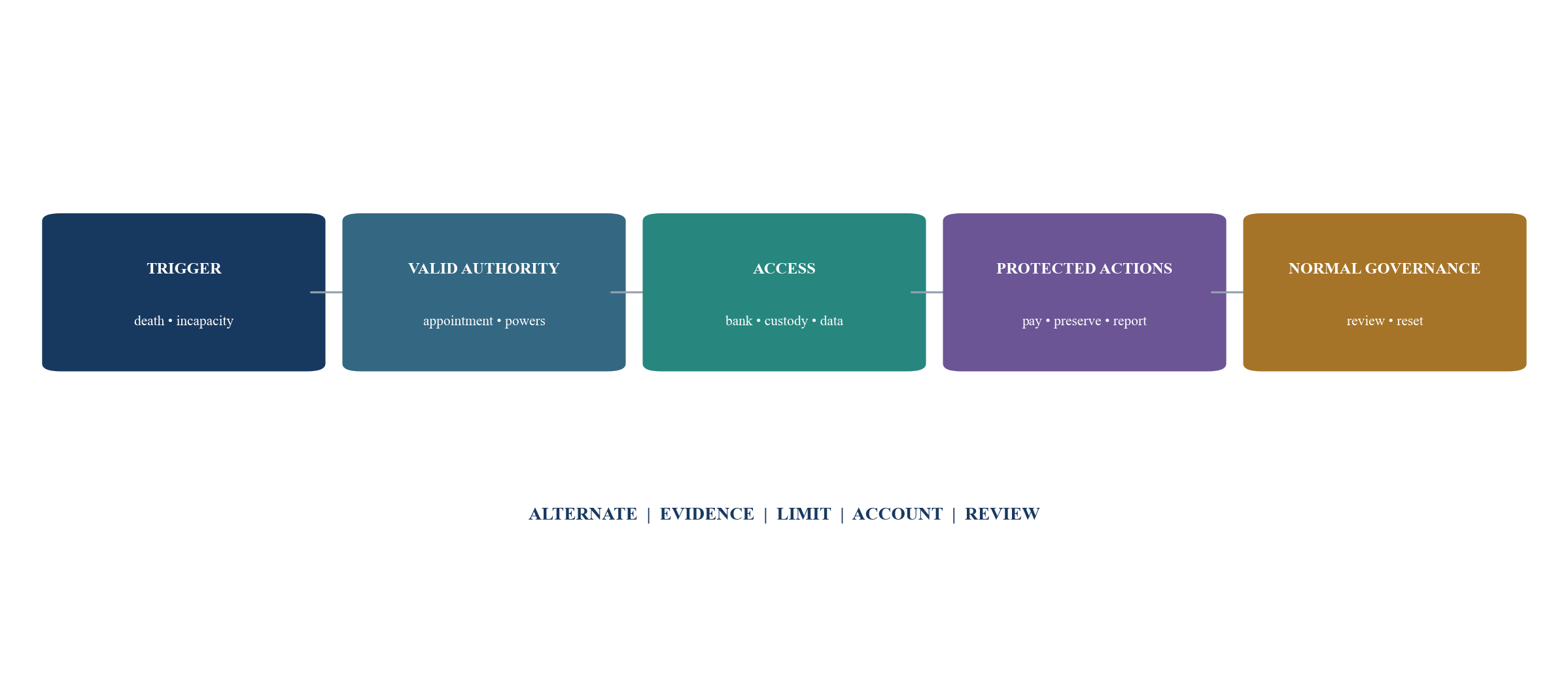
Author framework. Legal appointment, operational access and decision limits should be tested together.
15. Demonstrate the method with a hypothetical family group
Consider a hypothetical cross-border family group with USD 1.6 billion of reported assets. The group includes a family holding company, three operating companies, two investment vehicles, a foundation and personal households. The investment vehicles have USD 180 million of private-market net asset value and USD 72 million of remaining commitments. The family has USD 68 million of cash and short-duration securities across several entities, plus a USD 60 million committed securities-backed facility.
Every amount and circumstance in this case is a hypothetical management assumption. The example does not describe a client, forecast, market estimate or recommended reserve.
The next twelve months contain USD 14 million of approved family and household uses, USD 9 million of tax, USD 11 million of debt and property obligations, and a base forecast of USD 42 million of private-market calls. Expected private-market distributions are USD 38 million, of which only USD 12 million has high-confidence evidence. One operating company requests USD 20 million after a major customer delays payment. A concentrated listed holding supports part of the committed facility.
The first consolidated view suggests ample capacity: USD 68 million of liquid assets plus USD 60 million of credit against USD 96 million of base uses before forecast distributions. The legal-availability overlay changes the result. USD 17 million belongs to an entity unable to fund household or investment-vehicle obligations without a valid transaction. USD 9 million is already pledged or allocated. USD 8 million is needed for thirty-day operating and tax uses. The hard reserve begins at USD 34 million, while facility availability is contingent on the same listed assets used in the sale plan.
The governing body adopts a downside case: calls rise to USD 67 million, distributions fall to USD 16 million, the operating company receives a staged USD 20 million shareholder facility, and listed-asset proceeds carry a 14 percent haircut. It freezes new discretionary commitments, protects core lifestyle and hard obligations, sells a diversified portion of liquid securities, obtains lender confirmation, and stages business support against weekly cash controls and milestones.
The severe case combines USD 91 million of calls, USD 5 million of distributions, a USD 45 million business request, USD 24 million of collateral and guarantee calls, a 28 percent listed-asset haircut and twenty days of impaired access. The dashboard turns red. The family declines full enterprise support, activates alternates, opens a secondary-market review, preserves hard obligations and takes structural capital decisions to the valid boards and owner bodies.
The example demonstrates why the reserve cannot be a single percentage of net worth. Legal access, correlated sources, obligation timing, business viability and authority determine the response.
16. Create a recurring governance and testing calendar
The reserve should be refreshed monthly and tested more deeply each quarter. Monthly work reconciles accounts, calls, distributions, obligations, facility availability, collateral and exceptions. Quarterly work updates scenarios, asset-sale capacity, business exposures, lifestyle forecast and concentration. Annual work approves risk tolerance, reserve policy, distribution envelope, authorities, facilities, insurance and succession readiness.
Event-driven triggers should supplement the calendar. A large capital-call notice, covenant warning, business interruption, death, incapacity, major acquisition, litigation, sanctions event, bank downgrade, currency move or custody incident can require an immediate update. Each trigger should state who convenes, what data are needed and which actions are permitted.
The family should conduct two operating simulations each year. One can test market and collateral stress. The other can test succession and access. The exercises should include family governance, investment, treasury, legal, tax, operations, banks, custodians and relevant business owners. Findings should become dated actions with accountable owners.
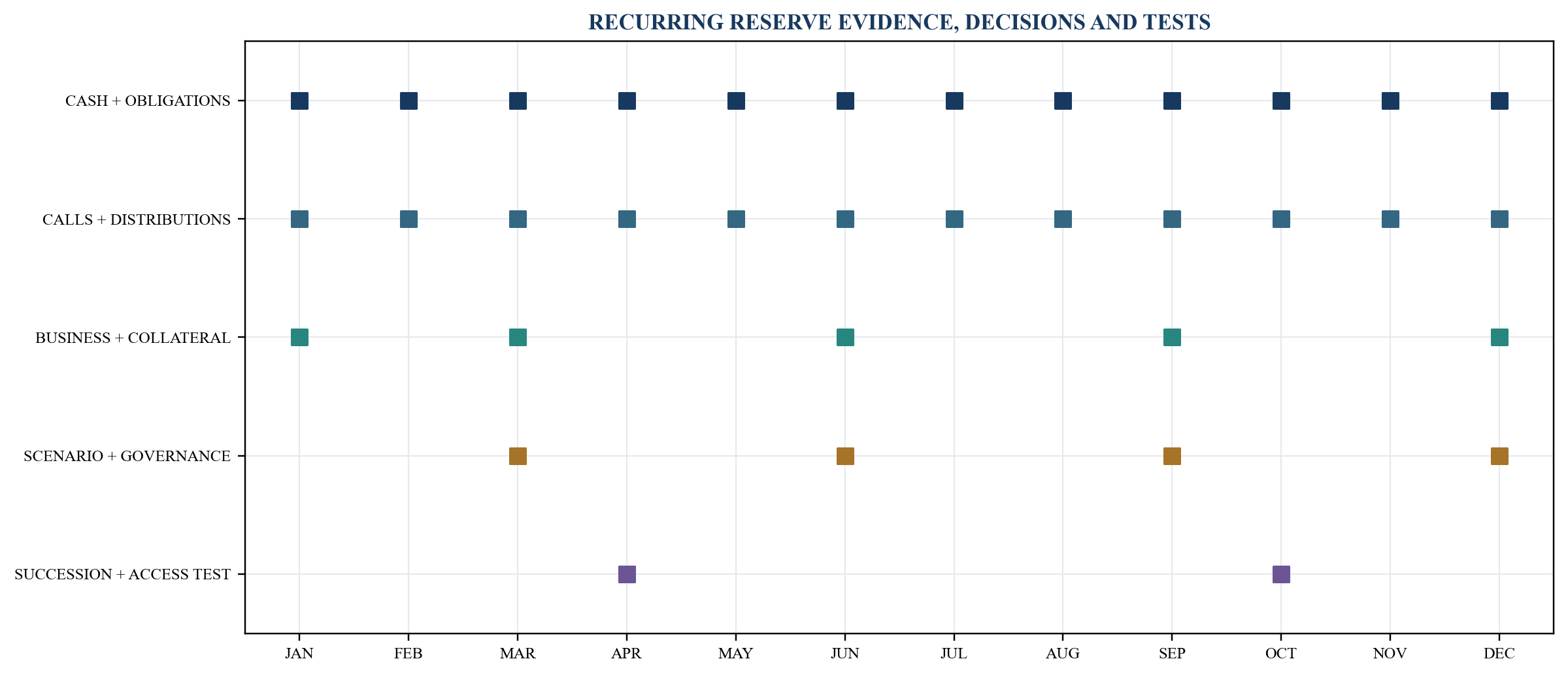
Author framework. Event-driven triggers should supplement recurring reviews and simulations.
17. Implement the reserve in one hundred days
The first twenty days establish the perimeter, objectives, governing bodies, policy priorities and evidence owners. The team collects legal-entity records, accounts, custody data, debt, commitments, family budgets, business exposures, insurance and succession documents. It opens an issue register and records missing access or authority.
Days twenty-one to forty reconcile cash, assets, liabilities, guarantees, commitments, capital calls, distributions and recurring uses. The team maps currencies, restrictions, collateral, transfer routes and decision rights. Hard obligations and protected uses receive dated funding sources.
Days forty-one to sixty build the base, downside and severe scenarios. Treasury tests asset sales, facilities, currency, collateral and settlement. Operating companies prepare their own liquidity and support protocols. The family approves the lifestyle envelope, enterprise-support gate and reserve tiers.
Days sixty-one to eighty execute controls. The group updates mandates, delegations, bank signatories, facility information, data feeds, reporting, notice workflows and contingency contacts. It documents alternatives and pre-authorised protective actions. Legal and tax advisers review entity transfers, distributions, loans, guarantees and succession arrangements.
Days eighty-one to one hundred conduct a simulation, close critical issues and approve the reserve memorandum. The governing body receives the opening dashboard, exception list, implementation evidence and annual calendar. Residual uncertainties remain visible with owners and dates.
18. Give the governing body a scorecard
The decision scorecard should avoid one blended readiness percentage. A red authority, legal-access or hard-obligation issue can outweigh completed administrative tasks. The scorecard should show conclusion, evidence, owner, open issue, action and approval for each domain.
Coverage is sufficient only when sources are legally and operationally available inside the obligation window. Lifestyle is sustainable only when its source and adjustment rule are explicit. Commitments are controlled only when the register reconciles to notices and cash. Enterprise support is governed only when its purpose, alternatives, terms, conflicts and monitoring are accepted. Succession is ready only when appointments and access have been tested.
Table 6. Governing-body family liquidity scorecard
| Domain | Governing question | Acceptance evidence |
|---|---|---|
| perimeter and access | does each reserve source have a valid legal owner, operator and transfer route? | entity map, accounts, mandates and access test |
| hard obligations | are all approved uses dated, prioritised and funded under stress? | obligation calendar and scenario model |
| lifestyle | is the distribution envelope affordable, fair and adjustable? | policy, branch budgets and approvals |
| commitments | are remaining commitments, calls and distributions reconciled? | register, notices, cash and manager evidence |
| enterprise support | does every request pass need, alternatives, terms, conflict and monitoring gates? | board file and staged funding agreement |
| financing and collateral | are availability, repayment, covenants and correlated haircuts understood? | committed terms and stress test |
| succession | can alternates access information and protect hard obligations within valid limits? | documents, appointments and simulation |
| operating cycle | are data, thresholds, escalation and review dates current? | dashboard, issue register and calendar |
Each conclusion should link to current evidence and the responsible decision body.
19. Keep liquidity connected to family strategy
The reserve protects continuity, supports patient ownership and creates decision time. It also exposes trade-offs between lifestyle, private-market pacing, enterprise concentration, leverage, philanthropy and succession.
The annual family strategy process should begin with the economic balance sheet and liquidity reserve. New private-market exposure, succession and acquisitions should be assessed against dated calls, lifestyle needs, enterprise risk, transition cash, authority and the protection of hard obligations.
The governing body should compare forecast and actual calls, distributions, spending, business support, financing and asset sales. Repeated exceptions can indicate that policy, portfolio, enterprise strategy or family expectations need structural change.
A durable reserve is entity-aware, dated and executable. It connects family purpose to legal ownership, cash priorities, capital commitments, enterprise resilience and succession. That connection turns liquidity from a static allocation into a repeatable family-capital operating system.
References
- Financial Stability Board, Liquidity Preparedness for Margin and Collateral Calls: Final Report, 10 December 2024, https://www.fsb.org/2024/12/liquidity-preparedness-for-margin-and-collateral-calls-final-report/
- Financial Stability Institute, Liquidity Preparedness for Margin and Collateral Calls: Executive Summary, 25 March 2026, https://www.bis.org/fsi/fsisummaries/exsum_23913.htm
- Institutional Limited Partners Association, Capital Call and Distribution Template, current implementation timeline and materials, https://ilpa.org/industry-guidance/templates-standards-model-documents/ilpa-templates-hub/ilpa-capital-call-distribution-template/
- Institutional Limited Partners Association, Capital Call and Distribution Template v2.0 Suggested Guidance, 2025, https://ilpa.org/wp-content/uploads/2025/09/ILPA-Suggested-Guidance-2025-Final.pdf
- Institutional Limited Partners Association, NAV-Based Facilities Guidance and Roadmap, https://ilpa.org/industry-guidance/principles-best-practices/nav-based-facilities-guidance-roadmap/
- Institutional Limited Partners Association, NAV-Based Facilities: Guidance for Limited Partners and General Partners, 2024, https://ilpa.org/wp-content/uploads/2024/07/ILPA-Guidance-on-NAV-Facilities-2024.pdf
- International Organization of Securities Commissions, Revised Recommendations for Liquidity Risk Management for Collective Investment Schemes, May 2025, https://www.iosco.org/library/pubdocs/pdf/IOSCOPD798.pdf
- International Monetary Fund, Addressing Market Dysfunction and Liquidity Stresses in Nonbank Financial Intermediaries, Global Financial Stability Note 2025/004, https://www.elibrary.imf.org/view/journals/065/2025/004/article-A001-en.xml
- International Monetary Fund, Global Financial Stability Report, October 2025, Chapter 1, https://www.imf.org/-/media/files/publications/gfsr/2025/october/english/ch1.pdf
- International Finance Corporation, Family Business Governance Handbook, https://www.ifc.org/en/insights-reports/2011/ifc-family-business-governance-handbook
- International Finance Corporation, Family Business Governance, https://www.ifc.org/en/what-we-do/sector-expertise/corporate-governance/family-business-governance
- United States Securities and Exchange Commission, Family Offices, Final Rule IA-3220, https://www.sec.gov/rules-regulations/2011/06/family-offices
- United States Securities and Exchange Commission, Staff Responses to Questions About the Family Office Rule, https://www.sec.gov/rules-regulations/staff-guidance/division-investment-management-frequently-asked-questions/staff-responses-questions-about-family-office-rule
- United States Securities and Exchange Commission, Investment Company Liquidity Risk Management Programs Frequently Asked Questions, https://www.sec.gov/rules-regulations/staff-guidance/division-investment-management-frequently-asked-questions/investment-company-liquidity-risk-management-programs-frequently-asked-questions
- Organisation for Economic Co-operation and Development, G20/OECD Principles of Corporate Governance 2023, https://www.oecd.org/en/publications/g20-oecd-principles-of-corporate-governance-2023_ed750b30-en.html
- IFRS Foundation, IFRS 13 Fair Value Measurement, https://www.ifrs.org/issued-standards/list-of-standards/ifrs-13-fair-value-measurement/
About the Author
Chennakeshav Adya is an independent researcher and Managing Partner of Matchpoint Partners. His work examines strategy, capital formation, valuation, transactions and operating execution across private and public markets.
