

1. Underwrite a hotel as an asset and an operating system
A hotel cannot be underwritten as a conventional leased building. Its rooms are sold night by night, demand changes by season and event, and the operator continually converts labour, utilities, distribution, food, maintenance and guest experience into revenue. A vacant office can retain lease-up potential. A poorly operated hotel can lose rate, reputation, staff and distribution position while the physical building remains intact.
The credit analysis should therefore contain two connected cases. The property case tests title, use, replacement cost, physical condition, alternative use, insurance and sale value. The operating case tests room inventory, occupancy, average daily rate, revenue per available room, departmental profit, undistributed expenses, fixed charges, recurring capital expenditure, working capital and cash available for debt service.
The lender should identify which cash flows belong to the borrower. Ownership, operating company, hotel manager, franchisor, property company and central services company can be separate entities. Revenue may enter accounts controlled by the operator. Fees may be deducted before owner cash is released. Licences, staff and supplier contracts can sit outside the property owner. The structure should map every material right and payment from guest booking to debt service.
Asset value can provide loss protection, while current debt capacity should be anchored in stressed cash flow. A valuation based on stabilised earnings should not be treated as current operating evidence when rooms are closed, the brand is changing or the property has not completed a full demand cycle. The lender should bridge explicitly from current trading to stabilised value.
Table 1. Hotel asset and operating evidence stack
| Layer | Core evidence | Underwriting question | Financing response |
|---|---|---|---|
| land and building | title, survey, planning, valuation and insurance | what remains recoverable if trading fails? | property security, valuation haircut and insurance control |
| licences and use | hotel classification, operating, tourism, food and other approvals | can the hotel lawfully continue operating? | licence covenant and change notification |
| brand and operator | management or franchise agreement, performance tests and termination rights | who controls trading and can the relationship survive enforcement? | lender recognition, cure and replacement mechanics |
| room inventory | keys, out-of-order rooms, room type and condition | how much sellable capacity exists? | verified available-room base |
| demand and pricing | channel, segment, occupancy, rate and booking pace | which revenue is repeatable through the cycle? | seasonal and segment stress |
| operating conversion | departmental and undistributed costs, payroll, utilities and fees | how much revenue becomes owner cash? | normalised operating margin and cost sensitivity |
| capital condition | property condition assessment, FF&E plan and backlog | what spending is required to protect the franchise and revenue? | funded reserve and renovation facility |
| cash and debt | bank accounts, taxes, reserve accounts and existing facilities | which cash is available and which claims rank ahead? | cash waterfall, priority and intercreditor controls |
The required evidence and legal structure depend on the jurisdiction, ownership model and brand arrangement.
2. Start with official market evidence and property-level proof
GCC hospitality markets do not move as one portfolio. Dubai's 2025 performance reflects a mature international destination with 19.59 million overnight visitors and 80.7 per cent hotel occupancy.[1] Saudi official statistics for the second quarter of 2025 show a different national occupancy level and a broad establishment base.[2] Oman reported growth in guests, room nights and hotel revenue during 2025 with occupancy of 56.7 per cent for classified three-to-five-star hotels.[3] Each source uses its own coverage, period and methodology.
Market evidence should be used to define the competitive set and downside, not to replace hotel records. The lender needs monthly and daily property data, including rooms available, rooms sold, average daily rate, revenue per available room, cancellations, no-shows, length of stay, booking window, channel cost, segment, nationality where lawfully recorded, group blocks, events, food and beverage, spa, parking and other revenue.
The competitive set should match location, quality, room count, guest proposition, meeting capacity, resort or urban use and demand segment. A luxury beachfront resort should not rely on citywide occupancy without a reconciliation to its submarket and season. A serviced apartment, pilgrimage hotel, airport hotel and convention hotel can have different cash curves in the same city.
Management should explain the relationship between destination growth and property performance. If visitor arrivals rise while the hotel's market share falls, supply, product condition, distribution or operating execution may be the binding constraint. The underwrite should separate market support from property-specific recovery.
3. Reconstruct revenue from rooms available to cash collected
Rooms revenue should reconcile from physical inventory. Total keys less permanently unavailable rooms, renovation closures and temporary out-of-order rooms equals available rooms. Available rooms multiplied by occupancy gives rooms sold. Rooms sold multiplied by average daily rate gives gross rooms revenue before cancellations, refunds, taxes, commissions and other adjustments.
Revenue per available room combines occupancy and rate, but it does not capture distribution cost or operating margin. A heavily discounted online travel agency campaign can lift occupancy and reduce net contribution. The model should therefore calculate net rooms revenue after channel commissions, loyalty charges, promotions and direct booking costs.
Food and beverage, meetings, banqueting, spa and other departments require separate drivers. Some revenue follows occupied rooms; some depends on local customers or events. Each department should carry its direct payroll, cost of sales and operating expenses. The Uniform System of Accounts for the Lodging Industry provides a consistent industry structure for departmental and undistributed reporting.[4]
The lender should reconcile property-management, point-of-sale and event systems to the general ledger, tax returns and bank receipts. Differences caused by deposits, advance bookings, loyalty settlements, third-party collections, foreign currency, refunds and chargebacks should be visible. Guest deposits can be restricted by contract or law and should not be assumed to be free cash.
4. Build a seasonal cash curve before sizing debt
Seasonality affects more than occupancy. Rate, room mix, events, food and beverage, payroll, utilities, maintenance and working capital can move on different calendars. Hotel filings consistently identify seasonality as a source of quarterly revenue variation and note that renovations, travel disruption and events can amplify it.[5][6]
The base model should run monthly and, around renovation or opening, weekly. It should show bookings already on hand, expected transient demand, group blocks, cancellation assumptions, room nights, rate, departmental revenue, variable expense, fixed expense, fees, taxes, reserve funding and debt service. The low-cash point determines liquidity need even when the full-year debt-service ratio appears acceptable.
The lender should test at least four curves: expected trading, weak peak season, prolonged low season and combined disruption. A weak peak can be more damaging than an ordinary low season because it removes the cash usually accumulated to fund later fixed costs. A disruption case should include airline capacity, geopolitical event, extreme weather, public-health event, major system outage or loss of a key group booking where relevant.
Seasonal facilities can use sculpted amortisation, interest-only periods, quarterly rather than monthly testing, minimum cash and pre-funded debt service. The structure should preserve a clear final maturity and avoid capitalising routine underperformance into a growing balance.
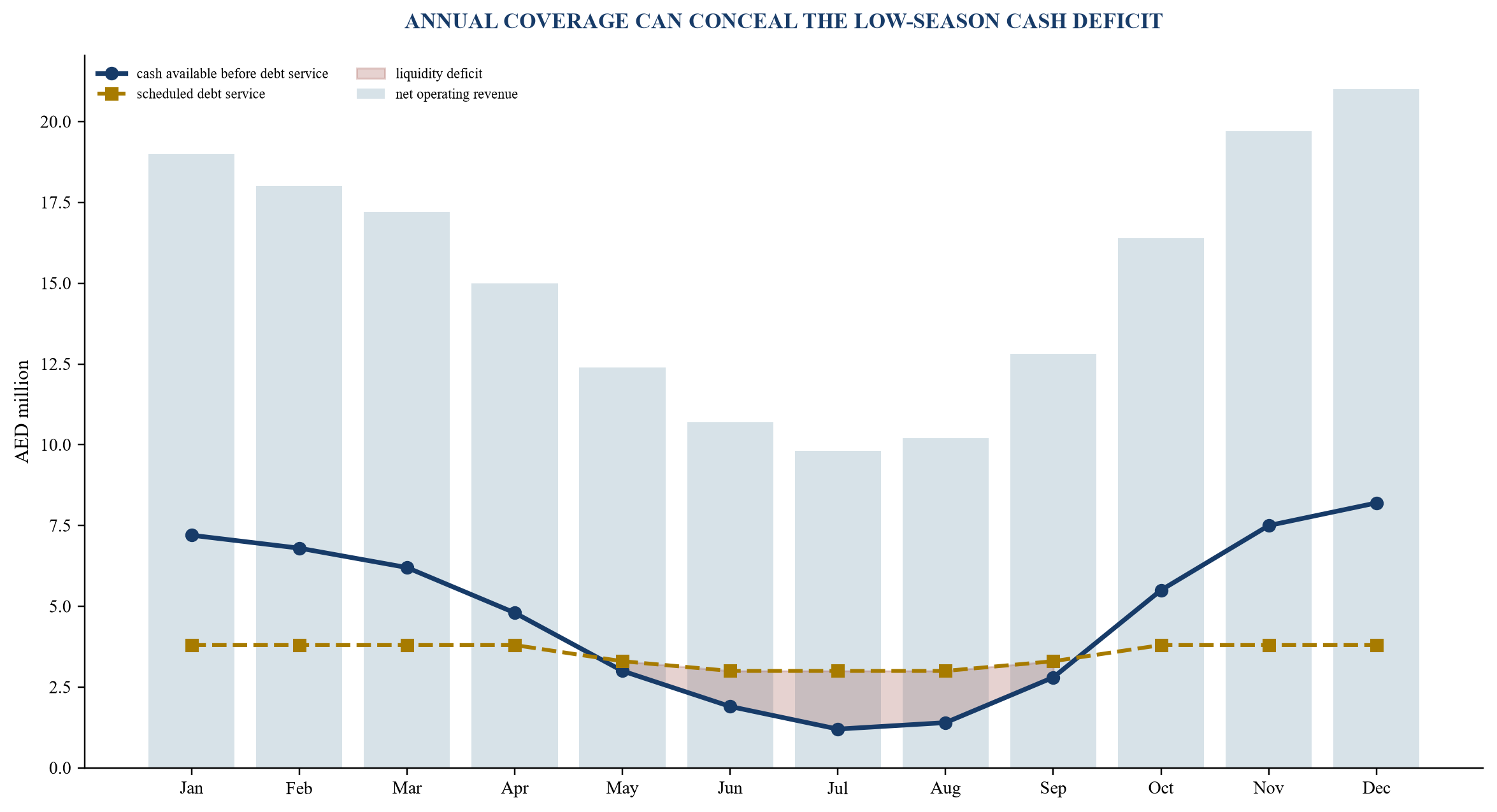
Hypothetical AED million amounts demonstrate monthly liquidity analysis and are not observed hotel data.
Table 2. Seasonal underwrite and financing response
| Seasonal question | Required analysis | Failure signal | Potential structural response |
|---|---|---|---|
| when is demand earned? | daily rooms and event calendar by segment | revenue concentrated in a short peak | conservative peak capture and minimum booking pace |
| when is cash received? | deposits, card settlement, corporate billing and refunds | accounting revenue arrives before usable cash | cash-based debt sizing and receivable reserve |
| which costs are fixed? | payroll, utilities, rent, fees and maintenance | costs fail to flex in low season | minimum liquidity and operating action plan |
| what funds the low point? | monthly cash balance after reserves and debt | forecast cash falls below operating minimum | seasonal reserve or sculpted amortisation |
| what happens if the peak misses? | weak-peak and disruption scenarios | annual coverage falls and reserve is consumed | cash trap, draw stop and sponsor support |
| can the hotel recover next season? | booking pace, rate, channel and group pipeline | weak forward demand persists | revised business plan and independent review |
Thresholds and remedies are transaction-specific management assumptions.
5. Use a cash measure that survives scrutiny
Hotel earnings can be presented at several levels. Rooms and departmental profit are useful operating indicators. Gross operating profit includes undistributed operating expenses under the selected reporting convention. Owner cash must then deduct management and franchise fees, insurance, property costs, recurring capital expenditure, taxes, leases and other fixed charges.
The financing definition should state every permitted add-back. A one-time cost should remain excluded from adjusted earnings only when it is genuinely non-recurring and supported by evidence. Pre-opening, repositioning and renovation costs can recur across a portfolio and should not disappear automatically. Management fees tied to revenue continue even when margins compress.
Recurring capital expenditure belongs above debt service in the sustainable cash calculation. Hotel owners commonly fund FF&E reserves through management, franchise or debt arrangements. Public hotel owners disclose typical reserve requirements around three to five per cent of hotel revenue, with Host Hotels reporting four to five per cent under many agreements and Park Hotels reporting a general four per cent reserve.[7][8]
The lender should compare reported profit with cash collected, accounts receivable, deposits, payables, taxes and reserve movements. A hotel can report positive operating profit and face a cash deficit if corporate customers pay slowly, supplier balances rise or renovation commitments consume liquidity.
6. Separate maintenance, brand compliance and value-creating renovation
Recurring replacement preserves the existing guest proposition. Brand-mandated work protects affiliation and standards. Repositioning aims to change the property's rate, segment, capacity or margin. These categories have different certainty and should not be combined under one optimistic return case.
A property condition assessment should identify life-safety, structure, mechanical, electrical, plumbing, façade, waterproofing, lifts, kitchens, fire systems, rooms, public areas, technology and sustainability needs. The operator or franchisor should identify the property-improvement plan and required completion dates. Management should map each item to room closure, guest disruption and revenue effect.
Deferred maintenance can overstate current cash flow because the hotel is temporarily avoiding spending required to preserve its value. The lender should normalise recurring capital expenditure and fund material backlog separately. A valuation should state whether it assumes completion of the renovation and who bears the cost.
Value-creating claims need a driver bridge. Room renovation can support higher rate, improved occupancy, lower maintenance or better reviews. Meeting-space work can support events. Energy systems can lower utilities. Each benefit should have a measurable operating mechanism, implementation period and downside.
7. Lock the renovation scope before releasing capital
The approved scope should contain drawings, specifications, room counts, bill of quantities, contracts, programme, procurement schedule, permits, operator approval, brand approval, insurance and a cost plan. The budget should distinguish hard cost, soft cost, taxes, owner-supplied items, operating supplies, pre-opening, contingency, interest and lost cash flow.
The lender should understand package and contractor concentration. Long-lead lifts, chillers, façades, kitchens, furniture, fixtures, equipment and technology can control reopening. Imported items can introduce currency, shipping and customs risk. An alternative supplier may require brand or design approval.
The closure plan should be tested against guest operations. A floor-by-floor programme can preserve revenue, while noise, access or shared-system work can affect more rooms than the construction boundary suggests. Event space and food outlets can create indirect disruption.
Scope changes should require a written request showing cost, programme, contingency, room inventory and revenue impact. A change funded by removing essential work can produce a formally balanced budget and an economically incomplete hotel.
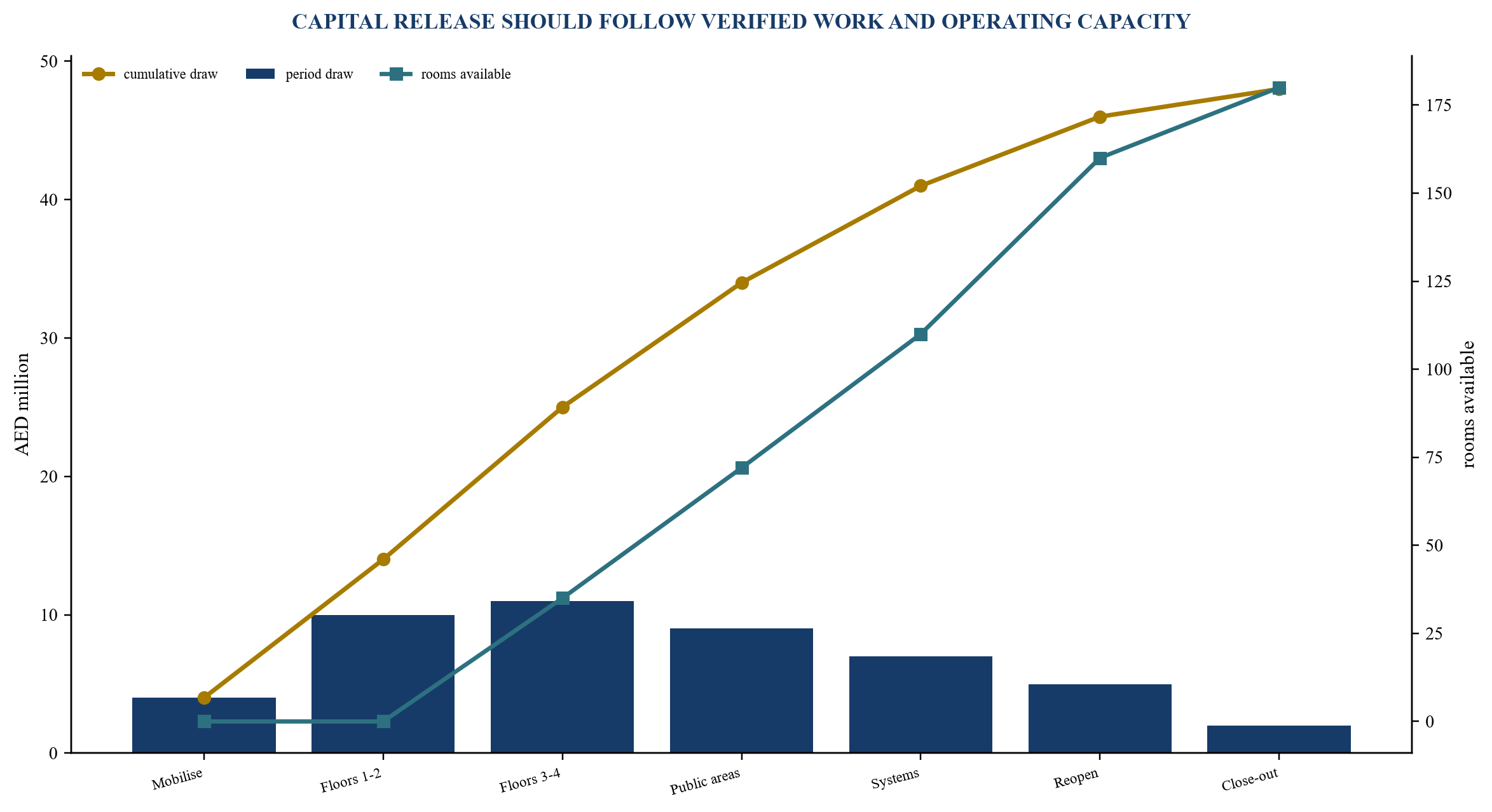
Hypothetical AED million draws and room counts demonstrate milestone-based funding.
8. Release renovation draws against completed value
Each draw request should reconcile opening committed cost, work completed, prior payments, current request, retention, remaining commitment, contingency and forecast cost to complete. Independent technical evidence should confirm physical progress and whether completed work matches the approved scope.
The lender should fund the lower of eligible cost incurred, independently certified progress and the amount allowed by the draw schedule. Sponsor equity can be required first or pari passu according to the agreed risk allocation. The facility should not become the sole source of completion capital after the sponsor's funds are exhausted.
Cost-to-complete testing should occur at every draw. Undrawn debt, committed equity, permitted hotel cash and contingency should exceed remaining cost, financing cost and required operating liquidity. If a deficit appears, the next draw should depend on an approved cure.
Practical completion is not the same as trading readiness. Rooms require testing, snagging, systems integration, cleaning, staffing, photography, channel loading and operator acceptance. Final retention should remain until completion evidence, warranties, as-built documents and material defects are resolved.
Table 3. Renovation draw controls
| Draw control | Evidence | Release condition | Holdback or remedy |
|---|---|---|---|
| approved scope | signed contracts, design, brand and operator approval | no material unresolved scope gap | affected package excluded |
| work completed | independent certificate, photographs and site record | work exists and meets specification | disputed value withheld |
| payment status | invoices, payment certificates and prior payment proof | no unexplained duplicate or overdue claim | direct payment or retention |
| cost to complete | updated budget, commitment log and contingency | committed sources exceed remaining need | sponsor cure before further draw |
| programme | critical path, long-lead log and room closure schedule | opening date remains credible | revised reserve and business plan |
| insurance and permits | current policies, approvals and compliance record | work and operations remain lawful and insured | draw stop |
| room return | operator acceptance, systems and channel readiness | rooms are saleable, safe and correctly loaded | completion holdback |
| close-out | warranties, manuals, as-builts and defects list | defined completion evidence delivered | retention until cure |
Documentation and certification should be adapted to local law and the construction contract.
9. Fund lost trading cash as deliberately as construction
Renovation affects both uses and sources. Closed rooms reduce revenue. Open rooms can suffer noise, access restrictions, view obstruction and weaker guest satisfaction. Group business may avoid the property during uncertainty. Staff and utility costs do not fall in proportion to unavailable rooms.
The financing model should show operating cash during the works, including deposit refunds, relocation, compensation, temporary facilities, staff retention, marketing relaunch and pre-opening. This requirement is separate from the physical renovation budget.
Working-capital funding should have a cap, eligible uses and monthly reconciliation. It should not absorb permanent cost overruns without approval. Sponsor support can cover specified overruns or weak trading, with clear evidence of availability and payment mechanics.
Debt service during closure can be paid from a funded interest reserve, permitted capitalised interest or sponsor cash. The documents should state when ordinary cash-pay debt service resumes and what happens if reopening is delayed.
10. Treat the operator and brand as material credit dependencies
Management and franchise agreements affect control, fees, standards, data, budget approval, bank accounts, assignment, transfer, termination and replacement. Public hotel owners disclose long agreement terms, transfer limitations, performance tests, cure rights and termination payments.[7][9][10]
The lender should abstract the term, renewal, base fee, incentive fee, system charges, central services, owner priority, budget process, working-capital obligation, FF&E reserve, performance test, cure, termination, sale restrictions, mortgage consent, casualty, default and dispute provisions. Side letters and guarantees should be included.
Operator performance tests can be based on profit, owner return or performance against a competitive set. Cure rights can allow the manager to pay a deficiency and preserve the agreement. A lender should not assume that weak operating results permit immediate replacement.
Brand value can support distribution and rate, while brand agreements can require capital and restrict transfers. A lender step-in or enforcement sale may need brand consent or a qualified transferee. Recognition and non-disturbance arrangements should be reviewed by transaction counsel.
11. Convert operator oversight into a measurable scorecard
The scorecard should connect guest demand to owner cash. Market penetration, occupancy index, rate index and revenue index show competitive position. Gross operating profit, cash conversion and cost per occupied room show operating conversion. Guest quality, staff turnover, digital availability and brand audit show durability.
Budget variance should be analysed by driver, not only total amount. A revenue miss caused by fewer rooms available requires a different response from a rate miss or channel-cost increase. A favourable profit variance created by deferred maintenance can weaken long-term value.
Renovation and ramp-up measures should include rooms returned, defects, booking pace, channel loading, staff readiness and guest scores. The operator should certify the monthly operating report and explain changes to prior data.
The lender's rights should focus on information, cash, agreed covenants and remedies. Operating decisions remain with the authorised owner and operator unless transaction documents and applicable law provide otherwise.
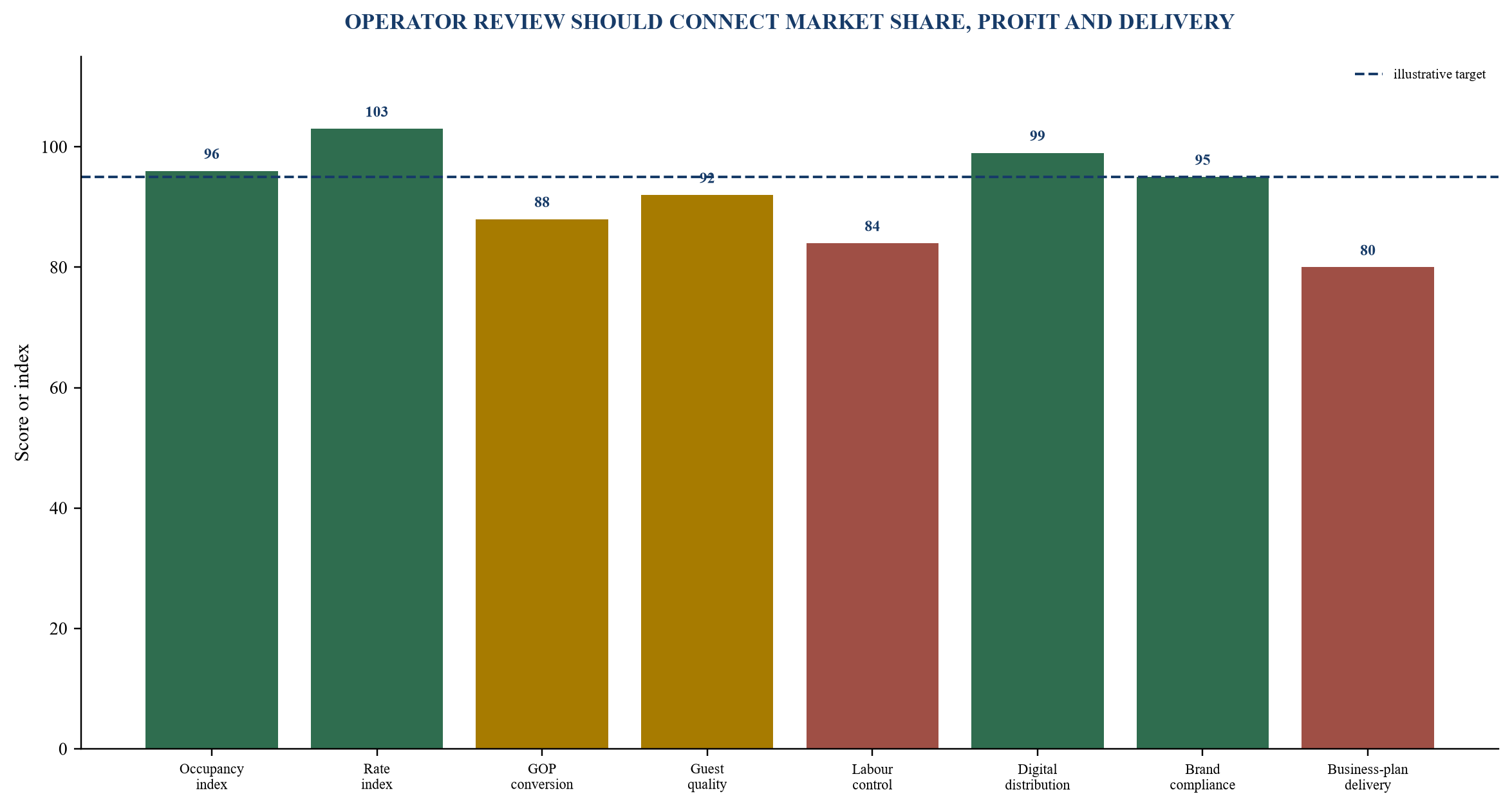
Hypothetical scores demonstrate a balanced monitoring framework and are not a rating of an identified operator.
Table 4. Operator and brand diligence matrix
| Topic | Evidence | Credit concern | Required decision |
|---|---|---|---|
| authority and accounts | management agreement and bank mandates | operator controls cash or contracting beyond lender assumptions | document permitted account and approval structure |
| fees and central charges | fee schedules and historical invoices | gross revenue fees continue during margin pressure | model all recurring and contingent fees |
| annual business plan | budget process and approval rights | owner cannot impose required cost or capital action | align financing case with contractual process |
| performance test | definitions, competitive set and cure history | replacement right is delayed or curable | underwrite actual trigger and cure route |
| brand standards | audit, improvement plan and waiver | capital requirement exceeds funded plan | fund or condition required works |
| transfer and mortgage | consent, qualified owner and lender recognition | enforcement or sale disrupts brand | obtain consent or viable replacement plan |
| data and systems | ownership, access, retention and transition | lender or replacement operator loses operating history | secure reporting and transition rights |
| termination | default, sale, casualty and termination payment | replacement creates delay and cash cost | quantify payment, timing and interim operation |
Agreement rights require legal review; the table is an analytical checklist.
12. Build a reserve waterfall around the hotel's real obligations
Hotel cash can be subject to taxes, guest deposits, payroll, service charges, operator accounts, insurance, FF&E reserves and existing security. The waterfall should begin with legally or contractually senior obligations and preserve the minimum cash required for safe operation.
A collection account can receive card, online travel agency, corporate, group and other proceeds. Daily or frequent reconciliation should separate restricted amounts and identify chargebacks or refunds. The operator's agreement and payment systems should permit the proposed control.
After required operating and statutory amounts, cash can fund the FF&E reserve, debt-service reserve, insurance and tax reserves, current interest, scheduled amortisation and approved owner distributions. During a trigger, surplus can remain trapped, replenish reserves or prepay debt.
Reserve accounts require permitted investments, control, release tests and replenishment rules. A headline reserve balance is not useful if the operator, brand or existing lender has prior rights that prevent application to the new facility.
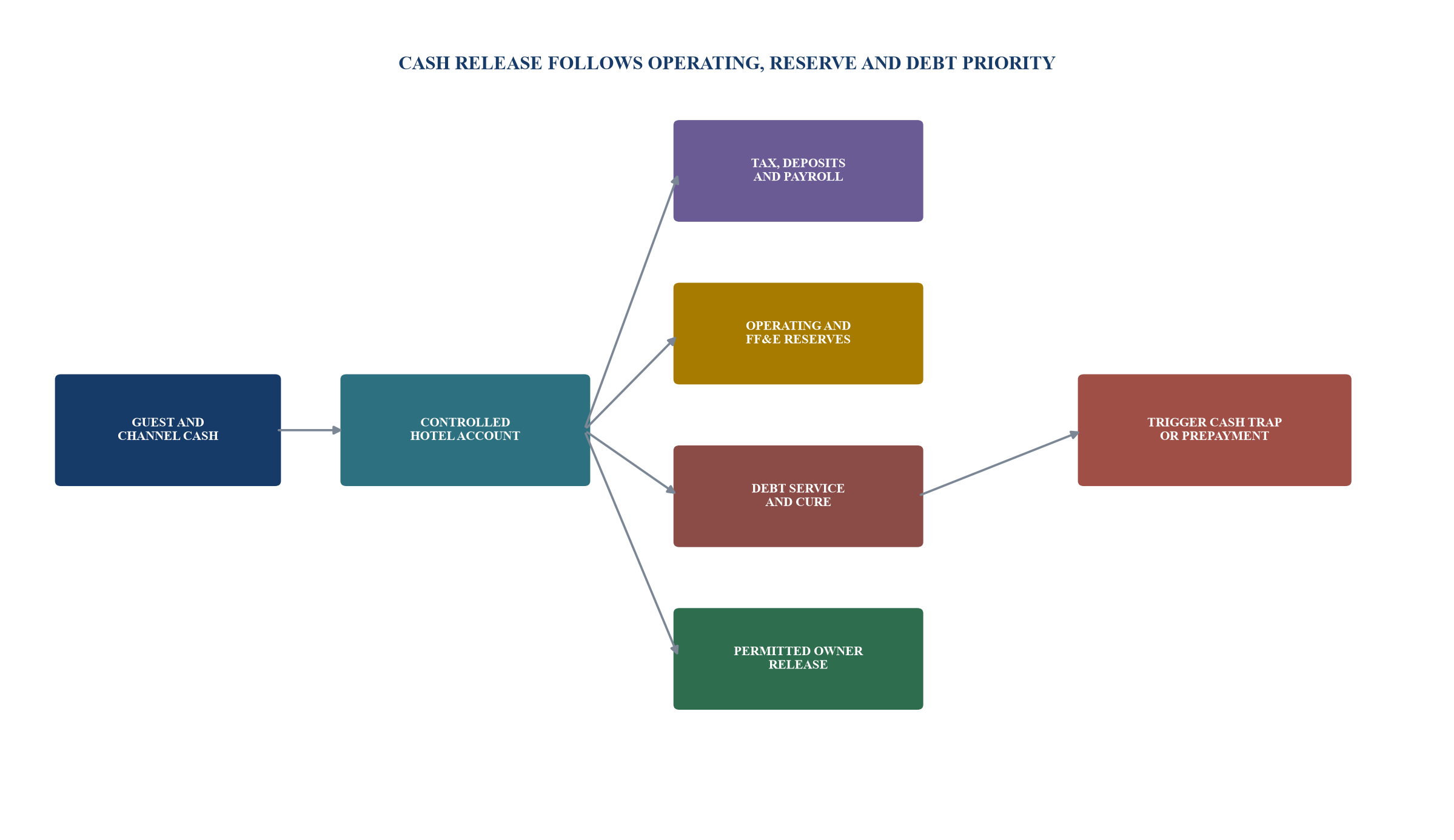
Priority and account control require transaction-specific legal, tax and operating advice.
13. Size the facility from uses, sources and downside liquidity
The facility can contain separate tranches for acquisition or refinancing, renovation, working capital and interest reserve. Each tranche should have its own purpose, draw conditions, maturity, amortisation and conversion test. A single undifferentiated loan can allow cost overruns to consume liquidity intended for operations.
Maximum debt should satisfy value, cash flow and completion tests. Loan-to-value uses a current and, where relevant, completed or stabilised valuation with explicit assumptions. Debt-service coverage uses sustainable cash after recurring capital expenditure. Completion testing requires committed sources to cover remaining work and operating needs.
The debt case should test rate, occupancy, channel mix, payroll, utilities, operator fees, completion delay, cost overrun and exit yield. Interest-rate hedging or fixed-rate treatment should be modelled where relevant. Foreign currency exposure can arise from imported renovation packages or non-local financing even when hotel revenue is local currency.
Sponsor support should be specific. A completion guarantee, cost-overrun undertaking, interest support or minimum-equity covenant should define amount, duration, evidence and enforcement. An uncommitted intention to support the hotel should receive no credit.
Table 5. Illustrative hotel facility structure
| Tranche | Illustrative use | Draw basis | Repayment source | Principal protection |
|---|---|---|---|---|
| senior term | refinance existing property debt | closing conditions and current valuation | stressed operating cash and sale or refinance | property security, cash control and amortisation |
| renovation | approved rooms, public areas and systems | certified progress and cost-to-complete test | post-renovation operating cash | equity contribution, contingency and completion support |
| working capital | operating deficit during closure and reopening | approved monthly budget and reconciliation | trading recovery | cap, eligible uses and draw-stop triggers |
| interest reserve | scheduled interest during defined works period | time and progress conditions | refinance into ordinary cash pay | funded amount and mandatory cash-pay transition |
| delayed draw | later package or optional phase | prior phase completion and updated downside | incremental verified cash flow | fresh valuation, coverage and no-default tests |
| revolving seasonal line | recurring low-season working capital | borrowing period and minimum liquidity test | high-season cash sweep | annual clean-down and utilisation cap |
Amounts and thresholds are hypothetical management assumptions for method demonstration.
14. Define stabilisation as a set of observed tests
Stabilisation should not be a date selected in the original model. It should occur when the hotel has completed works, returned rooms to sale, operated through a meaningful period and demonstrated market and cash performance. The required duration depends on seasonality and the scale of repositioning.
Physical tests include practical completion, open rooms, operating systems, licences, insurance, brand acceptance and resolved material defects. Commercial tests include booking channels, competitive position, occupancy, rate and group pipeline. Financial tests include gross operating profit, cash available for debt service, reserve funding, liquidity and compliance.
A hotel that opens immediately before peak season can produce strong early revenue without proving low-season resilience. The lender should require a measurement period that includes enough of the relevant demand cycle or apply a conservative annualisation.
Stabilisation can trigger conversion from renovation or interest-reserve terms to ordinary amortising debt. Failure should trigger a revised plan, additional equity, extension fee, lower leverage, cash trap or sale process according to the documents. Automatic extension without a new cost-to-complete and liquidity test can compound risk.
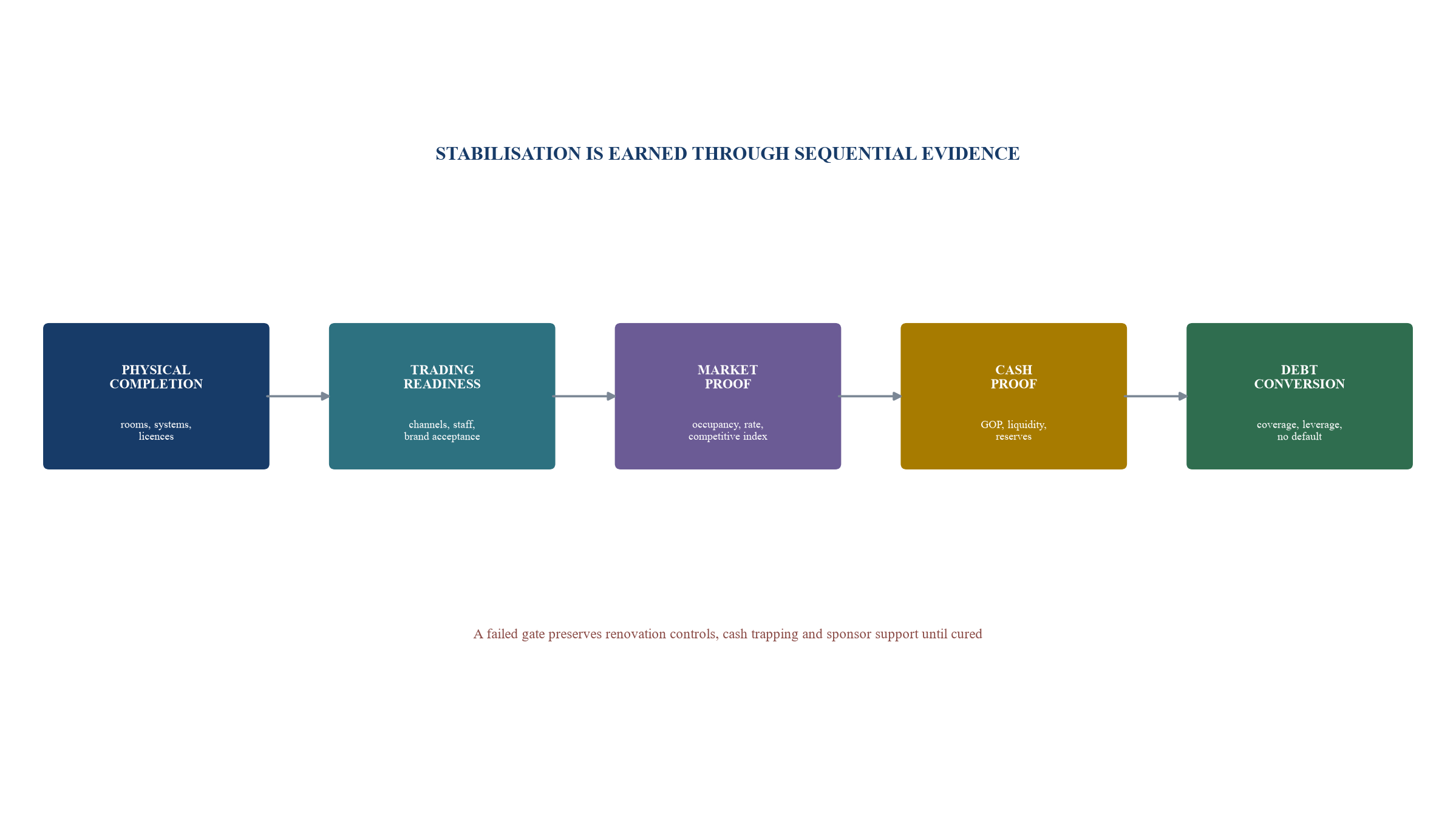
Hypothetical thresholds demonstrate the sequence from completion to durable cash flow.
15. Design covenants that detect deterioration early
Financial covenants should include minimum liquidity, debt-service coverage, leverage and limits on distributions, additional debt and capital spending outside the plan. Definitions should specify recurring capital expenditure, management fees, reserves, restricted cash and treatment of renovation disruption.
Operating covenants can monitor rooms available, occupancy, average daily rate, revenue per available room, gross operating profit, booking pace, cancellations, guest scores, payroll and utilities. A covenant should have a reliable data source, reporting date and remedy.
Renovation covenants should cover milestone dates, cost to complete, contingency, contractor claims, permits, room closures and brand approval. Operator covenants should address agreement amendments, termination, replacement, performance-test notices and material disputes.
Remedies should escalate. An early warning can require an explanation and weekly reporting. A trigger can stop draws, increase reserves or trap cash. A material breach can require equity cure, mandatory prepayment, operator action or enforcement as documented. The response should address the underlying risk rather than create a purely technical default.
16. Stress renovation, seasonality and ramp-up together
The most useful downside combines risks. A four-month completion delay can move reopening from peak to low season. Cost overrun can consume working capital. Weak guest reviews can slow rate recovery. A competitor opening can reduce market share. Higher interest can increase debt service while cash remains below stabilised level.
The model should show monthly sources and uses through maturity. It should include construction cost, operating loss, interest, reserve funding, taxes, deposits and required sponsor support. Availability should follow the lower of draw conditions, cost-to-complete capacity and facility limit.
Reverse stress testing should identify the occupancy, rate, delay and overrun combination that exhausts liquidity or breaches coverage. Management should then define leading indicators: procurement delay, rooms not returned, booking pace, channel availability, staffing, guest score and contractor claim.
The action plan should be executable. It can defer an optional phase, add equity, re-sequence rooms, reduce non-essential cost, change distribution, renegotiate a package or commence a sale process. It should not assume an unapproved brand change, immediate operator termination or additional debt that has not been committed.
17. Protect value through insurance, resilience and continuity
The insurance programme should cover property damage, business interruption, machinery breakdown, public liability, employer liability, cyber risk and other exposures appropriate to the hotel. Lender interests, loss-payee provisions, deductibles, waiting periods, limits and exclusions should be reviewed.
Business-interruption proceeds may depend on historical or forecast trading and can arrive after the cash need. The liquidity case should not assume immediate insurance recovery. Renovation works may require contractor and owner policies with coordinated coverage.
Operational continuity should address power, water, cooling, lifts, fire systems, food safety, technology, payment systems, reservations, data, key suppliers and staffing. A resort with one access road, central plant or water system can have a single point of failure.
Climate and resource risk can affect cooling cost, water, coastal exposure and insurance. Mitigation projects should be linked to measured consumption, cost and resilience. A sustainability label alone does not establish debt-service benefit.
18. Align accounting, valuation and financing definitions
IFRS 16 requires lessees generally to recognise right-of-use assets and lease liabilities for leases longer than twelve months, subject to specified exceptions.[11] Hotel ownership and operating structures can contain leases and service arrangements. The accounting presentation should be reconciled to contractual cash obligations used in debt analysis.
IAS 36 requires an asset not to be carried above its recoverable amount and defines recoverable amount as the higher of fair value less costs of disposal and value in use.[12] Renovation delay, operating decline or a changed business plan can create impairment indicators. The financing model should not rely on a carrying amount as proof of collateral value.
Valuation should distinguish current condition, completed renovation and stabilised trading. Capitalisation rate, discount rate, market occupancy, rate, margin, capital expenditure and stabilisation period should be explicit. Brand and operator assumptions should match the agreements that can survive a sale or enforcement.
The lender should reconcile accounting EBITDA, valuation net operating income and financing cash available for debt service. Each can be useful, but they are not interchangeable.
19. Structure security for the property and operating cash
The security package can include property mortgage, shares, movable assets, bank accounts, insurance proceeds, material contracts and receivables where lawful and appropriate. UAE Federal Law No. 4 of 2020 expressly addresses security rights over movables, including accounts receivable and bank credit accounts.[13] Transaction counsel should confirm creation, registration, priority and enforcement.
Hotel operating rights require special attention. Licences may not transfer automatically. Management and franchise agreements can restrict mortgage, change of control, transfer or replacement. The lender should seek recognition, notice, cure and step-in arrangements where available.
Cash control must work with the operator's ordinary systems. Card processors, online travel agencies, loyalty programmes and corporate accounts can settle through different channels. Every material channel should reach an agreed account or be subject to a reconciled transfer process.
Existing security, negative pledges, reserve rights and intercompany cash pooling should be mapped. UAE restructuring and bankruptcy law affects creditor and debtor processes and should be considered in enforcement and restructuring analysis.[14]
20. Establish an evidence-led diligence programme
The first workstream should map ownership, title, licences, brand, operator, rooms, systems, accounts, existing debt and facility purpose. Management should provide at least three years of daily and monthly operating data where available, alongside audited or reviewed financial statements, budgets, bank statements and tax records.
The second workstream should reconstruct revenue and cash, build the seasonal curve, normalise expenses, calculate recurring capital expenditure and test the operator scorecard. The competitive set and market evidence should be documented.
The third workstream should complete technical, insurance, valuation, legal, tax and accounting review. Renovation scope, contractor commitments, permits, brand approvals, contingency, programme and cost to complete should reconcile.
The final workstream should integrate facility size, tranches, reserves, cash waterfall, covenants, remedies, reporting and closing conditions. A shadow reporting cycle should be completed before funding so that the first certificate is reproducible.
Table 6. One-hundred-day hotel financing workplan
| Period | Primary work | Required output | Approval gate |
|---|---|---|---|
| days 1-15 | ownership, title, licence, brand, operator, account and debt map | legal and operating architecture | defined borrower, collateral and facility purpose |
| days 16-30 | rooms, revenue, system, ledger and bank reconciliation | verified operating data spine | reproducible revenue and cash |
| days 31-45 | seasonal curve, competitive set, cost and reserve analysis | sustainable cash-flow case | base and low-season liquidity established |
| days 46-60 | condition, scope, contracts, permits and cost to complete | renovation and completion report | funded and executable scope |
| days 61-75 | operator, brand, insurance, valuation, tax and accounting review | diligence exceptions register | material rights and risks resolved or conditioned |
| days 76-90 | structure, tranches, draw controls, waterfall and covenants | credit-approved term sheet and model | downside and remedy package accepted |
| days 91-100 | security, accounts, closing evidence and shadow reporting | final documents and first certificate | controlled funding readiness |
Timing depends on data quality, technical scope, operator cooperation and legal requirements.
21. Use a credit committee gate that can decline the transaction
The credit paper should answer ten questions. Which assets and entities generate the cash? Which licences and agreements permit continued operation? How does revenue reconcile to rooms and bank receipts? Where is the seasonal low point? Which recurring capital spending preserves value? Is the renovation fully funded? Can the operator and brand survive a financing stress or transfer? What observed evidence supports stabilisation? Which cash is restricted or senior? Which downside can be survived without relying on new uncommitted capital?
Funding should pause when title or licences are uncertain, room inventory does not reconcile, operator accounts are inaccessible, historical revenue cannot reconcile to cash, renovation scope is incomplete, cost to complete exceeds committed sources, brand approval is missing, a valuation assumes unsupported stabilisation, restricted cash is counted as liquidity or sponsor support is uncommitted.
Every management estimate should be listed with owner, date and sensitivity. Every exception should have a resolver and closing, post-closing or exclusion treatment. Professional conclusions should remain within the scope of qualified legal, technical, tax, accounting, insurance and valuation advisers.
Approval can be conditional when the remaining item has a bounded effect and an enforceable condition. A material uncertainty that determines licence, completion, cash control or debt capacity should be resolved before funding.
22. Turn financing discipline into operating value
The financing framework can improve the hotel beyond the loan. A reconciled rooms bridge identifies hidden out-of-order capacity. A seasonal cash curve clarifies staffing, purchasing and maintenance timing. A renovation draw process exposes scope and procurement risk. An operator scorecard creates a common owner-manager fact base.
Reserve discipline protects the product and reduces abrupt capital calls. Cash reconciliation identifies channel leakage and delayed settlement. Stabilisation tests convert a broad ambition into observed milestones. The board can see which value depends on market demand, physical completion, operator execution and financing structure.
Reporting should remain proportional. Daily data are useful for rooms, rate and cash; monthly governance is appropriate for full financial and covenant review. Material events, cost overruns, licence notices, operator disputes and account changes should be reported promptly.
A successful facility supports the hotel's actual cash cycle. It provides capital when work and operating evidence justify release, preserves liquidity through the low season and converts to ordinary debt when the property demonstrates durable performance.
Conclusion
GCC hospitality assets can support asset-backed capital when property value and operating cash are underwritten together. Strong destination statistics provide context. Debt service still depends on the individual hotel's room inventory, demand mix, operating conversion, contractual structure, capital condition and cash controls.
The framework in this paper begins with a reconciled operating data spine and monthly seasonal curve. It funds renovation through certified progress and a current cost-to-complete test. It measures the operator and brand as credit dependencies, protects recurring FF&E and liquidity reserves, and defines stabilisation through observed physical, market and cash tests.
The result is a structure that can finance seasonality, renovation and ramp-up without treating forecast stabilisation as present cash. Sponsors gain a controlled route from capital work to stronger trading. Lenders gain transparent draw conditions, early-warning indicators, protected reserves and remedies linked to the risks that actually determine hotel value.
References
- Dubai Department of Economy and Tourism. Tourism Performance Report January to December 2025. https://www.dubaidet.gov.ae/en/research-and-insights/tourism-performance-report-december-2025
- General Authority for Statistics, Saudi Arabia. Tourism Establishments Statistics, Q2 2025. https://www.stats.gov.sa/documents/20117/2435281/Tourism%2BEstablishments%2BStatistics%2BQ2%2B2025%2BEN.pdf/749dab2b-1edc-77a5-b734-afab6b9858cf?t=1761827151490
- National Centre for Statistics and Information, Oman. Indicators of Hotels Activity Classified Three to Five Stars, December 2025. https://api.ncsi.gov.om/uploads/pdfs/tourism_indicators_report___december_2025_1769918181.pdf
- Hospitality Financial and Technology Professionals and American Hotel and Lodging Association. Uniform System of Accounts for the Lodging Industry, Eleventh Revised Edition. https://www.hftp.org/downloads/documents/usali/usali-659-11-digital.pdf
- Procaccianti Hotel REIT, Inc. Annual Report on Form 10-K for 2024, seasonality and renovation disclosures. https://www.sec.gov/Archives/edgar/data/1692345/000155837025003548/tmb-20241231x10k.htm
- Sunstone Hotel Investors, Inc. Annual Report on Form 10-K for 2025, seasonality and capital expenditure disclosures. https://www.sec.gov/Archives/edgar/data/1295810/000110465926021440/sho-20251231x10k.htm
- Host Hotels and Resorts, Inc. Annual Report on Form 10-K for 2025, management agreements and FF&E reserves. https://www.sec.gov/Archives/edgar/data/1061937/000107075026000054/hst-20251231.htm
- Park Hotels and Resorts Inc. Annual Report on Form 10-K for 2025, FF&E reserve disclosures. https://www.sec.gov/Archives/edgar/data/1617406/000161740626000006/pk-20251231.htm
- Apple Hospitality REIT, Inc. Annual Report on Form 10-K for 2025, management agreements and renovation programme. https://www.sec.gov/Archives/edgar/data/1418121/000119312526064008/aple-20251231.htm
- Braemar Hotels and Resorts Inc. Annual Report on Form 10-K for 2025, management agreement term, performance and termination provisions. https://www.sec.gov/Archives/edgar/data/1574085/000157408526000038/bhr-20251231.htm
- IFRS Foundation. IFRS 16 Leases. https://www.ifrs.org/issued-standards/list-of-standards/ifrs-16-leases/
- IFRS Foundation. IAS 36 Impairment of Assets. https://www.ifrs.org/issued-standards/list-of-standards/ias-36-impairment-of-assets/
- United Arab Emirates. Federal Law No. 4 of 2020 on Securing the Rights in Movables. https://www.uaelegislation.gov.ae/en/legislations/1446/download
- United Arab Emirates. Federal Decree-Law No. 51 of 2023 Promulgating the Financial Restructuring and Bankruptcy Law. https://uaelegislation.gov.ae/en/legislations/2190/download
- IFRS Foundation. IAS 40 Investment Property. https://www.ifrs.org/content/dam/ifrs/publications/pdf-standards/english/2022/issued/part-a/ias-40-investment-property.pdf?bypass=on
- Hilton Worldwide Holdings Inc. Annual Report on Form 10-K for 2025, franchise terms and brand-standard default. https://www.sec.gov/Archives/edgar/data/1585689/000158568926000007/hlt-20251231.htm
- Sonesta. Form of Hotel Management Agreement dated August 2025, filed with the US Securities and Exchange Commission. https://www.sec.gov/Archives/edgar/data/945394/000110465925086013/tm2524729d1_ex10-1.htm
- Xenia Hotels and Resorts, Inc. Annual Report on Form 10-K for 2023, FF&E reserve range and renovation funding. https://www.sec.gov/Archives/edgar/data/1616000/000161600024000023/xhr-20231231.htm
