

1. Define the investment decision
The investment decision is whether acquiring a network digital-twin business will improve capital allocation, network resilience and operating performance enough to justify the purchase price and integration risk. The buyer must identify the decisions the platform changes. These may include where to add capacity, which site to upgrade, whether to retire equipment, how to route traffic, which failure scenario to remediate and when to dispatch an engineer.
The word twin can describe a geographic model, an inventory graph, a propagation simulator, a service topology, a live operational model or a closed-loop control environment. These products carry different evidence and economic profiles. A three-dimensional representation can improve field planning. A continuously calibrated service twin can support outage analysis. A high-fidelity RAN twin can train and test optimisation algorithms.
The transaction thesis should therefore name the twin's perimeter, update frequency, model purpose and financial decision. A valuation built on a broad digital-twin label can combine incompatible markets and double-count benefits.
Table 1. Network digital-twin value layers
| Layer | Primary function | Decision supported | Required evidence |
|---|---|---|---|
| Asset and geographic twin | Locate sites, equipment, terrain and environment | Build, upgrade, access and field dispatch | Inventory accuracy and planning adoption |
| Topology and service twin | Map dependencies across physical and logical networks | Change impact, routing and outage response | Correlated service and network records |
| Capacity and propagation twin | Simulate traffic, coverage and interference | Densification, spectrum and parameter planning | Calibrated forecast and observed outcome |
| Operational twin | Reflect current state and predict degradation | Assurance, maintenance and recovery | Timely telemetry, detection and closed records |
| Autonomous decision twin | Test and govern automated actions | Optimisation and closed-loop control | Safety, rollback, accountability and persistence |
The buyer should value each layer through the decision and evidence it supports.
2. Use a precise digital-twin definition
ITU-T Y.3090 defines a digital twin network as a virtual representation of a physical network used to analyse, diagnose, emulate and control that network through data, models and interfaces. The recommendation identifies data, mapping, models and interfaces as core elements. This definition provides a useful diligence boundary.
A periodic planning model can be valuable without meeting every feature of a real-time twin. The buyer should describe it accurately. A target that refreshes monthly from several source systems may support strategic planning. It should not receive an operational-control premium based on a real-time claim.
The diligence team should document the physical counterpart, virtual representation, synchronisation mechanism, model library, interface set and supported applications. It should then test whether the declared twin remains sufficiently current and faithful for each decision.
3. Identify the capital problem
Telecom capital is constrained by coverage commitments, traffic growth, service targets, spectrum, vendor roadmaps, resilience requirements and shareholder returns. GSMA reported in 2025 that mobile network operators account for USD 109 billion of USD 127 billion in annual mobile-internet infrastructure investment. The economic value of better capital selection can therefore be material.
The problem is not simply excessive build. Underbuilding can damage quality, growth and regulatory commitments. A useful twin improves the timing, location, configuration and priority of capital while preserving required outcomes.
The buyer should classify each capital decision as avoid, defer, redirect, resize or accelerate. Each classification has a different cash-flow effect. A project cancelled permanently creates an avoided outflow only when its underlying requirement is met another way or no longer exists. A delayed project creates time value and remains a future obligation.
4. Map the decision chain
The decision chain begins with source data and ends with an approved capital or operational action. Network inventory, geographic information, performance counters, traffic, customer experience, billing, faults, projects and external data enter the model. The platform reconciles them into a decision environment.
Models then estimate propagation, demand, capacity, failure, service impact or financial value. A planner evaluates scenarios and chooses an action. The operator executes the build, change or remediation. Subsequent network and financial outcomes update the twin.
The acquisition team should trace representative decisions through every stage. The trace reveals data gaps, manual work, model dependencies and whether the target influences execution. A platform that recommends actions without integration into governance may have high technical quality and limited realised value.
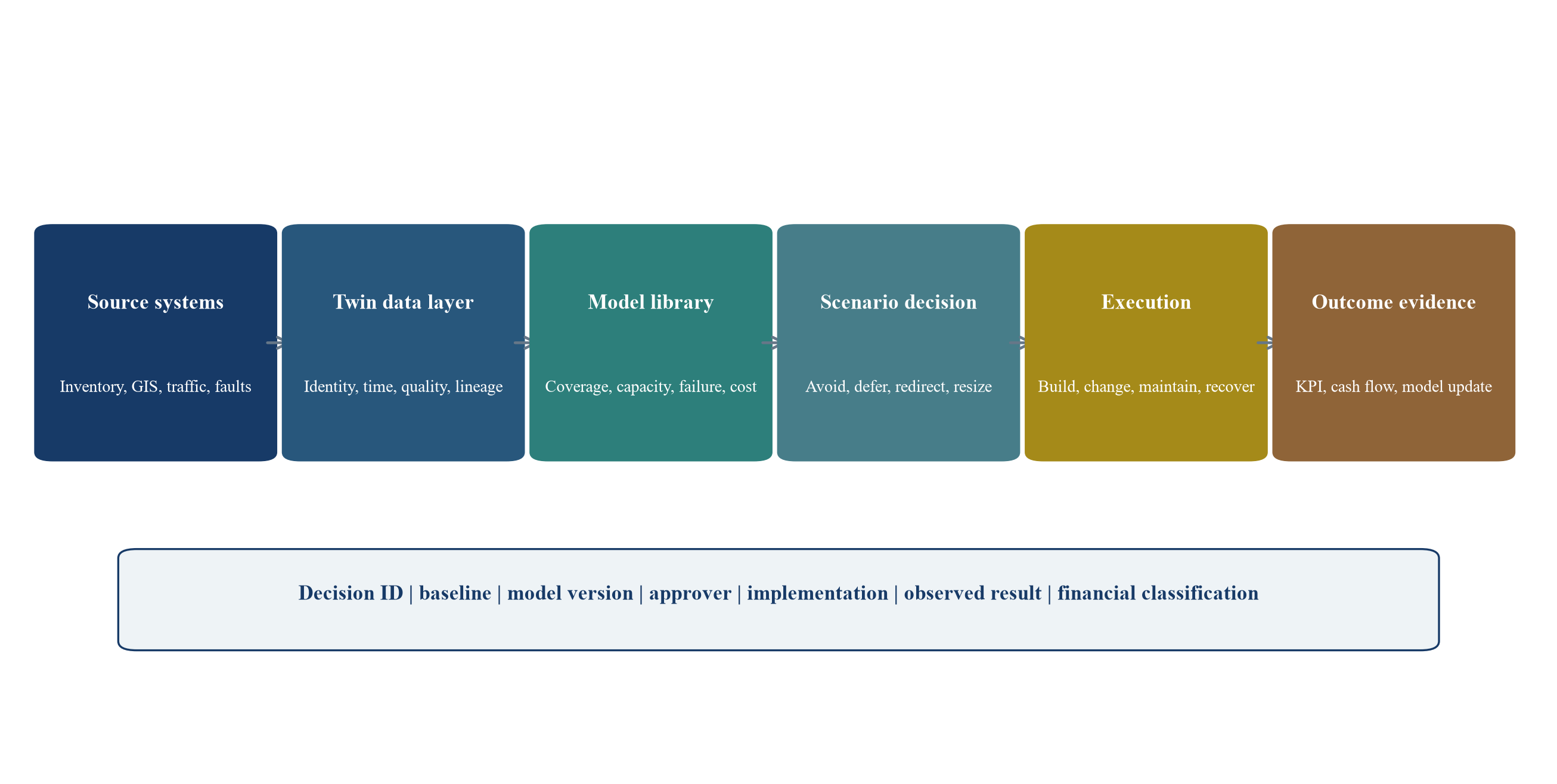
Value is created when governed data and calibrated models change an approved network decision and the outcome returns to the evidence base.
5. Establish asset identity
A useful twin needs stable identity across physical equipment, logical functions, links, sites, services and customers. Source systems often use different identifiers and update cycles. Mergers, vendor migrations and field changes can create duplicates or orphan records.
The target should demonstrate an identity model that reconciles these systems and preserves history. The buyer should sample assets from source to twin and from twin to field record. It should measure match rate, unresolved exceptions, update latency and ownership.
Identity quality affects every downstream claim. A capacity model can allocate investment incorrectly when traffic, equipment and revenue attach to different versions of a site. An outage model can miss service impact when topology and customer records do not join. Valuation should therefore begin with data integrity rather than visual sophistication.
6. Measure inventory accuracy
Inventory accuracy is the proportion of relevant assets and attributes that match the operational network within the tolerance required for the decision. A planning twin may require location, antenna, frequency and equipment details. A service twin may require logical dependencies and configurations.
The diligence team should define critical fields and use a risk-based sample. Field inspection, configuration records, vendor systems and completed work orders can provide corroboration. The analysis should show completeness, accuracy, timeliness and exception age.
The twin's remediation process matters as much as the starting score. It should detect divergence, assign an owner and update affected models. Persistent inventory gaps can cause false avoided-build claims because the baseline network was described incorrectly.
7. Govern data lineage
Data lineage records where a value originated, how it changed and which model or decision used it. It supports audit, reproducibility and post-acquisition continuity. The target should identify source systems, transformations, timestamps, permissions and quality rules.
Network data can include commercially sensitive, security-sensitive and personal information. Contracts and policies should permit the processing required for the twin. Rights to improve a shared model or reuse data across customers may differ from rights to provide one operator service.
The buyer should connect lineage to model versions and decision records. When a source is corrected, the platform should identify affected simulations and recommendations. This capability reduces the risk that an attractive planning result rests on stale or unauthorised data.
8. Calibrate model fidelity
Fidelity is fitness for a specified decision. A high-resolution model is not automatically more valuable. It can be expensive to build and maintain while adding little decision accuracy. The buyer should test fidelity against the material variables and tolerances of each use case.
Calibration compares predicted and observed outcomes. For radio planning, this can include signal strength, interference, throughput and demand. For transport, it can include link utilisation and failure effects. For outages, it can include alarm sequence, affected services and recovery time.
The target should show error distributions, confidence ranges and conditions where the model performs poorly. Acquisition assumptions should use conservative accuracy after deducting for environments that remain untested.
9. Apply capability levels
ITU-T Y.3091 specifies capability levels and evaluation methods for digital twin networks. A maturity assessment helps the buyer distinguish a static representation from a twin that supports interactive decisions and control.
Capability should be assessed by use case. A platform can be mature in geographic planning and early in autonomous remediation. Averaging across functions can conceal risk. The buyer should score data, mapping, model, interface, application and governance capabilities separately.
The score should connect to value. A higher level matters when it changes planning cycle time, accuracy, resilience or scale. Maturity without adoption does not support an acquisition premium.
10. Build the scenario library
The scenario library contains the planning and operational questions that the twin can test. Examples include traffic growth, building changes, spectrum refarming, equipment failure, transport rerouting, site loss, energy constraints and disaster response.
Each scenario should define inputs, assumptions, decision thresholds and validation. The library should preserve unsuccessful scenarios because they show model boundaries and prevent repeated work.
The transaction team should compare the library with customer contracts and operator priorities. Reusable scenarios improve product economics. Bespoke consulting scenarios can create value and require different margin and scalability assumptions.
11. Define the counterfactual build
The counterfactual build is the capital programme the operator would have executed without the twin. It should be contemporaneous and documented. Approved budgets, pre-twin plans, matched regions or historical planning methods can provide evidence.
Management should not reconstruct a larger baseline after the outcome is known. The team should identify which requirement the build addressed, the date it would have occurred and the assumed configuration. Changes in demand, strategy, regulation or funding should be separated from the twin's effect.
When the counterfactual is uncertain, value can be represented as a range or probability-weighted amount. Precision should follow evidence.
12. Separate avoided and deferred capital
Avoided capital is permanently removed while the service, capacity, coverage or resilience requirement is still met. Deferred capital moves to a later period. The latter creates present value through timing and flexibility while remaining in the plan.
The model should track the obligation through the forecast. A twin may defer a capacity upgrade for two years by improving parameters or reallocating traffic. The acquisition case should recognise the discounting benefit and any additional operating cost, then include the later outflow.
A permanent avoidance claim requires evidence that the requirement disappeared, moved to another asset or was satisfied without equivalent expenditure. Transfers between budgets should not be counted as savings.
13. Value redirected capital
Redirected capital moves from a lower-return location or configuration to a higher-return alternative. The total outflow may remain unchanged while the network produces better coverage, capacity, resilience or revenue.
The buyer should compare incremental cash flow or service outcomes between the old and new plan. This can include customer value, avoided churn, enterprise service availability or regulatory performance. Attribution needs a credible baseline.
Redirected capital can be the twin's largest contribution in a growing network. Valuation should not force it into a cost-saving category. It belongs in return-on-invested-capital and strategic value analysis.
14. Test coverage planning
Coverage planning uses terrain, buildings, vegetation, radio configuration and demand to predict service. Vodafone describes a United Kingdom mobile-network twin that maps more than 40 million environmental features and approximately 500,000 network features. The operator states that engineers use it to plan improvements and inspect assets remotely.
This evidence demonstrates scale and practical planning use. It does not quantify acquisition value for another product. The buyer should test target-specific decisions: predicted coverage, field result, site choice, upgrade cost and time saved.
Coverage value may arise through fewer surveys, better first-time design, avoided relocation or reduced rework. Each benefit should be measured separately.
15. Test capacity planning
Capacity planning forecasts where traffic and service demand will exceed available resources. A twin can combine network, customer and geographic data to simulate interventions before capital is committed.
O2 Telefónica reported in October 2025 that its internal twin mapped 28,000 mobile sites and more than 50,000 transport connections. The operator reported up to 80 percent faster analysis and reductions in temporary bottlenecks of 90 percent at mobile sites and 40 percent in the transport network. These are operator-reported results in its environment.
An acquirer should inspect the underlying definitions, period and counterfactual. Fewer temporary bottlenecks can reflect better planning, operational changes or investment. The financial bridge should identify the specific avoided, deferred or redirected decisions.
16. Model transport dependencies
Radio capacity depends on transport and core resources. A site upgrade can fail to create value when backhaul, power or upstream functions remain constrained. The twin should model end-to-end dependencies.
The diligence team should test whether the topology reflects protection routes, shared risks, leased capacity and planned changes. It should review how the model treats incomplete records and concurrent failures.
End-to-end modelling can prevent stranded investment. The benefit is the difference between a coordinated plan and a fragmented plan, adjusted for implementation cost. It should not be assumed across all capital without sampled decisions.
17. Measure planning cycle time
Planning cycle time affects the operator's ability to respond to demand, procurement windows and construction constraints. A twin can reduce data collection, scenario preparation, review and rework.
The buyer should map elapsed time and active labour before and after adoption. Faster analysis creates value only if it changes execution or frees scarce resources. A recommendation that waits in the same approval queue may not accelerate delivery.
Cycle-time evidence supports recurring value when workflows repeat. It also reveals service intensity. If target engineers prepare every scenario manually, faster customer analysis may coexist with weak software scalability.
18. Quantify survey and truck-roll effects
Geographic and site twins can allow engineers to inspect assets remotely before visiting. This may reduce unnecessary surveys, improve dispatch preparation and raise first-time completion.
The model should use verified visit records, labour, travel, access, equipment and contractor cost. Avoided visits should be separated from visits shifted to another team or period. Safety and access benefits can be material and require their own measures.
The buyer should assess geographic transferability. Image availability, mapping quality, regulation and site types can change performance across markets.
19. Evaluate outage detection
An operational twin can correlate alarms, topology, service and customer impact. It may detect silent failures that component monitoring misses. The buyer should test detection lead time, precision, false positives and affected-service accuracy.
Outage value depends on consequence. A shorter incident affecting a critical enterprise service differs from a minor cell degradation. The financial model should use service credits, customer loss, response cost and regulatory exposure where supported.
The target should demonstrate that alerts enter operational workflows and produce recorded action. A model's theoretical detection accuracy does not create cash flow without adoption.
20. Evaluate recovery and resilience
Recovery analysis tests whether the twin helps isolate faults, select routes, stage repairs or rehearse high-impact scenarios. ITU-T X.2014, approved in March 2026, addresses the use of network digital twins for security applications and simulation of network situations and strategies.
The buyer should review incident records, counterfactual recovery paths and human decisions. Resilience value can arise from reduced downtime, better prioritisation and fewer unintended consequences during change.
Simulation also supports preparedness. Its value should reflect the probability and consequence of scenarios, the quality of the model and the degree to which plans are exercised.
21. Assess major-event performance
GSMA's case on the Hangzhou Asian Games describes China Telecom and China Unicom using a dynamic three-dimensional model to monitor performance on a 10 by 10 metre grid and predict traffic peaks. GSMA reports a 99.82 percent 4G and 5G connection rate during an event drawing 600,000 users.
The case supports practical use of a twin for high-density planning and operational readiness. It does not isolate the twin's effect from the broader network programme. An acquisition model should therefore use it as feasibility evidence and rely on target-specific, controlled evidence for valuation.
Major-event capability may support operator service quality, temporary capacity and enterprise offerings. The commercial capture should be identified in contracts or avoided-cost records.
22. Measure change-risk reduction
Network changes can create outages or performance degradation. A twin can test configuration, routing, capacity and dependency effects before implementation.
The target should show which changes were simulated, which risks were identified and what happened after execution. The buyer should examine failed predictions and rollback events. A test environment with no connection to release governance may have limited realised value.
Change-risk value can be measured through incident frequency, severity, rework and delay. The model should avoid claiming that every incident prevented would have produced the worst possible loss.
23. Review security and access
A twin can contain a concentrated representation of critical network assets, vulnerabilities and dependencies. Its compromise can expose sensitive information or influence operational decisions. Security therefore affects both downside risk and market access.
The diligence team should inspect identity, privileged access, encryption, environment separation, update controls, logging, incident response and supply-chain security. It should review whether the twin can send actions to the live network and how those actions are bounded.
Data residency and national-security requirements can affect hosting and support. The forecast should include compliance and market-specific deployment cost.
24. Govern human accountability
Human accountability should match the decision. Planners can approve capital recommendations. Operational teams can review high-impact changes. Closed-loop automation needs bounded authority, monitoring and rollback.
The target should document decision rights, model limitations and escalation. Operators should be able to reconstruct why an action occurred. Model uncertainty should be visible at the point of approval.
Acquisition agreements should follow actual control. The vendor can be responsible for software and agreed model performance. The operator controls its network and final investment decisions. Shared processes should be explicit.
25. Build the evidence ladder
Evidence progresses from a model demonstration to repeatable financial outcomes. Laboratory accuracy shows technical possibility. A retrospective replay shows how the model would have behaved. A shadow deployment observes live conditions without influencing decisions. A controlled production use changes a defined decision. Repeat adoption demonstrates durability.
The buyer should assign each value claim to a rung. It should record sample size, duration, operator, environment, verifier and limitations. Vendor and operator case studies can inform plausibility and should not substitute for target evidence.
Value can be contingent on evidence that arrives after completion. This supports milestone payments and protects the buyer from paying a portfolio-wide premium for one successful case.
Table 2. Evidence ladder for avoided-build value
| Evidence stage | Record required | Principal limitation | Valuation treatment |
|---|---|---|---|
| Demonstration | Reproducible model and defined dataset | No live decision | Research capability |
| Historical replay | Archived baseline and outcome | Hindsight and data leakage | Technical confidence only |
| Shadow deployment | Live inputs and prospective recommendation | Decision not executed | Milestone evidence |
| Controlled production | Approved action and matched counterfactual | Narrow scope | Discounted decision value |
| Repeat portfolio use | Multiple decisions, persistence and audit | Remaining transfer risk | Core acquisition value |
Financial attribution strengthens as the record moves from model accuracy to approved and observed capital outcomes.
26. Calculate planning accuracy
Planning accuracy should reflect the decision variable. Demand forecasting can use error by location and horizon. Coverage can use field measurements. Capacity can compare predicted and realised headroom. Outage models can use detection and service-impact measures.
An average can conceal costly tail errors. The buyer should inspect distributions, high-value locations and unusual events. It should compare the target with the operator's prior process and credible alternatives.
Accuracy should be converted to decision quality. A small forecast improvement matters when it changes a large capital commitment. A highly accurate estimate may have little value when the decision threshold remains unchanged.
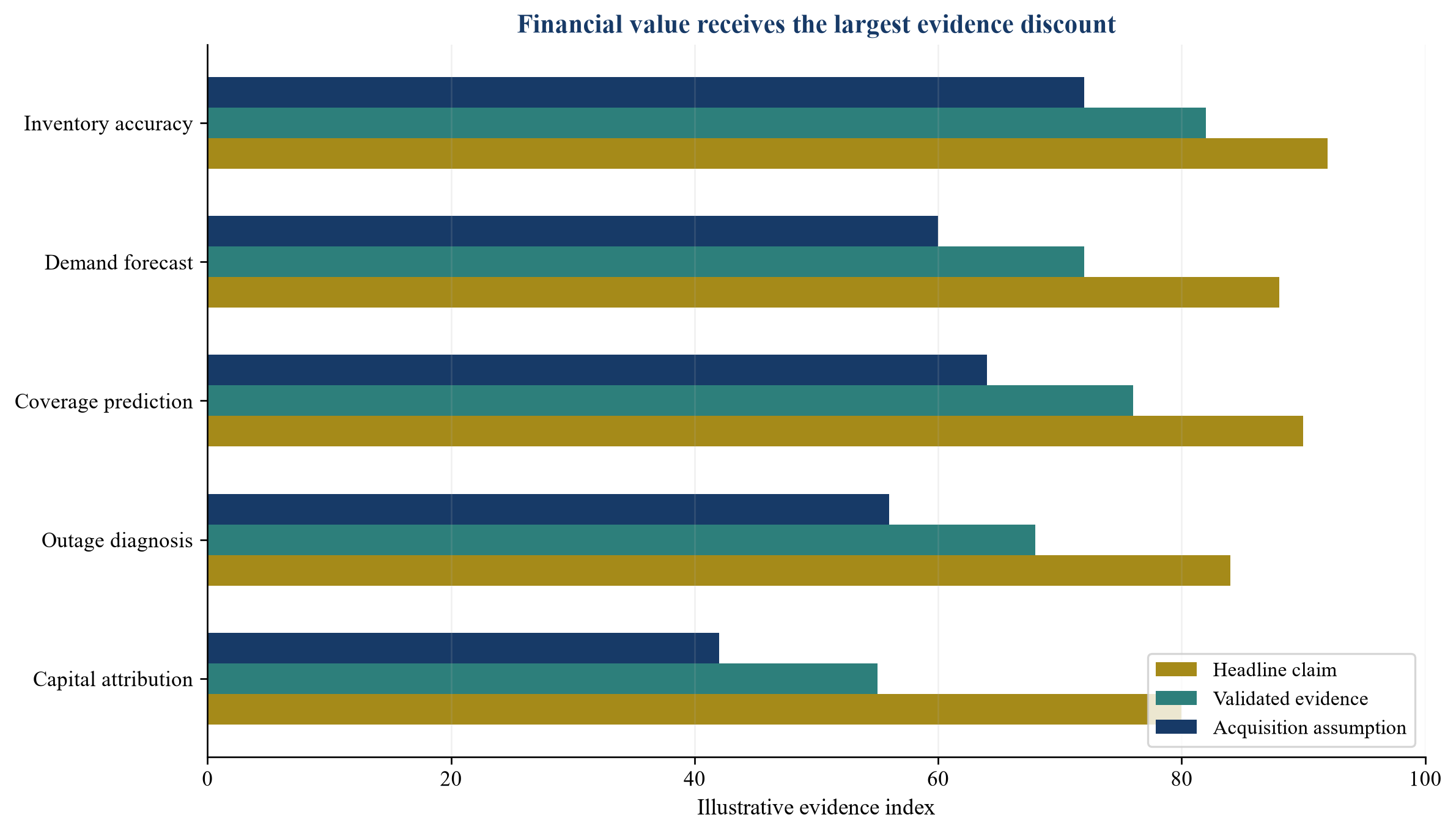
Hypothetical index scores show how a headline claim is adjusted for live use, persistence and financial attribution.
27. Construct the capital register
The capital register links each twin-influenced decision to project, baseline amount, original date, requirement, recommendation, approval, execution, outcome and classification. It is the core evidence for avoided-build valuation.
Finance and network teams should reconcile the register to budgets, purchase orders and fixed-asset records. Projects removed from one plan and reintroduced elsewhere should remain visible. Benefits should be adjusted for integration, compute, licence and operating cost.
The register can support customer pricing and post-acquisition earn-outs. Definitions should be agreed before the measurement period begins.
28. Model the capex curve
The capital curve compares the approved counterfactual with the twin-influenced plan over time. It should preserve coverage, capacity, service and resilience requirements. Differences are classified as permanent, deferred or redirected.
In a hypothetical five-year network, early twin investment can increase current-period cost through integration and data remediation. Later periods may show deferred densification and reduced rework. The terminal plan should include obligations that remain.
The present value of the difference should use a rate consistent with the operator's investment analysis. It should not assume that all released capital becomes distributable cash; the operator may reinvest it.
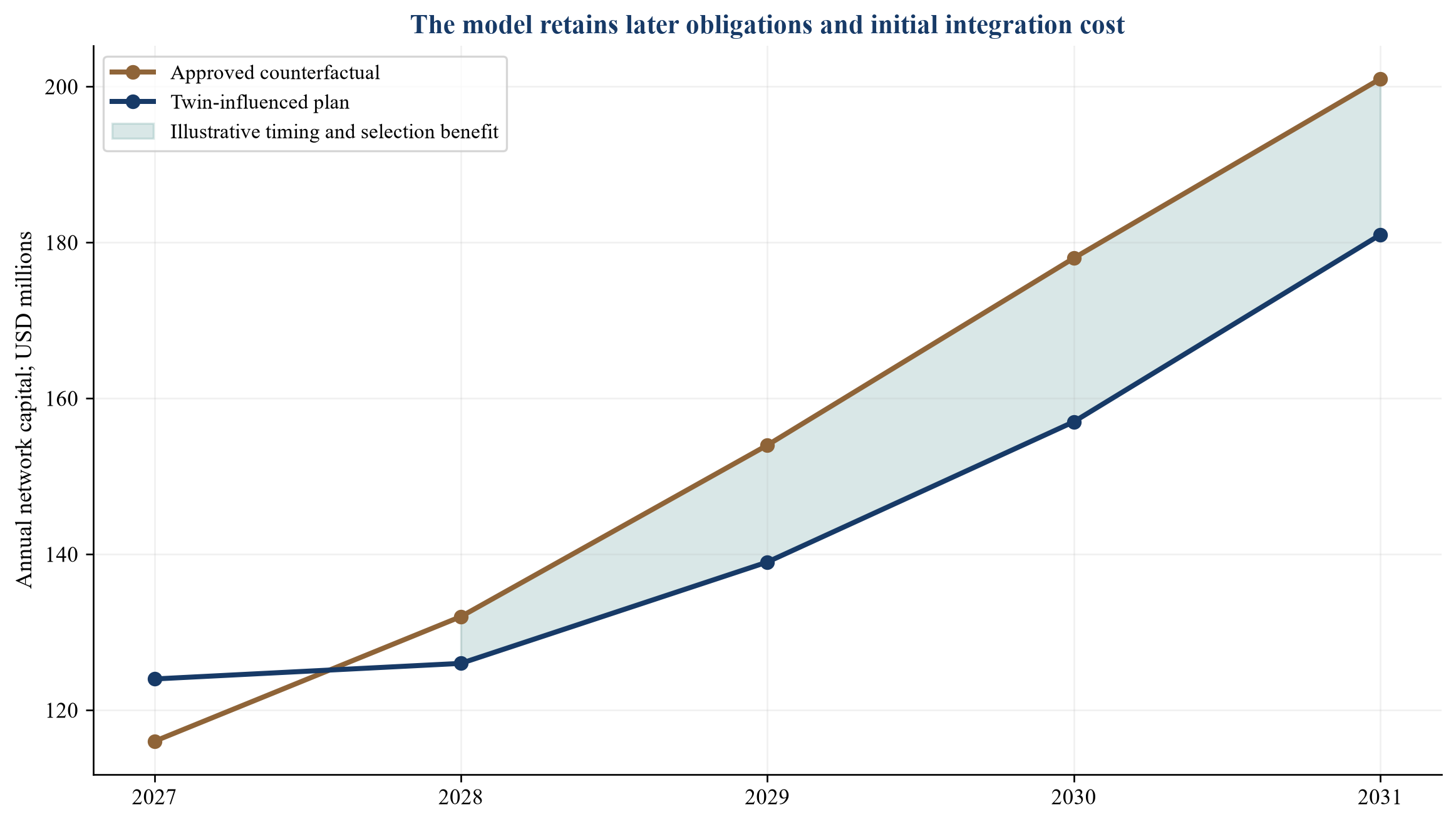
Illustrative management assumptions; the twin adds initial integration cost and changes the timing and composition of later network investment.
29. Value outage economics
Outage economics combine incident probability, affected services, duration, customer and regulatory effects, response cost and recovery. The target's contribution is the change in detection, diagnosis, decision or restoration attributable to the twin.
The buyer should avoid multiplying a maximum incident loss by every event. It should use observed distributions and distinguish incidents that the twin could address. Improvements may reduce expected loss even when no major incident occurs during the diligence period.
Where evidence is limited, outage value should remain a scenario or support contingent consideration. It should not be presented as realised savings.
30. Analyse revenue protection
Network quality can affect churn, usage, enterprise service levels and brand. Connecting a twin to revenue requires customer-level evidence and careful controls. Many factors influence retention and demand.
The buyer can use matched areas, service cohorts or documented enterprise incidents. It should separate revenue preserved through network action from broader commercial programmes. The target's contract determines how much of the benefit it captures.
Revenue protection can support strategic value and should remain conservative when causal evidence is weak. The base valuation should rely on contracted target revenue and margins.
31. Normalise target revenue
Recurring revenue should include continuing software or platform consideration supported by contracts and invoices. Implementation, data remediation, custom modelling, hardware and pass-through cloud cost should be shown separately.
Gross margin should include customer-specific engineering, model maintenance, data operations, compute, support and assurance. A product can create large customer benefits and retain service-heavy economics.
Retention should be analysed by operator, module, geography and use case. Expansion through more assets or decisions is stronger when it uses a stable product core.
32. Test portability
Portability is the ability to deploy across operators, network vendors, technologies and geographies without rebuilding the platform. It increases addressable market and reduces concentration.
The buyer should measure reused code, models, connectors, ontology, tests and workflows. It should track deployment time, engineering effort and accuracy retained. Standards-based interfaces can support portability while optional features and data semantics still require work.
Portability value should follow production evidence. It can be paid through a milestone when the platform is accepted in a new environment.
33. Consider build versus buy
An operator or strategic buyer may build a twin internally, acquire a specialist or combine vendor capabilities. The decision should compare time, data access, talent, product maturity, control and total cost.
O2 Telefónica describes an internally developed twin. Vodafone's case identifies the use of Esri capabilities. Other operators work with network and test vendors. These approaches show that ownership models vary.
The target's advantage should be specific: faster implementation, broader integrations, stronger models, reusable evidence or access to scarce expertise. A broad assertion that internal development is impossible does not support value.
34. Value future autonomy
ETSI's zero-touch network and service management work integrates network digital twins into automation architectures. TM Forum materials describe operator progress toward higher autonomous-network levels. These developments create a strategic option for platforms that can test and govern increasingly automated decisions.
Future autonomy value should be separated from current planning revenue. The buyer should identify required data, interfaces, safeguards, operator approvals and capital. Standards participation and demonstrations support the option but do not establish recurring economics.
Milestones can include accepted closed-loop use cases, safety evidence, production scale and contracted revenue. This preserves upside while limiting payment for an immature market.
35. Construct the valuation bridge
The valuation bridge begins with the present business and adds distinct, verified effects. It can add customer-validated capital-decision value, outage and resilience value, portability and a capped autonomy option. It subtracts integration, concentration, data, model and security risk.
The hypothetical case discusses an enterprise value of USD 280 million. The amounts illustrate the method and are not a valuation opinion. Present contracted economics carry most of the value.
Each adjustment should have an evidence owner and transaction response. Cureable issues can become conditions. Outcomes that emerge after closing can support earn-outs, holdbacks or staged investment.
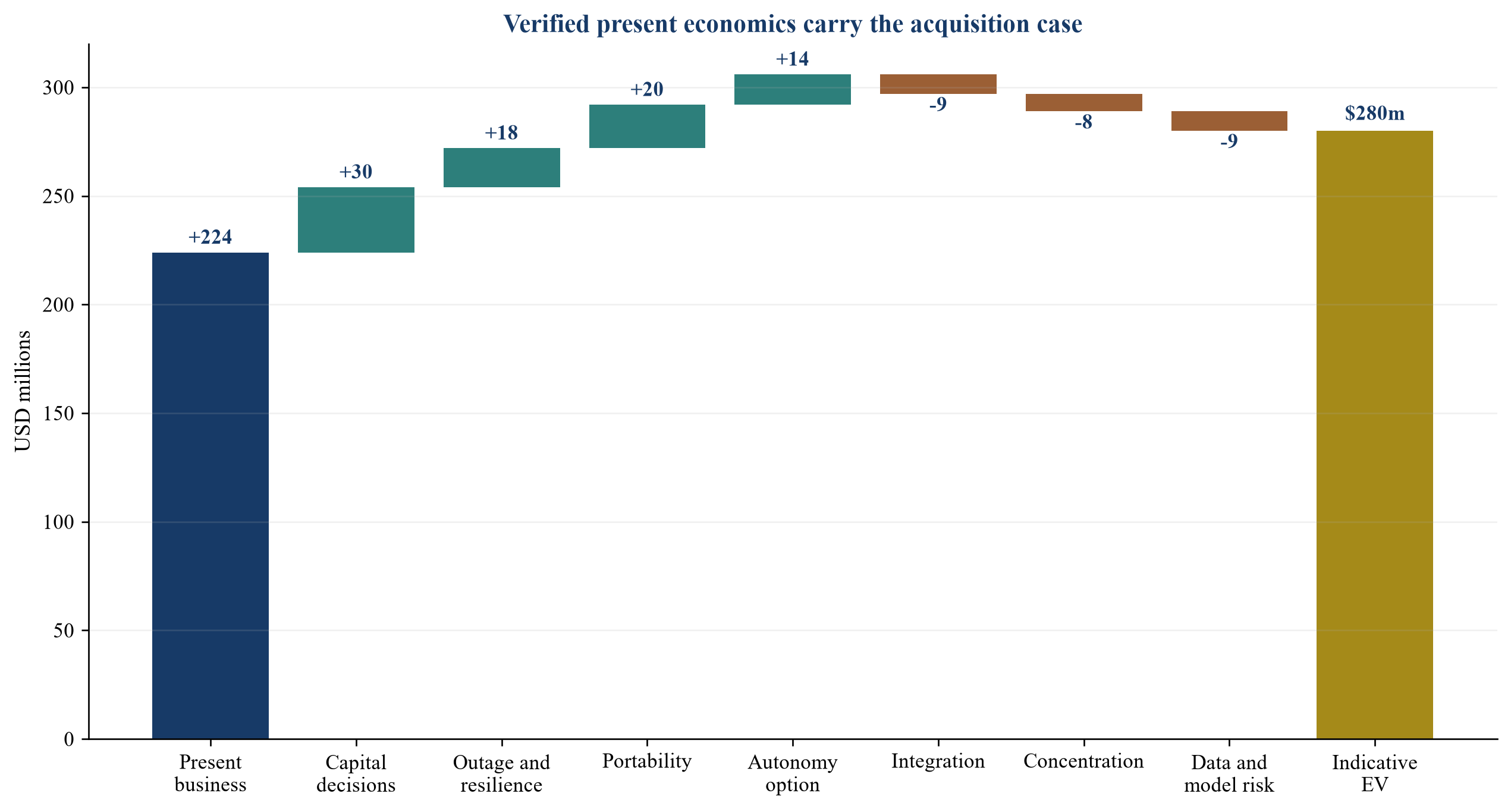
Illustrative management assumptions in USD millions; capital and resilience premiums are limited to verified, contractually relevant evidence.
36. Structure consideration
Cash at completion should correspond to the verified present business. Seller rollover can preserve alignment when founders and technical leaders remain important. Earn-outs can pay for customer renewal, production adoption, validated capital decisions or portable deployment.
A capital-savings earn-out requires a pre-agreed register, counterfactual, classification and verifier. The agreement should address changes in operator budgets, buyer priorities and market conditions. The seller should not be penalised for buyer decisions outside its control.
An autonomy option can be funded in tranches against technical and commercial milestones. Governance and information rights should remain clear throughout the measurement period.
37. Plan integration
Integration should preserve customer trust, data controls and release quality. Operators may need to approve ownership, hosting, support or access changes. Product integration should follow tested interfaces rather than an immediate platform rewrite.
The buyer should establish a verified inventory of code, models, data, contracts, deployments and privileged access. It should reconcile security and incident processes. Customer roadmaps should remain stable during transition.
Synergies should identify owner, cost and dependency. Channel access can support growth only after technical and procurement enablement. Cost reduction should not remove the engineering needed to maintain model fidelity.
38. Build the first 100-day plan
The first 100 days should confirm rights, inventory accuracy, model lineage, deployment status and customer evidence. The buyer should reproduce representative planning and outage cases using agreed data.
Finance and network teams should establish the capital register and measurement rules. Customer meetings should confirm continuity, decision workflows and expansion priorities. Security teams should review privileged access and live-network boundaries.
The board should separate the present-value roadmap from the autonomy option. Funding should follow evidence and customer adoption.
39. Apply a transaction scorecard
The scorecard should cover revenue quality, data, model fidelity, planning adoption, capital attribution, resilience, portability, security and future options. Each domain should have a minimum evidence threshold and a transaction response.
The scorecard should display exceptions rather than hide them in a composite average. Weak rights or critical security can stop a transaction even when commercial indicators are strong.
Definitions can continue after completion as operating measures. This connects diligence promises to integration accountability.
Table 3. Hypothetical acquisition case
| Item | Base assumption | Diligence condition | Deal response |
|---|---|---|---|
| Enterprise value discussion | USD 280 million | Present business carries majority of value | Limit cash at completion |
| Contracted recurring revenue | USD 42 million | Contract, invoice, renewal and margin review | Base-value input |
| Normalised EBITDA | USD 10 million | Include model, compute, deployment and support cost | Normalise earnings |
| Capital-decision premium | USD 30 million | Verified counterfactual and repeat register | Earn-out or premium |
| Outage and resilience premium | USD 18 million | Incident evidence and attribution | Milestone value |
| Portability premium | USD 20 million | Accepted deployment in another environment | Deferred consideration |
| Autonomy option | USD 14 million capped | Production closed loop and contracted adoption | Staged option payment |
| Risk deductions | USD 26 million | Integration, concentration, data and model risk | Price adjustment or escrow |
Illustrative management assumptions only; no amount represents observed company data or a valuation opinion.
Table 4. Board and diligence scorecard
| Domain | Minimum evidence | Red flag | Decision response |
|---|---|---|---|
| Revenue | Contracts, invoices, renewals and cost-to-serve | Projects described as recurring software | Normalise or reprice |
| Data | Identity, accuracy, lineage, rights and update controls | Twin diverges from network | Remediate before reliance |
| Models | Calibration, error range, version and decision fitness | High fidelity claimed without validation | Exclude premium |
| Capital | Approved counterfactual, action and observed outcome | Deferred project called avoided | Reclassify value |
| Resilience | Incident records, service effect and recovery evidence | Maximum loss applied to every event | Rebuild scenario |
| Portability | Repeat deployment and retained accuracy | Bespoke integration hidden as product | Reduce multiple |
| Security | Access, separation, logging and response | Unbounded live-network control | Remediate or stop |
| Future autonomy | Standards map, safeguards, production milestone | Forecast revenue without adoption | Cap and defer value |
Material value should follow current, attributable and decision-specific evidence.
40. Recognise limitations and conclude
This framework supports acquisition and capital-allocation analysis. It does not determine whether a twin is technically safe, legally compliant or suitable for a particular network. Qualified technical, cybersecurity, regulatory, legal, tax, accounting and valuation advice is required.
Standards and operator architectures continue to evolve. Operator and vendor case studies are specific to their reported environments. They demonstrate feasibility and should not be generalised without reproduction. The hypothetical case is a method, not empirical evidence.
The avoided build is a disciplined financial claim. It requires a documented counterfactual, a model fit for the decision, an accountable approval, an implemented outcome and a correct classification across avoidance, deferral, redirection and resizing. A digital twin earns acquisition value when it repeatedly improves those decisions and the target captures durable economics. Present performance should carry the purchase price; portability and autonomy should remain staged options until evidence matures.
References
- International Telecommunication Union. Recommendation ITU-T Y.3090: Digital twin network; requirements and architecture. February 2022. https://www.itu.int/rec/T-REC-Y.3090-202202-I
- International Telecommunication Union. Recommendation ITU-T Y.3091: Digital twin network; capability levels and evaluation methods. December 2023. https://www.itu.int/rec/T-REC-Y.3091-202312-I
- International Telecommunication Union. Recommendation ITU-T Y.3093: Digital twin network; framework and functional requirements of the data domain in the network digital twin layer. Approved 29 August 2025. https://www.itu.int/itu-t/workprog/wp_item.aspx?isn=21506
- International Telecommunication Union. Recommendation ITU-T X.2011: Security guidelines for digital twin network. April 2024. https://www.itu.int/epublications/publication/itu-t-x-2011-2024-04-security-guidelines-for-digital-twin-network
- International Telecommunication Union. Recommendation ITU-T X.2014: Guidelines for using network digital twins for network security. March 2026. https://www.itu.int/dms_pubrec/itu-t/rec/x/T-REC-X.2014-202603-I%21%21SUM-HTM-E.htm
- ETSI. Zero touch network and Service Management. https://www.etsi.org/technical-groups/zsm/
- ETSI. GR ZSM 015 V1.1.1: Network Digital Twin. February 2024. https://www.etsi.org/deliver/etsi_gr/ZSM/001_099/015/01.01.01_60/gr_ZSM015v010101p.pdf
- ETSI. GS ZSM 018 V1.1.1: Network Digital Twin for enhanced zero-touch network and service management. https://www.etsi.org/deliver/etsi_gs/ZSM/001_099/018/01.01.01_60/gs_zsm018v010101p.pdf
- TM Forum. Autonomous Networks Implementation Guide v7.0.0. July 2025. https://www.tmforum.org/resources/how-to-guide/ig1443-autonomous-networks-implementation-guide-v1-0-0/
- TM Forum. Autonomy accelerated: Intent to impact, Phase II. 2025. https://www.tmforum.org/catalysts/projects/C25.5.861/autonomy-accelerated-intent-to-impact-phase-ii
- GSMA. Mobile operators account for 85 percent of investments in mobile internet connectivity infrastructure. 3 March 2025. https://www.gsma.com/newsroom/press-release/mobile-operators-account-for-85-of-investments-in-mobile-internet-connectivity-infrastructure-new-gsma-report-reveals/
- GSMA. The Mobile Economy 2026. https://www.gsma.com/solutions-and-impact/connectivity-for-good/mobile-economy/
- GSMA. EUR 475 billion required for Europe to complete its 5G journey. 6 May 2026. https://www.gsma.com/about-us/regions/europe/gsma_resources/e475-billion-required-for-europe-to-complete-its-5g-journey-and-regain-digital-leadership-new-gsma-study-finds/
- GSMA. Digital Twin Network Lifecycle Management for the Asian Games. https://www.gsma.com/get-involved/gsma-foundry/digital-twin-network-lifecycle-management-for-the-asian-games/
- GSMA. Shared Network Smart Co-Governance Whitepaper. 2025. https://www.gsma.com/get-involved/gsma-foundry/wp-content/uploads/2025/02/Shared-Network-Smart-Co-Governance-Whitepaper-2025-a-1.pdf
- Vodafone. Vodafone's mobile network has a digital twin. https://www.vodafone.com/news/newsroom/technology/vodafone-mobile-network-digital-twin
- O2 Telefónica Germany. Intelligent network control: digital twin puts O2 mobile network on autopilot. 13 October 2025. https://www.telefonica.de/news/press-releases-telefonica-germany/2025/10/intelligent-network-control-digital-twin-puts-o2-mobile-network-on-autopilot.html
- KDDI. KDDI, KDDI Research and Global Partners Launch RAN Digital Twin Collaboration for the 6G Era. 23 June 2026. https://newsroom.kddi.com/english/news/detail/kddi_nr-1068_4588.html
- Nokia. Nokia launches FTTH digital twin and AI-powered tools to boost network reliability. 6 October 2025. https://www.nokia.com/newsroom/nokia-launches-ftth-digital-twin-and-ai-powered-tools-to-boost-network-reliability/
- Ericsson. Chunghwa Telecom enhanced network performance with Site Digital Twin. 2025. https://www.ericsson.com/en/cases/2025/chunghwa-telecom
- IFRS Foundation. IFRS 3 Business Combinations. https://www.ifrs.org/issued-standards/list-of-standards/ifrs-3-business-combinations/
- IFRS Foundation. IAS 36 Impairment of Assets. https://www.ifrs.org/issued-standards/list-of-standards/ias-36-impairment-of-assets/
- IFRS Foundation. IAS 38 Intangible Assets. https://www.ifrs.org/issued-standards/list-of-standards/ias-38-intangible-assets/
- IFRS Foundation. IFRS 13 Fair Value Measurement. https://www.ifrs.org/issued-standards/list-of-standards/ifrs-13-fair-value-measurement/
About the Author
Chennakeshav (CK) is a corporate finance and investment banking executive with 25+ years of global experience in deal origination, structuring and execution across M&A, growth capital and corporate strategy. He has led value-creation mandates for founders, corporates and funds — bridging the boardroom view to hands-on execution and close.
His career spans Morgan Stanley, HSBC, Lloyds Banking Group, EWEC, ADQ portfolio companies and Emirates Growth Fund, across TMT, real estate, fintech, deeptech, cleantech, infrastructure and energy. He has partnered with C-suite leaders, private equity and venture funds, sovereign wealth funds and family offices to finance complex fund raises and scale-up ventures, and has led M&A due diligence, post-merger integration and business-transformation initiatives to create value.
At Matchpoint Partners he is Managing Partner, leading the firm's corporate finance, M&A and capital-raising practice. He holds an MBA from London Business School, an engineering degree from VTU and a Master of Laws (LLM, in progress) from UCL London.
An active start-up mentor, CK mentors at Techstars, DIFC FinTech Hive, Startup Grind, Founder Institute and IN5, serves as Entrepreneur Mentor in Residence (EMiR) at London Business School, and judges the Entrepreneurship World Cup.
https://www.linkedin.com/in/ckadya/
https://www.matchpoint-partners.com/team/ck-adya.html
This paper is part of a continuing series on the structure of private and alternative markets. The views expressed are the author's own. The paper is for information only, describes market structure in general terms, and does not constitute investment, legal, tax or regulatory advice or a recommendation in respect of any security, vehicle or counterparty.
