

1. Define the transaction and valuation question
The analysis should begin with the decision to be made. A seed or growth-equity raise, strategic investment, joint venture, licence, acquisition, project financing or portfolio sale has a specific valuation date, perimeter, funding requirement, control structure and evidence threshold. Scientific promise should be translated into the rights, assets, obligations and development pathways conveyed by the transaction.
The central question is which chemistry options can produce application-qualified performance and cash within the available capital and time. The model should distinguish research candidates, protected inventions, validated materials, prototype cells, pilot processes, customer programmes and commercial production. It should also separate the value of the operating platform from the value of individual chemistry pathways.
Decision evidence should be frozen and dated. Each material claim should state its source, test conditions, uncertainty, owner and verification status. Resolvable gaps belong in diligence; residual uncertainty can influence price, staged funding, milestones, warranties, governance, liquidation preference, licence scope or contingent consideration. This converts scientific optionality into a transaction timetable.
2. Establish the legal, scientific and economic perimeter
The perimeter should identify legal entities, laboratories, pilot lines, equipment, data, samples, patents, software, licences, grants, collaboration agreements and personnel dependencies. University, national-laboratory, customer and supplier relationships can allocate background intellectual property, foreground inventions, publication rights and commercial fields. A valuation cannot assume rights that the company does not control.
The scientific perimeter should identify cathode, anode, electrolyte, separator, interface, cell design, formation protocol, battery-management system and pack assumptions. A claimed chemistry can depend on several complementary components. The economic perimeter should show which components are proprietary, purchased, licenced or supplied through a restricted relationship.
Shared equipment and data can create benefit and dependency. Diligence should inspect access rights, replacement cost, transferability, change-of-control provisions, grant obligations and export controls. The forecast should include only the capability that survives the intended transaction and can operate under documented rights.
3. Build a chemistry option tree
The option tree should map incumbent lithium-ion improvements and emerging pathways by material system, cell architecture and intended application. Branches can include LFP and manganese-rich cathodes, nickel-rich systems, silicon-rich or lithium-metal anodes, sodium-ion, solid-state, lithium-sulphur, iron-air and redox-flow systems. Each branch should state whether it competes with, complements or serves a different use case from incumbent technology.
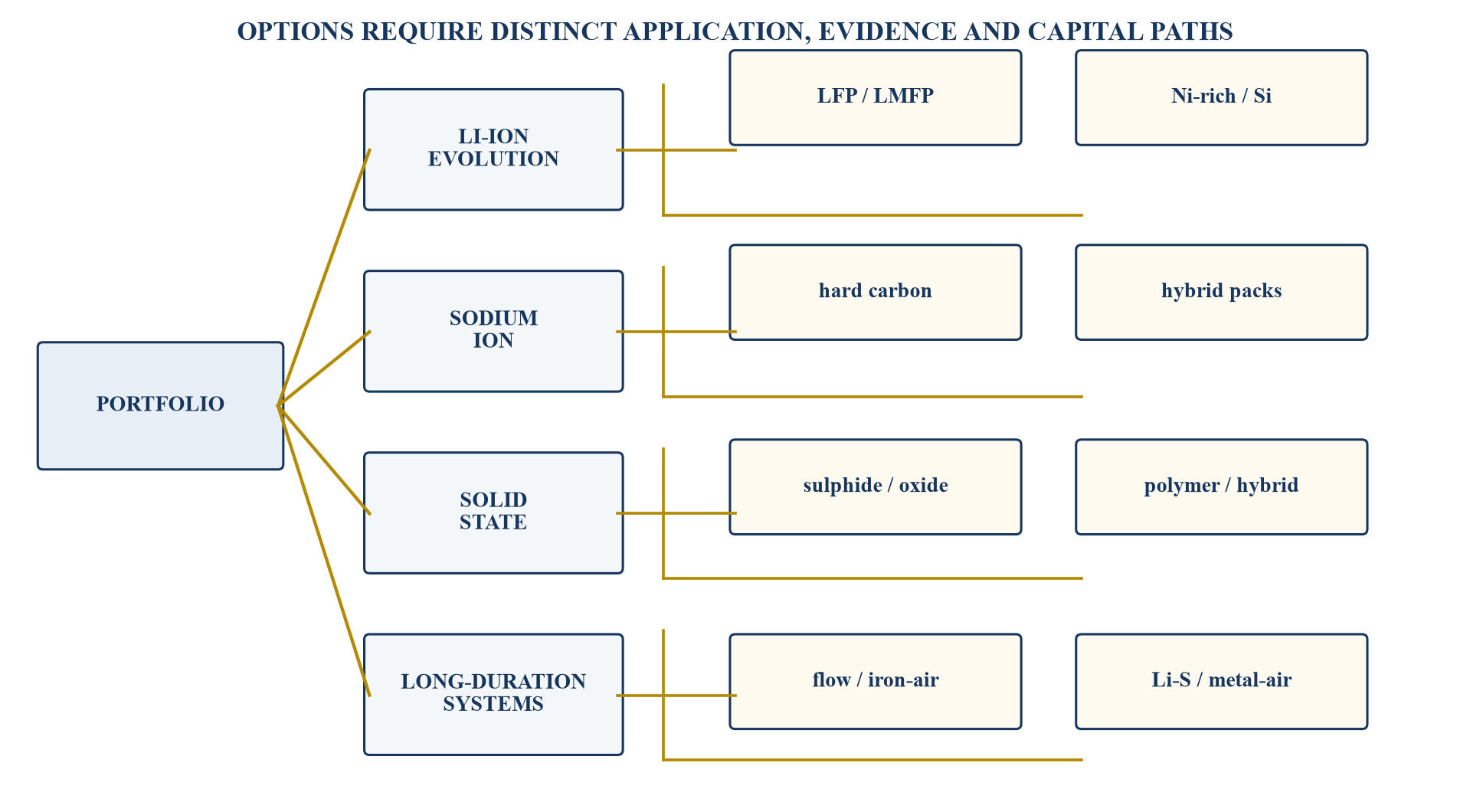
Replace the illustrative branches with the controlled portfolio, owned rights and target applications.
The tree should prevent a broad patent family or research platform from being presented as several independent commercial assets when branches rely on the same unresolved mechanism. It should also reveal shared learning, common infrastructure and incompatible manufacturing routes. Options should be grouped by the evidence and capital needed to reach the next decision gate.
4. Define the target application before comparing chemistry
Battery value is application-specific. Passenger vehicles, heavy transport, aviation, consumer electronics, industrial equipment, short-duration grid storage and long-duration storage require different balances of energy density, power, cycle life, calendar life, safety, temperature, charge rate, footprint, weight and cost. A chemistry can be superior for one application and uneconomic for another.
The application statement should define duty cycle, operating environment, service life, charging pattern, warranty, system boundary and customer constraint. It should include pack or system effects rather than rely only on cell metrics. Thermal management, containment, controls and balance-of-plant can alter the advantage implied by a material result.
The commercial model should identify the buyer, procurement route, replacement alternative, qualification process and willingness to pay. An addressable market does not prove product fit. Value should follow a specific performance-cost proposition that a customer can test and contract.
5. Create the scientific evidence ledger
Table 1. Battery chemistry evidence ledger
| Evidence layer | Controlled record | Transaction question |
|---|---|---|
| composition | formulation, purity and provenance | what material was tested? |
| process | synthesis, coating, assembly and formation | can the sample be reproduced? |
| test | protocol, equipment, calibration and environment | are results comparable? |
| outcome | raw data, analysis and uncertainty | what performance was observed? |
| mechanism | characterisation and degradation evidence | why did performance change? |
| economics | material, process, yield, capex and qualification | can value survive scale-up? |
Evidence fields should be adapted to the material system, cell format and intended application.
Every claim should link composition, batch, process, sample, cell design, test protocol, raw data, analysis code, result and reviewer. Corrections should preserve prior values and effective dates. Replicate count, missing data, exclusions and failed experiments should remain visible. A selected chart without its denominator and unsuccessful trials is weak transaction evidence.
Two-way traceability matters. Reviewers should move from a valuation claim to the relevant cells and from a selected cell back to material lots, synthesis, assembly and test conditions. The ledger should distinguish simulation, model prediction, laboratory observation, independent replication, pilot evidence and customer result.
6. Govern data provenance and scientific comparability
Battery datasets combine literature, simulation, supplier data, internal experiments and public databases. Units, naming conventions, sample histories and test conditions can differ. Provenance should identify the original source, licence, transformation, quality checks and permitted use. Training on confidential partner data can create restrictions that survive a model export.
Comparability requires a defined reference design and protocol. Reported energy density can refer to active material, electrode, cell or pack; cycle life depends on depth of discharge, temperature, charge rate and end-of-life definition. Cost can represent raw material, cell production or complete system. The evidence model should preserve these boundaries.
Data quality should be scored for completeness, representativeness, consistency, accuracy and relevance to the target decision. A large dataset assembled from incompatible experiments can provide less decision value than a smaller controlled series. Transaction disclosure should state material gaps and the work required to close them.
7. Define AI's role in the R&D workflow
AI can support literature extraction, molecular and crystal representation, property prediction, candidate ranking, experiment selection, anomaly detection and process optimisation. Each use should state the input, prediction target, decision, human authority and validation method. An AI label should not combine unrelated capabilities into one undifferentiated platform claim.
The workflow should separate generation from verification. A model can screen a large chemical space and still produce candidates that are unstable, impractical to synthesise, unsafe or dependent on unavailable materials. Physical experiments remain the test of the relevant claim. Negative results improve the model only when captured without selection bias.
The investment case should quantify the decision changed by AI: fewer experiments, faster cycle time, higher hit rate, stronger reproducibility or better process windows. Compute, data curation, laboratory automation, specialist review and integration costs should be included. Activity volume and model novelty do not establish economic value.
8. Validate molecular and materials models
Validation should reflect the property and chemical domain in which a model will be used. Random train-test splits can overstate performance when near-duplicate molecules or structures appear across sets. Time-based, scaffold-based, composition-based and out-of-domain tests can provide stronger evidence of transfer to genuinely new candidates.
The scorecard should report error distributions, calibration, uncertainty, failure modes and applicability domain. Ranking quality can matter more than average numerical error when the model selects experiments. Rare but consequential properties such as flammability, dendrite formation or interfacial instability require dedicated evidence.
Benchmarking should compare the model with expert selection, physics-based methods and simpler statistical baselines. Changes to data, tokenisation, architecture and property labels should be versioned together. A valuation should reflect demonstrated decision utility rather than the size of a foundation model or computing allocation.
9. Use active learning with controlled experimental selection
Active learning can choose experiments that balance expected performance, information gain, uncertainty and laboratory feasibility. The acquisition policy should be recorded before results are known. Constraints should include available precursors, synthesis conditions, safety, equipment, cost and time.
The programme should preserve a representative exploration set alongside exploitation of promising regions. Concentrating only on predicted winners can reinforce model bias and leave uncertainty hidden. Failed synthesis and null results are valuable evidence when their recording is complete.
Economic evaluation should measure candidate quality per unit of time and spend, including setup and characterisation. A faster selection loop creates value when it brings forward a decision, removes a poor pathway or produces a reproducible candidate. It can also accelerate expenditure without improving the probability of commercial success.
10. Build the autonomous-laboratory control system
Automated laboratories connect model selection, robotics, synthesis, measurement, analysis and feedback. The control system should state allowable actions, instrument limits, material custody, calibration, exception handling and human approval. Safety-critical decisions and hazardous processes require protected interlocks and competent oversight.
Reproducibility should be tested across time, instruments, operators and laboratories. An autonomous sequence can repeat a systematic measurement error efficiently. Reference materials, blanks, duplicate experiments and independent assays should be embedded in the workflow.
The business case should include utilisation, throughput, failure recovery, maintenance, consumables and specialist labour. Laboratory autonomy can increase data volume; enterprise value arises when controlled experiments improve option decisions and shorten the path to application evidence.
11. Separate prediction, synthesis and electrochemical proof
A predicted stable structure is not a synthesised material. A synthesised material is not a functional electrode. A promising half-cell is not a qualified full cell. The evidence ladder should keep these states separate and specify the test required to advance.
Synthesis records should show phase purity, morphology, composition and yield. Electrode evidence should include loading, porosity, binder, conductive additive, thickness and manufacturing route. Cell evidence should state counter-electrode, electrolyte, capacity balance, formation and test conditions.
The valuation should apply probability and capital to the next unproven conversion. Model predictions can reduce search cost but cannot be treated as owned commercial inventory. Option value should increase as independent physical proof closes a material uncertainty.
12. Create a common chemistry performance matrix
Table 2. Application-specific chemistry comparison
| Dimension | Measurement boundary | Decision relevance |
|---|---|---|
| energy | cell and system Wh/kg and Wh/L | range, footprint and payload |
| power | pulse and sustained power under duty cycle | acceleration, response and equipment size |
| life | cycle and calendar life to defined threshold | replacement cost and warranty |
| safety | abuse, propagation and control requirements | qualification, insurance and containment |
| temperature | performance and life across operating range | market and system design |
| cost | material, process, yield, system and lifecycle | margin and customer economics |
Replace qualitative entries with controlled, comparable evidence for the target application.
The matrix should use the same boundary and operating conditions for each pathway. It should show confidence, maturity and source alongside each value. A best laboratory result should not be compared with a conservative commercial specification.
Trade-offs should be explicit. Higher energy can increase material cost or safety burden; faster charging can reduce life; abundant materials can require new processing infrastructure. Application value should be calculated from the complete system and service outcome.
13. Model degradation and lifetime evidence
Battery value depends on how performance changes with time, cycling, temperature, state of charge and duty cycle. Degradation can arise from several coupled mechanisms. The programme should connect electrochemical outcomes to physical characterisation and should distinguish reversible loss from permanent damage.
Accelerated tests require a validated relationship to use conditions. A short high-stress protocol can rank candidates and can misrepresent calendar ageing or field interactions. Lifetime extrapolation should state model form, data range, uncertainty and evidence required for confirmation.
Warranty and customer economics should use mature application-relevant cohorts. A chemistry option with exceptional initial performance and weak lifetime evidence should carry a development reserve. The forecast should include the time and cost needed to mature degradation evidence.
14. Validate safety at material, cell and system levels
Safety evidence should address material reactivity, thermal stability, gas generation, short circuit, abuse response, propagation and system controls. A material-level advantage may be offset by manufacturing defect, interface instability or pack design. Applicable standards and customer requirements should be mapped by application and geography.
Testing should use representative cells and credible worst-case states. Passing one protocol does not establish safe operation across all formats, ages and conditions. Incidents, near misses and destructive tests should enter the evidence ledger.
Valuation should reflect containment, monitoring, certification, insurance, recall and remediation requirements. Safety-critical uncertainty can affect market access and financing structure. It cannot be traded against a favourable energy metric without a competent decision process.
15. Assess manufacturability early
Materials should be evaluated for synthesis yield, purity, moisture sensitivity, handling, coating, drying, calendaring, assembly, formation and quality control. A chemistry that performs in handcrafted cells can fail when transferred to thicker electrodes, larger formats or faster production.
Manufacturability experiments should identify critical process parameters and acceptable windows. Equipment compatibility, environmental controls, solvent recovery, hazardous-material treatment and inspection should be included. The option map should show which existing assets can be reused and which require a new line.
Early design-for-manufacture work can prevent a scientifically attractive pathway from accumulating hidden scale-up cost. Transaction models should distinguish laboratory recipe cost, pilot conversion cost and mature production cost, with explicit yield and utilisation assumptions.
16. Build the technology-readiness and evidence matrix
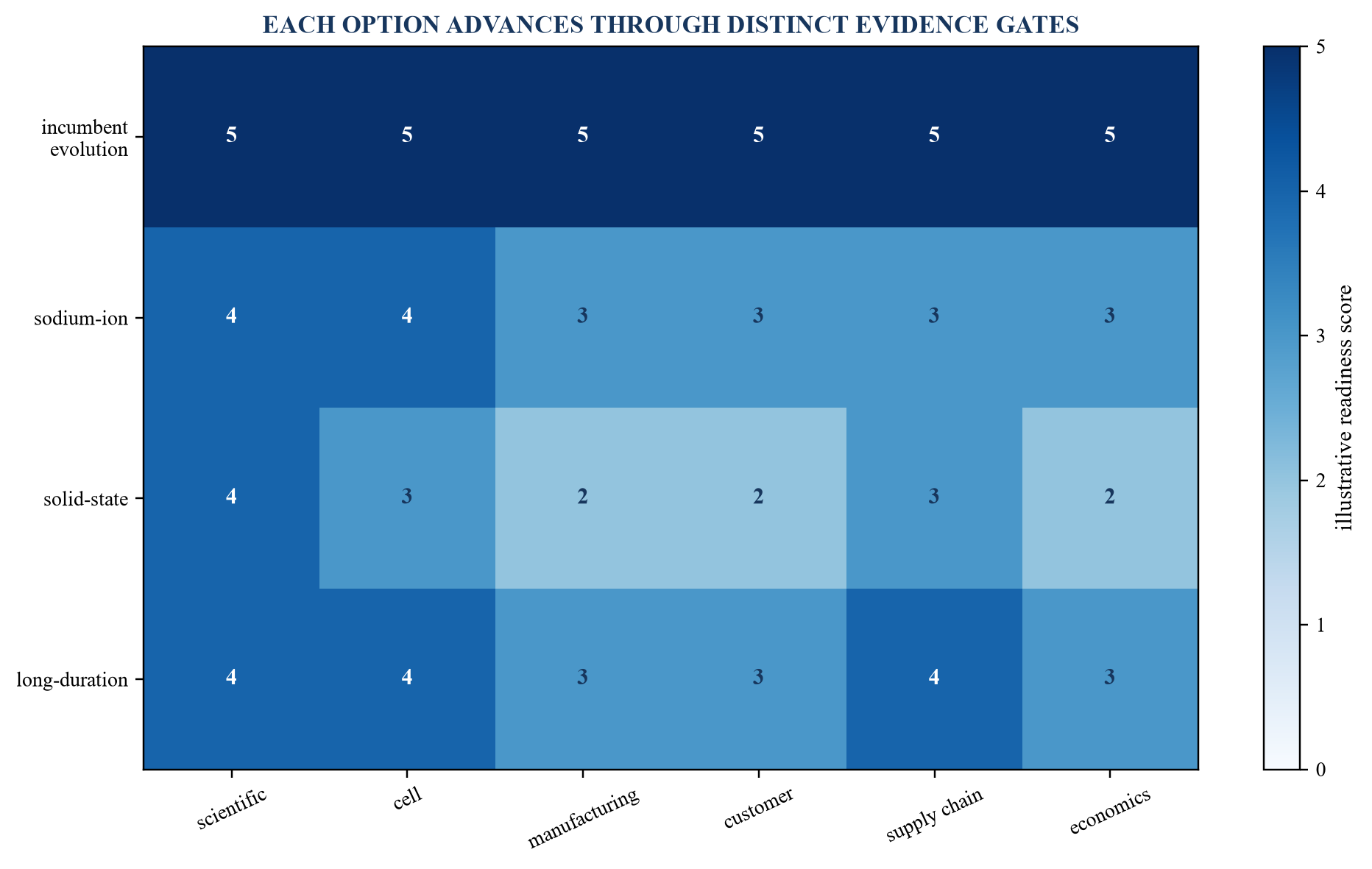
Scores are illustrative; replace them with independently reviewed evidence and gate definitions.
Readiness should be defined by observable evidence rather than an unsupported number. Scientific readiness, cell performance, manufacturing, customer, supply-chain and economic readiness can move at different speeds. The weakest critical dimension often controls the next financing decision.
Gate definitions should identify required tests, acceptance thresholds, owner, independent reviewer, cost and schedule. Advancement should preserve failed evidence and conditions. A portfolio dashboard should show both current maturity and the work required to reach the next value-inflection point.
17. Quantify scale-up risk by transition
Scale-up should be modelled as a sequence: material batch, electrode, small cell, large cell, module or system, pilot process, customer sample and qualified production. Each transition can change interfaces, thermal behaviour, uniformity, yield and control requirements.
The team should identify which physical mechanisms are expected to remain stable and which require new evidence. Geometric scaling alone is insufficient. Larger cells can change current density, pressure, heat rejection and defect consequences. Pilot equipment can produce material different from laboratory methods.
The probability model should assign uncertainty to each transition and should avoid multiplying arbitrary percentages without evidence. Technical reviews, comparable programmes and observed portfolio history can inform ranges. Funding should be linked to the next decision-changing transition.
18. Protect intellectual property and freedom to operate
Intellectual property can include composition, process, cell design, control software, data, know-how and test methods. Patent counts are weak value indicators without claim scope, jurisdiction, remaining life, ownership and connection to the commercial product. Trade secrets require documented controls and personnel continuity.
Freedom-to-operate review should address the intended material, process, application and geography. A patent can be valid and commercially narrow; a promising product can face third-party rights. Collaboration, employment and grant agreements should be checked for assignment, licence, publication and government rights.
The valuation should separate blocking rights, enabling know-how and defensive filings. It should also include the cost and time of prosecution, challenge, design-around and licence. AI-generated candidates require clear records of human contribution, data rights and invention decisions under applicable law.
19. Value data and platform transferability
A chemistry R&D platform can support several programmes through shared datasets, automation, models and experimental methods. Transfer value should be demonstrated across materials or applications under controlled tests. A success confined to one narrow domain should not be valued as a general discovery engine.
Data rights should cover training, validation, benchmarking, retention, customer use and change of control. Models should be exportable, documented and reproducible without dependence on one individual or inaccessible compute environment. Laboratory methods should survive equipment substitution and team turnover.
Platform value should be separated from the value of individual options to avoid double-counting. The platform earns value through repeatable reduction in decision time, cost or failure risk across programmes. Forecasts should include ongoing data, compute, laboratory and specialist costs.
20. Map critical-material and supply-chain exposure
Each pathway should map active materials, precursors, processing steps, geographic concentration, supplier qualification, price exposure and recycling route. Avoiding one critical mineral can introduce another constrained material or immature process. Supply risk should be assessed at the specification and processing level, not only by element.
The map should show current and scaled requirements, alternate suppliers, minimum orders, lead times, purity, logistics and environmental obligations. Laboratory-grade availability does not prove commercial supply. Customer localisation and content requirements can affect eligible markets and incentives.
Supply-chain optionality can create strategic value when a chemistry reduces concentration or price sensitivity for a defined application. The valuation should include the cost and time to qualify alternatives and should test how incumbent chemistry prices affect competitiveness.
21. Compare chemistry pathways on total system cost
Cost comparison should connect material quantities and prices to conversion, yield, formation, quality, pack integration, thermal management, controls, balance-of-plant, warranty and recycling. A low active-material cost can be offset by low energy density, additional containment, slower manufacturing or shorter life. System boundaries should be consistent.
The model should separate current observed cost from mature target cost. Learning rates, scale economies, process improvements and input-price assumptions require evidence. Incumbent technologies continue to improve while emerging pathways develop, so a static benchmark can overstate future advantage.
Total cost of ownership should reflect the customer duty cycle, financing, efficiency, replacement and residual value. The option becomes economically relevant when it meets a decision threshold under a credible manufacturing and qualification plan. Cost parity asserted from a materials bill alone is insufficient.
22. Build the supply-chain and application map
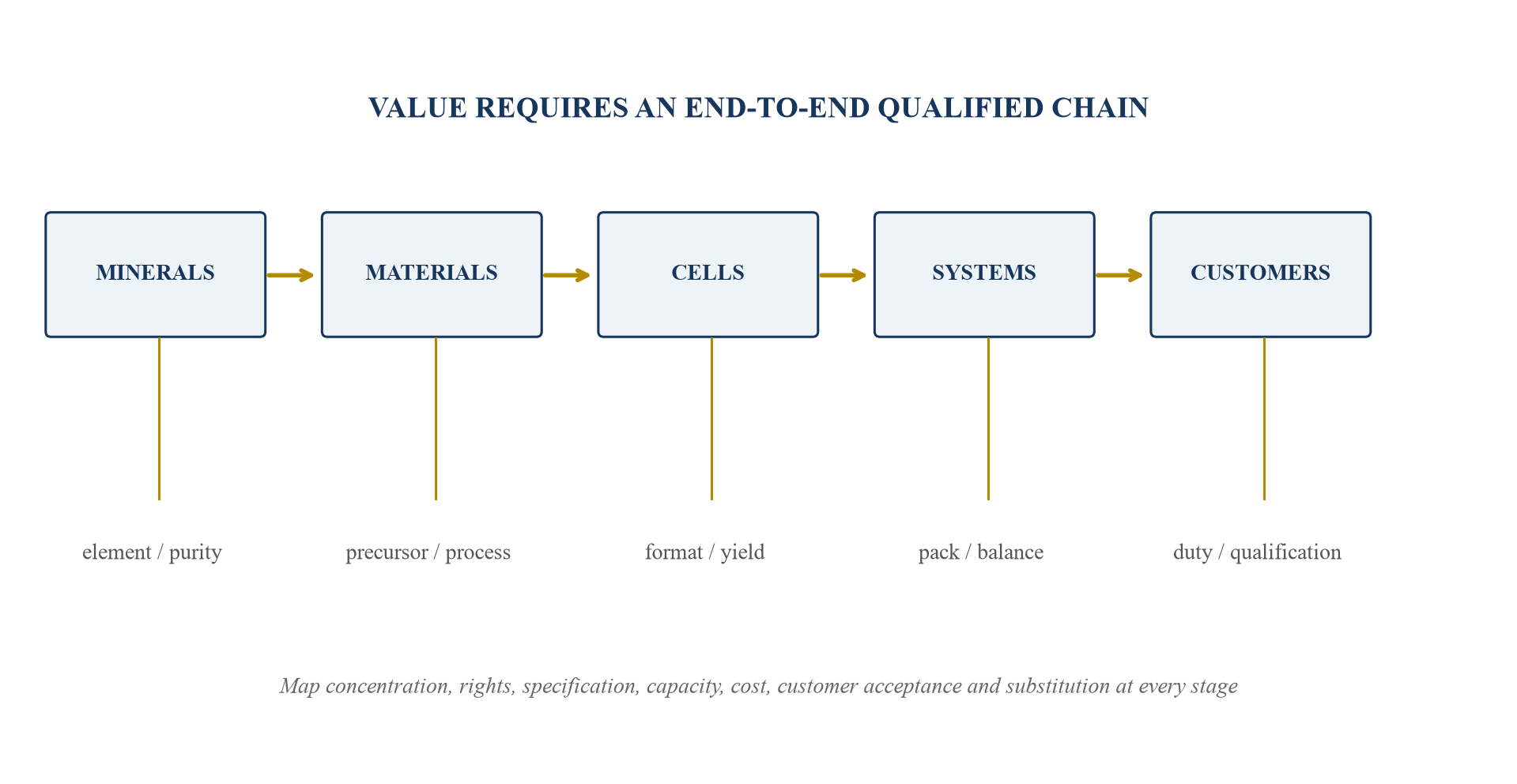
The map should identify owned capability, contracted access, concentration and qualification gaps.
The map should connect upstream specification to downstream application performance. Substitution is often limited by process and customer qualification, even when another material appears chemically similar. Capacity announcements should be distinguished from operating, qualified supply.
Commercial diligence should trace each critical dependency through contract, lead time, price mechanism, quality history and alternate route. The portfolio model should identify options that share a concentrated bottleneck and should avoid treating them as independent diversification.
23. Integrate sustainability and regulatory evidence
Battery pathways can differ in mineral extraction, energy use, water, emissions, hazardous materials, durability, repair, second life and recycling. Environmental comparisons should use a consistent lifecycle boundary and should state geography, electricity mix, recovery assumptions and data quality. A laboratory material claim does not establish a lower lifecycle impact.
Applicable battery, chemical, product, transport and waste rules should be mapped by target market and application. Product information, carbon-footprint, recycled-content and due-diligence obligations can influence data architecture and supplier selection. Timing and scope should be confirmed by competent counsel.
The valuation should include compliance, testing, reporting, remediation and end-of-life costs. Sustainability attributes can support customer value when they are measured, verified and contractually relevant. Aspirational targets should remain outside realised benefits.
24. Define the customer qualification pathway
Qualification should identify the customer, product, application, sample stage, test plan, acceptance criteria, audit, design freeze and change-control process. Research samples, engineering cells, A-samples, production-intent samples and serial qualification should remain separate. Customer language should be reproduced accurately without converting interest into commitment.
The pathway should show sample quantities, lead times, failure response, tooling, pilot capacity and customer resources. A technically successful test can still fail to become revenue because timing, integration, procurement, warranty or strategy changes. Forecasts should use observed conversion evidence and explicit stage probabilities.
Customer concentration and programme dependence should be visible. A chemistry option can have strong fit for one buyer and limited transfer. Transaction terms can link value to independent qualification, contracted volume or production acceptance rather than management-labelled engagement.
25. Measure portfolio learning and option interaction
Options can share materials data, test methods, automation, suppliers, process knowledge and customer relationships. The portfolio model should identify genuine learning spillovers and negative interactions such as competition for laboratory capacity, capital or specialist attention. Shared resources are constraints as well as synergies.
Learning should be measured through fewer experiments, higher reproducibility, improved prediction, faster failure identification and transfer across programmes. Publications and datasets can support learning but do not prove commercial progress. The evidence should connect a shared capability to a changed option decision.
Portfolio governance should prevent sunk cost or technical enthusiasm from preserving weak pathways. A programme can be stopped while its data retains platform value. The option ledger should record continuation, pivot, partnership, licence and termination decisions with reasons and recovered learning.
26. Set kill, pivot and acceleration criteria
Every pathway should have predefined criteria for continuation. Technical criteria can include performance, reproducibility, degradation, safety and scale transition. Commercial criteria can include application advantage, customer sponsorship, supply chain, cost and time. Capital criteria should include remaining spend, runway and financing feasibility.
Kill criteria should identify results that invalidate the value proposition or make the next experiment uneconomic. Pivot criteria can redirect a chemistry to another application or business model when evidence supports the change. Acceleration criteria should require enough evidence and capacity to justify increased spend.
Decisions should be made by accountable technical and commercial owners with independent challenge. Changing thresholds after results are known should be documented. This discipline converts optionality from an excuse for indefinite research into a controlled capital-allocation system.
27. Construct the probability-adjusted option model
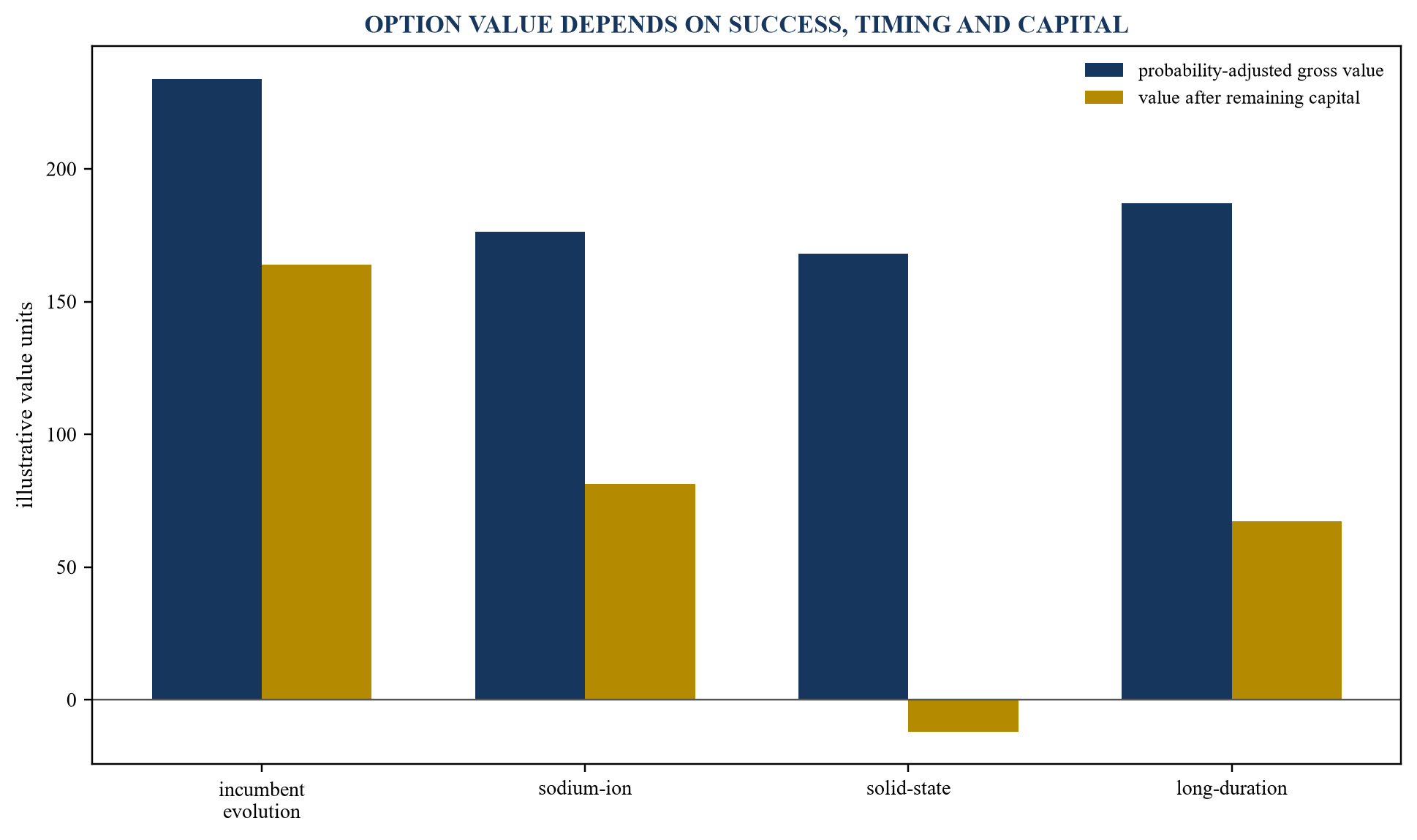
Illustrative values only; replace with independently validated probabilities, cash flows, timing and capital requirements.
The model should define commercial value at success, probability of reaching that state, timing, remaining capital, dilution, tax and risk. Probabilities should be attached to observable gates and should be conditional on funding. Correlated failure across options should be modelled where they share a material, mechanism, process or customer assumption.
Value at success should use application-specific volume, price, margin, capital and competitive assumptions. It should not apply a full market share to every option. The model should include licence, partnership and sale pathways where these are credible alternatives to own manufacturing.
Probability-adjusted value is a decision aid, not a substitute for evidence. Ranges and sensitivities should show which assumptions control the result. The same option should not be counted both as a standalone programme and inside a platform multiple.
28. Reconcile strategic, income and market approaches
An income approach can model probability-adjusted cash flows or milestone payments. A market approach can examine comparable transactions, companies or licences while adjusting for evidence, rights, application, maturity and capital need. A cost approach can inform replacement or reproduction but usually does not capture successful optionality.
Strategic value can arise from supply security, application access, time saved, blocking rights, manufacturing learning or portfolio fit. Each synergy should have an owner, action, timing, cost and standalone baseline. A buyer's ability to fund scale-up should not silently convert into seller value.
The valuation conclusion should reconcile approaches and explain differences. Wide uncertainty can support ranges, staged consideration or option structures. Precision unsupported by technical evidence creates false confidence.
29. Translate R&D speed into economic value
Faster research creates value when it brings forward a cash flow, removes a failing pathway, reduces required capital or improves the probability of qualification. The model should identify the decision date changed by AI or automation and the downstream consequence. Laboratory throughput alone is an incomplete benefit.
Time savings should be net of data curation, automation setup, model validation, synthesis, characterisation and queue constraints. A faster early stage can move the bottleneck to pilot manufacture or customer testing. The integrated plan should identify the critical path.
Economic value can be estimated through avoided spend, earlier partnership, reduced dilution or accelerated market entry, with probability and discounting. Claimed compression from years to months should be treated as a target until programme evidence supports it.
30. Build the integrated development and cash forecast
The forecast should connect experiments, candidates, scale transitions, headcount, equipment, materials, customer samples, qualification and financing. Each programme should have base, downside and stop cases. Shared platform costs should be allocated consistently without hiding the true cost of an option.
Cash burn should reflect laboratory utilisation, external testing, compute, intellectual property, regulatory work, pilot campaigns and long-lead equipment. Milestones should have evidence-based dates and should include failure recovery. A technical plan without financing headroom can destroy option value.
The board should reconcile monthly actuals to programme output and decision gates. Variances should identify scope, productivity, result and schedule. Forecast improvements should enter only after evidence changes the relevant assumption.
Forecast construction should begin at the experiment and batch level and aggregate only after units are consistent. A programme may report candidate count, cell count, ampere-hours, kilowatt-hours, pilot tonnes and customer samples at different stages. These measures should be connected to the work, time and expenditure needed to advance an option. A forecast that jumps from laboratory candidates to commercial revenue without the intermediate conversion steps conceals the principal investment risk.
Resource loading should identify scarce instruments, dry-room time, pilot equipment, specialist reviewers and customer test windows. Delays often arise from queues and dependencies rather than the nominal duration of one experiment. The critical path should include procurement, installation, calibration, material lead time, safety review, sample logistics and feedback. Parallel activity can shorten schedules and can increase cash burn before evidence warrants commitment.
Downside planning should assume that priority experiments fail, a material batch is unavailable, a test must be repeated or a customer window moves. Management should show which expenditure can be stopped and which commitments are fixed. The liquidity model should preserve a route to an orderly decision rather than force financing under distress immediately before a decisive gate.
Portfolio forecasts should also state the value of information expected from each spending tranche. Expenditure can create value by confirming a strong pathway, rejecting a weak one or revealing a better application. Reporting only favourable technical milestones overlooks the economic benefit of an early, well-evidenced stop. Capital efficiency should therefore measure the quality and timing of decisions as well as the number of technical outputs.
31. Design milestone-based financing
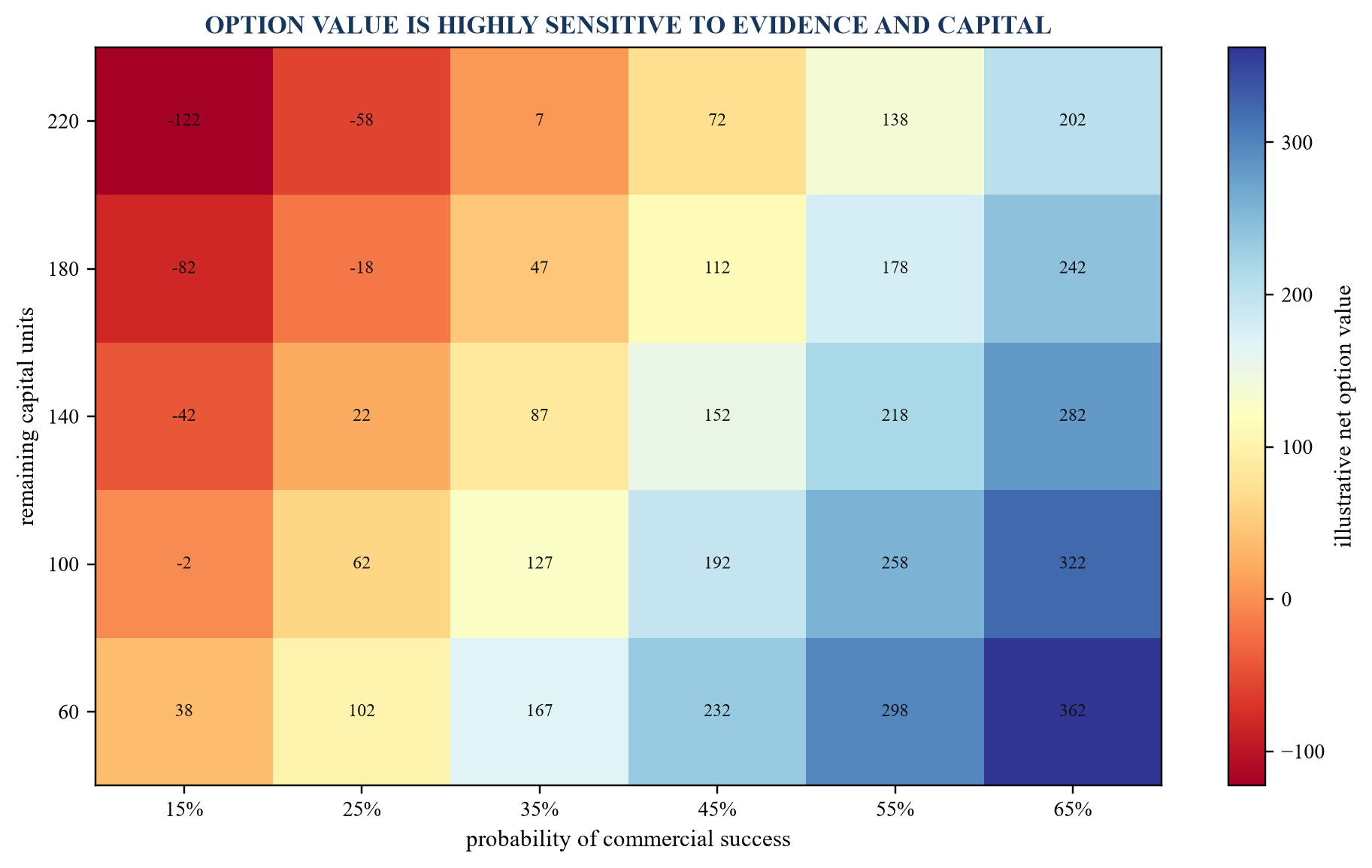
Illustrative values only; replace with independently validated commercial value, probability, timing and funding requirements.
The sensitivity should be read alongside the evidence gates. A higher probability should result from reproducible technical, manufacturing and customer evidence rather than management confidence. Remaining capital should include the full cost to the defined commercial state, including failure recovery, working capital and financing fees. A model can show positive value at several combinations and still be infeasible if liquidity cannot reach the next gate.
The board should identify the evidence that can move the option from one probability range to another. Independent replication may reduce scientific risk; a pilot campaign may reduce process risk; customer acceptance may reduce application risk. These changes should not be added mechanically when they are dependent. For example, a successful customer test using laboratory cells may leave manufacturing probability substantially unresolved.
Capital sensitivity also supports partnering decisions. A strategic partner with qualified manufacturing, materials or customer access can reduce required capital and time while receiving economics or control. The standalone and partnership cases should recognise these transfers explicitly. The company should not claim the partner's infrastructure as owned value, and it should reflect exclusivity, field restrictions, governance and termination rights.
Financing design should consider the consequence of partial success. A material can meet performance targets and miss process cost; a customer can accept samples and delay a platform launch. Milestone documents should define the accepted result, cure process and decision rights. Ambiguous milestones can create disputes precisely when new capital is required.
Financing should retire the uncertainties that prevent customer qualification and cash. Milestones can include reproducible material, independent cell validation, safety result, pilot batch, manufacturing yield, customer sample acceptance, contracted development, design freeze and production qualification. Each should have a source, owner and acceptance test.
Equity can absorb research and portfolio uncertainty. Strategic capital can bring application, supply-chain or manufacturing capability and can introduce exclusivity or control constraints. Grants can fund defined work and can carry reporting, access or commercial obligations. Debt usually requires stronger asset, completion and cash evidence.
Tranched funding, warrants, licences, joint ventures and contingent consideration can align capital with proof. Terms should preserve enough runway to reach the next gate under a downside plan. Milestones should be technically meaningful and resistant to cosmetic satisfaction.
32. Prepare the technology-portfolio data room
Table 3. Battery technology portfolio data room
| Workstream | Core evidence | Verification test |
|---|---|---|
| science | compositions, protocols, raw data and mechanisms | reproduce selected claims |
| AI and data | provenance, models, validation and decisions | replay candidate selection |
| intellectual property | ownership, claims, licences and know-how | trace rights to target product |
| scale-up | process, equipment, yield and quality plans | walk the next transition |
| commercial | applications, customer evidence and qualification | confirm stage and acceptance |
| finance | budgets, grants, cap table, forecast and funding | reconcile spend to milestones |
Access should be controlled and evidence reconciled to source systems.
The data room should preserve version, date, owner and relationship between scientific and financial evidence. Summaries should link to raw records. Material failed experiments, disputes, restrictions, safety events and programme stops should be disclosed with context and remediation.
Reviewers should select samples independently and reproduce the evidence chain. Access controls should protect trade secrets while allowing decision-grade verification. Unavailable evidence should be logged as a gap rather than recreated from memory.
33. Run scientific and commercial diligence together
Scientific diligence should test composition, mechanism, reproducibility, test quality, degradation, safety and scale transitions. Commercial diligence should test application need, customer process, competition, supply chain, cost and qualification. The two workstreams should use one option map and reconcile assumptions.
A technical advantage can be commercially irrelevant; a customer problem can exceed the chemistry's capabilities. Joint reviews should identify the few variables that determine both performance and value. Management explanations should be linked to experiments, contracts, budgets and schedules.
Findings should enter price, structure, conditions, warranties, integration and financing. A long technical appendix that does not change the transaction decision has limited value. Open issues should state materiality, owner, remedy, cost and completion evidence.
34. Assess team and key-person transfer risk
Battery programmes depend on tacit knowledge across materials, electrochemistry, process, modelling and customer qualification. Diligence should identify who can reproduce each critical method, interpret anomalies and operate equipment. Employment, consultancy, invention and retention arrangements should be reviewed.
Documentation should allow a competent team to repeat material synthesis, cell assembly, testing, analysis and model deployment. Concentration in one founder or scientist increases continuity risk even when patents exist. Succession and knowledge-transfer plans should be costed.
The transaction model should include retention, recruitment, relocation and integration. Team value depends on willingness and ability to continue under the proposed structure. It should not be assumed from historical association alone.
35. Control cybersecurity, model and laboratory risk
Research environments contain sensitive formulations, partner data, instrument control and intellectual property. Controls should cover identity, access, segmentation, patching, logging, backup, secure development, supplier access and incident response. Laboratory availability and data integrity require tested recovery.
Model packages should be versioned and protected from unauthorised change. Training data, code, parameters, environment and outputs should be reproducible. Automated equipment should have bounded authority, safe states and independent interlocks.
Cyber diligence should inspect architecture, incidents, open findings, recovery exercises and critical dependencies. Insurance does not replace control. Material gaps should affect scope, remediation cost, integration and valuation.
36. Build the board portfolio dashboard
Table 4. Board chemistry-portfolio dashboard
| Dimension | Board measure | Required evidence |
|---|---|---|
| application | defined use case and buyer | qualification map and customer record |
| technical | current gate and limiting claim | controlled test and independent review |
| scale | next manufacturing transition | process plan, equipment and acceptance test |
| economics | value range and remaining capital | integrated cost and cash forecast |
| rights | owned and usable position | IP, licence, data and collaboration review |
| decision | continue, pivot, partner or stop | approved rationale and next evidence |
Report evidence, uncertainty and cash together; avoid unsupported precision.
The dashboard should show change since the prior review, not only current status. It should identify which evidence moved probability, value, timing or capital. Green labels without source and uncertainty are weak governance.
The board should review portfolio concentration, correlated risk, resource bottlenecks and runway. Decisions should preserve an audit trail. Technical leaders and finance should use the same option identifiers and gate definitions.
37. Model portfolio concentration and correlation
Diversification requires independent drivers. Several chemistry options can depend on the same lithium price, electrolyte mechanism, pilot line, founder, customer or regulatory assumption. The model should identify common causes and should stress them together.
Concentration should be assessed by expected value, remaining capital, time, application, customer and critical resource. A small programme can consume a disproportionate share of scarce expert or pilot capacity. Portfolio sequencing can create value when early experiments inform several pathways.
Scenario analysis should test incumbent cost decline, material-price reversal, customer delay, scale failure and financing constraint. Portfolio value should reflect the ability to stop, defer, partner or redirect options as evidence changes.
38. Plan transaction integration and value capture
An acquirer or strategic investor should define how laboratories, data, models, intellectual property, teams, suppliers and customer programmes will operate after closing. Integration can interrupt experiments and qualification if systems, equipment or decision rights change. Continuity requirements should be identified before signing.
Value-capture plans should assign owners to data migration, model reproducibility, IP controls, laboratory access, supplier qualification and customer communication. Synergies should be separated from standalone option value and supported by actions and costs.
The first hundred days should preserve scientific evidence and programme cadence while testing central claims. Integration should not force every option into one process when their experimental needs differ. Governance should retain stop and pivot authority.
39. Use a one-hundred-day option-value plan
Table 5. One-hundred-day chemistry option-value plan
| Period | Priority | Gated output |
|---|---|---|
| days 1-15 | perimeter and option register | controlled portfolio baseline |
| days 16-30 | evidence and data provenance | reproducible priority claims |
| days 31-50 | application and readiness review | approved gate definitions |
| days 51-70 | scale, supply and customer path | integrated transition plan |
| days 71-85 | probability, value and cash | reconciled portfolio model |
| days 86-100 | governance and financing | board-approved option decisions |
Timing is illustrative and should reflect transaction scope, maturity and customer commitments.
The plan should run through accountable scientific, engineering, commercial, legal and finance owners. Weekly evidence reviews should close critical gaps and reconcile definitions. Independent review should focus on the claims that control transaction value.
Readiness is reached when central option, platform, probability, capital and customer claims can be reproduced from controlled records. Mixed outcomes can support a transaction when uncertainty is explicit and appropriately structured. The governance system should continue after closing.
40. Conclusion
AI-assisted R&D can improve battery discovery and portfolio decisions by searching wider spaces, prioritising experiments and connecting data to controlled learning. Value is defensible when model predictions lead to reproducible materials, application-relevant cells, scalable processes, customer qualification and cash. Search speed and peak performance are insufficient without this chain.
Boards and investors should value chemistry pathways as evidence-gated options. They should compare technologies on consistent system boundaries, preserve failed evidence, test data and intellectual-property rights, map critical materials, define kill criteria and connect each transition to capital. Portfolio diversification should account for shared mechanisms, people, equipment and markets.
The transaction case should reconcile scientific, manufacturing, customer and financial evidence. Probability-adjusted models should expose the assumptions that control value and should support staged financing or contingent structures where uncertainty remains. This framework turns a broad innovation narrative into a decision-ready portfolio of applications, milestones, cash requirements and strategic choices.
The portfolio should remain dynamic after a financing or acquisition. New experiments, incumbent cost changes, material availability, customer feedback and regulatory developments can alter both the preferred pathway and the capital sequence. Governance should require a dated reassessment when evidence crosses a defined threshold. The review should reconcile the original investment case with observed outcomes, retain explanations for changes and identify whether value arose from the expected option or from a disciplined pivot. This continuing evidence cycle protects decision quality, supports transparent investor communication and prevents an attractive historical narrative from replacing the current scientific and commercial position.
The evidence should remain reproducible.
References
- International Energy Agency, Global EV Outlook 2026: Electric vehicle batteries, https://www.iea.org/reports/global-ev-outlook-2026/electric-vehicle-batteries
- International Energy Agency, Global EV Outlook 2026: Executive summary, https://www.iea.org/reports/global-ev-outlook-2026/executive-summary
- International Energy Agency, Global EV Outlook 2025: Electric vehicle batteries, https://www.iea.org/reports/global-ev-outlook-2025/electric-vehicle-batteries
- International Energy Agency, Batteries and Secure Energy Transitions: Executive summary, https://www.iea.org/reports/batteries-and-secure-energy-transitions/executive-summary
- International Energy Agency, The State of Energy Innovation 2025: Executive summary, https://www.iea.org/reports/the-state-of-energy-innovation-2025/executive-summary
- International Energy Agency, Global Critical Minerals Outlook 2025: Beyond NMC batteries, https://www.iea.org/reports/global-critical-minerals-outlook-2025/beyond-nmc-batteries-supply-chain-issues-for-emerging-battery-technologies
- International Energy Agency, How innovation can help secure future battery markets and mineral supplies, https://www.iea.org/commentaries/how-can-innovation-help-secure-future-battery-markets-and-mineral-supplies
- United States Department of Energy, AI for Energy, https://www.energy.gov/sites/default/files/2024-04/AI%20EO%20Report%20Section%205.2g%28i%29_043024.pdf
- United States Department of Energy, Designing Materials with Predictable Functionality, https://www.energy.gov/undersecretaryforscience/genesis-mission/designing-materials-predictable-functionality
- United States Department of Energy, Achieving AI-Driven Autonomous Laboratories, https://www.energy.gov/undersecretaryforscience/genesis-mission/achieving-ai-driven-autonomous-laboratories
- United States Department of Energy, New Approach to Materials Synthesis with Quick Validation by a Robotic Lab, https://www.energy.gov/science/bes/articles/new-approach-materials-synthesis-quick-validation-robotic-lab
- Argonne Leadership Computing Facility, Building AI foundation models to accelerate the discovery of new battery materials, https://www.alcf.anl.gov/news/building-ai-foundation-models-accelerate-discovery-new-battery-materials
- Argonne Leadership Computing Facility, Foundation Models for Molecular Design for Energy Storage and Conversion, https://www.alcf.anl.gov/science/case-studies/foundation-models-molecular-design-energy-storage-and-conversion
- Argonne Leadership Computing Facility, Autonomous Molecular Design for Redox Flow Batteries, https://www.alcf.anl.gov/science/projects/autonomous-molecular-design-redox-flow-batteries
- Argonne Leadership Computing Facility, Heterogeneous Reaction Dynamics for Energy Storage and Hydrogen Production, https://www.alcf.anl.gov/science/projects/heterogeneous-reaction-dynamics-energy-storage-and-hydrogen-production-0
- Argonne National Laboratory, BatPaC Model Software, https://www.anl.gov/amd/batpac-model-software
- National Renewable Energy Laboratory, Supply Chain and Cost Analysis of Advanced Technologies, https://www.nrel.gov/manufacturing/advanced-tech.html
- National Renewable Energy Laboratory, Multi-Scale Modeling of Battery Physics, https://www.nrel.gov/transportation/multi-scale-battery-physics-modeling.html
- United States Department of Energy, National Blueprint for Lithium Batteries 2021-2030, https://www.energy.gov/sites/default/files/2021-06/FCAB%20National%20Blueprint%20Lithium%20Batteries%200621_0.pdf
- European Union, Regulation (EU) 2023/1542 concerning batteries and waste batteries, https://eur-lex.europa.eu/legal-content/EN/TXT/?uri=CELEX:32023R1542
- European Union, Regulation (EU) 2024/1689 laying down harmonised rules on artificial intelligence, https://eur-lex.europa.eu/eli/reg/2024/1689/oj
- National Institute of Standards and Technology, Artificial Intelligence Risk Management Framework 1.0, https://www.nist.gov/itl/ai-risk-management-framework
- International Organization for Standardization, ISO 9001 Quality management systems, https://www.iso.org/standard/62085.html
- International Organization for Standardization, ISO/IEC 42001 Artificial intelligence management systems, https://www.iso.org/standard/81230.html
- United Nations, Recommendations on the Transport of Dangerous Goods, Manual of Tests and Criteria, subsection 38.3, https://unece.org/transport/dangerous-goods/rev7-files
- International Valuation Standards Council, International Valuation Standards, https://ivsc.org/standards/
