

1 Define the asset being priced
The first decision in a battery-materials transaction is to identify the asset whose economics will be modelled. The author proposes a written description specifying the relevant material, intended application, discovery method, available rights and remaining validation work. A licence to a defined composition and manufacturing recipe has a different perimeter from access to an algorithm, a research dataset or a team of specialists. A transaction committee needs that distinction before discussing a headline valuation or an ownership percentage.
The proposed asset description should identify how value reaches the payer. A manufacturer might pay for a usable process, a customer might purchase qualified material, or a research partner might pay for a computational service. Each arrangement has different acceptance requirements, operating costs and contractual receipts. The paper's framework traces those differences instead of combining the anticipated revenues into a single technology narrative. No particular arrangement is assumed to exist for any of the research examples cited below.
The committee should also describe the decision being sought: fund a validation programme, obtain a time-limited evaluation right, acquire exclusive commercial rights, or buy the operating company. Each decision calls for a different model boundary. The recommended opening document contains the asset description, proposed counterparty obligations and the evidence necessary for the next payment. A technical milestone can support a financing decision when its connection to that decision is explicit. Without an identified asset and payment mechanism, a monetary estimate leaves too many unresolved meanings for negotiation.
2 Method, scope and evidence limitations
This paper combines documentary research with an author-developed transaction framework. Its scientific sources concern quantum-assisted modelling of reactions and spectroscopy associated with battery materials. The official sources explain intellectual-property rights, valuation methods and a battery performance-and-cost model. These sources establish the reported methods and their stated boundaries. They contain no private diligence record for the fictional licence model, and the paper does not claim to have inspected an actual battery-materials patent portfolio or customer contract.
The proposed framework follows a sequence from computational result to legal asset, experimental evidence, manufacturable product and eligible receipts. Evidence gates are decision aids rather than an accredited readiness scale. No numerical score in the figures measures the maturity of a real company. Suggested contract provisions require adaptation by qualified legal, technical and tax advisers. The valuation illustration is a transparent calculation using invented inputs, with explicitly stated timing and a finite economic life. Its scenarios have no assigned probabilities.
This scope matters when reading the conclusions. An original simulation study can inform what questions to ask about a discovery method; it cannot establish that a licensee will manufacture, qualify or sell the resulting material. A patent database entry can help locate a right; the actual legal conclusion depends on the claims, ownership, jurisdiction and relevant agreements. The research contribution is an organised decision process with reproducible illustrative arithmetic. It is not a recommendation to purchase a security, a fairness opinion, an audited forecast or a legal opinion about freedom to operate.
3 What current quantum research establishes
Fomichev and colleagues proposed quantum algorithms for simulating near-edge X-ray absorption spectroscopy of battery materials in 2024, including an illustrative oxygen-manganese cluster associated with a lithium-excess cathode [1]. Barroca and colleagues reported a quantum-embedding study of oxygen-reduction reactions at a lithium-battery electrode surface in Scientific Reports in June 2026. Their largest configurations used circuits mapped onto 80 qubits; benchmark comparisons depended on the active-space size and classical reference method [2]. These are specific computational results and proposals.
Kunitsa and colleagues presented a quantum framework for electron energy loss spectroscopy in a 2025 preprint. Their representative lithium-manganese-oxide cluster calculation included an estimated requirement of 100 logical qubits and a T-gate circuit depth of 3.25 x 10^8 [3]. Those resource estimates describe the stated algorithm and model. They are not a demonstration that a current commercial system can execute the full proposed calculation economically, nor a measured improvement in industrial battery performance. Each study should be evaluated within its own experimental or computational boundary.
For a valuation mandate, the author proposes recording the reported output, comparison method, resource assumptions and commercial question it might help address. The scientific evidence may support further investigation of reaction mechanisms or interpretation of measurements. The next commercial question is whether a defined discovery workflow produces useful, reproducible decisions for a specified customer at an acceptable total cost. That question requires evidence beyond the cited papers. The framework deliberately keeps the scientific result and the proposed business consequence in separate fields of the diligence record.
4 Convert a research partnership into diligence questions
IonQ and Hyundai announced a research partnership in January 2022 intended to develop variational quantum eigensolver algorithms for studying lithium compounds and battery chemistry [4]. The announcement establishes the companies' stated research intention at that date. It does not disclose a saleable material, a royalty agreement, an independent industrial-validation result or the allocation of every resulting intellectual-property right. This paper makes no claim about the partnership's subsequent commercial outcome.
The author proposes using such announcements as a source of transaction questions. Which party controls the input data, computational workflow, chemical candidates and resulting process knowledge? Who may use improvements outside the collaboration? What constitutes delivery, and who pays for experimental work? A collaboration can contain several assets with different ownership arrangements. The relevant diligence record needs the actual agreement and schedules, with a distinction between background rights brought into the programme and rights created during it.
A potential licensee should ask what evidence can be transferred with the proposed asset. A demonstration delivered through a collaborator's restricted environment may require continuing access arrangements. A candidate material discovered with jointly supplied data may depend on consent to use that data in later development. These are proposed risk questions, not findings about the named partnership. They help a committee organise its own review without treating a public announcement as proof of transferable commercial rights. The necessary valuation input is the agreement-specific capacity to use and monetise the identified asset.
5 Build the rights-to-receipts bridge
The proposed bridge contains five linked records: a scientific result, an identifiable asset, a usable rights package, an accepted product or process, and a defined receipt. Each record names an owner, supporting documents and unresolved conditions. A computational prediction might connect to a candidate composition; that composition might require process knowledge and experimental data before a manufacturer can evaluate it. Payment may depend on qualified output, eligible sales or delivery of a service. The relationship should be explicit at every step.
The bridge is useful for identifying mismatched valuation boundaries. For example, a proposed royalty based on finished-cell sales could be inconsistent with rights covering only a narrow material process. The committee should request the contract defining the royalty base, deductions and relevant products. It should also establish which costs the rights holder must continue to bear. A financial model that omits required support, licensing dependencies or validation work may attribute receipts to an incomplete operating perimeter.
Table 1. Author-proposed rights-to-receipts diligence bridge
| Asset layer | Evidence to request | Proposed payment or decision link |
|---|---|---|
| Computational method | Reproducible code, benchmark files and usable licences | Evaluation fees or scoped research deliverables |
| Composition or material design | Defined claims, ownership chain and experimental records | Rights to develop specified candidate materials |
| Process knowledge | Recipe versions, transfer package and operating dependencies | Acceptance-linked process-transfer consideration |
| Qualified product | Test protocol, repeatability and customer acceptance records | Eligible commercial products under the agreement |
| Economic rights | Executed licence, territory, field and payment definitions | Auditable receipts and finite-life valuation inputs |
Proposed diligence structure; no actual asset ownership, licence or customer qualification is represented.
6 Review ownership and freedom to operate separately
The USPTO explains that a patent grants a right to exclude others, while the holder's ability to practise an invention can depend on other rights and applicable law [5]. This distinction provides a bounded legal starting point. The framework therefore recommends separate specialist reviews of ownership, the scope of protection and freedom to operate. This paper offers no conclusion about any actual patent, country-specific infringement position or proposed battery chemistry.
An ownership review should request assignments, employment and research agreements, joint-development provisions, licences and relevant funding conditions. The committee needs to know which entity can grant the proposed rights and whether another party's approval is necessary. The material description used in the technical model should match the claims and know-how identified in the rights schedule. A patent family name or a presentation's description of proprietary technology is insufficient to establish that correspondence.
The freedom-to-operate workstream asks a different set of questions about the planned product, process, territory and activity. A proposed transaction can allocate responsibility for obtaining necessary permissions, changing an implementation or stopping development if an unresolved dependency is material. Any associated cost or delay belongs in the financial model. The investment committee should receive the legal adviser's bounded conclusions and outstanding questions, with dates and identified jurisdictions. The proposed workflow keeps a general statement about owning intellectual property separate from the evidence required for a commercial-operation forecast.
7 Distinguish algorithm rights, material rights and know-how
The author proposes three linked asset schedules for a quantum-enabled materials programme. The first records computational tools, data inputs and the rights necessary to reproduce and modify the workflow. The second records candidate compositions and associated protection. The third records preparation methods, process settings, test procedures and transfer documentation. These schedules can reveal why an apparently attractive scientific result remains dependent on resources outside the proposed transaction.
For computational tools, reviewers should identify third-party software, hardware-access arrangements, input-data restrictions and the ability to reproduce the result in an authorised environment. For materials, the schedule should distinguish a predicted candidate from a synthesised sample and a documented product specification. For know-how, the review should ask whether another qualified team can follow the transfer package. The framework does not presume that every piece of knowledge is patentable or that every asset needs the same form of protection.
This separation also changes consideration design. A buyer may pay for a limited evaluation right before committing to an exclusive material licence. Further payment can be tied to the delivery and acceptance of a process package. The agreement should specify which improvements and datasets are included at each stage. An acquirer of the whole company needs the same mapping to identify rights that remain licensed, jointly controlled or non-transferable. The proposed structure avoids treating the operating company, the patent portfolio and a single licence as interchangeable valuation objects.
8 Use an evidence progression instead of an unsupported readiness score
The paper proposes an evidence progression from a reproducible computational result through sample preparation, controlled cell testing, pilot-process repeatability and customer qualification. Each stage contains a question that can be answered through documents and testing. The progression is qualitative. It assigns no universal development duration and no readiness score to a company, chemistry or quantum platform. A project can advance in one dimension while an ownership or manufacturing dependency remains unresolved.
The first stage asks whether the computational method and its comparison can be repeated within the stated boundary. Sample preparation asks whether the candidate can be made and characterised under documented conditions. Cell testing asks how performance is measured in a relevant configuration. Pilot evidence asks how the process behaves across specified batches and operating conditions. Customer qualification asks whether the proposed user accepts the relevant product and terms. The committee should keep the evidence supporting each answer alongside the status field.
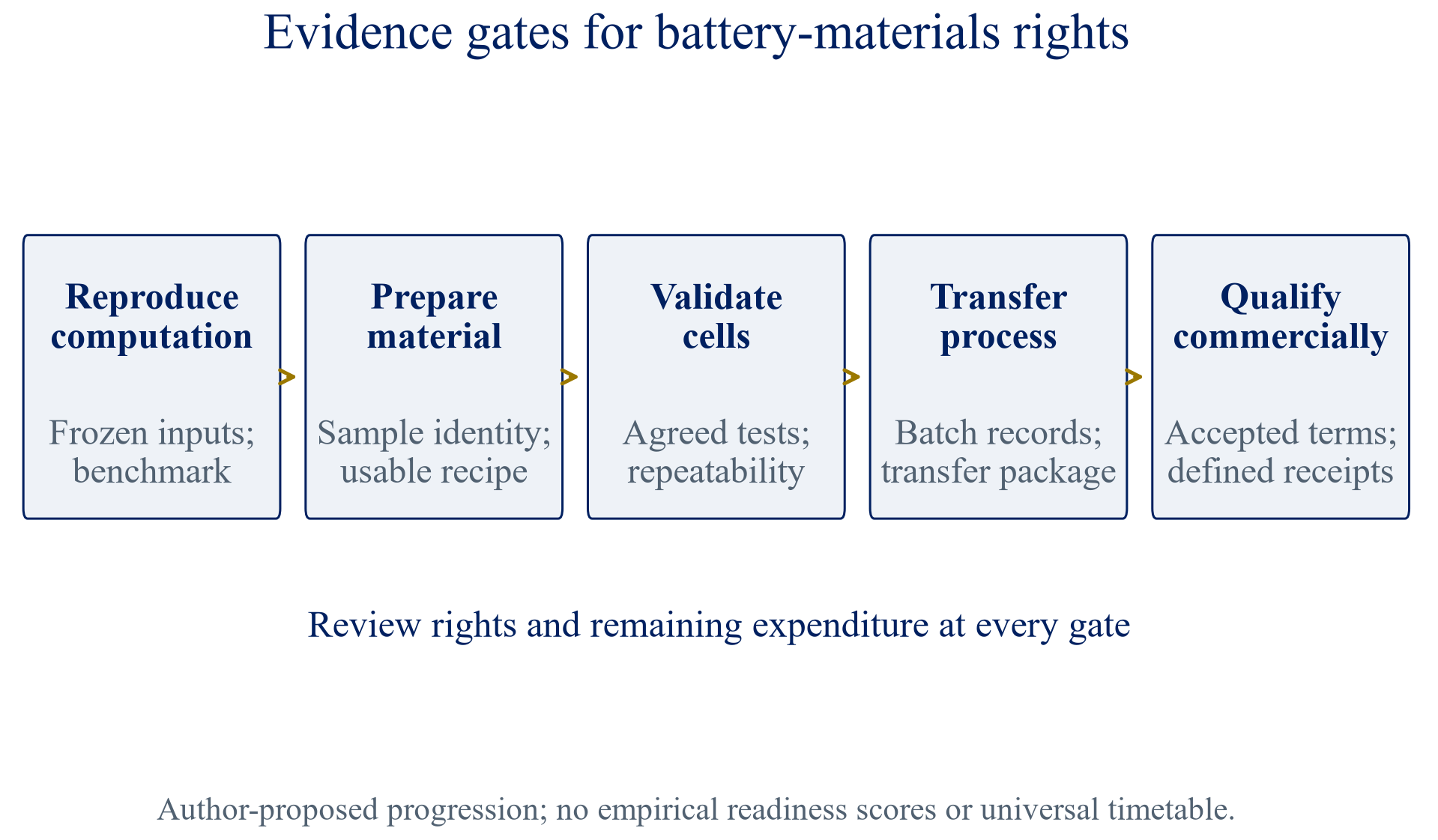
Qualitative decision gates from reproducible computation to accepted commercial receipts; no empirical maturity curve, probability or universal timetable is represented.
The valuation can then use the evidence progression to determine which assumptions remain conditional. Rights-dependent receipts should remain separate from observed sales. A pilot milestone should release consideration only under its agreed acceptance definition. This is an author-proposed connection between technical work and payment design. It provides a specific decision mechanism without assigning unsupported monetary increments to laboratory milestones or presuming a linear relationship between scientific maturity and commercial value.
9 Design the computational benchmark around a decision
A computational benchmark should specify the chemical question, system boundary, comparison methods, accuracy criterion and resource accounting before an output is used in a transaction model. The author proposes testing whether the workflow changes a practical discovery decision: which candidates to prepare, which measurement to interpret, or which reaction mechanism to investigate. The benchmark should also record cases where the method produces an inconclusive result. A selective demonstration alone cannot establish the workflow's value across an intended discovery programme.
The total-cost review should include hardware access, classical preprocessing, sampling, error treatment, specialist time and interpretation. Reviewers need the actual conditions under which comparisons were made. A larger represented system, a better result in a particular active space and a shorter elapsed workflow are different potential outcomes. The committee should avoid using one as evidence of another without a documented test. The cited scientific studies illustrate why method-specific boundaries and classical references belong in the evidence record [1-3].
A proposed procurement protocol can require frozen inputs, independent reproduction and an agreed exception report. It should describe who owns the benchmark data and whether results may be used in subsequent licensing discussions. A useful comparison might still leave the material's experimental performance unproven. The framework keeps that remaining work visible in the commercialisation budget. An investor can then choose whether further computational spending is justified by a defined validation objective, rather than assuming that the presence of quantum computation itself determines a valuation premium.
10 Specify a material and cell validation protocol
The author proposes an experimental protocol that links the candidate material to the intended commercial application. Its definition should include composition, preparation route, sample identity, cell configuration, comparison material, test conditions and reporting conventions. Independent technical advisers should determine the appropriate measurements and standards for the actual product. This paper does not propose universal cycle-life, energy-density, safety or charging thresholds. It recommends that negotiated acceptance criteria identify those thresholds where relevant and state how they are measured.
Repeatability needs a record of sample preparation and testing across the agreed batches and laboratories. Reviewers should ask how failed samples, outliers, retests and changes in process settings are handled. A report that shows the best-performing specimen may serve a different purpose from a qualification programme. The committee should request the complete agreed dataset and the criteria used to select or exclude results. This is a proposed diligence requirement, with no assertion that any cited research programme omitted such information.
The financing link is the cost of resolving the remaining uncertainty. A transaction budget should specify the testing work, responsible party, laboratory access, expected deliverables and consequences of an inconclusive outcome. If the licensor must supply samples or technical support, those obligations affect net receipts. If the licensee funds validation, the consideration structure should describe its continuing rights when an early test succeeds but a later test fails. The framework treats those contractual choices as part of asset pricing, rather than postponing them until after a headline value has been agreed.
11 Test manufacturing transfer before assuming scale economics
The proposed manufacturing review asks whether another operator can reproduce the specified material using the rights and instructions being transferred. It should identify input quality, equipment requirements, process tolerances, measurement practices, waste treatment and relevant supplier dependencies. A laboratory preparation record can begin that review; the actual transfer package and pilot evidence determine what additional work is needed. The paper makes no assertion about the industrial yield of any quantum-derived material.
The committee should request a bridge from demonstrated conditions to the proposed manufacturing model. Changes in batch size, equipment, operating time or feedstock can be recorded as separate assumptions until the relevant evidence exists. Reviewers should quantify planned trial costs and specify acceptance at the scale being tested. A successful transfer test under one configuration does not automatically establish performance across every site or product variant covered by a proposed licence.
The contracting workstream can then define transfer deliverables, training, process-change rights and support obligations. The financial workstream should assign the corresponding costs and timing to the correct party. Exclusivity may be conditioned on the licensee completing an agreed development programme or reaching specified commercial activity, with legal advice on the actual terms. This structure gives unresolved manufacturing dependencies an explicit treatment. A committee can price the rights it receives today while retaining a documented decision about further rights and consideration after additional validation.
12 Build a cost-performance benchmark with comparable boundaries
Argonne's BatPaC v5.0 manual describes a battery design and cost-modelling framework with chemistry, cell and pack design, manufacturing costs and production-volume inputs [8]. The manual is a 2022 methodological source, not a current supplier quotation or evidence of the cost of a new chemistry. This paper uses it to motivate a proposed boundary-consistent comparison. An actual mandate must identify the model version, revised inputs and limitations before presenting contemporary economics.
The benchmark should compare alternatives under the same intended use and accounting boundary. Material purchase price, usable output, rejected batches, process energy, required equipment and continuing support can affect the commercial comparison. A proposed discovery benefit should be translated into a measurable product or process effect before it is entered into a cost model. The framework asks reviewers to distinguish measured inputs, customer-provided specifications and assumed scale-up values. It contains no observed cost advantage for a candidate material.
Table 2. Proposed cost-performance benchmark design
| Dimension | Comparison requirement | Evidence boundary |
|---|---|---|
| Cell performance | Same application, configuration and agreed test conditions | Accepted experimental data; disclose sample scope |
| Material utilisation | Defined saleable output and rejected or reworked batches | Batch records at the demonstrated scale |
| Process cost | Consistent equipment, energy, labour and treatment perimeter | Quotes and operating evidence separated from assumptions |
| Computational workflow | Defined accuracy, elapsed work and total resource use | Reproducible test against named reference methods |
| Commercial adoption | Product approval, support and usable rights | Customer-specific acceptance and executed terms |
Benchmark design only; no observed numerical performance, manufacturing advantage or customer result is asserted.
13 Separate validation value from exclusivity value
The author proposes analysing two questions independently: what evidence a development payment purchases, and what commercial rights an exclusivity payment obtains. A paid validation programme might generate valuable information while leaving commercial rights unchanged. An exclusive licence might block alternative partnerships before a product is qualified. Combining these payments under a single initial licence fee can obscure the cost of development and the opportunity cost of restricting future commercial routes.
The diligence pack should therefore show rights before and after each payment. Evaluation rights can specify duration, field, access to samples and restrictions on use. Commercial rights can specify products, territories, sublicensing, improvements and performance obligations. A proposed extension should identify which additional evidence or consideration triggers it. These are negotiation questions rather than recommendations that a particular legal structure is suitable in every jurisdiction.
The financial comparison should recognise any activity excluded by the proposed agreement. If one buyer receives a defined exclusive field, receipts from overlapping licences should be removed from that scenario. If the owner retains other fields, their development costs and legal compatibility need separate review. The framework recommends recording unresolved restrictions before presenting a combined portfolio value. It also treats non-cash contributions, such as laboratory access or pilot equipment, as specific obligations with evidence and estimated cost. Their contribution should not be silently converted into revenue or an unsupported monetary uplift.
14 Choose the valuation method that matches available evidence
WIPO describes income, market and cost approaches to intellectual-property valuation. The income approach uses expected economic receipts; the market approach compares transfers of similar rights under comparable circumstances; the cost approach considers reproduction cost and has limitations concerning distinctive characteristics and wasted expenditure [6]. WIPO's technology-transfer guide also discusses staged-development flexibility and the information required for methods using uncertainty distributions [7]. These sources provide methodological context rather than sector-specific royalty rates or target values.
The author proposes using the evidence register to select a method and explain its weaknesses. A finite-life income model is useful for displaying timing, costs and contractual dependence, even when its inputs remain scenarios. A comparable licence needs an actual agreement or a sufficiently detailed disclosure of rights, payment base, stage and obligations. Development spending can inform the cost of repeating work, with an explicit review of what remains useful. None of these approaches establishes value merely because a large research expenditure has occurred.
For pre-scale rights, the committee should receive a range of decisions with the limitations of any numerical estimate stated. These might include the amount payable for a limited evaluation, the additional expenditure authorised at a successful gate and the commercial terms considered after qualification. The present paper uses deterministic cases to expose those decisions. It assigns no probabilities because it has no calibrated dataset of comparable development outcomes. Any actual risk-weighted or real-option calculation would require justified inputs, an explicit decision policy and specialist review.
15 Define the fictional licence and cash-flow perimeter
The numerical illustration concerns an entirely fictional rights package for a specified battery-materials application. It assumes that the relevant asset owner can grant an enforceable licence, that necessary third-party permissions can be obtained within the validation budget, and that the stated sales become eligible under the agreement. These are modelling assumptions, with no actual company, patent, customer or negotiation represented. The example values receipts available to the rights holder after the specified costs; it does not value a battery factory or the licensee's enterprise.
Time zero is the date immediately before an upfront licence price would be paid. Validation expenditure is assumed to be USD 1.000 million at time zero, USD 1.200 million at the end of year one and USD 0.800 million at the end of year two. The model assumes no tax benefit from this expenditure. Eligible licensee sales are zero in the first two years and then USD 40, 80, 120, 150, 160 and 140 million in years three through eight. These are invented sales inputs.
The assumed royalty is 4% of those eligible sales. Annual support spending is USD 0.200 million during royalty-generating years. A fictional 20% cash-tax charge applies to positive royalty receipts after support, and all resulting net receipts occur at year end. The discount rate is 15%. Economic rights expire at the end of year eight, with no renewal value, terminal value or residual recovery. The example also assumes no additional working capital, debt, withholding, foreign-exchange movement or third-party royalty; an actual valuation must test those exclusions.
16 Calculate value with transparent finite-life arithmetic
Under the fictional assumptions, annual net receipts in years three through eight are USD 1.120, 2.400, 3.680, 4.640, 4.960 and 4.320 million. For each year, the calculation multiplies eligible sales by 4%, deducts USD 0.200 million support cost and applies the assumed 20% cash-tax charge. The present value is the sum of each net receipt divided by 1.15 raised to its year number. There are no receipts beyond year eight and no terminal-value component.
The discounted net receipts total USD 9.221 million. Discounted validation spending is USD 1.000 million plus USD 1.200 million divided by 1.15 plus USD 0.800 million divided by 1.15 squared, totalling USD 2.648 million. Subtracting unrounded validation cost from unrounded receipt value produces USD 6.573 million before an upfront licence price. At a fictional USD 2.500 million upfront price, the modelled net present value is USD 4.073 million. These results are rounded to three decimal places after calculation.
Table 3. Fictional finite-life licence model; USD million unless stated
| Input or result | Assumed value or calculated amount | Boundary |
|---|---|---|
| Eligible sales, years 3 to 8 | 40; 80; 120; 150; 160; 140 | Fictional end-year sales base |
| Royalty; support; cash tax | 4%; 0.200 per revenue year; 20% | Fictional rights-holder cash-flow assumptions |
| Discount rate; economic life | 15%; through end of year 8 | No terminal or renewal value |
| Present value of net receipts | 9.221 | Calculated before upfront price and validation spending |
| Present value of validation spending | 2.648 | Costs at time 0 and ends of years 1 and 2 |
| Value before upfront price | 6.573 | Net receipts less validation spending |
| NPV at upfront price of 2.500 | 4.073 | No market-value or recommended-offer claim |
All commercial, legal and financial inputs are fictional. Decimal and floating-point calculations are independently reconciled; displayed amounts are rounded after calculation.
17 Examine sales and timing without invented probabilities
The lower-sales case assumes eligible sales equal 70% of each corresponding base-case amount. The 4% royalty, USD 0.200 million annual support, 20% cash-tax assumption, validation spending and discount rate remain unchanged. This produces a value before upfront price of USD 3.669 million. The case isolates a specified commercial-volume change; it is not a measured sector downturn or a statistical forecast. No probability is attached to its occurrence.
The delay case shifts each base-case receipt one year later while keeping the licence's end date fixed at the end of year eight. Consequently, the original year-eight sales do not produce a modelled receipt within the remaining economic life. Original years three through seven become years four through eight. Validation spending remains on the original schedule. The resulting value is USD 4.142 million before an upfront price. The fixed expiry assumption is essential to this result; a different contractual extension would require a different calculation.
Combining the same 30% sales reduction with the specified delay produces USD 1.999 million before upfront price. At the fictional USD 2.500 million upfront price, that combined case has negative NPV of approximately USD 0.501 million. The author proposes using these calculations to discuss payment timing and rights duration. They do not establish an actual buyer's required return or willingness to pay. A modelled base-case ceiling is an arithmetic boundary under assumed conditions, not a valuation opinion about an identified asset or a recommended negotiated price.
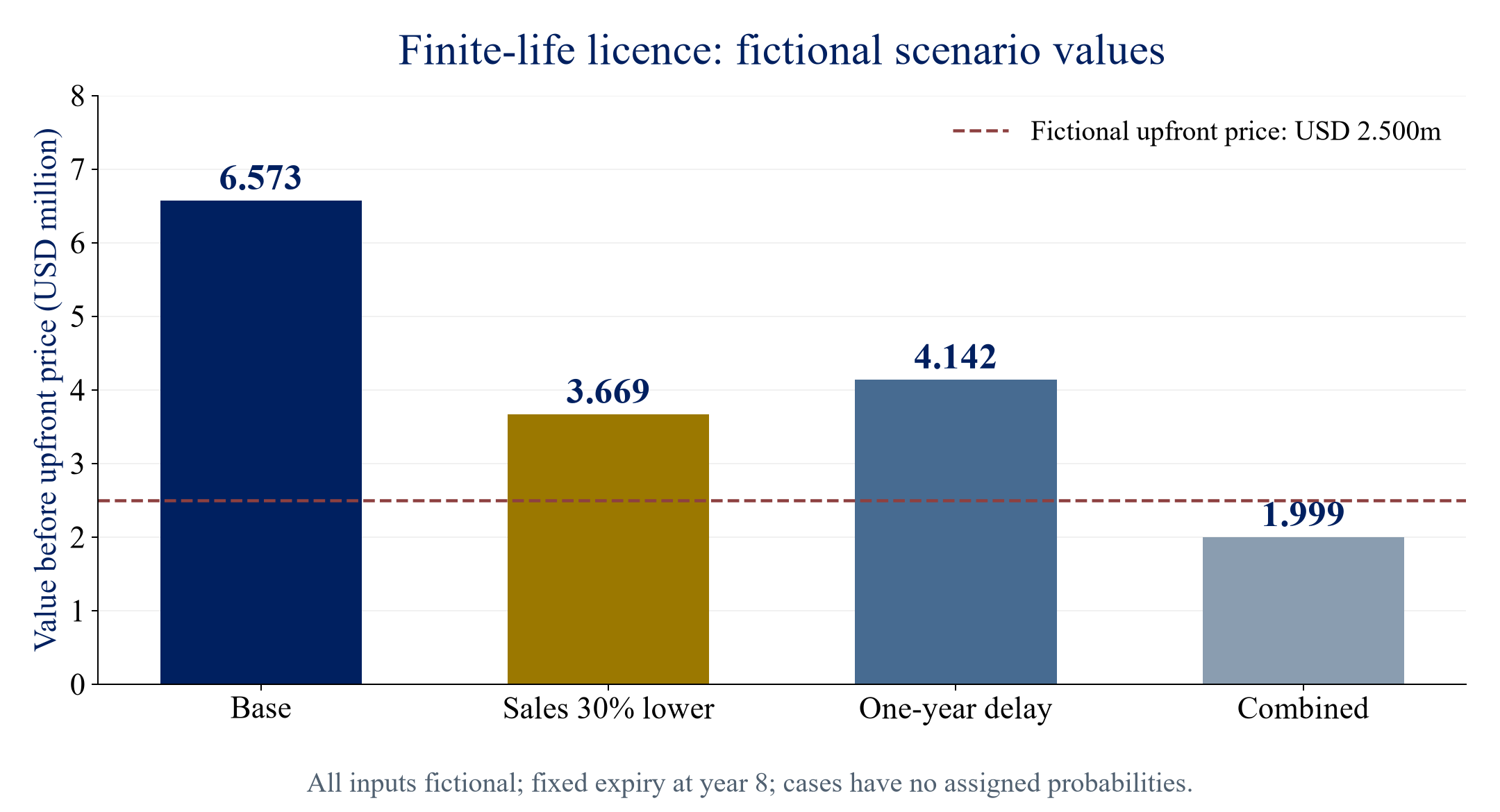
Base USD 6.573 million; lower sales USD 3.669 million; one-year delay USD 4.142 million; combined USD 1.999 million. No probabilities or empirical battery-materials valuations are represented.
18 Translate the model into staged consideration
The fictional example supports a specific contracting discussion: which expenditure should be committed immediately, and which payment should depend on new evidence? The author proposes considering a limited evaluation payment, separate validation funding and later commercial consideration. The agreement should identify what happens to each right if a gate is unsuccessful or inconclusive. A development programme can provide useful information without justifying full commercial exclusivity or a non-refundable acquisition price.
Milestone terms should name the deliverable, measurement method, acceptance authority, timing and dispute process. A phrase such as successful pilot validation needs a technical schedule explaining its meaning. Royalties need a defined product base, treatment of affiliate transfers and an auditable reporting mechanism. Continuing support requires a scope and cost responsibility. These proposed terms follow from the model's dependence on usable rights, eligible receipts and bounded expenditure. Their legal and tax treatment requires advice on the actual parties and jurisdictions.
The model should be rebuilt around the negotiated payment schedule. A deferred payment at an accepted gate has a different present value from an upfront payment, and a variable royalty changes both upside and downside exposure. A licence extension could offset part of a delay, subject to the actual rights and commercial demand. The present illustration calculates none of those alternatives as a real deal proposal. It shows the variables a committee should make explicit before agreeing terms. The resulting negotiation can connect payment obligations to the evidence and rights that make the asset commercially usable.
19 Compare licensing, equity and acquisition on consistent terms
A transaction committee can compare a licence, collaborative development, minority investment and acquisition using a common decision perimeter. The proposed comparison records rights obtained, obligations assumed, control over future work, additional funding and the route to cash. A licence may offer a defined application right; equity exposes the investor to the company's wider assets, liabilities and governance. Acquisition may bring personnel and operating infrastructure alongside the intellectual-property portfolio. Those additional elements require their own evidence and valuation treatment.
The licence model in this paper cannot be converted directly into an equity valuation. A company's capital structure, other programmes, overhead, funding needs and ownership rights would change the economic boundary. Likewise, a manufacturer assessing a licence would need to model its own capital expenditure, production economics, qualification costs and customer receipts. A rights holder's royalty income and a licensee's operating profit belong to different perspectives. The committee should label the perspective on every model and avoid adding those cash flows together.
The author proposes an alternatives schedule showing the smallest transaction that can answer the immediate commercial question. An evaluation agreement may be sufficient to test a transfer package. A larger investment could become relevant when evidence supports a broader operating plan. The schedule should disclose lock-up periods, exclusivity restrictions, funding commitments and exit dependencies. This method helps the committee compare options on an equivalent basis while retaining flexibility to decline later expenditure. It contains no assumption that one transaction type is universally superior for pre-scale battery-materials rights.
20 Establish a commercially auditable royalty base
The proposed royalty review begins with the contract's definition of an eligible product or activity. Reviewers should map that definition to the material, process and rights actually licensed. Sales reporting needs an identified entity, currency, period and deduction policy. The author recommends a reconciliation from operational records to invoices, permitted deductions and cash received. This is a proposed audit trail, not evidence that a particular licensee has agreed those reporting terms or achieved sales.
The agreement should address transfers within a group, bundled products, subcontracted manufacturing and sublicensing where relevant. It should specify how the rights holder can inspect supporting records and how disputed classifications are resolved. A valuation based on a percentage of sales is sensitive to these definitions. The percentage alone does not identify the cash-flow perimeter. Diligence should also consider the licensee's practical capacity to manufacture and sell the eligible product, without substituting a non-binding expression of interest for contracted receipts.
Reporting obligations should be proportionate to the transaction's size and commercially workable. The committee can request sample calculations using hypothetical invoices before signing. Such examples can reveal mismatches between the legal definition and the spreadsheet formula. Continued technical support should have a separate scope, with any associated expense reflected in the rights holder's model. The framework recommends testing the entire receipt calculation, including payment timing, deductions and taxes, using the actual proposed terms. Only then can a negotiated royalty be connected to a credible financial schedule.
21 Build a financing plan around the next evidence gate
The proposed financing plan begins with the next unresolved decision rather than a general ambition to scale. It identifies the work necessary to resolve that decision, the budget, responsible parties and available rights at completion. A computational reproduction programme, a sample-preparation exercise and a customer qualification programme can require different expertise and resources. Funding should be linked to their actual requirements and the relevant contractual rights, with contingency funding disclosed separately.
The committee should review what happens if the next result is delayed, ambiguous or unsuccessful. The budget can specify stop points, rework authority and limits on additional commitments. Any proposed lender security over intellectual property requires specialist review of the rights, enforcement and transfer restrictions. This paper makes no claim that an unqualified battery-materials licence can support conventional debt financing. Financing suitability depends on the actual asset, receipts, obligations and counterparty evidence.
For equity or collaborative funding, governance should connect cash release to documented work while giving researchers a practical process for explaining changes. A revised experimental protocol may be justified, but its impact on cost, timing and licensed scope should be recorded. The author proposes a short evidence-gate memorandum accompanying each funding decision. It contains the completed work, exceptions, remaining dependencies and updated economics. This provides a repeatable connection between technical progress and financial commitment without assigning unsupported fee conversion, investor demand or future commercial success to the research programme.
22 Set a commercialisation roadmap with accountable deliverables
The roadmap proposed here has five stages: define the rights package, reproduce the discovery workflow, validate material and cell performance, test manufacturing transfer, and secure accepted commercial terms. Each stage has a responsible workstream and an investment decision. The sequence is a planning framework rather than a timetable applying to every chemistry. Some activities can proceed concurrently, with their interdependencies stated. A legal restriction or inaccessible dataset can affect the sequence even when experimental work is progressing.
The rights stage produces an asset schedule and specialist review plan. Computational reproduction produces a frozen benchmark and exception report. Material validation produces the agreed test dataset. Manufacturing transfer produces an accepted process package and pilot records at the specified boundary. Commercial qualification produces the relevant customer acceptance and executed economic terms. The committee should describe which of these deliverables exists today and which remains a funded objective. It should avoid presenting a calendar milestone as completion evidence by itself.
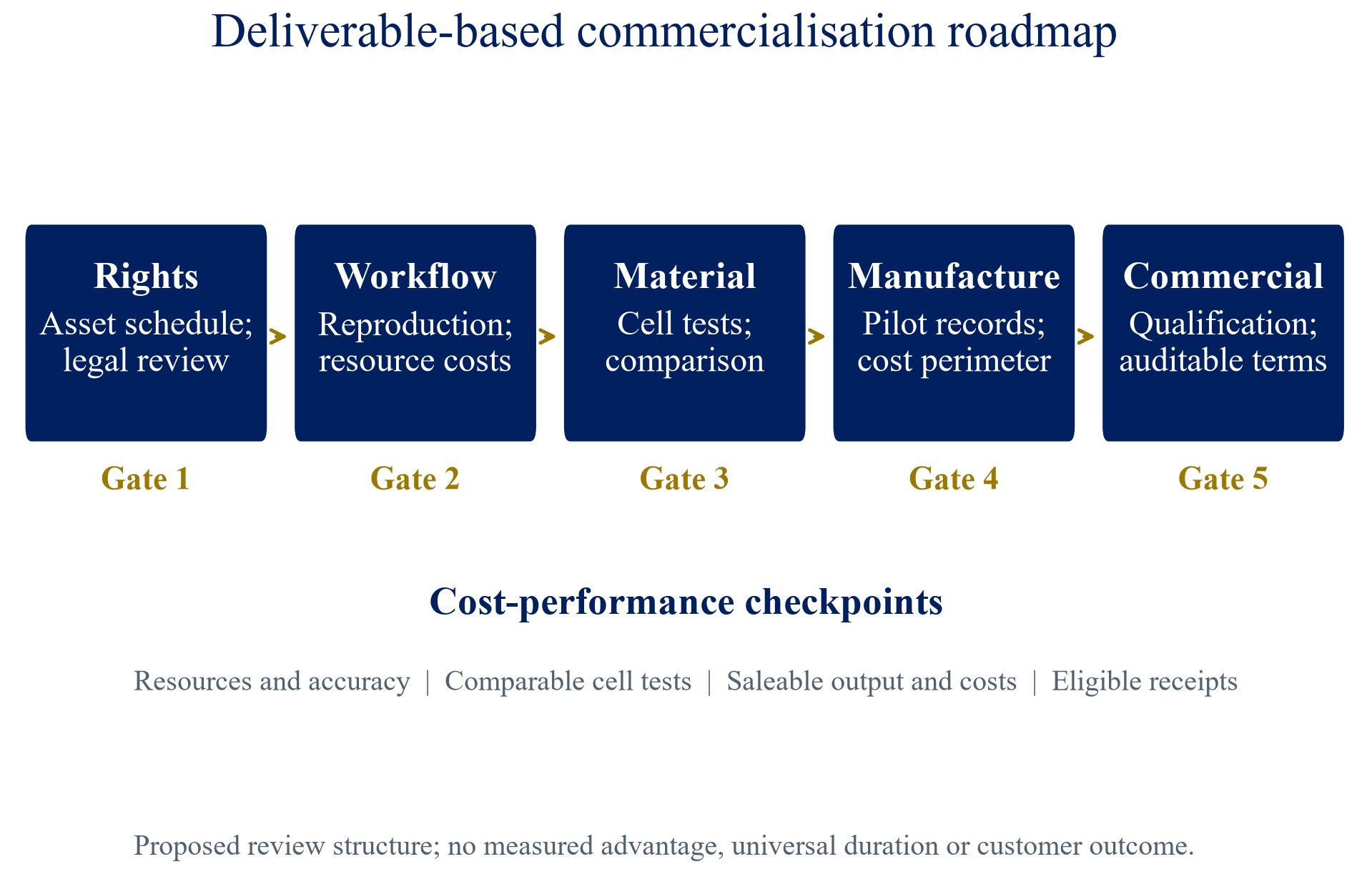
Roadmap stages have deliverable-based gates and no universal duration. Benchmark checkpoints cover computational resources, accepted cell testing, manufacturing cost boundaries and contractual receipts; no measured cost-performance advantage is shown.
The roadmap also needs a change-control record. If the candidate material, process, customer application or licence field changes, reviewers should identify which earlier evidence remains relevant. The valuation should be revised using the updated perimeter and cost schedule. That makes the roadmap a continuing governance tool, with each authorised expenditure attached to a current commercial question and a defined deliverable.
23 Use AI and data tools to improve evidence traceability
The author proposes bounded AI and data workflows for organising the materials transaction record. Potential uses include locating inconsistent definitions across licences, associating sample identifiers with test files, checking version references and preparing structured review queues. These are suggested applications with no measured productivity or accuracy claim. Any deployment would need authorised data access, confidentiality controls, specialist validation and testing in the relevant environment before its outputs influence a transaction decision.
A useful evidence record retains the original file, version, passage or data location, reviewer and decision treatment. Extracted fields should remain distinguishable from calculated results and specialist judgement. A generated summary of a patent cannot establish its enforceable scope; a summary of cell tests cannot establish compliance with an acceptance protocol. Reviewers should validate the underlying records used in legal, engineering and financial conclusions. Quantitative model checks should use explicit formulas and independent arithmetic rather than a language-model assertion of correctness.
For a materials programme, the proposed data graph links composition version, preparation batch, test configuration, benchmark run, rights schedule and eligible product. This could make changes easier to trace across workstreams, subject to actual implementation and validation. The model should record incomplete links instead of filling them with inferred ownership or performance. The commercial objective is a reviewable chain supporting decisions about expenditure and rights. The paper demonstrates the structure through its fictional case; it reports no installed AI system, observed advisory efficiency gain or paid client mandate.
24 Committee conclusion and further research
The author proposes that an investment committee receive a defined asset perimeter, a rights schedule, a reproducible computational benchmark, a validation budget, manufacturing-transfer questions and a financial model tied to the proposed contract. Material unresolved items should have a specific treatment: additional diligence, conditional expenditure, a narrower licence, deferred consideration or a decision to stop. This approach makes the scientific result relevant to a commercial decision while keeping unsupported business outcomes outside the factual record.
The fictional example shows why timing and contract scope matter. A base value of USD 6.573 million before upfront price falls to USD 1.999 million when the separately specified sales reduction and fixed-expiry delay are combined. Those calculations depend entirely on invented inputs. They are useful for examining payment structure and evidence requirements; they provide no estimate of actual battery-materials licensing prices. The proposed framework also leaves investor-specific required returns, legal conclusions and customer adoption to an actual mandate's evidence and advisers.
Further research could evaluate this framework against consented transaction records containing comparable rights, test protocols, manufacturing costs and realised receipts. Such evidence could support more specific comparisons and justified uncertainty estimates. The current paper has no such dataset. Its limitations include a small documentary evidence set, absence of proprietary experimental data, no observed licence outcomes and deliberately hypothetical economics. Its practical contribution is a rights-to-receipts discipline: identify what can be transferred, document what has been demonstrated, cost the remaining work and connect payment obligations to accepted commercial evidence.
References
- Fomichev, S., Hejazi, K., Loaiza, I., Shokrian Zini, M., Delgado, A., Voigt, A.-C., Mueller, J. E. and Arrazola, J. M. Simulating X-ray absorption spectroscopy of battery materials on a quantum computer. arXiv:2405.11015, 17 May 2024. https://arxiv.org/abs/2405.11015
- Barroca, M. A. and colleagues. Scaling active spaces in simulations of surface reactions through sample-based quantum diagonalization. Scientific Reports 16, 28514, 22 June 2026. DOI: 10.1038/s41598-026-58228-0. https://www.nature.com/articles/s41598-026-58228-0
- Kunitsa, A., Dhawan, D., Fomichev, S., Arrazola, J. M., Zhang, M. and Stetina, T. F. Quantum Simulation of Electron Energy Loss Spectroscopy for Battery Materials. arXiv:2508.15935, 21 August 2025. Preprint. https://arxiv.org/abs/2508.15935
- IonQ. IonQ and Hyundai Motor Partner to Advance Next-Generation Batteries with Quantum Computing. 19 January 2022. Historical partnership announcement; commercial outcomes are not established here. https://www.ionq.com/news/january-19-2022-ionq-and-hyundai-partner-to-advance-batteries
- United States Patent and Trademark Office. Managing a patent; nature of rights and assignments and licences. Official guidance, updated 20 October 2025. https://www.uspto.gov/patents/basics/manage
- World Intellectual Property Organization. Valuing Intellectual Property Assets. Official valuation-method overview. https://www.wipo.int/en/web/business/ip-valuation
- World Intellectual Property Organization. Intellectual Property Valuation Basics for Technology Transfer Professionals. Official technology-transfer guide. https://www.wipo.int/web-publications/intellectual-property-valuation-basics-for-technology-transfer-professionals/en/index.html
- Knehr, K. W., Kubal, J. J., Nelson, P. A. and Ahmed, S. A Manual for BatPaC v5.0: Battery Performance and Cost Modeling for Electric Vehicles. Argonne National Laboratory, ANL/CSE-22/1, July 2022. Methodological reference; no current supplier quotations are implied. https://publications.anl.gov/anlpubs/2022/07/176234.pdf
About the Author
Chennakeshav (CK) is a corporate finance and investment banking executive with 25+ years of global experience in deal origination, structuring and execution across M&A, growth capital and corporate strategy. He has led value-creation mandates for founders, corporates and funds — bridging the boardroom view to hands-on execution and close.
His career spans Morgan Stanley, HSBC, Lloyds Banking Group, EWEC, ADQ portfolio companies and Emirates Growth Fund, across TMT, real estate, fintech, deeptech, cleantech, infrastructure and energy. He has partnered with C-suite leaders, private equity and venture funds, sovereign wealth funds and family offices to finance complex fund raises and scale-up ventures, and has led M&A due diligence, post-merger integration and business-transformation initiatives to create value.
At Matchpoint Partners he is Managing Partner, leading the firm's corporate finance, M&A and capital-raising practice. He holds an MBA from London Business School, an engineering degree from VTU and a Master of Laws (LLM, in progress) from UCL London.
An active start-up mentor, CK mentors at Techstars, DIFC FinTech Hive, Startup Grind, Founder Institute and IN5, serves as Entrepreneur Mentor in Residence (EMiR) at London Business School, and judges the Entrepreneurship World Cup.
