

1 The investment decision
A utility considering post-quantum migration needs to decide which commitments it can approve today, what evidence the next commitment requires and how those commitments fit its capital programme. This paper proposes a method for making those decisions in power and water systems. The unit of analysis is a defined operating environment with named equipment, communications, supplier relationships and service responsibilities. A board submission should state that environment explicitly before presenting a total programme budget.
The proposed initial approval purchases discovery and a defensible migration design. Subsequent approvals depend on evidence about compatibility, performance, deployment windows and continuing support. This sequence gives the investment committee a way to review unresolved dependencies without treating them as completed work. It also creates a record for treasury, procurement and operating teams to reconcile their different assumptions about timing and cost.
The decision includes several alternatives within an agreed security objective. An operator might update a supported component, replace equipment at its planned refresh, redesign a communications boundary or procure a managed service. Each alternative needs its own scope and acceptance conditions. A financial comparison should use equivalent required outcomes and identify any remaining differences. Apparent savings based on a smaller deployment boundary should be explained before they enter a recommendation.
2 Research method and evidence boundaries
The research uses eight primary sources accessed on 4 October 2026. These comprise three final NIST cryptographic standards, NIST operational technology guidance, UK National Cyber Security Centre migration guidance, a joint US agency fact sheet, the NCCoE migration programme and NIST's current programme page. References identify the publication or live page used. The research reviews their stated roles and status; it does not independently test the algorithms or reproduce their technical security analysis.
Three kinds of statements are separated in the paper. Published guidance is attributed to its issuing institution. Proposed investment practices are presented as recommendations for review. Fictional calculations state their assumptions beside the relevant model. A proposed acceptance procedure therefore remains a design recommendation until an operator adopts it and produces test results. Financial arithmetic remains an illustration even when its calculation is exact.
The literature review establishes a limited foundation for the capital framework. It supports discussing cryptographic inventory, migration planning, interoperability and operational constraints. It supplies no standard price for utility migration, no uniform implementation duration and no probability distribution for a future quantum threat. Those missing quantities remain outside the empirical claims of this paper. An actual investment submission should identify which additional observations it has obtained.
3 The cryptographic functions being financed
NIST published FIPS 203, FIPS 204 and FIPS 205 on 13 August 2024. FIPS 203 specifies ML-KEM for establishing shared secrets under its stated conditions. FIPS 204 specifies ML-DSA digital signatures. FIPS 205 specifies the stateless hash-based signature scheme SLH-DSA [1-3]. These distinct functions should be reflected in the migration inventory. A project description that uses one generic encryption label leaves the intended technical change insufficiently specified.
For the proposed funding method, each cryptographic dependency should be linked to the function it performs. The operator should ask whether the dependency concerns a communication session, signed software, device identity or another identified use. Technical reviewers should establish the actual algorithms and implementation conditions. Procurement and treasury can then attach their estimates to the component and function that the project intends to change.
Published standards provide a reference point for technical requirements. An operating product also needs an identified implementation, integration arrangement and acceptance record. The proposed diligence questions should therefore request the applicable standard, product version, supported configurations and test boundary separately. Evidence for one product version should remain attached to that version. A later software release or architecture change may require a renewed acceptance review.
The current FIPS 203 and FIPS 204 pages contain planning notes about future corrections [1,2]. An approval pack should preserve the standards and errata versions reviewed, together with the date of technical sign-off. The existence of a planning note supplies a document-control requirement for this framework. It provides no basis here for asserting that an installed system has failed. Decisions about particular implementations require competent technical assessment and their own evidence.
4 Define the operational boundary
NIST's Guide to Operational Technology Security addresses systems interacting with physical processes and highlights performance, reliability and safety considerations [5]. This paper uses that distinction to frame the proposed investment boundary. An operator should identify the services and operating conditions that a migration must preserve, along with the people authorised to accept changes. A security programme involving a treatment plant or electrical control environment needs an explicit operating review.
The proposed boundary description should show the equipment included, the communications crossing it and the upstream or downstream services on which it depends. Remote access, support arrangements and shared identity services should be recorded when they are within scope. The description should identify excluded assets and explain whether those exclusions affect the acceptance case. A budget reviewer should be able to locate each major spending item within this boundary.
An author-proposed discovery record can combine an asset identifier, cryptographic function, responsible supplier, support status and inspection date. The record should distinguish a confirmed dependency from an item awaiting examination. Where access is restricted or a supplier has withheld information, the resulting uncertainty should remain visible. The sponsor should assign a person to obtain or assess the missing evidence before treating the item as ready for migration.
Table 1. Proposed dependency records and acceptance questions
| Dependency | Evidence to request | Proposed acceptance question |
|---|---|---|
| Remote access | Product version and session configuration | Which approved connections were tested? |
| Signed updates | Signing and verification dependencies | Can the approved update and recovery process operate? |
| Device identity | Trust chain and supported versions | Which equipment and management services are included? |
| Shared service | Contract and supplier migration scope | Who owns acceptance across the service boundary? |
| Legacy equipment | Support and replacement evidence | What approved treatment remains feasible? |
Author-proposed framework. Entries identify questions to investigate; they report no observed utility configuration or compatibility result.
5 Establish priorities within the boundary
The joint CISA, NSA and NIST fact sheet recommends a migration roadmap, cryptographic inventory and engagement with technology suppliers. It includes IT and operational technology and discusses information whose confidentiality needs extend over time [6]. Those recommendations establish a starting point for discovery. This paper proposes a financial prioritisation record that connects an identified dependency to the reason for examining it and the action its review can support.
Each proposed priority should state the service consequence under review, the relevant information or authentication requirement and the evidence available. A sponsor might examine an exposed support connection earlier than an isolated component with a different threat model. That choice requires site-specific reasoning. The paper supplies no universal ranking across power and water systems, and it assumes no equivalence between confidential data exposure and disruption of a physical process.
Priority should also account for delivery dependencies. A technically important change may require supplier support, equipment replacement or an approved outage window. The capital plan should identify those conditions rather than assign a deployment date solely from the importance score. Work that prepares an eventual change can receive a separate approval when its deliverable and cost are clear. Preparation should remain distinguishable from accepted deployment in the completion record.
6 Interpret migration timelines accurately
The NCSC's March 2025 guidance recommends discovery and initial planning by 2028, migration of the highest-priority activities by 2031 and completion by 2035. These are UK migration recommendations, with flexibility for organisational circumstances [4]. This paper treats them as a planning reference. It makes no claim that those dates are a global legal requirement or a forecast for the arrival of a cryptographically relevant quantum computer.
An operator should identify its own applicable obligations through qualified local review. The funding submission should state the relevant jurisdiction, customer commitments, financing documents and authority requirements. A timeline borrowed from another country needs a clear explanation of its role. If the organisation voluntarily adopts an external reference, the approval record should identify that choice and the operating assumptions supporting its use.
The author-proposed capital schedule should work backwards from identified completion requirements and forwards from verified dependencies. It should distinguish planned milestone dates from commitments supported by suppliers and operating teams. A schedule with an unresolved equipment route should show that uncertainty alongside the proposed expenditure. Treasury can then assess the liquidity effect of different timing scenarios without presenting an unsupported deployment forecast as a fact.
7 Evaluate supplier evidence
The proposed supplier review should ask for a specific product, version and implementation route. A broad statement about readiness leaves procurement without the information needed to define a deliverable. The operator should request supported configurations, release conditions and evidence for the intended integration. Commercial documents should identify which part of that evidence the supplier will provide and when the operator can inspect it.
Supplier documentation should be assessed against the proposed use at the site. A test in another environment may inform the review, while leaving local operating requirements unresolved. The acceptance owner should identify the additional observations required for the actual installation. A capital request can fund those observations through a bounded test package. The package should identify the conditions under which the operator approves further spending or requests a redesign.
The financial review should examine responsibility for changes in implementation requirements. Procurement should ask who pays for repeat testing, revised integration and extended support under the proposed terms. Counsel should assess the actual allocation of obligations, warranties and liability. This paper offers questions for contract review and makes no determination about the enforceability of any clause or the suitability of a supplier's standard contract.
8 Design controlled tests
The NCCoE migration programme describes discovery and interoperability work, including testing in controlled non-production environments [7]. This paper proposes using controlled tests as a separate capital decision with a written scope. The test submission should define the configuration, relevant workload, pass conditions and records to be retained. It should also identify the circumstances in which the operating team requires another review before deployment.
The sponsor should ask technical reviewers to specify relevant measurements for the particular system. Possible questions include communication behaviour, resource use, update verification and recovery under the agreed conditions. These are proposed questions rather than claims about the performance of a particular algorithm or device. A supplier's results should identify how measurements were collected and whether they cover the operating conditions that the operator intends to accept.
Repeatability should be part of the proposed acceptance design. The operator should retain enough information about versions, configurations and test conditions to understand a later discrepancy. A single successful demonstration does not establish the result for all permitted configurations. The project record should state the configurations actually examined and the treatment of combinations that remain outside that examination. Additional scope needs an explicit technical and financial decision.
9 Connect readiness to capital release
This paper proposes five qualitative readiness stages: inventory, supported design, controlled test, site acceptance and continuing review. These stages describe an evidence sequence. Their position in Figure 1 supplies no measured technology score, adoption probability or implementation duration. An operator should adapt the stages to its actual requirements and identify the evidence that each acceptance owner needs before recommending the next commitment.
An inventory-stage approval should purchase a defined record and an analysis of unresolved access. A supported-design approval should identify the chosen treatment of each material dependency. A controlled-test approval should produce results under stated conditions. Site acceptance should record the implemented configuration and the operating team's decision. Continuing review should assess relevant changes and support responsibilities after deployment. Each deliverable should have an identified owner.
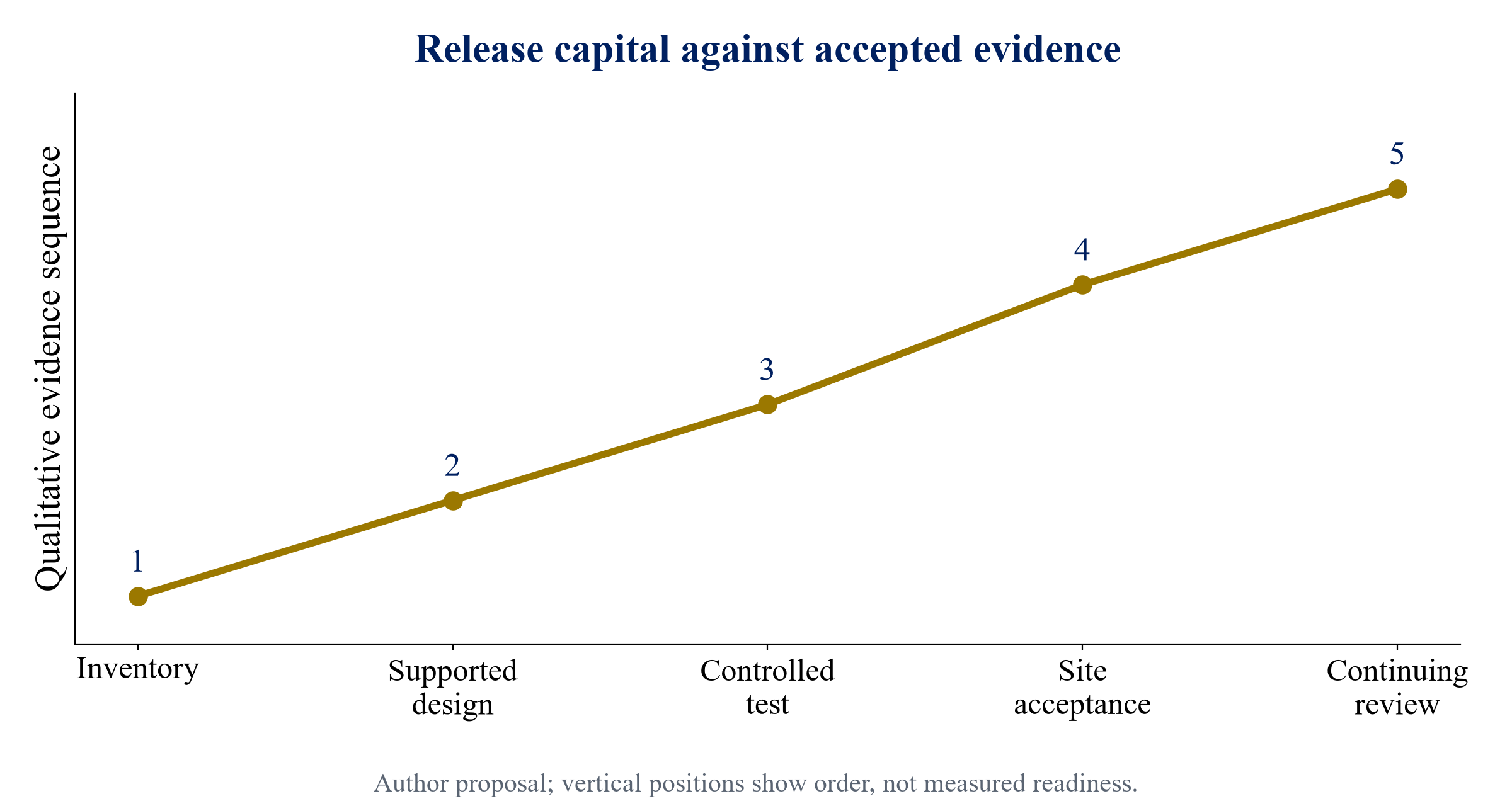
Qualitative evidence order only. The curve reports no measured readiness score, success probability or required duration.
The proposed capital release should match the accepted deliverable and the next approved work. A programme can retain unspent funding when a condition remains unresolved. The operator should record committed amounts, paid amounts and remaining authority separately. This prevents a budget allocation from becoming an unsupported completion claim. It also gives treasury a basis for comparing the forecast cash schedule with actual contractual payments.
10 Compare alternatives at a common outcome
The proposed cost-performance benchmark uses a stated required outcome and a common scope. Performance means acceptance against the operator's defined requirements. A financial ratio can be calculated only after that outcome is specified. The paper offers no generic claim that a higher cryptographic parameter, newer device or more expensive product gives a proportionate improvement in utility performance. The relevant relationship needs technical evidence.
For the fictional capital example developed below, two alternatives are assumed to reach the same accepted scope by the end of year four. The baseline incurs the stated expenditure schedule. A coordinated-refresh alternative moves particular work between years three and four and assumes a reduced cash cost for that work. Equivalent acceptance is a modelling assumption. An actual comparison should test that assumption and identify any additional interim measures or operating consequences.
The benchmark should include the full resources needed to obtain acceptance. The proposed boundary includes discovery, design, test work, installation, coordination and support where relevant. The sponsor should state any omitted cost and explain its significance. If alternatives use different equipment lifetimes or continuing service arrangements, the appraisal horizon and residual assumptions should reflect that difference. A five-year cash comparison alone may leave those consequences incomplete.
11 Construct the capital budget
Consider a fictional utility programme with base capital expenditure of USD 0.6 million in year zero, USD 0.9 million in year one, USD 2.4 million in year two, USD 2.0 million in year three and USD 1.1 million in year four. The total is USD 7.0 million. These amounts are author assumptions. They are intended to demonstrate approval and timing mechanics, and provide no supplier quotation or estimate for an actual operator.
Assume a contingency allocation equal to 20 percent of base capital, giving USD 1.4 million. Total authorised capital including that reserve is USD 8.4 million. An allocation establishes the model's funding authority. Actual spending depends on the circumstances defined by the approval. The proposed operating record should show reserve authority, amounts committed and amounts spent individually, allowing reviewers to understand how the contingency has been used.
Table 2. Fictional five-year capital allocation in USD millions
| Item | Year 0 | Year 1 | Year 2 | Year 3 | Year 4 | Total |
|---|---|---|---|---|---|---|
| Base capital | 0.60 | 0.90 | 2.40 | 2.00 | 1.10 | 7.00 |
| Capital contingency allocation | 1.40 | |||||
| Total capital authority | 8.40 |
Author assumptions. Contingency is an allocation; its actual use and timing are unspecified. Support is a separate operating cash assumption.
Assume separately that recurring support costs USD 0.25 million annually in years one through five. Its undiscounted total is USD 1.25 million. The fictional capital authority plus these support payments amounts to USD 9.65 million of allocations and assumed support, with the contingency still distinguished from actual spending. The paper does not classify that combined number as an observed implementation price or an accounting asset.
An actual budget should obtain quantities, quotations and responsibilities for each spending category. The sponsor should also reconcile the programme with existing refresh plans. Costs already included in another approved programme need to be identified so that the appraisal can show incremental expenditure consistently. The fictional schedule supplies a calculation structure into which an operator could enter those verified amounts after completing the relevant review.
12 Discount timing without inventing benefits
The fictional timing appraisal uses an assumed annual discount rate of 8 percent. Year-zero expenditure occurs immediately and later capital expenditure is paid at the end of the indicated year. Discounted base cost is the sum of each payment divided by 1.08 raised to its payment year. The rate is an author assumption and supplies no measured utility cost of capital, market financing quote or recommended rate for a particular investment.
Annual support payments are separately discounted at the same assumed rate, each occurring at year end in years one through five. The present value of capital and support can be combined because their timing is specified. The contingency allocation has no specified spending schedule, so its present value is left uncalculated. An appraisal using an expected draw of contingency would need to state the amount and payment timing explicitly.
The fictional discounted base capital is approximately USD 5.887 million. Discounted support is approximately USD 0.998 million, giving combined present cost of USD 6.885 million before any contingency spending. These are costs within the stated boundary.
The model intentionally leaves security benefits unmonetised. It contains no probability of an attack, avoided outage estimate or insurance recovery assumption. Consequently, the discounted costs establish a spending comparison and cannot establish a positive project net present value. A sponsor proposing a quantified benefit should provide the evidence, causal boundary and uncertainty needed to assess it. Those inputs should remain distinguishable from the assumed discount rate.
The method remains useful when benefits cannot be credibly priced. An operator can compare the cash required by alternatives that satisfy an agreed obligation, subject to verified operating acceptance. The committee should state that decision basis directly. A least-cost comparison under required outcomes is different from an unconstrained return calculation, and its approval record should explain which objective the operator has adopted and which alternatives were feasible.
13 Coordinate refresh and migration
In the fictional coordinated-refresh alternative, year-three capital falls by USD 0.6 million and year-four capital increases by USD 0.3 million. All other capital and support inputs remain unchanged. Base capital then totals USD 6.7 million, compared with USD 7.0 million in the baseline. The assumed undiscounted reduction is USD 0.3 million. These inputs describe a fictional coordination effect and establish no observed saving from scheduling equipment replacement.
The discounted difference equals USD 0.6 million divided by 1.08 cubed, less USD 0.3 million divided by 1.08 to the fourth power. Equivalent final acceptance by the end of year four is assumed. The model contains no cost for an interim security measure or different operational exposure during the schedule. An actual committee should identify those consequences before adopting a similar arrangement.
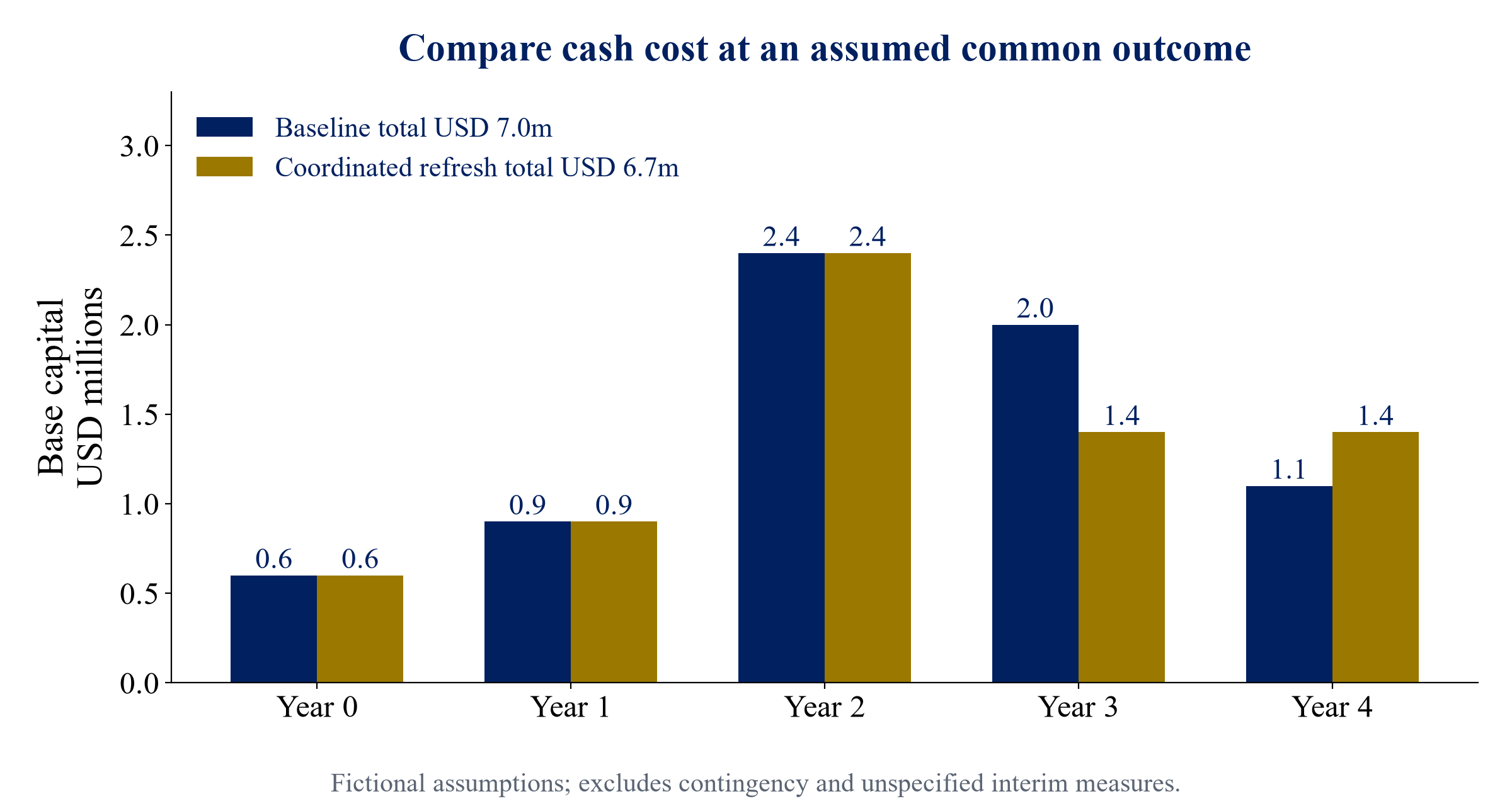
USD millions. Baseline total 7.0 and coordinated-refresh total 6.7. Equal final acceptance and unchanged support are assumptions; contingency and omitted interim measures are excluded.
The proposed refresh review should ask which existing capital items the alternative changes. If an equipment purchase would occur anyway, its baseline cost and timing should be documented. Incremental migration spending should then be separated from that existing obligation. The operator should avoid counting the same avoided expenditure in both the equipment appraisal and the security programme. A cross-reference between approvals can preserve the reconciliation.
The committee also needs a route when the planned refresh slips. The proposed decision should identify whether a delayed supplier release or construction programme changes the migration treatment. Treasury should model revised payments and any additional support, while technical reviewers assess operating implications. The fictional saving remains conditional on its stated arrangement. The programme should preserve that condition in later reporting and reassess it when the delivery assumptions change.
14 Separate capital funding from operating support
The proposed financing record should distinguish capital funding, recurring expenditure and cash available for debt service. A capital allocation identifies authority for a project. Recurring support affects the operating cash model when it falls within that model's boundary. The treatment of capitalised costs, taxation and covenant definitions requires transaction-specific accounting and legal review. The fictional example here supplies cash arithmetic with no determination about statutory accounting or a financing agreement.
Assume cash available for debt service before incremental programme support is USD 5.0 million in an illustrative operating year. Subtract the assumed USD 0.25 million of recurring support, giving USD 4.75 million. This operating calculation excludes the programme's capital payments and contingency reserve, whose funding is assessed separately. It assumes the stated support cost is incremental and already includes all support items intended for the illustration.
An actual operator should reconcile the cash model to its financing definitions. Existing maintenance provisions, fees or outsourced service charges might already include part of the proposed expenditure. The sponsor should identify overlaps and the basis for any adjustment. A model that subtracts the same item twice would distort coverage. A model that omits an incremental cash obligation would leave the operating funding requirement incomplete.
The reserve record also needs its own liquidity analysis. Even when a capital contingency remains unspent, an operator may choose to maintain funding against it under the actual approval. Treasury should identify the source and availability of that liquidity. The fictional model makes no assumption about an interest-bearing reserve account or commitment fee. Those costs should be added where supported by the financing terms being considered.
15 Assess debt service coverage
Assume existing annual debt service of USD 3.2 million in the illustrative operating year. The fictional post-support cash of USD 4.75 million divided by this debt service gives coverage of approximately 1.484 times. Adding assumed annual debt service of USD 0.6 million increases the denominator to USD 3.8 million. Coverage becomes 1.25 times. The additional service payment is an assumption; it supplies no loan principal, tenor, interest rate or lender offer.
The proposed debt review should calculate this operating effect alongside the separate capital funding schedule. An operator cannot derive a complete financing package from a single coverage ratio. Payment timing, existing restrictions, liquidity and the ability to obtain the assumed funding all need assessment. This paper uses the ratio to show how incremental recurring support and debt service interact under a defined cash boundary.
Table 3. Fictional operating coverage sensitivity in USD millions
| Pre-support cash | Post-support cash | Total debt service | Coverage |
|---|---|---|---|
| 4.40 | 4.15 | 3.80 | 1.092 times |
| 5.00 | 4.75 | 3.80 | 1.250 times |
| 5.60 | 5.35 | 3.80 | 1.408 times |
Annual support 0.25 and total annual debt service 3.80. Pre-support cash inputs are author assumptions. These are arithmetic ratios rather than covenant certifications or lending offers.
Suppose the sponsor adopts a fictional minimum coverage requirement of 1.30 times. Post-support cash needed against USD 3.8 million of debt service would be USD 4.94 million. Adding support requires pre-support cash of USD 5.19 million. These thresholds follow from the assumed denominator and sponsor rule. They establish no prevailing lender requirement for utilities or a condition applicable to any actual borrower.
The sponsor should explain how it would respond if verified cash falls below its adopted threshold. Available proposals could include less new debt, a different capital payment schedule or more shareholder funding, subject to actual agreements and acceptance requirements. Each response needs a complete cash model. The coverage shortfall itself identifies a review question and does not authorise delaying work required by the operator's obligations.
16 Review financing sensitivity and value
For the fictional sponsor requirement of 1.30 times, the operating-year maximum total debt service implied by USD 4.75 million of post-support cash is USD 4.75 million divided by 1.30. Subtracting existing debt service of USD 3.2 million leaves approximately USD 0.454 million of additional annual debt service. This is an algebraic cash constraint. Converting it into principal would require payment structure, maturity, rate and other financing terms.
Figure 3 presents the coverage sensitivity and a proposed commercialisation sequence. Its financial values come entirely from the stated author assumptions. The figure links a financial review to the evidence sequence that a delivery provider would need to support. It implies no demand forecast, contract award or revenue conversion. The paper treats willingness to pay for an actual service as a question requiring procurement and paid-contract evidence.
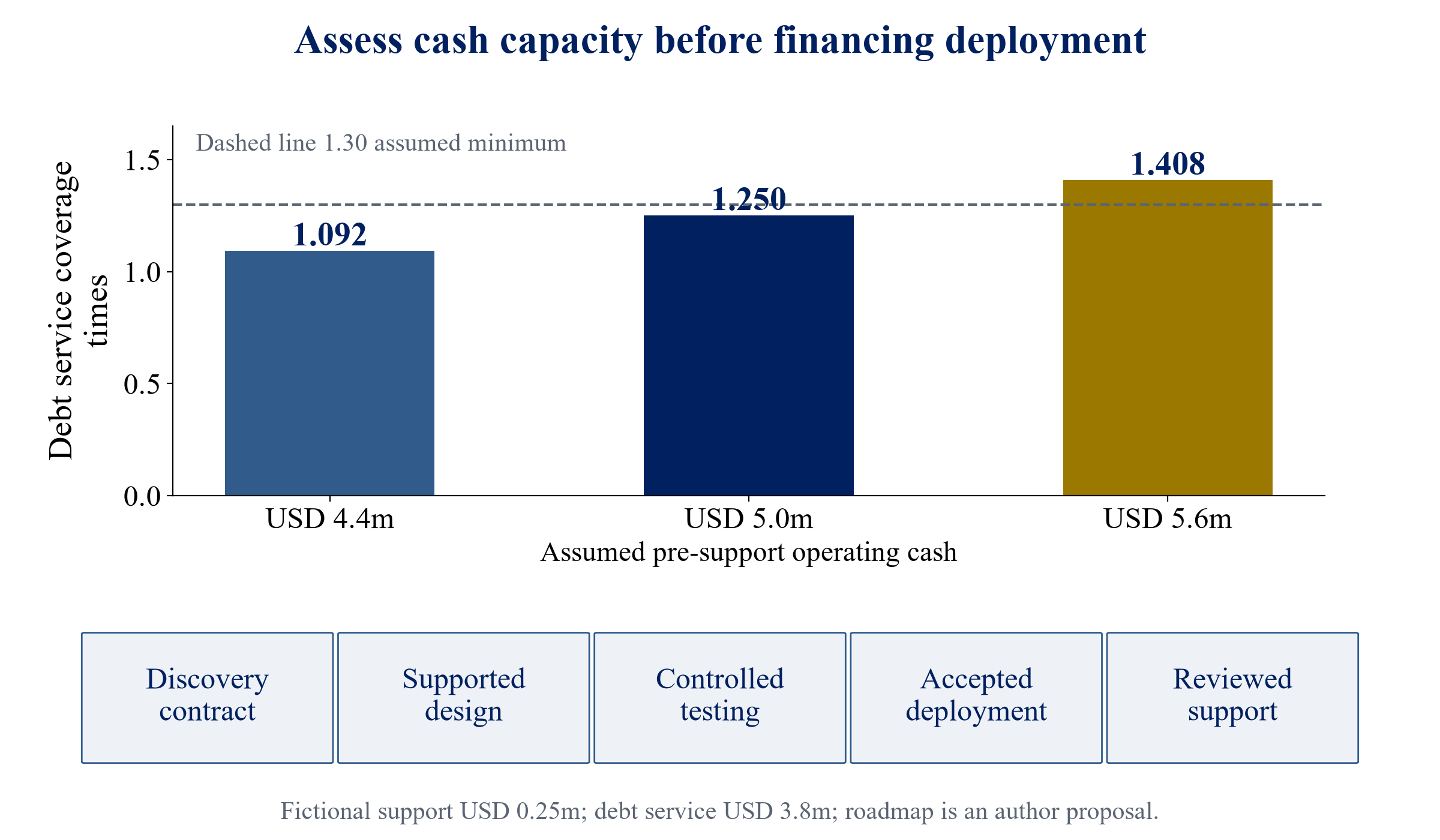
Coverage uses support 0.25 and debt service 3.8 in USD millions. The 1.30 reference is an assumed sponsor rule. Roadmap stages have no promised timing or commercial conversion.
An acquisition valuation using this framework should show migration capital and support in the applicable cash flows. The treatment should follow the actual valuation boundary and avoid deducting a cost already included elsewhere. There is no assumed valuation premium for having a migration programme. A buyer claiming such a premium should establish the relevant cash consequence, comparable evidence or agreed transaction mechanism.
The framework leaves other valuation questions open. It contains no estimate of cyber insurance savings, interruption probability, tariff treatment or terminal value effect. These omissions limit any claim about enterprise value. The fictional calculations are sufficient to demonstrate a capital and cash constraint. Further valuation work would need transaction-specific inputs, a consistent appraisal horizon and a transparent treatment of the operating obligations that continue beyond the model period.
17 Match financing instruments to accepted scope
The proposed financing review should begin with the borrower, the obligation being funded and the payment schedule. Corporate funding, shareholder capital, vendor terms or project financing each require an actual counterpart and agreed conditions. The paper recommends examining their fit to the accepted scope and remaining dependencies. It assumes no instrument is available merely because the programme concerns essential infrastructure or uses a published cryptographic standard.
For corporate funding, the sponsor should show the programme's effect on available liquidity and competing capital obligations. Shareholder funding needs an identified approval and cash contribution. Vendor payment terms require review of delivery responsibility, acceptance conditions and the cost of deferred payments. The sponsor should retain the assumptions for each alternative and avoid comparing a confirmed arrangement with an unsupported financing proposition as if both were equally executable.
A proposed project-finance treatment should identify the project entity, revenue boundary and existing restrictions. Programme spending may interact with an established financing package, and the relevant documents require specialist review. The paper supplies no conclusion about permitted debt, lender consent or recovery through revenues. Those questions should be resolved for the actual project before a financial recommendation claims an available financing route.
The committee should reconcile the chosen funding source with technical commitments. A supplier requiring payment before acceptance can create a different liquidity exposure from a contract with staged payments. Financing that depends on an accepted deliverable also needs a route for funding earlier discovery and testing. The proposed schedule should show who funds each stage, what has been committed and what remains conditional on further evidence or approval.
18 Address legacy equipment and service continuity
A proposed legacy review should identify equipment whose migration route remains unresolved. The sponsor should obtain available support documentation and ask technical reviewers to assess the actual feasible treatments. Options proposed for examination might involve replacement, a redesigned boundary or another specifically approved operating arrangement. This paper makes no claim that a compensating control makes any particular legacy device secure or that an external gateway solves all cryptographic dependencies.
The acceptance case should explain how the chosen treatment supports the actual service requirement. A control that covers one communications path may leave another function outside its scope. The operator should record that boundary and the remaining obligations. Funding requests should then cover the complete proposed treatment and its review. A temporary arrangement should retain its intended duration, decision owner and conditions for reconsideration.
Service continuity needs site-specific deployment planning. The proposed plan should identify operating windows, recovery requirements and the people authorised to suspend or reverse a change. Technical staff should assess those arrangements using actual system knowledge and controlled observations. The capital schedule should include the approved resources for rehearsal and recovery where required. The paper offers no universal downtime estimate or assertion that migration can occur without disruption.
The financial review should examine consequences if acceptance is delayed. Additional support, extended testing or a changed equipment route can affect cash requirements. The sponsor should identify which costs have a supported estimate and which remain unresolved. A contingency allocation can provide a funding mechanism, subject to its approval conditions. It does not establish that every possible change is affordable or that the operating requirements have been satisfied.
19 Structure outsourced service responsibilities
For an outsourced service, the proposed review should identify which cryptographic functions the operator controls and which belong to the provider. The service boundary needs enough detail to assign evidence and acceptance responsibilities. A customer may require records that sit within the provider's system. The contract review should establish how those records can be accessed and whether the proposed deliverable covers the customer's intended use.
An operator should request the provider's migration route for the specific service and versions it uses. The review should distinguish a public roadmap from a contractual commitment and an accepted deployment. Each has a different evidential role. A budget based on a provider commitment should retain its conditions and consequences if the commitment changes. The paper assumes no contractual right arises merely because a provider has published an intention.
The proposed cost record should include charges for configuration changes, testing and continuing support where applicable. The operator should reconcile those charges with the existing service price. If a provider includes part of migration in an existing agreement, procurement should retain the supporting terms. If additional work requires approval, its price and acceptance conditions should be documented before being included as a committed programme amount.
20 Apply the framework in acquisition diligence
A proposed acquisition review should ask the seller to define the scope behind any migration completion statement. The reviewer should inspect the inventory, accepted configurations, exceptions and support arrangements. The financial team should then reconcile paid spending, outstanding commitments and future support to the model used in the transaction. Evidence for one subsidiary or operating site should remain attached to that scope and should not imply coverage of the entire acquired group.
Buyer diligence should identify the consequence of incomplete evidence. Missing supplier information may require further investigation, and unresolved migration work may require a revised capital budget. The deal team should record the assumptions used in its pricing analysis and obtain the relevant specialists' assessment. The paper provides no automatic purchase-price adjustment and no claim that every unresolved dependency has the same financial importance.
Post-completion integration can introduce a new boundary. Shared identity, remote support or central operating services may change the dependencies assessed before the transaction. The proposed integration plan should identify which acceptance records remain applicable and which require renewed testing. The financial model should include supported incremental costs of the intended integration, with a reconciliation to amounts already included in the acquisition appraisal.
Transaction documentation should reflect the actual review. Counsel should determine the treatment of disclosure, commitments and any proposed allocation of responsibility. The paper offers a structure for technical and financial questions without prescribing legal protection. A defensible investment record should preserve the evidence on which the buyer relied, the unresolved matters disclosed at approval and the funded work needed to complete its own intended operating arrangement.
21 Use AI with a bounded evidence role
NIST's current post-quantum page reports that an AI-assisted vulnerability finding led the HAWK candidate team to withdraw that candidate in July 2026. NIST states that the finding does not affect final ML-KEM or ML-DSA standards [8]. The attribution and algorithm boundary matter. This event supplies no evidence that AI has broken the deployed cryptography of a particular utility or predicts when another algorithm will be affected.
This paper proposes a limited role for AI in programme administration. An operator could assess whether authorised tools help organise supplier documents, identify missing inventory fields or compare version references. These are proposed uses requiring evaluation. The output should retain a link to the inspected source and a named reviewer. The paper reports no measured accuracy, labour saving or implemented AI discovery capability for such a workflow.
Security-sensitive information requires an approved handling arrangement. The operator should decide which data may enter a tool and how access, retention and review work under the actual contract. A generated inventory entry should remain unresolved until the relevant evidence is verified. The proposed financial model should include the cost of review and correction where applicable. Tool subscription cost alone leaves that workflow's spending boundary incomplete.
Technical acceptance must retain competent human responsibility and appropriate test evidence. A generated summary of a supplier statement cannot establish local compatibility or operational safety. The proposed review should use the summary to locate evidence and questions, with conclusions attached to the actual inspected records. Any claimed benefit from AI assistance would need a measured comparison under the operator's approved process and a consistent accounting of the resources used.
22 Develop a commercial service with accountable deliverables
The author-proposed commercialisation roadmap starts with a paid discovery package whose deliverable is a defined inventory and unresolved-dependency record. A separate design package should specify feasible treatments and the evidence required for acceptance. Testing and deployment packages should retain their own boundaries and owners. This proposed service architecture identifies what a buyer would procure. It supplies no proof of market demand or forecast of consulting revenue.
A provider should describe its competence and the limits of its responsibility accurately. Corporate finance advice can structure the funding analysis and approval record. Technical implementation and operational acceptance require appropriately qualified participants. A commercial offer should identify those responsibilities and the evidence of capability relevant to the promised work. The paper makes no claim about any firm's existing authorisation, certification or completed utility implementation.
The proposed contract should attach payments to accepted deliverables with stated conditions. An inventory review can be useful even when it identifies that a proposed deployment is infeasible. The client and provider should agree the treatment of that result beforehand. Qualified counsel should review the actual terms and professional obligations. A fee model based on presumed savings needs an agreed baseline and support for the claimed economic consequence.
Expansion should follow observed procurement and delivery evidence. A completed pilot can inform a further decision within its documented boundary. A new site or service may need additional discovery and acceptance work. Providers should retain the cost and outcome of unsuccessful proposals as well as paid work when evaluating their business model. The roadmap therefore offers a sequence for evaluating a service and establishing demand through actual contractual evidence.
23 Governance and continuing review
The proposed governance record assigns a technical acceptance owner, an operating owner and a financial approval owner for each material workstream. Their decisions should refer to a common scope and version record. A committee should be able to reconcile the accepted deliverable with the payment request and continuing obligations. The paper proposes these roles for adaptation and makes no claim that a particular operator already uses this governance design.
Continuing review should identify changes relevant to the accepted configuration. A revised supplier version, changed service boundary or updated technical guidance may require assessment. The current NIST operational technology publication page distinguishes final Revision 3 from an initial public draft of Revision 4 dated September 2026 [5]. The review record should identify which documents informed an actual decision and preserve the distinction between draft proposals and final guidance.
The financial programme should close only the spending and deliverables actually completed. Unresolved exceptions, retained contingency and recurring support should be recorded with their owners. The completion statement should identify its coverage and the date of acceptance. This gives a future operating or transaction reviewer a usable account of the programme. A broad completion label without those details leaves the scope of the claim difficult to assess.
The sponsor should compare actual costs and accepted outcomes with the original appraisal. Variances should identify changed scope, revised assumptions and delivery consequences. An evidence-based review of those variances could improve later approvals, although this paper reports no measured benefit from the proposed practice. The record should preserve the original decision basis so that a later reviewer can understand what was known when a commitment was made.
24 Conclusion and investment submission
The proposed funding method connects each capital commitment to an operating boundary, supplier evidence and a defined acceptance decision. An investment submission should present the discovery record, feasible treatments, testing requirements, deployment conditions and continuing support together. Treasury should reconcile those commitments with cash timing and financing terms. Technical and operating reviewers should retain responsibility for assessing the actual configuration and its acceptance.
The fictional example shows why capital authority and operating coverage need separate analysis. Base capital of USD 7.0 million and contingency authority of USD 1.4 million define a funding envelope. Assumed annual support of USD 0.25 million affects the illustrative operating cash model. Adding assumed annual debt service of USD 0.6 million produces coverage of 1.25 times under the stated inputs. These calculations support a reproducible financing discussion without establishing a supplier price or lender commitment.
The paper leaves several material questions open for actual application. It contains no empirical utility migration costs, validated site performance or quantified avoided-loss benefit. Its proposed method requires evaluation against real programmes, including failures and revised budgets. Relevant legal obligations, accounting treatment and financing definitions also need jurisdiction- and transaction-specific review. A reader should retain those limitations when applying the framework to a power or water operator.
The immediate recommended submission is a bounded discovery and design request with an identified owner, budget and evidence requirement. Further spending should refer to accepted results and the remaining operating conditions. This creates a reviewable record for procurement, financing and later diligence. Its commercial value would need to be established through actual client decisions and delivery outcomes. The framework provides a structured way to ask for that evidence and organise the capital decision.
References
- National Institute of Standards and Technology. 2024. FIPS 203 Module-Lattice-Based Key-Encapsulation Mechanism Standard. Published 13 August 2024; current planning note reviewed. https://csrc.nist.gov/pubs/fips/203/final
- National Institute of Standards and Technology. 2024. FIPS 204 Module-Lattice-Based Digital Signature Standard. Published 13 August 2024; current planning note reviewed. https://csrc.nist.gov/pubs/fips/204/final
- National Institute of Standards and Technology. 2024. FIPS 205 Stateless Hash-Based Digital Signature Standard. https://csrc.nist.gov/pubs/fips/205/final
- National Cyber Security Centre. 2025. Timelines for migration to post-quantum cryptography. Guidance published 20 March 2025. https://www.ncsc.gov.uk/guidance/pqc-migration-timelines
- Stouffer, K., et al. 2023. Guide to Operational Technology Security. NIST Special Publication 800-82 Revision 3. Final revision distinguished from the later draft listed on its publication page. https://csrc.nist.gov/pubs/sp/800/82/r3/final
- Cybersecurity and Infrastructure Security Agency, National Security Agency and National Institute of Standards and Technology. 2023. Quantum-Readiness Migration to Post-Quantum Cryptography. https://www.nccoe.nist.gov/sites/default/files/2023-08/quantum-readiness-fact-sheet.pdf
- National Cybersecurity Center of Excellence. Migration to Post-Quantum Cryptography. Current project overview and publication status. https://www.nccoe.nist.gov/applied-cryptography/migration-to-pqc
- National Institute of Standards and Technology. Post-quantum cryptography. Current programme page, including the July 2026 HAWK update and its stated algorithm boundary. https://www.nist.gov/pqc
About the Author
Chennakeshav (CK) is a corporate finance and investment banking executive with 25+ years of global experience in deal origination, structuring and execution across M&A, growth capital and corporate strategy. He has led value-creation mandates for founders, corporates and funds — bridging the boardroom view to hands-on execution and close.
His career spans Morgan Stanley, HSBC, Lloyds Banking Group, EWEC, ADQ portfolio companies and Emirates Growth Fund, across TMT, real estate, fintech, deeptech, cleantech, infrastructure and energy. He has partnered with C-suite leaders, private equity and venture funds, sovereign wealth funds and family offices to finance complex fund raises and scale-up ventures, and has led M&A due diligence, post-merger integration and business-transformation initiatives to create value.
At Matchpoint Partners he is Managing Partner, leading the firm's corporate finance, M&A and capital-raising practice. He holds an MBA from London Business School, an engineering degree from VTU and a Master of Laws (LLM, in progress) from UCL London.
An active start-up mentor, CK mentors at Techstars, DIFC FinTech Hive, Startup Grind, Founder Institute and IN5, serves as Entrepreneur Mentor in Residence (EMiR) at London Business School, and judges the Entrepreneurship World Cup.
