

1 The investment decision
An exploration sponsor should approve a sensing evaluation only after specifying the expenditure decision that the resulting information could change. The decision could concern a first appraisal well, the position of a borehole, a repeat groundwater survey or the purchase of an exploration technology business. Each needs a different evidence boundary. A technically interesting anomaly can justify investigation while leaving the commercial commitment unresolved.
This paper addresses whether to pay for a defined quantum sensing comparison before committing further appraisal capital. The comparison combines measurement acquisition, data acceptance, geological interpretation and an independently reviewed decision recommendation. The proposed initial programme excludes autonomous drilling instructions, reserve certification and representations that a surface measurement has established a recoverable commodity. Those activities require their own technical and professional review.
The sponsor should write down the available actions before commissioning the survey. These might include proceeding with appraisal, changing its location, collecting another type of evidence, delaying expenditure or declining the opportunity. Information has a financial consequence when it changes one of these actions or its timing. A more detailed image with no effect on an authorised decision still needs a separate justification for its cost.
The contribution developed here is a proposed investment method with reproducible fictional examples. No original sensing experiment or commercial exploration trial has been performed for this paper. Published results retain their stated application boundaries. The numerical models describe assumed programme characteristics and conditional cash outcomes. A real sponsor should replace those assumptions with independently reviewed site evidence before using the framework to approve expenditure.
2 What the published demonstrations establish
Stray and colleagues reported an outdoor quantum gravity gradient survey in Nature in 2022. The work detected a known tunnel beneath an urban road using a cold atom instrument. Its interpretation incorporated information about the survey site and tunnel geometry. This is a bounded demonstration of sensing and subsurface interpretation under reported conditions; it supplies no mineral grade, geothermal flow or hydrogen resource estimate [1].
In September 2025, the British Geological Survey described installation of five UK-made quantum magnetometers to extend national magnetic field coverage. That programme concerns geomagnetic monitoring. Its deployment context should remain attached to any discussion of field readiness, with resource exploration treated as a separate proposed application requiring its own validation [6].
Research published in npj Quantum Information in 2025 examines quantum locking of an intrinsic spin squeezed state for Earth-field-range magnetometry, including a machine-learning-optimised control sequence. The publication concerns a specific sensing method. It supplies no exploration service price or commercial mine-discovery outcome [7].
These examples help define evidence requests. A sponsor can ask which measured quantity, instrument configuration and field environment the supplier's proposal shares with a cited result. Changes in terrain, target geometry, deployment method or analysis can alter the comparison. The proposed evaluation should document those differences explicitly. A literature reference is useful background for the test; independent results from the intended application remain necessary for the actual procurement decision.
3 Define the resource hypothesis before selecting a sensor
The proposed survey should begin with a geological question that has a clear connection to appraisal. A mineral programme might need to test a structural interpretation before selecting a borehole. A geothermal programme might seek evidence that changes an interpreted fault position. A water manager might need to examine a change in underground storage. Natural hydrogen exploration might assess a regional geological hypothesis before sampling a particular prospect.
Write the hypothesis in a form that an independent reviewer can challenge. Identify the expected measurement response, plausible alternative explanations, information already available and the further observation required to discriminate between interpretations. State what would count as an inconclusive result. This approach allows a sponsor to reject a survey design whose proposed output cannot resolve the decision it is supposed to support.
Instrument selection follows this definition. Ask the supplier to describe the quantity measured, the acquisition geometry, the handling of environmental effects and the assumptions used in converting observations into a geological model. The sponsor should request the complete interpretation chain, including uncertainty and model choices. The proposed comparison evaluates that chain as a service rather than assigning value to a sensitivity specification in isolation.
The application boundaries in Table 1 are proposed questions for commercial diligence. They are neither validated detection capabilities nor a claim that one instrument serves every resource. A programme may combine several methods when each has an independently specified role. The financing decision should remain attached to the actual accepted evidence, with each unresolved geological property carried forward as an explicit appraisal requirement.
Table 1. Proposed resource questions and independent appraisal requirements
| Application | Proposed information decision | Evidence still required |
|---|---|---|
| Minerals | Revise a structural target for drilling | Sampling, grade, continuity and recovery tests |
| Geothermal | Review a conceptual reservoir model | Temperature, permeability and fluid testing |
| Natural hydrogen | Prioritise a geological prospect | Gas composition, flow and preservation evidence |
| Water | Examine underground storage change | Hydrogeological interpretation, quality and usable yield |
Author framework. These are evaluation questions rather than demonstrated quantum detection capabilities.
4 Mineral exploration and target discrimination
A proposed mineral sensing pilot should identify how its result changes a drill-target ranking. The sponsor can define an existing geological model, the locations under consideration and the additional observation expected to affect those locations. A supplier should then explain which measurement response supports the proposed interpretation and which competing geological models could produce a similar response. This is the starting point for an independently reviewable comparison.
The commercial evaluation should retain all candidate targets, including those that the new survey downgrades. Selecting only locations that later produce encouraging samples would give an incomplete account of the decision programme. The proposed record should include target positions before the survey, recommendations after interpretation and the independent observations subsequently obtained. Where the sponsor declines drilling, the reason and unresolved geological uncertainty should remain visible.
Sampling and testing have a separate role in the proposed programme. The sponsor should require qualified specialists to assess evidence about commodity composition, grade, continuity and potential recovery before assigning economic significance to a target. The paper proposes no gravity or magnetic measurement as a substitute for that assessment. Its financing model values an appraisal decision under hypothetical cash outcomes, with successful appraisal defined outside the sensing result itself.
For an acquisition, the buyer should request records that connect the vendor's claimed contribution to actual targeting decisions. Useful diligence questions include whether conventional interpretations were available, how unsuccessful sites were treated and which information was known before testing. The purpose is to understand a service's supported contribution and remaining uncertainty. A portfolio of attractive subsurface graphics alone leaves that commercial analysis incomplete.
5 Geothermal characterisation and drilling commitments
Department of Energy geothermal guidance describes limited public data and expensive acquisition as barriers to exploration. It identifies temperature, permeability, fluid characteristics and stress as important subsurface properties. The guidance states that a single non-invasive characterisation method does not provide sufficient resolution across these properties for the desired high-confidence well targeting. It supports integrated geological, geophysical and geochemical analysis [3].
For the proposed commercial evaluation, the sponsor should identify which uncertainty a quantum sensing service is expected to reduce within that integrated analysis. A change in interpreted structure could affect a well location while leaving temperature or fluid behaviour unresolved. The investment submission should state both the changed interpretation and the other evidence still required. Each further expenditure should have a defined technical objective and its own acceptance decision.
A paired test should use the same available geological information and a documented review process for both the conventional and proposed sensing workflows. Independent reviewers should record their recommendations without access to withheld appraisal outcomes. The programme can then compare which recommendations changed, why they changed and how subsequent observations relate to the frozen interpretation. The proposed method makes no promise about drilling success or reduced development time.
The sponsor should also separate geological appraisal from project development economics. A technically useful interpretation does not complete the analysis of construction, connection, operating obligations or commercial receipts. Those costs and permissions belong in a subsequent project appraisal with supported inputs. The sensing comparison can inform that appraisal through a specific evidence contribution whose uncertainty remains attached to the decision.
6 Natural hydrogen and the limits of prospectivity
The US Geological Survey's geologic hydrogen programme describes research on generation, migration, trapping and preservation. Its project page states that limited observations and an early understanding of the resource constrain quantitative assessment. Regional prospectivity mapping identifies geological conditions of interest; the mapped prospectivity remains separate from a site-specific demonstration of economic recovery [4].
A proposed hydrogen sensing programme should explain which element of its geological hypothesis the new measurements could inform. The sponsor might wish to examine structure before selecting a sampling location. The supplier should describe alternative interpretations and identify how the proposed observation affects that selection. Claims about gas composition, sustainable flow or commercially recoverable quantities should require independent evidence appropriate to those claims.
The trial agreement should address how the team treats a promising interpretation followed by inconclusive sampling. Both outcomes belong in the evidence record. The sponsor should preserve the original target recommendation, the sampling method and the reasons that a result remains unresolved. A revised geological explanation can be considered through a further authorised investigation, with a new comparison boundary and budget.
The proposed financing approach limits expenditure to a defined evidence programme before larger commitments. A sponsor should assess whether the resulting information could change its next action and whether that action has a supported economic rationale. The fictional value-of-information example later in this paper illustrates that logic without assigning a hydrogen probability, resource volume, market price or exploration success rate. Those variables require actual site evidence and an independently reviewed commercial model.
7 Groundwater storage and usable water
Kennedy's USGS fact sheet describes repeat gravity measurements as a way to examine groundwater storage changes. The method relates observed changes in gravity to changes in underground mass within a defined measurement setting. The source establishes a hydrological application for gravity surveys; it provides no comparative quantum sensor performance result [5].
Kennedy, Bell and Seelig's 2025 Rio Rancho report presents a specific groundwater study combining repeat microgravity and water-level observations. Its reported findings retain their location and study period. For this paper, the relevance is the presence of independently documented hydrological observations alongside gravity evidence. No result from that location is transferred to a proposed survey elsewhere [8].
A water-focused sensing pilot should state whether it concerns storage change, basin structure or another defined question. The sponsor should specify timing, comparison stations and the additional observations used for interpretation. The proposed acceptance report should distinguish a measured change, the model used to interpret it and the management action that follows. Water quality, usable yield and permissions remain separate review questions within the overall proposed commercial programme.
An investor assessing a water technology service should ask which decisions customers actually changed after receiving its data. A repeat measurement contract, a research grant and an accepted operational recommendation each support different revenue or application claims. The proposed diligence record should preserve that distinction and identify any information withheld for commercial or privacy reasons. Where independent review cannot access the evidence, the resulting limitation belongs in the investment submission.
8 Keep measurement families and application boundaries clear
The phrase quantum sensing can describe different measurement systems and research approaches. The sources considered here include atom-based gravity sensing and magnetic sensing. Their reported outputs, environmental conditions and demonstrations differ. For the proposed investment process, the supplier should identify the specific instrument and measurement quantity before comparing its proposal with a cited result or another commercial service.
The sponsor should request an application description in ordinary operational terms. It should explain where equipment is placed, what is measured, how observations are recorded and what processing produces the deliverable. Any laboratory-dependent component, external positioning input or interpretation service should appear in that description. This makes the proposed spending boundary understandable to technical and commercial reviewers without requiring them to treat a product category as a uniform capability.
Benchmarking should compare services that support the same defined decision. A magnetic monitoring installation and a gravity exploration survey may each supply useful evidence, with no basis for ranking them through a shared headline sensitivity number. Even services measuring the same quantity can use different spatial coverage, repeat procedures or acceptance criteria. A meaningful comparison states those differences and either aligns them or limits the conclusion accordingly.
9 Field procedures and environmental observations
Kennedy, Pool and Carruth's USGS techniques report sets out field collection, processing, quality assurance and archiving for relative and absolute gravity surveys. It describes calibration, careful acquisition and post-processing as elements of reliable survey work. Its procedures focus particularly on repeat measurements for hydrological applications and also discuss geological structure mapping [2].
The proposed quantum comparison should document its own complete field procedure, with qualified reviewers identifying adaptations required for the chosen instrument. The evaluation record should include station positions, acquisition times, configuration changes, instrument checks and rejected observations. Environmental measurements and corrections should be specified before analysis wherever practicable. Their purpose and uncertainty should remain attached to the accepted dataset.
A supplier should explain how revisits enter the programme. Repeat acquisition may resolve a suspect observation, leave it inconclusive or reveal a discrepancy requiring investigation. The sponsor should retain the first record and the reason for the revisit. Reporting only the final selected measurement removes information relevant to reliability, field effort and complete service cost. The proposed benchmark therefore records each attempt and its disposition.
Acceptance should be an explicit professional decision. A dataset that passes an instrument check can still leave the geological question unresolved. The proposed contract should distinguish acquisition acceptance, interpretation review and the sponsor's spending decision. Each deliverable should name the reviewer and evidence required. The commercial model should carry the cost of unsuccessful or inconclusive work rather than silently treating every field visit as a usable decision output.
10 Establish a credible conventional comparison
The sponsor should agree a conventional comparison with qualified practitioners before evaluating the proposed quantum workflow. The comparison should represent a maintained method suitable for the chosen geological question. Its configuration, supporting data, interpretation process and expenditure boundary should be documented. A poorly specified conventional service would weaken any claimed improvement even if the new instrument produces repeatable measurements.
Both workflows should receive the same information that would legitimately have been available when the target decision was made. If one interpretation uses an existing borehole or a known target geometry, the comparison should either give the same information to the other team or state the difference explicitly. The sponsor should also record which staff already knew the site. Familiarity can affect interpretation and needs consideration in the proposed trial design.
The programme should preserve a useful conventional path if the proposed service fails to deliver accepted information. Costs for that path belong in the relevant economic boundary. They might include alternative acquisition, additional review or a delayed appraisal decision. The precise requirements depend on the sponsor's application and should be agreed rather than assumed. This paper assigns no universal fallback cost or availability.
A technically informed comparison can support several conclusions. The proposed workflow may add useful information, produce equivalent information at a different cost, remain inconclusive or fail the agreed acquisition criteria. Every outcome should be retained. The investment committee should receive the complete result and the recommendation it supports. Further research may still be justified, with its purpose distinguished from an approved commercial service expansion.
11 Freeze the trial design and preserve negative results
The sponsor should approve a trial protocol before receiving the measurements it intends to evaluate. The protocol should identify the sites, intended decisions, comparison method, information available to interpreters, acceptance rules and planned independent observations. It should also explain how missing observations, inaccessible sites and equipment failures enter the record. A revision needs a dated reason and a separate interpretation of any affected results.
Selection is particularly important for the proposed commercial assessment. A test consisting entirely of known positive targets cannot establish how the service behaves across a representative exploration portfolio. The sponsor should describe why sites were chosen and which sites were excluded. Where blind testing is practicable, the information withheld and the people responsible for holding it should be documented. The trial should remain safe and consistent with site permissions.
Negative and inconclusive results deserve their own analysis. A negative recommendation that later avoids an unattractive appraisal might contribute useful decision information. An apparently positive interpretation that fails independent review can impose cost. The sponsor should define these outcomes before assigning commercial value. It should avoid treating the number of visually compelling anomalies as a sufficient measure of programme performance.
The proposed protocol should permit independent inspection of original records under agreed confidentiality controls. The reviewer needs enough information to examine acquisition, processing and interpretation, including version changes and rejected records. A supplier can protect commercially sensitive implementation details through appropriate agreements, while the sponsor identifies any review limitation. Unsupported assumptions about inaccessible evidence should remain unresolved in the investment decision.
12 Independent observations and the meaning of success
Success must have a precise meaning in the proposed evaluation. Measurement acceptance, support for a geological hypothesis, successful appraisal and profitable development represent different outcomes. A sponsor should define each outcome it intends to study and identify the observation used to assess it. The definition should remain stable through the comparison or be revised with a transparent explanation of its consequences.
Independent geological review should examine alternative explanations and the role of prior information. Subsequent drilling or sampling may supply relevant observations, but those observations require their own documented quality controls. The sponsor should agree how ambiguous evidence will be treated. A trial with many unresolved outcomes should describe that uncertainty directly rather than allocating every site to success or failure to simplify a commercial presentation.
The fictional model in this paper uses a binary commercial appraisal outcome to make a decision calculation reproducible. Real programmes may require more than two outcomes, including partial appraisal success, delays, different recoverable quantities or different development costs. The sponsor should use a model that represents its actual authorised decision. It should explain how technical observations support probabilities and cash assumptions, with independent specialists reviewing those links.
The proposed evidence record should separate knowledge available at each stage. A recommendation made after seeing appraisal results cannot be treated as a prospective prediction. Similarly, a revised interpretation can be valuable scientific work while needing a separate comparison. Maintaining this chronology helps a transaction team understand which capability was demonstrated and which parts of the claim remain dependent on further testing.
13 Geological interpretation and alternative models
A proposed interpretation report should show how the observed measurement connects to the subsurface model. The sponsor should request the main assumptions, alternative plausible models and observations that would help distinguish them. Qualified geoscientists should explain the limitations relevant to the spending decision. The investment submission should avoid presenting a single attractive cross-section as the complete range of geological possibilities.
The interpretation team should identify which model inputs came from existing maps, site observations, laboratory analysis or other surveys. It should describe the effect of changing important assumptions within a justified range. Where there is insufficient evidence to assign a range, the parameter should remain unresolved. The proposed financial framework can accommodate that limitation by delaying a larger commitment or funding a defined additional observation.
Model uncertainty should influence the proposed procurement decision. A measurement may be repeatable while its commercial interpretation remains sensitive to an unmeasured property. The sponsor should ask whether additional precision in the measurement actually changes the recommended action under those alternative models. This question links scientific improvement to the decision being funded. The paper supplies no universal answer for different targets or environments.
The review should record which conclusion survives a reasonable alternative interpretation. A recommendation to obtain independent sampling might remain appropriate even when the exact target geometry changes. A proposal to commit development capital might require much stronger evidence. The sponsor should state the narrow decision supported by the current record and the work needed for any broader claim, with costs and contractual responsibilities made explicit.
14 AI and data assistance within the interpretation workflow
The proposed programme may evaluate AI-assisted processing, interpretation or acquisition planning when the supplier describes a specific function. The sponsor should record its inputs, outputs, training information and role in the final recommendation. A system used to identify suspect records needs a different acceptance test from one used to classify exploration targets. The commercial comparison should retain that distinction.
Any learning-based comparison should preserve a holdout dataset whose outcomes were unavailable during development. The sponsor should ask qualified reviewers to examine site overlap, repeated observations and other routes through which information could enter the evaluation. A prediction based on a neighbouring or previously characterised site needs appropriate interpretation. The proposed service record should identify such dependencies rather than treating every prediction as independent.
The evaluation should also examine the human review required after automated processing. Record corrections, disagreements and rejected suggestions, including their time and cost. If a model update changes a recommendation, preserve the version and the reason. The sponsor should specify which decisions remain with authorised professionals. The paper makes no claim that AI removes the need for geological review or supplies a general accuracy improvement.
The commercial test concerns the accepted programme output and its cost. An AI-assisted stage can be useful even when it produces no independent new observation, provided its actual contribution is supported. Conversely, additional computational complexity should justify its resource requirements through the defined comparison. The sponsor should retain the conventional interpretation result and assess whether the proposed assistance changes an authorised action or a supported cost input.
15 A qualitative sequence for application readiness
Figure 1 proposes an evidence sequence for the specific application. Begin with a defined site question, then obtain repeatable field records under an agreed protocol. Compare interpretations without access to withheld outcomes, examine independent geological observations and review the bounded commercial case. The sequence establishes the proposed order of decisions. It assigns no measured technology-readiness level, success probability or delivery timetable.
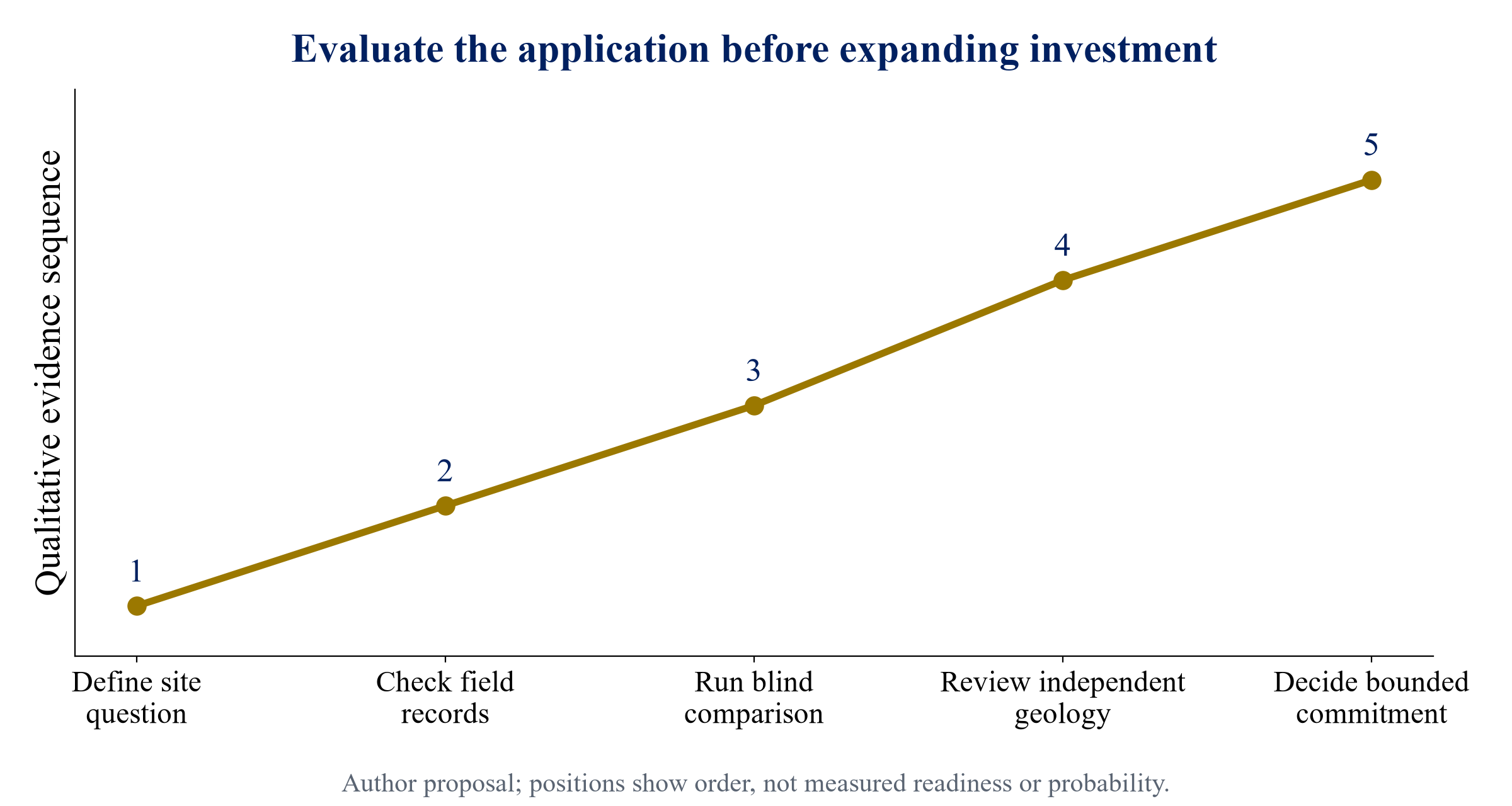
Author proposal. Vertical position shows evidence order only, with no measured readiness score or adoption probability.
Each stage should produce a record that the next reviewer can inspect. The site question defines the authorised decision. Field records describe what was acquired and accepted. The comparison preserves both recommendations and their information boundaries. Independent observations test the relevant interpretation. The commercial review then identifies whether the evidence supports another commitment and which uncertainties remain.
Failure at a stage should produce a specific next action. A poorly framed geological question needs revision before acquisition. An inaccessible comparison dataset needs an agreed review arrangement. An inconclusive independent observation may justify a different test or a decision to stop. The sponsor should carry the cost already incurred into the financial record while treating further spending as a new commitment.
The sequence is application-specific. A successful water storage comparison does not complete the evaluation of a mineral target or a hydrogen prospect. New terrain, acquisition methods or interpretation models may also require additional testing within the same resource category. An expansion submission should identify which records remain relevant and which need replacement. This allows commercialisation to proceed through stated evidence requirements without presenting research progress as a universal operating capability.
16 Define the full survey cost boundary
The proposed economic comparison should include every resource needed to produce the agreed accepted output. Costs can include mobilisation, site access, acquisition, environmental observations, revisits, processing, independent interpretation and report preparation. The sponsor should identify the payer for each item and the handling of unsuccessful work. A quoted instrument hire charge alone leaves the decision-programme boundary incomplete.
The comparison should hold scope constant where possible. Define the area, stations, delivery period, permitted field conditions and acceptance criteria. Any material difference should be stated before calculating cost per accepted record. That metric can help examine acquisition economics, but its relevance to the investment decision depends on whether accepted records actually supply the required information. The proposed programme therefore also records the cost per independently reviewed recommendation.
Table 2 and Figure 2 use fictional costs for two survey packages over an assumed common scope. The conventional package costs USD 120,000 and yields ninety accepted records. The proposed quantum package costs USD 185,000 and yields ninety-five accepted records. The counts and costs are invented author assumptions. No named vendor quotation, field acceptance rate or comparative technical result supports them.
Table 2. Fictional survey package costs in USD thousands
| Component | Conventional package | Quantum package |
|---|---|---|
| Mobilisation and access | 25 | 40 |
| Acquisition | 45 | 70 |
| Revisits and quality control | 20 | 35 |
| Interpretation and reporting | 30 | 40 |
| Total cost | 120 | 185 |
| Accepted records | 90 | 95 |
Author assumptions under an assumed common scope. Accepted record counts do not establish geological accuracy or commercial discovery rates.
17 Interpret cost performance without an unsupported ranking
The fictional packages in Table 2 imply cost per accepted record of approximately USD 1,333 for the conventional package and USD 1,947 for the quantum package. These ratios divide total assumed cost by the assumed accepted-record count. They describe acquisition economics within the example. Their denominators contain no information about target classification, independent geological confirmation or the value of a resulting appraisal recommendation.
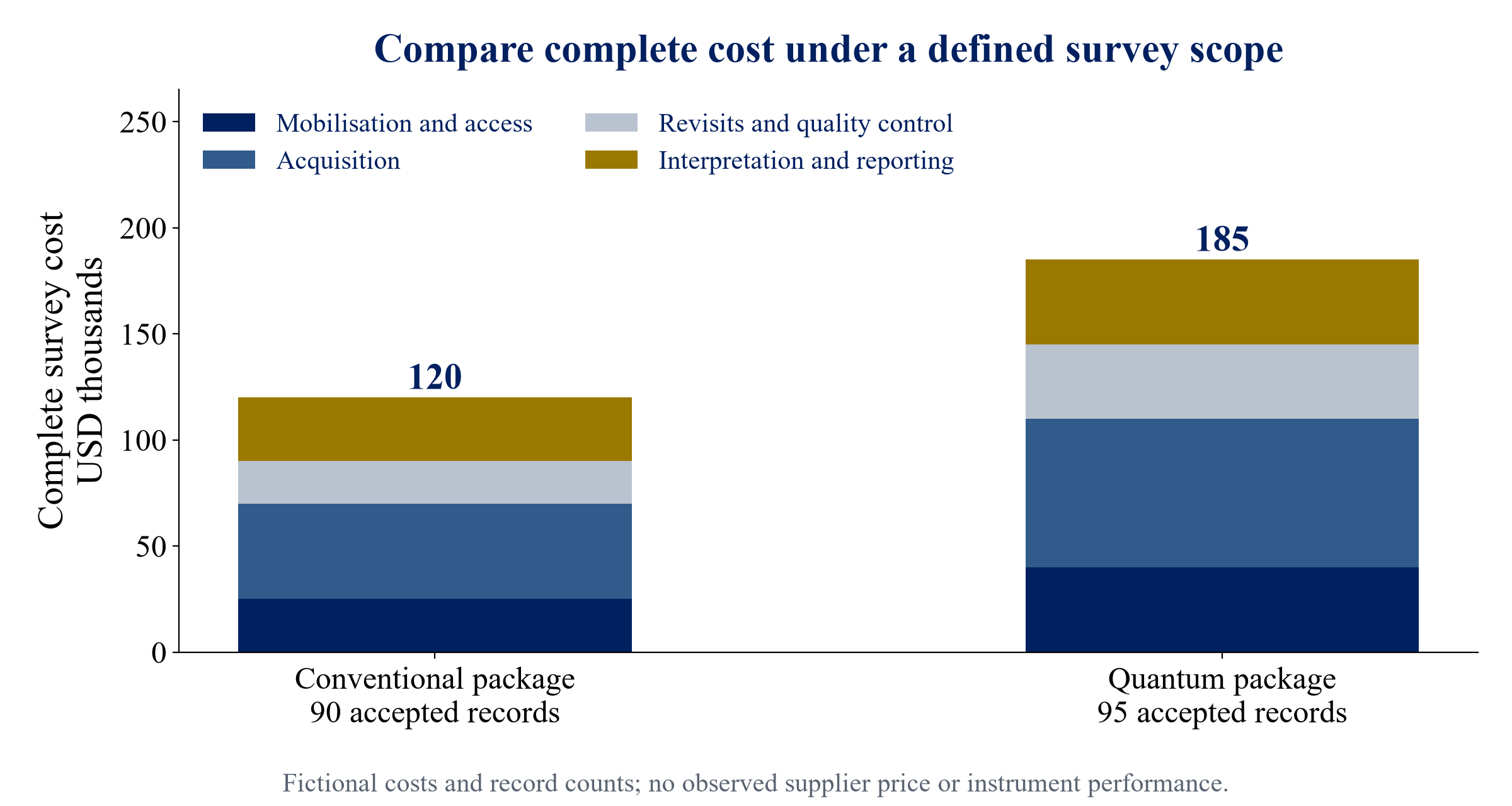
Author assumptions. Common scope is assumed for illustration; no observed supplier cost or instrument performance is reported.
A real sponsor should examine the relevance of each accepted record to its decision. Additional spatial coverage could be useful, redundant or insufficient depending on the geological question. The proposed comparison should preserve these limitations rather than assume a fixed financial benefit for each observation. Any claim that a more expensive package earns its incremental cost needs evidence linking its information to a changed action or supported cash consequence.
The two package illustrations are separate from the later USD 350,000 information programme. That programme assumes a broader decision service whose classification and conditional appraisal payoffs are defined explicitly. Its cost is not derived from these survey packages. Combining the examples would require a new model that specifies the additional evidence, interpretation, validation and contracting costs. This paper keeps their boundaries separate so that readers can reproduce each calculation without attributing a fictional operating relationship to them.
18 A fictional appraisal decision before new information
Consider a fictional sponsor choosing whether to undertake appraisal at one opportunity. Assume a 15 percent probability of successful commercial appraisal before purchasing new information. Conditional success produces a net present cash payoff of USD 8 million. Failure produces a net present loss of USD 2 million. These payoffs already incorporate the assumed appraisal and subsequent project consequences within the example's stated boundary. They exclude the separate information-programme cost.
Appraisal without new information has expected value equal to 0.15 multiplied by USD 8 million, less 0.85 multiplied by USD 2 million. The result is negative USD 0.5 million. The available decline action is assigned zero value. Under the fictional risk-neutral policy, the sponsor declines appraisal at this prior probability. There are no assumed proceeds from waiting, transferring the licence or obtaining a competing information source.
The break-even success probability for appraisal is 20 percent. With success probability p, expected appraisal payoff in millions of dollars is 8p less 2 times one minus p, which simplifies to 10p less 2. An appraisal action has positive expected value when the assumed probability exceeds 0.2. At the threshold, a risk-neutral sponsor is indifferent within this simplified boundary.
These assumptions describe a decision example and carry no geological calibration. A real sponsor may face capital constraints, risk preferences, obligations or alternative opportunities that change its decision. Its appraisal model should use supported project cash flows and qualified technical probabilities. The example's purpose is to make the information-purchase calculation explicit, including the action that would be chosen before paying for the proposed programme.
19 Calculate the information policy and its posterior probabilities
Now assume a fictional information programme costing USD 0.35 million upfront. Its complete decision recommendation has sensitivity of 75 percent and specificity of 85 percent for the defined commercial appraisal outcome. Sensitivity means the assumed proportion of success cases receiving a positive recommendation. Specificity means the assumed proportion of failure cases receiving a negative recommendation. These are hypothetical programme characteristics, with no conversion from instrument sensitivity, noise or measurement resolution.
The probability of a positive recommendation is 0.15 times 0.75 plus 0.85 times 0.15, giving 0.24. The probability that appraisal succeeds conditional on a positive recommendation is 0.1125 divided by 0.24, or 46.875 percent. Conditional on a negative recommendation, it is 0.0375 divided by 0.76, approximately 4.934 percent. The assumed policy therefore appraises positive cases and declines negative cases.
The unconditional expected appraisal payoff under that policy is 0.1125 times USD 8 million less 0.1275 times USD 2 million, giving USD 0.645 million. After paying USD 0.35 million for information, expected policy value is USD 0.295 million. Because the prior best action has value zero, that amount is also the incremental value of purchasing this programme under the fictional assumptions.
The example includes the cost of appraisal failures that receive positive recommendations. It assigns no payoff to declined cases and no additional loss from missing a successful opportunity beyond the foregone payoff already excluded by declining. Different contractual duties or opportunity costs require an extended model. The sponsor should record those changes and recalculate the policy, with every assumed probability and cash outcome visible to its investment committee.
20 Test specificity and the choice to purchase information
Hold the fictional prior, sensitivity, conditional payoffs and USD 0.35 million information cost constant. Change specificity to 65 percent, 85 percent or 95 percent. The resulting positive recommendation probabilities are 41 percent, 24 percent and 15.5 percent. Corresponding conditional success probabilities after a positive result are approximately 27.439 percent, 46.875 percent and 72.581 percent. All exceed the fictional 20 percent appraisal threshold.
Table 3. Fictional information policy values in USD millions
| Specificity | Positive result probability | Success given positive | Net value after test cost |
|---|---|---|---|
| 65 percent | 41.0 percent | 27.439 percent | -0.045 |
| 85 percent | 24.0 percent | 46.875 percent | 0.295 |
| 95 percent | 15.5 percent | 72.581 percent | 0.465 |
Prior 15 percent, sensitivity 75 percent, success payoff 8, failure loss 2 and information cost 0.35. No empirical classifier performance is implied.
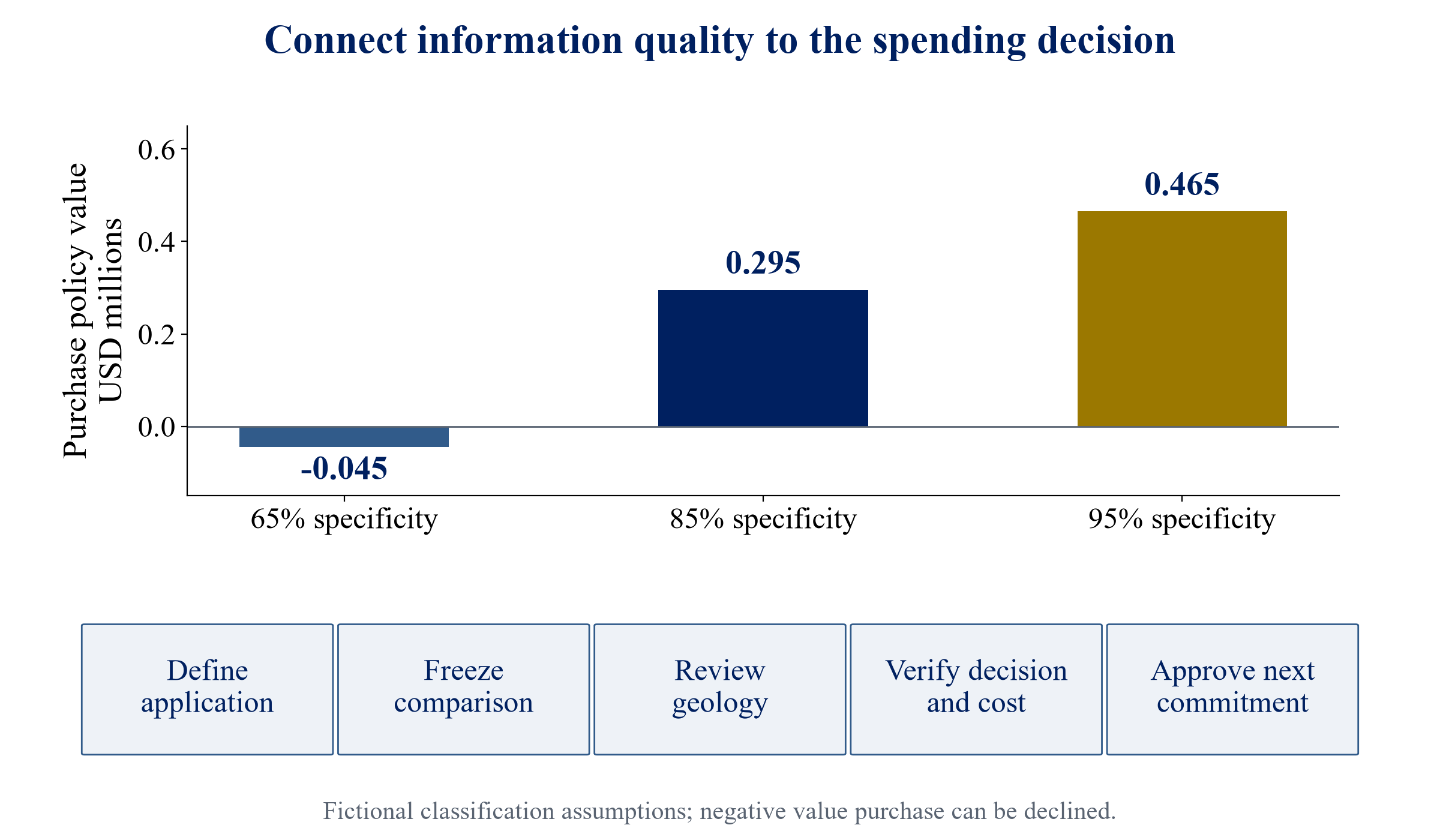
Conditional purchase values shown. A sponsor can decline the negative value purchase. Proposed roadmap has no promised timing or conversion rate.
The lower-specificity purchase has expected value of negative USD 0.045 million. A sponsor with the assumed decline alternative would choose not to buy that programme. The maximum available decision value in that case remains zero. The other two purchase cases have positive expected value within the stated boundary. The table shows conditional purchase values so that the economic consequence of the assumed information characteristics stays visible.
For the middle case, the break-even information budget is USD 0.645 million before other omitted costs. That number is the fictional policy payoff before paying for information, with prior decline valued at zero. It supplies no market price, acceptable lending amount or supplier valuation. A real purchasing decision should include omitted costs, alternative information and the uncertainty around estimated programme performance.
21 Contract for accepted evidence and bounded commitments
The proposed evaluation agreement should specify the survey protocol, data deliverables, interpretation record, independent review and commercial decision report. Each payment milestone should identify the work accepted and the treatment of unsuccessful outcomes. A completed research report can earn an agreed payment even when it finds no commercial advantage, provided that outcome fits the contract. The sponsor should avoid payment language that silently equates completion with geological success.
Rights to inspect and retain relevant evidence should be negotiated before acquisition. The sponsor may need original observations, processing versions, field records and an independent review report for later appraisal or transaction diligence. The supplier may need protection for intellectual property and confidential methods. Qualified counsel should assess the actual balance, jurisdiction and permitted use. The paper proposes questions for contract design and offers no legal conclusion about particular terms.
The agreement should identify responsibility for site access, safety, permissions and any planned follow-up observations. It should also state how delays or missing access affect the trial and its costs. A further field visit or a new application should require an authorised scope change. Clear records allow the investment committee to distinguish the cost of the original evaluation from expenditure approved after the results were available.
22 Investment valuation M and A and financing evidence
A buyer considering a quantum sensing business should separate the value of its intellectual property, contractual rights, field delivery capability and verified customer economics. A favourable hypothetical programme value provides no company valuation. The transaction team should request actual contracts, receipts, operating costs, liabilities and evidence supporting the applications represented in the sale materials. Claims that depend on restricted data should retain the resulting diligence limitation.
Technical review should trace selected case studies through the original acquisition and decision records. Ask whether the customer adopted the recommendation, what independent observations followed and which outcomes were excluded from the presentation. The buyer should identify whether results came from paid commercial work, sponsored research or demonstrations. Those distinctions affect what revenue and operating capability the transaction can substantiate.
Financing should follow the evidence and cash obligations of the actual borrower or project. A sensor company with research contracts, a service company with repeat survey receipts and an exploration sponsor with uncertain project outcomes need separate credit analysis. The proposed framework offers no debt capacity or required capital structure for them. A lender would need supported repayment sources, contractual rights and a qualified assessment of the risks relevant to its transaction.
An acquisition agreement can reflect unresolved application evidence through negotiated terms, with qualified advisers examining the actual structure. The buyer should define measurable milestones and preserve the conditions of any performance representation. It should also assess dependencies on particular staff, suppliers or datasets. This supports an informed transaction discussion while leaving technical uncertainty and commercial demand visible in the valuation record.
23 Geography commercialisation and the next funded test
The sources reviewed span UK sensing demonstrations and monitoring deployment, United States survey methods and hydrological studies, and a specific magnetic sensing research publication. Their settings remain attached to their findings. A sponsor proposing work in another country should examine site permissions, geological conditions, field logistics, data rights and the availability of qualified independent reviewers before treating any cited demonstration as applicable to its project.
The proposed commercialisation plan starts with one funded test whose purpose, budget and decision are fixed. The supplier should identify the customer problem, the conventional alternative and the evidence expected from the programme. The sponsor should identify how the output could change its next action. Both parties should state what happens when the outcome is inconclusive or economically unattractive. This gives the evaluation a deliverable without inventing market demand.
The next funded study proposed by this framework is a prospective, independently reviewed comparison at a defined application. It should preserve negative results and enough original evidence for qualified reproduction or challenge. Commercial analysis should then examine the decisions affected and the costs actually incurred. Those observations could replace fictional inputs in a revised investment model and support a narrower, better-evidenced purchasing decision.
24 Conclusions limitations and further research
Quantum sensing investment should be assessed through a specified exploration or management decision, with the complete measurement and interpretation service included in the comparison. The published sources considered here establish bounded demonstrations, methods and study results. The proposed framework asks what additional evidence would connect those results to a customer's authorised action, complete delivery cost and further capital commitment.
The fictional information example shows why programme specificity and the prior decision matter. Under its middle assumptions, purchasing information and appraising positive recommendations has incremental expected value of USD 0.295 million. Under the lower-specificity assumptions, the information purchase has negative value and the sponsor declines it. These calculations illustrate decision policy; they do not establish sensor accuracy, exploration economics or a recoverable resource at any site.
The framework has material limitations. It reports no new experiment, calibrated site probability, supplier price or verified customer outcome. The binary cash example assumes a risk-neutral sponsor and omits alternatives, taxes, financing, timing changes and several possible liabilities. The survey cost example is separate and hypothetical. A real appraisal should replace these assumptions, consider richer outcomes and obtain qualified review of geological and commercial inputs.
Further research should examine prospective paired trials, representative site selection, complete field acceptance records and independently observed appraisal outcomes. Publishing negative and inconclusive results would help readers understand application boundaries. Documented customer decisions and costs could then inform a supported value-of-information model. The proposed commercial conclusion remains bounded: fund a defined comparison when its potential decision contribution justifies examination, and approve further commitment only on the evidence actually obtained.
References
- Stray, B., et al. (2022). Quantum sensing for gravity cartography. Nature, 602, 590-594. https://www.nature.com/articles/s41586-021-04315-3
- Kennedy, J. R., Pool, D. R., and Carruth, R. L. (2021). Procedures for field data collection, processing, quality assurance and quality control, and archiving of relative- and absolute-gravity surveys. USGS Techniques and Methods 2-D4. https://doi.org/10.3133/tm2D4
- US Department of Energy. Exploration and Characterization. Geothermal programme guidance. https://www.energy.gov/hgeo/geothermal/exploration-and-characterization
- US Geological Survey. Geologic Hydrogen. Central Energy Resources Science Center project information. https://www.usgs.gov/centers/central-energy-resources-science-center/science/geologic-hydrogen
- Kennedy, J. R. (2018). Changes in Earth's gravity reveal changes in groundwater storage. USGS Fact Sheet 2018-3032. https://doi.org/10.3133/fs20183032
- British Geological Survey (2025). UK scientists in awe-rora as national coverage of magnetic field complete for the first time. 23 September. https://www.bgs.ac.uk/news/uk-scientists-in-awe-rora-as-national-coverage-of-magnetic-field-complete-for-the-first-time/
- Quantum locking of intrinsic spin squeezed state in Earth-field-range magnetometry (2025). npj Quantum Information, 11, 36. https://doi.org/10.1038/s41534-025-00971-9
- Kennedy, J. R., Bell, M. T., and Seelig, W. G. (2025). Aquifer storage change and storage properties, Rio Rancho, New Mexico, 2019-23. USGS Scientific Investigations Report 2025-5040. https://doi.org/10.3133/sir20255040
About the Author
Chennakeshav (CK) is a corporate finance and investment banking executive with 25+ years of global experience in deal origination, structuring and execution across M&A, growth capital and corporate strategy. He has led value-creation mandates for founders, corporates and funds — bridging the boardroom view to hands-on execution and close.
His career spans Morgan Stanley, HSBC, Lloyds Banking Group, EWEC, ADQ portfolio companies and Emirates Growth Fund, across TMT, real estate, fintech, deeptech, cleantech, infrastructure and energy. He has partnered with C-suite leaders, private equity and venture funds, sovereign wealth funds and family offices to finance complex fund raises and scale-up ventures, and has led M&A due diligence, post-merger integration and business-transformation initiatives to create value.
At Matchpoint Partners he is Managing Partner, leading the firm's corporate finance, M&A and capital-raising practice. He holds an MBA from London Business School, an engineering degree from VTU and a Master of Laws (LLM, in progress) from UCL London.
An active start-up mentor, CK mentors at Techstars, DIFC FinTech Hive, Startup Grind, Founder Institute and IN5, serves as Entrepreneur Mentor in Residence (EMiR) at London Business School, and judges the Entrepreneurship World Cup.
