

1. Define the financing and valuation decision
The analysis should begin with the decision that battery-health evidence must support. Vehicle or fleet finance, equipment leasing, project debt, asset-backed lending, refinancing, securitisation, acquisition, warranty provisioning and residual-value guarantees have different horizons, cash flows and rights. The valuation date, asset population, obligor, security, repayment source and recovery process should be explicit.
The central question is whether the batteries can deliver contracted service and cash with acceptable downside protection. Health evidence should connect to availability, usable energy, power, efficiency, customer payments, warranty claims, maintenance, replacement and terminal value. A model output that does not change a financial assumption or control has limited transaction value.
Decision evidence should be frozen and dated. Resolvable gaps belong in diligence; residual uncertainty can influence advance rate, tenor, amortisation, reserve accounts, covenants, warranties, guarantees, insurance, pricing or eligibility. This discipline turns technical monitoring into a financeable asset case.
2. Establish the asset, legal and economic perimeter
The perimeter should identify battery cells, modules, packs or containers, associated controls, thermal systems, power conversion, software, enclosures, spares and service contracts. It should distinguish owned, leased, financed, customer-provided and shared assets. Serial numbers and locations should reconcile to legal title and the financing schedule.
The legal perimeter should address ownership, liens, access, data rights, warranties, software licences, permits, transport, insurance and end-of-life obligations. A lender cannot assume control of software, telemetry or a site merely because it has security over hardware. Change-of-control and assignment provisions require review.
The economic perimeter should show which revenue, operating cost, replacement obligation, salvage and liability accompany the asset. Recoverable value located outside the secured perimeter should not support debt. Shared infrastructure can create dependency that reduces standalone recovery.
3. Build the battery genealogy and evidence chain
Battery health begins with identity. Genealogy should connect manufacturer, plant, line, batch, chemistry, cell format, design revision, manufacturing date, module, pack, firmware, vehicle or system, installation and maintenance. Repairs and replacements should preserve both original and current configuration.
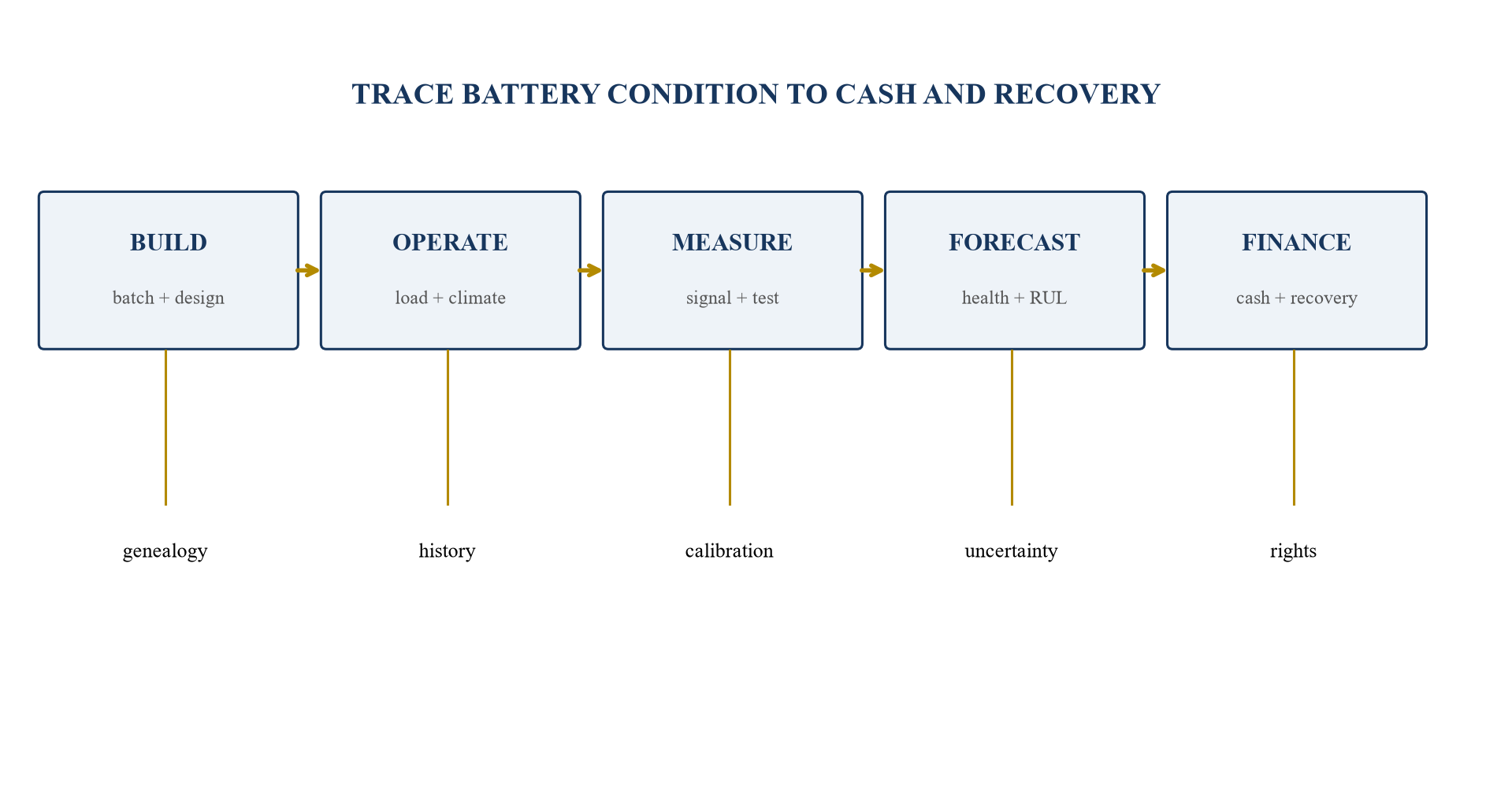
Replace the illustrative chain with controlled identifiers, source systems, rights and decision owners.
The chain should preserve custody and time. A health claim should trace to the relevant battery, measurement, model version, operating history and financial decision. Portfolio averages without genealogy can conceal replacements, missing units and selection bias.
4. Define state of charge, state of health and remaining useful life
State of charge estimates available charge at a point in time. State of health compares a condition metric with a defined reference, often capacity or resistance. Remaining useful life estimates the time, cycles, energy throughput or service until a defined threshold. These concepts should not be used interchangeably.
The threshold depends on application and contract. A vehicle, high-power service, backup system and long-duration storage asset can reach economic end of life at different conditions. Energy capacity can remain acceptable while power, efficiency, safety or availability becomes limiting.
Every reported measure should state definition, unit, reference, method, uncertainty, date and applicability. A percentage without its denominator and test conditions is weak evidence. Financial models should use the measure linked to contracted service and cash.
5. Create the battery health evidence ledger
Table 1. Battery health evidence ledger
| Evidence layer | Controlled record | Finance question |
|---|---|---|
| identity | serial, batch, design and ownership | is the asset in the secured pool? |
| operation | load, charge, temperature and downtime | how was the battery used? |
| condition | capacity, resistance, faults and inspection | what service remains? |
| model | inputs, version, validation and uncertainty | can the estimate be reproduced? |
| contract | warranty, service, maintenance and remedies | who bears deterioration risk? |
| economics | revenue, cost, reserve and recovery | what cash and collateral remain? |
Evidence fields should be adapted to chemistry, design, application and contractual service.
Each record should carry source, timestamp, owner, unit and correction history. Raw signals, derived metrics and management adjustments should remain separate. Missing data should be visible rather than imputed without disclosure.
Two-way traceability matters. Reviewers should move from a debt-sizing assumption to the underlying cohorts and from an individual failure to the model, warranty, maintenance and cash treatment. Reconciliation exceptions should remain open until resolved or reflected in downside protection.
6. Govern operational data provenance
Battery management systems, chargers, vehicles, inverters, fleet platforms and service tools can record voltage, current, temperature, state, faults, energy and events. Sampling, aggregation, clock, calibration and retention differ. Data extraction should preserve the original source and transformation.
Rights should cover access, historical export, continuing telemetry, lender use, servicing, transfer and recovery. Proprietary algorithms can create dependency when the lender or acquirer cannot reproduce health outside the vendor system. Cybersecurity and privacy obligations should be mapped.
Data quality should be scored for completeness, accuracy, consistency, representativeness and relevance. A large field dataset can be misleading if it excludes failed units or periods without connectivity. Transaction disclosure should state coverage and material gaps.
7. Reconcile calendar and cycling ageing
Calendar ageing depends on elapsed time and conditions such as temperature and state of charge. Cycling ageing depends on energy throughput, depth of discharge, rate, temperature and operating boundaries. The mechanisms interact; a simple mileage or cycle count can misstate condition.
The analysis should separate exposure variables and identify the operating regions that drive degradation. Storage at high temperature or high state of charge can matter even when the asset is idle. Frequent shallow cycling can differ from fewer deep cycles with the same throughput.
Forecasts should use application-specific history and physics-informed relationships. Calendar and cycling components should not be double-counted. Operational changes that reduce one form of ageing can alter revenue or availability and should enter the cash model.
8. Build degradation cohorts
Cohorts should group batteries by chemistry, design, manufacture, age, geography, climate, duty cycle, charging, maintenance and intervention. The grouping should be determined before outcomes are selected. Small or changing cohorts should carry wider uncertainty.
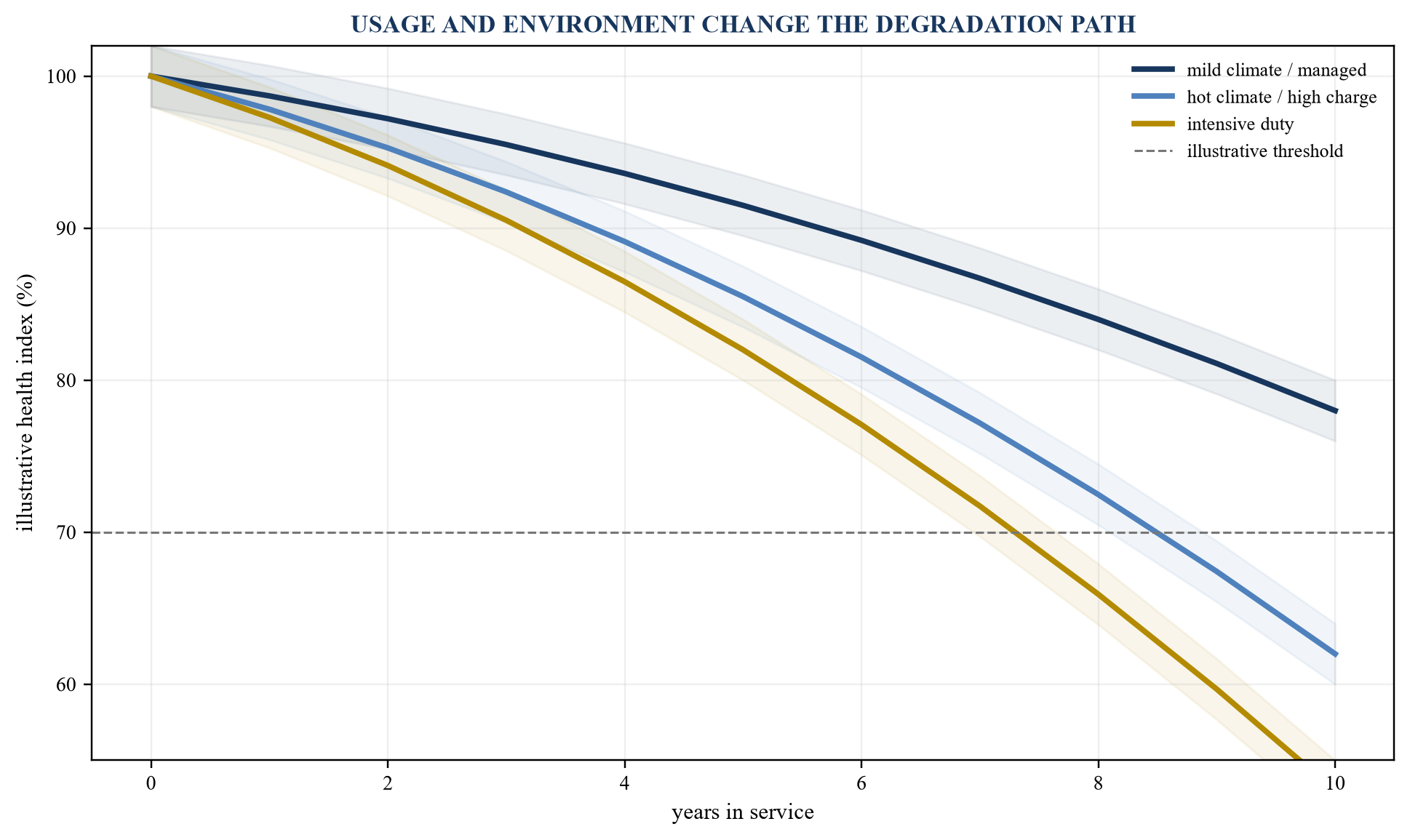
Curves are illustrative; replace with controlled cohort evidence, common health definitions and uncertainty bands.
Cohort reporting should include entry, exit, replacement, missing data and claim maturity. Survivorship bias arises when failed batteries leave the monitored pool. Replaced units should remain connected to their original history and cost.
The financial model should use the cohort relevant to the financed population. Transfer from laboratory or another market requires evidence. A portfolio average should not erase a concentrated weak batch or high-stress subpopulation.
9. Establish measurement-system capability
Capacity, resistance, impedance and power tests depend on equipment, temperature, state of charge, rest time, protocol and calibration. Field estimates can be faster and less intrusive than laboratory tests and can carry greater uncertainty. The measurement system should be validated for the intended decision.
Repeatability and reproducibility should be tested across instruments, sites, operators and time. Reference cells, control signals and independent checks can reveal drift. Firmware or sensor changes should be versioned.
The valuation should distinguish measurement error from true battery variation. A narrow covenant threshold can trigger false breach when measurement uncertainty is ignored. Acceptance bands and retest procedures should be defined in advance.
10. Validate rapid state-of-health diagnostics
Rapid diagnostics can use voltage response, incremental capacity, impedance, temperature and controlled pulses to estimate condition without a full capacity test. The method should state required operating state, duration, equipment, model and applicability domain.
Validation should compare estimates with controlled reference tests across representative chemistry, age, temperature and degradation modes. Average error can conceal poor performance near a warranty or collateral threshold. Calibration and confidence intervals should be reported.
Operational deployment should address missing signals, sensor faults, recent use and unsafe conditions. The diagnostic should invoke retest or expert review when evidence lies outside the validated domain. Speed has value when it enables decisions without weakening reliability.
11. Build the state-of-health model
A state-of-health model can combine physical relationships, observers, statistical methods and machine learning. Inputs should be available at the decision time. Information obtained after failure or through destructive testing should not leak into a production model.
Training and validation sets should separate batteries by batch, time or asset where appropriate. Random record splits can place near-identical observations from the same battery in both sets and overstate performance. Out-of-distribution tests should cover new designs and operating conditions.
The model should report error, bias, calibration and failure modes. Version, data, code, parameters and output should be reproducible. A lender should understand how model error affects warranty, residual value and eligibility rather than rely on a technical accuracy headline.
12. Forecast remaining useful life with uncertainty
Remaining-useful-life forecasts should define the endpoint, horizon and unit. They can estimate time, cycles, throughput or service to a threshold. The model should update as new evidence arrives and should preserve prior forecasts for back-testing.
Table 2. Remaining-useful-life validation scorecard
| Domain | Evidence | Finance relevance |
|---|---|---|
| accuracy | forecast error by horizon and cohort | reserve and value reliability |
| calibration | actual outcomes within predicted ranges | downside confidence |
| timeliness | warning before threshold or failure | intervention and liquidity |
| stability | performance across use and environment | portfolio transferability |
| actionability | maintenance or operating response | realised cash protection |
| governance | version, override and monitoring | covenant integrity |
Thresholds should reflect application, contract, data maturity and financial materiality.
Point estimates should be accompanied by probability distributions or scenarios. Error usually grows with horizon. The financial model should use downside quantiles or stressed cases appropriate to the obligation and should not treat an expected life as a guaranteed life.
Forecasts should distinguish aleatory variation in future use from uncertainty in the model and measurements. A battery can be healthy under one dispatch plan and reach the threshold earlier under another. Scenario inputs should therefore describe future temperature, charging, depth of discharge, power and downtime rather than embed a single opaque usage assumption. Contracted operating controls can narrow this uncertainty when they are enforceable and monitored.
Aggregation requires care. The remaining life of a portfolio is not the average of individual estimates when service depends on the weakest module, container or vehicle. Series and parallel configurations, replacement policy and redundancy change the system endpoint. Financial forecasts should model the level at which revenue, warranty and replacement decisions occur.
The review should also identify censored outcomes. Many batteries will remain in service at the valuation date, so their final life is unknown. Statistical methods and scenarios should recognise this rather than treating current age as completed life. Early portfolios can appear stronger because deterioration has not matured.
13. Back-test model vintages
Back-testing should compare each historical forecast with subsequent observed outcomes using the model and data available at the time. Rebuilding the prediction with newer information can conceal prior error. Vintages should be archived.
Results should be analysed by chemistry, design, age, climate, duty and health range. Systematic optimism near end of life can understate warranty reserves and overstate collateral. False early warnings can increase maintenance and replacement cost.
Model changes should document reason, expected effect and approval. Forecast improvements should be demonstrated on holdout cohorts. Historical errors should inform financial overlays until sufficient new evidence matures.
14. Monitor drift and design change
Models can drift when suppliers, chemistry, cell format, firmware, operating policy, climate, charging or customer behaviour changes. Monitoring should compare inputs, predictions, errors and outcomes across cohorts. A stable aggregate error can conceal a weak new subpopulation.
Change control should define when recalibration or revalidation is required. Temporary overrides should expire and record owner, rationale and outcome. Product changes should preserve lineage.
Financing documents should address model replacement and methodology changes. A borrower should not improve reported collateral by changing the model without controlled approval. Lenders need continuity of definitions and access to evidence.
15. Connect health to service capability
Technical condition should be translated into the service required by the contract. Usable energy, power, response, efficiency, availability and safety can each limit performance. The relevant capability can vary by dispatch profile and season.
The model should simulate or measure service under credible operating conditions. Nameplate energy and a health percentage do not prove deliverable capacity at the required power and temperature. Auxiliary load and system constraints should be included.
Revenue and penalties should follow the service actually available. Operating strategies can protect life by reducing use and can reduce income. The optimisation should show this trade-off rather than assume full revenue and low degradation together.
16. Build the warranty exposure map
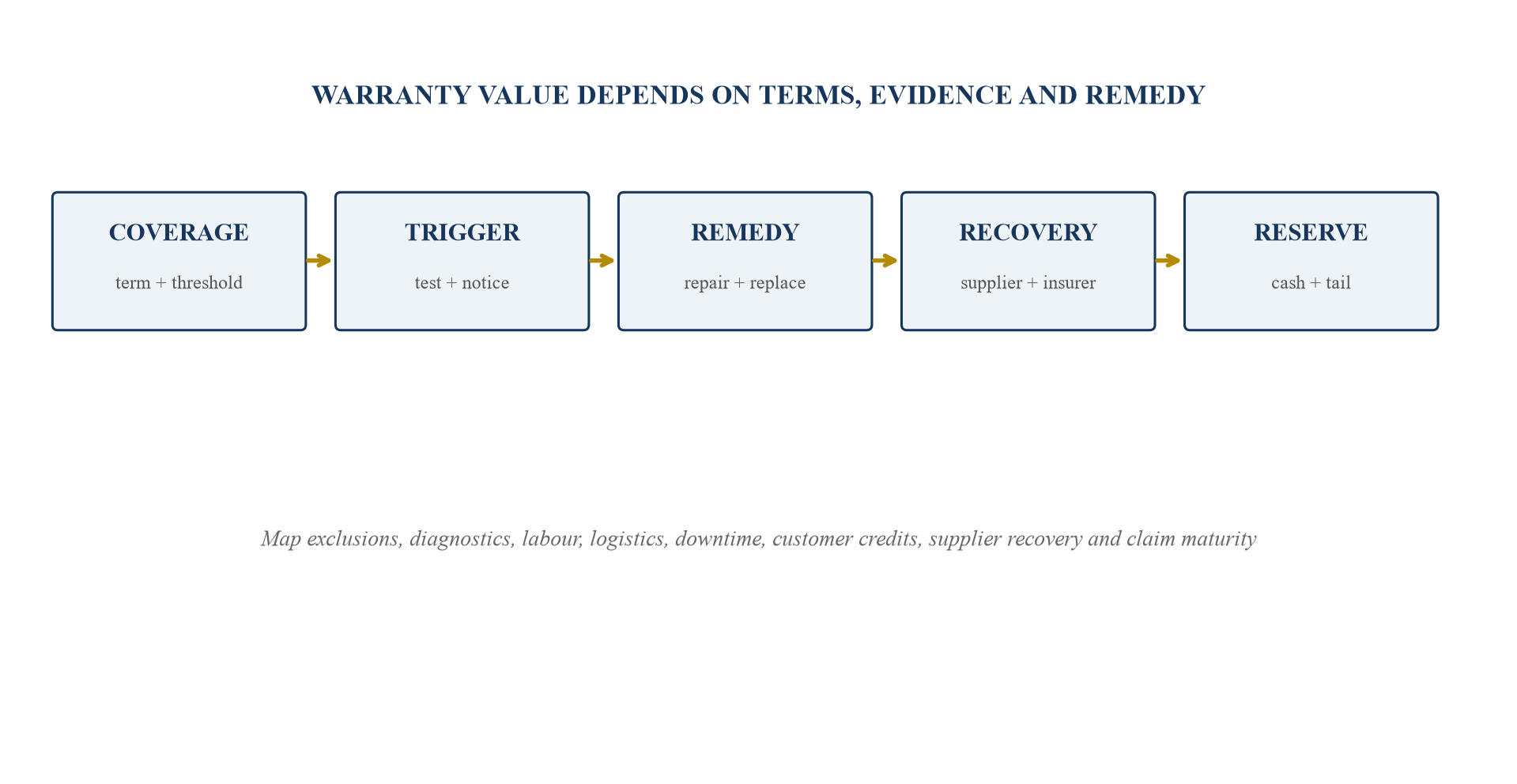
Replace the illustrative map with contract terms, cohort evidence, claim processes and responsible parties.
The map should identify capacity, performance, defect, availability and safety coverage; term and throughput limits; exclusions; required diagnostics; notice; remedy; and responsible party. Supplier warranties may not match obligations given to customers.
Claims should be tracked by cohort, cause, cost, recovery and maturity. A low claim rate can reflect young assets or barriers to making claims. Open investigations and expected future claims should remain visible.
17. Calculate warranty reserves from cohorts
Warranty reserves should connect expected claim frequency, severity, timing, remedy, logistics, labour, downtime and recoveries. Cohort health forecasts can inform exposure while remaining subject to accounting policy and competent review.
The model should distinguish observed claims, incurred-but-not-reported exposure, future deterioration and systemic events. Replacement cost can fall with battery prices and can rise through logistics, redesign or scarce compatible parts. Supplier and insurance recovery should be probability- and timing-adjusted.
Sensitivity should cover adverse batches, hot climates, model bias and delayed remediation. A reserve should not be released solely because a new model reports higher health. Evidence and policy approvals should govern changes.
Contract terms should be translated into measurable exposure. Capacity retention, energy throughput, years, mileage, availability and defect warranties can overlap or terminate at different points. Exclusions for misuse, temperature, charging or unauthorised equipment require operational evidence if they are expected to reduce claims. A legal exclusion without reliable monitoring may offer limited economic protection.
The claim funnel should record notice, diagnosis, acceptance, remedy, completion and recovery. Delays can create customer credits or replacement rentals beyond the hardware cost. Reserves should include the expected path to settlement and should not assume immediate supplier reimbursement.
Portfolio acquisitions require a reserve-opening review. Historical claim practices, goodwill repairs, parts policies and customer behaviour can differ from written terms. The buyer should reconcile reported warranty expense to claims, replacements, inventory and cash and should retain an overlay where history is incomplete.
18. Reconcile maintenance, repair and replacement
Health intelligence creates value when it enables a controlled action. Maintenance can include balancing, thermal repair, firmware, module replacement, operating limits or complete replacement. Each intervention should record condition before and after, cost, downtime and subsequent outcome.
The financial model should distinguish preventive action from failure response. Early replacement can protect service and consume cash sooner. Delayed intervention can increase penalties, collateral impairment or safety exposure.
Repairability depends on design, parts, tools, training, software and warranty. Module-level repair can preserve value when diagnosis and matching are reliable. Intervention assumptions should reflect demonstrated capability and legal rights.
19. Build the residual-value framework
Residual value should begin with the asset and market at the expected sale or recovery date. It depends on condition, remaining service, technology obsolescence, replacement prices, demand, buyer trust, warranty, certification, transport, repurposing and recycling. Technical health is one input.
The valuation should separate continued first use, refurbishment, second use, parts, recycling and disposal. Each path has eligibility, cost, time and liability. The highest gross value is not necessarily the highest net recoverable value.
Comparable transactions require adjustment for age, chemistry, design, geography, condition evidence and market liquidity. Management estimates should be labelled and stressed. A residual guarantee should identify the guarantor and enforceable terms.
Market evidence should be recorded with sale date, condition, configuration, location, warranty, buyer type and transaction cost. Asking prices and broker indications should remain separate from completed sales. Thin markets require wider ranges and may justify independent appraisal or auction testing.
Residual value can also be affected by data credibility. A buyer may pay more for an asset with verified genealogy, complete health history, transferable software and a recognised diagnostic certificate. The uplift should be based on observed market behaviour or a supportable reduction in testing, warranty or risk rather than assumed trust.
The forecast should avoid circularity between residual value and debt. A guaranteed value funded by the same weak obligor that depends on refinancing provides limited independent protection. Guarantor credit, collateral, terms and claim mechanics should be assessed separately.
20. Build the residual-value curve
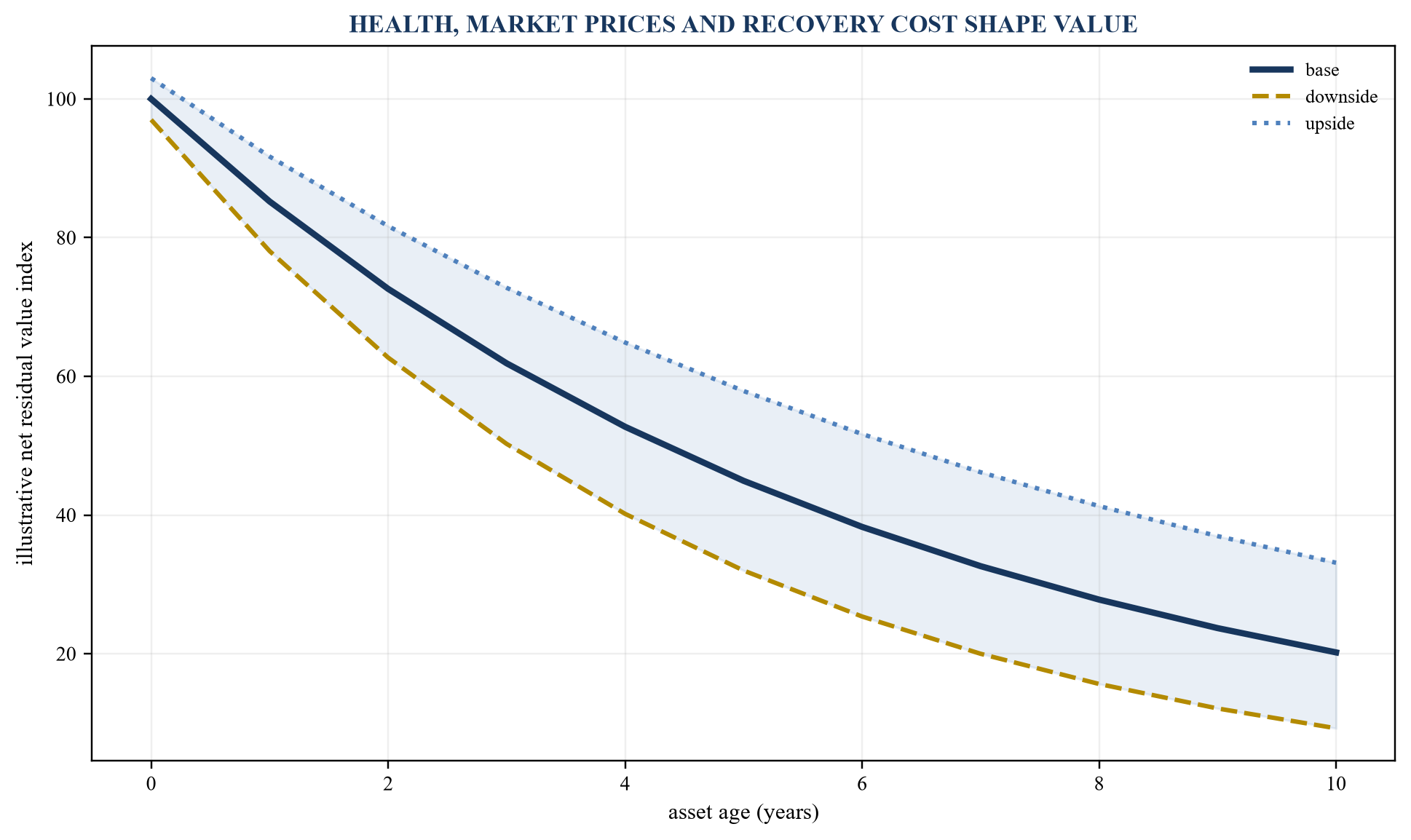
Illustrative values only; replace with verified market evidence, condition, costs, timing and legal recovery rights.
The curve should reflect the passage of time and expected health distribution. Technology and new-battery price declines can reduce value even when technical degradation is mild. Scarcity or strong second-hand demand can temporarily support prices.
Debt analysis should use a stressed net value after enforcement delay, testing, repair, transport, selling cost and tax. The value should correspond to the lender's actual rights and market route. A clean theoretical value should not substitute for recoverable cash.
21. Evaluate continued first use
Continued first use can preserve the highest value when the battery remains integrated with a vehicle, fleet or energy system. The assessment should cover service capability, repair, software, safety, customer demand and remaining contract. Removing a functioning battery can destroy integration value.
Health evidence can support sale, lease extension or refinancing when it is trusted by buyers and financiers. Certification and warranty transfer can reduce information asymmetry. The cost and availability of replacement components should be included.
The forecast should compare continued operation with sale, repurposing and recycling at the same decision date. Revenue, operating cost, degradation and terminal value should be consistent. Continuing an asset solely to avoid recognising impairment is not an economic rationale.
22. Assess second-life eligibility
Second use requires a defined application, condition threshold, safety review, dismantling, testing, sorting, reassembly, controls, certification, installation and warranty. Batteries from different designs or histories may not be compatible. State of health alone cannot establish eligibility.
The process should identify custody, transport, hazardous-material handling, data and liability. Repurposing transfers responsibility for safety, compliance and end-of-life management. The commercial model should include rejected units and uncertain feedstock.
Value depends on competition from new batteries and recycling, available volumes, system integration and customer acceptance. A credible second-life path requires evidence of supply, process yield, performance and net cash. Pilot announcements should remain separate from mature recovery.
23. Compare reuse, recycling and disposal
The route should be selected by condition, application, chemistry, material value, regulation, cost and timing. Reuse can defer recycling and preserve service; recycling can recover material; disposal can create cost and liability. The decision should use net value under applicable obligations.
Table 3. Battery terminal-route decision matrix
| Route | Required evidence | Net-value deductions |
|---|---|---|
| continued use | service capability, repair and market | maintenance, warranty and selling cost |
| refurbishment | diagnostic, parts and validation | labour, downtime, failed repair and requalification |
| second use | safety, compatibility and application | testing, sorting, integration and new warranty |
| recycling | chemistry, mass, recovery and buyer | transport, processing, price and compliance |
| disposal | classification and lawful route | handling, remediation and liability |
Replace qualitative entries with verified eligibility, price, process, cost, timing and liability evidence.
The matrix should be updated as market prices and regulations change. Recycling value can move with critical-mineral prices and chemistry. LFP and nickel-rich batteries can have different material economics. The lender should avoid relying on a route that is uneconomic or unavailable at enforcement.
24. Model market and technology obsolescence
Residual value can decline because newer batteries become cheaper, safer, denser, faster-charging or better integrated. Vehicle and system software, connectors and parts can become unsupported. These risks are distinct from physical degradation.
The model should compare the financed asset with expected replacement alternatives at the recovery date. New-battery prices, policy, customer preference and supply conditions require scenarios. Rapid price cuts can impair used value even when condition is stable.
Obsolescence stress should affect advance rate and amortisation. A long-tenor loan against fast-changing technology requires stronger cash repayment and lower reliance on terminal value. Health monitoring cannot remove market risk.
25. Convert health into cash-flow availability
Cash flow should be built from the service that the battery can deliver. For stationary storage this can include contracted availability, capacity, energy, ancillary services or arbitrage. For fleets and leasing it can include vehicle availability, rental, mileage and resale. Each revenue stream has performance conditions.
The forecast should connect degradation to dispatch, efficiency, downtime, maintenance and replacement. Operating less aggressively can extend life and reduce income. Contract penalties and customer credits should be modelled from the relevant thresholds.
Base, downside and severe cases should state health, market and operational assumptions. Revenue should not remain unchanged while battery capability declines. Replacement capex and liquidity should be timed to the expected intervention.
26. Build the integrated cash and collateral model
The model should reconcile opening assets, additions, operation, deterioration, replacements, disposals and closing eligible collateral. Health cohorts should connect to revenue, operating expense, capex, warranty and terminal value. Units and dates should reconcile with financial reporting.
Collateral eligibility should be tested each period. Assets can leave the pool through sale, failure, missing data, warranty claim, location, lien or condition. Substitution rules should preserve quality rather than allow weak assets to replace strong ones.
Cash and collateral should be viewed together. A borrower can meet near-term debt service while the pool deteriorates. A strong residual pool can still face liquidity stress. The structure should address both risks.
27. Size debt to stressed cash flow
Debt service should be supported by cash after operating costs, maintenance, warranty, replacement, tax and reserves. Coverage tests should use contracted or evidence-based revenue and should account for performance deductions. Merchant upside should receive conservative treatment.
Tenor should fit the period of reliable service and contract visibility. Amortisation can follow expected cash and degradation. A large balloon depends on terminal value and should be stressed for condition, market and enforcement.
The lender should test lower availability, faster degradation, delayed replacement, higher cost and weaker prices together where related. Debt capacity should reflect the downside that the borrower can survive and the lender can monitor.
Cash-flow sizing should reconcile the battery case with the wider obligor and project. Revenue can depend on grid connection, vehicle demand, charger availability, site access, power prices, counterparties and operating capability. Battery health evidence cannot compensate for a missing permit, weak offtaker or unavailable interconnection.
Coverage ratios should define numerator, denominator, period and permitted adjustments. Add-backs for expected health improvement, warranty recovery or refinancing should require strong evidence. Historical and projected ratios should be shown together, with bridge items explaining the change.
The structure should also test replacement concentration. Several cohorts can reach intervention windows together, producing a cash trough even when annual average cost appears manageable. Reserve and amortisation profiles should follow the cohort schedule rather than a smooth percentage of revenue.
28. Size debt to net recoverable value
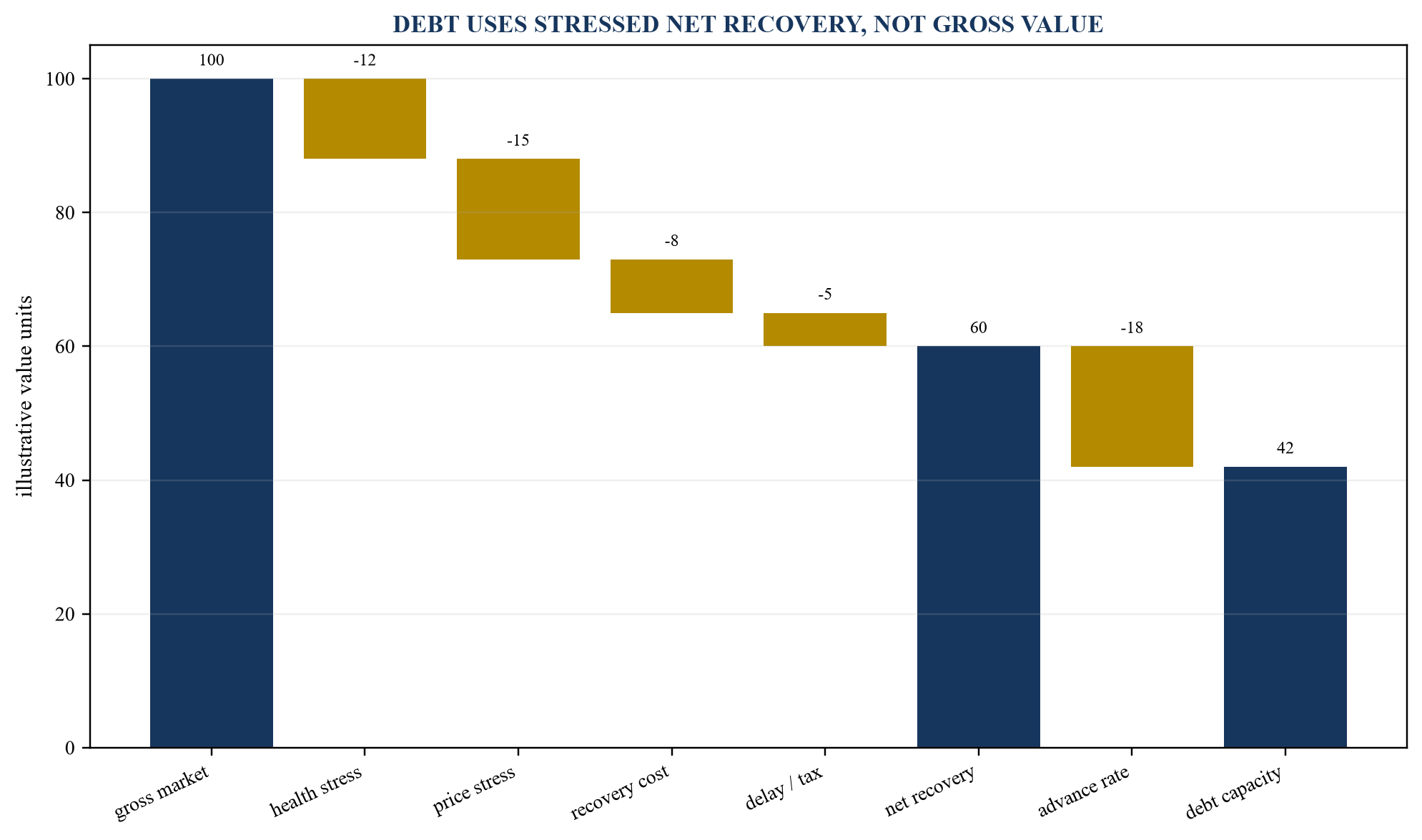
Illustrative values only; replace with verified collateral, rights, health, market, cost, timing and priority evidence.
The collateral model should begin with the assets the lender can lawfully control. It should deduct ineligible units, uncertain condition, market stress, testing, repair, transport, storage, sale, taxes, enforcement delay and senior claims. The advance rate then provides additional protection.
Gross equipment cost or replacement cost should not be used without a recovery route. Values should be reviewed by cohort and location. Concentrated weak assets can matter more than the portfolio average.
Recovery timing matters because condition and market price can change during enforcement. The model should include continued monitoring, preservation, insurance and site costs while control is obtained. Batteries can deteriorate through poor storage even without cycling. A rapid disposal at a distressed price and a slower managed sale should be compared.
The lender should identify who can diagnose, de-install, transport and remarket the assets and whether those providers remain available after borrower default. Specialist access can be constrained across many simultaneous failures. Contracts and estimates should be tested rather than assumed.
Advance rates should vary with evidence quality and liquidity. Assets with complete telemetry, transferable warranty and an active market can support a different haircut from assets with missing data or proprietary dependencies. The methodology should remain documented and consistent across reporting periods.
29. Design eligibility criteria and borrowing bases
Eligibility can require verified identity, title, location, operational status, telemetry, minimum health, warranty, insurance and absence of default. Criteria should be observable and resistant to borrower discretion. Exceptions should be limited, approved and reported.
The borrowing base should update for additions, deterioration, sale, replacement and missing data. Haircuts can reflect age, cohort, market, concentration and health uncertainty. A model change should not automatically increase availability.
Reporting should reconcile the borrowing base to the asset register, ledger and financial statements. Independent sampling can test the population. Cure mechanisms should preserve lender protection without forcing unnecessary asset disruption.
30. Build reserve accounts and liquidity protection
Reserves can cover debt service, maintenance, warranty, replacement, insurance, taxes and end-of-life costs. The sizing should follow expected and stressed cash needs, claim maturity and replenishment rules. Restricted cash should remain separate from operating liquidity.
Replacement reserves should consider cohort timing and compatible supply. A falling battery price can reduce unit cost while simultaneous replacements create cash concentration. Logistics and installation can control the schedule.
Liquidity triggers should act before service or collateral collapses. Cash sweeps, distribution locks and additional funding commitments can protect the structure. Terms should define release conditions using reproducible evidence.
31. Design battery-health covenants
Table 4. Battery-health covenant framework
| Covenant | Measure | Potential response |
|---|---|---|
| data coverage | eligible assets with complete telemetry | cure, exclusion or reserve |
| cohort health | distribution against approved threshold | maintenance, replacement or amortisation |
| forecast error | back-test performance by horizon | overlay, revalidation or model replacement |
| warranty exposure | claims and reserve adequacy | reserve top-up or cash lock |
| collateral value | stressed net recovery and advance rate | prepayment or additional collateral |
| concentration | batch, design, site and obligor limits | eligibility haircut or diversification |
Thresholds and remedies should reflect portfolio evidence, model uncertainty and legal enforceability.
Covenants should use stable definitions, sources and calculation agents. Thresholds need buffers for measurement and model uncertainty. Automatic breach from a trivial model fluctuation can create avoidable instability.
Remedies should match the risk and preserve safety. Maintenance, additional testing, reserve, replacement, amortisation and distribution lock can be staged. Covenant amendments should retain an evidence trail.
Health covenants should consider distributions rather than a single average. Percentiles, weak-cohort concentration and assets below thresholds can reveal risk earlier. The denominator should include all relevant assets, including missing-data units where the documents require conservative treatment.
Triggers should distinguish a short data outage from genuine deterioration. Cure periods can allow telemetry restoration or independent testing while preventing new borrowing against uncertain assets. Persistent missing data should lead to exclusion or protection rather than indefinite management adjustment.
Information undertakings should require model-validation reports, claim data, incident notice, maintenance records and forecast-versus-actual comparisons. Lender consent rights should focus on material changes to design, use, software, warranty and operating limits that can alter health or recovery.
32. Govern model use in financing documents
Financing documents should identify the approved health and remaining-life methodology, version-control process, data rights, reporting, validation and independent review. The calculation agent and dispute process should be clear. Material changes should require defined approval.
The structure should address model unavailability, vendor failure, missing telemetry and cyber incident. Fallback calculations can use conservative eligibility or physical tests. The borrower should maintain access and export capability.
Model outputs should support, not replace, legal rights and operational evidence. A lender needs asset control, contracts, insurance and recovery processes. Technology should make those protections measurable and timely.
33. Account for concentration and correlated model risk
Battery portfolios can share manufacturer, batch, chemistry, climate, charging policy, firmware, site or operator. These correlations can produce simultaneous deterioration or claims. Diversification should be tested by underlying drivers rather than asset count.
Model error can also be correlated when the same algorithm and data weakness affect every asset. Stress tests should apply bias to the full relevant cohort. Independent diagnostics can reduce reliance on one method.
Concentration limits, haircuts, reserves and insurance can address exposure. The model should show which risk the protection covers and which remains with the lender or investor.
Stress design should begin with causal drivers. A hot-weather event can increase degradation, cooling load, downtime and power cost together. A firmware error can affect a complete installed population. A supplier defect can create claims, replacement demand and parts scarcity. Combining only independent percentage shocks can understate these pathways.
Correlation can change with time. Assets that appeared diversified at origination can converge through common software, operating policy or replacement component. Monitoring should update the concentration map when the portfolio changes. Acquisitions and substitutions should be assessed before entry into the collateral pool.
The lender should also examine concentration in evidence providers. One diagnostic vendor, cloud platform or data gateway can become a single point of failure. Fallback access, export, escrow, alternative testing and contractual continuity can reduce this operational dependency.
34. Integrate insurance and supplier recovery
Insurance can cover physical damage, business interruption, warranty or performance under specific terms. Policies, exclusions, deductibles, limits, insurer credit and claim processes should be reviewed. Insurance should not be presented as complete protection when degradation or model error is excluded.
Supplier warranties and service agreements can provide repair or replacement. Recovery depends on enforceable terms, evidence, notice, solvency, logistics and timing. Customer obligations may be broader than supplier recovery.
The cash model should show gross claims, recoveries and delays separately. Concentrated supplier failure should be stressed. Rights should be assignable or accessible to the secured party where required.
35. Prepare the lender data room
Table 5. Battery asset and financing data room
| Workstream | Core evidence | Verification test |
|---|---|---|
| assets | register, genealogy, title and location | reconcile secured population |
| condition | telemetry, tests, faults and interventions | reproduce selected health claims |
| models | data, version, validation and back-tests | replay state and RUL estimates |
| contracts | revenue, warranty, service and insurance | trace risk allocation and remedies |
| finance | cash, reserves, debt and collateral | reconcile coverage and borrowing base |
| recovery | access, removal, market and end-of-life | test net realisable route |
Access should be controlled and evidence reconciled to source systems.
Summaries should link to source records. Material failures, data gaps, model exceptions, warranty disputes, safety events and liens should be disclosed with context. Versions and dates should remain controlled.
Reviewers should sample assets independently across strong, weak and missing-data cohorts. Site observation should compare documented and actual access, maintenance and telemetry. Open issues should state materiality, owner, remedy, cost and completion evidence.
36. Run independent technical and financial diligence
Technical diligence should test genealogy, measurement, models, degradation, safety, service capability and interventions. Financial diligence should test contracts, revenue, costs, reserves, residual value, debt service and recovery. Both should use the same asset population and dates.
A technically healthy battery can have weak value if rights, market or integration are missing. A strong contract can fail when assets cannot deliver service. Joint reviews should identify the variables that determine both performance and cash.
Findings should enter eligibility, valuation, structure, covenants, conditions and monitoring. A technical appendix that does not change a financing assumption has limited decision value.
37. Monitor the portfolio after closing
Monitoring should report asset count, data coverage, health distribution, remaining life, service, faults, maintenance, claims, replacements, cash, reserves and collateral. Changes since the prior period should be reconciled. Cohort migration should remain visible.
Exceptions should identify cause, owner and expected resolution. The lender should receive enough detail to test calculations while respecting data protection and cybersecurity. Independent reviews can increase when thresholds weaken.
Monitoring should update forecasts and compare them with actuals. Persistent optimism should trigger overlays or methodology review. Stronger evidence can support controlled release of protection under the documents.
38. Plan enforcement and recovery before closing
Recovery planning should identify notice, access, control, software, site rights, removal, transport, storage, testing, repair, sale, reuse, recycling and disposal. Safety and environmental duties continue during enforcement. Local laws and contracts can delay action.
The plan should name service providers, markets, costs and timelines. A theoretical buyer should not support collateral without evidence of transaction capability. Recovery drills or desktop exercises can expose dependencies.
Net recovery should reflect senior claims, taxes, fees and deterioration during delay. The lender should understand which assets are movable and which depend on an operating platform. Financing structure should follow that reality.
Site and infrastructure dependencies should be mapped at physical and contractual levels. Removal may require landlord consent, grid shutdown, cranes, hazardous-material procedures, manufacturer tools or software credentials. Fixed systems can suffer damage or lose certification when moved. The recovery value should reflect the feasible process.
The plan should distinguish an operating sale from piecemeal enforcement. An operating platform can preserve contracts, staff, software and site value and can require working capital or an administrator. Piecemeal sale can be faster and may lose integration value. The chosen downside should match legal rights and credible buyers.
Environmental and end-of-life obligations should be included through completion. The secured party may face duties for safe storage, transport and disposal even when gross proceeds are weak. Qualified contractors, emergency procedures and cost estimates belong in the closing diligence.
39. Use a one-hundred-day financeability plan
The first phase should reconcile the asset, rights and data perimeter. The second should validate diagnostics, cohorts and remaining-life models. The third should connect health to service, warranty, residual value and cash. The final phase should approve debt sizing, protection and monitoring.
Accountable engineering, operations, finance, legal and risk owners should use one evidence ledger. Weekly reviews should close material gaps and preserve definitions. Independent challenge should focus on the claims controlling debt and recovery.
Readiness is reached when central health, warranty, value, cash and collateral claims can be reproduced from controlled records. Uncertainty can remain when it is explicit, stressed and addressed through structure.
40. Conclusion
Battery remaining-useful-life intelligence can improve warranty, residual-value and lending decisions by connecting identity, operating history, measurement, models and service outcomes. Value is defensible when forecasts are validated by cohort, uncertainty is explicit and model outputs lead to controlled cash or risk actions. A health percentage alone is insufficient.
Boards and lenders should distinguish state of charge, state of health and remaining useful life; define the relevant endpoint; preserve genealogy; back-test model vintages; and monitor drift. Warranty, continued use, second life, recycling and recovery should be valued as distinct routes with rights, costs, timing and liabilities.
Debt should be sized to stressed cash flow and net recoverable value. Eligibility, reserves, covenants, insurance and monitoring should use stable evidence and include model uncertainty. This framework turns battery telemetry into a decision-ready view of service, obligation, liquidity, collateral and lender protection.
The framework should be applied proportionately. A small homogeneous fleet with short tenor and strong manufacturer support can use simpler monitoring than a multi-chemistry, multi-site portfolio with merchant revenue and long residual exposure. Simplicity remains credible when definitions, evidence and downside are clear. Complexity in a model should be justified by a material improvement in decision quality.
Health intelligence should also improve incentives. Operators should understand how charging, temperature, dispatch and maintenance affect service, warranty and financing. Contractual rewards or restrictions can align use with asset value when they are measurable and commercially appropriate. Lenders should avoid controls that create unsafe operation or destroy revenue merely to preserve a technical metric.
As portfolios mature, actual outcomes should replace broad assumptions. Claim cohorts, resale transactions, recovery exercises and model back-tests can refine reserves, values and advance rates. Governance should preserve earlier forecasts so that improvement is measurable. Strong evidence can support more efficient capital; weak or missing evidence should produce explicit protection rather than optimism.
The final financing case should show which facts are observed, which outputs are modelled and which values remain subject to market execution. Owners, review dates and decision consequences should accompany each material assumption so that monitoring can identify change before cash or collateral protection becomes impaired.
The evidence should remain reproducible.
References
- International Energy Agency, Global EV Outlook 2026: Electric vehicle batteries, https://www.iea.org/reports/global-ev-outlook-2026/electric-vehicle-batteries
- International Energy Agency, Global EV Outlook 2026: Trends in electric cars, https://www.iea.org/reports/global-ev-outlook-2026/trends-in-electric-cars
- International Energy Agency, Battery Circularity, https://www.iea.org/reports/battery-circularity
- International Energy Agency, Vehicle-to-grid technology, https://www.iea.org/reports/vehicle-to-grid-technology
- International Energy Agency, Global EV Outlook 2025: Electric vehicle batteries, https://www.iea.org/reports/global-ev-outlook-2025/electric-vehicle-batteries
- International Energy Agency, Electric Vehicles Total Cost of Ownership Tool, https://www.iea.org/data-and-statistics/data-tools/electric-vehicles-total-cost-of-ownership-tool
- National Renewable Energy Laboratory, Battery Lifespan, https://www.nrel.gov/transportation/battery-lifespan.html
- National Renewable Energy Laboratory, Battery State of Health Estimator, https://www.nrel.gov/docs/fy25osti/91880.pdf
- National Renewable Energy Laboratory, Models for Battery Reliability and Lifetime, https://www.nrel.gov/docs/fy13osti/58550.pdf
- United States Department of Energy, Electric Drive Vehicle Battery Recycling and Second Life Applications Selections, https://www.energy.gov/sites/default/files/2022-11/Recycling%20and%20Second-Use%20Selections%20Factsheets%2011-16.pdf
- United States Department of Energy, Alternative Fuels Data Center: Batteries for Electric Vehicles, https://afdc.energy.gov/vehicles/electric-batteries
- United States Department of Energy, Battery Second Life Frequently Asked Questions, https://cleancities.energy.gov/files/u/publication_orders/publication/115/attachment/battery_second_life_faq_optimized.pdf
- United States Department of Energy, National Blueprint for Lithium Batteries 2021-2030, https://www.energy.gov/sites/default/files/2021-06/FCAB%20National%20Blueprint%20Lithium%20Batteries%200621_0.pdf
- Argonne National Laboratory, BatPaC Model Software, https://www.anl.gov/amd/batpac-model-software
- National Renewable Energy Laboratory, Multi-Scale Modeling of Battery Physics, https://www.nrel.gov/transportation/multi-scale-battery-physics-modeling.html
- European Union, Regulation (EU) 2023/1542 concerning batteries and waste batteries, https://eur-lex.europa.eu/legal-content/EN/TXT/?uri=CELEX:32023R1542
- United Nations Economic Commission for Europe, UN Regulation No. 100, https://unece.org/transport/documents/2023/05/standards/un-regulation-no-100-rev3
- United Nations, Recommendations on the Transport of Dangerous Goods, Manual of Tests and Criteria, subsection 38.3, https://unece.org/transport/dangerous-goods/rev7-files
- National Institute of Standards and Technology, Artificial Intelligence Risk Management Framework 1.0, https://www.nist.gov/itl/ai-risk-management-framework
- National Institute of Standards and Technology, AI Risk Management Framework Playbook, https://airc.nist.gov/airmf-resources/playbook/
- International Organization for Standardization, ISO 9001 Quality management systems, https://www.iso.org/standard/62085.html
- International Organization for Standardization, ISO/IEC 42001 Artificial intelligence management systems, https://www.iso.org/standard/81230.html
- International Electrotechnical Commission, IEC 62660 secondary lithium-ion cells for electric road vehicles, https://webstore.iec.ch/en/iec-search/result?query=IEC%2062660
- International Electrotechnical Commission, IEC 62933 electrical energy storage systems, https://webstore.iec.ch/en/iec-search/result?query=IEC%2062933
- International Valuation Standards Council, International Valuation Standards, https://ivsc.org/standards/
- Basel Committee on Banking Supervision, Principles for the Management of Credit Risk, https://www.bis.org/publ/bcbs75.htm
