

1 Frame the financing decision
An investment committee considering power from orbit faces several decisions that are often compressed into one proposal. It may be asked to fund a wireless-power component, a satellite demonstrator, a ground receiver, a first integrated generating system or a repeatable fleet. Each decision has its own evidence standard, capital need and potential buyer. The first task is to specify what asset is being financed and what measurable output it must deliver. A sponsor should identify the point where electricity becomes metered, the party responsible for each loss between sunlight and that meter, and the customer that will pay for the resulting energy or capacity.
The technology chain is conceptually simple: collection, conversion, wireless transmission, reception, reconversion and grid or behind-the-meter supply. Its commercial chain includes launch services, orbital operation, replacement, spectrum and safety permissions, site rights, grid access, power sales and end-of-life obligations. These links cannot be valued as if they were a conventional solar plant with an extra transport cost. A terrestrial project generally has equipment that can be inspected and replaced on site. A space-based system adds remote assembly or deployment, long-duration operation, beam control, and a receiver with its own land and connection requirements. The sponsor must present the complete chain before claiming that the project can earn electricity revenue.
This paper's finance test asks five questions in order. What has been demonstrated at the required scale and operating condition? Which rights allow the system to be launched, operated, transmitted and received? Who builds and maintains each component, with what remedies for failure? What metered product is sold under an enforceable contract? What capital structure can absorb construction delay, technology underperformance and counterparty default? A negative answer at an early gate calls for a different funding instrument or a narrower experiment. The questions are author-developed analytical proposals; they do not describe an approved project.
2 Read technical claims within the evidence
NASA's 2024 assessment modelled two conceptual systems for possible operation in 2050 and compared their levelised cost and emissions against terrestrial alternatives under stated assumptions [1]. It identified important capability gaps, including large-system assembly and maintenance, autonomous operation and efficient power beaming. Its analysis did not certify a commercial system or establish that one design will be financeable. NASA's results are useful as a challenge to unsupported cost claims because the comparison includes more than the launch price. A sponsor should disclose where its architecture differs from NASA's model and why a lower-cost assumption is justified.
The UK Department for Energy Security and Net Zero published a 2025 feasibility study in February 2026 that explored smaller-scale systems as a possible route to early adoption in the 2030s [2, 3]. The commissioned study evaluates designs, a minimum viable system, potential grid benefits and financial feasibility under illustrative support mechanisms. It is a feasibility exercise with developer inputs and modelled future costs. The report's own sensitivity analysis attributes 55.5 percent, 62.9 percent and 64.0 percent of modelled levelised-cost variance to launch cost in its respective 2030, 2035 and 2040 cases [3]. Those percentages describe influence within that model. They are not observed cost shares in an operating station.
Caltech reported an experimental wireless-power demonstration in space and detection of transmitted power on Earth in 2023 [4]. The result matters because it tests a component of the chain in a relevant environment. It provides no evidence of utility-scale energy delivery, long-term reliability, commercial conversion efficiency or a bankable price. The investment committee should keep laboratory, orbital demonstration, integrated pilot and commercial operation as separate evidence states. A claim supported at one state should not be relabelled as support for the next without an identified test.
3 Define the delivered product and system boundary
Before costing the system, define whether the customer buys kilowatt-hours, firm capacity, availability, emergency supply, geographic diversity or a combination. The metered point might be the rectenna output, a grid delivery point or a behind-the-meter connection. Each choice assigns conversion losses, curtailment and transmission charges differently. For a multi-country beam schedule, the same spacecraft may serve different receivers at different times. The project cannot sell the same capacity twice. The sponsor should reconcile satellite availability, beam windows, receiving-site availability and contract dispatch rights in a single hourly model.
The system boundary should include launch and deployment, satellites and replacement modules, beam-forming equipment, ground receiving arrays, conversion equipment, grid interconnection, control systems, insurance where available, end-of-life disposal and contingency. A lower quoted price for a satellite subassembly cannot be compared directly with the total cost of delivered electricity. NASA and the UK study use different architectures and assumptions [1, 3]; a sponsor should avoid splicing the least expensive element of each into a synthetic project. The engineering lead should own the physical energy balance. Finance should use exactly that version, with configuration control and signed revisions.
Delivered output requires a chain of efficiencies and availabilities. Solar collection, electrical conversion, beam formation, atmospheric transmission, ground reception, reconversion and grid delivery each reduce net output. Where a calculation assumes an ideal or future performance level, the model should show the source and a test date. It should also separate routine degradation from outages caused by control errors, servicing constraints or receiver unavailability. An annual capacity factor is an output of this model, not an input chosen to match a tariff. The hypothetical numerical example later in this paper uses a simplified net capacity factor solely to demonstrate the financial sensitivity.
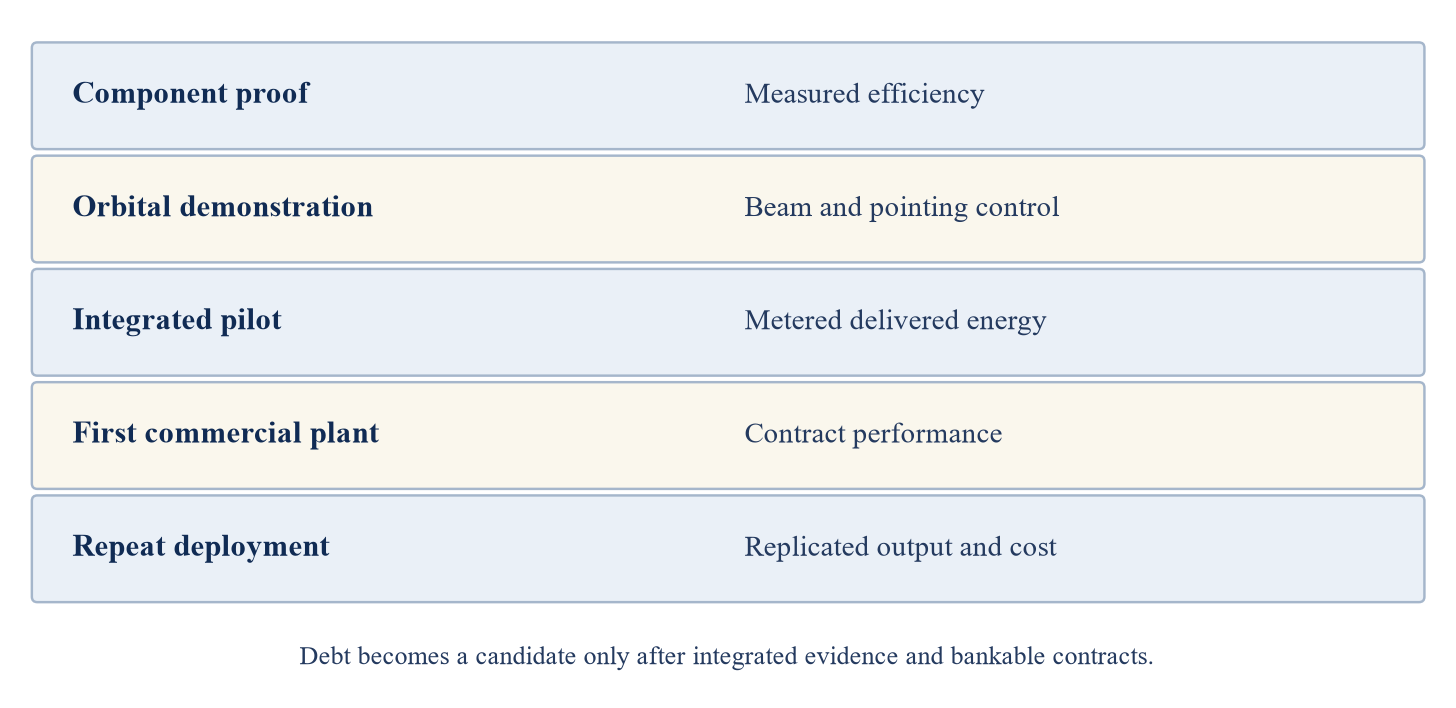
Author-developed stage gates. The stages are not a claim that any project has completed them.
4 Separate technology readiness from project readiness
A readiness score should be attached to a defined subsystem, configuration and environment. A transmitting array may have measured laboratory efficiency while deployment, beam steering and safety controls remain unproven at scale. A high score for one component cannot average away a failure at a critical interface. The IEA's innovation framework distinguishes concept validation, prototypes, pre-commercial demonstration, first-of-a-kind operation and commercial integration [10]. That sequence offers an evidence vocabulary; it is not a certification of any space-power design. A project readiness assessment should identify the lowest-maturity critical path and the experiment that could retire it.
The financing instrument should match the activity. Research grants, philanthropic or corporate research budgets and early venture equity can pay for component tests. Strategic equity and public co-funding may support a demonstrator with clearly bounded objectives. A first integrated plant may require large development equity, a defined public contribution and conditional commercial commitments. Traditional non-recourse construction debt relies on a more complete revenue and risk allocation than a research demonstration can offer. These are proposed financing categories, not a claim that a named lender has agreed to participate.
At each stage, define the evidence product before spending the money. A component test might produce calibrated efficiency curves under stated conditions. An orbital demonstrator might produce beam-control logs and independent receiver measurements. A grid pilot should produce metered delivered energy and outages over an agreed period. A first plant should additionally document construction cost, operating expense, availability and contract performance. Test protocols should be established before results are known. Investors should receive failure data as well as successful trials, with an explanation of design changes and retest requirements.
5 Underwrite launch as an integrated cost and schedule risk
Launch expenditure is not a single cost per kilogram. The sponsor needs a manifest linking each satellite and module to mass, packaging, number of launches, orbital destination, deployment sequence, spares and replacement plans. It should identify which contractor bears losses caused by failed launch, delayed launch, partial deployment or damage in orbit. A quoted transportation price may exclude payload integration, insurance, mission assurance, delays and replacement hardware. Financing draws should correspond to milestones the project company can inspect and accept. A lender should ask whether a replacement launch slot is realistically available inside the contracted delivery timetable.
The UK study's model sensitivity highlights launch as a major driver of its projected cost distribution [3]. A prospective project should run its own bottom-up sensitivity rather than import the study's percentage. Let total launch cost equal the mass per generation unit times the contracted price per delivered kilogram, adjusted for launches, contingencies and expected replacement. That identity is a starting point. It omits the timing effect of later replacement and the consequences of losing a launch during construction. A risk model should convert those events into delayed metered output, additional capital calls and changed debt-service dates.
Launch providers can supply schedule options, performance envelopes and contractual remedies. None should be assumed until the executed agreement, technical interface and payment terms are reviewed. A launch reservation may be an option on capacity rather than a guarantee of an on-time commercial plant. Conversely, an investor may value a modular design if a missed launch affects only part of expected output. The sponsor should quantify the trade-off between modularity, redundancy, additional launches and operations complexity. The physical design determines whether replacement units can be integrated safely without redesigning the receiver and control system.
6 Price transmission and the receiving estate
Wireless transmission is the project's unique operating interface. Diligence should identify the transmission method, power level, pointing and control method, shut-off requirements, spectrum treatment, interference analysis, weather assumptions and monitoring evidence. The system's safety case must be assessed by qualified specialists and the competent authorities. A promise that a beam can be redirected between countries does not create lawful spectrum access or a permitted receiving site. The investment memorandum should attach a permission matrix to each proposed country and specify which approval is already granted, applied for, or only contemplated.
The receiver has ordinary infrastructure burdens that can be underestimated in an orbital narrative. Land acquisition or rights, site preparation, environmental and planning assessment, security, grid connection, conversion equipment, access roads and long-term maintenance need their own cost and schedule. Receiver size and location influence the energy delivered and who can buy it. A rural site might ease land assembly and face higher transmission cost. A site near a large customer might have greater land and safety complexity. Compare alternatives on delivered cost at the same meter, not on the apparent cheapness of the ground lease.
The International Telecommunication Union's Radio Regulations provide the global framework for managing radio-frequency use. WRC-23 Resolution 910 calls for studies concerning possible frequency bands for beam and non-beam wireless-power transmission to avoid harmful interference [6]. That study mandate should not be presented as an issued project licence or universal allocation for a proposed power beam. National implementation and project-specific approvals require specialist confirmation. The UK government's orbital-operator guidance identifies relevant licensing, spectrum, safety, liability and insurance considerations for a UK-linked operator [5]. Applicability depends on actual operator, activity and jurisdiction.
7 Treat sovereign offtake as a contract question
A public authority may be interested in energy security, technology development or resilient power. Interest has limited financing value until it becomes a defined obligation of a creditworthy party under an authorised agreement. A sovereign or state utility may buy delivered energy, support a regulated tariff, procure availability, fund a demonstration or provide a guarantee. Those are different cash-flow and risk structures. The sponsor should identify the legal buyer, procurement route, budget authority, currency, payment source, termination regime and dispute forum. A memorandum of understanding should be described according to its binding clauses, not promoted to a bankable power purchase agreement.
A conventional PPA identifies seller, buyer, product, delivery point, price, term, conditions, billing and remedies. The World Bank's project-finance resources emphasise the centrality of the PPA and the role of credit support for public or quasi-public offtaker obligations [9]. Space power adds questions: what happens if the beam is available but the ground receiver is not, if a foreign receiver becomes unavailable, or if an orbital unit can deliver only partial power? The contract needs an objective metering protocol and clear treatment of curtailment, deemed energy, force majeure, commissioning tests and performance degradation. A cross-border supply arrangement also needs an accountable operator and a lawful commercial route in each location.
Sovereign credit support should be tailored to a defined obligation. A guarantee that pays late invoices may not cover cancellation before completion, political restrictions on beam operation or a currency-convertibility event. A lender should test payment mechanics and enforceability with jurisdiction-specific counsel. Investors should assess contingent public liabilities openly. A proposed public backstop can shift risk rather than remove it. The project should disclose whose balance sheet ultimately bears launch failure, inadequate energy delivery and technology obsolescence.
8 Avoid assuming tariff eligibility
The UK commissioned study explores potential financial feasibility under support mechanisms including contracts for difference [3]. That is a modelled policy pathway. It does not make a space-power project automatically eligible for an existing allocation round. DESNZ's CfD framework ties awards to specified eligible generation technologies, application tests and round rules [8]. A sponsor proposing SBSP should obtain a current policy and legal assessment for the exact technology and project. Its base case should state whether the assumed support exists, is proposed or remains a request for policy change.
An offtake term can also be shorter than the asset's modelled life. A hypothetical twenty-five-year spacecraft economics case supported by a shorter fixed-price contract has merchant exposure after contract expiry. The sponsor must forecast that period separately and test a zero or conservative residual value. It should not fill the gap by assuming an extension at the same tariff. Similarly, an availability payment does not equal an energy payment. Where public value includes security of supply or geographic diversity, the procurement instrument should explicitly purchase those attributes with measurable service standards.
The affordability test should compare delivered cost with the relevant system alternatives and policy objectives. NASA's comparative modelling showed its examined concepts more expensive than terrestrial sustainable alternatives under its assumptions [1]. The UK study investigated the potential value of dispatchability, predictability and geographic flexibility in an early-market design [3]. These are distinct analyses. A sponsor should commission an independent system-value assessment using the target country's demand and grid conditions, with counterfactuals such as terrestrial renewables plus storage, interconnection, demand response and firm low-carbon generation. A technology can offer differentiated service and still be too costly for the proposed buyer.
9 Establish a reproducible cost model
A finance model should begin with a bill of quantities and a physical energy model. Capital rows should include payload engineering, satellite production, launch, deployment, ground receiver, conversion, grid connection, control systems, contingency and financing costs during construction. Operating rows should include staff, ground maintenance, orbital operations, replacements, spectrum and site obligations, insurance and end-of-life provision. Where insurance is unavailable or excludes a risk, the model needs a funded reserve or an explicit uncovered exposure. The sponsor should preserve the date, source and uncertainty range for each cost input.
Use a cost bridge between today's demonstrated configuration and the proposed commercial configuration. Learning curves and mass reductions require an engineering explanation, suppliers' evidence and a production schedule. A projection of launch-price decline should be tested at a flat price and at an adverse price. The UK study's Annex A sets out its capital recovery and levelised-cost methodology, including capex, fixed operating expense, capacity factor and hurdle rate [3]. This paper adopts the same broad accounting logic for its own teaching example. It does not import the study's project values or claim its scenario is an independently verified quote.
Unit economics should be tested at the meter. If annual net energy is lower than expected because one receiver is delayed, the revenue loss can be disproportionate to the reduction in capital cost. Capacity, transmission and offtake schedules should be modelled hour by hour for a commercial financing case. A high-level annual result is useful for screening and inadequate for debt sizing. The model should show real and nominal currency consistently, separate taxes and subsidies, and identify which party pays for grid losses. The investment committee should be able to reproduce the result from a small set of approved inputs.
Table 1. Proposed model inputs and required evidence
| Model input | Primary evidence request | Downside test |
|---|---|---|
| Net delivered output | Signed energy balance and pilot meter protocol | Losses, outage, receiver delay |
| Launch cost and timing | Manifest, binding quote and slot terms | Reflight and late delivery |
| Satellite build cost | Supplier scope and manufacturing plan | Yield loss and redesign |
| Ground capital | Site, connection and equipment estimates | Permitting and grid delay |
| Operating expense | Service plan and maintenance contracts | Replacement and insurance gap |
| Revenue price | Executed offtake or authorised tariff | Lower price and shorter term |
| Cost of capital | Investor and lender term sheets | Debt unavailable or repriced |
Author-developed diligence matrix. The evidence column is a proposed request, not a statement that documents exist for any project.
10 Use a deliberately hypothetical valuation test
Consider a fictional system with 250 MW of net delivery capability at the chosen meter. For illustration only, assume a 65 percent annual net capacity factor, capital expenditure of USD 4.0 billion at commercial operation, annual fixed operating expense of USD 60 million, a twenty-five-year operating period, a 9 percent nominal discount rate, no taxes, no inflation, no residual value and no construction-period delay. These are author-selected teaching inputs. They are not market quotes, observed SBSP performance, a sponsor forecast or an estimate of an available mandate. Their simplicity makes the arithmetic transparent while excluding major real-world uncertainties.
The assumed annual energy is 250 MW times 8,760 hours times 65 percent, or 1,423,500 MWh. A 9 percent, twenty-five-year capital recovery factor is approximately 10.18 percent. Annual capital recovery is about USD 407.2 million; adding USD 60 million of operating expense gives USD 467.2 million. Dividing by the assumed output yields a screening break-even price of about USD 328.22 per MWh. This is a price required by the fictional model under its assumptions. It excludes taxes, financing fees, construction-period interest, working capital, major replacement and risk reserves. Including those items would change the result.
The same assumptions give an illustrative NPV of approximately negative USD 2.49 billion at USD 150/MWh, negative USD 1.09 billion at USD 250/MWh and positive USD 0.30 billion at USD 350/MWh. The NPV is computed as the present value of annual revenue less annual fixed operating expense, minus initial capital. These scenarios are not prospective tariff recommendations. A real investment case would require probability-weighted technical and policy outcomes, explicit construction cash flows, decommissioning, tax, inflation, debt covenants and likely a different output profile over time. The point of the exercise is to show how much of the investment case sits in contracted price, delivered energy and capital cost.
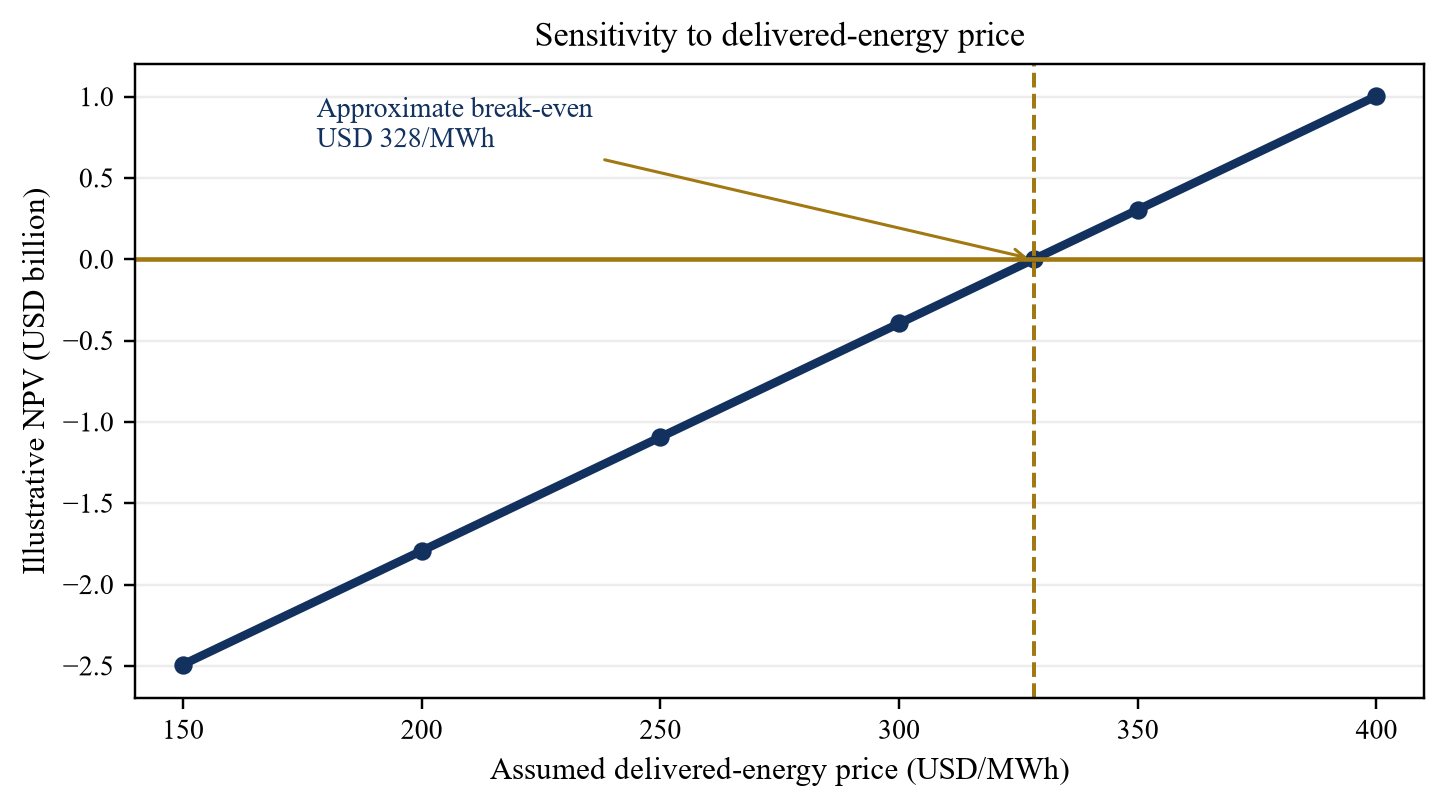
Author-developed illustration using 250 MW, 65 percent capacity factor, USD 4.0 billion initial capital, USD 60 million annual operating expense, twenty-five years and a 9 percent discount rate. No actual project is valued.
11 Challenge launch, output and capital simultaneously
A single-variable sensitivity is useful for diagnosing a model and insufficient for financing a first integrated plant. Launch price, system mass and delivery date can move together. A redesign may increase mass, create another launch, delay commercial operation and require a receiver change. An adverse case should therefore represent a coherent physical and commercial story. The sponsor should explain which expenditure is committed before a technical test, which cost can be deferred and which payments are refundable. A lender's downside is the cash shortfall during the delay, not merely a higher levelised-cost statistic.
The UK study's launch variance contribution is an invitation to test a launch cost range, not a transferable input for this fictional system [3]. Likewise, NASA's assessment highlights the importance of space assembly, maintenance and beaming assumptions in its configurations [1]. In a stage-gated model, each major cost reduction should be linked to a milestone: lower demonstrated payload mass, qualified production process, executed launch contract, proven receiver efficiency or repeatable deployment. Without that link, the upside case is a managerial aspiration. A committee may still fund the next test, but should not borrow against the unearned improvement.
The capital model should include correlations. A later commercial date can postpone revenue, increase interest during construction and compress the fixed-price offtake term if the contract has an outside date. A replacement satellite can cost more when purchased out of sequence. A receiver site dispute may prevent any energy sale even if the satellite works. These interactions matter for both private equity and sovereign risk. Present the expected, delay and failure paths with their funding sources. Identify the decision point at which further investment should stop, be redesigned or be redirected to a smaller demonstrator.
12 Set a realistic debt boundary
Project finance normally lends against a defined asset and contractual cash flows, with construction, performance and operating risks allocated among capable parties. The IEA observes that debt is more common in energy projects with lower technology risk and relatively predictable long-term revenues [11]. A first integrated SBSP system would need to establish how its novel risks are absorbed before conventional non-recourse debt becomes plausible. A proposal might use corporate equity, sponsor guarantees, concessional capital or public co-funding at early stages. Calling that package project finance should not imply that lenders have accepted construction or orbital performance risk.
The debt boundary should be written as a set of conditions precedent rather than an aspirational leverage ratio. Possible conditions include completed technical tests, a fixed or bounded construction budget, permits, interconnection, a bankable offtake agreement, credit support, contractor security, defined insurance or reserves, independent engineer review and a funded contingency. Each condition needs a responsible party, document and completion test. Lenders will also need direct agreements and step-in rights appropriate to assets they can realistically operate or replace. A satellite that cannot be serviced or reassigned may have little collateral recovery value despite a large replacement cost.
Debt sizing should use contracted cash available for debt service under prudent output and cost assumptions. The sponsor should test how much of the contracted term remains after the expected build and commissioning period. A public guarantee can improve creditworthiness for a specified payment obligation; it cannot make an unproven system deliver power. A sovereign offtaker may require affordability and procurement scrutiny, and a public backstop could introduce an explicit contingent liability. The investment committee should compare the public funding requested with the evidenced strategic benefit and the next milestone purchased.
13 Allocate risks to parties able to manage them
A proposed contractual matrix should identify each material failure, the first party able to prevent or remedy it, the evidence needed to prove performance and the financial consequence. The launch provider can be accountable for launch-service obligations within its agreed scope. The satellite manufacturer can be accountable for production and acceptance tests. A ground contractor can build and test the receiver and grid interface. The operator must coordinate the system. These responsibilities require negotiated caps, security and interfaces. A collection of separate warranties leaves a gap if a failure crosses two contracts and each contractor attributes it to the other.
Performance guarantees should be measured at useful system boundaries. A supplier may guarantee a conversion efficiency at laboratory conditions while the project company needs delivered output at the revenue meter. The difference includes beam scheduling, receiver availability and grid curtailment. An integrated engineering, procurement and construction arrangement could simplify responsibility but may be unavailable or prohibitively priced for first-of-a-kind technology. If the sponsor retains integration risk, it needs its own technical team, contingency and equity capacity. An independent engineer should test the proposed allocation against the engineering design and the financing model.
Risk transfer has a cost. A larger warranty cap, standby letter of credit, insurance policy or public guarantee changes who pays when the project fails and may change the project price. The committee should see both gross exposure and net exposure after credible security. It should also see exclusions, aggregate caps and the effect of simultaneous claims. A policy that excludes the most important orbital loss has limited value in the construction downside. The World Bank's explanations of public-project credit support provide a framework for analysing payment obligations [9]; they do not supply a ready-made guarantee for SBSP.
Table 2. Proposed contractual risk allocation questions
| Risk event | Initial responsible party to examine | Evidence and financial test |
|---|---|---|
| Launch loss or missed slot | Launch provider and project sponsor | Contract remedy, reflight option, replacement funding |
| In-orbit deployment failure | Satellite integrator and operator | Acceptance test, warranty scope, recovery plan |
| Beam-control or interference issue | Operator and technology supplier | Safety protocol, permissions, shutdown test |
| Receiver or grid delay | Ground contractor and site owner | Permit status, connection agreement, interface test |
| Output below contract threshold | Project company and offtaker | Metering method, cure period, payment adjustment |
| Offtaker non-payment | Legal buyer and credit-support provider | Security amount, claim mechanics, currency access |
| Early termination | Parties under negotiated agreement | Compensation formula and debt treatment |
Author-developed contract matrix. Entries are diligence questions and proposed allocation principles; enforceability and actual allocation require negotiated documents and legal review.
14 Make the permission path a dated workstream
Orbital operation, spectrum, land, planning, environmental review, grid connection and power sales can involve different authorities. The legal team should map permissions by the actual project structure and locations. The Outer Space Treaty requires authorisation and continuing supervision of non-governmental space activities by the appropriate state [7]. National implementation determines the precise operator obligations. The UK's current guidance describes orbital operator licensing and links to spectrum, safety, liability and insurance requirements [5]. The existence of such a regime does not imply that a particular power-transmission design is licensed.
A multi-receiver business case adds local interfaces. A satellite may be controlled from one country, launched under another jurisdiction and transmit to a receiver in a third. The project should identify jurisdiction-specific authorisations, land rights, spectrum coordination, grid codes, electricity-market participation and data obligations for each planned recipient. Counsel should decide which approvals are conditions to launch, commissioning, service and payment. A policy narrative about international energy trade does not substitute for a legally operable route. The schedule should include public consultation where required and potential redesign following authority feedback.
The permission register should be treated as a financing document. Each entry needs an authority, applicant, legal basis, submission package, expected decision, dependencies and appeal or modification risk. Investors should not assume a permit simply because a similar communications satellite or terrestrial generator holds one. Wireless power can raise distinct technical and safety questions. The project should disclose the limits of available guidance and seek written engagement with competent authorities before a final investment decision. This paper offers a diligence structure, not legal advice or an opinion on the regulatory outcome of a specific system.
15 Treat safety, debris and end-of-life costs as capital items
A beam-control safety case should identify operating envelope, exclusion zones where applicable, detection and interruption controls, testing, monitoring and independent verification. Its acceptance standard must come from the applicable authority and project design. Public confidence also affects land access and permitting. A sponsor should publish clear measurements, testing protocols and incident procedures within the limits of security and commercial confidentiality. The ability to turn a system off safely is a design and commercial requirement; an outage following a safety trip also affects contractual availability.
Space systems have disposal and debris responsibilities. NASA's orbital debris programme documents mitigation standards and the importance of limiting persistent debris [12]. The rules applicable to a particular project depend on its jurisdiction, orbit and licence. A financing model should therefore include end-of-life design, disposal capacity, monitoring and reserves. A very large power satellite may have different collision, servicing and retirement issues from a small demonstration platform. No universal end-of-life cost can be assigned from the sources reviewed here. The sponsor should commission a project-specific engineering and regulatory estimate.
Safety costs become material when omitted from a proposal. Ground exclusion or monitoring arrangements can increase receiver land needs. Redundancy in beam controls adds hardware and testing. Debris mitigation can affect mass and launch cost. Insurance terms may depend on the verified safety case. These costs should remain visible in the capital budget rather than being netted against an unproved social benefit. A credible project has permission and environmental work running alongside engineering, with design changes reflected in the price model before capital commitments become irreversible.
16 Distinguish the public-value case from revenue
A state may value secure supply, domestic capability, industrial learning, resilience or a new export platform. These objectives can justify research funding or procurement consideration under the applicable policy process. They do not create cash flow for a project company until a lawful instrument defines who pays, for what and when. The project should present a commercial revenue case and a separate public-value case. Mixing them can make an uneconomic tariff appear affordable or make a non-binding policy objective appear to be a payment guarantee.
The UK study explores possible GB-system benefits under its own model and future energy-system assumptions [3]. A country-specific decision requires an independently scoped counterfactual. The analysts should compare the orbital option with alternatives that deliver the same service profile, including timing, geographic exposure, carbon attributes and resilience. If the proposed benefit is avoided grid expenditure, the model should identify which expenditure, in which location, and how the project changes the investment plan. If the benefit is technology learning, it should be tied to replicable evidence and a defined demonstration budget. The sponsor should avoid counting the same benefit in both tariff and grant requests.
The public purchaser should examine procurement, affordability, contingent liabilities and exit rights. A staged demonstration procurement can require measurable results before more funds are committed. It can also preserve competition for later commercial supply. A capacity or availability contract may be better aligned to a resilience objective than payment for energy alone, but it requires a verifiable service standard. This paper does not recommend a specific sovereign to issue a contract or guarantee. It proposes a method for turning a policy objective into a defined and reviewable transaction question.
17 Build a sovereign offtake diligence file
The first document should identify the actual counterparty. Is it a ministry, a utility, a transmission system operator, a procurement company or a special-purpose vehicle? What approvals allow it to contract and pay? The next document should describe the purchased product, meter, delivery location, commissioning test, expected quantity, curtailment rules and price. Finance should model gross invoices, taxes, deductions, currency conversion and payment timing. Counsel should assess termination, change in law, dispute resolution and direct agreements for lenders. Technical specialists should confirm that each performance promise can be measured and supplied.
Credit support should be proportionate to the exposure. A letter of credit might address several months of invoices, while termination compensation and construction cancellation require separate treatment. The World Bank's financing material describes guarantees and support arrangements used around public power projects [9]. Its examples illustrate the questions; they do not validate a particular sovereign promise. A proposed state guarantee should be reviewed for scope, budget authority, claims process and enforceability. Project documents should show whether the public authority bears construction, operating or payment risk and how those liabilities are accounted for.
For a cross-border arrangement, the sponsor should add an interface file for each receiving country. A single satellite may beam to multiple locations, but revenues depend on lawful receiver operation and compatible commercial contracts in each location. The model should show what happens when one receiver is unavailable. A secondary market may provide resilience if it is contracted and permitted. An uncommitted option to redirect power should not be used as debt-service revenue. Any proposed sovereign-backed offtake requires direct discussions and actual documents; none are assumed in this paper.
18 Use data and AI for traceable engineering finance
The project can use data tools to connect subsystem tests, mass budgets, launch manifests, beam-control logs, ground measurements, permissions, cost estimates and contract obligations. Each record needs a version, owner, date and link to the physical configuration it describes. A model should flag when a cost estimate relates to an older design or a performance test relates to a smaller prototype. This is a proposed information architecture. It claims no measured savings or technical improvement from AI use. Automated extraction can help find inconsistencies only when qualified reviewers check the original evidence.
Scenario models should be reproducible. Preserve formulas, input sources, units, currency, date and assumptions. An AI-generated narrative cannot substitute for an independently reviewed energy balance or a legal opinion on licence requirements. Restricted technical information may have export, security or contractual limitations; the project should agree an approved processing environment before uploading it to a third-party system. The investment committee should receive the actual evidence, the management estimate and the author-developed assumption in distinguishable fields of its workpaper. Investment decisions should remain traceable to source records and qualified review.
The analytical benefit of this structure is a cleaner decision. If an orbital test improves beam efficiency, the team can update the physical model and show its effect on delivered price. If a launch quote expires, the model can identify the affected scenario. If a proposed receiver location fails a permission test, the team can see which offtake obligations depend on it. A configuration-controlled model connects technical learning to financing readiness. It still requires professional judgement, physical testing and independently reviewed legal and commercial documents.
19 Stage the commercialisation roadmap
The proposed roadmap begins with an evidence-backed subsystem programme. Its objective is to measure the critical energy and control interfaces and establish a credible mass and ground-footprint budget. The next phase is an orbital demonstration with predefined tests and receiver measurement. A limited integrated pilot follows only when permission and safety conditions can be met. The pilot should produce metered output, availability and cost records that can be reviewed outside the sponsor. A first commercial plant then requires an executed offtake, a complete capital package and a realistic operating plan. Repeat deployment should be based on actual first-plant data rather than a learning curve alone.
Every phase should have a stop or redesign rule. The demonstrator might show inadequate conversion efficiency, unexpected mass, unacceptable beam-control variation or permission constraints. Continuing simply because the next stage has already been announced would obscure the purpose of staged capital. The sponsor can preserve valuable intellectual property or redirect research after a failed test. Investors should define the rights they retain, the information they receive and the funding they are obliged to provide at each stage. A stage gate provides a disciplined choice; it does not guarantee project success.
The roadmap also separates corporate value from project value. A technology developer may own patents and test capability even when a commercial power project remains uneconomic. Equity in that developer should be valued with its own contracts, funding needs and dilution path. A later project company may have distinct investors, permits, assets and offtake. Intercompany licences, transfer prices and step-in rights need to be negotiated. A sponsor should avoid using a project revenue model to justify a corporate valuation before rights to that revenue have been established.
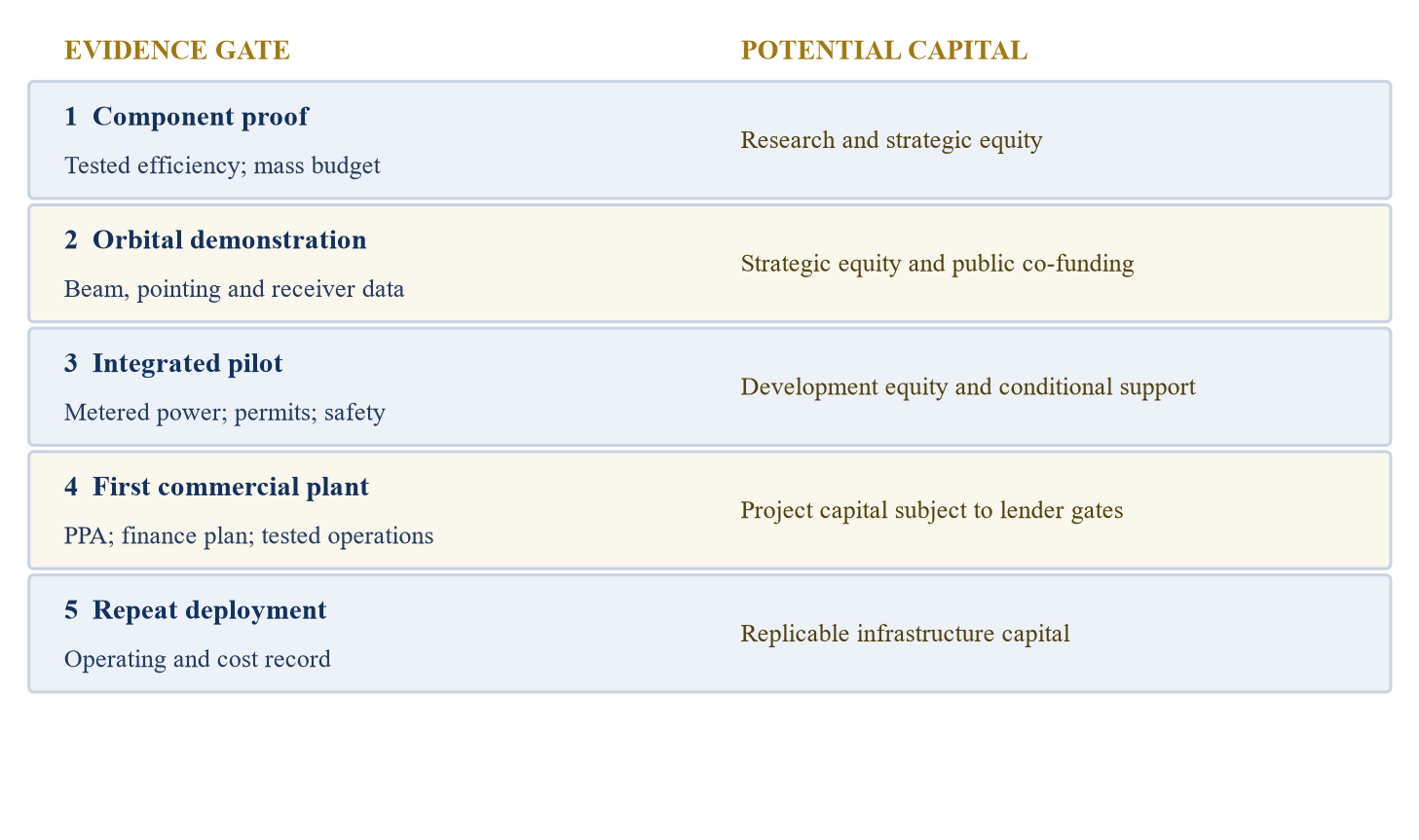
Author-developed roadmap. Gate order reflects evidence dependencies, not promised dates or an approved development schedule.
20 Set investment committee rejection criteria
A committee can approve a limited test while declining a commercial investment. The test budget should define its learning objective and maximum exposure. For a plant decision, the committee should require a consistent technical configuration, independently reviewed performance evidence, a credible construction programme, permits, binding offtake, financing commitments and a fully funded downside. If any element remains conditional, the committee should record the condition and the cost of satisfying it. An assumed public guarantee, speculative tariff or unquoted launch price should not be hidden inside a central case.
Rejection criteria are particularly useful when the technology narrative is compelling. A committee might stop or redesign if mass exceeds the launch envelope, if the beam cannot meet an agreed safety test, if ground-site permissions cannot be obtained, or if delivered cost remains above the buyer's defined willingness to pay after plausible improvements. The threshold is a transaction decision made by the sponsor and its financiers. This paper cannot set a universal threshold. The model should show the difference between a technological setback and a commercially fatal result.
The committee should also examine governance. Who controls design changes after financing commitments? Who owns the underlying data and intellectual property? Can a sovereign purchaser audit the safety and performance evidence? Can lenders replace an operator if the original developer fails? These rights affect the value of contracted revenue and the ability to manage a troubled project. A sophisticated capital structure cannot compensate for ungoverned interfaces. The decision record should preserve dissenting technical and commercial assessments where material.
21 Specify an executable advisory mandate
An advisory mandate for a sponsor or public purchaser could begin with a bounded feasibility-to-finance review. Proposed work products include a system and asset perimeter, a claim-to-source register, a regulatory route map, a bottom-up cost and energy model, an offtake term-sheet options paper and a stage-gate capital plan. An independent engineering team should own technical certification questions; specialist counsel should own legal opinions. Corporate-finance advisers can connect those findings to valuation, capital structure, counterparties and transaction sequencing. Scope, responsibilities and fees must be agreed with the actual client.
The mandate should be priced around decisions rather than a promised financing outcome. An initial phase can determine whether a defined pilot is investable under a capped budget. A subsequent phase can test procurement and commercial structuring if the first phase passes. A full capital raise or project-finance execution mandate should require agreed evidence, rights and approvals. This paper does not establish any available client, government interest, lender commitment or retainer willingness. It identifies the decision problems for which specialist work may be commissioned.
Deliverables should be auditable. The finance model should reconcile to technical inputs and contract terms. The offtake options should distinguish an energy PPA, an availability agreement, a grant and a public guarantee. The risk matrix should name unresolved items and owners. The project should have a data room index with source dates and document status. This makes an advisory engagement useful even if the prudent conclusion is to narrow or defer the investment. The value of the work is a documented decision path, not a promotional claim about space energy.
22 Conclusion
Space-based solar power combines several technologies and contracts in one proposed energy product. The public evidence reviewed here includes comparative modelling, small-scale feasibility analysis and a wireless-power demonstration. It does not establish commercial power generation from orbit at utility scale. The finance test therefore begins with physical and contractual boundaries. A sponsor should define metered output, quantify losses and operating windows, identify every permission and ground dependency, then connect each investment stage to measurable evidence.
The hypothetical example shows the scale of the price question under one deliberately simplified set of assumptions. A USD 4.0 billion fictional plant delivering 1,423,500 MWh annually at the assumed cost and discount rate requires about USD 328.22/MWh to break even in the screening model. That figure should not be treated as a project forecast, tariff request or conclusion about the technology's eventual cost. It provides a transparent basis for testing what launch, satellite, receiver, output and financing changes would have to be evidenced before a commercial case could be proposed.
Sovereign offtake is a contract and credit question. A government study, public interest or memorandum of understanding cannot substitute for an authorised buyer, a measurable product, enforceable payment terms and a funded downside. The proposed stage gates let research, demonstration and commercial finance proceed at standards appropriate to each phase. They also preserve the option to stop, redesign or fund only the next experiment. That discipline is the central financing contribution of the framework.
Table 3. Investment committee evidence gates
| Decision gate | Evidence required | Decision if absent |
|---|---|---|
| Fund component test | Test protocol and capped budget | Redesign test scope |
| Fund orbital demonstration | Launch plan, safety case, measured objectives | Defer flight commitment |
| Fund integrated pilot | Permissions, ground site and meter protocol | Limit to permitted experiment |
| Commit commercial equity | Costed design, operating plan and offtake path | Reprice, stage or decline |
| Commit construction debt | Binding contracts, credit support, contingency | Use different capital or defer |
| Replicate deployment | Actual output, cost and reliability record | Retest design and economics |
Author-developed proposed decision checklist. Each line requires project-specific engineering, legal and commercial review.
References
- NASA Office of Technology, Policy and Strategy. Space Based Solar Power. 11 January 2024. https://ntrs.nasa.gov/citations/20230018600
- UK Department for Energy Security and Net Zero. Space based solar power: de-risking the pathway to net zero. Updated 13 February 2026. https://www.gov.uk/government/publications/space-based-solar-power-de-risking-the-pathway-to-net-zero
- Frazer-Nash Consultancy, Space Solar Engineering and Imperial College London for the UK Department for Energy Security and Net Zero. Feasibility of Small-Scale Space Based Solar Power Systems for Early Market Adoption. 2025 report published February 2026. https://assets.publishing.service.gov.uk/media/698f167c7da91680ad7f43ad/SBSP-enabled-pathways-to-net-zero-final-report-raf036-2425.pdf
- California Institute of Technology. In a First, Caltech's Space Solar Power Demonstrator Wirelessly Transmits Power in Space. 1 June 2023. https://www.caltech.edu/about/news/in-a-first-caltechs-space-solar-power-demonstrator-wirelessly-transmits-power-in-space
- UK Government and Civil Aviation Authority. Operating an orbital space object: rules and regulations. Updated 3 July 2026. https://www.gov.uk/guidance/operating-an-orbital-space-object-rules-and-regulations
- International Telecommunication Union. WRC-23 Final Acts, Resolution 910: studies on possible frequency bands for wireless-power transmission to avoid harmful interference. https://www.itu.int/dms_pub/itu-r/oth/0c/0a/R0C0A0000100023PDFE.pdf
- United Nations Office for Outer Space Affairs. Treaty on Principles Governing the Activities of States in the Exploration and Use of Outer Space, Article VI. https://www.unoosa.org/oosa/en/ourwork/spacelaw/treaties/outerspacetreaty.html
- UK Department for Energy Security and Net Zero. Contracts for Difference Allocation Round 7 collection and allocation documents. https://www.gov.uk/government/collections/contracts-for-difference-cfd-allocation-round-7
- World Bank. Power Purchase Agreements and Energy Purchase Agreements, Public-Private Partnership Reference. https://ppp.worldbank.org/sector/energy/energy-power-agreements/power-purchase-agreements
- International Energy Agency. Innovation Gaps: innovation readiness framework. https://www.iea.org/reports/innovation-gaps
- International Energy Agency. Who is investing in energy around the world, and who is financing it? 2024. https://www.iea.org/commentaries/who-is-investing-in-energy-around-the-world-and-who-is-financing-it
- NASA Orbital Debris Program Office. Debris Mitigation. https://orbitaldebris.jsc.nasa.gov/mitigation/index.html
About the Author
Chennakeshav (CK) is a corporate finance and investment banking executive with 25+ years of global experience in deal origination, structuring and execution across M&A, growth capital and corporate strategy. He has led value-creation mandates for founders, corporates and funds — bridging the boardroom view to hands-on execution and close.
His career spans Morgan Stanley, HSBC, Lloyds Banking Group, EWEC, ADQ portfolio companies and Emirates Growth Fund, across TMT, real estate, fintech, deeptech, cleantech, infrastructure and energy. He has partnered with C-suite leaders, private equity and venture funds, sovereign wealth funds and family offices to finance complex fund raises and scale-up ventures, and has led M&A due diligence, post-merger integration and business-transformation initiatives to create value.
At Matchpoint Partners he is Managing Partner, leading the firm's corporate finance, M&A and capital-raising practice. He holds an MBA from London Business School, an engineering degree from VTU and a Master of Laws (LLM, in progress) from UCL London.
An active start-up mentor, CK mentors at Techstars, DIFC FinTech Hive, Startup Grind, Founder Institute and IN5, serves as Entrepreneur Mentor in Residence (EMiR) at London Business School, and judges the Entrepreneurship World Cup.
