

1. Define the corridor before financing its components
An agribusiness corridor is an operating system rather than a line on a map. It begins with land, water, seeds, fertiliser, equipment, knowledge and farmer organisation. It passes through harvest, collection, testing, storage, processing, packaging, cold chain and transport. It ends with a domestic, regional or export buyer and collected cash.
The first investment product should be a corridor perimeter. It should identify commodities, seasons, production zones, farmers, cooperatives, aggregators, warehouses, processors, roads, rail, border posts, ports, buyers, banks, insurers and public agencies. Each node should have an owner, capacity, current utilisation, critical constraint and data source.
The perimeter should distinguish a value chain from a transport corridor. A road can serve several commodities and communities. A processor can draw from several production zones. A port may be outside the project jurisdiction. Financing should identify which assets and contracts are controlled by the borrower and which dependencies require public action, third-party agreements or contingency.
The corridor thesis should state the commercial transformation in measurable terms. Examples include reducing farm-to-warehouse time, increasing graded volume, cutting loss, raising processing yield, increasing contracted sales or reducing border dwell time. A broad promise of food security is an important policy objective and an insufficient debt-service model by itself.
Table 1. Agribusiness corridor evidence stack
| Corridor layer | Core evidence | Finance question | Potential capital response |
|---|---|---|---|
| production base | farmer registry, land and water rights, crop plan and historical yield | can volume be produced lawfully and repeatedly? | seasonal input finance, equipment lease and technical support |
| aggregation | collection points, weighing, grading and payment records | can fragmented output become traceable commercial lots? | working capital, digital payment and operator equity |
| storage | warehouse licence, condition, capacity, stock controls and receipt system | can quality and title be preserved? | warehouse facility, collateral management and loss reserve |
| processing | plant design, input specification, yield, energy and maintenance | can raw product become a saleable higher-value output? | project debt, equity and completion support |
| transport | route, fleet, road, rail, cold chain and service agreements | can goods move within cost and shelf-life limits? | asset finance, availability payment or logistics contract finance |
| border and port | customs, SPS, testing, dwell time and handling capacity | can product cross the trade gateway reliably? | public infrastructure, guarantee and trade-facilitation capital |
| buyer and cash | offtake, quality, pricing, currency and payment history | which cash repays each facility? | receivables, trade finance, hedging and cash control |
| development outcome | farmer income, jobs, inclusion, loss and climate indicators | what justifies catalytic support? | grant, concessional tranche and results-linked payment |
Evidence requirements should be adapted to the commodity, jurisdiction and intended market.
2. Begin with bottleneck economics
The World Bank's 2025 transport analysis estimates that African food supply chains are substantially longer than European chains and identifies storage, roads, ports and border crossings as material sources of loss and price.[1][5] The financier should convert this system evidence into corridor-specific bottleneck economics.
For each node, management should calculate current volume, capacity, time, loss, cost and price. The constraint can then be tested by relaxing it. Additional warehouse capacity creates value only when farms can supply, product can be graded, title can be controlled and buyers will purchase later. A faster road may have limited effect when customs or cold storage remains the binding constraint.
The model should distinguish physical loss from commercial loss. Spoilage, moisture, breakage and contamination reduce quantity or quality. Delayed delivery can miss a price window or buyer specification without destroying the product. Side-selling can divert pledged crop. Congestion can increase fuel, demurrage or inventory finance.
Investment priority should follow marginal corridor value. A modest weighbridge, testing laboratory or border process can unlock more throughput than a larger processing plant. Blended finance should not make a low-priority asset appear bankable by lowering its capital cost.
3. Build the farm-to-port data spine
Every financed unit should retain a traceable identity from farmer or production lot to final sale where feasible. Minimum fields include producer, location, crop, area, input package, planting date, expected harvest, observed yield, collection point, weight, quality, price, payment, warehouse, receipt, processing batch, transport document, border record, buyer invoice and cash receipt.
Digital tools can support registration, geolocation, remote sensing, weather data, mobile payments, warehouse receipts and shipment tracking. Technology should strengthen evidence and control. A dashboard cannot cure inaccurate farmer records, weak title, non-calibrated scales or a warehouse that releases stock without authority.
The data spine should reconcile physical and financial records. Opening stock plus receipts minus processing, sales, verified loss and closing stock should balance by commodity and location. Cash paid to farmers should reconcile to accepted weight and grade. Buyer collections should reconcile to invoices, shipment and bank account.
Data rights require attention. Farmers and communities should understand what is collected and how it is used. The project should define consent, access, retention, correction and security. A lender should receive the minimum data needed to validate collateral and performance, with personal data protected under applicable law.
4. Map the full production-to-market value chain
The value-chain map should show material, information, cash and risk. Inputs and finance move toward production. Crops move toward markets. Quality and ownership evidence move with the goods. Buyer cash moves back through controlled accounts to repay trade or working-capital facilities and release farmer or sponsor proceeds.
The map should identify seasonal gates. Land preparation, planting, crop establishment, harvest, drying, storage and sale occur at different times. A perennial crop, grain, livestock, dairy or horticulture corridor has a different cash and perishability profile.
Public and private responsibilities should be visible. Rural roads, border posts, laboratories and public irrigation can be public goods. Farms, warehouses, processors and logistics businesses can be private or cooperative assets. Blended financing can connect them, while each asset still requires accountable ownership and maintenance.
The corridor should be decomposable. If a port or border is delayed, domestic or regional buyers may provide an alternative market. If one warehouse fails, other certified capacity may support continuity. Concentration and substitution should be measured before capital is committed.
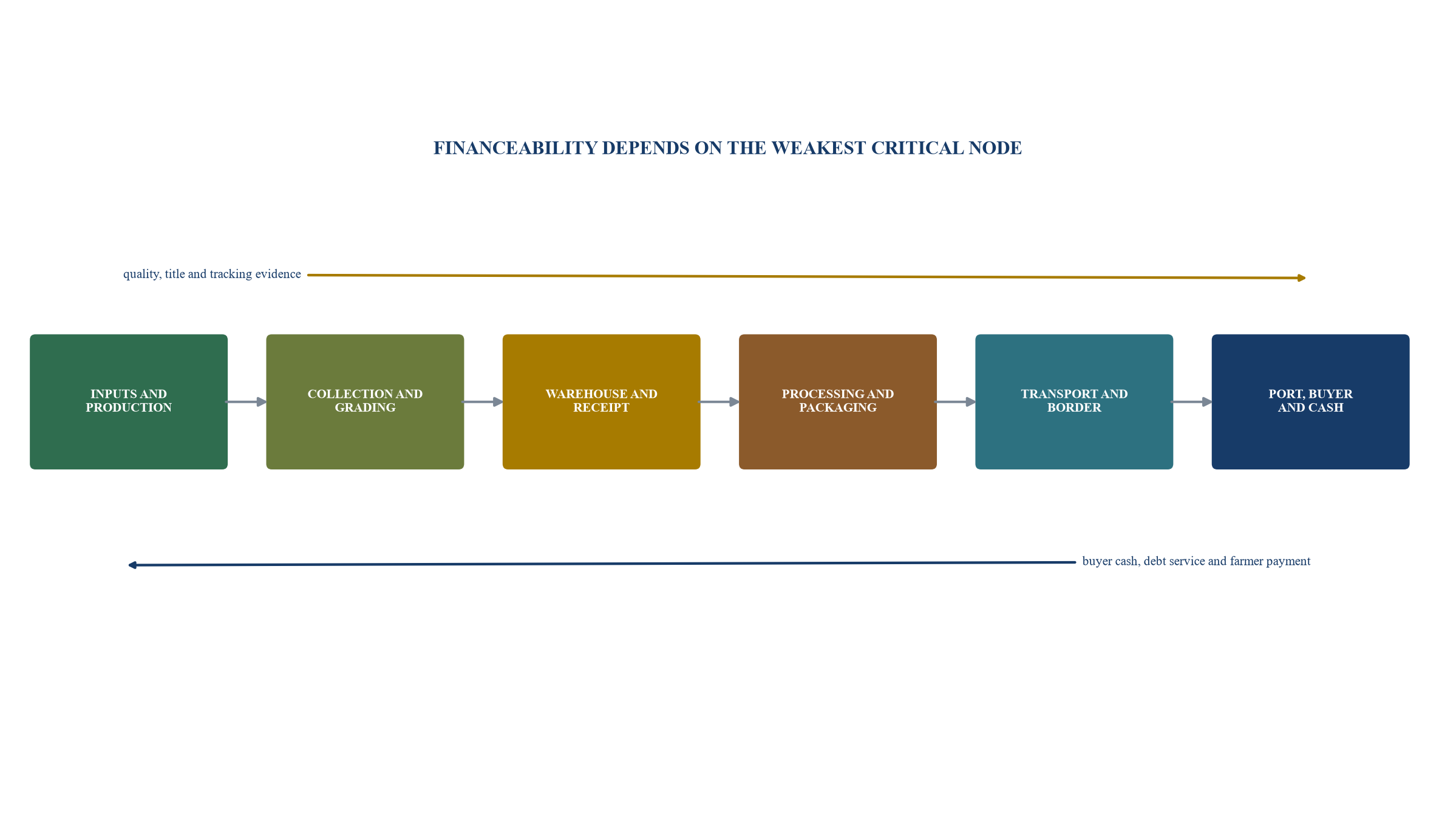
The diagram shows the control points that connect physical throughput with financing evidence.
5. Separate public goods from commercial assets
Roads, border systems, laboratories, extension services and climate information can create benefits beyond the project borrower. Their revenue may be diffuse, politically constrained or collected through taxes and user charges. They can require public, sovereign or availability-based funding.
Warehouses, processors, fleets, cold stores and export businesses can generate direct commercial cash when throughput and customers exist. These assets can support project debt, leases, working-capital facilities or corporate finance. The boundary should be established asset by asset.
Special Agro-Industrial Processing Zones illustrate the combination. AfDB's Nigeria programme finances public and enabling infrastructure while seeking private investment in agro-industrial hubs and enterprises.[2][6] The published Phase II financing includes development-bank loans, private equity and federal or state contributions.[7] A separate AfDB-led alliance announced USD 3 billion of commitments for Special Agro-Industrial Processing Zones across Africa.[17]
The financing plan should prevent commercial debt from depending on an unfunded public obligation. Public land, road, power, water, border or policy commitments should have approved budgets, authority, procurement and completion evidence. Private assets should have their own demand, cost and operating case.
6. Define the development rationale for catalytic capital
Catalytic capital should address a specified problem: early-stage risk, climate adaptation, smallholder inclusion, missing tenor, unaffordable currency, limited collateral, first commercial demonstration or a public-good externality. The rationale should be recorded before the amount and form of concession are chosen.
OECD's 2025 blended-finance guidance anchors blended finance to a development rationale, commercial mobilisation, local context, effective partnership and transparent results.[8] It also states that blended finance cannot compensate for a weak enabling environment. The transaction should therefore identify which policy or institutional constraints require separate reform.
Additionality should be tested. Management should document the commercial financing available without support, the gap, the minimum catalytic intervention and the expected mobilisation. A subsidy that increases sponsor return without changing investment, inclusion, resilience or scale lacks a clear rationale.
The concession should have a risk budget and exit. It can reduce as production history, warehouse control, contracted sales and repayment evidence accumulate. Permanent high-risk features may require insurance, equity or policy action rather than a temporary concessional loan.
7. Allocate each risk to an instrument that can absorb it
Climate risk can affect yield, quality, timing and regional correlation. Insurance can cover defined weather or loss events, while basis risk and exclusions remain. Working-capital debt should not assume a full insurance recovery when the policy index and farm loss can diverge.
Construction risk belongs with fixed-price or controlled contracts, sponsor equity, contingency, performance security and completion support. Operating risk belongs with capable operators, maintenance, working capital and covenants. Commodity price risk can be managed through offtake, hedging, floors, diversification and borrowing-base haircuts.
Political and non-commercial risks can be addressed through project design, contractual protections and guarantee products. MIGA describes political-risk guarantees as a way to mitigate non-commercial risks in agribusiness, and the World Bank Group announced an objective in 2026 to increase guarantee issuance in Africa.[9][10]
Credit guarantees and first-loss capital should cover a defined portfolio or exposure. They should retain lender and originator discipline through risk sharing, eligibility, claim verification and recovery allocation.
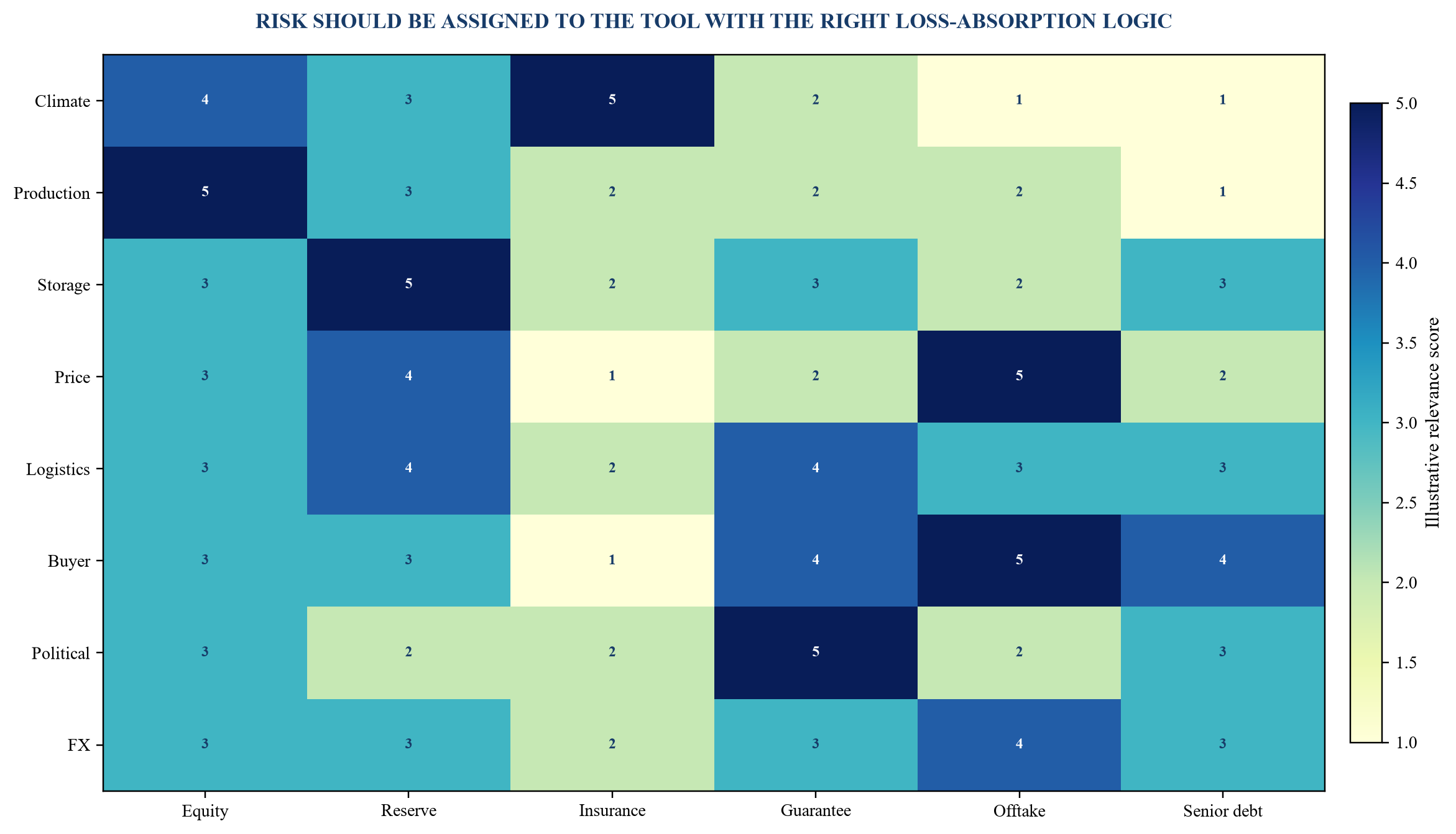
Hypothetical intensity scores show why different risks require different instruments.
Table 2. Risk owner, evidence and financing response
| Risk | Primary evidence | Natural risk owner | Potential financing response |
|---|---|---|---|
| weather and climate | historical and forward climate data, crop calendar and water plan | producer, insurer and public resilience system | index or indemnity insurance, reserve and resilient capex |
| crop performance | farmer history, inputs, agronomy and field monitoring | producer, aggregator and technical operator | equity retention, input facility and milestone draw |
| post-harvest loss | warehouse condition, handling, testing and stock record | warehouse and processor | collateral management, insurance and loss tolerance |
| commodity price | offtake, benchmark, basis and hedge | sponsor, buyer and market intermediary | price floor, hedge, advance-rate haircut and reserve |
| transport and border | route time, service level, capacity and customs record | logistics operator and public authority | performance contract, availability support and delay reserve |
| buyer payment | contract, invoice, credit and collection history | buyer and seller | letter of credit, guarantee, receivables finance and concentration limit |
| political and transfer | permits, public obligations and convertibility | state, sponsor and guarantor | political-risk guarantee and offshore reserve where lawful |
| currency | revenue and debt currency, hedge market and convertibility | sponsor and lender | local-currency debt, hedge, reserve and natural matching |
Actual allocation depends on the contracts, law, insurance and public programme.
8. Construct the blended capital stack from the bottom up
Sponsor or operator equity should absorb ordinary business risk and demonstrate commitment. Public grants can fund technical assistance, farmer registration, climate data, public goods or viability-gap items that do not create direct cash. Concessional debt or junior capital can absorb bounded early losses or extend tenor.
Guarantees and insurance should sit against defined events or portfolios. Commercial senior debt should fund cash flows and collateral that remain viable after the lower layers perform as documented. The commercial lender should still underwrite the project and retain meaningful exposure.
IFC's blended-finance agribusiness programme and GAFSP Private Sector Window invest across the food supply chain where high perceived risk limits commercial finance.[4][11] GAFSP's Business Investment Financing Track uses grants and concessional instruments with development-bank finance to mobilise private lending.[12]
The capital stack should show amount, price, tenor, currency, security, payment priority, loss position, control, development condition and exit for every tranche. A blended label should not obscure transfer of value or risk.
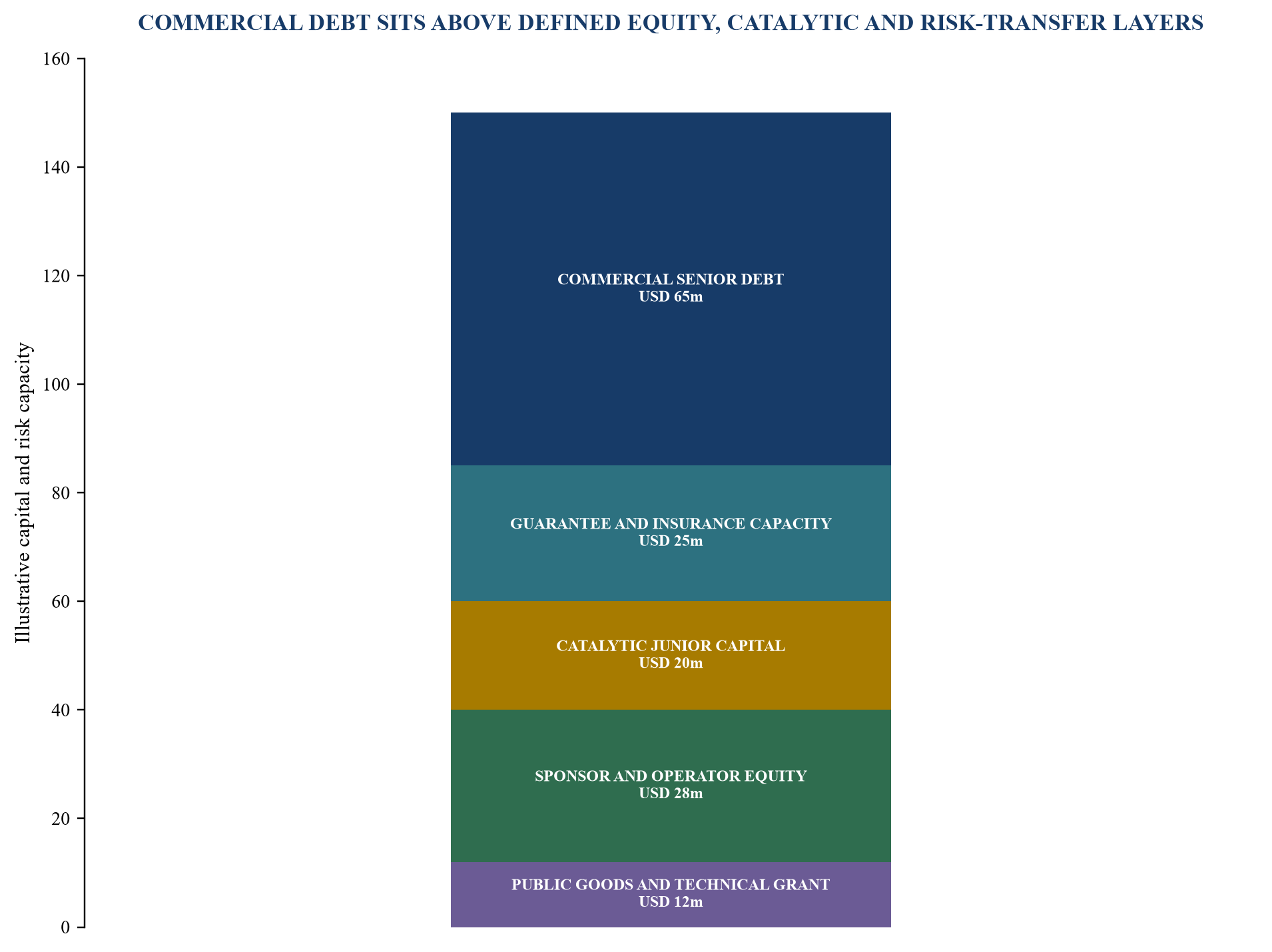
Hypothetical USD million amounts demonstrate role-based capital layering.
9. Match the instrument to the asset and cash cycle
Long-lived processing, storage, irrigation, energy and transport assets need project or corporate capital with a tenor linked to useful life and cash ramp-up. Seasonal input and crop finance should revolve through planting, harvest and sale. Warehouse and trade facilities should turn with controlled stock and receivables.
One corridor can therefore contain several facilities. A project loan can fund the processing plant. A warehouse line can finance certified inventory. A bank can provide farmer input facilities through an aggregator. Trade instruments can support imported equipment and exported product. Guarantees can support local lenders without displacing their origination role.
The interdependence should be captured through conditions and information rather than one oversized borrower. The plant facility can require minimum contracted feedstock. The warehouse line can require approved processors and buyers. The transport facility can require service contracts. Each lender should understand shared collateral and cash priority.
Tenor should follow risk retirement. Construction capital can convert after completion. Seasonal exposure should clean down after sale. A first-commercial-cycle guarantee can reduce after verified repayment cohorts. Long-term infrastructure debt should not depend on perpetual refinancing of short-term crop exposure.
10. Make production finance observable
Pre-harvest finance faces weather, agronomy, diversion and farmer fragmentation. The lender should define the financed input package, eligible farmer, crop, area, delivery evidence, technical support, monitoring and sale route. Disbursement can go directly to approved input suppliers where appropriate.
Farmer enrolment should be voluntary and transparent. Pricing, deductions, quality rules and sale obligations should be understandable. The project should address land and community rights, labour, gender, grievance and environmental impact.
Crop receipts can connect pre-harvest obligations to future delivery, while enforceability and practical control vary. IFC and FAO have examined crop-receipt structures for African markets, including Zambia and Uganda.[13] The finance case should test side-selling, production failure, priority and dispute.
Repayment should be reconciled at delivery and buyer cash. A digital record can support traceability, while field verification and farmer communication remain necessary. Repeat performance can allow eligible limits and commercial share to rise over time.
11. Use warehouse finance only when control is real
Warehouse finance shifts collateral from fixed assets to stored commodities. IFC's Global Warehouse Finance Program provides liquidity and risk-sharing support to banks lending against warehouse receipts or equivalent collateral and recognises collateral-management arrangements where statutory receipt systems are absent.[3]
The lender should approve the warehouse, commodity, receipt, insurer, collateral manager, inspection process and buyer. Stock should be weighed, graded, insured, segregated or reliably identified, and released only under controlled authority.
Advance rates should reflect price volatility, quality deterioration, storage loss, liquidation time, currency, buyer concentration and legal enforceability. Daily or frequent mark-to-market should trigger margin, reserve or sale action before collateral value falls below debt.
Fraud can arise through duplicate receipts, missing stock, grade substitution or unauthorised release. Independent inspection, electronic registry, rotation checks, reconciled movement and lender-controlled release are core controls. A guarantee cannot replace physical collateral discipline.
Table 3. Commodity borrowing-base controls
| Control | Required evidence | Eligibility rule | Trigger response |
|---|---|---|---|
| warehouse approval | licence, condition, operator, insurance and audit | approved location and operator | stop new receipts |
| stock existence | weight, grade, lot and independent inspection | verified commodity in controlled custody | exclude missing or disputed stock |
| title and priority | receipt, registry, purchase and security record | clear title and first-ranking route | suspend availability until resolved |
| price | approved benchmark, basis and observable market | lower of cost and stressed market value | margin call or sale |
| quality and age | testing, storage conditions and expiry profile | within specification and maximum age | haircut, reprocess or dispose |
| concentration | commodity, warehouse, region and buyer exposure | within approved limits | exclude excess or add reserve |
| release | lender instruction and matched sale | cash directed to controlled account | event escalation for unauthorised release |
| reconciliation | opening, receipts, movements, sales and closing stock | no unexplained variance | independent count and draw stop |
Advance rates and thresholds are hypothetical and require transaction-specific calibration.
12. Underwrite processing as a conversion system
Processing debt depends on input volume, quality, yield, uptime, energy, labour, maintenance, packaging and buyer demand. Nameplate capacity is a technical ceiling rather than a cash-flow forecast. The model should begin with contracted or evidenced feedstock and realistic utilisation.
Yield loss should reconcile raw input to finished and by-product output. Waste, moisture, rejects and normal process loss should be measured. By-product revenue should be included only when a market, specification and collection history exist.
Energy and water can be binding constraints. Connection, generation, fuel, backup, tariff and interruption should be tested. Maintenance inventory and technical capability determine uptime. Imported equipment creates spare-parts and currency exposure.
Completion requires performance testing at agreed throughput and quality, not mechanical completion alone. The facility should retain completion support until the plant produces saleable product over a defined test and the corridor can supply sufficient input.
13. Finance logistics around service evidence
Transport capital should be linked to route, commodity, volume, season, utilisation and service level. A truck, cold-store or rail terminal creates debt capacity when customers, operating capability and maintenance convert the asset into reliable movement.
The World Bank's corridor analysis identifies long transport chains, storage gaps, port and border bottlenecks as material contributors to food loss and price.[1][5] Afreximbank's trade-facilitation and logistics offering also reflects the role of logistics in building export capability.[16] The project should measure route time, queue, border dwell, temperature excursion, damage, fuel, empty return and cash collection.
Fleet finance can use asset security and contracted revenue. Cold-chain projects can use capacity contracts, minimum-volume commitments or availability payments where the service is critical and demand is emerging. Public road or border works require approved public funding and maintenance.
The financing downside should test route closure, security incident, fuel increase, border delay, equipment failure and reduced volume. Alternative routes and buyers should be evidenced before receiving credit.
14. Make offtake bankable without transferring all risk to farmers
An offtake contract should identify product, grade, volume, delivery, price, benchmark, currency, adjustment, inspection, rejection, force majeure, credit support and payment. A take-or-pay label has limited value when conditions allow broad rejection.
The buyer's capacity and payment history matter. Export contracts can be supported by confirmed letters of credit, guarantees or trade credit insurance. Domestic buyers can support receivables finance when invoices, acceptance and cash history are reliable.
Pricing should allocate market movement transparently. A floor can protect debt service while allowing farmers or sponsors to participate above it. Quality discounts should use published or agreed tests. Currency and basis risk should be modelled between local purchase and export sale.
Exclusive offtake can reduce side-selling and market choice. The project should test whether pricing, services and deductions are fair and whether producers have a grievance route. Durable supply depends on farmer economics, not contractual control alone.
15. Release capital against observable milestones
Calendar-based disbursement can fund before the underlying risk has retired. Milestone disbursement should follow evidence. Early grants can support surveys, farmer enrolment, design and permits. Equity can fund land, mobilisation and initial works. Debt can follow completed and verified assets or eligible working capital.
Production milestones can include farmer verification, input delivery, crop establishment and field condition. Infrastructure milestones can include land access, permits, civil completion, equipment delivery and performance testing. Commercial milestones can include warehouse certification, buyer contracts, quality approval and collected sales.
Each milestone needs an owner, verifier, document, date, tolerance and remedy. Independent engineers can verify construction. Agronomists and remote sensing can support crop evidence. Warehouse inspectors can verify stock. Banks can verify cash.
Failure should not automatically accelerate all capital. The response can stop the affected tranche, require equity cure, revise scope or reduce availability. A material failure that breaks the corridor thesis should trigger a stop decision.
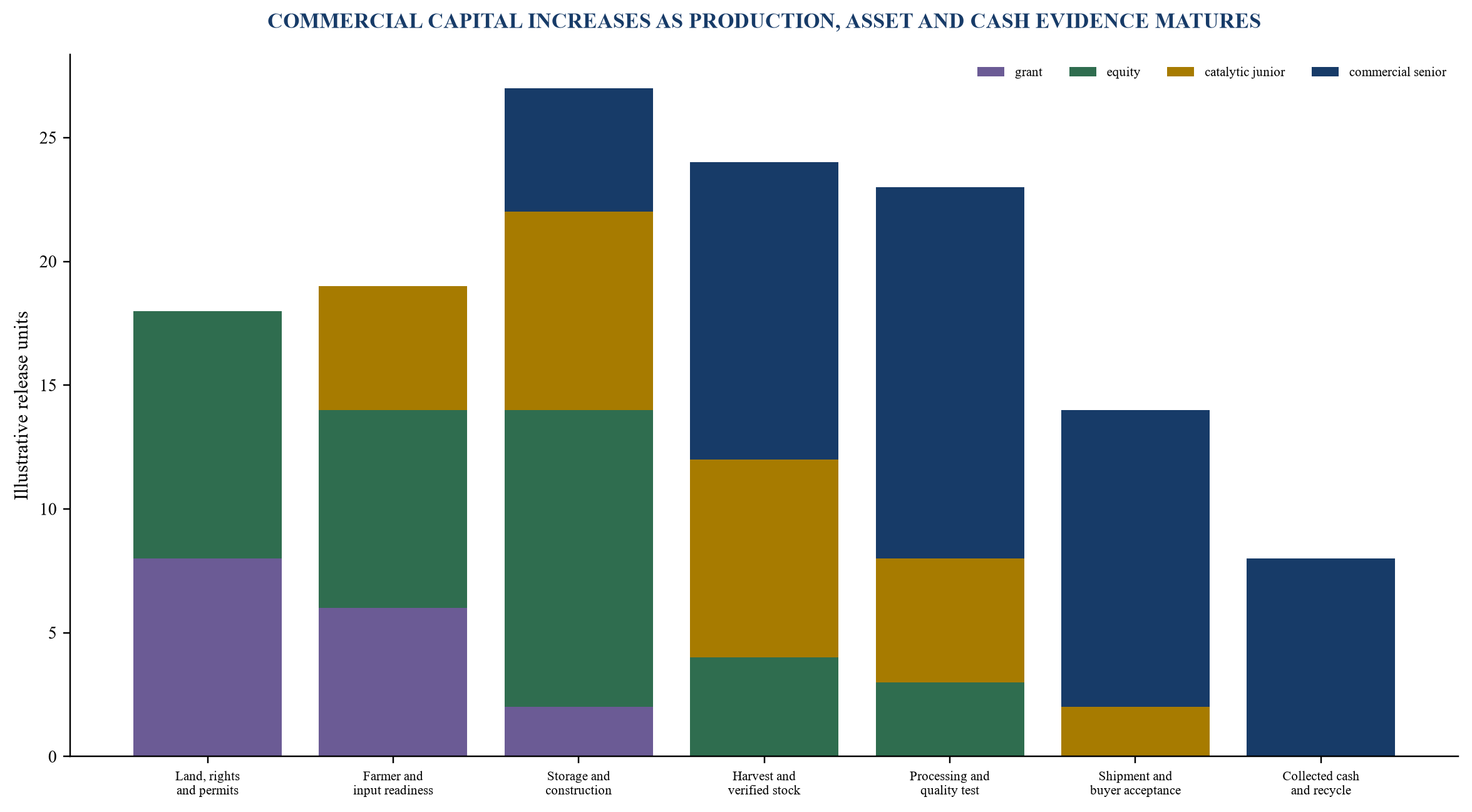
Hypothetical percentages show capital release following evidence rather than elapsed time.
Table 4. Milestone evidence and draw response
| Milestone | Evidence | Eligible capital | Failed-gate response |
|---|---|---|---|
| land and community readiness | rights, consultation, grievance and access record | grant and sponsor equity | stop site capital and resolve rights |
| farmer and input readiness | verified registry, contracts, supplier delivery and training | input facility and catalytic support | reduce financed area or defer draw |
| infrastructure progress | permits, independent certificate and cost-to-complete test | project debt after required equity | sponsor cure or scope reset |
| harvest and aggregation | field estimate, weight, grade and farmer payment | warehouse or crop facility | use lower verified volume |
| storage and processing | certified stock, plant test and quality evidence | inventory and term debt | exclude stock or retain completion support |
| shipment and buyer acceptance | transport, customs, inspection and acceptance | trade and receivables finance | reserve delay or pursue alternate buyer |
| collected sale | controlled-account receipt and allocation | recycle revolving exposure | apply cash waterfall and investigate shortfall |
The verifier and legal effect should be defined in the transaction documents.
16. Design the loss waterfall before discussing mobilisation
A loss waterfall defines who absorbs which loss and when. Ordinary commercial losses should first affect borrower equity and retained earnings. Operating and commodity reserves can absorb expected volatility. Insurance and guarantees respond only to covered events and documented claims.
Catalytic first-loss capital can absorb specified unexpected losses after retention and recoveries. Commercial senior debt should be protected within the agreed structure and remain exposed enough to support disciplined underwriting. A public guarantee of all losses can create weak origination and poor recovery incentives.
The waterfall should distinguish cash loss, collateral shortfall, timing delay and grant-funded outcome failure. A late buyer payment may require liquidity and still be fully collectible. A failed crop can create a principal loss. A missed inclusion target can affect a results payment without changing the senior loan.
Recoveries should follow a stated order. Insurance, guarantee and collateral proceeds should not create double recovery. Workout control, claim submission, subrogation and costs require agreement before default.
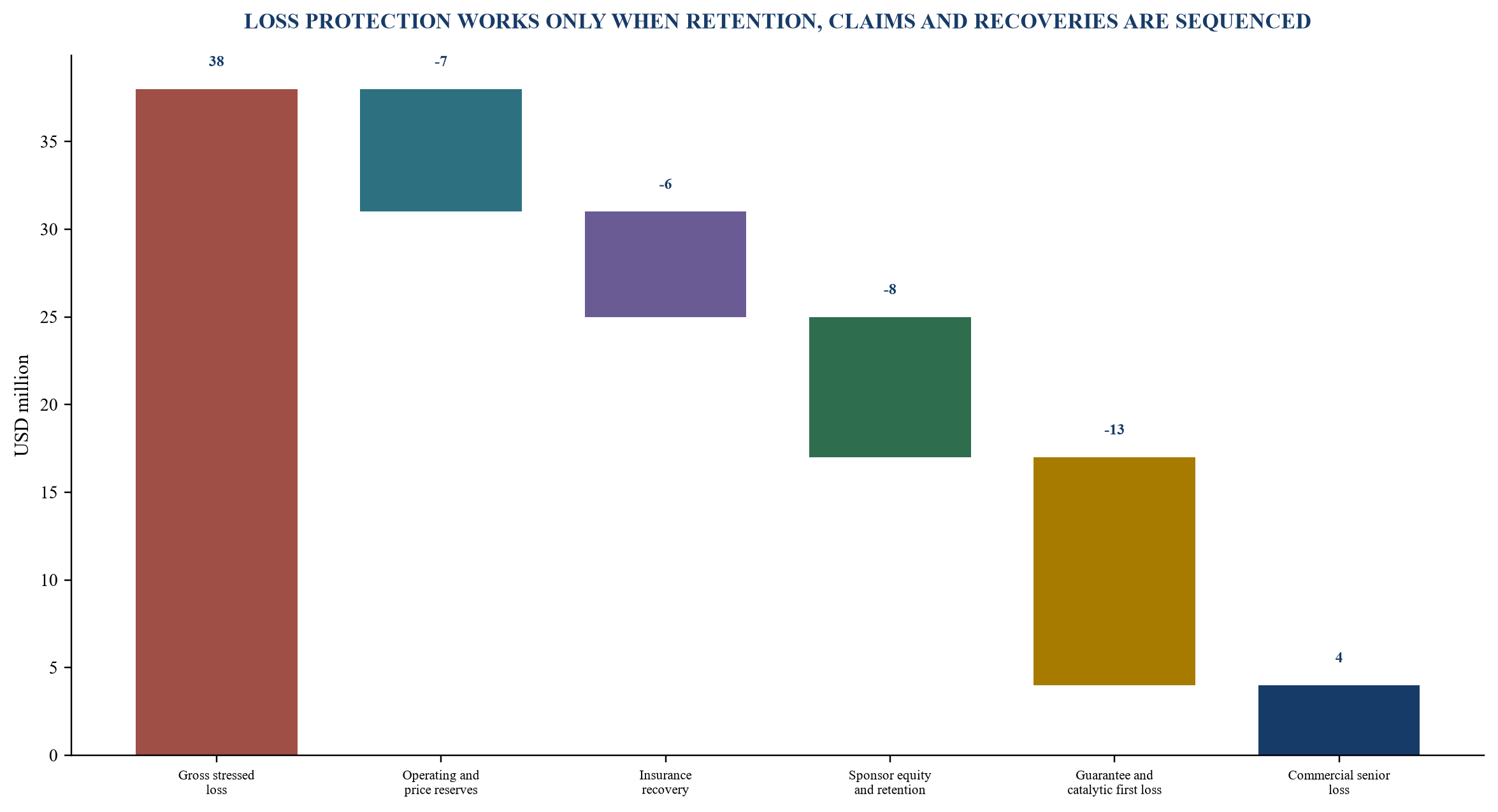
Hypothetical USD million loss absorption demonstrates sequencing and does not describe an offered structure.
17. Use insurance with an explicit basis-risk analysis
Agricultural insurance can protect against drought, rainfall, flood, yield, mortality, price or other defined risks. Index insurance pays according to a pre-agreed index, which can accelerate objective settlement but can differ from actual project loss. The World Bank describes index insurance as a tool based on predetermined indices and highlights data and pricing requirements.[14]
The project should map the insured peril, index, measurement location, attachment, limit, exclusions, premium, claim timing and beneficiary. Basis risk should be tested by comparing historical project outcome with hypothetical policy payout.
Sovereign or regional insurance can support public response and indirectly protect corridor demand or farmer recovery. African Risk Capacity reported a 2025 payout to Malawi after drought under traditional and anticipatory policies.[15] Project debt should include only proceeds legally and contractually available to the borrower or facility.
Premium support can be catalytic when it enables an initial market. The commercial case should show how data, scale, risk reduction and farmer economics support later premium affordability.
18. Govern guarantees as contingent capital
A guarantee should specify beneficiary, covered obligation, coverage percentage, first or second loss, cap, tenor, currency, claim event, exclusions, waiting period, recovery and termination. The lender should model payment timing as well as amount.
Portfolio guarantees can support local-bank origination to farmers, warehouses and processors. Eligibility should define borrower, use, commodity, exposure, collateral and reporting. The bank should retain risk and conduct ordinary credit work.
Project guarantees can cover public obligations, political risk, completion or payment. The guarantor should have information, consent and cure rights proportionate to exposure. Guarantee amendments should align with the underlying facility.
Mobilisation should be measured as commercial capital causally enabled by the support, with methodology disclosed. A high ratio is not useful when the underlying loan would have occurred anyway or when the guarantee absorbs nearly all risk.
19. Build a cash waterfall across seasonal facilities
Buyer cash should enter designated accounts and reconcile to shipment, invoice and financed stock. Taxes, farmer payments, statutory amounts and required operating costs should be treated according to law and contract. The waterfall should then cure over-advance, pay trade or warehouse facilities, replenish reserves and service term debt.
The facilities should avoid double financing. The same crop should not support an input loan, warehouse advance and receivables facility without a controlled transition and discharge. A collateral registry or internal system should show exposure and title by lot.
Foreign currency cash should be matched to debt or hedged where feasible. Convertibility and transfer restrictions can affect offshore debt service. Local-currency facilities can reduce mismatch but require local liquidity and pricing.
During a trigger, surplus can be trapped, exposure reduced or capital redirected to preserve the corridor. Farmer payments and essential operating obligations should be protected within the agreed legal and social framework.
Table 5. Corridor cash waterfall and control purpose
| Cash step | Control purpose | Required record | Trigger treatment |
|---|---|---|---|
| buyer and trade receipts | capture financed sale proceeds | invoice, shipment, acceptance and bank value date | investigate missing or diverted receipt |
| taxes and protected amounts | preserve statutory and restricted obligations | tax, farmer and trust account reconciliation | retain required amount |
| farmer and essential operating payment | sustain production and corridor continuity | accepted delivery and approved operating budget | controlled direct payment where agreed |
| over-advance cure | keep exposure within eligible collateral | borrowing-base certificate | mandatory application of cash |
| seasonal and trade debt | recycle short-duration facilities | lot and facility allocation | suspend new cycle after default |
| reserves and insurance premium | restore expected-loss and protection capacity | reserve statement and policy invoice | trap cash until replenished |
| term debt service | pay long-lived asset capital | payment schedule and coverage calculation | apply cure and escalation |
| permitted release | distribute residual sponsor cash | no-default and development conditions | blocked during trigger |
Priority is transaction-specific and subject to applicable law and stakeholder agreements.
20. Monitor commercial and development performance together
Commercial metrics include area planted, yield, delivered volume, grade, storage loss, processing yield, utilisation, transport time, rejection, price, buyer concentration, collection and debt service. Development metrics can include smallholder participation, income, women and youth inclusion, jobs, local value addition, food loss and climate resilience.
The two sets should share the same data spine where possible. Farmer income should reconcile to weight, grade, price and payment. Reduced loss should reconcile to stock movement and sale. Jobs should distinguish temporary construction from continuing employment.
Development reporting should not modify the credit definition silently. A project can meet inclusion targets and miss debt service. It can also perform commercially and miss an environmental or social commitment. Remedies and governance should address each outcome clearly.
Independent verification should focus on material claims and sampled source records. Public reporting should protect personal and commercially sensitive information and disclose methodology, limitations and changes.
21. Stress the corridor as a connected system
The downside should combine yield reduction, harvest delay, storage loss, lower price, border delay, buyer default, currency movement and interest. Correlation matters. Drought can reduce volume across farmers and increase local price. Regional weather can affect several commodities. Port disruption can affect all export buyers.
The model should run by month through at least two production and sale cycles where relevant. It should show crop, inventory, receivable, cash, debt, guarantee headroom, insurance recovery and minimum operating liquidity. Insurance and guarantee proceeds should use realistic claim timing.
Reverse stress testing should identify the yield, price, loss and delay combination that exhausts reserves or causes senior loss. Early indicators can include rainfall, planting progress, vegetation index, warehouse receipts, processing uptime, route time, buyer limit and unpaid invoice.
Management actions should be executable: alternate crop, domestic buyer, temporary storage, revised shipment, hedge, reserve release, equity cure or controlled reduction. An unfunded public rescue or immediate new lender should not be included.
22. Establish a gated diligence and implementation programme
The first thirty days should define the corridor, legal entities, public and private assets, commodities, seasons, rights, communities, contracts, accounts and data. Management should produce the bottleneck map and baseline.
Days thirty-one to sixty should reconcile production, storage, processing, logistics, buyer and cash history. Technical, environmental, social, climate, legal, tax, insurance and market work should begin. Proposed development outcomes should receive a baseline and measurement method.
Days sixty-one to ninety should design the facilities, blended capital stack, risk allocation, milestone draws, guarantees, insurance, security, cash waterfall and downside. Each catalytic element should have an additionality case and risk budget.
Days ninety-one to one hundred and twenty should finalise conditions, accounts, verifiers, reporting, grievance, procurement, claims and first disbursement evidence. A shadow borrowing-base or milestone certificate should be completed before funding.
Table 6. One-hundred-and-twenty-day corridor financing workplan
| Period | Primary work | Required output | Approval gate |
|---|---|---|---|
| days 1-20 | corridor perimeter, commodity, season, rights and stakeholder map | farm-to-market architecture | defined assets, obligations and cash sources |
| days 21-40 | baseline volume, capacity, time, loss, cost and price | bottleneck and data report | evidence supports investment priority |
| days 41-60 | technical, E&S, climate, community, market and legal diligence | integrated risk register | material feasibility and rights established |
| days 61-80 | facility, capital stack, insurance, guarantee and security design | blended financing model | additionality and loss allocation accepted |
| days 81-100 | milestones, cash waterfall, downside, covenants and results | credit and development approval pack | financeability and outcome controls aligned |
| days 101-120 | documents, accounts, verification and shadow reporting | closing evidence and first certificate | controlled disbursement readiness |
Timing depends on season, jurisdiction, public approvals, community process and data quality.
23. Use a committee gate that can reject the blend
The approval paper should answer twelve questions. Which bottleneck creates value? Which assets and obligations are public? Which cash repays each facility? Which evidence controls production and stock? Which risks are insured or guaranteed? What remains with equity? What justifies concession? How much commercial capital is genuinely mobilised? Which milestone retires each risk? How do farmers and communities participate? Which downside creates senior loss? What is the route to reduced concessional support?
Funding should pause when land or community rights are unresolved, farmer data are unreliable, environmental or social impacts lack a mitigation plan, throughput does not support asset scale, warehouses lack control, offtake permits broad rejection, public enabling works are unfunded, guarantee or insurance terms are assumed rather than committed, or the loss waterfall permits double recovery.
Every management estimate should be listed with date, owner and sensitivity. Every professional conclusion should remain within the scope of qualified advisers. Every catalytic dollar should have a documented purpose, cap, result and exit.
A transaction can be declined even when development benefits are attractive. Capital discipline protects public resources, commercial lenders, farmers and the credibility of the corridor programme.
Conclusion
African agribusiness corridors become investible when finance follows physical throughput, contractual rights and collected cash across the complete production-to-market chain. The scale of food loss and transport inefficiency identified by the World Bank supports targeted investment. World Bank evidence from West Africa also links agricultural transformation with food security and job creation.[18] These findings do not establish bankability for every warehouse, road, processor or export plan.
The framework in this paper begins with bottleneck economics and a traceable data spine. It separates public goods from commercial assets, assigns each risk to an instrument with appropriate loss-absorption logic, and layers equity, grants, catalytic capital, guarantees, insurance and senior debt around observable milestones.
Warehouse receipts, offtake and trade instruments can shorten the path from crop to cash when title, quality and control are real. Climate insurance and guarantees can reduce defined risks when basis, claims and recovery are explicit. A transparent loss waterfall preserves incentives and prevents unsupported transfer of commercial risk to public capital.
The resulting corridor can progress from catalytic demonstration to commercial refinancing as production, storage, logistics, buyer and repayment evidence accumulate. Investors gain controlled exposure to a connected value chain. Farmers, operators and public partners gain infrastructure and finance tied to measurable performance rather than broad promises.
References
- World Bank. Addressing Transportation Inefficiencies in Africa Crucial to Reducing Food Insecurity, May 2025. https://www.worldbank.org/en/news/press-release/2025/05/20/crucial-african-transport-hubs-food-security-efforts
- African Development Bank. Nigeria: $200 million for Special Agro-Industrial Processing Zones Program Phase II, December 2025. https://www.afdb.org/en/news-and-events/press-releases/nigeria-african-development-bank-provides-200-million-support-special-agro-industrial-processing-zones-program-89292
- International Finance Corporation. Global Warehouse Finance Program. https://www.ifc.org/en/what-we-do/sector-expertise/trade-and-supply-chain-finance/global-warehouse-finance-program
- Global Agriculture and Food Security Program. Private Sector Window. https://www.gafspfund.org/Private-Sector-Window
- World Bank. Improving Transport Connectivity for Food Security in Africa: Strengthening Supply Chains. https://www.worldbank.org/en/topic/transport/publication/improving-transport-connectivity-for-food-security-in-africa
- African Development Bank. Nigeria Special Agro-Industrial Processing Zones Phase I construction, April 2025. https://www.afdb.org/en/news-and-events/press-releases/nigerias-agro-revolution-construction-special-agro-industrial-processing-zones-sapz-begins-82556
- African Development Bank MapAfrica. Nigeria Special Agro-Industrial Processing Zones Phase II, Tranche 1. https://mapafrica.afdb.org/en/projects/46002-P-NG-AAG-011
- OECD. DAC Blended Finance Guidance 2025. https://www.oecd.org/content/dam/oecd/en/publications/reports/2025/09/oecd-dac-blended-finance-guidance-2025_8ea42fde/e4a13d2c-en.pdf
- Multilateral Investment Guarantee Agency. Cultivating Agribusiness Growth. https://www.miga.org/brief/cultivating-agribusiness-growth
- World Bank Group Guarantees. World Bank Group to Double Guarantees for Africa to Catalyze Investment, Create Jobs, May 2026. https://www.miga.org/press-release/world-bank-group-double-guarantees-africa-catalyze-investment-create-jobs
- International Finance Corporation. Blended Finance Solutions for Agribusiness. https://www.ifc.org/en/what-we-do/sector-expertise/blended-finance/blended-finance-agribusiness
- Global Agriculture and Food Security Program. African Development Bank receives first Business Investment Financing Track allocation, October 2025. https://www.gafspfund.org/news/african-development-bank-group-receives-first-funding-allocation-global-agriculture-and-food
- International Finance Corporation and Food and Agriculture Organization. Crops Receipts: A New Financing Instrument for Africa. https://www.ifc.org/en/insights-reports/2019/crops-receipts
- World Bank Academy. Introduction to Index Insurance. https://academy.worldbank.org/en/planet/agriculture/introduction-to-index-insurance
- African Risk Capacity Group. Government of Malawi receives insurance payout following the 2024 drought, July 2025. https://www.africanriskcapacity.org/index.php/news/government-malawi-receives-insurance-payout-arc-group-following-2024-drought
- African Export-Import Bank. Trade Facilitation and Logistics. https://www.afreximbank.com/export-development-advisory-service-offerings/trade-facilitation-and-logistics/
- African Development Bank and partners. Alliance for Special Agro-Industrial Processing Zones commitments. https://www.afdb.org/en/news-and-events/press-releases/new-alliance-special-agro-industrial-processing-zones-commits-3-bn-investment-boost-african-agriculture-and-food-production-65671
- World Bank. Driving Agricultural Transformation to Improve Food Security and Create Jobs in West Africa, June 2026. https://www.worldbank.org/en/results/2026/06/23/agricultural-transformation-improve-food-security-create-jobs-west-africa
