

1. Design the pack around the board's work
A board pack should help directors perform four connected tasks: understand what changed, judge why it changed, decide what must happen next and hold the responsible owner to account. These tasks sound simple. They become difficult when the pack is organised around management functions rather than board decisions. Finance presents a long monthly report, commercial teams provide pipeline slides, operations provide service or production metrics, and risk functions append registers. Directors receive information, but the links between operating cause, financial consequence and requested action remain incomplete.
The G20/OECD Principles state that boards should guide strategy, monitor management, oversee risk and act on a fully informed basis. They also state that directors should have access to accurate, relevant and timely information [1]. The UK Financial Reporting Council asks boards to monitor the quality of the information they receive and emphasises accurate, clear, comprehensive and current papers that tell directors what is expected of them [3]. These principles provide the design test: information belongs in the pack when it enables a duty, decision, challenge or follow-through.
For a sponsor-backed company, the pack also connects the investment thesis to the operating system. The sponsor may have underwritten revenue growth, margin expansion, working-capital release, capital investment, bolt-on acquisitions or management strengthening. The board needs current evidence on the mechanisms behind those outcomes. A monthly EBITDA variance without volume, price, mix, productivity and cost drivers cannot show whether the thesis is working. A commercial pipeline without conversion, capacity and cash consequences cannot support a hiring or capital decision.
The board should therefore approve a pack charter. It states the purpose of the pack, the decisions reserved to the board, the information required for those decisions, the reporting calendar, the owners of each section, the definitions used and the escalation rules. The charter also protects the pack from uncontrolled expansion. New pages require a defined decision use; redundant or consistently unused material moves to an appendix or management report.
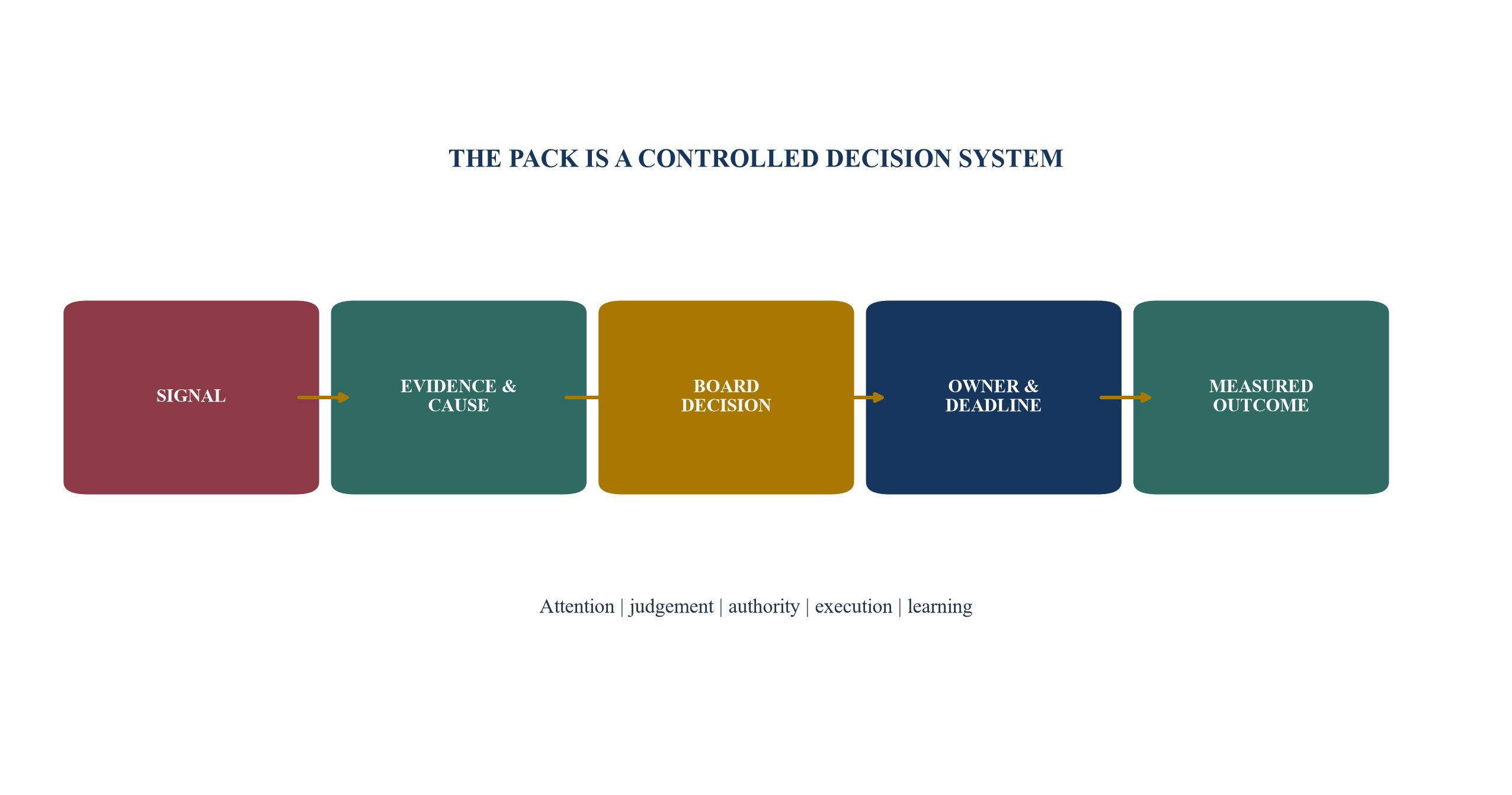
Every connection needs a controlled definition, evidence source, owner and review date.
2. Start with mandate, duties and decision rights
The pack should reflect the legal and governance structure of the company. A sponsor nominee on a portfolio-company board may have been appointed through shareholder rights, but the director's duties ordinarily attach to the company under the applicable law. The OECD Principles emphasise that directors should act in the interests of the company and shareholders and address conflicts fairly [1]. The United Kingdom's section 172 duty requires a director to promote the success of the company while considering specified long-term and stakeholder factors [5]. Comparable duties and governance expectations take different forms elsewhere.
This boundary matters because the board pack can otherwise become an investor reporting instrument that displaces the company's own governance. Sponsor reporting, lender reporting and the company board pack can share controlled data. Their purposes, recipients, confidentiality, duties and approval routes may differ. Information rights in shareholder agreements and financing documents should be mapped alongside statutory and fiduciary duties. Legal advice should govern conflicts, privilege, market-sensitive information and restrictions on sharing.
Reserved matters translate authority into a decision calendar. They commonly cover budget approval, strategy, major capital expenditure, financing, acquisitions, disposals, material contracts, related-party matters, senior appointments, incentive plans and litigation. The board should map each reserved matter to the evidence required, the lead time for decision, the approving body and the record that demonstrates approval. This prevents material decisions from appearing as late information updates after management has already committed resources.
Committee mandates also shape the pack. Audit, risk, remuneration, nomination or transaction committees may examine detail before the full board. The OECD Principles state that committees can support the board while the board retains responsibility [1]. Committee reporting should therefore show the issue considered, evidence reviewed, judgement reached, unresolved questions and recommendation. A committee appendix cannot substitute for a clear full-board decision request.
Table 1. Board-pack readiness diagnostic
| domain | decision-grade condition | warning signal | minimum evidence | accountable role | board response |
|---|---|---|---|---|---|
| mandate | reserved matters and delegations are current | decisions arrive after commitment | charter, authorities and approval history | chair and company secretary | reset route and timing |
| value creation | priorities connect to drivers and financial outcomes | pack reports outcomes without mechanisms | baseline, driver tree and value ledger | chief executive and finance | test cause and intervention |
| cash and financing | liquidity, covenant and funding views reconcile | EBITDA is healthy while cash deteriorates | cash bridge, facility terms and downside | chief financial officer | preserve headroom and decide action |
| commercial | revenue signals include quality and capacity | pipeline grows while conversion falls | cohorts, margin, capacity and customer evidence | commercial executive | revise offer, resource or forecast |
| operations | service or production outcomes trace to constraints | average metric hides critical failure | site, product or process evidence | operations executive | contain, correct or invest |
| accountability | every action has one owner and due date | actions recur without closure evidence | decision and action register | chief executive | escalate or reassign |
The diagnostic tests whether information supports duties, decisions and execution.
3. Establish a single performance spine
The pack needs one controlled performance spine that reconciles the value-creation plan, budget, forecast and actual results. The spine begins with the investment or corporate thesis and expresses it through a limited set of value drivers. Revenue may decompose into active customers, volume, price, mix, retention and new sales. Gross margin may decompose into price, input cost, yield, labour productivity and service delivery. Cash may decompose into EBITDA, working capital, tax, capital expenditure, interest and exceptional items.
Each value driver requires a baseline, definition, source, frequency, owner and financial destination. The pack should distinguish an outcome measure from a leading driver. Revenue is an outcome. Qualified pipeline, renewal dates, backlog conversion and delivery capacity can be drivers. EBITDA is an outcome. Price realisation, yield, utilisation and overhead productivity can be drivers. The board needs both, because outcome measures confirm performance after the fact while drivers support earlier decisions.
Forecast versions should remain visible. A revised forecast should not overwrite the original budget or prior forecast. The board should see actual performance against budget, latest forecast and the previous board view. It should also see changes in assumptions. This creates a forecast-accuracy record and discourages silent rebasing. Management can then explain whether a variance reflects external conditions, execution, timing, scope or prior estimation error.
The same spine should support internal and external reporting where applicable. IFRS revised its Practice Statement on Management Commentary in June 2025 to promote connected information about resources, relationships, risks, opportunities, strategy and performance [7]. IFRS S1 similarly connects governance, strategy, risk management, metrics and targets for sustainability-related information [8]. A portfolio-company pack can use the same discipline even when the entity is not required to apply those materials: relevant information should be connected, comparable and traceable to the financial consequences that directors govern.
4. Build a controlled signal dictionary
A metric becomes a board signal when a defined change requires attention or action. The signal dictionary is the control record behind the dashboard. It identifies the measure, business meaning, formula, source system, owner, reporting frequency, threshold, comparison basis and expected response. It also identifies data latency and limitations. A signal that arrives six weeks after the underlying event cannot support a weekly intervention without a faster proxy.
Thresholds should reflect economics and risk rather than colour preferences. A red signal might indicate forecast cash below an approved minimum, covenant headroom inside a warning boundary, loss of a major customer, a safety event, a material cyber incident or a capital project outside approved cost. Amber can indicate deteriorating trend, incomplete evidence or a decision deadline approaching. Green should mean performance is within the approved boundary, not that every number improved.
Threshold design should include direction, magnitude, duration and interaction. One week of lower conversion may be noise; a sustained fall across priority segments may require action. A modest margin decline combined with inventory growth and overdue receivables can create a larger cash risk than any single metric suggests. The pack should show linked signals and permit management to explain valid exceptions.
Data quality is itself a signal. Missing source records, manual adjustments, changed definitions and unreconciled systems can change the confidence that directors place on a measure. The dictionary should assign an evidence grade or control status. A provisional metric may still support containment, but it should not be presented with the same confidence as a reconciled financial amount.
Table 2. Illustrative board signal dictionary
| signal | definition and comparison | leading evidence | hypothetical trigger | owner | expected board use |
|---|---|---|---|---|---|
| revenue quality | recurring and contracted gross profit by cohort | renewal, backlog and churn reasons | two periods below approved retention boundary | commercial executive | approve account intervention |
| EBITDA delivery | gross-to-net bridge against budget and prior forecast | price, mix, yield, labour and overhead | downside exceeds tolerance after mitigations | chief financial officer | revise forecast and action plan |
| cash conversion | operating cash flow relative to EBITDA | receivables, inventory and payables cohorts | cash gap persists beyond one cycle | finance and operations | release cash and protect liquidity |
| covenant headroom | forecast distance to each tested covenant | downside model and facility terms | warning boundary reached before test date | treasury | engage lenders or change plan |
| customer concentration | revenue and margin exposed to named accounts | contract events and procurement signals | account loss exceeds risk appetite | chief executive | diversify or protect revenue |
| critical operations | service, quality, safety or capacity exception | site and incident evidence | limit breached or recurring near miss | operations executive | contain and invest |
Thresholds are hypothetical and require calibration to the company, financing documents and risk appetite.
5. Separate observation, explanation and decision
Board papers often mix data, narrative and recommendation without making the logic testable. A decision page should separate three layers. Observation states what changed against a defined baseline. Explanation states the evidence-supported causes and uncertainty. Decision states what management wants the board to approve, note, challenge or defer. This structure reduces debate about whether a slide is information or a request.
The observation should quantify the financial and strategic consequence. A revenue shortfall should identify gross profit, cash and customer implications. A delayed system programme should identify cost, operational dependency, control exposure and decision deadlines. A covenant signal should show available headroom under base and downside cases, the relevant test dates and the actions that remain within management authority.
Explanation requires a driver bridge and counterfactual. The board should see what would have happened without the event or intervention. Management should also distinguish fact, estimate and judgement in reader-friendly language. The pack can state that a forecast uses management assumptions and identify the range or sensitivity. It should avoid false precision and should not hide uncertainty inside a blended number.
The decision section specifies authority, options, recommendation, economics, risks, dependencies and timing. It identifies the consequences of delay and the next irreversible step. The board can then approve a boundary or stage rather than a vague programme. Minutes should record the alternatives considered, material questions, conflicts, advice and reasons for the decision. The FRC guidance encourages minutes to document the discussion leading to decisions and the issues raised [3].
6. Reconcile the EBITDA bridge to operating mechanisms
The EBITDA page should explain movement from the approved baseline to current forecast and actual performance. It separates volume, price, mix, input cost, productivity, overhead, one-off items and timing. Each line connects to an operating mechanism and an accountable initiative. The board can then distinguish external pressure from execution failure and genuine structural improvement from temporary benefit.
Gross benefit should be separated from leakage and recurring cost. A procurement saving can be reduced by lower quality, expedited freight or inventory growth. A headcount reduction may create a short-term cost while reducing capacity needed for growth. A price increase may improve reported revenue but reduce retention or volume. The pack should show the net financial destination and cash timing.
Finance should validate benefits against the ledger. The same saving cannot be credited to procurement, operations and a transformation programme. Benefits should carry states such as forecast, contracted, implemented, observed and finance-validated. This creates an evidence trail for incentive decisions, lender discussions and exit diligence.
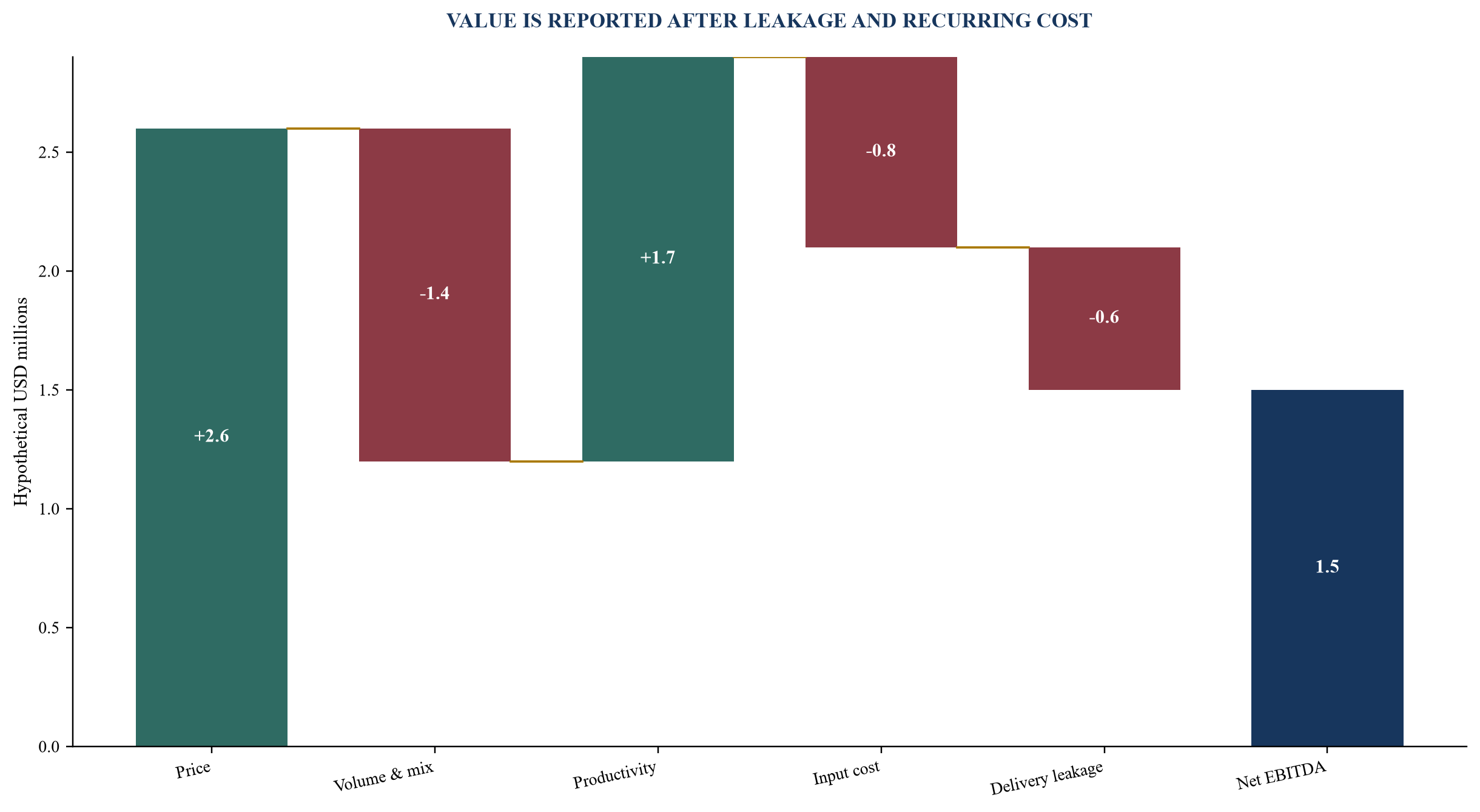
Values are hypothetical USD millions and do not describe a client or achieved result.
7. Put cash conversion and financing capacity beside profit
Boards can miss liquidity stress when profit measures dominate the opening pages. The pack should reconcile EBITDA to operating cash flow and free cash flow. It should show receivables, inventory and payables through cohorts, ageing, disputes, concentration and operational causes. A single days-sales-outstanding average can improve while a material account becomes overdue; cohort detail identifies the actual intervention.
The cash view should separate timing from structural consumption. Seasonal inventory, a one-time tax payment and planned capital expenditure have different management responses from unbilled revenue, poor collections or recurring cost overruns. Each cash variance should identify whether the issue can be recovered, when it is expected to reverse and what evidence supports the forecast.
Financing capacity should show facilities, availability, maturity, covenant definitions, security, guarantees, interest, information undertakings and consent requirements. Forecast headroom should be tested under scenarios aligned with the board's actual risks. The OECD Principles identify material debt contracts and covenant non-compliance risk as relevant information for investors [2]. For the board, the same information is an operating decision input.
Lender engagement needs an owner and calendar. A refinancing process may need to begin before the model shows a breach. Management should identify actions within its control, actions requiring lender consent and actions that change the value-creation plan. The pack should never imply that a waiver, refinancing or additional equity is available until executable terms exist.
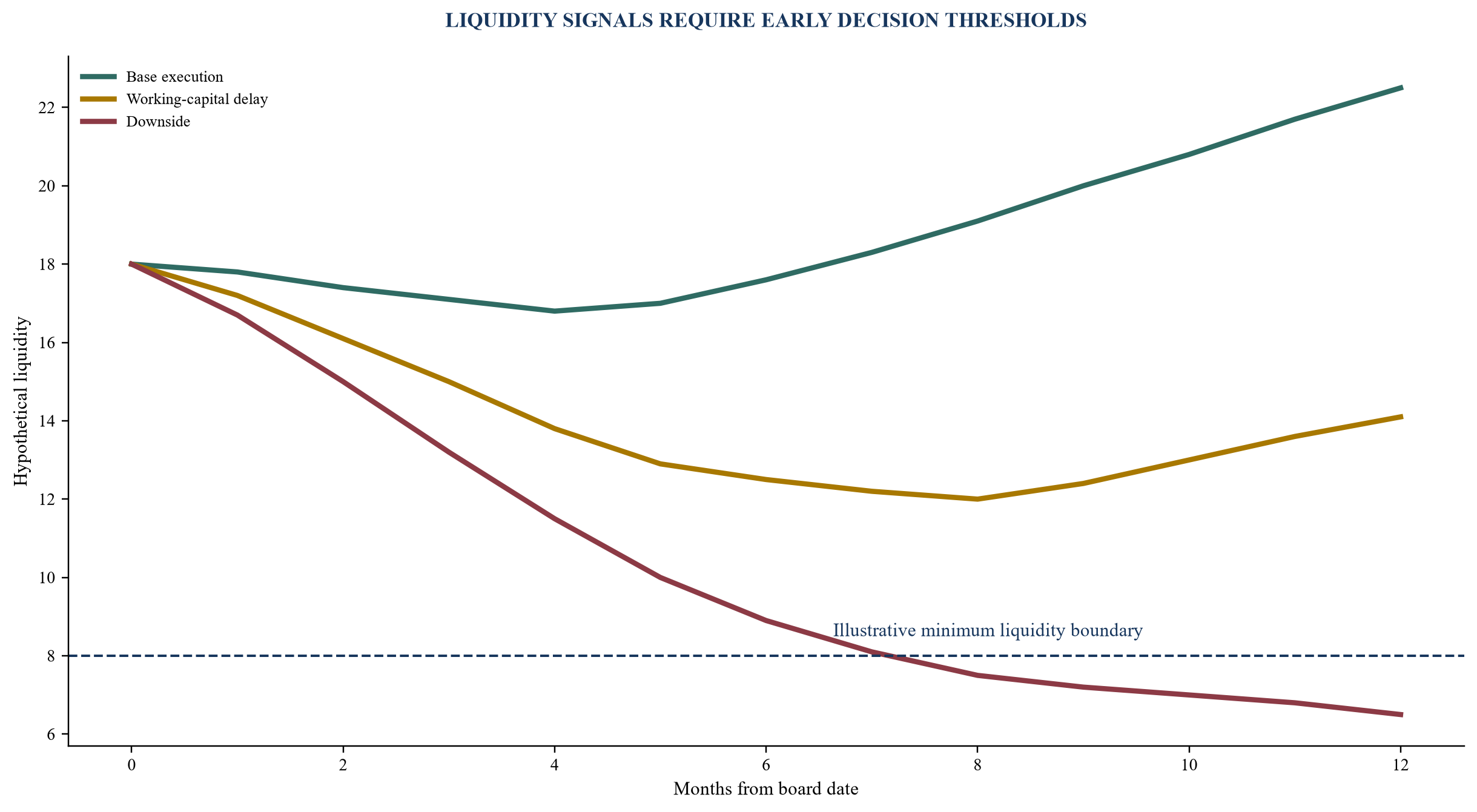
Values are hypothetical USD millions; they do not represent available financing or forecast results.
8. Convert commercial reporting into customer decisions
Commercial reporting should move beyond aggregate pipeline and revenue. The board needs revenue quality, margin, concentration, retention, contract events, customer acquisition economics and delivery capacity. Pipeline should be weighted through a controlled method, segmented by stage and evidence, and reconciled to historical conversion. It should show whether operations can deliver the sold volume at the expected margin and cash profile.
Customer cohorts reveal changes that averages hide. The pack can group customers by start date, product, geography, channel or risk. It should show gross and net retention, expansion, contraction, churn reasons and margin. A named-account view is appropriate when concentration is material, subject to confidentiality and access controls. Early signals can include reduced usage, service failure, delayed renewal, procurement changes or executive turnover.
The decision page should identify the commercial intervention. Options may include account recovery, price action, product change, service investment, sales-capacity reallocation or forecast revision. The economics should include gross profit, incremental cost, cash timing and opportunity cost. Management should avoid protecting low-quality revenue that consumes scarce capacity or working capital without an adequate return.
Customer evidence should connect to product and operations. Sales commentary alone cannot establish whether a renewal risk is caused by product performance, service quality, price, implementation or relationship. The board pack should show the cross-functional owner and the date by which the intervention must change the customer outcome.
9. Turn operations and resilience into leading signals
Operational reporting should identify the few mechanisms that determine service, quality, capacity, cost and cash. A manufacturing platform may need yield, scrap, labour productivity, uptime, energy intensity and order backlog. A software company may need availability, incident severity, release quality, implementation capacity and cloud unit cost. A services business may need utilisation, realised rates, project margin, backlog conversion and employee capacity. The board should see a compact causal chain rather than an undifferentiated catalogue of metrics.
Each critical process needs a service or production promise, a tolerance and a response. The tolerance can reflect customer commitments, regulatory requirements, safety, financial exposure or risk appetite. Management should report the frequency and duration of breaches, the economic effect, the root cause, the containment action and the permanent correction. Repeated green averages can conceal serious local failures, so the pack should include distributions or exceptions where they are material.
Resilience requires attention to dependencies. The board should understand concentration in suppliers, facilities, logistics routes, utilities, data providers, technology platforms and key people. For each material dependency, the pack should show recoverability, tested alternatives, lead times and financial exposure. A nominal contingency arrangement has limited value when it has not been tested or cannot support the required volume.
The board should distinguish incident reporting from resilience improvement. An incident page explains what happened and what is being done. A resilience page shows whether the operating system is becoming more robust through tested recovery times, reduced single points of failure, improved preventive maintenance, stronger supplier coverage or better capacity buffers. The decision request should state which risk reduction is economical and which residual exposure the board is being asked to accept.
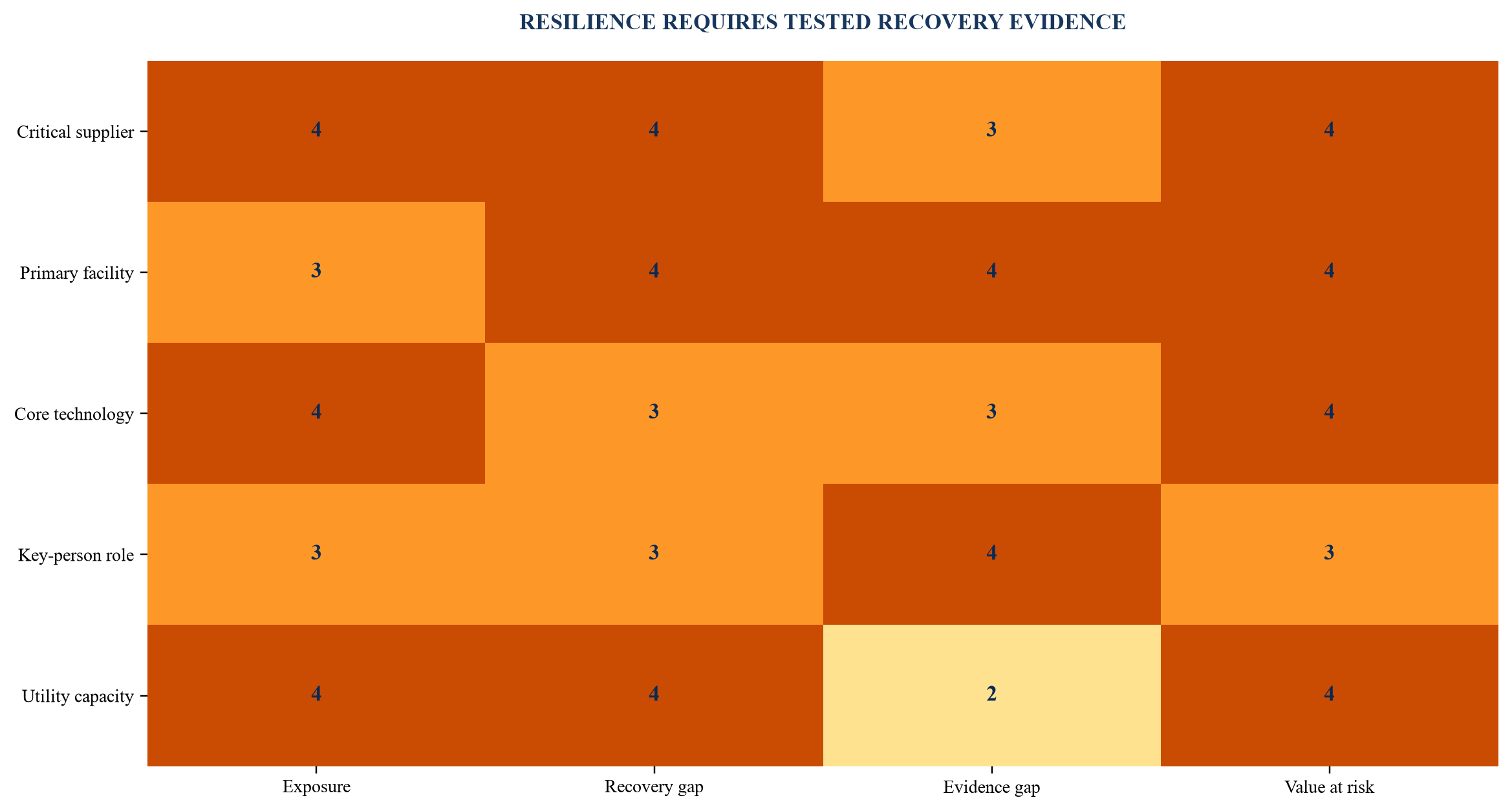
Scores are hypothetical; management should define impact, recoverability and evidence for its own operating context.
10. Make leadership capacity and incentives visible
People reporting becomes board-relevant when it connects leadership capacity to execution. Headcount, vacancies and turnover are starting points. The board also needs critical-role coverage, succession readiness, decision bottlenecks, capability gaps, retention risk and the quality of the management operating rhythm. A vacancy in a critical technical, commercial or control role can affect value more than several non-critical vacancies combined.
The pack should identify roles, not named individuals, unless confidentiality and access controls support the disclosure. For each critical role, it can show incumbent status, performance, retention risk, successor readiness and development action. Management should separate observed evidence from judgement. A succession rating without readiness criteria or evidence creates false precision.
Incentive reporting should connect measures to the value-creation plan and to conduct. Revenue incentives that ignore margin, collections or customer outcomes can create growth that destroys cash. Cost targets that ignore service, safety or maintenance can shift liabilities into future periods. The remuneration committee or board should see whether measures, thresholds, deferrals and malus or clawback terms remain aligned with the actual risks and objectives of the company.
The board should also monitor organisational friction. Examples include recurring decisions that escalate because authority is unclear, functions that optimise incompatible measures, or initiatives that lack the capacity to execute. The pack can show spans, layers and interfaces where they affect delivery. The requested action may be a hire, a role redesign, a decision-right clarification, a change to incentives or a reprioritisation of work.
11. Govern technology, data and cyber as operating value
Technology reporting should connect investment and risk to business outcomes. Project status expressed through traffic lights can obscure whether the capability is usable, adopted and economically productive. The board needs the intended operating change, delivery evidence, adoption, full cost, dependency, control implications and realised value. Benefits should reconcile to the same financial and operational definitions used elsewhere in the pack.
For data, the pack should show the quality of the information used for material decisions. Ownership, lineage, access, timeliness, completeness and reconciliation matter. The board does not need every data-quality exception; it needs to know which decisions are exposed, how large the potential error is, and what control or remediation is planned. Management estimates should be labelled and separated from ledger, contract, system or independently assured evidence.
Cyber reporting should be decision-oriented. It can cover material incidents, critical vulnerabilities, identity and access, recovery tests, third-party concentration, remediation ageing and regulatory or contractual exposure. The United States Securities and Exchange Commission requires public companies within its scope to disclose material cybersecurity incidents and information about risk management and governance [30]. Other jurisdictions and sectors apply different requirements. The board should use the applicable legal and regulatory framework and should avoid assuming that a dashboard alone demonstrates control effectiveness.
Artificial intelligence initiatives require the same discipline. The pack should identify the use case, accountable owner, decision affected, approved data, validation, human oversight, security, third parties, cost and measurable outcome. Model accuracy without workflow adoption or economic impact is incomplete evidence. Material limitations, drift, override rates and incidents should be visible where they can affect customers, financial reporting, regulation or enterprise value.
12. Force capital expenditure and portfolio choices into one frame
Capital expenditure should be presented as a portfolio of choices competing for scarce capital and management capacity. The pack should separate maintenance, safety, compliance, capacity, productivity, technology and strategic-option expenditure. It should also distinguish committed, approved and proposed amounts. Cash timing, total project cost and contingency should reconcile to the forecast.
Each material proposal should state the problem, options considered, counterfactual, full cost, operating dependency, implementation risk and decision rule. Financial analysis can include return on invested capital, net present value, payback and downside cases, using assumptions that finance can reproduce. The board should see whether the proposal relies on uncontracted revenue, unavailable financing, unproven technology or management capacity already allocated elsewhere.
Post-investment review is part of accountability. Management should compare approved assumptions with actual cost, timing, adoption, output and financial effect. Variances should identify controllable and external causes. The purpose is to improve decisions and execution, while recognising that hindsight can distort the assessment of a sound decision made with the information available at the time.
Table 3. Board-pack architecture from signal to evidence
| Layer | Core question | Required evidence | Typical output |
|---|---|---|---|
| Executive decisions | What must the board decide now? | Decision memo, options, economics, risks | Resolution or direction |
| Performance spine | Is the value-creation plan on track? | Actual, plan, prior forecast, bridge | Management intervention |
| Cash and capital | Can the company fund the plan? | Cash bridge, headroom, maturities, scenarios | Funding or allocation decision |
| Customers and operations | Which mechanisms are changing value? | Cohorts, unit economics, service, capacity | Commercial or operating action |
| People and organisation | Can the team execute? | Critical roles, capacity, incentives | Appointment or operating-model action |
| Risk and resilience | Which exposures exceed tolerance? | Incidents, triggers, recovery evidence | Mitigation or risk acceptance |
| Actions and outcomes | Did prior decisions change results? | Owner, deadline, evidence, realised effect | Closure, escalation or redesign |
The architecture should remain concise, controlled and linked to the approved board calendar.
13. Put acquisitions and integration readiness on the same operating spine
An acquisition pipeline should show more than targets and indicative valuation. The board needs strategic fit, source, status, decision date, valuation range, financing, diligence priorities, management capacity, integration thesis and walk-away conditions. The pipeline should distinguish screened opportunities from actionable processes. Probability weights should be supported by defined stages rather than optimism.
For a live transaction, the pack should connect diligence findings to the operating model and value-creation plan. Revenue quality, customer concentration, margin, working capital, capital needs, technology, people, compliance and liabilities should reconcile to the investment case. The board should see what has been verified, what remains uncertain, who owns each unresolved issue and which finding changes price, terms, structure or appetite.
Integration should begin before completion. The board needs a Day One control plan, decision rights, leadership, customer and employee communications, financial reporting, cash control, technology dependencies and synergy governance. Synergy should remain gross, leakage, cost and timing separated. A recurring benefit should not be recorded as realised merely because an initiative has launched.
The same framework applies to divestitures. Management should show perimeter, separation dependencies, stranded cost, transitional services, customer and employee risks, cash requirements and value protection. Board reporting should make clear which decisions preserve optionality and which commit the company to a path that is costly to reverse.
14. Integrate risk, control and regulatory events with performance
Risk information should sit beside the decisions and performance mechanisms it affects. A separate risk register can support completeness, but the board pack should elevate changes in exposure, breaches, incidents, remediation delays and emerging obligations that alter value or require action. The board should understand the source, velocity, potential effect, control status and decision owner.
Risk appetite becomes operational through limits and escalation triggers. A limit should define the measure, owner, data source, frequency and response. Management should report both current position and trajectory. A threshold crossed after value has already been lost is a lagging record; a useful trigger gives the board or management time to intervene.
Control reporting should distinguish design, implementation and operating effectiveness. A policy can exist while execution remains inconsistent. Assurance should identify its scope, method, period and limitations. The board should avoid treating internal audit, external audit, compliance monitoring and management testing as interchangeable forms of evidence.
Regulatory events need accountable translation into operations. The pack should identify the obligation, effective date, affected processes, legal interpretation, implementation milestones, budget, testing and residual exposure. Multi-jurisdiction groups should maintain a jurisdictional map because board duties, listing requirements, privacy, employment, competition, sector regulation and disclosure can differ materially.
15. Use a one-page decision memo standard
Every material request should arrive in a consistent decision format. The first line states the decision required and the latest responsible decision date. The memo then explains the fact pattern, options, economics, risks, dependencies, management recommendation, implementation owner and monitoring evidence. Appendices can hold detailed models, contracts or technical analysis.
The memo should preserve alternatives. A binary approve-or-reject framing can conceal viable sequencing, scope or structure choices. Management should describe the counterfactual and the cost of delay. The financial section should show cash, profit, balance-sheet, covenant and valuation implications where material. Scenario ranges should identify the assumptions that change the recommendation.
Board challenge should be recorded through the rationale for the decision. FRC guidance states that minutes should document discussion and reasons for decisions [3]. The record supports accountability and helps later reviewers distinguish decision quality from outcome luck. Sensitive material should be handled in accordance with applicable privilege, confidentiality, competition and data requirements.
Table 4. One-page board decision memo
| Field | Required content | Quality test |
|---|---|---|
| Decision | Exact approval, direction or acknowledgement | Can the resolution be drafted from this sentence? |
| Timing | Latest responsible decision date and reason | Is the cost of delay explicit? |
| Evidence | Verified facts, source dates and limitations | Can finance and the responsible function reproduce it? |
| Options | Alternatives, counterfactual and reversibility | Are feasible choices genuinely compared? |
| Economics | Cash, profit, capital and downside | Are assumptions controlled and reconciled? |
| Risk | Principal exposures, controls and residual risk | Is acceptance authority clear? |
| Execution | Owner, milestones, dependencies and capacity | Can progress be measured after approval? |
| Monitoring | Outcome measures and review date | Will the board know whether the decision worked? |
The memo should point to controlled appendices and avoid repeating the full board pack.
16. Build the calendar, agenda and pre-read discipline
The board calendar should reflect the company's decision cycle. Monthly meetings may focus on performance, cash, operating interventions and live transactions. Quarterly meetings can examine strategy, capital allocation, risk, talent and value-creation priorities in greater depth. Annual work can include budget, strategy, succession, board evaluation, risk appetite and assurance. The calendar should reserve time for known decisions before urgency compresses analysis.
Agenda design allocates attention. The chair, chief executive and company secretary or governance lead should identify decision items, discussion items and information items. Matters that require challenge should not be placed late in an overloaded meeting. Standing reports can be taken as read when directors have had time to review them and can raise questions. The agenda should allow management to explain causes and alternatives without converting the meeting into a sequence of presentations.
Pre-read discipline requires a clear cut-off, controlled version and delivery sufficiently in advance for directors to prepare. FRC guidance identifies timely provision and clear expectations as features of effective board papers [3]. Late material should identify what changed, why it is late and whether the decision should proceed. A standing acceptance of late packs reduces the quality of challenge and shifts the cost of weak preparation onto the board.
Questions raised before the meeting can improve efficiency when the process does not suppress open debate. Management can circulate factual answers and corrected data while preserving substantive issues for discussion. Directors should have access to management and independent advice through the applicable governance arrangements. The final pack and minutes should be retained through approved records controls.
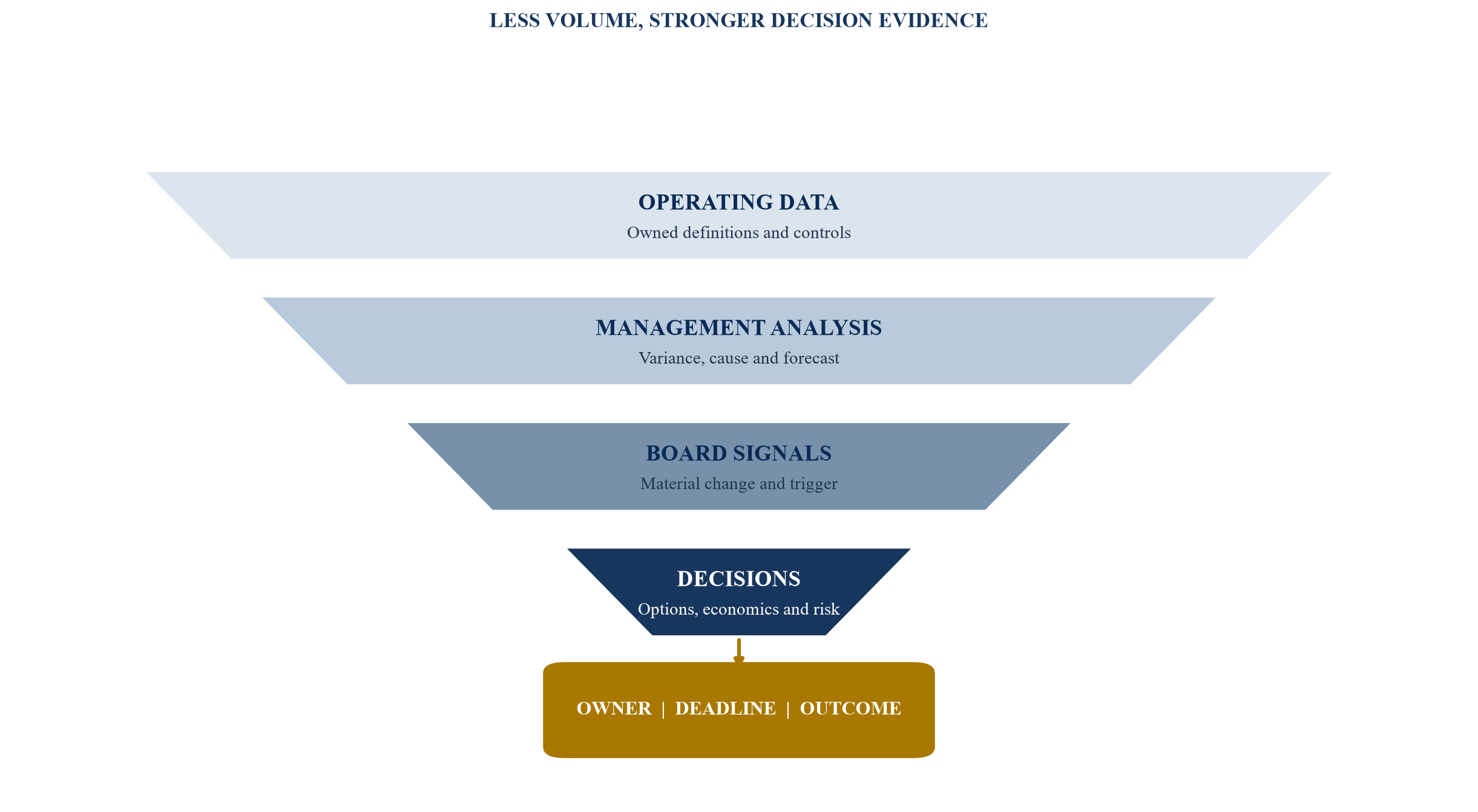
Detailed evidence remains accessible in controlled appendices while the meeting focuses on material choices.
17. Close the loop through a decision and action register
Minutes document governance; the action register makes follow-through operational. Every decision should identify the owner, deliverable, due date, dependencies, evidence of completion and expected outcome. An action is not complete because a meeting occurred or a document was produced. Completion requires the defined deliverable, and value requires evidence that the intended operating or financial result followed.
The register should distinguish decisions, actions and outcomes. A board may approve a pricing programme; management may implement customer-level price actions; the measured outcome may be realised price, volume retention, margin and collections. Keeping these stages separate prevents activity from being mistaken for value. It also reveals when a sound decision is undermined by weak execution.
Overdue actions should carry an explanation, revised date and escalation. Repeated extensions can indicate inadequate capacity, unclear authority, poor prioritisation or an unrealistic plan. The board should decide whether to add resources, change the approach, accept the consequence or stop the initiative. The register should not grow indefinitely; closed items can move to an archive while recurring control actions remain in the appropriate management system.
Table 5. Decision and action register
| Decision or action | Accountable owner | Due date | Completion evidence | Intended outcome | Status and escalation |
|---|---|---|---|---|---|
| Approve customer recovery plan | Chief commercial officer | Day 15 | Signed account plans and revised forecast | Protect margin and renewal value | Open; escalate missed client milestones |
| Release working capital | Chief financial officer | Day 30 | Cohort collections and dispute closure | Increase available liquidity | At risk; board reviews top exposures |
| Stabilise service capacity | Chief operating officer | Day 45 | Tested capacity and service evidence | Restore delivery and reduce penalties | Open; supplier dependency tracked |
| Fill critical control role | Chief executive officer | Day 60 | Appointment and authority confirmed | Reduce control and execution exposure | Open; interim coverage documented |
Hypothetical entries illustrate the control fields; they do not describe a company or engagement.
18. Protect the sponsor-company information boundary
Sponsor-backed governance requires clarity about roles. Directors owe duties under the law and constitutional arrangements applicable to the company. Shareholders or sponsors may have contractual information, consent or appointment rights. Management remains responsible for operating the business. The pack should support these roles without blurring accountability.
Information access should follow law, contracts, confidentiality, privilege, competition rules, privacy and conflicts procedures. A sponsor may manage multiple portfolio companies in related markets. Sensitive customer, pricing, employee, technology or transaction information should be shared only through approved access, clean-team or other controls where required. Board materials should be classified, distributed and retained through a controlled process.
Conflicts should be identified before the relevant discussion. The board can use declarations, recusals, separate committees, independent advice or information restrictions as appropriate. The minutes should record the process followed. Directors should obtain current legal advice because duties and conflict rules differ across jurisdictions and company forms.
The sponsor should also define how portfolio information is consolidated. A common performance dictionary can support comparison, while each company retains measures relevant to its business model. Portfolio benchmarking should account for definitions, maturity, geography and operating context. A rank without comparable data can create misleading pressure and poor decisions.
19. Define early-warning triggers and escalation routes
An early-warning system begins with the failure modes that can materially damage value. Management can work backwards from liquidity stress, customer loss, service failure, covenant pressure, regulatory breach, leadership loss, technology outage or transaction delay. For each failure mode, it identifies leading signals, thresholds, evidence, owner and response.
Triggers should be calibrated through operating reality. A fixed percentage variance may be appropriate for some measures; others require event-based or trajectory-based triggers. Customer concentration may require escalation when a renewal enters a risk stage. Liquidity may require action when forecast headroom falls below a board-approved buffer. Cyber may require immediate escalation based on affected data, service or legal criteria.
The escalation route should define who is informed, who decides and how quickly. It should operate between board meetings. Reserved matters and emergency authorities should be clear. Management should record the evidence and action, then include the event and outcome in the next pack. Testing the escalation process through scenario exercises can reveal contact, data and authority gaps before an actual event.
False alarms and missed signals should both be reviewed. A trigger that fires constantly can consume attention; a trigger that never fires may be too late or based on unavailable data. Calibration should remain governed, with changes documented and approved by the responsible authority.
20. Measure whether the board pack improves decisions
Board-pack effectiveness can be measured without reducing governance to a score. Useful process measures include on-time distribution, late papers, reconciliations, unresolved data exceptions, pages per decision, decision deferrals, action ageing and evidence of closure. Outcome measures can include forecast accuracy, intervention lead time and the realised economic effects attached to approved actions.
The board should interpret these measures carefully. A low number of questions can indicate a clear pack or weak challenge. A high number can indicate healthy scrutiny or poor preparation. Evidence should combine quantitative patterns, director feedback, management feedback, minutes, action records and periodic board evaluation. The UK, Singapore, Australia, Japan, Malaysia, Canada and South Africa all provide governance frameworks that emphasise board effectiveness, information or evaluation in jurisdiction-specific ways [4], [17], [19], [21], [23], [24], [25].
The company can run a quarterly pack review. It removes unused pages, investigates recurring restatements, checks the signal dictionary and assesses whether the pack anticipated material events. Annual review can align the pack with strategy, budget, risk appetite, financing and board calendar. A transaction, refinancing, leadership change or material operating shift may require an earlier redesign.
21. Apply the framework to a hypothetical services platform
Consider a hypothetical multi-country business-services platform. The prior pack reports revenue ahead of budget and EBITDA broadly on plan. Cash is behind forecast, one major customer's renewal has slowed, project overruns are increasing and a critical delivery leader has resigned. The acquisition pipeline includes a strategically attractive target. These assumptions are illustrative and do not represent an actual company.
The redesigned pack begins with four decisions. The board must decide whether to revise the forecast, fund a customer recovery and delivery programme, authorise interim leadership capacity and continue acquisition diligence. The performance spine shows that headline revenue growth includes lower-margin work and delayed billing. The EBITDA bridge separates price and volume from delivery leakage. The cash bridge shows the effect of unbilled revenue, disputes and milestone slippage.
Customer cohorts identify a concentrated renewal exposure, while operations data shows the service failures behind it. The people page identifies the authority and capability gap created by the departure. The acquisition memo shows that management capacity is a binding dependency. The board therefore sequences the choices: stabilise delivery and cash, install accountable leadership, establish evidence-based renewal milestones, and continue only limited diligence until defined operating triggers are met.
The decision register records owners, deadlines and expected economics. At the next meeting, management reports actual billing release, service recovery, customer milestones and leadership coverage. The acquisition decision is reconsidered using current capacity and financing evidence. The example demonstrates how one performance spine can convert separate departmental reports into a coherent sequence of choices.
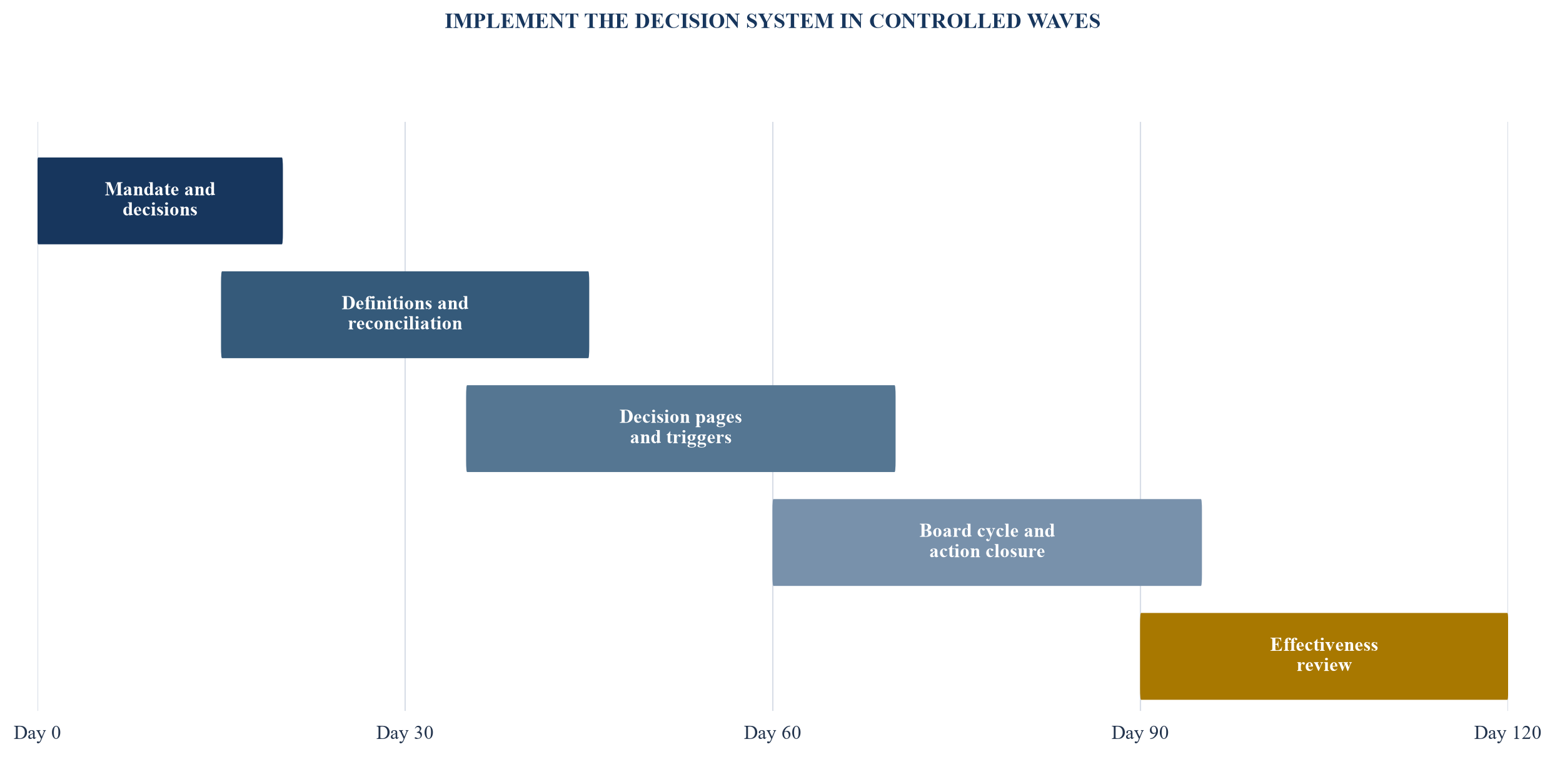
Timing is illustrative and should be adapted to board calendar, data maturity and operating urgency.
22. Assemble the recurring board-pack template
The recurring pack can begin with a cover, confidentiality classification, meeting details and contents. The first substantive pages should present the executive decision list, prior actions and material changes since the previous pack. The performance spine follows, with strategy and value-creation measures, EBITDA, cash, financing and forecast. Customer, operations, people, technology and risk sections then explain the mechanisms behind those outcomes.
Each section should use a standard header: signal, status, change, cause, economic effect, owner, action and decision. Commentary should explain only material movement. Charts should show periods and units clearly, define sources and avoid decorative complexity. Tables should keep comparable definitions. Appendices can provide financial statements, detailed metrics, legal documents, transaction materials and committee reports.
The pack should be built from controlled source systems where practical. Automation can improve timeliness, while ownership and reconciliation remain essential. Finance should reconcile the performance spine to approved records. Functional owners should sign off their measures. The company secretary or governance lead should control the meeting version. Corrections after distribution should be logged and highlighted.
Table 6. Illustrative board meeting agenda and evidence set
| Agenda item | Purpose | Core evidence | Board output |
|---|---|---|---|
| Prior decisions and actions | Close accountability loop | Decision register and outcome evidence | Closure or escalation |
| Performance and forecast | Understand value movement | KPI spine, EBITDA and cash bridges | Forecast direction |
| Material decision memos | Choose among alternatives | Options, economics, risks, capacity | Resolution or further evidence |
| Customers and operations | Address leading mechanisms | Cohorts, service, capacity, resilience | Operating intervention |
| People and organisation | Confirm execution capacity | Critical roles, succession, incentives | Appointment or redesign |
| Risk, controls and compliance | Review exposure and tolerance | Incidents, triggers, assurance | Mitigation or acceptance |
| Strategy and transactions | Protect long-term options | Portfolio choices, M&A and scenarios | Strategic direction |
Allocation reflects decision complexity; it does not prescribe a universal meeting length.
23. Execute a 120-day implementation programme
Days 0 to 20 establish authority and scope. The chair, sponsor representatives, directors and management confirm board responsibilities, reserved matters, strategic priorities, risk appetite, reporting calendar and current pain points. The team inventories existing reports and identifies decisions delayed by missing, late or inconsistent information. It agrees the pack charter and named design owner.
Days 15 to 45 build the controlled data spine. Finance and functional owners define the signal dictionary, baselines, source systems, evidence hierarchy, reconciliation and forecast calendar. They identify manual estimates and data limitations. The team selects the smallest set of measures that explains value, cash, customers, operations, people and material risk.
Days 35 to 70 create decision pages and escalation. Management builds the EBITDA and cash bridges, customer and operating cohorts, critical-role view, resilience map and decision memo. The board approves triggers and response authorities. A dry run uses a prior meeting or current decision to test whether each page leads from evidence to action.
Days 60 to 95 run the first controlled board cycle. Papers are delivered to the agreed timetable, factual questions are resolved, decisions and rationale are minuted, and actions enter the register. Management records corrections and pages that did not support discussion. The board protects sufficient time for the highest-value and highest-risk decisions.
Days 90 to 120 review effectiveness. The team examines forecast changes, deferred decisions, action ageing, data exceptions, director feedback and early operating outcomes. It removes low-value content, corrects definitions and establishes the quarterly review. The result is a governed decision system that continues to evolve with strategy and risk.
Implementation should remain proportionate. A smaller company can use a concise pack with disciplined definitions and ownership. A regulated or multi-jurisdiction group may need additional committee, assurance and disclosure layers. The governing principle remains consistent: every material signal should lead to informed judgement, accountable action and evidence of outcome.
References
- OECD, G20/OECD Principles of Corporate Governance 2023. https://www.oecd.org/en/publications/g20-oecd-principles-of-corporate-governance-2023_ed750b30-en.html
- OECD, G20/OECD Principles of Corporate Governance 2023, Disclosure and transparency. https://www.oecd.org/en/publications/g20-oecd-principles-of-corporate-governance-2023_ed750b30-en/full-report/component-7.html
- UK Financial Reporting Council, Guidance on Board Effectiveness. https://www.frc.org.uk/library/standards-codes-policy/corporate-governance/corporate-governance-code-guidance/
- UK Financial Reporting Council, UK Corporate Governance Code 2024. https://media.frc.org.uk/documents/UK_Corporate_Governance_Code_2024_a2hmQmY.pdf
- UK Parliament, Companies Act 2006, section 172. https://www.legislation.gov.uk/ukpga/2006/46/section/172
- UK Financial Reporting Council, Review of Corporate Governance Reporting 2024. https://media.frc.org.uk/documents/Review_of_Corporate_Governance_Reporting_2024.pdf
- IFRS Foundation, Management Commentary. https://www.ifrs.org/projects/completed-projects/2025/management-commentary/
- IFRS Foundation, IFRS S1 General Requirements for Disclosure of Sustainability-related Financial Information. https://www.ifrs.org/issued-standards/ifrs-sustainability-standards-navigator/ifrs-s1-general-requirements/
- United States Securities and Exchange Commission, Proxy Disclosure Enhancements. https://www.sec.gov/files/rules/final/2009/33-9089-secg.htm
- Electronic Code of Federal Regulations, 17 CFR 229.407. https://www.ecfr.gov/current/title-17/chapter-II/part-229/subpart-229.400/section-229.407
- International Finance Corporation, Corporate Governance Methodology and Tools. https://www.ifc.org/en/what-we-do/sector-expertise/corporate-governance/cg-methodology-tools
- International Finance Corporation, Corporate Governance Methodology. https://www.ifc.org/content/dam/ifc/doc/2023/ifc-corporate-governance-methodology.pdf
- Committee of Sponsoring Organizations of the Treadway Commission, Enterprise Risk Management. https://www.coso.org/enterprise-risk-management
- UAE Securities and Commodities Authority, Corporate Governance. https://www.sca.gov.ae/en/regulations/corporate-governance.aspx
- Saudi Capital Market Authority, Corporate Governance Regulations. https://cma.org.sa/en/RulesRegulations/Regulations/Documents/CorporateGovernanceRegulations1.pdf
- Securities and Exchange Board of India, Listing Obligations and Disclosure Requirements Regulations, amended to January 22, 2026. https://www.sebi.gov.in/web/?file=https%3A%2F%2Fwww.sebi.gov.in%2Fsebi_data%2Fattachdocs%2Fapr-2026%2F1777351317428.pdf
- Singapore Exchange Regulation, Code of Corporate Governance 2018. https://rulebook.sgx.com/rulebook/download-pdf-3
- Singapore Exchange Regulation, Mainboard Rules. https://rulebook.sgx.com/rulebook/mainboard-rules
- ASX Corporate Governance Council, Corporate Governance Principles and Recommendations. https://www.asx.com.au/about/regulation/corporate-governance-principles-and-recommendations
- Japan Financial Services Agency, Revisions of Japan's Corporate Governance Code, 2021. https://www.fsa.go.jp/en/news/2021/20210406.html
- Japan Financial Services Agency, Corporate Governance Code. https://www.fsa.go.jp/en/laws_regulations/pc_corporate_governance.html
- Securities Commission Malaysia, Malaysian Code on Corporate Governance 2021. https://www.sc.com.my/api/documentms/download.ashx?id=239e5ea1-a258-4db8-a9e2-41c215bdb776
- Securities Commission Malaysia, Corporate Governance Monitor 2025. https://www.sc.com.my/api/documentms/download.ashx?id=498c2e80-44c6-4c10-b983-c122bbf22609
- Financial and Consumer Services Commission of New Brunswick, National Policy 58-201 Corporate Governance Guidelines. https://fcnb.ca/en/securities/securities-law-and-policy/regulatory-instruments/58-201-corporate-governance-guidelines
- Institute of Directors South Africa, King V Report on Corporate Governance. https://www.iodsa.co.za/page/king-v
- Basel Committee on Banking Supervision, Corporate governance principles for banks. https://www.bis.org/bcbs/publ/d328.htm
- European Banking Authority, Guidelines on internal governance under CRD. https://eba.europa.eu/activities/single-rulebook/regulatory-activities/internal-governance/guidelines-internal-governance-under-crd?version=2017
- UK Financial Reporting Council, Wates Corporate Governance Principles for Large Private Companies. https://www.frc.org.uk/library/standards-codes-policy/corporate-governance/the-wates-corporate-governance-principles-for-large-private-companies/
- UK Financial Reporting Council, Audit Committees and the External Audit: Minimum Standard. https://www.frc.org.uk/library/standards-codes-policy/audit-assurance-and-ethics/audit-committees/
- United States Securities and Exchange Commission, Cybersecurity Risk Management, Strategy, Governance, and Incident Disclosure. https://www.sec.gov/files/rules/final/2023/33-11216.pdf
- International Organization of Securities Commissions, Principles for Periodic Disclosure by Listed Entities. https://www.iosco.org/library/pubdocs/pdf/IOSCOPD317.pdf
- Institutional Limited Partners Association, Principles and Best Practices. https://ilpa.org/industry-guidance/principles-best-practices/
- Chartered Governance Institute UK and Ireland, Board Behavioural Dynamics. https://cgi.org.uk/resources/research/research/board-behavioural-dynamics/
Sources and further reading
- OECD, G20/OECD Principles of Corporate Governance 2023. Official source
- OECD, G20/OECD Principles of Corporate Governance 2023, Disclosure and transparency. Official source
- UK Financial Reporting Council, Guidance on Board Effectiveness. Official source
- UK Financial Reporting Council, UK Corporate Governance Code 2024. Official source
- UK Parliament, Companies Act 2006, section 172. Official source
- UK Financial Reporting Council, Review of Corporate Governance Reporting 2024. Official source
- IFRS Foundation, Management Commentary. Official source
- IFRS Foundation, IFRS S1 General Requirements for Disclosure of Sustainability-related Financial Information. Official source
- United States Securities and Exchange Commission, Proxy Disclosure Enhancements. Official source
- Electronic Code of Federal Regulations, 17 CFR 229.407. Official source
- International Finance Corporation, Corporate Governance Methodology and Tools. Official source
- International Finance Corporation, Corporate Governance Methodology. Official source
- Committee of Sponsoring Organizations of the Treadway Commission, Enterprise Risk Management. Official source
- UAE Securities and Commodities Authority, Corporate Governance. Official source
- Saudi Capital Market Authority, Corporate Governance Regulations. Official source
- Securities and Exchange Board of India, Listing Obligations and Disclosure Requirements Regulations, amended to January 22, 2026. Official source
- Singapore Exchange Regulation, Code of Corporate Governance 2018. Official source
- Singapore Exchange Regulation, Mainboard Rules. Official source
- ASX Corporate Governance Council, Corporate Governance Principles and Recommendations. Official source
- Japan Financial Services Agency, Revisions of Japan's Corporate Governance Code, 2021. Official source
- Japan Financial Services Agency, Corporate Governance Code. Official source
- Securities Commission Malaysia, Malaysian Code on Corporate Governance 2021. Official source
- Securities Commission Malaysia, Corporate Governance Monitor 2025. Official source
- Financial and Consumer Services Commission of New Brunswick, National Policy 58-201 Corporate Governance Guidelines. Official source
- Institute of Directors South Africa, King V Report on Corporate Governance. Official source
- Basel Committee on Banking Supervision, Corporate governance principles for banks. Official source
- European Banking Authority, Guidelines on internal governance under CRD. Official source
- UK Financial Reporting Council, Wates Corporate Governance Principles for Large Private Companies. Official source
- UK Financial Reporting Council, Audit Committees and the External Audit: Minimum Standard. Official source
- United States Securities and Exchange Commission, Cybersecurity Risk Management, Strategy, Governance, and Incident Disclosure. Official source
- International Organization of Securities Commissions, Principles for Periodic Disclosure by Listed Entities. Official source
- Institutional Limited Partners Association, Principles and Best Practices. Official source
- Chartered Governance Institute UK and Ireland, Board Behavioural Dynamics. Official source
