

1. Treat platform readiness as an investment decision
A bolt-on programme creates value only when the platform can convert ownership into better operating outcomes. Deal origination, price and financing are visible decisions. Absorption capacity is less visible because it sits across daily processes, management calendars, data, systems, customer relationships and control routines. The board should therefore approve a readiness posture before authorising the next acquisition process.
Readiness has three dimensions. Strategic readiness asks whether the next target archetype advances a defined investment thesis. Operating readiness asks whether the existing company can absorb change without weakening service, cash, controls or leadership. Transaction readiness asks whether the company can screen, diligence, sign, complete and integrate the specific target within legal and practical constraints. A company can be strong in one dimension and weak in another.
The decision should be evidence-led. A declared ambition to execute several acquisitions is not capacity. A prior successful deal is not necessarily repeatable when the target, geography, integration mode or management team changes. The board needs current baselines, named owners, reserved resources, standard modules, unresolved integration debt and clear stop conditions.
Research on serial acquirers shows that overlapping integrations can weaken the relationships and organisational routines on which future integration depends [27]. Other work finds that task integration can be codified more readily than human integration, whose effects depend on context and experience [28][29]. These findings support a practical rule: the platform should prove both technical capacity and human capacity before opening another major change programme.
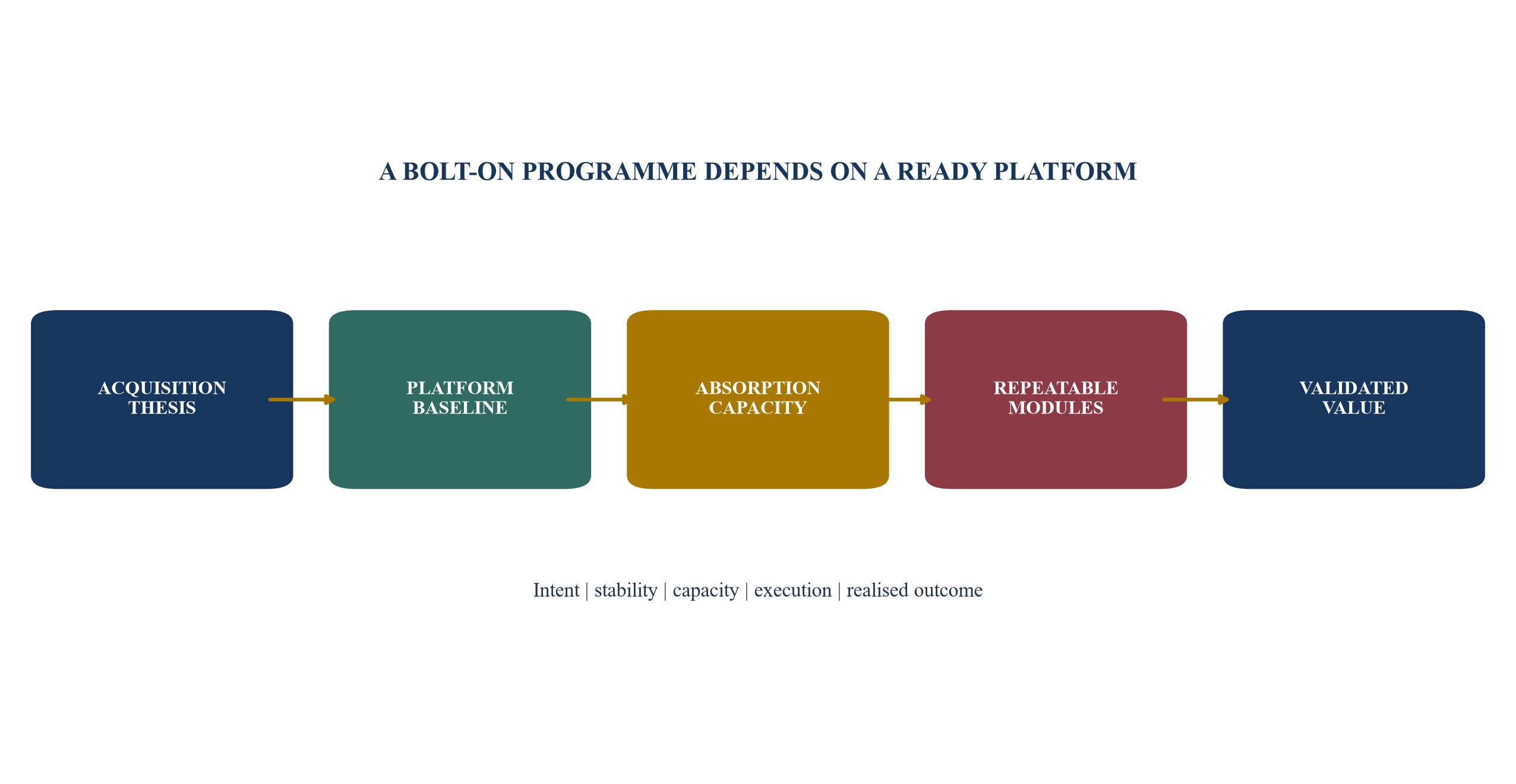
Each layer requires current evidence, an accountable owner and a board-approved capacity boundary.
2. Define the target archetype before building capacity
Readiness is meaningful only against a target archetype. A platform cannot be generally ready for every acquisition. Management should define the typical target's revenue range, product and customer overlap, geography, regulatory perimeter, technology estate, operating maturity, ownership profile, likely integration mode and expected source of value. The archetype converts a broad buy-and-build ambition into a testable demand on the platform.
The target archetype also disciplines origination. A company designed to acquire local service businesses with limited technology complexity may not be ready for a regulated cross-border target with proprietary software and significant personal data. A target can look strategically attractive while exceeding the platform's current control, funding or integration capacity. That gap should become a decision variable rather than an issue discovered after signing.
Management can maintain more than one archetype when the programme is genuinely multi-track. Each track should have its own screening criteria, diligence depth, integration modules, capacity requirement and approval route. The board should understand which track is active and which capabilities are shared. An unrestricted target universe usually produces incompatible processes and makes learning difficult.
The archetype should state the intended integration logic. Cost-led acquisitions often require deeper process and system convergence. Revenue-led acquisitions may need greater autonomy to protect customer relationships, talent or innovation. Empirical research using 1,452 acquisitions found that integration degree should align with the intended source of operating synergy [30]. The readiness plan should therefore begin with value logic, not with a universal integration template.
3. Establish a readiness score before the pipeline accelerates
The board needs a compact view of the platform's current state. A readiness scorecard can cover performance stability, cash and covenant headroom, management capacity, finance close, customer continuity, technology scalability, data quality, cybersecurity, people, compliance and integration governance. Scores should summarise evidence; they should not replace judgement.
Every domain needs a minimum standard and a stop condition. For example, finance may require a reliable monthly close, chart-of-accounts ownership and capacity for purchase accounting. Technology may require an application inventory, identity standards, secure connectivity and tested recovery. People may require an organisation baseline, critical-role map and capacity for consultation or transfer processes. A red condition in one critical domain can outweigh a strong average score.
The scorecard should distinguish current control from planned remediation. An approved project does not create present capacity. The evidence date and owner should be visible because platform conditions can deteriorate while a target search continues. The readiness decision should be refreshed before signing and again before completion.
Readiness scoring should also preserve the difference between design, implementation and operation. A documented policy shows design. A configured process and trained owner show implementation. Reconciled outputs, tested controls and timely decisions show operation. Boards can require operating evidence in critical domains and accept design evidence only where the planned capability is not yet needed. This prevents a well-presented readiness pack from overstating what the platform can actually do.
Dependencies between domains should be recorded. A finance close can depend on one data warehouse, one integration engineer and one target chart mapping. A customer-continuity plan can depend on employee retention and contract consent. The scorecard should highlight the small number of dependencies whose failure can move several domains from green to red. Those items deserve contingency, capacity and board attention.
Table 1. Board platform-readiness scorecard
| domain | readiness evidence | minimum gate | accountable owner | warning signal | board response |
|---|---|---|---|---|---|
| strategy | target archetype and value thesis | agreed screen and integration logic | chief executive | opportunities outside archetype dominate | narrow or reapprove the thesis |
| performance | stable revenue, margin, service and cash baseline | no unexplained material deterioration | business leaders | missed plan or service instability | pause or condition launch |
| finance | reliable close, controls and acquisition-accounting capacity | reconciled baseline and named workstream | chief financial officer | close delay or control backlog | remediate before signing |
| liquidity | sources, uses, downside and covenant capacity | funded base case and protected downside | chief financial officer | headroom depends on early synergy | resize or defer |
| technology and data | inventories, standards, access and migration capacity | secure Day One route and target-state choices | technology executive | unresolved critical legacy failure | ring-fence or stop |
| people | leadership bandwidth, critical roles and change capacity | owners and backfill for key workstreams | people executive | simultaneous transformation overload | sequence or add capacity |
| integration governance | mandate, modules, decision rights and evidence system | active office with reserved resources | integration executive | work begins after signing | delay the process |
Thresholds are illustrative; each company should define evidence and escalation appropriate to its target archetype.
4. Make integration debt visible
Integration debt is the unfinished work from prior acquisitions that consumes future capacity. It can include duplicate legal entities, inconsistent pricing, unreconciled customer or supplier masters, manual consolidations, temporary access, unclosed cyber findings, separate payrolls, conflicting policies, stranded applications, unsettled earn-outs and unresolved leadership roles. The debt may remain invisible because the company continues operating.
Management should catalogue each item, owner, exposure, recurring cost, dependency and retirement date. Some debt is an intentional coexistence choice. Other debt is a deferred control or value problem. The register should distinguish both. A board can accept an exception when its economics, risk and expiry are clear.
Integration debt also compounds. A new acquisition may need to connect to an architecture that was itself temporary. The platform can then add another workaround rather than a reusable module. Cost, complexity and failure exposure rise with every deal. The programme should set debt limits just as a lender sets leverage limits.
The next acquisition can sometimes fund or accelerate a necessary platform upgrade. That should be an explicit investment case. The deal model should carry the full cost, timing and execution risk. Presenting overdue platform work as a target-specific synergy can overstate acquisition economics.
Debt retirement should follow economic priority. A manual report that is slow but controlled may be less urgent than privileged access without effective review. A duplicate customer system may be acceptable for a defined period when migration would disrupt service. The register should therefore score value leakage, control exposure, failure probability, dependency and remediation effort rather than rank items by age alone.
The board can establish a debt budget for the acquisition programme. Completion may create temporary debt within that budget, with a defined repayment path. Launching another transaction can require the platform to remain below thresholds for critical exceptions, recurring manual effort and unresolved integration capital. This makes capacity consumption visible before the programme compounds it.
Table 2. Integration-debt register
| debt item | current exposure | recurring burden | next-deal dependency | owner | required disposition |
|---|---|---|---|---|---|
| duplicate finance processes | close delay and inconsistent controls | manual reconciliation | purchase accounting and consolidation | finance | standardise before completion |
| temporary user access | excessive privilege and weak evidence | repeated review effort | target identity onboarding | technology and security | retire or isolate |
| overlapping products | pricing and customer confusion | commercial complexity | cross-sell thesis | commercial | define portfolio architecture |
| unresolved leadership roles | slow decisions and retention risk | management conflict | new integration governance | chief executive | decide before launch |
| legacy supplier contracts | fragmented spend and renewal risk | lost buying leverage | procurement synergy | operations | map terms and renewal windows |
| open compliance finding | legal or conduct exposure | remediation effort | diligence and control reliance | compliance | close or ring-fence |
The register separates accepted coexistence from unmanaged accumulation.
5. Protect the existing platform baseline
The platform's current business remains the main source of value during an acquisition. Management should establish a clean baseline for revenue, gross margin, customer retention, order book, service levels, working capital, cash conversion, safety, quality, employee turnover and critical control performance. The baseline creates an early-warning system for deal distraction.
Metrics should be defined before the acquisition process changes behaviour. Sales teams may delay difficult decisions, finance may accumulate reconciling items and managers may divert time to diligence. A pre-deal baseline helps the board distinguish underlying deterioration from target effects, seasonality and integration work.
Each material metric needs a tolerance and response. A decline in customer retention may trigger leadership intervention or a pause in discretionary integration. A cash-conversion deterioration may require a revised funding case. A rising cyber backlog may reduce the organisation's ability to connect another environment safely. The board should reserve the right to stop the acquisition process when platform stability falls outside appetite.
The baseline also strengthens later value measurement. Without a credible counterfactual, management can attribute ordinary market movement or pre-existing improvement to the transaction. Acquisition performance should be measured against the outcome reasonably expected without the deal, with assumptions recorded and refreshed.
6. Quantify management bandwidth as a scarce resource
Management attention is a capacity constraint. The same executives may own the existing plan, refinancing, regulatory matters, systems implementation and acquisition workstreams. A readiness review should estimate the hours, decisions and specialist effort required from each critical role across diligence, negotiation, Day One and the first hundred days.
The resource plan should identify backfill, delegation and independent challenge. A chief financial officer who leads financing, diligence, purchase accounting, reporting and synergy validation may become a single point of failure. The plan can assign a deal finance lead, strengthen controllership and reserve external specialists while preserving final accountability.
Bandwidth also concerns decision quality. An organisation can attend every meeting and still lack time to analyse options, prepare evidence or communicate with employees and customers. The integration office should therefore measure overdue decisions, unresolved dependencies and owner load, not meeting volume.
Human integration deserves dedicated capacity. Research across Nordic mid-sized firms associates employee resistance with lower acquisition performance and finds that human integration can reduce resistance [28]. A platform that cannot provide credible leadership, communication, consultation and manager support is not ready simply because its technical workstreams are staffed.
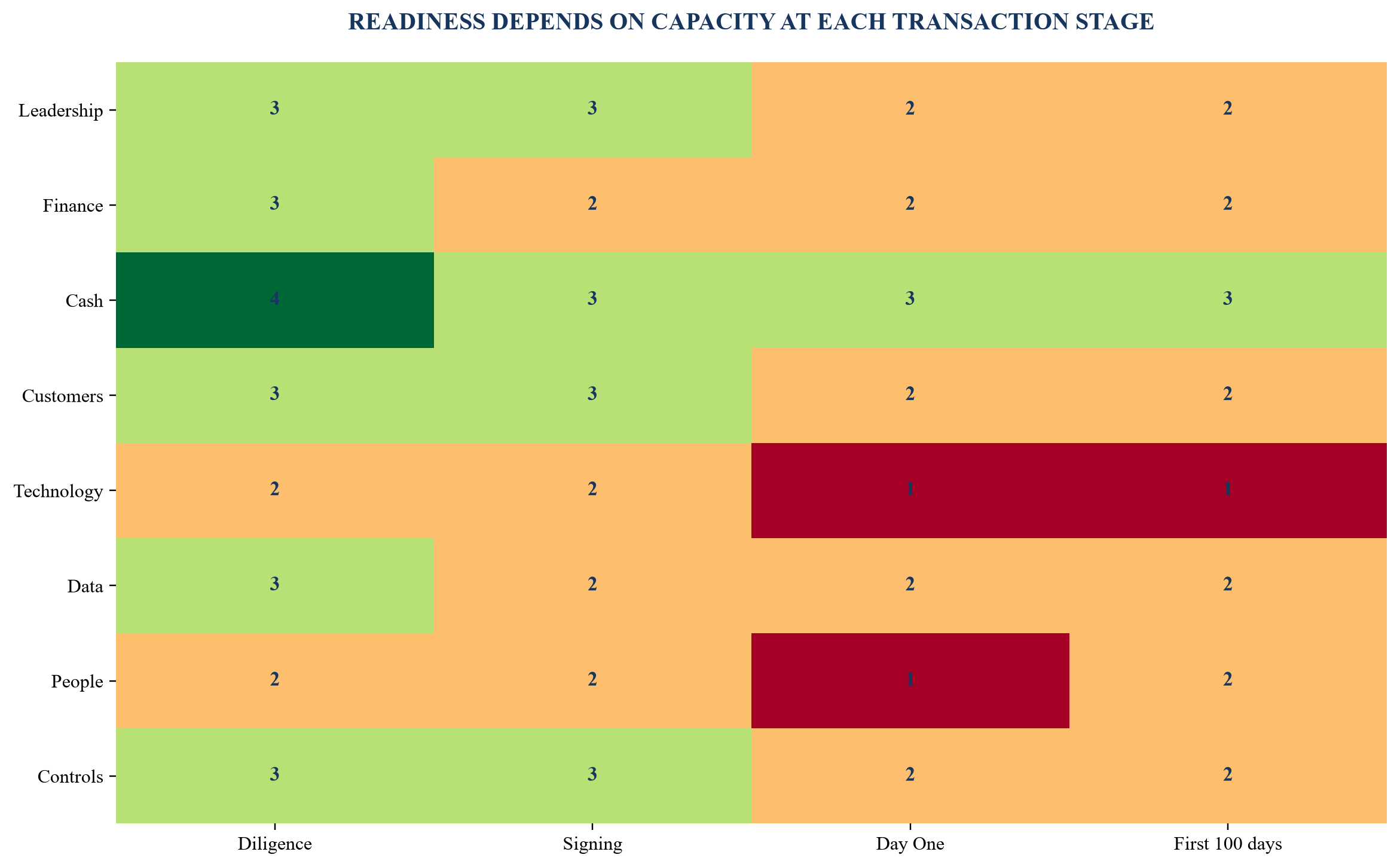
Capacity is assessed against the defined target archetype; scores are hypothetical.
7. Separate the repeatable core from the modular perimeter
A scalable acquisition platform standardises the controls that should remain consistent and preserves flexibility where value depends on target context. The repeatable core can include governance, issue logging, decision records, finance controls, identity, cybersecurity minimums, data classification, compliance escalation, benefit definitions and board reporting. The perimeter can vary by brand, product, customer, operating process, geography and integration mode.
Standardisation should reduce decision time and control variation. It should not force every target into the same end state. A technology target may preserve development autonomy while adopting group security and finance controls. A fragmented service business may require rapid process convergence. The target archetype should determine which modules are mandatory, optional or prohibited.
Each module should contain purpose, inputs, owner, decision rights, minimum evidence, dependencies, timing, acceptance criteria and handoff. A Day One identity module, for example, can define access principles and emergency controls while allowing several technical routes. A finance-close module can define control outcomes while respecting local statutory reporting.
The module library should be version-controlled and improved after every acquisition. A checklist copied without outcome evidence can institutionalise weak practice. The owner should record where the module worked, where it created delay and which target facts required deviation.
Modularity also clarifies what should be purchased externally. Competition advice, specialist tax analysis, cyber testing, valuation or local employment support may remain episodic. Programme governance, customer ownership, finance control, leadership decisions and benefit accountability should remain anchored inside the platform. The readiness design should identify external capacity, procurement lead time, independence requirements and handoff to accountable executives.
Interfaces between modules deserve the same attention as modules themselves. Customer migration can depend on data permissions, employee training, product configuration and billing. A module is ready only when its inputs, outputs and acceptance owner are explicit. The integration office should own the dependency map while functional executives own the underlying decisions.
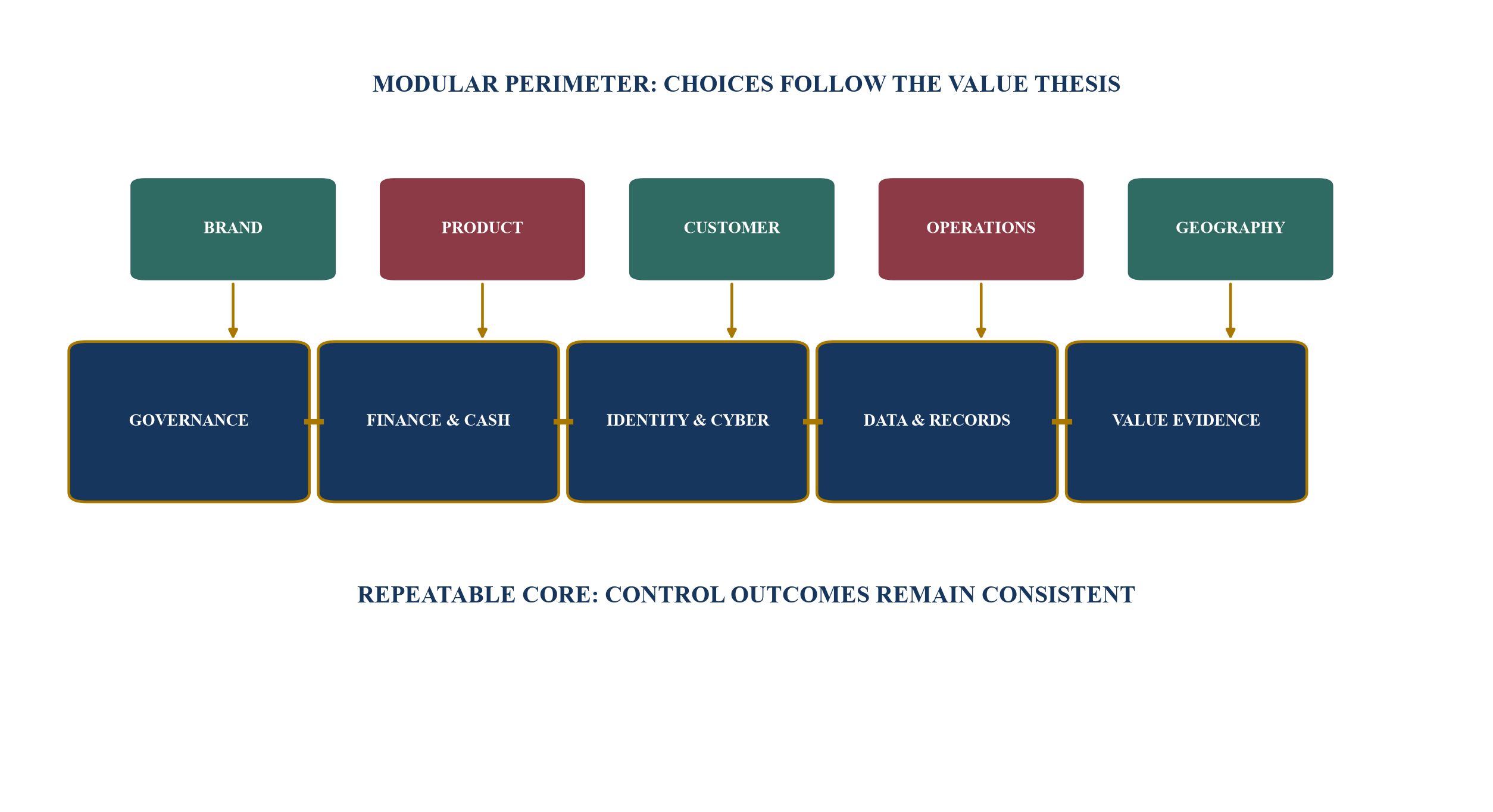
Mandatory controls remain stable while commercial and operating choices follow the acquisition thesis.
Table 3. Repeatable platform module library
| module | reusable core | transaction choice | acceptance evidence | primary owner | review trigger |
|---|---|---|---|---|---|
| governance | decision rights, issue log and escalation | workstream structure and cadence | signed mandate and current decisions | integration executive | scope or leadership change |
| finance | close control, chart ownership and reporting calendar | system migration and local ledger path | reconciled opening position | chief financial officer | reporting or entity change |
| technology | identity, security, inventory and recovery minimums | migrate, coexist, isolate or retire | tested access and continuity | technology executive | architecture or threat change |
| data | classification, lineage and sharing record | migration and residency pattern | approved data flow | data owner | purpose or geography change |
| people | critical roles, authority and conduct expectations | organisation design and retention route | accepted appointments and consultation plan | people executive | key-person or plan change |
| value | baseline, owner, full cost and counterfactual | synergy timing and capture mechanism | finance-approved benefit record | business and finance | assumption or performance change |
Modules define controlled outcomes while allowing an appropriate implementation route.
8. Make the finance platform acquisition-ready
The finance function must absorb a new entity while continuing to report the group. Readiness requires a controlled chart-of-accounts architecture, accounting-policy ownership, close calendar, consolidation route, statutory-reporting map, tax ownership, treasury controls and purchase-accounting capacity. The opening balance sheet should have an evidence plan before completion.
IFRS 3 requires the acquirer to identify and measure acquired assets and assumed liabilities within the acquisition method, subject to its detailed requirements [18]. IAS 36 requires annual recoverable-amount assessment for goodwill and certain intangible assets and provides the impairment framework [19]. The deal team should preserve the valuation, integration and performance evidence needed for those processes.
Management should distinguish transaction cost, integration cost, capital expenditure, restructuring, recurring run cost and synergy. Each category can affect reported results, cash and covenant metrics differently. Accounting treatment requires qualified review. The management ledger should still show the full economic cost even when financial-statement presentation differs.
The readiness gate should test whether finance can run both the existing close and the acquisition close without relying on uncontrolled spreadsheets or a few exhausted individuals. Reconciliation owners, data extraction, audit support and board reporting should be planned. A temporary close route needs an expiry and migration decision.
9. Protect liquidity and covenant capacity
Acquisition funding is only one claim on cash. The company may also need working-capital support, retention payments, integration spend, systems investment, tax payments, fees, restructuring and contingency. The sources-and-uses model should therefore extend through the integration period rather than stop at completion.
The downside case should delay synergy, reduce revenue, increase integration cost and include cash trapped in entities or working-capital seasonality. Covenant headroom should be assessed under definitions in the actual financing documents. Management should identify which benefits qualify, when they qualify and what evidence the lender requires.
A bolt-on should not depend on immediate execution success to remain liquid. The board can set a minimum cash reserve and covenant buffer that survives a defined downside. Funding commitments, conditions precedent, currency exposure and refinancing dates should be connected to the transaction timetable.
Cash governance continues after completion. A daily or weekly liquidity view may be required during transition. Bank mandates, payment authority, cash pooling, merchant facilities and fraud controls need Day One decisions. The platform should know how it will control cash before it owns the target.
10. Build a customer-continuity platform
Customer value can erode while internal integration appears on schedule. Readiness therefore requires a customer baseline, account ownership, contract map, renewal calendar, pricing authority, service commitments, complaint route and communication principles. The plan should identify customers exposed to change in brand, legal entity, product, personnel, data handling or service delivery.
The target archetype should state the commercial integration hypothesis. Cross-selling may require compatible propositions, trained sellers, permission to use data and clear incentives. Procurement leverage may affect service capacity. Product consolidation can create churn even when it reduces cost. The platform should test these mechanisms before including value in the investment case.
Top accounts deserve named continuity owners and early-warning indicators. Pipeline movement, renewal risk, service levels, credit notes, complaints and key-contact changes can signal leakage. Communication should follow legal constraints before completion and should avoid promises the operating model cannot support.
Revenue synergy should enter the value ledger only after a defined customer action. A lead, meeting or campaign is activity. A controlled uplift in conversion, retention, price, share of wallet or eligible volume is operating evidence. Finance validation follows when the outcome can be reconciled to revenue, margin and cash.
11. Prepare technology, data and cybersecurity before target access
Technology readiness begins with the platform's own inventory and standards. Management should know critical applications, identity architecture, privileged access, interfaces, data stores, recovery objectives, vendor dependencies, licences and material technical debt. Without this baseline, target diligence cannot distinguish an acceptable gap from a compounded platform weakness.
NIST CSF 2.0 adds governance and emphasises supply-chain risk [23]. Its supply-chain guidance supports due diligence before formal relationships and ongoing control over third parties [24][25]. The acquisition process can use the same logic: identify the target technology chain, understand critical dependencies, define contractual and integration requirements and test the resulting environment.
Pre-completion access must respect confidentiality, competition and data-protection constraints. Clean teams, controlled data rooms, aggregation and staged access may be required. The Information Commissioner's Office states that data sharing following a merger or acquisition should be addressed in due diligence, including purpose, lawful basis, transparency, governance and security [22]. Applicability should be assessed for each transaction.
Day One does not require immediate migration. It requires controlled access, continuity, incident routing and a target-state decision process. The platform should be able to isolate the target, connect limited services or migrate selected capabilities according to risk. Every temporary connection needs an owner and expiry.
12. Create the people and leadership architecture
The platform should decide which leadership roles, decision rights and cultural behaviours must be stable before the next deal. A transaction can magnify ambiguity in the existing organisation. If two executives already share authority informally, the target may receive conflicting instructions and delay integration.
Readiness includes a critical-role map, succession and backfill, integration appointments, retention principles, incentive alignment, consultation route and communication cadence. The company should understand which roles create customer, technical, regulatory or institutional continuity. Retention decisions should follow the value thesis rather than title or deal visibility.
Human and task integration should be sequenced deliberately. Fast task standardisation can support control and cost value, while trust, identity and knowledge transfer require managerial attention. Research finds different performance effects for task and human integration speed [29]. The plan should avoid treating all workstreams as one race.
The platform also needs a behavioural standard for integration. Leaders should make decisions through the agreed governance, surface bad news, protect continuity, explain trade-offs and avoid creating a winner-and-loser narrative. These expectations can be built into appointments and performance reviews.
13. Screen merger-control and regulatory perimeter early
The acquisition pipeline should include a jurisdiction and regulatory screen before management commits substantial time or communicates certainty. The screen covers merger-control thresholds, standstill obligations, sector approvals, foreign-investment regimes, licences, foreign subsidies, data transfers, employment processes and contractual consents. Qualified counsel should determine applicability.
Current rules illustrate why the screen must be refreshed. The US HSR programme requires filings for qualifying transactions and imposes a waiting period; the FTC reported procedural changes following litigation in March 2026 [3][4]. The UK's CMA updated its merger-assessment guidance in 2026 [5]. The European Commission administers mandatory notification for concentrations with an EU dimension and separate Foreign Subsidies Regulation procedures for defined transactions [6][7][8].
Australia's mandatory acquisition-notification regime took effect on 1 January 2026 and includes rules for serial acquisitions [9]. India operates a pre-consummation combination regime under the Competition Act and 2024 framework [10]. Singapore and Japan publish merger assessment and procedure guidance [11][12]. Canada has amended its competition law while reviewing merger guidelines [16][17].
The UAE applies Federal Decree-Law No. 36 of 2023 and Cabinet Decision No. 3 of 2025; the Ministry describes notification thresholds based on UAE revenue or market share [13][14]. Saudi Arabia's General Authority for Competition publishes economic-concentration review guidance with a Saudi nexus analysis [15]. These sources should inform the issue list; they do not replace transaction-specific advice.
Table 4. Cross-border acquisition pre-screen
| question | evidence needed | platform owner | external adviser input | timetable effect | integration implication |
|---|---|---|---|---|---|
| where can the transaction be reviewed? | parties, control, revenue, assets and market presence | legal | merger-control counsel | filing and standstill path | preserve independent conduct |
| do sector approvals apply? | licences, regulated activities and ownership | compliance | sector counsel and regulator strategy | conditions and sequencing | maintain regulated perimeter |
| are foreign subsidies or investment reviews relevant? | public financial contributions and investor profile | legal and finance | specialist counsel | separate notification or review | information and remedy readiness |
| what data can be shared before completion? | data categories, purpose, geography and recipients | data and privacy | privacy counsel | clean-team design | staged migration and access |
| which workforce processes apply? | employees, entities, locations and proposed changes | people | employment counsel | consultation and transfer timetable | sequence organisation decisions |
| which consents control continuity? | customer, supplier, lender and landlord contracts | legal and business | transaction counsel | conditions and waiver process | Day One contract controls |
This is a management routing tool; qualified advisers determine legal scope, filing and timing.
14. Connect diligence evidence to integration decisions
Diligence should produce decisions rather than parallel reports. Every material finding should state the affected value driver, exposure, confidence, owner, required action and transaction mechanism. The mechanism may be price, condition, covenant, indemnity, insurance, integration plan, capital reserve, ring-fence or stop decision.
The evidence model should continue after completion. A target application identified as critical in diligence should appear in the Day One continuity plan and the technology roadmap. A customer concentration finding should appear in account ownership and the value ledger. A control weakness should appear in the remediation plan and board scorecard. Re-entering the same issue in several tools creates ambiguity.
Access limitations should remain visible. Management may be unable to test a system, interview an employee or review certain competitively sensitive information before completion. The plan should state what is unknown, how the deal protects against it, who will test it after completion and which decision follows the result.
The US Department of Justice's corporate-compliance guidance asks how companies conduct acquisition diligence, connect findings to implementation and integrate acquired entities into compliance and control structures [2][21]. This supports a traceable path from issue identification to remediation and post-acquisition audit.
The issue ledger should preserve source quality. A seller representation, management interview, sample test, reconciled extract and independently verified control provide different confidence. The deal team can act on lower-confidence evidence when timing requires it, while documenting the protection, post-close test and decision owner. Confidence should never be converted into a false binary of confirmed or absent.
The handoff should also preserve privilege and confidentiality boundaries. Workstream tools, board packs and integration records should contain the information needed for execution and should follow approved access. Counsel should determine how sensitive analyses and legal advice are maintained. A controlled summary can route an action without exposing material beyond its authorised audience.
15. Choose integration depth domain by domain
An acquisition does not need one global integration setting. Management can choose full integration, selective integration, federation, temporary coexistence or separation for each domain. The choice should follow value, risk, interdependence, reversibility, customer impact and capacity.
Finance reporting, payment control, sanctions, conduct and cybersecurity minimums may require rapid convergence. Product development, brand, customer coverage or specialist talent may preserve autonomy. The decision record should state why the mode was chosen, its end state, timing and trigger for change.
Integration intensity can create value and destroy it. Deeper integration can unlock cost synergy and control. It can also interrupt revenue, remove distinctive capability or create employee resistance. Recent empirical work finds cost-led and revenue-led acquisition strategies can call for different degrees of integration [30]. Case research also shows that integration effects are mediated through functions such as sales, manufacturing, IT, finance and HR [33].
The platform should therefore measure domain outcomes. A system migration is complete when the required process is stable, controlled and accepted, not when data has moved. An organisation design is complete when authority works and critical roles are filled, not when an announcement is issued.
16. Build a gross-to-net acquisition value ledger
The acquisition model should show how strategic logic becomes cash. Each value line needs a baseline, counterfactual, gross opportunity, dis-synergy, implementation cost, recurring run cost, timing, owner, evidence source and financial-statement destination. Revenue, margin, working capital, capital expenditure, tax and financing effects should remain distinguishable.
The ledger should separate forecast, enabled, observed and finance-validated value. A contract renegotiation can enable a saving. The saving becomes observed when purchasing behaviour changes. Finance validates it when volume, mix, price and counterfactual are reconciled. This sequence limits double counting and creates a decision trail.
The same discipline applies to revenue. Cross-sell pipeline is not revenue. Revenue is not gross profit. Gross profit is not cash. The ledger should identify the operational mechanism and the lag between commercial action and financial effect.
Full-cost measurement protects the investment case. Integration teams, external advisers, retention, systems, temporary services, severance, duplicated costs and management distraction all consume value. The board should see net value and the cash trough before it sees the headline synergy.
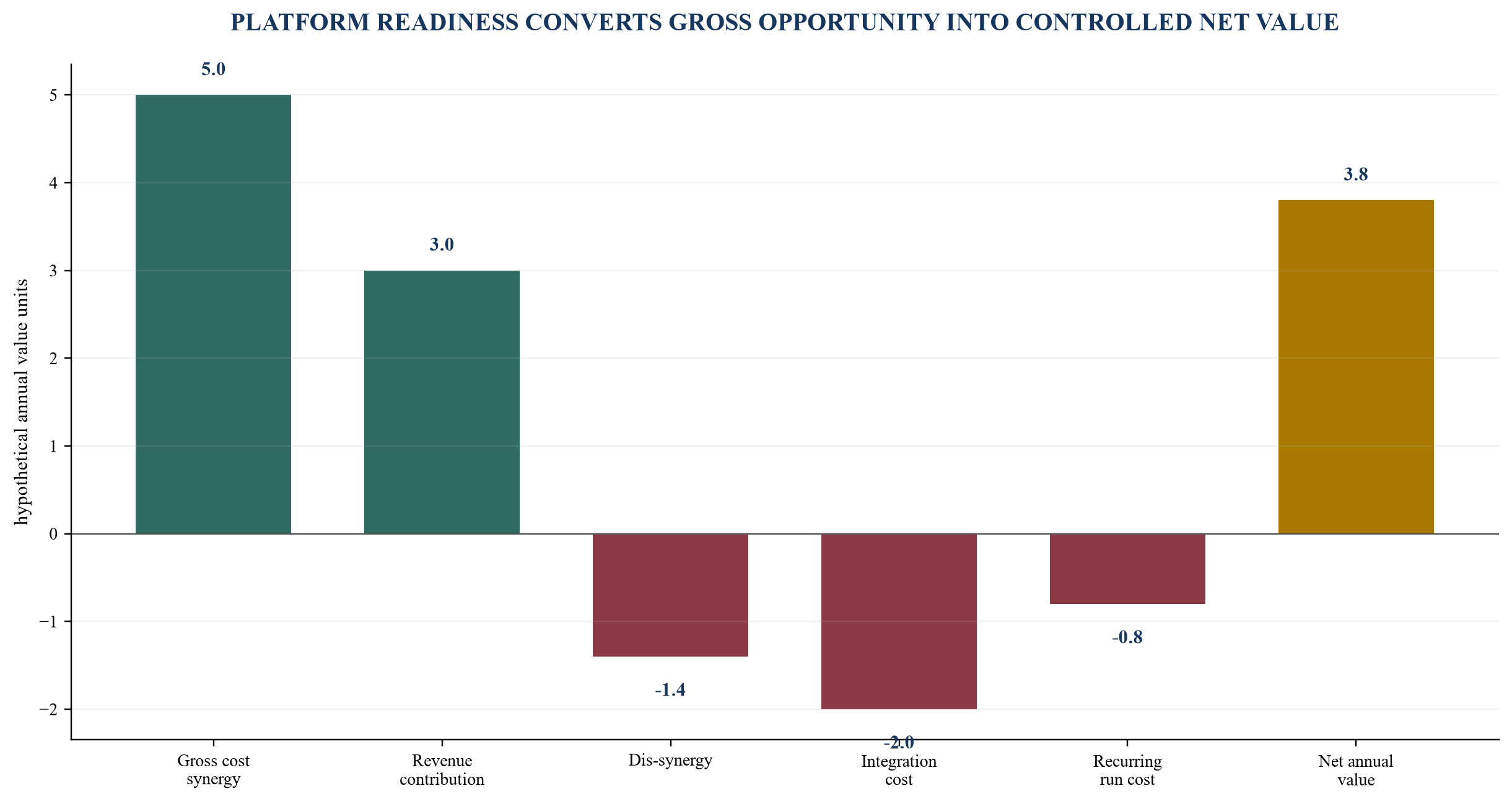
Values are illustrative management assumptions and do not represent a transaction or forecast.
Table 5. Acquisition value ledger
| value line | operating mechanism | baseline and counterfactual | full cost | evidence owner | validation gate |
|---|---|---|---|---|---|
| procurement | harmonised specification and supplier terms | comparable volume, mix and price without deal | sourcing and transition cost | operations | invoice and volume reconciliation |
| customer retention | protected relationships and service | cohort retention without acquisition | account coverage and service investment | commercial | cohort margin and cash evidence |
| cross-sell | target product sold through platform channel | eligible accounts and historical conversion | sales capacity, incentives and delivery | commercial | incremental gross profit |
| working capital | billing, collections and inventory discipline | normalised days and seasonality | systems and operating effort | finance | cash movement attributable to action |
| footprint | capacity consolidation | existing utilisation and alternative plan | exit, move and disruption cost | operations | stable output and realised cost |
| platform cost | shared finance, technology and controls | standalone and group run-rate | migration and retained overhead | functional owners | recurring net cost after stabilisation |
Every line requires a controlled baseline and a finance-approved route into reported value.
17. Pace the pipeline through absorption capacity
A pipeline should be constrained by capacity, not by opportunity count. The platform can define maximum concurrent work by transaction stage, target complexity and critical resource. One acquisition in diligence, one in first-hundred-day integration and one stabilised target may be manageable; the answer depends on the actual platform.
Capacity planning should identify bottlenecks. Finance, legal, security, data, customer operations or a small number of executives can determine throughput. Adding targets without relieving the bottleneck lengthens cycles and weakens evidence. The board can choose to add capacity, reduce integration depth, narrow the archetype or defer a process.
Stage gates prevent the pipeline from outrunning the platform. Launch requires a stable baseline and reserved resources. Indicative offer requires a credible regulatory, funding and value route. Signing requires unresolved issues to have transaction and integration dispositions. Completion requires Day One continuity and authority. Scale requires stable operations and early value evidence.
Overlapping work should be visible in one resource calendar. A target-by-target view can hide that the same controller, security architect or business leader owns several critical paths. The capacity calendar should extend beyond closing dates into stabilisation and benefit validation.
Pipeline pacing should reflect uncertainty as well as planned work. A regulatory review, seller delay or remediation finding can move demand into another period. Capacity plans can reserve contingency around critical functions and define which discretionary initiatives will move when the reserve is used. A plan built at full utilisation has little ability to absorb the events that make acquisitions difficult.
The board should see the opportunity cost of pacing choices. Deferring a target can carry strategic cost, while proceeding can delay core investment or weaken another integration. Management should present these alternatives through value, risk and capacity rather than treating speed as an independent objective. A disciplined pause can preserve negotiating credibility when it follows an established gate.
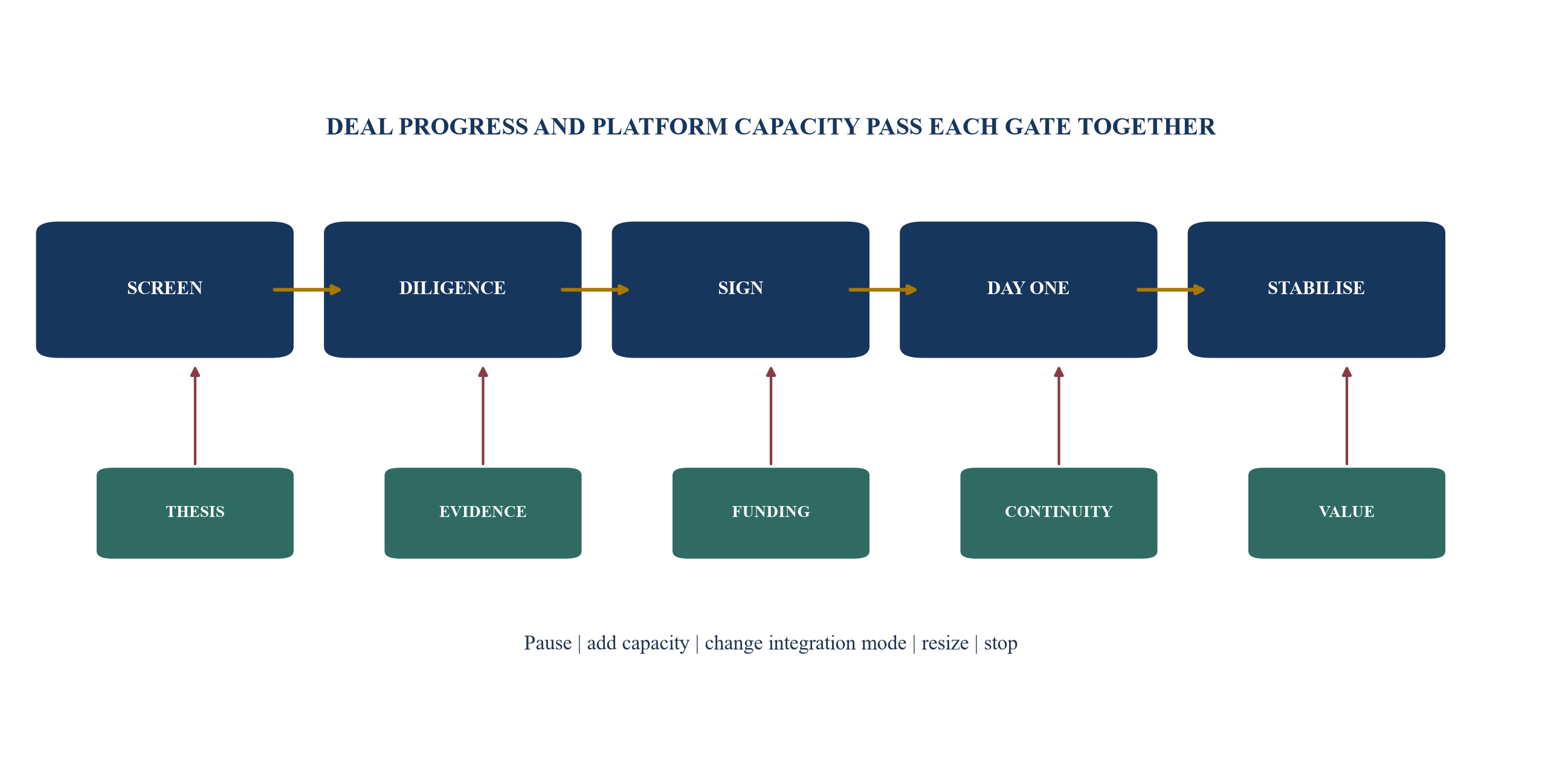
A transaction advances only when both deal evidence and platform capacity meet the gate.
18. Prepare Day One as a continuity event
Day One establishes ownership, authority, control and confidence. It does not require every integration action to occur immediately. The platform should have reusable modules for governance, leadership, legal ownership, payment authority, cash visibility, customer continuity, employee communication, identity, incident escalation, regulatory commitments and reporting.
Every module needs a readiness test. Bank access is tested, not assumed. Critical customer ownership is accepted by named individuals. Technology access follows least privilege and has an emergency route. Employees know where to raise payroll, conduct and safety concerns. The board receives a completion status and material exceptions.
The plan should distinguish completion-dependent actions from preparatory work. Parties must preserve independence and comply with applicable standstill and information-sharing rules before closing. Clean teams, external advisers and aggregated information can support planning when legally appropriate. Transaction counsel should approve the protocol.
Day One exceptions require expiry. A temporary manual payment process, shared mailbox or broad access group can remain necessary for continuity. The owner should state why, what compensating control applies and when the permanent route will replace it.
19. Design the first hundred days around stabilisation and choices
The first hundred days should be a sequence of decisions rather than a single deadline. The first phase confirms control and service stability. The second validates the target baseline and resolves information unavailable before closing. The third implements selected integration modules. The fourth assesses value, debt and capacity before the next acquisition gate.
The programme should protect reversible choices. A rapid system migration can lock the platform into weak data or an unsuitable process. Temporary coexistence can preserve options when the cost and control are understood. A stage gate should test architecture, data, users, continuity and rollback before an irreversible change.
Milestones should express outcomes. “ERP workstream complete” is ambiguous. “Opening balances reconciled, group reporting accepted, payments controlled and local statutory ledger operating” is testable. Each milestone should have evidence and an approver.
The hundred-day close should update the platform, not merely the target. Modules, capacity assumptions, diligence questions, costs and timing should be revised. The board can then decide whether the company has greater, equal or lower capacity for the next acquisition.
20. Build a learning system across acquisitions
Acquisition experience becomes a capability only when evidence changes behaviour. The platform should conduct structured reviews after signing, Day One, stabilisation and benefit validation. Reviews should compare forecast and actual timing, cost, resource load, customer impact, employee outcomes, control issues and value.
The review should preserve causal humility. A target can outperform because of market conditions while integration underperforms. A delayed system change can protect customers even when it misses the original plan. Management should distinguish outcome, mechanism and context before changing the standard module.
Module owners should maintain version history. A revised diligence question should identify the failure it addresses. A new Day One control should state the exposure and cost. Modules that add burden without improving decisions or control should be simplified or retired.
The board should see learning as part of platform value. The evidence can reduce future diligence time, improve pricing, sharpen target selection and lower integration variance. It can also reveal that the acquisition strategy depends on capabilities the company does not possess. Both outcomes support better capital allocation.
21. Test readiness through a hypothetical bolt-on
Consider a hypothetical regional business-services platform with annual revenue of 120 value units and EBITDA of 18. It plans to acquire a smaller specialist provider with revenue of 24 and EBITDA of 4.5. The investment thesis combines customer retention, cross-sell and selected back-office scale. All figures are illustrative.
The readiness review identifies a stable commercial baseline and adequate liquidity. It also identifies an eight-day finance close, unresolved identity-access exceptions and an overcommitted chief operating officer. The board conditions process launch on a close-remediation plan, access clean-up and appointment of an integration lead with operational backfill.
Diligence finds strong customer relationships, a concentrated technical team and a separate cloud application. Management chooses selective integration: immediate finance, cash, compliance and security control; preserved product and technical autonomy; staged customer coordination; and a later architecture decision. The value ledger carries retention investment and coexistence cost.
The hypothetical gross annual opportunity is eight value units. After dis-synergy, integration cost and recurring platform cost, the model shows 3.8 net annual value units. Finance treats this as forecast. Validation requires customer cohort, supplier invoices, employee retention, service levels and reconciled reporting. The transaction is not presented as successful at completion; success is tested through controlled operating evidence.
22. Give the board a readiness decision pack
The board pack should lead with the decision requested. It can show the target archetype, platform baseline, integration debt, capacity heat map, regulatory route, funding headroom, target-specific exceptions, gross-to-net value, Day One readiness and unresolved choices. Supporting workstream detail sits behind the decision pages.
Every red or amber item needs an owner, action, date, residual exposure and gate consequence. A risk list without decision rules can normalise delay. The pack should state whether the issue blocks launch, signing, completion or scale.
The board should also see evidence confidence. A source-system extract, reconciled account and tested control have different reliability from management estimate or seller representation. The decision can proceed with uncertainty when the transaction mechanism and post-close test are proportionate.
The pack should preserve a record of the counterfactual. The board can later compare actual performance with the case it approved. This supports capital allocation, incentive assessment, impairment analysis and learning across the acquisition programme.
Board reporting should separate facts, assumptions and decisions. Facts include reconciled performance, tested controls and executed commitments. Assumptions include synergy timing, customer behaviour and future resource availability. Decisions record the approved option, conditions and accountable owner. This separation improves later review and reduces the risk that a planning case becomes accepted history.
Assurance coverage should be visible. Internal audit, finance, legal, compliance, cybersecurity and external advisers may each examine part of the programme. The board should know which material assertions were tested, by whom, for what period and with what limitations. Multiple reports do not constitute complete coverage when they test the same evidence and leave a critical dependency unexamined.
Table 6. Board bolt-on readiness decision pack
| board question | primary evidence | owner | gate threshold | management response | board action |
|---|---|---|---|---|---|
| does the target fit the programme? | archetype and value thesis | chief executive | approved strategic fit | narrow, reshape or reject | approve thesis |
| is the existing platform stable? | operating and control baseline | business leaders | within appetite | remediate or pause | confirm launch |
| can the organisation absorb the work? | capacity heat map and resource plan | integration executive | critical roles reserved | backfill, sequence or defer | approve capacity |
| is the downside funded? | cash, covenant and cost model | chief financial officer | protected downside buffer | resize or restructure | approve funding posture |
| can Day One operate safely? | continuity tests and exception log | workstream owners | no unowned critical exception | control, ring-fence or delay | approve completion readiness |
| is value measurable? | baseline, counterfactual and ledger | business and finance | owned evidence route | revise case or gate scale | approve value framework |
Each line should produce approval, a condition, an escalation, a pause or a stop decision.
23. Execute a one-hundred-and-twenty-day readiness programme
Days one to thirty establish the acquisition design. The board approves the target archetype, value logic and integration principles. Management baselines current performance, maps integration debt and identifies critical resources. Legal and regulatory advisers define the reusable jurisdiction screen.
Days thirty-one to sixty strengthen the control spine. Finance shortens or stabilises the close, treasury tests liquidity and authority, technology establishes inventories and identity standards, people confirm leadership capacity, and the integration office creates the issue, decision and evidence records. Critical debt receives owners and dates.
Days sixty-one to ninety build and test modules. Teams prepare Day One packs, diligence-to-integration handoffs, customer continuity, finance opening, access, incident response, value ledger and board reporting. A tabletop exercise uses a representative target archetype and introduces failures such as a delayed approval, cyber issue or customer concern.
Days ninety-one to one hundred and twenty close the readiness gate. Management retests platform stability, presents open constraints, confirms reserved capacity and approves the pipeline pace. The board decides whether to launch, condition, defer or redesign the next acquisition process. Readiness becomes a maintained operating system, with a refresh before signing and completion.
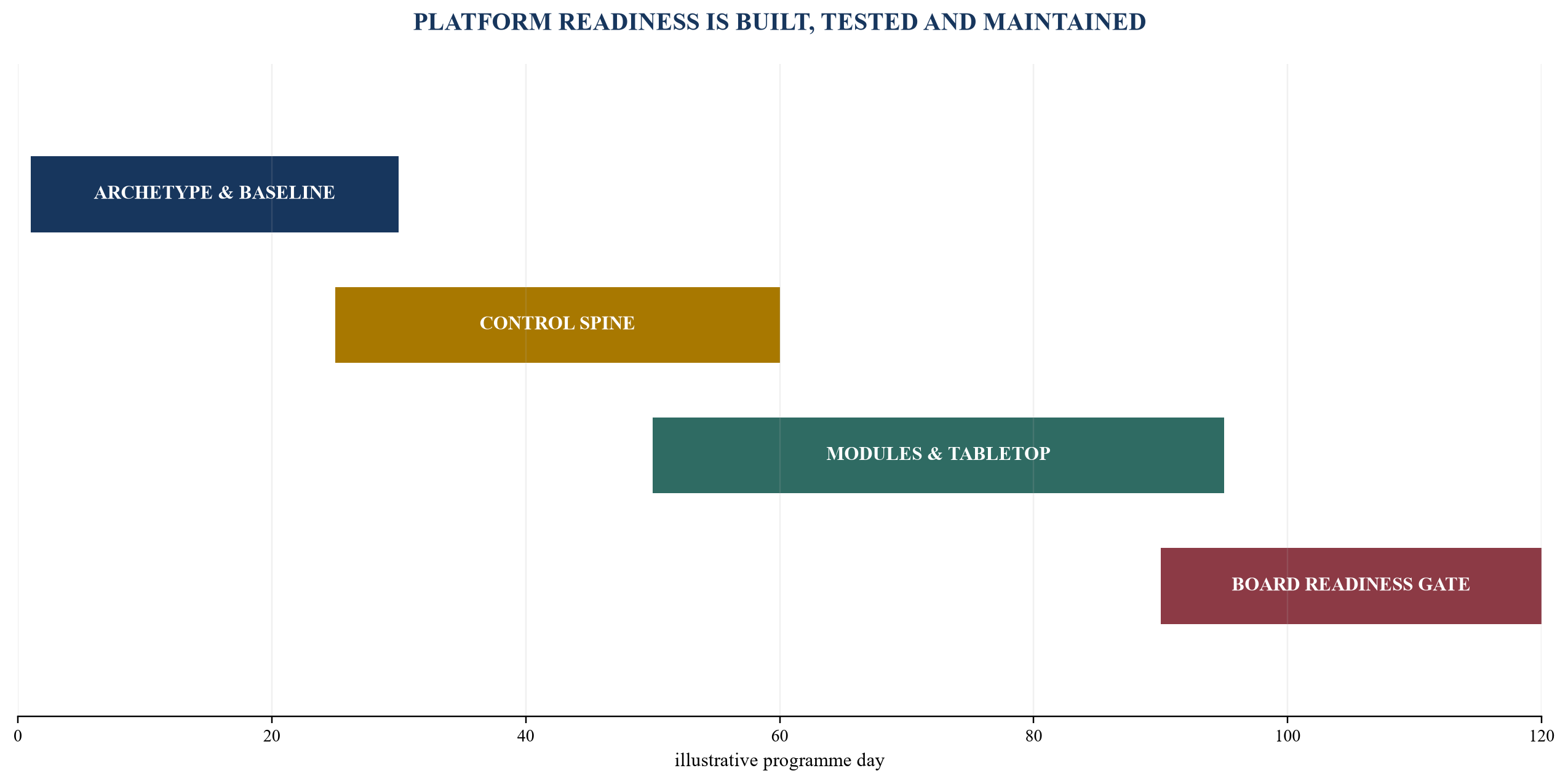
Timing is illustrative and should expand when regulation, target complexity or platform remediation requires it.
References
- OECD, G20/OECD Principles of Corporate Governance 2023, https://www.oecd.org/en/publications/g20-oecd-principles-of-corporate-governance-2023_ed750b30-en.html
- United States Department of Justice, Evaluation of Corporate Compliance Programs, September 2024, https://www.justice.gov/criminal/criminal-fraud/page/file/937501
- Federal Trade Commission and United States Department of Justice, Merger Guidelines, 2023, https://www.ftc.gov/reports/merger-guidelines-2023
- Federal Trade Commission, Premerger Notification Program, updated 2026, https://www.ftc.gov/enforcement/premerger-notification-program
- Competition and Markets Authority, Merger Assessment Guidelines, updated 2026, https://www.gov.uk/government/publications/merger-assessment-guidelines
- European Commission, EU Merger Legislation, updated 2026, https://competition-policy.ec.europa.eu/mergers/legislation_en
- European Commission, Merger Procedures, updated 2026, https://competition-policy.ec.europa.eu/mergers/procedures_en
- European Commission, Foreign Subsidies Regulation: About, updated 2026, https://competition-policy.ec.europa.eu/foreign-subsidies-regulation/about_en
- Australian Competition and Consumer Commission, Thresholds for Notifying Acquisitions, updated 2026, https://www.accc.gov.au/business/mergers-and-acquisitions/thresholds-for-notifying-acquisitions
- Competition Commission of India, Regulation of Combination, updated 2026, https://www.cci.gov.in/regulation-of-combination
- Competition and Consumer Commission of Singapore, Merger Assessment Process, updated 2025, https://www.cccs.gov.sg/get-in-touch/for-businesses/notify-a-merger/merger-assessment-process
- Japan Fair Trade Commission, Merger Review Guidebook, 2025, https://www.jftc.go.jp/file/240618/en.pdf
- UAE Ministry of Economy, Regulation of Competition Legislation, updated 2025, https://www.moec.gov.ae/en/regulation-of-competition-legislations
- UAE Ministry of Economy, Cabinet Resolution on Competition Thresholds and Economic Concentrations, 2025, https://www.moet.gov.ae/en/-/ministry-of-economy-reviews-cabinet-resolution-on%C2%A0thresholds-and-controls-associated-with-competition-law-and-its-role-in-enhancing-oversight-of-economic-concentration-transactions-in-the-country
- Saudi General Authority for Competition, Economic Concentration Review Guidelines, 2025, https://gacbep.gac.gov.sa/cms/b9376edc-79a1-4573-a36d-4f3effaba838.pdf
- Competition Bureau Canada, Overview of the Merger Review Process, updated 2025, https://competition-bureau.canada.ca/en/mergers-and-acquisitions/overview-merger-review-process
- Competition Bureau Canada, Changes to the Provisions on Mergers and Restrictive Trade Practices, 2024, https://competition-bureau.canada.ca/en/mergers-and-acquisitions/changes-provisions-mergers-and-restrictive-trade-practices-competition-act
- IFRS Foundation, IFRS 3 Business Combinations, 2022 issued standards edition, https://www.ifrs.org/content/dam/ifrs/publications/pdf-standards/english/2022/issued/part-a/ifrs-3-business-combinations.pdf?bypass=on
- IFRS Foundation, IAS 36 Impairment of Assets, updated 2026, https://www.ifrs.org/issued-standards/list-of-standards/ias-36-impairment-of-assets/
- IFRS Foundation, Business Combinations: Disclosures, Goodwill and Impairment Exposure Draft, 2024, https://www.ifrs.org/projects/work-plan/goodwill-and-impairment/exposure-draft-and-cl-bcdgi/
- United States Department of Justice, Corporate Enforcement, updated 2026, https://www.justice.gov/criminal/corporate-enforcement
- Information Commissioner's Office, Due Diligence When Sharing Data Following Mergers and Acquisitions, updated 2026, https://ico.org.uk/for-organisations/uk-gdpr-guidance-and-resources/data-sharing/data-sharing-a-code-of-practice/due-diligence/
- National Institute of Standards and Technology, Cybersecurity Framework 2.0, 2024, https://www.nist.gov/cyberframework
- National Institute of Standards and Technology, CSF 2.0 Quick-Start Guide for Cybersecurity Supply Chain Risk Management, 2024, https://csrc.nist.gov/pubs/sp/1305/final
- National Institute of Standards and Technology, Cybersecurity Supply Chain Risk Management Practices for Systems and Organizations, updated 2024, https://csrc.nist.gov/pubs/sp/800/161/r1/upd1/final
- European Commission, Digital Operational Resilience Regulation Implementing and Delegated Acts, updated 2025, https://finance.ec.europa.eu/regulation-and-supervision/financial-services-legislation/implementing-and-delegated-acts/digital-operational-resilience-regulation_en
- Colman, H. L. and Lunnan, R., Pulling Together While Falling Apart: A Relational View on Integration in Serial Acquirers, Journal of Management, 2024, https://doi.org/10.1177/01492063221121788
- Bauer, F., Dao, M. A. and Matzler, K., Integration, Employee Resistance, and Acquisition Performance, European Management Journal, 2025, https://doi.org/10.1016/j.emj.2024.02.003
- Homburg, C. and Bucerius, M., Is Speed of Integration Really a Success Factor of Mergers and Acquisitions?, Strategic Management Journal, 2006, https://doi.org/10.1002/smj.520
- Steigenberger, N. and Mirc, N., Operating Synergy and Post-Acquisition Integration in Corporate Acquisitions, Long Range Planning, 2024, https://doi.org/10.1016/j.lrp.2024.102428
- Epstein, M. J., Measuring Performance During M&A Integration, Long Range Planning, 2003, https://doi.org/10.1016/S0024-6301(03)00004-9
- Henningsson, S. and Yetton, P., Post-Acquisition IT Integration: The Sequential Effects in Growth-by-Acquisition Programs, 2013, https://aisel.aisnet.org/acis2013/114/
- Steigenberger, N., Looking into the Black Box: Unlocking the Effect of Integration on Acquisition Performance, European Management Journal, 2018, https://doi.org/10.1016/j.emj.2017.06.002
Sources and further reading
- OECD, G20/OECD Principles of Corporate Governance 2023, Official source
- United States Department of Justice, Evaluation of Corporate Compliance Programs, September 2024, Official source
- Federal Trade Commission and United States Department of Justice, Merger Guidelines, 2023, Official source
- Federal Trade Commission, Premerger Notification Program, updated 2026, Official source
- Competition and Markets Authority, Merger Assessment Guidelines, updated 2026, Official source
- European Commission, EU Merger Legislation, updated 2026, Official source
- European Commission, Merger Procedures, updated 2026, Official source
- European Commission, Foreign Subsidies Regulation: About, updated 2026, Official source
- Australian Competition and Consumer Commission, Thresholds for Notifying Acquisitions, updated 2026, Official source
- Competition Commission of India, Regulation of Combination, updated 2026, Official source
- Competition and Consumer Commission of Singapore, Merger Assessment Process, updated 2025, Official source
- Japan Fair Trade Commission, Merger Review Guidebook, 2025, Official source
- UAE Ministry of Economy, Regulation of Competition Legislation, updated 2025, Official source
- UAE Ministry of Economy, Cabinet Resolution on Competition Thresholds and Economic Concentrations, 2025, Official source
- Saudi General Authority for Competition, Economic Concentration Review Guidelines, 2025, Official source
- Competition Bureau Canada, Overview of the Merger Review Process, updated 2025, Official source
- Competition Bureau Canada, Changes to the Provisions on Mergers and Restrictive Trade Practices, 2024, Official source
- IFRS Foundation, IFRS 3 Business Combinations, 2022 issued standards edition, Official source
- IFRS Foundation, IAS 36 Impairment of Assets, updated 2026, Official source
- IFRS Foundation, Business Combinations: Disclosures, Goodwill and Impairment Exposure Draft, 2024, Official source
- United States Department of Justice, Corporate Enforcement, updated 2026, Official source
- Information Commissioner's Office, Due Diligence When Sharing Data Following Mergers and Acquisitions, updated 2026, Official source
- National Institute of Standards and Technology, Cybersecurity Framework 2.0, 2024, Official source
- National Institute of Standards and Technology, CSF 2.0 Quick-Start Guide for Cybersecurity Supply Chain Risk Management, 2024, Official source
- National Institute of Standards and Technology, Cybersecurity Supply Chain Risk Management Practices for Systems and Organizations, updated 2024, Official source
- European Commission, Digital Operational Resilience Regulation Implementing and Delegated Acts, updated 2025, Official source
- Colman, H. L. and Lunnan, R., Pulling Together While Falling Apart: A Relational View on Integration in Serial Acquirers, Journal of Management, 2024, Official source
- Bauer, F., Dao, M. A. and Matzler, K., Integration, Employee Resistance, and Acquisition Performance, European Management Journal, 2025, Official source
- Homburg, C. and Bucerius, M., Is Speed of Integration Really a Success Factor of Mergers and Acquisitions?, Strategic Management Journal, 2006, Official source
- Steigenberger, N. and Mirc, N., Operating Synergy and Post-Acquisition Integration in Corporate Acquisitions, Long Range Planning, 2024, Official source
- Epstein, M. J., Measuring Performance During M&A Integration, Long Range Planning, 2003, Official source
- Henningsson, S. and Yetton, P., Post-Acquisition IT Integration: The Sequential Effects in Growth-by-Acquisition Programs, 2013, Official source
- Steigenberger, N., Looking into the Black Box: Unlocking the Effect of Integration on Acquisition Performance, European Management Journal, 2018, Official source
