Introduction
Of all the private alternatives into which Gulf family offices are now allocating, private credit has perhaps the broadest appeal. It offers a yield well above what public fixed income provides, a return that is largely uncorrelated with public equity markets, and a risk profile that, for the senior strategies at least, is conservative and asset-backed. For a family office seeking to preserve and grow wealth across generations, and to generate income along the way, private credit answers several needs at once, which is why it has moved from the periphery to the centre of many family office portfolios.
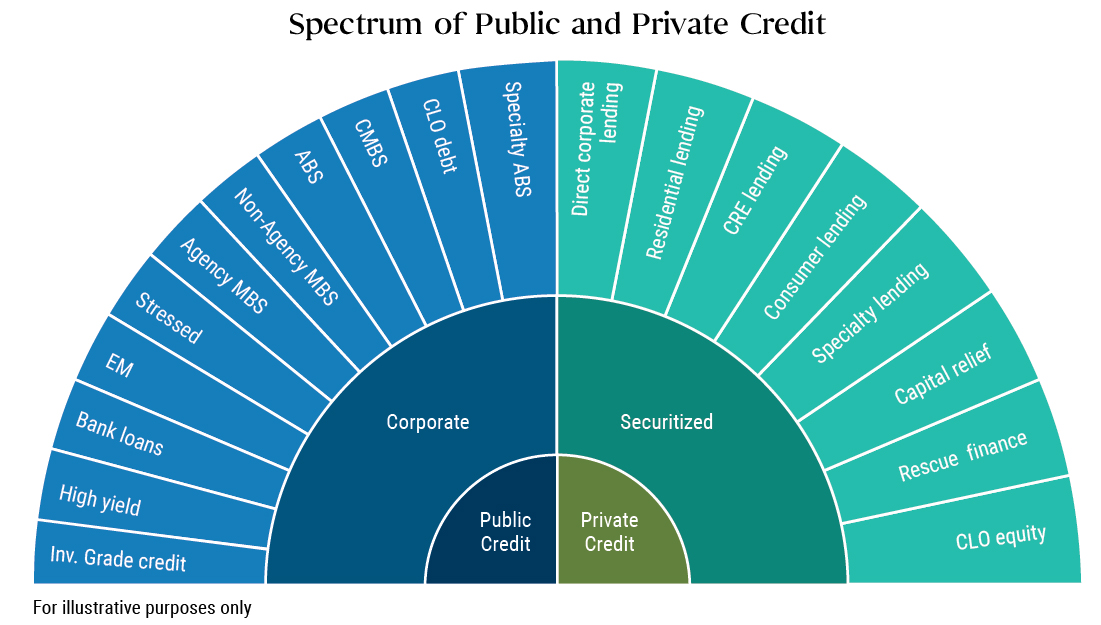
But the appeal of the asset class can obscure the difficulty of building an allocation to it well. Private credit is not one thing but a spectrum of sub-strategies with very different risk and return profiles; its returns depend heavily on the manager, with a wide gap between the best and the worst; it is illiquid, locking capital away for years; and it requires capabilities, in manager selection, liquidity management and portfolio construction, that a family office accustomed to public markets may not possess. A family office that allocates to private credit without building these capabilities, or without understanding the spectrum and its risks, can be disappointed even as the asset class as a whole performs well.
This paper sets out a comprehensive framework for building a private credit allocation deliberately. It treats the allocation as a programme to be constructed across sub-strategies, managers, vintages and access structures, and balanced continuously across the three dimensions that define private credit: the risk it bears, the yield it delivers, and the liquidity it sacrifices. The central argument is that a private credit allocation creates value when it is matched to the family office objective, diversified across sub-strategies and vintages, accessed through capable managers, and sized so that its illiquidity can be borne comfortably, and that the capability which most determines the outcome is manager selection.
The Case for a Private Credit Allocation
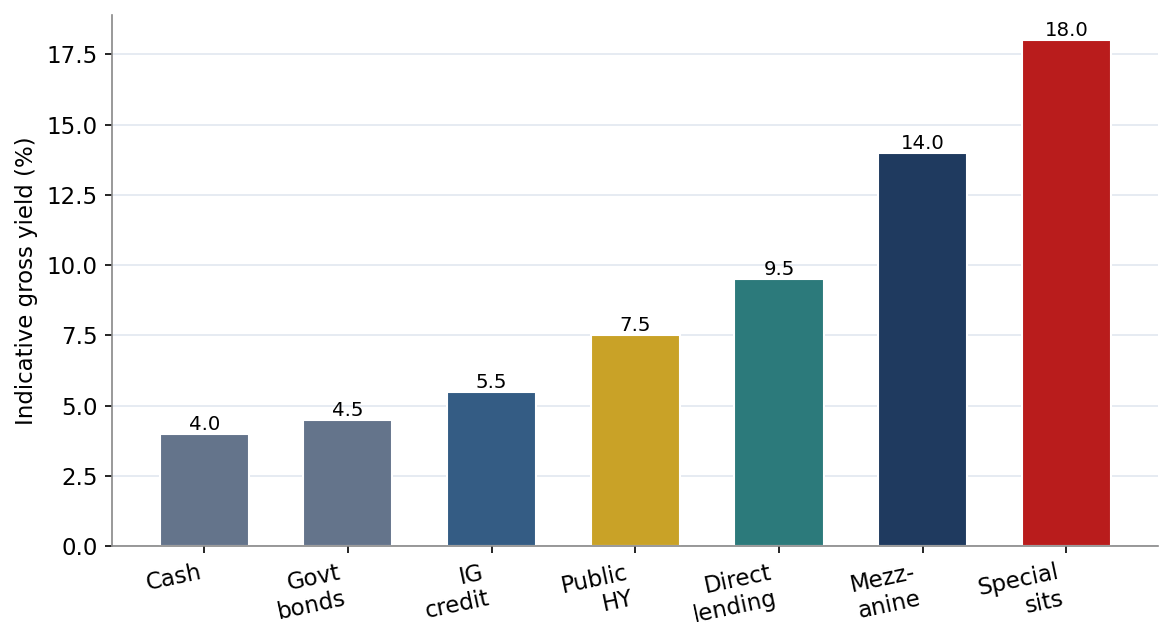
The case for private credit rests first on yield. Figure 1 places the indicative yield of the principal private credit sub-strategies alongside the public alternatives, and the gap is striking: where cash and government bonds offer low single-digit yields and even public high yield sits below eight percent, senior direct lending offers around nine to ten percent, and the subordinated strategies considerably more. This yield premium reflects genuine economic compensation, for the illiquidity of the asset, for the credit risk borne, and for the complexity and origination effort that private lending requires, rather than a free lunch, but it is a premium that a family office seeking income or total return can capture if it builds the allocation well.
Figure 1. Indicative Yield Across the Fixed Income and Private Credit Spectrum
The case rests second on diversification. Private credit returns derive from contracted interest and principal payments on loans to private borrowers, and they are largely uncorrelated with the daily movements of public equity and bond markets. Adding private credit to a portfolio dominated by public assets therefore reduces the portfolio overall volatility and its sensitivity to public market cycles, which is valuable to a family office focused on preserving wealth through cycles. The diversification is genuine, though it should not be overstated: private credit is exposed to the credit cycle and to economic downturns that raise defaults, so it diversifies away from equity market volatility more than from economic risk itself.
The case rests third on the structural growth and maturation of the asset class, illustrated in Figure 2. Global private credit assets under management have grown several-fold over recent years, as banks have retreated from mid-market lending and institutional and private capital has filled the gap, and the asset class has matured into a deep, established part of the financing system with a wide range of managers and strategies. This maturation means a family office building an allocation today has a broad and deep opportunity set to construct from, and access to experienced managers, where an earlier generation of investors faced a narrower and less proven market.
Figure 2. Growth of the Global Private Credit Market
Conceptual Foundations: The Risk-Yield-Liquidity Triangle
Every private credit decision can be understood as a position within a triangle whose vertices are risk, yield and liquidity. These three are linked by an iron logic: higher yield is available only by accepting higher risk or lower liquidity, and greater liquidity or lower risk can be obtained only by accepting lower yield. A family office cannot maximise all three at once; it must choose where within the triangle its allocation sits, and that choice should follow from its objectives, its tolerance for risk, and its need for liquidity.
The risk dimension captures the probability and severity of credit losses, which vary enormously across the private credit spectrum, from the low loss rates of senior, asset-backed lending to the substantial potential losses of distressed and special situations. The yield dimension captures the return the strategy offers, which rises with the risk and the illiquidity accepted. The liquidity dimension captures how readily the capital can be recovered, which ranges from the multi-year lock-up of a closed-end fund to the periodic redemption windows of an evergreen vehicle. A position in the triangle is defined by where it sits on all three dimensions simultaneously.
The conceptual value of the triangle is that it forces an explicit choice and prevents the common error of seeking yield without consciously accepting the risk or illiquidity that necessarily accompanies it. A family office that chases the highest available yield is, whether it acknowledges it or not, accepting the highest risk and the lowest liquidity, and if it has not consciously decided that this suits its objectives, it has made a poor decision by default. The triangle disciplines the allocation by making the trade-off visible, so that the family office chooses its position deliberately rather than drifting toward yield without regard to the cost.
The triangle also frames the construction of the allocation as a portfolio problem rather than a single choice. A family office need not pick one point in the triangle; it can build a portfolio of positions across it, combining low-risk, lower-yield senior strategies with a measured exposure to higher-yield, higher-risk subordinated and special situations strategies, to achieve a blended position that matches its objectives. The art of building the allocation is, in large part, the art of combining positions across the triangle into a coherent whole, which the framework in the following sections develops.
The Risk-Yield-Liquidity Framework
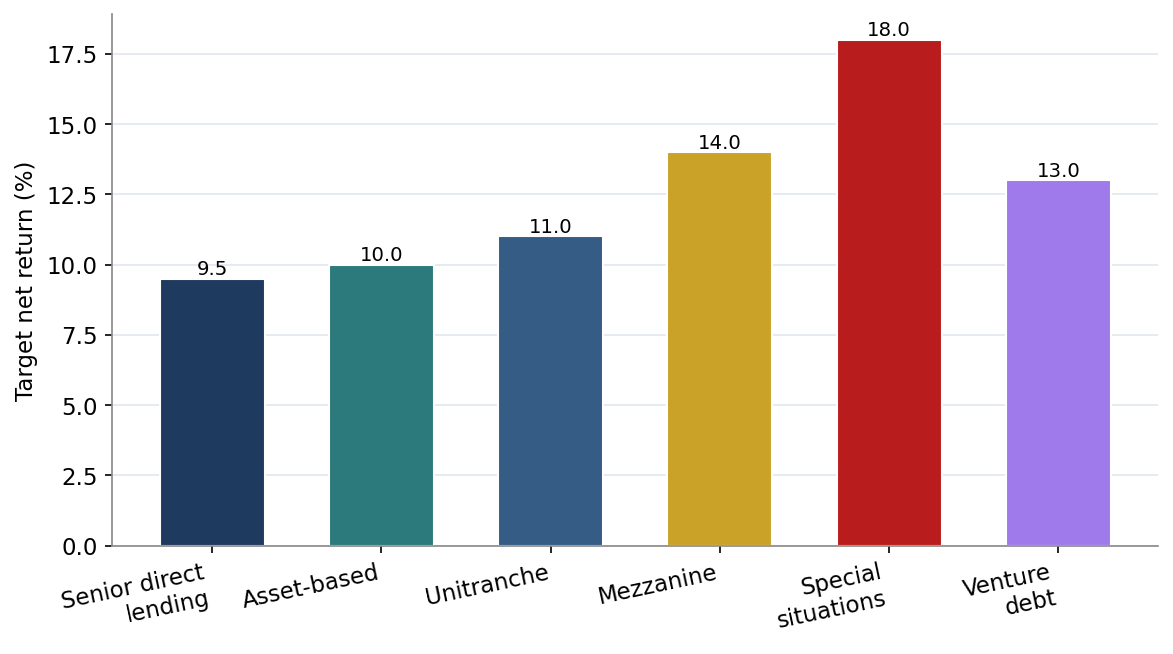
The framework for building the allocation begins by mapping the family office objective to a position in the risk-yield-liquidity triangle, illustrated in the decision tree of Figure 4. A family office whose objective is capital preservation should weight its allocation toward the senior, asset-backed, low-loss strategies, accepting a more modest yield for the low risk. A family office whose objective is income should weight toward a balanced position, combining senior strategies with a measure of unitranche and mezzanine for yield. A family office whose objective is total return can bear more risk for more return, weighting toward mezzanine and special situations.
Figure 4. Private Credit Sub-Strategy Selection by Family Office Objective
Figure 5 expresses the same logic as a fit matrix, scoring how well each principal sub-strategy serves each objective. Senior direct lending fits capital preservation best; mezzanine fits income; special situations fits total return. The matrix is a tool for translating the family office objective into a sub-strategy weighting, and it makes explicit that no single sub-strategy serves all objectives, so the allocation must be constructed to match the specific objective the family office holds.
Figure 5. Sub-Strategy Fit by Family Office Objective
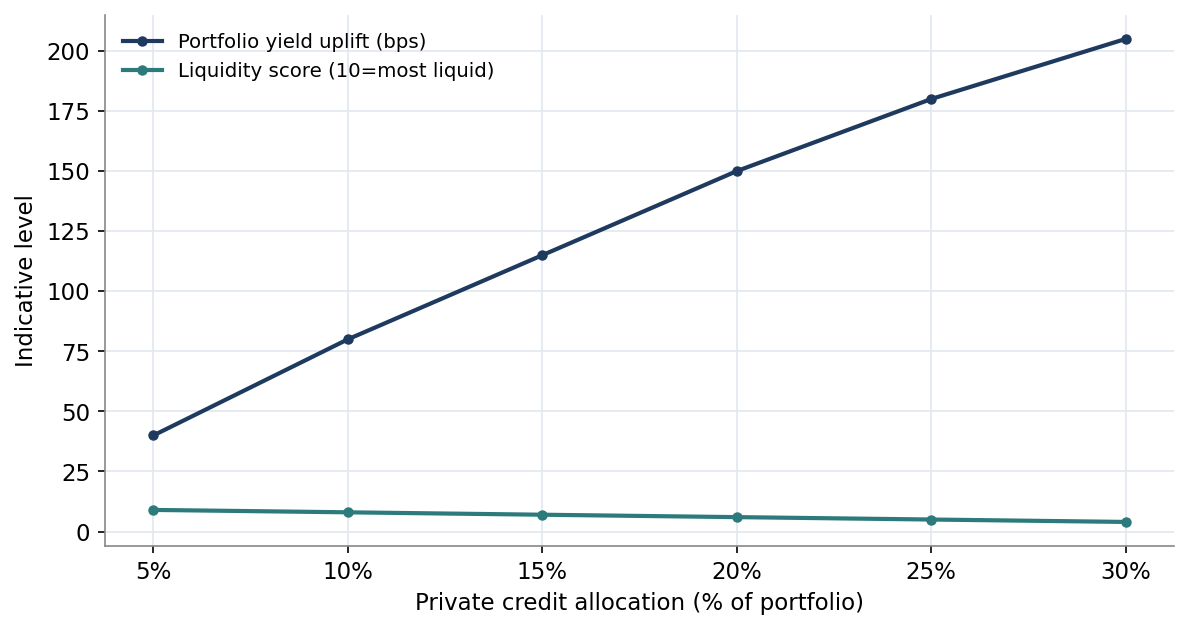
The framework also accounts for the liquidity dimension explicitly, because the family office liquidity needs constrain how much it can allocate to illiquid private credit and which structures it can use. A family office with substantial liquidity needs must limit its private credit allocation and favour more liquid access structures, while one with little near-term liquidity need can allocate more and accept longer lock-ups for higher yield. The liquidity dimension therefore interacts with the risk and yield dimensions to determine the family office position in the triangle, and the framework considers all three together rather than yield alone.
Applying the framework produces a target sub-strategy weighting that matches the family office objectives, risk tolerance and liquidity needs, which becomes the blueprint for constructing the allocation. The weighting is not static; it should be reviewed as the family office circumstances and the market conditions change, shifting toward more defensive strategies when the credit cycle turns and toward more opportunistic strategies when dislocations create opportunity. The framework is therefore a living one, producing a target weighting that evolves with the family office and the market, rather than a one-time decision.
| Sub-strategy | Target net return | Loss profile | Role in allocation |
|---|---|---|---|
| Senior direct lending | ~9-10% | Low | Core, income |
| Asset-based lending | ~9-11% | Low (collateralised) | Core, diversifier |
| Unitranche | ~10-12% | Low-moderate | Core-plus |
| Mezzanine | ~13-15% | Moderate | Yield enhancement |
| Special situations | ~16-20% | Higher, dispersed | Opportunistic |
| Venture debt | ~12-14% | Equity-linked | Growth diversifier |
Senior Direct Lending
Senior direct lending is the core of most private credit allocations, and it deserves a closer examination. It provides senior secured loans directly to mid-market companies, ranking first in the capital structure and secured against the borrower assets and cash flows, which gives it a low loss rate and a moderate, stable yield. For a family office seeking income with capital preservation, senior direct lending is the natural foundation of the allocation, offering a yield well above public fixed income with a conservative risk profile.
The return from senior direct lending derives from the interest margin over a base rate, plus fees, and because much senior direct lending is floating-rate, the yield rises with the base rate, providing some protection against rising rates. The loss rate, illustrated in Figure 7, is low, reflecting the senior, secured position and the diversification across many loans, though it rises in a downturn as defaults increase. The combination of a moderate, floating-rate yield and a low loss rate gives senior direct lending an attractive risk-adjusted return that anchors the allocation.
Figure 7. Indicative Through-Cycle Loss Rate by Sub-Strategy
The principal risk in senior direct lending is the credit risk of the borrowers, which rises in a downturn, and the quality of the manager underwriting is what most determines whether that risk translates into losses. A manager with disciplined underwriting and strong covenants can limit losses even in a downturn, recovering much of its capital through its senior, secured position, while a manager that has underwritten loosely or accepted weak covenants may suffer greater losses. The low average loss rate of the strategy therefore masks a wide dispersion across managers, which is why manager selection matters even in the most conservative sub-strategy.
Access Structures
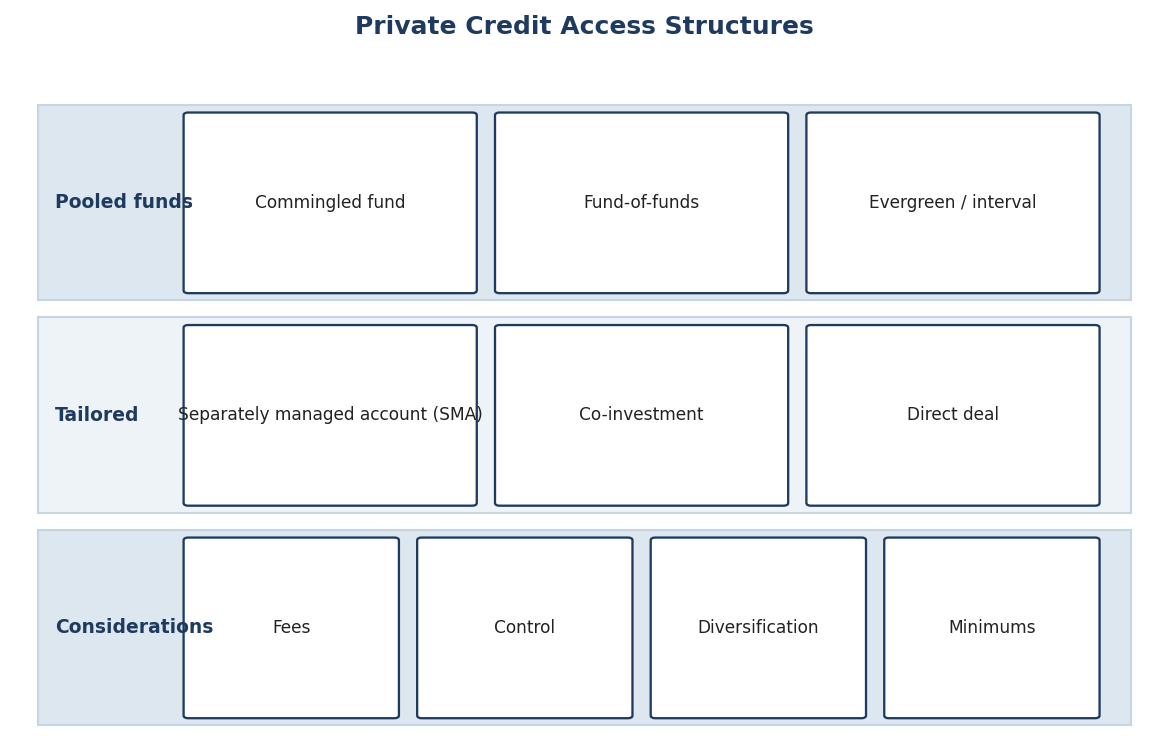
Once the family office has determined its sub-strategy weighting and selected managers, it must decide how to access the strategies, through which structures to deploy its capital. Figure 9 sets out the principal access structures, which differ in their fees, control, diversification and minimum commitments. The choice of structure materially affects the cost and the character of the allocation, and it should follow from the family office scale, sophistication and objectives.
Figure 9. Private Credit Access Structures
Commingled funds, in which the family office invests alongside other investors in a manager pooled vehicle, are the most accessible structure, offering diversification across the manager loan book and professional management for a standard fee. They suit a family office early in its programme or seeking simple, diversified access. Funds-of-funds, which invest across multiple managers, offer further diversification and manager selection for an additional layer of fees, suiting a family office that wishes to delegate the manager selection but accepts the extra cost.
Separately managed accounts, in which the manager runs a dedicated portfolio for the family office, offer greater control, customisation and often lower fees, but require a larger commitment and more involvement, suiting a larger, more sophisticated family office. Co-investments, in which the family office invests directly alongside a manager in specific loans, offer the lowest fees and direct exposure to selected deals, enhancing the net return, but require the capability to assess individual deals and the relationships to access them. Direct deals, in which the family office lends directly without a manager, offer the lowest cost but require full in-house capability and are suitable only for the most sophisticated family offices.
Most family offices use a combination of structures that evolves with their programme: beginning with commingled funds for accessible, diversified exposure, adding separately managed accounts as they grow and seek control and lower fees, and adding co-investments as they build the capability to assess deals and the relationships to access them. This progression lowers the blended fee and increases the control as the programme matures, capturing more of the gross return over time. The access structure decision is therefore not a one-time choice but an evolving mix that develops with the family office capability.
Risk Management and Monitoring
A private credit programme requires ongoing risk management and monitoring, because the credit risk it bears evolves with the borrowers, the managers, and the cycle. The family office should monitor the performance of its managers, the credit quality of the underlying loans, the diversification of the programme, and the macro conditions that affect the credit cycle, and it should act on what it observes, reallocating away from underperforming managers or toward more defensive strategies as conditions change. The monitoring is what allows the family office to manage the programme actively rather than holding it passively.
The monitoring should track, for each manager, the realised losses against the underwriting, the pace of deployment, the diversification of the loan book, and any signs of underwriting drift or stress, comparing the manager performance against its peers and its own track record. A manager whose losses exceed its underwriting, whose deployment is rushed, or whose loan book is concentrating may be drifting from the discipline that justified its selection, and the family office should engage with the manager and, if the concerns persist, reduce its allocation. The manager monitoring is the ongoing complement to the manager selection, sustaining the quality of the programme over time.
At the programme level, the family office should monitor the overall diversification, across sub-strategies, managers, vintages, sectors and geographies, ensuring that the programme has not drifted toward concentration in any dimension, and the overall risk profile, ensuring it remains aligned with the family office objective and risk tolerance. The programme-level monitoring guards against the gradual concentration and risk drift that can occur as a programme grows, and it ensures that the programme as a whole remains the deliberately constructed portfolio the framework intended.
The monitoring should also track the macro conditions that affect the credit cycle, the economic outlook, the default environment, the conditions in the sectors and geographies to which the programme is exposed, so that the family office can position the programme for the cycle, shifting toward more defensive strategies as the cycle turns and toward more opportunistic strategies as dislocations create opportunity. The macro monitoring allows the family office to manage the programme through the cycle, which is essential for a programme exposed to the credit cycle, and it distinguishes an actively managed programme from a passive one.
| Stage | PC allocation | Sub-strategy focus | Access |
|---|---|---|---|
| Early | ~10% | Senior DL, ABL | Pooled funds |
| Developing | ~15% | Add unitranche, mezz | Funds + SMA |
| Mature | ~20-25% | Full spectrum | SMA, co-invest, FoF |
The Manager Perspective
Understanding the perspective of the private credit manager helps a family office select and engage with managers effectively. The manager seeks to raise capital from investors, deploy it into loans it has originated and underwritten, and earn a return for its investors and a fee for itself. Its interests align with the family office when it underwrites prudently and manages losses well, earning genuine performance, but they can diverge when its incentive is to gather assets and earn fees regardless of performance, which may lead it to underwrite loosely to deploy capital. The family office should select managers whose interests align with its own.
The manager values investors who are reliable, sophisticated and aligned, who commit capital dependably, understand the asset class and its risks, and engage constructively, and it may offer such investors better access, terms and co-investment opportunities. A family office that establishes itself as a reliable, sophisticated, aligned investor can access better managers and better terms, including the co-investment opportunities that enhance the net return. Building a reputation as a quality investor is therefore valuable to a family office, opening access to the best managers and the best opportunities.
The manager also competes for capital, and a family office can use this competition to negotiate terms, fees, co-investment rights, and reporting, particularly if it commits at scale through a separately managed account or as an anchor investor. A family office with scale and reliability has negotiating leverage, and it should use it to secure favourable terms that enhance its net return and its access. The negotiation, conducted from a position of being a desirable investor, can materially improve the economics and the access of the allocation, which is part of building the programme well.
Understanding the manager perspective therefore tells the family office how to position itself: as a reliable, sophisticated, aligned investor that commits dependably, engages constructively, and negotiates from strength, accessing the best managers, the best terms, and the co-investment opportunities that enhance the return. A family office that positions itself this way builds a better programme than one that approaches managers passively, taking standard terms and standard access. The relationship with the managers, like the manager selection, is part of building the allocation well.
Case Studies
Three family-office cases illustrate the framework applied to different objectives. The figures are modelled for analytical clarity and are not drawn from any specific family office.
Case A: the income-led family office
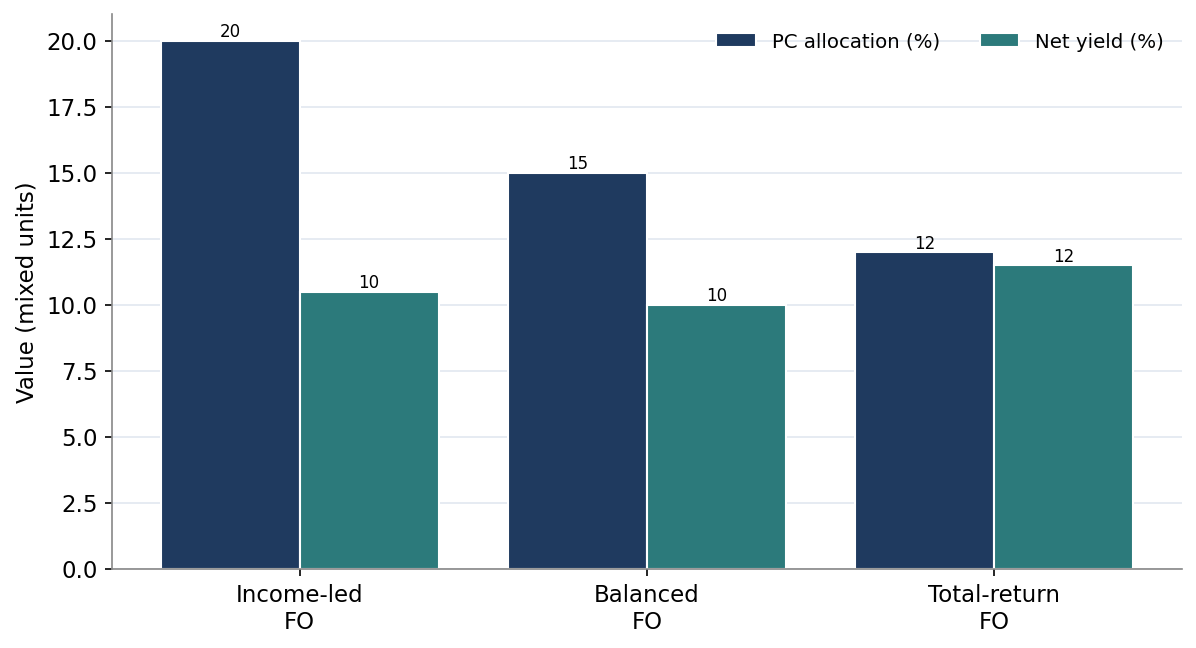
Case A is a family office whose objective is income, to fund its spending from the yield of its portfolio. It builds a private credit allocation of around twenty percent, weighted toward senior direct lending and asset-based lending for stable income, with a measure of unitranche and mezzanine for yield enhancement, accessed through commingled funds and a separately managed account. The allocation delivers a high, stable yield that funds the family office spending, with a conservative risk profile that preserves the capital. The case illustrates an income-led allocation, weighted toward the stable, yield-generating strategies.
Case B: the balanced family office
Case B is a family office with a balanced objective, seeking income and growth. It builds an allocation of around fifteen percent, balanced across senior strategies for stability, unitranche and mezzanine for yield, and a measured special situations allocation for opportunistic return, accessed through funds and co-investments. The allocation delivers a balanced combination of income and total return, diversified across the spectrum, suiting the family office balanced objective. The case illustrates a balanced allocation, spread across the risk-yield-liquidity triangle.
Case C: the total-return family office
Case C is a family office whose objective is total return, able to bear more risk and illiquidity for higher return. It builds an allocation of around twelve percent, weighted toward the higher-yielding strategies, mezzanine and special situations, with a foundation of senior lending, accessed through funds, separately managed accounts and co-investments, and including a counter-cyclical special situations allocation. The allocation delivers a higher total return for the higher risk, with the special situations providing counter-cyclical diversification. The case illustrates a total-return allocation, weighted toward the higher-return strategies.
Figure 12. Allocation and Net Yield by Family Office Objective
Figure 12 compares the three cases on the allocation size and the net yield. Each is matched to the family office objective, the income-led with a large, stable allocation, the balanced with a diversified one, the total-return with a higher-yielding one, and each delivers a net yield appropriate to its objective and risk. The comparison illustrates that the framework produces different allocations for different objectives, each coherent and matched to the family office needs, which is the point of building the allocation deliberately rather than by default.
Common Errors and How to Avoid Them
A recognisable set of errors recurs in building private credit allocations.
Chasing yield blindly. Chasing yield without consciously accepting the accompanying risk and illiquidity leads to an allocation riskier and less liquid than intended. The remedy is to choose the position in the risk-yield-liquidity triangle deliberately.
Weak manager selection. Selecting managers on headline returns rather than underwriting discipline and track record risks poor outcomes given the wide dispersion. The remedy is rigorous manager selection focused on underwriting and alignment.
Single-vintage deployment. Deploying the whole allocation in a single vintage concentrates the timing risk and creates a liquidity strain. The remedy is to pace commitments across vintages.
Over-allocating. Over-sizing the allocation relative to liquidity needs risks a strain when the locked capital is needed. The remedy is to size from the liquidity side, allocating only what can be comfortably locked away.
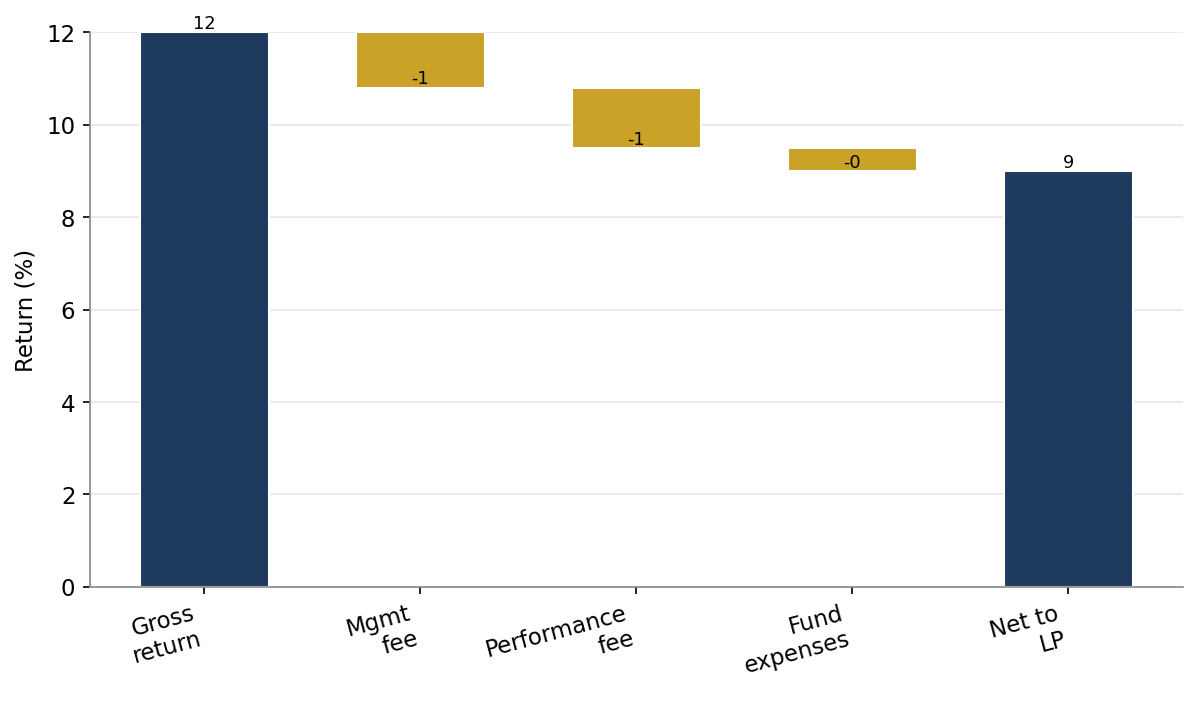
Ignoring fees. Ignoring the fee drag and assessing managers on gross returns overstates the return the family office actually earns. The remedy is to focus on net returns and manage fees through structures and negotiation.
Each of these errors is avoidable through the disciplined approach the framework encourages: choose the position in the triangle deliberately, select managers rigorously, pace commitments across vintages, size from the liquidity side, and manage the fees. The family office that does so builds a robust, coherent allocation, while the one that does not chases yield into excessive risk, selects poor managers, concentrates its vintages, over-allocates, or overpays in fees.
Implementation Roadmap
Determine the family office objective, capital preservation, income, or total return, and translate it into a target position in the risk-yield-liquidity triangle.
Size the allocation from the liquidity side, allocating only the capital that can be comfortably locked away beyond the family office liquidity needs.
Construct a diversified sub-strategy weighting around a senior core, with satellites in unitranche, mezzanine and a measured special situations allocation as the objective allows.
Select managers rigorously, focusing on underwriting discipline, track record through a cycle, sourcing and alignment, and diversify across managers.
Choose access structures that match the family office scale and capability, progressing toward separately managed accounts and co-investments to lower fees and increase control.
Pace commitments across vintages, manage the liquidity of calls and distributions, and use financing tools where helpful.
Monitor the managers, the programme diversification, and the macro conditions, and manage the programme actively through the cycle.
| Scenario | Manager selection | Credit environment | Net return |
|---|---|---|---|
| Strong | Top managers | Benign | ~12% |
| Base | Solid | Normal | ~9.5% |
| Stress | Average | Downturn | ~6% |
| Adverse | Weak | Severe downturn | ~3% or loss |
Conclusion
Private credit offers GCC family offices a compelling combination of yield and diversification, but capturing it requires building an allocation deliberately, across sub-strategies, managers, vintages and access structures, and balancing it continuously across the risk, yield and liquidity dimensions that define the asset class. This paper has set out a comprehensive framework for that construction, from the case for the allocation, through the opportunity set and the risk-yield-liquidity framework, the sizing and sub-strategy selection, the manager selection that most determines the outcome, the access structures, the liquidity management, the risk monitoring, and the regional considerations, to the implementation roadmap.
The central conclusions are that a private credit allocation creates value when it is matched to the family office objective, diversified across sub-strategies and vintages, accessed through capable managers, and sized so that its illiquidity can be borne comfortably; that manager selection is the capability that most determines the outcome, given the wide dispersion between the best and worst managers; and that building the allocation well requires the family office to develop a credit investment capability that is a durable asset across cycles. The family office that internalises these conclusions and builds its allocation deliberately will capture the yield and diversification the asset class offers while managing its illiquidity, credit risk, manager dependence and fees, and the frameworks in this paper are intended to help it do so.
Limitations and Directions for Further Research
This paper is framework-oriented and relies on modelled figures, and its conclusions are directional rather than precise. The yields, loss rates, returns and allocation sizes are calibrated to observable conditions but are not empirical estimates, and they vary across managers, strategies, regions and points in the cycle. The private credit market, particularly in the GCC, is evolving, and the framework should be applied with current, specific information.
Several extensions would strengthen the analysis. An empirical study of realised private credit returns and losses by sub-strategy across managers and cycles would replace the modelled figures with data. An analysis of the dispersion between the best and worst managers would quantify the manager selection effect that the framework emphasises. And a study of how private credit allocations have performed through a downturn, when losses rise and liquidity tightens, would test the resilience of the framework in the conditions where its risks are greatest. Each is a natural subject for a later paper in this series.