

Introduction
A great deal of real estate development in the Gulf and in South Asia does not proceed through a single owner who buys land, funds construction and develops it alone. Instead it proceeds through a partnership of three parties, each contributing something the others lack: a landowner who holds the land but lacks the capital or expertise to develop it, a developer who holds the expertise but not the land or the funding, and a capital partner who holds the equity but neither the land nor the development capability. The three-way joint venture brings these complementary contributions together, and it is one of the most common and most important structures in the regional development market.
The structure is powerful precisely because of this complementarity: it allows a development to proceed that none of the three parties could undertake alone, combining the land, the expertise and the capital into a single venture. But it is also fragile, because the three parties are not the same. The landowner, the developer and the capital partner have different objectives, different time horizons, different risk appetites and different views of what each contribution is worth, and a venture that fails to reconcile these differences can stall, sour or collapse, destroying the value that the complementarity created. The structuring of the venture is therefore a matter of aligning three different parties around a common interest, and it is the subject of this paper.
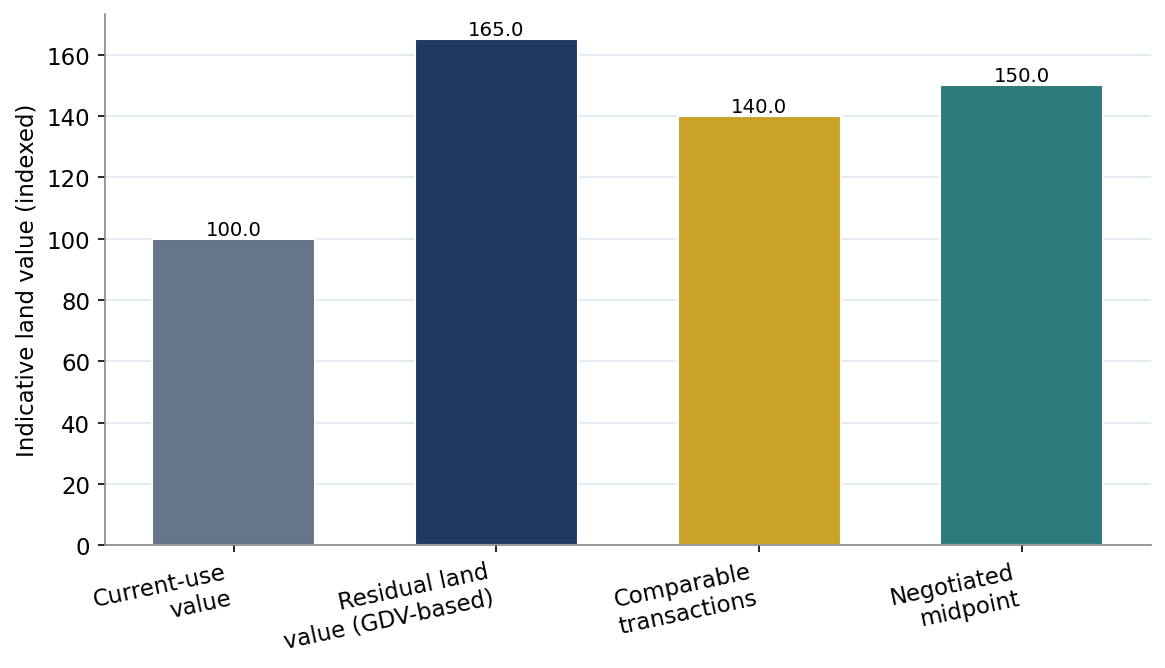
The central argument is that alignment is achieved not by treating the three parties identically but by matching each party reward to its contribution and its risk, so that each is fairly compensated for what it brings and bears, and each therefore has an interest in the venture success. The landowner is rewarded for the land, the developer for the expertise and execution, and the capital partner for the capital and the risk, and the structure must calibrate these rewards so that no party feels short-changed and all pull in the same direction. The most contentious element, as the paper explores, is the valuation of the land, which determines the landowner share and which is best resolved through a transparent, method-based approach.
The Three Parties and What Each Brings
Understanding the venture requires understanding what each party brings and what each seeks, because the structure must reward each for its contribution and satisfy each objective. Figure 2 sets out the three-party structure schematically.
Figure 2. The Three-Party Development Joint Venture
Indicative schematic of contributions and rewards. Not transaction-specific.
The landowner brings the land, the scarcest and often the most valuable contribution, and seeks to realise the development value of the land while sharing in the upside rather than selling for a fixed cash sum. The landowner typically wants the land valued generously, a meaningful equity stake, and protection against the venture being structured in a way that dilutes or disadvantages it, and it may also have non-financial objectives, such as a continuing association with the land or the development. The landowner risk tolerance is often lower than the developer, since the land may represent a large part of the landowner wealth, which shapes the protections it seeks.
The developer brings the expertise and the execution capability, the ability to design, permit, construct and deliver the development, and increasingly a co-investment of its own capital. The developer seeks to be rewarded for its expertise and execution through a promote or carried interest, a share of the venture profits above a threshold that rewards it for delivering returns, and through fees for its development services. The developer is typically the most risk-tolerant and the most return-seeking of the three parties, since development is its business, and its co-investment aligns it with the venture success. The capital partner brings the financial capital that funds the construction, and seeks a return on that capital commensurate with the risk, typically structured as a preferred return ahead of the other parties plus a share of the residual, together with governance protections appropriate to its capital at risk.
The complementarity of these three contributions is what makes the venture work, but the differences in what each seeks are what make it hard to structure. The landowner wants a high land value and protection; the developer wants a generous promote and the freedom to execute; the capital partner wants a protected return and governance control. These objectives are not inherently incompatible, but reconciling them requires a structure that gives each party enough of what it wants to be committed to the venture, while keeping all three aligned in maximising the total value they share. The remainder of the paper examines how that reconciliation is achieved.
| Structure | Landowner | Developer | Capital partner |
|---|---|---|---|
| Land-for-equity | Equity for land | Promote + fees | Preferred + residual |
| Promote-led | Equity or deferred | Significant promote | Preferred + majority |
| Preferred-equity-led | Equity, subordinated | Mandate + promote | Preferred, protected |
| Deferred land payment | Cash over time + stake | Co-invest + promote | Senior equity |
| Development management | Sells or leases land | Fee + small promote | Owns the equity |
Anatomy of JV Structures
The three-way joint venture can be structured in several ways, and Table 1 sets out the principal variants. The choice among them depends on which party drives the deal, the relative bargaining power of the parties, and the specific objectives each brings.
Table 1. Principal Three-Way JV Structures
Indicative variants. The right structure depends on bargaining power and objectives. Not transaction-specific.
In the land-for-equity structure, the most common, the landowner contributes the land for an equity stake, the developer earns a promote and fees for its expertise and execution, and the capital partner provides the construction equity for a preferred return and a share of the residual. This structure aligns all three with the venture upside, since each holds equity or equity-like rewards, and it is the natural structure where the landowner is willing to share the upside and the parties are reasonably balanced in bargaining power. The promote-led and preferred-equity-led variants shift the balance toward the developer or the capital partner respectively, reflecting their relative bargaining power.
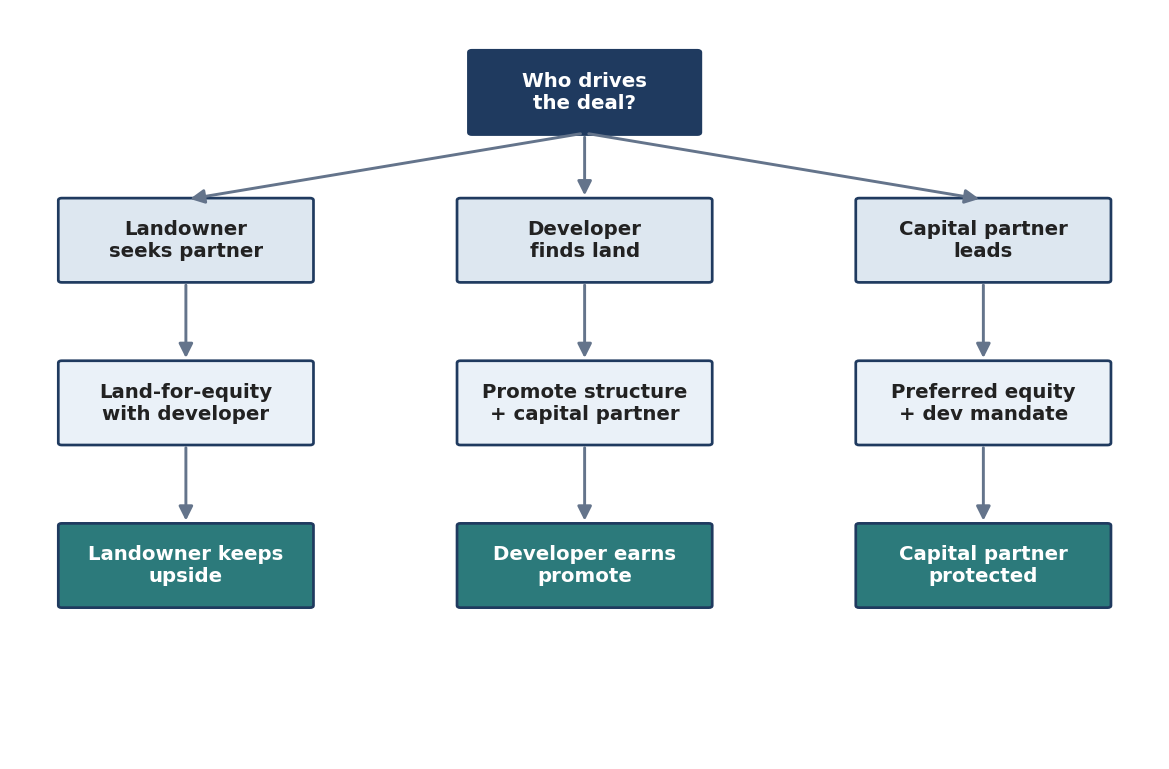
The choice of structure also reflects which party originates and drives the deal, as Figure 3 in Section 7 illustrates through a decision tree. A landowner seeking a partner to develop its land tends toward a land-for-equity structure that preserves its upside; a developer that has found land and assembled a capital partner tends toward a promote structure that rewards its origination and execution; and a capital partner leading the deal tends toward a preferred-equity structure that protects its capital and gives it control. The structure is, in part, a reflection of who holds the initiative, and the party that originates the deal frequently shapes the structure to favour its position, which the other parties then negotiate against.
Aligning Incentives
The central challenge of the three-way joint venture is aligning the incentives of three parties whose interests do not naturally coincide, and Figure 5 presents a decision tree for the structure choice that begins this alignment.
Figure 4. JV Structure Choice by Originating Party
Indicative framework. The structure reflects who drives the deal and the parties objectives.
Alignment is achieved by matching each party reward to its contribution and its risk, so that each is fairly compensated and each has an interest in the venture overall success. The principle is not to equalise the parties, which would ignore their different contributions and risks, but to reward each proportionately to what it brings and bears, so that each feels fairly treated and committed. Figure 6 illustrates this matching of contribution to return: each party share of the return should bear a sensible relationship to its share of the contribution and the risk, with adjustments reflecting the different nature of each contribution.
Figure 5. Matching Contribution Share to Return Share by Party
Each party return should relate sensibly to its contribution and risk. Not a forecast.
The alignment devices are several. The developer co-investment puts the developer own capital at risk alongside the capital partner, aligning the developer with the capital partner and giving it skin in the game. The promote rewards the developer for delivering returns above a hurdle, aligning the developer with the upside and with the capital partner success. The landowner equity stake, received in exchange for the land, aligns the landowner with the venture rather than leaving it indifferent as an outright sale would. And the preferred return protects the capital partner appropriately for its risk without over-rewarding it at the expense of the others. Together these devices tie each party reward to the venture success, which is the definition of alignment.
Risk and Misalignment
The principal risk in a three-way joint venture is misalignment among the parties, which can arise from the economic structure, the governance, or a change in circumstances, and which can stall or destroy the venture. A venture that begins aligned can become misaligned if circumstances change, for example if the development underperforms and the parties disagree on how to respond, or if one party financial position changes and its objectives shift. The structure should anticipate these possibilities and provide for them, through mechanisms that realign the parties or allow a party to exit without destroying the venture.
A specific risk is the failure of a party to perform its role: the developer fails to execute, the capital partner fails to fund, or the landowner fails to deliver clean title or the necessary cooperation. The structure must provide remedies for each, through performance obligations, funding commitments, and the consequences of default, so that the failure of one party does not leave the others stranded. These remedies, like the deadlock mechanisms, are best addressed at the outset, when the parties are cooperative, rather than improvised in the midst of a default, and a well-structured venture includes clear provisions for what happens if a party fails to perform.
The interests of the parties can also diverge over time as the venture progresses, particularly around the exit. The capital partner may wish to exit and realise its return at a point when the developer or the landowner would prefer to hold for further upside, or the parties may disagree on the timing or method of the sale or refinancing. The structure should address the exit explicitly, through agreed exit rights, timing and mechanisms, so that the parties divergent exit preferences are reconciled in advance rather than fought over at the end. An exit that is well provided for in the structure proceeds smoothly; an exit left to be negotiated when the parties interests have diverged can become contentious and can erode the value the venture created.
Considerations Specific to the GCC and South Asia
Land conversion and entitlement
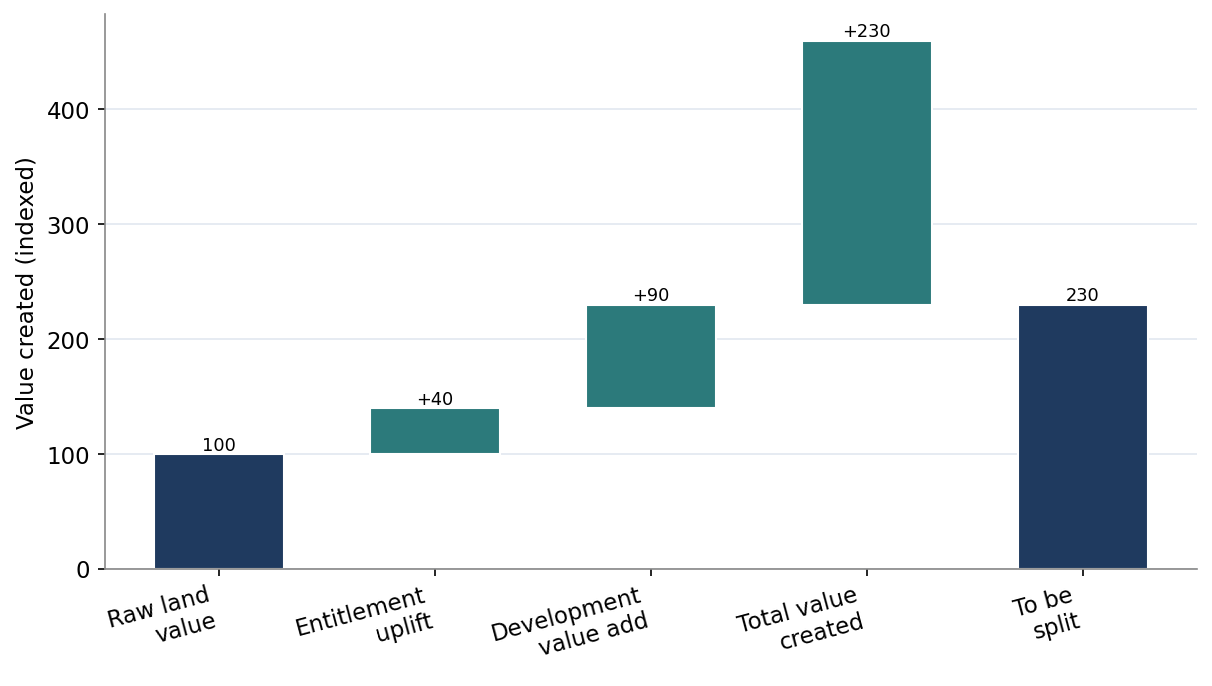
In many regional land deals, particularly in South Asia, the land begins in an agricultural or undeveloped use and must be converted to a developable use through a conversion and entitlement process, and this process is frequently a central part of the venture value creation. The structure must account for the conversion, both in the timeline and in the allocation of the conversion risk and reward, since the conversion may take time and may not succeed, and the party that bears the conversion risk should be rewarded for it. A venture built on land that must be converted should make the conversion a defined milestone, with the parties roles, risks and rewards around it clearly allocated.
Foreign ownership and structuring
Land ownership rules, including restrictions on foreign ownership in parts of the region, shape the structures through which a three-way joint venture can be effected, particularly where the capital partner is foreign. The structure must comply with the applicable ownership rules, which may require particular vehicles, particular allocations of ownership, or particular arrangements between local and foreign parties. A capital partner from outside the region must understand how the ownership rules affect its ability to hold an interest and to enforce its rights, and the structure must be designed to give it the protection it requires within the constraints of the rules.
The landowner relationship and trust
In regional land deals, the relationship between the developer and the landowner is frequently personal and long-term, and the venture is built on trust as much as on the legal structure. A developer that has a strong, trusted relationship with a landowner can structure a venture that a developer without that relationship could not, and the maintenance of the relationship through the venture is important to its success. This personal, relationship-based dimension is a distinctive feature of regional land deals, and a developer or capital partner that understands and respects it, treating the landowner as a partner rather than a counterparty, builds the trust that makes the venture durable.
Indicative Case Studies
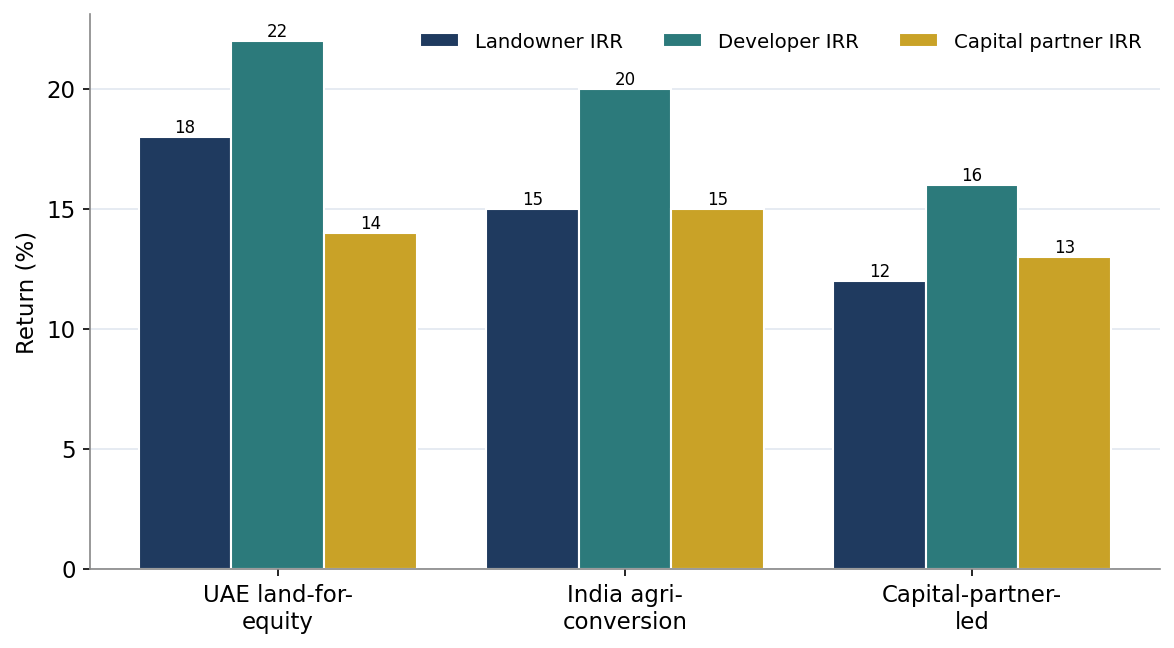
Three indicative cases show the framework applied. The figures are synthetic and constructed for analytical clarity, not drawn from any specific transaction.
Case A: UAE land-for-equity
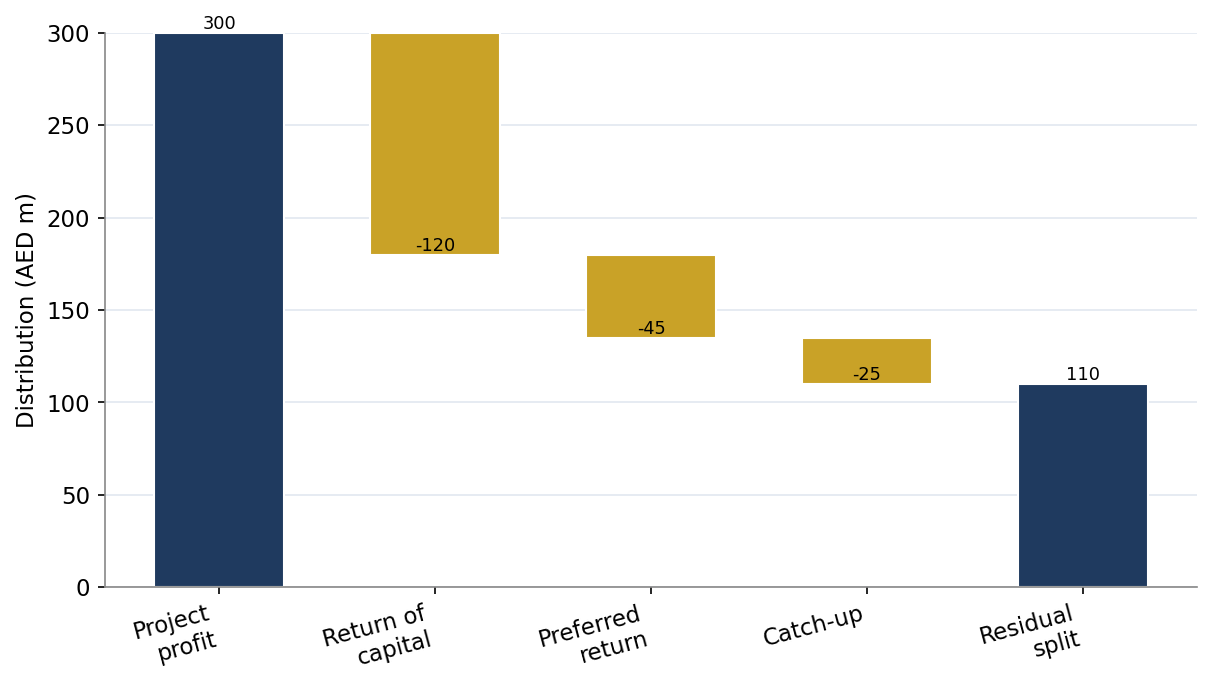
Case A is a UAE landowner with a prime plot who contributes the land to a venture in exchange for an equity stake, partnering with a developer that provides expertise and a co-investment and a capital partner that funds construction. The land is valued through a transparent, method-based approach, partly fixed and partly linked to the residual, and the waterfall returns capital and a preferred return to the capital partner, a promote to the developer, and a residual split among all three. The structure aligns all three with the venture upside, and each earns a return reflecting its contribution and risk.
Case B: India agri-conversion JV
Case B is an Indian venture in which a landowner contributes agricultural land that must be converted to a developable use, partnering with a developer that manages the conversion and development and a capital partner that funds it. The conversion is a defined milestone, with the conversion risk and reward allocated among the parties, and the land valuation reflects the uplift the conversion creates, partly deferred until the conversion succeeds. The structure aligns the parties around the conversion and the development, and it illustrates the three-way JV applied to the agri-conversion deals common in South Asia.
Case C: capital-partner-led
Case C is a venture led by a capital partner that has identified the opportunity, secured the land through a structure with the landowner, and engaged a developer on a mandate with a promote to execute. The structure protects the capital partner with a preferred return and governance control, rewards the developer with a promote tied to performance, and gives the landowner a stake or a deferred payment. The case illustrates the capital-partner-led variant, in which the capital partner drives the deal and structures it to protect its capital while still aligning the developer and the landowner through their promotes and stakes.
Figure 7. Return to Each Party by Case
Synthetic figures for analytical comparison. Not a forecast.
Sensitivity and Scenario Analysis
A tornado analysis identifies the variables that most influence the developer promote return, which is the most performance-sensitive of the three parties returns. Figure 8 presents the result.
Figure 8. Sensitivity of Developer Promote Return to Key Variables
Each bar shows the promote return when the labelled variable moves to its low or high case. Dashed line is the base case. Indicative.
The analysis shows that the land valuation and the development margin dominate the developer promote return, with the timing, the preferred return and the promote hurdle also significant. The prominence of the land valuation is telling: because it determines the landowner share, it directly affects how much is left for the developer and the capital partner, which is why it is so contentious and why a fair, transparent valuation matters so much. The development margin matters because it determines the total value to be split, and the developer promote, being in the residual tier, is highly geared to it. The timing matters because it affects the return on the capital partner preferred return and therefore what remains.
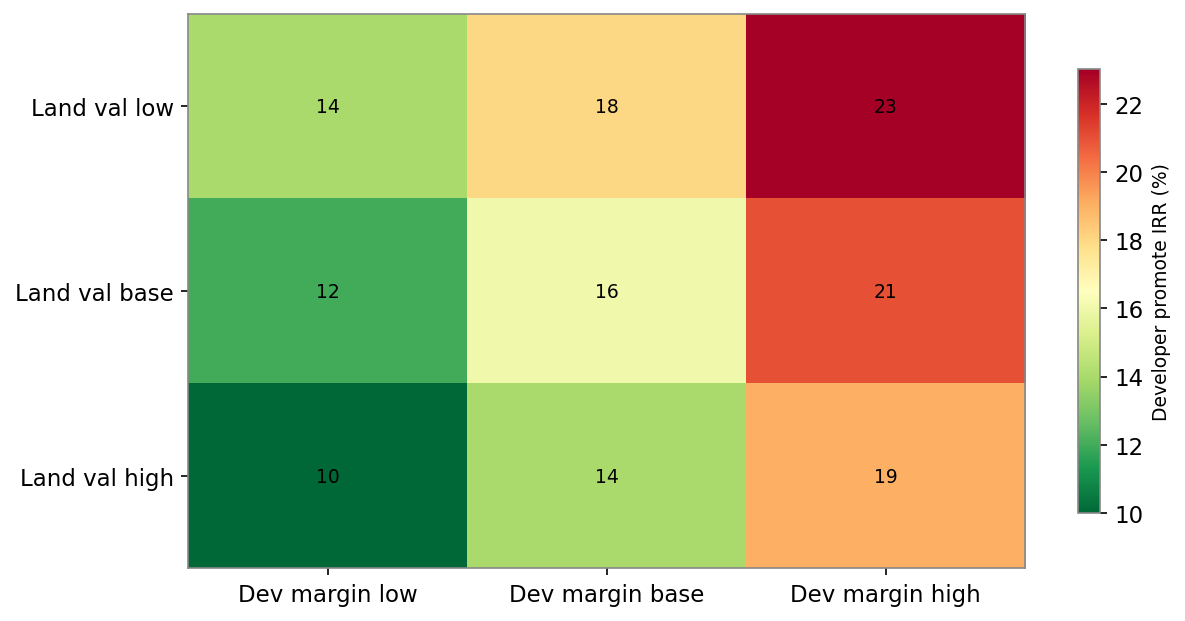
Figure 9. Developer Promote IRR by Land Valuation and Development Margin
The promote is most sensitive to the land valuation and the development margin. Not a forecast.
Figure 9 shows the developer promote IRR across combinations of land valuation and development margin, and it makes the interaction visible. A high land valuation combined with a low development margin compresses the developer promote, because much of the value goes to the landowner and little is created to split; a low land valuation combined with a high margin maximises the promote. This interaction underlines why the land valuation and the development performance are the two critical variables, and why the structure must get the land valuation right and the venture must deliver the development margin. The other parties returns show analogous sensitivities, with the capital partner return more protected by its preferred position and the landowner return geared to the land valuation.
Table 2. Scenario Matrix for the Venture
Indicative scenarios. Not a forecast.
Implementation Roadmap
Identify what each party brings, land, expertise, capital, and what each seeks, and design the structure to reward each proportionately to its contribution and risk.
Resolve the land valuation through a transparent, method-based approach, partly linked to the development outcome, rather than through pure negotiation.
Align the developer through a meaningful co-investment and a promote tied to delivering returns above a fair hurdle.
Calibrate the preferred return and the waterfall to protect the capital partner fairly for its risk without over-rewarding it at the expense of the others.
Design governance that delegates operational decisions to the developer while reserving major decisions to the capital partner and landowner, with a clear deadlock-resolution mechanism.
Address the exit explicitly, with agreed rights, timing and mechanisms, to reconcile the parties divergent exit preferences in advance.
Build and maintain the relationship with the landowner, recognising the personal, trust-based dimension of regional land deals.
Conclusion
The three-way development joint venture, bringing together a landowner, a developer and a capital partner, is one of the most important structures in regional real estate, and its success depends on aligning three parties whose interests do not naturally coincide. This paper has argued that alignment is achieved not by equalising the parties but by matching each party reward to its contribution and risk, so that each is fairly compensated and each has an interest in the venture overall success. The devices of alignment, the developer co-investment and promote, the capital partner preferred return, the landowner equity stake, and above all a transparent and partly outcome-linked land valuation, tie each party reward to the venture success.
The most contentious issue, the valuation of the land, is best resolved through a transparent, method-based approach rather than pure negotiation, and the venture durability depends on clear governance, provision for deadlock and exit, and respect for the personal relationship with the landowner. The developer that internalises these lessons, structuring fair ventures that align all three parties, occupies the valuable position of the aligner at the centre of the regional development market, with privileged access to both land and capital. In a market where land, expertise and capital are held by different parties, the skill of bringing them together in a durable, well-aligned venture is among the most valuable a developer can possess, and the frameworks in this paper are intended to help build it.
Limitations and Directions for Further Research
This paper is framework-oriented and relies on indicative data, and its conclusions are directional rather than precise. The valuation methods, waterfall parameters and returns are calibrated to observable conditions but are not empirical estimates, and they vary with the parties, the asset and the jurisdiction. The legal and ownership considerations are described in general terms and require specialist advice for any specific venture.
Several extensions would strengthen the analysis. An empirical study of realised returns to landowners, developers and capital partners across a sample of regional ventures would replace the indicative figures with data. A detailed analysis of land valuation methods and how they are reconciled in practice would sharpen the treatment of the most contentious issue. And a study of how three-way ventures perform through disputes and underperformance, when alignment is tested, would illuminate the governance and exit provisions that the framework emphasises. Each is a natural subject for a later paper in this series.
| Scenario | Land valuation | Development margin | Outcome |
|---|---|---|---|
| Aligned success | Fair (method-based) | Strong | All parties rewarded |
| Base | Fair | Moderate | All parties earn fairly |
| Land overvalued | High | Moderate | Developer/CP squeezed |
| Underperformance | Fair | Weak | Returns compressed for all |
